Bishkek: Difference between revisions
imported>Paprikaiser →Mass public transport: Replaced bare URL |
imported>JFal of Dallas Added & linked Otto Barch |
||
| Line 1: | Line 1: | ||
{{short description|Capital and largest city of Kyrgyzstan}} | {{short description|Capital and largest city of Kyrgyzstan}} | ||
{{pp-move}} | {{pp-move}} | ||
{{Use dmy dates|date=December 2020}} | {{Use dmy dates|date=December 2020}} | ||
{{Use British English|date=August 2013}} | {{Use British English|date=August 2013}} | ||
{{Infobox settlement | {{Infobox settlement | ||
| name | | name = Bishkek | ||
| native_name | | native_name = Бишкек | ||
| native_name_lang | | native_name_lang = ky | ||
| other_name | | other_name = | ||
| settlement_type | | translit_lang1_type1 = [[ISO 9]] | ||
| translit_lang1 | | translit_lang1_info1 = Biškek | ||
| image_skyline | | translit_lang1_type2 = [[BGN/PCGN romanization|BGN/PCGN]] | ||
| translit_lang1_info2 = Bishkek | |||
| translit_lang1_type3 = [[ALA-LC Romanization|ALA-LC]] | |||
| translit_lang1_info3 = Bishkek | |||
| official_name = | |||
| settlement_type = [[Capital city]] | |||
| translit_lang1 = [[Kyrgyz language|Kyrgyz]] | |||
| image_skyline = {{multiple image | border = infobox | | perrow = 1/2/2/ | total_width = 300 | align = center | |||
| image1 = Bishkek_City%27s_business_center.jpg | | image1 = Bishkek_City%27s_business_center.jpg | ||
| caption1 = Bishkek's skyline and the [[Kyrgyz Ala-Too Range]] | | caption1 = Bishkek's skyline and the [[Kyrgyz Ala-Too Range]] | ||
| Line 21: | Line 29: | ||
| image5 = E7903-Bishkek-Ala-Too-Square.jpg | | image5 = E7903-Bishkek-Ala-Too-Square.jpg | ||
| caption5 = [[Ala-Too Square]] | | caption5 = [[Ala-Too Square]] | ||
}} | |||
| imagesize = | |||
| imagesize | | image_caption = '''Clockwise from top''': view from Bishkek south towards the [[Kyrgyz Ala-Too Range]]; [[Bishkek Central Mosque]]; Residential Area of the City; [[Victory Square, Bishkek|Victory Square]] and [[Mayor of Bishkek|Bishkek City Hall]] | ||
| image_caption | | image_flag = Flag of Bishkek.svg | ||
| image_flag | | image_shield = Coat of arms of Bishkek Kyrgyzstan.svg | ||
| image_shield | | flag_size = 120px | ||
| pushpin_map | | shield_size = 75px | ||
| pushpin_relief | | flag_link = Flag of Bishkek | ||
| shield_link = Coat of Arms | |||
| pushpin_map = Kyrgyzstan#Asia | |||
| pushpin_relief = 1 | |||
| pushpin_label_position = bottom | | pushpin_label_position = bottom | ||
| pushpin_mapsize | | pushpin_mapsize = 250 | ||
| pushpin_map_caption = Location in Kyrgyzstan | | pushpin_map_caption = Location in Kyrgyzstan | ||
| coordinates | | coordinates = {{coord|42|52|29|N|74|36|44|E|region:KG-GB_type:city(1,100,000|display=inline,title}} | ||
| subdivision_type | | subdivision_type = Country | ||
| subdivision_name | | subdivision_name = {{flag|Kyrgyzstan}} | ||
| subdivision_type1 | | subdivision_type1 = [[Regions of Kyrgyzstan|City]] | ||
| subdivision_name1 | | subdivision_name1 = Bishkek<ref>[http://e-bishkek.kg/?q=node/13 Law on the Status of Bishkek] {{webarchive|url=https://web.archive.org/web/20110721201655/http://e-bishkek.kg/?q=node%2F13 |date=21 July 2011 }}, 16 April 1994, article 2 {{in lang|ru}}. Retrieved on 3 August 2009</ref> | ||
| established_title | | established_title = Founded | ||
| established_date | | established_date = 1825 | ||
| parts_type | | parts_type = [[Districts of Kyrgyzstan|District]]<ref name=class>{{cite web|url=https://stat.gov.kg/media/files/21f93e4d-9418-433e-aed9-ecb28d70ef5a.doc|title=Classification system of territorial units of the Kyrgyz Republic|language=ky|date=May 2021|publisher=National Statistics Committee of the Kyrgyz Republic|pages=81}}</ref> | ||
| parts_style | | parts_style = list | ||
| parts | | parts = Districts | ||
| p1 | | p1 = [[Birinchi May District, Bishkek|Birinchi May]] | ||
| p2 | | p2 = [[Lenin District, Bishkek|Lenin]] | ||
| p3 | | p3 = [[Oktyabr District, Bishkek|Oktyabr]] | ||
| p4 | | p4 = [[Sverdlov District, Bishkek|Sverdlov]] | ||
| leader_title | | leader_title = [[Mayor of Bishkek|Mayor]] | ||
| leader_name | | leader_name = {{ill|Aibek Junushaliev|ru|Джунушалиев, Айбек Джанышбекович}} | ||
| area_footnotes | | area_footnotes = <ref name="stat09">{{cite Kyrgyzstan census 2009|Bishkek|13, 15}}</ref> | ||
| area_total_km2 | | area_total_km2 = 386.0 | ||
| area_total_sq_mi | | area_total_sq_mi = | ||
| elevation_footnotes = | | elevation_footnotes = | ||
| elevation_m | | elevation_m = 800 | ||
| elevation_ft | | elevation_ft = | ||
| population_total | | population_total = 1,120,827 | ||
| population_as_of = 2025 | |||
| population_footnotes = <ref name="u039">{{cite web | title=Biškek Šaary (City, Kyrgyzstan) | website=Population Statistics, Charts, Map and Location | date=2022-03-25 | url=https://www.citypopulation.de/en/kyrgyzstan/admin/11__bi%C5%A1kek/ | access-date=2025-12-06}}</ref> | |||
| population_density_km2 = auto | | population_density_km2 = auto | ||
| population_density_sq_mi = auto | | population_density_sq_mi = auto | ||
| population_est | | population_est = | ||
| pop_est_as_of | | pop_est_as_of = | ||
| population_metro = 1,321,900 | |||
| population_metro_footnotes = <ref name="i902">{{cite web | last=BENGARD | first=Anastasia | title=Almost 1.5 million people to live in Bishkek by 2028 | website=24.kg | date=2025-05-21 | url=https://24.kg/english/329905_Almost_15_million_people_to_live_in_Bishkek_by_2028/ | access-date=2025-12-06}}</ref> | |||
| population_demonym = {{native name|ky|бишкектик, bishkektik}} {{native name|ru|бишкекчанин (male), бишкекчанка (female), bishkekchanin (male), bishkekchanka (female)}} | | population_demonym = {{native name|ky|бишкектик, bishkektik}} {{native name|ru|бишкекчанин (male), бишкекчанка (female), bishkekchanin (male), bishkekchanka (female)}} | ||
| timezone | | timezone = [[Kyrgyzstan Time|KGT]] | ||
| utc_offset | | utc_offset = +06:00 | ||
| postal_code_type | | postal_code_type = Postal code | ||
| postal_code | | postal_code = 720000–720085 | ||
| area_code | | area_code = (+996) 312 | ||
| area_code_type | | area_code_type = | ||
| iso_code = KG-GB | |||
| registration_plate = B, E, 01 | | registration_plate = B, E, 01 | ||
| blank_name_sec1 | | blank_name_sec1 = [[Human Development Index|HDI]] (2023) | ||
| blank_info_sec1 | | blank_info_sec1 = 0.757<ref name="GlobalDataLab">{{Cite web |title=Sub-national HDI – Area Database |publisher=Global Data Lab |url=https://globaldatalab.org/shdi/shdi/KGZ/?levels=1%2B4&interpolation=1&extrapolation=0&nearest_real=0&years=2019 |website=hdi.globaldatalab.org |language=en}}</ref><br />{{color|#0c0|high}} · [[List of regions of Kyrgyzstan by Human Development Index|1st]] | ||
| website | | website = {{URL|http://meria.kg}} {{in lang|ky|ru|en}} | ||
| footnotes = | |||
| footnotes | |||
}} | }} | ||
'''Bishkek''',{{efn|{{langx| | '''Bishkek''',{{efn|[[Kyrgyz language|Kyrgyz]] and {{langx|ru|Бишкек}}; {{IPA|ky|b̥ɪɕkʰékʰ|audio=LL-Q9255 (kir)-Almanbet Janışev-Бишкек.wav}}, {{IPA|ru|bʲɪʂˈkʲek}}}} formerly known as '''Pishpek''' (until 1926),{{efn|[[Kyrgyz language|Kyrgyz]] and {{langx|ru|Пишпек}}}} and then '''Frunze''' (1926–1991),{{efn|[[Kyrgyz language|Kyrgyz]] and {{langx|ru|Фрунзе}}}} is the [[Capital city|capital]] and largest urban city of [[Kyrgyzstan]]. The city is also the capital of the [[Chüy Region]].{{efn|The region surrounds the city, although the city itself is not part of the region but rather a region-level unit of Kyrgyzstan.}} It is situated near the [[Kazakhstan–Kyrgyzstan border|border with Kazakhstan]] and has a population of around 1,200,000 people as of 2024.<ref>{{Cite web |title = Kyrgyzstan| url=https://stat.gov.kg/media/publicationarchive/a4e6a7dc-4a37-4448-807f-2d0a67a17df8.pdf |website=улуттук статистика комитети}}</ref> | ||
The [[Khanate of Kokand]] established the fortress of Pishpek in 1825 to control local caravan routes and to collect [[tribute]] from [[Kyrgyz people|Kyrgyz]] tribes. On 4 September 1860, with the approval of the Kyrgyz, Russian forces led by Colonel Apollon Zimmermann destroyed the fortress. In the present day, the fortress ruins can be found just north of Jibek Jolu Street, near the new main mosque.<ref>{{Cite web|title=Bishkek | The [[Khanate of Kokand]] established the fortress of Pishpek in 1825 to control local caravan routes and to collect [[tribute]] from [[Kyrgyz people|Kyrgyz]] tribes. On 4 September 1860, with the approval of the Kyrgyz, Russian forces led by Colonel Apollon Zimmermann destroyed the fortress. In the present day, the fortress ruins can be found just north of Jibek Jolu Street, near the new main mosque.<ref>{{Cite web |title=Bishkek |url=https://trvlland.com/blog-kyrgyzstan/bishkek-the-capital-of-kyrgyzstan/ |website=Travel Land}}</ref> A Russian settlement was established in 1868 on the site of the fortress under its original name, Pishpek. It lay within the General Governorship of [[Russian Turkestan]] and its [[Semirechye Oblast]]. | ||
The [[Kara-Kirghiz Autonomous Oblast]] was established in 1925 in Russian Turkestan, promoting Pishpek to its capital. In 1926, the [[Communist Party of the Soviet Union]] renamed the city ''Frunze'', after [[Bolsheviks|Bolshevik]] military leader [[Mikhail Frunze]] (1885–1925), who was born there. Frunze became the capital of the [[Kirghiz Soviet Socialist Republic]] in 1936, during the final stages of [[national delimitation in the Soviet Union]]. In 1991, the [[Kyrgyz parliament]] changed the capital's name to a modified original name of Pishpek as Bishkek. | The [[Kara-Kirghiz Autonomous Oblast]] was established in 1925 in Russian Turkestan, promoting Pishpek to its capital. In 1926, the [[Communist Party of the Soviet Union]] renamed the city ''Frunze'', after [[Bolsheviks|Bolshevik]] military leader [[Mikhail Frunze]] (1885–1925), who was born there. Frunze became the capital of the [[Kirghiz Soviet Socialist Republic]] in 1936, during the final stages of [[national delimitation in the Soviet Union]]. In 1991, the [[Kyrgyz parliament]] changed the capital's name to a modified original name of Pishpek as Bishkek. | ||
Bishkek is situated at an altitude of about {{convert|800|m}}, just off the northern fringe of the [[Kyrgyz Ala-Too Range]], an extension of the [[Tian Shan]] mountain range. These mountains rise to a height of {{convert|4895|m}}. North of the city, a fertile and gently undulating steppe extends far north into | Bishkek is situated at an altitude of about {{convert|800|m}}, just off the northern fringe of the [[Kyrgyz Ala-Too Range]], an extension of the [[Tian Shan]] mountain range. These mountains rise to a height of {{convert|4895|m}}. North of the city, a fertile and gently undulating steppe extends far north into neighbouring [[Kazakhstan]]. The river [[Chu (river)|Chüy]] drains most of the area. Bishkek is connected to the [[Turkestan–Siberia Railway]] by a [[spur line]]. | ||
Bishkek is a city of wide boulevards and marble-faced public buildings combined with numerous [[Khrushchevka|Soviet-style apartment blocks]] surrounding interior courtyards. There are also thousands of smaller, privately built houses, mostly outside the city centre. Streets follow a grid pattern, with most flanked on both sides by narrow irrigation channels, which provide water to trees which provide shade during the hot summers. | Bishkek is a very large city of wide boulevards and marble-faced public buildings combined with numerous [[Khrushchevka|Soviet-style apartment blocks]] surrounding interior courtyards. There are also thousands of smaller, privately built houses, mostly outside the city centre. Streets follow a grid pattern, with most flanked on both sides by narrow irrigation channels, which provide water to trees which provide shade during the hot summers. | ||
== Etymology == | == Etymology == | ||
Bishkek is supposedly named after the paddle used to churn fermenting milk.<ref>{{Cite web |title=Bishkek Capital of Islamic Culture 2014 |url=https://www.icesco.org/en/bishkek-capital-of-islamic-culture-2014/ |access-date=2022-11-11 |website=ICESCO-En |language=en-US |archive-date=11 November 2022 |archive-url=https://web.archive.org/web/20221111190636/https://www.icesco.org/en/bishkek-capital-of-islamic-culture-2014/ |url-status=dead }}</ref><ref>{{Cite news |date=2022-03-26 |title=In Kyrgyzstan, a taste of the 'purest milk imaginable' |work=Financial Times |url=https://www.ft.com/content/5efd328e-bcdd-41ec-96c1-1aec00f38d74 |access-date=2022-11-11}}</ref><ref>{{Cite web |last= |first= |date=21 July 2022 |title=This Asian country is betting on fermented horse milk to attract tourists |url=https://www.cnn.com/travel/article/kyrgyzstan-kumis-fermented-milk-intl-hnk/index.html |access-date=2022-11-11 |website=CNN |language=en}}</ref> | Bishkek is supposedly named after the paddle used to churn fermenting milk.<ref>{{Cite web |title=Bishkek Capital of Islamic Culture 2014 |url=https://www.icesco.org/en/bishkek-capital-of-islamic-culture-2014/ |access-date=2022-11-11 |website=ICESCO-En |language=en-US |archive-date=11 November 2022 |archive-url=https://web.archive.org/web/20221111190636/https://www.icesco.org/en/bishkek-capital-of-islamic-culture-2014/ |url-status=dead }}</ref><ref>{{Cite news |date=2022-03-26 |title=In Kyrgyzstan, a taste of the 'purest milk imaginable' |work=Financial Times |url=https://www.ft.com/content/5efd328e-bcdd-41ec-96c1-1aec00f38d74 |access-date=2022-11-11}}</ref><ref>{{Cite web |last= |first= |date=21 July 2022 |title=This Asian country is betting on fermented horse milk to attract tourists |url=https://www.cnn.com/travel/article/kyrgyzstan-kumis-fermented-milk-intl-hnk/index.html |access-date=2022-11-11 |website=CNN |language=en}}</ref> | ||
The official website of | The official website of Bishkek's city hall provides the following etymological justification for the name of the city: the pregnant wife of a hero lost a paddle used to churn [[kumis]]. While looking for it, she suddenly gave birth to a boy, who she named Bishkek. Bishkek would grow up to be a noble figure and after his death, was buried on a mound near the banks of the [[Alamüdün (river)|Alamüdün]]. There, a tombstone was erected. The building was seen and described by travelers of the 17th and 18th centuries.<ref>{{Cite web |title=История города |url=http://www.meria.kg/ru/history |access-date=2022-11-11 |website=Мэрия |language=ru}}</ref> | ||
Under Soviet rule, from 1926 to 1991, the city was named ''Frunze'' in | Under Soviet rule, from 1926 to 1991, the city was named ''Frunze'' in honour of [[Bolshevik]] [[Mikhail Frunze]]. | ||
==History== | ==History== | ||
| Line 115: | Line 118: | ||
===Soviet era=== | ===Soviet era=== | ||
In 1926, the city became the capital of the newly established [[Kara-Kirghiz Autonomous Oblast|Kirghiz ASSR]] and was renamed Frunze after [[Mikhail Frunze]], [[Lenin]]'s close associate who was born in Bishkek and played key roles during the [[1905 Russian Revolution|revolutions of 1905]] and [[Russian Revolution|1917]] and during the [[Russian Civil War]] of the early 1920s. | In 1926, the city became the capital of the newly established [[Kara-Kirghiz Autonomous Oblast|Kirghiz ASSR]] and was renamed Frunze after [[Mikhail Frunze]], [[Lenin]]'s close associate who was born in Bishkek and played key roles during the [[1905 Russian Revolution|revolutions of 1905]] and [[Russian Revolution|1917]] and during the [[Russian Civil War]] of the early 1920s. | ||
| Line 315: | Line 317: | ||
|year sun = 2546 | |year sun = 2546 | ||
|source 1 = Pogoda.ru.net<ref name="Pogoda">{{Cite web |title=Weather and Climate-The Climate of Bishkek |url=http://www.pogodaiklimat.ru/climate/38353.htm |access-date=3 January 2022 |publisher=Weather and Climate |language=ru}}</ref> | |source 1 = Pogoda.ru.net<ref name="Pogoda">{{Cite web |title=Weather and Climate-The Climate of Bishkek |url=http://www.pogodaiklimat.ru/climate/38353.htm |access-date=3 January 2022 |publisher=Weather and Climate |language=ru}}</ref> | ||
|source 2 = NOAA (sun, 1961–1990)<ref name="NOAA">{{Cite web |title=Frunze (Bishkek) Climate Normals 1961–1990 |url=https://www.ncei.noaa.gov/pub/data/normals/WMO/1961-1990/TABLES/REG_II/KY/38353.TXT |access-date=8 February 2015 |publisher=[[National Oceanic and Atmospheric Administration]] }}</ref> | |source 2 = NOAA (sun, 1961–1990)<ref name="NOAA">{{Cite web |title=Frunze (Bishkek) Climate Normals 1961–1990 |url=https://www.ncei.noaa.gov/pub/data/normals/WMO/1961-1990/TABLES/REG_II/KY/38353.TXT |access-date=8 February 2015 |publisher=[[National Oceanic and Atmospheric Administration]] |archive-date=10 November 2021 |archive-url=https://web.archive.org/web/20211110034142/https://www.ncei.noaa.gov/pub/data/normals/WMO/1961-1990/TABLES/REG_II/KY/38353.TXT |url-status=dead }}</ref> | ||
|date=August 2010 | |date=August 2010 | ||
}} | }} | ||
==Demographics== | ==Demographics== | ||
Bishkek is the most populated city in Kyrgyzstan. Its population, estimated in 2021, was 1,074,075.<ref name=pop21/> From the foundation of the city to the mid-1990s, ethnic Russians and other peoples of European descent (Ukrainians, Germans) comprised the majority of the city's population. According to the 1970 census, the ethnic Kyrgyz were only 12.3%, while Europeans comprised more than 80% of the Frunze population. Now Bishkek is a predominantly Kyrgyz city, with 75% of its residents Kyrgyz, while European peoples make up around 15% of the population.<ref name="Table 1.13: Distribution of the resident population by individual nationalities at the beginning of 2020">{{cite web |title=Дем. ежегодник 2015-2019гг.xlsx |url=https://stat.gov.kg/media/publicationarchive/b87b13d4-7bc2-43bf-b4cc-6d1f12619db8.rar |publisher=National Statistical Committee of the Kyrgyz Republic |access-date=19 September 2021}}</ref> Despite this fact, Russian is the main language while Kyrgyz continues losing ground, especially among the younger generations.<ref name="Ferdinand and Komlósi">{{Cite journal |title=Ferdinand, S. & Komlósi, F. 2016. The vitality of the Kyrgyz Language in Bishkek |journal=Ijors - International Journal of Russian Studies |url=https://www.academia.edu/27246121 |access-date=10 September 2016 |publisher=IJORS 5–2, pp. 210–226|last1=Komlosi-Ferdinand |first1=Flora |last2=Ferdinand |first2=Siarl |date=25 July 2016 }}</ref> | Bishkek is the most populated city in Kyrgyzstan. Its population, estimated in 2021, was 1,074,075.<ref name=pop21>{{cite Kyrgyzstan population 2021}}</ref> From the foundation of the city to the mid-1990s, ethnic Russians and other peoples of European descent (Ukrainians, Germans) comprised the majority of the city's population. According to the 1970 census, the ethnic Kyrgyz were only 12.3%, while Europeans comprised more than 80% of the Frunze population. Now Bishkek is a predominantly Kyrgyz city, with 75% of its residents Kyrgyz, while European peoples make up around 15% of the population.<ref name="Table 1.13: Distribution of the resident population by individual nationalities at the beginning of 2020">{{cite web |title=Дем. ежегодник 2015-2019гг.xlsx |url=https://stat.gov.kg/media/publicationarchive/b87b13d4-7bc2-43bf-b4cc-6d1f12619db8.rar |publisher=National Statistical Committee of the Kyrgyz Republic |access-date=19 September 2021}}</ref> Despite this fact, Russian is the main language while Kyrgyz continues losing ground, especially among the younger generations.<ref name="Ferdinand and Komlósi">{{Cite journal |title=Ferdinand, S. & Komlósi, F. 2016. The vitality of the Kyrgyz Language in Bishkek |journal=Ijors - International Journal of Russian Studies |url=https://www.academia.edu/27246121 |access-date=10 September 2016 |publisher=IJORS 5–2, pp. 210–226|last1=Komlosi-Ferdinand |first1=Flora |last2=Ferdinand |first2=Siarl |date=25 July 2016 }}</ref> | ||
{{Historical populations | {{Historical populations | ||
| Line 347: | Line 349: | ||
|2012|874400 | |2012|874400 | ||
|2021|1074075 | |2021|1074075 | ||
|footnote= | |footnote= Sources:<ref>[http://demoscope.ru/weekly/ssp/rus_gub_97.php?reg=85 Первая всеобщая перепись населения Российской Империи 1897 г. Наличное население в губерниях, уездах, городах Российской Империи (без Финляндии). Семиреченская область] {{webarchive|url=https://web.archive.org/web/20110629062446/http://demoscope.ru/weekly/ssp/rus_gub_97.php?reg=85 |date=29 June 2011 }} – First General Russian Empire Census of 1897. Population in provinces, districts, towns of Russian Empire (without Finland). Semirech'e Province (Demoscope.ru) {{in lang|ru}}</ref><ref>{{Cite news |last=Petrov |first=Vladimir |year=2005 |title=Пишпек исчезающий 1825–1926 (Pishpek disappearing. 1825–1926) |place=Bishkek}}</ref><ref>{{Cite news |last1=Pisarskoy |first1=Evgeniy |last2=Kurbatov |first2=Valentin |year=1976 |title=Архитектура Советской Киргизии (Architecture of Soviet Kirghizia.) |publisher=Stroyizdat |place=Moscow}}</ref><ref>{{Cite book |year=1908 |title=Review of Semirech'e Oblast for 1907 (Обзор Семиреченской области за 1907 год) |url=http://rarebooks.net.kg/ru/view/56/ |url-status=dead |publisher=Publishing House of Semirech'e Provincial Administration |archive-url=https://web.archive.org/web/20110722132014/http://rarebooks.net.kg/ru/view/56/ |archive-date=22 July 2011 |access-date=6 March 2011 |place=Verniy}}</ref><ref>{{Cite book |year=1903 |title=Review of Semirech'e Oblast for 1902 (Обзор Семиреченской области за 1902 год) |url=http://rarebooks.net.kg/ru/view/54/ |url-status=dead |publisher=Publishing House of Semirech'e Provincial Administration |archive-url=https://web.archive.org/web/20180713165604/http://rarebooks.net.kg/ru/view/54/ |archive-date=13 July 2018 |access-date=7 March 2011 |place=Verniy}}</ref><ref>{{Cite book |year=1928 |title=Всесоюзная перепись населения 1926 года : Киргизская АССР. (All-Union Census of 1926: Kyrgyz ASSR) |url=http://rarebooks.net.kg/ru/view/30/ |url-status=dead |publisher=CSU SSSR |archive-url=https://web.archive.org/web/20110722132021/http://rarebooks.net.kg/ru/view/30/ |archive-date=22 July 2011 |access-date=6 March 2011 |place=Moscow}}</ref><ref>{{cite web| url = http://www.demoscope.ru/weekly/ssp/rus_pop_39_2.php| title = 1939 census USSR}}</ref><ref>{{cite web| url = http://www.demoscope.ru/weekly/ssp/ussr59_reg2.php| title = 1959 census USSR}}</ref><ref name=stat09/><ref name=pop21/>}} | ||
==Ecology and environment== | ==Ecology and environment== | ||
| Line 368: | Line 370: | ||
==Government== | ==Government== | ||
[[File:Kyrgyz Republic Government Building.jpg|thumb|Former Central Committee Building]] | |||
[[File:American University of Central Asia, Bishkek (2005).jpg|thumb|Former Supreme Soviet Building]] | |||
Local government is administered by the Bishkek Mayor's Office. [[Askarbek Salymbekov]] was mayor until his resignation in August 2005, after which his deputy, [[Arstanbek Nogoev]], took over the mayorship. Nogoev was in turn removed from his position in October 2007 through a decree of President [[Kurmanbek Bakiyev]] and replaced by businessman and former first deputy prime minister [[Daniar Usenov]].<ref>{{Cite news |date=17 October 2007 |title=New mayor of Bishkek promises to solve capital's problems |publisher=The Times of Central Asia |url=http://www.timesca.com/index.php?option=com_content&task=view&id=182916&Itemid=7 |access-date=18 October 2007 |archive-url=https://web.archive.org/web/20080619111339/http://www.timesca.com/index.php?option=com_content&task=view&id=182916&Itemid=7 |archive-date=19 June 2008}}</ref><ref>{{Cite journal |last=Marat |first=Erica |date=15 October 2007 |title=Upcoming referendum sinks Kyrgyzstan deeper into crisis |url=http://jamestown.org/edm/article.php?article_id=2372503 |journal=Eurasia Daily Monitor |publisher=The Jamestown Foundation |volume=4 |issue=190 |archive-url=https://web.archive.org/web/20071022122621/http://jamestown.org/edm/article.php?article_id=2372503 |archive-date=22 October 2007 |access-date=18 October 2007}}</ref><ref>{{Cite news |date=22 August 2005 |title=Kyrgyz capital gets new mayor |publisher=Radio Free Europe |url=http://www.hri.org/news/balkans/rferl/2005/05-08-22.rferl.html#20 |url-status=live |access-date=18 October 2007 |archive-url=https://web.archive.org/web/20110605073147/http://www.hri.org/news/balkans/rferl/2005/05-08-22.rferl.html#20 |archive-date=5 June 2011}}</ref> In July 2008 former head of the Kyrgyz Railways [[Nariman Tuleyev]] was appointed mayor, who was dismissed by the interim government after 7 April 2010. From April 2010 to February 2011 Isa Omurkulov, also a former head of the Kyrgyz Railways, was an interim mayor,<ref>{{Cite news |date=7 July 2008 |title=New Mayor for Bishkek |publisher=Lenta.Ru |url=http://www.lenta.ru/news/2008/07/07/bishkek/ |url-status=live |access-date=25 September 2008 |archive-url=https://web.archive.org/web/20110607094506/http://www.lenta.ru/news/2008/07/07/bishkek/ |archive-date=7 June 2011}}</ref> and from 4 February 2011 to 14 December 2013 he was re-elected the mayor of Bishkek.<ref>{{Cite news |date=4 February 2011 |title=Isa Omurkulov elected mayor of Bishkek |publisher=Radio Azattyk |url=http://rus.azattyk.org/a/3484359.html |access-date=10 August 2016}}</ref><ref>{{Cite news |date=4 December 2013 |title=Isa Omurkulov resigned |publisher=Vecherniy Bishkek |url=http://www.vb.kg/doc/253805_isa_omyrkylov_podal_v_otstavky.html |access-date=10 August 2016}}</ref> Kubanychbek Kulmatov was nominated for election by parliamentary group of [[Social Democratic Party of Kyrgyzstan]] in city kenesh, and he was elected as a new mayor on 15 January 2014,<ref>{{Cite news |date=27 February 2016 |title=Kubanychbek Kulmatov elected mayor of Bishkek |publisher=Radio Azattyk |url=http://rus.azattyk.org/a/25230503.html |access-date=10 August 2016}}</ref> and stepped down on 9 February 2016. The next mayor, Albek Sabirbekovich Ibraimov, was also nominated for election by parliamentary group of Social Democratic Party of Kyrgyzstan in city kenesh, and Bishkek City Kenesh elected him on 27 February 2016.<ref>{{Cite news |date=27 February 2016 |title=Albek Ibraimov elected mayor of Bishkek |publisher=Radio Azattyk |url=http://rus.azattyk.org/a/27577073.html |access-date=10 August 2016}}</ref> The current mayor is Emil Abdykadyrov, who was elected on 24 February 2022. | Local government is administered by the Bishkek Mayor's Office. [[Askarbek Salymbekov]] was mayor until his resignation in August 2005, after which his deputy, [[Arstanbek Nogoev]], took over the mayorship. Nogoev was in turn removed from his position in October 2007 through a decree of President [[Kurmanbek Bakiyev]] and replaced by businessman and former first deputy prime minister [[Daniar Usenov]].<ref>{{Cite news |date=17 October 2007 |title=New mayor of Bishkek promises to solve capital's problems |publisher=The Times of Central Asia |url=http://www.timesca.com/index.php?option=com_content&task=view&id=182916&Itemid=7 |access-date=18 October 2007 |archive-url=https://web.archive.org/web/20080619111339/http://www.timesca.com/index.php?option=com_content&task=view&id=182916&Itemid=7 |archive-date=19 June 2008}}</ref><ref>{{Cite journal |last=Marat |first=Erica |date=15 October 2007 |title=Upcoming referendum sinks Kyrgyzstan deeper into crisis |url=http://jamestown.org/edm/article.php?article_id=2372503 |journal=Eurasia Daily Monitor |publisher=The Jamestown Foundation |volume=4 |issue=190 |archive-url=https://web.archive.org/web/20071022122621/http://jamestown.org/edm/article.php?article_id=2372503 |archive-date=22 October 2007 |access-date=18 October 2007}}</ref><ref>{{Cite news |date=22 August 2005 |title=Kyrgyz capital gets new mayor |publisher=Radio Free Europe |url=http://www.hri.org/news/balkans/rferl/2005/05-08-22.rferl.html#20 |url-status=live |access-date=18 October 2007 |archive-url=https://web.archive.org/web/20110605073147/http://www.hri.org/news/balkans/rferl/2005/05-08-22.rferl.html#20 |archive-date=5 June 2011}}</ref> In July 2008 former head of the Kyrgyz Railways [[Nariman Tuleyev]] was appointed mayor, who was dismissed by the interim government after 7 April 2010. From April 2010 to February 2011 Isa Omurkulov, also a former head of the Kyrgyz Railways, was an interim mayor,<ref>{{Cite news |date=7 July 2008 |title=New Mayor for Bishkek |publisher=Lenta.Ru |url=http://www.lenta.ru/news/2008/07/07/bishkek/ |url-status=live |access-date=25 September 2008 |archive-url=https://web.archive.org/web/20110607094506/http://www.lenta.ru/news/2008/07/07/bishkek/ |archive-date=7 June 2011}}</ref> and from 4 February 2011 to 14 December 2013 he was re-elected the mayor of Bishkek.<ref>{{Cite news |date=4 February 2011 |title=Isa Omurkulov elected mayor of Bishkek |publisher=Radio Azattyk |url=http://rus.azattyk.org/a/3484359.html |access-date=10 August 2016}}</ref><ref>{{Cite news |date=4 December 2013 |title=Isa Omurkulov resigned |publisher=Vecherniy Bishkek |url=http://www.vb.kg/doc/253805_isa_omyrkylov_podal_v_otstavky.html |access-date=10 August 2016}}</ref> Kubanychbek Kulmatov was nominated for election by parliamentary group of [[Social Democratic Party of Kyrgyzstan]] in city kenesh, and he was elected as a new mayor on 15 January 2014,<ref>{{Cite news |date=27 February 2016 |title=Kubanychbek Kulmatov elected mayor of Bishkek |publisher=Radio Azattyk |url=http://rus.azattyk.org/a/25230503.html |access-date=10 August 2016}}</ref> and stepped down on 9 February 2016. The next mayor, Albek Sabirbekovich Ibraimov, was also nominated for election by parliamentary group of Social Democratic Party of Kyrgyzstan in city kenesh, and Bishkek City Kenesh elected him on 27 February 2016.<ref>{{Cite news |date=27 February 2016 |title=Albek Ibraimov elected mayor of Bishkek |publisher=Radio Azattyk |url=http://rus.azattyk.org/a/27577073.html |access-date=10 August 2016}}</ref> The current mayor is Emil Abdykadyrov, who was elected on 24 February 2022. | ||
===Administrative divisions=== | ===Administrative divisions=== | ||
Bishkek city covers {{convert|169.6|km2|abbr=off}}<ref name="stat09" /> and is administered separately and not part of any region. Besides the city proper, one [[urban-type settlement]] and one village are administered by the city: [[ | Bishkek city covers {{convert|169.6|km2|abbr=off}}<ref name="stat09" /> and is administered separately and not part of any region. Besides the city proper, one [[urban-type settlement]] and one village are administered by the city: [[Chon-Aryk, Bishkek|Chong-Aryk]] and [[Orto-Say]].<ref name="class" /> The city is divided into 4 districts: [[Birinchi May District, Bishkek|Birinchi May]], [[Lenin District, Bishkek|Lenin]], [[Oktyabr District, Bishkek|Oktyabr]] and [[Sverdlov District, Bishkek|Sverdlov]]. Chon-Aryk and Orto-Say are part of Lenin District.<ref name="class" /> | ||
== Culture == | == Culture == | ||
| Line 391: | Line 391: | ||
==Education== | ==Education== | ||
Educational institutions in Bishkek include: | Educational institutions in Bishkek include: | ||
* [[Kyrgyz International University NRZ]] | * [[Kyrgyz International University NRZ]] | ||
* [[APAP KR]] | * [[APAP KR]] | ||
| Line 421: | Line 422: | ||
=== Mass public transport === | === Mass public transport === | ||
Public transportation includes buses | Public transportation includes buses and public vans (alternatively known as minibuses<ref>{{cite web |title=Transport-in-Kyrgyzstan |url=https://trvlland.com/blog-kyrgyzstan/transport-in-kyrgyzstan/ |website=Travel Land |access-date=26 July 2025 |date=20 September 2021}}</ref> or''[[marshrutka|marshrutki]]'' in Russian). [[Trolleybus|Trolleybuses]] were previously used, but were phased out in 2024.<ref>{{Cite web |last=Chipegin |first=Anton |date=2024-11-25 |title=End of the Trolleybus: Bishkek Authorities Abandon Eco-Friendly Transport Option - The Times Of Central Asia |url=https://timesca.com/end-of-the-trolleybus-bishkek-authorities-abandon-eco-friendly-transport-option/ |access-date=2026-04-15 |language=en-US}}</ref> The first bus and trolleybus services in Bishkek were introduced in 1934 and 1951, respectively.<ref>{{Cite web |title=Frunze. City Encyclopedia. |url=http://yiv1999.narod.ru/ABC_0040.htm#6300 |access-date=26 January 2014}}</ref> | ||
Taxi cabs can be found throughout the city. | Taxi cabs can be found throughout the city. | ||
| Line 432: | Line 433: | ||
Long-distance regular bus and minibus services to all parts of the country, as well as to [[Almaty]] (the largest city in neighbouring [[Kazakhstan]]) and [[Kashgar]], China, run mostly from the newer grand Western Bus Station; only a smaller number run from the Eastern Station. | Long-distance regular bus and minibus services to all parts of the country, as well as to [[Almaty]] (the largest city in neighbouring [[Kazakhstan]]) and [[Kashgar]], China, run mostly from the newer grand Western Bus Station; only a smaller number run from the Eastern Station. | ||
The Dordoy Bazaar on the north-eastern outskirts of the city also contains makeshift terminals for frequent | The Dordoy Bazaar on the north-eastern outskirts of the city also contains makeshift terminals for frequent minibuses and shared taxis to suburban towns in all directions (from [[Sokuluk]] in the west to [[Tokmok]] in the east), with some buses taking traders to Kazakhstan and Siberia. | ||
===Rail=== | ===Rail=== | ||
{{As of| | {{As of|2026}}, the [[Bishkek-2 railway station]] sees only a few trains a day. It offers a popular three-day train service from Bishkek to Moscow, as well as once-daily commuter services wesbound to [[Kaindy]] and eastbound to [[Tokmok]].<ref>{{Cite web |title=Кыргыз темир жолу - Кыргызские железные дороги |url=https://www.railway.kg/ |access-date=2026-04-15 |website=www.railway.kg |language=en}}</ref> | ||
There are also long-distance trains that leave for Siberia ([[Novosibirsk]] and [[Novokuznetsk]]), via [[Almaty]], over the [[TurkSib]] route, and to [[Yekaterinburg]] | There are also long-distance trains that leave for Siberia ([[Novosibirsk]] and [[Novokuznetsk]]), via [[Almaty]], over the [[TurkSib]] route, and to [[Yekaterinburg]] in the Urals, via [[Astana]]. These services are remarkably slow (over 48 hours to Yekaterinburg), due to long stops at the border and the indirect route (the trains first have to go west for more than a {{convert|100|km}} before they enter the main TurkSib line and can continue to the east or north). For example, as of the fall of 2008, train No. 305 Bishkek-Yekaterinburg was scheduled to take 11 hours to reach the [[Shu, Jambyl|Shu]] junction—a distance of some {{convert|269|km}} by rail, and less than half of that by road.<ref>{{Cite web |title=Маршрут поезда ????? – ????? на сайте |url=http://www.poezda.net/ru/train_timetable?st_code=2708000&order=&forDate=3 |access-date=21 November 2012 |publisher=Poezda.net}}</ref> | ||
===Air=== | ===Air=== | ||
The city is served by [[Manas International Airport]] ([[International Air Transport Association|IATA]] code | The city is served by [[Manas International Airport]] ([[International Air Transport Association|IATA]] code BSZ), located approximately {{convert|25|km}} north-west of the city centre. | ||
In 2001, the United States obtained the right to use Manas International Airport as an [[Transit Center at Manas|air base]] for its military operations in [[Afghanistan]] and [[Iraq]].<ref>{{Cite web |last=Dzyubenko |first=Olga |date=June 3, 2014 |title=U.S. vacates base in Central Asia as Russia's clout rises |url=https://www.reuters.com/article/idUSKBN0EE1LG/ |url-status=live |archive-url=https://archive.today/20240210094832/https://www.reuters.com/article/idUSKBN0EE1LG/ |archive-date=February 10, 2024 |access-date=February 10, 2024 |website=[[Reuters]]}}</ref> Russia subsequently (2003) established an airbase of its own ([[Kant (air base)|Kant Air Base]]) near [[Kant, Kyrgyzstan|Kant]], some {{convert|20|km}} east of Bishkek. It is based at a facility that used to be home to a major Soviet military pilot training school; one of its students, [[Hosni Mubarak]], later became president of [[Egypt]]. | In 2001, the United States obtained the right to use Manas International Airport as an [[Transit Center at Manas|air base]] for its military operations in [[Afghanistan]] and [[Iraq]].<ref>{{Cite web |last=Dzyubenko |first=Olga |date=June 3, 2014 |title=U.S. vacates base in Central Asia as Russia's clout rises |url=https://www.reuters.com/article/idUSKBN0EE1LG/ |url-status=live |archive-url=https://archive.today/20240210094832/https://www.reuters.com/article/idUSKBN0EE1LG/ |archive-date=February 10, 2024 |access-date=February 10, 2024 |website=[[Reuters]]}}</ref> Russia subsequently (2003) established an airbase of its own ([[Kant (air base)|Kant Air Base]]) near [[Kant, Kyrgyzstan|Kant]], some {{convert|20|km}} east of Bishkek. It is based at a facility that used to be home to a major Soviet military pilot training school; one of its students, [[Hosni Mubarak]], later became president of [[Egypt]]. | ||
| Line 446: | Line 447: | ||
==Notable people== | ==Notable people== | ||
* [[Chinghiz Aitmatov]] (1928–2008), writer | * [[Chinghiz Aitmatov]] (1928–2008), writer | ||
* [[Otto Barch]] (1943-2025), race walker | |||
* [[Sopubek Begaliev]] (1931–2002), economist | |||
* [[Bermet Borubaeva]], artist | |||
* [[Altynai Botoyarova]] (born 2004), model | * [[Altynai Botoyarova]] (born 2004), model | ||
* [[Igor Chudinov]] (born 1961), politician | * [[Igor Chudinov]] (born 1961), politician | ||
| Line 518: | Line 522: | ||
{{List of Asian capitals by region}} | {{List of Asian capitals by region}} | ||
{{Authority control}} | {{Authority control}} | ||
[[Category:Bishkek| ]] | [[Category:Bishkek| ]] | ||
[[Category:1825 establishments in Asia]] | [[Category:1825 establishments in Asia]] | ||
[[Category: | [[Category:Capital cities in Asia]] | ||
[[Category:Cities in Central Asia]] | [[Category:Cities in Central Asia]] | ||
[[Category:Populated places along the Silk Road]] | [[Category:Populated places along the Silk Road]] | ||
Latest revision as of 15:22, 14 May 2026
Script error: No such module "Settlement short description".


.jpg)


Bishkek,[lower-alpha 1] formerly known as Pishpek (until 1926),[lower-alpha 2] and then Frunze (1926–1991),[lower-alpha 3] is the capital and largest urban city of Kyrgyzstan. The city is also the capital of the Chüy Region.[lower-alpha 4] It is situated near the border with Kazakhstan and has a population of around 1,200,000 people as of 2024.[7]
The Khanate of Kokand established the fortress of Pishpek in 1825 to control local caravan routes and to collect tribute from Kyrgyz tribes. On 4 September 1860, with the approval of the Kyrgyz, Russian forces led by Colonel Apollon Zimmermann destroyed the fortress. In the present day, the fortress ruins can be found just north of Jibek Jolu Street, near the new main mosque.[8] A Russian settlement was established in 1868 on the site of the fortress under its original name, Pishpek. It lay within the General Governorship of Russian Turkestan and its Semirechye Oblast.
The Kara-Kirghiz Autonomous Oblast was established in 1925 in Russian Turkestan, promoting Pishpek to its capital. In 1926, the Communist Party of the Soviet Union renamed the city Frunze, after Bolshevik military leader Mikhail Frunze (1885–1925), who was born there. Frunze became the capital of the Kirghiz Soviet Socialist Republic in 1936, during the final stages of national delimitation in the Soviet Union. In 1991, the Kyrgyz parliament changed the capital's name to a modified original name of Pishpek as Bishkek.
Bishkek is situated at an altitude of about 800 metres (2,600 ft), just off the northern fringe of the Kyrgyz Ala-Too Range, an extension of the Tian Shan mountain range. These mountains rise to a height of 4,895 metres (16,060 ft). North of the city, a fertile and gently undulating steppe extends far north into neighbouring Kazakhstan. The river Chüy drains most of the area. Bishkek is connected to the Turkestan–Siberia Railway by a spur line.
Bishkek is a very large city of wide boulevards and marble-faced public buildings combined with numerous Soviet-style apartment blocks surrounding interior courtyards. There are also thousands of smaller, privately built houses, mostly outside the city centre. Streets follow a grid pattern, with most flanked on both sides by narrow irrigation channels, which provide water to trees which provide shade during the hot summers.
Etymology
Bishkek is supposedly named after the paddle used to churn fermenting milk.[9][10][11]
The official website of Bishkek's city hall provides the following etymological justification for the name of the city: the pregnant wife of a hero lost a paddle used to churn kumis. While looking for it, she suddenly gave birth to a boy, who she named Bishkek. Bishkek would grow up to be a noble figure and after his death, was buried on a mound near the banks of the Alamüdün. There, a tombstone was erected. The building was seen and described by travelers of the 17th and 18th centuries.[12]
Under Soviet rule, from 1926 to 1991, the city was named Frunze in honour of Bolshevik Mikhail Frunze.
History
Based on DNA evidence, the area near Bishkek is considered one of the possible origins of the Black Death between AD 1346 and 1353.[13]
Kokhand rule
Originally a caravan rest stop, possibly founded by the Sogdians, on one of the branches of the Silk Road through the Tian Shan range, the location was fortified in 1825 by the khan of Kokand with a mud fort. In the last years of Kokhand rule, the Pishpek fortress was led by Atabek, the Datka. In 1844, the forces of Ormon Khan, the leader of the Kara-Kyrgyz Khanate, briefly captured the fortress.[14]
Tsarist era
In 1860, Imperial Russia annexed the area, and the military forces of Colonel Apollon Zimmerman took and razed the fort. Colonel Zimmermann rebuilt the town over the destroyed fort and appointed field-Poruchik Titov as head of a new Russian garrison. The Imperial Russian government redeveloped the site from 1877 onward, encouraging the settlement of Russian peasants by giving them fertile land to develop.
Soviet era
In 1926, the city became the capital of the newly established Kirghiz ASSR and was renamed Frunze after Mikhail Frunze, Lenin's close associate who was born in Bishkek and played key roles during the revolutions of 1905 and 1917 and during the Russian Civil War of the early 1920s.
Independence era
The early 1990s were a tumultuous time for Bishkek. In June 1990, a state of emergency was declared following severe ethnic riots in southern Kyrgyzstan that threatened to spread to the capital. The city was renamed Bishkek on 5 February 1991, and Kyrgyzstan achieved independence later that year during the breakup of the Soviet Union. Before independence, the majority of Bishkek's population were ethnic Russians. In 2004, Russians made up approximately 20% of the city's population, and about 7–8% in 2011.[15]
Bishkek is Kyrgyzstan's financial centre, with all of the country's 21 commercial banks headquartered there. During the Soviet era, the city was home to many industrial plants, but most have been shut down since 1991 or now operate on a much-reduced scale. One of Bishkek's largest employment centres today is the Dordoy Bazaar open market, where many of the Chinese goods imported to CIS countries are sold.
Geography
_-_panoramio.jpg)
Orientation
Although Bishkek itself is relatively young, its surrounding area has some sites of interest dating to prehistoric times. There are also sites from the Greco-Buddhist period, the period of Nestorian influence, the era of the Central Asian khanates, and the Soviet period.[16][failed verification]

The central part of the city is laid out on a rectangular grid plan. The city's main street is the east-west Chüy Avenue (Chüy Prospekti), named after the region's main river. In the Soviet era, it was called Lenin Avenue. Along or near it are many important government buildings and universities. These include the Academy of Sciences compound. The westernmost section of the avenue is known as Deng Xiaoping Avenue.
Sovietskaya Street forms the primary north–south corridor through Bishkek. Officially, Sovietskaya Street has been renamed Yusup Abdrakhmanov Street, but it is still commonly referred to by its original name. Its northern and southern sections are called, respectively, Yelebesov and Baityk Batyr Streets. Several major shopping centres are located along with it, and in the north, it provides access to Dordoy Bazaar.
Erkindik ("Freedom") Boulevard runs from north to south, from the main railroad station (Bishkek II) south of Chüy Avenue to the museum quarter and sculpture park just north of Chüy Avenue, and further north toward the Ministry of Foreign Affairs. In the past, it was called Dzerzhinsky Boulevard, named after a Communist revolutionary, Felix Dzerzhinsky, and its northern continuation is still called Dzerzhinsky Street.
An important east–west street is Jibek Jolu ('Silk Road'). It runs parallel to Chüy Avenue about 2 km (1.2 mi) north of it and is part of the main east–west road of Chüy Region. Both the eastern and western bus terminals are located along Jibek Jolu.
There is a Roman Catholic church located at ul. Vasiljeva 197 (near Rynok Bayat). It is the only Catholic cathedral in Kyrgyzstan.[17]
A stadium named in honour of Dolon Omurzakov is located near the centre of Bishkek. This is the largest stadium in the Kyrgyz Republic.
City centre
- Kyrgyz State Historical Museum, located in Ala-Too Square, the main city square.
- State Museum of Applied Arts, containing examples of traditional Kyrgyz handicrafts.
- Frunze House Museum.
- Statue of Ivan Panfilov in the park near the White House.
- An equestrian statue of Mikhail Frunze stands in a large park (Boulevard Erkindik) across from the train station.
- The train station was built in 1946 by German prisoners of war and has survived since then without further renovation or repairs; most of those who built it perished and were buried in unmarked pits near the station.[18]
- The main government building, the White House, is a large seven-story marble building and the former headquarters of the Communist Party of the Kirghiz SSR.
- At Ala-Too Square there is an independence monument where the changing of the guards may be watched.
- Osh Bazaar, west of the city centre, is a large, picturesque produce market.
- Kyrgyz National Philharmonic, concert hall.
Outer neighbourhoods
The Dordoy Bazaar, just inside the bypass highway on the north-eastern edge of the city, is a major retail and wholesale market.
Outside the city
The Kyrgyz Ala-Too mountain range, some 40 kilometres (25 mi) away, provides a spectacular backdrop to the city; the Ala Archa National Park is only a 30- to 45-minute drive away.
Distances
Bishkek is about 300 km away directly from the country's second largest city Osh. However, its nearest large city is Almaty of Kazakhstan, which is 190 km to the east. Furthermore, it is 470 km from Tashkent (Uzbekistan), 680 km from Dushanbe (Tajikistan), and about 1,000 km each from Astana (Kazakhstan), Ürümqi (China), Islamabad (Pakistan), and Kabul (Afghanistan).
Climate
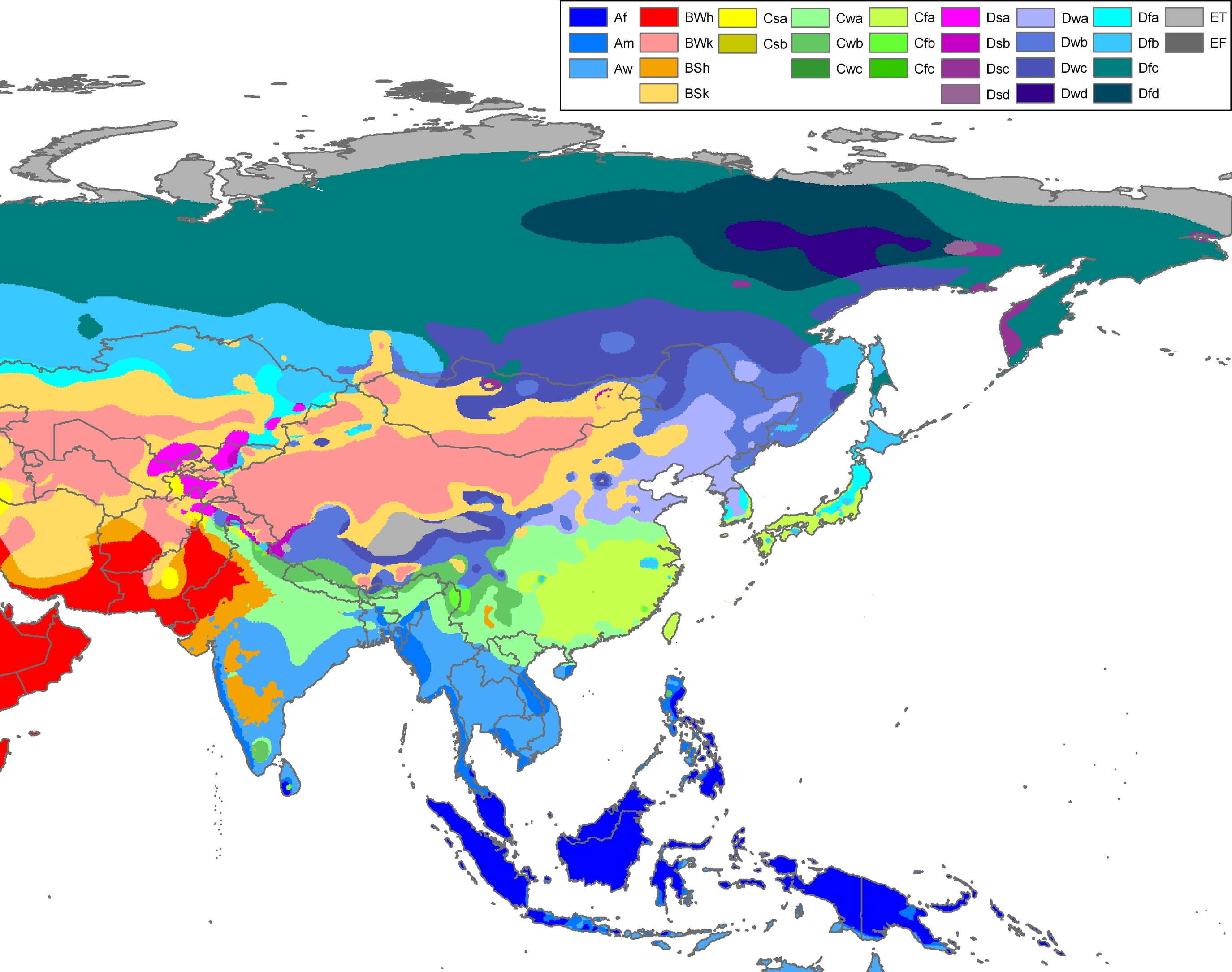
Bishkek has a Mediterranean-influenced humid continental climate (Köppen climate classification Dsa), as the average mean temperature in the winter is below 0 °C (32.0 °F).[19] Average precipitation is around 440 millimetres (17 in) per year. Average daily high temperatures range from 3 °C (37.4 °F) in January to about 31 °C (87.8 °F) during July.[20] The summer months are dominated by dry periods, punctuated by the occasional thunderstorm, which produces strong gusty winds and rare dust storms. The mountains to the south provide a natural boundary and protection from damaging weather, as does the smaller mountain chain that runs north-west to south-east. In the winter months, sparse snow storms and frequent heavy fog are the dominating features. There are sometimes temperature inversions, during which the fog can last for days at a time.
Demographics
Bishkek is the most populated city in Kyrgyzstan. Its population, estimated in 2021, was 1,074,075.[21] From the foundation of the city to the mid-1990s, ethnic Russians and other peoples of European descent (Ukrainians, Germans) comprised the majority of the city's population. According to the 1970 census, the ethnic Kyrgyz were only 12.3%, while Europeans comprised more than 80% of the Frunze population. Now Bishkek is a predominantly Kyrgyz city, with 75% of its residents Kyrgyz, while European peoples make up around 15% of the population.[22] Despite this fact, Russian is the main language while Kyrgyz continues losing ground, especially among the younger generations.[23]
Template:Historical populations
Ecology and environment
Air quality
Emissions of air pollutants in Bishkek amounted to 14,400 tons in 2010.[24] Among all cities in Kyrgyzstan, the level of air pollution in Bishkek is the highest, occasionally exceeding maximum allowable concentrations by several times, especially in the city centre.[25] For example, concentrations of formaldehyde occasionally exceed maximum allowable limits by a factor of four. The hydrogeologist Zheenbek Kulbekov identifies coal-heating mainly in informal settlements (samozakhvat), the exhaust from private vehicles and the lack of air circulation as the three main factors for the grave air pollution in Kyrgyzstan's capital.[26] The latter is mainly due to the haphazard construction of private multi-story buildings - in contradiction to former city plans developed up until the end of the USSR - which prompted discussion on a moratorium on the further construction of high-rise buildings.[27]
Responsibility for ambient air quality monitoring in Bishkek lies with the Kyrgyz State Agency of Hydrometeorology. There are seven air-quality monitoring stations in Bishkek, measuring levels of sulfur dioxide, nitrogen oxides, formaldehyde, and ammonia.[24]
Economy

Bishkek uses the Kyrgyzstan currency, the som. The som's value fluctuates regularly but averaged around 86 som per U.S. dollar as of November 2024. The economy in Bishkek is primarily agricultural, and agricultural products are sometimes bartered in the outlying regions. The streets of Bishkek are regularly lined with produce vendors in a market-style venue. In most of the downtown area there is a more urban cityscape with banks, stores, markets, and malls. Sought-after goods include hand-crafted artisan pieces, such as statues, carvings, paintings, and many nature-based sculptures.
Housing
As with many cities in post-Soviet states, housing in Bishkek has undergone extensive changes since the collapse of the Soviet Union. While housing was formerly distributed to citizens in the Soviet era, housing in Bishkek has since become privatised.
Though single-family houses are slowly becoming more popular, the majority of the residents live in Soviet-era apartments. Despite the Kyrgyz economy experiencing growth, increases in available housing have been slow with very little new construction and a doubling of prices from 2001 to 2002.[28] This changed by the 2010s when an unprecedented housing boom has transformed the city. By 2021, over 246 construction firms were active in Kyrgyzstan, primarily focusing on upscale residences, often marketed as 'business class' or 'premium class' accommodations.[26] The southern part of the city, where a significant portion of new constructions is concentrated, faces a critical concern due to its proximity to the Issyk-Ata fault line.[26] Compounded by the inadequately seismic-proof architecture of most of these buildings, this situation poses a serious threat to the safety of residents and has sparked criticism.[27] Limited land availability propels private developers to encroach into socialist-era residential zones, resulting in the loss of green spaces and vital social infrastructure, including sports fields and playgrounds.[29]
Those unable to afford the high housing price within Bishkek, notably internal migrants from rural villages and small provincial towns, often have to resort to informal squatter settlements on the city's outskirts such as Ak Jar, Ak Jol, Ak Örgö, Altyn Kazyk, Archa Beshik, Kalys-Ordo, Kayndy-2, Kelechek, Muras-Ordo and TETS-2 Yntymak.[30] These urban settlements are estimated to house 400,000 people or about 30 percent of Bishkek's population. While many of the settlements have lacked basic necessities such as electricity and running water, recently, the local government has pushed to provide these services.[31]
Government

.jpg)
Local government is administered by the Bishkek Mayor's Office. Askarbek Salymbekov was mayor until his resignation in August 2005, after which his deputy, Arstanbek Nogoev, took over the mayorship. Nogoev was in turn removed from his position in October 2007 through a decree of President Kurmanbek Bakiyev and replaced by businessman and former first deputy prime minister Daniar Usenov.[32][33][34] In July 2008 former head of the Kyrgyz Railways Nariman Tuleyev was appointed mayor, who was dismissed by the interim government after 7 April 2010. From April 2010 to February 2011 Isa Omurkulov, also a former head of the Kyrgyz Railways, was an interim mayor,[35] and from 4 February 2011 to 14 December 2013 he was re-elected the mayor of Bishkek.[36][37] Kubanychbek Kulmatov was nominated for election by parliamentary group of Social Democratic Party of Kyrgyzstan in city kenesh, and he was elected as a new mayor on 15 January 2014,[38] and stepped down on 9 February 2016. The next mayor, Albek Sabirbekovich Ibraimov, was also nominated for election by parliamentary group of Social Democratic Party of Kyrgyzstan in city kenesh, and Bishkek City Kenesh elected him on 27 February 2016.[39] The current mayor is Emil Abdykadyrov, who was elected on 24 February 2022.
Administrative divisions
Bishkek city covers 169.6 square kilometres (65.5 square miles)[3] and is administered separately and not part of any region. Besides the city proper, one urban-type settlement and one village are administered by the city: Chong-Aryk and Orto-Say.[2] The city is divided into 4 districts: Birinchi May, Lenin, Oktyabr and Sverdlov. Chon-Aryk and Orto-Say are part of Lenin District.[2]
Culture
Bishkek is culturally the country's most important city. It is home to the National Library of the Kyrgyz Republic as well as a number of museums, e.g. the Kyrgyz State Historical Museum or the M. V. Frunze Museum. The national public broadcasting service KTRK or Kyrgyz Television is based in Bishkek. Newspapers in Bishkek include the English-language Bishkek Observer, the world's only dungan-language newspaper called Huimin bao and the Russian-language Vecherniy Bishkek newspaper.
Religion
The largest religion is Sunni Islam, but since many Russians live in Kyrgyzstan, there is also a large Russian Orthodox community. The Bishkek Central Mosque is one of the largest in Central Asia. Bishkek is home to the Roman Catholic Apostolic Administration of Kyrgyzstan.
Sports
Bishkek is home to Dolen Omurzakov Stadium, the largest football stadium in Kyrgyzstan and the only one eligible to host international matches.[40] Several Bishkek-based football teams play on this pitch, including six-time Kyrgyzstan League champions, Dordoi Bishkek. Others include Alga Bishkek, Ilbirs Bishkek, and RUOR-Guardia Bishkek.
Bishkek hosted the 2014 IIHF Challenge Cup of Asia – Division I.
Education
Educational institutions in Bishkek include:
- Kyrgyz International University NRZ
- APAP KR
- American University of Central Asia
- Arabaev Kyrgyz State University[41]
- Bishkek Humanities University
- International Atatürk-Alatoo University[42]
- International University of Kyrgyzstan[43]
- Kyrgyz International University NRZ
- Kyrgyz-Russian Slavic University[44]
- I.K. Akhunbaev Kyrgyz State Medical Academy
- Kyrgyz State National University[45]
- Kyrgyz Technical University
- Kyrgyz-Russian State University
- Kyrgyz-Turkish Manas University[46]
- Kyrgyz Uzbek University
- Plato University of Management and Design[47]
- University of Central Asia[48]
In addition, the following international schools serve the expatriate community in Bishkek:
- European School in Central Asia[49]
- Oxford International School Bishkek[50]
- Hope Academy of Bishkek[51]
- QSI International School of Bishkek[52]
- Silk Road International School[53]
Transportation


Mass public transport
Public transportation includes buses and public vans (alternatively known as minibuses[54] ormarshrutki in Russian). Trolleybuses were previously used, but were phased out in 2024.[55] The first bus and trolleybus services in Bishkek were introduced in 1934 and 1951, respectively.[56]
Taxi cabs can be found throughout the city.
The city is considering designing and building a light rail system.
Commuter and long-distance buses
There are two main bus stations in Bishkek. The smaller old Eastern Bus Station is primarily the terminal for minibusses to various destinations within or just beyond the eastern suburbs, such as Kant, Tokmok, Kemin, Issyk Ata, or the Korday border crossing.
Long-distance regular bus and minibus services to all parts of the country, as well as to Almaty (the largest city in neighbouring Kazakhstan) and Kashgar, China, run mostly from the newer grand Western Bus Station; only a smaller number run from the Eastern Station.
The Dordoy Bazaar on the north-eastern outskirts of the city also contains makeshift terminals for frequent minibuses and shared taxis to suburban towns in all directions (from Sokuluk in the west to Tokmok in the east), with some buses taking traders to Kazakhstan and Siberia.
Rail
As of 2026[update], the Bishkek-2 railway station sees only a few trains a day. It offers a popular three-day train service from Bishkek to Moscow, as well as once-daily commuter services wesbound to Kaindy and eastbound to Tokmok.[57]
There are also long-distance trains that leave for Siberia (Novosibirsk and Novokuznetsk), via Almaty, over the TurkSib route, and to Yekaterinburg in the Urals, via Astana. These services are remarkably slow (over 48 hours to Yekaterinburg), due to long stops at the border and the indirect route (the trains first have to go west for more than a 100 kilometres (62 mi) before they enter the main TurkSib line and can continue to the east or north). For example, as of the fall of 2008, train No. 305 Bishkek-Yekaterinburg was scheduled to take 11 hours to reach the Shu junction—a distance of some 269 kilometres (167 mi) by rail, and less than half of that by road.[58]
Air
The city is served by Manas International Airport (IATA code BSZ), located approximately 25 kilometres (16 mi) north-west of the city centre.
In 2001, the United States obtained the right to use Manas International Airport as an air base for its military operations in Afghanistan and Iraq.[59] Russia subsequently (2003) established an airbase of its own (Kant Air Base) near Kant, some 20 kilometres (12 mi) east of Bishkek. It is based at a facility that used to be home to a major Soviet military pilot training school; one of its students, Hosni Mubarak, later became president of Egypt.
Notable people
- Chinghiz Aitmatov (1928–2008), writer
- Otto Barch (1943-2025), race walker
- Sopubek Begaliev (1931–2002), economist
- Bermet Borubaeva, artist
- Altynai Botoyarova (born 2004), model
- Igor Chudinov (born 1961), politician
- Tugolbay Sydykbekov (1912–1997), writer
- Talant Dujshebaev (born 1968), handball coach and former handball player
- Mikhail Frunze (1885–1925), after whom the city was named from 1926 to 1991
- Nasirdin Isanov (1943–1991), first prime minister of Kyrgyzstan
- Kamchy Kolbayev (1974–2023), crime boss
- Sergei B. Korolev (born 1962), First Deputy Director of the Federal Security Service
- Felix Kulov (born 1948), politician
- Orzubek Nazarov (born 1966), former WBA lightweight boxing champion
- Roza Otunbayeva (born 1950), third president of Kyrgyzstan
- Vladimir Perlin (born 1942), cellist
- Denis Petrashov (born 2000), swimmer, Youth Games and Maccabiah Games medalist
- Salizhan Sharipov (born 1964), first cosmonaut of independent Kyrgyzstan
- Antonina Shevchenko (born 1984), kickboxer
- Valentina Shevchenko (born 1988), kickboxer and UFC champion
- Iasyr Shivaza (1906–1988), poet and activist
- Natalya Tsyganova (born 1971), 800m medallist at the World and European championships, representing Russia
- Daniar Usenov (born 1960), banker and politician
Twin towns – sister cities
- Kazakhstan Almaty, Kazakhstan (1994)
- Turkey Ankara, Turkey (1992)[61]
- Turkmenistan Ashgabat, Turkmenistan (2018)[62]
- United States Colorado Springs, United States (1994)[63]
- Qatar Doha, Qatar (2014)
- South Korea Gumi, South Korea (1991)
- Turkey İzmir, Turkey (1994)
- Ukraine Kyiv, Ukraine (1997)[64]
- China Lianyungang, China (2015)[65]
- Kazakhstan Astana, Kazakhstan (2011)
- Iran Qazvin, Iran (2003)
- Turkey Samsun, Turkey[66]
- Belgium Liège, Belgium (2012)[67]
- China Shenzhen, China (2016)[68]
- Uzbekistan Tashkent, Uzbekistan[69]
- Iran Tehran, Iran (1994)
- Turkey Trabzon, Turkey (2014)[70]
- Russia Ufa, Russia (2017)
- China Ürümqi, China (1993)[71]
- China Wuhan, China (2016)
- China Yinchuan, China (2000)[72]


.svg)


See also
Notes
- ↑ Kyrgyz and Script error: The function "langx" does not exist.; ky, ru
- ↑ Kyrgyz and Script error: The function "langx" does not exist.
- ↑ Kyrgyz and Script error: The function "langx" does not exist.
- ↑ The region surrounds the city, although the city itself is not part of the region but rather a region-level unit of Kyrgyzstan.
References
- ↑ Law on the Status of Bishkek Archived 21 July 2011 at the Wayback Machine, 16 April 1994, article 2 (in Russian). Retrieved on 3 August 2009
- ↑ 2.0 2.1 2.2 "Classification system of territorial units of the Kyrgyz Republic" (in Kyrgyz). National Statistics Committee of the Kyrgyz Republic. May 2021. p. 81.
- ↑ 3.0 3.1 Template:Cite Kyrgyzstan census 2009
- ↑ "Biškek Šaary (City, Kyrgyzstan)". Population Statistics, Charts, Map and Location. 25 March 2022. Retrieved 6 December 2025.
- ↑ BENGARD, Anastasia (21 May 2025). "Almost 1.5 million people to live in Bishkek by 2028". 24.kg. Retrieved 6 December 2025.
- ↑ "Sub-national HDI – Area Database". hdi.globaldatalab.org. Global Data Lab.
- ↑ "Kyrgyzstan" (PDF). улуттук статистика комитети.
- ↑ "Bishkek". Travel Land.
- ↑ "Bishkek Capital of Islamic Culture 2014". ICESCO-En. Archived from the original on 11 November 2022. Retrieved 11 November 2022.
- ↑ "In Kyrgyzstan, a taste of the 'purest milk imaginable'". Financial Times. 26 March 2022. Retrieved 11 November 2022.
- ↑ "This Asian country is betting on fermented horse milk to attract tourists". CNN. 21 July 2022. Retrieved 11 November 2022.
- ↑ "История города". Мэрия (in Russian). Retrieved 11 November 2022.
- ↑ Woodward, Aylin (15 June 2022). "Black Death Mystery Solved Centuries After Plague Killed 50 Million in Europe". Wall Street Journal.
- ↑ Belyakov, Yuri (2020). "Ормон-хан" [Ormon Khan]. proza.ru (in Russian). Retrieved 5 October 2022.
- ↑ Residential Real Estate Market in Bishkek, Kyrgyzstan: Current Conditions and Prospects Archived 21 March 2009 at the Wayback Machine
- ↑ "Bishkek: The City of Lenin and the White House | .TR". www.tourism-review.com. Retrieved 8 June 2022.
- ↑ Catholic Church in Kyrgyzstan Archived 3 August 2019 at the Wayback Machine. Catholic-kyrgyzstan.org. Retrieved 11 March 2012.
- ↑ "Adam University School of Medicine". fm.adam.kg. Retrieved 23 April 2025.
- ↑ "Koppen Map". Upload.wikimedia.org. Retrieved 21 November 2012.
- ↑ Cite error: Invalid
<ref>tag; no text was provided for refs namedPogoda - ↑ Template:Cite Kyrgyzstan population 2021
- ↑ "Дем. ежегодник 2015-2019гг.xlsx". National Statistical Committee of the Kyrgyz Republic. Retrieved 19 September 2021.
- ↑ Komlosi-Ferdinand, Flora; Ferdinand, Siarl (25 July 2016). "Ferdinand, S. & Komlósi, F. 2016. The vitality of the Kyrgyz Language in Bishkek". Ijors - International Journal of Russian Studies. IJORS 5–2, pp. 210–226. Retrieved 10 September 2016.
- ↑ 24.0 24.1 "Анализ загрязнения атмосферы". Nature.kg. Archived from the original on 9 February 2014. Retrieved 21 November 2012.
- ↑ Web-site of the State Agency on Environment Protection and Forestry: Assessment of Air Pollution Archived 9 February 2014 at the Wayback Machine. Meteo.ktnet.kg. Retrieved on 11 March 2012.
- ↑ 26.0 26.1 26.2 Leupold, David (9 August 2023). "Skyrise, Smog and Seismic Menace. In the El Dorado of Bishkek's Elite Housing". Europe-Asia Studies. 75 (7): 1218. doi:10.1080/09668136.2023.2185203. ISSN 0966-8136.
- ↑ 27.0 27.1 Leupold, David (9 August 2023). "Skyrise, Smog and Seismic Menace. In the El Dorado of Bishkek's Elite Housing". Europe-Asia Studies. 75 (7): 1194–1221. doi:10.1080/09668136.2023.2185203. ISSN 0966-8136.
- ↑ Roseman, Gary. "The Residential Real Estate Market in Bishkek, Kyrgyzstan". Real Estate Issues. Summer 2004.
- ↑ Leupold, David (9 August 2023). "Skyrise, Smog and Seismic Menace. In the El Dorado of Bishkek's Elite Housing". Europe-Asia Studies. 75 (7): 1213–14. doi:10.1080/09668136.2023.2185203. ISSN 0966-8136.
- ↑ Isabaeva, Eliza (2013). "Migration into the "Illegality" and Coping with Difficulties in a Squatter Settlement in Bishkek". Zeitschrift für Ethnologie. 138 (2): 139–154. ISSN 0044-2666. JSTOR 24364951.
- ↑ Isabaeva, Eliza (2013). "Migration into the "Illegality" and Coping with Difficulties in a Squatter Settlement in Bishkek". Zeitschrift für Ethnologie. 138.
- ↑ "New mayor of Bishkek promises to solve capital's problems". The Times of Central Asia. 17 October 2007. Archived from the original on 19 June 2008. Retrieved 18 October 2007.
- ↑ Marat, Erica (15 October 2007). "Upcoming referendum sinks Kyrgyzstan deeper into crisis". Eurasia Daily Monitor. The Jamestown Foundation. 4 (190). Archived from the original on 22 October 2007. Retrieved 18 October 2007.
- ↑ "Kyrgyz capital gets new mayor". Radio Free Europe. 22 August 2005. Archived from the original on 5 June 2011. Retrieved 18 October 2007.
- ↑ "New Mayor for Bishkek". Lenta.Ru. 7 July 2008. Archived from the original on 7 June 2011. Retrieved 25 September 2008.
- ↑ "Isa Omurkulov elected mayor of Bishkek". Radio Azattyk. 4 February 2011. Retrieved 10 August 2016.
- ↑ "Isa Omurkulov resigned". Vecherniy Bishkek. 4 December 2013. Retrieved 10 August 2016.
- ↑ "Kubanychbek Kulmatov elected mayor of Bishkek". Radio Azattyk. 27 February 2016. Retrieved 10 August 2016.
- ↑ "Albek Ibraimov elected mayor of Bishkek". Radio Azattyk. 27 February 2016. Retrieved 10 August 2016.
- ↑ Corporate Japanese companies to renovate Kyrgyzstan football stadium. The-afc.com (9 November 2007). Retrieved on 11 March 2012.
- ↑ "October 2009+01:35:14". Archived from the original on 27 October 2009.
- ↑ "International Ataturk Alatoo University". Iaau.edu.kg. Archived from the original on 30 November 2012. Retrieved 21 November 2012.
- ↑ "Главная Международный университет Кыргызстана.|". Iuk.kg. Retrieved 21 November 2012.
- ↑ "Кыргызско-Российский Славянский университет имени Б.Н. Ельцина – Главная". Krsu.edu.kg. Retrieved 21 November 2012.
- ↑ "Новости КНУ им. Ж.Баласагына". University.kg. 1 November 2012. Retrieved 21 November 2012.
- ↑ "Kırgızistan-Türkiye Manas Üniversitesi". Manas.kg. Retrieved 21 November 2012.
- ↑ "Plato UMD – Home". Umd.edu.kg. Archived from the original on 25 August 2012. Retrieved 21 November 2012.
- ↑ "University of Central Asia – University of Central Asia". www.ucentralasia.org. Retrieved 23 February 2017.
- ↑ "European School in Central Asia – Bishkek – Kyrgyzstan". esca.kg. 13 October 2014. Retrieved 13 October 2014.
- ↑ "Oxford International School". oxford.kg. Archived from the original on 9 August 2017. Retrieved 8 August 2017.
- ↑ "Hope Academy of Bishkek". Hopeacademykg.com. Retrieved 21 November 2012.
- ↑ "Welcome | QSI". Bishkek.qsischool.org. Retrieved 21 November 2012.
- ↑ "SRIS - Silk Road International School, Bishkek". sris.edu.kg.
- ↑ "Transport-in-Kyrgyzstan". Travel Land. 20 September 2021. Retrieved 26 July 2025.
- ↑ Chipegin, Anton (25 November 2024). "End of the Trolleybus: Bishkek Authorities Abandon Eco-Friendly Transport Option - The Times Of Central Asia". Retrieved 15 April 2026.
- ↑ "Frunze. City Encyclopedia". Retrieved 26 January 2014.
- ↑ "Кыргыз темир жолу - Кыргызские железные дороги". www.railway.kg. Retrieved 15 April 2026.
- ↑ "Маршрут поезда ????? – ????? на сайте". Poezda.net. Retrieved 21 November 2012.
- ↑ Dzyubenko, Olga (3 June 2014). "U.S. vacates base in Central Asia as Russia's clout rises". Reuters. Archived from the original on 10 February 2024. Retrieved 10 February 2024.
- ↑ "Бишкек стал городом-побратимом Уфы". kaktus.media (in Russian). Kaktus Media. 14 July 2017. Retrieved 30 November 2020.
- ↑ "Ankaranın Kardeş Şehirleri". ankara.bel.tr (in Turkish). Ankara. Archived from the original on 25 October 2020. Retrieved 30 November 2020.
- ↑ "Kostroma is looking for a twin city in Turkmenistan". orient.tm. Orient. 15 July 2020. Archived from the original on 12 November 2020. Retrieved 30 November 2020.
- ↑ "Colorado Springs Sister Cities International". Colorado Springs. City of Colorado Springs. 30 April 2018. Retrieved 30 November 2020.
- ↑ "Перелік міст, з якими Києвом підписані документи про поріднення, дружбу, співробітництво, партнерство" (PDF). kyivcity.gov.ua (in Ukrainian). Kyiv. 15 February 2018. Archived (PDF) from the original on 9 October 2022. Retrieved 30 November 2020.
- ↑ "友好往来". lyg.gov.cn (in Chinese). Lianyungang. Retrieved 30 November 2020.
- ↑ "Bişkek, Kırgızistan". samsun.bel.tr (in Turkish). Samsun. Archived from the original on 14 May 2022. Retrieved 30 November 2020.
- ↑ "International relations". City Hall (in Kyrgyz). Retrieved 5 January 2024.
- ↑ "Sister Cities". sz.gov.cn (in Chinese). Shenzhen. Retrieved 30 November 2020.
- ↑ "Ну, здравствуй, брат! Города-побратимы Ташкента". vot.uz (in Russian). The Voice of Tashkent. 10 November 2015. Archived from the original on 3 February 2016. Retrieved 30 November 2020.
- ↑ "Kardeş Şehirler". trabzon.bel.tr (in Turkish). Trabzon. Archived from the original on 23 December 2019. Retrieved 30 November 2020.
- ↑ "新疆维吾尔自治区友城介绍". xinjiang.gov.cn (in Chinese). Xinjiang Uygur Autonomous Region. 9 August 2012. Archived from the original on 13 November 2020. Retrieved 30 November 2020.
- ↑ "银川市友好城市及交流合作情况". yinchuan.gov.cn (in Chinese). Yinchuan. Retrieved 30 November 2020.
Bibliography
External links
| File:Commons-logo.svg | Wikimedia Commons has media related to Bishkek. |

| File:Wikivoyage-Logo-v3-icon.svg | Wikivoyage has a travel guide for Bishkek. |

- The Spektator – society, culture, and travel articles on Kyrgyzstan and Bishkek city guide (archived)
Template:Districts of Kyrgyzstan Template:Provinces of Kyrgyzstan Template:Provincial seats of Kyrgyzstan Template:List of Asian capitals by region
- Articles with Russian-language sources (ru)
- CS1 Kyrgyz-language sources (ky)
- CS1 Russian-language sources (ru)
- CS1 Turkish-language sources (tr)
- CS1 Ukrainian-language sources (uk)
- CS1 Chinese-language sources (zh)
- Use dmy dates from December 2020
- Use British English from August 2013
- Coordinates not on Wikidata
- Articles with Kyrgyz-language sources (ky)
- Articles with failed verification from July 2022
- Articles containing potentially dated statements from 2026
- All articles containing potentially dated statements
- Bishkek
- 1825 establishments in Asia
- Capital cities in Asia
- Cities in Central Asia
- Populated places along the Silk Road
- Populated places established in 1825
- Populated places in Kyrgyzstan
- Regions of Kyrgyzstan
- Semirechye Oblast