Douglas Adams: Difference between revisions
imported>RabbitFromMars Removed the false claim that Frank Wedekind was his great-grandfather, see talk page |
imported>SkywalkerEccleston No edit summary |
||
| Line 1: | Line 1: | ||
{{short description|English | {{short description|English writer and humourist (1952–2001)}} | ||
{{other people}} | {{other people}} | ||
{{Use British English|date=March 2021}} | {{Use British English|date=March 2021}} | ||
{{Use dmy dates|date= | {{Use dmy dates|date=January 2026}} | ||
{{Infobox writer | {{Infobox writer | ||
| name | | name = Douglas Adams | ||
| image | | image = Douglas adams portrait cropped.jpg | ||
| caption | | caption = Portrait by Michael Hughes | ||
| birth_name | | birth_name = | ||
| birth_date | | birth_date = {{birth date|1952|03|11|df=yes}} | ||
| birth_place | | birth_place = [[Cambridge]], England | ||
| death_date | | death_date = {{death date and age|2001|05|11|1952|03|11|df=yes}} | ||
| death_place | | death_place = [[Santa Barbara, California]], U.S. | ||
| resting_place = [[Highgate Cemetery]], London | | resting_place = [[Highgate Cemetery]], London | ||
| occupation | | occupation = {{flatlist| | ||
* Author | * Author | ||
* screenwriter | * screenwriter | ||
* essayist | * essayist | ||
* [[List of humorists| | * [[List of humorists|humourist]] | ||
* satirist | * satirist | ||
* dramatist}} | * dramatist}} | ||
| years_active | | years_active = 1974–2001 | ||
| alma_mater | | alma_mater = [[University of Cambridge]] | ||
| genre | | genre = [[Comedy]], [[satire]], [[science fiction]], [[absurdist fiction|absurdism]] | ||
| notablework | | notablework = ''[[The Hitchhiker's Guide to the Galaxy]]'' | ||
| signature | | signature = Douglas Adams Unterschrift (cropped).jpg | ||
| awards | | awards = | ||
| spouse | | spouse = {{marriage|Jane Belson|25 November 1991}} | ||
| children | | children = 1 | ||
| website | | website = {{URL|douglasadams.com}} | ||
}} | }} | ||
'''Douglas | '''Douglas Noël Adams'''<!--His middle name is spelt "Noël", not "Noel". See the note below, as well as the recent discussion on the Talk page.--> (11 March 1952 – 11 May 2001) was an English author, [[humourist]], and screenwriter. He was best known as the creator of ''[[The Hitchhiker's Guide to the Galaxy]]'', a [[The Hitchhiker's Guide to the Galaxy (radio series)|1978 radio comedy series]] which he adapted into a "trilogy" of five{{refn|group=nb|The sixth and final book in the ''Hitchhiker's'' series, ''[[And Another Thing... (novel)|And Another Thing...]]'' (2009), was written by [[Eoin Colfer]].<ref name=aatreview/>}} books that sold over 14 million copies in his lifetime. He also adapted it into a [[The Hitchhiker's Guide to the Galaxy (TV series)|1981 television series]], a [[The Hitchhiker's Guide to the Galaxy (video game)|1984 video game]] and a [[The Hitchhiker's Guide to the Galaxy (film)|2005 feature film]]. | ||
Adams wrote ''[[Dirk Gently's Holistic Detective Agency]]'' (1987) and ''[[The Long Dark Tea-Time of the Soul]]'' (1988), and co-wrote ''[[The Meaning of Liff]]'' (1983), ''[[The Deeper Meaning of Liff]]'' (1990) and ''[[Last Chance to See]]'' (1990). He wrote | Adams wrote the novels ''[[Dirk Gently's Holistic Detective Agency]]'' (1987) and ''[[The Long Dark Tea-Time of the Soul]]'' (1988), and co-wrote ''[[The Meaning of Liff]]'' (1983), ''[[The Deeper Meaning of Liff]]'' (1990) and ''[[Last Chance to See]]'' (1990). He wrote three serials for the television series ''[[Doctor Who]]'' including the unaired serial ''[[Shada (Doctor Who)|Shada]]'' and ''[[City of Death]]'' (1979) which he co-wrote with producer [[Graham Williams (television producer)|Graham Williams]], and served as script editor for its [[Doctor Who season 17|17th season]]. He co-wrote the sketch "[[Patient Abuse]]" for the final episode of ''[[Monty Python's Flying Circus]]''. A posthumous collection of his selected works, including chapters of his final unfinished novel, was published as ''[[The Salmon of Doubt]]'' in 2002. | ||
Adams called himself a "radical atheist" and was an advocate for [[environmentalism]] and [[Conservation movement|conservation]]. He was a lover of fast cars,<ref name=TI>{{cite web |title=Douglas Adams: Master of his universe |url=https://www.independent.co.uk/news/people/profiles/douglas-adams-master-of-his-universe-495422.html |work=[[The Independent]] | Known for his sharp wit and [[procrastination]], Adams called himself a "radical [[Atheism|atheist]]" and was an advocate for [[environmentalism]] and [[Conservation movement|conservation]]. He was a lover of music, fast cars,<ref name="TI">{{cite web |last=Bywater |first=Michael |date=19 April 2005 |title=Douglas Adams: Master of his universe |url=https://www.independent.co.uk/news/people/profiles/douglas-adams-master-of-his-universe-495422.html |url-status=live |archive-url=https://web.archive.org/web/20250124084440/https://www.independent.co.uk/news/people/profiles/douglas-adams-master-of-his-universe-495422.html |archive-date=24 January 2025 |work=[[The Independent]]}}</ref> technological innovation, and the [[Mac (computer)|Apple Macintosh]]. | ||
==Early life== | ==Early life and education== | ||
Adams was born in [[Cambridge]] | |||
=== Family === | |||
Douglas Noël Adams{{refn|group=nb|Biographers [[M. J. Simpson]] and Nick Webb spell his middle name "Noël", with a [[Diaeresis (diacritic)|diaresis]].{{sfn|Simpson|2003|p=6}}{{sfn|Webb|2017|loc=1st paragraph}}}} was born in [[Cambridge]] on 11 March 1952 to Christopher Douglas Adams, a management consultant and computer salesman who formerly worked as a probation officer, and nurse Janet Dora Sydney Adams (''née'' Donovan). He had English, Scottish, Irish and German ancestry. His paternal grandfather, born in [[Glasgow]], came from a long line of distinguished doctors.{{Sfn|Simpson|2003|p=7}}{{sfn|Webb|2017|loc=1st–2nd paragraphs}} | |||
Shortly after his birth, the family moved to the [[East End of London]].{{Sfn|Ainsworth|2017|p=42}} His sister Susan was born in March 1955.{{Sfn|Simpson|2003|p=7}} By the time he was five his parents had divorced; Douglas, Susan and their mother subsequently moved to an [[RSPCA]] animal shelter in [[Brentwood, Essex|Brentwood]] run by his maternal grandparents.{{Sfnm|1a1=Ainsworth|1y=2017|1p=42|2a1=Webb|2y=2017|2loc=2nd paragraph}} Each parent remarried, giving Adams several half-siblings.{{Sfn|Simpson|2003|pp=7–8}}{{refn|group=nb|In 1960, Christopher remarried to Mary Judith Stewart (''née'' Robertson). In 1964, Janet remarried to Ron Thrift.{{sfn|Webb|2017|loc=3rd paragraph}}}} | |||
===Education=== | ===Education=== | ||
Adams attended Primrose Hill Primary School in Brentwood. | Adams attended Primrose Hill Primary School in Brentwood.{{Sfn|Webb|2017|loc=4th paragraph}} He entered the [[Preparatory school (United Kingdom)|prep school]] for [[Brentwood School (Essex)|Brentwood School]] in September 1959.{{Sfnm|1a1=Simpson|1y=2003|1p=8|2a1=Webb|2y=2017|2loc=4th paragraph}} Adams felt isolated at school because of his large stature;{{Sfn|Simpson|2003|p=9}} he was {{convert|6|ft|m}} tall by the age of 12, and stopped growing at {{convert|6|ft|5|in|m}}.{{Sfn|Webb|2017|loc=4th paragraph}} His form master Frank Halford had a profound influence on him. Adams was the only student to be awarded 10/10 by Halford for creative writing – something Adams remembered for the rest of his life, particularly when facing [[writer's block]].{{Sfn|Simpson|2003|pp=9–10}} | ||
Some of his earliest writing was published at | Some of his earliest writing was published at Brentwood School. His first published work was a brief report on the prep school's photography society in ''The Brentwoodian'' in September 1962.{{Sfn|Simpson|2003|pp=11–12}} His poem "Tramp's Eye View", written when he was twelve years old, is held by the [[University of Cambridge]].<ref name=adamssmithadams>{{cite web |title=Douglas Adams: Life in the Universe |url=https://www.joh.cam.ac.uk/douglas-adams-life-universe-0 |url-status=dead |archive-url=https://web.archive.org/web/20210930235336/https://www.joh.cam.ac.uk/douglas-adams-life-universe-0 |archive-date=30 September 2021 |website=St John's College, Cambridge}}</ref> In early 1965, he had a surreal short story titled ''Suspense'' published in the children's comic ''[[Eagle (British comics)|Eagle]]''.{{Sfnm|2a1=Ainsworth|2y=2017|2p=42|2ps=: Adams's surreal short story was published in Eagle in early 1965.|1a1=Simpson|1y=2003|1p=18|1ps=: Adams's short story Suspense was published in Eagle in early 1965.}} A poem written by Adams in January 1970 was discovered in a school cupboard in early 2014.<ref>{{Cite news |last=Flood |first=Alison |date=19 March 2014 |title=Lost poems of Douglas Adams and Griff Rhys Jones found in school cupboard |url=https://www.theguardian.com/books/2014/mar/19/lost-school-poems-douglas-adams-griff-rhys-jones |access-date=6 December 2025 |work=The Guardian |language=en-GB |issn=0261-3077}}</ref> He became a boarder at the school in September 1964,{{Sfn|Webb|2017|loc=4th paragraph}} and eventually left in December 1970.{{Sfn|Simpson|2003|p=8}} | ||
On the strength of | On the strength of a religious poetry essay that discussed [[the Beatles]] and [[William Blake]],{{Sfn|Webb|2017|loc=4th paragraph}} Adams was awarded an [[Exhibition (scholarship)|exhibition]] to study English at [[St John's College, Cambridge]], where his father had studied.{{Sfn|Simpson|2003|p=27}} He entered the university in 1971,{{Sfn|Webb|2017|loc=4th paragraph}} hoping to follow in the footsteps of comedy writer-performers like [[Monty Python]].{{sfnm|1p=|2a1=Ainsworth|1a1=Simpson|1y=2003|2y=2017|2p=42|1pp=30, 53}} Adams desperately wanted to join [[Footlights]], the invitation-only student comedy club, and was elected to the club in February 1972. However he was disappointed by its aloof culture. He began writing comedy sketches with fellow student [[Keith Jeffery]] (with whom he shared a room), but this partnership ended in November 1972.{{Sfn|Simpson|2003|pp=30–33, 37–38}}<ref>{{Cite news |date=28 March 2016 |title=Professor Keith Jeffery - obituary |url=https://www.telegraph.co.uk/obituaries/2016/03/28/professor-keith-jeffery---obituary/ |url-status=live |archive-url=https://web.archive.org/web/20260129043857/https://www.telegraph.co.uk/obituaries/2016/03/28/professor-keith-jeffery---obituary/ |archive-date=29 January 2026 |access-date=15 December 2025 |work=The Telegraph |language=en-GB |issn=0307-1235 |quote=[Jeffery] shared a room with Douglas Adams...}}</ref> He subsequently wrote and performed in revues with students Will Adams (no relation)<ref name=adamssmithadams/> and Martin Smith; their troupe was called "Adams-Smith-Adams".{{Sfn|Simpson|2003|pp=33, 37–38, 43–44}} Although Adams-Smith-Adams' written material featured prominently in Footlights' 1974 May Week Revue (titled ''Chox''), Douglas was gutted when he was not cast on the basis that his performing abilities were not strong enough.{{Sfn|Simpson|2003|p=50}} He graduated in 1974 with a 2:2 in [[English literature]].{{Sfn|Webb|2017|loc=6th paragraph}}{{refn|group=nb|Adams claimed to have written only three essays in his time at St John's, but surviving work shows he completed a great deal more work.<ref name=adamssmithadams/>}} Many of Adams's Cambridge peers played important roles in his career, such as [[Jon Canter]], [[John Lloyd (producer)|John Lloyd]], [[Mary Allen (arts administrator)|Mary Allen]] and [[Simon Jones (actor)|Simon Jones]].{{Sfnm|3a1=Webb|3y=2017|3loc=5th paragraph|3ps=: Jon Canter and John Lloyd.|1a1=Simpson|1y=2003|1p=32|1ps=: Simon Jones|2a1=Webb|2y=2005|2p=63|2ps=: Jon Canter, Mary Allen and John Lloyd}} Adams took a series of odd jobs during his time at Cambridge, which included working as a hospital porter and a chicken-shed cleaner.{{sfn|Webb|2005|p=58}}{{Sfn|Fleming|Adams|1981a|p=29}} | ||
==Career== | ==Career== | ||
Adams moved back to London after leaving university, determined to break into TV and radio as a writer.{{Sfn|Webb|2017|loc=6th paragraph}} The Adams-Smith-Adams trio continued working together until late 1975.{{Sfn|Simpson|2003|p=55}} The BBC occasionally accepted sketches from Adams, but his writing style was unsuited to the current style of radio and TV comedy.{{Sfn|Webb|2017|loc=6th paragraph}} To make ends meet he took a job as a bodyguard for a wealthy Arab family, which involved long night shifts guarding their hotel rooms.{{sfnm|1a1=Simpson|1y=2003|1p=75|2a1=Webb|2y=2005|2pp=92–93}} In 1976 he directed Footlights' May Week Revue, ''A Kick in the Stalls''.{{Sfn|Simpson|2003|p=|pp=76–77}} In August 1976, his career had a brief improvement when he co-wrote and performed ''Unpleasantness at Brodie's Close'' at the [[Edinburgh Festival Fringe]] with John Lloyd, [[David Renwick]] and [[Andrew Marshall (screenwriter)|Andrew Marshall]].{{Sfn|Webb|2017|loc=6th paragraph}}{{Sfn|Simpson|2003|loc=|p=82}} By the end of the year, Adams's career again stalled and he moved in with his family in [[Stalbridge]], [[Dorset]].{{Sfn|Webb|2017|loc=6th paragraph}}[[File:John lloyd secret comedy podcast.jpg|thumb|Adams often worked with writer [[John Lloyd (producer)|John Lloyd]] (''pictured in 2013''); they co-wrote ''The Meaning of Liff'' books and two episodes of the ''Hitchhiker's Guide'' radio series.]]Adams and Lloyd unsuccessfully developed various comedy projects, such as ''The Swasivious Zebu'', ''Knight and Day'' and a [[The Guiness Book of Records|''Guinness Books of Records'']] film. The latter project, which involved aliens competing with humans in an intergalactic sporting event, was cancelled due to there being "no market for [[science fiction film]]s". Adams and Lloyd also pitched ''Sno 7 and the White Dwarfs'', a radio [[sitcom]] about two astrophysicists trapped in a [[Mount Everest|Mt Everest]] observatory, but were told by the BBC that [[science fiction]] was "too 1950s".{{Sfn|Simpson|2003|pp=83–84}}<ref>{{Cite web |last= |first= |date=8 March 2018 |title=John Lloyd and Dirk Maggs reveal how Douglas Adams made Hitchhiker's Guide to the Galaxy |url=https://www.radiotimes.com/audio/john-lloyd-and-dirk-maggs-reveal-how-douglas-adams-made-hitchhikers-guide-to-the-galaxy/ |archive-url=https://web.archive.org/web/20210525093039/https://www.radiotimes.com/audio/john-lloyd-and-dirk-maggs-reveal-how-douglas-adams-made-hitchhikers-guide-to-the-galaxy/ |archive-date=25 May 2021 |access-date=31 December 2025 |website=[[Radio Times]] |language=en-GB}}</ref> Adams's first professional solo work was a sketch for the radio comedy series ''[[The Burkiss Way]]'', broadcast in early 1977. Around the same time he wrote for ''[[The News Huddlines]]''.{{Sfn|Simpson|2003|pp=86–87}} | |||
Shortly before being commissioned to write the pilot episode of ''[[The Hitchhiker's Guide to the Galaxy (radio series)|The Hitchhiker's Guide to the Galaxy]]'', Adams was considering leaving the industry out of frustration and moving to [[Hong Kong]].{{Sfn|Simpson|2003|pp=89, 91}} He got a job as a BBC radio producer in May 1978{{sfn|Webb|2017|loc=10th paragraph}} "for the money",{{sfn|Fleming|Adams|1981a|p=32}} and worked on satirical programme ''[[Week Ending]]'', documentary ''Here's More Egg on Your Face'' and panel show ''[[The News Quiz]]''.{{sfn|Ainsworth|2017|p=43}} He produced only one original project, a pantomime version of [[Cinderella]] titled ''[[Black Cinderella Two Goes East]]''. He left the position in October 1978 to become [[script editor]] for ''[[Doctor Who]]'' [[Doctor Who season 17|season 17]].{{sfn|Roberts|2010|pp=164–165}}{{Sfn|Simpson|2003|pp=115, 117–118}} Adams and Lloyd wrote two 1979 episodes of the animated children's show ''[[Doctor Snuggles]]'', "The Remarkable Fidgety River" and "The Great Disappearing Mystery".{{sfn|Roberts|2015|pp=129–130}} The pair also co-wrote the mock dictionary books ''[[The Meaning of Liff]]'' (1983) and ''[[The Deeper Meaning of Liff]]'' (1990).{{Sfn|Webb|2017|loc=13th paragraph}} On his death in 2001, Adams was on a long break from writing books.{{Sfn|Webb|2017|loc=15th paragraph}} | |||
{{Quote box | |||
| quote = "I love deadlines. I love the whooshing noise they make as they go by."{{sfn|Simpson|2003|pp=236, 378}} | |||
| source = —Douglas Adams, in a widely quoted citation of unknown origin | |||
| align = | |||
| width = 25% | |||
| quoted = | |||
}} | |||
Adams | Adams struggled with writing and usually did not find pleasure from it.<ref name=":12">{{Cite news |last=Brown |first=Mark |date=22 March 2021 |title=Douglas Adams' note to self reveals author found writing torture |url=https://www.theguardian.com/books/2021/mar/22/douglas-adams-note-to-self-reveals-author-found-writing-torture |access-date=6 December 2025 |work=[[The Guardian]] |language=en-GB |issn=0261-3077|archive-url=https://web.archive.org/web/20260309144848/https://www.theguardian.com/books/2021/mar/22/douglas-adams-note-to-self-reveals-author-found-writing-torture|archive-date=9 March 2026|url-status=live}}</ref> He often suffered from low confidence and [[writer's block]],{{sfn|Wroe|2000|loc=26th paragraph}}<ref name="times" />{{sfn|Simpson|2003|pp=128, 265–266}} and was infamous for his [[procrastination]]. Weeks before his manuscript for ''[[So Long, and Thanks for All the Fish]]'' (1984) was due, he had only written 25 pages. He was locked in a hotel suite with [[Sonny Mehta]] (editorial director of [[Pan Books]]) who kept an eye on him until the manuscript was completed.<ref name=":18">{{Cite news |last=Grant |first=Adam |date=13 March 2020 |title=Procrastinate Much? Manage Your Emotions, Not Your Time. |url=https://www.nytimes.com/2020/03/13/smarter-living/tips-to-stop-procrastinating.html |archive-url=https://web.archive.org/web/20200316022110/https://www.nytimes.com/2020/03/13/smarter-living/tips-to-stop-procrastinating.html |archive-date=16 March 2020 |work=[[The New York Times]]}}</ref>{{sfn|Webb|2005|p=|pp=129, 181–184}} The [[Douglas Adams's Starship Titanic: A Novel|1997 tie-in novel]] to Adams's video game ''[[Starship Titanic]]'' was ultimately written by [[Terry Jones]] because Adams kept putting it off.<ref name=":17" /><ref name="times">{{cite news |last=Jones |first=Terry |date=10 October 2009 |title=Terry Jones remembers Douglas Adams, 'the last of the Pythons' |url=https://www.thetimes.com/article/terry-jones-remembers-douglas-adams-the-last-of-the-pythons-vfr2vd5hz3k |archive-url=https://web.archive.org/web/20260101091227/https://www.thetimes.com/culture/tv-radio/article/terry-jones-remembers-douglas-adams-the-last-of-the-pythons-vfr2vd5hz3k |archive-date=1 January 2026 |newspaper=[[The Times]]}}</ref> On ''[[Quote... Unquote]]'', Adams suggested his own [[epitaph]]: "He finally met his deadline."<ref name=":18" /><ref>{{Cite book |last= |first= |url=https://books.google.com/books?id=5q4XBa5jsy8C&q=%22quote+unquote%22+epitaph |title=Oxford Dictionary of Humorous Quotations |date=25 September 2008 |publisher=[[Oxford University Press]] |isbn=978-0-19-923716-6 |editor-last=Sherrin |editor-first=Ned |pages=110 |language=en}}</ref> | ||
=== ''Monty Python'' and Graham Chapman === | |||
Once he had established himself in Footlights, Adams quickly sought out his idol [[John Cleese]] of Monty Python, interviewing him for the student newspaper [[Varsity (Cambridge)|''Varsity'']] in November 1972.{{Sfn|Simpson|2003|pp=41–42}} Adams was inspired by Cleese's work on ''[[The Frost Report]]'' (1966–67) and similarly tall stature,{{Sfn|Fleming|Adams|1981a|p=29}} later admitting "I wanted to be John Cleese and it took me some time to realise that the job was taken".{{Sfn|Simpson|2003|pp=41–42}} Cleese quit ''[[Monty Python's Flying Circus]]'' in early 1974, leaving his writing partner [[Graham Chapman]] to search for a new collaborator. Chapman met Adams in July 1974 at the [[West End theatre|West End]] opening night party of ''Chox''. The two formed a writing partnership, earning Adams a writing credit in ''Monty Python's'' [[List of Monty Python's Flying Circus episodes#Series 4 (1974)|fourth series]] for a sketch called "[[Patient Abuse]]".{{Sfn|Simpson|2003|pp=58–59, 62}} Adams also contributed to the "Marilyn Monroe" sketch that appeared on ''[[The Album of the Soundtrack of the Trailer of the Film of Monty Python and the Holy Grail]]''. Adams later stated that his contributions were "hardly worth mentioning" and that he had written "about half a dozen lines that appeared here and there in ''Python''". Nevertheless, he is one of only two non-Python members to receive a writing credit on the television series (the other is [[Neil Innes]]).{{Sfn|Simpson|2003|pp=60–61, 78}}[[File:DNA in Monty Python.jpg|thumb|Adams in his first ''[[Monty Python's Flying Circus|Monty Python]]'' appearance, in surgeon's garb]]Adams had two brief appearances in ''Monty Python's'' fourth series. In "The Light Entertainment War", Adams is in a surgeon's mask (as Dr. Emile Koning, according to on-screen captions) pulling on gloves.{{Sfn|Simpson|2003|p=60}}<ref name="times" /><ref>{{Cite episode |title=The Light Entertainment War |series=Monty Python |series-link=Monty Python's Flying Circus |network=BBC |date=14 November 1974 |season=4 |number=3}}</ref> In "Mr. Neutron", Adams is dressed in a [[List of recurring Monty Python's Flying Circus characters#Pepperpots|pepper-pot]] outfit and loads a missile onto a cart driven by Terry Jones, who is calling for scrap metal ("Any old iron...").{{Sfn|Simpson|2003|p=60}}<ref name=":17">{{Cite news |last=Masters |first=Tim |date=12 March 2012 |title=Douglas Adams loved ideas, but hated writing, says Terry Jones |url=https://www.bbc.com/news/entertainment-arts-17285332 |url-status=live |archive-url=https://web.archive.org/web/20240519090125/https://www.bbc.com/news/entertainment-arts-17285332 |archive-date=19 May 2024 |access-date=14 December 2025 |work=BBC News |language=en-GB}}</ref><ref>{{Cite episode |title=Mr Neutron |series=Monty Python |series-link=Monty Python's Flying Circus |network=BBC |date=28 November 1974 |season=4 |number=5}}</ref> Jones was the Python member with whom Adams formed the closest friendship.{{Sfn|Simpson|2003|p=57|pp=}} | |||
Adams and Chapman co-wrote a 1974 comedy science fiction script as a vehicle for [[Ringo Starr]], which was rejected by all major American TV networks.<ref>{{Cite web |last=Sokol |first=Tony |date=25 March 2023 |title=Remembering Ringo Starr's Forgotten Acting Career After the Beatles |url=https://www.denofgeek.com/movies/remembering-ringo-starr-forgotten-acting-career-after-the-beatles/ |url-status=live |archive-url=https://web.archive.org/web/20230325090016/https://www.denofgeek.com/movies/remembering-ringo-starr-forgotten-acting-career-after-the-beatles/ |archive-date=25 March 2023 |access-date=1 January 2026 |website=Den of Geek |language=en-US}}</ref> Adams, Chapman and [[Bernard McKenna (writer)|Bernard McKenna]] co-wrote a 1976 television pilot titled ''[[Out of the Trees]]''. The pilot did not go to series. Adams was disappointed by the production,{{Sfn|Simpson|2003|pp=62–63, 65, 87}} stating it "actually had some very good material in it, but just didn't hang together properly".{{Sfn|Fleming|Adams|1981a|p=31}} Adams and Chapman also wrote the episode "For Your Own Good" for the sitcom ''[[Doctor on the Go]]''. By the time the episode aired in February 1977, Adams had ended their partnership as Chapman's [[Alcoholism|heavy drinking]] made him difficult to work with.{{Sfn|Simpson|2003|pp=59, 74–75}} The two men also "virtually came to blows" over Adams's assistance in writing [[A Liar's Autobiography: Volume VI|Chapman's autobiography]]. Adams expected his ''Monty Python'' work to be his big break, but was disappointed that he had "nothing to show for it except a large overdraft and not much achieved". He subsequently "went through a total crisis of confidence".{{Sfn|Fleming|Adams|1981a|p=31}} | |||
===''The Hitchhiker's Guide to the Galaxy''=== | |||
{{main|The Hitchhiker's Guide to the Galaxy}} | |||
[[File:RadioCast HitchhikersGuide 1970s.png|thumb|Cast and crew of the first ''Hitchhiker's Guide'' radio series. From left: Adams, producer [[Geoffrey Perkins]], actors [[David Tate (actor)|David Tate]], [[Geoffrey McGivern]], [[Mark Wing-Davey]], [[Simon Jones (actor)|Simon Jones]] and [[Alan Ford (actor)|Alan Ford]].]] | |||
Adams became obsessed with combining the comedy and science fiction genres in a single project.{{sfnm|2a1=Adams|2y=2002|2p=xii|1a1=Fleming|1a2=Adams|1y=1981a|1p=31}} In 1977, he got that chance when producer [[Simon Brett]] encouraged him to pitch a [[Science fiction comedy|comedy science fiction]] radio show to [[BBC Radio 4]]. Adams's initial idea was ''The Ends of the Earth'', an anthology series where the Earth was destroyed in a different way each episode.<ref name="Deep#">{{cite web |last=Agustin |first=Francis |date=3 March 2025 |title='Lying drunk in a field': Douglas Adams on the unlikely origins of the cult space comedy that inspired Elon Musk |url=https://www.bbc.com/culture/article/20250226-the-hitchhikers-guide-to-the-galaxy-the-quirky-radio-show-that-became-a-phenomenon |archive-url=https://web.archive.org/web/20250327214842/https://www.bbc.com/culture/article/20250226-the-hitchhikers-guide-to-the-galaxy-the-quirky-radio-show-that-became-a-phenomenon |archive-date=27 March 2025 |access-date=9 March 2025 |website=BBC|language=en-GB}}</ref>{{Sfn|Ainsworth|2017|p=43}} He started developing the pilot episode—in which Earth is demolished to make way for a hyperspace express route—and realised he needed an alien character to provide context. He decided this character should be a journalist who had come to Earth researching for a [[guide book]] for space travellers.{{Sfn|Adams|2002|pp=xii–xiii}} Adams first conceived of the title in 1971 while he lay drunk in a field in [[Innsbruck]] gazing at the stars. He was carrying a copy of the ''[[Hitch-hiker's Guide to Europe]]'', and it occurred to him that somebody should write a ''Hitchhiker's Guide to the Galaxy''.{{sfnm|2ps=: secondary source.|1ps=: primary source|2a1=Simpson|2y=2003|2pp=28–29|1a1=Adams|1y=2002|1pp=xi–xii}}{{refn|group=nb|Several of Adams's Cambridge friends recall Adams telling them that he had the idea while spending the night on a rock in [[Santorini]] in summer 1973.{{sfn|Webb|2017|loc=9th paragraph}} According to Adams, "the constant need to repeat the story has now completely obliterated my memory of the actual event".<ref name=":9" />}} He abandoned the anthology approach in favour of a single narrative following the travels of ordinary Englishman [[Arthur Dent]] and his alien friend [[Ford Prefect (character)|Ford Prefect]].{{sfnm|2ps=: secondary source.|1ps=: primary source|2a1=Simpson|2y=2003|1a1=Adams|1y=2002|1pp=xii–xiii|2pp=90–92}} | |||
Adams submitted the pilot script on 4 April, and the episode was recorded on 28 June (starring Adams's Footlights' peers Simon Jones and [[Geoffrey McGivern]] as Dent and Prefect respectively). The remaining five episodes of the series were officially commissioned on 1 September.{{Sfn|Simpson|2003|pp=32, 51, 94, 97, 99–100}}<ref name=":19">{{Cite news |last=Moss |first=Stephen |date=27 February 2018 |title=Don't panic! The Hitchhiker's Guide to the Galaxy is back |url=https://www.theguardian.com/tv-and-radio/2018/feb/27/the-hitchhikers-guide-to-the-galaxy-bbc-radio-4 |access-date=8 December 2025 |work=The Guardian |language=en-GB |issn=0261-3077}}</ref> Adams developed the series episode-by-episode, without an overarching storyline.{{sfnm|1a1=Adams|2pp=105–108|2y=2003|1y=2002|1p=xiii|2a1=Simpson|1ps=: primary source|2ps=: secondary source.}} Facing time constraints, he turned to [[John Lloyd (producer)|John Lloyd]] to co-write the final two episodes; Lloyd contributed concepts from his unfinished novel ''GiGax''.{{sfnm|1a1=Simpson|1y=2003|1pp=105, 109–110|2a1=Webb|2y=2005|2pp=118–120}} The radio series, directed by [[Geoffrey Perkins]] (with the exception of the pilot, directed by Brett),{{Sfn|Webb|2017|loc=10th paragraph}} was innovative in its use of sound effects and music. It was the first radio comedy programme to be produced in [[Stereophonic sound|stereo]].<ref name="Deep#" />{{refn|group=nb|The programme was temporarily listed as a drama, as the BBC would only allow dramas to be recorded in stereo.<ref name="Deep#"/>}} Adams wanted the series to sound "like a rock album". Unusually for a writer, he was heavily involved in its post-production.{{Sfn|Simpson|2003|p=109}} [[The Hitchhiker's Guide to the Galaxy (radio series)|''The Hitchhiker's Guide to the Galaxy'']]'s [[The Hitchhiker's Guide to the Galaxy Primary and Secondary Phases#The Primary Phase|first series]], broadcast weekly from 8 March 1978,<ref name=":9">{{cite news |last=Speed |first=Richard |date=9 March 2020 |title=Grab a towel and pour yourself a Pan Galactic Gargle Blaster because The Hitchhiker's Guide to the Galaxy is 42 |url=https://www.theregister.co.uk/2020/03/09/hhgttg_42/ |archive-url=https://web.archive.org/web/20200321043011/https://www.theregister.co.uk/2020/03/09/hhgttg_42/ |archive-date=21 March 2020 |access-date=9 March 2025 |website=The Register}}</ref>{{Sfn|Simpson|2003|p=114}} quickly became a hit with audiences and spread via positive [[word of mouth]].{{Sfn|Webb|2005|pp=125–126}} By its fourth episode, the Post Office was receiving letters addressed to Megadodo (the fictional publisher of the guide book).{{sfn|Webb|2017|loc=10th paragraph}} In August, Adams was commissioned to write a Christmas special (broadcast on [[Christmas Eve]]) and a [[The Hitchhiker's Guide to the Galaxy Primary and Secondary Phases#The Secondary Phase|second series]] (broadcast in five parts in January 1980).{{Sfn|Simpson|2003|pp=118–119}}{{Sfn|Webb|2017|loc=11th paragraph}} Both series were condensed and re-recorded for an [[LP record|LP]] release.{{Sfn|Simpson|2003|pp=141–143}} | |||
[[File:Towelday-Innsbruck.jpg|thumb|upright|[[Towel Day]] 2005 in [[Innsbruck]], [[Austria]]; In the ''Hitchhiker's Guide'' novels, a [[towel]] is the most useful thing a space traveller can have. The first annual Towel Day was celebrated on 25 May 2001, two weeks after Adams's death.<ref name=":8" />]] | |||
In | In August 1978, [[Pan Books]] bought the rights to a novel based on the series. Adams was thrilled that the opportunity had come to him so easily.{{Sfn|Simpson|2003|pp=130–131}} He arranged to co-write the novel with John Lloyd, but had a change of heart and told Lloyd he would write it alone—a decision which damaged their friendship, especially as Lloyd was in debt at the time.{{sfnm|1a1=Simpson|1y=2003|1pp=131–132, 295|2a1=Webb|2y=2005|2pp=132–133}} Lloyd swiftly got an entertainment agent, who advised him to take "10 per cent of anything with the name Hitchhiker on it". Lloyd was "appalled" and settled for splitting the £3000 advance.<ref name="oldie">{{Cite web |last=Lloyd |first=John |author-link=John Lloyd (producer) |date=22 October 2025 |title=The Hitchhiker's Guide to the Dictionary - by John Lloyd |url=https://www.theoldie.co.uk/blog/the-hitchhikers-guide-to-the-dictionary-forty-years-ago-john-lloyd-wrote-the-meaning-of-liff-with-douglas-adams-despite-a-huge-row-over-their-previous-collaboration |url-status=live |archive-url=https://web.archive.org/web/20250325120230/https://www.theoldie.co.uk/blog/the-hitchhikers-guide-to-the-dictionary-forty-years-ago-john-lloyd-wrote-the-meaning-of-liff-with-douglas-adams-despite-a-huge-row-over-their-previous-collaboration |archive-date=25 March 2025 |access-date=2026-01-08 |website=[[The Oldie]] |language=en-gb}}</ref> Adams later stated that his decision to write the novel solo "was perfectly within my rights. On the other hand, I should have handled it a bit better". Adams only adapted the series' first four episodes for the novel as he did not want to use any co-written material.{{Sfn|Simpson|2003|pp=132–134}}{{refn|group=nb|This was the reason given by Adams in contemporary interviews. He later attributed the novel's incomplete adaptation of the series' storyline to his procrastination.{{sfn|Simpson|2003|pp=133–134}}}} The novel (titled ''[[The Hitchhiker's Guide to the Galaxy (novel)|The Hitchhiker's Guide to the Galaxy]]''), published in October 1979, was an instant bestseller.{{sfnm|1a1=Simpson|1y=2003|1p=136|2a1=Webb|2y=2017|2loc=11th paragraph}} It sold one million copies faster than any title in Pan's history{{Sfn|Webb|2017|loc=11th paragraph}} and the US rights for the novel and its sequel sold for $2.3 million.{{Sfn|Ainsworth|2017|p=44}} The sequel, ''[[The Restaurant at the End of the Universe]]'' (1980), also a bestseller, reworked elements from both radio series and the Christmas special.{{Sfn|Webb|2017|loc=11th paragraph}} | ||
The novels became the core of the ''Hitchhiker's'' franchise.{{Sfn|Ainsworth|2017|p=44}} Adams wrote three more novels in the series: ''[[Life, the Universe and Everything]]'' (1982), ''[[So Long, and Thanks for All the Fish]]'' (1984), and ''[[Mostly Harmless]]'' (1992).<ref name=":14">{{Cite web|date=14 June 2025|title=Douglas Adams |url=https://www.britannica.com/biography/Douglas-Adams |archive-url=http://web.archive.org/web/20250625214533/https://www.britannica.com/biography/Douglas-Adams |archive-date=25 June 2025 |access-date=7 December 2025 |website=Encyclopedia Britannica |language=en}}</ref> Upon the publication of the fourth book, he began to jokingly describe the series as a "trilogy".<ref>{{Cite episode |title=Jack Hanna, Rich Hall, Douglas Adams |url=https://www.youtube.com/watch?v=SF2fZ2iOXhk |series=Late Night with David Letterman |series-link=Late Night with David Letterman |network=NBC |date=14 February 1985 |season=4 |number=7 |quote=This [''So Long, and Thanks for All the Fish''] is the first book which is a fourth book in a trilogy.}}</ref>{{Sfn|Adams|2002|p=xvi}} Adams only intended to write two books in the series and felt trapped by the franchise's success.{{sfnm|1a1=Simpson|1y=2003|1pp=202–203|2a1=Ainsworth|2y=2017|2p=44}} He had plans for a sixth book to conclude the series, noting that ''Mostly Harmless'' was "a bleak book. I would love to finish ''Hitchhiker'' on a slightly more upbeat note, so five seems to be a wrong kind of number, six is a better kind of number."<ref name="colferannounced">{{Cite news |last=Flood |first=Alison |date=16 September 2008 |title=Eoin Colfer to write sixth Hitchhiker's Guide book |url=https://www.theguardian.com/books/2008/sep/17/douglasadams |access-date=6 December 2025 |work=The Guardian |language=en-GB |issn=0261-3077}}</ref> After his death, his estate selected [[Eoin Colfer]] to write a sixth and final book in the series, ''[[And Another Thing... (novel)|And Another Thing...]]'' (2009).<ref name="aatreview">{{Cite news |last=Lawson |first=Mark |date=16 October 2009 |title=And Another Thing . . . by Eoin Colfer {{!}} Book review |url=https://www.theguardian.com/books/2009/oct/17/hitchhikers-guide-another-thing-colfer |access-date=6 December 2025 |work=The Guardian |language=en-GB |issn=0261-3077}}</ref> 14 million copies of ''Hitchhiker's Guide'' books had been sold worldwide by the time of Adams's death.<ref name=":16">{{Cite news |last=Lawless |first=Jill |date=12 May 2001 |title=Douglas Adams, Author of 'Hitchhiker's Guide to the Galaxy,' Dies at 49 |url=https://archive.nytimes.com/www.nytimes.com/books/01/05/13/daily/adams-obit.html |url-status=live |archive-url=https://web.archive.org/web/20251001104419/https://archive.nytimes.com/www.nytimes.com/books/01/05/13/daily/adams-obit.html |archive-date=1 October 2025 |access-date=5 December 2025 |newspaper=[[The New York Times]]}}</ref><ref>{{Cite news |last=Harris |first=Paul |date=13 May 2001 |title=Douglas Adams dies at age 49 |url=https://www.theguardian.com/uk/2001/may/13/books.booksnews |access-date=5 December 2025 |work=The Guardian |language=en-GB |issn=0261-3077}}</ref> | |||
{{ | |||
'' | |||
[[ | ''The Hitchhiker's Guide to the Galaxy'' has been adapted into various mediums.<ref name=":6">{{Cite web |last=Hunt |first=James |date=8 March 2018 |title=Celebrating The Hitchhiker's Guide To The Galaxy at 40 |url=https://www.denofgeek.com/culture/celebrating-the-hitchhikers-guide-to-the-galaxy-at-40/ |url-status=live |archive-url=https://web.archive.org/web/20250523075140/https://www.denofgeek.com/culture/celebrating-the-hitchhikers-guide-to-the-galaxy-at-40/ |archive-date=23 May 2025 |access-date=31 December 2025 |website=Den of Geek |language=en-US}}</ref> [[Ken Campbell]] produced a stage version in May 1979.{{sfn|Webb|2017|loc=10th paragraph}} [[Theatr Clwyd|Theatre Clwyd]] also toured a stage version in Wales.{{sfn|Fleming|Adams|loc=|1981a|p=33}} A financially-disappointing July 1980 stage adaptation at the [[Rainbow Theatre]] was called "a fiasco" by Adams; he criticised the large venue and overdone stage effects.{{Sfnm|1a1=Fleming|1a2=Adams|1y=1981a|1p=33|1ps=: Adams calls the Rainbow Theatre production a fiasco|2a1=Fleming|2a2=Adams|2y=1981b|2p=38|3a1=Ainsworth|3y=2017|3p=44|3ps=: The overblown production at the Rainbow Theatre in July 1980 flopped.|2ps=: Adams criticises the large venue and overdone stage effects of the play, which he calls a total financial disaster}} Adams adapted the first radio series into a [[The Hitchhiker's Guide to the Galaxy (TV series)|1981 BBC television miniseries]], in which various members of the radio cast reprised their roles.{{sfn|Webb|2017|loc=11th paragraph}}<ref>{{Cite web |date=6 September 2018 |title=BBC Studios to release classic 1981 TV adaption of The Hitchhiker's Guide to the Galaxy on DVD and Blu-ray |url=https://www.bbc.co.uk/mediacentre/bbcstudios/2018/hitchhikers-guide-to-the-galaxy-dvd-bluray |archive-url=https://web.archive.org/web/20181121152119/https://www.bbc.co.uk/mediacentre/bbcstudios/2018/hitchhikers-guide-to-the-galaxy-dvd-bluray |archive-date=21 November 2018 |access-date=31 December 2025 |website=BBC Media Centre |language=en}}</ref><ref name=":9" /> Adams was disappointed with the television adaptation, finding it clunky, and clashed with producer [[Alan J. W. Bell]].{{Sfn|Ainsworth|2017|p=44}}{{sfn|Webb|2017|loc=11th paragraph}} A three-part comic book adaptation was published in 1993.<ref>{{Cite web |last=Robson |first=Darryll |date=10 April 2020 |title=THE HITCH HIKER'S GUIDE TO THE GALAXY Comic Will... |url=https://monkeysfightingrobots.co/the-hitch-hikers-guide-to-the-galaxy-comic-will/ |archive-url=https://web.archive.org/web/20221203162615/https://monkeysfightingrobots.co/the-hitch-hikers-guide-to-the-galaxy-comic-will/ |archive-date=3 December 2022 |access-date=31 December 2025 |website=monkeysfightingrobots.co |language=en-US}}</ref> | ||
Adams and radio producer [[Dirk Maggs]] planned, as early as 1993, to create further radio series based on the third, fourth and fifth ''Hitchhiker's'' novels. This was realised only after Adams's death.{{sfn|Adams|2005|pp=viii, xiv–xvii}} The [[The Hitchhiker's Guide to the Galaxy Tertiary to Hexagonal Phases|''Tertiary'', ''Quandary'' and ''Quintessential Phases'']] of the radio series were broadcast from September 2004 to June 2005,{{sfn|Adams|2005|p=364}} with most of the original cast reprising their roles.{{Sfn|Webb|2005|pp=323–324}} With the aid of a recording of Adams reading ''Life, the Universe and Everything'', he posthumously voices the character [[List of The Hitchhiker's Guide to the Galaxy characters#Agrajag|Agrajag]].{{sfn|Adams|2005|pp=x, xii, xviii}} The final episode of the fifth series was dedicated to Adams.{{sfn|Adams|2005|p=356}} A [[The Hitchhiker's Guide to the Galaxy Tertiary to Hexagonal Phases#The Hexagonal Phase|sixth radio series]], broadcast in 2018, was based on both ''And Another Thing...'' and Adams's unpublished material.<ref name=":19" />[[File:HHGTHG 1979 ICA Stage Production Flyer.jpg|thumb|Flyer for [[Ken Campbell]]'s 1979 stage version of ''The Hitchhiker's Guide'']]For almost two decades, Adams attempted to adapt ''The Hitchhiker's Guide to the Galaxy'' into a feature film.{{sfnm|1a1=Simpson|1y=2003|1p=192|2a1=Webb|2y=2005|2pp=187–216}} He was approached by a film producer as early as 1979.<ref>{{Cite book |last=Hughes |first=David |url=http://archive.org/details/greatestscifimov0000hugh |title=The greatest sci-fi movies never made |date=2001 |publisher=A Cappella Books |others=via the [[Internet Archive]] |isbn=978-1-55652-449-3 |location=Chicago |pages=197}}</ref> [[Ivan Reitman]] was involved as a producer in 1982; he left the project over creative differences with Adams.{{sfn|Simpson|2003|pp=193–200}} The film's development was affected by Adams's desire for both creative control and a large budget,{{sfnm|1a1=Simpson|1y=2003|1pp=192–198, 334–337|2a1=Webb|2y=2005|2pp=190–191, 214–215}} though he had no problem with [[Americanization|Americanising]] certain elements.{{sfn|Simpson|2003|p=200}}{{Refn|Adams unhappily described one Hollywood team's pitch for the film as "''Star Wars'' with jokes".{{sfn|Simpson|2003|p=192}} However he had no problem with an American actor being cast as Ford Prefect.{{sfn|Simpson|2003|p=200}} Ultimately, American [[Yasiin Bey]] (formerly known as Mos Def) was cast as Prefect in the 2005 film.<ref>{{Cite news |last=Grundy |first=Gareth |date=2009-08-22 |title=Mos Def: The Ecstatic |url=https://www.theguardian.com/music/2009/aug/23/mos-def-the-ecstatic |access-date=2026-01-10 |work=The Guardian |language=en-GB |issn=0261-3077}}</ref>|group=nb}} A film deal with Disney was agreed on 1997.{{sfn|Simpson|2003|pp=311–312, 334}} Adams and his family moved to [[Montecito, California]], in 1999 when the film was close to being made,{{Sfn|Webb|2005|p=4}} but it remained in [[development hell]]. In 2000, he likened the [[Cinema of the United States|Hollywood]] process to "trying to grill a steak by having a succession of people coming into the room and breathing on it".{{sfn|Wroe|2000|loc=48th paragraph}} The long-awaited [[The Hitchhiker's Guide to the Galaxy (film)|feature film adaptation]], directed by [[Garth Jennings]], was finally released in April 2005. The screenplay is credited to Adams and [[Karey Kirkpatrick]].<ref>{{Cite web |last=Felperin |first=Leslie |date=23 April 2005 |title=The Hitchhiker's Guide to the Galaxy |url=https://variety.com/2005/film/reviews/the-hitchhiker-s-guide-to-the-galaxy-2-1200526390/ |url-status=live |archive-url=https://web.archive.org/web/20160122182140/https://variety.com/2005/film/reviews/the-hitchhiker-s-guide-to-the-galaxy-2-1200526390/ |archive-date=22 January 2016 |access-date=9 December 2025 |website=Variety |language=en-US}}</ref><ref>{{Cite news |last= |date=13 January 2004 |title=Nice Tim offers Hitchhiker's Guide |url=https://www.theguardian.com/film/2004/jan/13/douglasadams |access-date=2026-03-19 |work=The Guardian |language=en-GB |issn=0261-3077}}</ref> | |||
=== ''Doctor Who'' === | |||
Adams was a fan of the BBC science fiction series ''[[Doctor Who]]'',{{Sfn|Simpson|2003|p=129}} and at prep school he wrote a spoof about [[Dalek]]s being powered by [[Rice Krispies]].{{sfnm|1a1=Simpson|1y=2003|2a1=Ainsworth|2y=2017|2p=42|1p=17}} He submitted at least two story outlines to the ''Doctor Who'' production office, in 1974 and 1976, which were rejected. His first concept,{{sfn|Simpson|2003|pp=67, 100}} about a spaceship full of useless passengers fleeing a catastrophe, was rejected for being too similar to ''[[The Ark in Space]]'' (1975).{{sfn|Jones|Goss|2018|loc=1st paragraph}} This idea was reused in ''The Hitchhiker's Guide'' for the Golgafrincham fleet.{{sfn|Simpson|2003|pp=67, 100, 110}} The second story concept, ''Doctor Who and the Krikkitmen'', was rejected by producer [[Graham Williams (television producer)|Graham Williams]] for being "too silly".{{sfnm|1a1=Simpson|1y=2003|1pp=100, 129|2a1=Ainsworth|2y=2017|2p=44}} | |||
BBC | Whilst awaiting a commission for ''The Hitchhiker's Guide to the Galaxy'' in 1977, BBC producer [[Richard Imison]] sent Adams's pilot script to the ''Doctor Who'' production office. Script editor [[Anthony Read]] was impressed and commissioned Adams to write the ''Doctor Who'' serial ''[[The Pirate Planet]]'' (1978).{{Sfn|Ainsworth|2017|pp=14, 19, 42}} Despite years of inactivity, Adams ironically found himself writing ''The Pirate Planet'' and ''The Hitchhiker's Guide to the Galaxy''<nowiki/>'s first series simultaneously.{{sfnm|2a1=Simpson|2y=2003|2pp=100–102, 105|2ps=: secondary source.|1a1=Fleming|1a2=Adams|1y=1981a|1pp=31–32|1ps=: primary source}} Adams and actor [[Tom Baker]] tried unsuccessfully to pitch a film treatment of ''Krikkitmen'' from April 1978{{Sfn|Simpson|2003|p=129}} to at least 1980; Adams recycled the storyline in ''Life, the Universe and Everything''.{{Sfn|Jones|Goss|2018|loc=13th paragraph}} | ||
Adams replaced Read as script editor in October 1978 for ''Doctor Who''<nowiki/>'s [[Doctor Who season 17|17th season]] (1979-80).{{Sfn|Wright|2016|pp=55–56, 80}} He heavily rewrote [[Terry Nation]]'s script for ''[[Destiny of the Daleks]]'' (1979) "almost from the ground up" to bring it within budget, but was uncredited.{{sfnm|1a1=Simpson|1y=2003|1ps=: Adams rewrote a ''Doctor Who'' script, likely Nation's ''Destiny of the Daleks'', "almost from the ground up"|2a1=Wright|2y=2016|2pp=101–102, 119|1pp=127–128|2ps=: Adams was uncredited for his extensive rewrites on Nation's ''Destiny of the Daleks'' to bring it within budget.}} He co-wrote ''[[City of Death]]'' (1979) with Graham Williams, from an original storyline by [[David Fisher (writer)|David Fisher]]; it was credited to the pseudonym "[[David Agnew]]".{{Sfn|Wright|2018|p=|pp=19–20, 49}} In 2008, ''[[The Daily Telegraph]]'' named ''City of Death'' one of the ten greatest ''Doctor Who'' stories.<ref>{{cite web |date=2 July 2008 |title=The 10 greatest episodes of Doctor Who ever |url=https://www.telegraph.co.uk/culture/3674193/The-10-greatest-episodes-of-Doctor-Who-ever.html |url-status=dead |archive-url=https://web.archive.org/web/20111017232819/https://www.telegraph.co.uk/culture/3674193/The-10-greatest-episodes-of-Doctor-Who-ever.html |archive-date=17 October 2011 |access-date= |work=[[The Daily Telegraph]]|quote=City of Death (Tom Baker, 1979)}}</ref> Adams wrote the unaired serial ''[[Shada (Doctor Who)|Shada]]'', which was only partly filmed due to industrial action at the BBC.{{Sfn|Ainsworth|2019|pp=9, 33–34, 44–45}} He also pitched a story for season 17 where the Doctor becomes a bitter recluse and is eventually called back into action. This storyline inspired [[Steven Moffat]] to write the 2012 ''Doctor Who'' Christmas special "[[The Snowmen]]".{{Sfn|Ainsworth|2019|p=17}}<ref>{{cite web |last=Moffat |first=Steven |author-link=Steven Moffat |date=24 December 2012 |title=Doctor Who Christmas special: Steven Moffat, Matt Smith and Jenna-Louise Coleman reveal all |url=http://www.radiotimes.com/news/2012-12-24/doctor-who-christmas-special-steven-moffat-matt-smith-and-jenna-louise-coleman-reveal-all |url-status=dead |archive-url=https://web.archive.org/web/20180916065645/https://www.radiotimes.com/news/2012-12-24/doctor-who-christmas-special-steven-moffat-matt-smith-and-jenna-louise-coleman-reveal-all/ |archive-date=16 September 2018 |access-date=8 July 2013 |work=Radio Times}}</ref> Adams left ''Doctor Who'' in late 1979.{{sfnm|2a1=Jones|2a2=Goss|2y=2018|1a1=Ainsworth|1y=2017|1p=44|2loc=10th paragraph}} Scenes from ''Shada'' were used to cover Tom Baker's absence from "[[The Five Doctors]]" (1983).{{sfnm|1a1=Simpson|1y=2003|1p=126|2a1=Ainsworth|2y=2019|2p=39}} As ''Shada'''s production was abandoned, Adams reused its story elements in his 1987 novel ''[[Dirk Gently's Holistic Detective Agency]]''. He was unhappy with his script for ''Shada'', calling it a "patchwork",<ref name="timea">{{Cite web |last=McEwan |first=Cameron |date=12 October 2017 |title=Time after Time: A History of 'Shada' from The Essential Doctor Who |url=https://www.doctorwho.tv/news-and-features/time-after-time-a-history-of-shada-from-the-essential-doctor-who |url-status=dead |archive-url=http://web.archive.org/web/20250715225707/https://www.doctorwho.tv/news-and-features/time-after-time-a-history-of-shada-from-the-essential-doctor-who |archive-date=2025-07-15 |access-date=2025-12-05 |website=doctorwho.tv |language=en}}</ref> and was extremely displeased when the existing footage was released on [[home media]] in 1992 (it has been stated that he signed over permission for the project's release by accident). Per his request, he was not credited on the release and his fee was donated to [[Comic Relief]].{{sfnm|1a1=Simpson|1pp=126–127|1y=2003|2a1=Ainsworth|2pp=18, 46|2y=2019}} | |||
He declined lucrative offers to [[List of Doctor Who novelisations|novelise]] his ''Doctor Who'' scripts and did not allow others to do so in his lifetime.{{Sfn|Ainsworth|2017|p=40}}<ref>{{Cite news |last=Flood |first=Alison |date=20 March 2015 |title=Douglas Adams Doctor Who script to regenerate as a novel |url=https://www.theguardian.com/books/2015/mar/20/douglas-adams-doctor-who-script-city-of-death-novel-james-goss |access-date=5 December 2025 |work=The Guardian |language=en-GB |issn=0261-3077}}</ref> ''Shada'' was novelised by [[Gareth Roberts (writer)|Gareth Roberts]] in 2012, and ''City of Death'' and ''The Pirate Planet'' by [[James Goss (producer)|James Goss]] in 2015 and 2017 respectively.{{Sfn|Ainsworth|2017|pp=40, 45}} ''Doctor Who and the Krikkitmen'' was novelised by Goss in 2018.{{sfn|Jones|Goss|2018|loc=14th paragraph}} In 2003, ''Shada'' was adapted into a webcast and audio drama starring [[Paul McGann]]. A [[Shada (Doctor Who)#2017 animated restoration|partially animated reconstruction]] of ''Shada'' voiced by the original cast was released in 2017.{{Sfn|Ainsworth|2019|pp=41–47}} | |||
=== ''Dirk Gently'' === | |||
Chafing at the pressure from publishers to write more ''Hitchhiker's Guide to the Galaxy'' books, Adams broke away with a new novel series.<ref name=":10">{{Cite web |last=Pearlman |first=Gregg |date=27 March 1987 |title=Exclusive Interview With Douglas Adams |url=http://www.liquivista.com/eeeeeegp/NotGiants/Projects/Adams.html |url-status=dead |archive-url=https://web.archive.org/web/20080314162352/http://www.liquivista.com/eeeeeegp/NotGiants/Projects/Adams.html |archive-date=2008-03-14 |access-date=2026-01-08 |website=liquivista.com}}</ref>{{Sfn|Webb|2017|p=|loc=13th paragraph}} He satirised [[detective fiction]] with ''[[Dirk Gently's Holistic Detective Agency]]'' (1987), a humorous [[whodunit]] novel about a "[[Holism|holistic]]" [[Private investigator|private detective]] named [[Dirk Gently]]. A sequel, ''[[The Long Dark Tea-Time of the Soul]]'', was published in 1988.<ref name=":14" />{{Sfn|Ainsworth|2017|p=45}}{{Sfn|Webb|2017|p=|loc=13th paragraph}} Before his death he was writing a third ''Dirk Gently'' novel, which he apparently considered adapting into a sixth ''Hitchhiker's Guide'' novel. The unfinished novel was posthumously published in ''[[The Salmon of Doubt]]'' (2002).<ref name=":15">{{cite news |author=The Literator |date=5 January 2002 |title=Cover Stories: Douglas Adams, Narnia Chronicles, Something like a House |url=https://www.independent.co.uk/arts-entertainment/books/features/cover-stories-douglas-adams-narnia-chronicles-something-like-a-house-672250.html |url-status=dead |archive-url=https://web.archive.org/web/20090801062359/http://www.independent.co.uk/arts-entertainment/books/features/cover-stories-douglas-adams-narnia-chronicles-something-like-a-house-672250.html |archive-date=1 August 2009 |access-date=2 August 2009 |work=The Independent |location=London}} | |||
</ref><ref name=":30">{{cite news |last=Murray |first=Charles Shaar |date=10 May 2002 |title=The Salmon of Doubt by Douglas Adams |url=https://www.independent.co.uk/arts-entertainment/books/reviews/the-salmon-of-doubt-by-douglas-adams-650803.html |url-status=dead |archive-url=https://web.archive.org/web/20091016090749/http://www.independent.co.uk/arts-entertainment/books/reviews/the-salmon-of-doubt-by-douglas-adams-650803.html |archive-date=16 October 2009 |access-date=2 August 2009 |work=The Independent |location=London}}</ref> After Adams's death, the ''Dirk Gently'' series was adapted into a [[Dirk Gently's Holistic Detective Agency#Radio|BBC Radio 4 series]] (2007–2008) starring [[Harry Enfield]],{{refn|group=nb|A third radio series based on ''The Salmon of Doubt'' was commissioned,<ref>{{cite web |last=Hemley |first=Matthew |date=5 May 2009 |title=Douglas Adams's final Dirk Gently novel to be adapted for Radio 4 |url=https://www.thestage.co.uk/news/douglas-adams-final-dirk-gently-novel-to-be-adapted-for-radio-4 |access-date=20 August 2009 |work=The Stage}}</ref> but was cancelled by Adams's estate in 2009 as "there was not enough of Douglas" in the project.<ref>{{cite web |date=11 October 2009 |title=BBC plans Dirk Gently TV series |url=http://www.chortle.co.uk/news/2009/10/11/9767/bbc_plans_dirk_gently_tv_series |access-date=11 October 2009 |publisher=Chortle.co.uk|archive-url=https://web.archive.org/web/20160812111133/http://www.chortle.co.uk/news/2009/10/11/9767/bbc_plans_dirk_gently_tv_series|archive-date=12 August 2016}}</ref>}} a [[Dirk Gently (TV series)|BBC television series]] (2010–2012) starring [[Stephen Mangan]] and a [[Dirk Gently's Holistic Detective Agency (TV series)|BBC America television series]] (2016–2017) starring [[Samuel Barnett (actor)|Samuel Barnett]].{{Sfn|Ainsworth|2017|p=45}} | |||
=== Video games and digital projects === | |||
[[File:Douglas adams cropped.jpg|thumb|Adams at software convention [[ApacheCon]] in 2000]] | |||
Adams and [[Steve Meretzky]] created a 1984 [[interactive fiction]] video game based on ''[[The Hitchhiker's Guide to the Galaxy (video game)|The Hitchhiker's Guide to the Galaxy]]'' for [[Infocom]].{{Sfn|Ainsworth|2017|p=44}}{{Sfn|Simpson|2003|pp=210–218}} The game ultimately sold 400,000 copies{{Sfn|Simpson|2003|pp=224–225}} and was one of the best-selling titles of its time.<ref>{{Cite web |date=March 2014 |title=About the game |url=http://www.bbc.co.uk/programmes/articles/cqmWf7n7tcy9Hb76H8BYTv/about-the-game |url-status=live |archive-url=https://web.archive.org/web/20140313104410/http://www.bbc.co.uk/programmes/articles/cqmWf7n7tcy9Hb76H8BYTv/about-the-game |archive-date=13 March 2014 |access-date=10 March 2014 |publisher=[[BBC]]}}</ref> ''[[Computer Gaming World]]'' included the game on their 1996 list of the 150 best games of all-time.<ref name="cgw150">{{cite magazine |author= |date=November 1996 |title=150 Best (and 50 Worst) Games of All Time |url=http://www.cgwmuseum.org/galleries/issues/cgw_148.pdf |url-status=live |archive-url=https://web.archive.org/web/20130513042358/https://www.cgwmuseum.org/galleries/issues/cgw_148.pdf |archive-date=13 May 2013 |access-date=11 July 2017 |magazine=Computer Gaming World |pages=42 |issue=148}}</ref> | |||
Adams participated in a week-long [[brainstorming]] session with the [[Lucasfilm Games]] team for the game ''[[Labyrinth: The Computer Game|Labyrinth]]'' (1986), based on the [[Labyrinth (1986 film)|fantasy film of the same name]]. He conceived of the game's transition from a text-based format to a graphical one, as a reference to ''[[The Wizard of Oz]]''{{'}}s black-and-white to colour transition.{{Sfn|Simpson|2003|p=225}} Subsequently Adams wrote the game ''[[Bureaucracy (video game)|Bureaucracy]]'' (1987),{{Sfn|Ainsworth|2017|p=45}} but after its disappointing reception (it sold only 40,000 copies), he stepped away from the video game industry for a time.{{Sfn|Simpson|2003|pp=224–225}} | |||
In 1995, Adams and his friend [[Robbie Stamp]] founded [[The Digital Village]], a digital media and technology company to produce video game adaptations of Adams's work.{{Sfn|Webb|2017|loc=14th paragraph}} Adams took the title of "Chief Fantasist".<ref name=":24">{{Cite news |last=Wroe |first=Nicholas |date=15 May 2001 |title=Obituary: Douglas Adams |url=https://www.theguardian.com/news/2001/may/15/guardianobituaries.books |access-date=5 December 2025 |work=The Guardian |language=en-GB |issn=0261-3077}}</ref> At the company he created ''[[Starship Titanic]]'' (1998), a [[Software and Information Industry Association#CODiE Awards|Codie award]]-winning and [[British Academy Games Awards|BAFTA]]-nominated [[adventure game]].{{Sfn|Webb|2017|p=|loc=14th paragraph}}<ref>{{Cite web |title=Douglas Adams - Biography |url=https://www.bbc.co.uk/cult/hitchhikers/dna/biog2.shtml |url-status=live |archive-url=https://web.archive.org/web/20251212040316/https://www.bbc.co.uk/cult/hitchhikers/dna/biog2.shtml |archive-date=12 December 2025 |access-date=2026-01-09 |website=BBC Online}}</ref> In April 1999, Adams initiated [[h2g2]], a public [[wiki]] which served as an [[online encyclopedia]]—an experimental attempt at making ''The Hitchhiker's Guide to the Galaxy'' a reality.<ref name=":31">{{Cite web |last=Fiveash |first=Kelly |date=26 January 2011 |title=Rescue mission begins for Hitchhiker's Real Guide |url=https://www.theregister.com/2011/01/26/h2g2_future_after_beeb_abandonment/ |access-date=9 January 2026 |website=The Register}}</ref> The Digital Village changed its name to h2g2 in 1999. With the [[Dot-com bubble|dotcom crash]], the company was sold to the BBC in January 2001, who continued to run and maintain the project<ref name=":24" />{{Sfn|Webb|2017|p=|loc=14th paragraph}} until 2011.<ref>{{Cite news |date=2011-01-24 |title=BBC to cut online budget by 25% |url=https://www.bbc.com/news/entertainment-arts-12265173 |access-date=2026-01-09 |work=BBC News |language=en-GB}}</ref><ref name=":31" /> | |||
Adams wrote and presented the "fantasy documentary" ''[[Hyperland]]'' (1990) which featured Tom Baker as the personification of a software programme.<ref>{{Cite web |title=The Hitchhiker's Guide to the Galaxy - How Douglas Adams changed the future |url=https://www.bbc.co.uk/programmes/articles/2qnK6Z7xpJdvMxG10Q99s38/how-douglas-adams-changed-the-future |url-status=live |archive-url=https://web.archive.org/web/20250119092358/https://www.bbc.co.uk/programmes/articles/2qnK6Z7xpJdvMxG10Q99s38/how-douglas-adams-changed-the-future |archive-date=19 January 2025 |access-date=9 December 2025 |website=BBC Radio 4 |language=en-GB}}</ref><ref name=":0">{{Cite web |title=Adams, Douglas (1952-2001) Credits |url=http://www.screenonline.org.uk/people/id/1233876/credits.html |url-status=live |archive-url=https://web.archive.org/web/20250130165132/http://www.screenonline.org.uk/people/id/1233876/credits.html |archive-date=30 January 2025 |access-date=10 December 2025 |website=BFI Screenonline}}</ref> It discussed [[Vannevar Bush]]'s [[Memex]] and [[Douglas Engelbart]]'s [[The Mother of All Demos]], and included an interview with [[Ted Nelson]] on [[Project Xanadu]].<ref>{{Cite web |title=DNA/Hyperland |url=https://www.douglasadams.com/creations/hype.html |archive-url=https://web.archive.org/web/20251001140224/https://www.douglasadams.com/creations/hype.html |archive-date=1 October 2025 |access-date=7 December 2025 |website=www.douglasadams.com}}</ref><ref>{{Cite magazine |last=Finley |first=Klint |date=8 May 2015 |title=Tech Time Warp of the Week: Douglas Adams Glimpsed Tech's Future in This 1990 BBC Film |url=https://www.wired.com/2015/05/tech-time-warp-douglas-adams-bbc-hyperland/ |archive-url=https://web.archive.org/web/20150711062033/https://www.wired.com/2015/05/tech-time-warp-douglas-adams-bbc-hyperland/ |archive-date=2015-07-11 |access-date=2026-01-09 |magazine=WIRED |language=en-US}}</ref> Adams also hosted the radio documentaries ''The Internet: The Last 20th Century Battleground'' (1999) and [[The Hitchhiker's Guide to the Future|''The Hitchhikers' Guide to the Future'']] (2000).{{Sfn|Ainsworth|2017|p=45}} | |||
Adams | |||
==Personal beliefs and activism== | ==Personal beliefs and activism== | ||
=== | ===Views on religion=== | ||
{{Quote box | |||
| quote = "...imagine a puddle waking up one morning and thinking, 'This is an interesting world I find myself in - an interesting hole I find myself in - fits me rather neatly, doesn't it? In fact it fits me staggeringly well, must have been made to have me in it!'"<ref>{{Cite web |last=Adams |first=Douglas |date=September 1998 |others=Speech at Digital Biota 2, Cambridge, England |title=Is there an Artificial God? |url=http://www.biota.org/people/douglasadams/ |url-status=dead |archive-url=https://web.archive.org/web/20130302151540/http://www.biota.org/people/douglasadams/ |archive-date=2 March 2013}}</ref> | |||
He remained fascinated by religion because of its effect on human affairs | | source = —Adams in September 1998, expressing disbelief in the [[fine-tuned universe]] argument for God | ||
| align = | |||
| width = 25% | |||
| quoted = | |||
}}Adams's parents belonged to a Christian community, and he described his childhood self as "extremely religious"{{Sfn|Simpson|2003|p=241}} and an "active Christian".{{sfn|Wroe|2000|loc=43rd paragraph}} In 1984, Adams stated he was "very firmly [[Agnosticism|agnostic]]" and that atheism seemed irrational as "there's no evidence either way".{{Sfn|Simpson|2003|p=242}} In 1998 he described himself as a "radical [[Atheism|atheist]]". He added "radical" for emphasis so he would not be mistaken for an agnostic. He remained fascinated by religion because of its effect on human affairs, stating "I love to keep poking and prodding at it. I've thought about it so much over the years that that fascination is bound to spill over into my writing."<ref name=":5">{{Cite magazine |last=Silverman |first=David |authorlink= David Silverman (activist)|date=Winter 1998–1999 |title=Life, the Universe, and Everything: An Interview with Douglas Adams |url=http://www.americanatheist.org/win98-99/T2/silverman.html |archive-url=https://web.archive.org/web/20080310204020/http://www.americanatheist.org/win98-99/T2/silverman.html |archive-date=10 March 2008 |magazine=American Atheist |pages=4–6 |volume=37 |issue=1}}</ref><ref>{{Cite web |title=Humanist Heritage: Douglas Adams (1952–2001) |url=https://heritage.humanists.uk/douglas-adams/ |archive-url=https://web.archive.org/web/20250427074437/https://heritage.humanists.uk/douglas-adams/ |archive-date=27 April 2025 |access-date=5 December 2025 |website=Humanist Heritage |language=en}}</ref> He enjoyed chapel choir and [[Christmas carol]]s into adulthood.{{sfn|Simpson|2003|p=|pp=25, 242, 270}} | |||
Adams was a friend of the [[Evolutionary biology|evolutionary biologist]] and prominent atheist [[Richard Dawkins]].<ref name=":7">{{Cite news |last=Dawkins |first=Richard |date=13 May 2001 |title=Lament for Douglas Adams |url=https://www.theguardian.com/uk/2001/may/14/books.booksnews |access-date=5 December 2025 |work=The Guardian |language=en-GB |issn=0261-3077}}</ref>{{Sfn|Webb|2017|loc=13th paragraph}} Dawkins invited Adams to participate in his 1991 [[Royal Institution Christmas Lectures|Royal Institution Christmas Lecture]], where Adams read a passage from ''The Restaurant at the End of the Universe'' about a talking cow which had been bred to desire being eaten.<ref>{{Cite AV media |url=https://www.youtube.com/watch?v=aGFtjU5juEk |title=Richard Dawkins Interview - Presenting the 1991 CHRISTMAS LECTURES |date=23 November 2012 |last=The Royal Institution |access-date=7 December 2025 |archive-url=https://web.archive.org/web/20201216061602/https://www.youtube.com/watch?v=aGFtjU5juEk |archive-date=16 December 2020 |via=YouTube}}</ref> In his 2006 book ''[[The God Delusion]]'', Dawkins jokingly called Adams his "possibly only convert" to atheism.<ref>{{Cite web |last=Bloom |first=Kevin |date=12 May 2011 |title=Life, the universe, and Douglas Adams - ten years later |url=https://www.dailymaverick.co.za/article/2011-05-12-life-the-universe-and-douglas-adams-ten-years-later/ |url-status=live |archive-url=https://web.archive.org/web/20260101064807/https://www.dailymaverick.co.za/article/2011-05-12-life-the-universe-and-douglas-adams-ten-years-later/ |archive-date=1 January 2026 |access-date=5 December 2025 |website=Daily Maverick |language=en}}</ref> | |||
===Environmental activism=== | ===Environmental activism=== | ||
Adams was | [[File:Rhino Douglas Adams Kilimanjaro.png|thumb|Adams climbing [[Mount Kilimanjaro]] in 1994, while wearing a rhino costume, for the charity [[Save the Rhino]].]] | ||
Adams was an [[environmental activist]] who campaigned on behalf of [[endangered species]].<ref name=":34" /> In 1985, the [[World Wide Fund for Nature|World Wildlife Fund]] and ''[[The Observer]]'' organised for Adams and naturalist [[Mark Carwardine]] to travel to Madagascar to search for the endangered [[aye-aye]]. They succeeded in capturing the first photograph of an aye-aye in the wild. Adams found the trip hugely enjoyable and profound. The two men spent 1988 travelling the world in search of other endangered species,{{Sfn|Webb|2005|pp=261–268, 270–272}} such as the [[kākāpō]] and [[baiji]], and chronicled their journey in a 1989 documentary radio series and 1990 companion book, both titled ''[[Last Chance to See]]''.<ref>{{Cite web |title=Last Chance to See - About - Background |url=https://www.bbc.co.uk/lastchancetosee/sites/about/last_chance_to_see.shtml |url-status=dead |archive-url=https://web.archive.org/web/20250623201743/https://www.bbc.co.uk/lastchancetosee/sites/about/last_chance_to_see.shtml |archive-date=23 June 2025 |access-date=7 December 2025 |website=BBC}}</ref>{{Sfn|Ainsworth|2017|p=45}} It was the book Adams was most proud of,{{Sfn|Wroe|2000|loc=40th paragraph}} and he was disappointed by its relative lack of success.{{Sfnm|1a1=Simpson|1y=2003|2a1=Webb|2y=2005|2p=272|1p=250}} Adams and Carwardine contributed the "Meeting a Gorilla" passage from their book to ''[[Great Ape Project#The Great Ape Project (book)|The Great Ape Project]]'' (1994).<ref>{{cite book |url=https://archive.org/details/greatapeprojecte00cava |title=The Great Ape Project: Equality Beyond Humanity |publisher=St. Martin's Griffin |year=1994 |isbn=0-312-11818-X |editor=Cavalieri, Paola |editor-link=Paola Cavalieri |edition=U.S. Paperback |pages=[https://archive.org/details/greatapeprojecte00cava/page/19 19–23] |editor-last2=Singer |editor-first2=Peter |editor2-link=Peter Singer |url-access=registration}}</ref> Adams was a signatory to the [[Great Ape Project]], which argued for moral equality for [[Hominidae|great apes]]. He was also a supporter of the [[Dian Fossey Gorilla Fund International|Dian Fossey Gorilla Fund]].{{Sfn|Wroe|2000|loc=41st paragraph}} | |||
Adams and | |||
In 1994, Adams participated in a climb of [[Mount Kilimanjaro]] for the British charity [[Save the Rhino]]; for part of the event he wore a rhino costume.<ref name=":7"/><ref>{{Cite web |last= |first= |date=2013-03-11 |title=Google doodle celebrates Save the Rhino founder patron Douglas Adams |url=https://www.savetherhino.org/fundraising/google-doodle-celebrates-save-the-rhino-founder-patron-douglas-adams/ |archive-url=https://web.archive.org/web/20250713180133/https://www.savetherhino.org/fundraising/google-doodle-celebrates-save-the-rhino-founder-patron-douglas-adams/ |archive-date=13 July 2025 |access-date=2026-01-08 |website=Save the Rhino |language=en-US}}</ref> Adams was a founder patron of Save the Rhino, and since 2003 the charity have held the annual [[Douglas Adams Memorial Lectures]] to raise money for environmental campaigns.<ref>{{Cite web |date=20 February 2013 |title=11th Douglas Adams Memorial Lecture takes a look at life |url=https://eia-international.org/news/looking-at-life-with-the-11th-douglas-adams-memorial-lecture/ |url-status=live |archive-url=https://web.archive.org/web/20241226132740/https://eia-international.org/news/looking-at-life-with-the-11th-douglas-adams-memorial-lecture/ |archive-date=26 December 2024 |access-date=1 January 2026 |website=eia-international.org |language=en}}</ref><ref>{{Cite web |title=Hitchhikers Guide to the Galaxy |url=https://www.bbc.co.uk/bbc7/drama/progpages/hitchhikers_dna.shtml |archive-url=https://web.archive.org/web/20220618123417/http://www.bbc.co.uk/bbc7/drama/progpages/hitchhikers_dna.shtml |archive-date=18 June 2022 |access-date=2026-01-08 |website=BBC |quote=...the first DNA Lecture in celebration of the Life and Universe of Douglas Adams on Tuesday 11 March 2003.}}</ref> | |||
===Technology and innovation=== | ===Technology and innovation=== | ||
Adams bought his first word processor in 1982, having considered one as early as 1979. | [[File:Douglas Adams San Francisco.jpg|thumb|Adams speaking at the Internet Security Conference in March 2000]] | ||
One of the first computers Adams ever saw was a [[Commodore PET]].<ref name=":32" /> He bought his first [[word processor]] (a Nexus) in 1982, having considered using one as early as 1979. When he and his future wife Jane Belson moved to Los Angeles in 1983, he bought a [[Digital Equipment Corporation|DEC]] [[Rainbow 100|Rainbow]]. Upon their return to England, Adams bought an [[Apricot Computers|Apricot]], then a [[BBC Micro]] and a [[Tandy 1000]].{{Sfn|Simpson|2003|pp=184–185, 192–204}} He brought his [[Cambridge Z88]] to [[Zaire]] on [[safari]] for ''Last Chance to See''.<ref>{{cite book |author=Adams, Douglas and [[Mark Carwardine]] |title=Last Chance to See |edition=first U.S. Hardcover |publisher=[[Harmony Books]] |year=1991 |page=[https://archive.org/details/lastchancetosee0000adam/page/59 59] |isbn=0-517-58215-5 |url=https://archive.org/details/lastchancetosee0000adam/page/59}}</ref> Adams intermittently used a Hermes typewriter for writing "when he got stuck".{{Sfn|Simpson|2003|p=186}} | |||
Adams | Adams first saw an [[Apple Inc.|Apple]] [[Mac (computer)|Macintosh]] at Infocom's [[Boston]] offices in 1984.<ref name=":32">{{cite book |author=Adams, Douglas |title=The Salmon of Doubt: Hitchhiking the Galaxy One Last Time |edition=first UK hardcover |publisher=Macmillan |year=2002 |pages=90–91 |isbn=0-333-76657-1}}</ref> It was "love at first sight".<ref name=":33">{{Cite journal |last=Vosburgh |first=Matthew |date=July 1986 |title=The Hitch-Hiker's Guide To The Macintosh |url=https://www.muzines.co.uk/articles/the-hitch-hikers-guide-to-the-macintosh/1925 |journal=Electronics & Music Maker |issue=July 1986 |archive-url=https://web.archive.org/web/20250214110315/https://www.muzines.co.uk/articles/the-hitch-hikers-guide-to-the-macintosh/1925 |archive-date=2025-02-14}}</ref> Adams and [[Stephen Fry]] were the first two individuals to buy a Mac in Europe.{{sfnm|1a1=Simpson|1y=2003|1p=186|2a1=Ainsworth|2y=2017|2p=45}} Adams accumulated numerous Macintoshes over the years,<ref name=":32" /> and he was also an "[[AppleMasters|AppleMaster]]" (celebrities whom Apple used as spokespeople for its products).<ref>{{Cite web |last=Brown |first=Janelle |date=2 December 1999 |title=Celebs flock to Apple's digital hype fest |url=https://www.salon.com/1999/12/02/apple_masters/ |url-status=live |archive-url=https://web.archive.org/web/20251007131713/https://www.salon.com/1999/12/02/apple_masters/?utm_source=website&utm_medium=social&utm_campaign=ogshare&utm_content=og |archive-date=7 October 2025 |access-date=2026-01-09 |website=Salon.com |language=en-US}}</ref> Adams created a rock video featuring his daughter Polly using the first version of [[iMovie]], which was available on his [[MobileMe#.Mac|.Mac]] homepage.<ref>{{Cite web |title=Rockstar |url=http://homepage.mac.com/dna/imovie.html |url-status=dead |archive-url=https://web.archive.org/web/20021025094518/http://homepage.mac.com/dna/imovie.html |archive-date=2002-10-25 |access-date=2026-01-09 |website=homepage.mac.com}}</ref><ref>{{Cite news |last=Unickow |first=Joel |date=29 March 2012 |title=Publisher's Note: Don't Panic! |url=https://www.streamingmedia.com/Articles/Editorial/Featured-Articles/Publishers-Note-Dont-Panic!-81345.aspx |url-status=live |archive-url=https://web.archive.org/web/20250429201340/https://www.streamingmedia.com/Articles/Editorial/Featured-Articles/Publishers-Note-Dont-Panic!-81345.aspx |archive-date=29 April 2025 |access-date=2026-01-09 |work=Streaming Media Magazine}}</ref> Adams installed and started using [[Mac OS X]] in the weeks leading up to his death. His last post to his own forum was in praise of Mac OS X and the possibilities of its [[Cocoa (API)|Cocoa]] framework: "And the promise of what's to come once people start developing in Cocoa is awesome... ".<ref>{{cite web |last=Adams |first=Douglas |date=26 April 2001 |title=Adams's final post on his forums at |url=https://douglasadams.com/cgi-bin/mboard/info/dnathread.cgi?2922,1 |url-status=live |archive-url=https://web.archive.org/web/20240616003513/http://douglasadams.com/cgi-bin/mboard/info/dnathread.cgi?2922,1 |archive-date=16 June 2024 |access-date=15 November 2022 |website=douglasadams.com |publisher=}}</ref> An Apple Macintosh SE/30 once owned by Adams is on display at the [[Centre for Computing History]] in Cambridge.<ref>{{cite web |title=Apple Macintosh SE/30 (Douglas Adams) |url=http://www.computinghistory.org.uk/det/41378/Apple-Macintosh-SE-30-(Douglas-Adams)/ |url-status=live |archive-url=https://web.archive.org/web/20251112080037/https://www.computinghistory.org.uk/det/41378/Apple-Macintosh-SE-30-(Douglas-Adams)/ |archive-date=12 November 2025 |work=The Centre for Computing History website}}</ref> | ||
{{Quote box | |||
| quote = "People think [''Hitchhiker's'' is] some kind of vision of the future which it isn't. I'm not in the field of predictive science fiction... It's very much about using the ideas of science fiction and so on to look at us right here and now, so essentially it's got its feet probably more firmly planted in the area of satire and social comedy, I guess, than science fiction. But at the same time, I mean, inadvertently, [the fictional ''Hitchhiker's Guide to the Galaxy''] turns out to be tremendously like where [[Personal digital assistant|PDAs]] are going."<ref name=":35"/> | |||
| source = —Adams during one of his last interviews in May 2001 | |||
| align = | |||
| width = 25% | |||
| quoted = | |||
}} | |||
Adams used email to correspond with | Adams was an early adopter of the internet.<ref name=":34">{{Cite news |last=Barnett |first=David |date=11 May 2011 |title=So long, Douglas Adams, and thanks for all the books |url=https://www.theguardian.com/books/booksblog/2011/may/11/douglas-adams-books |access-date=5 December 2025 |work=The Guardian |language=en-GB |issn=0261-3077}}</ref><ref>{{Cite news |last=Adams |first=Douglas |date=29 August 1999 |title=How to Stop Worrying and Learn to Love the Internet |url=https://www.douglasadams.com/dna/19990901-00-a.html |url-status=live |archive-url=https://web.archive.org/web/20250709220930/https://www.douglasadams.com/dna/19990901-00-a.html |archive-date=9 July 2025 |access-date=7 December 2025 |work=The Sunday Times}}</ref> He used [[email]] to correspond with Steve Meretzky in the early 1980s, during their collaboration on ''The Hitchhiker's Guide'' video game.{{Sfn|Simpson|2003|p=212}} He allowed his email address to be widely publicised so he could receive [[fan mail]].{{Sfn|Simpson|2003|p=298}} While working in [[New Mexico]] in October 1993 he began posting to his own [[USENET]] newsgroup.<ref>{{Cite web |last=Adams |first=Douglas |date=4 October 1993 |title=Hello from Douglas Adams |url=https://groups.google.com/g/alt.fan.douglas-adams/c/KbQLfSMAzm4#1bde2619252bd648 |archive-url=https://web.archive.org/web/20230623214107/https://groups.google.com/g/alt.fan.douglas-adams/c/KbQLfSMAzm4#1bde2619252bd648 |archive-date=23 June 2023 |access-date=2026-01-09 |website=groups.google.com |quote=Hi, I've finally managed to get a convenient connection to the Internet. I opened an account at the Santa Fe Institute earlier in the year, but it was slow and complicated using it from London so I gave up on it. I know there is a ton of accumulated mail on my Santa Fe account, which I will try and get to. I'll try and post news here from time to time if it seems like it might interest people - for instance, it looks as if the HHGG movie is finally coming after the shelf after 10 years. I'm going to be doing a book signing tour in November, and I've posted a current provisional list of where I'm going. Best, Douglas Adams}}</ref> Adams became a prolific lecturer on [[information technology]] towards the end of his life, which friend Jon Canter said allowed him to fulfil his desire to become a writer-performer.<ref name=":20">{{Cite web |last=McGibbon |first=Andrew |date=23 January 2011 |title=Encounters with legends: 'I was Douglas Adams's flatmate' |url=https://www.the-independent.com/arts-entertainment/books/features/encounters-with-legends-i-was-douglas-adams-s-flatmate-2188855.html |access-date=1 January 2026 |website=The Independent |language=en|archive-url=https://web.archive.org/web/20260202021906/https://www.the-independent.com/arts-entertainment/books/features/encounters-with-legends-i-was-douglas-adams-s-flatmate-2188855.html|archive-date=2 February 2026|url-status=live}}</ref>{{Sfn|Webb|2017|p=|loc=14th paragraph}} He was a keynote speaker at the 1996 [[Microsoft]] [[Professional Developers Conference]] (PDC)<ref>{{cite web |last=Adams |first=Douglas |date=15 May 2001 |title=PDC 1996 Keynote with Douglas Adams |url=https://learn.microsoft.com/en-us/events/pdc-1996/pdc-1996-keynote-douglas-adams |access-date=15 November 2022 |work=Microsoft |publisher=Channel 9}}</ref> and the April 2001 [[Academic conference|Embedded Systems Conference]], both held in [[San Francisco]].<ref>{{cite web |last=Cassel |first=David |date=15 May 2001 |title=So long, Douglas Adams, and thanks for all the fun |url=https://www.salon.com/2001/05/15/douglas_adams/ |url-status=live |archive-url=https://web.archive.org/web/20251113032435/https://www.salon.com/2001/05/15/douglas_adams/ |archive-date=13 November 2025 |access-date=15 November 2022 |work=[[Salon (website)|Salon]]}}</ref> | ||
Adams's fiction (and non-fiction) work has predicted future technology,<ref>{{Cite news |last=Barnett |first=David |date=3 September 2023 |title=Revealed: how Hitchhiker's Guide author predicted rise of ebooks 30 years ago |url=https://www.theguardian.com/books/2023/sep/03/revealed-how-hitchhikers-guide-author-predicted-rise-of-ebooks-30-years-ago |access-date=10 December 2025 |work=The Guardian |language=en-GB |issn=0261-3077}}</ref><ref name=":11">{{cite journal |last=Bundell |first=Shamini |date=2 October 2019 |title=The Hitchhiker's Guide to the Galaxy: 40 years of parody and predictions |url=https://www.nature.com/articles/d41586-019-02969-8 |archive-url=https://web.archive.org/web/20191002114517/https://www.nature.com/articles/d41586-019-02969-8 |archive-date=2 October 2019 |journal=Nature |doi=10.1038/d41586-019-02969-8|url-access=subscription }}</ref><ref name=":36">{{Cite web |last=Saler |first=Michael |date=2025-09-19 |title='Douglas Adams' Review: Why Can’t Futurism Be Funny? |url=https://www.wsj.com/arts-culture/books/douglas-adams-review-why-cant-futurism-be-funny-626f3774 |access-date=2026-03-15 |website=[[The Wall Street Journal]] |language=en-US}}</ref> though this was not his intention.<ref name=":35">{{Cite interview |last=Adams |first=Douglas |title=Douglas Adams' Last TV Interview |url=https://www.youtube.com/watch?v=W9CzDk4JHSo |date=May 2001|archive-url=https://web.archive.org/web/20250828221109/https://www.youtube.com/watch?v=W9CzDk4JHSo&t=222s|archive-date=28 August 2025|url-status=live}}</ref> Both Adams and critics have noted that the fictional ''Hitchhiker's Guide to the Galaxy'', which takes the form of a digital handheld device, forecasted [[personal digital assistant]]s and [[smartphone]]s.{{Sfn|Webb|2017|p=|loc=14th paragraph}}<ref name=":11" /><ref name=":35" /> Adams was highly regarded by the generation of [[Silicon Valley]] technologists who had grown up with his work.{{Sfn|Webb|2017|p=|loc=14th paragraph}} [[Yahoo]]'s [[Babel Fish (website)|Babel Fish]] translation service is named after Adams's fictional creature which translates languages.<ref>{{Cite news |last=Saunders |first=Tristram Fane |date=17 March 2025 |title=How Douglas Adams predicted the future |url=https://www.telegraph.co.uk/books/authors/douglas-adams-hitchhikers-guide-to-the-galaxy-sky/ |archive-url=https://web.archive.org/web/20250329183936/https://www.telegraph.co.uk/books/authors/douglas-adams-hitchhikers-guide-to-the-galaxy-sky/ |archive-date=2025-03-29 |access-date=2026-01-08 |work=The Telegraph |language=en}}</ref> Chess-playing computers [[Deep Thought (chess computer)|Deep Thought]] and [[Deep Blue (chess computer)|Deep Blue]] were named after the fictional Deep Thought supercomputer.<ref>{{cite web |last=Leopold |first=Todd |date=28 April 2005 |title=The Meaning of Life |url=http://articles.cnn.com/2005-04-26/entertainment/eye.ent.adams_1_answer-arthur-dent-galaxy/2?_s=PM:SHOWBIZ |url-status=dead |archive-url=https://web.archive.org/web/20120120215305/http://articles.cnn.com/2005-04-26/entertainment/eye.ent.adams_1_answer-arthur-dent-galaxy/2?_s=PM:SHOWBIZ |archive-date=20 January 2012 |publisher=CNN}}</ref><ref name=":23"/> [[Google]]'s AI research laboratory [[Google DeepMind|DeepMind]] was also named in homage. Tech entrepreneur [[Elon Musk]] called the writer the "best philosopher ever", and in 2018 he launched a [[Tesla, Inc.|Tesla]] car into space with a copy of ''The Hitchhiker's Guide'' in its glovebox.<ref name="Deep#" /> Musk stated that the [[Grok (chatbot)|Grok]] [[chatbot]] is inspired by the fictional guide book.<ref name=":21">{{Cite news |last=Pahwa |first=Nitish |date=7 November 2023 |title=What Elon Musk Misunderstands About His "Favorite Philosopher" |url=https://slate.com/technology/2023/11/elon-musk-xai-grok-hitchhikers-guide-galaxy-douglas-adams.html |archive-url=https://web.archive.org/web/20250327215005/https://slate.com/technology/2023/11/elon-musk-xai-grok-hitchhikers-guide-galaxy-douglas-adams.html |archive-date=2025-03-27 |access-date=2026-01-08 |work=Slate Magazine |language=en}}</ref> ''[[The Wall Street Journal]]'' also compared Eddie, the annoyingly upbeat [[Artificial intelligence|AI]] from ''The Hitchhiker's Guide to the Galaxy'', to AI chatbots.<ref name=":36" /> | |||
== | == Writing style and themes == | ||
Adams | Despite Adams's association with science fiction, he stated that he was not a science fiction writer but rather a comedy writer working in the genre of science fiction{{Sfn|Fleming|Adams|1981b|p=41}}<ref name=":29">{{Cite web |last=Thurber |first=Jon |date=13 May 2001 |title=Douglas Adams; Father of 'Hitchhiker's Guide' |url=https://www.latimes.com/archives/la-xpm-2001-may-13-me-62981-story.html |archive-url=https://web.archive.org/web/20251224072410/https://www.latimes.com/archives/la-xpm-2001-may-13-me-62981-story.html |archive-date=24 December 2025 |access-date=6 December 2025 |website=Los Angeles Times |language=en-US}}</ref> simply because he "exaggerated so much".<ref name="Deep#" />{{refn|group=nb|''The Hitchhiker's Guide to the Galaxy'' has been described as more of a "lampoon" or "mock" science fiction rather than an earnest instalment in the genre.{{sfn|Opdahl|2013|p=4}}{{sfn|Kropf|1988|p=61}}}} He also thought of himself more as a screenwriter than a novelist.{{sfn|Wroe|2000|loc=37th paragraph}} His chief literary influence was humourist [[P. G. Wodehouse]]. Other influences included [[Evelyn Waugh]], [[Jane Austen]] and [[Kurt Vonnegut]]. Adams downplayed comparisons between himself and Vonnegut: "Vonnegut is essentially a deeply serious writer who uses comedy to make his points, and I am essentially a comic writer who occasionally tries to slip a point about something or other 'under the counter'... I find the comparison embarrassing because he's a great writer, and I think I'm essentially a frivolous one".<ref name=":10" /> Adams has also been compared with [[Lewis Carroll]] and [[Jonathan Swift]].<ref>{{Cite news |last=McFarlane |first=Robert |date=2001-08-12 |title=Lewis Carroll in cyberspace |url=https://www.theguardian.com/books/2001/aug/12/sciencefictionfantasyandhorror.douglasadams |access-date=2026-01-08 |work=The Guardian |language=en-GB |issn=0261-3077}}</ref><ref name=":27">{{Cite news |last=Lezard |first=Nicholas |author-link=Nicholas Lezard |date=10 May 2002 |title=Gently does it |url=https://www.theguardian.com/books/2002/may/11/fiction.douglasadams |access-date=5 December 2025 |work=The Guardian |language=en-GB |issn=0261-3077}}</ref> | ||
{{Quote box | |||
| quote = "Far out in the uncharted backwaters of the unfashionable end of the Western Spiral arm of the Galaxy lies a small unregarded yellow sun. Orbiting this at a distance of roughly ninety-two million miles is an utterly insignificant little blue green planet whose ape-descended life forms are so amazingly primitive that they still think digital watches are a pretty neat idea."<ref name=":11"/> | |||
| source = —The opening sentences of ''The Hitchhiker's Guide to the Galaxy'' (1979), which illustrate Adams's writing style, [[Existentialism|existentialist]] themes and satire of modern society. | |||
| align = left | |||
| width = 25% | |||
| quoted = | |||
}} | |||
Adams's writing is characterised by [[wordplay]] and witty [[aside]]s which diverge from the main plot.<ref name=":22">{{Cite web |date=24 December 2018 |title=Don't Panic: A Philosophical Analysis of The Hitchhiker's Guide to the Galaxy |url=https://www.teenink.com/reviews/book_reviews/article/1027392/Dont-Panic-A-Philosophical-Analysis-Of-The-Hitchhikers-Guide-To-The-Galaxy |url-status=live |archive-url=https://web.archive.org/web/20210721221053/https://www.teenink.com/reviews/book_reviews/article/1027392/Dont-Panic-A-Philosophical-Analysis-Of-The-Hitchhikers-Guide-To-The-Galaxy |archive-date=21 July 2021 |access-date=2026-01-08 |website=Teen Ink |language=en}}</ref>{{Sfn|Kropf|1988|p=66}} ''[[The Economist]]'' praised his "deftly executed one-liners".<ref name=":23">{{Cite news |last=D. B. |date=6 March 2020 |title="The Hitchhiker's Guide To The Galaxy" turns 42 |url=https://www.economist.com/prospero/2020/03/06/the-hitchhikers-guide-to-the-galaxy-turns-42 |archive-url=https://web.archive.org/web/20200308070153/https://www.economist.com/prospero/2020/03/06/the-hitchhikers-guide-to-the-galaxy-turns-42 |archive-date=8 March 2020 |access-date=2026-01-08 |newspaper=The Economist |issn=0013-0613}}</ref> His storylines often intentionally subvert drama and narrative closure.{{Sfn|Kropf|1988|pp=65–66}}{{refn|group=nb|Due to his habit for procrastination, the conclusions to his novels have been described as "abrupt"{{Sfn|Simpson|2003|pp=134, 249}} or "cobbled together".<ref name=":27" />}} Adams's work has been described as [[Existentialism|existentialist]], as ''The'' ''Hitchhiker's Guide to the Galaxy'' emphasises the insignificance of humanity's social and political troubles in a vast, meaningless universe. The ordinary Arthur Dent repeatedly finds himself accidentally travelling through ludicrous alien worlds, and resorts to a [[Tea in the United Kingdom|quintessentially English cup of tea]] to prevent himself from going mad.{{sfn|van der Colff|2008|p=|pp=124–129}}{{Sfn|Opdahl|2013|p=|pp=11, 16–17}} One of the novel's best-known jokes is the anticlimactic discovery of [[Meaning of life|the answer to life, the universe and everything]]: "[[Phrases from The Hitchhiker's Guide to the Galaxy#The Answer to the Ultimate Question of Life, the Universe, and Everything is 42|42]]".<ref name="Deep#" />{{Sfn|Opdahl|2013|p=13}} Additionally, a machine calculating the "Ultimate Question" of life is destroyed five minutes before its completion.{{Sfnm|2a1=Opdahl|2y=2013|2p=7|1a1=Kropf|1y=1988|1p=65}} Dent and Ford Prefect have been compared to the two main characters of [[Samuel Beckett]]'s [[tragicomedy]] play ''[[Waiting for Godot]]''.{{sfn|van der Colff|2008|p=129|pp=}} In contrast, the ''Dirk Gently'' series foregrounds humanity's far-reaching impact on the Earth, with Adams criticising man-made [[pollution]] and [[extinction]].<ref name=":28">{{Cite thesis |last=Pinder |first=Morgan K. |title=The Fundamental Interconnectedness of All Things: Ecology in Douglas Adams' Dirk Gently Series |date=October 2019 |publisher=Deakin University |url=https://www.academia.edu/43424732 |journal=}}</ref> | |||
Adams | [[Bureaucracy]] is a repetitive theme in Adams's work.{{Sfn|Opdahl|2013|p=7}} The goal of his video game ''Bureaucracy'' is solely to get a bank to acknowledge a change-of-address card.{{Sfn|Simpson|2003|p=222|pp=}} The [[Vogon]]s are easily recognisable as a [[satire]] of [[Middle management|middle-management]] work culture.<ref>{{cite book |last=Dillon |first=Amanda |url= |title=Aliens in Popular Culture |date=2019 |publisher=[[Greenwood (publisher)|Greenwood]] |isbn=978-1-4408-3832-3 |editor-last1=Levy |editor-first1=Michael M. |editor-link1=Michael M. Levy |location= |page=153 |chapter=''The Hitchhiker's Guide to the Galaxy'' |editor-last2=Mendlesohn |editor-first2=Farah |editor-link2=Farah Mendlesohn}}</ref> Adams invites comparisons between the Vogon captain, who unsympathetically demolishes the Earth to develop a hyperspace express route, and a bureaucratic [[civil servant]], who unsympathetically demolishes Arthur's house to develop a [[Bypass (road)|bypass]].<ref>{{Cite web |last=Adams |first=John |date=18 September 1993 |title=Forum: Vogon economics and the hyperspace bypass - John Adams on a debate in which scientific uncertainty is being transformed into economic farce |url=https://www.newscientist.com/article/mg13918915-200-forum-vogon-economics-and-the-hyperspace-bypass-john-adams-on-a-debate-in-which-scientific-uncertainty-is-being-transformed-into-economic-farce/ |archive-url=https://web.archive.org/web/20230527044647/https://www.newscientist.com/article/mg13918915-200-forum-vogon-economics-and-the-hyperspace-bypass-john-adams-on-a-debate-in-which-scientific-uncertainty-is-being-transformed-into-economic-farce/ |archive-date=27 May 2023 |access-date=2026-01-08 |website=New Scientist |language=en-US}}</ref> Adams also commented on his frustrations with [[Technology company|technology companies]]; artificially intelligent machines are programmed with "genuine people personalities", resulting in annoyingly cheerful doors, depressed robots and existential elevators.<ref name=":11" />{{sfn|van der Colff|2008|p=128}} Despite billionaire Elon Musk's appreciation of ''The'' ''Hitchhiker's Guide'', the historian [[Jill Lepore]] described the novel as "a razor-sharp satiric indictment of [[imperialism]]". Adams wrote the novel on a typewriter that bore a sticker reading "End [[Apartheid]]".<ref>{{Cite magazine |last=Lepore |first=Jill |date=2023-09-11 |title=How Elon Musk Went from Superhero to Supervillain |url=https://www.newyorker.com/magazine/2023/09/18/elon-musk-walter-isaacson-book-review |archive-url=https://web.archive.org/web/20250327215023/https://www.newyorker.com/magazine/2023/09/18/elon-musk-walter-isaacson-book-review |archive-date=2025-03-27 |access-date=2026-01-08 |magazine=The New Yorker |language=en-US}}</ref> Writing for ''[[The Guardian]]'', Jenny Turner described the story as a "post-colonial metaphor".<ref name=":26">{{Cite news |last=Turner |first=Jenny |date=2009-10-02 |title=Does the Hitchhiker's Guide to the Galaxy still answer the ultimate question? |url=https://www.theguardian.com/books/2009/oct/03/hitchhikers-guide-galaxy-douglas-adams |access-date=2026-01-08 |work=The Guardian |language=en-GB |issn=0261-3077}}</ref> The reveal that [[dolphin]]s and [[Mouse|mice]] are more intelligent than humans satirises humanity's belief in its superiority over the animal kingdom.<ref name=":11" /><ref name=":25">{{Cite news |last=Chang |first=Ha-Joon |date=2015-08-07 |title=The Hitchhiker's Guide taught me about satire, Vogons and even economics |url=https://www.theguardian.com/commentisfree/2015/aug/07/hitchhikers-guide-galaxy-book-changed-me-vogons-economics |access-date=2026-01-08 |work=The Guardian |language=en-GB |issn=0261-3077}}</ref> Adams also promotes [[environmentalism]] in the ''Dirk Gently'' series.<ref name=":28" /> Economist [[Ha-Joon Chang]] notes that Adams references [[Thorstein Veblen]]’s theory of [[conspicuous consumption]] as well as the theory of [[underconsumption]].<ref name=":25" /> | ||
Adams's "flimsy" characterisation of female characters has been criticised.<ref name=":23"/> Adams professed: "I find women completely mysterious anyway. I never know what they want. And I always get nervous about writing one as I always think I'll do something terribly wrong".{{Sfn|Simpson|2003|p=176}} Nick Webb, Adams's biographer, stated that Adams's early female characters tended to be mere foils for the male characters, but that this notably improved with the fully-rounded depiction of Kate Schechter in ''The Salmon of Doubt''.{{Sfn|Webb|2005|p=249}} | |||
==Personal life== | |||
===Romantic relationships=== | |||
From February to December 1981, Adams was in a relationship with novelist [[Sally Emerson]], who was then separated from her husband, journalist [[Peter Stothard]]. Adams dedicated ''Life, the Universe and Everything'' to her. Emerson moved in with Adams in September, but their relationship ended when she returned to her husband.{{Sfn|Simpson|2003|pp=175–181}} | |||
Shortly afterwards, Adams's friends introduced him to barrister Jane Elizabeth Belson as a replacement flatmate. They became romantically involved.{{Sfnm|1a1=Simpson|1y=2003|2a1=Webb|2y=2005|1pp=182–183|2pp=225–227|3a1=Webb|3y=2017|3loc=12th paragraph|3ps=: Belson's full name.}} The couple lived in [[Los Angeles]] together in 1983 while Adams worked on an early screenplay of the ''Hitchhiker's Guide to the Galaxy'' film. When the deal fell through, they moved back to [[Islington]], London.{{Sfn|Simpson|2003|p=|pp=192–204}} Adams and Belson separated in 1988, but resumed their relationship in 1991.{{Sfn|Simpson|2003|p=|loc=|pp=256–257}} They married on 25 November 1991.{{refn|group=nb|Belson did not take Adams's surname.{{sfn|Simpson|2003|p=259}}}} The couple had a daughter, Polly Jane Rocket Adams, born 22 June 1994.{{Sfn|Webb|2017|p=|loc=12th paragraph}} Belson died on 7 September 2011.<ref>{{Cite web |last=Botti |first=Nicolas |date=2011-09-07 |title=Jane Belson, Douglas Adams' widow, passed away - Life, DNA & H2G2 |url=http://douglasadams.eu/jane-belson-douglas-adams-widow-passed/ |archive-url=https://web.archive.org/web/20250210160612/http://douglasadams.eu/jane-belson-douglas-adams-widow-passed/ |archive-date=2025-02-10 |access-date=2026-01-07 |work=Life, DNA & H2G2 |language=}}</ref> | |||
</ref> | |||
===Music=== | |||
[[File:DouglasAdams PinkFloyd 1994.png|thumb|Adams (wearing white) playing guitar with [[David Gilmour]] of [[Pink Floyd]] in 1994]] | |||
Music was a significant part of Adams's life.<ref>{{Cite web |date=11 May 2002 |title=Interview with MJ Simpson, Douglas Adams' biographer |url=https://douglasadams.eu/interview-with-mj-simpson-douglas-adams-biographer/ |url-status=live |archive-url=https://web.archive.org/web/20250316035542/http://douglasadams.eu/interview-with-mj-simpson-douglas-adams-biographer/ |archive-date=16 March 2025 |access-date=5 December 2025 |website=Life, DNA & H2G2 |language=en-US}}</ref> During a segment on music programme ''[[Private Passions]]'', Adams remarked that he "would have loved to have been a rock musician".<ref name=":1">"[https://www.facebook.com/watch/?v=10159992799720459 Douglas Adams]." ''[[Private Passions]]'', hosted by [[Michael Berkeley]], BBC Radio 3, 13 September 1997. "...I would have loved to have been a rock musician. A couple of years ago I had an enormous extraordinary treat. I got to play one song live on stage with Pink Floyd at Earls Court..."</ref> He had a collection of 24 left-handed electric guitars{{Sfn|Webb|2017|p=|loc=12th paragraph}} (he was left-handed)<ref name=":20" /> and also studied piano as a child,{{Sfnm|2a1=Webb|2y=2005|2p=49|1a1=Simpson|1y=2003|1pp=14, 18}} though he was poor at keeping time with other musicians.{{Sfn|Webb|2017|p=|loc=12th paragraph}} [[Procol Harum]]'s song ''Grand Hotel'' inspired the restaurant Milliways from ''[[The Restaurant at the End of the Universe|The Restaurant At The End Of The Universe]]''.<ref>{{cite web |date=3 September 2013 |title=Grand Designs |url=https://recordcollectormag.com/articles/grand-designs |url-status=live |archive-url=https://web.archive.org/web/20241130090102/https://recordcollectormag.com/articles/grand-designs |archive-date=30 November 2024 |access-date=5 July 2024 |website=Record Collector Magazine}}</ref><ref>{{Cite web |date=8 February 1996 |title=Douglas Adams at The Barbican |url=https://procolharum.com/dadams.htm |url-status=live |archive-url=https://web.archive.org/web/20241127085917/https://procolharum.com/dadams.htm |archive-date=27 November 2024 |access-date=5 July 2024 |website=procolharum.com}}</ref> Adams cited [[the Beatles]] as one of his biggest creative influences.{{Sfn|Simpson|2003|p=14}} He was also a devotee of [[Johann Sebastian Bach]] and called the [[Mass in B minor]] "one of the great pinnacles of human achievement".{{sfn|Wroe|2000|loc=43rd paragraph}} | |||
Adams was a huge [[Pink Floyd]] fan.<ref name=":2">{{cite web |last=Perry |first=Kevin EG |date=25 May 2017 |title=Celebrate Towel Day with Disaster Area: The loudest band in the Galaxy |url=https://www.nme.com/blogs/nme-blogs/celebrate-towel-day-disaster-area-loudest-band-galaxy-2078072 |url-status=live |archive-url=https://web.archive.org/web/20170712034123/https://www.nme.com/blogs/nme-blogs/celebrate-towel-day-disaster-area-loudest-band-galaxy-2078072 |archive-date=12 July 2017 |access-date=10 March 2022 |website=NME |language=en-GB}}</ref> His official biography shares its name with "[[Wish You Were Here (Pink Floyd song)|Wish You Were Here]]"<ref name=":3">{{Cite web |last=Nissim |first=Mayer |date=12 March 2012 |title=David Gilmour marks Douglas Adams 60th |url=https://www.digitalspy.com/music/a370593/david-gilmour-sings-wish-you-were-here-for-douglas-adams-60th-video/ |url-status=live |archive-url=https://web.archive.org/web/20200805162612/https://www.digitalspy.com/music/a370593/david-gilmour-sings-wish-you-were-here-for-douglas-adams-60th-video/ |archive-date=5 August 2020 |access-date=5 December 2025 |website=Digital Spy |language=en-GB}}</ref><ref>{{Cite web |date=28 April 2012 |title=Publisher hitched to Adams's galaxy |url=https://www.smh.com.au/national/publisher-hitched-to-adamss-galaxy-20120427-1xq60.html |access-date=1 January 2026 |website=The Sydney Morning Herald |language=en}}</ref> and an excerpt of "[[Shine On You Crazy Diamond]]" was featured in the ''Hitchhiker's Guide'' radio series (this was cut from commercial releases).<ref>{{Cite web |last=Whitham |first=Jack |title=Episode 3 - Fit The Third |url=http://www.jwhitham.org/magrathea/ep3.html |url-status=dead |archive-url=https://web.archive.org/web/20220516152058/http://www.jwhitham.org/magrathea/ep3.html |archive-date=16 May 2022 |access-date=9 January 2026 |website=Hitch-hiker's Guide Restoration Project}}</ref> Pink Floyd also inspired the fictional rock band Disaster Area from ''The Restaurant at the End of the Universe''.<ref name=":2" />{{refn|group=nb|Both bands are known for their outré live shows. Disaster Area crash a spaceship into a star as a concert stunt—a reference to Pink Floyd's 1968 song "[[Set the Controls for the Heart of the Sun]]". Like Pink Floyd's members, the frontman of Disaster Area was involved in a [[tax avoidance]] scheme.<ref name=":2" />}} Adams became good friends with the band and,<ref name=":3" /><ref name=":2" /> for a 42nd birthday present, he was invited to play guitar with them live on stage in Earls Court.<ref name=":1" /><ref name=":4" /> He also suggested the title for their 1994 album ''[[The Division Bell]]'' from the lyrics to its track "[[High Hopes (Pink Floyd song)|High Hopes]]".<ref name="Mabbett-MM">{{cite book |last=Mabbett |first=Andy |url=https://archive.org/details/completeguidetom0000mabb |title=Pink Floyd – The Music and the Mystery |publisher=Omnibus Press |others=Digitized by the [[Internet Archive]] in 2022 with funding from Kahle/Austin Foundation |year=2010 |isbn=978-0-7119-4301-8 |location=London |pages=119–120 |quote=}}</ref><ref>{{Cite web |title=Pink Floyd The Division Bell |url=https://www.female.com.au/pink-floyd-the-division-bell.htm |url-status=live |archive-url=https://web.archive.org/web/20260307182114/https://www.female.com.au/pink-floyd-the-division-bell.htm |archive-date=7 March 2026 |access-date=5 December 2025 |website=female.com.au |language=en}}</ref> Pink Floyd guitarist [[David Gilmour]] performed at Adams's memorial service in 2001,<ref name=":13">{{Cite web |title=Douglas Adams - Service of Celebration |url=https://www.bbc.co.uk/cult/hitchhikers/celebration/about.shtml |url-status=live |archive-url=https://web.archive.org/web/20050329093505/https://www.bbc.co.uk/cult/hitchhikers/celebration/about.shtml |archive-date=29 March 2005 |access-date=6 December 2025 |website=BBC Online}}</ref> and at Adams's 60th birthday charity event in 2012.<ref name=":4">{{Cite news |last=Sale |first=Jonathan |date=6 March 2012 |title=Douglas Adams's 60th birthday marked with liff, the universe and Pink Floyd |url=https://www.theguardian.com/books/2012/mar/06/douglas-adams-60th-birthday-party |access-date=4 April 2025 |work=The Guardian |language=en-GB |issn=0261-3077}}</ref><ref name=":3" /> | |||
== Death and legacy == | |||
[[File:Highgate Cemetery - East - Douglas Adams 01.jpg|thumb|upright=1.2|Adams's gravestone in [[Highgate Cemetery]], North London, 2016]]On 11 May 2001, Adams was resting from a workout at Platinum Fitness, a private gym in Santa Barbara, when he collapsed from a [[heart attack]].{{Sfn|Webb|2005|p=|pp=4, 9–10}}<ref name=":16" /> He died the same morning at [[Santa Barbara Cottage Hospital]], aged 49.<ref name=":29" /><ref name="Lewis Shulman 2001">{{cite news |last1=Lewis |first1=Judith |last2=Shulman |first2=Dave |date=24 May 2001 |title=Lots of Screamingly Funny Sentences. No Fish. |url=http://www.laweekly.com/2001-05-24/news/lots-of-screamingly-funny-sentences-no-fish/ |url-status=dead |archive-url=https://web.archive.org/web/20141026173540/http://www.laweekly.com/2001-05-24/news/lots-of-screamingly-funny-sentences-no-fish/ |archive-date=26 October 2014 |access-date=20 August 2009 |newspaper=LA Weekly}}</ref> Adams's funeral was held on 16 May in Santa Barbara. His ashes were interred in [[Highgate Cemetery]], London, in June 2002.{{sfnm|1a1=Simpson|1y=2003|1pp=337–338|2a1=Webb|2y=2017|2loc=15th paragraph}} A memorial service was held on 17 September 2001 at [[St Martin-in-the-Fields]] in [[Trafalgar Square]]—the first church service broadcast online by the BBC.<ref name=":13" /> | |||
''[[The Salmon of Doubt]]'', published in 2002, contains various essays, speeches and short stories from Adams, as well as ten chapters of an unfinished ''Dirk Gently'' novel.{{Sfn|Webb|2017|pp=|loc=15th paragraph}}<ref name=":30" /> | |||
On 9 May 2001, 2 days before his death, the [[Minor Planet Center]] announced that asteroid [[18610 Arthurdent]] had been named after the protagonist of ''The Hitchhiker's Guide to the Galaxy''.<ref name="MPC42677">{{citation |title=New Names of Minor Planets |date=9 May 2001 |periodical=[[Minor Planet Circular]] |issue=MPC 42677 |url=http://www.minorplanetcenter.net/iau/ECS/MPCArchive/2001/MPC_20010509.pdf |archive-url=https://web.archive.org/web/20251116001210/https://www.minorplanetcenter.net/iau/ECS/MPCArchive/2001/MPC_20010509.pdf |archive-date=16 November 2025 |location=Cambridge, MA |publisher=[[Minor Planet Center]] |issn=0736-6884}}</ref> In 2005, the asteroid [[25924 Douglasadams]] was named in his memory.<ref>{{Cite news |last=Boyle |first=Alan |date=25 January 2005 |title=Asteroid named after 'Hitchhiker' humorist |url=http://www.nbcnews.com/id/6867061/ |archive-url=https://web.archive.org/web/20131217122008/http://www.nbcnews.com/id/6867061/ |archive-date=17 December 2013 |work=NBC News}}</ref> | |||
On 25 May 2001, two weeks after Adams's death, his fans organised an annual tribute known as [[Towel Day]].<ref name=":8">{{cite news |last=Molloy |first=Mark |date=25 May 2016 |title=What is Towel Day? The Hitchhiker's Guide to the Galaxy creator Douglas Adams celebrated |work=[[The Daily Telegraph|The Telegraph]] |url=https://www.telegraph.co.uk/books/authors/what-is-towel-day-the-hitchhikers-guide-to-the-galaxy-creator-do/ |archive-url=https://ghostarchive.org/archive/20220111/https://www.telegraph.co.uk/books/authors/what-is-towel-day-the-hitchhikers-guide-to-the-galaxy-creator-do/ |archive-date=11 January 2022 |url-access=subscription |url-status=live |access-date=27 July 2017}}{{cbignore}}</ref> Travessa Douglas Adams, a street in [[São José, Santa Catarina|São José]], [[Brazil]], is named in Adams's honour.<ref name="TDA">{{cite web |date=2 November 2015 |title=Travessa Douglas Adams |url=http://www.cdef.com.br/2015/11/02/travessa-douglas-adams/ |url-status=dead |archive-url=https://web.archive.org/web/20170824220558/https://www.cdef.com.br/2015/11/02/travessa-douglas-adams/ |archive-date=24 August 2017 |access-date=30 March 2018 |website=Cdef Blog |language=pt-BR}}</ref> In 2018, John Lloyd presented an episode of the BBC Radio Four documentary ''[[Archive on 4]]'' discussing Adams's private papers held at St John's College.<ref name="BBC-b09tbl2s">{{cite web |title=Don't Panic! It's The Douglas Adams Papers, Archive on 4|url=https://www.bbc.co.uk/programmes/b09tbl2s |url-status=live |archive-url=https://web.archive.org/web/20251024034753/https://www.bbc.co.uk/programmes/b09tbl2s |archive-date=24 October 2025 |access-date=30 March 2018 |publisher=[[BBC Radio 4]]}}</ref> In 2023, [[Unbound (publisher)|Unbound]] published ''42: The Wildly Improbable Ideas of Douglas Adams'', a collection of Adams's notes and essays edited by [[Kevin Jon Davies]].<ref name=":12" /><ref>{{Cite news |last=Larman |first=Alexander |date=6 August 2023 |title=In brief: 42: The Wildly Improbable Ideas of Douglas Adams; Alchemy; Mercury Pictures Presents – review |url=https://www.theguardian.com/books/2023/aug/06/in-brief-42-the-wildly-improbable-ideas-of-douglas-adams-alchemy-sj-parris-mercury-pictures-presents-anthony-marra-review |access-date=10 December 2025 |work=The Guardian |language=en-GB |issn=0261-3077}}</ref> | |||
Travessa Douglas Adams, a street | |||
In | |||
==Awards and nominations== | ==Awards and nominations== | ||
{| class="wikitable" | {| class="wikitable" | ||
! scope=col| Year | |||
! | ! scope=col| Award | ||
! | ! scope=col| Work | ||
! | ! scope=col| Category | ||
! | ! scope=col| Result | ||
! | !Notes | ||
! | ! scope="col" | {{Abbr|Ref.|References}} | ||
|- | |||
|1978 | |||
|[[Imperial Tobacco|Imperial Tobacco Awards for Radio]] | |||
| rowspan="3" |''[[The Hitchhiker's Guide to the Galaxy (radio series)|The Hitchhiker's Guide to the Galaxy]]'' | |||
|Light Entertainment | |||
|{{win}} | |||
| | |||
|{{Sfn|Donovan|1991|pp=131–132}} | |||
|- | |- | ||
|1979 | |1979 | ||
|scope=row| [[Hugo Award]] | | scope="row" | [[Hugo Award]] | ||
|[[Hugo Award for Best Dramatic Presentation|Best Dramatic Presentation]] | |[[Hugo Award for Best Dramatic Presentation|Best Dramatic Presentation]] | ||
|{{nom}} | |{{nom}} | ||
| | |<small>Shared with [[Geoffrey Perkins]]</small> | ||
| | |<ref>{{Cite web|archive-date=17 March 2025|archive-url=https://web.archive.org/web/20250317135554/https://www.thehugoawards.org/hugo-history/1979-hugo-awards/ |date=26 July 2007 |title=1979 Hugo Awards |url=https://www.thehugoawards.org/hugo-history/1979-hugo-awards/ |access-date=7 December 2025 |website=The Hugo Award |language=en-US}}</ref> | ||
== | |||
=== | |||
|- | |- | ||
| | |1980 | ||
| [[ | |[[Pye (electronics company)|Pye Radio Awards]] | ||
| | |Programme, or series of programmes, for young listeners | ||
|{{win}} | |||
| {{ | |||
| | | | ||
|{{Sfn|Donovan|1991|p=212}} | |||
|- | |- | ||
| | | rowspan="2" |1983 | ||
| | |[[Inkpot Award]] | ||
| {{ | |{{N/A}} | ||
|{{N/A}} | |||
|{{win}} | |||
| | | | ||
|<ref>{{cite web |website=comic-con.org|archive-date=13 September 2025|archive-url=https://web.archive.org/web/20250913113437/https://www.comic-con.org/awards/inkpot/|date=6 December 2012 |title=Inkpot Award |url=https://www.comic-con.org/awards/inkpot}}</ref> | |||
|- | |- | ||
| | |[[Best of Young British Novelists]] | ||
|{{N/A}} | |||
| {{ | |{{N/A}} | ||
|{{nom}} | |||
| {{ | |||
| | |||
| | | | ||
|<ref>{{Cite web |title=BBC Online - Cult - Hitchhiker's - Guide to the Guide - Books |url=https://www.bbc.co.uk/cult/hitchhikers/metaguide/books.shtml |url-status=live |archive-url=https://web.archive.org/web/20240718011315/https://www.bbc.co.uk/cult/hitchhikers/metaguide/books.shtml |archive-date=18 July 2024 |access-date=2026-01-08 |website=BBC |quote=He was also nominated for the first Best of Young British Novelists awards.}}</ref><ref>{{Cite web |last=Hensher |first=Philip |date=2013-04-18 |title='Best of Young British Novelists 4', by John Freeman (ed) |url=https://spectator.com/article/best-of-young-british-novelists-4-by-john-freeman-ed/ |access-date=2026-01-08 |website=The Spectator |language=en-US}}</ref> | |||
|} | |} | ||
Adams was inducted into the [[Radio Academy]]'s UK Radio Hall of Fame.<ref name="radioacad">{{cite web |title=The Radio Academy Hall of Fame |url=https://www.radioacademy.org/hall-of-fame/ |url-status=live |archive-url=https://web.archive.org/web/20260226075037/https://audioacademy.org.uk/hall-of-fame/ |archive-date=26 February 2026 |access-date=20 November 2025 |work=The Radio Academy}}</ref> | |||
== | ==Body of work== | ||
{| | {{Main|List of Douglas Adams projects}} | ||
'''Novels'''{{col div}} | |||
* [[ | * ''[[The Hitchhiker's Guide to the Galaxy (novel)|The Hitchhiker's Guide to the Galaxy]]'' (1979) | ||
* [[ | * ''[[The Restaurant at the End of the Universe]]'' (1980) | ||
* ''[[Life, the Universe and Everything]]'' (1982) | |||
* ''[[So Long, and Thanks for All the Fish]]'' (1984) | |||
* ''[[Dirk Gently's Holistic Detective Agency]]'' (1987) | |||
* ''[[The Long Dark Tea-Time of the Soul]]'' (1988) | |||
* ''[[Mostly Harmless]]'' (1992) | |||
{{col div end}}'''Short stories''' | |||
{{col div}} | |||
* "[[The Private Life of Genghis Khan]]" (1986) | |||
* "A Christmas Fairly Story" (1986) | |||
* "[[Young Zaphod Plays It Safe]]" (1986) | |||
{{col div end}} | |||
'''Other books''' | |||
{{col div}} | |||
* ''[[The Meaning of Liff]]'' (with [[John Lloyd (producer)|John Lloyd]]; 1983) | |||
* ''[[The Deeper Meaning of Liff]]'' (with John Lloyd; 1990) | |||
* ''[[Last Chance to See]]'' (with [[Mark Carwardine]]; 1990) | |||
{{col div end}} | |||
==Notes== | |||
{{Reflist|group="nb"}} | |||
==References== | ==References== | ||
=== Citations === | |||
{{Reflist|30em}} | {{Reflist|30em}} | ||
==Sources== | === Sources === | ||
* {{Cite | {{Refbegin|30em}} | ||
* {{ | * {{Cite book|last=Adams |first=Douglas |chapter=Introduction: A Guide to the Guide |publisher=Ballantine Books |location=New York |year=2002 |title=The Ultimate Hitchhiker's Guide to the Galaxy |pages=xi–xvi}} | ||
* {{ | * {{cite book |others=Digitised by the [[Internet Archive]] in 2023 |last=Adams |first=Douglas |url=https://archive.org/details/hitchhikersguide0000adam_j1x0 |title=The Hitchhiker's Guide to the Galaxy Radio Scripts: The Tertiary, Quandary and Quintessential Phases |publisher=Pan Books |year=2005 |isbn=0-330-43510-8 |editor-last=Maggs |editor-first=Dirk |editor-link=Dirk Maggs}} | ||
* {{Cite | * {{Cite journal |date=2017 |editor-last=Ainsworth |editor-first=John |title=The Pirate Planet, The Stones of Blood and The Androids of Tara |url= |journal=Doctor Who: The Complete History |publisher=[[Panini Comics]], [[Hachette Book Group|Hachette Partworks]] |volume=29 |issue= |issn=2057-6048}} | ||
* {{Cite book |last= | * {{Cite journal |date=2019 |editor-last=Ainsworth |editor-first=John |title=Shada, Dimensions in Time, The Curse of Fatal Death and Time Crash |url= |journal=Doctor Who: The Complete History |publisher=[[Panini Comics]], [[Hachette Book Group|Hachette Partworks]] |volume=90 |issue= |issn=2057-6048}} | ||
* {{cite book |last=Roberts |first=Jem |title=The Frood: The Authorised and Very Official Biography of Douglas Adams & The Hitchhiker's Guide to the Galaxy |publisher=Arrow Books |publication-place=London |date=10 September 2015 |isbn=978-0-09-959076-7 |oclc=920836076}} | * {{Cite book |last=Donovan |first=Paul |url=https://www.worldradiohistory.com/BOOKSHELF-ARH/Encyclopedias/The-Radio-Companion-Donovan-1991.pdf |title=The Radio Companion |date=1991 |publisher=[[HarperCollins]] |isbn=0246-13648-0 |pages=131–132 |archive-url=https://web.archive.org/web/20240717214224/https://www.worldradiohistory.com/BOOKSHELF-ARH/Encyclopedias/The-Radio-Companion-Donovan-1991.pdf |archive-date=17 July 2024 |url-status=live}} | ||
* {{cite book |last=Simpson |first=M. J. |url=https://archive.org/details/hitchhikerbiogra0000simp |title=Hitchhiker: A Biography of Douglas Adams |year=2003 |publisher=Justin, Charles & Co. |location=Boston, Mass. |isbn=1-932112-17-0 |edition=1st}} | * {{Cite journal |last=Kropf |first=Carl R. |date=1988 |title=Douglas Adams's "Hitchhiker" Novels as Mock Science Fiction (Les romans du "Hitchhiker" de Douglas Adams considérés comme de la science-fiction burlesque) |url=https://www.jstor.org/stable/4239859 |jstor=4239859|journal=Science Fiction Studies |volume=15 |issue=1 |pages=61–70 |doi=10.1525/sfs.15.1.0061 |issn=0091-7729}} | ||
* {{Cite book |last=Webb |first=Nick |title=Wish You Were Here: The Official Biography of Douglas Adams |date= | * {{Cite magazine |last1=Fleming |first1=John |last2=Adams |first2=Douglas |date=1981a |editor-last=McKenzie |editor-first=Alan |title=Don't Panic: An Interview with Douglas Adams |url=|magazine=[[Starburst Magazine]] |publisher=[[Stan Lee]] |pages=28–33 |volume=1 |issue=7}} | ||
* {{ | * {{Cite magazine |last1=Fleming |first1=John |last2=Adams |first2=Douglas |date=1981b |editor-last=McKenzie |editor-first=Alan |title=Don't Panic II: The Rest of the Interview with Douglas Adams |url= |magazine=Starburst Magazine |publisher=[[Stan Lee]] |pages=38–42 |volume=3 |issue=8}} | ||
* {{cite web |author-link2=James Goss (producer)|last1=Jones |first1=Paul |last2=Goss |first2=James |date=18 January 2018 |title=Douglas Adams and his mad year of Doctor Who |url=https://www.radiotimes.com/tv/sci-fi/doctor-who-douglas-adams-krikkitmen/ |url-status=live |archive-url=https://web.archive.org/web/20250707111815/https://www.radiotimes.com/tv/sci-fi/doctor-who-douglas-adams-krikkitmen/ |archive-date=7 July 2025 |access-date=7 July 2025 |work=[[Radio Times]]}} | |||
* {{Cite thesis |last=Opdahl |first=Ellen Julie |title=DON'T PANIC!: A Study of the Absurd as an Expression of Anxiety and Existentialism in Douglas Adams' The Hitchhiker's Guide to the Galaxy |date=Spring 2013 |publisher=[[University of Gothenburg]] |url=https://gupea.ub.gu.se/server/api/core/bitstreams/46d844fe-7cf9-43de-96a8-368030d9fbdb/content}} | |||
* {{Cite book |last=Roberts |first=Jem |url=https://books.google.com/books?id=phnzB6B7oqcC |title=The Fully Authorised History of I'm Sorry I Haven't a Clue: The Clue Bible from Footlights to Mornington Crescent |date=2010 |publisher=Penguin Random House |isbn=978-1-84809-132-0|language=en}} | |||
* {{cite book |last=Roberts |first=Jem |title=The Frood: The Authorised and Very Official Biography of Douglas Adams & The Hitchhiker's Guide to the Galaxy |publisher=Arrow Books |publication-place=London |date=10 September 2015 |isbn=978-0-09-959076-7 |oclc=920836076 |url=https://books.google.com/books?id=nqeGCgAAQBAJ}} | |||
* {{cite book |last=Simpson |first=M. J. |author-link=M. J. Simpson |url=https://archive.org/details/hitchhikerbiogra0000simp |title=Hitchhiker: A Biography of Douglas Adams |year=2003 |publisher=Justin, Charles & Co. |location=Boston, Mass. |isbn=1-932112-17-0 |edition=1st}} | |||
* {{Cite journal|doi=10.4102/lit.v29i3.128|last=van der Colff |first=M.A. |date=2008 |title=Aliens and existential elevators: absurdity and its shadows in Douglas Adams's ''Hitch hiker'' series |url=https://pdfs.semanticscholar.org/674c/45224f7b4a7460c9d079d2003ebaa297c947.pdf |url-status=live |journal=Literator |pages=123–138 |s2cid=170350416 |issn=0258-2279 |archive-url=https://web.archive.org/web/20231117021907/https://pdfs.semanticscholar.org/674c/45224f7b4a7460c9d079d2003ebaa297c947.pdf |archive-date=17 November 2023}} | |||
* {{Cite book |last=Webb |first=Nick |title=Wish You Were Here: The Official Biography of Douglas Adams |date=2005 |publisher=Ballantine Books |isbn=0-345-47650-6 |edition=Del Rey Books Trade Paperback |location=New York}} | |||
* {{cite ODNB|last=Webb |first=Nick |title=Adams, Douglas Noël (1952–2001), writer |url=https://www.oxforddnb.com/view/10.1093/ref:odnb/9780198614128.001.0001/odnb-9780198614128-e-75853 |orig-date=6 January 2005 |doi=10.1093/ref:odnb/75853|date=1 September 2017}} | |||
* {{Cite journal |date=2016 |editor-last=Wright |editor-first=Mark |title=The Power of Kroll, The Armageddon Factor and Destiny of the Daleks |url= |journal=Doctor Who: The Complete History |publisher=[[Panini Comics]], [[Hachette Book Group|Hachette Partworks]] |volume=30 |issue= |issn=2057-6048}} | |||
* {{Cite journal |date=2018 |editor-last=Wright |editor-first=Mark |title=City of Death, The Creature from the Pit, Nightmare of Eden and The Horns of Nimon |url= |journal=Doctor Who: The Complete History |publisher=[[Panini Comics]], [[Hachette Book Group|Hachette Partworks]] |volume=31 |issue= |issn=2057-6048}} | |||
*{{Cite news |last=Wroe |first=Nicholas |date=3 June 2000 |title=Planet of the japes |url=https://www.theguardian.com/books/2000/jun/03/sciencefictionfantasyandhorror |access-date=6 December 2025 |work=[[The Guardian]] |language=en-GB |issn=0261-3077|archive-url=https://web.archive.org/web/20140508222724/https://www.theguardian.com/books/2000/jun/03/sciencefictionfantasyandhorror|archive-date=8 May 2014|url-status=live}}{{refend}} | |||
==Further reading== | ==Further reading== | ||
<!-- | |||
===Articles=== | ===Articles=== | ||
{{Refbegin|30em}} | {{Refbegin|30em}} | ||
* {{cite book |url=https://books.google.com/books?id=IQmJU21_o9IC&q=the+salmon+of+doubt |last=Adams |first=Douglas |title=The Salmon of Doubt: Hitchhiking the Galaxy One Last Time |year=2002b |publisher=Macmillan |location=London |isbn=0-333-76657-1}} | |||
* Herbert, R. (1980). "The Hitchhiker's Guide to the Galaxy (Book Review)". ''[[Library Journal]]'', 105(16), 1982. | * Herbert, R. (1980). "The Hitchhiker's Guide to the Galaxy (Book Review)". ''[[Library Journal]]'', 105(16), 1982. | ||
* Adams, J., & Brown, R. (1981). "The Hitchhiker's Guide to the Galaxy (Book Review)". ''[[School Library Journal]]'', 27(5), 74. | * Adams, J., & Brown, R. (1981). "The Hitchhiker's Guide to the Galaxy (Book Review)". ''[[School Library Journal]]'', 27(5), 74. | ||
| Line 526: | Line 355: | ||
* "My life in books" (2011). ''Times Educational Supplement'' (4940), 27. | * "My life in books" (2011). ''Times Educational Supplement'' (4940), 27. | ||
{{Refend}} | {{Refend}} | ||
===Other=== | |||
-->{{Refbegin}} | |||
=== Books === | |||
* {{Cite book |last=Colff |first=Marilette van der |url=https://books.google.com/books?id=PmMnBwAAQBAJ |title=One is Never Alone with a Rubber Duck: Douglas Adams's Absurd Fictional Universe |date=2010-08-11 |publisher=Cambridge Scholars Publishing |isbn=978-1-4438-2438-5 |language=en}} | |||
* {{cite book |last=Simpson |first=M. J. |orig-date=2001 |title=The Pocket Essential Hitchhiker's Guide |publisher=Pocket Essentials | date=April 2005| ISBN=1-904048-46-3}} | |||
{{refend}}{{Refbegin}} | |||
=== Articles === | |||
=== | ==== Journals ==== | ||
* {{cite magazine |issue=87 |last=Bevan |first=William Ham |date=2019 |title=A Hitchhiker's Guide: It is a mistake to think you can solve any major problems just with potatoes |url=https://www.alumni.cam.ac.uk/magazine/issue-87 |magazine=Cambridge Alumni Magazine |publisher=Cambridge University Press |pages=30–33}} | |||
* {{Cite journal |last=Fatima |first=Zohra |date=December 2016 |title=Humor, Satire and Verbal Parody in ''The Hitchhiker's Guide to the Galaxy'': A Relevance Theoretic Approach |url=https://www.numl.edu.pk/journals/subjects/1566363390article%203.pdf |journal=NUML Journal of Critical Inquiry |volume=14 |issue=2 |issn=2222-5706 |archive-url=https://web.archive.org/web/20240819045915/https://www.numl.edu.pk/journals/subjects/1566363390article%203.pdf |archive-date=19 August 2024}} | |||
* {{Cite thesis |last=Lombard |first=Johanna Christina |title=A pangalactic gargle blaster of Lilliputian proportions: A comparative analysis of Jonathan Swift's ''Gulliver's Travels'' and Douglas Adams's ''The Hitchhiker's Guide to the Galaxy'' |date=April 2017 |access-date=8 January 2026 |publisher=University of Pretoria |url=https://repository.up.ac.za/server/api/core/bitstreams/629eaa81-0531-47c7-9082-94105d4731fb/content}} | |||
* {{Cite thesis |publisher=[[Lund University]] |last=Torffvit |first=Simon |title=The Hitchhiker's Guide to Irony: Using Douglas Adams' The Hitchhiker's Guide to the Galaxy in the Swedish upper secondary English 5 classroom to teach irony in English communication |date=2021 |url=https://lup.lub.lu.se/luur/download?func=downloadFile&recordOId=9074661&fileOId=9074663}} | |||
* {{cite journal |last=Young |first=Jeffrey S. |title=A Hitchhiker's Guide to Douglas Adams |url=https://archive.org/details/MacWorld8505May1985 |pages=148–153 |date=May 1985 |journal=[[Macworld]]}} | |||
==== News ==== | |||
* {{Cite web |last=Armstrong |first=Stephen |date=27 March 2025 |title=Douglas Adams predicted our digital world – AI and all – but "found life extraordinarily difficult" |url=https://www.radiotimes.com/tv/documentaries/douglas-adams-documentary/ |url-status=live |archive-url=https://web.archive.org/web/20260404005217/https://www.radiotimes.com/tv/documentaries/douglas-adams-documentary/ |archive-date=4 April 2026 |access-date=5 December 2025 |website=[[Radio Times]] |language=en-GB}} | |||
* {{Cite news |date=14 May 2001 |title=Author Douglas Adams dies |url=http://news.bbc.co.uk/2/hi/uk_news/1326657.stm |access-date=6 December 2025 |language=en-GB |archive-url=https://web.archive.org/web/20120128023233/http://news.bbc.co.uk/2/hi/uk_news/1326657.stm |archive-date=28 January 2012 |url-status=live |work=BBC News}} | |||
* {{Cite web |last=Buhler |first=Brendan |date=5 April 2001 |title=Interview: Douglas Adams |url=https://dailynexus.com/2001-04-05/interview-douglas-adams/ |url-status=live |archive-url=https://web.archive.org/web/20251228022134/https://dailynexus.com/2001-04-05/interview-douglas-adams/ |archive-date=28 December 2025 |access-date=2026-01-08 |website=The Daily Nexus}} | |||
* {{Cite news |date=22 July 2008 |title=Douglas Adams |url=https://www.theguardian.com/books/2008/jun/09/douglasadams |access-date=6 January 2026 |work=The Guardian |language=en-GB |issn=0261-3077}} | |||
* {{Cite news |last=Flood |first=Alison |date=2014-05-29 |title=Unseen Hitchhiker's Guide material in new Douglas Adams biography |url=https://www.theguardian.com/books/2014/may/29/unseen-hitchikers-guide-new-douglas-adams-biography |access-date=2026-01-07 |work=The Guardian |language=en-GB |issn=0261-3077}} | |||
* {{Cite news |last=Gill |first=Peter |date=2011-02-03 |title=Douglas Adams and the cult of 42 |url=https://www.theguardian.com/books/2011/feb/03/douglas-adams-42-hitchhiker |access-date=2026-01-08 |work=The Guardian |language=en-GB |issn=0261-3077}} | |||
* {{Cite web |date=2014-09-16 |title=Douglas Adams: How a new biography sheds light on his genius |url=https://www.the-independent.com/arts-entertainment/books/features/douglas-adams-how-a-new-biography-sheds-light-on-his-genius-9734532.html |access-date=2026-01-07 |website=The Independent |language=en |last=Roberts |first=Jem}} | |||
* {{Cite news |date=14 May 2001 |title=Douglas Adams |url=https://cuttingsarchive.org/images/e/e6/2001-05-14_Times.jpg |url-status=live |archive-url=https://archive.today/20251205145812/https://cuttingsarchive.org/images/e/e6/2001-05-14_Times.jpg |archive-date=5 December 2025 |access-date=6 December 2025 |work=The Times |pages=17}} | |||
* {{Cite web |last=Homer |first=Steve |date=October 1992 |title=Mankind as sickly as a parrot: Douglas Adams leaves his Apple Macs to tell Steve Homer how technology can rescue a human race that is stranded like a flightless bird |url=https://www.independent.co.uk/news/science/mankind-as-sickly-as-a-parrot-douglas-adams-leaves-his-apple-macs-to-tell-steve-homer-how-technology-can-rescue-a-human-race-that-is-stranded-like-a-flightless-bird-1555585.html |access-date=2026-01-09 |website=The Independent |language=en}} | |||
* {{Cite news |last=Mackintosh |first=Hamish |date=1999-01-28 |title=Working it Out - Douglas adams |url=https://www.theguardian.com/technology/1999/jan/28/onlinesupplement4 |access-date=2026-01-07 |work=The Guardian |language=en-GB |issn=0261-3077}} | |||
* {{Cite web |last=Walsh |first=John |date=25 August 2023 |title=A Hitchhiker's Guide to Douglas Adams — boy, man and comic genius |url=https://www.thetimes.com/culture/books/article/42-the-wildly-improbable-ideas-of-douglas-adams-edited-by-kevin-jon-davies-review-0f3n0bdl8 |archive-url=https://web.archive.org/web/20251025200411/https://www.thetimes.com/culture/books/article/42-the-wildly-improbable-ideas-of-douglas-adams-edited-by-kevin-jon-davies-review-0f3n0bdl8 |archive-date=25 October 2025 |access-date=6 December 2025 |website=The Times |language=en }} | |||
* {{Cite news |last=Wroe |first=Nicholas |date=10 April 2009 |title=Laughing matters |url=https://www.theguardian.com/culture/2009/apr/11/interview-john-lloyd-comedy-producer |access-date=15 December 2025 |work=The Guardian |language=en-GB |issn=0261-3077}} | |||
* {{Cite news |last=Davies |first=Kevin Jon |last2=Adams |first2=Douglas |date=2023-08-06 |title=‘Arthur Dent is a burk. He does not interest me’: the secret doubts of Douglas Adams |url=https://www.telegraph.co.uk/books/what-to-read/douglas-adams-wildly-impossible-ideas-extract/ |access-date=2026-03-15 |work=The Telegraph |language=en-GB |issn=0307-1235}} | |||
{{refend}}{{Refbegin}} | |||
=== Websites === | |||
* {{webarchive |url=https://web.archive.org/web/20110720193159/http://www.douglasadams.com/ |date=20 July 2011 |title=Adams's official web site }}, established by him, and still operated by [[The Digital Village]] | * {{webarchive |url=https://web.archive.org/web/20110720193159/http://www.douglasadams.com/ |date=20 July 2011 |title=Adams's official web site }}, established by him, and still operated by [[The Digital Village]] | ||
* {{ | * {{Cite web |date=17 October 2004 |title=Douglas Adams's Mac IIfx |url=http://www.vintagemacworld.com/iifx.html |archive-url=https://web.archive.org/web/20051128034815/http://www.vintagemacworld.com/iifx.html |archive-date=28 November 2005 |website=vintagemacworld.com}} | ||
* [https://www.youtube.com/watch?v=PXq6Auaui2U Adam's "Rockstar" Mac video] | |||
* [https://www. | {{refend}}{{Refbegin}} | ||
=== Broadcasts === | |||
* BBC2 [[Omnibus (British TV programme)|''Omnibus'']] tribute to Adams, presented by Kirsty Wark, 4 August 2001 | * BBC2 [[Omnibus (British TV programme)|''Omnibus'']] tribute to Adams, presented by Kirsty Wark, 4 August 2001 | ||
* Mueller, Rick and Greengrass, Joel (2002). ''Life, The Universe and Douglas Adams'', documentary. | * Mueller, Rick and Greengrass, Joel (2002). ''Life, The Universe and Douglas Adams'', documentary. | ||
* [https://www.bbc.co.uk/programmes/p00fpvbm Special edition of BBC ''Bookclub'' featuring Douglas Adams], first broadcast 2 January 2000 on BBC Radio 4 | * [https://www.bbc.co.uk/programmes/p00fpvbm Special edition of BBC ''Bookclub'' featuring Douglas Adams], first broadcast 2 January 2000 on BBC Radio 4 | ||
* {{ | {{refend}}{{Refbegin}} | ||
=== Speeches === | |||
* {{TED speaker|douglas_adams}} | |||
* [http://www.biota.org/people/douglasadams/ Douglas Adams speech at Digital Biota 2 (1998)] {{Webarchive|url=https://web.archive.org/web/20130302151540/http://www.biota.org/people/douglasadams/ |date=2 March 2013 }} [http://www.biota.org/podcast/#DNA (The audio of the speech)] {{Webarchive|url=https://web.archive.org/web/20080129164511/http://www.biota.org/podcast/#DNA |date=29 January 2008 }} | |||
* [https://www.youtube.com/watch?v=_ZG8HBuDjgc Adams's speech at UCSB in May 2001: "Parrots, the Universe and Everything"] | |||
{{Refend}} | |||
==External links== | ==External links== | ||
| Line 589: | Line 453: | ||
[[Category:English essayists]] | [[Category:English essayists]] | ||
[[Category:English humanists]] | [[Category:English humanists]] | ||
[[Category:English male comedians]] | [[Category:English male comedians]] | ||
[[Category:English male television writers]] | [[Category:English male television writers]] | ||
| Line 605: | Line 468: | ||
[[Category:Usenet people]] | [[Category:Usenet people]] | ||
[[Category:Writers from Cambridge]] | [[Category:Writers from Cambridge]] | ||
[[Category:British people of German descent]] | |||
Latest revision as of 05:38, 28 May 2026
Douglas Noël Adams (11 March 1952 – 11 May 2001) was an English author, humourist, and screenwriter. He was best known as the creator of The Hitchhiker's Guide to the Galaxy, a 1978 radio comedy series which he adapted into a "trilogy" of five[nb 1] books that sold over 14 million copies in his lifetime. He also adapted it into a 1981 television series, a 1984 video game and a 2005 feature film.
Adams wrote the novels Dirk Gently's Holistic Detective Agency (1987) and The Long Dark Tea-Time of the Soul (1988), and co-wrote The Meaning of Liff (1983), The Deeper Meaning of Liff (1990) and Last Chance to See (1990). He wrote three serials for the television series Doctor Who including the unaired serial Shada and City of Death (1979) which he co-wrote with producer Graham Williams, and served as script editor for its 17th season. He co-wrote the sketch "Patient Abuse" for the final episode of Monty Python's Flying Circus. A posthumous collection of his selected works, including chapters of his final unfinished novel, was published as The Salmon of Doubt in 2002.
Known for his sharp wit and procrastination, Adams called himself a "radical atheist" and was an advocate for environmentalism and conservation. He was a lover of music, fast cars,[2] technological innovation, and the Apple Macintosh.
Early life and education
Family
Douglas Noël Adams[nb 2] was born in Cambridge on 11 March 1952 to Christopher Douglas Adams, a management consultant and computer salesman who formerly worked as a probation officer, and nurse Janet Dora Sydney Adams (née Donovan). He had English, Scottish, Irish and German ancestry. His paternal grandfather, born in Glasgow, came from a long line of distinguished doctors.[5][6]
Shortly after his birth, the family moved to the East End of London.[7] His sister Susan was born in March 1955.[5] By the time he was five his parents had divorced; Douglas, Susan and their mother subsequently moved to an RSPCA animal shelter in Brentwood run by his maternal grandparents.[8] Each parent remarried, giving Adams several half-siblings.[9][nb 3]
Education
Adams attended Primrose Hill Primary School in Brentwood.[11] He entered the prep school for Brentwood School in September 1959.[12] Adams felt isolated at school because of his large stature;[13] he was 6 feet (1.8 m) tall by the age of 12, and stopped growing at 6 feet 5 inches (1.96 m).[11] His form master Frank Halford had a profound influence on him. Adams was the only student to be awarded 10/10 by Halford for creative writing – something Adams remembered for the rest of his life, particularly when facing writer's block.[14]
Some of his earliest writing was published at Brentwood School. His first published work was a brief report on the prep school's photography society in The Brentwoodian in September 1962.[15] His poem "Tramp's Eye View", written when he was twelve years old, is held by the University of Cambridge.[16] In early 1965, he had a surreal short story titled Suspense published in the children's comic Eagle.[17] A poem written by Adams in January 1970 was discovered in a school cupboard in early 2014.[18] He became a boarder at the school in September 1964,[11] and eventually left in December 1970.[19]
On the strength of a religious poetry essay that discussed the Beatles and William Blake,[11] Adams was awarded an exhibition to study English at St John's College, Cambridge, where his father had studied.[20] He entered the university in 1971,[11] hoping to follow in the footsteps of comedy writer-performers like Monty Python.[21] Adams desperately wanted to join Footlights, the invitation-only student comedy club, and was elected to the club in February 1972. However he was disappointed by its aloof culture. He began writing comedy sketches with fellow student Keith Jeffery (with whom he shared a room), but this partnership ended in November 1972.[22][23] He subsequently wrote and performed in revues with students Will Adams (no relation)[16] and Martin Smith; their troupe was called "Adams-Smith-Adams".[24] Although Adams-Smith-Adams' written material featured prominently in Footlights' 1974 May Week Revue (titled Chox), Douglas was gutted when he was not cast on the basis that his performing abilities were not strong enough.[25] He graduated in 1974 with a 2:2 in English literature.[26][nb 4] Many of Adams's Cambridge peers played important roles in his career, such as Jon Canter, John Lloyd, Mary Allen and Simon Jones.[27] Adams took a series of odd jobs during his time at Cambridge, which included working as a hospital porter and a chicken-shed cleaner.[28][29]
Career
Adams moved back to London after leaving university, determined to break into TV and radio as a writer.[26] The Adams-Smith-Adams trio continued working together until late 1975.[30] The BBC occasionally accepted sketches from Adams, but his writing style was unsuited to the current style of radio and TV comedy.[26] To make ends meet he took a job as a bodyguard for a wealthy Arab family, which involved long night shifts guarding their hotel rooms.[31] In 1976 he directed Footlights' May Week Revue, A Kick in the Stalls.[32] In August 1976, his career had a brief improvement when he co-wrote and performed Unpleasantness at Brodie's Close at the Edinburgh Festival Fringe with John Lloyd, David Renwick and Andrew Marshall.[26][33] By the end of the year, Adams's career again stalled and he moved in with his family in Stalbridge, Dorset.[26]

Adams and Lloyd unsuccessfully developed various comedy projects, such as The Swasivious Zebu, Knight and Day and a Guinness Books of Records film. The latter project, which involved aliens competing with humans in an intergalactic sporting event, was cancelled due to there being "no market for science fiction films". Adams and Lloyd also pitched Sno 7 and the White Dwarfs, a radio sitcom about two astrophysicists trapped in a Mt Everest observatory, but were told by the BBC that science fiction was "too 1950s".[34][35] Adams's first professional solo work was a sketch for the radio comedy series The Burkiss Way, broadcast in early 1977. Around the same time he wrote for The News Huddlines.[36]
Shortly before being commissioned to write the pilot episode of The Hitchhiker's Guide to the Galaxy, Adams was considering leaving the industry out of frustration and moving to Hong Kong.[37] He got a job as a BBC radio producer in May 1978[38] "for the money",[39] and worked on satirical programme Week Ending, documentary Here's More Egg on Your Face and panel show The News Quiz.[40] He produced only one original project, a pantomime version of Cinderella titled Black Cinderella Two Goes East. He left the position in October 1978 to become script editor for Doctor Who season 17.[41][42] Adams and Lloyd wrote two 1979 episodes of the animated children's show Doctor Snuggles, "The Remarkable Fidgety River" and "The Great Disappearing Mystery".[43] The pair also co-wrote the mock dictionary books The Meaning of Liff (1983) and The Deeper Meaning of Liff (1990).[44] On his death in 2001, Adams was on a long break from writing books.[45]
"I love deadlines. I love the whooshing noise they make as they go by."[46]
—Douglas Adams, in a widely quoted citation of unknown origin
Adams struggled with writing and usually did not find pleasure from it.[47] He often suffered from low confidence and writer's block,[48][49][50] and was infamous for his procrastination. Weeks before his manuscript for So Long, and Thanks for All the Fish (1984) was due, he had only written 25 pages. He was locked in a hotel suite with Sonny Mehta (editorial director of Pan Books) who kept an eye on him until the manuscript was completed.[51][52] The 1997 tie-in novel to Adams's video game Starship Titanic was ultimately written by Terry Jones because Adams kept putting it off.[53][49] On Quote... Unquote, Adams suggested his own epitaph: "He finally met his deadline."[51][54]
Monty Python and Graham Chapman
Once he had established himself in Footlights, Adams quickly sought out his idol John Cleese of Monty Python, interviewing him for the student newspaper Varsity in November 1972.[55] Adams was inspired by Cleese's work on The Frost Report (1966–67) and similarly tall stature,[29] later admitting "I wanted to be John Cleese and it took me some time to realise that the job was taken".[55] Cleese quit Monty Python's Flying Circus in early 1974, leaving his writing partner Graham Chapman to search for a new collaborator. Chapman met Adams in July 1974 at the West End opening night party of Chox. The two formed a writing partnership, earning Adams a writing credit in Monty Python's fourth series for a sketch called "Patient Abuse".[56] Adams also contributed to the "Marilyn Monroe" sketch that appeared on The Album of the Soundtrack of the Trailer of the Film of Monty Python and the Holy Grail. Adams later stated that his contributions were "hardly worth mentioning" and that he had written "about half a dozen lines that appeared here and there in Python". Nevertheless, he is one of only two non-Python members to receive a writing credit on the television series (the other is Neil Innes).[57]

Adams had two brief appearances in Monty Python's fourth series. In "The Light Entertainment War", Adams is in a surgeon's mask (as Dr. Emile Koning, according to on-screen captions) pulling on gloves.[58][49][59] In "Mr. Neutron", Adams is dressed in a pepper-pot outfit and loads a missile onto a cart driven by Terry Jones, who is calling for scrap metal ("Any old iron...").[58][53][60] Jones was the Python member with whom Adams formed the closest friendship.[61]
Adams and Chapman co-wrote a 1974 comedy science fiction script as a vehicle for Ringo Starr, which was rejected by all major American TV networks.[62] Adams, Chapman and Bernard McKenna co-wrote a 1976 television pilot titled Out of the Trees. The pilot did not go to series. Adams was disappointed by the production,[63] stating it "actually had some very good material in it, but just didn't hang together properly".[64] Adams and Chapman also wrote the episode "For Your Own Good" for the sitcom Doctor on the Go. By the time the episode aired in February 1977, Adams had ended their partnership as Chapman's heavy drinking made him difficult to work with.[65] The two men also "virtually came to blows" over Adams's assistance in writing Chapman's autobiography. Adams expected his Monty Python work to be his big break, but was disappointed that he had "nothing to show for it except a large overdraft and not much achieved". He subsequently "went through a total crisis of confidence".[64]
The Hitchhiker's Guide to the Galaxy

Adams became obsessed with combining the comedy and science fiction genres in a single project.[66] In 1977, he got that chance when producer Simon Brett encouraged him to pitch a comedy science fiction radio show to BBC Radio 4. Adams's initial idea was The Ends of the Earth, an anthology series where the Earth was destroyed in a different way each episode.[67][40] He started developing the pilot episode—in which Earth is demolished to make way for a hyperspace express route—and realised he needed an alien character to provide context. He decided this character should be a journalist who had come to Earth researching for a guide book for space travellers.[68] Adams first conceived of the title in 1971 while he lay drunk in a field in Innsbruck gazing at the stars. He was carrying a copy of the Hitch-hiker's Guide to Europe, and it occurred to him that somebody should write a Hitchhiker's Guide to the Galaxy.[69][nb 5] He abandoned the anthology approach in favour of a single narrative following the travels of ordinary Englishman Arthur Dent and his alien friend Ford Prefect.[72]
Adams submitted the pilot script on 4 April, and the episode was recorded on 28 June (starring Adams's Footlights' peers Simon Jones and Geoffrey McGivern as Dent and Prefect respectively). The remaining five episodes of the series were officially commissioned on 1 September.[73][74] Adams developed the series episode-by-episode, without an overarching storyline.[75] Facing time constraints, he turned to John Lloyd to co-write the final two episodes; Lloyd contributed concepts from his unfinished novel GiGax.[76] The radio series, directed by Geoffrey Perkins (with the exception of the pilot, directed by Brett),[38] was innovative in its use of sound effects and music. It was the first radio comedy programme to be produced in stereo.[67][nb 6] Adams wanted the series to sound "like a rock album". Unusually for a writer, he was heavily involved in its post-production.[77] The Hitchhiker's Guide to the Galaxy's first series, broadcast weekly from 8 March 1978,[71][78] quickly became a hit with audiences and spread via positive word of mouth.[79] By its fourth episode, the Post Office was receiving letters addressed to Megadodo (the fictional publisher of the guide book).[38] In August, Adams was commissioned to write a Christmas special (broadcast on Christmas Eve) and a second series (broadcast in five parts in January 1980).[80][81] Both series were condensed and re-recorded for an LP release.[82]

In August 1978, Pan Books bought the rights to a novel based on the series. Adams was thrilled that the opportunity had come to him so easily.[84] He arranged to co-write the novel with John Lloyd, but had a change of heart and told Lloyd he would write it alone—a decision which damaged their friendship, especially as Lloyd was in debt at the time.[85] Lloyd swiftly got an entertainment agent, who advised him to take "10 per cent of anything with the name Hitchhiker on it". Lloyd was "appalled" and settled for splitting the £3000 advance.[86] Adams later stated that his decision to write the novel solo "was perfectly within my rights. On the other hand, I should have handled it a bit better". Adams only adapted the series' first four episodes for the novel as he did not want to use any co-written material.[87][nb 7] The novel (titled The Hitchhiker's Guide to the Galaxy), published in October 1979, was an instant bestseller.[89] It sold one million copies faster than any title in Pan's history[81] and the US rights for the novel and its sequel sold for $2.3 million.[90] The sequel, The Restaurant at the End of the Universe (1980), also a bestseller, reworked elements from both radio series and the Christmas special.[81]
The novels became the core of the Hitchhiker's franchise.[90] Adams wrote three more novels in the series: Life, the Universe and Everything (1982), So Long, and Thanks for All the Fish (1984), and Mostly Harmless (1992).[91] Upon the publication of the fourth book, he began to jokingly describe the series as a "trilogy".[92][93] Adams only intended to write two books in the series and felt trapped by the franchise's success.[94] He had plans for a sixth book to conclude the series, noting that Mostly Harmless was "a bleak book. I would love to finish Hitchhiker on a slightly more upbeat note, so five seems to be a wrong kind of number, six is a better kind of number."[95] After his death, his estate selected Eoin Colfer to write a sixth and final book in the series, And Another Thing... (2009).[1] 14 million copies of Hitchhiker's Guide books had been sold worldwide by the time of Adams's death.[96][97]
The Hitchhiker's Guide to the Galaxy has been adapted into various mediums.[98] Ken Campbell produced a stage version in May 1979.[38] Theatre Clwyd also toured a stage version in Wales.[99] A financially-disappointing July 1980 stage adaptation at the Rainbow Theatre was called "a fiasco" by Adams; he criticised the large venue and overdone stage effects.[100] Adams adapted the first radio series into a 1981 BBC television miniseries, in which various members of the radio cast reprised their roles.[81][101][71] Adams was disappointed with the television adaptation, finding it clunky, and clashed with producer Alan J. W. Bell.[90][81] A three-part comic book adaptation was published in 1993.[102]
Adams and radio producer Dirk Maggs planned, as early as 1993, to create further radio series based on the third, fourth and fifth Hitchhiker's novels. This was realised only after Adams's death.[103] The Tertiary, Quandary and Quintessential Phases of the radio series were broadcast from September 2004 to June 2005,[104] with most of the original cast reprising their roles.[105] With the aid of a recording of Adams reading Life, the Universe and Everything, he posthumously voices the character Agrajag.[106] The final episode of the fifth series was dedicated to Adams.[107] A sixth radio series, broadcast in 2018, was based on both And Another Thing... and Adams's unpublished material.[74]

For almost two decades, Adams attempted to adapt The Hitchhiker's Guide to the Galaxy into a feature film.[108] He was approached by a film producer as early as 1979.[109] Ivan Reitman was involved as a producer in 1982; he left the project over creative differences with Adams.[110] The film's development was affected by Adams's desire for both creative control and a large budget,[111] though he had no problem with Americanising certain elements.[112][nb 8] A film deal with Disney was agreed on 1997.[115] Adams and his family moved to Montecito, California, in 1999 when the film was close to being made,[116] but it remained in development hell. In 2000, he likened the Hollywood process to "trying to grill a steak by having a succession of people coming into the room and breathing on it".[117] The long-awaited feature film adaptation, directed by Garth Jennings, was finally released in April 2005. The screenplay is credited to Adams and Karey Kirkpatrick.[118][119]
Doctor Who
Adams was a fan of the BBC science fiction series Doctor Who,[120] and at prep school he wrote a spoof about Daleks being powered by Rice Krispies.[121] He submitted at least two story outlines to the Doctor Who production office, in 1974 and 1976, which were rejected. His first concept,[122] about a spaceship full of useless passengers fleeing a catastrophe, was rejected for being too similar to The Ark in Space (1975).[123] This idea was reused in The Hitchhiker's Guide for the Golgafrincham fleet.[124] The second story concept, Doctor Who and the Krikkitmen, was rejected by producer Graham Williams for being "too silly".[125]
Whilst awaiting a commission for The Hitchhiker's Guide to the Galaxy in 1977, BBC producer Richard Imison sent Adams's pilot script to the Doctor Who production office. Script editor Anthony Read was impressed and commissioned Adams to write the Doctor Who serial The Pirate Planet (1978).[126] Despite years of inactivity, Adams ironically found himself writing The Pirate Planet and The Hitchhiker's Guide to the Galaxy's first series simultaneously.[127] Adams and actor Tom Baker tried unsuccessfully to pitch a film treatment of Krikkitmen from April 1978[120] to at least 1980; Adams recycled the storyline in Life, the Universe and Everything.[128]
Adams replaced Read as script editor in October 1978 for Doctor Who's 17th season (1979-80).[129] He heavily rewrote Terry Nation's script for Destiny of the Daleks (1979) "almost from the ground up" to bring it within budget, but was uncredited.[130] He co-wrote City of Death (1979) with Graham Williams, from an original storyline by David Fisher; it was credited to the pseudonym "David Agnew".[131] In 2008, The Daily Telegraph named City of Death one of the ten greatest Doctor Who stories.[132] Adams wrote the unaired serial Shada, which was only partly filmed due to industrial action at the BBC.[133] He also pitched a story for season 17 where the Doctor becomes a bitter recluse and is eventually called back into action. This storyline inspired Steven Moffat to write the 2012 Doctor Who Christmas special "The Snowmen".[134][135] Adams left Doctor Who in late 1979.[136] Scenes from Shada were used to cover Tom Baker's absence from "The Five Doctors" (1983).[137] As Shada's production was abandoned, Adams reused its story elements in his 1987 novel Dirk Gently's Holistic Detective Agency. He was unhappy with his script for Shada, calling it a "patchwork",[138] and was extremely displeased when the existing footage was released on home media in 1992 (it has been stated that he signed over permission for the project's release by accident). Per his request, he was not credited on the release and his fee was donated to Comic Relief.[139]
He declined lucrative offers to novelise his Doctor Who scripts and did not allow others to do so in his lifetime.[140][141] Shada was novelised by Gareth Roberts in 2012, and City of Death and The Pirate Planet by James Goss in 2015 and 2017 respectively.[142] Doctor Who and the Krikkitmen was novelised by Goss in 2018.[143] In 2003, Shada was adapted into a webcast and audio drama starring Paul McGann. A partially animated reconstruction of Shada voiced by the original cast was released in 2017.[144]
Dirk Gently
Chafing at the pressure from publishers to write more Hitchhiker's Guide to the Galaxy books, Adams broke away with a new novel series.[145][44] He satirised detective fiction with Dirk Gently's Holistic Detective Agency (1987), a humorous whodunit novel about a "holistic" private detective named Dirk Gently. A sequel, The Long Dark Tea-Time of the Soul, was published in 1988.[91][146][44] Before his death he was writing a third Dirk Gently novel, which he apparently considered adapting into a sixth Hitchhiker's Guide novel. The unfinished novel was posthumously published in The Salmon of Doubt (2002).[147][148] After Adams's death, the Dirk Gently series was adapted into a BBC Radio 4 series (2007–2008) starring Harry Enfield,[nb 9] a BBC television series (2010–2012) starring Stephen Mangan and a BBC America television series (2016–2017) starring Samuel Barnett.[146]
Video games and digital projects

Adams and Steve Meretzky created a 1984 interactive fiction video game based on The Hitchhiker's Guide to the Galaxy for Infocom.[90][151] The game ultimately sold 400,000 copies[152] and was one of the best-selling titles of its time.[153] Computer Gaming World included the game on their 1996 list of the 150 best games of all-time.[154]
Adams participated in a week-long brainstorming session with the Lucasfilm Games team for the game Labyrinth (1986), based on the fantasy film of the same name. He conceived of the game's transition from a text-based format to a graphical one, as a reference to The Wizard of Oz's black-and-white to colour transition.[155] Subsequently Adams wrote the game Bureaucracy (1987),[146] but after its disappointing reception (it sold only 40,000 copies), he stepped away from the video game industry for a time.[152]
In 1995, Adams and his friend Robbie Stamp founded The Digital Village, a digital media and technology company to produce video game adaptations of Adams's work.[156] Adams took the title of "Chief Fantasist".[157] At the company he created Starship Titanic (1998), a Codie award-winning and BAFTA-nominated adventure game.[156][158] In April 1999, Adams initiated h2g2, a public wiki which served as an online encyclopedia—an experimental attempt at making The Hitchhiker's Guide to the Galaxy a reality.[159] The Digital Village changed its name to h2g2 in 1999. With the dotcom crash, the company was sold to the BBC in January 2001, who continued to run and maintain the project[157][156] until 2011.[160][159]
Adams wrote and presented the "fantasy documentary" Hyperland (1990) which featured Tom Baker as the personification of a software programme.[161][162] It discussed Vannevar Bush's Memex and Douglas Engelbart's The Mother of All Demos, and included an interview with Ted Nelson on Project Xanadu.[163][164] Adams also hosted the radio documentaries The Internet: The Last 20th Century Battleground (1999) and The Hitchhikers' Guide to the Future (2000).[146]
Personal beliefs and activism
Views on religion
"...imagine a puddle waking up one morning and thinking, 'This is an interesting world I find myself in - an interesting hole I find myself in - fits me rather neatly, doesn't it? In fact it fits me staggeringly well, must have been made to have me in it!'"[165]
—Adams in September 1998, expressing disbelief in the fine-tuned universe argument for God
Adams's parents belonged to a Christian community, and he described his childhood self as "extremely religious"[166] and an "active Christian".[167] In 1984, Adams stated he was "very firmly agnostic" and that atheism seemed irrational as "there's no evidence either way".[168] In 1998 he described himself as a "radical atheist". He added "radical" for emphasis so he would not be mistaken for an agnostic. He remained fascinated by religion because of its effect on human affairs, stating "I love to keep poking and prodding at it. I've thought about it so much over the years that that fascination is bound to spill over into my writing."[169][170] He enjoyed chapel choir and Christmas carols into adulthood.[171]
Adams was a friend of the evolutionary biologist and prominent atheist Richard Dawkins.[172][44] Dawkins invited Adams to participate in his 1991 Royal Institution Christmas Lecture, where Adams read a passage from The Restaurant at the End of the Universe about a talking cow which had been bred to desire being eaten.[173] In his 2006 book The God Delusion, Dawkins jokingly called Adams his "possibly only convert" to atheism.[174]
Environmental activism

Adams was an environmental activist who campaigned on behalf of endangered species.[175] In 1985, the World Wildlife Fund and The Observer organised for Adams and naturalist Mark Carwardine to travel to Madagascar to search for the endangered aye-aye. They succeeded in capturing the first photograph of an aye-aye in the wild. Adams found the trip hugely enjoyable and profound. The two men spent 1988 travelling the world in search of other endangered species,[176] such as the kākāpō and baiji, and chronicled their journey in a 1989 documentary radio series and 1990 companion book, both titled Last Chance to See.[177][146] It was the book Adams was most proud of,[178] and he was disappointed by its relative lack of success.[179] Adams and Carwardine contributed the "Meeting a Gorilla" passage from their book to The Great Ape Project (1994).[180] Adams was a signatory to the Great Ape Project, which argued for moral equality for great apes. He was also a supporter of the Dian Fossey Gorilla Fund.[181]
In 1994, Adams participated in a climb of Mount Kilimanjaro for the British charity Save the Rhino; for part of the event he wore a rhino costume.[172][182] Adams was a founder patron of Save the Rhino, and since 2003 the charity have held the annual Douglas Adams Memorial Lectures to raise money for environmental campaigns.[183][184]
Technology and innovation

One of the first computers Adams ever saw was a Commodore PET.[185] He bought his first word processor (a Nexus) in 1982, having considered using one as early as 1979. When he and his future wife Jane Belson moved to Los Angeles in 1983, he bought a DEC Rainbow. Upon their return to England, Adams bought an Apricot, then a BBC Micro and a Tandy 1000.[186] He brought his Cambridge Z88 to Zaire on safari for Last Chance to See.[187] Adams intermittently used a Hermes typewriter for writing "when he got stuck".[188]
Adams first saw an Apple Macintosh at Infocom's Boston offices in 1984.[185] It was "love at first sight".[189] Adams and Stephen Fry were the first two individuals to buy a Mac in Europe.[190] Adams accumulated numerous Macintoshes over the years,[185] and he was also an "AppleMaster" (celebrities whom Apple used as spokespeople for its products).[191] Adams created a rock video featuring his daughter Polly using the first version of iMovie, which was available on his .Mac homepage.[192][193] Adams installed and started using Mac OS X in the weeks leading up to his death. His last post to his own forum was in praise of Mac OS X and the possibilities of its Cocoa framework: "And the promise of what's to come once people start developing in Cocoa is awesome... ".[194] An Apple Macintosh SE/30 once owned by Adams is on display at the Centre for Computing History in Cambridge.[195]
"People think [Hitchhiker's is] some kind of vision of the future which it isn't. I'm not in the field of predictive science fiction... It's very much about using the ideas of science fiction and so on to look at us right here and now, so essentially it's got its feet probably more firmly planted in the area of satire and social comedy, I guess, than science fiction. But at the same time, I mean, inadvertently, [the fictional Hitchhiker's Guide to the Galaxy] turns out to be tremendously like where PDAs are going."[196]
—Adams during one of his last interviews in May 2001
Adams was an early adopter of the internet.[175][197] He used email to correspond with Steve Meretzky in the early 1980s, during their collaboration on The Hitchhiker's Guide video game.[198] He allowed his email address to be widely publicised so he could receive fan mail.[199] While working in New Mexico in October 1993 he began posting to his own USENET newsgroup.[200] Adams became a prolific lecturer on information technology towards the end of his life, which friend Jon Canter said allowed him to fulfil his desire to become a writer-performer.[201][156] He was a keynote speaker at the 1996 Microsoft Professional Developers Conference (PDC)[202] and the April 2001 Embedded Systems Conference, both held in San Francisco.[203]
Adams's fiction (and non-fiction) work has predicted future technology,[204][205][206] though this was not his intention.[196] Both Adams and critics have noted that the fictional Hitchhiker's Guide to the Galaxy, which takes the form of a digital handheld device, forecasted personal digital assistants and smartphones.[156][205][196] Adams was highly regarded by the generation of Silicon Valley technologists who had grown up with his work.[156] Yahoo's Babel Fish translation service is named after Adams's fictional creature which translates languages.[207] Chess-playing computers Deep Thought and Deep Blue were named after the fictional Deep Thought supercomputer.[208][209] Google's AI research laboratory DeepMind was also named in homage. Tech entrepreneur Elon Musk called the writer the "best philosopher ever", and in 2018 he launched a Tesla car into space with a copy of The Hitchhiker's Guide in its glovebox.[67] Musk stated that the Grok chatbot is inspired by the fictional guide book.[210] The Wall Street Journal also compared Eddie, the annoyingly upbeat AI from The Hitchhiker's Guide to the Galaxy, to AI chatbots.[206]
Writing style and themes
Despite Adams's association with science fiction, he stated that he was not a science fiction writer but rather a comedy writer working in the genre of science fiction[211][212] simply because he "exaggerated so much".[67][nb 10] He also thought of himself more as a screenwriter than a novelist.[215] His chief literary influence was humourist P. G. Wodehouse. Other influences included Evelyn Waugh, Jane Austen and Kurt Vonnegut. Adams downplayed comparisons between himself and Vonnegut: "Vonnegut is essentially a deeply serious writer who uses comedy to make his points, and I am essentially a comic writer who occasionally tries to slip a point about something or other 'under the counter'... I find the comparison embarrassing because he's a great writer, and I think I'm essentially a frivolous one".[145] Adams has also been compared with Lewis Carroll and Jonathan Swift.[216][217]
"Far out in the uncharted backwaters of the unfashionable end of the Western Spiral arm of the Galaxy lies a small unregarded yellow sun. Orbiting this at a distance of roughly ninety-two million miles is an utterly insignificant little blue green planet whose ape-descended life forms are so amazingly primitive that they still think digital watches are a pretty neat idea."[205]
—The opening sentences of The Hitchhiker's Guide to the Galaxy (1979), which illustrate Adams's writing style, existentialist themes and satire of modern society.
Adams's writing is characterised by wordplay and witty asides which diverge from the main plot.[218][219] The Economist praised his "deftly executed one-liners".[209] His storylines often intentionally subvert drama and narrative closure.[220][nb 11] Adams's work has been described as existentialist, as The Hitchhiker's Guide to the Galaxy emphasises the insignificance of humanity's social and political troubles in a vast, meaningless universe. The ordinary Arthur Dent repeatedly finds himself accidentally travelling through ludicrous alien worlds, and resorts to a quintessentially English cup of tea to prevent himself from going mad.[222][223] One of the novel's best-known jokes is the anticlimactic discovery of the answer to life, the universe and everything: "42".[67][224] Additionally, a machine calculating the "Ultimate Question" of life is destroyed five minutes before its completion.[225] Dent and Ford Prefect have been compared to the two main characters of Samuel Beckett's tragicomedy play Waiting for Godot.[226] In contrast, the Dirk Gently series foregrounds humanity's far-reaching impact on the Earth, with Adams criticising man-made pollution and extinction.[227]
Bureaucracy is a repetitive theme in Adams's work.[228] The goal of his video game Bureaucracy is solely to get a bank to acknowledge a change-of-address card.[229] The Vogons are easily recognisable as a satire of middle-management work culture.[230] Adams invites comparisons between the Vogon captain, who unsympathetically demolishes the Earth to develop a hyperspace express route, and a bureaucratic civil servant, who unsympathetically demolishes Arthur's house to develop a bypass.[231] Adams also commented on his frustrations with technology companies; artificially intelligent machines are programmed with "genuine people personalities", resulting in annoyingly cheerful doors, depressed robots and existential elevators.[205][232] Despite billionaire Elon Musk's appreciation of The Hitchhiker's Guide, the historian Jill Lepore described the novel as "a razor-sharp satiric indictment of imperialism". Adams wrote the novel on a typewriter that bore a sticker reading "End Apartheid".[233] Writing for The Guardian, Jenny Turner described the story as a "post-colonial metaphor".[234] The reveal that dolphins and mice are more intelligent than humans satirises humanity's belief in its superiority over the animal kingdom.[205][235] Adams also promotes environmentalism in the Dirk Gently series.[227] Economist Ha-Joon Chang notes that Adams references Thorstein Veblen’s theory of conspicuous consumption as well as the theory of underconsumption.[235]
Adams's "flimsy" characterisation of female characters has been criticised.[209] Adams professed: "I find women completely mysterious anyway. I never know what they want. And I always get nervous about writing one as I always think I'll do something terribly wrong".[236] Nick Webb, Adams's biographer, stated that Adams's early female characters tended to be mere foils for the male characters, but that this notably improved with the fully-rounded depiction of Kate Schechter in The Salmon of Doubt.[237]
Personal life
Romantic relationships
From February to December 1981, Adams was in a relationship with novelist Sally Emerson, who was then separated from her husband, journalist Peter Stothard. Adams dedicated Life, the Universe and Everything to her. Emerson moved in with Adams in September, but their relationship ended when she returned to her husband.[238]
Shortly afterwards, Adams's friends introduced him to barrister Jane Elizabeth Belson as a replacement flatmate. They became romantically involved.[239] The couple lived in Los Angeles together in 1983 while Adams worked on an early screenplay of the Hitchhiker's Guide to the Galaxy film. When the deal fell through, they moved back to Islington, London.[240] Adams and Belson separated in 1988, but resumed their relationship in 1991.[241] They married on 25 November 1991.[nb 12] The couple had a daughter, Polly Jane Rocket Adams, born 22 June 1994.[243] Belson died on 7 September 2011.[244]
Music

Music was a significant part of Adams's life.[245] During a segment on music programme Private Passions, Adams remarked that he "would have loved to have been a rock musician".[246] He had a collection of 24 left-handed electric guitars[243] (he was left-handed)[201] and also studied piano as a child,[247] though he was poor at keeping time with other musicians.[243] Procol Harum's song Grand Hotel inspired the restaurant Milliways from The Restaurant At The End Of The Universe.[248][249] Adams cited the Beatles as one of his biggest creative influences.[250] He was also a devotee of Johann Sebastian Bach and called the Mass in B minor "one of the great pinnacles of human achievement".[167]
Adams was a huge Pink Floyd fan.[251] His official biography shares its name with "Wish You Were Here"[252][253] and an excerpt of "Shine On You Crazy Diamond" was featured in the Hitchhiker's Guide radio series (this was cut from commercial releases).[254] Pink Floyd also inspired the fictional rock band Disaster Area from The Restaurant at the End of the Universe.[251][nb 13] Adams became good friends with the band and,[252][251] for a 42nd birthday present, he was invited to play guitar with them live on stage in Earls Court.[246][255] He also suggested the title for their 1994 album The Division Bell from the lyrics to its track "High Hopes".[256][257] Pink Floyd guitarist David Gilmour performed at Adams's memorial service in 2001,[258] and at Adams's 60th birthday charity event in 2012.[255][252]
Death and legacy

On 11 May 2001, Adams was resting from a workout at Platinum Fitness, a private gym in Santa Barbara, when he collapsed from a heart attack.[259][96] He died the same morning at Santa Barbara Cottage Hospital, aged 49.[212][260] Adams's funeral was held on 16 May in Santa Barbara. His ashes were interred in Highgate Cemetery, London, in June 2002.[261] A memorial service was held on 17 September 2001 at St Martin-in-the-Fields in Trafalgar Square—the first church service broadcast online by the BBC.[258]
The Salmon of Doubt, published in 2002, contains various essays, speeches and short stories from Adams, as well as ten chapters of an unfinished Dirk Gently novel.[45][148]
On 9 May 2001, 2 days before his death, the Minor Planet Center announced that asteroid 18610 Arthurdent had been named after the protagonist of The Hitchhiker's Guide to the Galaxy.[262] In 2005, the asteroid 25924 Douglasadams was named in his memory.[263]
On 25 May 2001, two weeks after Adams's death, his fans organised an annual tribute known as Towel Day.[83] Travessa Douglas Adams, a street in São José, Brazil, is named in Adams's honour.[264] In 2018, John Lloyd presented an episode of the BBC Radio Four documentary Archive on 4 discussing Adams's private papers held at St John's College.[265] In 2023, Unbound published 42: The Wildly Improbable Ideas of Douglas Adams, a collection of Adams's notes and essays edited by Kevin Jon Davies.[47][266]
Awards and nominations
| Year | Award | Work | Category | Result | Notes | Ref. |
|---|---|---|---|---|---|---|
| 1978 | Imperial Tobacco Awards for Radio | The Hitchhiker's Guide to the Galaxy | Light Entertainment | Won | [267] | |
| 1979 | Hugo Award | Best Dramatic Presentation | Nominated | Shared with Geoffrey Perkins | [268] | |
| 1980 | Pye Radio Awards | Programme, or series of programmes, for young listeners | Won | [269] | ||
| 1983 | Inkpot Award | N/A | N/A | Won | [270] | |
| Best of Young British Novelists | N/A | N/A | Nominated | [271][272] |
Adams was inducted into the Radio Academy's UK Radio Hall of Fame.[273]
Body of work
Novels
- The Hitchhiker's Guide to the Galaxy (1979)
- The Restaurant at the End of the Universe (1980)
- Life, the Universe and Everything (1982)
- So Long, and Thanks for All the Fish (1984)
- Dirk Gently's Holistic Detective Agency (1987)
- The Long Dark Tea-Time of the Soul (1988)
- Mostly Harmless (1992)
Template:Col div endShort stories
- "The Private Life of Genghis Khan" (1986)
- "A Christmas Fairly Story" (1986)
- "Young Zaphod Plays It Safe" (1986)
Template:Col div end Other books
- The Meaning of Liff (with John Lloyd; 1983)
- The Deeper Meaning of Liff (with John Lloyd; 1990)
- Last Chance to See (with Mark Carwardine; 1990)
Notes
- ↑ The sixth and final book in the Hitchhiker's series, And Another Thing... (2009), was written by Eoin Colfer.[1]
- ↑ Biographers M. J. Simpson and Nick Webb spell his middle name "Noël", with a diaresis.[3][4]
- ↑ In 1960, Christopher remarried to Mary Judith Stewart (née Robertson). In 1964, Janet remarried to Ron Thrift.[10]
- ↑ Adams claimed to have written only three essays in his time at St John's, but surviving work shows he completed a great deal more work.[16]
- ↑ Several of Adams's Cambridge friends recall Adams telling them that he had the idea while spending the night on a rock in Santorini in summer 1973.[70] According to Adams, "the constant need to repeat the story has now completely obliterated my memory of the actual event".[71]
- ↑ The programme was temporarily listed as a drama, as the BBC would only allow dramas to be recorded in stereo.[67]
- ↑ This was the reason given by Adams in contemporary interviews. He later attributed the novel's incomplete adaptation of the series' storyline to his procrastination.[88]
- ↑ Adams unhappily described one Hollywood team's pitch for the film as "Star Wars with jokes".[113] However he had no problem with an American actor being cast as Ford Prefect.[112] Ultimately, American Yasiin Bey (formerly known as Mos Def) was cast as Prefect in the 2005 film.[114]
- ↑ A third radio series based on The Salmon of Doubt was commissioned,[149] but was cancelled by Adams's estate in 2009 as "there was not enough of Douglas" in the project.[150]
- ↑ The Hitchhiker's Guide to the Galaxy has been described as more of a "lampoon" or "mock" science fiction rather than an earnest instalment in the genre.[213][214]
- ↑ Due to his habit for procrastination, the conclusions to his novels have been described as "abrupt"[221] or "cobbled together".[217]
- ↑ Belson did not take Adams's surname.[242]
- ↑ Both bands are known for their outré live shows. Disaster Area crash a spaceship into a star as a concert stunt—a reference to Pink Floyd's 1968 song "Set the Controls for the Heart of the Sun". Like Pink Floyd's members, the frontman of Disaster Area was involved in a tax avoidance scheme.[251]
References
Citations
- ↑ 1.0 1.1 Lawson, Mark (16 October 2009). "And Another Thing . . . by Eoin Colfer | Book review". The Guardian. ISSN 0261-3077. Retrieved 6 December 2025.
- ↑ Bywater, Michael (19 April 2005). "Douglas Adams: Master of his universe". The Independent. Archived from the original on 24 January 2025.
- ↑ Simpson 2003, p. 6.
- ↑ Webb 2017, 1st paragraph.
- ↑ 5.0 5.1 Simpson 2003, p. 7.
- ↑ Webb 2017, 1st–2nd paragraphs.
- ↑ Ainsworth 2017, p. 42.
- ↑ Ainsworth 2017, p. 42; Webb 2017, 2nd paragraph.
- ↑ Simpson 2003, pp. 7–8.
- ↑ Webb 2017, 3rd paragraph.
- ↑ 11.0 11.1 11.2 11.3 11.4 Webb 2017, 4th paragraph.
- ↑ Simpson 2003, p. 8; Webb 2017, 4th paragraph.
- ↑ Simpson 2003, p. 9.
- ↑ Simpson 2003, pp. 9–10.
- ↑ Simpson 2003, pp. 11–12.
- ↑ 16.0 16.1 16.2 "Douglas Adams: Life in the Universe". St John's College, Cambridge. Archived from the original on 30 September 2021.
- ↑ Simpson 2003, p. 18: Adams's short story Suspense was published in Eagle in early 1965.; Ainsworth 2017, p. 42: Adams's surreal short story was published in Eagle in early 1965.
- ↑ Flood, Alison (19 March 2014). "Lost poems of Douglas Adams and Griff Rhys Jones found in school cupboard". The Guardian. ISSN 0261-3077. Retrieved 6 December 2025.
- ↑ Simpson 2003, p. 8.
- ↑ Simpson 2003, p. 27.
- ↑ Simpson 2003, pp. 30, 53; Ainsworth 2017, p. 42.
- ↑ Simpson 2003, pp. 30–33, 37–38.
- ↑ "Professor Keith Jeffery - obituary". The Telegraph. 28 March 2016. ISSN 0307-1235. Archived from the original on 29 January 2026. Retrieved 15 December 2025.
[Jeffery] shared a room with Douglas Adams...
- ↑ Simpson 2003, pp. 33, 37–38, 43–44.
- ↑ Simpson 2003, p. 50.
- ↑ 26.0 26.1 26.2 26.3 26.4 Webb 2017, 6th paragraph.
- ↑ Simpson 2003, p. 32: Simon Jones; Webb 2005, p. 63: Jon Canter, Mary Allen and John Lloyd; Webb 2017, 5th paragraph: Jon Canter and John Lloyd.
- ↑ Webb 2005, p. 58.
- ↑ 29.0 29.1 Fleming & Adams 1981a, p. 29.
- ↑ Simpson 2003, p. 55.
- ↑ Simpson 2003, p. 75; Webb 2005, pp. 92–93.
- ↑ Simpson 2003, pp. 76–77.
- ↑ Simpson 2003, p. 82.
- ↑ Simpson 2003, pp. 83–84.
- ↑ "John Lloyd and Dirk Maggs reveal how Douglas Adams made Hitchhiker's Guide to the Galaxy". Radio Times. 8 March 2018. Archived from the original on 25 May 2021. Retrieved 31 December 2025.
- ↑ Simpson 2003, pp. 86–87.
- ↑ Simpson 2003, pp. 89, 91.
- ↑ 38.0 38.1 38.2 38.3 Webb 2017, 10th paragraph.
- ↑ Fleming & Adams 1981a, p. 32.
- ↑ 40.0 40.1 Ainsworth 2017, p. 43.
- ↑ Roberts 2010, pp. 164–165.
- ↑ Simpson 2003, pp. 115, 117–118.
- ↑ Roberts 2015, pp. 129–130.
- ↑ 44.0 44.1 44.2 44.3 Webb 2017, 13th paragraph.
- ↑ 45.0 45.1 Webb 2017, 15th paragraph.
- ↑ Simpson 2003, pp. 236, 378.
- ↑ 47.0 47.1 Brown, Mark (22 March 2021). "Douglas Adams' note to self reveals author found writing torture". The Guardian. ISSN 0261-3077. Archived from the original on 9 March 2026. Retrieved 6 December 2025.
- ↑ Wroe 2000, 26th paragraph.
- ↑ 49.0 49.1 49.2 Jones, Terry (10 October 2009). "Terry Jones remembers Douglas Adams, 'the last of the Pythons'". The Times. Archived from the original on 1 January 2026.
- ↑ Simpson 2003, pp. 128, 265–266.
- ↑ 51.0 51.1 Grant, Adam (13 March 2020). "Procrastinate Much? Manage Your Emotions, Not Your Time". The New York Times. Archived from the original on 16 March 2020.
- ↑ Webb 2005, pp. 129, 181–184.
- ↑ 53.0 53.1 Masters, Tim (12 March 2012). "Douglas Adams loved ideas, but hated writing, says Terry Jones". BBC News. Archived from the original on 19 May 2024. Retrieved 14 December 2025.
- ↑ Sherrin, Ned, ed. (25 September 2008). Oxford Dictionary of Humorous Quotations. Oxford University Press. p. 110. ISBN 978-0-19-923716-6.
- ↑ 55.0 55.1 Simpson 2003, pp. 41–42.
- ↑ Simpson 2003, pp. 58–59, 62.
- ↑ Simpson 2003, pp. 60–61, 78.
- ↑ 58.0 58.1 Simpson 2003, p. 60.
- ↑ "The Light Entertainment War". Monty Python. Season 4. Episode 3. 14 November 1974. BBC.
- ↑ "Mr Neutron". Monty Python. Season 4. Episode 5. 28 November 1974. BBC.
- ↑ Simpson 2003, p. 57.
- ↑ Sokol, Tony (25 March 2023). "Remembering Ringo Starr's Forgotten Acting Career After the Beatles". Den of Geek. Archived from the original on 25 March 2023. Retrieved 1 January 2026.
- ↑ Simpson 2003, pp. 62–63, 65, 87.
- ↑ 64.0 64.1 Fleming & Adams 1981a, p. 31.
- ↑ Simpson 2003, pp. 59, 74–75.
- ↑ Fleming & Adams 1981a, p. 31; Adams 2002, p. xii.
- ↑ 67.0 67.1 67.2 67.3 67.4 67.5 Agustin, Francis (3 March 2025). "'Lying drunk in a field': Douglas Adams on the unlikely origins of the cult space comedy that inspired Elon Musk". BBC. Archived from the original on 27 March 2025. Retrieved 9 March 2025.
- ↑ Adams 2002, pp. xii–xiii.
- ↑ Adams 2002, pp. xi–xii: primary source; Simpson 2003, pp. 28–29: secondary source.
- ↑ Webb 2017, 9th paragraph.
- ↑ 71.0 71.1 71.2 Speed, Richard (9 March 2020). "Grab a towel and pour yourself a Pan Galactic Gargle Blaster because The Hitchhiker's Guide to the Galaxy is 42". The Register. Archived from the original on 21 March 2020. Retrieved 9 March 2025.
- ↑ Adams 2002, pp. xii–xiii: primary source; Simpson 2003, pp. 90–92: secondary source.
- ↑ Simpson 2003, pp. 32, 51, 94, 97, 99–100.
- ↑ 74.0 74.1 Moss, Stephen (27 February 2018). "Don't panic! The Hitchhiker's Guide to the Galaxy is back". The Guardian. ISSN 0261-3077. Retrieved 8 December 2025.
- ↑ Adams 2002, p. xiii: primary source; Simpson 2003, pp. 105–108: secondary source.
- ↑ Simpson 2003, pp. 105, 109–110; Webb 2005, pp. 118–120.
- ↑ Simpson 2003, p. 109.
- ↑ Simpson 2003, p. 114.
- ↑ Webb 2005, pp. 125–126.
- ↑ Simpson 2003, pp. 118–119.
- ↑ 81.0 81.1 81.2 81.3 81.4 Webb 2017, 11th paragraph.
- ↑ Simpson 2003, pp. 141–143.
- ↑ 83.0 83.1 Molloy, Mark (25 May 2016). "What is Towel Day? The Hitchhiker's Guide to the Galaxy creator Douglas Adams celebrated". The Telegraph. Archived from the original on 11 January 2022. Retrieved 27 July 2017.
- ↑ Simpson 2003, pp. 130–131.
- ↑ Simpson 2003, pp. 131–132, 295; Webb 2005, pp. 132–133.
- ↑ Lloyd, John (22 October 2025). "The Hitchhiker's Guide to the Dictionary - by John Lloyd". The Oldie. Archived from the original on 25 March 2025. Retrieved 8 January 2026.
- ↑ Simpson 2003, pp. 132–134.
- ↑ Simpson 2003, pp. 133–134.
- ↑ Simpson 2003, p. 136; Webb 2017, 11th paragraph.
- ↑ 90.0 90.1 90.2 90.3 Ainsworth 2017, p. 44.
- ↑ 91.0 91.1 "Douglas Adams". Encyclopedia Britannica. 14 June 2025. Archived from the original on 25 June 2025. Retrieved 7 December 2025.
- ↑ "Jack Hanna, Rich Hall, Douglas Adams". Late Night with David Letterman. Season 4. Episode 7. 14 February 1985. NBC.
This [So Long, and Thanks for All the Fish] is the first book which is a fourth book in a trilogy.
- ↑ Adams 2002, p. xvi.
- ↑ Simpson 2003, pp. 202–203; Ainsworth 2017, p. 44.
- ↑ Flood, Alison (16 September 2008). "Eoin Colfer to write sixth Hitchhiker's Guide book". The Guardian. ISSN 0261-3077. Retrieved 6 December 2025.
- ↑ 96.0 96.1 Lawless, Jill (12 May 2001). "Douglas Adams, Author of 'Hitchhiker's Guide to the Galaxy,' Dies at 49". The New York Times. Archived from the original on 1 October 2025. Retrieved 5 December 2025.
- ↑ Harris, Paul (13 May 2001). "Douglas Adams dies at age 49". The Guardian. ISSN 0261-3077. Retrieved 5 December 2025.
- ↑ Hunt, James (8 March 2018). "Celebrating The Hitchhiker's Guide To The Galaxy at 40". Den of Geek. Archived from the original on 23 May 2025. Retrieved 31 December 2025.
- ↑ Fleming & Adams 1981a, p. 33.
- ↑ Fleming & Adams 1981a, p. 33: Adams calls the Rainbow Theatre production a fiasco; Fleming & Adams 1981b, p. 38: Adams criticises the large venue and overdone stage effects of the play, which he calls a total financial disaster; Ainsworth 2017, p. 44: The overblown production at the Rainbow Theatre in July 1980 flopped.
- ↑ "BBC Studios to release classic 1981 TV adaption of The Hitchhiker's Guide to the Galaxy on DVD and Blu-ray". BBC Media Centre. 6 September 2018. Archived from the original on 21 November 2018. Retrieved 31 December 2025.
- ↑ Robson, Darryll (10 April 2020). "THE HITCH HIKER'S GUIDE TO THE GALAXY Comic Will..." monkeysfightingrobots.co. Archived from the original on 3 December 2022. Retrieved 31 December 2025.
- ↑ Adams 2005, pp. viii, xiv–xvii.
- ↑ Adams 2005, p. 364.
- ↑ Webb 2005, pp. 323–324.
- ↑ Adams 2005, pp. x, xii, xviii.
- ↑ Adams 2005, p. 356.
- ↑ Simpson 2003, p. 192; Webb 2005, pp. 187–216.
- ↑ Hughes, David (2001). The greatest sci-fi movies never made. via the Internet Archive. Chicago: A Cappella Books. p. 197. ISBN 978-1-55652-449-3.
- ↑ Simpson 2003, pp. 193–200.
- ↑ Simpson 2003, pp. 192–198, 334–337; Webb 2005, pp. 190–191, 214–215.
- ↑ 112.0 112.1 Simpson 2003, p. 200.
- ↑ Simpson 2003, p. 192.
- ↑ Grundy, Gareth (22 August 2009). "Mos Def: The Ecstatic". The Guardian. ISSN 0261-3077. Retrieved 10 January 2026.
- ↑ Simpson 2003, pp. 311–312, 334.
- ↑ Webb 2005, p. 4.
- ↑ Wroe 2000, 48th paragraph.
- ↑ Felperin, Leslie (23 April 2005). "The Hitchhiker's Guide to the Galaxy". Variety. Archived from the original on 22 January 2016. Retrieved 9 December 2025.
- ↑ "Nice Tim offers Hitchhiker's Guide". The Guardian. 13 January 2004. ISSN 0261-3077. Retrieved 19 March 2026.
- ↑ 120.0 120.1 Simpson 2003, p. 129.
- ↑ Simpson 2003, p. 17; Ainsworth 2017, p. 42.
- ↑ Simpson 2003, pp. 67, 100.
- ↑ Jones & Goss 2018, 1st paragraph.
- ↑ Simpson 2003, pp. 67, 100, 110.
- ↑ Simpson 2003, pp. 100, 129; Ainsworth 2017, p. 44.
- ↑ Ainsworth 2017, pp. 14, 19, 42.
- ↑ Fleming & Adams 1981a, pp. 31–32: primary source; Simpson 2003, pp. 100–102, 105: secondary source.
- ↑ Jones & Goss 2018, 13th paragraph.
- ↑ Wright 2016, pp. 55–56, 80.
- ↑ Simpson 2003, pp. 127–128: Adams rewrote a Doctor Who script, likely Nation's Destiny of the Daleks, "almost from the ground up"; Wright 2016, pp. 101–102, 119: Adams was uncredited for his extensive rewrites on Nation's Destiny of the Daleks to bring it within budget.
- ↑ Wright 2018, pp. 19–20, 49.
- ↑ "The 10 greatest episodes of Doctor Who ever". The Daily Telegraph. 2 July 2008. Archived from the original on 17 October 2011.
City of Death (Tom Baker, 1979)
- ↑ Ainsworth 2019, pp. 9, 33–34, 44–45.
- ↑ Ainsworth 2019, p. 17.
- ↑ Moffat, Steven (24 December 2012). "Doctor Who Christmas special: Steven Moffat, Matt Smith and Jenna-Louise Coleman reveal all". Radio Times. Archived from the original on 16 September 2018. Retrieved 8 July 2013.
- ↑ Ainsworth 2017, p. 44; Jones & Goss 2018, 10th paragraph.
- ↑ Simpson 2003, p. 126; Ainsworth 2019, p. 39.
- ↑ McEwan, Cameron (12 October 2017). "Time after Time: A History of 'Shada' from The Essential Doctor Who". doctorwho.tv. Archived from the original on 15 July 2025. Retrieved 5 December 2025.
- ↑ Simpson 2003, pp. 126–127; Ainsworth 2019, pp. 18, 46.
- ↑ Ainsworth 2017, p. 40.
- ↑ Flood, Alison (20 March 2015). "Douglas Adams Doctor Who script to regenerate as a novel". The Guardian. ISSN 0261-3077. Retrieved 5 December 2025.
- ↑ Ainsworth 2017, pp. 40, 45.
- ↑ Jones & Goss 2018, 14th paragraph.
- ↑ Ainsworth 2019, pp. 41–47.
- ↑ 145.0 145.1 Pearlman, Gregg (27 March 1987). "Exclusive Interview With Douglas Adams". liquivista.com. Archived from the original on 14 March 2008. Retrieved 8 January 2026.
- ↑ 146.0 146.1 146.2 146.3 146.4 Ainsworth 2017, p. 45.
- ↑ The Literator (5 January 2002). "Cover Stories: Douglas Adams, Narnia Chronicles, Something like a House". The Independent. London. Archived from the original on 1 August 2009. Retrieved 2 August 2009.
- ↑ 148.0 148.1 Murray, Charles Shaar (10 May 2002). "The Salmon of Doubt by Douglas Adams". The Independent. London. Archived from the original on 16 October 2009. Retrieved 2 August 2009.
- ↑ Hemley, Matthew (5 May 2009). "Douglas Adams's final Dirk Gently novel to be adapted for Radio 4". The Stage. Retrieved 20 August 2009.
- ↑ "BBC plans Dirk Gently TV series". Chortle.co.uk. 11 October 2009. Archived from the original on 12 August 2016. Retrieved 11 October 2009.
- ↑ Simpson 2003, pp. 210–218.
- ↑ 152.0 152.1 Simpson 2003, pp. 224–225.
- ↑ "About the game". BBC. March 2014. Archived from the original on 13 March 2014. Retrieved 10 March 2014.
- ↑ "150 Best (and 50 Worst) Games of All Time" (PDF). Computer Gaming World. No. 148. November 1996. p. 42. Archived (PDF) from the original on 13 May 2013. Retrieved 11 July 2017.
- ↑ Simpson 2003, p. 225.
- ↑ 156.0 156.1 156.2 156.3 156.4 156.5 Webb 2017, 14th paragraph.
- ↑ 157.0 157.1 Wroe, Nicholas (15 May 2001). "Obituary: Douglas Adams". The Guardian. ISSN 0261-3077. Retrieved 5 December 2025.
- ↑ "Douglas Adams - Biography". BBC Online. Archived from the original on 12 December 2025. Retrieved 9 January 2026.
- ↑ 159.0 159.1 Fiveash, Kelly (26 January 2011). "Rescue mission begins for Hitchhiker's Real Guide". The Register. Retrieved 9 January 2026.
- ↑ "BBC to cut online budget by 25%". BBC News. 24 January 2011. Retrieved 9 January 2026.
- ↑ "The Hitchhiker's Guide to the Galaxy - How Douglas Adams changed the future". BBC Radio 4. Archived from the original on 19 January 2025. Retrieved 9 December 2025.
- ↑ "Adams, Douglas (1952-2001) Credits". BFI Screenonline. Archived from the original on 30 January 2025. Retrieved 10 December 2025.
- ↑ "DNA/Hyperland". www.douglasadams.com. Archived from the original on 1 October 2025. Retrieved 7 December 2025.
- ↑ Finley, Klint (8 May 2015). "Tech Time Warp of the Week: Douglas Adams Glimpsed Tech's Future in This 1990 BBC Film". WIRED. Archived from the original on 11 July 2015. Retrieved 9 January 2026.
- ↑ Adams, Douglas (September 1998). "Is there an Artificial God?". Speech at Digital Biota 2, Cambridge, England. Archived from the original on 2 March 2013.
- ↑ Simpson 2003, p. 241.
- ↑ 167.0 167.1 Wroe 2000, 43rd paragraph.
- ↑ Simpson 2003, p. 242.
- ↑ Silverman, David (Winter 1998–1999). "Life, the Universe, and Everything: An Interview with Douglas Adams". American Atheist. Vol. 37 no. 1. pp. 4–6. Archived from the original on 10 March 2008.
- ↑ "Humanist Heritage: Douglas Adams (1952–2001)". Humanist Heritage. Archived from the original on 27 April 2025. Retrieved 5 December 2025.
- ↑ Simpson 2003, pp. 25, 242, 270.
- ↑ 172.0 172.1 Dawkins, Richard (13 May 2001). "Lament for Douglas Adams". The Guardian. ISSN 0261-3077. Retrieved 5 December 2025.
- ↑ The Royal Institution (23 November 2012). Richard Dawkins Interview - Presenting the 1991 CHRISTMAS LECTURES. Archived from the original on 16 December 2020. Retrieved 7 December 2025 – via YouTube.
- ↑ Bloom, Kevin (12 May 2011). "Life, the universe, and Douglas Adams - ten years later". Daily Maverick. Archived from the original on 1 January 2026. Retrieved 5 December 2025.
- ↑ 175.0 175.1 Barnett, David (11 May 2011). "So long, Douglas Adams, and thanks for all the books". The Guardian. ISSN 0261-3077. Retrieved 5 December 2025.
- ↑ Webb 2005, pp. 261–268, 270–272.
- ↑ "Last Chance to See - About - Background". BBC. Archived from the original on 23 June 2025. Retrieved 7 December 2025.
- ↑ Wroe 2000, 40th paragraph.
- ↑ Simpson 2003, p. 250; Webb 2005, p. 272.
- ↑ Cavalieri, Paola; Singer, Peter, eds. (1994). The Great Ape Project: Equality Beyond Humanity (U.S. Paperback ed.). St. Martin's Griffin. pp. 19–23. ISBN 0-312-11818-X.
- ↑ Wroe 2000, 41st paragraph.
- ↑ "Google doodle celebrates Save the Rhino founder patron Douglas Adams". Save the Rhino. 11 March 2013. Archived from the original on 13 July 2025. Retrieved 8 January 2026.
- ↑ "11th Douglas Adams Memorial Lecture takes a look at life". eia-international.org. 20 February 2013. Archived from the original on 26 December 2024. Retrieved 1 January 2026.
- ↑ "Hitchhikers Guide to the Galaxy". BBC. Archived from the original on 18 June 2022. Retrieved 8 January 2026.
...the first DNA Lecture in celebration of the Life and Universe of Douglas Adams on Tuesday 11 March 2003.
- ↑ 185.0 185.1 185.2 Adams, Douglas (2002). The Salmon of Doubt: Hitchhiking the Galaxy One Last Time (first UK hardcover ed.). Macmillan. pp. 90–91. ISBN 0-333-76657-1.
- ↑ Simpson 2003, pp. 184–185, 192–204.
- ↑ Adams, Douglas and Mark Carwardine (1991). Last Chance to See (first U.S. Hardcover ed.). Harmony Books. p. 59. ISBN 0-517-58215-5.
- ↑ Simpson 2003, p. 186.
- ↑ Vosburgh, Matthew (July 1986). "The Hitch-Hiker's Guide To The Macintosh". Electronics & Music Maker (July 1986). Archived from the original on 14 February 2025.
- ↑ Simpson 2003, p. 186; Ainsworth 2017, p. 45.
- ↑ Brown, Janelle (2 December 1999). "Celebs flock to Apple's digital hype fest". Salon.com. Archived from the original on 7 October 2025. Retrieved 9 January 2026.
- ↑ "Rockstar". homepage.mac.com. Archived from the original on 25 October 2002. Retrieved 9 January 2026.
- ↑ Unickow, Joel (29 March 2012). "Publisher's Note: Don't Panic!". Streaming Media Magazine. Archived from the original on 29 April 2025. Retrieved 9 January 2026.
- ↑ Adams, Douglas (26 April 2001). "Adams's final post on his forums at". douglasadams.com. Archived from the original on 16 June 2024. Retrieved 15 November 2022.
- ↑ "Apple Macintosh SE/30 (Douglas Adams)". The Centre for Computing History website. Archived from the original on 12 November 2025.
- ↑ 196.0 196.1 196.2 Adams, Douglas (May 2001). "Douglas Adams' Last TV Interview" (Interview). Archived from the original on 28 August 2025.
- ↑ Adams, Douglas (29 August 1999). "How to Stop Worrying and Learn to Love the Internet". The Sunday Times. Archived from the original on 9 July 2025. Retrieved 7 December 2025.
- ↑ Simpson 2003, p. 212.
- ↑ Simpson 2003, p. 298.
- ↑ Adams, Douglas (4 October 1993). "Hello from Douglas Adams". groups.google.com. Archived from the original on 23 June 2023. Retrieved 9 January 2026.
Hi, I've finally managed to get a convenient connection to the Internet. I opened an account at the Santa Fe Institute earlier in the year, but it was slow and complicated using it from London so I gave up on it. I know there is a ton of accumulated mail on my Santa Fe account, which I will try and get to. I'll try and post news here from time to time if it seems like it might interest people - for instance, it looks as if the HHGG movie is finally coming after the shelf after 10 years. I'm going to be doing a book signing tour in November, and I've posted a current provisional list of where I'm going. Best, Douglas Adams
- ↑ 201.0 201.1 McGibbon, Andrew (23 January 2011). "Encounters with legends: 'I was Douglas Adams's flatmate'". The Independent. Archived from the original on 2 February 2026. Retrieved 1 January 2026.
- ↑ Adams, Douglas (15 May 2001). "PDC 1996 Keynote with Douglas Adams". Microsoft. Channel 9. Retrieved 15 November 2022.
- ↑ Cassel, David (15 May 2001). "So long, Douglas Adams, and thanks for all the fun". Salon. Archived from the original on 13 November 2025. Retrieved 15 November 2022.
- ↑ Barnett, David (3 September 2023). "Revealed: how Hitchhiker's Guide author predicted rise of ebooks 30 years ago". The Guardian. ISSN 0261-3077. Retrieved 10 December 2025.
- ↑ 205.0 205.1 205.2 205.3 205.4 Bundell, Shamini (2 October 2019). "The Hitchhiker's Guide to the Galaxy: 40 years of parody and predictions". Nature. doi:10.1038/d41586-019-02969-8. Archived from the original on 2 October 2019.
- ↑ 206.0 206.1 Saler, Michael (19 September 2025). "'Douglas Adams' Review: Why Can't Futurism Be Funny?". The Wall Street Journal. Retrieved 15 March 2026.
- ↑ Saunders, Tristram Fane (17 March 2025). "How Douglas Adams predicted the future". The Telegraph. Archived from the original on 29 March 2025. Retrieved 8 January 2026.
- ↑ Leopold, Todd (28 April 2005). "The Meaning of Life". CNN. Archived from the original on 20 January 2012.
- ↑ 209.0 209.1 209.2 D. B. (6 March 2020). ""The Hitchhiker's Guide To The Galaxy" turns 42". The Economist. ISSN 0013-0613. Archived from the original on 8 March 2020. Retrieved 8 January 2026.
- ↑ Pahwa, Nitish (7 November 2023). "What Elon Musk Misunderstands About His "Favorite Philosopher"". Slate Magazine. Archived from the original on 27 March 2025. Retrieved 8 January 2026.
- ↑ Fleming & Adams 1981b, p. 41.
- ↑ 212.0 212.1 Thurber, Jon (13 May 2001). "Douglas Adams; Father of 'Hitchhiker's Guide'". Los Angeles Times. Archived from the original on 24 December 2025. Retrieved 6 December 2025.
- ↑ Opdahl 2013, p. 4.
- ↑ Kropf 1988, p. 61.
- ↑ Wroe 2000, 37th paragraph.
- ↑ McFarlane, Robert (12 August 2001). "Lewis Carroll in cyberspace". The Guardian. ISSN 0261-3077. Retrieved 8 January 2026.
- ↑ 217.0 217.1 Lezard, Nicholas (10 May 2002). "Gently does it". The Guardian. ISSN 0261-3077. Retrieved 5 December 2025.
- ↑ "Don't Panic: A Philosophical Analysis of The Hitchhiker's Guide to the Galaxy". Teen Ink. 24 December 2018. Archived from the original on 21 July 2021. Retrieved 8 January 2026.
- ↑ Kropf 1988, p. 66.
- ↑ Kropf 1988, pp. 65–66.
- ↑ Simpson 2003, pp. 134, 249.
- ↑ van der Colff 2008, pp. 124–129.
- ↑ Opdahl 2013, pp. 11, 16–17.
- ↑ Opdahl 2013, p. 13.
- ↑ Kropf 1988, p. 65; Opdahl 2013, p. 7.
- ↑ van der Colff 2008, p. 129.
- ↑ 227.0 227.1 Template:Cite thesis
- ↑ Opdahl 2013, p. 7.
- ↑ Simpson 2003, p. 222.
- ↑ Dillon, Amanda (2019). "The Hitchhiker's Guide to the Galaxy". In Levy, Michael M.; Mendlesohn, Farah (eds.). Aliens in Popular Culture. Greenwood. p. 153. ISBN 978-1-4408-3832-3.
- ↑ Adams, John (18 September 1993). "Forum: Vogon economics and the hyperspace bypass - John Adams on a debate in which scientific uncertainty is being transformed into economic farce". New Scientist. Archived from the original on 27 May 2023. Retrieved 8 January 2026.
- ↑ van der Colff 2008, p. 128.
- ↑ Lepore, Jill (11 September 2023). "How Elon Musk Went from Superhero to Supervillain". The New Yorker. Archived from the original on 27 March 2025. Retrieved 8 January 2026.
- ↑ Turner, Jenny (2 October 2009). "Does the Hitchhiker's Guide to the Galaxy still answer the ultimate question?". The Guardian. ISSN 0261-3077. Retrieved 8 January 2026.
- ↑ 235.0 235.1 Chang, Ha-Joon (7 August 2015). "The Hitchhiker's Guide taught me about satire, Vogons and even economics". The Guardian. ISSN 0261-3077. Retrieved 8 January 2026.
- ↑ Simpson 2003, p. 176.
- ↑ Webb 2005, p. 249.
- ↑ Simpson 2003, pp. 175–181.
- ↑ Simpson 2003, pp. 182–183; Webb 2005, pp. 225–227; Webb 2017, 12th paragraph: Belson's full name.
- ↑ Simpson 2003, pp. 192–204.
- ↑ Simpson 2003, pp. 256–257.
- ↑ Simpson 2003, p. 259.
- ↑ 243.0 243.1 243.2 Webb 2017, 12th paragraph.
- ↑ Botti, Nicolas (7 September 2011). "Jane Belson, Douglas Adams' widow, passed away - Life, DNA & H2G2". Life, DNA & H2G2. Archived from the original on 10 February 2025. Retrieved 7 January 2026.
- ↑ "Interview with MJ Simpson, Douglas Adams' biographer". Life, DNA & H2G2. 11 May 2002. Archived from the original on 16 March 2025. Retrieved 5 December 2025.
- ↑ 246.0 246.1 "Douglas Adams." Private Passions, hosted by Michael Berkeley, BBC Radio 3, 13 September 1997. "...I would have loved to have been a rock musician. A couple of years ago I had an enormous extraordinary treat. I got to play one song live on stage with Pink Floyd at Earls Court..."
- ↑ Simpson 2003, pp. 14, 18; Webb 2005, p. 49.
- ↑ "Grand Designs". Record Collector Magazine. 3 September 2013. Archived from the original on 30 November 2024. Retrieved 5 July 2024.
- ↑ "Douglas Adams at The Barbican". procolharum.com. 8 February 1996. Archived from the original on 27 November 2024. Retrieved 5 July 2024.
- ↑ Simpson 2003, p. 14.
- ↑ 251.0 251.1 251.2 251.3 Perry, Kevin EG (25 May 2017). "Celebrate Towel Day with Disaster Area: The loudest band in the Galaxy". NME. Archived from the original on 12 July 2017. Retrieved 10 March 2022.
- ↑ 252.0 252.1 252.2 Nissim, Mayer (12 March 2012). "David Gilmour marks Douglas Adams 60th". Digital Spy. Archived from the original on 5 August 2020. Retrieved 5 December 2025.
- ↑ "Publisher hitched to Adams's galaxy". The Sydney Morning Herald. 28 April 2012. Retrieved 1 January 2026.
- ↑ Whitham, Jack. "Episode 3 - Fit The Third". Hitch-hiker's Guide Restoration Project. Archived from the original on 16 May 2022. Retrieved 9 January 2026.
- ↑ 255.0 255.1 Sale, Jonathan (6 March 2012). "Douglas Adams's 60th birthday marked with liff, the universe and Pink Floyd". The Guardian. ISSN 0261-3077. Retrieved 4 April 2025.
- ↑ Mabbett, Andy (2010). Pink Floyd – The Music and the Mystery. Digitized by the Internet Archive in 2022 with funding from Kahle/Austin Foundation. London: Omnibus Press. pp. 119–120. ISBN 978-0-7119-4301-8.
- ↑ "Pink Floyd The Division Bell". female.com.au. Archived from the original on 7 March 2026. Retrieved 5 December 2025.
- ↑ 258.0 258.1 "Douglas Adams - Service of Celebration". BBC Online. Archived from the original on 29 March 2005. Retrieved 6 December 2025.
- ↑ Webb 2005, pp. 4, 9–10.
- ↑ Lewis, Judith; Shulman, Dave (24 May 2001). "Lots of Screamingly Funny Sentences. No Fish". LA Weekly. Archived from the original on 26 October 2014. Retrieved 20 August 2009.
- ↑ Simpson 2003, pp. 337–338; Webb 2017, 15th paragraph.
- ↑ "New Names of Minor Planets" (PDF), Minor Planet Circular, Cambridge, MA: Minor Planet Center (MPC 42677), 9 May 2001, ISSN 0736-6884, archived from the original (PDF) on 16 November 2025
- ↑ Boyle, Alan (25 January 2005). "Asteroid named after 'Hitchhiker' humorist". NBC News. Archived from the original on 17 December 2013.
- ↑ "Travessa Douglas Adams". Cdef Blog (in Portuguese). 2 November 2015. Archived from the original on 24 August 2017. Retrieved 30 March 2018.
- ↑ "Don't Panic! It's The Douglas Adams Papers, Archive on 4". BBC Radio 4. Archived from the original on 24 October 2025. Retrieved 30 March 2018.
- ↑ Larman, Alexander (6 August 2023). "In brief: 42: The Wildly Improbable Ideas of Douglas Adams; Alchemy; Mercury Pictures Presents – review". The Guardian. ISSN 0261-3077. Retrieved 10 December 2025.
- ↑ Donovan 1991, pp. 131–132.
- ↑ "1979 Hugo Awards". The Hugo Award. 26 July 2007. Archived from the original on 17 March 2025. Retrieved 7 December 2025.
- ↑ Donovan 1991, p. 212.
- ↑ "Inkpot Award". comic-con.org. 6 December 2012. Archived from the original on 13 September 2025.
- ↑ "BBC Online - Cult - Hitchhiker's - Guide to the Guide - Books". BBC. Archived from the original on 18 July 2024. Retrieved 8 January 2026.
He was also nominated for the first Best of Young British Novelists awards.
- ↑ Hensher, Philip (18 April 2013). "'Best of Young British Novelists 4', by John Freeman (ed)". The Spectator. Retrieved 8 January 2026.
- ↑ "The Radio Academy Hall of Fame". The Radio Academy. Archived from the original on 26 February 2026. Retrieved 20 November 2025.
Sources
- Adams, Douglas (2002). "Introduction: A Guide to the Guide". The Ultimate Hitchhiker's Guide to the Galaxy. New York: Ballantine Books. pp. xi–xvi.
- Adams, Douglas (2005). Maggs, Dirk (ed.). The Hitchhiker's Guide to the Galaxy Radio Scripts: The Tertiary, Quandary and Quintessential Phases. Digitised by the Internet Archive in 2023. Pan Books. ISBN 0-330-43510-8.
- Ainsworth, John, ed. (2017). "The Pirate Planet, The Stones of Blood and The Androids of Tara". Doctor Who: The Complete History. Panini Comics, Hachette Partworks. 29. ISSN 2057-6048.
- Ainsworth, John, ed. (2019). "Shada, Dimensions in Time, The Curse of Fatal Death and Time Crash". Doctor Who: The Complete History. Panini Comics, Hachette Partworks. 90. ISSN 2057-6048.
- Donovan, Paul (1991). The Radio Companion (PDF). HarperCollins. pp. 131–132. ISBN 0246-13648-0. Archived (PDF) from the original on 17 July 2024.
- Kropf, Carl R. (1988). "Douglas Adams's "Hitchhiker" Novels as Mock Science Fiction (Les romans du "Hitchhiker" de Douglas Adams considérés comme de la science-fiction burlesque)". Science Fiction Studies. 15 (1): 61–70. doi:10.1525/sfs.15.1.0061. ISSN 0091-7729. JSTOR 4239859.
- Fleming, John; Adams, Douglas (1981a). McKenzie, Alan (ed.). "Don't Panic: An Interview with Douglas Adams". Starburst Magazine. Vol. 1 no. 7. Stan Lee. pp. 28–33.
- Fleming, John; Adams, Douglas (1981b). McKenzie, Alan (ed.). "Don't Panic II: The Rest of the Interview with Douglas Adams". Starburst Magazine. Vol. 3 no. 8. Stan Lee. pp. 38–42.
- Jones, Paul; Goss, James (18 January 2018). "Douglas Adams and his mad year of Doctor Who". Radio Times. Archived from the original on 7 July 2025. Retrieved 7 July 2025.
- Template:Cite thesis
- Roberts, Jem (2010). The Fully Authorised History of I'm Sorry I Haven't a Clue: The Clue Bible from Footlights to Mornington Crescent. Penguin Random House. ISBN 978-1-84809-132-0.
- Roberts, Jem (10 September 2015). The Frood: The Authorised and Very Official Biography of Douglas Adams & The Hitchhiker's Guide to the Galaxy. London: Arrow Books. ISBN 978-0-09-959076-7. OCLC 920836076.
- Simpson, M. J. (2003). Hitchhiker: A Biography of Douglas Adams (1st ed.). Boston, Mass.: Justin, Charles & Co. ISBN 1-932112-17-0.
- van der Colff, M.A. (2008). "Aliens and existential elevators: absurdity and its shadows in Douglas Adams's Hitch hiker series" (PDF). Literator: 123–138. doi:10.4102/lit.v29i3.128. ISSN 0258-2279. S2CID 170350416. Archived (PDF) from the original on 17 November 2023.
- Webb, Nick (2005). Wish You Were Here: The Official Biography of Douglas Adams (Del Rey Books Trade Paperback ed.). New York: Ballantine Books. ISBN 0-345-47650-6.
- Template:Cite ODNB
- Wright, Mark, ed. (2016). "The Power of Kroll, The Armageddon Factor and Destiny of the Daleks". Doctor Who: The Complete History. Panini Comics, Hachette Partworks. 30. ISSN 2057-6048.
- Wright, Mark, ed. (2018). "City of Death, The Creature from the Pit, Nightmare of Eden and The Horns of Nimon". Doctor Who: The Complete History. Panini Comics, Hachette Partworks. 31. ISSN 2057-6048.
- Wroe, Nicholas (3 June 2000). "Planet of the japes". The Guardian. ISSN 0261-3077. Archived from the original on 8 May 2014. Retrieved 6 December 2025.
Further reading
Books
- Colff, Marilette van der (11 August 2010). One is Never Alone with a Rubber Duck: Douglas Adams's Absurd Fictional Universe. Cambridge Scholars Publishing. ISBN 978-1-4438-2438-5.
- Simpson, M. J. (April 2005) [2001]. The Pocket Essential Hitchhiker's Guide. Pocket Essentials. ISBN 1-904048-46-3.
Articles
Journals
- Bevan, William Ham (2019). "A Hitchhiker's Guide: It is a mistake to think you can solve any major problems just with potatoes". Cambridge Alumni Magazine. No. 87. Cambridge University Press. pp. 30–33.
- Fatima, Zohra (December 2016). "Humor, Satire and Verbal Parody in The Hitchhiker's Guide to the Galaxy: A Relevance Theoretic Approach" (PDF). NUML Journal of Critical Inquiry. 14 (2). ISSN 2222-5706. Archived from the original (PDF) on 19 August 2024.
- Template:Cite thesis
- Template:Cite thesis
- Young, Jeffrey S. (May 1985). "A Hitchhiker's Guide to Douglas Adams". Macworld: 148–153.
News
- Armstrong, Stephen (27 March 2025). "Douglas Adams predicted our digital world – AI and all – but "found life extraordinarily difficult"". Radio Times. Archived from the original on 4 April 2026. Retrieved 5 December 2025.
- "Author Douglas Adams dies". BBC News. 14 May 2001. Archived from the original on 28 January 2012. Retrieved 6 December 2025.
- Buhler, Brendan (5 April 2001). "Interview: Douglas Adams". The Daily Nexus. Archived from the original on 28 December 2025. Retrieved 8 January 2026.
- "Douglas Adams". The Guardian. 22 July 2008. ISSN 0261-3077. Retrieved 6 January 2026.
- Flood, Alison (29 May 2014). "Unseen Hitchhiker's Guide material in new Douglas Adams biography". The Guardian. ISSN 0261-3077. Retrieved 7 January 2026.
- Gill, Peter (3 February 2011). "Douglas Adams and the cult of 42". The Guardian. ISSN 0261-3077. Retrieved 8 January 2026.
- Roberts, Jem (16 September 2014). "Douglas Adams: How a new biography sheds light on his genius". The Independent. Retrieved 7 January 2026.
- "Douglas Adams". The Times. 14 May 2001. p. 17. Archived from the original on 5 December 2025. Retrieved 6 December 2025.
- Homer, Steve (October 1992). "Mankind as sickly as a parrot: Douglas Adams leaves his Apple Macs to tell Steve Homer how technology can rescue a human race that is stranded like a flightless bird". The Independent. Retrieved 9 January 2026.
- Mackintosh, Hamish (28 January 1999). "Working it Out - Douglas adams". The Guardian. ISSN 0261-3077. Retrieved 7 January 2026.
- Walsh, John (25 August 2023). "A Hitchhiker's Guide to Douglas Adams — boy, man and comic genius". The Times. Archived from the original on 25 October 2025. Retrieved 6 December 2025.
- Wroe, Nicholas (10 April 2009). "Laughing matters". The Guardian. ISSN 0261-3077. Retrieved 15 December 2025.
- Davies, Kevin Jon; Adams, Douglas (6 August 2023). "'Arthur Dent is a burk. He does not interest me': the secret doubts of Douglas Adams". The Telegraph. ISSN 0307-1235. Retrieved 15 March 2026.
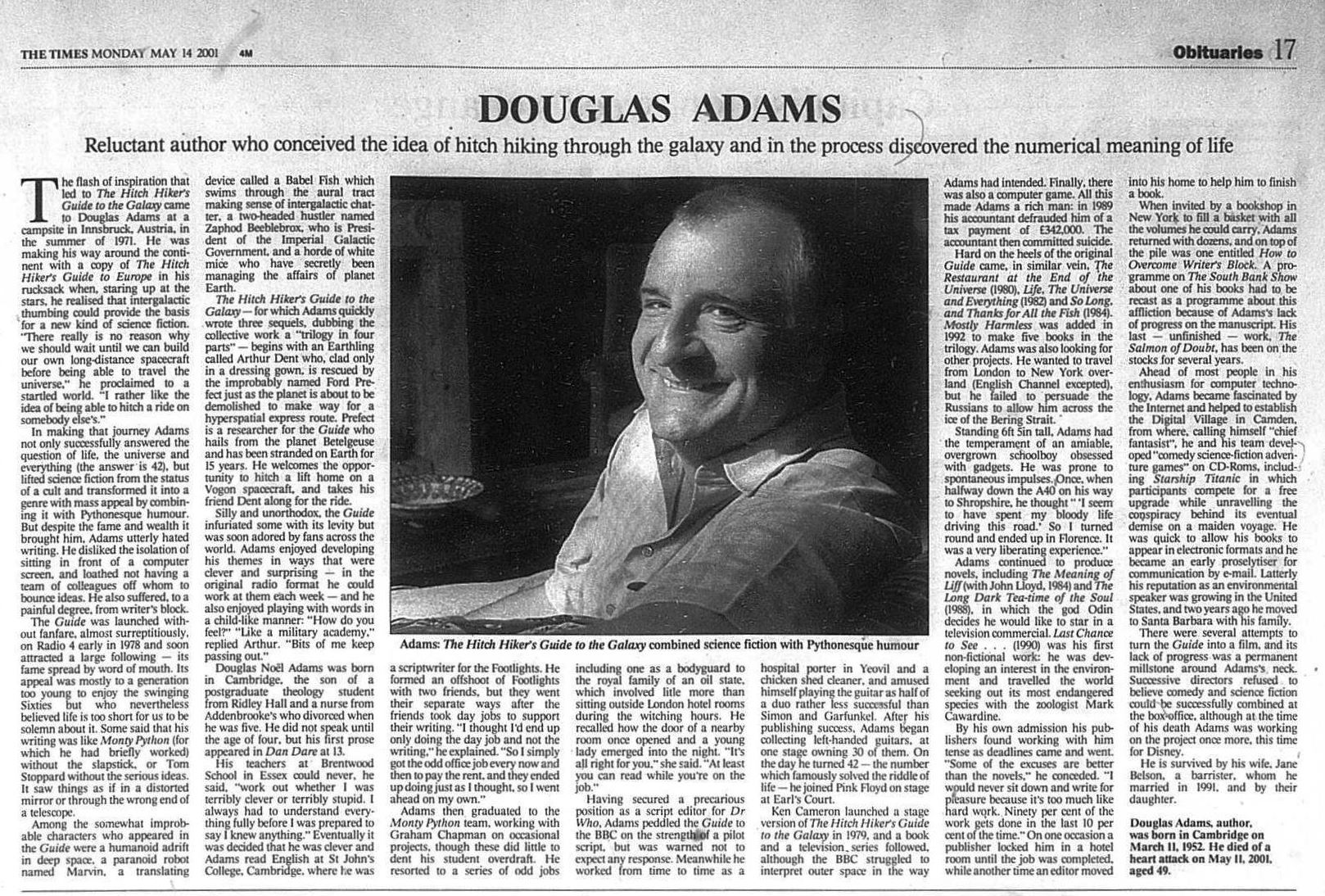

Websites
- Adams's official web site at the Wayback Machine (archived 20 July 2011), established by him, and still operated by The Digital Village
- "Douglas Adams's Mac IIfx". vintagemacworld.com. 17 October 2004. Archived from the original on 28 November 2005.
- Adam's "Rockstar" Mac video
Broadcasts
- BBC2 Omnibus tribute to Adams, presented by Kirsty Wark, 4 August 2001
- Mueller, Rick and Greengrass, Joel (2002). Life, The Universe and Douglas Adams, documentary.
- Special edition of BBC Bookclub featuring Douglas Adams, first broadcast 2 January 2000 on BBC Radio 4
Speeches
External links
| File:Commons-logo.svg | Wikimedia Commons has media related to Douglas Adams. |

| File:Wikiquote-logo.svg | Wikiquote has quotations related to: Douglas Adams |

| Library resources about Douglas Adams |
| By Douglas Adams |
|---|
- No URL found. Please specify a URL here or add one to Wikidata.
- Douglas Adams at IMDb
- Template:British Comedy Guide
- Interview with Douglas Adams, A DISCUSSION WITH National Authors on Tour TV Series, Episode No. 33 (1992)
Template:Douglas Adams Template:HitchhikerBooks Template:Dirk Gently Template:Infocom games Template:Inkpot Award 1980s
- CS1 Portuguese-language sources (pt)
- Use British English from March 2021
- Use dmy dates from January 2026
- IMDb template with no id set
- Douglas Adams
- 1952 births
- 2001 deaths
- 20th-century atheists
- 20th-century English novelists
- 20th-century English screenwriters
- 21st-century atheists
- 21st-century English novelists
- Alumni of St John's College, Cambridge
- Apple Inc. people
- Audiobook narrators
- BBC radio producers
- British atheism activists
- British child writers
- British non-fiction environmental writers
- British radio show creators
- British satirical radio show creators
- British video game writers
- Burials at Highgate Cemetery
- Comedians from Cambridgeshire
- Deaths from coronary artery disease
- English atheists
- English comedy writers
- English essayists
- English humanists
- English male comedians
- English male television writers
- English radio writers
- English satirists
- English science fiction writers
- English television writers
- English video game designers
- Infocom
- Inkpot Award winners
- Interactive fiction writers
- Monty Python
- People educated at Brentwood School, Essex
- Science Fiction Hall of Fame inductees
- Usenet people
- Writers from Cambridge
- British people of German descent