Big Apple: Difference between revisions
imported>Crork m Changed the timestamp on the Sinatra radio mention citation, which is the first item in the pop culture section. It was previously @22:50. The audio clip doesn't even have 20 minutes. He actually says it @2:23. |
imported>Shredlordsupreme →In popular culture: singular/incidental mentions of "big apple" removed |
||
| Line 1: | Line 1: | ||
{{ | {{short description|Nickname for New York City}} | ||
{{use American English|date=January 2026}}{{use mdy dates|date=December 2017}} | |||
{{for multi|the city itself|New York City|other uses|Big Apple (disambiguation)}} | {{for multi|the city itself|New York City|other uses|Big Apple (disambiguation)}} | ||
[[ | [[file:big-apple-corner.jpg|thumb|300px|right|Big Apple Corner at [[54th Street (Manhattan)|54th Street]] and [[Broadway (Manhattan)|Broadway]], in [[Manhattan]]'s [[Theater District, Manhattan|Theater District]]]] | ||
"'''The Big Apple'''" is a [[Nicknames of New York City|nickname]] for [[New York City]]. It was first popularized in the 1920s by [[John J. Fitz Gerald]], a sportswriter for the ''[[The Morning Telegraph|New York Morning Telegraph]]''. Its popularity since the 1970s is due in part to a promotional campaign by the New York tourist authorities. | "'''The Big Apple'''" is a [[Nicknames of New York City|nickname]] for [[New York City]]. It was first popularized in the 1920s by [[John J. Fitz Gerald]], a sportswriter for the ''[[The Morning Telegraph|New York Morning Telegraph]]''. Its popularity since the 1970s is due in part to a promotional campaign by the New York tourist authorities. | ||
== Origin == | == Origin == | ||
Although the history of "Big Apple" was once thought a mystery,<ref>[[Cecil Adams|Adams, Cecil]] (February 18, 1977) [http://www.straightdope.com/classics/a1_382.html "Why is New York called the Big Apple?"], ''[[The Straight Dope]]''</ref> a clearer picture of the term's history has emerged due to the work of historian [[Barry Popik]] | |||
Although the history of "Big Apple" was once thought a mystery,<ref>[[Cecil Adams|Adams, Cecil]] (February 18, 1977) [http://www.straightdope.com/classics/a1_382.html "Why is New York called the Big Apple?"], ''[[The Straight Dope]]''</ref> a clearer picture of the term's history has emerged due to the work of historian [[Barry Popik]]<ref>[[Barry Popik|Popik, Barry]] [http://www.barrypopik.com/ "The Big Apple"]. Research by Barry Popik and others with the text of contemporary examples.</ref> as well as Gerald Cohen of the [[Missouri University of Science and Technology]].<ref>Cohen, Gerald (1991) ''Origin of New York City's Nickname "The Big Apple"''. Bern, Switzerland: Peter Lang. {{ISBN|3-631-43787-0}}</ref> A number of false theories had previously existed,<ref>{{cite web| url = http://www.barrypopik.com/index.php/new_york_city/category/C10/| title = "False Etymologies"}}</ref> including a claim that the term derived from a woman named Eve who ran a brothel in the city.<ref name=salwen /> This was subsequently exposed as a hoax.<ref name=salwen>{{cite web|url=http://www.salwen.com/apple.html|title=Why Is New York City Called "The Big Apple"?|first=Peter|last=Salwen|archive-url=https://web.archive.org/web/19971010010804/http://www.salwen.com/apple.html|archive-date=October 10, 1997}}</ref><ref>{{cite web| url = http://www.barrypopik.com/index.php/new_york_city/entry/big_apple_whore_hoax_1800s/| title = "Big Apple Whore Hoax (1800s!)"}}</ref> | |||
The earliest known usage of "big apple" appears in the book ''The Wayfarer in New York'' (1909), in which [[Edward Sandford Martin]] writes: <blockquote>Kansas is apt to see in New York a greedy city ... It inclines to think that the big apple gets a disproportionate share of the national sap.<ref>{{Cite news | first = William | last = Safire | author-link = William Safire | title = Big Applesource | newspaper = [[The New York Times Magazine]] | date = September 17, 2000 | url = https://www.nytimes.com/2000/09/17/magazine/the-way-we-live-now-9-17-00-on-language-slurvian.html?pagewanted=2}}</ref><ref>{{Citation | first = William | last = Safire | author-link = William Safire | title = The Right Word in the Right Place at the Right Time | year = 2004 | page = [https://books.google.com/books?id=blcCxBWVdzgC&pg=PA23&dq=big%20apple 23]| publisher=Simon & Schuster|isbn=9780743242448}}</ref></blockquote> [[William Safire]] considered this the coinage, but because the phrase is not quoted in the text, it is likely that it was used as a metaphor, and not as a nickname for the city.<ref name=gothamist>Hamilton, Alex (January 21, 2020) [https://gothamist.com/arts-entertainment/big-apple-nickname-origin-nyc-history "Where Did The Nickname 'The Big Apple' Come From?"] {{Webarchive|url=https://web.archive.org/web/20200122030521/https://gothamist.com/arts-entertainment/big-apple-nickname-origin-nyc-history |date=January 22, 2020 }} ''[[Gothamist]]''</ref> | The earliest known usage of "big apple" appears in the book ''The Wayfarer in New York'' (1909), in which [[Edward Sandford Martin]] writes: <blockquote>Kansas is apt to see in New York a greedy city ... It inclines to think that the big apple gets a disproportionate share of the national sap.<ref>{{Cite news | first = William | last = Safire | author-link = William Safire | title = Big Applesource | newspaper = [[The New York Times Magazine]] | date = September 17, 2000 | url = https://www.nytimes.com/2000/09/17/magazine/the-way-we-live-now-9-17-00-on-language-slurvian.html?pagewanted=2}}</ref><ref>{{Citation | first = William | last = Safire | author-link = William Safire | title = The Right Word in the Right Place at the Right Time | year = 2004 | page = [https://books.google.com/books?id=blcCxBWVdzgC&pg=PA23&dq=big%20apple 23]| publisher=Simon & Schuster|isbn=9780743242448}}</ref></blockquote> [[William Safire]] considered this the coinage, but because the phrase is not quoted in the text, it is likely that it was used as a metaphor, and not as a nickname for the city.<ref name=gothamist>Hamilton, Alex (January 21, 2020) [https://gothamist.com/arts-entertainment/big-apple-nickname-origin-nyc-history "Where Did The Nickname 'The Big Apple' Come From?"] {{Webarchive|url=https://web.archive.org/web/20200122030521/https://gothamist.com/arts-entertainment/big-apple-nickname-origin-nyc-history |date=January 22, 2020 }} ''[[Gothamist]]''</ref> | ||
=== Horse racing origin === | === Horse racing origin === | ||
"The Big Apple" was popularized as a name for New York City by [[John J. Fitz Gerald]] in a number of horse-racing articles for the ''New York Morning Telegraph'' in the 1920s. The earliest of these was a casual reference on 3 May 1921: | "The Big Apple" was popularized as a name for New York City by [[John J. Fitz Gerald]] in a number of horse-racing articles for the ''New York Morning Telegraph'' in the 1920s. The earliest of these was a casual reference on 3 May 1921: | ||
| Line 33: | Line 38: | ||
== Popularity == | == Popularity == | ||
[[file:Citi Field Home Run Apple 2012.jpg|right|thumb|250px|The [[New York Mets]] [[Home Run Apple]] located in [[Citi Field]]]] | |||
By the late 1920s, New York writers other than Fitz Gerald were starting to use "Big Apple", and were using it in contexts other than horse racing.<ref>{{cite web| url = http://www.barrypopik.com/index.php/new_york_city/entry/1920s_non_horseracing_big_apple_citations/| title = "1920s Non-Horseracing 'Big Apple' Citations"}}</ref> "The Big Apple" was a popular song<ref>{{cite web| url = http://www.barrypopik.com/index.php/new_york_city/entry/big_apple_song_by_bob_emmerich/| title = "'Big Apple""song by Bob Emmerich"}}</ref> and [[Big Apple (dance)|dance]]<ref>{{cite web| url = http://www.barrypopik.com/index.php/new_york_city/entry/big_apple_in_the_1930s_two_clubs_plus_song_and_dance/| title = "'Big Apple' in the 1930s (Two clubs, plus song and dance)"}}</ref><ref>The dance was mentioned by name by [[Mickey Rooney]] in the 1938 movie ''[[Love Finds Andy Hardy]]''.</ref> in the 1930s. Jazz musicians in the 1930s also contributed to the use of the phrase to refer to New York City,<ref>Zimmer, Ben (January 2, 2020) [https://www.wsj.com/articles/the-big-apple-new-yorks-nickname-via-new-orleans-and-the-red-delicious-11577991162 "'The Big Apple': New York’s Nickname, via New Orleans and the 'Red Delicious'"] ''[[The Wall Street Journal]]''</ref> specifically to the city and [[Harlem]] as the jazz capital of the world.<ref name=enc-nyc>Cohen, Gerald Leonard "Big Apple" in {{cite enc-nyc2|page=125}}</ref> Beside the song and the dance, two nightclubs in the city used "Big Apple" in their names.<ref name=gothamist /> | By the late 1920s, New York writers other than Fitz Gerald were starting to use "Big Apple", and were using it in contexts other than horse racing.<ref>{{cite web| url = http://www.barrypopik.com/index.php/new_york_city/entry/1920s_non_horseracing_big_apple_citations/| title = "1920s Non-Horseracing 'Big Apple' Citations"}}</ref> "The Big Apple" was a popular song<ref>{{cite web| url = http://www.barrypopik.com/index.php/new_york_city/entry/big_apple_song_by_bob_emmerich/| title = "'Big Apple""song by Bob Emmerich"}}</ref> and [[Big Apple (dance)|dance]]<ref>{{cite web| url = http://www.barrypopik.com/index.php/new_york_city/entry/big_apple_in_the_1930s_two_clubs_plus_song_and_dance/| title = "'Big Apple' in the 1930s (Two clubs, plus song and dance)"}}</ref><ref>The dance was mentioned by name by [[Mickey Rooney]] in the 1938 movie ''[[Love Finds Andy Hardy]]''.</ref> in the 1930s. Jazz musicians in the 1930s also contributed to the use of the phrase to refer to New York City,<ref>Zimmer, Ben (January 2, 2020) [https://www.wsj.com/articles/the-big-apple-new-yorks-nickname-via-new-orleans-and-the-red-delicious-11577991162 "'The Big Apple': New York’s Nickname, via New Orleans and the 'Red Delicious'"] ''[[The Wall Street Journal]]''</ref> specifically to the city and [[Harlem]] as the jazz capital of the world.<ref name=enc-nyc>Cohen, Gerald Leonard "Big Apple" in {{cite enc-nyc2|page=125}}</ref> Beside the song and the dance, two nightclubs in the city used "Big Apple" in their names.<ref name=gothamist /> | ||
| Line 39: | Line 47: | ||
In the early 1970s, however, during [[New York City fiscal crisis|the city's fiscal crisis]], "People were looking around desperately and some of them seized that old phrase the Big Apple to remind people of when New York had been a strong and powerful city and might become that again," according to the official Manhattan Borough Historian, Dr. Robert Snyder. It was then that the New York Convention and Visitors Bureau – now [[NYC & Company|"NYC Tourism + Conventions"]], New York City's official marketing and tourism organization – with the help of the [[Ogilvy & Mather]] advertising firm,<ref name=gothamist /> began to promote the city's "Big Apple" nickname to tourists,<ref>[http://www.nycvisit.com/content/index.cfm?pagePkey=20 About NYC and Company] {{Webarchive|url=https://web.archive.org/web/20071012224809/http://www.nycvisit.com/content/index.cfm?pagePkey=20 |date=October 12, 2007 }}.</ref> under the leadership of its president, Charles Gillett.<ref>{{cite web| url = http://www.barrypopik.com/index.php/new_york_city/entry/big_apple_1970s_revival_charlie_gillett_and_lew_rudin/| title = "Big Apple 1970s Revival: Charlie Gillett and Lew Rudin"}}</ref><ref name=enc-nyc /> The campaign was a success,<ref name=gothamist /> and the nickname has remained popular since then.<ref name=voa>{{cite news|author=Staff|url=http://www1.voanews.com/a-23-2009-12-24-voa2-84659432.html|title=Words and Their Stories: Nicknames for New York City|date=February 23, 2010|work=[[Voice of America]]|access-date=March 2, 2010|archive-url=https://web.archive.org/web/20100413182642/http://www1.voanews.com/a-23-2009-12-24-voa2-84659432.html|archive-date=April 13, 2010|url-status=dead|df=mdy-all}}</ref> | In the early 1970s, however, during [[New York City fiscal crisis|the city's fiscal crisis]], "People were looking around desperately and some of them seized that old phrase the Big Apple to remind people of when New York had been a strong and powerful city and might become that again," according to the official Manhattan Borough Historian, Dr. Robert Snyder. It was then that the New York Convention and Visitors Bureau – now [[NYC & Company|"NYC Tourism + Conventions"]], New York City's official marketing and tourism organization – with the help of the [[Ogilvy & Mather]] advertising firm,<ref name=gothamist /> began to promote the city's "Big Apple" nickname to tourists,<ref>[http://www.nycvisit.com/content/index.cfm?pagePkey=20 About NYC and Company] {{Webarchive|url=https://web.archive.org/web/20071012224809/http://www.nycvisit.com/content/index.cfm?pagePkey=20 |date=October 12, 2007 }}.</ref> under the leadership of its president, Charles Gillett.<ref>{{cite web| url = http://www.barrypopik.com/index.php/new_york_city/entry/big_apple_1970s_revival_charlie_gillett_and_lew_rudin/| title = "Big Apple 1970s Revival: Charlie Gillett and Lew Rudin"}}</ref><ref name=enc-nyc /> The campaign was a success,<ref name=gothamist /> and the nickname has remained popular since then.<ref name=voa>{{cite news|author=Staff|url=http://www1.voanews.com/a-23-2009-12-24-voa2-84659432.html|title=Words and Their Stories: Nicknames for New York City|date=February 23, 2010|work=[[Voice of America]]|access-date=March 2, 2010|archive-url=https://web.archive.org/web/20100413182642/http://www1.voanews.com/a-23-2009-12-24-voa2-84659432.html|archive-date=April 13, 2010|url-status=dead|df=mdy-all}}</ref> | ||
Today, the name is used exclusively to refer to New York City, and is used with regularity by journalists and news headline writers across the English-speaking world.<ref>{{cite web|author=McGeough, Paul|url=http://www.smh.com.au/federal-politics/political-news/malcolm-turnbulls-big-day-out-in-the-big-apple-ahead-of-donald-trump-meeting-20170504-gvyxkq.html|title=Malcolm Turnbull's big day out in the Big Apple ahead of Donald Trump meeting|date=May 5, 2017|publisher=The Sydney Morning Herald}}</ref><ref>{{cite news|author=Trejos, Nancy|url=https://www.usatoday.com/story/travel/destinations/2017/04/28/big-apple-picnics-enjoy-new-york-like-local/100754504/|title=Big Apple picnics: Enjoy New York like a local|date=April 28, 2017|newspaper=[[USA Today]]}}</ref><ref>{{cite news|author=McDowell, Rhiannon|url=http://www.manchestereveningnews.co.uk/trips-and-breaks/new-york-simon-shopping-destinations-12966693|title=Taking a bite out of the Big Apple|date=May 1, 2017|newspaper=[[Manchester Evening News]]}}</ref><ref>{{cite news|author=Zen, Summer|url=https://www.scmp.com/business/companies/article/1998136/big-apple-benefits-falling-overseas-interest-london-commercial|title=Big Apple benefits from falling overseas interest in London commercial real estate|date=August 4, 2016|newspaper=[[South China Morning Post]]}}</ref> | |||
== In popular culture == | |||
{{in popular culture|section|date=December 2025}} | |||
* The [[Big Apple Circus]] was founded in Manhattan in 1977.<ref name="bigac">{{cite web|url=http://www.circusesandsideshows.com/circuses/bigapplecircus.html|title=Big Apple Circus|publisher=Circuses and side shows|access-date=October 10, 2016}}</ref> | |||
* The [[New York Mets]] of [[Major League Baseball]]<ref>{{cite web|title=Official New York Mets Site |website=[[MLB.com]]|url=https://www.mlb.com/mets}}</ref> have featured a "Home Run Apple" that rises whenever a Mets player hits a home run. It has become a symbol of the Mets baseball team, recognized throughout [[Major League Baseball]]<ref>{{cite web|title=Official Major League Baseball Site |url=https://www.mlb.com/}}</ref> as an iconic feature of the Mets' stadiums. It first appeared in [[Shea Stadium]], and the original can still be seen on display at [[Citi Field]], outside the Jackie Robinson Rotunda. Citi Field now uses a new apple, one that is much larger than the original.<ref>{{Cite news|last1=Gagne|first1=Matt|last2=McCarron|first2=Anthony|url=http://www.nydailynews.com/sports/baseball/mets/mets-brand-new-home-run-apple-grows-citi-field-article-1.364890|title=A new Home Run Apple grows at Citi Field|newspaper=[[New York Daily News]]|language=en|access-date=February 3, 2017}}</ref> | |||
*The [[Big Apple Circus]] was founded in Manhattan in 1977.<ref name="bigac">{{cite web|url=http://www.circusesandsideshows.com/circuses/bigapplecircus.html|title=Big Apple Circus|publisher=Circuses and side shows|access-date=October 10, 2016}}</ref> | * Uses of the term abound elsewhere in the names of cultural products and events in or concerning New York, including the [[Big Apple Anime Fest]], the [[Big Apple Circus]], the Big Apple Theater Festival, Jess Teong's [[The Kid from the Big Apple]] and Kajagoogoo's [[Big Apple (song)|Big Apple]], and playful uses of the nickname have been seen, such as Patrick Downey's 2008 historical study of New York City's criminal underworld, entitled ''Bad Seeds in the Big Apple.'' | ||
*The [[New York Mets]] of [[Major League Baseball]]<ref>{{cite web|title=Official New York Mets Site |website=[[MLB.com]]|url=https://www.mlb.com/mets}}</ref> have featured a "Home Run Apple" that rises whenever a Mets player hits a home run. It has become a symbol of the Mets baseball team, recognized throughout [[Major League Baseball]]<ref>{{cite web|title=Official Major League Baseball Site |url=https://www.mlb.com/}}</ref> as an iconic feature of the Mets' stadiums. It first appeared in [[Shea Stadium]], and the original can still be seen on display at [[Citi Field]], outside the Jackie Robinson Rotunda. Citi Field now uses a new apple, one that is much larger than the original.<ref>{{Cite news|last1=Gagne|first1=Matt|last2=McCarron|first2=Anthony|url=http://www.nydailynews.com/sports/baseball/mets/mets-brand-new-home-run-apple-grows-citi-field-article-1.364890|title=A new Home Run Apple grows at Citi Field|newspaper=[[New York Daily News]]|language=en|access-date=February 3, 2017}}</ref> | |||
*Uses of the term abound elsewhere in the names of cultural products and events in or concerning New York, including the [[Big Apple Anime Fest]], the [[Big Apple Circus]], the Big Apple Theater Festival, Jess Teong's [[The Kid from the Big Apple]] and Kajagoogoo's [[Big Apple (song)|Big Apple]], and playful uses of the nickname have been seen, such as Patrick Downey's 2008 historical study of New York City's criminal underworld, entitled ''Bad Seeds in the Big Apple.'' | |||
{{portal|New York City}} | {{portal|New York City}} | ||
== References == | == References == | ||
{{ | |||
{{reflist}} | |||
== External links == | == External links == | ||
{{wiktionary|Big Apple}} | {{wiktionary|Big Apple}} | ||
* [http:// | * [http://barrypopik.com/article/3/summary-the-big-apple The Big Apple] Research on the term's history by [[Barry Popik]] | ||
* [http:// | * [http://straightdope.com/classics/a990917.html Straight Dope article] | ||
{{New York City}} | {{New York City}}{{authority control}} | ||
{{ | |||
[[ | [[category:1900s neologisms]] | ||
[[ | [[category:American slang]] | ||
[[ | [[category:apples in culture]] | ||
[[ | [[category:cities named after apples]]<!--[[category:etymologies]]--> | ||
[[ | [[category:city fruit nicknames]] | ||
[[ | [[category:culture of New York City]] | ||
[[ | [[category:symbols of New York City]] | ||
Latest revision as of 00:10, 6 April 2026

"The Big Apple" is a nickname for New York City. It was first popularized in the 1920s by John J. Fitz Gerald, a sportswriter for the New York Morning Telegraph. Its popularity since the 1970s is due in part to a promotional campaign by the New York tourist authorities.
Origin
Although the history of "Big Apple" was once thought a mystery,[1] a clearer picture of the term's history has emerged due to the work of historian Barry Popik[2] as well as Gerald Cohen of the Missouri University of Science and Technology.[3] A number of false theories had previously existed,[4] including a claim that the term derived from a woman named Eve who ran a brothel in the city.[5] This was subsequently exposed as a hoax.[5][6]
The earliest known usage of "big apple" appears in the book The Wayfarer in New York (1909), in which Edward Sandford Martin writes:
Kansas is apt to see in New York a greedy city ... It inclines to think that the big apple gets a disproportionate share of the national sap.[7][8]
William Safire considered this the coinage, but because the phrase is not quoted in the text, it is likely that it was used as a metaphor, and not as a nickname for the city.[9]
Horse racing origin
"The Big Apple" was popularized as a name for New York City by John J. Fitz Gerald in a number of horse-racing articles for the New York Morning Telegraph in the 1920s. The earliest of these was a casual reference on 3 May 1921:
J. P. Smith, with Tippity Witchet and others of the L. T. Bauer string, is scheduled to start for "the big apple" to-morrow after a most prosperous Spring campaign at Bowie and Havre de Grace.[10]
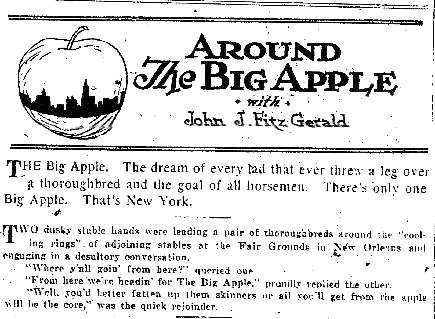
Fitz Gerald referred to the "big apple" frequently thereafter.[11] He explained his use in a column dated February 18, 1924, under the headline "Around the Big Apple":
The Big Apple. The dream of every lad that ever threw a leg over a thoroughbred and the goal of all horsemen. There's only one Big Apple. That's New York.[12][9]
Fitz Gerald reportedly first heard "The Big Apple" used to describe New York's racetracks by two African American stable hands at the New Orleans Fair Grounds.[13][9] Using racing records, Popik traced that conversation to January 1920.[9]
In recognition of Fitz Gerald's role in promulgating "The Big Apple" as a nickname for New York City, in 1997 Mayor Rudy Giuliani signed legislation designating as "Big Apple Corner" the southwest corner of West 54th Street and Broadway, the corner on which John J. Fitz Gerald lived from 1934 to 1963.[14] The Hotel Ameritania also once had a plaque which was installed in 1996, according to Popik, but it was removed during renovations to the building and was lost.[9]
Evidence can also be found in the Chicago Defender, an African-American newspaper that had a national circulation. Writing for the Defender on September 16, 1922, "Ragtime" Billy Tucker used the name "big apple" to refer to New York in a non-horse-racing context:
I trust your trip to 'the big apple' (New York) was a huge success and only wish that I had been able to make it with you.[15]
Tucker had also earlier used "big apple" as a reference to Los Angeles. It is possible that he simply used "big apple" as a nickname for any large city:
Dear Pal, Tony: No, Ragtime Billy Tucker hasn't dropped completely out of existence, but is still in the 'Big Apple', Los Angeles.[15]
Popularity

By the late 1920s, New York writers other than Fitz Gerald were starting to use "Big Apple", and were using it in contexts other than horse racing.[16] "The Big Apple" was a popular song[17] and dance[18][19] in the 1930s. Jazz musicians in the 1930s also contributed to the use of the phrase to refer to New York City,[20] specifically to the city and Harlem as the jazz capital of the world.[21] Beside the song and the dance, two nightclubs in the city used "Big Apple" in their names.[9]
Walter Winchell and other writers continued to use the term in the 1940s and early 1950s,[22] but by the late 1950s, if it was known at all,[21] it had come to be considered an outdated nickname for New York.[23]
In the early 1970s, however, during the city's fiscal crisis, "People were looking around desperately and some of them seized that old phrase the Big Apple to remind people of when New York had been a strong and powerful city and might become that again," according to the official Manhattan Borough Historian, Dr. Robert Snyder. It was then that the New York Convention and Visitors Bureau – now "NYC Tourism + Conventions", New York City's official marketing and tourism organization – with the help of the Ogilvy & Mather advertising firm,[9] began to promote the city's "Big Apple" nickname to tourists,[24] under the leadership of its president, Charles Gillett.[25][21] The campaign was a success,[9] and the nickname has remained popular since then.[26]
Today, the name is used exclusively to refer to New York City, and is used with regularity by journalists and news headline writers across the English-speaking world.[27][28][29][30]
In popular culture
TemplateStyles' src attribute must not be empty.
This section appears to contain trivial, minor, or unrelated references to popular culture. (December 2025) |

- The Big Apple Circus was founded in Manhattan in 1977.[31]
- The New York Mets of Major League Baseball[32] have featured a "Home Run Apple" that rises whenever a Mets player hits a home run. It has become a symbol of the Mets baseball team, recognized throughout Major League Baseball[33] as an iconic feature of the Mets' stadiums. It first appeared in Shea Stadium, and the original can still be seen on display at Citi Field, outside the Jackie Robinson Rotunda. Citi Field now uses a new apple, one that is much larger than the original.[34]
- Uses of the term abound elsewhere in the names of cultural products and events in or concerning New York, including the Big Apple Anime Fest, the Big Apple Circus, the Big Apple Theater Festival, Jess Teong's The Kid from the Big Apple and Kajagoogoo's Big Apple, and playful uses of the nickname have been seen, such as Patrick Downey's 2008 historical study of New York City's criminal underworld, entitled Bad Seeds in the Big Apple.
References
- ↑ Adams, Cecil (February 18, 1977) "Why is New York called the Big Apple?", The Straight Dope
- ↑ Popik, Barry "The Big Apple". Research by Barry Popik and others with the text of contemporary examples.
- ↑ Cohen, Gerald (1991) Origin of New York City's Nickname "The Big Apple". Bern, Switzerland: Peter Lang. ISBN 3-631-43787-0
- ↑ ""False Etymologies"".
- ↑ 5.0 5.1 Salwen, Peter. "Why Is New York City Called "The Big Apple"?". Archived from the original on October 10, 1997.
- ↑ ""Big Apple Whore Hoax (1800s!)"".
- ↑ Safire, William (September 17, 2000). "Big Applesource". The New York Times Magazine.
- ↑ Safire, William (2004), The Right Word in the Right Place at the Right Time, Simon & Schuster, p. 23, ISBN 9780743242448
- ↑ 9.0 9.1 9.2 9.3 9.4 9.5 9.6 9.7 Hamilton, Alex (January 21, 2020) "Where Did The Nickname 'The Big Apple' Come From?" Archived January 22, 2020, at the Wayback Machine Gothamist
- ↑ "First 'Big Apple': May 3, 1921".
- ↑ Numerous 1920s “Big Apple” citations in the New York Morning Telegraph.
- ↑ First “Big Apple” explanation: February 18, 1924. See also the original article image.
- ↑ Hutchinson, Sean (May 8, 2018). "Why is New York City Called The Big Apple?". Retrieved July 23, 2018.
- ↑ Mayor's Press Office, Release No. 082-97, Mayor Giuliani Signs Legislation Creating "Big Apple Corner" in Manhattan (Feb. 12, 1997).
- ↑ 15.0 15.1 "Big Apple" antedating Archived February 20, 2008, at the Wayback Machine; 1920s Vaudeville/Ragtime “Big Apple” Citations.
- ↑ ""1920s Non-Horseracing 'Big Apple' Citations"".
- ↑ ""'Big Apple""song by Bob Emmerich"".
- ↑ ""'Big Apple' in the 1930s (Two clubs, plus song and dance)"".
- ↑ The dance was mentioned by name by Mickey Rooney in the 1938 movie Love Finds Andy Hardy.
- ↑ Zimmer, Ben (January 2, 2020) "'The Big Apple': New York’s Nickname, via New Orleans and the 'Red Delicious'" The Wall Street Journal
- ↑ 21.0 21.1 21.2 Cohen, Gerald Leonard "Big Apple" in Template:Cite enc-nyc2
- ↑ ""'Big Apple' in the 1940s-1950s"".
- ↑ Vonnegut, Kurt (1969) Slaughterhouse-Five New York: Dell Publishing. p.207. Quote: "New York." / "The Big Apple." / "Hm?" / "That's what they used to call New York." / "Oh."
- ↑ About NYC and Company Archived October 12, 2007, at the Wayback Machine.
- ↑ ""Big Apple 1970s Revival: Charlie Gillett and Lew Rudin"".
- ↑ Staff (February 23, 2010). "Words and Their Stories: Nicknames for New York City". Voice of America. Archived from the original on April 13, 2010. Retrieved March 2, 2010.
- ↑ McGeough, Paul (May 5, 2017). "Malcolm Turnbull's big day out in the Big Apple ahead of Donald Trump meeting". The Sydney Morning Herald.
- ↑ Trejos, Nancy (April 28, 2017). "Big Apple picnics: Enjoy New York like a local". USA Today.
- ↑ McDowell, Rhiannon (May 1, 2017). "Taking a bite out of the Big Apple". Manchester Evening News.
- ↑ Zen, Summer (August 4, 2016). "Big Apple benefits from falling overseas interest in London commercial real estate". South China Morning Post.
- ↑ "Big Apple Circus". Circuses and side shows. Retrieved October 10, 2016.
- ↑ "Official New York Mets Site". MLB.com.
- ↑ "Official Major League Baseball Site".
- ↑ Gagne, Matt; McCarron, Anthony. "A new Home Run Apple grows at Citi Field". New York Daily News. Retrieved February 3, 2017.
External links
| File:Wiktionary-logo-en-v2.svg | Look up Big Apple in Wiktionary, the free dictionary. |

- The Big Apple Research on the term's history by Barry Popik
- Straight Dope article