Carl Sagan: Difference between revisions
imported>TheRealStang m →In popular culture: Chronological order |
No edit summary |
||
| Line 69: | Line 69: | ||
}} | }} | ||
'''Carl Edward Sagan''' ({{IPAc-en|ˈ|s|eɪ|ɡ|ən}}; {{respell|SAY|gən}};<!-- Location of birth; please add here. --> November 9, 1934{{spaced ndash}}<!-- Location of death; please add here. -->December 20, 1996) was an American [[astronomer]], [[planetary scientist]] and [[science communicator]]. | '''Carl Edward Sagan''' ({{IPAc-en|ˈ|s|eɪ|ɡ|ən}}; {{respell|SAY|gən}};<!-- Location of birth; please add here. --> November 9, 1934{{spaced ndash}}<!-- Location of death; please add here. -->December 20, 1996)<ref name="nyt"/> was an American [[astronomer]], [[planetary scientist]] and [[science communicator]]. Initially an assistant professor at [[Harvard University|Harvard]], Sagan later moved to [[Cornell]], where he was the David Duncan Professor of Astronomy and Space Sciences and directed the Laboratory for Planetary Studies. He played an active role in the [[Mariner program|Mariner]], [[Viking program|Viking]] and [[Voyager program|Voyager]] programs. He published more than 600 scientific papers and articles and several [[popular science]] books, starting with ''[[The Cosmic Connection]]''.<ref name="scholar"/><ref name=Smithsonian/> He won the [[Pulitzer Prize for General Nonfiction]] for ''[[The Dragons of Eden]]''. | ||
He co-wrote and narrated the 1980 documentary series ''[[Cosmos: A Personal Voyage]]'', which has been seen by at least 500 million people in 60 countries and won two [[Emmy Awards]] and a [[Peabody Award]].<ref name =Starchild>{{cite web |url=http://starchild.gsfc.nasa.gov/docs/StarChild/whos_who_level2/sagan.html |title=StarChild: Dr. Carl Sagan |work=StarChild |publisher=[[NASA]] |access-date=October 8, 2009 |archive-date=February 7, 2012 |archive-url=https://web.archive.org/web/20120207191139/http://starchild.gsfc.nasa.gov/docs/StarChild/whos_who_level2/sagan.html |url-status=live}}</ref> [[Cosmos (Sagan book)|''Cosmos'']], the companion volume, was the bestselling science book to date. | |||
Sagan was | A lifelong [[science fiction]] fan, Sagan entered the genre with ''[[Contact (novel)|Contact]]'', which was adapted as the [[Contact (1997 American film)|film of the same name]]. He was a founding member and first president of the [[Planetary Society]]. He proposed the ''[[Pale Blue Dot]]'' photograph of Earth taken by ''[[Voyager 1]]''.<ref name="planet-soc">{{cite web|url=http://www.planetary.org/explore/space-topics/earth/pale-blue-dot.html|title=A Pale Blue Dot|publisher=[[The Planetary Society]]|access-date=December 21, 2014|url-status=live|archive-url=https://web.archive.org/web/20141219181905/http://www.planetary.org/explore/space-topics/earth/pale-blue-dot.html|archive-date=December 19, 2014}}</ref> | ||
He had a lifelong interest in the possibility of [[extraterrestrial life]] and is generally credited with contributions to the [[Arecibo message]], with a much more significant role developing the [[Pioneer plaques]] and the [[Voyager Golden Record]], universal messages that could potentially be understood by any intelligence that might find them. He promoted [[Scientific skepticism|skepticism]] and the [[scientific method]], particularly in his penultimate book ''[[The Demon-Haunted World]]''. He popularized a toolkit for [[critical thinking]].<ref name=Kit/> He made famous the maxim "[[Extraordinary claims require extraordinary evidence]]." The phrase "Billions and billions" was attributed to him, although he never said it; he did use it as the title of his [[Billions and billions|last book]]. Sagan received numerous awards and honors, including the [[NASA Distinguished Public Service Medal]] and the [[National Academy of Sciences]] [[Public Welfare Medal]]. He married three times and had five children. After developing [[myelodysplastic syndrome|myelodysplasia]], Sagan died of [[pneumonia]] at the age of 62 on December 20, 1996. | |||
== Early life== | == Early life== | ||
===Childhood=== | ===Childhood=== | ||
[[File:Carl Sagan in 1951 Allegarooter.jpg|thumb|upright|left|Sagan (age 16) in the 1951 [[Rahway High School]] yearbook | [[File:Carl Sagan in 1951 Allegarooter.jpg|thumb|upright|left|Sagan (age 16) in the 1951 [[Rahway High School]] yearbook]] | ||
Carl Edward Sagan was born on November 9, 1934, in the [[Bensonhurst, Brooklyn|Bensonhurst]] neighborhood of New York City's [[Brooklyn]] borough.<ref name=poundstone>[[#Poundstone|Poundstone 1999]], pp. 363–364, 374–375.</ref><ref name="nyt"/> His mother, Rachel Molly Gruber (1906–1982), was a housewife from New York City; his father, Samuel Sagan (1905–1979), was a Ukrainian-born garment worker who had emigrated from [[Kamianets-Podilskyi]] (then in the [[Russian Empire]]).<ref name="Internet Accuracy Project">{{cite web |title=Carl Sagan |url=http://www.accuracyproject.org/cbe-Sagan,Carl.html |website=Internet Accuracy Project |location=[[Grandville, Michigan]] |access-date=August 22, 2012 |archive-date=March 8, 2012 |archive-url=https://web.archive.org/web/20120308095615/http://www.accuracyproject.org/cbe-Sagan,Carl.html |url-status=live}}</ref> Sagan was named in honor of his maternal grandmother, Chaiya Clara, who had died while giving birth to her second child; she was, in Sagan's words, "the mother she [Rachel] never knew."<!-- note: "she" is correct, refers to Rachel. Please do not turn this into "he" --><ref name="Davidson">[[#CITEREFDavidson1999|Davidson 1999]]. | Carl Edward Sagan was born on November 9, 1934, in the [[Bensonhurst, Brooklyn|Bensonhurst]] neighborhood of New York City's [[Brooklyn]] borough.<ref name=poundstone>[[#Poundstone|Poundstone 1999]], pp. 363–364, 374–375.</ref><ref name="nyt"/> His mother, Rachel Molly Gruber (1906–1982), was a housewife from New York City; his father, Samuel Sagan (1905–1979), was a Ukrainian-born garment worker who had emigrated from [[Kamianets-Podilskyi]] (then in the [[Russian Empire]]).<ref name="Internet Accuracy Project">{{cite web |title=Carl Sagan |url=http://www.accuracyproject.org/cbe-Sagan,Carl.html |website=Internet Accuracy Project |location=[[Grandville, Michigan]] |access-date=August 22, 2012 |archive-date=March 8, 2012 |archive-url=https://web.archive.org/web/20120308095615/http://www.accuracyproject.org/cbe-Sagan,Carl.html |url-status=live}}</ref> Sagan was named in honor of his maternal grandmother, Chaiya Clara, who had died while giving birth to her second child; she was, in Sagan's words, "the mother she [Rachel] never knew."<!-- note: "she" is correct, refers to Rachel. Please do not turn this into "he" --><ref name="Davidson">[[#CITEREFDavidson1999|Davidson 1999]].</ref> Sagan's family lived in a modest apartment in Bensonhurst. He later described his family as [[Reform Judaism|Reform Jews]], one of the more liberal of Judaism's four main branches. He and his sister agreed that their father was not especially religious, but that their mother "definitely believed in God, and was active in the [[Synagogue|temple]] [...] and served only [[Kosher foods|kosher]] meat."{{Sfn|Davidson|1999|p=12}} During the worst years of the [[Great Depression]], his father worked as a movie theater usher.{{Sfn|Davidson|1999|p=12}} | ||
According to biographer Keay Davidson, Sagan | According to biographer Keay Davidson, Sagan traced his analytical inclinations to his mother, who had been extremely poor as a child in New York City during [[World War I]] and the 1920s,{{Sfn|Davidson|1999|p=2}} and whose later intellectual ambitions were sabotaged by her poverty, status as a woman and wife, and [[Jewish ethnicity]]. Davidson suggested she "worshipped her only son, Carl" because "he would fulfill her unfulfilled dreams."{{Sfn|Davidson|1999|p=2}} Sagan traced his sense of wonder to his father, who spent his free time giving apples to the poor or helping soothe tensions between workers and management within New York City's garment industry.{{Sfn|Davidson|1999|p=2}} Sagan said: "My parents were not scientists. They knew almost nothing about science. But in introducing me simultaneously to skepticism and to wonder, they taught me the two uneasily cohabiting modes of thought that are central to the scientific method."<ref name="Spangenburg">[[#Spangenburg & Moser|Spangenburg & Moser 2004]], pp. 2–5.</ref> | ||
He described a defining moment in his development, when his parents took him to the [[1939 New York World's Fair]]. He recalled his vivid memories of several exhibits there. One, [[Futurama (New York World's Fair)|Futurama]], included a moving map, which, as he recalled, "showed beautiful highways and [[Cloverleaf interchange|cloverleaves]] and little [[General Motors]] cars all carrying people to skyscrapers, buildings with lovely spires, flying buttresses—and it looked great!"{{Sfn|Davidson|1999|p=14}} Another involved a flashlight shining on a [[Solar cell|photoelectric cell]], which created a crackling sound, and another showed how the sound from a [[tuning fork]] became a wave on an [[oscilloscope]]. He saw an exhibit of the nascent medium of [[television]]. He later wrote: "Plainly, the world held wonders of a kind I had never guessed. How ''could'' a tone become a picture and light become a noise?"{{Sfn|Davidson|1999|p=14}} Sagan saw one of the fair's most publicized events: the burial at [[Flushing Meadows–Corona Park|Flushing Meadows]] of a [[time capsule]], which contained mementos from the 1930s to be recovered in the far future. Davidson wrote that this "thrilled Carl." As an adult, Sagan and his colleagues would create similar time capsules to be sent out into space. | |||
Sagan | During [[World War II]], Sagan's parents worried about the fate of their European relatives, but he was generally unaware of the details of the ongoing war. He wrote, "Sure, we had relatives who were caught up in the [[The Holocaust|Holocaust]]. [[Adolf Hitler|Hitler]] was not a popular fellow in our household... but on the other hand, I was fairly insulated from the horrors of the war." His sister, Carol, said that their mother "above all wanted to protect Carl... she had an extraordinarily difficult time dealing with World War II and the Holocaust."{{Sfn|Davidson|1999|p=15}} | ||
He wondered what the [[stars]] were, but no one could give him a clear answer. He recalled: <blockquote> As soon as I was old enough, my parents gave me my very first library card. I think the library was on 85th Street, an alien land. Immediately, I asked the librarian for something on stars. She returned with a picture book displaying portraits of men and women with names like [[Clark Gable]] and [[Jean Harlow]]. I complained, and for some reason then obscure to me, she smiled and found another book—the right kind of book. I opened it breathlessly and read until I found it. The book said something astonishing, a very big thought. It said that the stars were suns, but very far away. [[The Sun]] was a star, but close up... | |||
I was innocent of the notion of the [[inverse square law]] for light propagation. I had not the ghost of a chance of calculating the distance to the stars. But I could tell that if the stars were suns, they had to be very far away—farther away than 85th Street, farther away than Manhattan, farther away, probably, than New Jersey. The Cosmos was much bigger than I had guessed.<ref name=Cosmos>{{cite book| last=Sagan| first=Carl| title=[[Cosmos (Sagan book)|Cosmos]] | year=1980}}</ref>{{rp|180}}</blockquote> | |||
He said: "The scale of the universe suddenly opened up to me. It was a kind of religious experience. There was a magnificence to it, a grandeur, a scale which has never left me. Never ever left me."{{Sfn|Davidson|1999|p=18}} At age six or seven, he and a close friend took trips to the [[American Museum of Natural History]]. They were impressed by the displays of [[dinosaur]] fossils and nature [[dioramas]] and by the [[Hayden Planetarium]].{{Sfn|Davidson|1999|p=18}} Sagan's parents nurtured his growing interest in science, buying him chemistry sets and reading matter. Per biographer Ray Spangenburg, Sagan's desire to understand the Cosmos became a "driving force in his life, a continual spark to his intellect, and a quest that would never be forgotten."<ref name="Spangenburg" /><ref name="anb.org">{{Cite encyclopedia |first=Keay |last=Davidson |title=Sagan, Carl (1934–1996), space scientist, author, science popularizer, TV personality, and antinuclear weapons activist |url=https://www.anb.org/view/10.1093/anb/9780198606697.001.0001/anb-9780198606697-e-1302612 |encyclopedia=American National Biography |publisher=[[Oxford University Press]] |year=2000 |doi=10.1093/anb/9780198606697.article.1302612 |archive-url=https://web.archive.org/web/20210514010502/https://www.anb.org/view/10.1093/anb/9780198606697.001.0001/anb-9780198606697-e-1302612 |archive-date=May 14, 2021 |url-status=live |isbn=978-0-19-860669-7 |access-date=June 23, 2021|url-access=subscription }}</ref> His fascination with outer space deepened after reading [[Edgar Rice Burroughs]]'s [[John Carter of Mars]] books. In 1947, he discovered ''[[Astounding Science Fiction]]'', which introduced him to more [[hard science fiction]] speculations: "Each month I eagerly awaited the arrival of ''Astounding''. I read [[Jules Verne|Verne]] and [[H. G. Wells|Wells]], read, cover‐to‐cover, the first two science‐fiction anthologies that I was able to find, devised scorecards, similar to those I was fond of making for [[baseball]], on the quality of the stories I read. Many ranked high in asking interesting questions but low in answering them."<ref name="sagan19780528">{{Cite news |url=https://www.nytimes.com/1978/05/28/archives/growing-up-with.html |title=Growing up with Science Fiction |last=Sagan |first=Carl |date=May 28, 1978 |work=[[The New York Times]] |access-date=December 12, 2018 |page=SM7|issn=0362-4331 |archive-date=December 11, 2018 |archive-url=https://web.archive.org/web/20181211180058/https://www.nytimes.com/1978/05/28/archives/growing-up-with.html |url-status=live}}</ref> | |||
===Education=== | ===Education=== | ||
[[File:Carl Sagan in 1954 Cap and Gown.jpg|thumb|upright|right|Sagan in the [[University of Chicago]]'s 1954 yearbook]] | [[File:Carl Sagan in 1954 Cap and Gown.jpg|thumb|upright|right|Sagan in the [[University of Chicago]]'s 1954 yearbook]] | ||
Sagan attended David A. Boody Junior High School in his native Bensonhurst and had his [[bar mitzvah]] when he turned 13.{{Sfn|Davidson|1999|p=23}} In 1948, when he was 14, his father's work took the family to | Sagan attended David A. Boody Junior High School, in his native Bensonhurst and had his [[bar mitzvah]] when he turned 13.{{Sfn|Davidson|1999|p=23}} In 1948, when he was 14, his father's work took the family to [[Rahway, New Jersey]], where he attended [[Rahway High School]].{{Sfn|Davidson|1999|p=23}} He was a straight-A student but was bored because his classes did not challenge him and his teachers did not inspire him.{{Sfn|Davidson|1999|p=23}} His teachers realized this and tried to convince his parents to send him to a private school, with an administrator telling them, "This kid ought to go to a school for gifted children, he has something really remarkable."{{Sfn|Davidson|1999|p=24}} However, his parents could not afford to do so. Sagan became president of the school's chemistry club, and set up his own laboratory at home. He taught himself about [[molecule]]s by making cardboard cutouts to help him visualize how they were formed: "I found that about as interesting as doing [chemical] experiments."{{Sfn|Davidson|1999|p=24}} He was mostly interested in astronomy, studying it in his spare time. In his junior year of high school, he discovered that professional astronomers were paid for doing something he always enjoyed. "That was a splendid day—when I began to suspect that if I tried hard I could do astronomy full-time."{{Sfn|Davidson|1999|p=25}} | ||
Before | Before finishing high school, Sagan entered an essay writing contest in which he explored the idea that human contact with advanced extraterrestrials might be as disastrous for people on Earth as [[European colonization of the Americas|Native Americans' first contact with Europeans]] had been for Native Americans.<ref name="ReferenceA">[[#Poundstone|Poundstone 1999]], p. 15.</ref> The subject was considered controversial, but his rhetorical skill won over the judges and they awarded him first prize.<ref name="ReferenceA"/> When he was about to graduate from high school, his classmates voted him "most likely to succeed" and put him in line to be [[valedictorian]].<ref name="ReferenceA"/> In 1950, Sagan wrote the essay "Space, Time, and the Poet" for his high school newspaper.<ref>{{cite web |url=https://blogs.loc.gov/catbird/2014/01/space-time-and-the-poet-sagan/ |title= Space, Time, and the Poet Sagan |first=Robert |last=Casper |website=From the Catbird Seat: Poetry at the Library of Congress |publisher=[[Library of Congress]] |date=January 30, 2014 |access-date=August 17, 2025 }}</ref> In it, he mused on man's place in the universe as expressed by poets like [[T. S. Eliot]] and [[Alfred, Lord Tennyson]] and "the work containing perhaps the greatest poetry—[[the Bible]]."<ref>{{cite web |url=https://www.loc.gov/resource/mss85590.002/?sp=1 |title=Space, Time, and the Poet |publisher=[[Rahway High School]] Wawawhack Newsletter |access-date=August 17, 2025 }}</ref> He graduated from Rahway High School in 1951.{{Sfn|Davidson|1999|p=23}} | ||
He attended the [[University of Chicago]] as it was one of the few colleges he had applied to that would accept a 16 year old. [[Robert M. Hutchins]], its chancellor, had recently retooled the [[College of the University of Chicago]] into an "ideal meritocracy" built on [[Great Books]], [[Socratic dialogue]], [[comprehensive examination]]s, and [[college early entrance program|early entrance to college]].<ref name="ReferenceB">[[#Poundstone|Poundstone 1999]], p. 14.</ref> | |||
He joined the Ryerson Astronomical Society.<ref>{{cite web |url=http://astro.uchicago.edu/RAS/ |title=Ryerson Astronomical Society |work=Ryerson Astronomical Society (RAS) |publisher=[[University of Chicago]] Department of Astronomy and Astrophysics |access-date=August 22, 2012 |archive-date=September 19, 2012 |archive-url=https://web.archive.org/web/20120919011234/http://astro.uchicago.edu/RAS/ |url-status=live}}</ref> He wrote "College was the fulfillment of my dreams. I found teachers who not only understood science, but were actually able to explain it. … I was a physics student in a department orbiting around [[Enrico Fermi]]; I discovered what true [[mathematical elegance]] is from [[Subrahmanyan Chandrasekhar]]; I was given the chance to talk chemistry with [[Harold Urey]]; over summers I was apprenticed in biology to [[H. J. Muller]] at Indiana University; and I learned planetary astronomy from its only full-time practitioner at the time, [[G. P. Kuiper]]."<ref name=Candle>{{cite book |last=Sagan |first=Carl | title=[[The Demon-Haunted World]] | year=1995}}</ref>{{rp|xiv}} The [[Miller-Urey experiment]], conducted in 1952, sparked his interest in the [[origin of life]]. Under Urey, he wrote "Radiation and the Origin of the Gene."<ref>{{cite journal| last=Sagan| first=Carl| title=Radiation and the Origin of the Gene| date=March 1, 1957| volume=11| pp=40–55| journal=[[Evolution (journal)|Evolution]]| url=https://academic.oup.com/evolut/article-abstract/11/1/40/6868011?redirectedFrom=fulltext}}</ref> He recalled that "science was presented as an integral part of the gorgeous tapestry of human knowledge. It was considered unthinkable for an aspiring physicist not to know [[Plato]], [[Aristotle]], [[Bach]], [[Shakespeare]], [[Edward Gibbon|Gibbon]], [[Bronisław Malinowski|Malinowski]] and [[Freud]]—among many others."<ref name=Candle/>{{rp|xiv}} | |||
In 1958, Sagan and Kuiper worked on the classified military [[Project A119]], a secret [[United States Air Force]] plan to detonate a nuclear warhead on the Moon and document its effects.<ref>{{cite book |url=https://books.google.com/books?id=W1f4TvNUwLsC |title=Lunar Exploration: Human Pioneers and Robotic Surveyors |first=Paolo |last=Ulivi |date=April 6, 2004 |publisher=Springer Science & Business Media |isbn=978-1-85233-746-9 |access-date=April 15, 2016 |archive-date=January 1, 2014 |archive-url=https://web.archive.org/web/20140101183032/http://books.google.com/books?id=W1f4TvNUwLsC |url-status=live |via=[[Google Books]]}}</ref> Sagan had a [[Top Secret]] clearance at the Air Force and a [[Classified information#Secret|Secret]] clearance with [[NASA]].<ref name="morrison">{{cite journal |last=Morrison |first=David |author-link=David Morrison (astrophysicist) |date=January–February 2007 |title=Carl Sagan's Life and Legacy as Scientist, Teacher, and Skeptic |url=http://www.csicop.org/si/show/carl_sagans_life_and_legacy_as_scientist_teacher_and_skeptic |journal=[[Skeptical Inquirer]] |volume=31 |issue=1 |pages=29–38 |issn=0194-6730 |access-date=August 31, 2013 |archive-url=https://web.archive.org/web/20160201115954/http://www.csicop.org/si/show/carl_sagans_life_and_legacy_as_scientist_teacher_and_skeptic |archive-date=February 1, 2016 |url-status=dead}}</ref> In 1999, an article published in the journal ''[[Nature (journal)|Nature]]'' revealed that Sagan had included the classified titles of two Project A119 papers in his 1959 application for a scholarship to [[University of California, Berkeley]]. A follow-up letter to the journal by project leader Leonard Reiffel confirmed Sagan's security leak.<ref>{{cite journal |last1=Reiffel |first1=Leonard |title=Sagan breached security by revealing US work on a lunar bomb project |journal=Nature |date=May 4, 2000 |volume=405 |issue=13 |page=Correspondence |doi=10.1038/35011148 |pmid=10811192 |doi-access=free | issn = 0028-0836}}</ref> | He was awarded a Bachelor of Liberal Arts with general and special honors<ref>[http://www.mit.edu/people/thb/SAGAN.pdf Carl Sagan] – website of the [[Massachusetts Institute of Technology]]</ref> in what he quipped was "nothing."<!-- literally in the cited source - please do not change this --><ref>Sic. See {{cite book |title=Carl Sagan: A Biography |edition=illustrated |first1=Ray |last1=Spangenburg |first2=Kit |last2=Moser |first3=Diane |last3=Moser |publisher=Greenwood Publishing Group |year=2004 |isbn=978-0-313-32265-5 |page=[https://books.google.com/books?id=Z01FzDkprgUC&pg=PA28 28] |url=https://books.google.com/books?id=Z01FzDkprgUC |access-date=August 31, 2018 |archive-date=December 6, 2021 |archive-url=https://web.archive.org/web/20211206055120/https://books.google.com/books?id=Z01FzDkprgUC |url-status=live |via=[[Google Books]]}}</ref> In 1955, he earned a Bachelor of Science in physics. He went on to do graduate work at the University of Chicago, earning a Master of Science in physics in 1956 and a Doctor of Philosophy in astronomy and astrophysics in 1960. His doctoral thesis, under the direction of Kuiper, was "Physical Studies of the Planets".<ref name=phd>{{cite thesis |last=Sagan |first=Carl |author-link=Carl Sagan |title=Physical Studies of the Planets |degree=PhD |year=1960 |publisher=[[University of Chicago]] |page=ii |quote=A thesis in four parts submitted in partial fulfillment of the requirements for the degree of Doctor of Philosophy in the Department of Astronomy, University of Chicago, June, 1960 |oclc=20678107 | url=https://www.proquest.com/docview/301918122}}</ref><ref>[[#Spangenburg & Moser|Spangenburg & Moser 2004]], p. 28.</ref> During his [[Postgraduate education|graduate studies]], he spent summers working with Kuiper,<ref name=mathgene>{{MathGenealogy|id=226265}}</ref> as well as chemist [[Melvin Calvin]] and physicist [[George Gamow]].<ref>{{Citation |last=Tatarewicz |first=Joseph N. |title=Space Technology & Planetary Astronomy |place=Bloomington, IN |publisher=Indiana University Press |series=Science, technology, and society |year=1990 |page=22 |isbn=978-0-253-35655-0}}</ref> He credited Kuiper with teaching him [[back-of-the-envelope calculation]]s: "A possible explanation to a problem occurs to you, you pull out an old envelope, appeal to your knowledge of fundamental physics, scribble a few approximate equations on the envelope, and see if your answer comes anywhere near explaining your problem. If not, you look for a different explanation. It cut through nonsense like a knife through butter."<ref name=Candle/>{{rp|xiv}} | ||
In 1958, Sagan and Kuiper worked on the classified military [[Project A119]], a secret [[United States Air Force]] plan to detonate a nuclear warhead on the Moon and document its effects.<ref>{{cite book |url=https://books.google.com/books?id=W1f4TvNUwLsC |title=Lunar Exploration: Human Pioneers and Robotic Surveyors |first=Paolo |last=Ulivi |date=April 6, 2004 |publisher=Springer Science & Business Media |isbn=978-1-85233-746-9 |access-date=April 15, 2016 |archive-date=January 1, 2014 |archive-url=https://web.archive.org/web/20140101183032/http://books.google.com/books?id=W1f4TvNUwLsC |url-status=live |via=[[Google Books]]}}</ref> Sagan had a [[Top Secret]] clearance at the Air Force and a [[Classified information#Secret|Secret]] clearance with [[NASA]].<ref name="morrison">{{cite journal |last=Morrison |first=David |author-link=David Morrison (astrophysicist) |date=January–February 2007 |title=Carl Sagan's Life and Legacy as Scientist, Teacher, and Skeptic |url=http://www.csicop.org/si/show/carl_sagans_life_and_legacy_as_scientist_teacher_and_skeptic |journal=[[Skeptical Inquirer]] |volume=31 |issue=1 |pages=29–38 |issn=0194-6730 |access-date=August 31, 2013 |archive-url=https://web.archive.org/web/20160201115954/http://www.csicop.org/si/show/carl_sagans_life_and_legacy_as_scientist_teacher_and_skeptic |archive-date=February 1, 2016 |url-status=dead}}</ref> In 1999, an article published in the journal ''[[Nature (journal)|Nature]]'' revealed that Sagan had included the classified titles of two Project A119 papers in his 1959 application for a scholarship to [[University of California, Berkeley]]. A follow-up letter to the journal by project leader Leonard Reiffel confirmed Sagan's security leak.<ref>{{cite journal |last1=Reiffel |first1=Leonard |title=Sagan breached security by revealing US work on a lunar bomb project |journal=[[Nature (journal)|Nature]] |date=May 4, 2000 |volume=405 |issue=13 |page=Correspondence |doi=10.1038/35011148 |pmid=10811192 |doi-access=free | issn = 0028-0836}}</ref> | |||
==Career and research == | ==Career and research == | ||
[[File:Who's Out There (1975).webm|thumb|250px|thumbtime=4:45|Sagan is one of those discussing the likelihood of [[extraterrestrial life|life on other planets]] in ''[[c:File:Who's Out There (1975).webm|Who's Out There?]]'' (1973), an [[CINE|award-winning]] [[NASA]] documentary film by [[Robert Drew]].<ref>{{cite web|url=https://drewassociates.com/films/whos-out-there|title=Who's Out There? – Films – Drew Associates|access-date=March 14, 2024|website=Drew Associates|archive-url=https://web.archive.org/web/20240314170516/https://drewassociates.com/films/whos-out-there/|archive-date=March 14, 2024}}</ref>]] | [[File:Who's Out There (1975).webm|thumb|250px|thumbtime=4:45|Sagan is one of those discussing the likelihood of [[extraterrestrial life|life on other planets]] in ''[[c:File:Who's Out There (1975).webm|Who's Out There?]]'' (1973), an [[CINE|award-winning]] [[NASA]] documentary film by [[Robert Drew]].<ref>{{cite web|url=https://drewassociates.com/films/whos-out-there|title=Who's Out There? – Films – Drew Associates|access-date=March 14, 2024|website=Drew Associates|archive-url=https://web.archive.org/web/20240314170516/https://drewassociates.com/films/whos-out-there/|archive-date=March 14, 2024}}</ref>]] | ||
From 1960 to 1962, Sagan was a [[Miller Research Fellows|Miller Fellow]] at the [[University of California, Berkeley]].<ref>{{cite web |url=http://sciencereview.berkeley.edu/happy-belated-birthday-carl/ |title=Happy (Belated) Birthday Carl! |publisher=[[University of California, Berkeley]] The Berkeley Science Review |access-date=December 1, 2013 |date=November 11, 2013 |archive-date=December 3, 2013 |archive-url=https://web.archive.org/web/20131203045427/http://sciencereview.berkeley.edu/happy-belated-birthday-carl/ |url-status=dead}}</ref> Meanwhile, he published an article in 1961 in the journal ''Science'' on the atmosphere of Venus, while also working with [[NASA]]'s [[Mariner 2]] team, and served as a "Planetary Sciences Consultant" to the [[RAND Corporation]].{{Sfn|Davidson|1999|p=138}} | From 1960 to 1962, Sagan was a [[Miller Research Fellows|Miller Fellow]] at the [[University of California, Berkeley]].<ref>{{cite web |url=http://sciencereview.berkeley.edu/happy-belated-birthday-carl/ |title=Happy (Belated) Birthday Carl! |publisher=[[University of California, Berkeley]] The Berkeley Science Review |access-date=December 1, 2013 |date=November 11, 2013 |archive-date=December 3, 2013 |archive-url=https://web.archive.org/web/20131203045427/http://sciencereview.berkeley.edu/happy-belated-birthday-carl/ |url-status=dead}}</ref> Meanwhile, he published an article in 1961 in the journal [[Science (journal)|''Science'']] on the atmosphere of Venus, while also working with [[NASA]]'s [[Mariner 2]] team, and served as a "Planetary Sciences Consultant" to the [[RAND Corporation]].{{Sfn|Davidson|1999|p=138}} | ||
After the publication of Sagan's ''Science'' article, in 1961, [[Harvard University]] astronomers [[Fred Whipple]] and [[Donald Menzel]] offered Sagan the opportunity to give a colloquium at Harvard and subsequently offered him a [[Academic ranks in the United States|lecturer]] position at the institution. Sagan instead asked to be made an assistant professor, and eventually Whipple and Menzel were able to convince Harvard to offer Sagan the assistant professor position he requested.{{Sfn|Davidson|1999|p=138}} Sagan lectured, performed research, and advised graduate students at the institution from 1963 until 1968, as well as working at the [[Smithsonian Astrophysical Observatory]], also located in [[Cambridge, Massachusetts]]. | After the publication of Sagan's ''Science'' article, in 1961, [[Harvard University]] astronomers [[Fred Whipple]] and [[Donald Menzel]] offered Sagan the opportunity to give a colloquium at Harvard and subsequently offered him a [[Academic ranks in the United States|lecturer]] position at the institution. Sagan instead asked to be made an assistant professor, and eventually Whipple and Menzel were able to convince Harvard to offer Sagan the assistant professor position he requested.{{Sfn|Davidson|1999|p=138}} Sagan lectured, performed research, and advised graduate students at the institution from 1963 until 1968, as well as working at the [[Smithsonian Astrophysical Observatory]], also located in [[Cambridge, Massachusetts]]. | ||
In 1968, Sagan was denied [[academic tenure]] at Harvard. He later indicated that the decision was very unexpected.{{Sfn|Davidson|1999|p=204}} The denial has been blamed on several factors, including that he focused his interests too broadly across a number of areas (while the norm in academia is to become a renowned expert in a narrow specialty), and perhaps because of his well-publicized scientific advocacy, which some scientists perceived as borrowing the ideas of others for little more than self-promotion.<ref name="morrison"/> An advisor from his years as an undergraduate student, | In 1968, Sagan was denied [[academic tenure]] at Harvard. He later indicated that the decision was very unexpected.{{Sfn|Davidson|1999|p=204}} The denial has been blamed on several factors, including that he focused his interests too broadly across a number of areas (while the norm in academia is to become a renowned expert in a narrow specialty), and perhaps because of his well-publicized scientific advocacy, which some scientists perceived as borrowing the ideas of others for little more than self-promotion.<ref name="morrison"/> An advisor from his years as an undergraduate student, Harold Urey, wrote a letter to the tenure committee recommending strongly against tenure for Sagan.<ref name="anb.org"/> | ||
Long before the ill-fated tenure process, Cornell University astronomer [[Thomas Gold]] had courted Sagan to move to [[Ithaca, New York]], and join the recently hired astronomer [[Frank Drake]] among the faculty at Cornell. Following the denial of tenure from Harvard, Sagan accepted Gold's offer and remained a faculty member at Cornell for nearly 30 years until his death in 1996. Unlike Harvard, the smaller and more laid-back astronomy department at Cornell welcomed Sagan's growing celebrity status.{{Sfn|Davidson|1999|p=213}} Following two years as an associate professor, Sagan became a [[Professor|full professor]] at Cornell in 1970 and directed the Laboratory for [[Planetary science|Planetary Studies]] there. From 1972 to 1981, he was associate director of the Center for Radiophysics and Space Research (CRSR) at Cornell. In 1976, he became the David Duncan Professor of Astronomy and Space Sciences, a position he held for the remainder of his life.<ref name=Soc/><ref>{{cite book |title=Conversations with Carl Sagan |edition=illustrated |first1=Carl |last1=Sagan |first2=Tom |last2=Head |publisher=Univ. Press of Mississippi |year=2006 |isbn=978-1-57806-736-7 |page=xxi |url=https://archive.org/details/conversationswit00saga |url-access=registration}} [https://books.google.com/books?id=gJ1rDj2nR3EC&pg=PR21 Extract of page xxi] {{Web archive |url=https://web.archive.org/web/20191223205906/https://books.google.com/books?id=gJ1rDj2nR3EC&pg=PR21 |date=December 23, 2019 }}.</ref> | |||
Sagan was associated with the U.S. space program from its inception.<ref name=Soc>{{cite web| title=Carl Sagan | publisher= [[The Planetary Society]]| url=https://www.planetary.org/profiles/carl-sagan}}</ref> From the 1950s onward, he worked as an advisor to [[NASA]], where one of his duties included briefing the [[Apollo program|Apollo]] [[astronaut]]s before their flights to the [[Moon]]. Sagan contributed to many of the [[robotic spacecraft]] missions that explored the [[Solar System]], arranging experiments on many of the expeditions. He often challenged the decisions to fund the [[Space Shuttle]] and the [[International Space Station]] at the expense of further robotic missions. Sagan assembled the first physical message that was sent into space: a [[Gold plating|gold-plated]] [[Pioneer plaque|plaque]], attached to the space probe ''[[Pioneer 10]]'', launched in 1972. ''[[Pioneer 11]]'', also carrying another copy of the plaque, was launched the following year. He continued to refine his designs. He contributed to the [[Voyager Golden Record]], a sample of the sights and sounds of Earth sent with the [[Voyager program|Voyager]] space probes in 1977. [[Contents of the Voyager Golden Record|Among much else]], it features music by Bach, [[Beethoven]] and [[Chuck Berry]].<ref>{{cite web| title=Golden Record Overview| url= https://science.nasa.gov/mission/voyager/voyager-golden-record-overview/| publisher=[[NASA]]}}</ref><ref name="TimFerris">{{cite magazine|last1=Ferris|first1=Timothy| author-link=Timothy Ferris| title=How the Voyager Golden Record Was Made|url=https://www.newyorker.com/tech/elements/voyager-golden-record-40th-anniversary-timothy-ferris|access-date=15 November 2017|magazine=[[The New Yorker]]|date=20 August 2017}}</ref> | |||
=== Scientific achievements === | === Scientific achievements === | ||
[[File:Sagan large.jpg|thumb | [[File:Sagan large.jpg|thumb|Sagan and the Viking spacecraft]] | ||
Former student [[David Morrison (astrophysicist)|David Morrison]] described Sagan as "an 'idea person' and a master of intuitive physical arguments and '[[Back-of-the-envelope calculation|back of the envelope]]' calculations",<ref name="morrison" /> and | Former student [[David Morrison (astrophysicist)|David Morrison]] described Sagan as "an 'idea person' and a master of intuitive physical arguments and '[[Back-of-the-envelope calculation|back of the envelope]]' calculations",<ref name="morrison" /> and Gerard Kuiper said that "Some persons work best in specializing on a major program in the laboratory; others are best in liaison between sciences. Dr. Sagan belongs in the latter group."<ref name="morrison" /> | ||
Sagan's contributions were central to the discovery of the high surface temperatures of the planet [[Venus]].<ref name=surftemp /><ref>{{cite book |title=Principles of Planetary Climate |first1=Raymond T. |last1=Pierrehumbert |publisher=Cambridge University Press |year=2010 |isbn=978-1-139-49506-6 |page=202 |url=https://books.google.com/books?id=bO_U8f5pVR8C |access-date=March 20, 2016 |archive-date=July 30, 2019 |archive-url=https://web.archive.org/web/20190730193712/https://books.google.com/books?id=bO_U8f5pVR8C |url-status=live |via=[[Google Books]]}} [https://books.google.com/books?id=bO_U8f5pVR8C&pg=PA202 Extract of page 202] {{Webarchive |url=https://web.archive.org/web/20191219182625/https://books.google.com/books?id=bO_U8f5pVR8C&pg=PA202 |date=December 19, 2019 }}.</ref> In the early 1960s no one knew for certain the basic conditions of Venus' surface, and Sagan listed the possibilities in a report later depicted for popularization in a [[Time Life]] book ''Planets''. His own view was that Venus was dry and very hot as opposed to the balmy paradise others had imagined. He had investigated [[radio wave]]s from Venus and concluded that there was a surface temperature of {{convert|500|°C|-2}}. As a visiting scientist to NASA's [[Jet Propulsion Laboratory]], he contributed to the first [[Mariner program|Mariner]] missions to Venus, working on the design and management of the project. [[Mariner 2]] confirmed his conclusions on the surface conditions of Venus in 1962. | Sagan's contributions were central to the discovery of the high surface temperatures of the planet [[Venus]].<ref name=surftemp /><ref>{{cite book |title=Principles of Planetary Climate |first1=Raymond T. |last1=Pierrehumbert |publisher=Cambridge University Press |year=2010 |isbn=978-1-139-49506-6 |page=202 |url=https://books.google.com/books?id=bO_U8f5pVR8C |access-date=March 20, 2016 |archive-date=July 30, 2019 |archive-url=https://web.archive.org/web/20190730193712/https://books.google.com/books?id=bO_U8f5pVR8C |url-status=live |via=[[Google Books]]}} [https://books.google.com/books?id=bO_U8f5pVR8C&pg=PA202 Extract of page 202] {{Webarchive |url=https://web.archive.org/web/20191219182625/https://books.google.com/books?id=bO_U8f5pVR8C&pg=PA202 |date=December 19, 2019 }}.</ref> In the early 1960s no one knew for certain the basic conditions of Venus' surface, and Sagan listed the possibilities in a report later depicted for popularization in a [[Time Life]] book ''Planets''. His own view was that Venus was dry and very hot as opposed to the balmy paradise others had imagined. He had investigated [[radio wave]]s from Venus and concluded that there was a surface temperature of {{convert|500|°C|-2}}. As a visiting scientist to NASA's [[Jet Propulsion Laboratory]], he contributed to the first [[Mariner program|Mariner]] missions to Venus, working on the design and management of the project. [[Mariner 2]] confirmed his conclusions on the surface conditions of Venus in 1962. | ||
Sagan was among the first to hypothesize that [[Saturn]]'s moon [[Titan (moon)|Titan]] might possess oceans of liquid compounds on its surface and that [[Jupiter]]'s moon [[Europa (moon)|Europa]] might possess subsurface oceans of water. This would make Europa potentially habitable.<ref>Much of Sagan's research in the field of planetary science is outlined by [[William Poundstone]]. Poundstone's biography of Sagan includes an 8-page list of Sagan's scientific articles published from 1957 to 1998. Detailed information about Sagan's scientific work comes from the primary research articles. Example: {{cite journal |last1=Sagan |first1=C. |last2=Thompson |first2=W. R. |last3=Khare |first3=B. N. |year=1992 |title=Titan: A Laboratory for Prebiological Organic Chemistry |journal=[[Accounts of Chemical Research]] |volume=25 |issue=7 |pages=286–292 |doi=10.1021/ar00019a003 |pmid=11537156}} There is commentary on this research article about Titan at [[David J. Darling]]'s [http://www.daviddarling.info/encyclopedia/T/Titanprebiotic.html ''The Encyclopedia of Science''] {{Webarchive |url=https://web.archive.org/web/20050310124623/http://www.daviddarling.info/encyclopedia/T/Titanprebiotic.html |date=March 10, 2005 }}.</ref> Europa's subsurface ocean of water was later indirectly confirmed by the spacecraft ''[[Galileo (spacecraft)|Galileo]]''. The mystery of Titan's reddish haze was also solved with Sagan's help. The reddish haze was revealed to be due to complex [[Organic compound|organic molecules]] constantly raining down onto Titan's surface.<ref>{{cite book |title=Astronomy Today |edition=illustrated |first1=Eric |last1=Chaisson |authorlink1=Eric Chaisson |first2=Stephen |last2=McMillan |publisher=Prentice Hall |year=1997 |isbn=978-0-13-712382-7 |page=266 |url=https://books.google.com/books?id=94fQCLt3pN8C |access-date=June 20, 2020 |archive-date=March 15, 2021 |archive-url=https://web.archive.org/web/20210315211314/https://books.google.com/books?id=94fQCLt3pN8C |url-status=live |via=[[Google Books]]}}</ref> | Sagan was among{{clarify|date=October 2014}} the first to hypothesize that [[Saturn]]'s moon [[Titan (moon)|Titan]] might possess oceans of liquid compounds on its surface and that [[Jupiter]]'s moon [[Europa (moon)|Europa]] might possess subsurface oceans of water. This would make Europa potentially habitable.<ref>Much of Sagan's research in the field of planetary science is outlined by [[William Poundstone]]. Poundstone's biography of Sagan includes an 8-page list of Sagan's scientific articles published from 1957 to 1998. Detailed information about Sagan's scientific work comes from the primary research articles. Example: {{cite journal |last1=Sagan |first1=C. |last2=Thompson |first2=W. R. |last3=Khare |first3=B. N. |year=1992 |title=Titan: A Laboratory for Prebiological Organic Chemistry |journal=[[Accounts of Chemical Research]] |volume=25 |issue=7 |pages=286–292 |doi=10.1021/ar00019a003 |pmid=11537156 |bibcode=1992AcChR..25..286S }} There is commentary on this research article about Titan at [[David J. Darling]]'s [http://www.daviddarling.info/encyclopedia/T/Titanprebiotic.html ''The Encyclopedia of Science''] {{Webarchive |url=https://web.archive.org/web/20050310124623/http://www.daviddarling.info/encyclopedia/T/Titanprebiotic.html |date=March 10, 2005 }}.</ref> Europa's subsurface ocean of water was later indirectly confirmed by the spacecraft ''[[Galileo (spacecraft)|Galileo]]''. The mystery of Titan's reddish haze was also solved with Sagan's help. The reddish haze was revealed to be due to complex [[Organic compound|organic molecules]] constantly raining down onto Titan's surface.<ref>{{cite book |title=Astronomy Today |edition=illustrated |first1=Eric |last1=Chaisson |authorlink1=Eric Chaisson |first2=Stephen |last2=McMillan |publisher=Prentice Hall |year=1997 |isbn=978-0-13-712382-7 |page=266 |url=https://books.google.com/books?id=94fQCLt3pN8C |access-date=June 20, 2020 |archive-date=March 15, 2021 |archive-url=https://web.archive.org/web/20210315211314/https://books.google.com/books?id=94fQCLt3pN8C |url-status=live |via=[[Google Books]]}}</ref> | ||
Sagan further contributed insights regarding the atmospheres of Venus and [[Jupiter]], as well as seasonal changes on [[Mars]]. He also perceived [[climate change]] as a growing, man-made danger and likened it to the natural development of Venus into a hot, life-hostile planet through a kind of [[runaway greenhouse effect]].<ref name="cosmos_book">{{cite book |last=Sagan |first=Carl |title=Cosmos |edition=1st Ballantine Books |orig-year=Originally published 1980 |year=1985 |publisher=Ballantine Books |location=New York |isbn=978-0-345-33135-9 |oclc=12814276 |lccn=80005286 |ref=Sagan 1980 (1985 ed.) |title-link=Cosmos (Sagan book)}}</ref> He testified to the US Congress in 1985 that the greenhouse effect would change the Earth's climate system.<ref>Carl Sagan testifying to Congress, December 10, 1985, [[C-SPAN]], https://www.c-span.org/video/?125856-1/greenhouse-effect {{Webarchive |url=https://web.archive.org/web/20211225195157/https://www.c-span.org/video/?125856-1%2Fgreenhouse-effect |date=December 25, 2021 }}</ref> Sagan and his Cornell colleague [[Edwin Ernest Salpeter]] speculated about [[Atmosphere of Jupiter#The possibility of life|life in Jupiter's clouds]], given the planet's dense atmospheric composition rich in organic molecules. He studied the observed color variations on Mars' surface and concluded that they were not seasonal or vegetational changes as most believed,{{clarify|date=October 2014}} but shifts in surface dust caused by [[dust storm#On Mars|windstorms]]. He argued in favor of the hypothesis, which has since been accepted, that the high surface temperatures of [[Venus]] are the result of the [[greenhouse effect]].<ref name="surftemp">{{cite book |title=Conversations with Carl Sagan |edition=illustrated |first1=Carl |last1=Sagan |first2=Tom |last2=Head |publisher=University Press of Mississippi |year=2006 |isbn=978-1-57806-736-7 |page=[https://archive.org/details/conversationswit00saga/page/14 14] |url=https://archive.org/details/conversationswit00saga |url-access=registration}} [https://books.google.com/books?id=gJ1rDj2nR3EC&pg=PR14 Extract of page 14] {{Web archive |url=https://web.archive.org/web/20161203154130/https://books.google.com/books?id=gJ1rDj2nR3EC&pg=PR14 |date=December 3, 2016 }}</ref> | |||
Sagan is also known for his research on the possibilities of [[Astrobiology|extraterrestrial life]], including experimental demonstration of the production of [[amino acid]]s from basic chemicals by [[radiation]].<ref>{{cite encyclopedia |encyclopedia=[[Columbia Encyclopedia]] |title=Sagan, Carl Edward |url=http://www.bartelby.com/65/sa/Sagan-Ca.html |access-date=August 30, 2013 |edition=Sixth |date=May 2001 |publisher=[[Columbia University Press]] |location=New York |archive-url=https://web.archive.org/web/20071011220013/http://bartelby.com/65/sa/Sagan-Ca.html |archive-date=October 11, 2007}}</ref><ref name="ATP Synthesized">{{cite news |last1=No Writer Attributed |title=Sagan Synthesizes ATP in Laboratory |url=http://www.thecrimson.com/article/1963/8/21/sagan-synthesizes-atp-in-laboratory-plaboratory/ |access-date=September 12, 2015 |work=[[The Harvard Crimson]] |date=August 21, 1963 |archive-date=December 22, 2015 |archive-url=https://web.archive.org/web/20151222131945/http://www.thecrimson.com/article/1963/8/21/sagan-synthesizes-atp-in-laboratory-plaboratory/ |url-status=live}}</ref> | |||
Sagan | {{as of|2017}}, Sagan is the most cited SETI scientist and one of the most cited planetary scientists.<ref name="scholar">{{Cite web |url=https://scholar.google.com/citations?user=Wd1k3voAAAAJ |title=Carl Sagan |publisher=Google Scholar |access-date=November 20, 2018 |archive-date=December 23, 2019 |archive-url=https://web.archive.org/web/20191223173449/https://scholar.google.com/citations?user=Wd1k3voAAAAJ |url-status=live}}</ref> | ||
He edited ''[[Icarus (journal)|Icarus]]'' from 1975 to 1979.<ref>{{cite web| title=Past Icarus Editorial Board Members| url=https://dps.aas.org/leadership/publications/icarus/past-icarus-editorial-board-members/| publisher=American Astronomical Society}}</ref> In 1980, he cofounded the [[Planetary Society]].<ref name=Soc/> | |||
=== Science popularization=== | |||
[[File:Cosmic Calendar.png|thumb|upright=1.35|Carl Sagan popularized the Cosmic Calendar as a method to visualize the [[chronology of the universe]], scaling its [[Age of the universe|current age]] of 13.8 billion years to a single year to help intuit it for pedagogical purposes]] | |||
Sagan wrote the ''[[Encyclopædia Britannica]]'' entry on [[Life]], later updated by his first wife, the biologist [[Lynn Margulis]].<ref>{{cite web| title=Life| url= https://www.britannica.com/science/life | publisher=[[Encyclopædia Britannica]]}}</ref> Sagan's first [[popular science]] book was ''[[The Cosmic Connection]]''.<ref name=Smithsonian>{{cite news| last=Achenbach| first=Joel| date=March 2014| work=[[Smithsonian Magazine]]| title=Why Carl Sagan is Truly Irreplaceable| url=https://www.smithsonianmag.com/science-nature/why-carl-sagan-truly-irreplaceable-180949818/}}</ref> He introduced the [[Cosmic Calendar]] in ''[[The Dragons of Eden]]'', which won the 1978 [[Pulitzer Prize for General Nonfiction]].<ref>{{cite web| title=The Dragons of Eden, by Carl Sagan | url=https://www.pulitzer.org/winners/carl-sagan| publisher=The Pulitzer Prizes}}</ref> He delivered the 1977 [[Royal Institution Christmas Lectures]] on ''The Planets''.<ref name=RI>{{cite web |title=Christmas Lectures 1977: The Planets : Ri Channel |publisher=[[Royal Institution]] of Great Britain |location=London | url=https://www.rigb.org/explore-science/explore/video/planets-earth-planet-1977}}</ref> | |||
[[File:Carl Sagan - 1980.jpg|thumb|upright|Sagan in ''[[Cosmos: A Personal Voyage|Cosmos]]'' (1980)]] | [[File:Carl Sagan - 1980.jpg|thumb|upright|Sagan in ''[[Cosmos: A Personal Voyage|Cosmos]]'' (1980)]] | ||
Sagan and [[Ann Druyan]] co-wrote the 13-part [[PBS]] documentary ''[[Cosmos: A Personal Voyage]]''. It drew on earlier documentaries, notably [[Jacob Bronowski]]'s ''[[The Ascent of Man]]''. The production involved the recreation of the [[Library of Alexandria]]. It covered an array of scientific subjects, including the [[stellar evolution|evolution of stars]] and how it is linked to the [[evolution]] of life. Frederic Golden wrote "The series' name comes from the Greek word for the ordered universe, the antithesis of chaos. It is an apt choice. ''Cosmos'' is nothing less than Sagan's attempt to make sense out of what is for many people the hopelessly baffling world of 20th century science. To unfold his story he roves through two millennia of scientific progress, often shuttling back and forth over the centuries like some Wellsian time traveler. One moment he is seated in a cafe on the Aegean island of [[Samos]], home of [[Pythagoras]] and [[Aristarchus of Samos|Aristarchus]], explaining the first stirrings of Greek scientific prowess. At another moment, he is strolling through the venerable [[Cavendish Laboratories]] of England's Cambridge University, recounting the birth of modern atomic physics. Sagan makes science as palatable as the apple pie he lovingly cuts up in a Cambridge University dining room in order to make a point about matter."<ref>{{cite magazine |last=Golden |first=Frederic |date=October 20, 1980 |title=The Cosmic Explainer |magazine=[[Time (magazine)|Time]] |access-date=August 30, 2013 |url=http://content.time.com/time/magazine/article/0,9171,951539,00.html |archive-date=September 1, 2013 |archive-url=https://web.archive.org/web/20130901160650/http://content.time.com/time/magazine/article/0,9171,951539,00.html |url-status=live}}</ref> He offers an optimistic and a perspective of humans' place on Earth, arguing that "We are a way for the cosmos to know itself." ''Cosmos'' has been seen by at least 500 million people across 60 countries,<ref name="Starchild" /><ref>{{cite web |url=http://www.mnsu.edu/emuseum/information/biography/pqrst/sagan_carl.html |title=Carl Sagan |work=EMuseum |publisher=[[Minnesota State University, Mankato]] |archive-url=https://web.archive.org/web/20100528213538/http://www.mnsu.edu/emuseum/information/biography/pqrst/sagan_carl.html |archive-date=May 28, 2010 |access-date=August 30, 2013}}</ref><ref>{{cite web |url=http://www.cosmolearning.com/documentaries/cosmos/ |title=CosmoLearning Astronomy |publisher=CosmoLearning |access-date=October 8, 2009 |archive-date=May 29, 2012 |archive-url=https://archive.today/20120529135421/http://www.cosmolearning.com/documentaries/cosmos/ |url-status=live}}</ref><ref name="NationalGeo">{{cite web |url=http://news.nationalgeographic.com/news/2014/03/140316-carl-sagan-science-galaxies-space/ |title=Who Was Carl Sagan? |last=Vergano |first=Dan |date=March 16, 2014 |website=National Geographic Daily News |publisher=[[National Geographic Society]] |location=Washington, D.C. |access-date=May 13, 2014 |archive-date=May 13, 2014 |archive-url=https://web.archive.org/web/20140513032406/http://news.nationalgeographic.com/news/2014/03/140316-carl-sagan-science-galaxies-space/ |url-status=dead}}</ref> making it the most widely watched series in the history of American public television until [[Ken Burns]]'s [[The Civil War (miniseries)|''The Civil War'']] in 1990.<ref name=Smithsonian/> ''Cosmos'' won an [[Emmy Award|Emmy]]<ref name="cosmosemmy">{{cite web |url=http://www.emmys.com/shows/cosmos |title=Cosmos |publisher=[[Academy of Television Arts & Sciences]] |access-date=September 4, 2013 |archive-date=March 25, 2014 |archive-url=https://web.archive.org/web/20140325044620/http://www.emmys.com/shows/cosmos |url-status=live}}</ref> and a [[Peabody Award|Peabody]]. It featured music by Bach, [[Vivaldi]], [[Vangelis]] and others. | |||
The [[Cosmos (Sagan book)|accompanying book]] was well received. [[James Michener]] wrote "Mr. Sagan's essay, a spin-off from his hugely successful television show, is a cleverly written, imaginatively illustrated summary of his geological, anthropological, biological, historical and astronomical ruminations about our universe. His references comprise the entire scope of human history. His treatment, necessarily abbreviated, is highly personal. He is always readable, and because his mind ranges so far and wide, he seems exactly the right man for the job."<ref>{{cite news| last=Michener| first=James| author-link= James Michener | title=TEN MILLION CIVILIZATIONS NEARBY| date=January 25, 1981| work=[[The New York Times]]| url=https://www.nytimes.com/1981/01/25/books/ten-million-civilizations-nearby.html}}</ref> | |||
He wrote the introduction to [[Stephen Hawking]]'s bestseller ''[[A Brief History of Time]]''. In 1988, [[Magnus Magnusson]] moderated a discussion between Sagan, Hawking and [[Arthur C. Clarke]], ''[[God, the Universe and Everything Else]]''.<ref>{{cite web| title=Carl Sagan, Stephen Hawking & Arthur C. Clarke Discuss God, the Universe, and Everything Else | work=[[Open Culture]]| url=https://www.openculture.com/2013/03/carl_sagan_stephen_hawking_arthur_c_clarke_discuss_igod_the_universe_and_everything_elsei.html}}</ref> He wrote a sequel to ''Cosmos'', ''[[Pale Blue Dot (book)|Pale Blue Dot]]''.<ref name=Light>{{cite web| title= Light-Years From Home | last=Abramson| first=Rudy| work=[[The New York Times]]| date=January 15, 1995| url=https://www.nytimes.com/1995/01/15/books/lightyears-from-home.html}}</ref> The title refers to the view of Earth from the ''Voyager'' spacecraft. | |||
Sagan said that there were at least two reasons for scientists to share the purposes and findings of science. Simple self-interest was one: much of the funding for science came from the public, and the public therefore had the right to know how the money was being spent. If scientists increased public admiration for science, there was a good chance of having more public supporters.<ref>{{cite news |url=https://www.nytimes.com/1977/05/29/archives/carl-sagan-obliged-to-explain-carl-sagan.html |title=Carl Sagan: Obliged to Explain |first=Boyce |last=Rensberger |newspaper=[[The New York Times]] |date=May 29, 1977 |access-date=March 23, 2019 |archive-date=March 23, 2019 |archive-url=https://web.archive.org/web/20190323135333/https://www.nytimes.com/1977/05/29/archives/carl-sagan-obliged-to-explain-carl-sagan.html |url-status=live}}</ref> The other reason was the joy of communicating one's own excitement about science to others.<ref name="nyt">{{cite news |title=Carl Sagan, an Astronomer Who Excelled at Popularizing Science, Is Dead at 62 |first=William |last=Dicke |url=https://www.nytimes.com/1996/12/21/us/carl-sagan-an-astronomer-who-excelled-at-popularizing-science-is-dead-at-62.html |newspaper=[[The New York Times]] |date=December 21, 1996}}</ref> | |||
He wrote: "Among the best contemporary scientist-popularizers, I think of [[Stephen Jay Gould]], [[E. O. Wilson]], [[Lewis Thomas]] and [[Richard Dawkins]] in biology; [[Steven Weinberg]], [[Alan Lightman]] and [[Kip Thorne]] in physics; [[Roald Hoffmann]] in chemistry; and the early works of [[Fred Hoyle]] in astronomy. (And while requiring [[calculus]], the most consistently exciting, provocative, and inspiring science popularization of the last few decades seems to me to be Volume 1 of [[Richard Feynman]]'s [[The Feynman Lectures on Physics|''Introductory Lectures on Physics'']].)"<ref name=Candle/>{{rp|336}} | |||
=== Science fiction=== | |||
Sagan wrote that science fiction led him to science. He added that, while most of the science fiction he read in his youth didn't hold up, "the best of science fiction remains very good indeed. There are stories that are so tautly constructed, so rich in the accommodating details of an unfamiliar society that they sweep me along before I have even a chance to be critical. Such works include [[Robert Heinlein]]'s ''[[The Door into Summer]]''; [[Alfred Bester]]'s ''[[The Stars My Destination]]'' and his ''[[The Demolished Man]]''; [[Jack Finney]]'s [[Time and Again (Finney novel)|''Time and Again'']]; [[Frank Herbert]]'s [[Dune (novel)|''Dune'']], and [[Walter M. Miller]]'s ''[[A Canticle for Leibowitz]]''."<ref name="sagan19780528"/> {{quote box| | |||
| align = right | |||
| width = 25em | |||
| bgcolor = Cornsilk | |||
| quote = I have just finished ''The Cosmic Connection'' and loved every word of it. You are my idea of a good writer because you have an unmannered style, and when I read what you write, I hear you talking. One thing about the book made me nervous. It was entirely too obvious that you are smarter than I am. I hate that. | |||
| source = [[Isaac Asimov]], in a letter to Sagan, 1973<ref>Maggio, Rosalie. ''How They Said it'', Prentice-Hall Press (2000) p. 20</ref> | |||
}}Sagan was acquainted with [[science fiction fandom]] through his friendship with [[Isaac Asimov]], and he spoke at the [[Nebula Award]]s ceremony in 1969.<ref>{{Cite web |url=https://nebulas.sfwa.org/nominees/carl-sagan/ |title=Carl Sagan |website=The Nebula Awards |access-date=May 17, 2021 |archive-date=May 17, 2021 |archive-url=https://web.archive.org/web/20210517172209/https://nebulas.sfwa.org/nominees/carl-sagan/ |url-status=live}}</ref><ref>{{Cite web |url=http://www.neoteo.com/wp-content/uploads/2013/08/Asimov-Sagan.jpg |title=Photo of Asimov and Sagan |access-date=November 4, 2016 |archive-date=March 5, 2016 |archive-url=https://web.archive.org/web/20160305061827/http://www.neoteo.com/wp-content/uploads/2013/08/Asimov-Sagan.jpg |url-status=live}}</ref> Asimov described Sagan as one of only two people he ever met whose intellect surpassed his own, the other being [[computer scientist]] and [[artificial intelligence]] expert [[Marvin Minsky]].<ref>{{cite book |last=Asimov |first=Isaac |author-link=Isaac Asimov |title=In Joy Still Felt: The Autobiography of Isaac Asimov, 1954–1978 |orig-year=Originally published 1980; Garden City, NY: [[Doubleday (publisher)|Doubleday]] |year=1981 |publisher=[[Avon (publisher)|Avon]] |location=New York |isbn=978-0-380-53025-0 |oclc=7880716 |lccn=79003685 |pages=[https://archive.org/details/injoystillfelt00isaa/page/217 217, 302] |url=https://archive.org/details/injoystillfelt00isaa/page/217}}</ref> Sagan briefly served as an adviser on [[Stanley Kubrick]]'s ''[[2001: A Space Odyssey (film)|2001: A Space Odyssey]]''.{{Sfn|Davidson|1999|p=168}} He proposed that the film suggest, rather than depict, extraterrestrial superintelligence.<ref>{{cite book |first=Carl |last=Sagan |others=Produced by Jerome Agel; new contributions by [[Freeman Dyson]], Ann Druyan, and David Morrison |title=Carl Sagan's Cosmic Connection: An Extraterrestrial Perspective |edition=2nd |orig-year=Originally published 1973 |year=2000 |publisher=[[Cambridge University Press]] |location=Cambridge; New York |isbn=978-0-521-78303-3 |oclc=460747781 |lccn=00020378 |page=183 |chapter='Hello, Central Casting? Send Me Twenty Extraterrestrials' |chapter-url=https://books.google.com/books?id=lL57o9YB0mAC&pg=PA183 |ref=Sagan & Agel 2000 |access-date=February 28, 2016 |archive-date=January 4, 2017 |archive-url=https://web.archive.org/web/20170104171249/https://books.google.com/books?id=lL57o9YB0mAC&pg=PA183 |url-status=live |via=[[Google Books]]}}</ref> In 1971, he participated in a panel on Mars with [[Ray Bradbury]], Arthur C. Clarke, [[Bruce C. Murray]] and [[Walter Sullivan (journalist)|Walter Sullivan]], published as ''[[Mars and the Mind of Man]]''.<ref>{{cite web| title=Mars and the Mind of Man: Carl Sagan, Ray Bradbury and Arthur C. Clarke in Cosmic Conversation, 1971| work=The Marginalian| last=Popova| first=Maria| author-link=Maria Popova| url=https://www.themarginalian.org/2012/08/20/mars-and-the-mind-of-man-sagan-bradbury-clarke-caltech-1971/}}</ref> Sagan turned his pen to science fiction with ''[[Contact (novel)|Contact]]''.<ref>{{cite news| last=Benford| first=Gregory| author-link=Gregory Benford| title=Theology and the Interstellar Subway| work=[[The New York Times]]| date=November 3, 1985| url=https://archive.nytimes.com/www.nytimes.com/books/97/07/20/bsp/5803.html}}</ref> He needed a way for his heroine, Ellie Arroway, to get from Earth to [[Vega]], so he asked his friend Kip Thorne for advice on the physics of [[wormholes]]. This led to original research by Thorne on [[closed timelike curves]].<ref>{{cite book| last=Thorne| first=Kip| author-link=Kip Thorne| title=[[Black Holes and Time Warps]]| p=484| year=1994}}</ref> | |||
[[ | [[File:Planetary society2.jpg|thumb|[[The Planetary Society]] members at the organization's founding. Sagan is seated on the right.]] | ||
[[File:PIA23645-Earth-PaleBlueDot-6Bkm-Voyager1-orig19900214-upd20200212.jpg|thumb|right|300px|''[[Pale Blue Dot]]'': Earth is a bright pixel when photographed from ''[[Voyager 1]]'', {{convert|6|e9km|e9mi|abbr=off}} away.<ref name="NASA-20200212">{{cite news |author=<!--Not stated--> |title=Pale Blue Dot Revisited |url=https://photojournal.jpl.nasa.gov/catalog/PIA23645 |date=February 12, 2020 |work=[[NASA]] |access-date=February 12, 2020 |archive-date=February 12, 2020 |archive-url=https://web.archive.org/web/20200212230826/https://photojournal.jpl.nasa.gov/catalog/PIA23645 |url-status=live}}</ref> Sagan encouraged NASA to generate this image.{{quote box|align=right||title = from ''Pale Blue Dot'' (1994)<ref name=speech>Sagan, Carl. [https://www.youtube.com/watch?v=p86BPM1GV8M Recorded lecture at Cornell in 1994] {{Webarchive |url=https://web.archive.org/web/20171109060953/https://www.youtube.com/watch?v=p86BPM1GV8M |date=November 9, 2017 }}, from ''Pale Blue Dot: A Vision of the Human Future in Space'', Ballantine Books (reprint) (1997) p. 88.</ref>|width=280px|bgcolor = lightblue|quote=On it, everyone you ever heard of... The aggregate of all our joys and sufferings, thousands of confident religions, ideologies and economic doctrines, every hunter and forager, every hero and coward, every creator and destroyer of civilizations, every king and peasant, every young couple in love, every hopeful child, every mother and father, every inventor and explorer, every teacher of morals, every corrupt politician, every superstar, every supreme leader, every saint and sinner in the history of our species, lived there on a mote of dust, suspended in a sunbeam. ... | |||
<br/> | |||
Think of the rivers of blood spilled by all those generals and emperors so that in glory and triumph they could become the momentary masters of a fraction of a dot.|source=Carl Sagan, Cornell lecture in 1994}}]] | |||
=== | === Skepticism === | ||
Sagan's | Sagan promoted [[scientific skepticism]] against [[pseudoscience]]. He credited [[Martin Gardner]]'s ''[[Fads and Fallacies in the Name of Science]]'' and [[Charles Mackay (author)|Charles Mackay]]'s ''[[Extraordinary Popular Delusions and the Madness of Crowds]]'' with teaching him critical thinking.<ref name=Candle/>{{rp|69}} In 1974, he challenged [[Immanuel Velikovsky]] to a debate. He was a critic of practices like crystal healing and astrology. In a column for ''[[Parade (magazine)|Parade]]'', he proposed a "Baloney Detection Kit",<ref name=Parade>{{cite news| first=Carl| last=Sagan| title=The Fine Art of Baloney Detection| date=February 1, 1987| work=[[Parade (magazine)|Parade]]| url=https://cdn.centerforinquiry.org/wp-content/uploads/sites/29/2023/01/17184049/The-Fine-Art-of-Baloney-Detection-How-Not-to-Be-Fooled-PARADE-Magazine-February-1-1987.pdf}}</ref> a phrase coined by Arthur Felberbaum, a friend of his wife Ann Druyan.<ref name=Palmer>{{cite web |last1=Palmer |first1=Rob |title=Exploring 'Possible Worlds' With Ann Druyan |url=https://skepticalinquirer.org/exclusive/exploring-possible-worlds-with-ann-druyan/ |website=Skepticalinquirer.org |publisher=CFI |access-date=April 17, 2020 |archive-url=https://web.archive.org/web/20200401031822/https://skepticalinquirer.org/exclusive/exploring-possible-worlds-with-ann-druyan/ |archive-date=April 1, 2020 |date=March 31, 2020 |url-status=live}}</ref> He expanded on it in his penultimate book, ''[[The Demon-Haunted World]]''.<ref name=Kit>{{cite web| last=Popova| first=Maria| author-link=Maria Popova| title=The Baloney Detection Kit| work=The Marginalian| date=January 3, 2014| url=https://www.themarginalian.org/2014/01/03/baloney-detection-kit-carl-sagan/}}</ref> He lamented the fact that most newspapers had a daily column on astrology and very few had even a weekly column on astronomy.<ref name=Parade/> | ||
To mark the tenth anniversary of Sagan's death, [[David Morrison (astrophysicist)|David Morrison]], a former student of Sagan, recalled "Sagan's immense contributions to planetary research, the public understanding of science, and the skeptical movement" in ''[[Skeptical Inquirer]]''.<ref name="morrison" /> He taught a Senior Seminar on "Critical Thinking".<ref>{{cite web| title=Astronomy 490, Cornell University: Course Materials| work=[[Library of Congress]]| url= https://www.loc.gov/resource/mss85590.036/?st=gallery}}</ref><ref>{{cite web| title=The Controversial Final Exam Carl Sagan Gave His Students| author=[[Toby Hendy]]| url=https://www.youtube.com/watch?v=-Pc3IuVNuO0}}</ref> | |||
{{quote box| | |||
| align = left | |||
| width = 25em | |||
| bgcolor = LightCyan | |||
| quote = Science is more than a body of knowledge; it is a way of thinking. I have a foreboding of an America in my children's or grandchildren's time – when the United States is a service and information economy; when nearly all the key manufacturing industries have slipped away to other countries; when awesome technological powers are in the hands of a very few, and no one representing the public interest can even grasp the issues; when the people have lost the ability to set their own agendas or knowledgeably question those in authority; when, clutching our crystals and nervously consulting our horoscopes, our critical faculties in decline, unable to distinguish between what feels good and what's true, we slide, almost without noticing, back into superstition and darkness... The dumbing down of America is most evident in the slow decay of substantive content in the enormously influential media, the 30 second sound bites (now down to 10 seconds or less), lowest common denominator programming, credulous presentations on pseudoscience and superstition, but especially a kind of celebration of ignorance.<ref name=Candle/>{{rp|69}} | |||
}} | |||
=== | One of his most famous quotations, "[[extraordinary claims require extraordinary evidence]]",<ref>{{Cite episode |title=Encyclopaedia Galactica |series=Cosmos: A Personal Voyage |first=Carl (writer/host) |last=Sagan |network=PBS |air-date=December 14, 1980 |number=12 |minutes=01:24}}</ref> is called the "Sagan standard" by some.<ref>{{cite web |url=http://lawsoflife.co.uk/sagans-standard/ |title=Sagan's Standard |last=Rawson |first=Hugh |work=The Unwritten Laws of Life |publisher=CSBC Ltd |year=2008 |archive-url=https://web.archive.org/web/20120112045003/http://lawsoflife.co.uk/sagans-standard/ |archive-date=January 12, 2012 |access-date=September 1, 2013}}</ref> It was based on a nearly identical statement by fellow founder of the [[Committee for Skeptical Inquiry|Committee for the Scientific Investigation of Claims of the Paranormal]], [[Marcello Truzzi]], "An extraordinary claim requires extraordinary proof."<ref>{{cite journal |last=Truzzi |first=Marcello |author-link=Marcello Truzzi |title=On the Extraordinary: An Attempt at Clarification |year=1978 |journal=Zetetic Scholar |volume=1 |issue=1 |page=11 |url=http://www.tricksterbook.com/truzzi/ZS-Issues-PDFs/ZeteticScholarNo1.pdf |access-date=May 9, 2011 |archive-date=April 11, 2019 |archive-url=https://web.archive.org/web/20190411204900/http://www.tricksterbook.com/truzzi/ZS-Issues-PDFs/ZeteticScholarNo1.pdf |url-status=live}}</ref><ref>{{cite journal |last=Truzzi |first=Marcello |editor-last=Binkowski |editor-first=Edward |year=1998 |title=On Some Unfair Practices towards Claims of the Paranormal |journal=Oxymoron: Annual Thematic Anthology of the Arts and Sciences |volume=2: The Fringe |issn=1090-2236 |oclc=35240974 |access-date=September 1, 2013 |url=http://www.skepticalinvestigations.org/Anomali/practices.html |archive-date=October 20, 2013 |archive-url=https://web.archive.org/web/20131020173159/http://www.skepticalinvestigations.org/Anomali/practices.html |url-status=dead}}</ref> This idea had been aphorized in [[Théodore Flournoy]]'s ''From India to the Planet Mars'' (1899) from a longer quote by the French mathematician and astronomer [[Pierre-Simon Laplace]] as the Principle of Laplace: "The weight of the evidence should be proportioned to the strangeness of the facts."<ref>{{cite book |last=Flournoy |first=Théodore |author-link=Théodore Flournoy |others=Introduction by Hélène Boursinhac; translation by Daniel B. Vermilye |title=Des Indes à la Planète Mars: Étude sur un cas de Somnambulisme avec Glossolalie |trans-title=From India to the Planet Mars: A Study of a Case of Somnambulism with Glossolalia |edition=Reprint |orig-year=Originally published 1899; Geneva: Édition Atar |year=1983 |publisher=Éditions Slatkine |location=Geneva |language=fr |pages=344–345 |url=https://books.google.com/books?id=6xdk111WDScC&pg=PA344 |isbn=978-2-05-100499-2 |oclc=11558608 |access-date=February 24, 2018 |archive-date=December 26, 2019 |archive-url=https://web.archive.org/web/20191226053015/https://books.google.com/books?id=6xdk111WDScC&pg=PA344 |url-status=live |via=[[Google Books]]}}</ref> | ||
He noted that science's [[predictive power]] distinguished it from pseudoscience: "If you want to know when the next [[solar eclipse|eclipse of the Sun]] will be, you might try magicians and mystics, but you'll do much better with scientists. They will tell you where on Earth to stand, when you have to be there, and whether it will be a partial eclipse, a total eclipse, or an annular eclipse. They can routinely predict a solar eclipse, up to the minute, a century in advance. You can go to the witch doctor to lift the spell that causes your [[pernicious anemia]], or you can take [[Vitamin B12]]. If you want to save your child from [[polio]], you can pray or you can [[inoculate]]."<ref name=Candle/>{{rp|30}} | |||
Sagan | === Other interests === | ||
In his later years, Sagan proposed organizing a search for [[near-Earth object]]s (NEOs) that might impact the Earth but postponing the development of the technological methods needed to defend against them.<ref>[[#Head|Head 2006]], p. 86–87.</ref> He argued that all of the numerous methods proposed to [[asteroid impact avoidance|alter the orbit of an asteroid]], including the employment of [[nuclear weapon design|nuclear detonations]], created a [[Asteroid impact avoidance#Deflection technology concerns|deflection dilemma]]: if the ability to deflect an asteroid away from the Earth exists, then one would also have the ability to divert a non-threatening object towards Earth, creating an immensely destructive weapon.<ref name="auto">{{Cite journal |last1=Sagan |first1=Carl |last2=Ostro |first2=Steven J. |author-link2=Steven J. Ostro |date=Summer 1994 |title=Long-Range Consequences of Interplanetary Collisions |journal=[[Issues in Science and Technology]] |volume=10 |issue=4 |pages=67–72 |issn=0748-5492 |bibcode=1994IST....10...67S |access-date=August 31, 2013 |url=http://trs-new.jpl.nasa.gov/dspace/bitstream/2014/33108/1/94-1042.pdf |url-status=dead |archive-url=https://web.archive.org/web/20131203014812/http://trs-new.jpl.nasa.gov/dspace/bitstream/2014/33108/1/94-1042.pdf |archive-date=December 3, 2013}}</ref><ref name="e-reading.club">{{cite web |url=http://www.e-reading.club/chapter.php/72440/26/Sagan_-_Pale_Blue_Dot__A_Vision_of_the_Human_Future_in_Space.html |title=Chapter 18. The Marsh of Camarina – Pale Blue Dot: A Vision of the Human Future in Space |work=e-reading.club |access-date=September 1, 2015 |archive-date=September 24, 2015 |archive-url=https://web.archive.org/web/20150924003823/http://www.e-reading.club/chapter.php/72440/26/Sagan_-_Pale_Blue_Dot__A_Vision_of_the_Human_Future_in_Space.html |url-status=live}}</ref> In a 1994 paper he co-authored, he ridiculed a three-day-long "[[Asteroid impact avoidance#Nuclear explosive device|Near-Earth Object Interception Workshop]]" held by [[Los Alamos National Laboratory]] (LANL) in 1993 that did not, "even in passing" state that such interception and deflection technologies could have these "ancillary dangers."<ref name="auto"/> | |||
Sagan remained hopeful that the natural NEO impact threat and the intrinsically double-edged essence of the methods to prevent these threats would serve as a "new and potent motivation to maturing international relations."<ref name="auto"/><ref>{{cite podcast |url=http://www.astrosociety.org/silicon-valley-astronomy-lectures/taking-a-hit-asteroid-impacts-and-evolution/ |title=Taking a Hit: Asteroid Impacts & Evolution |website=Astronomical Society of the Pacific |publisher=[[Astronomical Society of the Pacific]] |last=Morrison |first=David |author-link=David Morrison (astrophysicist) |date=October 3, 2007 |access-date=August 31, 2013 |archive-date=August 18, 2014 |archive-url=https://web.archive.org/web/20140818231737/http://www.astrosociety.org/silicon-valley-astronomy-lectures/taking-a-hit-asteroid-impacts-and-evolution/ |url-status=dead}}</ref> Later acknowledging that, with sufficient international oversight, in the future a "work our way up" approach to implementing nuclear explosive deflection methods could be fielded, and when sufficient knowledge was gained, to use them to aid in [[mining asteroids]].<ref name="e-reading.club"/> His interest in the use of nuclear detonations in space grew out of his work in 1958 for the [[Armour Research Foundation]]'s [[Project A119]], concerning the possibility of detonating a nuclear device on the lunar surface.<ref>{{cite web |url=https://medium.com/war-is-boring/3516ac20ae1e |title=When Earth Dreamed of Nuking the Moon |last1=Gault |first1=Matthew |date=November 28, 2013 |website=medium.com |publisher=War is Boring |access-date=November 28, 2013 |archive-date=December 3, 2013 |archive-url=https://web.archive.org/web/20131203014738/https://medium.com/war-is-boring/3516ac20ae1e |url-status=live}}</ref> | |||
He was an advocate for [[basic research]], pointing out that it might prove to have practical applications in the future: "[[James Clerk Maxwell|Maxwell]] wasn't thinking of radio, radar, and television when he first scratched out the fundamental [[Maxwell's equations|equations of electromagnetism]]; [[Isaac Newton|Newton]] wasn't dreaming of space flight or communications satellites when he first understood the [[Newton's law of universal gravitation|motion of the Moon]]; [[Wilhelm Roentgen|Roentgen]] wasn't contemplating medical diagnosis when he investigated a penetrating radiation so mysterious he called it '[[X-rays]]'; [[Marie Curie|Curie]] wasn't thinking of cancer therapy when she painstakingly extracted minute amounts of [[radium]] from tons of pitchblende; [[Alexander Fleming|Fleming]] wasn't planning on saving the lives of millions with [[antibiotics]] when he noticed a circle free of bacteria around a growth of [[penicillin|mold]]; [[James Watson|Watson]] and [[Francis Crick|Crick]] weren't imagining the cure of genetic diseases when they puzzled over the [[X-ray crystallography|X-ray diffractometry]] of [[DNA]]…"<ref name=Candle/>{{rp|398}} | |||
===Sagan's number=== | |||
Sagan's number is the number of [[star]]s in the [[observable universe]].<ref>{{cite web |url=http://www.numericana.com/answer/sagan.htm |title=Sizing up the Universe – Stars, Sand and Nucleons – Numericana |first=Gerard |last=Michon |website=numericana.com |access-date=April 1, 2018 |archive-date=April 11, 2020 |archive-url=https://web.archive.org/web/20200411012359/http://www.numericana.com/answer/sagan.htm |url-status=live}}</ref> This number is reasonably well defined, because it is known what stars are and what the observable universe is, but its value is highly uncertain. | |||
Sagan | * In 1980, Sagan estimated it to be 10 [[sextillion]] in [[short scale]] (10<sup>22</sup>).<ref name=Cosmos/>{{rp|3}} | ||
* In 2003, it was estimated to be 70 sextillion (7 × 10<sup>22</sup>).<ref>{{cite web |publisher=Australian National University Media Releases |url=http://info.anu.edu.au/ovc/Media/Media_Releases/2003/030717StarCount/ |title=STAR COUNT: ANU ASTRONOMER MAKES BEST YET |date=July 17, 2003 |location=Sydney, Australia |access-date=October 27, 2015 |archive-url=https://web.archive.org/web/20110309114938/http://info.anu.edu.au/ovc/Media/Media_Releases/2003/030717StarCount |archive-date=March 9, 2011}}</ref> | |||
* In 2010, it was estimated to be 300 sextillion (3 × 10<sup>23</sup>).<ref>{{cite web |work=[[HuffPost]] |url=https://www.huffingtonpost.com/2010/12/01/number-of-stars-in-universe_n_790563.html |title=Number of Stars in the Universe Could Be 300 Sextillion, Triple The Amount Scientists Previously Thought: Study |date=December 1, 2010 |access-date=September 3, 2016 |archive-url=https://web.archive.org/web/20101204134457/http://www.huffingtonpost.com/2010/12/01/number-of-stars-in-universe_n_790563.html |archive-date=December 4, 2010 |url-status=dead}}</ref> | |||
=== {{Anchor|Phrase 'billions and billions'|Billions and billions}} "Billions and billions" === | |||
<!-- This Anchor tag serves to provide a permanent target for incoming section links. Please do not move it out of the section heading, even though it disrupts edit summary generation (you can manually fix the edit summary before you save your changes). Please do not modify it, even if you modify the section title. It is always best to anchor an old section header that has been changed so that links to it won't be broken. See [[Template:Anchor]] for details. (This text: [[Template:Anchor comment]]) --> | |||
After ''Cosmos'' aired, Sagan became associated with the [[catchphrase]] "billions and billions", although he never actually said it.<ref name="BandB">[[#Sagan & Druyan 1997|Sagan & Druyan 1997]], pp. 3–4.</ref> He rather used the term "billions ''upon'' billions."<ref>{{cite book |editor-last=Shapiro |editor-first=Fred R. |editor-link=Fred R. Shapiro |others=Foreword by [[Joseph Epstein (writer)|Joseph Epstein]] |title=The Yale Book of Quotations |year=2006 |publisher=[[Yale University Press]] |location=New Haven, CT |isbn=978-0-300-10798-2 |oclc=66527213 |lccn=2006012317 |page=[https://archive.org/details/isbn_9780300107982/page/660 660] |url=https://archive.org/details/isbn_9780300107982/page/660}}</ref> | |||
Richard Feynman used the phrase "billions and billions" many times in his ''Lectures on Physics''. However, Sagan's frequent use of the word ''billions'' and distinctive delivery emphasizing the "b" (which he did intentionally, in place of more cumbersome alternatives such as "billions with a 'b{{'"}}, in order to distinguish the word from "millions")<ref name="BandB" /> was spoofed by [[Johnny Carson]]. Sagan was a friend of Carson's and a frequent guest on the ''[[Tonight Show]]''.<ref>{{cite web | title=Carl Sagan on the Problems With Star Wars | work=[[The Tonight Show]] | url= https://www.youtube.com/watch?v=cPM5WpS65tk}}</ref> | |||
Other comedians followed Carson's lead, including [[Gary Kroeger]], [[Mike Myers]], [[Bronson Pinchot]], [[Penn Jillette]], [[Harry Shearer]], and others.<ref>{{cite journal |editor-last=Frazier |editor-first=Kendrick |editor-link=Kendrick Frazier |date=July–August 2005 |title=Carl Sagan Takes Questions: More From His 'Wonder and Skepticism' CSICOP 1994 Keynote |journal=Skeptical Inquirer |volume=29 |issue=4 |url=http://www.csicop.org/si/show/carl_sagan_takes_questions |access-date=March 25, 2010 |archive-url=https://web.archive.org/web/20161221054208/http://www.csicop.org/si/show/carl_sagan_takes_questions |archive-date=December 21, 2016 |url-status=dead}}</ref> [[Frank Zappa]] satirized the line in the song "Be in My Video". Sagan took this all in good humor, and his final book was titled ''[[Billions and Billions]]'', which opened with a tongue-in-cheek discussion of this catchphrase, observing that Carson was an amateur astronomer and that Carson's comic caricature often included real science.<ref name="BandB" /> | |||
In | In 1993, engineers at [[Apple Inc.|Apple Computer]] code-named the [[Power Macintosh 7100]] "Carl Sagan" in the hope that Apple would make "billions and billions".<ref name=poundstone /> The name was only used internally, but Sagan was concerned that it would become a product endorsement and sent Apple a cease-and-desist letter. Apple complied, but engineers retaliated by changing the internal codename to "BHA" for "[[Notable litigation of Apple Computer#Libel dispute with Carl Sagan|Butt-Head Astronomer]]."<ref name="Poundstone, p. 364">[[#Poundstone|Poundstone 1999]], p. 364</ref><ref name="Linzmayer">{{cite news |title=This Week in Apple History: November 14–20: McIntosh, IIe Killed, Butt-Head Astronomer |first1=Owen |last1=Linzmayer |first2=Bryan |last2=Chaffin |url=http://www.macobserver.com/columns/thisweek/2004/20041120.shtml |work=The Mac Observer |publisher=The Mac Observer, Inc. |date=November 15, 2004 |access-date=July 23, 2012 |archive-date=February 19, 2012 |archive-url=https://web.archive.org/web/20120219170529/http://www.macobserver.com/columns/thisweek/2004/20041120.shtml |url-status=live}}</ref> In November 1995, after further legal battle, an out-of-court settlement was reached and Apple's office of trademarks and patents released a conciliatory statement that "Apple has always had great respect for Dr. Sagan. It was never Apple's intention to cause Dr. Sagan or his family any embarrassment or concern."<ref name="Poundstone, pp. 374–375">[[#Poundstone|Poundstone 1999]], pp. 374–375</ref> | ||
As a humorous tribute to Sagan and his association with the catchphrase "billions and billions", a {{anchor |Sagan units}}''[[wikt:Sagan#Noun|sagan]]'' has been defined as a [[List of humorous units of measurement|unit of measurement]] equivalent to a very large number of anything.<ref>{{cite news |title=Footprints on the Infobahn |first=William |last=Safire |author-link=William Safire |url=https://www.nytimes.com/1994/04/17/magazine/on-language-footprints-on-the-infobahn.html |newspaper=[[The New York Times]] |date=April 17, 1994 |access-date=August 31, 2013 |archive-date=November 13, 2013 |archive-url=https://web.archive.org/web/20131113054310/http://www.nytimes.com/1994/04/17/magazine/on-language-footprints-on-the-infobahn.html |url-status=live}}</ref><ref name="annbot">{{cite journal |last=Gresshoff |first=P. M. |year=2004 |title=Scheel D. and Wasternack C.(eds) Plant Signal Transduction |journal=[[Annals of Botany]] |volume=93 |issue=6 |pages=783–784 |type=Book review |doi=10.1093/aob/mch102 |pmc=4242307}}</ref> | |||
===Criticisms=== | ===Criticisms=== | ||
| Line 211: | Line 223: | ||
=== Social concerns === | === Social concerns === | ||
Sagan | [[File:P-13734B Carl Sagan.jpg|thumb|Sagan with Mariner 9's photos of Mars]] | ||
At the height of the [[Cold War]], Sagan became involved in [[nuclear disarmament]] efforts by promoting hypotheses on the effects of [[nuclear warfare|nuclear war]], when [[Paul Crutzen]]'s [[Nuclear winter#1982|"Twilight at Noon"]] concept suggested that a substantial nuclear exchange could trigger a [[Nuclear winter#1982|nuclear twilight]] and upset the delicate balance of life on Earth by cooling the surface. In 1983, he was one of five authors—the "S"—in the follow-up [[Nuclear winter#1983|"TTAPS"]] model (as the research article came to be known), which contained the first use of the term "[[nuclear winter]]", which his colleague [[Richard P. Turco]] had coined.<ref>{{cite journal |last1=Turco |first1=R. P. |author-link1=Richard P. Turco |last2=Toon |first2=O. B. |author-link2=Owen Toon |last3=Ackerman |first3=T. P. |last4=Pollack |first4=J. B. |last5=Sagan |first5=C. |date=January 12, 1990 |title=Climate and smoke: an appraisal of nuclear winter |journal=[[Science (journal)|Science]] |volume=247 |issue=4939 |pages=166–176 |doi=10.1126/science.11538069 |pmid=11538069 |bibcode=1990Sci...247..166T |citeseerx=10.1.1.584.8478}} [https://www.jstor.org/stable/2873486 JSTOR] {{Webarchive |url=https://web.archive.org/web/20180917222355/https://www.jstor.org/stable/2873486 |date=September 17, 2018 }} link to full text article. Carl Sagan discussed his involvement in the political nuclear winter debates and his erroneous global cooling prediction for the Gulf War fires in ''The Demon-Haunted World''.</ref> In 1984, he co-authored the book ''[[The Cold and the Dark: The World after Nuclear War]]'' and in 1990, the book ''A Path Where No Man Thought: Nuclear Winter and the End of the Arms Race'', which explains the nuclear-winter hypothesis and advocates [[nuclear disarmament]]. Sagan received a great deal of skepticism and disdain for the use of media to disseminate a very uncertain hypothesis. A personal correspondence with nuclear physicist [[Edward Teller]] around 1983 began amicably, with Teller expressing support for continued research to ascertain the credibility of the winter hypothesis. However, Sagan and Teller's correspondence would ultimately result in Teller writing: "A propagandist is one who uses incomplete information to produce maximum persuasion. I can compliment you on being, indeed, an excellent propagandist, remembering that a propagandist is the better the less he appears to be one."<ref name="rubinsonp66913">{{cite web |url=https://www.lib.utexas.edu/etd/d/2008/rubinsonp66913/rubinsonp66913.pdf |title=The U.S. National Security State and Scientists'Challenge to Nuclear Weapons during the Cold War. Paul Harold Rubinson 2008 |url-status=dead |archive-url=https://web.archive.org/web/20140924041711/https://www.lib.utexas.edu/etd/d/2008/rubinsonp66913/rubinsonp66913.pdf |archive-date=September 24, 2014}}</ref> Biographers of Sagan would also comment that from a scientific viewpoint, nuclear winter was a low point for Sagan, although, politically speaking, it popularized his image among the public.<ref name="rubinsonp66913"/> | |||
Sagan believed that the [[Drake equation]] suggested that a large number of extraterrestrial civilizations would form, but that the lack of evidence of such civilizations highlighted by the [[Fermi paradox]] suggests [[Technology|technological]] civilizations tend to self-destruct. This stimulated his interest in identifying and publicizing ways that humanity could destroy itself, with the hope of avoiding such a [[Risks to civilization, humans, and planet Earth|cataclysm]] and eventually becoming a [[spacefaring]] species. Sagan's deep concern regarding the potential destruction of [[Risks to civilization, humans, and planet Earth|human civilization]] in a [[nuclear holocaust]] was conveyed in a memorable cinematic sequence in the final episode of ''Cosmos'', "Who Speaks for Earth?" Sagan had already resigned{{date?}} from the [[United States Air Force Scientific Advisory Board|Air Force Scientific Advisory Board]]'s UFO-investigating [[Condon Committee]] and voluntarily surrendered his [[United States security clearance#Top Secret|top-secret clearance]] in protest over the [[Vietnam War]].<ref>{{cite journal |last=Druyan |first=Ann |author-link=Ann Druyan |date=November 2000 |title=A New Sense of the Sacred Carl Sagan's 'Cosmic Connection' |journal=[[American Humanist Association|The Humanist]] |volume=60 |issue=6 |access-date=December 20, 2023 |url=https://www.thefreelibrary.com/A+New+Sense+of+the+Sacred+Carl+Sagan%27s+%22Cosmic+Connection%22.-a078889720 |archive-date=October 3, 2022 |archive-url=https://web.archive.org/web/20221003060924/https://www.gale.com/databases/questia |url-status=live}}</ref> Following his marriage to his third wife (novelist Ann Druyan) in June 1981, Sagan became more politically active—particularly in opposing escalation of the [[nuclear arms race]] under President [[Ronald Reagan]]. | |||
[[File:US and USSR nuclear stockpiles.svg|thumb|The United States and [[Soviet Union]]/Russia nuclear stockpiles, in [[Historical nuclear weapons stockpiles and nuclear tests by country|total number of nuclear bombs/warheads in existence]] throughout the [[Cold War]] and post-Cold War era]] | [[File:US and USSR nuclear stockpiles.svg|thumb|The United States and [[Soviet Union]]/Russia nuclear stockpiles, in [[Historical nuclear weapons stockpiles and nuclear tests by country|total number of nuclear bombs/warheads in existence]] throughout the [[Cold War]] and post-Cold War era]] | ||
In March 1983, Reagan announced the [[Strategic Defense Initiative]]—a multibillion-dollar project to develop a comprehensive [[missile defense|defense]] against attack by [[Nuclear weapons delivery#Ballistic missile|nuclear missiles]], which was quickly dubbed | In March 1983, Reagan announced the [[Strategic Defense Initiative]]—a multibillion-dollar project to develop a comprehensive [[missile defense|defense]] against attack by [[Nuclear weapons delivery#Ballistic missile|nuclear missiles]], which was quickly dubbed "Star Wars". Sagan, along with other scientists, spoke out against the project, arguing that it was technically impossible to develop a system with the level of perfection required, and far more expensive to build such a system than it would be for an enemy to defeat it through [[Decoy#Military decoy|decoys]] and other means—and that its construction would seriously destabilize the "nuclear balance" between the United States and the [[Soviet Union]], making further progress toward [[nuclear disarmament]] impossible.<ref>{{Cite AV media |url=https://www.youtube.com/watch?v=T5TfDiFtEww |title=How to Reduce the Risk of Nuclear Warfare: Carl Sagan on Space Exploration (1986) |via=[[YouTube]]}}</ref><ref name="v346">{{cite news | last1=Weisskopf | first1=Victor F. | author1-link=Victor Weisskopf | last2=Sagan | first2=Carl | last3=Kendall | first3=Henry W. | last4=Gottfried | first4=Kurt | last5=Garwin | first5=Richard L. | last6=Bethe | first6=Hans A. | author6-link=Hans Bethe | title=Why Star Wars Is Dangerous and Won't Work | work=[[The New York Review of Books]] | date=2015-11-21 | url=https://www.nybooks.com/articles/1985/02/14/why-star-wars-is-dangerous-and-wont-work/ | access-date=2025-05-29}}</ref> | ||
When Soviet leader [[Mikhail Gorbachev]] declared a unilateral moratorium on the [[Nuclear weapons testing|testing of nuclear weapons]], which would begin on August 6, 1985—the 40th anniversary of the [[Nuclear weapon#Fission weapons|atomic bombing]] of [[Atomic bombings of Hiroshima and Nagasaki|Hiroshima]]—the Reagan administration dismissed the dramatic move as nothing more than propaganda and refused to follow suit. In response, US [[Anti-nuclear movement|anti-nuclear]] and peace activists staged a series of protest actions at the [[Nevada National Security Site|Nevada Test Site]], beginning on Easter Sunday in 1986 and continuing through 1987. Hundreds of people in the "[[Nevada Desert Experience]]" group were arrested, including Sagan, who was arrested on two separate occasions as he climbed over a chain-link fence at the test site during the underground [[Operation Charioteer]] and [[Operation Musketeer (Nuclear test)|United States's Musketeer nuclear test series]] of detonations.<ref>[[#Spangenburg & Moser|Spangenburg & Moser 2004]], p. 106.</ref> | When Soviet leader [[Mikhail Gorbachev]] declared a unilateral moratorium on the [[Nuclear weapons testing|testing of nuclear weapons]], which would begin on August 6, 1985—the 40th anniversary of the [[Nuclear weapon#Fission weapons|atomic bombing]] of [[Atomic bombings of Hiroshima and Nagasaki|Hiroshima]]—the Reagan administration dismissed the dramatic move as nothing more than propaganda and refused to follow suit. In response, US [[Anti-nuclear movement|anti-nuclear]] and peace activists staged a series of protest actions at the [[Nevada National Security Site|Nevada Test Site]], beginning on Easter Sunday in 1986 and continuing through 1987. Hundreds of people in the "[[Nevada Desert Experience]]" group were arrested, including Sagan, who was arrested on two separate occasions as he climbed over a chain-link fence at the test site during the underground [[Operation Charioteer]] and [[Operation Musketeer (Nuclear test)|United States's Musketeer nuclear test series]] of detonations.<ref>[[#Spangenburg & Moser|Spangenburg & Moser 2004]], p. 106.</ref> | ||
He was an advocate for free speech and [[civil liberties]]. His professor [[Edward Condon]], during the [[McCarthy era]], was accused by [[HUAC]] of being a "revolutionary in physics". Sagan quotes Condon as replying: "I believe in [[Archimedes' principle|Archimedes' Principle]], formulated in the third century B. C. I believe in [[Kepler's laws of planetary motion]], discovered in the seventeenth century. I believe in [[Newton's laws of motion|Newton's laws]]…", going on to invoke [[Daniel Bernoulli|Bernoulli]], [[Joseph Fourier|Fourier]], [[André-Marie Ampère|Ampère]], [[Boltzmann]], and Maxwell. The committee was not amused. "But the most they were able to pin on Condon, as I recall, was that in high school he had a job delivering a socialist newspaper door-to-door on his bicycle."<ref name=Candle/>{{rp|249}} When visiting the Soviet Union, he and Druyan would smuggle in banned books.<ref name=Candle/>{{rp|415}} | |||
In | In a speech given at [[Monticello]] on July 4, 1992, Sagan emphasized the importance of science to [[Thomas Jefferson]], [[John Adams]], [[Benjamin Franklin]] and democracy in America:<ref>{{cite web| title=Extract from Carl Sagan's Remarks at the Independence Day Ceremony at Monticello| date=July 4, 1992| work=[[Thomas Jefferson Foundation]]| url=https://tjrs.monticello.org/letter/1883}}</ref> <blockquote>It is a fact of life on our beleaguered little planet that widespread torture, famine and governmental criminal corruption are more likely to be found in tyrannical than in democratic governments. Why? Because the rulers of the former are much less likely to be thrown out of office for their misdeeds than the rulers of the latter. This is the error correction machinery in politics.</blockquote> | ||
He notes that "New ideas, invention, and creativity in general, always spearhead a new kind of freedom—a breaking out from hobbling constraints. Freedom is a prerequisite for continuing the delicate experiment of science—which is one reason the Soviet Union could not remain a totalitarian state and remain technically competitive. At the same time, science—or rather its delicate mix of openness and skepticism, and its encouragement of diversity and debate—is a prerequisite for continuing the delicate experiment of freedom in an industrial and highly technological society." | |||
He concludes: <blockquote>Education on the value of [[free speech]] and the other freedoms reserved by the [[United States Bill of Rights|Bill of Rights]], about what happens when you don't have them, and about how to exercise and protect them, should be an essential prerequisite for being an American citizen — or indeed a citizen of any nation, the more so to the degree that such rights remain unprotected. If we can't think for ourselves, if we're unwilling to question authority, then we're just putty in the hands of those in power. But if the citizens are educated and form their own opinions, then those in power work for ''us''. In every country, we should be teaching our children the scientific method and the reasons for a Bill of Rights. With it comes a certain decency, humility and community spirit.<ref>Reprinted as the last chapter of his penultimate book, as "Real Patriots Ask Questions". {{cite book| last=Sagan| first=Carl| title=[[The Demon-Haunted World]]| year=1995| page=[https://ia801202.us.archive.org/6/items/DemonHauntedWorld_carlSagan/Sagan_-_The_Demon-Haunted_World___Science_as_a_candle_in_the_dark.pdf/ 434] }}</ref></blockquote> | |||
== Personal life and beliefs == | == Personal life and beliefs == | ||
Sagan was married three times. In 1957, he married biologist [[Lynn Margulis]]. The couple had two children, Jeremy and [[Dorion Sagan]]. According to Margulis, Sagan | Sagan was married three times. In 1957, he married biologist [[Lynn Margulis]]. The couple had two children, Jeremy and [[Dorion Sagan]]. According to Margulis, Sagan left her to do the majority of the domestic duties, believing he was above them.{{Sfn|Davidson|1999|pp=140}} Their marriage ended in 1964. Sagan married artist [[Linda Salzman Sagan|Linda Salzman]] in 1968 and they had a child together, [[Nick Sagan]], and divorced in 1981. During these marriages, Carl Sagan focused heavily on his career, a factor which may have contributed to Sagan's first divorce.<ref name="morrison" /> In 1981, Sagan married author [[Ann Druyan]] and they later had two children, Alexandra (known as [[Sasha Sagan|Sasha]]) and Samuel Sagan. Carl Sagan and Druyan remained married until his death in 1996.<ref name="y548">{{cite web | last=Pomeroy | first=Ross | title=In Carl Sagan's Death, an Amazing Life Lesson | website=RealClearScience | date=2014-12-22 | url=https://www.realclearscience.com/blog/2014/12/how_carl_sagan_died.html | access-date=2025-04-29}}</ref> | ||
Sagan was a proponent of the search for extraterrestrial life. He urged the scientific community to listen with [[radio telescope]]s for signals from potential intelligent [[Extraterrestrial life#Indirect search|extraterrestrial life-forms]]. Sagan was so persuasive that by 1982 he was able to get a petition advocating SETI published in the journal ''[[Science (journal)|Science]]'', signed by 70 scientists, including seven Nobel Prize winners. This signaled a tremendous increase in the respectability of a then-controversial field. He may have contributed to [[Frank Drake]]'s [[Arecibo message]], a radio message beamed into space from the [[Arecibo Observatory]] on November 16, 1974, aimed at informing potential extraterrestrials about Earth.<ref>{{cite web | |||
|last=Deamer | |||
|first=Dave | |||
|title=RuBisCo, Stars, Drake and the “Riddle of Life” | |||
|url=http://www.science20.com/stars_planets_life/rubisco_stars_drake_and_riddle_life | |||
|website=Science 2.0 | |||
|date=December 4, 2009 | |||
|archive-url=https://web.archive.org/web/20120430025542/http://www.science20.com/stars_planets_life/rubisco_stars_drake_and_riddle_life | |||
|archive-date=30 April 2012 | |||
|access-date=8 February 2026 | |||
}}</ref><ref>{{cite web | |||
|last=LEMMiNO | |||
|title=Shouting at Stars: A History of Interstellar Messages | |||
|url=https://www.lemmi.no/p/shouting-at-stars | |||
|website=lemmi.no | |||
|publisher=LEMMiNO | |||
|access-date=9 February 2026 | |||
}}</ref> | |||
Sagan was chief technology officer of the professional planetary research journal ''[[Icarus (journal)|Icarus]]'' for 12 years. He co-founded [[The Planetary Society]] and was a member of the [[SETI Institute]] Board of Trustees. Sagan served as Chairman of the Division for Planetary Science of the [[American Astronomical Society]], as President of the Planetology Section of the [[American Geophysical Union]], and as Chairman of the Astronomy Section of the [[American Association for the Advancement of Science]] (AAAS). | |||
While teaching at Cornell, he lived in an [[900 Stewart Avenue (Ithaca, New York)|Egyptian revival house | While teaching at [[Cornell University]], he lived in an [[900 Stewart Avenue (Ithaca, New York)|Egyptian revival house]] perched on the edge of a cliff in Ithaca.<ref>{{citation |url=https://ezra.cornell.edu/posting.php?timestamp=1207807200 |url-status=dead |title=Dear Uncle Ezra |archive-url=https://web.archive.org/web/20130606171745/http://ezra.cornell.edu/posting.php?timestamp=1207807200 |archive-date=June 6, 2013 |access-date=August 16, 2016}}</ref> While there he drove a red [[Porsche 911 (classic)#2.2-litre / C and D series (1969–1971)|Porsche 911]] Targa and an orange 1970 [[Porsche 914]] with the license plate [[Phobos (moon)|PHOBOS]].<ref>{{Cite book |last=Fahy |first=Declan |url=https://books.google.com/books?id=ai4ABwAAQBAJ&q=He+also+owned+an+orange+Porsche+914+carl+sagan |title=The New Celebrity Scientists: Out of the Lab and into the Limelight |date=March 6, 2015 |publisher=[[Rowman & Littlefield]] |isbn=978-1-4422-3343-0 |page=4 |access-date=June 21, 2022 |archive-url=https://web.archive.org/web/20221003060922/https://books.google.com/books?id=ai4ABwAAQBAJ&q=He+also+owned+an+orange+Porsche+914+carl+sagan |archive-date=October 3, 2022 |url-status=live |via=[[Google Books]]}}</ref> | ||
===Naturalism=== | |||
Sagan wrote frequently about religion and the relationship between religion and science, expressing his skepticism about the conventional conceptualization of God as a sapient being. For example: {{blockquote|Some people think God is an outsized, light-skinned male with a long white beard, sitting on a throne somewhere up there in the sky, busily tallying the fall of every sparrow. Others—for example [[Baruch Spinoza]] and [[Albert Einstein]]—considered God to be essentially the sum total of the physical laws which describe the universe. I do not know of any compelling evidence for anthropomorphic patriarchs controlling human destiny from some hidden celestial vantage point, but it would be madness to deny the existence of physical laws.<ref>{{cite book |last=Sagan |first=Carl |title=Broca's Brain: Reflections on the Romance of Science|edition=Reprint |orig-year=Originally published 1979 |year=1980 |publisher=Ballantine Books |location=New York |isbn=978-0-345-33689-7 |oclc=428008204 |lccn=78021810 |page=[https://archive.org/details/brocasbrainrefle00saga/page/n345 330] |title-link=Broca's Brain (book)}}</ref>}} | |||
On [[atheism]], Sagan said in 1981: {{blockquote|An atheist is someone who is certain that God does not exist, someone who has compelling evidence against the existence of God. I know of no such compelling evidence. Because God can be relegated to remote times and places and to ultimate causes, we would have to know a great deal more about the universe than we do now to be sure that no such God exists. To be certain of the existence of God and to be certain of the nonexistence of God seem to me to be the confident extremes in a subject so riddled with doubt and uncertainty as to inspire very little confidence indeed.<ref name="Sagan2006">[[#Head|Head 2006]], [https://books.google.com/books?id=gJ1rDj2nR3EC&pg=PA70 p. 70] {{Webarchive |url=https://web.archive.org/web/20140921212452/http://books.google.com/books?id=gJ1rDj2nR3EC&pg=PA70 |date=September 21, 2014 }}</ref>}} | |||
[[File:Astronomer Carl Sagan in 1987.jpg|thumb|Sagan in 1987]] | |||
Sagan also commented on Christianity and the [[Jefferson Bible]], stating "My long-time view about Christianity is that it represents an amalgam of two seemingly immiscible parts, the religion of Jesus and the religion of [[Paul the Apostle|Paul]]. [[Thomas Jefferson]] attempted to excise the Pauline parts of the New Testament. There wasn't much left when he was done, but it was an inspiring document."<ref>{{cite book |last=Schei |first=Kenneth A. |title=An Atheist for Jesus |year=1996 |publisher=Synthesis |isbn=978-0-926491-01-4}}</ref> | |||
Sagan thought that spirituality should be scientifically informed and that traditional religions should be abandoned and replaced with belief systems that revolve around the scientific method,<ref>{{Cite encyclopedia |date=December 16, 2022 |title=Carl Sagan |url=https://www.britannica.com/biography/Carl-Sagan |access-date=March 21, 2023 |encyclopedia=[[Encyclopædia Britannica]]}}</ref> but also the mystery and incompleteness of scientific fields. Regarding spirituality and its relationship with science, Sagan stated: {{blockquote|'Spirit' comes from the Latin word 'to breathe'. What we breathe is air, which is certainly matter, however thin. Despite usage to the contrary, there is no necessary implication in the word 'spiritual' that we are talking of anything other than matter (including the matter of which the brain is made), or anything | |||
outside the realm of science. On occasion, I will feel free to use the word. Science is not only compatible with spirituality; it is a profound source of spirituality. When we recognize our place in an immensity of light-years and in the passage of ages, when we grasp the intricacy, beauty, and subtlety of life, then that soaring feeling, that sense of elation and humility combined, is surely spiritual. So are our feelings in the presence of great art or music or literature, or acts of exemplary selfless courage, such as those of [[Mohandas Gandhi]] or [[Martin Luther King, Jr.]] The notion that science and spirituality are somehow mutually exclusive does a disservice to both.<ref name=Candle/>{{rp|29–30}}}} | |||
An environmental appeal, "Preserving and Cherishing the Earth", written primarily by Sagan and signed by him and other noted scientists as well as religious leaders and published in January 1990, stated that "The historical record makes clear that religious teaching, example, and leadership are powerfully able to influence personal conduct and commitment... Thus, there is a vital role for religion and science."<ref>{{cite journal |last=Sagan |first=Carl |title=Guest Comment: Preserving and cherishing the Earth—An appeal for joint commitment in science and religion |url=https://www.sustainable.soltechdesigns.com/preserving-cherishing-earth.html |journal=[[American Journal of Physics]] |publisher=American Association of Physics Teachers (AAPT) |volume=58 |issue=7 |year=1990 |issn=0002-9505 |doi=10.1119/1.16418 |pages=615–617 |bibcode=1990AmJPh..58..615S |access-date=April 23, 2022 |archive-date=January 26, 2021 |archive-url=https://web.archive.org/web/20210126205725/https://www.sustainable.soltechdesigns.com/preserving-cherishing-earth.html |url-status=live}}</ref> | |||
In reply to a question in 1996 about his religious beliefs, Sagan said he was [[agnostic]].<ref>{{cite journal |last=Head |first=Tom |year=1997 |title=Conversations with Carl |journal=Skeptic |volume=13 |issue=1 |pages=32–38}} Excerpted in [[#Head|Head 2006]]</ref> Sagan maintained that the idea of a creator God of the Universe was difficult to prove or disprove and that the only conceivable scientific discovery that could challenge it would be an infinitely old universe.<ref>{{cite book |last=Sagan |first=Carl |title=The Demon-Haunted World: Science as a Candle in the Dark |edition=1st Ballantine Books |orig-year=Originally published 1995 |year=1997 |publisher=Ballantine Books |location=New York |isbn=978-0-345-40946-1 |oclc=36504316 |lccn=95034076 |page=278 |title-link=The Demon-Haunted World}}</ref> His son, [[Dorion Sagan]], said, "My father believed in the God of Spinoza and Einstein, God not behind nature but as nature, equivalent to it."<ref>{{cite book |title=Dazzle Gradually: Reflections on the Nature of Nature |year=2007 |publisher=Chelsea Green Publishing |isbn=978-1933392318 |editor1-first=Lynn |editor1-last=Margulis |editor2-first=Dorion |editor2-last=Sagan |page=14}}</ref> | |||
{{quote box| | {{quote box| | ||
| Line 234: | Line 284: | ||
| width = 25em | | width = 25em | ||
| bgcolor = Cornsilk | | bgcolor = Cornsilk | ||
| quote = | | quote = When my husband died, because he was so famous and known for not being a believer, many people would come up to me-it still sometimes happens-and ask me if Carl changed at the end and converted to a belief in an afterlife. They also frequently ask me if I think I will see him again. Carl faced his death with unflagging courage and never sought refuge in illusions. The tragedy was that we knew we would never see each other again. | ||
I don't ever expect to be reunited with Carl. But, the great thing is that when we were together, for nearly twenty years, we lived with a vivid appreciation of how brief and precious life is. We never trivialized the meaning of death by pretending it was anything other than a final parting. | |||
Every single moment that we were alive and we were together was miraculous-not miraculous in the sense of inexplicable or supernatural. We knew we were beneficiaries of chance... That pure chance could be so generous and so kind... That we could find each other, as Carl wrote so beautifully in ''Cosmos'', you know, in the vastness of space and the immensity of time... That we could be together for twenty years. That is something which sustains me and it's much more meaningful... The way he treated me and the way I treated him, the way we took care of each other and our family, while he lived. That is so much more important than the idea I will see him someday. | |||
I don't think I'll ever see Carl again. But I saw him. We saw each other. We found each other in the cosmos, and that was wonderful. | |||
| source = His last wife, Ann Druyan, said<ref>{{cite journal |last=Druyan |first=Ann |author-link=Ann Druyan |date=November–December 2003 |title=Ann Druyan Talks About Science, Religion, Wonder, Awe ... and Carl Sagan |journal=Skeptical Inquirer |volume=27 |issue=6 |issn=0194-6730 |access-date=July 27, 2010 |url=http://www.csicop.org/si/show/ann_druyan_talks_about_science_religion/ |archive-date=August 10, 2010 |archive-url=https://web.archive.org/web/20100810040426/http://www.csicop.org/si/show/ann_druyan_talks_about_science_religion |url-status=live}}</ref> | |||
}} | |||
In 2006, Druyan edited Sagan's 1985 Glasgow [[Gifford Lectures]] in Natural Theology into a book, ''[[The Varieties of Scientific Experience: A Personal View of the Search for God]]'', in which he elaborates on his views of divinity in the natural world. | |||
[[File:Carl Sagan with two CDC employees.png|thumb|right|Sagan (center) speaks with [[Centers for Disease Control and Prevention|CDC]] employees in 1988]] | |||
Late in his life, Sagan's books elaborated on his [[naturalism (philosophy)|naturalistic]] view of the world. ''[[Billions and Billions: Thoughts on Life and Death at the Brink of the Millennium]]'', published posthumously, contains essays written by him on such topics as his views on abortion; it also contains an essay by Ann Druyan about the relationship between his agnostic and freethinking beliefs and his death. | |||
He wrote of the universality of physical law:<ref name=Candle/>{{rp|273}} | |||
<blockquote>We [[Spectroscopy|detect the light]] from distant [[quasars]] only because the laws of [[electromagnetism]] are the same ten billion light years away as here. The [[Spectral line|spectra]] of those quasars are recognizable only because the same [[chemical elements]] are present there as here, and because the same laws of [[quantum mechanics]] apply. The motion of [[Galaxy|galaxies]] around one another follows familiar [[Newtonian gravity]]. [[Gravitational lenses]] and [[binary pulsar]] spin-downs reveal [[general relativity]] in the depths of space. We ''could'' have lived in a universe with different laws in every province, but we do not. This fact cannot but elicit feelings of reverence and awe.</blockquote> | |||
[[ | |||
He went on: "Why should a few simple laws of Nature explain so much and hold such sway throughout this vast Universe? Isn't this just what you might expect from a Creator of the Universe? Why should some religious people oppose the reductionist program in science, except out of some misplaced love of mysticism?"<ref name=Candle/>{{rp|274}} | |||
===Marijuana advocacy=== | ===Marijuana advocacy=== | ||
| Line 274: | Line 317: | ||
Sociologist [[Ron Westrum]] writes that "The high point of Sagan's treatment of the UFO question was the [[American Association for the Advancement of Science|AAAS]]' symposium in 1969. A wide range of educated opinions on the subject were offered by participants, including not only proponents such as [[James E. McDonald|James McDonald]] and [[J. Allen Hynek]] but also skeptics like astronomers [[William Kenneth Hartmann|William Hartmann]] and [[Donald Howard Menzel|Donald Menzel]]. The roster of speakers was balanced, and it is to Sagan's credit that this event was presented in spite of pressure from Edward Condon."<ref name=westrum /> With physicist Thornton Page, Sagan edited the lectures and discussions given at the symposium; these were published in 1972 as ''UFO's: A Scientific Debate''. Some of Sagan's many books examine UFOs (as did one episode of ''Cosmos'') and he claimed a religious undercurrent to the phenomenon. | Sociologist [[Ron Westrum]] writes that "The high point of Sagan's treatment of the UFO question was the [[American Association for the Advancement of Science|AAAS]]' symposium in 1969. A wide range of educated opinions on the subject were offered by participants, including not only proponents such as [[James E. McDonald|James McDonald]] and [[J. Allen Hynek]] but also skeptics like astronomers [[William Kenneth Hartmann|William Hartmann]] and [[Donald Howard Menzel|Donald Menzel]]. The roster of speakers was balanced, and it is to Sagan's credit that this event was presented in spite of pressure from Edward Condon."<ref name=westrum /> With physicist Thornton Page, Sagan edited the lectures and discussions given at the symposium; these were published in 1972 as ''UFO's: A Scientific Debate''. Some of Sagan's many books examine UFOs (as did one episode of ''Cosmos'') and he claimed a religious undercurrent to the phenomenon. | ||
He wrote:<blockquote> Occasionally, I get a letter from someone who is 'in contact' with extraterrestrials. I am invited to 'ask them anything.' And so, over the years I've prepared a list of questions. These extraterrestrials are very advanced, remember. So I ask things like, 'Please provide a short proof of [[Fermat's Last Theorem]].' Or the [[Goldbach Conjecture]]. So then I have to explain what these are, because extraterrestrials will not call it Fermat's Last Theorem. So I write out the simple equations and the exponents. I never get an answer. On the other hand, if I ask something like 'Should we be good?' I almost always get an answer. Anything vague, especially involving conventional moral judgments, these aliens are extremely happy to respond to. But on anything specific, where there is a chance to find out if they actually know anything beyond what most humans know, there is only silence. Something can be deduced from this differential ability to answer questions.</blockquote> | |||
He noted: "It's a stimulating exercise to think of questions to which no human today knows the answers, but where a correct answer would be immediately recognized as such. It's even more challenging to such formulate such questions in fields other than mathematics. Perhaps we should hold a contest and collect the best responses in 'Ten Questions to Ask an Alien.'"<ref name=Candle/>{{rp|100}} | |||
== Death == | == Death == | ||
| Line 282: | Line 325: | ||
After suffering from [[Myelodysplastic syndrome|myelodysplasia]] for two years and receiving three [[Hematopoietic stem cell transplantation|bone marrow transplants]] from his sister, Sagan died from [[pneumonia]] at the age of 62 at the [[Fred Hutchinson Cancer Research Center]] in [[Seattle]] on December 20, 1996.<ref name="nyt"/><ref>{{cite news |first=Norma |last=Quarles |title=Carl Sagan dies at 62 |url=http://www.cnn.com/US/9612/20/sagan/ |publisher=CNN|date=December 20, 1996 |access-date=December 5, 2011 |quote=Sagan was a noted astronomer whose lifelong passion was searching for intelligent life in the cosmos. |archive-date=March 11, 2010 |archive-url=https://web.archive.org/web/20100311184931/http://www.cnn.com/US/9612/20/sagan/ |url-status=live}}</ref> He was buried at [[Lake View Cemetery (Ithaca, New York)|Lake View Cemetery]] in [[Ithaca, New York]]. | After suffering from [[Myelodysplastic syndrome|myelodysplasia]] for two years and receiving three [[Hematopoietic stem cell transplantation|bone marrow transplants]] from his sister, Sagan died from [[pneumonia]] at the age of 62 at the [[Fred Hutchinson Cancer Research Center]] in [[Seattle]] on December 20, 1996.<ref name="nyt"/><ref>{{cite news |first=Norma |last=Quarles |title=Carl Sagan dies at 62 |url=http://www.cnn.com/US/9612/20/sagan/ |publisher=CNN|date=December 20, 1996 |access-date=December 5, 2011 |quote=Sagan was a noted astronomer whose lifelong passion was searching for intelligent life in the cosmos. |archive-date=March 11, 2010 |archive-url=https://web.archive.org/web/20100311184931/http://www.cnn.com/US/9612/20/sagan/ |url-status=live}}</ref> He was buried at [[Lake View Cemetery (Ithaca, New York)|Lake View Cemetery]] in [[Ithaca, New York]]. | ||
== Awards and | == Legacy == | ||
Sagan has been credited with inspiring a generation of scientists and science popularizers. [[Simon Singh]] dedicated [[Big Bang (Singh book)|''Big Bang'']] to "Carl Sagan, [[James Burke (science historian)|James Burke]], [[Magnus Pyke]], [[Heinz Wolff]], [[Patrick Moore]], [[Johnny Ball]], [[Rob Buckman]], [[Miriam Stoppard]], [[Raymond Baxter]], and all the science TV producers and directors who inspired my interest in science."<ref>{{cite book| last=Singh| first=Simon| author-link=Simon Singh| title=[[Big Bang (Singh book)|Big Bang]]| year=2004}}</ref> | |||
The Sagan Teaching Awards at the University of Chicago are named in his honor.<ref>{{cite journal |date=November 11, 1993 |title=Graduate Students Receive First Sagan Teaching Awards |journal=University of Chicago Chronicle |volume=13 |issue=6 |access-date=August 30, 2013 |url=http://chronicle.uchicago.edu/931111/sagan.shtml |archive-date=March 10, 2012 |archive-url=https://web.archive.org/web/20120310091907/http://chronicle.uchicago.edu/931111/sagan.shtml |url-status=live}}</ref> | |||
''[[Discover Magazine]]'' named ''The Cosmic Connection'' as one of the 25 best science books of all time.<ref>{{Cite magazine|title=25 Greatest Science Books of All Time|url=https://www.discovermagazine.com/the-sciences/25-greatest-science-books-of-all-time|access-date=2020-12-05|magazine=[[Discover Magazine]]|language=en}}</ref> | |||
In 2013, Librarian of Congress [[James H. Billington]] joined [[Ann Druyan]] for the opening of the Carl Sagan Archives. Speakers included [[Carolyn Porco]], [[Bill Nye]] and [[Kip Thorne]].<ref>{{cite web| title=A Celebration of Carl Sagan| work=[[Library of Congress]]| url= https://www.loc.gov/item/2021689262/}}</ref> In 2014, Druyan and [[Seth MacFarlane]] produced ''[[Cosmos: A Spacetime Odyssey]]'', hosted by [[Neil Degrasse Tyson]].<ref>{{cite news| last=Overbye| first=Dennis| author-link=Dennis Overbye| title=A Successor to Sagan Reboots 'Cosmos'| work=[[The New York Times]]| date=March 3, 2014| url= https://www.nytimes.com/2014/03/04/science/space/a-successor-to-sagan-reboots-cosmos.html}}</ref> | |||
He received the [[Public Welfare Medal]], the highest award of the [[National Academy of Sciences]] for "distinguished contributions in the application of science to the public welfare."<ref>{{cite web |title=Carl Sagan |url=http://www.planetary.org/about/our-founders/carl-sagan.html |publisher=[[The Planetary Society]] |location=Pasadena, CA |access-date=August 30, 2013 |archive-date=February 21, 2015 |archive-url=https://web.archive.org/web/20150221051400/http://www.planetary.org/about/our-founders/carl-sagan.html |url-status=live}}</ref> He was denied membership in the academy, reportedly because his media activities made him unpopular with many other scientists.<ref>{{cite journal |last=Benford |first=Gregory |author-link=Gregory Benford |year=1997 |title=A Tribute to Carl Sagan: Popular & Pilloried |journal=[[Skeptic (U.S. magazine)|Skeptic]] |volume=13 |issue=1 |url=http://www.skeptic.com/reading_room/popular-and-pilloried/ |access-date=February 18, 2011 |archive-date=April 16, 2011 |archive-url=https://web.archive.org/web/20110416091611/http://www.skeptic.com/reading_room/popular-and-pilloried/ |url-status=live}}</ref><ref>{{cite web |url=http://www.michaelshermer.com/2003/11/candle-in-the-dark/ |title=Candle in the Dark |last=Shermer |first=Michael |author-link=Michael Shermer |website=The Works of Michael Shermer |publisher=Michael Shermer |access-date=March 10, 2013 |date=November 2, 2003 |archive-date=September 27, 2009 |archive-url=https://web.archive.org/web/20090927101121/http://www.michaelshermer.com/2003/11/candle-in-the-dark/ |url-status=live}} Article originally published in November 2003 issue of ''[[Scientific American]]''.</ref><ref>{{cite journal |last=Impey |first=Chris |author-link=Chris Impey |date=January–February 2000 |title=Carl Sagan, Carl Sagan: Biographies Echo an Extraordinary Life |journal=[[American Scientist]] |volume=88 |issue=1 |type=Book review |issn=0003-0996 |access-date=March 10, 2013 |url=http://www.americanscientist.org/bookshelf/pub/carl-sagan-carl-sagan-biographies-echo-an-extraordinary-life |archive-date=May 16, 2013 |archive-url=https://web.archive.org/web/20130516121457/http://www.americanscientist.org/bookshelf/pub/carl-sagan-carl-sagan-biographies-echo-an-extraordinary-life |url-status=live}}</ref> | |||
[[File:NASA Distinguished Public Service Medal.png|thumb|upright=0.7|right|NASA Distinguished Public Service Medal]] | [[File:NASA Distinguished Public Service Medal.png|thumb|upright=0.7|right|NASA Distinguished Public Service Medal]] | ||
| Line 325: | Line 379: | ||
* Grand-Cross of the [[Order of Saint James of the Sword]], [[Portugal]] (November 23, 1998)<ref name="OrdHonPor">{{cite web |title=Cidadãos Estrangeiros Agraciados com Ordens Portuguesas |url=http://www.ordens.presidencia.pt/?idc=154 |website=Página Oficial das Ordens Honoríficas Portuguesas |access-date=March 20, 2019 |archive-date=February 8, 2012 |archive-url=https://web.archive.org/web/20120208164102/http://www.ordens.presidencia.pt/?idc=154 |url-status=live}}</ref> | * Grand-Cross of the [[Order of Saint James of the Sword]], [[Portugal]] (November 23, 1998)<ref name="OrdHonPor">{{cite web |title=Cidadãos Estrangeiros Agraciados com Ordens Portuguesas |url=http://www.ordens.presidencia.pt/?idc=154 |website=Página Oficial das Ordens Honoríficas Portuguesas |access-date=March 20, 2019 |archive-date=February 8, 2012 |archive-url=https://web.archive.org/web/20120208164102/http://www.ordens.presidencia.pt/?idc=154 |url-status=live}}</ref> | ||
* Honorary Doctor of Science (Sc.D.) degree from [[Whittier College]] in 1978.<ref>{{cite web |title=Honorary Degrees |url=https://www.whittier.edu/alumni/poetnation/honorary |publisher=Whittier College |access-date=January 28, 2020 |archive-date=September 10, 2018 |archive-url=https://web.archive.org/web/20180910152705/https://www.whittier.edu/alumni/poetnation/honorary |url-status=live}}</ref> | * Honorary Doctor of Science (Sc.D.) degree from [[Whittier College]] in 1978.<ref>{{cite web |title=Honorary Degrees |url=https://www.whittier.edu/alumni/poetnation/honorary |publisher=Whittier College |access-date=January 28, 2020 |archive-date=September 10, 2018 |archive-url=https://web.archive.org/web/20180910152705/https://www.whittier.edu/alumni/poetnation/honorary |url-status=live}}</ref> | ||
* Was given the 2012 [[Science Fiction and Fantasy Writers Association]]'s Kate Wilhelm Solstice Award | * Was given the 2012 [[Science Fiction and Fantasy Writers Association]]'s Kate Wilhelm Solstice Award.<ref>{{cite web|url=https://nebulas.sfwa.org/award/solstice-award/|title=Nebula Awards Nominees and Winners: Kate Wilhelm Solstice Award|access-date=April 14, 2026}}</ref> | ||
=== Posthumous recognition === | === Posthumous recognition === | ||
====Sites named after him==== | ====Sites named after him==== | ||
In 1997, the [[Sagan Planet Walk]] was opened in Ithaca, New York. It is a walking-scale model of the Solar System, extending 1.2 km from the center of The Commons in downtown Ithaca to the [[Sciencenter]], a hands-on museum. The exhibition was created in memory of | In 1993, ''[[Sky & Telescope]]'' held a contest to replace the name of the [[Big Bang]] model. Suggestions included "Hubble Bubble", "Bertha D. Universe" and "SAGAN" ("Scientists Awestruck at God's Awesome Nature".) The panel, including Sagan, [[Timothy Ferris]] and [[Hugh Downs]], turned them down.<ref>{{cite book| last=Singh| first=Simon| author-link=Simon Singh|title=[[Big Bang (Singh book)|Big Bang]]| year=2004| p=484}}</ref> | ||
In 1997, the [[Sagan Planet Walk]] was opened in Ithaca, New York. It is a walking-scale model of the Solar System, extending 1.2 km from the center of The Commons in downtown Ithaca to the [[Sciencenter]], a hands-on museum. The exhibition was created in memory of Sagan, who was an Ithaca resident and Cornell Professor. Professor Sagan had been a founding member of the museum's advisory board.<ref>{{cite web |url=http://www.sciencenter.org/saganpw/ |title=Sagan Planet Walk |website=sciencenter.org |publisher=[[Sciencenter]] |location=Ithaca, NY |access-date=March 10, 2013 |url-status=dead |archive-url=https://web.archive.org/web/20130205135839/http://www.sciencenter.org/saganpw/ |archive-date=February 5, 2013}}</ref> | |||
The landing site of the uncrewed ''[[Mars Pathfinder]]'' spacecraft was renamed the [[Mars Pathfinder#End of mission|Carl Sagan Memorial Station]] on July 5, 1997. | The landing site of the uncrewed ''[[Mars Pathfinder]]'' spacecraft was renamed the [[Mars Pathfinder#End of mission|Carl Sagan Memorial Station]] on July 5, 1997. | ||
| Line 338: | Line 394: | ||
On October 21, 2019, the Carl Sagan and Ann Druyan Theater was opened at the [[Center for Inquiry]] West in Los Angeles.<ref>{{Cite journal |last=Frazier |first=Kendrick |date=January–February 2020 |title=It's the Carl Sagan & Ann Druyan Theater: A Gala Event in Los Angeles |url=https://skepticalinquirer.org/2020/01/its-the-carl-sagan-ann-druyan-theater-a-gala-event-in-los-angeles/ |journal=Skeptical Inquirer |volume=44 |pages=5 |access-date=March 2, 2020 |archive-date=March 2, 2020 |archive-url=https://web.archive.org/web/20200302181404/https://skepticalinquirer.org/2020/01/its-the-carl-sagan-ann-druyan-theater-a-gala-event-in-los-angeles/ |url-status=live}}</ref> | On October 21, 2019, the Carl Sagan and Ann Druyan Theater was opened at the [[Center for Inquiry]] West in Los Angeles.<ref>{{Cite journal |last=Frazier |first=Kendrick |date=January–February 2020 |title=It's the Carl Sagan & Ann Druyan Theater: A Gala Event in Los Angeles |url=https://skepticalinquirer.org/2020/01/its-the-carl-sagan-ann-druyan-theater-a-gala-event-in-los-angeles/ |journal=Skeptical Inquirer |volume=44 |pages=5 |access-date=March 2, 2020 |archive-date=March 2, 2020 |archive-url=https://web.archive.org/web/20200302181404/https://skepticalinquirer.org/2020/01/its-the-carl-sagan-ann-druyan-theater-a-gala-event-in-los-angeles/ |url-status=live}}</ref> | ||
His papers, comprising 595,000 items,<ref>{{cite book |title=The Seth MacFarlane Collection of the Carl Sagan and Ann Druyan Archive: A Finding Aid to the Collection in the Library of Congress |date=2013 |publisher=Manuscript Division, Library of Congress |url=http://rs5.loc.gov/service/mss/eadxmlmss/eadpdfmss/2013/ms013113.pdf |access-date=January 17, 2016 |archive-date=March 8, 2016 |archive-url=https://web.archive.org/web/20160308005013/http://rs5.loc.gov/service/mss/eadxmlmss/eadpdfmss/2013/ms013113.pdf |url-status=live}}</ref> are archived in the [[Library of Congress]].<ref>{{cite web |last1=Lowensohn |first1=Josh |title=Massive Carl Sagan archive posted by Library of Congress |url=https://www.theverge.com/2014/2/4/5379446/massive-carl-sagan-archive-posted-by-library-of-congress |access-date=January 16, 2016 |website=The Verge |date=February 4, 2014 |archive-date=January 12, 2020 |archive-url=https://web.archive.org/web/20200112204114/https://www.theverge.com/2014/2/4/5379446/massive-carl-sagan-archive-posted-by-library-of-congress |url-status=live}}</ref> | |||
====Awards named after him==== | ====Awards named after him==== | ||
| Line 345: | Line 403: | ||
* The [[Carl Sagan Award for Public Understanding of Science]] presented by the [[Council of Scientific Society presidents]] (CSSP)—Sagan was the first recipient of the CSSP award in 1993.<ref>{{cite web |url=http://cssp.us/index.php?option=content&task=view&id=17&Itemid=47 |title=Sagan Award for Public Understanding of Science |publisher=Council of Scientific Society Presidents |archive-url=https://web.archive.org/web/20070726075012/http://cssp.us/index.php?option=content&task=view&id=17&Itemid=47 |archive-date=July 26, 2007 |access-date=May 2, 2007}}</ref> | * The [[Carl Sagan Award for Public Understanding of Science]] presented by the [[Council of Scientific Society presidents]] (CSSP)—Sagan was the first recipient of the CSSP award in 1993.<ref>{{cite web |url=http://cssp.us/index.php?option=content&task=view&id=17&Itemid=47 |title=Sagan Award for Public Understanding of Science |publisher=Council of Scientific Society Presidents |archive-url=https://web.archive.org/web/20070726075012/http://cssp.us/index.php?option=content&task=view&id=17&Itemid=47 |archive-date=July 26, 2007 |access-date=May 2, 2007}}</ref> | ||
====Awards given him==== | ====Awards given to him==== | ||
August 2007 the [[Independent Investigations Group]] (IIG) awarded Sagan posthumously a Lifetime Achievement Award. This honor has also been awarded to [[Harry Houdini]] and [[James Randi]].<ref>{{cite web |url=http://www.iigwest.com/iigawards/2006/index.html |title=The 2007 IIG Awards |website=IIG |publisher=[[Independent Investigations Group]] |location=Los Angeles |date=August 18, 2007 |access-date=July 1, 2011 |archive-date=July 18, 2011 |archive-url=https://web.archive.org/web/20110718144538/http://www.iigwest.com/iigawards/2006/index.html |url-status=live}}</ref> | August 2007 the [[Independent Investigations Group]] (IIG) awarded Sagan posthumously a Lifetime Achievement Award. This honor has also been awarded to [[Harry Houdini]] and [[James Randi]].<ref>{{cite web |url=http://www.iigwest.com/iigawards/2006/index.html |title=The 2007 IIG Awards |website=IIG |publisher=[[Independent Investigations Group]] |location=Los Angeles |date=August 18, 2007 |access-date=July 1, 2011 |archive-date=July 18, 2011 |archive-url=https://web.archive.org/web/20110718144538/http://www.iigwest.com/iigawards/2006/index.html |url-status=live}}</ref> | ||
| Line 351: | Line 409: | ||
====In popular culture==== | ====In popular culture==== | ||
[[Robert Zemeckis]]'s ''[[Contact (1997 American film)|Contact]]'' was based on Sagan's novel of the same name. The movie was completed after his death.<ref>{{cite news| title=At the intersection of science, politics and faith| last=Ebert| first=Roger| author-link=Roger Ebert| date=December 11, 2011| work=[[Chicago Sun Times]]| url=https://www.rogerebert.com/reviews/great-movie-contact-1997}}</ref> It ends with the dedication "For Carl." His photo can also be seen in the film. | |||
[[The Beastie Boys]] paid homage to Sagan on ''[[To the 5 Boroughs]]'': "I've got billions and billions of rhymes to flex / 'Cause I've got more rhymes than Carl Sagan's got turtlenecks."<ref>{{cite news| last=Danielsen| first=Aarik| title=Adam Yauch would have turned 61 in August. Celebrate with these Beastie Boys cuts| date=July 27, 2025| work=[[Columbia Daily Tribune]]| url=https://www.columbiatribune.com/story/entertainment/music/2025/07/27/25-best-beastie-boys-tunes-to-celebrate-adam-yauch-birthday/85198297007/}}</ref> | |||
In September 2008, | Sagan's son Nick wrote several episodes in the ''[[Star Trek]]'' franchise. In an episode of ''[[Star Trek: Enterprise]]'' entitled "[[Terra Prime]]", a quick shot is shown of the relic [[Rover (space exploration)|rover]] ''[[Mars Pathfinder#Sojourner rover|Sojourner]]'', part of the ''Mars Pathfinder'' mission, placed by a historical marker at [[Mars Pathfinder|Carl Sagan Memorial Station]] on the Martian surface. The marker displays a quote from Sagan: "Whatever the reason you're on Mars, I'm glad you're there, and I wish I was with you." Sagan's student [[Steve Squyres]] led the team that landed the rovers ''[[Spirit (rover)|Spirit]]'' and ''[[Opportunity (rover)|Opportunity]]'' successfully on Mars in 2004. | ||
In September 2008, musical compositor [[Benn Jordan]] released [[Benn Jordan#As Benn Jordan|''Pale Blue Dot'']], a tribute to Sagan's life.<ref>{{Cite web |url=https://headphonecommute.com/2008/12/11/two-and-a-half-questions-with-benn-jordan/ |title=Two and a Half Questions with Benn Jordan |date=December 12, 2008 |website=Headphone Commute|access-date=December 11, 2019 |archive-date=December 11, 2019 |archive-url=https://web.archive.org/web/20191211160405/https://headphonecommute.com/2008/12/11/two-and-a-half-questions-with-benn-jordan/ |url-status=live}}</ref><ref>{{Cite web |url=https://bennjordan.bandcamp.com/album/pale-blue-dot |title=Pale Blue Dot, by Benn Jordan |website=Benn Jordan |access-date=December 11, 2019 |archive-date=December 11, 2019 |archive-url=https://web.archive.org/web/20191211162621/https://bennjordan.bandcamp.com/album/pale-blue-dot |url-status=live}}</ref> | |||
Beginning in 2009, a musical project known as [[Symphony of Science]] sampled several excerpts of Sagan from his series ''Cosmos'' and remixed them to [[electronic music]]. To date, the videos have received over 21 million views worldwide on YouTube.<ref>{{cite AV media |people=Boswell, John |date=November 9, 2009 |title=A Glorious Dawn |medium=[[Gramophone record#Common formats|7-in (17.5 cm) gramophone record]] |url=https://www.youtube.com/watch?v=zSgiXGELjbc |archive-url=https://ghostarchive.org/varchive/youtube/20211124/zSgiXGELjbc |archive-date=November 24, 2021 |url-status=live |access-date=September 3, 2013 |publisher=[[Third Man Records]] |location=Nashville, TN}}{{cbignore}}</ref> | Beginning in 2009, a musical project known as [[Symphony of Science]] sampled several excerpts of Sagan from his series ''Cosmos'' and remixed them to [[electronic music]]. To date, the videos have received over 21 million views worldwide on YouTube.<ref>{{cite AV media |people=Boswell, John |date=November 9, 2009 |title=A Glorious Dawn |medium=[[Gramophone record#Common formats|7-in (17.5 cm) gramophone record]] |url=https://www.youtube.com/watch?v=zSgiXGELjbc |archive-url=https://ghostarchive.org/varchive/youtube/20211124/zSgiXGELjbc |archive-date=November 24, 2021 |url-status=live |access-date=September 3, 2013 |publisher=[[Third Man Records]] |location=Nashville, TN}}{{cbignore}}</ref> | ||
The 2014 Swedish science fiction short film ''[[Wanderers (short film)|Wanderers]]'' uses excerpts of Sagan's narration | The 2014 Swedish science fiction short film ''[[Wanderers (short film)|Wanderers]]'' uses excerpts of Sagan's narration of his book ''Pale Blue Dot'', played over digitally-created visuals of humanity's possible future expansion into outer space.<ref>{{cite news |last=D'Orazio |first=Dante |date=November 30, 2014 |title=Wonderful short film imagines the day when we conquer the solar system |url=https://www.theverge.com/2014/11/30/7310433/wanderers-sci-fi-short-film-imagines-when-humans-conquer-the-solar-system |newspaper=The Verge |access-date=February 19, 2016 |archive-date=December 3, 2014 |archive-url=https://web.archive.org/web/20141203030509/https://www.theverge.com/2014/11/30/7310433/wanderers-sci-fi-short-film-imagines-when-humans-conquer-the-solar-system |url-status=live}}</ref><ref>{{cite news |last=David |first=Leonard |date=December 1, 2014 |title=Epic Short Film 'Wanderers' Envisions Humanity's Future in Space |url=http://www.space.com/27895-wanderers-science-fiction-short-film.html |location=Space.com |access-date=February 21, 2016 |archive-date=February 11, 2016 |archive-url=https://web.archive.org/web/20160211170146/http://www.space.com/27895-wanderers-science-fiction-short-film.html |url-status=live}}</ref> | ||
In February 2015, the Finnish-based [[symphonic metal]] band [[Nightwish]] released the song "Sagan" as a non-album bonus track for their single "[[Élan (song)|Élan]]. | In February 2015, the Finnish-based [[symphonic metal]] band [[Nightwish]] released the song "Sagan" as a non-album bonus track for their single "[[Élan (song)|Élan]]".<ref>{{cite web |url=http://www.nightwish.com/en/news?page=2 |title=Latest News – Nightwish – The Official Website |work=nightwish.com |access-date=February 9, 2015 |archive-date=November 19, 2017 |archive-url=https://web.archive.org/web/20171119211531/http://nightwish.com/en/news?page=2 |url-status=dead}}</ref> The song, written by the band's songwriter/composer/keyboardist [[Tuomas Holopainen]], is an homage to Sagan's the life and work. | ||
In | In February 2019, the progressive metal band [[Dream Theater]] dedicated their song named "Pale Blue Dot" to Sagan. It opens with an audioclip from Nick Sagan saying "Hello from the children of planet Earth." | ||
In | In 2019, Sagan's daughter Sasha released ''For Small Creatures Such as We: Rituals for Finding Meaning in our Unlikely World'', which depicts life with her parents and her father's death when she was fourteen.<ref name="Ruth Frazier">{{cite journal |last1=Frazier |first1=Ruth |title=Finding Science and Wonder, Making Meaning |journal=Skeptical Inquirer |year=2019 |volume=43 |issue=6 |pages=62–63}}</ref> Building on a theme in her father's work, Sasha Sagan argues in ''For Small Creatures Such as We'' that skepticism does not imply pessimism.<ref>{{Cite web |url=https://www.kveller.com/sasha-sagan-on-making-jewish-rituals-meaningful-for-secular-jews/ |title=Sasha Sagan on Making Jewish Rituals Meaningful for Secular Jews |date=October 23, 2019 |website=Kveller|access-date=November 6, 2019 |archive-date=November 6, 2019 |archive-url=https://web.archive.org/web/20191106082345/https://www.kveller.com/sasha-sagan-on-making-jewish-rituals-meaningful-for-secular-jews/ |url-status=live}}</ref> | ||
''Cosmos'' was named one of the Books That Shaped America by the [[Library of Congress]].<ref>{{cite web| title=Exhibition Overview - Books That Shaped America| publisher=[[Library of Congress]]| url=https://www.loc.gov/exhibits/books-that-shaped-america/overview.html}}</ref> In 2022, the audiobook recording of Sagan's ''Pale Blue Dot'' was selected for inclusion in the [[National Recording Registry]] for being "culturally, historically, or aesthetically significant."<ref>{{cite web| title=The pale blue dot: a short recording| work=[[Library of Congress]]| url=https://www.loc.gov/item/cosmos000110/}}</ref><ref>{{cite web |title=2023 National Recording Registry selections |url=https://www.loc.gov/programs/national-recording-preservation-board/recording-registry/registry-by-induction-years/2023/ |website=Library of Congress |access-date=April 12, 2023}}</ref><ref name="loc2">{{cite web |title=National Recording Registry Inducts Music from Madonna, Mariah Carey, Queen Latifah, Daddy Yankee |url=https://newsroom.loc.gov/news/national-recording-registry-inducts-music-from-madonna--mariah-carey--queen-latifah--daddy-yankee/s/5a91b115-3825-4a5f-a702-35940b4de958 |website=Library of Congress |access-date=April 12, 2023}}</ref> | |||
He is featured in [[Emer Reynolds]]'s documentary ''[[The Farthest]]'', about the ''Voyager'' program.<ref>{{cite web| last=Webster| first=Andy| title= Review: A True-Life Journey Into Interstellar Space in 'The Farthest' | date=August 10, 2017| work=[[The New York Times]]| url=https://www.nytimes.com/2017/08/10/movies/review-a-true-life-journey-into-interstellar-space-in-the-farthest.html}}</ref> | |||
In 2023, a movie ''Voyagers'' by [[Sebastián Lelio]] was announced with Sagan played by [[Andrew Garfield]] and with [[Daisy Edgar-Jones]] playing Sagan's third wife, [[Ann Druyan]].<ref>{{cite web |url=https://variety.com/2023/film/news/andrew-garfield-daisy-edgar-jones-carl-sagan-ann-druyan-sebastian-lelio-voyagers-filmnation-entertainment-cannes-1235604419/ |title=Andrew Garfield, Daisy Edgar-Jones Playing Carl Sagan and Ann Druyan in Sebastián Lelio's 'Voyagers' for FilmNation Entertainment |date=May 5, 2023 |work=Variety}}</ref> | In 2023, a movie ''Voyagers'' by [[Sebastián Lelio]] was announced with Sagan played by [[Andrew Garfield]] and with [[Daisy Edgar-Jones]] playing Sagan's third wife, [[Ann Druyan]].<ref>{{cite web |url=https://variety.com/2023/film/news/andrew-garfield-daisy-edgar-jones-carl-sagan-ann-druyan-sebastian-lelio-voyagers-filmnation-entertainment-cannes-1235604419/ |title=Andrew Garfield, Daisy Edgar-Jones Playing Carl Sagan and Ann Druyan in Sebastián Lelio's 'Voyagers' for FilmNation Entertainment |date=May 5, 2023 |work=Variety}}</ref> | ||
Recordings and archival video of Sagan were used extensively in two 2025 films, ''[[Elio (film)|Elio]]'' and ''[[The Life of Chuck]]''.<ref>{{cite web|url=https://mashable.com/article/carl-sagan-elio-the-life-of-chuck|title=Carl Sagan gets his moment at the movies thanks to 'Elio' and 'The Life of Chuck'|website=Mashable|last=Edwards|first=Belen|date=June 20, 2025|access-date=June 20, 2025}}</ref> | Recordings and archival video of Sagan were used extensively in two 2025 films, ''[[Elio (film)|Elio]]'' and ''[[The Life of Chuck]]''.<ref>{{cite web|url=https://mashable.com/article/carl-sagan-elio-the-life-of-chuck|title=Carl Sagan gets his moment at the movies thanks to 'Elio' and 'The Life of Chuck'|website=Mashable|last=Edwards|first=Belen|date=June 20, 2025|access-date=June 20, 2025}}</ref> | ||
Druyan tells of a porter who refused to let Sagan pay him for handling baggage. He told Sagan, "You gave me the universe."<ref name=Smithsonian/> | |||
== Books == | == Books == | ||
| Line 400: | Line 466: | ||
== See also == | == See also == | ||
* [[List of peace activists]] | * [[List of peace activists]] | ||
* [[Neil deGrasse Tyson]] | * [[Neil deGrasse Tyson]] | ||
| Line 424: | Line 489: | ||
{{Scholia}} | {{Scholia}} | ||
{{Library resources box|by=yes|about=yes}} | {{Library resources box|by=yes|about=yes}} | ||
* [https://search.catalog.loc.gov/instances/315979cb-e829-54cc-847e-0745c97d9c9b?option=lccn&query=mm2011085590 The Seth MacFarlane collection of the Carl Sagan and Ann Druyan archive, 1860-2004 (bulk 1962-1997).] [[The Library of Congress]] | |||
* {{Official website|http://www.carlsagan.com/|name=The Carl Sagan Portal (CarlSagan.com)}} | * {{Official website|http://www.carlsagan.com/|name=The Carl Sagan Portal (CarlSagan.com)}} | ||
* {{IMDb name|755981|Carl Sagan}} | * {{IMDb name|755981|Carl Sagan}} | ||
| Line 430: | Line 496: | ||
* David Morrison, [http://www.nasonline.org/publications/biographical-memoirs/memoir-pdfs/sagan-carl.pdf "Carl Sagan"], Biographical Memoirs of the [[National Academy of Sciences]] (2014) | * David Morrison, [http://www.nasonline.org/publications/biographical-memoirs/memoir-pdfs/sagan-carl.pdf "Carl Sagan"], Biographical Memoirs of the [[National Academy of Sciences]] (2014) | ||
* [https://www.lindahall.org/carl-sagan/ Scientist of the Day – Carl Sagan] at [[Linda Hall Library]] | * [https://www.lindahall.org/carl-sagan/ Scientist of the Day – Carl Sagan] at [[Linda Hall Library]] | ||
* [https://www.bbc.co.uk/iplayer/episode/b00scvqk/Great_Lives_Series_21_Carl_Sagan/ Carl Sagan] – ''Great Lives'', [[BBC Radio]], December 15, 2017 | * [https://www.bbc.co.uk/iplayer/episode/b00scvqk/Great_Lives_Series_21_Carl_Sagan/ Carl Sagan] – ''Great Lives'', [[BBC Radio]], December 15, 2017 | ||
* [https://web.archive.org/web/20221018010748/https://books.google.co.uk/books?id=HoZdcomupUQC&pg=PA36&hl=en#v=onepage&q&f=false "A man whose time has come" (archived)] – Interview with Carl Sagan by [[Ian Ridpath]], ''[[New Scientist]]'', July 4, 1974 | * [https://web.archive.org/web/20221018010748/https://books.google.co.uk/books?id=HoZdcomupUQC&pg=PA36&hl=en#v=onepage&q&f=false "A man whose time has come" (archived)] – Interview with Carl Sagan by [[Ian Ridpath]], ''[[New Scientist]]'', July 4, 1974 | ||
| Line 443: | Line 508: | ||
{{U.S. anti-nuclear}} | {{U.S. anti-nuclear}} | ||
{{Pulitzer Prize for General Nonfiction}} | {{Pulitzer Prize for General Nonfiction}} | ||
{{Locus Award Best First Novel}} | |||
{{Planetary Society}} | {{Planetary Society}} | ||
{{Interstellar messages}} | {{Interstellar messages}} | ||
| Line 449: | Line 515: | ||
{{Viking and Mars Pathfinder}} | {{Viking and Mars Pathfinder}} | ||
}} | }} | ||
{{Portal bar|Biography|Physics | {{Portal bar|Astronomy|Biography|Cannabis|Physics|Spaceflight|Solar System|Stars}} | ||
{{Authority control}} | {{Authority control}} | ||
{{DEFAULTSORT:Sagan, Carl}} | {{DEFAULTSORT:Sagan, Carl}} | ||
[[Category:Carl Sagan| ]] | [[Category:Carl Sagan| ]] | ||
[[Category:1934 births]] | |||
[[Category:1996 deaths]] | |||
[[Category:20th-century American astronomers]] | [[Category:20th-century American astronomers]] | ||
[[Category:20th-century American male writers]] | [[Category:20th-century American male writers]] | ||
[[Category:20th-century American novelists]] | [[Category:20th-century American novelists]] | ||
[[Category:20th-century American naturalists]] | [[Category:20th-century American naturalists]] | ||
[[Category:20th-century American Jews]] | |||
[[Category:20th-century American science writers]] | |||
[[Category:American agnostics]] | [[Category:American agnostics]] | ||
[[Category:American anti–nuclear weapons activists]] | [[Category:American anti–nuclear weapons activists]] | ||
| Line 466: | Line 535: | ||
[[Category:American cosmologists]] | [[Category:American cosmologists]] | ||
[[Category:American critics of alternative medicine]] | [[Category:American critics of alternative medicine]] | ||
[[Category:American critics of atheism]] | |||
[[Category:American critics of creationism]] | [[Category:American critics of creationism]] | ||
[[Category:American humanists]] | [[Category:American humanists]] | ||
| Line 477: | Line 547: | ||
[[Category:American science communicators]] | [[Category:American science communicators]] | ||
[[Category:American science fiction writers]] | [[Category:American science fiction writers]] | ||
[[Category:American secular Jews]] | [[Category:American secular Jews]] | ||
[[Category:American skeptics]] | [[Category:American skeptics]] | ||
| Line 486: | Line 555: | ||
[[Category:Cornell University faculty]] | [[Category:Cornell University faculty]] | ||
[[Category:Critics of parapsychology]] | [[Category:Critics of parapsychology]] | ||
[[Category:Deaths from myelodysplastic syndrome]] | [[Category:Deaths from myelodysplastic syndrome in the United States]] | ||
[[Category:Deaths from pneumonia in Washington (state)]] | [[Category:Deaths from pneumonia in Washington (state)]] | ||
[[Category:Fellows of the American Physical Society]] | [[Category:Fellows of the American Physical Society]] | ||
| Line 504: | Line 573: | ||
[[Category:People associated with the American Museum of Natural History]] | [[Category:People associated with the American Museum of Natural History]] | ||
[[Category:People from Bensonhurst, Brooklyn]] | [[Category:People from Bensonhurst, Brooklyn]] | ||
[[Category:People with myelodysplastic syndrome]] | |||
[[Category:Presidents of The Planetary Society]] | [[Category:Presidents of The Planetary Society]] | ||
[[Category:Pulitzer Prize for General Nonfiction winners]] | [[Category:Pulitzer Prize for General Nonfiction winners]] | ||
[[Category:Rahway High School alumni]] | [[Category:Rahway High School alumni]] | ||
[[Category:Sagan family]] | [[Category:Sagan family|Carl]] | ||
[[Category:Scientists from New York (state)]] | [[Category:Scientists from New York (state)]] | ||
[[Category:Search for extraterrestrial intelligence]] | [[Category:Search for extraterrestrial intelligence]] | ||
[[Category:Secular humanists]] | [[Category:Secular humanists]] | ||
[[Category:Space advocates]] | [[Category:Space advocates]] | ||
[[Category:University of California, Berkeley | [[Category:University of California, Berkeley Miller Fellows]] | ||
[[Category:University of Chicago alumni]] | [[Category:University of Chicago alumni]] | ||
[[Category:Writers about religion and science]] | [[Category:Writers about religion and science]] | ||
[[Category:Writers from Brooklyn]] | [[Category:Writers from Brooklyn]] | ||
Latest revision as of 04:56, 7 May 2026
Carl Edward Sagan (/ˈseɪɡən/; SAY-gən; November 9, 1934 – December 20, 1996)[1] was an American astronomer, planetary scientist and science communicator. Initially an assistant professor at Harvard, Sagan later moved to Cornell, where he was the David Duncan Professor of Astronomy and Space Sciences and directed the Laboratory for Planetary Studies. He played an active role in the Mariner, Viking and Voyager programs. He published more than 600 scientific papers and articles and several popular science books, starting with The Cosmic Connection.[2][3] He won the Pulitzer Prize for General Nonfiction for The Dragons of Eden.
He co-wrote and narrated the 1980 documentary series Cosmos: A Personal Voyage, which has been seen by at least 500 million people in 60 countries and won two Emmy Awards and a Peabody Award.[4] Cosmos, the companion volume, was the bestselling science book to date.
A lifelong science fiction fan, Sagan entered the genre with Contact, which was adapted as the film of the same name. He was a founding member and first president of the Planetary Society. He proposed the Pale Blue Dot photograph of Earth taken by Voyager 1.[5]
He had a lifelong interest in the possibility of extraterrestrial life and is generally credited with contributions to the Arecibo message, with a much more significant role developing the Pioneer plaques and the Voyager Golden Record, universal messages that could potentially be understood by any intelligence that might find them. He promoted skepticism and the scientific method, particularly in his penultimate book The Demon-Haunted World. He popularized a toolkit for critical thinking.[6] He made famous the maxim "Extraordinary claims require extraordinary evidence." The phrase "Billions and billions" was attributed to him, although he never said it; he did use it as the title of his last book. Sagan received numerous awards and honors, including the NASA Distinguished Public Service Medal and the National Academy of Sciences Public Welfare Medal. He married three times and had five children. After developing myelodysplasia, Sagan died of pneumonia at the age of 62 on December 20, 1996.
Early life
Childhood

Carl Edward Sagan was born on November 9, 1934, in the Bensonhurst neighborhood of New York City's Brooklyn borough.[7][1] His mother, Rachel Molly Gruber (1906–1982), was a housewife from New York City; his father, Samuel Sagan (1905–1979), was a Ukrainian-born garment worker who had emigrated from Kamianets-Podilskyi (then in the Russian Empire).[8] Sagan was named in honor of his maternal grandmother, Chaiya Clara, who had died while giving birth to her second child; she was, in Sagan's words, "the mother she [Rachel] never knew."[9] Sagan's family lived in a modest apartment in Bensonhurst. He later described his family as Reform Jews, one of the more liberal of Judaism's four main branches. He and his sister agreed that their father was not especially religious, but that their mother "definitely believed in God, and was active in the temple [...] and served only kosher meat."[10] During the worst years of the Great Depression, his father worked as a movie theater usher.[10]
According to biographer Keay Davidson, Sagan traced his analytical inclinations to his mother, who had been extremely poor as a child in New York City during World War I and the 1920s,[11] and whose later intellectual ambitions were sabotaged by her poverty, status as a woman and wife, and Jewish ethnicity. Davidson suggested she "worshipped her only son, Carl" because "he would fulfill her unfulfilled dreams."[11] Sagan traced his sense of wonder to his father, who spent his free time giving apples to the poor or helping soothe tensions between workers and management within New York City's garment industry.[11] Sagan said: "My parents were not scientists. They knew almost nothing about science. But in introducing me simultaneously to skepticism and to wonder, they taught me the two uneasily cohabiting modes of thought that are central to the scientific method."[12]
He described a defining moment in his development, when his parents took him to the 1939 New York World's Fair. He recalled his vivid memories of several exhibits there. One, Futurama, included a moving map, which, as he recalled, "showed beautiful highways and cloverleaves and little General Motors cars all carrying people to skyscrapers, buildings with lovely spires, flying buttresses—and it looked great!"[13] Another involved a flashlight shining on a photoelectric cell, which created a crackling sound, and another showed how the sound from a tuning fork became a wave on an oscilloscope. He saw an exhibit of the nascent medium of television. He later wrote: "Plainly, the world held wonders of a kind I had never guessed. How could a tone become a picture and light become a noise?"[13] Sagan saw one of the fair's most publicized events: the burial at Flushing Meadows of a time capsule, which contained mementos from the 1930s to be recovered in the far future. Davidson wrote that this "thrilled Carl." As an adult, Sagan and his colleagues would create similar time capsules to be sent out into space.
During World War II, Sagan's parents worried about the fate of their European relatives, but he was generally unaware of the details of the ongoing war. He wrote, "Sure, we had relatives who were caught up in the Holocaust. Hitler was not a popular fellow in our household... but on the other hand, I was fairly insulated from the horrors of the war." His sister, Carol, said that their mother "above all wanted to protect Carl... she had an extraordinarily difficult time dealing with World War II and the Holocaust."[14]
He wondered what the stars were, but no one could give him a clear answer. He recalled:
As soon as I was old enough, my parents gave me my very first library card. I think the library was on 85th Street, an alien land. Immediately, I asked the librarian for something on stars. She returned with a picture book displaying portraits of men and women with names like Clark Gable and Jean Harlow. I complained, and for some reason then obscure to me, she smiled and found another book—the right kind of book. I opened it breathlessly and read until I found it. The book said something astonishing, a very big thought. It said that the stars were suns, but very far away. The Sun was a star, but close up... I was innocent of the notion of the inverse square law for light propagation. I had not the ghost of a chance of calculating the distance to the stars. But I could tell that if the stars were suns, they had to be very far away—farther away than 85th Street, farther away than Manhattan, farther away, probably, than New Jersey. The Cosmos was much bigger than I had guessed.[15]: 180
He said: "The scale of the universe suddenly opened up to me. It was a kind of religious experience. There was a magnificence to it, a grandeur, a scale which has never left me. Never ever left me."[16] At age six or seven, he and a close friend took trips to the American Museum of Natural History. They were impressed by the displays of dinosaur fossils and nature dioramas and by the Hayden Planetarium.[16] Sagan's parents nurtured his growing interest in science, buying him chemistry sets and reading matter. Per biographer Ray Spangenburg, Sagan's desire to understand the Cosmos became a "driving force in his life, a continual spark to his intellect, and a quest that would never be forgotten."[12][17] His fascination with outer space deepened after reading Edgar Rice Burroughs's John Carter of Mars books. In 1947, he discovered Astounding Science Fiction, which introduced him to more hard science fiction speculations: "Each month I eagerly awaited the arrival of Astounding. I read Verne and Wells, read, cover‐to‐cover, the first two science‐fiction anthologies that I was able to find, devised scorecards, similar to those I was fond of making for baseball, on the quality of the stories I read. Many ranked high in asking interesting questions but low in answering them."[18]
Education

Sagan attended David A. Boody Junior High School, in his native Bensonhurst and had his bar mitzvah when he turned 13.[19] In 1948, when he was 14, his father's work took the family to Rahway, New Jersey, where he attended Rahway High School.[19] He was a straight-A student but was bored because his classes did not challenge him and his teachers did not inspire him.[19] His teachers realized this and tried to convince his parents to send him to a private school, with an administrator telling them, "This kid ought to go to a school for gifted children, he has something really remarkable."[20] However, his parents could not afford to do so. Sagan became president of the school's chemistry club, and set up his own laboratory at home. He taught himself about molecules by making cardboard cutouts to help him visualize how they were formed: "I found that about as interesting as doing [chemical] experiments."[20] He was mostly interested in astronomy, studying it in his spare time. In his junior year of high school, he discovered that professional astronomers were paid for doing something he always enjoyed. "That was a splendid day—when I began to suspect that if I tried hard I could do astronomy full-time."[21]
Before finishing high school, Sagan entered an essay writing contest in which he explored the idea that human contact with advanced extraterrestrials might be as disastrous for people on Earth as Native Americans' first contact with Europeans had been for Native Americans.[22] The subject was considered controversial, but his rhetorical skill won over the judges and they awarded him first prize.[22] When he was about to graduate from high school, his classmates voted him "most likely to succeed" and put him in line to be valedictorian.[22] In 1950, Sagan wrote the essay "Space, Time, and the Poet" for his high school newspaper.[23] In it, he mused on man's place in the universe as expressed by poets like T. S. Eliot and Alfred, Lord Tennyson and "the work containing perhaps the greatest poetry—the Bible."[24] He graduated from Rahway High School in 1951.[19]
He attended the University of Chicago as it was one of the few colleges he had applied to that would accept a 16 year old. Robert M. Hutchins, its chancellor, had recently retooled the College of the University of Chicago into an "ideal meritocracy" built on Great Books, Socratic dialogue, comprehensive examinations, and early entrance to college.[25] He joined the Ryerson Astronomical Society.[26] He wrote "College was the fulfillment of my dreams. I found teachers who not only understood science, but were actually able to explain it. … I was a physics student in a department orbiting around Enrico Fermi; I discovered what true mathematical elegance is from Subrahmanyan Chandrasekhar; I was given the chance to talk chemistry with Harold Urey; over summers I was apprenticed in biology to H. J. Muller at Indiana University; and I learned planetary astronomy from its only full-time practitioner at the time, G. P. Kuiper."[27]: xiv The Miller-Urey experiment, conducted in 1952, sparked his interest in the origin of life. Under Urey, he wrote "Radiation and the Origin of the Gene."[28] He recalled that "science was presented as an integral part of the gorgeous tapestry of human knowledge. It was considered unthinkable for an aspiring physicist not to know Plato, Aristotle, Bach, Shakespeare, Gibbon, Malinowski and Freud—among many others."[27]: xiv
He was awarded a Bachelor of Liberal Arts with general and special honors[29] in what he quipped was "nothing."[30] In 1955, he earned a Bachelor of Science in physics. He went on to do graduate work at the University of Chicago, earning a Master of Science in physics in 1956 and a Doctor of Philosophy in astronomy and astrophysics in 1960. His doctoral thesis, under the direction of Kuiper, was "Physical Studies of the Planets".[31][32] During his graduate studies, he spent summers working with Kuiper,[33] as well as chemist Melvin Calvin and physicist George Gamow.[34] He credited Kuiper with teaching him back-of-the-envelope calculations: "A possible explanation to a problem occurs to you, you pull out an old envelope, appeal to your knowledge of fundamental physics, scribble a few approximate equations on the envelope, and see if your answer comes anywhere near explaining your problem. If not, you look for a different explanation. It cut through nonsense like a knife through butter."[27]: xiv
In 1958, Sagan and Kuiper worked on the classified military Project A119, a secret United States Air Force plan to detonate a nuclear warhead on the Moon and document its effects.[35] Sagan had a Top Secret clearance at the Air Force and a Secret clearance with NASA.[36] In 1999, an article published in the journal Nature revealed that Sagan had included the classified titles of two Project A119 papers in his 1959 application for a scholarship to University of California, Berkeley. A follow-up letter to the journal by project leader Leonard Reiffel confirmed Sagan's security leak.[37]
Career and research
From 1960 to 1962, Sagan was a Miller Fellow at the University of California, Berkeley.[39] Meanwhile, he published an article in 1961 in the journal Science on the atmosphere of Venus, while also working with NASA's Mariner 2 team, and served as a "Planetary Sciences Consultant" to the RAND Corporation.[40]
After the publication of Sagan's Science article, in 1961, Harvard University astronomers Fred Whipple and Donald Menzel offered Sagan the opportunity to give a colloquium at Harvard and subsequently offered him a lecturer position at the institution. Sagan instead asked to be made an assistant professor, and eventually Whipple and Menzel were able to convince Harvard to offer Sagan the assistant professor position he requested.[40] Sagan lectured, performed research, and advised graduate students at the institution from 1963 until 1968, as well as working at the Smithsonian Astrophysical Observatory, also located in Cambridge, Massachusetts.
In 1968, Sagan was denied academic tenure at Harvard. He later indicated that the decision was very unexpected.[41] The denial has been blamed on several factors, including that he focused his interests too broadly across a number of areas (while the norm in academia is to become a renowned expert in a narrow specialty), and perhaps because of his well-publicized scientific advocacy, which some scientists perceived as borrowing the ideas of others for little more than self-promotion.[36] An advisor from his years as an undergraduate student, Harold Urey, wrote a letter to the tenure committee recommending strongly against tenure for Sagan.[17]
Long before the ill-fated tenure process, Cornell University astronomer Thomas Gold had courted Sagan to move to Ithaca, New York, and join the recently hired astronomer Frank Drake among the faculty at Cornell. Following the denial of tenure from Harvard, Sagan accepted Gold's offer and remained a faculty member at Cornell for nearly 30 years until his death in 1996. Unlike Harvard, the smaller and more laid-back astronomy department at Cornell welcomed Sagan's growing celebrity status.[42] Following two years as an associate professor, Sagan became a full professor at Cornell in 1970 and directed the Laboratory for Planetary Studies there. From 1972 to 1981, he was associate director of the Center for Radiophysics and Space Research (CRSR) at Cornell. In 1976, he became the David Duncan Professor of Astronomy and Space Sciences, a position he held for the remainder of his life.[43][44]
Sagan was associated with the U.S. space program from its inception.[43] From the 1950s onward, he worked as an advisor to NASA, where one of his duties included briefing the Apollo astronauts before their flights to the Moon. Sagan contributed to many of the robotic spacecraft missions that explored the Solar System, arranging experiments on many of the expeditions. He often challenged the decisions to fund the Space Shuttle and the International Space Station at the expense of further robotic missions. Sagan assembled the first physical message that was sent into space: a gold-plated plaque, attached to the space probe Pioneer 10, launched in 1972. Pioneer 11, also carrying another copy of the plaque, was launched the following year. He continued to refine his designs. He contributed to the Voyager Golden Record, a sample of the sights and sounds of Earth sent with the Voyager space probes in 1977. Among much else, it features music by Bach, Beethoven and Chuck Berry.[45][46]
Scientific achievements

Former student David Morrison described Sagan as "an 'idea person' and a master of intuitive physical arguments and 'back of the envelope' calculations",[36] and Gerard Kuiper said that "Some persons work best in specializing on a major program in the laboratory; others are best in liaison between sciences. Dr. Sagan belongs in the latter group."[36]
Sagan's contributions were central to the discovery of the high surface temperatures of the planet Venus.[47][48] In the early 1960s no one knew for certain the basic conditions of Venus' surface, and Sagan listed the possibilities in a report later depicted for popularization in a Time Life book Planets. His own view was that Venus was dry and very hot as opposed to the balmy paradise others had imagined. He had investigated radio waves from Venus and concluded that there was a surface temperature of 500 °C (900 °F). As a visiting scientist to NASA's Jet Propulsion Laboratory, he contributed to the first Mariner missions to Venus, working on the design and management of the project. Mariner 2 confirmed his conclusions on the surface conditions of Venus in 1962.
Sagan was among[clarification needed] the first to hypothesize that Saturn's moon Titan might possess oceans of liquid compounds on its surface and that Jupiter's moon Europa might possess subsurface oceans of water. This would make Europa potentially habitable.[49] Europa's subsurface ocean of water was later indirectly confirmed by the spacecraft Galileo. The mystery of Titan's reddish haze was also solved with Sagan's help. The reddish haze was revealed to be due to complex organic molecules constantly raining down onto Titan's surface.[50]
Sagan further contributed insights regarding the atmospheres of Venus and Jupiter, as well as seasonal changes on Mars. He also perceived climate change as a growing, man-made danger and likened it to the natural development of Venus into a hot, life-hostile planet through a kind of runaway greenhouse effect.[51] He testified to the US Congress in 1985 that the greenhouse effect would change the Earth's climate system.[52] Sagan and his Cornell colleague Edwin Ernest Salpeter speculated about life in Jupiter's clouds, given the planet's dense atmospheric composition rich in organic molecules. He studied the observed color variations on Mars' surface and concluded that they were not seasonal or vegetational changes as most believed,[clarification needed] but shifts in surface dust caused by windstorms. He argued in favor of the hypothesis, which has since been accepted, that the high surface temperatures of Venus are the result of the greenhouse effect.[47]
Sagan is also known for his research on the possibilities of extraterrestrial life, including experimental demonstration of the production of amino acids from basic chemicals by radiation.[53][54]
As of 2017[update], Sagan is the most cited SETI scientist and one of the most cited planetary scientists.[2]
He edited Icarus from 1975 to 1979.[55] In 1980, he cofounded the Planetary Society.[43]
Science popularization

Sagan wrote the Encyclopædia Britannica entry on Life, later updated by his first wife, the biologist Lynn Margulis.[56] Sagan's first popular science book was The Cosmic Connection.[3] He introduced the Cosmic Calendar in The Dragons of Eden, which won the 1978 Pulitzer Prize for General Nonfiction.[57] He delivered the 1977 Royal Institution Christmas Lectures on The Planets.[58]

Sagan and Ann Druyan co-wrote the 13-part PBS documentary Cosmos: A Personal Voyage. It drew on earlier documentaries, notably Jacob Bronowski's The Ascent of Man. The production involved the recreation of the Library of Alexandria. It covered an array of scientific subjects, including the evolution of stars and how it is linked to the evolution of life. Frederic Golden wrote "The series' name comes from the Greek word for the ordered universe, the antithesis of chaos. It is an apt choice. Cosmos is nothing less than Sagan's attempt to make sense out of what is for many people the hopelessly baffling world of 20th century science. To unfold his story he roves through two millennia of scientific progress, often shuttling back and forth over the centuries like some Wellsian time traveler. One moment he is seated in a cafe on the Aegean island of Samos, home of Pythagoras and Aristarchus, explaining the first stirrings of Greek scientific prowess. At another moment, he is strolling through the venerable Cavendish Laboratories of England's Cambridge University, recounting the birth of modern atomic physics. Sagan makes science as palatable as the apple pie he lovingly cuts up in a Cambridge University dining room in order to make a point about matter."[59] He offers an optimistic and a perspective of humans' place on Earth, arguing that "We are a way for the cosmos to know itself." Cosmos has been seen by at least 500 million people across 60 countries,[4][60][61][62] making it the most widely watched series in the history of American public television until Ken Burns's The Civil War in 1990.[3] Cosmos won an Emmy[63] and a Peabody. It featured music by Bach, Vivaldi, Vangelis and others.
The accompanying book was well received. James Michener wrote "Mr. Sagan's essay, a spin-off from his hugely successful television show, is a cleverly written, imaginatively illustrated summary of his geological, anthropological, biological, historical and astronomical ruminations about our universe. His references comprise the entire scope of human history. His treatment, necessarily abbreviated, is highly personal. He is always readable, and because his mind ranges so far and wide, he seems exactly the right man for the job."[64]
He wrote the introduction to Stephen Hawking's bestseller A Brief History of Time. In 1988, Magnus Magnusson moderated a discussion between Sagan, Hawking and Arthur C. Clarke, God, the Universe and Everything Else.[65] He wrote a sequel to Cosmos, Pale Blue Dot.[66] The title refers to the view of Earth from the Voyager spacecraft.
Sagan said that there were at least two reasons for scientists to share the purposes and findings of science. Simple self-interest was one: much of the funding for science came from the public, and the public therefore had the right to know how the money was being spent. If scientists increased public admiration for science, there was a good chance of having more public supporters.[67] The other reason was the joy of communicating one's own excitement about science to others.[1]
He wrote: "Among the best contemporary scientist-popularizers, I think of Stephen Jay Gould, E. O. Wilson, Lewis Thomas and Richard Dawkins in biology; Steven Weinberg, Alan Lightman and Kip Thorne in physics; Roald Hoffmann in chemistry; and the early works of Fred Hoyle in astronomy. (And while requiring calculus, the most consistently exciting, provocative, and inspiring science popularization of the last few decades seems to me to be Volume 1 of Richard Feynman's Introductory Lectures on Physics.)"[27]: 336
Science fiction
Sagan wrote that science fiction led him to science. He added that, while most of the science fiction he read in his youth didn't hold up, "the best of science fiction remains very good indeed. There are stories that are so tautly constructed, so rich in the accommodating details of an unfamiliar society that they sweep me along before I have even a chance to be critical. Such works include Robert Heinlein's The Door into Summer; Alfred Bester's The Stars My Destination and his The Demolished Man; Jack Finney's Time and Again; Frank Herbert's Dune, and Walter M. Miller's A Canticle for Leibowitz."[18]
I have just finished The Cosmic Connection and loved every word of it. You are my idea of a good writer because you have an unmannered style, and when I read what you write, I hear you talking. One thing about the book made me nervous. It was entirely too obvious that you are smarter than I am. I hate that.
Isaac Asimov, in a letter to Sagan, 1973[68]
Sagan was acquainted with science fiction fandom through his friendship with Isaac Asimov, and he spoke at the Nebula Awards ceremony in 1969.[69][70] Asimov described Sagan as one of only two people he ever met whose intellect surpassed his own, the other being computer scientist and artificial intelligence expert Marvin Minsky.[71] Sagan briefly served as an adviser on Stanley Kubrick's 2001: A Space Odyssey.[72] He proposed that the film suggest, rather than depict, extraterrestrial superintelligence.[73] In 1971, he participated in a panel on Mars with Ray Bradbury, Arthur C. Clarke, Bruce C. Murray and Walter Sullivan, published as Mars and the Mind of Man.[74] Sagan turned his pen to science fiction with Contact.[75] He needed a way for his heroine, Ellie Arroway, to get from Earth to Vega, so he asked his friend Kip Thorne for advice on the physics of wormholes. This led to original research by Thorne on closed timelike curves.[76]


Carl Sagan, Cornell lecture in 1994On it, everyone you ever heard of... The aggregate of all our joys and sufferings, thousands of confident religions, ideologies and economic doctrines, every hunter and forager, every hero and coward, every creator and destroyer of civilizations, every king and peasant, every young couple in love, every hopeful child, every mother and father, every inventor and explorer, every teacher of morals, every corrupt politician, every superstar, every supreme leader, every saint and sinner in the history of our species, lived there on a mote of dust, suspended in a sunbeam. ...
Think of the rivers of blood spilled by all those generals and emperors so that in glory and triumph they could become the momentary masters of a fraction of a dot.
Skepticism
Sagan promoted scientific skepticism against pseudoscience. He credited Martin Gardner's Fads and Fallacies in the Name of Science and Charles Mackay's Extraordinary Popular Delusions and the Madness of Crowds with teaching him critical thinking.[27]: 69 In 1974, he challenged Immanuel Velikovsky to a debate. He was a critic of practices like crystal healing and astrology. In a column for Parade, he proposed a "Baloney Detection Kit",[79] a phrase coined by Arthur Felberbaum, a friend of his wife Ann Druyan.[80] He expanded on it in his penultimate book, The Demon-Haunted World.[6] He lamented the fact that most newspapers had a daily column on astrology and very few had even a weekly column on astronomy.[79]
To mark the tenth anniversary of Sagan's death, David Morrison, a former student of Sagan, recalled "Sagan's immense contributions to planetary research, the public understanding of science, and the skeptical movement" in Skeptical Inquirer.[36] He taught a Senior Seminar on "Critical Thinking".[81][82]
Science is more than a body of knowledge; it is a way of thinking. I have a foreboding of an America in my children's or grandchildren's time – when the United States is a service and information economy; when nearly all the key manufacturing industries have slipped away to other countries; when awesome technological powers are in the hands of a very few, and no one representing the public interest can even grasp the issues; when the people have lost the ability to set their own agendas or knowledgeably question those in authority; when, clutching our crystals and nervously consulting our horoscopes, our critical faculties in decline, unable to distinguish between what feels good and what's true, we slide, almost without noticing, back into superstition and darkness... The dumbing down of America is most evident in the slow decay of substantive content in the enormously influential media, the 30 second sound bites (now down to 10 seconds or less), lowest common denominator programming, credulous presentations on pseudoscience and superstition, but especially a kind of celebration of ignorance.[27]: 69
One of his most famous quotations, "extraordinary claims require extraordinary evidence",[83] is called the "Sagan standard" by some.[84] It was based on a nearly identical statement by fellow founder of the Committee for the Scientific Investigation of Claims of the Paranormal, Marcello Truzzi, "An extraordinary claim requires extraordinary proof."[85][86] This idea had been aphorized in Théodore Flournoy's From India to the Planet Mars (1899) from a longer quote by the French mathematician and astronomer Pierre-Simon Laplace as the Principle of Laplace: "The weight of the evidence should be proportioned to the strangeness of the facts."[87]
He noted that science's predictive power distinguished it from pseudoscience: "If you want to know when the next eclipse of the Sun will be, you might try magicians and mystics, but you'll do much better with scientists. They will tell you where on Earth to stand, when you have to be there, and whether it will be a partial eclipse, a total eclipse, or an annular eclipse. They can routinely predict a solar eclipse, up to the minute, a century in advance. You can go to the witch doctor to lift the spell that causes your pernicious anemia, or you can take Vitamin B12. If you want to save your child from polio, you can pray or you can inoculate."[27]: 30
Other interests
In his later years, Sagan proposed organizing a search for near-Earth objects (NEOs) that might impact the Earth but postponing the development of the technological methods needed to defend against them.[88] He argued that all of the numerous methods proposed to alter the orbit of an asteroid, including the employment of nuclear detonations, created a deflection dilemma: if the ability to deflect an asteroid away from the Earth exists, then one would also have the ability to divert a non-threatening object towards Earth, creating an immensely destructive weapon.[89][90] In a 1994 paper he co-authored, he ridiculed a three-day-long "Near-Earth Object Interception Workshop" held by Los Alamos National Laboratory (LANL) in 1993 that did not, "even in passing" state that such interception and deflection technologies could have these "ancillary dangers."[89]
Sagan remained hopeful that the natural NEO impact threat and the intrinsically double-edged essence of the methods to prevent these threats would serve as a "new and potent motivation to maturing international relations."[89][91] Later acknowledging that, with sufficient international oversight, in the future a "work our way up" approach to implementing nuclear explosive deflection methods could be fielded, and when sufficient knowledge was gained, to use them to aid in mining asteroids.[90] His interest in the use of nuclear detonations in space grew out of his work in 1958 for the Armour Research Foundation's Project A119, concerning the possibility of detonating a nuclear device on the lunar surface.[92]
He was an advocate for basic research, pointing out that it might prove to have practical applications in the future: "Maxwell wasn't thinking of radio, radar, and television when he first scratched out the fundamental equations of electromagnetism; Newton wasn't dreaming of space flight or communications satellites when he first understood the motion of the Moon; Roentgen wasn't contemplating medical diagnosis when he investigated a penetrating radiation so mysterious he called it 'X-rays'; Curie wasn't thinking of cancer therapy when she painstakingly extracted minute amounts of radium from tons of pitchblende; Fleming wasn't planning on saving the lives of millions with antibiotics when he noticed a circle free of bacteria around a growth of mold; Watson and Crick weren't imagining the cure of genetic diseases when they puzzled over the X-ray diffractometry of DNA…"[27]: 398
Sagan's number
Sagan's number is the number of stars in the observable universe.[93] This number is reasonably well defined, because it is known what stars are and what the observable universe is, but its value is highly uncertain.
- In 1980, Sagan estimated it to be 10 sextillion in short scale (1022).[15]: 3
- In 2003, it was estimated to be 70 sextillion (7 × 10²²).[94]
- In 2010, it was estimated to be 300 sextillion (3 × 10²³).[95]
"Billions and billions"
After Cosmos aired, Sagan became associated with the catchphrase "billions and billions", although he never actually said it.[96] He rather used the term "billions upon billions."[97]
Richard Feynman used the phrase "billions and billions" many times in his Lectures on Physics. However, Sagan's frequent use of the word billions and distinctive delivery emphasizing the "b" (which he did intentionally, in place of more cumbersome alternatives such as "billions with a 'b'", in order to distinguish the word from "millions")[96] was spoofed by Johnny Carson. Sagan was a friend of Carson's and a frequent guest on the Tonight Show.[98]
Other comedians followed Carson's lead, including Gary Kroeger, Mike Myers, Bronson Pinchot, Penn Jillette, Harry Shearer, and others.[99] Frank Zappa satirized the line in the song "Be in My Video". Sagan took this all in good humor, and his final book was titled Billions and Billions, which opened with a tongue-in-cheek discussion of this catchphrase, observing that Carson was an amateur astronomer and that Carson's comic caricature often included real science.[96]
In 1993, engineers at Apple Computer code-named the Power Macintosh 7100 "Carl Sagan" in the hope that Apple would make "billions and billions".[7] The name was only used internally, but Sagan was concerned that it would become a product endorsement and sent Apple a cease-and-desist letter. Apple complied, but engineers retaliated by changing the internal codename to "BHA" for "Butt-Head Astronomer."[100][101] In November 1995, after further legal battle, an out-of-court settlement was reached and Apple's office of trademarks and patents released a conciliatory statement that "Apple has always had great respect for Dr. Sagan. It was never Apple's intention to cause Dr. Sagan or his family any embarrassment or concern."[102]
As a humorous tribute to Sagan and his association with the catchphrase "billions and billions", a sagan has been defined as a unit of measurement equivalent to a very large number of anything.[103][104]
Criticisms
While Sagan was widely adored by the general public, his reputation in the scientific community was more polarized.[105] Critics sometimes characterized his work as fanciful, non-rigorous, and self-aggrandizing,[106] and others complained in his later years that he neglected his role as a faculty member to foster his celebrity status.[107]
One of Sagan's harshest critics, Harold Urey, felt that Sagan was getting too much publicity for a scientist and was treating some scientific theories too casually.[108] Urey and Sagan were said to have different philosophies of science, according to Davidson. While Urey was an "old-time empiricist" who avoided theorizing about the unknown, Sagan was by contrast willing to speculate openly about such matters.[41] Fred Whipple wanted Harvard to keep Sagan there, but learned that because Urey was a Nobel laureate, his opinion was an important factor in Harvard denying Sagan tenure.[108]
Sagan's Harvard friend Lester Grinspoon also stated: "I know Harvard well enough to know there are people there who certainly do not like people who are outspoken."[108] Grinspoon added:[108]
Wherever you turned, there was one astronomer being quoted on everything, one astronomer whose face you were seeing on TV, and one astronomer whose books had the preferred display slot at the local bookstore.
Some, like Urey, later believed that Sagan's popular brand of scientific advocacy was beneficial to the science as a whole.[109] Urey especially liked Sagan's 1977 book The Dragons of Eden and wrote Sagan with his opinion: "I like it very much and am amazed that someone like you has such an intimate knowledge of the various features of the problem... I congratulate you... You are a man of many talents."[109]
Sagan was accused of borrowing some ideas of others for his own benefit and countered these claims by explaining that the misappropriation was an unfortunate side effect of his role as a science communicator and explainer, and that he attempted to give proper credit whenever possible.[108]
Social concerns

At the height of the Cold War, Sagan became involved in nuclear disarmament efforts by promoting hypotheses on the effects of nuclear war, when Paul Crutzen's "Twilight at Noon" concept suggested that a substantial nuclear exchange could trigger a nuclear twilight and upset the delicate balance of life on Earth by cooling the surface. In 1983, he was one of five authors—the "S"—in the follow-up "TTAPS" model (as the research article came to be known), which contained the first use of the term "nuclear winter", which his colleague Richard P. Turco had coined.[110] In 1984, he co-authored the book The Cold and the Dark: The World after Nuclear War and in 1990, the book A Path Where No Man Thought: Nuclear Winter and the End of the Arms Race, which explains the nuclear-winter hypothesis and advocates nuclear disarmament. Sagan received a great deal of skepticism and disdain for the use of media to disseminate a very uncertain hypothesis. A personal correspondence with nuclear physicist Edward Teller around 1983 began amicably, with Teller expressing support for continued research to ascertain the credibility of the winter hypothesis. However, Sagan and Teller's correspondence would ultimately result in Teller writing: "A propagandist is one who uses incomplete information to produce maximum persuasion. I can compliment you on being, indeed, an excellent propagandist, remembering that a propagandist is the better the less he appears to be one."[111] Biographers of Sagan would also comment that from a scientific viewpoint, nuclear winter was a low point for Sagan, although, politically speaking, it popularized his image among the public.[111]
Sagan believed that the Drake equation suggested that a large number of extraterrestrial civilizations would form, but that the lack of evidence of such civilizations highlighted by the Fermi paradox suggests technological civilizations tend to self-destruct. This stimulated his interest in identifying and publicizing ways that humanity could destroy itself, with the hope of avoiding such a cataclysm and eventually becoming a spacefaring species. Sagan's deep concern regarding the potential destruction of human civilization in a nuclear holocaust was conveyed in a memorable cinematic sequence in the final episode of Cosmos, "Who Speaks for Earth?" Sagan had already resignedTemplate:Date? from the Air Force Scientific Advisory Board's UFO-investigating Condon Committee and voluntarily surrendered his top-secret clearance in protest over the Vietnam War.[112] Following his marriage to his third wife (novelist Ann Druyan) in June 1981, Sagan became more politically active—particularly in opposing escalation of the nuclear arms race under President Ronald Reagan.

In March 1983, Reagan announced the Strategic Defense Initiative—a multibillion-dollar project to develop a comprehensive defense against attack by nuclear missiles, which was quickly dubbed "Star Wars". Sagan, along with other scientists, spoke out against the project, arguing that it was technically impossible to develop a system with the level of perfection required, and far more expensive to build such a system than it would be for an enemy to defeat it through decoys and other means—and that its construction would seriously destabilize the "nuclear balance" between the United States and the Soviet Union, making further progress toward nuclear disarmament impossible.[113][114]
When Soviet leader Mikhail Gorbachev declared a unilateral moratorium on the testing of nuclear weapons, which would begin on August 6, 1985—the 40th anniversary of the atomic bombing of Hiroshima—the Reagan administration dismissed the dramatic move as nothing more than propaganda and refused to follow suit. In response, US anti-nuclear and peace activists staged a series of protest actions at the Nevada Test Site, beginning on Easter Sunday in 1986 and continuing through 1987. Hundreds of people in the "Nevada Desert Experience" group were arrested, including Sagan, who was arrested on two separate occasions as he climbed over a chain-link fence at the test site during the underground Operation Charioteer and United States's Musketeer nuclear test series of detonations.[115]
He was an advocate for free speech and civil liberties. His professor Edward Condon, during the McCarthy era, was accused by HUAC of being a "revolutionary in physics". Sagan quotes Condon as replying: "I believe in Archimedes' Principle, formulated in the third century B. C. I believe in Kepler's laws of planetary motion, discovered in the seventeenth century. I believe in Newton's laws…", going on to invoke Bernoulli, Fourier, Ampère, Boltzmann, and Maxwell. The committee was not amused. "But the most they were able to pin on Condon, as I recall, was that in high school he had a job delivering a socialist newspaper door-to-door on his bicycle."[27]: 249 When visiting the Soviet Union, he and Druyan would smuggle in banned books.[27]: 415
In a speech given at Monticello on July 4, 1992, Sagan emphasized the importance of science to Thomas Jefferson, John Adams, Benjamin Franklin and democracy in America:[116]
It is a fact of life on our beleaguered little planet that widespread torture, famine and governmental criminal corruption are more likely to be found in tyrannical than in democratic governments. Why? Because the rulers of the former are much less likely to be thrown out of office for their misdeeds than the rulers of the latter. This is the error correction machinery in politics.
He notes that "New ideas, invention, and creativity in general, always spearhead a new kind of freedom—a breaking out from hobbling constraints. Freedom is a prerequisite for continuing the delicate experiment of science—which is one reason the Soviet Union could not remain a totalitarian state and remain technically competitive. At the same time, science—or rather its delicate mix of openness and skepticism, and its encouragement of diversity and debate—is a prerequisite for continuing the delicate experiment of freedom in an industrial and highly technological society."
He concludes:
Education on the value of free speech and the other freedoms reserved by the Bill of Rights, about what happens when you don't have them, and about how to exercise and protect them, should be an essential prerequisite for being an American citizen — or indeed a citizen of any nation, the more so to the degree that such rights remain unprotected. If we can't think for ourselves, if we're unwilling to question authority, then we're just putty in the hands of those in power. But if the citizens are educated and form their own opinions, then those in power work for us. In every country, we should be teaching our children the scientific method and the reasons for a Bill of Rights. With it comes a certain decency, humility and community spirit.[117]
Personal life and beliefs
Sagan was married three times. In 1957, he married biologist Lynn Margulis. The couple had two children, Jeremy and Dorion Sagan. According to Margulis, Sagan left her to do the majority of the domestic duties, believing he was above them.[118] Their marriage ended in 1964. Sagan married artist Linda Salzman in 1968 and they had a child together, Nick Sagan, and divorced in 1981. During these marriages, Carl Sagan focused heavily on his career, a factor which may have contributed to Sagan's first divorce.[36] In 1981, Sagan married author Ann Druyan and they later had two children, Alexandra (known as Sasha) and Samuel Sagan. Carl Sagan and Druyan remained married until his death in 1996.[119]
Sagan was a proponent of the search for extraterrestrial life. He urged the scientific community to listen with radio telescopes for signals from potential intelligent extraterrestrial life-forms. Sagan was so persuasive that by 1982 he was able to get a petition advocating SETI published in the journal Science, signed by 70 scientists, including seven Nobel Prize winners. This signaled a tremendous increase in the respectability of a then-controversial field. He may have contributed to Frank Drake's Arecibo message, a radio message beamed into space from the Arecibo Observatory on November 16, 1974, aimed at informing potential extraterrestrials about Earth.[120][121]
Sagan was chief technology officer of the professional planetary research journal Icarus for 12 years. He co-founded The Planetary Society and was a member of the SETI Institute Board of Trustees. Sagan served as Chairman of the Division for Planetary Science of the American Astronomical Society, as President of the Planetology Section of the American Geophysical Union, and as Chairman of the Astronomy Section of the American Association for the Advancement of Science (AAAS).
While teaching at Cornell University, he lived in an Egyptian revival house perched on the edge of a cliff in Ithaca.[122] While there he drove a red Porsche 911 Targa and an orange 1970 Porsche 914 with the license plate PHOBOS.[123]
Naturalism
Sagan wrote frequently about religion and the relationship between religion and science, expressing his skepticism about the conventional conceptualization of God as a sapient being. For example:
Some people think God is an outsized, light-skinned male with a long white beard, sitting on a throne somewhere up there in the sky, busily tallying the fall of every sparrow. Others—for example Baruch Spinoza and Albert Einstein—considered God to be essentially the sum total of the physical laws which describe the universe. I do not know of any compelling evidence for anthropomorphic patriarchs controlling human destiny from some hidden celestial vantage point, but it would be madness to deny the existence of physical laws.[124]
On atheism, Sagan said in 1981:
An atheist is someone who is certain that God does not exist, someone who has compelling evidence against the existence of God. I know of no such compelling evidence. Because God can be relegated to remote times and places and to ultimate causes, we would have to know a great deal more about the universe than we do now to be sure that no such God exists. To be certain of the existence of God and to be certain of the nonexistence of God seem to me to be the confident extremes in a subject so riddled with doubt and uncertainty as to inspire very little confidence indeed.[125]

Sagan also commented on Christianity and the Jefferson Bible, stating "My long-time view about Christianity is that it represents an amalgam of two seemingly immiscible parts, the religion of Jesus and the religion of Paul. Thomas Jefferson attempted to excise the Pauline parts of the New Testament. There wasn't much left when he was done, but it was an inspiring document."[126]
Sagan thought that spirituality should be scientifically informed and that traditional religions should be abandoned and replaced with belief systems that revolve around the scientific method,[127] but also the mystery and incompleteness of scientific fields. Regarding spirituality and its relationship with science, Sagan stated:
'Spirit' comes from the Latin word 'to breathe'. What we breathe is air, which is certainly matter, however thin. Despite usage to the contrary, there is no necessary implication in the word 'spiritual' that we are talking of anything other than matter (including the matter of which the brain is made), or anything outside the realm of science. On occasion, I will feel free to use the word. Science is not only compatible with spirituality; it is a profound source of spirituality. When we recognize our place in an immensity of light-years and in the passage of ages, when we grasp the intricacy, beauty, and subtlety of life, then that soaring feeling, that sense of elation and humility combined, is surely spiritual. So are our feelings in the presence of great art or music or literature, or acts of exemplary selfless courage, such as those of Mohandas Gandhi or Martin Luther King, Jr. The notion that science and spirituality are somehow mutually exclusive does a disservice to both.[27]: 29–30
An environmental appeal, "Preserving and Cherishing the Earth", written primarily by Sagan and signed by him and other noted scientists as well as religious leaders and published in January 1990, stated that "The historical record makes clear that religious teaching, example, and leadership are powerfully able to influence personal conduct and commitment... Thus, there is a vital role for religion and science."[128]
In reply to a question in 1996 about his religious beliefs, Sagan said he was agnostic.[129] Sagan maintained that the idea of a creator God of the Universe was difficult to prove or disprove and that the only conceivable scientific discovery that could challenge it would be an infinitely old universe.[130] His son, Dorion Sagan, said, "My father believed in the God of Spinoza and Einstein, God not behind nature but as nature, equivalent to it."[131]
When my husband died, because he was so famous and known for not being a believer, many people would come up to me-it still sometimes happens-and ask me if Carl changed at the end and converted to a belief in an afterlife. They also frequently ask me if I think I will see him again. Carl faced his death with unflagging courage and never sought refuge in illusions. The tragedy was that we knew we would never see each other again.
I don't ever expect to be reunited with Carl. But, the great thing is that when we were together, for nearly twenty years, we lived with a vivid appreciation of how brief and precious life is. We never trivialized the meaning of death by pretending it was anything other than a final parting.
Every single moment that we were alive and we were together was miraculous-not miraculous in the sense of inexplicable or supernatural. We knew we were beneficiaries of chance... That pure chance could be so generous and so kind... That we could find each other, as Carl wrote so beautifully in Cosmos, you know, in the vastness of space and the immensity of time... That we could be together for twenty years. That is something which sustains me and it's much more meaningful... The way he treated me and the way I treated him, the way we took care of each other and our family, while he lived. That is so much more important than the idea I will see him someday.
I don't think I'll ever see Carl again. But I saw him. We saw each other. We found each other in the cosmos, and that was wonderful.
His last wife, Ann Druyan, said[132]
In 2006, Druyan edited Sagan's 1985 Glasgow Gifford Lectures in Natural Theology into a book, The Varieties of Scientific Experience: A Personal View of the Search for God, in which he elaborates on his views of divinity in the natural world.

Late in his life, Sagan's books elaborated on his naturalistic view of the world. Billions and Billions: Thoughts on Life and Death at the Brink of the Millennium, published posthumously, contains essays written by him on such topics as his views on abortion; it also contains an essay by Ann Druyan about the relationship between his agnostic and freethinking beliefs and his death.
He wrote of the universality of physical law:[27]: 273
We detect the light from distant quasars only because the laws of electromagnetism are the same ten billion light years away as here. The spectra of those quasars are recognizable only because the same chemical elements are present there as here, and because the same laws of quantum mechanics apply. The motion of galaxies around one another follows familiar Newtonian gravity. Gravitational lenses and binary pulsar spin-downs reveal general relativity in the depths of space. We could have lived in a universe with different laws in every province, but we do not. This fact cannot but elicit feelings of reverence and awe.
He went on: "Why should a few simple laws of Nature explain so much and hold such sway throughout this vast Universe? Isn't this just what you might expect from a Creator of the Universe? Why should some religious people oppose the reductionist program in science, except out of some misplaced love of mysticism?"[27]: 274
Marijuana advocacy
Sagan was a user and advocate of marijuana. Under the pseudonym "Mr. X", he contributed an essay about smoking cannabis to the 1971 book Marihuana Reconsidered.[133][134] The essay explained that marijuana use had helped to inspire some of Sagan's works and enhance sensual and intellectual experiences. After Sagan's death, his friend Lester Grinspoon disclosed this information to Sagan's biographer, Keay Davidson. The publishing of the biography Carl Sagan: A Life, in 1999 brought media attention to this aspect of Sagan's life.[135][136][137] Not long after his death, his widow Ann Druyan went on to preside over the board of directors of the National Organization for the Reform of Marijuana Laws (NORML), a non-profit organization dedicated to reforming cannabis laws.[138][139]
UFOs
In 1947, the year that inaugurated the "flying saucer" craze, the young Sagan suspected the "discs" might be alien spaceships.[17] Sagan's interest in UFO reports prompted him on August 3, 1952, to write a letter to U.S. Secretary of State Dean Acheson to ask how the United States would respond if flying saucers turned out to be extraterrestrial.[140] He later had several conversations on the subject in 1964 with Jacques Vallée.[141] Though quite skeptical of any extraordinary answer to the UFO question, Sagan thought scientists should study the phenomenon, at least because there was widespread public interest in UFO reports.
Stuart Appelle notes that Sagan "wrote frequently on what he perceived as the logical and empirical fallacies regarding UFOs and the abduction experience. Sagan rejected an extraterrestrial explanation for the phenomenon but felt there were both empirical and pedagogical benefits for examining UFO reports and that the subject was, therefore, a legitimate topic of study."[142]
In 1966, Sagan was a member of the Ad Hoc Committee to Review Project Blue Book, the U.S. Air Force's UFO investigation project. The committee concluded Blue Book had been lacking as a scientific study, and recommended a university-based project to give the UFO phenomenon closer scientific scrutiny. The result was the Condon Committee (1966–68), led by physicist Edward Condon, and in their final report they formally concluded that UFOs, regardless of what any of them actually were, did not behave in a manner consistent with a threat to national security.
Sociologist Ron Westrum writes that "The high point of Sagan's treatment of the UFO question was the AAAS' symposium in 1969. A wide range of educated opinions on the subject were offered by participants, including not only proponents such as James McDonald and J. Allen Hynek but also skeptics like astronomers William Hartmann and Donald Menzel. The roster of speakers was balanced, and it is to Sagan's credit that this event was presented in spite of pressure from Edward Condon."[141] With physicist Thornton Page, Sagan edited the lectures and discussions given at the symposium; these were published in 1972 as UFO's: A Scientific Debate. Some of Sagan's many books examine UFOs (as did one episode of Cosmos) and he claimed a religious undercurrent to the phenomenon.
He wrote:
Occasionally, I get a letter from someone who is 'in contact' with extraterrestrials. I am invited to 'ask them anything.' And so, over the years I've prepared a list of questions. These extraterrestrials are very advanced, remember. So I ask things like, 'Please provide a short proof of Fermat's Last Theorem.' Or the Goldbach Conjecture. So then I have to explain what these are, because extraterrestrials will not call it Fermat's Last Theorem. So I write out the simple equations and the exponents. I never get an answer. On the other hand, if I ask something like 'Should we be good?' I almost always get an answer. Anything vague, especially involving conventional moral judgments, these aliens are extremely happy to respond to. But on anything specific, where there is a chance to find out if they actually know anything beyond what most humans know, there is only silence. Something can be deduced from this differential ability to answer questions.
He noted: "It's a stimulating exercise to think of questions to which no human today knows the answers, but where a correct answer would be immediately recognized as such. It's even more challenging to such formulate such questions in fields other than mathematics. Perhaps we should hold a contest and collect the best responses in 'Ten Questions to Ask an Alien.'"[27]: 100
Death

After suffering from myelodysplasia for two years and receiving three bone marrow transplants from his sister, Sagan died from pneumonia at the age of 62 at the Fred Hutchinson Cancer Research Center in Seattle on December 20, 1996.[1][143] He was buried at Lake View Cemetery in Ithaca, New York.
Legacy
Sagan has been credited with inspiring a generation of scientists and science popularizers. Simon Singh dedicated Big Bang to "Carl Sagan, James Burke, Magnus Pyke, Heinz Wolff, Patrick Moore, Johnny Ball, Rob Buckman, Miriam Stoppard, Raymond Baxter, and all the science TV producers and directors who inspired my interest in science."[144]
The Sagan Teaching Awards at the University of Chicago are named in his honor.[145]
Discover Magazine named The Cosmic Connection as one of the 25 best science books of all time.[146]
In 2013, Librarian of Congress James H. Billington joined Ann Druyan for the opening of the Carl Sagan Archives. Speakers included Carolyn Porco, Bill Nye and Kip Thorne.[147] In 2014, Druyan and Seth MacFarlane produced Cosmos: A Spacetime Odyssey, hosted by Neil Degrasse Tyson.[148]
He received the Public Welfare Medal, the highest award of the National Academy of Sciences for "distinguished contributions in the application of science to the public welfare."[149] He was denied membership in the academy, reportedly because his media activities made him unpopular with many other scientists.[150][151][152]

- Annual Award for Television Excellence—1981—Ohio State University—PBS series Cosmos: A Personal Voyage
- Apollo Achievement Award—National Aeronautics and Space Administration
- NASA Distinguished Public Service Medal—National Aeronautics and Space Administration (1977)
- Emmy—Outstanding Individual Achievement—1981—PBS series Cosmos: A Personal Voyage[63]
- Emmy—Outstanding Informational Series—1981—PBS series Cosmos: A Personal Voyage[63]
- Fellow of the American Physical Society–1989[153]
- Exceptional Scientific Achievement Medal—National Aeronautics and Space Administration
- Helen Caldicott Leadership Award – Awarded by Women's Action for Nuclear Disarmament
- Hugo Award—1981—Best Dramatic Presentation—Cosmos: A Personal Voyage
- Hugo Award—1981—Best Related Non-Fiction Book—Cosmos
- Hugo Award—1998—Best Dramatic Presentation—Contact
- Humanist of the Year—1981—Awarded by the American Humanist Association[154]
- American Philosophical Society—1995—Elected to membership.[155]
- In Praise of Reason Award—1987—Committee for Skeptical Inquiry[156]
- Isaac Asimov Award—1994—Committee for Skeptical Inquiry[157]
- John F. Kennedy Astronautics Award—1982—American Astronautical Society[158]
- Special non-fiction Campbell Memorial Award—1974—The Cosmic Connection: An Extraterrestrial Perspective[159]
- Joseph Priestley Award—"For distinguished contributions to the welfare of mankind"[160]
- Klumpke-Roberts Award of the Astronomical Society of the Pacific—1974
- Golden Plate Award of the American Academy of Achievement—1975[161]
- Konstantin Tsiolkovsky Medal—Awarded by the Soviet Cosmonauts Federation
- Locus Award 1986—Contact
- Los Angeles Times Book Prize's 1996 Science and Technology category for The Demon-Haunted World: Science as a Candle in the Dark.
- Lowell Thomas Award—The Explorers Club—75th Anniversary
- Masursky Award—American Astronomical Society
- Miller Research Fellowship—Miller Institute (1960–1962)
- Oersted Medal—1990—American Association of Physics Teachers
- Peabody Award—1980—PBS series Cosmos: A Personal Voyage
- Le Prix Galabert d'astronautique—International Astronautical Federation (IAF)[162]
- Public Welfare Medal—1994—National Academy of Sciences[163]
- Pulitzer Prize for General Nonfiction—1978—The Dragons of Eden
- Science Fiction Chronicle Award—1998—Dramatic Presentation—Contact
- UCLA Medal–1991[164]
- Inductee to International Space Hall of Fame in 2004[165]
- Named the "99th Greatest American" on June 5, 2005, Greatest American television series on the Discovery Channel[166]
- Named an honorary member of the Demosthenian Literary Society on November 10, 2011
- New Jersey Hall of Fame—2009—Inductee.[167]
- Committee for Skeptical Inquiry (CSI) Pantheon of Skeptics—April 2011—Inductee[lower-alpha 1][169]
- Grand-Cross of the Order of Saint James of the Sword, Portugal (November 23, 1998)[170]
- Honorary Doctor of Science (Sc.D.) degree from Whittier College in 1978.[171]
- Was given the 2012 Science Fiction and Fantasy Writers Association's Kate Wilhelm Solstice Award.[172]
Posthumous recognition
Sites named after him
In 1993, Sky & Telescope held a contest to replace the name of the Big Bang model. Suggestions included "Hubble Bubble", "Bertha D. Universe" and "SAGAN" ("Scientists Awestruck at God's Awesome Nature".) The panel, including Sagan, Timothy Ferris and Hugh Downs, turned them down.[173]
In 1997, the Sagan Planet Walk was opened in Ithaca, New York. It is a walking-scale model of the Solar System, extending 1.2 km from the center of The Commons in downtown Ithaca to the Sciencenter, a hands-on museum. The exhibition was created in memory of Sagan, who was an Ithaca resident and Cornell Professor. Professor Sagan had been a founding member of the museum's advisory board.[174]
The landing site of the uncrewed Mars Pathfinder spacecraft was renamed the Carl Sagan Memorial Station on July 5, 1997.
Asteroid 2709 Sagan is named in his honor,[80] as is the Carl Sagan Institute for the search of habitable planets.
On November 9, 2001, on what would have been Sagan's 67th birthday, the Ames Research Center dedicated the site for the Carl Sagan Center for the Study of Life in the Cosmos. "Carl was an incredible visionary, and now his legacy can be preserved and advanced by a 21st century research and education laboratory committed to enhancing our understanding of life in the universe and furthering the cause of space exploration for all time", said NASA Administrator Daniel Goldin. Ann Druyan was at the center as it opened its doors on October 22, 2006.
On October 21, 2019, the Carl Sagan and Ann Druyan Theater was opened at the Center for Inquiry West in Los Angeles.[175]
His papers, comprising 595,000 items,[176] are archived in the Library of Congress.[177]
Awards named after him
Sagan has at least three awards named in his honor:
- The Carl Sagan Memorial Award presented jointly since 1997 by the American Astronomical Society and The Planetary Society,
- The Carl Sagan Medal for Excellence in Public Communication in Planetary Science presented since 1998 by the American Astronomical Society's Division for Planetary Sciences (AAS/DPS) for outstanding communication by an active planetary scientist to the general public—Carl Sagan was one of the original organizing committee members of the DPS, and
- The Carl Sagan Award for Public Understanding of Science presented by the Council of Scientific Society presidents (CSSP)—Sagan was the first recipient of the CSSP award in 1993.[178]
Awards given to him
August 2007 the Independent Investigations Group (IIG) awarded Sagan posthumously a Lifetime Achievement Award. This honor has also been awarded to Harry Houdini and James Randi.[179]
In 2022, Sagan was posthumously awarded the Future of Life Award "for reducing the risk of nuclear war by developing and popularizing the science of nuclear winter." The honor, shared by seven other recipients involved in nuclear winter research, was accepted by his widow, Ann Druyan.[180]
In popular culture
Robert Zemeckis's Contact was based on Sagan's novel of the same name. The movie was completed after his death.[181] It ends with the dedication "For Carl." His photo can also be seen in the film.
The Beastie Boys paid homage to Sagan on To the 5 Boroughs: "I've got billions and billions of rhymes to flex / 'Cause I've got more rhymes than Carl Sagan's got turtlenecks."[182]
Sagan's son Nick wrote several episodes in the Star Trek franchise. In an episode of Star Trek: Enterprise entitled "Terra Prime", a quick shot is shown of the relic rover Sojourner, part of the Mars Pathfinder mission, placed by a historical marker at Carl Sagan Memorial Station on the Martian surface. The marker displays a quote from Sagan: "Whatever the reason you're on Mars, I'm glad you're there, and I wish I was with you." Sagan's student Steve Squyres led the team that landed the rovers Spirit and Opportunity successfully on Mars in 2004.
In September 2008, musical compositor Benn Jordan released Pale Blue Dot, a tribute to Sagan's life.[183][184]
Beginning in 2009, a musical project known as Symphony of Science sampled several excerpts of Sagan from his series Cosmos and remixed them to electronic music. To date, the videos have received over 21 million views worldwide on YouTube.[185]
The 2014 Swedish science fiction short film Wanderers uses excerpts of Sagan's narration of his book Pale Blue Dot, played over digitally-created visuals of humanity's possible future expansion into outer space.[186][187]
In February 2015, the Finnish-based symphonic metal band Nightwish released the song "Sagan" as a non-album bonus track for their single "Élan".[188] The song, written by the band's songwriter/composer/keyboardist Tuomas Holopainen, is an homage to Sagan's the life and work.
In February 2019, the progressive metal band Dream Theater dedicated their song named "Pale Blue Dot" to Sagan. It opens with an audioclip from Nick Sagan saying "Hello from the children of planet Earth."
In 2019, Sagan's daughter Sasha released For Small Creatures Such as We: Rituals for Finding Meaning in our Unlikely World, which depicts life with her parents and her father's death when she was fourteen.[189] Building on a theme in her father's work, Sasha Sagan argues in For Small Creatures Such as We that skepticism does not imply pessimism.[190]
Cosmos was named one of the Books That Shaped America by the Library of Congress.[191] In 2022, the audiobook recording of Sagan's Pale Blue Dot was selected for inclusion in the National Recording Registry for being "culturally, historically, or aesthetically significant."[192][193][194]
He is featured in Emer Reynolds's documentary The Farthest, about the Voyager program.[195]
In 2023, a movie Voyagers by Sebastián Lelio was announced with Sagan played by Andrew Garfield and with Daisy Edgar-Jones playing Sagan's third wife, Ann Druyan.[196]
Recordings and archival video of Sagan were used extensively in two 2025 films, Elio and The Life of Chuck.[197]
Druyan tells of a porter who refused to let Sagan pay him for handling baggage. He told Sagan, "You gave me the universe."[3]
Books
- Sagan, Carl (1961). Organic Matter and The Moon. Panel on Extra-Terrestrial Life for the Armed Forces – NRC Committee on Bio-Astronautics, Publication 757. Washington, D.C.: National Academy of Sciences—National Research Council. Bibcode:1961orm..book.....S. LCCN 61-60064.
- Sagan, Carl; Leonard, Jonathan Norton (1966). Planets. Life Science Library. Editors of Life. New York: Time Inc. LCCN 66022436. OCLC 346361.
- ——; Shklovskii, I.S. (1966) [Originally published 1962 as Вселенная, жизнь, разум; Moscow: USSR Academy of Sciences Publisher]. Intelligent Life in the Universe. Authorized translation by Paula Fern. San Francisco: Holden-Day, Inc. LCCN 64018404. OCLC 317314.
- ——; Page, Thornton, eds. (1972). UFO's: A Scientific Debate. Ithaca, NY: Cornell University Press. ISBN 978-0-801-40740-6. LCCN 72004572. OCLC 415373.
- ——, ed. (1973). Communication with Extraterrestrial Intelligence (CETI). Cambridge, MA: MIT Press. ISBN 978-0-262-19106-7. LCCN 73013999. OCLC 700752.
- ——; Bradbury, Ray; Clarke, Arthur C.; et al. (1973). Mars and the Mind of Man (1st ed.). New York: Harper & Row. ISBN 978-0-060-10443-6. LCCN 72009746. OCLC 613541.
- —— (1973). The Cosmic Connection: An Extraterrestrial Perspective. Produced by Jerome Agel (1st ed.). Garden City, NY: Anchor Press. ISBN 978-0-385-00457-2. LCCN 73081117. OCLC 756158.
- —— (1975). Other Worlds. Produced by Jerome Agel. Toronto, NY: Bantam Books. ISBN 978-0-552-66439-4. OCLC 3029556.
- —— (1977). The Dragons of Eden: Speculations on the Evolution of Human Intelligence (1st ed.). New York: Random House. ISBN 978-0-394-41045-6. LCCN 76053472. OCLC 2922889.
- ——; Drake, F. D.; Lomberg, Jon; et al. (1978). Murmurs of Earth: The Voyager Interstellar Record (1st ed.). New York: Random House. Bibcode:1978mevi.book.....S. ISBN 978-0-394-41047-0. LCCN 77005991. OCLC 4037611.
- —— (1979). Broca's Brain: Reflections on the Romance of Science (1st ed.). New York: Random House. ISBN 978-0-394-50169-7. LCCN 78021810. OCLC 4493944.
- —— (1980). Cosmos (1st ed.). New York: Random House. ISBN 978-0-394-50294-6. LCCN 80005286. OCLC 6280573.
- ——; Ehrlich, Paul R.; Kennedy, Donald; et al. (1984). The Cold and the Dark: The World after Nuclear War: The Conference on the Long-Term Worldwide Biological Consequences of Nuclear War. Foreword by Lewis Thomas (1st ed.). New York: W. W. Norton & Company. ISBN 978-0-393-01870-7. LCCN 84006070. OCLC 10697281.
- ——; Druyan, Ann (1985). Comet (1st ed.). New York: Random House. ISBN 978-0-394-54908-8. LCCN 85008308. OCLC 811602694.
- —— (1985). Contact: A Novel. New York: Simon & Schuster. ISBN 978-0-671-43400-7. LCCN 85014645. OCLC 12344811.
- ——; Turco, Richard (1990). A Path Where No Man Thought: Nuclear Winter and the End of the Arms Race (1st ed.). New York: Random House. ISBN 978-0-394-58307-5. LCCN 89043155. OCLC 20217496.
- ——; Druyan, Ann (1992). Shadows of Forgotten Ancestors: A Search for Who We Are (1st ed.). New York: Random House. ISBN 978-0-394-53481-7. LCCN 92050155. OCLC 25675747.
- Sagan, Carl; Thompson, W. Reid; Carlson, Robert; Gurnett, Donald; Hord, Charles (October 23, 1993). "A search for life on Earth from the Galileo spacecraft" (PDF). Nature. 365 (6448): 715–721. Bibcode:1993Natur.365..715S. doi:10.1038/365715a0. PMID 11536539. S2CID 4269717.
- Sagan, Carl; Turco, Richard P. (November 1993). "Nuclear Winter in the Post-Cold War Era" (PDF). Journal of Peace Research. 30 (4): 369–373. doi:10.1177/0022343393030004001. JSTOR 424481. S2CID 109843259. Archived from the original (PDF) on February 15, 2020.
- —— (1994). Pale Blue Dot: A Vision of the Human Future in Space (1st ed.). New York: Random House. ISBN 978-0-679-43841-0. LCCN 94018121. OCLC 30736355.
- —— (1995). The Demon-Haunted World: Science as a Candle in the Dark (1st ed.). New York: Random House. ISBN 978-0-394-53512-8. LCCN 95034076. OCLC 779687822. (Note: errata slip inserted.)
- ——; Druyan, Ann (1997). Billions and Billions: Thoughts on Life and Death at the Brink of the Millennium (1st ed.). New York: Random House. ISBN 978-0-679-41160-4. LCCN 96052730. OCLC 36066119.
- —— (2006) [Edited from 1985 Gifford Lectures, University of Glasgow]. Druyan, Ann (ed.). The Varieties of Scientific Experience: A Personal View of the Search for God. New York: Penguin Press. ISBN 978-1-59420-107-3. LCCN 2006044827. OCLC 69021064.
See also
Explanatory notes
References
Citations
- ↑ 1.0 1.1 1.2 1.3 Dicke, William (December 21, 1996). "Carl Sagan, an Astronomer Who Excelled at Popularizing Science, Is Dead at 62". The New York Times.
- ↑ 2.0 2.1 "Carl Sagan". Google Scholar. Archived from the original on December 23, 2019. Retrieved November 20, 2018.
- ↑ 3.0 3.1 3.2 3.3 Achenbach, Joel (March 2014). "Why Carl Sagan is Truly Irreplaceable". Smithsonian Magazine.
- ↑ 4.0 4.1 "StarChild: Dr. Carl Sagan". StarChild. NASA. Archived from the original on February 7, 2012. Retrieved October 8, 2009.
- ↑ "A Pale Blue Dot". The Planetary Society. Archived from the original on December 19, 2014. Retrieved December 21, 2014.
- ↑ 6.0 6.1 Popova, Maria (January 3, 2014). "The Baloney Detection Kit". The Marginalian.
- ↑ 7.0 7.1 Poundstone 1999, pp. 363–364, 374–375.
- ↑ "Carl Sagan". Internet Accuracy Project. Grandville, Michigan. Archived from the original on March 8, 2012. Retrieved August 22, 2012.
- ↑ Davidson 1999.
- ↑ 10.0 10.1 Davidson 1999, p. 12.
- ↑ 11.0 11.1 11.2 Davidson 1999, p. 2.
- ↑ 12.0 12.1 Spangenburg & Moser 2004, pp. 2–5.
- ↑ 13.0 13.1 Davidson 1999, p. 14.
- ↑ Davidson 1999, p. 15.
- ↑ 15.0 15.1 Sagan, Carl (1980). Cosmos.
- ↑ 16.0 16.1 Davidson 1999, p. 18.
- ↑ 17.0 17.1 17.2 Davidson, Keay (2000). "Sagan, Carl (1934–1996), space scientist, author, science popularizer, TV personality, and antinuclear weapons activist". American National Biography. Oxford University Press. doi:10.1093/anb/9780198606697.article.1302612. ISBN 978-0-19-860669-7. Archived from the original on May 14, 2021. Retrieved June 23, 2021.
- ↑ 18.0 18.1 Sagan, Carl (May 28, 1978). "Growing up with Science Fiction". The New York Times. p. SM7. ISSN 0362-4331. Archived from the original on December 11, 2018. Retrieved December 12, 2018.
- ↑ 19.0 19.1 19.2 19.3 Davidson 1999, p. 23.
- ↑ 20.0 20.1 Davidson 1999, p. 24.
- ↑ Davidson 1999, p. 25.
- ↑ 22.0 22.1 22.2 Poundstone 1999, p. 15.
- ↑ Casper, Robert (January 30, 2014). "Space, Time, and the Poet Sagan". From the Catbird Seat: Poetry at the Library of Congress. Library of Congress. Retrieved August 17, 2025.
- ↑ "Space, Time, and the Poet". Rahway High School Wawawhack Newsletter. Retrieved August 17, 2025.
- ↑ Poundstone 1999, p. 14.
- ↑ "Ryerson Astronomical Society". Ryerson Astronomical Society (RAS). University of Chicago Department of Astronomy and Astrophysics. Archived from the original on September 19, 2012. Retrieved August 22, 2012.
- ↑ 27.00 27.01 27.02 27.03 27.04 27.05 27.06 27.07 27.08 27.09 27.10 27.11 27.12 27.13 Sagan, Carl (1995). The Demon-Haunted World.
- ↑ Sagan, Carl (March 1, 1957). "Radiation and the Origin of the Gene". Evolution. 11: 40–55.
- ↑ Carl Sagan – website of the Massachusetts Institute of Technology
- ↑ Sic. See Spangenburg, Ray; Moser, Kit; Moser, Diane (2004). Carl Sagan: A Biography (illustrated ed.). Greenwood Publishing Group. p. 28. ISBN 978-0-313-32265-5. Archived from the original on December 6, 2021. Retrieved August 31, 2018 – via Google Books.
- ↑ Template:Cite thesis
- ↑ Spangenburg & Moser 2004, p. 28.
- ↑ Carl Sagan at the Mathematics Genealogy Project
- ↑ Tatarewicz, Joseph N. (1990), Space Technology & Planetary Astronomy, Science, technology, and society, Bloomington, IN: Indiana University Press, p. 22, ISBN 978-0-253-35655-0
- ↑ Ulivi, Paolo (April 6, 2004). Lunar Exploration: Human Pioneers and Robotic Surveyors. Springer Science & Business Media. ISBN 978-1-85233-746-9. Archived from the original on January 1, 2014. Retrieved April 15, 2016 – via Google Books.
- ↑ 36.0 36.1 36.2 36.3 36.4 36.5 Morrison, David (January–February 2007). "Carl Sagan's Life and Legacy as Scientist, Teacher, and Skeptic". Skeptical Inquirer. 31 (1): 29–38. ISSN 0194-6730. Archived from the original on February 1, 2016. Retrieved August 31, 2013.
- ↑ Reiffel, Leonard (May 4, 2000). "Sagan breached security by revealing US work on a lunar bomb project". Nature. 405 (13): Correspondence. doi:10.1038/35011148. ISSN 0028-0836. PMID 10811192.
- ↑ "Who's Out There? – Films – Drew Associates". Drew Associates. Archived from the original on March 14, 2024. Retrieved March 14, 2024.
- ↑ "Happy (Belated) Birthday Carl!". University of California, Berkeley The Berkeley Science Review. November 11, 2013. Archived from the original on December 3, 2013. Retrieved December 1, 2013.
- ↑ 40.0 40.1 Davidson 1999, p. 138.
- ↑ 41.0 41.1 Davidson 1999, p. 204.
- ↑ Davidson 1999, p. 213.
- ↑ 43.0 43.1 43.2 "Carl Sagan". The Planetary Society.
- ↑ Sagan, Carl; Head, Tom (2006). Conversations with Carl Sagan (illustrated ed.). Univ. Press of Mississippi. p. xxi. ISBN 978-1-57806-736-7. Extract of page xxi Template:Web archive.
- ↑ "Golden Record Overview". NASA.
- ↑ Ferris, Timothy (August 20, 2017). "How the Voyager Golden Record Was Made". The New Yorker. Retrieved November 15, 2017.
- ↑ 47.0 47.1 Sagan, Carl; Head, Tom (2006). Conversations with Carl Sagan (illustrated ed.). University Press of Mississippi. p. 14. ISBN 978-1-57806-736-7. Extract of page 14 Template:Web archive
- ↑ Pierrehumbert, Raymond T. (2010). Principles of Planetary Climate. Cambridge University Press. p. 202. ISBN 978-1-139-49506-6. Archived from the original on July 30, 2019. Retrieved March 20, 2016 – via Google Books. Extract of page 202 Archived December 19, 2019, at the Wayback Machine.
- ↑ Much of Sagan's research in the field of planetary science is outlined by William Poundstone. Poundstone's biography of Sagan includes an 8-page list of Sagan's scientific articles published from 1957 to 1998. Detailed information about Sagan's scientific work comes from the primary research articles. Example: Sagan, C.; Thompson, W. R.; Khare, B. N. (1992). "Titan: A Laboratory for Prebiological Organic Chemistry". Accounts of Chemical Research. 25 (7): 286–292. Bibcode:1992AcChR..25..286S. doi:10.1021/ar00019a003. PMID 11537156. There is commentary on this research article about Titan at David J. Darling's The Encyclopedia of Science Archived March 10, 2005, at the Wayback Machine.
- ↑ Chaisson, Eric; McMillan, Stephen (1997). Astronomy Today (illustrated ed.). Prentice Hall. p. 266. ISBN 978-0-13-712382-7. Archived from the original on March 15, 2021. Retrieved June 20, 2020 – via Google Books.
- ↑ Sagan, Carl (1985) [Originally published 1980]. Cosmos (1st Ballantine Books ed.). New York: Ballantine Books. ISBN 978-0-345-33135-9. LCCN 80005286. OCLC 12814276.
- ↑ Carl Sagan testifying to Congress, December 10, 1985, C-SPAN, https://www.c-span.org/video/?125856-1/greenhouse-effect Archived December 25, 2021, at the Wayback Machine
- ↑ "Sagan, Carl Edward". Columbia Encyclopedia (Sixth ed.). New York: Columbia University Press. May 2001. Archived from the original on October 11, 2007. Retrieved August 30, 2013.
- ↑ No Writer Attributed (August 21, 1963). "Sagan Synthesizes ATP in Laboratory". The Harvard Crimson. Archived from the original on December 22, 2015. Retrieved September 12, 2015.
- ↑ "Past Icarus Editorial Board Members". American Astronomical Society.
- ↑ "Life". Encyclopædia Britannica.
- ↑ "The Dragons of Eden, by Carl Sagan". The Pulitzer Prizes.
- ↑ "Christmas Lectures 1977: The Planets : Ri Channel". London: Royal Institution of Great Britain.
- ↑ Golden, Frederic (October 20, 1980). "The Cosmic Explainer". Time. Archived from the original on September 1, 2013. Retrieved August 30, 2013.
- ↑ "Carl Sagan". EMuseum. Minnesota State University, Mankato. Archived from the original on May 28, 2010. Retrieved August 30, 2013.
- ↑ "CosmoLearning Astronomy". CosmoLearning. Archived from the original on May 29, 2012. Retrieved October 8, 2009.
- ↑ Vergano, Dan (March 16, 2014). "Who Was Carl Sagan?". National Geographic Daily News. Washington, D.C.: National Geographic Society. Archived from the original on May 13, 2014. Retrieved May 13, 2014.
- ↑ 63.0 63.1 63.2 "Cosmos". Academy of Television Arts & Sciences. Archived from the original on March 25, 2014. Retrieved September 4, 2013.
- ↑ Michener, James (January 25, 1981). "TEN MILLION CIVILIZATIONS NEARBY". The New York Times.
- ↑ "Carl Sagan, Stephen Hawking & Arthur C. Clarke Discuss God, the Universe, and Everything Else". Open Culture.
- ↑ Abramson, Rudy (January 15, 1995). "Light-Years From Home". The New York Times.
- ↑ Rensberger, Boyce (May 29, 1977). "Carl Sagan: Obliged to Explain". The New York Times. Archived from the original on March 23, 2019. Retrieved March 23, 2019.
- ↑ Maggio, Rosalie. How They Said it, Prentice-Hall Press (2000) p. 20
- ↑ "Carl Sagan". The Nebula Awards. Archived from the original on May 17, 2021. Retrieved May 17, 2021.
- ↑ "Photo of Asimov and Sagan". Archived from the original on March 5, 2016. Retrieved November 4, 2016.
- ↑ Asimov, Isaac (1981) [Originally published 1980; Garden City, NY: Doubleday]. In Joy Still Felt: The Autobiography of Isaac Asimov, 1954–1978. New York: Avon. pp. 217, 302. ISBN 978-0-380-53025-0. LCCN 79003685. OCLC 7880716.
- ↑ Davidson 1999, p. 168.
- ↑ Sagan, Carl (2000) [Originally published 1973]. "'Hello, Central Casting? Send Me Twenty Extraterrestrials'". Carl Sagan's Cosmic Connection: An Extraterrestrial Perspective. Produced by Jerome Agel; new contributions by Freeman Dyson, Ann Druyan, and David Morrison (2nd ed.). Cambridge; New York: Cambridge University Press. p. 183. ISBN 978-0-521-78303-3. LCCN 00020378. OCLC 460747781. Archived from the original on January 4, 2017. Retrieved February 28, 2016 – via Google Books.
- ↑ Popova, Maria. "Mars and the Mind of Man: Carl Sagan, Ray Bradbury and Arthur C. Clarke in Cosmic Conversation, 1971". The Marginalian.
- ↑ Benford, Gregory (November 3, 1985). "Theology and the Interstellar Subway". The New York Times.
- ↑ Thorne, Kip (1994). Black Holes and Time Warps. p. 484.
- ↑ "Pale Blue Dot Revisited". NASA. February 12, 2020. Archived from the original on February 12, 2020. Retrieved February 12, 2020.
- ↑ Sagan, Carl. Recorded lecture at Cornell in 1994 Archived November 9, 2017, at the Wayback Machine, from Pale Blue Dot: A Vision of the Human Future in Space, Ballantine Books (reprint) (1997) p. 88.
- ↑ 79.0 79.1 Sagan, Carl (February 1, 1987). "The Fine Art of Baloney Detection" (PDF). Parade.
- ↑ 80.0 80.1 Palmer, Rob (March 31, 2020). "Exploring 'Possible Worlds' With Ann Druyan". Skepticalinquirer.org. CFI. Archived from the original on April 1, 2020. Retrieved April 17, 2020.
- ↑ "Astronomy 490, Cornell University: Course Materials". Library of Congress.
- ↑ Toby Hendy. "The Controversial Final Exam Carl Sagan Gave His Students".
- ↑ Sagan, Carl (writer/host) (December 14, 1980). "Encyclopaedia Galactica". Cosmos: A Personal Voyage. Episode 12. 01:24 minutes in. PBS.
- ↑ Rawson, Hugh (2008). "Sagan's Standard". The Unwritten Laws of Life. CSBC Ltd. Archived from the original on January 12, 2012. Retrieved September 1, 2013.
- ↑ Truzzi, Marcello (1978). "On the Extraordinary: An Attempt at Clarification" (PDF). Zetetic Scholar. 1 (1): 11. Archived (PDF) from the original on April 11, 2019. Retrieved May 9, 2011.
- ↑ Truzzi, Marcello (1998). Binkowski, Edward (ed.). "On Some Unfair Practices towards Claims of the Paranormal". Oxymoron: Annual Thematic Anthology of the Arts and Sciences. 2: The Fringe. ISSN 1090-2236. OCLC 35240974. Archived from the original on October 20, 2013. Retrieved September 1, 2013.
- ↑ Flournoy, Théodore (1983) [Originally published 1899; Geneva: Édition Atar]. Des Indes à la Planète Mars: Étude sur un cas de Somnambulisme avec Glossolalie [From India to the Planet Mars: A Study of a Case of Somnambulism with Glossolalia] (in French). Introduction by Hélène Boursinhac; translation by Daniel B. Vermilye (Reprint ed.). Geneva: Éditions Slatkine. pp. 344–345. ISBN 978-2-05-100499-2. OCLC 11558608. Archived from the original on December 26, 2019. Retrieved February 24, 2018 – via Google Books.
- ↑ Head 2006, p. 86–87.
- ↑ 89.0 89.1 89.2 Sagan, Carl; Ostro, Steven J. (Summer 1994). "Long-Range Consequences of Interplanetary Collisions" (PDF). Issues in Science and Technology. 10 (4): 67–72. Bibcode:1994IST....10...67S. ISSN 0748-5492. Archived from the original (PDF) on December 3, 2013. Retrieved August 31, 2013.
- ↑ 90.0 90.1 "Chapter 18. The Marsh of Camarina – Pale Blue Dot: A Vision of the Human Future in Space". e-reading.club. Archived from the original on September 24, 2015. Retrieved September 1, 2015.
- ↑ Template:Cite podcast
- ↑ Gault, Matthew (November 28, 2013). "When Earth Dreamed of Nuking the Moon". medium.com. War is Boring. Archived from the original on December 3, 2013. Retrieved November 28, 2013.
- ↑ Michon, Gerard. "Sizing up the Universe – Stars, Sand and Nucleons – Numericana". numericana.com. Archived from the original on April 11, 2020. Retrieved April 1, 2018.
- ↑ "STAR COUNT: ANU ASTRONOMER MAKES BEST YET". Sydney, Australia: Australian National University Media Releases. July 17, 2003. Archived from the original on March 9, 2011. Retrieved October 27, 2015.
- ↑ "Number of Stars in the Universe Could Be 300 Sextillion, Triple The Amount Scientists Previously Thought: Study". HuffPost. December 1, 2010. Archived from the original on December 4, 2010. Retrieved September 3, 2016.
- ↑ 96.0 96.1 96.2 Sagan & Druyan 1997, pp. 3–4.
- ↑ Shapiro, Fred R., ed. (2006). The Yale Book of Quotations. Foreword by Joseph Epstein. New Haven, CT: Yale University Press. p. 660. ISBN 978-0-300-10798-2. LCCN 2006012317. OCLC 66527213.
- ↑ "Carl Sagan on the Problems With Star Wars". The Tonight Show.
- ↑ Frazier, Kendrick, ed. (July–August 2005). "Carl Sagan Takes Questions: More From His 'Wonder and Skepticism' CSICOP 1994 Keynote". Skeptical Inquirer. 29 (4). Archived from the original on December 21, 2016. Retrieved March 25, 2010.
- ↑ Poundstone 1999, p. 364
- ↑ Linzmayer, Owen; Chaffin, Bryan (November 15, 2004). "This Week in Apple History: November 14–20: McIntosh, IIe Killed, Butt-Head Astronomer". The Mac Observer. The Mac Observer, Inc. Archived from the original on February 19, 2012. Retrieved July 23, 2012.
- ↑ Poundstone 1999, pp. 374–375
- ↑ Safire, William (April 17, 1994). "Footprints on the Infobahn". The New York Times. Archived from the original on November 13, 2013. Retrieved August 31, 2013.
- ↑ Gresshoff, P. M. (2004). "Scheel D. and Wasternack C.(eds) Plant Signal Transduction". Annals of Botany (Book review). 93 (6): 783–784. doi:10.1093/aob/mch102. PMC 4242307.
- ↑ Davidson 1999, p. 202.
- ↑ Davidson 1999, p. 227.
- ↑ Davidson 1999, p. 341.
- ↑ 108.0 108.1 108.2 108.3 108.4 Davidson 1999, p. 203.
- ↑ 109.0 109.1 Davidson 1999, p. 297.
- ↑ Turco, R. P.; Toon, O. B.; Ackerman, T. P.; Pollack, J. B.; Sagan, C. (January 12, 1990). "Climate and smoke: an appraisal of nuclear winter". Science. 247 (4939): 166–176. Bibcode:1990Sci...247..166T. CiteSeerX 10.1.1.584.8478. doi:10.1126/science.11538069. PMID 11538069. JSTOR Archived September 17, 2018, at the Wayback Machine link to full text article. Carl Sagan discussed his involvement in the political nuclear winter debates and his erroneous global cooling prediction for the Gulf War fires in The Demon-Haunted World.
- ↑ 111.0 111.1 "The U.S. National Security State and Scientists'Challenge to Nuclear Weapons during the Cold War. Paul Harold Rubinson 2008" (PDF). Archived from the original (PDF) on September 24, 2014.
- ↑ Druyan, Ann (November 2000). "A New Sense of the Sacred Carl Sagan's 'Cosmic Connection'". The Humanist. 60 (6). Archived from the original on October 3, 2022. Retrieved December 20, 2023.
- ↑ How to Reduce the Risk of Nuclear Warfare: Carl Sagan on Space Exploration (1986) – via YouTube.
- ↑ Weisskopf, Victor F.; Sagan, Carl; Kendall, Henry W.; Gottfried, Kurt; Garwin, Richard L.; Bethe, Hans A. (November 21, 2015). "Why Star Wars Is Dangerous and Won't Work". The New York Review of Books. Retrieved May 29, 2025.
- ↑ Spangenburg & Moser 2004, p. 106.
- ↑ "Extract from Carl Sagan's Remarks at the Independence Day Ceremony at Monticello". Thomas Jefferson Foundation. July 4, 1992.
- ↑ Reprinted as the last chapter of his penultimate book, as "Real Patriots Ask Questions". Sagan, Carl (1995). The Demon-Haunted World. p. 434.
- ↑ Davidson 1999, pp. 140.
- ↑ Pomeroy, Ross (December 22, 2014). "In Carl Sagan's Death, an Amazing Life Lesson". RealClearScience. Retrieved April 29, 2025.
- ↑ Deamer, Dave (December 4, 2009). "RuBisCo, Stars, Drake and the "Riddle of Life"". Science 2.0. Archived from the original on April 30, 2012. Retrieved February 8, 2026.
- ↑ LEMMiNO. "Shouting at Stars: A History of Interstellar Messages". lemmi.no. LEMMiNO. Retrieved February 9, 2026.
- ↑ Dear Uncle Ezra, archived from the original on June 6, 2013, retrieved August 16, 2016
- ↑ Fahy, Declan (March 6, 2015). The New Celebrity Scientists: Out of the Lab and into the Limelight. Rowman & Littlefield. p. 4. ISBN 978-1-4422-3343-0. Archived from the original on October 3, 2022. Retrieved June 21, 2022 – via Google Books.
- ↑ Sagan, Carl (1980) [Originally published 1979]. Broca's Brain: Reflections on the Romance of Science (Reprint ed.). New York: Ballantine Books. p. 330. ISBN 978-0-345-33689-7. LCCN 78021810. OCLC 428008204.
- ↑ Head 2006, p. 70 Archived September 21, 2014, at the Wayback Machine
- ↑ Schei, Kenneth A. (1996). An Atheist for Jesus. Synthesis. ISBN 978-0-926491-01-4.
- ↑ "Carl Sagan". Encyclopædia Britannica. December 16, 2022. Retrieved March 21, 2023.
- ↑ Sagan, Carl (1990). "Guest Comment: Preserving and cherishing the Earth—An appeal for joint commitment in science and religion". American Journal of Physics. American Association of Physics Teachers (AAPT). 58 (7): 615–617. Bibcode:1990AmJPh..58..615S. doi:10.1119/1.16418. ISSN 0002-9505. Archived from the original on January 26, 2021. Retrieved April 23, 2022.
- ↑ Head, Tom (1997). "Conversations with Carl". Skeptic. 13 (1): 32–38. Excerpted in Head 2006
- ↑ Sagan, Carl (1997) [Originally published 1995]. The Demon-Haunted World: Science as a Candle in the Dark (1st Ballantine Books ed.). New York: Ballantine Books. p. 278. ISBN 978-0-345-40946-1. LCCN 95034076. OCLC 36504316.
- ↑ Margulis, Lynn; Sagan, Dorion, eds. (2007). Dazzle Gradually: Reflections on the Nature of Nature. Chelsea Green Publishing. p. 14. ISBN 978-1933392318.
- ↑ Druyan, Ann (November–December 2003). "Ann Druyan Talks About Science, Religion, Wonder, Awe ... and Carl Sagan". Skeptical Inquirer. 27 (6). ISSN 0194-6730. Archived from the original on August 10, 2010. Retrieved July 27, 2010.
- ↑ Grinspoon, Lester (1994) [2nd ed. published 1977; Cambridge, MA: Harvard University Press]. Marihuana Reconsidered. New introduction by author (2nd (reprint) ed.). Oakland, CA: Quick American Archives. ISBN 978-0-932551-13-9. LCCN 77076767. OCLC 32410025.
- ↑ Sagan, Carl. "Mr. X". Marijuana-Uses.com. Archived from the original on January 20, 2012. Retrieved August 7, 2009.
- ↑ Whitehouse, David (October 15, 1999). "Carl Sagan: A life in the cosmos". BBC News. Archived from the original on July 25, 2014. Retrieved August 30, 2013.
- ↑ Davidson, Keay (August 22, 1999). "Billions and Billions of '60s Flashbacks". The San Francisco Examiner. Archived from the original on June 13, 2010. Retrieved May 2, 2007.
- ↑ Larsen, Dana (November 1, 1999). "Carl Sagan: toking astronomer". Cannabis Culture. Vancouver, B.C. Archived from the original on September 27, 2011. Retrieved May 2, 2007.
- ↑ "Foundation Board of Directors". NORML.org. Washington, D.C.: NORML and the NORML Foundation. August 13, 2010. Archived from the original on January 4, 2011. Retrieved September 2, 2013.
- ↑ "Ann Druyan". NORML.org. Washington, D.C.: NORML and the NORML Foundation. Archived from the original on December 13, 2007. Retrieved July 20, 2011.
- ↑ Davidson 1999, pp. 51–52.
- ↑ 141.0 141.1 Westrum, Ron (2000). "Limited Access: Six Natural Scientists and the UFO Phenomenon". In Jacobs, David M. (ed.). UFOs and Abductions: Challenging the Borders of Knowledge. Lawrence, KS: University Press of Kansas. pp. 31–55. ISBN 978-0-7006-1032-7. LCCN 00028970. OCLC 43615835.
- ↑ Appelle, Stuart (2000). "Ufology and Academia: The UFO Phenomenon as a Scholarly Discipline". In Jacobs, David M. (ed.). UFOs and Abductions: Challenging the Borders of Knowledge. Lawrence, KS: University Press of Kansas. pp. 7–30. ISBN 978-0-7006-1032-7. LCCN 00028970. OCLC 43615835.
- ↑ Quarles, Norma (December 20, 1996). "Carl Sagan dies at 62". CNN. Archived from the original on March 11, 2010. Retrieved December 5, 2011.
Sagan was a noted astronomer whose lifelong passion was searching for intelligent life in the cosmos.
- ↑ Singh, Simon (2004). Big Bang.
- ↑ "Graduate Students Receive First Sagan Teaching Awards". University of Chicago Chronicle. 13 (6). November 11, 1993. Archived from the original on March 10, 2012. Retrieved August 30, 2013.
- ↑ "25 Greatest Science Books of All Time". Discover Magazine. Retrieved December 5, 2020.
- ↑ "A Celebration of Carl Sagan". Library of Congress.
- ↑ Overbye, Dennis (March 3, 2014). "A Successor to Sagan Reboots 'Cosmos'". The New York Times.
- ↑ "Carl Sagan". Pasadena, CA: The Planetary Society. Archived from the original on February 21, 2015. Retrieved August 30, 2013.
- ↑ Benford, Gregory (1997). "A Tribute to Carl Sagan: Popular & Pilloried". Skeptic. 13 (1). Archived from the original on April 16, 2011. Retrieved February 18, 2011.
- ↑ Shermer, Michael (November 2, 2003). "Candle in the Dark". The Works of Michael Shermer. Michael Shermer. Archived from the original on September 27, 2009. Retrieved March 10, 2013. Article originally published in November 2003 issue of Scientific American.
- ↑ Impey, Chris (January–February 2000). "Carl Sagan, Carl Sagan: Biographies Echo an Extraordinary Life". American Scientist (Book review). 88 (1). ISSN 0003-0996. Archived from the original on May 16, 2013. Retrieved March 10, 2013.
- ↑ "APS Fellow Archive". APS. Archived from the original on October 7, 2020. Retrieved October 5, 2020.
- ↑ "From the AHA archives: Carl Sagan's 1981 Humanist of the year speech". americanhumanist.org. Archived from the original on December 26, 2014. Retrieved December 25, 2014.
- ↑ "American Philosophical Society Member History". Philadelphia, PA: American Philosophical Society. Archived from the original on November 13, 2013. Retrieved September 3, 2013.
- ↑ Shore, Lys Ann (1987). "Controversies in Science and Fringe Science: From Animals and SETI to Quackery and SHC". The Skeptical Inquirer. 12 (1): 12–13.
- ↑ Karr, Barry (1994). "Five Honored with CSICOP Awards". Skeptical Inquirer. 18 (5): 461–462.
- ↑ "John F. Kennedy Astronautics Award". Springfield, VA: American Astronautical Society. Archived from the original on September 19, 2013. Retrieved September 3, 2013.
- ↑ "The John W. Campbell Memorial Award". Lawrence, KS: Center for the Study of Science Fiction. Archived from the original on December 29, 2012. Retrieved September 3, 2013.
- ↑ "Carl Sagan – 1975". The Joseph Priestley Award. Dickinson University. Archived from the original on November 13, 2017. Retrieved February 1, 2017.
- ↑ "Golden Plate Awardees of the American Academy of Achievement". achievement.org. American Academy of Achievement. Archived from the original on December 15, 2016. Retrieved May 21, 2020.
- ↑ "Chapter 4 : The Space Age Begins" (PDF). History.nasa.gov. Archived (PDF) from the original on June 26, 2020. Retrieved March 1, 2019.
- ↑ "Public Welfare Medal". Washington, D.C.: National Academy of Sciences. Archived from the original on August 9, 2013. Retrieved February 18, 2011.
- ↑ "THE UCLA MEDAL RECIPIENTS, 1979 – PRESENT (ALPHABETICAL)" (PDF). Eventsprotocol.ucla.edu. Archived (PDF) from the original on April 11, 2019. Retrieved March 1, 2019.
- ↑ "X-Prize Group Founder to Speak at Induction". El Paso Times. El Paso, Texas. October 17, 2004. p. 59. Archived from the original on December 23, 2019. Retrieved March 27, 2019 – via Newspapers.com.
- ↑ "Greatest American". IMDb. Archived from the original on September 22, 2020. Retrieved September 2, 2019.
- ↑ Mascarenhas, Rohan (May 3, 2009). "2009 New Jersey Hall of Fame inductees welcomed at NJPAC". The Star-Ledger. Newark, NJ. Archived from the original on November 5, 2013. Retrieved September 3, 2013.
- ↑ "CSICOP becomes CSI after thirty years". Committee for Skeptical Inquiry. November 20, 2006. Archived from the original on August 15, 2009.
- ↑ "The Pantheon of Skeptics". CSI. Committee for Skeptical Inquiry. Archived from the original on January 31, 2017. Retrieved April 30, 2017.
- ↑ "Cidadãos Estrangeiros Agraciados com Ordens Portuguesas". Página Oficial das Ordens Honoríficas Portuguesas. Archived from the original on February 8, 2012. Retrieved March 20, 2019.
- ↑ "Honorary Degrees". Whittier College. Archived from the original on September 10, 2018. Retrieved January 28, 2020.
- ↑ "Nebula Awards Nominees and Winners: Kate Wilhelm Solstice Award". Retrieved April 14, 2026.
- ↑ Singh, Simon (2004). Big Bang. p. 484.
- ↑ "Sagan Planet Walk". sciencenter.org. Ithaca, NY: Sciencenter. Archived from the original on February 5, 2013. Retrieved March 10, 2013.
- ↑ Frazier, Kendrick (January–February 2020). "It's the Carl Sagan & Ann Druyan Theater: A Gala Event in Los Angeles". Skeptical Inquirer. 44: 5. Archived from the original on March 2, 2020. Retrieved March 2, 2020.
- ↑ The Seth MacFarlane Collection of the Carl Sagan and Ann Druyan Archive: A Finding Aid to the Collection in the Library of Congress (PDF). Manuscript Division, Library of Congress. 2013. Archived (PDF) from the original on March 8, 2016. Retrieved January 17, 2016.
- ↑ Lowensohn, Josh (February 4, 2014). "Massive Carl Sagan archive posted by Library of Congress". The Verge. Archived from the original on January 12, 2020. Retrieved January 16, 2016.
- ↑ "Sagan Award for Public Understanding of Science". Council of Scientific Society Presidents. Archived from the original on July 26, 2007. Retrieved May 2, 2007.
- ↑ "The 2007 IIG Awards". IIG. Los Angeles: Independent Investigations Group. August 18, 2007. Archived from the original on July 18, 2011. Retrieved July 1, 2011.
- ↑ "Future of Life Award". Future of Life Institute. Archived from the original on August 14, 2022. Retrieved August 23, 2022.
- ↑ Ebert, Roger (December 11, 2011). "At the intersection of science, politics and faith". Chicago Sun Times.
- ↑ Danielsen, Aarik (July 27, 2025). "Adam Yauch would have turned 61 in August. Celebrate with these Beastie Boys cuts". Columbia Daily Tribune.
- ↑ "Two and a Half Questions with Benn Jordan". Headphone Commute. December 12, 2008. Archived from the original on December 11, 2019. Retrieved December 11, 2019.
- ↑ "Pale Blue Dot, by Benn Jordan". Benn Jordan. Archived from the original on December 11, 2019. Retrieved December 11, 2019.
- ↑ Boswell, John (November 9, 2009). A Glorious Dawn (7-in (17.5 cm) gramophone record). Nashville, TN: Third Man Records. Archived from the original on November 24, 2021. Retrieved September 3, 2013.
- ↑ D'Orazio, Dante (November 30, 2014). "Wonderful short film imagines the day when we conquer the solar system". The Verge. Archived from the original on December 3, 2014. Retrieved February 19, 2016.
- ↑ David, Leonard (December 1, 2014). "Epic Short Film 'Wanderers' Envisions Humanity's Future in Space". Space.com. Archived from the original on February 11, 2016. Retrieved February 21, 2016.
- ↑ "Latest News – Nightwish – The Official Website". nightwish.com. Archived from the original on November 19, 2017. Retrieved February 9, 2015.
- ↑ Frazier, Ruth (2019). "Finding Science and Wonder, Making Meaning". Skeptical Inquirer. 43 (6): 62–63.
- ↑ "Sasha Sagan on Making Jewish Rituals Meaningful for Secular Jews". Kveller. October 23, 2019. Archived from the original on November 6, 2019. Retrieved November 6, 2019.
- ↑ "Exhibition Overview - Books That Shaped America". Library of Congress.
- ↑ "The pale blue dot: a short recording". Library of Congress.
- ↑ "2023 National Recording Registry selections". Library of Congress. Retrieved April 12, 2023.
- ↑ "National Recording Registry Inducts Music from Madonna, Mariah Carey, Queen Latifah, Daddy Yankee". Library of Congress. Retrieved April 12, 2023.
- ↑ Webster, Andy (August 10, 2017). "Review: A True-Life Journey Into Interstellar Space in 'The Farthest'". The New York Times.
- ↑ "Andrew Garfield, Daisy Edgar-Jones Playing Carl Sagan and Ann Druyan in Sebastián Lelio's 'Voyagers' for FilmNation Entertainment". Variety. May 5, 2023.
- ↑ Edwards, Belen (June 20, 2025). "Carl Sagan gets his moment at the movies thanks to 'Elio' and 'The Life of Chuck'". Mashable. Retrieved June 20, 2025.
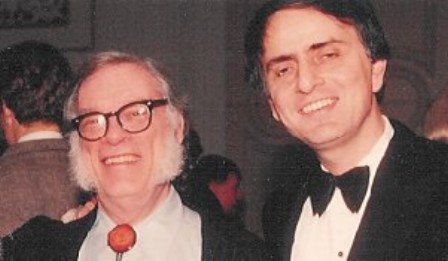

Cited references
- Achenbach, Joel (1999). Captured by Aliens: The Search for Life and Truth in a Very Large Universe. New York: Simon & Schuster. ISBN 978-0-684-84856-3. LCCN 99037592. OCLC 41606346.
- Davidson, Keay (1999). Carl Sagan: A Life. New York: John Wiley & Sons. ISBN 978-0-471-25286-3. LCCN 99036206. OCLC 41580617.
- Morrison, David (2006). "Carl Sagan: The People's Astronomer". AmeriQuests. 3 (2). doi:10.15695/amqst.v3i2.84. ISSN 1553-4316.
- Head, Tom, ed. (2006). Conversations with Carl Sagan (1st ed.). Jackson, MS: University Press of Mississippi. ISBN 978-1-57806-736-7. LCCN 2005048747. OCLC 60375648.
- Poundstone, William (1999). Carl Sagan: A Life in the Cosmos. New York: Henry Holt and Company. ISBN 978-0-8050-5766-9. LCCN 99014615. OCLC 40979822.
- Spangenburg, Ray; Moser, Kit (2004). Carl Sagan: A Biography. Westport, CT: Greenwood Publishing Group. ISBN 978-0-313-32265-5. LCCN 2004015176. OCLC 55846272.
- Terzian, Yervant; Bilson, Elizabeth, eds. (1997). Carl Sagan's Universe. Cambridge; New York: Cambridge University Press. ISBN 978-0-521-57603-1. LCCN 96040511. OCLC 36130681.
- Terzian, Yervant; Trimble, Virginia (January 1, 1997). "Carl Sagan (1934–1996)". Bulletin of the AAS. 29 (4).
External links
| File:Wiktionary-logo-v2.svg | Wiktionary has definitions related to Carl Sagan |

| File:Scholia logo.svg | Scholia has a profile for Carl Sagan (). |

| Library resources about Carl Sagan |
| By Carl Sagan |
|---|
- The Seth MacFarlane collection of the Carl Sagan and Ann Druyan archive, 1860-2004 (bulk 1962-1997). The Library of Congress
- The Carl Sagan Portal (CarlSagan.com)
- Carl Sagan at IMDb
- Template:Discogs artist
- FBI Records: The Vault – Carl Sagan at fbi.gov
- David Morrison, "Carl Sagan", Biographical Memoirs of the National Academy of Sciences (2014)
- Scientist of the Day – Carl Sagan at Linda Hall Library
- Carl Sagan – Great Lives, BBC Radio, December 15, 2017
- "A man whose time has come" (archived) – Interview with Carl Sagan by Ian Ridpath, New Scientist, July 4, 1974
- "Carl Sagan's Life and Legacy as Scientist, Teacher, and Skeptic" (archived), by David Morrison, Committee for Skeptical Inquiry
- "NASA Technical Reports Server (NTRS) 19630011050: Direct Contact Among Galactic Civilizations by Relativistic Interstellar Spaceflight", Carl Sagan, when he was at Stanford University, in 1962, produced a controversial paper funded by a NASA research grant that concludes ancient alien intervention may have sparked human civilization.
- Carl Sagan demonstrates how Eratosthenes determined that the Earth was round and the approximate circumference of the earth (via YouTube)
- CS1 French-language sources (fr)
- Use American English from September 2024
- Use mdy dates from September 2024
- Wikipedia articles needing clarification from October 2014
- Articles containing potentially dated statements from 2017
- All articles containing potentially dated statements
- Official website not in Wikidata
- Carl Sagan
- 1934 births
- 1996 deaths
- 20th-century American astronomers
- 20th-century American male writers
- 20th-century American novelists
- 20th-century American naturalists
- 20th-century American Jews
- 20th-century American science writers
- American agnostics
- American anti–nuclear weapons activists
- American anti–Vietnam War activists
- American astrophysicists
- American cannabis activists
- American cosmologists
- American critics of alternative medicine
- American critics of atheism
- American critics of creationism
- American humanists
- American male non-fiction writers
- American male novelists
- American nature writers
- American pacifists
- American people of Russian-Jewish descent
- American people of Ukrainian-Jewish descent
- American planetary scientists
- American science communicators
- American science fiction writers
- American secular Jews
- American skeptics
- American UFO writers
- American astrobiologists
- Astrochemists
- Cornell University faculty
- Critics of parapsychology
- Deaths from myelodysplastic syndrome in the United States
- Deaths from pneumonia in Washington (state)
- Fellows of the American Physical Society
- Grand Crosses of the Order of Saint James of the Sword
- Harvard University faculty
- Hugo Award–winning writers
- Interstellar messages
- Jewish agnostics
- Jewish American activists
- Jewish American non-fiction writers
- Jewish American scientists
- Jewish astronomers
- Jewish humanists
- Members of the American Philosophical Society
- Novelists from New York (state)
- Pantheists
- People associated with the American Museum of Natural History
- People from Bensonhurst, Brooklyn
- People with myelodysplastic syndrome
- Presidents of The Planetary Society
- Pulitzer Prize for General Nonfiction winners
- Rahway High School alumni
- Sagan family
- Scientists from New York (state)
- Search for extraterrestrial intelligence
- Secular humanists
- Space advocates
- University of California, Berkeley Miller Fellows
- University of Chicago alumni
- Writers about religion and science
- Writers from Brooklyn