Francis Hopkinson: Difference between revisions
imported>TheWiki93 added Category:Flags of the United States using HotCat |
No edit summary |
||
| Line 1: | Line 1: | ||
{{Short description|American Founding Father and jurist (1737–1791)}} | {{Short description|American Founding Father and jurist (1737–1791)}} | ||
{{Use mdy dates|date=May | {{Use American English|date=April 2026}} | ||
{{Use mdy dates|date=May 2026}} | |||
{{Infobox officeholder | {{Infobox officeholder | ||
| | | honorific_prefix = | ||
| name | | name = Francis Hopkinson | ||
| | | honorific_suffix = | ||
| image | | image = Francis Hopkinson, 1785 - Robert Edge Pine.jpg | ||
| alt | | alt = | ||
| caption | | caption = A 1785 portrait of Hopkinson by [[Robert Edge Pine]] | ||
| office | | office = Judge of the [[United States District Court for the District of Pennsylvania]] | ||
| term_start | | term_start = September 26, 1789 | ||
| term_end | | term_end = May 9, 1791 | ||
| nominator | | nominator = | ||
| appointer | | appointer = [[List of federal judges appointed by George Washington|George Washington]] | ||
| predecessor | | predecessor = ''Seat established by 1 Stat. 73'' | ||
| successor | | successor = [[William Lewis (judge)|William Lewis]] | ||
| pronunciation | | pronunciation = | ||
| birth_date | | birth_date = {{Birth date|1737|10|02}} <!--Only Gregorian dates are permitted in these templates, per their documentation.--> | ||
| birth_place | | birth_place = [[Philadelphia]],<br />[[Province of Pennsylvania]],<br />[[British America]] | ||
| death_date | | death_date = {{Death date and age|1791|05|09|1737|10|02}} | ||
| death_place | | death_place = Philadelphia, [[Pennsylvania]], U.S. | ||
| death_cause | | death_cause = sudden seizure | ||
| resting_place | | resting_place = [[Christ Church Burial Ground]]<br />[[Philadelphia]], [[Pennsylvania]], U.S. | ||
| resting_place_coordinates = | | resting_place_coordinates = | ||
| citizenship | | citizenship = | ||
| party = | |||
| party | | other_party = | ||
| | | height = | ||
| height | | spouse = | ||
| spouse | | children = [[Joseph Hopkinson]] | ||
| children | | mother = | ||
| mother | | father = [[Thomas Hopkinson]] | ||
| father | | relatives = [[James Johnson (Bishop of Worcester)|James Johnson]] | ||
| relatives | | education = [[University of Pennsylvania]] ([[Bachelor of Arts|AB]], [[Master of Arts|AM]]) | ||
| alma_mater = | |||
| education | | occupation = | ||
| alma_mater | | profession = | ||
| occupation | | known_for = | ||
| profession | | awards = [[Magellanic Premium]] (1790) | ||
| known_for | | signature = Francis Hopkinson signature.png | ||
| awards | | signature_alt = | ||
| signature | | footnotes = | ||
| signature_alt | |||
| footnotes | |||
}} | }} | ||
'''Francis Hopkinson''' (October 2,<ref group=Note>Hopkinson was born on September 21, 1737, according to the then-used [[Julian calendar]] (old style). In 1752, however, [[Great Britain]] and all its colonies adopted the [[Gregorian calendar]] (new style) which moved Hopkinson's birthday 11 days forward to October 2, 1737. See George E. Hastings, ''The Life and Works of Francis Hopkinson''. (Chicago: University of Chicago Press, 1926), p. 43.</ref> 1737 – May 9, 1791) was an American [[Founding Fathers of the United States|Founding Father]], lawyer, jurist, author, and composer.<ref name=Bernstein2009>{{cite book |last=Bernstein |first=Richard B. |author-link=Richard B. Bernstein |title=The Founding Fathers Reconsidered |chapter=Appendix: The Founding Fathers, A Partial List |pages=176–180|publisher=Oxford University Press |year=2009 |isbn=978-0199832576 |location=New York |chapter-url=https://archive.org/details/foundingfathersr0000bern/page/176/mode/2up}}</ref> He designed Continental paper money and two early versions of flags, [[flag of the United States|one for the United States]] and [[Flag of the United States Navy|one for the United States Navy]].<ref>{{Cite book |author1=Leepson, Marc |author2=DeMille, Nelson | title=Flag: An American Biography | date= May 30, 2006| publisher=St. Martin's Griffin | isbn=978-0-312-32309-7 | page=33}}</ref><ref>{{cite journal | last1=Williams | first1=Earl P. Jr. |title=Did Francis Hopkinson Design Two Flags? |journal=NAVA News |date=October 2012 |issue=216 |pages=7–9 |url=https://www.flagguys.com/pdf/NAVANews_2012_no216.pdf |archive-url=https://web.archive.org/web/20160306083443/http://www.flagguys.com/pdf/NAVANews_2012_no216.pdf |archive-date=2016 | '''Francis Hopkinson''' (October 2,<ref group=Note>Hopkinson was born on September 21, 1737, according to the then-used [[Julian calendar]] (old style). In 1752, however, [[Great Britain]] and all its colonies adopted the [[Gregorian calendar]] (new style) which moved Hopkinson's birthday 11 days forward to October 2, 1737. See George E. Hastings, ''The Life and Works of Francis Hopkinson''. (Chicago: University of Chicago Press, 1926), p. 43.</ref> 1737 – May 9, 1791) was an American [[Founding Fathers of the United States|Founding Father]], lawyer, jurist, author, and composer.<ref name=Bernstein2009>{{cite book |last=Bernstein |first=Richard B. |author-link=Richard B. Bernstein |title=The Founding Fathers Reconsidered |chapter=Appendix: The Founding Fathers, A Partial List |pages=176–180|publisher=Oxford University Press |year=2009 |isbn=978-0199832576 |location=New York |chapter-url=https://archive.org/details/foundingfathersr0000bern/page/176/mode/2up}}</ref> He designed Continental paper money and two early versions of flags, [[flag of the United States|one for the United States]] and [[Flag of the United States Navy|one for the United States Navy]].<ref>{{Cite book |author1=Leepson, Marc |author2=DeMille, Nelson | title=Flag: An American Biography | date= May 30, 2006| publisher=St. Martin's Griffin | isbn=978-0-312-32309-7 | page=33}}</ref><ref>{{cite journal | last1=Williams | first1=Earl P. Jr. |title=Did Francis Hopkinson Design Two Flags? |journal=NAVA News |date=October 2012 |issue=216 |pages=7–9 |url=https://www.flagguys.com/pdf/NAVANews_2012_no216.pdf |archive-url=https://web.archive.org/web/20160306083443/http://www.flagguys.com/pdf/NAVANews_2012_no216.pdf |archive-date=March 6, 2016 |url-status=live}}</ref> He was a signer of the [[United States Declaration of Independence|Declaration of Independence]] in July 1776 as a delegate from [[New Jersey]].<ref name=Bernstein2009 /> | ||
Hopkinson served in various roles in the early United States government including as a member of the [[Second Continental Congress]] and as a member of the Navy Board. He became the first federal judge of the Eastern District Court of Pennsylvania on September 30, 1789.<ref>{{cite book |last1=Hastings |first1=George E. |title=The Life and Works of Francis Hopkinson |date=1926 |publisher=University of Chicago Press |location=Chicago |page=325}}</ref> | Hopkinson served in various roles in the early United States government including as a member of the [[Second Continental Congress]] and as a member of the Navy Board. He became the first federal judge of the Eastern District Court of Pennsylvania on September 30, 1789.<ref>{{cite book |last1=Hastings |first1=George E. |title=The Life and Works of Francis Hopkinson |date=1926 |publisher=University of Chicago Press |location=Chicago |page=325}}</ref> | ||
==Education and early career== | ==Education and early career== | ||
Born on October 2, 1737 ([[Gregorian calendar|Gregorian]]), September 21, 1737 ([[Julian calendar|Julian]]) in [[Philadelphia]], [[Province of Pennsylvania]].<ref name=FJC>{{FJC Bio|1093|nid=1382396|name=Francis Hopkinson<!--(1737–1791)-->}}</ref><ref name=CB>{{CongBio|H000783|inline=yes}}</ref> Hopkinson received an [[Bachelor of Arts|Artium Baccalaureus]] degree in 1757 from the College of Philadelphia (now the [[University of Pennsylvania]]) and an [[Master of Arts|Artium Magister]] degree in 1760 from the same institution.<ref name=FJC/> He was the first | Born on October 2, 1737 ([[Gregorian calendar|Gregorian]]), September 21, 1737 ([[Julian calendar|Julian]]) in [[Philadelphia]], [[Province of Pennsylvania]].<ref name=FJC>{{FJC Bio|1093|nid=1382396|name=Francis Hopkinson<!--(1737–1791)-->}}</ref><ref name=CB>{{CongBio|H000783|inline=yes}}</ref> Hopkinson received an [[Bachelor of Arts|Artium Baccalaureus]] degree in 1757 from the College of Philadelphia (now the [[University of Pennsylvania]]) and an [[Master of Arts|Artium Magister]] degree in 1760 from the same institution.<ref name=FJC/> He was the first American-born composer to write a surviving secular song.<ref name=CB/><ref>{{cite web |author= <!-- not stated --> |date= |title=My Days Have Been So Wondrous Free |url=https://songofamerica.net/song/my-days-have-been-so-wondrous-free/ |website=Song of America |location= |publisher= |url-status= |archive-url=https://web.archive.org/web/20250326102947/https://songofamerica.net/song/my-days-have-been-so-wondrous-free/ |archive-date=March 26, 2025 |access-date=November 11, 2025}}</ref> He was secretary of a commission of the Provincial Council of Pennsylvania which made a treaty between the province and certain Indian tribes in 1761.<ref name=CB/> He entered private practice in Philadelphia from 1761 to 1766. He was collector of customs in [[Salem, New Jersey|Salem]], [[Province of New Jersey]], in 1763.<ref name=FJC/> | ||
Hopkinson spent from May 1766 to August 1767 in England in hopes of becoming commissioner of customs for North America.<ref name=Hastings>{{cite book|last1=Hastings|first1=George|title=The Life and Works of Francis Hopkinson|date=1926|publisher=University of Chicago Press|location=Chicago}}</ref>{{rp|133}} Although unsuccessful, he spent time with the future Prime Minister [[Frederick North, Lord North|Lord North]], Hopkinson's cousin [[James Johnson (bishop of Worcester)|James Johnson]], and the painter [[Benjamin West]].<ref name=Hastings/> Upon his return to Philadelphia in 1768, he sold varieties of fabric and port wine.<ref>Hastings, pp. 157 and 158.</ref> | Hopkinson spent from May 1766 to August 1767 in England in hopes of becoming commissioner of customs for North America.<ref name=Hastings>{{cite book|last1=Hastings|first1=George|title=The Life and Works of Francis Hopkinson|date=1926|publisher=University of Chicago Press|location=Chicago}}</ref>{{rp|133}} Although unsuccessful, he spent time with the future Prime Minister [[Frederick North, Lord North|Lord North]], Hopkinson's cousin [[James Johnson (bishop of Worcester)|James Johnson]], and the painter [[Benjamin West]].<ref name=Hastings/> Upon his return to Philadelphia in 1768, he sold varieties of fabric and port wine.<ref>Hastings, pp. 157 and 158.</ref> | ||
| Line 58: | Line 57: | ||
In 1776, Hopkinson served as a delegate to the [[Second Continental Congress]] ([[Continental Congress]]) from June 21 through November 18.<ref name="Hastings" />{{rp|212}}<ref name="Hastings" />{{rp|218}} He was a signer of the United States Declaration of Independence, representing New Jersey.<ref name="CB" /> He was the Chairman of the Navy Board in Philadelphia from November 18, 1776, to mid-August 1778.<ref name="Hastings" />{{rp|218}}<ref name="Hastings" />{{rp|234}} He was treasurer for the Continental Loan Office in Philadelphia from 1778 to 1781. He was judge of the Admiralty Court of Pennsylvania from 1779 to 1789.<ref name="FJC" /> | In 1776, Hopkinson served as a delegate to the [[Second Continental Congress]] ([[Continental Congress]]) from June 21 through November 18.<ref name="Hastings" />{{rp|212}}<ref name="Hastings" />{{rp|218}} He was a signer of the United States Declaration of Independence, representing New Jersey.<ref name="CB" /> He was the Chairman of the Navy Board in Philadelphia from November 18, 1776, to mid-August 1778.<ref name="Hastings" />{{rp|218}}<ref name="Hastings" />{{rp|234}} He was treasurer for the Continental Loan Office in Philadelphia from 1778 to 1781. He was judge of the Admiralty Court of Pennsylvania from 1779 to 1789.<ref name="FJC" /> | ||
While sitting on the court, in December 1780 Hopkinson was [[Impeachment in the United States|impeached]] on allegations of accepting payment from litigants, accepting bribes in exchange for appointments, and trading in false certificates. After an [[impeachment trial]], he was acquitted and remained in office.<ref name="MNstatelawlibrary1">{{cite web |title=Minnesota State Law Library: Trial Collection Bibliography, part 4 |url=http://www.lawlibrary.state.mn.us/ar2000/trialbib4.html |website=www.lawlibrary.state.mn.us |publisher=Minnesota State Law Library |archive-url=https://web.archive.org/web/20040223002715/http://www.lawlibrary.state.mn.us/ar2000/trialbib4.html |archive-date=February 23, 2004 |date=23 | While sitting on the court, in December 1780 Hopkinson was [[Impeachment in the United States|impeached]] on allegations of accepting payment from litigants, accepting bribes in exchange for appointments, and trading in false certificates. After an [[impeachment trial]], he was acquitted and remained in office.<ref name="MNstatelawlibrary1">{{cite web |title=Minnesota State Law Library: Trial Collection Bibliography, part 4 |url=http://www.lawlibrary.state.mn.us/ar2000/trialbib4.html |website=www.lawlibrary.state.mn.us |publisher=Minnesota State Law Library |archive-url=https://web.archive.org/web/20040223002715/http://www.lawlibrary.state.mn.us/ar2000/trialbib4.html |archive-date=February 23, 2004 |date=February 23, 2004 |url-status=dead}}</ref><ref name="Hopkinson book">{{cite book |title=The Pennsylvania State Trials: Containing the Impeachment, Trial, and Acquittal of Francis Hopkinson, and John Nicholson, Esquires. The Former Being Judge of the Court of Admiralty, and the Latter, the Comptroller-general of the Commonwealth of Pennsylvania |date=1794 |publisher=Francis Bailey |url=https://play.google.com/store/books/details?id=mXg0AQAAMAAJ&rdid=book-mXg0AQAAMAAJ&rdot=1 |access-date=June 16, 2023 |language=en}} |pages=22-24; 56-62</ref> He was a member of the Pennsylvania Convention which ratified the [[Constitution of the United States|United States Constitution]].<ref name="Hastings" />{{rp|chapter VI}}{{rp|325}}<ref name="CB" /> | ||
Hopkinson was nominated by President [[George Washington]] on September 24, 1789, to the [[United States District Court for the District of Pennsylvania]], to a new seat authorized by {{USStat|1|73}}. He was confirmed by the [[United States Senate]] on September 26, 1789, and received his commission the same day.<ref name="FJC" /> | Hopkinson was nominated by President [[George Washington]] on September 24, 1789, to the [[United States District Court for the District of Pennsylvania]], to a new seat authorized by {{USStat|1|73}}. He was confirmed by the [[United States Senate]] on September 26, 1789, and received his commission the same day.<ref name="FJC" /> | ||
| Line 73: | Line 72: | ||
==Great Seal of the United States== | ==Great Seal of the United States== | ||
In 1776 | In 1776, Hopkinson designed the [[Coat of arms and flag of New Jersey|Great Seal of New Jersey]] with assistance from [[Pierre Eugene du Simitiere]] in 1776.<ref>Hastings, p. 217.</ref> He was thus chosen as a consultant to design the [[Great Seal of the United States]].<ref name=Patterson>{{Cite book|url=https://archive.org/stream/TheEagleAndTheShield/The%20Eagle%20and%20the%20Shield#page/n81|title=The Eagle and the Shield: A History of the Great Seal of the United States|last1=Patterson|first1=Richard Sharpe|last2=Dougall|first2=Richardson|publisher= Washington : Office of the Historian, Bureau of Public Affairs, Dept. of State : for sale by the Supt. of Docs., U.S. Govt. Print. Off.|date=1978|orig-year=1976 i.e. 1978|series=Department and Foreign Service series; 161 Department of State publication; 8900|lccn=78602518|oclc=4268298|page=32}}</ref><ref name="auto">{{Cite web|url=http://memory.loc.gov/cgi-bin/query/r?ammem/hlaw:@field(DOCID+@lit(jc01845))|title=Journals of the Continental Congress --FRIDAY, OCTOBER 27, 1780|website=memory.loc.gov}}</ref><ref>Buescher, John. [http://www.teachinghistory.org/history-content/ask-a-historian/23852 "All Wrapped up in the Flag"] {{Webarchive|url=https://web.archive.org/web/20110923065711/http://www.teachinghistory.org/history-content/ask-a-historian/23852 |date=September 23, 2011 }}, [http://www.teachinghistory.org Teachinghistory.org] {{Webarchive|url=https://web.archive.org/web/20180926205612/https://teachinghistory.org/history-content/ask-a-historian/24484 |date=September 26, 2018 }}, accessed August 21, 2011.</ref> Fourteen men worked on the Great Seal of the United States, including two other consultants – Simitiere (first Great Seal committee) and [[William Barton (heraldist)|William Barton]] (third committee).<ref name="Williams2">{{cite journal|last1=Williams |first1=Earl P. Jr.|title=A Civil Servant Designed Our National Banner: The Unsung Legacy of Francis Hopkinson|journal=The New Constellation (Newsletter of the National Flag Foundation)|date=June 14, 1996|volume=Special Edition #7|page=8}}</ref> The seal was finalized on June 20, 1782.<ref>{{Cite web|url=https://archive.org/stream/TheEagleAndTheShield/The+Eagle+and+the+Shield#page/n127|title=The eagle and the shield : a history of the great seal of the United States|website=archive.org|year=1978 }}</ref> | ||
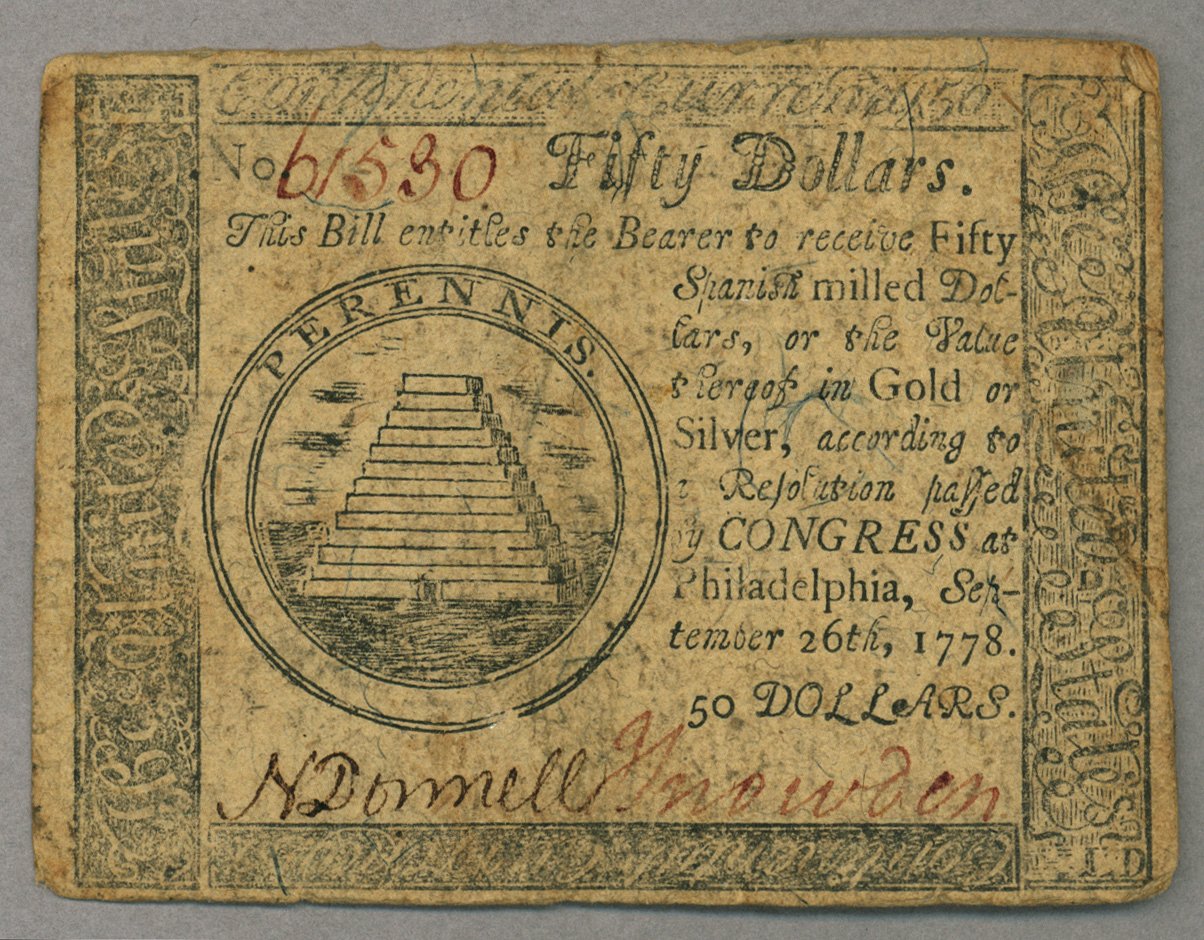
In the current rendition of the Great Seal of the United States, the 13 stars (constellation) representing the 13 original states have five points. They are arranged in the shape of a larger star with six points. The constellation comprising 13 smaller stars symbolizes the national motto, "E pluribus unum." Originally, the design had individual stars with six points, but this was changed in 1841 when a new die was cast. This seal is now impressed upon the reverse of the [[United States one-dollar bill]]. The reverse of the seal, designed by Barton, contains an unfinished pyramid below a radiant eye. The unfinished pyramid was an image used by Hopkinson when he designed the Continental $50 currency bill.<ref>{{Cite web|url=http://upload.wikimedia.org/wikipedia/commons/c/c9/Continental_$50_note_1778.jpg|title=wikimedia.org/wikipedia/commons/c/c9/Continental_$50_note_1778}}</ref><ref>{{Cite web|url=https://coins.nd.edu/ColCurrency/CurrencyText/CC-09-26-78.html|title=Continental Currency: September 26, 1778|website=coins.nd.edu|access-date=July 13, 2019|archive-date=July 13, 2019|archive-url=https://web.archive.org/web/20190713015023/https://coins.nd.edu/ColCurrency/CurrencyText/CC-09-26-78.html|url-status=dead}}</ref><ref>Patterson and Dougall, p. 68</ref> | In the current rendition of the Great Seal of the United States, the 13 stars (constellation) representing the 13 original states have five points. They are arranged in the shape of a larger star with six points. The constellation comprising 13 smaller stars symbolizes the national motto, "E pluribus unum." Originally, the design had individual stars with six points, but this was changed in 1841 when a new die was cast. This seal is now impressed upon the reverse of the [[United States one-dollar bill]]. The reverse of the seal, designed by Barton, contains an unfinished pyramid below a radiant eye. The unfinished pyramid was an image used by Hopkinson when he designed the Continental $50 currency bill.<ref>{{Cite web|url=http://upload.wikimedia.org/wikipedia/commons/c/c9/Continental_$50_note_1778.jpg|title=wikimedia.org/wikipedia/commons/c/c9/Continental_$50_note_1778}}</ref><ref>{{Cite web|url=https://coins.nd.edu/ColCurrency/CurrencyText/CC-09-26-78.html|title=Continental Currency: September 26, 1778|website=coins.nd.edu|access-date=July 13, 2019|archive-date=July 13, 2019|archive-url=https://web.archive.org/web/20190713015023/https://coins.nd.edu/ColCurrency/CurrencyText/CC-09-26-78.html|url-status=dead}}</ref><ref>Patterson and Dougall, p. 68</ref> | ||
==United States Flag== | ==United States Flag== | ||
[[File:Hopkinson Flag of the United States.svg|thumb|Francis Hopkinson's flag for the U.S., an interpretation, with 13 six-pointed stars arranged in five rows<ref>{{cite journal | last1=Williams | first1=Earl P. Jr. |title=Did Francis Hopkinson Design Two Flags? |journal=NAVA News |date=October 2012 |issue=216 |pages=7–9 |url=https://www.flagguys.com/pdf/NAVANews_2012_no216.pdf |archive-url=https://web.archive.org/web/20160306083443/http://www.flagguys.com/pdf/NAVANews_2012_no216.pdf |archive-date=2016 | [[File:Hopkinson Flag of the United States.svg|thumb|Francis Hopkinson's flag for the U.S., an interpretation, with 13 six-pointed stars arranged in five rows<ref>{{cite journal | last1=Williams | first1=Earl P. Jr. |title=Did Francis Hopkinson Design Two Flags? |journal=NAVA News |date=October 2012 |issue=216 |pages=7–9 |url=https://www.flagguys.com/pdf/NAVANews_2012_no216.pdf |archive-url=https://web.archive.org/web/20160306083443/http://www.flagguys.com/pdf/NAVANews_2012_no216.pdf |archive-date=March 6, 2016 |url-status=live}}</ref>]] | ||
[[File:Hopkinson Flag of the United States Navy.svg|thumb|Hopkinson Flag for the U.S. Navy, an interpretation<ref>Williams (2012), p.7.</ref>]] | [[File:Hopkinson Flag of the United States Navy.svg|thumb|Hopkinson Flag for the U.S. Navy, an interpretation<ref>Williams (2012), p.7.</ref>]] | ||
On June 14, 1777, the Second Continental Congress adopted the Stars and Stripes as the first official national flag of the newly independent United States (later celebrated as [[Flag Day (United States)|Flag Day]]). The resolution creating the flag came from the Continental Marine Committee. Hopkinson became a member of the committee in 1776. At the time of the flag's adoption, he was the chairman of the Navy Board, which was under the Marine Committee. Today, that office has been transferred to the [[United States Secretary of the Navy]].<ref name=Zall>{{cite book|last1=Zall|first1=Paul M.|title=Comical Spirit of Seventy-Six: The Humor of Francis Hopkinson|date=1976|publisher=Huntington Library|location=San Marino, California|page=10}}</ref> | On June 14, 1777, the Second Continental Congress adopted the Stars and Stripes as the first official national flag of the newly independent United States (later celebrated as [[Flag Day (United States)|Flag Day]]). The resolution creating the flag came from the Continental Marine Committee. Hopkinson became a member of the committee in 1776. At the time of the flag's adoption, he was the chairman of the Navy Board, which was under the Marine Committee. Today, that office has been transferred to the [[United States Secretary of the Navy]].<ref name=Zall>{{cite book|last1=Zall|first1=Paul M.|title=Comical Spirit of Seventy-Six: The Humor of Francis Hopkinson|date=1976|publisher=Huntington Library|location=San Marino, California|page=10}}</ref> | ||
| Line 84: | Line 83: | ||
Hopkinson is recognized as a designer of the [[Flag of the United States]], and the journals of the [[Continental Congress]] support this.<ref>{{cite book|last1=Furlong|first1=William Rea|last2=McCandless|first2=Byron|title=So Proudly We Hail|url=https://archive.org/details/soproudlywehail00furl|url-access=registration|date=1981|publisher=Smithsonian Institution Press|location=Washington, D.C.|page=[https://archive.org/details/soproudlywehail00furl/page/101 101]}}</ref> On May 25, 1780, Hopkinson wrote a letter to the Continental Board of Admiralty mentioning several patriotic designs he had completed during the previous three years.<ref>Hastings, p. 240.</ref> One was his Board of Admiralty seal, which contained a shield of seven red and six white stripes on a blue field. Others included the [[Symbols of the United States Department of the Treasury|Treasury Board seal]], "7 devices for the Continental Currency," and "the Flag of the United States of America."<ref>Leepson, p. 33</ref> Hopkinson noted that he had not asked for any compensation for the designs but was seeking a reward: "a Quarter Cask of the public Wine." The board sent that letter on to Congress. | Hopkinson is recognized as a designer of the [[Flag of the United States]], and the journals of the [[Continental Congress]] support this.<ref>{{cite book|last1=Furlong|first1=William Rea|last2=McCandless|first2=Byron|title=So Proudly We Hail|url=https://archive.org/details/soproudlywehail00furl|url-access=registration|date=1981|publisher=Smithsonian Institution Press|location=Washington, D.C.|page=[https://archive.org/details/soproudlywehail00furl/page/101 101]}}</ref> On May 25, 1780, Hopkinson wrote a letter to the Continental Board of Admiralty mentioning several patriotic designs he had completed during the previous three years.<ref>Hastings, p. 240.</ref> One was his Board of Admiralty seal, which contained a shield of seven red and six white stripes on a blue field. Others included the [[Symbols of the United States Department of the Treasury|Treasury Board seal]], "7 devices for the Continental Currency," and "the Flag of the United States of America."<ref>Leepson, p. 33</ref> Hopkinson noted that he had not asked for any compensation for the designs but was seeking a reward: "a Quarter Cask of the public Wine." The board sent that letter on to Congress. | ||
Hopkinson submitted another bill on June 24 for his "drawings and devices." In this second letter, Hopkinson did not mention designing the flag of the United States. Instead, the first item listed was "the great Naval Flag of the United States" along with the other contributions.<ref name="Williams 2012, pp. 7–9.">Williams (2012), pp. 7–9.</ref> This flag with its red outer stripes was designed to show up well on ships at sea.<ref name="Williams 2012, pp. 7–9."/> A parallel flag for the national flag was most likely intended by Hopkinson with white outer stripes<ref name="Williams 2012, pp. 7–9."/> as on the Great Seal of the United States and on the [[Bennington flag]], which commemorated 50th anniversary of the founding of the United States in 1826.<ref name=Joint>{{cite book|last1=Joint Committee on Printing|first1=U.S. Congress|title=Our Flag|date=2007|publisher=U.S. Government Printing Office|location=Washington, D.C.|isbn=978-0-16-076598-8|edition=Rev. ed.109th Congress, 2nd Session}}</ref> | Hopkinson submitted another bill on June 24 for his "drawings and devices." In this second letter, Hopkinson did not mention designing the flag of the United States. Instead, the first item listed was "the great Naval Flag of the United States" along with the other contributions.<ref name="Williams 2012, pp. 7–9.">Williams (2012), pp. 7–9.</ref> This flag with its red outer stripes was designed to show up well on ships at sea.<ref name="Williams 2012, pp. 7–9."/> A parallel flag for the national flag was most likely intended by Hopkinson with white outer stripes<ref name="Williams 2012, pp. 7–9."/> as on the Great Seal of the United States and on the [[Bennington flag]], which commemorated 50th anniversary of the founding of the United States in 1826.<ref name=Joint>{{cite book|last1=Joint Committee on Printing|first1=U.S. Congress|title=Our Flag|date=2007|publisher=U.S. Government Printing Office|location=Washington, D.C.|isbn=978-0-16-076598-8|edition=Rev. ed.109th Congress, 2nd Session}}</ref> | ||
For the various designs, Hopkinson asked for cash in the amount of £2,700. Auditor General James Milligan commissioned an evaluation of the request for payment. The report from the commissioner of the Chamber of Accounts said that the bill was reasonable and ought to be paid. Congress asked for an itemized bill for payment in cash. Hopkinson requested £9 for the naval flag. A committee investigated Hopkinson's charges that his payment was being delayed for arbitrary reasons. The Treasury Board turned down the request in an October 27, 1780, report to Congress. The Board cited several reasons for its action, including the fact that Hopkinson "was not the only person consulted on those exhibitions of Fancy [that were incidental to the Board (among them, the U.S. flag, the Navy flag, the Admiralty seal, and the Great Seal with a reverse)<ref>Hastings (1926), p. 241-242.</ref>], and therefore cannot claim the sole merit of them and not entitled in this respect to the full sum charged."<ref>Williams (1988), p. 47.</ref> The reference to the work of others is most probably a reference to his work on the Great Seal.<ref name="Williams1">{{cite journal|last1=Williams |first1=Earl P. Jr.|title=The 'Fancy Work' of Francis Hopkinson: Did He Design the Stars and Stripes?|journal=Prologue: Quarterly of the National Archives|date=Spring 1988|volume=20|issue=1|page=48}}</ref> Therefore, he would not be eligible to be paid for the Great Seal.<ref name="auto" /> Furthermore, the Great Seal project was still a work in progress. No known committee of the Continental Congress was documented with the assignment to design the national flag or naval flag.<ref>{{cite book|last1=Canby|first1=George|last2=Balderston|first2=Lloyd|title=The Evolution of the American Flag|url=https://archive.org/details/evolutionameric01baldgoog|date=1909|publisher=Ferris & Leach|location=Philadelphia|page=[https://archive.org/details/evolutionameric01baldgoog/page/n61 48]}}</ref> | For the various designs, Hopkinson asked for cash in the amount of £2,700. Auditor General James Milligan commissioned an evaluation of the request for payment. The report from the commissioner of the Chamber of Accounts said that the bill was reasonable and ought to be paid. Congress asked for an itemized bill for payment in cash. Hopkinson requested £9 for the naval flag. A committee investigated Hopkinson's charges that his payment was being delayed for arbitrary reasons. The Treasury Board turned down the request in an October 27, 1780, report to Congress. The Board cited several reasons for its action, including the fact that Hopkinson "was not the only person consulted on those exhibitions of Fancy [that were incidental to the Board (among them, the U.S. flag, the Navy flag, the Admiralty seal, and the Great Seal with a reverse)<ref>Hastings (1926), p. 241-242.</ref>], and therefore cannot claim the sole merit of them and not entitled in this respect to the full sum charged."<ref>Williams (1988), p. 47.</ref> The reference to the work of others is most probably a reference to his work on the Great Seal.<ref name="Williams1">{{cite journal|last1=Williams |first1=Earl P. Jr.|title=The 'Fancy Work' of Francis Hopkinson: Did He Design the Stars and Stripes?|journal=Prologue: Quarterly of the National Archives|date=Spring 1988|volume=20|issue=1|page=48}}</ref> Therefore, he would not be eligible to be paid for the Great Seal.<ref name="auto" /> Furthermore, the Great Seal project was still a work in progress. No known committee of the Continental Congress was documented with the assignment to design the national flag or naval flag.<ref>{{cite book|last1=Canby|first1=George|last2=Balderston|first2=Lloyd|title=The Evolution of the American Flag|url=https://archive.org/details/evolutionameric01baldgoog|date=1909|publisher=Ferris & Leach|location=Philadelphia|page=[https://archive.org/details/evolutionameric01baldgoog/page/n61 48]}}</ref> | ||
There is no known sketch of a Hopkinson flag—either U.S. or naval—in existence today.<ref name="Williams 2012, p. 7">Williams (2012), p. 7.</ref> However, he incorporated elements of the two flags he designed in his rough sketches of the Great Seal of the United States and his design for the Admiralty Board Seal.<ref name="Williams 2012, pp. 7–9."/> The rough sketch of his second Great Seal proposal has 7 white stripes and 6 red stripes.<ref>Patterson and Dougall, p. 37.</ref> The impression of Hopkinson's Admiralty Board Seal<ref>{{cite journal|last1=Moeller|first1=Henry W., Ph.D.|title=Two Early American Ensigns on the Pennsylvania State Arms|journal=NAVA News|date=January 2002|issue=173|page=fn. 41 & 42}}</ref> has a chevron with 7 red stripes and 6 white stripes. The Great Seal reflects Hopkinson's design for a governmental flag, and the Admiralty Board Seal reflects Hopkinson's design for a naval flag. Both flags were intended to have 13 stripes. Because the original stars used in the Great Seal had six points, Hopkinson's U.S. flag might also have intended the use of 6-pointed stars.<ref>Williams (2012), p. 8.</ref> This is bolstered by his original sketch for the Great Seal that featured a U.S. flag with six-pointed asterisks for stars.<ref>{{Cite web|url=https://archive.org/stream/TheEagleAndTheShield/The+Eagle+and+the+Shield#page/n81|title=The eagle and the shield : a history of the great seal of the United States|website=archive.org|year=1978 }}</ref> The stripe arrangement would have been consistent with other flags of the period that had seven stripes below the canton, or blue area with stars. For example, two of the earliest known examples of Stars and Stripes flags were painted by a Dutch artist who witnessed the arrival of Navy Lieutenant John Paul Jones' squadron in Texel, The Netherlands, in 1779. The two flags have seven stripes below the canton.<ref>{{cite book |last1=Furlong |first1=William Rea |last2=McCandless |first2=Byron |title=So Proudly We Hail: The History of the United States Flag |date=1961 |publisher=Smithsonian Institution Press |location=Washington |pages=130}}</ref> | There is no known sketch of a Hopkinson flag—either U.S. or naval—in existence today.<ref name="Williams 2012, p. 7">Williams (2012), p. 7.</ref> However, he incorporated elements of the two flags he designed in his rough sketches of the Great Seal of the United States and his design for the Admiralty Board Seal.<ref name="Williams 2012, pp. 7–9."/> The rough sketch of his second Great Seal proposal has 7 white stripes and 6 red stripes.<ref>Patterson and Dougall, p. 37.</ref> The impression of Hopkinson's Admiralty Board Seal<ref>{{cite journal|last1=Moeller|first1=Henry W., Ph.D.|title=Two Early American Ensigns on the Pennsylvania State Arms|journal=NAVA News|date=January 2002|issue=173|page=fn. 41 & 42}}</ref> has a chevron with 7 red stripes and 6 white stripes. The Great Seal reflects Hopkinson's design for a governmental flag, and the Admiralty Board Seal reflects Hopkinson's design for a naval flag. Both flags were intended to have 13 stripes. Because the original stars used in the Great Seal had six points, Hopkinson's U.S. flag might also have intended the use of 6-pointed stars.<ref>Williams (2012), p. 8.</ref> This is bolstered by his original sketch for the Great Seal that featured a U.S. flag with six-pointed asterisks for stars.<ref>{{Cite web|url=https://archive.org/stream/TheEagleAndTheShield/The+Eagle+and+the+Shield#page/n81|title=The eagle and the shield : a history of the great seal of the United States|website=archive.org|year=1978 }}</ref> The stripe arrangement would have been consistent with other flags of the period that had seven stripes below the canton, or blue area with stars. For example, two of the earliest known examples of Stars and Stripes flags were painted by a Dutch artist who witnessed the arrival of Navy Lieutenant John Paul Jones' squadron in Texel, The Netherlands, in 1779. The two flags have seven stripes below the canton.<ref>{{cite book |last1=Furlong |first1=William Rea |last2=McCandless |first2=Byron |title=So Proudly We Hail: The History of the United States Flag |date=1961 |publisher=Smithsonian Institution Press |location=Washington |pages=130}}</ref> | ||
==Personal life== | ==Personal life== | ||
Hopkinson was the son of [[Thomas Hopkinson]]<ref name="Hastings" />{{rp|30}} and Mary Johnson Hopkinson.<ref name="Hastings" />{{rp|16 and 448}} He married Ann Borden on September 1, 1768.<ref name="Hastings" />{{rp|164}} They had five children.<ref name="Hastings" />{{rp|449 and 450}} He was the father of [[Joseph Hopkinson]], who was a member of the [[United States House of Representatives]] and also became a federal judge.<ref name="CB" /> Hopkinson's sister Mary (1742–1785) was married to Dr. [[John Morgan (physician)|John Morgan]], second chief physician and director general of the [[Continental Army]].<ref>{{Cite book |last=Jordan |first=John Woolf |url=https://babel.hathitrust.org/cgi/pt?id=coo1.ark:/13960/t1xd1gm95&seq=7&q1=Hopkinson |title=Colonial Families of Philadelphia |publisher=Lewis Publishing Company |year=1911 |volume=II |pages=1191 |access-date=10 | Hopkinson was the son of [[Thomas Hopkinson]]<ref name="Hastings" />{{rp|30}} and Mary Johnson Hopkinson.<ref name="Hastings" />{{rp|16 and 448}} He married Ann Borden on September 1, 1768.<ref name="Hastings" />{{rp|164}} They had five children.<ref name="Hastings" />{{rp|449 and 450}} He was the father of [[Joseph Hopkinson]], who was a member of the [[United States House of Representatives]] and also became a federal judge.<ref name="CB" /> Hopkinson's sister Mary (1742–1785) was married to Dr. [[John Morgan (physician)|John Morgan]], second chief physician and director general of the [[Continental Army]].<ref>{{Cite book |last=Jordan |first=John Woolf |url=https://babel.hathitrust.org/cgi/pt?id=coo1.ark:/13960/t1xd1gm95&seq=7&q1=Hopkinson |title=Colonial Families of Philadelphia |publisher=Lewis Publishing Company |year=1911 |volume=II |pages=1191 |access-date=November 10, 2023}}</ref> According to Pennsylvania tax records and a Philadelphia census, Hopkinson owned at least two slaves.<ref>{{cite web |url=https://pennandslaveryproject.org/exhibits/show/campus/currentcampus/quaddorm |title=Quadrangle Dormitories: Hopkinson Dorm |website=pennandslaveryproject.org |publisher=Penn and Slavery Project, University of Pennsylvania |access-date=June 16, 2024 |archive-date=June 17, 2024 |archive-url=https://web.archive.org/web/20240617023042/https://pennandslaveryproject.org/exhibits/show/campus/currentcampus/quaddorm |url-status=dead }}</ref> | ||
==Death== | ==Death== | ||
| Line 131: | Line 130: | ||
==External links== | ==External links== | ||
* [https://web.archive.org/web/20111026012452/http://www.archives.upenn.edu/people/1700s/hopkinson_fra.html University of Penn. Archives on Hopkinson] | * [https://web.archive.org/web/20111026012452/http://www.archives.upenn.edu/people/1700s/hopkinson_fra.html University of Penn. Archives on Hopkinson] | ||
* The [ | * The [https://www.hsp.org/files/findingaid1978hopkinson.pdf Hopkinson Family Papers], including correspondence, documents and printed materials, are available for research use at the [[Historical Society of Pennsylvania]]. | ||
* [http://www.pabook.libraries.psu.edu/palitmap/bios/Hopkinson__Francis.html Pennsylvania Center for the Book on Hopkinson and his writings] | * [http://www.pabook.libraries.psu.edu/palitmap/bios/Hopkinson__Francis.html Pennsylvania Center for the Book on Hopkinson and his writings] | ||
* [http://lcweb2.loc.gov/diglib/ihas/loc.natlib.ihas.200035713/default.html Library of Congress on Hopkinson] | * [http://lcweb2.loc.gov/diglib/ihas/loc.natlib.ihas.200035713/default.html Library of Congress on Hopkinson] | ||
* [https://archive.org/details/heraldsamerican03marbgoog Francis Hopkinson: Jurist, Wit, and Dilettante] Marble, Annie Russell. ''Heralds of American Literature: A Group of Patriot Writers of the Revolutionary and National Periods.'' 1907, University of Chicago Press, hosted by [[Google Book Search]] | * [https://archive.org/details/heraldsamerican03marbgoog Francis Hopkinson: Jurist, Wit, and Dilettante] Marble, Annie Russell. ''Heralds of American Literature: A Group of Patriot Writers of the Revolutionary and National Periods.'' 1907, University of Chicago Press, hosted by [[Google Book Search]] | ||
* [https://web.archive.org/web/20070711214348/http://www.cviog.uga.edu/Projects/gainfo/hopkinsonflagstamp.htm image] of stamp with Hopkinson's flag, stars in a circle, from the University of Georgia | * [https://web.archive.org/web/20070711214348/http://www.cviog.uga.edu/Projects/gainfo/hopkinsonflagstamp.htm image] of stamp with Hopkinson's flag, stars in a circle, from the University of Georgia | ||
* [ | * [https://www.americanmusicpreservation.com/FirstAmericansong.htm First American Song by Francis Hopkinson] | ||
* {{IMSLP|id=Hopkinson, Francis}} | * {{IMSLP|id=Hopkinson, Francis}} | ||
* [https://archive.org/details/AnAccountOfTheGrandFederalProcession.PerformedAtPhiladelphiaOnFriday "AN ACCOUNT OF THE GRAND FEDERAL PROCESSION. PERFORMED AT PHILADELPHIA ON FRIDAY THE 4TH OF JULY 1788" by Francis Hopkinson] – Hopkinson's review of a Philadelphia [[Fourth of July]] parade of 1788; celebrating the ratification of the U.S. Constitution. | * [https://archive.org/details/AnAccountOfTheGrandFederalProcession.PerformedAtPhiladelphiaOnFriday "AN ACCOUNT OF THE GRAND FEDERAL PROCESSION. PERFORMED AT PHILADELPHIA ON FRIDAY THE 4TH OF JULY 1788" by Francis Hopkinson] – Hopkinson's review of a Philadelphia [[Fourth of July]] parade of 1788; celebrating the ratification of the U.S. Constitution. | ||
| Line 158: | Line 157: | ||
[[Category:Continental Congressmen from New Jersey]] | [[Category:Continental Congressmen from New Jersey]] | ||
[[Category:Flags of the American Revolution]] | [[Category:Flags of the American Revolution]] | ||
[[Category: | [[Category:Signatories of the United States Declaration of Independence]] | ||
[[Category:Judges of the United States District Court for the District of Pennsylvania]] | [[Category:Judges of the United States District Court for the District of Pennsylvania]] | ||
[[Category:Flag designers]] | [[Category:Flag designers]] | ||
[[Category:University of Pennsylvania alumni]] | [[Category:University of Pennsylvania alumni]] | ||
[[Category:University of Pennsylvania Law School alumni]] | [[Category:University of Pennsylvania Law School alumni]] | ||
[[Category: | [[Category:Slave owners from New Jersey]] | ||
[[Category:Musicians from Philadelphia]] | [[Category:Musicians from Philadelphia]] | ||
[[Category:United States federal judges appointed by George Washington]] | [[Category:United States federal judges appointed by George Washington]] | ||
[[Category:18th-century American musicians]] | [[Category:18th-century American musicians]] | ||
[[Category:18th-century American Episcopalians]] | [[Category:18th-century American Episcopalians]] | ||
[[Category:Burials at Christ Church | [[Category:Burials at Christ Church (Philadelphia)]] | ||
[[Category:People from Bordentown, New Jersey]] | [[Category:People from Bordentown, New Jersey]] | ||
[[Category:American male composers]] | [[Category:American male composers]] | ||
| Line 186: | Line 184: | ||
[[Category:American musicians with disabilities]] | [[Category:American musicians with disabilities]] | ||
[[Category:Members of the American Philosophical Society]] | [[Category:Members of the American Philosophical Society]] | ||
[[Category: | [[Category:Composers from Pennsylvania]] | ||
[[Category:American people of English descent]] | |||
Latest revision as of 21:35, 24 May 2026
Francis Hopkinson | |
|---|---|
| File:Francis Hopkinson, 1785 - Robert Edge Pine.jpg A 1785 portrait of Hopkinson by Robert Edge Pine | |
| Judge of the United States District Court for the District of Pennsylvania | |
| In office September 26, 1789 – May 9, 1791 | |
| Appointed by | George Washington |
| Preceded by | Seat established by 1 Stat. 73 |
| Succeeded by | William Lewis |
| Personal details | |
| Born | October 2, 1737 Philadelphia, Province of Pennsylvania, British America |
| Died | May 9, 1791 (aged 53) Philadelphia, Pennsylvania, U.S. |
| Cause of death | sudden seizure |
| Resting place | Christ Church Burial Ground Philadelphia, Pennsylvania, U.S. |
| Children | Joseph Hopkinson |
| Parent(s) |
|
| Relatives | James Johnson |
| Education | University of Pennsylvania (AB, AM) |
| Awards | Magellanic Premium (1790) |
| Signature | File:Francis Hopkinson signature.png |


Francis Hopkinson (October 2,[Note 1] 1737 – May 9, 1791) was an American Founding Father, lawyer, jurist, author, and composer.[1] He designed Continental paper money and two early versions of flags, one for the United States and one for the United States Navy.[2][3] He was a signer of the Declaration of Independence in July 1776 as a delegate from New Jersey.[1]
Hopkinson served in various roles in the early United States government including as a member of the Second Continental Congress and as a member of the Navy Board. He became the first federal judge of the Eastern District Court of Pennsylvania on September 30, 1789.[4]
Education and early career
Born on October 2, 1737 (Gregorian), September 21, 1737 (Julian) in Philadelphia, Province of Pennsylvania.[5][6] Hopkinson received an Artium Baccalaureus degree in 1757 from the College of Philadelphia (now the University of Pennsylvania) and an Artium Magister degree in 1760 from the same institution.[5] He was the first American-born composer to write a surviving secular song.[6][7] He was secretary of a commission of the Provincial Council of Pennsylvania which made a treaty between the province and certain Indian tribes in 1761.[6] He entered private practice in Philadelphia from 1761 to 1766. He was collector of customs in Salem, Province of New Jersey, in 1763.[5]
Hopkinson spent from May 1766 to August 1767 in England in hopes of becoming commissioner of customs for North America.[8]: 133 Although unsuccessful, he spent time with the future Prime Minister Lord North, Hopkinson's cousin James Johnson, and the painter Benjamin West.[8] Upon his return to Philadelphia in 1768, he sold varieties of fabric and port wine.[9]
In 1768, Hopkinson was elected to the revived American Philosophical Society and served as its curator from 1776 to 1782.[10] He was collector of customs for New Castle, Delaware Colony from 1772 to 1773. He resumed private practice in Bordentown, New Jersey from 1773 to 1774. He was a member of the New Jersey Provincial Council from 1774 to 1776.[5] He was a member of the Executive Council of New Jersey in 1775.[6] He was admitted to practice before the bar of the Supreme Court of New Jersey on May 8, 1775, and was elected an associate justice of that court in 1776 but declined the office.[6]
Second Continental Congress and judicial service
In 1776, Hopkinson served as a delegate to the Second Continental Congress (Continental Congress) from June 21 through November 18.[8]: 212 [8]: 218 He was a signer of the United States Declaration of Independence, representing New Jersey.[6] He was the Chairman of the Navy Board in Philadelphia from November 18, 1776, to mid-August 1778.[8]: 218 [8]: 234 He was treasurer for the Continental Loan Office in Philadelphia from 1778 to 1781. He was judge of the Admiralty Court of Pennsylvania from 1779 to 1789.[5]
While sitting on the court, in December 1780 Hopkinson was impeached on allegations of accepting payment from litigants, accepting bribes in exchange for appointments, and trading in false certificates. After an impeachment trial, he was acquitted and remained in office.[11][12] He was a member of the Pennsylvania Convention which ratified the United States Constitution.[8]: chapter VI : 325 [6]
Hopkinson was nominated by President George Washington on September 24, 1789, to the United States District Court for the District of Pennsylvania, to a new seat authorized by Template:USStat. He was confirmed by the United States Senate on September 26, 1789, and received his commission the same day.[5]
Cultural contributions
Hopkinson wrote popular airs and political satires (jeux d'esprit) in the form of poems and pamphlets. Some were widely circulated and powerfully assisted in arousing and fostering the spirit of political independence that issued in the American Revolution. His principal writings are A Pretty Story . . . (1774), a satire about King George; The Prophecy (1776); and The Political Catechism (1777).[13] Other notable essays are "Typographical Method of conducting a Quarrel", "Essay on White Washing", and "Modern Learning".
Hopkinson began to play the harpsichord at age seventeen and, during the 1750s, hand-copied arias, songs, and instrumental pieces by many European composers. He is credited as being the first American-born composer to commit a composition to paper with his 1759 composition "My Days Have Been So Wondrous Free". By the 1760s, was playing with professional musicians in concerts.
Some of his more notable songs include "The Treaty", "The Battle of the Kegs", and "The New Roof, a song for Federal Mechanics". He also played organ at Philadelphia's Christ Church and composed or edited a number of hymns and psalms including: "A Collection of Psalm Tunes with a few Anthems and Hymns Some of them Entirely New, for the Use of the United Churches of Christ Church and St. Peter's Church in Philadelphia" (1763), "A psalm of thanksgiving, Adapted to the Solemnity of Easter: To be performed on Sunday, the 30th of March, 1766, at Christ Church, Philadelphia" (1766), and "The Psalms of David, with the Ten Commandments, Creed, Lord's Prayer, &c. in Metre" (1767). In the 1780s, Hopkinson modified a glass harmonica to be played with a keyboard and invented the Bellarmonic, an instrument that utilized the tones of metal balls.[14]
At his alma mater, University of Pennsylvania, one of the buildings in the Fisher-Hassenfeld College House is named after him.[15]
Great Seal of the United States
In 1776, Hopkinson designed the Great Seal of New Jersey with assistance from Pierre Eugene du Simitiere in 1776.[16] He was thus chosen as a consultant to design the Great Seal of the United States.[17][18][19] Fourteen men worked on the Great Seal of the United States, including two other consultants – Simitiere (first Great Seal committee) and William Barton (third committee).[20] The seal was finalized on June 20, 1782.[21]
In the current rendition of the Great Seal of the United States, the 13 stars (constellation) representing the 13 original states have five points. They are arranged in the shape of a larger star with six points. The constellation comprising 13 smaller stars symbolizes the national motto, "E pluribus unum." Originally, the design had individual stars with six points, but this was changed in 1841 when a new die was cast. This seal is now impressed upon the reverse of the United States one-dollar bill. The reverse of the seal, designed by Barton, contains an unfinished pyramid below a radiant eye. The unfinished pyramid was an image used by Hopkinson when he designed the Continental $50 currency bill.[22][23][24]
United States Flag


On June 14, 1777, the Second Continental Congress adopted the Stars and Stripes as the first official national flag of the newly independent United States (later celebrated as Flag Day). The resolution creating the flag came from the Continental Marine Committee. Hopkinson became a member of the committee in 1776. At the time of the flag's adoption, he was the chairman of the Navy Board, which was under the Marine Committee. Today, that office has been transferred to the United States Secretary of the Navy.[27]
Hopkinson is recognized as a designer of the Flag of the United States, and the journals of the Continental Congress support this.[28] On May 25, 1780, Hopkinson wrote a letter to the Continental Board of Admiralty mentioning several patriotic designs he had completed during the previous three years.[29] One was his Board of Admiralty seal, which contained a shield of seven red and six white stripes on a blue field. Others included the Treasury Board seal, "7 devices for the Continental Currency," and "the Flag of the United States of America."[30] Hopkinson noted that he had not asked for any compensation for the designs but was seeking a reward: "a Quarter Cask of the public Wine." The board sent that letter on to Congress.
Hopkinson submitted another bill on June 24 for his "drawings and devices." In this second letter, Hopkinson did not mention designing the flag of the United States. Instead, the first item listed was "the great Naval Flag of the United States" along with the other contributions.[31] This flag with its red outer stripes was designed to show up well on ships at sea.[31] A parallel flag for the national flag was most likely intended by Hopkinson with white outer stripes[31] as on the Great Seal of the United States and on the Bennington flag, which commemorated 50th anniversary of the founding of the United States in 1826.[32]
For the various designs, Hopkinson asked for cash in the amount of £2,700. Auditor General James Milligan commissioned an evaluation of the request for payment. The report from the commissioner of the Chamber of Accounts said that the bill was reasonable and ought to be paid. Congress asked for an itemized bill for payment in cash. Hopkinson requested £9 for the naval flag. A committee investigated Hopkinson's charges that his payment was being delayed for arbitrary reasons. The Treasury Board turned down the request in an October 27, 1780, report to Congress. The Board cited several reasons for its action, including the fact that Hopkinson "was not the only person consulted on those exhibitions of Fancy [that were incidental to the Board (among them, the U.S. flag, the Navy flag, the Admiralty seal, and the Great Seal with a reverse)[33]], and therefore cannot claim the sole merit of them and not entitled in this respect to the full sum charged."[34] The reference to the work of others is most probably a reference to his work on the Great Seal.[35] Therefore, he would not be eligible to be paid for the Great Seal.[18] Furthermore, the Great Seal project was still a work in progress. No known committee of the Continental Congress was documented with the assignment to design the national flag or naval flag.[36]
There is no known sketch of a Hopkinson flag—either U.S. or naval—in existence today.[37] However, he incorporated elements of the two flags he designed in his rough sketches of the Great Seal of the United States and his design for the Admiralty Board Seal.[31] The rough sketch of his second Great Seal proposal has 7 white stripes and 6 red stripes.[38] The impression of Hopkinson's Admiralty Board Seal[39] has a chevron with 7 red stripes and 6 white stripes. The Great Seal reflects Hopkinson's design for a governmental flag, and the Admiralty Board Seal reflects Hopkinson's design for a naval flag. Both flags were intended to have 13 stripes. Because the original stars used in the Great Seal had six points, Hopkinson's U.S. flag might also have intended the use of 6-pointed stars.[40] This is bolstered by his original sketch for the Great Seal that featured a U.S. flag with six-pointed asterisks for stars.[41] The stripe arrangement would have been consistent with other flags of the period that had seven stripes below the canton, or blue area with stars. For example, two of the earliest known examples of Stars and Stripes flags were painted by a Dutch artist who witnessed the arrival of Navy Lieutenant John Paul Jones' squadron in Texel, The Netherlands, in 1779. The two flags have seven stripes below the canton.[42]
Personal life
Hopkinson was the son of Thomas Hopkinson[8]: 30 and Mary Johnson Hopkinson.[8]: 16 and 448 He married Ann Borden on September 1, 1768.[8]: 164 They had five children.[8]: 449 and 450 He was the father of Joseph Hopkinson, who was a member of the United States House of Representatives and also became a federal judge.[6] Hopkinson's sister Mary (1742–1785) was married to Dr. John Morgan, second chief physician and director general of the Continental Army.[43] According to Pennsylvania tax records and a Philadelphia census, Hopkinson owned at least two slaves.[44]
Death
On May 9, 1791, Hopkinson died in Philadelphia[5] of a sudden apoplectic seizure.[8]: 449 He was interred in Christ Church Burial Ground in Philadelphia.[6]
See also
- Francis Hopkinson House, listed on the National Register of Historic Places in Burlington County, New Jersey
- Memorial to the 56 Signers of the Declaration of Independence
Bibliography
Books
- The Miscellaneous Essays and Occasional Writings of Francis Hopkinson, Esq Printed by T. Dobson, 1792. Available via Google Books: Volume I, Volume II, Volume III
- Judgments in the Admiralty of Pennsylvania in four suits Printed at T. Dobson and T. Lang, 1789. Available via Internet Archive
Essays
- A Pretty Story Written in the Year of Our Lord 1774. Printed by John Dunlap, 1774. Available via Google Books
- "Dissertation IV," in Four Dissertations, on the Reciprocal Advantages of a Perpetual Union between Great-Britain and Her American Colonies. Printed by William & Thomas Bradford, 1766. Available via the U.S. National Library of Medicine, Digital Collections
Musical compositions
- Collection of Plain Tunes with a Few from Anthems and Hymns. Printed by Benjamin Carr, 1763.
- Temple of Minerva. (The First American Opera)[45] Printed by Benjamin Carr, 1781.
- Seven Songs for the Harpsichord or Forte Piano. Printed by T. Dobson, 1788.[46]
- No. 3: "Beneath a weeping willow's shade"[citation needed]
Note
- ↑ Hopkinson was born on September 21, 1737, according to the then-used Julian calendar (old style). In 1752, however, Great Britain and all its colonies adopted the Gregorian calendar (new style) which moved Hopkinson's birthday 11 days forward to October 2, 1737. See George E. Hastings, The Life and Works of Francis Hopkinson. (Chicago: University of Chicago Press, 1926), p. 43.
References
- ↑ 1.0 1.1 Bernstein, Richard B. (2009). "Appendix: The Founding Fathers, A Partial List". The Founding Fathers Reconsidered. New York: Oxford University Press. pp. 176–180. ISBN 978-0199832576.
- ↑ Leepson, Marc; DeMille, Nelson (May 30, 2006). Flag: An American Biography. St. Martin's Griffin. p. 33. ISBN 978-0-312-32309-7.
- ↑ Williams, Earl P. Jr. (October 2012). "Did Francis Hopkinson Design Two Flags?" (PDF). NAVA News (216): 7–9. Archived (PDF) from the original on March 6, 2016.
- ↑ Hastings, George E. (1926). The Life and Works of Francis Hopkinson. Chicago: University of Chicago Press. p. 325.
- ↑ 5.0 5.1 5.2 5.3 5.4 5.5 5.6 Francis Hopkinson at the Biographical Directory of Federal Judges, a public domain publication of the Federal Judicial Center.
- ↑ 6.0 6.1 6.2 6.3 6.4 6.5 6.6 6.7 6.8 United States Congress. "Francis Hopkinson (id: H000783)". Biographical Directory of the United States Congress.
- ↑ "My Days Have Been So Wondrous Free". Song of America. Archived from the original on March 26, 2025. Retrieved November 11, 2025.
- ↑ 8.00 8.01 8.02 8.03 8.04 8.05 8.06 8.07 8.08 8.09 8.10 8.11 Hastings, George (1926). The Life and Works of Francis Hopkinson. Chicago: University of Chicago Press.
- ↑ Hastings, pp. 157 and 158.
- ↑ Bell, Whitfield J., and Charles Greifenstein, Jr. Patriot-Improvers: Biographical Sketches of Members of the American Philosophical Society. 3 vols. Philadelphia: American Philosophical Society, 1997, I: 27—28, 30, 335, 415, II: 9, 24–32, 26, 193, 195, 277, 308, 406, III: 58, 78, 79, 160, 190, 308, 464.
- ↑ "Minnesota State Law Library: Trial Collection Bibliography, part 4". www.lawlibrary.state.mn.us. Minnesota State Law Library. February 23, 2004. Archived from the original on February 23, 2004.
- ↑ The Pennsylvania State Trials: Containing the Impeachment, Trial, and Acquittal of Francis Hopkinson, and John Nicholson, Esquires. The Former Being Judge of the Court of Admiralty, and the Latter, the Comptroller-general of the Commonwealth of Pennsylvania. Francis Bailey. 1794. Retrieved June 16, 2023. |pages=22-24; 56-62
- ↑ Charles Wells Moulton, ed. (1902). The Library of Literary Criticism of English and American Authors: 1785–1824. Buffalo, NY: The Moulton Publishing Company. pp. 131.
- ↑ Francis Hopkinson biography at the Library of Congress Performing Arts Digital Library; accessed September 30, 2015.
- ↑ "Hopkinson | Fisher College House". fh.house.upenn.edu. Retrieved June 2, 2016.
- ↑ Hastings, p. 217.
- ↑ Patterson, Richard Sharpe; Dougall, Richardson (1978) [1976 i.e. 1978]. The Eagle and the Shield: A History of the Great Seal of the United States. Department and Foreign Service series; 161 Department of State publication; 8900. Washington : Office of the Historian, Bureau of Public Affairs, Dept. of State : for sale by the Supt. of Docs., U.S. Govt. Print. Off. p. 32. LCCN 78602518. OCLC 4268298.
- ↑ 18.0 18.1 "Journals of the Continental Congress --FRIDAY, OCTOBER 27, 1780". memory.loc.gov.
- ↑ Buescher, John. "All Wrapped up in the Flag" Archived September 23, 2011, at the Wayback Machine, Teachinghistory.org Archived September 26, 2018, at the Wayback Machine, accessed August 21, 2011.
- ↑ Williams, Earl P. Jr. (June 14, 1996). "A Civil Servant Designed Our National Banner: The Unsung Legacy of Francis Hopkinson". The New Constellation (Newsletter of the National Flag Foundation). Special Edition #7: 8.
- ↑ "The eagle and the shield : a history of the great seal of the United States". archive.org. 1978.
- ↑ "wikimedia.org/wikipedia/commons/c/c9/Continental_$50_note_1778".
- ↑ "Continental Currency: September 26, 1778". coins.nd.edu. Archived from the original on July 13, 2019. Retrieved July 13, 2019.
- ↑ Patterson and Dougall, p. 68
- ↑ Williams, Earl P. Jr. (October 2012). "Did Francis Hopkinson Design Two Flags?" (PDF). NAVA News (216): 7–9. Archived (PDF) from the original on March 6, 2016.
- ↑ Williams (2012), p.7.
- ↑ Zall, Paul M. (1976). Comical Spirit of Seventy-Six: The Humor of Francis Hopkinson. San Marino, California: Huntington Library. p. 10.
- ↑ Furlong, William Rea; McCandless, Byron (1981). So Proudly We Hail. Washington, D.C.: Smithsonian Institution Press. p. 101.
- ↑ Hastings, p. 240.
- ↑ Leepson, p. 33
- ↑ 31.0 31.1 31.2 31.3 Williams (2012), pp. 7–9.
- ↑ Joint Committee on Printing, U.S. Congress (2007). Our Flag (Rev. ed.109th Congress, 2nd Session ed.). Washington, D.C.: U.S. Government Printing Office. ISBN 978-0-16-076598-8.
- ↑ Hastings (1926), p. 241-242.
- ↑ Williams (1988), p. 47.
- ↑ Williams, Earl P. Jr. (Spring 1988). "The 'Fancy Work' of Francis Hopkinson: Did He Design the Stars and Stripes?". Prologue: Quarterly of the National Archives. 20 (1): 48.
- ↑ Canby, George; Balderston, Lloyd (1909). The Evolution of the American Flag. Philadelphia: Ferris & Leach. p. 48.
- ↑ Williams (2012), p. 7.
- ↑ Patterson and Dougall, p. 37.
- ↑ Moeller, Henry W., Ph.D. (January 2002). "Two Early American Ensigns on the Pennsylvania State Arms". NAVA News (173): fn. 41 & 42.
- ↑ Williams (2012), p. 8.
- ↑ "The eagle and the shield : a history of the great seal of the United States". archive.org. 1978.
- ↑ Furlong, William Rea; McCandless, Byron (1961). So Proudly We Hail: The History of the United States Flag. Washington: Smithsonian Institution Press. p. 130.
- ↑ Jordan, John Woolf (1911). Colonial Families of Philadelphia. II. Lewis Publishing Company. p. 1191. Retrieved November 10, 2023.
- ↑ "Quadrangle Dormitories: Hopkinson Dorm". pennandslaveryproject.org. Penn and Slavery Project, University of Pennsylvania. Archived from the original on June 17, 2024. Retrieved June 16, 2024.
- ↑ "Pennsylvania Center for the Book on Hopkinson and his writings".
- ↑ "Seven Songs for the Harpsichord or Forte Piano". Early American Secular Music and its European Sources, 1589–1839. Archived from the original on July 25, 2011. Retrieved May 5, 2009.
Sources
- Francis Hopkinson holdings at[permanent dead link] the Historical Society of Pennsylvania Online Public Access Catalog.
- Mastai, Bolesław; Mastai, Marie-Louise d'Otrange (1973). The Stars and the Stripes; the American flag as art and as history from the birth of the Republic to the present. New York, Knopf, 1973. ISBN 0-394-47217-9.
- Znamierowski, Alfred (2001). The World Encyclopedia of Flags. Hermes House. ISBN 1-84309-042-2.
- United States Congress. "Francis Hopkinson (id: H000783)". Biographical Directory of the United States Congress.
- Francis Hopkinson at the Biographical Directory of Federal Judges, a public domain publication of the Federal Judicial Center.
External links
- University of Penn. Archives on Hopkinson
- The Hopkinson Family Papers, including correspondence, documents and printed materials, are available for research use at the Historical Society of Pennsylvania.
- Pennsylvania Center for the Book on Hopkinson and his writings
- Library of Congress on Hopkinson
- Francis Hopkinson: Jurist, Wit, and Dilettante Marble, Annie Russell. Heralds of American Literature: A Group of Patriot Writers of the Revolutionary and National Periods. 1907, University of Chicago Press, hosted by Google Book Search
- image of stamp with Hopkinson's flag, stars in a circle, from the University of Georgia
- First American Song by Francis Hopkinson
- Template:IMSLP
- "AN ACCOUNT OF THE GRAND FEDERAL PROCESSION. PERFORMED AT PHILADELPHIA ON FRIDAY THE 4TH OF JULY 1788" by Francis Hopkinson – Hopkinson's review of a Philadelphia Fourth of July parade of 1788; celebrating the ratification of the U.S. Constitution.
- Works by Francis Hopkinson at LibriVox (public domain audiobooks) File:Speaker Icon.svg

- Wikipedia articles incorporating text from the Biographical Directory of Federal Judges
- Use American English from April 2026
- Use mdy dates from May 2026
- Articles without Wikidata item
- Articles with unsourced statements from November 2022
- Articles with dead external links from December 2019
- 1737 births
- 1791 deaths
- Members of the New Jersey Provincial Council
- Continental Congressmen from New Jersey
- Flags of the American Revolution
- Signatories of the United States Declaration of Independence
- Judges of the United States District Court for the District of Pennsylvania
- Flag designers
- University of Pennsylvania alumni
- University of Pennsylvania Law School alumni
- Slave owners from New Jersey
- Musicians from Philadelphia
- United States federal judges appointed by George Washington
- 18th-century American musicians
- 18th-century American Episcopalians
- Burials at Christ Church (Philadelphia)
- People from Bordentown, New Jersey
- American male composers
- Musicians from Burlington County, New Jersey
- Neurological disease deaths in Pennsylvania
- Deaths from epilepsy
- People with epilepsy
- American lawyers with disabilities
- American politicians with disabilities
- 18th-century American composers
- 18th-century American male composers
- 18th-century American male musicians
- People from colonial Pennsylvania
- Founding Fathers of the United States
- United States judges impeached by state or territorial governments
- American musicians with disabilities
- Members of the American Philosophical Society
- Composers from Pennsylvania
- American people of English descent