Gregor Mendel: Difference between revisions
imported>Qualiesin added Category:Independent scientists using HotCat |
imported>FromCzech mNo edit summary |
||
| Line 1: | Line 1: | ||
{{Short description|Austrian friar | {{Short description|Austrian biologist and friar (1822–1884)}} | ||
{{pp-move}} | {{pp-move}} | ||
{{pp-semi-indef}} | {{pp-semi-indef}} | ||
| Line 5: | Line 5: | ||
{{Infobox scientist | {{Infobox scientist | ||
| image = Gregor Mendel 2.jpg | | image = Gregor Mendel 2.jpg | ||
| caption = Mendel, {{Circa|1862}}<ref>{{Cite book |last=Bateson |first=William |author-link=William Bateson |url=https://archive.org/details/mendelsprinciple00bate/ |title=Mendel's principles of heredity |last2=Mendel |first2=Gregor |publisher=[[Cambridge University Press]] |year=1909 |location=Cambridge |page=[https://archive.org/details/mendelsprinciple00bate/page/n355/mode/2up 308] |oclc=1048814686 |via=[[Internet Archive]]}}</ref> | |||
| image_size = | | image_size = | ||
| honorific_prefix = [[The Right Reverend]] | | honorific_prefix = [[The Right Reverend]] | ||
| honorific_suffix = [[Order of Saint Augustine|OSA]] | | honorific_suffix = [[Order of Saint Augustine|OSA]] | ||
| birth_name = Johann Mendel | | birth_name = Johann Mendel | ||
| birth_date = {{birth date|df= | | birth_date = {{birth date|df=y|1822|7|20}} | ||
| birth_place = [[ | | birth_place = [[Heinzendorf bei Odrau]], [[Austrian Silesia|Silesia]], Austrian Empire | ||
| death_date = {{death date and age|df= | | death_date = {{death date and age|df=y|1884|1|6|1822|7|20}} | ||
| death_place = [[Brno]], | | death_place = [[Brno]], Moravia, Austria-Hungary | ||
| education = [[University of Olmütz]]<br />[[University of Vienna]] | |||
| education = [[ | |||
| doctoral_advisor = <!--Please insert--> | | doctoral_advisor = <!--Please insert--> | ||
| doctoral_students = <!--Please insert--> | | doctoral_students = <!--Please insert--> | ||
| Line 26: | Line 26: | ||
| ordained = 25 December 1846<ref>{{cite journal|last1=Fr. Richter|first1=Clemens OSA|title=Remembering Johann Gregor Mendel: a human, a Catholic priest, an Augustinian monk, and abbot|journal=Molecular Genetics & Genomic Medicine|year=2015|volume=3|issue=6|pages=483–485|doi=10.1002/mgg3.186|pmid=26740939|pmc=4694133}}</ref> | | ordained = 25 December 1846<ref>{{cite journal|last1=Fr. Richter|first1=Clemens OSA|title=Remembering Johann Gregor Mendel: a human, a Catholic priest, an Augustinian monk, and abbot|journal=Molecular Genetics & Genomic Medicine|year=2015|volume=3|issue=6|pages=483–485|doi=10.1002/mgg3.186|pmid=26740939|pmc=4694133}}</ref> | ||
| religion = [[Christianity]] | | religion = [[Christianity]] | ||
| church | | church = [[Catholic Church]] | ||
}} | }} | ||
}} | }} | ||
{{Genetics sidebar}} | {{Genetics sidebar}} | ||
'''Gregor Johann Mendel''' | '''Gregor Johann Mendel''' ({{IPAc-en|ˈ|m|ɛ|n|d|əl}}; {{IPA|de|ˈmɛndl̩|lang}}; {{langx|cs|Řehoř Jan Mendel}};<ref name="card">[http://img.radio.cz/pictures/r/vystavy/mendel_190/umrtni_oznameni.jpg Funeral card in Czech (Brno, 6. January 1884)]</ref> 20 July 1822<!-- Please DO NOT change this date. 20 July is correct; see the talk page. --><ref>20 July is his birthday, often mentioned as 22 July, the date of his baptism. {{cite web |url=https://mendelmuseum.muni.cz/en/g-j-mendel/zivotopis |website=Mendel Museum |title=CV |archive-url=https://web.archive.org/web/20190410150755/https://mendelmuseum.muni.cz/en/g-j-mendel/zivotopis |archive-date=10 April 2019 }}</ref> – 6 January 1884) was an [[Austrian Empire|Austrian]]<ref>{{Cite journal |last=De Castro |first=Mauricio |date=Jan 2016 |title=Johann Gregor Mendel: paragon of experimental science |doi-access=free |journal=Molecular Genetics & Genomic Medicine |language=en |volume=4 |issue=1 |pages=3–8 |doi=10.1002/mgg3.199 |pmc=4707027 |pmid=26788542 }}</ref><ref>{{cite web |url=https://www.genome.gov/genetics-glossary/Gregor-Johann-Mendel |title=Mendel, Johann (Gregor) |website=genome.gov |access-date=22 November 2024 |archive-date=22 November 2024 |archive-url=https://web.archive.org/web/20241122180834/https://www.genome.gov/genetics-glossary/Gregor-Johann-Mendel}}</ref> biologist, meteorologist,<ref>Czech J. Genet. Plant Breed., 50, 2014 (2): 43–51</ref> mathematician, [[Augustinians|Augustinian]] [[friar]] and [[abbot]] of [[St Thomas's Abbey, Brno|St. Thomas' Abbey]] in [[Brno]] (Brünn)<!-- common English name of the city, besides "Brünn" it was the other official name of the city even in Mendel's time, also used by his abbey, see his funeral card from 1884; German names on English Wiki are confusing -->, [[Margraviate of Moravia]]. Mendel was born in a [[Sudeten Germans|German-speaking]] family in the [[Austrian Silesia|Silesian]] part of the [[Austrian Empire]] (today's [[Czech Republic]]) and gained posthumous recognition as the founder of the modern science of [[genetics]].<ref name=":4">{{Cite book|last1=Klein|first1=Jan|title=Solitude of a Humble Genius – Gregor Johann Mendel. Volume 1, Formative years|last2=Klein|first2=Norman|date=2013|publisher=Springer|isbn=978-3-642-35254-6|location=Berlin|pages=91–103|oclc=857364787}}</ref> Though farmers had known for millennia that crossbreeding of animals and plants could favor certain desirable [[trait (biological)|traits]], Mendel's [[pea]] plant experiments conducted between 1856 and 1863 established many of the rules of [[biological inheritance|heredity]], now referred to as the laws of [[Mendelian inheritance]].<ref>{{Cite journal|last=Schacherer|first=Joseph|date=2016|title=Beyond the simplicity of Mendelian inheritance|journal=Comptes Rendus Biologies|volume=339|issue=7–8|pages=284–288|doi=10.1016/j.crvi.2016.04.006|pmid=27344551|doi-access=free}}</ref> | ||
Mendel worked with seven characteristics of [[Pea|pea plants]]: plant height, pod shape and | Mendel worked with seven characteristics of [[Pea|pea plants]]: plant height, pod shape and colour, seed shape and colour, and flower position and colour. Taking seed colour as an example, Mendel showed that when a true-breeding yellow pea and a true-breeding green pea were cross-bred, their offspring always produced yellow seeds. However, in the next generation, the green peas reappeared at a ratio of 1 green to 3 yellow. To explain this phenomenon, Mendel coined the terms "[[Dominance (genetics)|recessive]]" and "[[Dominance (genetics)|dominant]]" in reference to certain traits. In the preceding example, the green trait, which seems to have vanished in the first filial generation, is recessive, and the yellow is dominant. He published his work in 1866, demonstrating the actions of invisible "factors"—now called [[gene]]s—in predictably determining the traits of an organism. The actual genes were only discovered in a long process that ended in 2025 when the last three of the seven Mendel genes were identified in the pea [[genome]].<ref name=":6" /> | ||
The profound significance of Mendel's work was not recognized until the turn of the 20th century (more than three decades later) with the rediscovery of his laws. [[Erich von Tschermak]], [[Hugo de Vries]] and [[Carl Correns]] independently verified several of Mendel's experimental findings in 1900, ushering in the modern age of genetics.<ref>{{Cite journal|last=Gayon|first=Jean|date=2016|title=From Mendel to epigenetics: History of genetics|journal=Comptes Rendus Biologies|volume=339|issue=7–8|pages=225–230|doi=10.1016/j.crvi.2016.05.009|pmid=27263362|doi-access=free}}</ref><ref>{{Cite journal|last1=Corcos|first1=Alain F.|last2=Monaghan|first2=Floyd V.|date=1990|title=Mendel's work and its rediscovery: A new perspective|url=http://www.tandfonline.com/doi/abs/10.1080/07352689009382287|journal=Critical Reviews in Plant Sciences|volume=9|issue=3|pages=197–212|doi=10.1080/07352689009382287|bibcode=1990CRvPS...9..197C |url-access=subscription}}</ref> | The profound significance of Mendel's work was not recognized until the turn of the 20th century (more than three decades later) with the rediscovery of his laws. [[Erich von Tschermak]], [[Hugo de Vries]] and [[Carl Correns]] independently verified several of Mendel's experimental findings in 1900, ushering in the modern age of genetics.<ref>{{Cite journal|last=Gayon|first=Jean|date=2016|title=From Mendel to epigenetics: History of genetics|journal=Comptes Rendus Biologies|volume=339|issue=7–8|pages=225–230|doi=10.1016/j.crvi.2016.05.009|pmid=27263362|doi-access=free}}</ref><ref>{{Cite journal|last1=Corcos|first1=Alain F.|last2=Monaghan|first2=Floyd V.|date=1990|title=Mendel's work and its rediscovery: A new perspective|url=http://www.tandfonline.com/doi/abs/10.1080/07352689009382287|journal=Critical Reviews in Plant Sciences|volume=9|issue=3|pages=197–212|doi=10.1080/07352689009382287|bibcode=1990CRvPS...9..197C |url-access=subscription}}</ref> | ||
== Early life and education == | == Early life and education == | ||
Mendel was born into a [[Sudeten Germans|German-speaking]] family in [[Hynčice (Vražné)|Heinzendorf bei Odrau]],<ref name="card"/> in [[Austrian Silesia|Silesia]], [[Austrian Empire]] (now Hynčice in the [[Czech Republic]]).<ref name=":4" /> He was the son of Anton and Rosine (Schwirtlich) Mendel and had one older sister, Veronika, and one younger, Theresia. They lived and worked on a farm which had been owned by the Mendel family for at least 130 years<ref>Gregor Mendel, Alain F. Corcos, Floyd V. Monaghan, Maria C. Weber "Gregor Mendel's Experiments on Plant Hybrids: A Guided Study", Rutgers University Press, 1993.</ref> (the house where Mendel was born is now a museum devoted to Mendel).<ref>{{cite web |url=http://www.mendel-rodnydum.vrazne.cz/index.php?lang=cs |title=Úvod – Rodný dům Johanna Gregora Mendela}}</ref> During his childhood, Mendel worked as a gardener and studied [[beekeeping]]. As a young man, he attended [[Gymnasium (school)|gymnasium]] in [[Troppau]] ({{langx|cs|Opava}}). Due to illness, he had to take four months off during his gymnasium studies.<ref>{{Cite web |last=Camarena |first=Belia |date=March 20, 2018 |title=Gregor Mendel, the Father of Modern Genetics: Brilliant Scientist or Complete Failure? |url=https://stmuscholars.org/gregor-mendel-the-father-of-modern-genetics-brilliant-scientist-or-complete-failure/ |access-date=10 March 2023 |website=StMU Research Scholars}}</ref> From 1840 to 1843, he studied practical and theoretical philosophy and physics at the Philosophical Institute of the [[Palacký University Olomouc|University of Olomouc]] ({{langx|de|Olmütz}}), taking another year off because of illness. He also struggled financially to pay for his studies, and Theresia gave him her dowry. Later he helped support her three sons, two of whom became doctors.<ref>{{Cite book|first=Silvia |last=Eckert-Wagner |year=2004 |title=Mendel und seine Erben: Eine Spurensuche |trans-title=Mendel and His Heirs: A search for traces |language=de |location=Norderstedt |publisher=Books on Demand |page=[https://books.google.com/books?id=3sU00yjUKfcC&pg=PA113 113] |isbn=978-3-8334-1706-1 }}</ref> | Mendel was born into a [[Sudeten Germans|German-speaking]] family in [[Hynčice (Vražné)|Heinzendorf bei Odrau]],<ref name="card"/> in [[Austrian Silesia|Silesia]], [[Austrian Empire]] (now Hynčice in the [[Czech Republic]]).<ref name=":4" /> He was the son of Anton and Rosine (Schwirtlich) Mendel and had one older sister, Veronika, and one younger, Theresia. They lived and worked on a farm which had been owned by the Mendel family for at least 130 years<ref>Gregor Mendel, Alain F. Corcos, Floyd V. Monaghan, Maria C. Weber "Gregor Mendel's Experiments on Plant Hybrids: A Guided Study", Rutgers University Press, 1993.</ref> (the house where Mendel was born is now a museum devoted to Mendel).<ref>{{cite web |url=http://www.mendel-rodnydum.vrazne.cz/index.php?lang=cs |title=Úvod – Rodný dům Johanna Gregora Mendela}}</ref> During his childhood, Mendel worked as a gardener and studied [[beekeeping]]. As a young man, he attended [[Gymnasium (school)|gymnasium]] in [[Troppau]] ({{langx|cs|Opava}}). Due to illness, he had to take four months off during his gymnasium studies.<ref>{{Cite web |last=Camarena |first=Belia |date=March 20, 2018 |title=Gregor Mendel, the Father of Modern Genetics: Brilliant Scientist or Complete Failure? |url=https://stmuscholars.org/gregor-mendel-the-father-of-modern-genetics-brilliant-scientist-or-complete-failure/ |access-date=10 March 2023 |website=StMU Research Scholars}}</ref> From 1840 to 1843, he studied practical and theoretical philosophy and physics at the Philosophical Institute of the [[Palacký University Olomouc|University of Olomouc]] ({{langx|de|Olmütz}}), taking another year off because of illness. He also struggled financially to pay for his studies, and Theresia gave him her dowry. Later, he helped support her three sons, two of whom became doctors.<ref>{{Cite book|first=Silvia |last=Eckert-Wagner |year=2004 |title=Mendel und seine Erben: Eine Spurensuche |trans-title=Mendel and His Heirs: A search for traces |language=de |location=Norderstedt |publisher=Books on Demand |page=[https://books.google.com/books?id=3sU00yjUKfcC&pg=PA113 113] |isbn=978-3-8334-1706-1 }}</ref> | ||
He became a monk partly because it enabled him to obtain an education without paying for it himself.<ref>{{Cite book|last=Henig|first=Robin Marantz|url=https://archive.org/details/monkingardenlost00heni|title=The Monk in the Garden: The Lost and Found Genius of Gregor Mendel, the Father of Genetics|date=2000|publisher=Houghton Mifflin|isbn=0-395-97765-7|location=Boston|pages=19–21|oclc=43648512}}</ref> As the son of a struggling farmer, the monastic life, in his words, spared him the "perpetual anxiety about a means of livelihood."<ref name=":0">{{Cite journal|last=Iltis|first=Hugo|date=1943|title=Gregor Mendel and His Work|url=https://www.jstor.org/stable/17803|journal=The Scientific Monthly|volume=56|issue=5|pages=414–423|jstor=17803|bibcode=1943SciMo..56..414I}}</ref> Born Johann Mendel, he was given the name "Gregor" ({{lang|cs|Řehoř}} in Czech)<ref name="card" /> when he joined the [[Order of Saint Augustine]].{{sfn|Henig|2000|p=24}} | He became a monk partly because it enabled him to obtain an education without paying for it himself.<ref>{{Cite book|last=Henig|first=Robin Marantz|url=https://archive.org/details/monkingardenlost00heni|title=The Monk in the Garden: The Lost and Found Genius of Gregor Mendel, the Father of Genetics|date=2000|publisher=Houghton Mifflin|isbn=0-395-97765-7|location=Boston|pages=19–21|oclc=43648512}}</ref> As the son of a struggling farmer, the monastic life, in his words, spared him the "perpetual anxiety about a means of livelihood."<ref name=":0">{{Cite journal|last=Iltis|first=Hugo|date=1943|title=Gregor Mendel and His Work|url=https://www.jstor.org/stable/17803|journal=The Scientific Monthly|volume=56|issue=5|pages=414–423|jstor=17803|bibcode=1943SciMo..56..414I}}</ref> Born Johann Mendel, he was given the name "Gregor" ({{lang|cs|Řehoř}} in Czech)<ref name="card" /> when he joined the [[Order of Saint Augustine]].{{sfn|Henig|2000|p=24}} | ||
| Line 43: | Line 43: | ||
== Academic career == | == Academic career == | ||
[[File:Zawadzki and Mendel.jpg|left|thumb|Mendel (seated second from right and numbered "2") with other faculty at the Brno Realschule in 1864 ([[Aleksander Zawadzki (naturalist)|Alexander Zawadzki]] is labelled "1".)]] | [[File:Zawadzki and Mendel.jpg|left|thumb|Mendel (seated second from right and numbered "2") with other faculty at the Brno Realschule in 1864 ([[Aleksander Zawadzki (naturalist)|Alexander Zawadzki]] is labelled "1".)]] | ||
When Mendel entered the Faculty of Philosophy, the Department of Natural History and Agriculture was headed by [[Johann Karl Nestler]], who conducted extensive research on hereditary traits of plants and animals, especially sheep. Upon recommendation of his [[physics]] teacher [[Friedrich Franz]],<ref name="Hasan">{{Cite book |last=Hasan |first=Heather |title=Mendel and The Laws Of Genetics|publisher=The Rosen Publishing Group|year=2004 |url=https://books.google.com/books?id=lXcRCag4rR8C&q=gregor+mendel+friedrich+franza&pg=PA1842|isbn =978-1-4042-0309-9 }}</ref> Mendel entered the [[Augustinians|Augustinian]] [[St Thomas's Abbey, Brno|St Thomas's Abbey]] in [[Brno]] and began his training as a [[Catholic priest]]. Mendel worked as a substitute high school teacher. In 1850, he failed his exams' oral part, the last of three parts, to become a certified high school teacher. In 1851, he was sent to the [[University of Vienna]] to study under the sponsorship of [[Abbot]] [[Cyril František Napp]] so that he could get a more formal education.{{sfn|Henig|2000|p=24}} At Vienna, his professor of physics was [[Christian Doppler]].<ref name="Mathofinheritance" /> Mendel returned to his abbey in 1853 as a teacher, principally of physics. In 1854 he met [[Aleksander Zawadzki (naturalist)|Aleksander Zawadzki]] who encouraged his research in Brno. In 1856, he took the exam to become a certified teacher and again failed the oral part.{{sfn|Henig|2000|pp=47–62}} In the summer of 1862, he joined an organised group tour to Paris and [[London]], where he visited the [[1862_International_Exhibition|International Exhibition]] and major scientific sites, a trip that may have influenced the final stage of his hybridisation research.<ref>{{Cite journal |last=Van Dijk |first=Peter J. |title=Mendel's journey to Paris and London: context and significance for the origin of genetics |journal=History and Philosophy of the Life Sciences |volume=56 |year=2020 |issue=1–2 |pages=5–47 }}</ref> In 1867, he succeeded Napp as abbot of the monastery.<ref name="MENDELMUSEUM">{{cite web|url=http://www.mendel-museum.com/eng/1online/ |publisher=The Masaryk University Mendel Museum |access-date=20 January 2010 |title=Online Museum Exhibition |url-status=dead |archive-url=https://web.archive.org/web/20141021181034/http://www.mendel-museum.com/eng/1online/ |archive-date=21 October 2014 }}</ref> | When Mendel entered the Faculty of Philosophy, the Department of Natural History and Agriculture was headed by [[Johann Karl Nestler]], who conducted extensive research on hereditary traits of plants and animals, especially sheep. Upon recommendation of his [[physics]] teacher [[Friedrich Franz]],<ref name="Hasan">{{Cite book |last=Hasan |first=Heather |title=Mendel and The Laws Of Genetics|publisher=The Rosen Publishing Group|year=2004 |url=https://books.google.com/books?id=lXcRCag4rR8C&q=gregor+mendel+friedrich+franza&pg=PA1842|isbn =978-1-4042-0309-9 }}</ref> Mendel entered the [[Augustinians|Augustinian]] [[St Thomas's Abbey, Brno|St Thomas's Abbey]] in [[Brno]] and began his training as a [[Catholic priest]]. Mendel worked as a substitute high school teacher. In 1850, he failed his exams' oral part, the last of three parts, to become a certified high school teacher. In 1851, he was sent to the [[University of Vienna]] to study under the sponsorship of [[Abbot]] [[Cyril František Napp]] so that he could get a more formal education.{{sfn|Henig|2000|p=24}} At Vienna, his professor of physics was [[Christian Doppler]].<ref name="Mathofinheritance" /> Mendel returned to his abbey in 1853 as a teacher, principally of physics. In 1854, he met [[Aleksander Zawadzki (naturalist)|Aleksander Zawadzki]], who encouraged his research in Brno. In 1856, he took the exam to become a certified teacher and again failed the oral part.{{sfn|Henig|2000|pp=47–62}} In the summer of 1862, he joined an organised group tour to Paris and [[London]], where he visited the [[1862_International_Exhibition|International Exhibition]] and major scientific sites, a trip that may have influenced the final stage of his hybridisation research.<ref>{{Cite journal |last=Van Dijk |first=Peter J. |title=Mendel's journey to Paris and London: context and significance for the origin of genetics |journal=History and Philosophy of the Life Sciences |volume=56 |year=2020 |issue=1–2 |pages=5–47 }}</ref> In 1867, he succeeded Napp as abbot of the monastery.<ref name="MENDELMUSEUM">{{cite web|url=http://www.mendel-museum.com/eng/1online/ |publisher=The Masaryk University Mendel Museum |access-date=20 January 2010 |title=Online Museum Exhibition |url-status=dead |archive-url=https://web.archive.org/web/20141021181034/http://www.mendel-museum.com/eng/1online/ |archive-date=21 October 2014 }}</ref> | ||
After he was elevated as abbot in 1868, his scientific work largely ended, as Mendel became overburdened with administrative responsibilities, especially a dispute with the civil government over its attempt to impose special taxes on religious institutions.<ref>{{cite encyclopedia |last=Windle |first =B.C.A. |others=Looby, John (trans.) |title=Mendel, Mendelism |encyclopedia=Catholic Encyclopedia |year=1911 |url=http://www.newadvent.org/cathen/10180b.htm |access-date=2 April 2007 }}</ref> Mendel died on 6 January 1884, at the age of 61, in Brno,<ref name="card"/> from chronic [[nephritis]]. Czech composer [[Leoš Janáček]] played the organ at his funeral.<ref name=Soudek>{{cite journal |last1=Soudek |first1=Dušan |date=1984 |title=Gregor Mendel and the people around him (commemorative of the centennial of Mendel's death) |journal=American Journal of Human Genetics |volume=36 |issue=3 |pages=495–498 [497]|pmid=6375354 |pmc=1684469 }}</ref> After his death, the succeeding abbot burned all papers in Mendel's collection, to mark an end to the disputes over taxation.<ref name=Carlson>{{cite book|last=Carlson|first=Elof Axel|author-link=Elof Axel Carlson|title=Mendel's Legacy|publisher=[[Cold Spring Harbor Laboratory]] Press|location=Cold Spring Harbor, NY|year=2004|pages=48–49|chapter=Doubts about Mendel's integrity are exaggerated|isbn=978-0-87969-675-7}}</ref> The [[exhumation]] of Mendel's corpse in 2021 delivered some [[physiognomic]] details like body height ({{cvt|168|cm}}). His [[genome analysis|genome was analysed]], revealing that Mendel was predisposed to heart problems.<ref>{{cite web |author=Austria Presse Agentur |url=https://science.apa.at/power-search/5470627088141089095l |language=de |title=Genomanalyse beim ersten Genetiker: Gregor Mendel exhumiert |website=science.apa.at |access-date=2022-07-16 }}{{Dead link|date=June 2024 |bot=InternetArchiveBot |fix-attempted=yes }}</ref> | After he was elevated as abbot in 1868, his scientific work largely ended, as Mendel became overburdened with administrative responsibilities, especially a dispute with the civil government over its attempt to impose special taxes on religious institutions.<ref>{{cite encyclopedia |last=Windle |first =B.C.A. |others=Looby, John (trans.) |title=Mendel, Mendelism |encyclopedia=Catholic Encyclopedia |year=1911 |url=http://www.newadvent.org/cathen/10180b.htm |access-date=2 April 2007 }}</ref> Mendel died on 6 January 1884, at the age of 61, in Brno,<ref name="card"/> from chronic [[nephritis]]. Czech composer [[Leoš Janáček]] played the organ at his funeral.<ref name=Soudek>{{cite journal |last1=Soudek |first1=Dušan |date=1984 |title=Gregor Mendel and the people around him (commemorative of the centennial of Mendel's death) |journal=American Journal of Human Genetics |volume=36 |issue=3 |pages=495–498 [497]|pmid=6375354 |pmc=1684469 }}</ref> After his death, the succeeding abbot burned all papers in Mendel's collection, to mark an end to the disputes over taxation.<ref name=Carlson>{{cite book|last=Carlson|first=Elof Axel|author-link=Elof Axel Carlson|title=Mendel's Legacy|publisher=[[Cold Spring Harbor Laboratory]] Press|location=Cold Spring Harbor, NY|year=2004|pages=48–49|chapter=Doubts about Mendel's integrity are exaggerated|isbn=978-0-87969-675-7}}</ref> The [[exhumation]] of Mendel's corpse in 2021 delivered some [[physiognomic]] details like body height ({{cvt|168|cm}}). His [[genome analysis|genome was analysed]], revealing that Mendel was predisposed to heart problems.<ref>{{cite web |author=Austria Presse Agentur |url=https://science.apa.at/power-search/5470627088141089095l |language=de |title=Genomanalyse beim ersten Genetiker: Gregor Mendel exhumiert |website=science.apa.at |access-date=2022-07-16 }}{{Dead link|date=June 2024 |bot=InternetArchiveBot |fix-attempted=yes }}</ref> | ||
| Line 59: | Line 59: | ||
==== Rediscovery of Mendel's work ==== | ==== Rediscovery of Mendel's work ==== | ||
About forty scientists listened to Mendel's two groundbreaking lectures, but it would appear that they failed to understand the implications of his work. Later, he also carried on a correspondence with [[Carl Nägeli]], one of the leading biologists of the time, but Nägeli also failed to appreciate Mendel's discoveries. At times, Mendel must have entertained doubts about his work, but not always: "My time will come," he reportedly told a friend,<ref name=":0" /> Gustav von Niessl.<ref name=":5">{{Cite journal|last=Gustafsson|first= | About forty scientists listened to Mendel's two groundbreaking lectures, but it would appear that they failed to understand the implications of his work. Later, he also carried on a correspondence with [[Carl Nägeli]], one of the leading biologists of the time, but Nägeli also failed to appreciate Mendel's discoveries. At times, Mendel must have entertained doubts about his work, but not always: "My time will come," he reportedly told a friend,<ref name=":0" /> Gustav von Niessl.<ref name=":5">{{Cite journal|last=Gustafsson|first=Åke|author-link=Åke Gustafsson|date=1969|title=The Life of Gregor Johann Mendel — Tragic or Not?|journal=Hereditas|volume=62|issue=1|pages=239–258|doi=10.1111/j.1601-5223.1969.tb02232.x|pmid=4922561|doi-access=free}}</ref> | ||
During Mendel's lifetime, most biologists held the idea that all characteristics were passed to the next generation through [[blending inheritance]] (indeed, many effectively are), in which the traits from each parent are averaged.<ref>{{Cite journal|last=Weldon|first=W. F. R.|date=1902|title=Mendel's Laws of Alternative Inheritance in Peas|url=https://academic.oup.com/biomet/article-lookup/doi/10.1093/biomet/1.2.228|journal=Biometrika|volume=1|issue=2|pages=228–233|doi=10.1093/biomet/1.2.228|url-access=subscription}}</ref><ref>{{Cite journal|last=Bulmer|first=Michael|date=1999|title=The Development of Francis Galton's Ideas on the Mechanism of Heredity|url=http://link.springer.com/10.1023/A:1004608217247|journal=Journal of the History of Biology|volume=32|issue=2|pages=263–292|doi=10.1023/A:1004608217247|pmid=11624207|s2cid=10451997|url-access=subscription}}</ref> Instances of this phenomenon are now explained by the action of multiple genes with [[Quantitative genetics|quantitative effects]]. Charles Darwin tried unsuccessfully to explain inheritance through a theory of [[pangenesis]]. It was not until the early 20th century that the importance of Mendel's ideas was realized.<ref name="Moore-2003" /> | During Mendel's lifetime, most biologists held the idea that all characteristics were passed to the next generation through [[blending inheritance]] (indeed, many effectively are), in which the traits from each parent are averaged.<ref>{{Cite journal|last=Weldon|first=W. F. R.|date=1902|title=Mendel's Laws of Alternative Inheritance in Peas|url=https://academic.oup.com/biomet/article-lookup/doi/10.1093/biomet/1.2.228|journal=Biometrika|volume=1|issue=2|pages=228–233|doi=10.1093/biomet/1.2.228|url-access=subscription}}</ref><ref>{{Cite journal|last=Bulmer|first=Michael|date=1999|title=The Development of Francis Galton's Ideas on the Mechanism of Heredity|url=http://link.springer.com/10.1023/A:1004608217247|journal=Journal of the History of Biology|volume=32|issue=2|pages=263–292|doi=10.1023/A:1004608217247|pmid=11624207|s2cid=10451997|url-access=subscription}}</ref> Instances of this phenomenon are now explained by the action of multiple genes with [[Quantitative genetics|quantitative effects]]. Charles Darwin tried unsuccessfully to explain inheritance through a theory of [[pangenesis]]. It was not until the early 20th century that the importance of Mendel's ideas was realized.<ref name="Moore-2003" /> | ||
By 1900, research aimed at finding a successful theory of discontinuous inheritance rather than [[blending inheritance]] led to independent duplication of his work by [[Hugo de Vries]] and [[Carl Correns]] and the rediscovery of Mendel's writings and laws. Both acknowledged Mendel's priority, and it is thought probable that de Vries did not understand the results he had found until after reading Mendel.<ref name="Moore-2003" /> Though [[Erich von Tschermak]] was originally also credited with rediscovery, this is no longer accepted because he did not understand [[Mendelian inheritance|Mendel's laws]].<ref>{{cite book |author=Mayr | By 1900, research aimed at finding a successful theory of discontinuous inheritance rather than [[blending inheritance]] led to independent duplication of his work by [[Hugo de Vries]] and [[Carl Correns]] and the rediscovery of Mendel's writings and laws. Both acknowledged Mendel's priority, and it is thought probable that de Vries did not understand the results he had found until after reading Mendel.<ref name="Moore-2003" /> Though [[Erich von Tschermak]] was originally also credited with rediscovery, this is no longer accepted because he did not understand [[Mendelian inheritance|Mendel's laws]].<ref>{{cite book |author=Mayr, Ernst |author-link=Ernst Mayr |year=1982 |title=The Growth of Biological Thought |location=Cambridge |publisher=The Belknap Press of Harvard University Press |isbn=978-0-674-36446-2 |page=730}}</ref> Though de Vries later lost interest in Mendelism, other biologists started to establish modern genetics as a science. All three of these researchers, each from a different country, published their rediscovery of Mendel's work within a two-month span in the spring of 1900.{{sfn|Henig|2000|pp=1–9}} | ||
Mendel's results were quickly replicated, and genetic linkage quickly worked out. Biologists flocked to the theory; even though it was not yet applicable to many phenomena, it sought to give a [[genotype|genotypic]] understanding of heredity, which they felt was lacking in previous studies of heredity, which had focused on [[phenotype|phenotypic]] approaches.<ref>{{Cite book|title=Mendel's Legacy: The Origins of Classical Genetics|last=Carlson|first=Elof Axel|publisher=Cold Spring Harbor|year=2004|location=New York}}</ref> Most prominent of these previous approaches was the [[Biostatistics|biometric]] school of [[Karl Pearson]] and [[W. F. R. Weldon]], which was based heavily on statistical studies of phenotype variation. The strongest opposition to this school came from [[William Bateson]], who perhaps did the most in the early days of publicising the benefits of Mendel's theory (the word "[[genetics]]", and much of the discipline's other terminology, originated with Bateson). This debate between the biometricians and the Mendelians was extremely vigorous in the first two decades of the 20th century, with the biometricians claiming statistical and mathematical rigor,<ref>{{cite journal|last1=Deichmann|first1=Ute|title=Early 20th-century research at the interfaces of genetics, development, and evolution: Reflections on progress and dead ends|journal=Developmental Biology|date=2011|volume=357|issue=1|pages=3–12|doi=10.1016/j.ydbio.2011.02.020 |pmid=21392502|doi-access=free}}</ref> whereas the Mendelians claimed a better understanding of biology.<ref>{{cite journal|last1=Elston|first1=RC|last2=Thompson|first2=EA|author2-link= Elizabeth A. Thompson |title=A century of biometrical genetics|journal=Biometrics|date=2000|volume=56|issue=3|pages=659–66|pmid=10985200|doi=10.1111/j.0006-341x.2000.00659.x|s2cid=45142547}}</ref><ref>{{cite journal|last1=Pilpel|first1=Avital|title=Statistics is not enough: revisiting Ronald A. Fisher's critique (1936) of Mendel's experimental results (1866)|journal=Studies in History and Philosophy of Science Part C: Studies in History and Philosophy of Biological and Biomedical Sciences|date=September 2007|volume=38|issue=3|pages=618–26|doi=10.1016/j.shpsc.2007.06.009 |pmid=17893069}}</ref> Modern genetics shows that Mendelian heredity is, in fact, an inherently biological process, though not all genes of Mendel's experiments are yet understood.<ref>{{Cite journal|last1=Reid|first1=J. B.|last2=Ross|first2=J. J.|title=Mendel's genes: toward a full molecular characterization|journal=Genetics|date=2011|volume=189|issue=1|pages=3–10|doi=10.1534/genetics.111.132118|pmid=21908742|pmc=3176118}}</ref><ref>{{cite journal|last1=Ellis|first1=T.H. Noel|last2=Hofer|first2=Julie M.I.|last3=Timmerman-Vaughan|first3=Gail M.|last4=Coyne|first4=Clarice J.|last5=Hellens|first5=Roger P.|title=Mendel, 150 years on|journal=Trends in Plant Science|date=2011|volume=16|issue=11|pages=590–96|doi=10.1016/j.tplants.2011.06.006|pmid=21775188|bibcode=2011TPS....16..590E }}</ref> | Mendel's results were quickly replicated, and genetic linkage was quickly worked out. Biologists flocked to the theory; even though it was not yet applicable to many phenomena, it sought to give a [[genotype|genotypic]] understanding of heredity, which they felt was lacking in previous studies of heredity, which had focused on [[phenotype|phenotypic]] approaches.<ref>{{Cite book|title=Mendel's Legacy: The Origins of Classical Genetics|last=Carlson|first=Elof Axel|publisher=Cold Spring Harbor|year=2004|location=New York}}</ref> Most prominent of these previous approaches was the [[Biostatistics|biometric]] school of [[Karl Pearson]] and [[W. F. R. Weldon]], which was based heavily on statistical studies of phenotype variation. The strongest opposition to this school came from [[William Bateson]], who perhaps did the most in the early days of publicising the benefits of Mendel's theory (the word "[[genetics]]", and much of the discipline's other terminology, originated with Bateson). This debate between the biometricians and the Mendelians was extremely vigorous in the first two decades of the 20th century, with the biometricians claiming statistical and mathematical rigor,<ref>{{cite journal|last1=Deichmann|first1=Ute|title=Early 20th-century research at the interfaces of genetics, development, and evolution: Reflections on progress and dead ends|journal=Developmental Biology|date=2011|volume=357|issue=1|pages=3–12|doi=10.1016/j.ydbio.2011.02.020 |pmid=21392502|doi-access=free}}</ref> whereas the Mendelians claimed a better understanding of biology.<ref>{{cite journal|last1=Elston|first1=RC|last2=Thompson|first2=EA|author2-link= Elizabeth A. Thompson |title=A century of biometrical genetics|journal=Biometrics|date=2000|volume=56|issue=3|pages=659–66|pmid=10985200|doi=10.1111/j.0006-341x.2000.00659.x|s2cid=45142547}}</ref><ref>{{cite journal|last1=Pilpel|first1=Avital|title=Statistics is not enough: revisiting Ronald A. Fisher's critique (1936) of Mendel's experimental results (1866)|journal=Studies in History and Philosophy of Science Part C: Studies in History and Philosophy of Biological and Biomedical Sciences|date=September 2007|volume=38|issue=3|pages=618–26|doi=10.1016/j.shpsc.2007.06.009 |pmid=17893069}}</ref> Modern genetics shows that Mendelian heredity is, in fact, an inherently biological process, though not all genes of Mendel's experiments are yet understood.<ref>{{Cite journal|last1=Reid|first1=J. B.|last2=Ross|first2=J. J.|title=Mendel's genes: toward a full molecular characterization|journal=Genetics|date=2011|volume=189|issue=1|pages=3–10|doi=10.1534/genetics.111.132118|pmid=21908742|pmc=3176118}}</ref><ref>{{cite journal|last1=Ellis|first1=T.H. Noel|last2=Hofer|first2=Julie M.I.|last3=Timmerman-Vaughan|first3=Gail M.|last4=Coyne|first4=Clarice J.|last5=Hellens|first5=Roger P.|title=Mendel, 150 years on|journal=Trends in Plant Science|date=2011|volume=16|issue=11|pages=590–96|doi=10.1016/j.tplants.2011.06.006|pmid=21775188|bibcode=2011TPS....16..590E }}</ref> | ||
Ultimately, the two approaches were combined, especially by work conducted by [[R. A. Fisher]] as early as 1918. The combination, in the 1930s and 1940s, of Mendelian genetics with Darwin's theory of [[natural selection]] resulted in the [[Modern synthesis (20th century)|modern synthesis]] of [[evolutionary biology]].<ref>{{cite journal|last1=Kutschera |first1=Ulrich|last2=Niklas|first2=KarlJ.|title=The modern theory of biological evolution: an expanded synthesis|journal=Naturwissenschaften|date=2004|volume=91|issue=6|pages=255–76|doi=10.1007/s00114-004-0515-y|pmid=15241603|bibcode=2004NW.....91..255K|s2cid=10731711}}</ref><ref>{{cite book|last1=Hall|first1=Brian Keith|last2=Hallgrímsson|first2=Benedikt|last3=Strickberger |first3=Monroe W.|title=Strickberger's evolution|date=2014|publisher=Jones & Bartlett Learning|location=Burlington, Mass.|isbn=978-1-4496-1484-3|pages=10–11|edition=5|url=https://books.google.com/books?id=WkcvuVpzjYQC}}</ref> | Ultimately, the two approaches were combined, especially by work conducted by [[R. A. Fisher]] as early as 1918. The combination, in the 1930s and 1940s, of Mendelian genetics with Darwin's theory of [[natural selection]] resulted in the [[Modern synthesis (20th century)|modern synthesis]] of [[evolutionary biology]].<ref>{{cite journal|last1=Kutschera |first1=Ulrich|last2=Niklas|first2=KarlJ.|title=The modern theory of biological evolution: an expanded synthesis|journal=Naturwissenschaften|date=2004|volume=91|issue=6|pages=255–76|doi=10.1007/s00114-004-0515-y|pmid=15241603|bibcode=2004NW.....91..255K|s2cid=10731711}}</ref><ref>{{cite book|last1=Hall|first1=Brian Keith|last2=Hallgrímsson|first2=Benedikt|last3=Strickberger |first3=Monroe W.|title=Strickberger's evolution|date=2014|publisher=Jones & Bartlett Learning|location=Burlington, Mass.|isbn=978-1-4496-1484-3|pages=10–11|edition=5|url=https://books.google.com/books?id=WkcvuVpzjYQC}}</ref> | ||
In the [[Soviet Union]] and the [[People's Republic of China]], Mendelian genetics was rejected in favor of [[Lamarckism]] under the state policy of [[Lysenkoism]], leading to imprisonment and even execution of Mendelian geneticists as well as massive famines in both of those countries. | In the [[Soviet Union]] and the [[People's Republic of China]], Mendelian genetics was rejected in favor of [[Lamarckism]] under the state policy of [[Lysenkoism]], leading to imprisonment and even execution of Mendelian geneticists as well as massive famines in both of those countries.<ref>{{Cite web |date=2021-11-02 |title=Collapse of Reason |url=https://exhibits.library.cornell.edu/cultivating-silence/feature/collapse-of-reason |access-date=2026-04-19 |website=Cultivating Silence - Online exhibitions across Cornell University Library |language=en}}</ref> | ||
=== Modern analysis of the genes causing Mendel's pea phenotypes === | === Modern analysis of the genes causing Mendel's pea phenotypes === | ||
Mendel postulated that seven "factors" determine the features he studied in peas. These factors are called "[[Gene|genes]]" today, but the nature of these genes remained mysterious for more than a century. The effort to identify these genes lasted until 2025 when the last 3 genes were discovered.<ref name=":6" /> The seven genes are as follows (genes are abbreviated PsXYZ for ''[[Pea|Pisum sativum]]'', the scientific name of the pea): the ''wrinkled'' phenotype of peas (wild-type round) is caused by an [[Insertion (genetics)|insertion]] in the '''PsSBE1''' gene. The ''yellow'' phenotype (wild-type: green) is caused by an insertion or mutation in the '''PsSGR''' gene. The ''white'' phenotype of the flower | Mendel postulated that seven "factors" determine the features he studied in peas. These factors are called "[[Gene|genes]]" today, but the nature of these genes remained mysterious for more than a century. The effort to identify these genes lasted until 2025, when the last 3 genes were discovered.<ref name=":6" /> The seven genes are as follows (genes are abbreviated PsXYZ for ''[[Pea|Pisum sativum]]'', the scientific name of the pea): the ''wrinkled'' phenotype of peas (wild-type round) is caused by an [[Insertion (genetics)|insertion]] in the '''PsSBE1''' gene. The ''yellow'' phenotype (wild-type: green) is caused by an insertion or mutation in the '''PsSGR''' gene. The ''white'' phenotype of the flower colour (wild-type: ''purple'') is caused by a [[Deletion (genetics)|deletion]] in the '''PsbHLH''' gene. The ''dwarf'' phenotype is caused by the '''PsGA3ox1''' gene while the pod color phenotype (''yellow'' vs. ''green'') is caused by the '''PsChlG''' gene. Finally, the pod shape is determined by the '''PsCLE41''' gene, which causes the ''constricted'' or ''inflated'' phenotypes, and the '''PsCIK2/3''' gene causes the ''terminal'' and ''axial'' flower position.<ref name=":6">{{Cite journal |last1=Feng |first1=Cong |last2=Chen |first2=Baizhi |last3=Hofer |first3=Julie |last4=Shi |first4=Yan |last5=Jiang |first5=Mei |last6=Song |first6=Bo |last7=Cheng |first7=Hong |last8=Lu |first8=Lu |last9=Wang |first9=Luyao |last10=Howard |first10=Alex |last11=Bendahmane |first11=Abdel |last12=Fouchal |first12=Anissa |last13=Moreau |first13=Carol |last14=Sawada |first14=Chie |last15=LeSignor |first15=Christine |date=2025-04-23 |title=Genomic and genetic insights into Mendel's pea genes |journal=[[Nature (journal)| Nature]] |volume=642 |issue=8069 |language=en |pages=980–989 |doi=10.1038/s41586-025-08891-6 |pmid=40269167 |issn=1476-4687|pmc=12221995 |bibcode=2025Natur.642..980F| url=https://www.nature.com/articles/s41586-025-08891-6}}</ref> | ||
=== Other experiments === | === Other experiments === | ||
| Line 79: | Line 79: | ||
Mendel appears to have kept animals at the monastery, breeding bees in custom-designed [[bee hive]]s.<ref>{{cite web|url=http://www.mendel-museum.com/eng/1online/room3.htm|title=The Enigma of Generation and the Rise of the Cell|publisher=The Masaryk University Mendel Museum|access-date=20 January 2010|url-status=dead|archive-url=https://web.archive.org/web/20141021181104/http://www.mendel-museum.com/eng/1online/room3.htm|archive-date=21 October 2014}}</ref><ref>{{Cite journal |last=Vecerek |first=O. |date=1965 |title=Johann Gregor Mendel as a Beekeeper |url=https://www.tandfonline.com/doi/full/10.1080/0005772X.1965.11095345 |journal=Bee World|volume=46 |issue=3 |pages=86–96 |doi=10.1080/0005772X.1965.11095345 |issn=0005-772X|url-access=subscription }}</ref> None of his results on bees survived, except for a passing mention in the reports of the Moravian Apiculture Society.<ref>{{cite book|last1=Orel|first1=Vítězslav|last2=Rozman |first2=Josef|last3=Veselý|first3=Vladimír|title=Mendel as a Beekeeper|date=1965|publisher=Moravian Museum|pages=12–14|url=https://books.google.com/books?id=S9pCAAAAYAAJ}}</ref> All that is known definitely is that he used Cyprian and Carniolan bees,<ref>{{cite book|last1=Demerec|first1=M.|title=Advances in Genetics|date=1956|publisher=Academic Press|location=New York|page=110|url=https://books.google.com/books?id=UuEVFGcJuw4C}}</ref> which were particularly aggressive, to the annoyance of other monks and visitors of the monastery, such that he was asked to get rid of them.<ref>{{cite book|last1=Roberts|first1=Michael|last2=Ingram|first2=Neil|title=Biology|date=2001|publisher=Nelson Thornes|location=Cheltenham|isbn=978-0-7487-6238-5|page=277|edition=2 |url=https://books.google.com/books?id=juiDySqWVYkC}}</ref> Mendel, on the other hand, was fond of his bees and referred to them as "my dearest little animals".<ref>{{cite journal|last1=Matalova|first1=A|last2=Kabelka|first2=A|title=The beehouse of Gregor Mendel|journal=Casopis Moravskeho Musea. Acta Musei Moraviae – Vedy Prirodni. Car Morav Mus Acta Mus Vedy Prir|date=1982|volume=57|pages=207–12|url=https://www.nal.usda.gov/agricola?Search_Arg=IND84032981&DB=local&CNT=25&Search_Code=GKEY&STARTDB=AGRIDB}}</ref> | Mendel appears to have kept animals at the monastery, breeding bees in custom-designed [[bee hive]]s.<ref>{{cite web|url=http://www.mendel-museum.com/eng/1online/room3.htm|title=The Enigma of Generation and the Rise of the Cell|publisher=The Masaryk University Mendel Museum|access-date=20 January 2010|url-status=dead|archive-url=https://web.archive.org/web/20141021181104/http://www.mendel-museum.com/eng/1online/room3.htm|archive-date=21 October 2014}}</ref><ref>{{Cite journal |last=Vecerek |first=O. |date=1965 |title=Johann Gregor Mendel as a Beekeeper |url=https://www.tandfonline.com/doi/full/10.1080/0005772X.1965.11095345 |journal=Bee World|volume=46 |issue=3 |pages=86–96 |doi=10.1080/0005772X.1965.11095345 |issn=0005-772X|url-access=subscription }}</ref> None of his results on bees survived, except for a passing mention in the reports of the Moravian Apiculture Society.<ref>{{cite book|last1=Orel|first1=Vítězslav|last2=Rozman |first2=Josef|last3=Veselý|first3=Vladimír|title=Mendel as a Beekeeper|date=1965|publisher=Moravian Museum|pages=12–14|url=https://books.google.com/books?id=S9pCAAAAYAAJ}}</ref> All that is known definitely is that he used Cyprian and Carniolan bees,<ref>{{cite book|last1=Demerec|first1=M.|title=Advances in Genetics|date=1956|publisher=Academic Press|location=New York|page=110|url=https://books.google.com/books?id=UuEVFGcJuw4C}}</ref> which were particularly aggressive, to the annoyance of other monks and visitors of the monastery, such that he was asked to get rid of them.<ref>{{cite book|last1=Roberts|first1=Michael|last2=Ingram|first2=Neil|title=Biology|date=2001|publisher=Nelson Thornes|location=Cheltenham|isbn=978-0-7487-6238-5|page=277|edition=2 |url=https://books.google.com/books?id=juiDySqWVYkC}}</ref> Mendel, on the other hand, was fond of his bees and referred to them as "my dearest little animals".<ref>{{cite journal|last1=Matalova|first1=A|last2=Kabelka|first2=A|title=The beehouse of Gregor Mendel|journal=Casopis Moravskeho Musea. Acta Musei Moraviae – Vedy Prirodni. Car Morav Mus Acta Mus Vedy Prir|date=1982|volume=57|pages=207–12|url=https://www.nal.usda.gov/agricola?Search_Arg=IND84032981&DB=local&CNT=25&Search_Code=GKEY&STARTDB=AGRIDB}}</ref> | ||
After his death, Mendel's colleagues remembered that he bred mice, crossing varieties of different | After his death, Mendel's colleagues remembered that he bred mice, crossing varieties of different sizes, although Mendel had left no record of any such work. A persistent myth has developed that Mendel turned his attention to plants only after Napp declared it unseemly for a celibate priest to closely observe rodent sex. In a 2022 biography, Daniel Fairbanks argued that Napp could hardly have given such a pronouncement, as Napp personally oversaw sheep breeding on the monastery's extensive agricultural estate.<ref>{{cite book|first=Daniel J.|last=Fairbanks|author-link=Daniel Justin Fairbanks|at=Ch. 4|title=Gregor Mendel|publisher=Promethean Books|location=Guilford, CT|year=2022|lccn=2021054684|isbn=9781633888395}}</ref> | ||
Mendel also studied [[astronomy]] and [[meteorology]],<ref name= MENDELMUSEUM /> founding the 'Austrian Meteorological Society' in 1865.<ref name=Mathofinheritance>{{Cite journal|title=The Mathematics of Inheritance |volume=132 |issue=3348 |pages=1012 |publisher=The Masaryk University Mendel Museum |journal=Online Museum Exhibition |bibcode=1933Natur.132.1012F |last1=Fisher |first1=R. A. |year=1933 |doi=10.1038/1321012a0|doi-access=free }}</ref> The majority of his published works were related to meteorology.<ref name=Mathofinheritance /> | Mendel also studied [[astronomy]] and [[meteorology]],<ref name= MENDELMUSEUM /> founding the 'Austrian Meteorological Society' in 1865.<ref name=Mathofinheritance>{{Cite journal|title=The Mathematics of Inheritance |volume=132 |issue=3348 |pages=1012 |publisher=The Masaryk University Mendel Museum |journal=Online Museum Exhibition |bibcode=1933Natur.132.1012F |last1=Fisher |first1=R. A. |year=1933 |doi=10.1038/1321012a0|doi-access=free }}</ref> The majority of his published works were related to meteorology.<ref name=Mathofinheritance /> | ||
| Line 96: | Line 96: | ||
Another attempt<ref name=":1" /> to resolve the Mendelian paradox notes that a conflict may sometimes arise between the moral imperative of a bias-free recounting of one's factual observations and the even more important imperative of advancing scientific knowledge. Mendel might have felt compelled "to simplify his data to meet real, or feared editorial objections."<ref name=":3" /> Such an action could be justified on moral grounds (and hence provide a resolution to the Mendelian paradox) since the alternative—refusing to comply—might have hindered the growth of scientific knowledge. Similarly, like so many other obscure innovators of science,<ref name=":2" /> Mendel, a little-known innovator of working-class background, had to "break through the cognitive paradigms and social prejudices" of his audience.<ref name=":3" /> If such a breakthrough "could be best achieved by deliberately omitting some observations from his report and adjusting others to make them more palatable to his audience, such actions could be justified on moral grounds."<ref name=":1" /> | Another attempt<ref name=":1" /> to resolve the Mendelian paradox notes that a conflict may sometimes arise between the moral imperative of a bias-free recounting of one's factual observations and the even more important imperative of advancing scientific knowledge. Mendel might have felt compelled "to simplify his data to meet real, or feared editorial objections."<ref name=":3" /> Such an action could be justified on moral grounds (and hence provide a resolution to the Mendelian paradox) since the alternative—refusing to comply—might have hindered the growth of scientific knowledge. Similarly, like so many other obscure innovators of science,<ref name=":2" /> Mendel, a little-known innovator of working-class background, had to "break through the cognitive paradigms and social prejudices" of his audience.<ref name=":3" /> If such a breakthrough "could be best achieved by deliberately omitting some observations from his report and adjusting others to make them more palatable to his audience, such actions could be justified on moral grounds."<ref name=":1" /> | ||
[[Dan Hartl|Daniel L. Hartl]] and [[Daniel J. Fairbanks]] reject | [[Dan Hartl|Daniel L. Hartl]] and [[Daniel J. Fairbanks]] reject Fisher's statistical argument outright, suggesting that Fisher incorrectly interpreted Mendel's experiments. They find it likely that Mendel scored more than ten progeny and that the results matched the expectation. They conclude: "Fisher's allegation of deliberate falsification can finally be put to rest, because on closer analysis it has proved to be unsupported by convincing evidence".<ref name="hartl">{{cite journal |last= Hartl|first=Daniel L. |author2=Fairbanks, Daniel J. |year= 2007|title=Mud sticks: On the alleged falsification of Mendel's Data |journal=Genetics |volume=175 |issue= 3 |pages=975–79 |doi=10.1093/genetics/175.3.975 |pmid= 17384156 |pmc= 1840063}}</ref><ref>{{cite journal|last=Novitski|first=Charles E.|year=2004|title=On Fisher's criticism of Mendel's results with the garden pea|url=http://www.genetics.org/cgi/reprint/166/3/1133|journal=Genetics|volume=166|issue=3|pages=1133–36|doi=10.1534/genetics.166.3.1133|pmc=1470775|pmid=15082533|access-date=20 March 2010|quote=In conclusion, Fisher's criticism of Mendel's data—that Mendel was obtaining data too close to false expectations in the two sets of experiments involving the determination of segregation ratios—is undoubtedly unfounded.}}</ref> In 2008 Hartl and Fairbanks (with Allan Franklin and AWF Edwards) wrote a comprehensive book in which they concluded that there were no reasons to assert Mendel fabricated his results, nor that Fisher deliberately tried to diminish Mendel's legacy.<ref>{{cite book|last1=Franklin|first1=Allan|last2=Edwards|first2=AWF|last3=Fairbanks|first3=Daniel J|last4=Hartl |first4=Daniel L|title=Ending the Mendel-Fisher controversy|year=2008|publisher=University of Pittsburgh Press|location=Pittsburgh, PA|isbn=978-0-8229-4319-8|page=67 |url=https://books.google.com/books?id=C4m6NlmGhjgC}}</ref> Reassessment of Fisher's statistical analysis, according to these authors, also disproves the notion of confirmation bias in Mendel's results.<ref>{{cite journal|last1=Monaghan|first1=F|last2=Corcos|first2=A|title=Chi-square and Mendel's experiments: where's the bias?|journal=The Journal of Heredity|date=1985|volume=76|issue=4|pages=307–09|pmid=4031468|doi=10.1093/oxfordjournals.jhered.a110099}}</ref><ref>{{cite journal|last1=Novitski|first1=C. E.|title=Revision of Fisher's analysis of Mendel's garden pea experiments|journal=Genetics|year=2004|volume=166|issue=3|pages=1139–40|doi=10.1534/genetics.166.3.1139|pmid=15082535|pmc=1470784}}</ref> | ||
==Commemoration== | ==Commemoration== | ||
| Line 116: | Line 116: | ||
* [[William Bateson]] {{cite book |author1=Mendel, Gregor |author2=Bateson, William |title=Mendel's Principles of Heredity: A Defence, with a Translation of Mendel's Original Papers on Hybridisation (Cambridge Library Collection – Life Sciences) |publisher=Cambridge University Press |location=Cambridge, UK |year=2009 |isbn=978-1-108-00613-2 }} [http://www.esp.org/books/bateson/mendel/facsimile/title3.html On-line Facsimile Edition: Electronic Scholarly Publishing, Prepared by Robert Robbins] | * [[William Bateson]] {{cite book |author1=Mendel, Gregor |author2=Bateson, William |title=Mendel's Principles of Heredity: A Defence, with a Translation of Mendel's Original Papers on Hybridisation (Cambridge Library Collection – Life Sciences) |publisher=Cambridge University Press |location=Cambridge, UK |year=2009 |isbn=978-1-108-00613-2 }} [http://www.esp.org/books/bateson/mendel/facsimile/title3.html On-line Facsimile Edition: Electronic Scholarly Publishing, Prepared by Robert Robbins] | ||
* [[Hugo Iltis]], ''Gregor Johann Mendel. Leben, Werk und Wirkung''. Berlin: J. Springer. 426 pages. (1924) | * [[Hugo Iltis]], ''Gregor Johann Mendel. Leben, Werk und Wirkung''. Berlin: J. Springer. 426 pages. (1924) | ||
**Translated by [[Eden Paul|Eden]] and [[Cedar Paul]] as ''Life of Mendel''. New York: W. W. Norton & Co, 1932. 336 pages. New York: Hafner, 1966: London: George Allen & Unwin, 1966. Ann Arbor: University Microfilms International, 1976. | ** Translated by [[Eden Paul|Eden]] and [[Cedar Paul]] as ''Life of Mendel''. New York: W. W. Norton & Co, 1932. 336 pages. New York: Hafner, 1966: London: George Allen & Unwin, 1966. Ann Arbor: University Microfilms International, 1976. | ||
**Translated by Zhenyao Tan as ''Mên-tê-êrh chuan''. Shanghai: Shang wu yin shu guan, 1924. 2 vols. in 1, 661 pp. Shanghai: Shang wu yin shu guan, Minguo 25 [1936]. | ** Translated by Zhenyao Tan as ''Mên-tê-êrh chuan''. Shanghai: Shang wu yin shu guan, 1924. 2 vols. in 1, 661 pp. Shanghai: Shang wu yin shu guan, Minguo 25 [1936]. | ||
**Translated as ''Zasshu shokubutsu no kenkyū. Tsuketari Menderu shōden''. Tōkyō: Iwanami Shoten, Shōwa 3 [1928]. 100 pp. Translated by Yuzuru Nagashima as ''Menderu no shōgai''. Tōkyō: Sōgensha, Shōwa 17 [1942]. ''Menderu den''. Tōkyō: Tōkyō Sōgensha, 1960. | ** Translated as ''Zasshu shokubutsu no kenkyū. Tsuketari Menderu shōden''. Tōkyō: Iwanami Shoten, Shōwa 3 [1928]. 100 pp. Translated by Yuzuru Nagashima as ''Menderu no shōgai''. Tōkyō: Sōgensha, Shōwa 17 [1942]. ''Menderu den''. Tōkyō: Tōkyō Sōgensha, 1960. | ||
* {{cite book |author1=Klein, Jan |author2=Klein, Norman |title=Solitude of a Humble Genius – Gregor Johann Mendel: Volume 1 |publisher=Springer |location=Heidelberg |year=2013 |isbn=978-3-642-35253-9}} | * {{cite book |author1=Klein, Jan |author2=Klein, Norman |title=Solitude of a Humble Genius – Gregor Johann Mendel: Volume 1 |publisher=Springer |location=Heidelberg |year=2013 |isbn=978-3-642-35253-9}} | ||
* Robert Lock, ''Recent Progress in the Study of Variation, Heredity and Evolution'', London, 1906 | * Robert Lock, ''Recent Progress in the Study of Variation, Heredity and Evolution'', London, 1906 | ||
| Line 146: | Line 146: | ||
* [https://web.archive.org/web/20170917000119/http://www.thomasmore.edu/library/mendel_collection.cfm?group%20=The%20Mendel%20Collection Gregor Mendel Primary Sources] | * [https://web.archive.org/web/20170917000119/http://www.thomasmore.edu/library/mendel_collection.cfm?group%20=The%20Mendel%20Collection Gregor Mendel Primary Sources] | ||
* [http://www.weloennig.de/mendel.htm Johann Gregor Mendel: Why his discoveries were ignored for 35 (72) years] {{in lang|de}} | * [http://www.weloennig.de/mendel.htm Johann Gregor Mendel: Why his discoveries were ignored for 35 (72) years] {{in lang|de}} | ||
* [https://web.archive.org/web/20090620175253/http://brnonow.com/2009/02/university-to-rebuild-mendels-greenhouse/ Masaryk University to rebuild | * [https://web.archive.org/web/20090620175253/http://brnonow.com/2009/02/university-to-rebuild-mendels-greenhouse/ Masaryk University to rebuild Mendel's greenhouse | Brno Now] | ||
* [http://www.mendelmuseum.muni.cz/en/ Mendel Museum of Genetics] | * [http://www.mendelmuseum.muni.cz/en/ Mendel Museum of Genetics] | ||
* [http://www.mendelweb.org/Mendel.html Mendel's Paper in English] | * [http://www.mendelweb.org/Mendel.html Mendel's Paper in English] | ||
* [https://www.ncbi.nlm.nih.gov/Omim/ Online Mendelian Inheritance in Man] | * [https://www.ncbi.nlm.nih.gov/Omim/ Online Mendelian Inheritance in Man] | ||
* [https://web.archive.org/web/20080419020741/http://biology.clc.uc.edu/Fankhauser/Travel/Berlin/for_web/Mendel_in_Brno.html A photographic tour of St. Thomas' Abbey, Brno, Czech Republic] | * [https://web.archive.org/web/20080419020741/http://biology.clc.uc.edu/Fankhauser/Travel/Berlin/for_web/Mendel_in_Brno.html A photographic tour of St. Thomas' Abbey, Brno, Czech Republic] | ||
* [https://sciencefromthestacks.library.villanova.edu/rediscovering-gregor-mendel-os Villanova University Mendel Collection] | |||
{{History of biology}} | {{History of biology}} | ||
{{Portal bar|Austria|Biology|Catholic Church|Christianity|Czech Republic|Mathematics}} | |||
{{Authority control}} | {{Authority control}} | ||
| Line 159: | Line 161: | ||
[[Category:1822 births]] | [[Category:1822 births]] | ||
[[Category:1884 deaths]] | [[Category:1884 deaths]] | ||
[[Category:People from Nový Jičín District]] | [[Category:People from Nový Jičín District]] | ||
[[Category: | [[Category:19th-century Austrian biologists]] | ||
[[Category: | [[Category:19th-century Austrian botanists]] | ||
[[Category: | [[Category:19th-century Austrian Roman Catholic priests]] | ||
[[Category:Austrian abbots]] | [[Category:Austrian abbots]] | ||
[[Category:Austrian gardeners]] | |||
[[Category:Austrian beekeepers]] | [[Category:Austrian beekeepers]] | ||
[[Category:Austrian geneticists]] | [[Category:Austrian geneticists]] | ||
[[Category:19th-century | [[Category:19th-century Czech botanists]] | ||
[[Category:Czech beekeepers]] | [[Category:Czech beekeepers]] | ||
[[Category:Czech geneticists]] | [[Category:Czech geneticists]] | ||
[[Category:Czech Roman Catholics]] | [[Category:Czech Roman Catholics]] | ||
[[Category:19th-century gardeners]] | |||
[[Category:People from Austrian Silesia]] | |||
[[Category:Botanists from the Austrian Empire]] | |||
[[Category:Farmers from the Austrian Empire]] | |||
[[Category:Philosophers from the Austrian Empire]] | |||
[[Category:Gardeners from the Austrian Empire]] | |||
[[Category:Independent scientists]] | |||
[[Category:Botanists with author abbreviations]] | |||
[[Category:Augustinian friars]] | |||
[[Category:Catholic clergy scientists]] | [[Category:Catholic clergy scientists]] | ||
[[Category:Catholic philosophers]] | [[Category:Catholic philosophers]] | ||
[[Category: | [[Category:Silesian-German people]] | ||
[[Category:Palacký University Olomouc alumni]] | [[Category:Palacký University Olomouc alumni]] | ||
[[Category:Deaths from nephritis]] | [[Category:Deaths from nephritis]] | ||
[[Category:Burials at Brno Central Cemetery]] | [[Category:Burials at Brno Central Cemetery]] | ||
Latest revision as of 18:48, 15 May 2026
Template:Infobox scientist Template:Genetics sidebar Gregor Johann Mendel (/ˈmɛndəl/; de; Script error: The function "langx" does not exist.;[1] 20 July 1822[2] – 6 January 1884) was an Austrian[3][4] biologist, meteorologist,[5] mathematician, Augustinian friar and abbot of St. Thomas' Abbey in Brno (Brünn), Margraviate of Moravia. Mendel was born in a German-speaking family in the Silesian part of the Austrian Empire (today's Czech Republic) and gained posthumous recognition as the founder of the modern science of genetics.[6] Though farmers had known for millennia that crossbreeding of animals and plants could favor certain desirable traits, Mendel's pea plant experiments conducted between 1856 and 1863 established many of the rules of heredity, now referred to as the laws of Mendelian inheritance.[7]
Mendel worked with seven characteristics of pea plants: plant height, pod shape and colour, seed shape and colour, and flower position and colour. Taking seed colour as an example, Mendel showed that when a true-breeding yellow pea and a true-breeding green pea were cross-bred, their offspring always produced yellow seeds. However, in the next generation, the green peas reappeared at a ratio of 1 green to 3 yellow. To explain this phenomenon, Mendel coined the terms "recessive" and "dominant" in reference to certain traits. In the preceding example, the green trait, which seems to have vanished in the first filial generation, is recessive, and the yellow is dominant. He published his work in 1866, demonstrating the actions of invisible "factors"—now called genes—in predictably determining the traits of an organism. The actual genes were only discovered in a long process that ended in 2025 when the last three of the seven Mendel genes were identified in the pea genome.[8]
The profound significance of Mendel's work was not recognized until the turn of the 20th century (more than three decades later) with the rediscovery of his laws. Erich von Tschermak, Hugo de Vries and Carl Correns independently verified several of Mendel's experimental findings in 1900, ushering in the modern age of genetics.[9][10]
Early life and education
Mendel was born into a German-speaking family in Heinzendorf bei Odrau,[1] in Silesia, Austrian Empire (now Hynčice in the Czech Republic).[6] He was the son of Anton and Rosine (Schwirtlich) Mendel and had one older sister, Veronika, and one younger, Theresia. They lived and worked on a farm which had been owned by the Mendel family for at least 130 years[11] (the house where Mendel was born is now a museum devoted to Mendel).[12] During his childhood, Mendel worked as a gardener and studied beekeeping. As a young man, he attended gymnasium in Troppau (Script error: The function "langx" does not exist.). Due to illness, he had to take four months off during his gymnasium studies.[13] From 1840 to 1843, he studied practical and theoretical philosophy and physics at the Philosophical Institute of the University of Olomouc (Script error: The function "langx" does not exist.), taking another year off because of illness. He also struggled financially to pay for his studies, and Theresia gave him her dowry. Later, he helped support her three sons, two of whom became doctors.[14]
He became a monk partly because it enabled him to obtain an education without paying for it himself.[15] As the son of a struggling farmer, the monastic life, in his words, spared him the "perpetual anxiety about a means of livelihood."[16] Born Johann Mendel, he was given the name "Gregor" (Řehoř in Czech)[1] when he joined the Order of Saint Augustine.[17]
Academic career

When Mendel entered the Faculty of Philosophy, the Department of Natural History and Agriculture was headed by Johann Karl Nestler, who conducted extensive research on hereditary traits of plants and animals, especially sheep. Upon recommendation of his physics teacher Friedrich Franz,[18] Mendel entered the Augustinian St Thomas's Abbey in Brno and began his training as a Catholic priest. Mendel worked as a substitute high school teacher. In 1850, he failed his exams' oral part, the last of three parts, to become a certified high school teacher. In 1851, he was sent to the University of Vienna to study under the sponsorship of Abbot Cyril František Napp so that he could get a more formal education.[17] At Vienna, his professor of physics was Christian Doppler.[19] Mendel returned to his abbey in 1853 as a teacher, principally of physics. In 1854, he met Aleksander Zawadzki, who encouraged his research in Brno. In 1856, he took the exam to become a certified teacher and again failed the oral part.[20] In the summer of 1862, he joined an organised group tour to Paris and London, where he visited the International Exhibition and major scientific sites, a trip that may have influenced the final stage of his hybridisation research.[21] In 1867, he succeeded Napp as abbot of the monastery.[22]
After he was elevated as abbot in 1868, his scientific work largely ended, as Mendel became overburdened with administrative responsibilities, especially a dispute with the civil government over its attempt to impose special taxes on religious institutions.[23] Mendel died on 6 January 1884, at the age of 61, in Brno,[1] from chronic nephritis. Czech composer Leoš Janáček played the organ at his funeral.[24] After his death, the succeeding abbot burned all papers in Mendel's collection, to mark an end to the disputes over taxation.[25] The exhumation of Mendel's corpse in 2021 delivered some physiognomic details like body height (168 cm (66 in)). His genome was analysed, revealing that Mendel was predisposed to heart problems.[26]
Contributions
Experiments on plant hybridization

Mendel, known as the "father of modern genetics," chose to study variation in plants in his monastery's 2 hectares (4.9 acres) experimental garden.[27] Mendel was assisted in his experimental design by Aleksander Zawadzki while his superior abbot Napp wrote to discourage him, saying that the Bishop giggled when informed of the detailed genealogies of peas.[28]
After initial experiments with pea plants, Mendel settled on studying seven traits that seemed to be inherited independently of other traits: seed shape, flower color, seed coat tint, pod shape, unripe pod color, flower location, and plant height. He first focused on seed shape, which was either angular or round.[29] Between 1856 and 1863 Mendel cultivated and tested some 28,000 plants, the majority of which were pea plants (Pisum sativum).[30][31][32] This study showed that, when true-breeding different varieties were crossed to each other (e.g., tall plants fertilized by short plants), in the second generation, one in four pea plants had purebred recessive traits, two out of four were hybrids, and one out of four were purebred dominant. His experiments led him to make two generalizations, the Law of Segregation and the Law of Independent Assortment, which later came to be known as Mendel's Laws of Inheritance.[33]
Initial reception of Mendel's work
Mendel presented his paper, Versuche über Pflanzenhybriden ("Experiments on Plant Hybridization"), at two meetings of the Natural History Society of Brno in Moravia on 8 February and 8 March 1865.[34] It generated a few favorable reports in local newspapers,[32] but was ignored by the scientific community. When Mendel's paper was published in 1866 in Verhandlungen des naturforschenden Vereines in Brünn,[35] it was seen as essentially about hybridization rather than inheritance, had little impact, and was cited only about three times over the next thirty-five years. His paper was criticized then but is now considered a seminal work.[36] Notably, Charles Darwin was not aware of Mendel's paper, and it is envisaged that if he had been aware of it, genetics as it exists now might have taken hold much earlier.[37][38] Mendel's scientific biography thus provides an example of the failure of obscure, highly original innovators to receive the attention they deserve.[39]
Rediscovery of Mendel's work
About forty scientists listened to Mendel's two groundbreaking lectures, but it would appear that they failed to understand the implications of his work. Later, he also carried on a correspondence with Carl Nägeli, one of the leading biologists of the time, but Nägeli also failed to appreciate Mendel's discoveries. At times, Mendel must have entertained doubts about his work, but not always: "My time will come," he reportedly told a friend,[16] Gustav von Niessl.[40]
During Mendel's lifetime, most biologists held the idea that all characteristics were passed to the next generation through blending inheritance (indeed, many effectively are), in which the traits from each parent are averaged.[41][42] Instances of this phenomenon are now explained by the action of multiple genes with quantitative effects. Charles Darwin tried unsuccessfully to explain inheritance through a theory of pangenesis. It was not until the early 20th century that the importance of Mendel's ideas was realized.[32]
By 1900, research aimed at finding a successful theory of discontinuous inheritance rather than blending inheritance led to independent duplication of his work by Hugo de Vries and Carl Correns and the rediscovery of Mendel's writings and laws. Both acknowledged Mendel's priority, and it is thought probable that de Vries did not understand the results he had found until after reading Mendel.[32] Though Erich von Tschermak was originally also credited with rediscovery, this is no longer accepted because he did not understand Mendel's laws.[43] Though de Vries later lost interest in Mendelism, other biologists started to establish modern genetics as a science. All three of these researchers, each from a different country, published their rediscovery of Mendel's work within a two-month span in the spring of 1900.[44]
Mendel's results were quickly replicated, and genetic linkage was quickly worked out. Biologists flocked to the theory; even though it was not yet applicable to many phenomena, it sought to give a genotypic understanding of heredity, which they felt was lacking in previous studies of heredity, which had focused on phenotypic approaches.[45] Most prominent of these previous approaches was the biometric school of Karl Pearson and W. F. R. Weldon, which was based heavily on statistical studies of phenotype variation. The strongest opposition to this school came from William Bateson, who perhaps did the most in the early days of publicising the benefits of Mendel's theory (the word "genetics", and much of the discipline's other terminology, originated with Bateson). This debate between the biometricians and the Mendelians was extremely vigorous in the first two decades of the 20th century, with the biometricians claiming statistical and mathematical rigor,[46] whereas the Mendelians claimed a better understanding of biology.[47][48] Modern genetics shows that Mendelian heredity is, in fact, an inherently biological process, though not all genes of Mendel's experiments are yet understood.[49][50]
Ultimately, the two approaches were combined, especially by work conducted by R. A. Fisher as early as 1918. The combination, in the 1930s and 1940s, of Mendelian genetics with Darwin's theory of natural selection resulted in the modern synthesis of evolutionary biology.[51][52]
In the Soviet Union and the People's Republic of China, Mendelian genetics was rejected in favor of Lamarckism under the state policy of Lysenkoism, leading to imprisonment and even execution of Mendelian geneticists as well as massive famines in both of those countries.[53]
Modern analysis of the genes causing Mendel's pea phenotypes
Mendel postulated that seven "factors" determine the features he studied in peas. These factors are called "genes" today, but the nature of these genes remained mysterious for more than a century. The effort to identify these genes lasted until 2025, when the last 3 genes were discovered.[8] The seven genes are as follows (genes are abbreviated PsXYZ for Pisum sativum, the scientific name of the pea): the wrinkled phenotype of peas (wild-type round) is caused by an insertion in the PsSBE1 gene. The yellow phenotype (wild-type: green) is caused by an insertion or mutation in the PsSGR gene. The white phenotype of the flower colour (wild-type: purple) is caused by a deletion in the PsbHLH gene. The dwarf phenotype is caused by the PsGA3ox1 gene while the pod color phenotype (yellow vs. green) is caused by the PsChlG gene. Finally, the pod shape is determined by the PsCLE41 gene, which causes the constricted or inflated phenotypes, and the PsCIK2/3 gene causes the terminal and axial flower position.[8]
Other experiments
Mendel also experimented with hawkweed (Hieracium).[54] He published a report on his work with hawkweed,[55] a group of plants of great interest to scientists at the time because of their diversity. However, the results of Mendel's inheritance study in hawkweeds were unlike those for peas; the first generation was very variable, and many of their offspring were identical to the maternal parent. In his correspondence with Carl Nägeli he discussed his results but was unable to explain them.[54] It was not appreciated until the end of the nineteenth century that many hawkweed species were apomictic, producing most of their seeds through an asexual process.[40][56]
Mendel appears to have kept animals at the monastery, breeding bees in custom-designed bee hives.[57][58] None of his results on bees survived, except for a passing mention in the reports of the Moravian Apiculture Society.[59] All that is known definitely is that he used Cyprian and Carniolan bees,[60] which were particularly aggressive, to the annoyance of other monks and visitors of the monastery, such that he was asked to get rid of them.[61] Mendel, on the other hand, was fond of his bees and referred to them as "my dearest little animals".[62]
After his death, Mendel's colleagues remembered that he bred mice, crossing varieties of different sizes, although Mendel had left no record of any such work. A persistent myth has developed that Mendel turned his attention to plants only after Napp declared it unseemly for a celibate priest to closely observe rodent sex. In a 2022 biography, Daniel Fairbanks argued that Napp could hardly have given such a pronouncement, as Napp personally oversaw sheep breeding on the monastery's extensive agricultural estate.[63]
Mendel also studied astronomy and meteorology,[22] founding the 'Austrian Meteorological Society' in 1865.[19] The majority of his published works were related to meteorology.[19]
He also described novel plant species, and these are denoted with the botanical author abbreviation "Mendel".[64]
Mendelian paradox
In 1936, Ronald Fisher, a prominent statistician and population geneticist, reconstructed Mendel's experiments, analyzed results from the F2 (second filial) generation, and found the ratio of dominant to recessive phenotypes (e.g., yellow versus green peas; round versus wrinkled peas) to be implausibly and consistently too close to the expected ratio of 3 to 1.[65][66][67] Fisher asserted that "the data of most, if not all, of the experiments have been falsified to agree closely with Mendel's expectations".[65] Mendel's alleged observations, according to Fisher, were "abominable," "shocking," [68] and "cooked."[69]
Other scholars agree with Fisher that Mendel's various observations come uncomfortably close to Mendel's expectations. A. W. F. Edwards,[70] for instance, remarks: "One can applaud the lucky gambler; but when he is lucky again tomorrow, and the next day, and the following day, one is entitled to become a little suspicious". Three other lines of evidence likewise lend support to the assertion that Mendel's results are indeed too good to be true.[71]
Fisher's analysis gave rise to the Mendelian paradox: Mendel's reported data are, statistically speaking, too good to be true, yet "everything we know about Mendel suggests that he was unlikely to engage in either deliberate fraud or in an unconscious adjustment of his observations".[71] Several writers have attempted to resolve this paradox.
One attempted explanation invokes confirmation bias.[72] Fisher accused Mendel's experiments as "biased strongly in the direction of agreement with expectation [...] to give the theory the benefit of the doubt".[65] In a 2004 article, J.W. Porteous concluded that Mendel's observations were indeed implausible.[73] An explanation for Mendel's results based on tetrad pollen has been proposed, but reproduction of the experiments showed no evidence that the tetrad-pollen model explains any of the bias.[74]
Another attempt[71] to resolve the Mendelian paradox notes that a conflict may sometimes arise between the moral imperative of a bias-free recounting of one's factual observations and the even more important imperative of advancing scientific knowledge. Mendel might have felt compelled "to simplify his data to meet real, or feared editorial objections."[70] Such an action could be justified on moral grounds (and hence provide a resolution to the Mendelian paradox) since the alternative—refusing to comply—might have hindered the growth of scientific knowledge. Similarly, like so many other obscure innovators of science,[39] Mendel, a little-known innovator of working-class background, had to "break through the cognitive paradigms and social prejudices" of his audience.[70] If such a breakthrough "could be best achieved by deliberately omitting some observations from his report and adjusting others to make them more palatable to his audience, such actions could be justified on moral grounds."[71]
Daniel L. Hartl and Daniel J. Fairbanks reject Fisher's statistical argument outright, suggesting that Fisher incorrectly interpreted Mendel's experiments. They find it likely that Mendel scored more than ten progeny and that the results matched the expectation. They conclude: "Fisher's allegation of deliberate falsification can finally be put to rest, because on closer analysis it has proved to be unsupported by convincing evidence".[68][75] In 2008 Hartl and Fairbanks (with Allan Franklin and AWF Edwards) wrote a comprehensive book in which they concluded that there were no reasons to assert Mendel fabricated his results, nor that Fisher deliberately tried to diminish Mendel's legacy.[76] Reassessment of Fisher's statistical analysis, according to these authors, also disproves the notion of confirmation bias in Mendel's results.[77][78]
Commemoration
Mount Mendel in New Zealand's Paparoa Range was named after him in 1970 by the Department of Scientific and Industrial Research.[79] In celebration of his 200th birthday, Mendel's body was exhumed and his DNA sequenced.[80]
See also
- List of Roman Catholic cleric–scientists
- Mendel Museum of Genetics
- Mendel Polar Station in Antarctica
- Mendel University in Brno
- Mendelian error
- The Gardener of God, an Italian docudrama about the life and works of Gregor Mendel
References
- ↑ 1.0 1.1 1.2 1.3 Funeral card in Czech (Brno, 6. January 1884)
- ↑ 20 July is his birthday, often mentioned as 22 July, the date of his baptism. "CV". Mendel Museum. Archived from the original on 10 April 2019.
- ↑ De Castro, Mauricio (January 2016). "Johann Gregor Mendel: paragon of experimental science". Molecular Genetics & Genomic Medicine. 4 (1): 3–8. doi:10.1002/mgg3.199. PMC 4707027. PMID 26788542.
- ↑ "Mendel, Johann (Gregor)". genome.gov. Archived from the original on 22 November 2024. Retrieved 22 November 2024.
- ↑ Czech J. Genet. Plant Breed., 50, 2014 (2): 43–51
- ↑ 6.0 6.1 Klein, Jan; Klein, Norman (2013). Solitude of a Humble Genius – Gregor Johann Mendel. Volume 1, Formative years. Berlin: Springer. pp. 91–103. ISBN 978-3-642-35254-6. OCLC 857364787.
- ↑ Schacherer, Joseph (2016). "Beyond the simplicity of Mendelian inheritance". Comptes Rendus Biologies. 339 (7–8): 284–288. doi:10.1016/j.crvi.2016.04.006. PMID 27344551.
- ↑ 8.0 8.1 8.2 Feng, Cong; Chen, Baizhi; Hofer, Julie; Shi, Yan; Jiang, Mei; Song, Bo; Cheng, Hong; Lu, Lu; Wang, Luyao; Howard, Alex; Bendahmane, Abdel; Fouchal, Anissa; Moreau, Carol; Sawada, Chie; LeSignor, Christine (23 April 2025). "Genomic and genetic insights into Mendel's pea genes". Nature. 642 (8069): 980–989. Bibcode:2025Natur.642..980F. doi:10.1038/s41586-025-08891-6. ISSN 1476-4687. PMC 12221995 Check
|pmc=value (help). PMID 40269167 Check|pmid=value (help). - ↑ Gayon, Jean (2016). "From Mendel to epigenetics: History of genetics". Comptes Rendus Biologies. 339 (7–8): 225–230. doi:10.1016/j.crvi.2016.05.009. PMID 27263362.
- ↑ Corcos, Alain F.; Monaghan, Floyd V. (1990). "Mendel's work and its rediscovery: A new perspective". Critical Reviews in Plant Sciences. 9 (3): 197–212. Bibcode:1990CRvPS...9..197C. doi:10.1080/07352689009382287.
- ↑ Gregor Mendel, Alain F. Corcos, Floyd V. Monaghan, Maria C. Weber "Gregor Mendel's Experiments on Plant Hybrids: A Guided Study", Rutgers University Press, 1993.
- ↑ "Úvod – Rodný dům Johanna Gregora Mendela".
- ↑ Camarena, Belia (20 March 2018). "Gregor Mendel, the Father of Modern Genetics: Brilliant Scientist or Complete Failure?". StMU Research Scholars. Retrieved 10 March 2023.
- ↑ Eckert-Wagner, Silvia (2004). Mendel und seine Erben: Eine Spurensuche [Mendel and His Heirs: A search for traces] (in German). Norderstedt: Books on Demand. p. 113. ISBN 978-3-8334-1706-1.
- ↑ Henig, Robin Marantz (2000). The Monk in the Garden: The Lost and Found Genius of Gregor Mendel, the Father of Genetics. Boston: Houghton Mifflin. pp. 19–21. ISBN 0-395-97765-7. OCLC 43648512.
- ↑ 16.0 16.1 Iltis, Hugo (1943). "Gregor Mendel and His Work". The Scientific Monthly. 56 (5): 414–423. Bibcode:1943SciMo..56..414I. JSTOR 17803.
- ↑ 17.0 17.1 Henig 2000, p. 24.
- ↑ Hasan, Heather (2004). Mendel and The Laws Of Genetics. The Rosen Publishing Group. ISBN 978-1-4042-0309-9.
- ↑ 19.0 19.1 19.2 Fisher, R. A. (1933). "The Mathematics of Inheritance". Online Museum Exhibition. The Masaryk University Mendel Museum. 132 (3348): 1012. Bibcode:1933Natur.132.1012F. doi:10.1038/1321012a0.
- ↑ Henig 2000, pp. 47–62.
- ↑ Van Dijk, Peter J. (2020). "Mendel's journey to Paris and London: context and significance for the origin of genetics". History and Philosophy of the Life Sciences. 56 (1–2): 5–47.
- ↑ 22.0 22.1 "Online Museum Exhibition". The Masaryk University Mendel Museum. Archived from the original on 21 October 2014. Retrieved 20 January 2010.
- ↑ Windle, B.C.A. (1911). "Mendel, Mendelism". Catholic Encyclopedia. Looby, John (trans.). Retrieved 2 April 2007.
- ↑ Soudek, Dušan (1984). "Gregor Mendel and the people around him (commemorative of the centennial of Mendel's death)". American Journal of Human Genetics. 36 (3): 495–498 [497]. PMC 1684469. PMID 6375354.
- ↑ Carlson, Elof Axel (2004). "Doubts about Mendel's integrity are exaggerated". Mendel's Legacy. Cold Spring Harbor, NY: Cold Spring Harbor Laboratory Press. pp. 48–49. ISBN 978-0-87969-675-7.
- ↑ Austria Presse Agentur. "Genomanalyse beim ersten Genetiker: Gregor Mendel exhumiert". science.apa.at (in German). Retrieved 16 July 2022.[permanent dead link]
- ↑ "Mendel's Experiments on Peas". The Masaryk University Mendel Museum. Archived from the original on 9 August 2021. Retrieved 4 October 2020.
- ↑ Szybalski, W. (2010). "Professor Alexander Zawadzki of Lviv University – Gregor Mendel's mentor and inspirer". Biopolymers and Cell. 26 (2): 83–86. doi:10.7124/bc.000149.
- ↑ Henig 2000, pp. 78–80.
- ↑ Magner, Lois N. (2002). History of the Life Sciences (3, revised ed.). New York: Marcel Dekker. p. 380. ISBN 978-0-203-91100-6.
- ↑ Gros, Franc̜ois (1992). The Gene Civilization (English ed.). New York: McGraw Hill. p. 28. ISBN 978-0-07-024963-9.
- ↑ 32.0 32.1 32.2 32.3 Moore, Randy (2001). "The "Rediscovery" of Mendel's Work" (PDF). Bioscene. 27 (2): 13–24. Archived from the original (PDF) on 16 February 2016.
- ↑ Butler, John M. (2010). Fundamentals of Forensic DNA Typing. Burlington, MA: Elsevier/Academic Press. pp. 34–35. ISBN 978-0-08-096176-7.
- ↑ Henig 2000, pp. 134–138.
- ↑ Mendel, J.G. (1866). "Versuche über Pflanzenhybriden", Verhandlungen des naturforschenden Vereines in Brünn, Bd. IV für das Jahr, 1865, Abhandlungen: 3–47. For the English translation, see: Druery, C.T.; Bateson, William (1901). "Experiments in plant hybridization" (PDF). Journal of the Royal Horticultural Society. 26: 1–32. Archived (PDF) from the original on 2 September 2000. Retrieved 9 October 2009.
- ↑ Galton, D. J. (2011). "Did Mendel falsify his data?". QJM. 105 (2): 215–16. doi:10.1093/qjmed/hcr195. PMID 22006558.
- ↑ Lorenzano, P (2011). "What would have happened if Darwin had known Mendel (or Mendel's work)?". History and Philosophy of the Life Sciences. 33 (1): 3–49. PMID 21789954.
- ↑ Liu, Y (2005). "Darwin and Mendel: who was the pioneer of genetics?". Rivista di Biologia. 98 (2): 305–22. PMID 16180199.
- ↑ 39.0 39.1 Nissani, M. (1995). "The Plight of the Obscure Innovator in Science". Social Studies of Science. 25 (1): 165–83. doi:10.1177/030631295025001008. S2CID 144949936.
- ↑ 40.0 40.1 Gustafsson, Åke (1969). "The Life of Gregor Johann Mendel — Tragic or Not?". Hereditas. 62 (1): 239–258. doi:10.1111/j.1601-5223.1969.tb02232.x. PMID 4922561.
- ↑ Weldon, W. F. R. (1902). "Mendel's Laws of Alternative Inheritance in Peas". Biometrika. 1 (2): 228–233. doi:10.1093/biomet/1.2.228.
- ↑ Bulmer, Michael (1999). "The Development of Francis Galton's Ideas on the Mechanism of Heredity". Journal of the History of Biology. 32 (2): 263–292. doi:10.1023/A:1004608217247. PMID 11624207. S2CID 10451997.
- ↑ Mayr, Ernst (1982). The Growth of Biological Thought. Cambridge: The Belknap Press of Harvard University Press. p. 730. ISBN 978-0-674-36446-2.
- ↑ Henig 2000, pp. 1–9.
- ↑ Carlson, Elof Axel (2004). Mendel's Legacy: The Origins of Classical Genetics. New York: Cold Spring Harbor.
- ↑ Deichmann, Ute (2011). "Early 20th-century research at the interfaces of genetics, development, and evolution: Reflections on progress and dead ends". Developmental Biology. 357 (1): 3–12. doi:10.1016/j.ydbio.2011.02.020. PMID 21392502.
- ↑ Elston, RC; Thompson, EA (2000). "A century of biometrical genetics". Biometrics. 56 (3): 659–66. doi:10.1111/j.0006-341x.2000.00659.x. PMID 10985200. S2CID 45142547.
- ↑ Pilpel, Avital (September 2007). "Statistics is not enough: revisiting Ronald A. Fisher's critique (1936) of Mendel's experimental results (1866)". Studies in History and Philosophy of Science Part C: Studies in History and Philosophy of Biological and Biomedical Sciences. 38 (3): 618–26. doi:10.1016/j.shpsc.2007.06.009. PMID 17893069.
- ↑ Reid, J. B.; Ross, J. J. (2011). "Mendel's genes: toward a full molecular characterization". Genetics. 189 (1): 3–10. doi:10.1534/genetics.111.132118. PMC 3176118. PMID 21908742.
- ↑ Ellis, T.H. Noel; Hofer, Julie M.I.; Timmerman-Vaughan, Gail M.; Coyne, Clarice J.; Hellens, Roger P. (2011). "Mendel, 150 years on". Trends in Plant Science. 16 (11): 590–96. Bibcode:2011TPS....16..590E. doi:10.1016/j.tplants.2011.06.006. PMID 21775188.
- ↑ Kutschera, Ulrich; Niklas, KarlJ. (2004). "The modern theory of biological evolution: an expanded synthesis". Naturwissenschaften. 91 (6): 255–76. Bibcode:2004NW.....91..255K. doi:10.1007/s00114-004-0515-y. PMID 15241603. S2CID 10731711.
- ↑ Hall, Brian Keith; Hallgrímsson, Benedikt; Strickberger, Monroe W. (2014). Strickberger's evolution (5 ed.). Burlington, Mass.: Jones & Bartlett Learning. pp. 10–11. ISBN 978-1-4496-1484-3.
- ↑ "Collapse of Reason". Cultivating Silence - Online exhibitions across Cornell University Library. 2 November 2021. Retrieved 19 April 2026.
- ↑ 54.0 54.1 Nogler, GA (2006). "The lesser-known Mendel: his experiments on Hieracium". Genetics. 172 (1): 1–6. doi:10.1093/genetics/172.1.1. PMC 1456139. PMID 16443600.
- ↑ Mendel, Gregor (1869). "Ueber einige aus künstlicher Befruchtung gewonnenen Hieracium-Bastarde. (On Hieracium hybrids obtained by artificial fertilisation)". Verh. Naturf. Ver. Brünn. 8 (Abhandlungen): 26–31.
- ↑ Koltunow, A. M. G.; Johnson, S. D.; Okada, T. (2011). "Apomixis in hawkweed: Mendel's experimental nemesis". Journal of Experimental Botany. 62 (5): 1699–1707. doi:10.1093/jxb/err011. PMID 21335438.
- ↑ "The Enigma of Generation and the Rise of the Cell". The Masaryk University Mendel Museum. Archived from the original on 21 October 2014. Retrieved 20 January 2010.
- ↑ Vecerek, O. (1965). "Johann Gregor Mendel as a Beekeeper". Bee World. 46 (3): 86–96. doi:10.1080/0005772X.1965.11095345. ISSN 0005-772X.
- ↑ Orel, Vítězslav; Rozman, Josef; Veselý, Vladimír (1965). Mendel as a Beekeeper. Moravian Museum. pp. 12–14.
- ↑ Demerec, M. (1956). Advances in Genetics. New York: Academic Press. p. 110.
- ↑ Roberts, Michael; Ingram, Neil (2001). Biology (2 ed.). Cheltenham: Nelson Thornes. p. 277. ISBN 978-0-7487-6238-5.
- ↑ Matalova, A; Kabelka, A (1982). "The beehouse of Gregor Mendel". Casopis Moravskeho Musea. Acta Musei Moraviae – Vedy Prirodni. Car Morav Mus Acta Mus Vedy Prir. 57: 207–12.
- ↑ Fairbanks, Daniel J. (2022). Gregor Mendel. Guilford, CT: Promethean Books. Ch. 4. ISBN 9781633888395. LCCN 2021054684.
- ↑ "Index of Botanists: Mendel, Gregor Johann". HUH – Databases – Botanist Search. Harvard University Herbaria & Libraries. Retrieved 29 January 2018.
- ↑ 65.0 65.1 65.2 Fisher, R.A. (1936). "Has Mendel's work been rediscovered?" (PDF). Annals of Science. 1 (2): 115–37. doi:10.1080/00033793600200111. hdl:2440/15123. Archived (PDF) from the original on 13 April 2011.
- ↑ Thompson, EA (1990). "R.A. Fisher's contributions to genetical statistics". Biometrics. 46 (4): 905–14. doi:10.2307/2532436. JSTOR 2532436. PMID 2085639.
- ↑ Pilgrim, I (1984). "The too-good-to-be-true paradox and Gregor Mendel". The Journal of Heredity. 75 (6): 501–02. doi:10.1093/oxfordjournals.jhered.a109998. PMID 6392413.
- ↑ 68.0 68.1 Hartl, Daniel L.; Fairbanks, Daniel J. (2007). "Mud sticks: On the alleged falsification of Mendel's Data". Genetics. 175 (3): 975–79. doi:10.1093/genetics/175.3.975. PMC 1840063. PMID 17384156.
- ↑ Piegorsch, WW (1990). "Fisher's contributions to genetics and heredity, with particular emphasis on the Gregor Mendel controversy". Biometrics. 46 (4): 915–24. doi:10.2307/2532437. JSTOR 2532437. PMID 2085640.
- ↑ 70.0 70.1 70.2 Edwards, A. W. F. (1986). "More on the too-good-to-be-true paradox and Gregor Mendel". Journal of Heredity. 77 (2): 138. doi:10.1093/oxfordjournals.jhered.a110192.
- ↑ 71.0 71.1 71.2 71.3 Nissani, M. (1994). "Psychological, Historical, and Ethical Reflections on the Mendelian Paradox". Perspectives in Biology and Medicine. 37 (2): 182–96. doi:10.1353/pbm.1994.0027. PMID 11644519. S2CID 33124822.
- ↑ Price, Michael (2010). "Sins against science: Data fabrication and other forms of scientific misconduct may be more prevalent than you think". Monitor on Psychology. 41 (7): 44.
- ↑ Lua error in package.lua at line 80: module 'Module:Citation/CS1/Suggestions' not found.
- ↑ Fairbanks, D. J.; Schaalje, G. B. (2007). "The tetrad-pollen model fails to explain the bias in Mendel's pea (Pisum sativum) experiments". Genetics. 177 (4): 2531–34. doi:10.1534/genetics.107.079970. PMC 2219470. PMID 18073445.
- ↑ Novitski, Charles E. (2004). "On Fisher's criticism of Mendel's results with the garden pea". Genetics. 166 (3): 1133–36. doi:10.1534/genetics.166.3.1133. PMC 1470775. PMID 15082533. Retrieved 20 March 2010.
In conclusion, Fisher's criticism of Mendel's data—that Mendel was obtaining data too close to false expectations in the two sets of experiments involving the determination of segregation ratios—is undoubtedly unfounded.
- ↑ Franklin, Allan; Edwards, AWF; Fairbanks, Daniel J; Hartl, Daniel L (2008). Ending the Mendel-Fisher controversy. Pittsburgh, PA: University of Pittsburgh Press. p. 67. ISBN 978-0-8229-4319-8.
- ↑ Monaghan, F; Corcos, A (1985). "Chi-square and Mendel's experiments: where's the bias?". The Journal of Heredity. 76 (4): 307–09. doi:10.1093/oxfordjournals.jhered.a110099. PMID 4031468.
- ↑ Novitski, C. E. (2004). "Revision of Fisher's analysis of Mendel's garden pea experiments". Genetics. 166 (3): 1139–40. doi:10.1534/genetics.166.3.1139. PMC 1470784. PMID 15082535.
- ↑ Template:LINZ
- ↑ Why scientists dug up the father of genetics, Gregor Mendel, and analyzed his DNA
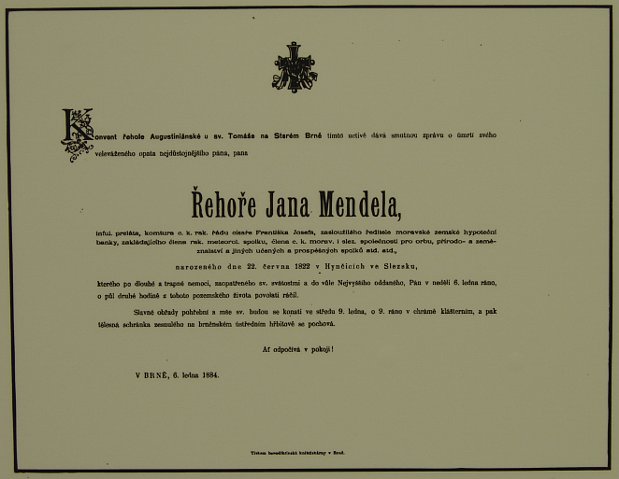
Further reading
- William Bateson Mendel, Gregor; Bateson, William (2009). Mendel's Principles of Heredity: A Defence, with a Translation of Mendel's Original Papers on Hybridisation (Cambridge Library Collection – Life Sciences). Cambridge, UK: Cambridge University Press. ISBN 978-1-108-00613-2. On-line Facsimile Edition: Electronic Scholarly Publishing, Prepared by Robert Robbins
- Hugo Iltis, Gregor Johann Mendel. Leben, Werk und Wirkung. Berlin: J. Springer. 426 pages. (1924)
- Translated by Eden and Cedar Paul as Life of Mendel. New York: W. W. Norton & Co, 1932. 336 pages. New York: Hafner, 1966: London: George Allen & Unwin, 1966. Ann Arbor: University Microfilms International, 1976.
- Translated by Zhenyao Tan as Mên-tê-êrh chuan. Shanghai: Shang wu yin shu guan, 1924. 2 vols. in 1, 661 pp. Shanghai: Shang wu yin shu guan, Minguo 25 [1936].
- Translated as Zasshu shokubutsu no kenkyū. Tsuketari Menderu shōden. Tōkyō: Iwanami Shoten, Shōwa 3 [1928]. 100 pp. Translated by Yuzuru Nagashima as Menderu no shōgai. Tōkyō: Sōgensha, Shōwa 17 [1942]. Menderu den. Tōkyō: Tōkyō Sōgensha, 1960.
- Klein, Jan; Klein, Norman (2013). Solitude of a Humble Genius – Gregor Johann Mendel: Volume 1. Heidelberg: Springer. ISBN 978-3-642-35253-9.
- Robert Lock, Recent Progress in the Study of Variation, Heredity and Evolution, London, 1906
- Orel, Vítĕzslav (1996). Gregor Mendel: the first geneticist. Oxford [Oxfordshire]: Oxford University Press. ISBN 978-0-19-854774-7.
- Punnett, Reginald Crundall (1922). Mendelism. London: Macmillan. (1st Pub. 1905)
- Curt Stern and Sherwood ER (1966) The Origin of Genetics.
- Taylor, Monica (July–September 1922). "Abbot Mendel". Dublin Review. London: W. Spooner.
- Tudge, Colin (2000). In Mendel's footnotes: an introduction to the science and technologies of genes and genetics from the nineteenth century to the twenty-second. London: Vintage. ISBN 978-0-09-928875-6.
- Waerden, B. L. V. D. (1968). "Mendel's Experiments". Centaurus. 12 (4): 275–88. Bibcode:1968Cent...12..275V. doi:10.1111/j.1600-0498.1968.tb00098.x. PMID 4880928. refutes allegations about "data smoothing"
- James Walsh, Catholic Churchmen in Science, Philadelphia: Dolphin Press, 1906
- Windle, Bertram C. A. (1915). "Mendel and His Theory of Heredity". A Century of Scientific Thought and Other Essays. Burns & Oates.
- Zumkeller, Adolar; Hartmann, Arnulf (1971). "Recently Discovered Sermon Sketches of Gregor Mendel". Folia Mendeliana. 6: 247–52.
External links
| File:Commons-logo.svg | Wikimedia Commons has media related to Gregor Mendel. |

| File:Wikiquote-logo.svg | Wikiquote has quotations related to: Gregor Mendel |

- Works by Gregor Mendel at Project Gutenberg
- Script error: No such module "Internet Archive".
- Works by Gregor Mendel at LibriVox (public domain audiobooks) File:Speaker Icon.svg
- 1913 Catholic Encyclopedia entry, "Mendel, Mendelism"
- Augustinian Abbey of St. Thomas at Brno Archived 22 November 2005 at the Wayback Machine
- Biography, bibliography and access to digital sources in the Virtual Laboratory of the Max Planck Institute for the History of Science
- Biography of Gregor Mendel
- GCSE student
- Gregor Mendel (1822–1884)
- Gregor Mendel Primary Sources
- Johann Gregor Mendel: Why his discoveries were ignored for 35 (72) years (in German)
- Masaryk University to rebuild Mendel's greenhouse | Brno Now
- Mendel Museum of Genetics
- Mendel's Paper in English
- Online Mendelian Inheritance in Man
- A photographic tour of St. Thomas' Abbey, Brno, Czech Republic
- Villanova University Mendel Collection

- CS1 errors: PMID
- CS1 German-language sources (de)
- Articles with dead external links from June 2024
- Use dmy dates from March 2022
- Articles containing Czech-language text
- Articles containing German-language text
- Articles with German-language sources (de)
- Gregor Mendel
- 1822 births
- 1884 deaths
- People from Nový Jičín District
- 19th-century Austrian biologists
- 19th-century Austrian botanists
- 19th-century Austrian Roman Catholic priests
- Austrian abbots
- Austrian gardeners
- Austrian beekeepers
- Austrian geneticists
- 19th-century Czech botanists
- Czech beekeepers
- Czech geneticists
- Czech Roman Catholics
- 19th-century gardeners
- People from Austrian Silesia
- Botanists from the Austrian Empire
- Farmers from the Austrian Empire
- Philosophers from the Austrian Empire
- Gardeners from the Austrian Empire
- Independent scientists
- Botanists with author abbreviations
- Augustinian friars
- Catholic clergy scientists
- Catholic philosophers
- Silesian-German people
- Palacký University Olomouc alumni
- Deaths from nephritis
- Burials at Brno Central Cemetery