Bilinear transform
 | This article needs additional citations for verification. (June 2009) |
The bilinear transform (also known as Tustin's method, after Arnold Tustin) is used in digital signal processing and discrete-time control theory to transform continuous-time system representations to discrete-time and vice versa.
The bilinear transform is a special case of a conformal mapping (namely, a Möbius transformation), often used for converting a transfer function of a linear, time-invariant (LTI) filter in the continuous-time domain (often named an analog filter) to a transfer function of a linear, shift-invariant filter in the discrete-time domain (often named a digital filter although there are analog filters constructed with switched capacitors that are discrete-time filters). It maps positions on the axis, , in the s-plane to the unit circle, , in the z-plane. Other bilinear transforms can be used for warping the frequency response of any discrete-time linear system (for example to approximate the non-linear frequency resolution of the human auditory system) and are implementable in the discrete domain by replacing a system's unit delays with first order all-pass filters.


![{\displaystyle \mathrm {Re} [s]=0}](https://wikimedia.org/api/rest_v1/media/math/render/svg/15f28163d358cf41e5edce7bb8af2ff66bb4395b)


The transform preserves stability and maps every point of the frequency response of the continuous-time filter, to a corresponding point in the frequency response of the discrete-time filter, although to a somewhat different frequency, as shown in the Frequency warping section below. This means that for every feature that one sees in the frequency response of the analog filter, there is a corresponding feature, with identical gain and phase shift, in the frequency response of the digital filter but, perhaps, at a somewhat different frequency. The change in frequency is barely noticeable at low frequencies but is quite evident at frequencies close to the Nyquist frequency.


Discrete-time approximation
[edit]The bilinear transform is a first-order Padé approximant of the natural logarithm function that is an exact mapping of the z-plane to the s-plane. When the Laplace transform is performed on a discrete-time signal (with each element of the discrete-time sequence attached to a correspondingly delayed unit impulse), the result is precisely the Z transform of the discrete-time sequence with the substitution of
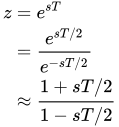
where is the numerical integration step size of the trapezoidal rule used in the bilinear transform derivation;[1] or, in other words, the sampling period. The above bilinear approximation can be solved for or a similar approximation for can be performed.



The inverse of this mapping (and its first-order bilinear approximation) is
![{\displaystyle {\begin{aligned}s&={\frac {1}{T}}\ln(z)\\&={\frac {2}{T}}\left[{\frac {z-1}{z+1}}+{\frac {1}{3}}\left({\frac {z-1}{z+1}}\right)^{3}+{\frac {1}{5}}\left({\frac {z-1}{z+1}}\right)^{5}+{\frac {1}{7}}\left({\frac {z-1}{z+1}}\right)^{7}+\cdots \right]\\&\approx {\frac {2}{T}}{\frac {z-1}{z+1}}\\&={\frac {2}{T}}{\frac {1-z^{-1}}{1+z^{-1}}}\end{aligned}}}](https://wikimedia.org/api/rest_v1/media/math/render/svg/f226f1f5efffa9a3d825090fc62007354455ee12)
The bilinear transform essentially uses this first order approximation and substitutes into the continuous-time transfer function,
- Failed to parse (Conversion error. Server ("https://wikimedia.org/api/rest_") reported: "Cannot get mml. Server problem."): {\displaystyle s\leftarrow {\frac {2}{T}}{\frac {z-1}{z+1}}.}
That is

Stability and minimum-phase property preserved
[edit]A continuous-time causal filter is stable if the poles of its transfer function fall in the left half of the complex s-plane. A discrete-time causal filter is stable if the poles of its transfer function fall inside the unit circle in the complex z-plane. The bilinear transform maps the left half of the complex s-plane to the interior of the unit circle in the z-plane. Thus, filters designed in the continuous-time domain that are stable are converted to filters in the discrete-time domain that preserve that stability.
Likewise, a continuous-time filter is minimum-phase if the zeros of its transfer function fall in the left half of the complex s-plane. A discrete-time filter is minimum-phase if the zeros of its transfer function fall inside the unit circle in the complex z-plane. Then the same mapping property assures that continuous-time filters that are minimum-phase are converted to discrete-time filters that preserve that property of being minimum-phase.
Transformation of a General LTI System
[edit]A general LTI system has the transfer function The order of the transfer function N is the greater of P and Q (in practice this is most likely P as the transfer function must be proper for the system to be stable). Applying the bilinear transform where K is defined as either 2/T or otherwise if using frequency warping, gives Multiplying the numerator and denominator by the largest power of (z + 1)−1 present, (z + 1)−N, gives It can be seen here that after the transformation, the degree of the numerator and denominator are both N.




Consider then the pole-zero form of the continuous-time transfer function Failed to parse (Conversion error. Server ("https://wikimedia.org/api/rest_") reported: "Cannot get mml. Server problem."): {\displaystyle H_{a}(s)={\frac {(s-\xi _{1})(s-\xi _{2})\cdots (s-\xi _{Q})}{(s-p_{1})(s-p_{2})\cdots (s-p_{P})}}} The roots of the numerator and denominator polynomials, ξi and pi, are the zeros and poles of the system. The bilinear transform is a one-to-one mapping, hence these can be transformed to the z-domain using Failed to parse (Conversion error. Server ("https://wikimedia.org/api/rest_") reported: "Cannot get mml. Server problem."): {\displaystyle z={\frac {K+s}{K-s}}} yielding some of the discretized transfer function's zeros and poles ξ'i and p'i Failed to parse (Conversion error. Server ("https://wikimedia.org/api/rest_") reported: "Cannot get mml. Server problem."): {\displaystyle {\begin{aligned}\xi '_{i}&={\frac {K+\xi _{i}}{K-\xi _{i}}}\quad 1\leq i\leq Q\\p'_{i}&={\frac {K+p_{i}}{K-p_{i}}}\quad 1\leq i\leq P\end{aligned}}} As described above, the degree of the numerator and denominator are now both N, in other words there is now an equal number of zeros and poles. The multiplication by (z + 1)−N means the additional zeros or poles are [2] Failed to parse (Conversion error. Server ("https://wikimedia.org/api/rest_") reported: "Cannot get mml. Server problem."): {\displaystyle {\begin{aligned}\xi '_{i}&=-1\quad Q<i\leq N\\p'_{i}&=-1\quad P<i\leq N\end{aligned}}} Given the full set of zeros and poles, the z-domain transfer function is then Failed to parse (Conversion error. Server ("https://wikimedia.org/api/rest_") reported: "Cannot get mml. Server problem."): {\displaystyle H_{d}(z)={\frac {(z-\xi '_{1})(z-\xi '_{2})\cdots (z-\xi '_{N})}{(z-p'_{1})(z-p'_{2})\cdots (z-p'_{N})}}}
Example
[edit]As an example take a simple low-pass RC filter. This continuous-time filter has a transfer function
- Failed to parse (Conversion error. Server ("https://wikimedia.org/api/rest_") reported: "Cannot get mml. Server problem."): {\displaystyle {\begin{aligned}H_{a}(s)&={\frac {1/sC}{R+1/sC}}\\&={\frac {1}{1+RCs}}.\end{aligned}}}
If we wish to implement this filter as a digital filter, we can apply the bilinear transform by substituting for the formula above; after some reworking, we get the following filter representation:
Failed to parse (Conversion error. Server ("https://wikimedia.org/api/rest_") reported: "Cannot get mml. Server problem."): {\displaystyle H_{d}(z)\ } Failed to parse (Conversion error. Server ("https://wikimedia.org/api/rest_") reported: "Cannot get mml. Server problem."): {\displaystyle ={\frac {1}{1+RC\left({\frac {2}{T}}{\frac {z-1}{z+1}}\right)}}\ } Failed to parse (Conversion error. Server ("https://wikimedia.org/api/rest_") reported: "Cannot get mml. Server problem."): {\displaystyle ={\frac {1+z}{(1-2RC/T)+(1+2RC/T)z}}\ } Failed to parse (Conversion error. Server ("https://wikimedia.org/api/rest_") reported: "Cannot get mml. Server problem."): {\displaystyle ={\frac {1+z^{-1}}{(1+2RC/T)+(1-2RC/T)z^{-1}}}.\ }
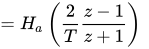
The coefficients of the denominator are the 'feed-backward' coefficients and the coefficients of the numerator are the 'feed-forward' coefficients used for implementing a real-time digital filter.
Transformation for a general first-order continuous-time filter
[edit]It is possible to relate the coefficients of a continuous-time, analog filter with those of a similar discrete-time digital filter created through the bilinear transform process. Transforming a general, first-order continuous-time filter with the given transfer function

using the bilinear transform (without prewarping any frequency specification) requires the substitution of
- Failed to parse (Conversion error. Server ("https://wikimedia.org/api/rest_") reported: "Cannot get mml. Server problem."): {\displaystyle s\leftarrow K{\frac {1-z^{-1}}{1+z^{-1}}}}
where
- Failed to parse (Conversion error. Server ("https://wikimedia.org/api/rest_") reported: "Cannot get mml. Server problem."): {\displaystyle K\triangleq {\frac {2}{T}}} .
However, if the frequency warping compensation as described below is used in the bilinear transform, so that both analog and digital filter gain and phase agree at frequency , then

- Failed to parse (Conversion error. Server ("https://wikimedia.org/api/rest_") reported: "Cannot get mml. Server problem."): {\displaystyle K\triangleq {\frac {\omega _{0}}{\tan \left({\frac {\omega _{0}T}{2}}\right)}}} .
This results in a discrete-time digital filter with coefficients expressed in terms of the coefficients of the original continuous time filter:
- Failed to parse (Conversion error. Server ("https://wikimedia.org/api/rest_") reported: "Cannot get mml. Server problem."): {\displaystyle H_{d}(z)={\frac {(b_{0}K+b_{1})+(-b_{0}K+b_{1})z^{-1}}{(a_{0}K+a_{1})+(-a_{0}K+a_{1})z^{-1}}}}
Normally the constant term in the denominator must be normalized to 1 before deriving the corresponding difference equation. This results in
- Failed to parse (Conversion error. Server ("https://wikimedia.org/api/rest_") reported: "Cannot get mml. Server problem."): {\displaystyle H_{d}(z)={\frac {{\frac {b_{0}K+b_{1}}{a_{0}K+a_{1}}}+{\frac {-b_{0}K+b_{1}}{a_{0}K+a_{1}}}z^{-1}}{1+{\frac {-a_{0}K+a_{1}}{a_{0}K+a_{1}}}z^{-1}}}.}
The difference equation (using the Direct form I) is
- Failed to parse (Conversion error. Server ("https://wikimedia.org/api/rest_") reported: "Cannot get mml. Server problem."): {\displaystyle y[n]={\frac {b_{0}K+b_{1}}{a_{0}K+a_{1}}}\cdot x[n]+{\frac {-b_{0}K+b_{1}}{a_{0}K+a_{1}}}\cdot x[n-1]-{\frac {-a_{0}K+a_{1}}{a_{0}K+a_{1}}}\cdot y[n-1]\ .}
General second-order biquad transformation
[edit]A similar process can be used for a general second-order filter with the given transfer function
- Failed to parse (Conversion error. Server ("https://wikimedia.org/api/rest_") reported: "Cannot get mml. Server problem."): {\displaystyle H_{a}(s)={\frac {b_{0}s^{2}+b_{1}s+b_{2}}{a_{0}s^{2}+a_{1}s+a_{2}}}={\frac {b_{0}+b_{1}s^{-1}+b_{2}s^{-2}}{a_{0}+a_{1}s^{-1}+a_{2}s^{-2}}}\ .}
This results in a discrete-time digital biquad filter with coefficients expressed in terms of the coefficients of the original continuous time filter:
- Failed to parse (Conversion error. Server ("https://wikimedia.org/api/rest_") reported: "Cannot get mml. Server problem."): {\displaystyle H_{d}(z)={\frac {(b_{0}K^{2}+b_{1}K+b_{2})+(2b_{2}-2b_{0}K^{2})z^{-1}+(b_{0}K^{2}-b_{1}K+b_{2})z^{-2}}{(a_{0}K^{2}+a_{1}K+a_{2})+(2a_{2}-2a_{0}K^{2})z^{-1}+(a_{0}K^{2}-a_{1}K+a_{2})z^{-2}}}}
Again, the constant term in the denominator is generally normalized to 1 before deriving the corresponding difference equation. This results in

The difference equation (using the Direct form I) is
- Failed to parse (Conversion error. Server ("https://wikimedia.org/api/rest_") reported: "Cannot get mml. Server problem."): {\displaystyle y[n]={\frac {b_{0}K^{2}+b_{1}K+b_{2}}{a_{0}K^{2}+a_{1}K+a_{2}}}\cdot x[n]+{\frac {2b_{2}-2b_{0}K^{2}}{a_{0}K^{2}+a_{1}K+a_{2}}}\cdot x[n-1]+{\frac {b_{0}K^{2}-b_{1}K+b_{2}}{a_{0}K^{2}+a_{1}K+a_{2}}}\cdot x[n-2]-{\frac {2a_{2}-2a_{0}K^{2}}{a_{0}K^{2}+a_{1}K+a_{2}}}\cdot y[n-1]-{\frac {a_{0}K^{2}-a_{1}K+a_{2}}{a_{0}K^{2}+a_{1}K+a_{2}}}\cdot y[n-2]\ .}
Frequency warping
[edit]To determine the frequency response of a continuous-time filter, the transfer function is evaluated at Failed to parse (Conversion error. Server ("https://wikimedia.org/api/rest_") reported: "Cannot get mml. Server problem."): {\displaystyle s=j\omega _{a}} which is on the axis. Likewise, to determine the frequency response of a discrete-time filter, the transfer function is evaluated at which is on the unit circle, . The bilinear transform maps the axis of the s-plane (which is the domain of ) to the unit circle of the z-plane, (which is the domain of ), but it is not the same mapping Failed to parse (Conversion error. Server ("https://wikimedia.org/api/rest_") reported: "Cannot get mml. Server problem."): {\displaystyle z=e^{sT}} which also maps the axis to the unit circle. When the actual frequency of Failed to parse (Conversion error. Server ("https://wikimedia.org/api/rest_") reported: "Cannot get mml. Server problem."): {\displaystyle \omega _{d}} is input to the discrete-time filter designed by use of the bilinear transform, then it is desired to know at what frequency, Failed to parse (Conversion error. Server ("https://wikimedia.org/api/rest_") reported: "Cannot get mml. Server problem."): {\displaystyle \omega _{a}} , for the continuous-time filter that this Failed to parse (Conversion error. Server ("https://wikimedia.org/api/rest_") reported: "Cannot get mml. Server problem."): {\displaystyle \omega _{d}} is mapped to.

- Failed to parse (Conversion error. Server ("https://wikimedia.org/api/rest_") reported: "Cannot get mml. Server problem."): {\displaystyle H_{d}(z)=H_{a}\left({\frac {2}{T}}{\frac {z-1}{z+1}}\right)}
Failed to parse (Conversion error. Server ("https://wikimedia.org/api/rest_") reported: "Cannot get mml. Server problem."): {\displaystyle =H_{a}\left({\frac {2}{T}}{\frac {e^{j\omega _{d}T}-1}{e^{j\omega _{d}T}+1}}\right)} Failed to parse (Conversion error. Server ("https://wikimedia.org/api/rest_") reported: "Cannot get mml. Server problem."): {\displaystyle =H_{a}\left({\frac {2}{T}}\cdot {\frac {e^{j\omega _{d}T/2}\left(e^{j\omega _{d}T/2}-e^{-j\omega _{d}T/2}\right)}{e^{j\omega _{d}T/2}\left(e^{j\omega _{d}T/2}+e^{-j\omega _{d}T/2}\right)}}\right)} Failed to parse (Conversion error. Server ("https://wikimedia.org/api/rest_") reported: "Cannot get mml. Server problem."): {\displaystyle =H_{a}\left({\frac {2}{T}}\cdot {\frac {\left(e^{j\omega _{d}T/2}-e^{-j\omega _{d}T/2}\right)}{\left(e^{j\omega _{d}T/2}+e^{-j\omega _{d}T/2}\right)}}\right)} Failed to parse (Conversion error. Server ("https://wikimedia.org/api/rest_") reported: "Cannot get mml. Server problem."): {\displaystyle =H_{a}\left(j{\frac {2}{T}}\cdot {\frac {\left(e^{j\omega _{d}T/2}-e^{-j\omega _{d}T/2}\right)/(2j)}{\left(e^{j\omega _{d}T/2}+e^{-j\omega _{d}T/2}\right)/2}}\right)}
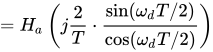
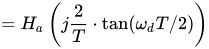
This shows that every point on the unit circle in the discrete-time filter z-plane, is mapped to a point on the axis on the continuous-time filter s-plane, Failed to parse (Conversion error. Server ("https://wikimedia.org/api/rest_") reported: "Cannot get mml. Server problem."): {\displaystyle s=j\omega _{a}} . That is, the discrete-time to continuous-time frequency mapping of the bilinear transform is
- Failed to parse (Conversion error. Server ("https://wikimedia.org/api/rest_") reported: "Cannot get mml. Server problem."): {\displaystyle \omega _{a}={\frac {2}{T}}\tan \left(\omega _{d}{\frac {T}{2}}\right)}
and the inverse mapping is
- Failed to parse (Conversion error. Server ("https://wikimedia.org/api/rest_") reported: "Cannot get mml. Server problem."): {\displaystyle \omega _{d}={\frac {2}{T}}\arctan \left(\omega _{a}{\frac {T}{2}}\right).}
The discrete-time filter behaves at frequency Failed to parse (Conversion error. Server ("https://wikimedia.org/api/rest_") reported: "Cannot get mml. Server problem."): {\displaystyle \omega _{d}} the same way that the continuous-time filter behaves at frequency Failed to parse (Conversion error. Server ("https://wikimedia.org/api/rest_") reported: "Cannot get mml. Server problem."): {\displaystyle (2/T)\tan(\omega _{d}T/2)} . Specifically, the gain and phase shift that the discrete-time filter has at frequency Failed to parse (Conversion error. Server ("https://wikimedia.org/api/rest_") reported: "Cannot get mml. Server problem."): {\displaystyle \omega _{d}} is the same gain and phase shift that the continuous-time filter has at frequency Failed to parse (Conversion error. Server ("https://wikimedia.org/api/rest_") reported: "Cannot get mml. Server problem."): {\displaystyle (2/T)\tan(\omega _{d}T/2)} . This means that every feature, every "bump" that is visible in the frequency response of the continuous-time filter is also visible in the discrete-time filter, but at a different frequency. For low frequencies (that is, when Failed to parse (Conversion error. Server ("https://wikimedia.org/api/rest_") reported: "Cannot get mml. Server problem."): {\displaystyle \omega _{d}\ll 2/T} or Failed to parse (Conversion error. Server ("https://wikimedia.org/api/rest_") reported: "Cannot get mml. Server problem."): {\displaystyle \omega _{a}\ll 2/T} ), then the features are mapped to a slightly different frequency; Failed to parse (Conversion error. Server ("https://wikimedia.org/api/rest_") reported: "Cannot get mml. Server problem."): {\displaystyle \omega _{d}\approx \omega _{a}} .
One can see that the entire continuous frequency range

is mapped onto the fundamental frequency interval
- Failed to parse (Conversion error. Server ("https://wikimedia.org/api/rest_") reported: "Cannot get mml. Server problem."): {\displaystyle -{\frac {\pi }{T}}<\omega _{d}<+{\frac {\pi }{T}}.}
The continuous-time filter frequency corresponds to the discrete-time filter frequency Failed to parse (Conversion error. Server ("https://wikimedia.org/api/rest_") reported: "Cannot get mml. Server problem."): {\displaystyle \omega _{d}=0} and the continuous-time filter frequency Failed to parse (Conversion error. Server ("https://wikimedia.org/api/rest_") reported: "Cannot get mml. Server problem."): {\displaystyle \omega _{a}=\pm \infty } correspond to the discrete-time filter frequency Failed to parse (Conversion error. Server ("https://wikimedia.org/api/rest_") reported: "Cannot get mml. Server problem."): {\displaystyle \omega _{d}=\pm \pi /T.}

One can also see that there is a nonlinear relationship between Failed to parse (Conversion error. Server ("https://wikimedia.org/api/rest_") reported: "Cannot get mml. Server problem."): {\displaystyle \omega _{a}} and Failed to parse (Conversion error. Server ("https://wikimedia.org/api/rest_") reported: "Cannot get mml. Server problem."): {\displaystyle \omega _{d}.} This effect of the bilinear transform is called frequency warping. The continuous-time filter can be designed to compensate for this frequency warping by setting Failed to parse (Conversion error. Server ("https://wikimedia.org/api/rest_") reported: "Cannot get mml. Server problem."): {\displaystyle \omega _{a}={\frac {2}{T}}\tan \left(\omega _{d}{\frac {T}{2}}\right)} for every frequency specification that the designer has control over (such as corner frequency or center frequency). This is called pre-warping the filter design.
It is possible, however, to compensate for the frequency warping by pre-warping a frequency specification (usually a resonant frequency or the frequency of the most significant feature of the frequency response) of the continuous-time system. These pre-warped specifications may then be used in the bilinear transform to obtain the desired discrete-time system. When designing a digital filter as an approximation of a continuous time filter, the frequency response (both amplitude and phase) of the digital filter can be made to match the frequency response of the continuous filter at a specified frequency , as well as matching at DC, if the following transform is substituted into the continuous filter transfer function.[3] This is a modified version of Tustin's transform shown above.
- Failed to parse (Conversion error. Server ("https://wikimedia.org/api/rest_") reported: "Cannot get mml. Server problem."): {\displaystyle s\leftarrow {\frac {\omega _{0}}{\tan \left({\frac {\omega _{0}T}{2}}\right)}}{\frac {z-1}{z+1}}.}
However, note that this transform becomes the original transform
- Failed to parse (Conversion error. Server ("https://wikimedia.org/api/rest_") reported: "Cannot get mml. Server problem."): {\displaystyle s\leftarrow {\frac {2}{T}}{\frac {z-1}{z+1}}}
as Failed to parse (Conversion error. Server ("https://wikimedia.org/api/rest_") reported: "Cannot get mml. Server problem."): {\displaystyle \omega _{0}\to 0} .
The main advantage of the warping phenomenon is the absence of aliasing distortion of the frequency response characteristic, such as observed with Impulse invariance.
See also
[edit]References
[edit]- ↑ Oppenheim, Alan (2010). Discrete Time Signal Processing Third Edition. Upper Saddle River, NJ: Pearson Higher Education, Inc. p. 504. ISBN 978-0-13-198842-2.
- ↑ Bhandari, Ayush. "DSP and Digital Filters Lecture Notes" (PDF). Archived from the original (PDF) on 3 March 2022. Retrieved 16 August 2022.
- ↑ Astrom, Karl J. (1990). Computer Controlled Systems, Theory and Design (Second ed.). Prentice-Hall. p. 212. ISBN 0-13-168600-3.