Elementary function
In mathematics, an elementary function is a function of a single variable (real or complex) that is typically encountered by beginners. The basic elementary functions are polynomial functions, rational functions, the trigonometric functions, the exponential and logarithm functions, the n-th root, and the inverse trigonometric functions, as well as those functions obtained by addition, multiplication, division, and composition of these. Some functions which are encountered by beginners are not elementary, such as piecewise-defined functions. More generally, in some modern treatments, elementary functions comprise the set of functions previously enumerated, all algebraic functions, and all functions obtained by roots of a polynomial whose coefficients are elementary.
The elementary functions were originally defined by Joseph Liouville in 1833. A key property is that all elementary functions have derivatives of any order, which are also elementary, and can be algorithmically computed by applying the differentiation rules (or the rules for implicit differentiation in the case of roots). The Taylor series of an elementary function converges in a neighborhood of every point of its domain. More generally, they are global analytic functions, defined (possibly with multiple values, such as the elementary function or ) for every complex argument, except at isolated points. In contrast, antiderivatives of elementary functions need not be elementary and is difficult to decide whether a specific elementary function has an elementary antiderivative.


Liouville's result is that, if an elementary function has an elementary antiderivative, then this antiderivative is a linear combination of logarithms, where the coefficients and the arguments of the logarithms are elementary functions involved, in some sense, in the definition of the function. The Risch algorithm (1968) can decide whether an elementary function has an elementary antiderivative, and, if so, to compute it. However, as of 2025[update], there is no full implementation.[1]
Examples
[edit]Basic examples
[edit]Elementary functions of a single variable Template:Tmath include:
- Constant functions: Template:Tmath, Template:Tmath, Template:Tmath, the Euler–Mascheroni constant, Apéry's constant, Khinchin's constant, etc. Any constant real (or complex) number.
- [[Exponentiation|Powers of Template:Tmath]]: Template:Tmath, etc. (The exponent can be any real or complex constant.)
- Exponential functions: Template:Tmath, Template:Tmath
- Logarithms: Template:Tmath, Template:Tmath
- Trigonometric functions: Template:Tmath, Template:Tmath, Template:Tmath, etc.
- Inverse trigonometric functions: Template:Tmath, Template:Tmath, etc.
- Hyperbolic functions: Template:Tmath, Template:Tmath, etc.
- Inverse hyperbolic functions: Template:Tmath, Template:Tmath, etc.
- All functions obtained by adding, subtracting, multiplying or dividing a finite number of any of the previous functions[2]
- All functions obtained as roots of a polynomial whose coefficients are elementary functions[3][4]
- All functions obtained by composing a finite number of any of the previously listed functions
Certain elementary functions of a single complex variable Template:Tmath, such as and Template:Tmath, may be multivalued. Additionally, certain classes of functions may be obtained by others using the final two rules. For example, the exponential function composed with addition, subtraction, and division provides the hyperbolic functions, while initial composition with instead provides the trigonometric functions.


Composite examples
[edit]Examples of elementary functions include:
- Addition, e.g. (Template:Tmath)
- Multiplication, e.g. (Template:Tmath)
- Polynomial functions
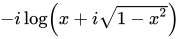
The last function is equal to Template:Tmath, the inverse cosine, in the entire complex plane.
All monomials, polynomials, rational functions and algebraic functions are elementary.
Non-elementary functions
[edit]All elementary functions are analytic in the following sense: they can be extended to functions of a complex variable (possibly multivalued) that are analytic except at isolated points of the complex plane.[5] Thus nonanalytic functions such as the absolute value function are not elementary,[6] nor are most other piecewise-defined functions.
Not every analytic function is elementary. In fact, most special functions are not elementary. Non-elementary functions include:
- the gamma function
- non-elementary Liouvillian functions, including
- the exponential integral (Ei) logarithmic integral (Li or li) and Fresnel integrals (S and C)
- the error function, Template:Tmath, a fact that may not be immediately obvious, but can be proven using the Risch algorithm
- other nonelementary integrals, including the Dirichlet integral and elliptic integral.
Real-variables and analytic branches
[edit]In elementary real-variable settings such as those in calculus and pre-calculus, expressions involving roots, logarithms, and inverse trigonometric functions are often interpreted using fixed real branches on specified real domains. This convention is distinct from the analytic convention used in the theory of elementary functions and integration in finite terms. Risch gives a precise definition of elementary functions "in the sense of analysis" by using functions of a complex variable rather than a real variable. In this setting the elementary functions are built using algebraic operations, exponentials, and logarithms, and are represented in differential fields of meromorphic functions on regions of the complex plane or on Riemann surfaces.[7]
An algebraic equation such as has the local analytic branches and . The real identity uses the convention that denotes the nonnegative real square root, and so changes from one analytic branch to the other at . Thus the restrictions of to and are elementary, but the usual real absolute value function on an interval containing is not a single analytic branch.


The same distinction appears in complex analysis. Whittaker and Watson note that although and , where , are functions of in a general sense, they are not elementary functions of the analytic type under consideration.[8] In symbolic computation, functions such as absolute value, signum, and piecewise-defined functions can be treated instead by adjoining a step or conditional operation, which forms a separate class of piecewise function rings.[9]


Closure
[edit]It follows directly from the definition that the set of elementary functions is closed under arithmetic operations, (algebraic) root extraction and composition. The elementary functions are closed under differentiation. They are not closed under limits and infinite sums. Importantly, the elementary functions are not closed under integration, as shown by Liouville's theorem, see nonelementary integral. The Liouvillian functions are defined as the elementary functions and, recursively, the integrals of the Liouvillian functions.
Extensions
[edit]In late-nineteenth-century analysis, elementary functions were often classified into successive kinds according to the number of independent integrations required for their definition. Functions expressible without any integration—those generated from rational functions by algebraic operations together with exponentiation, logarithms, and circular or hyperbolic trigonometric functions—were said to be elementary functions of the first kind (in the sense of Liouville). Functions defined by a single integration of an algebraic function, such as the error function and the elliptic integrals, were elementary functions of the second kind; their inverses, the elliptic functions, were considered of the same order. Higher "kinds" (third, fourth, etc.) corresponded to multiple integrals of algebraic functions, giving rise to hyperelliptic and more general Abelian functions.[10]
The essential point of the classification was that the class of elementary functions of any given kind be closed under the elementary operations—addition, multiplication, composition, and differentiation—so that differentiation never leads outside the same class, while integration may ascend to the next higher kind.
More recently, some have proposed extending the set of elementary functions by extending with certain transcendental functions, to include, for example, the Lambert W function[11] or elliptic functions,[12] all of which are analytic. The key attribute, from the perspective of the Liouville theorem, is that as a class, they are closed under taking derivatives. For example, the Lambert function , which is defined implicitly by the equation Template:Tmath, has a derivative which can be obtained by implicit differentiation:


which is again "elementary", provided that is.

Differential algebra
[edit]The mathematical definition of an elementary function is formalized in differential algebra. A differential field is a field with an extra operation of derivation (algebraic version of differentiation). Using the derivation operation new equations can be written and their solutions used in extensions of the algebra. By starting with the field of rational functions, two special types of transcendental extensions (the logarithm and the exponential) can be added to the field building a tower containing elementary functions.
A differential field Template:Tmath is a field together with a derivation Template:Tmath that maps Template:Tmath to itself. The derivation generalizes derivative, being linear (that is, Template:Tmath) and satisfying the Leibniz product rule (that is,Template:Tmath) for every two elements Template:Tmath and Template:Tmath in Template:Tmath. The rational functions over Template:Tmath of Template:Tmath form a basic examples of differential fields, when equipped with the usual derivative.
An element Template:Tmath of Template:Tmath is a constant if Template:Tmath. The constants of Template:Tmath form a differential field with zero derivative. Care must be taken that a differential field extension of a differential field may enlarge the field of constants.
A function Template:Tmath of a differential extension Template:Tmath of a differential field Template:Tmath is an elementary function over Template:Tmath if it belongs to a finite chain (for inclusion) of differential subfields of Template:Tmath that starts from Template:Tmath and is such that each is generated over the preceding one by a function that is either
- algebraic over the preceding field, or
- an exponential, that is, Template:Tmath for some a belonging to a prior subfield, or
- a logarithm, that is, Template:Tmath for some a belonging to a prior subfield, (see Liouville's theorem)
With this definition, the usual elementary functions are exactly the function that are elementary over the field of the rational functions. This generalized definition allows considering every transcendental function as elementary for applying Liouville's theorem.
See also
[edit]- Algebraic function
- Template:Anl
- Differential Galois theory
- Template:Anl
- Template:Anl
- Richardson's theorem: Undecidability of inequalities of real numbers formed out of a class of elementary functions
- Tarski's high school algebra problem
- Template:Anl
Notes
[edit]- ↑ "integration - Does there exist a complete implementation of the Risch algorithm?". MathOverflow. Oct 15, 2020. Retrieved 2023-02-10.
- ↑ Morris Tenenbaum (1985). Ordinary Differential Equations. Dover. p. 17. ISBN 0-486-64940-7.
- ↑ Spivak, Michael (1994). Calculus (3rd ed.). Houston, Tex.: Publish or Perish. p. 363. ISBN 0914098896. OCLC 31441929.
- ↑ Ritt, chapter 1
- ↑ Risch, Robert H. (1979). "Algebraic Properties of the Elementary Functions of Analysis". American Journal of Mathematics. 101 (4): 743–759. doi:10.2307/2373917. ISSN 0002-9327. JSTOR 2373917.
- ↑ Watson and Whittaker 1927, footnote to p 82. In the context of elementary functions, the function defined as the root of is two-valued: .
- ↑ Risch 1969, pp. 167–168.
- ↑ Whittaker & Watson 1927, §5.1.
- ↑ von Mohrenschildt 1998.
- ↑ Forsyth 1893.
- ↑ Stewart, Seán (2005). "A new elementary function for our curricula?" (PDF). Australian Senior Mathematics Journal. 19 (2): 8–26.
- ↑ Ince, E. L. (1956) [1926]. Ordinary Differential Equations. New York: Dover Publications. ISBN 0-486-60339-4, footnote to p 330


References
[edit]- Forsyth, Andrew (1893). Theory of Functions of a Complex Variable. Cambridge. JFM 25.0652.01.
- Liouville, Joseph (1833a). "Premier mémoire sur la détermination des intégrales dont la valeur est algébrique". Journal de l'École Polytechnique. tome XIV: 124–148.
- Liouville, Joseph (1833b). "Second mémoire sur la détermination des intégrales dont la valeur est algébrique". Journal de l'École Polytechnique. tome XIV: 149–193.
- Liouville, Joseph (1833c). "Note sur la détermination des intégrales dont la valeur est algébrique". Journal für die reine und angewandte Mathematik. 10: 347–359.
- von Mohrenschildt, Martin (1998), "A Normal Form for Function Rings of Piecewise Functions", Journal of Symbolic Computation, 26 (5): 607–619, doi:10.1006/jsco.1998.0229.
- Risch, R. H. (1969), "The problem of integration in finite terms", Transactions of the American Mathematical Society, American Mathematical Society, 139: 167–189, doi:10.2307/1995313, JSTOR 1995313.
- Ritt, Joseph (1950). Differential Algebra. AMS.
- Rosenlicht, Maxwell (1972). "Integration in finite terms". American Mathematical Monthly. 79 (9): 963–972. doi:10.2307/2318066. JSTOR 2318066.
Further reading
[edit]- Davenport, James H. (2007). "What Might "Understand a Function" Mean?". Towards Mechanized Mathematical Assistants. Lecture Notes in Computer Science. 4573. pp. 55–65. doi:10.1007/978-3-540-73086-6_5. ISBN 978-3-540-73083-5. S2CID 8049737.