Liouville function
In number theory, the Liouville function, named after French mathematician Joseph Liouville and denoted , is an important arithmetic function. Its value is if is the product of an even number of prime numbers, and if it is the product of an odd number of prime numbers.


Definition
By the fundamental theorem of arithmetic, any positive integer can be represented uniquely as a product of powers of primes:
- ,
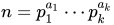
where are primes and the exponents are positive integers. The prime omega function counts the number of primes in the factorization of with multiplicity:


- .

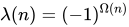
Thus, the Liouville function is defined by
Properties
Since is completely additive; i.e., , then is completely multiplicative. Since has no prime factors, , so .



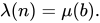
is also related to the Möbius function : if we write as , where is squarefree, then


The sum of the Liouville function over the divisors of is the characteristic function of the squares:

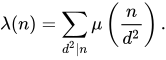
Möbius inversion of this formula yields
The Dirichlet inverse of the Liouville function is the absolute value of the Möbius function, , the characteristic function of the squarefree integers.

Series
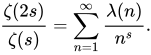
The Dirichlet series for the Liouville function is related to the Riemann zeta function by
Also:

The Lambert series for the Liouville function is

where is the Jacobi theta function.

Conjectures on weighted summatory functions
The Pólya problem is a question raised made by George Pólya in 1919. Defining

the problem asks whether L(n) ≤ 0 for all n > 1. The answer turns out to be no. The smallest counter-example is n = 906150257, found by Minoru Tanaka in 1980. It has since been shown that L(n) > 0.0618672√n for infinitely many positive integers n,[1] while it can also be shown via the same methods that L(n) < −1.3892783√n for infinitely many positive integers n.[2]
For any , assuming the Riemann hypothesis, we have that the summatory function is bounded by

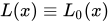

where the is some absolute limiting constant.[2]

Define the related sum
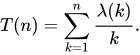
It was open for some time whether T(n) ≥ 0 for sufficiently big n ≥ n0 (this conjecture is occasionally—though incorrectly—attributed to Pál Turán). This was then disproved by Haselgrove (1958), who showed that T(n) takes negative values infinitely often. A confirmation of this positivity conjecture would have led to a proof of the Riemann hypothesis, as was shown by Pál Turán.
Generalizations
More generally, we can consider the weighted summatory functions over the Liouville function defined for any as follows for positive integers x where (as above) we have the special cases and [2]

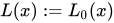
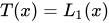
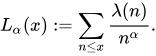
These -weighted summatory functions are related to the Mertens function, or weighted summatory functions of the Möbius function. In fact, we have that the so-termed non-weighted, or ordinary, function precisely corresponds to the sum


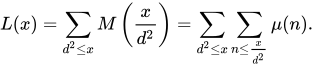
Moreover, these functions satisfy similar bounding asymptotic relations.[2] For example, whenever , we see that there exists an absolute constant such that



By an application of Perron's formula, or equivalently by a key (inverse) Mellin transform, we have that
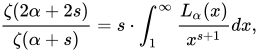
which then can be inverted via the inverse transform to show that for , and



where we can take , and with the remainder terms defined such that and as .


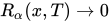

In particular, if we assume that the Riemann hypothesis (RH) is true and that all of the non-trivial zeros, denoted by , of the Riemann zeta function are simple, then for any and there exists an infinite sequence of which satisfies that for all v such that




where for any increasingly small we define
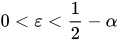

and where the remainder term

which of course tends to 0 as . These exact analytic formula expansions again share similar properties to those corresponding to the weighted Mertens function cases. Additionally, since we have another similarity in the form of to insomuch as the dominant leading term in the previous formulas predicts a negative bias in the values of these functions over the positive natural numbers x.


References
- ↑ Borwein, P.; Ferguson, R.; Mossinghoff, M. J. (2008). "Sign Changes in Sums of the Liouville Function". Mathematics of Computation. 77 (263): 1681–1694. doi:10.1090/S0025-5718-08-02036-X.
- ↑ 2.0 2.1 2.2 2.3 Humphries, Peter (2013). "The distribution of weighted sums of the Liouville function and Pólyaʼs conjecture". Journal of Number Theory. 133 (2): 545–582. arXiv:1108.1524. doi:10.1016/j.jnt.2012.08.011.
- Pólya, G. (1919). "Verschiedene Bemerkungen zur Zahlentheorie". Jahresbericht der Deutschen Mathematiker-Vereinigung. 28: 31–40.
- Haselgrove, C. Brian (1958). "A disproof of a conjecture of Pólya". Mathematika. 5 (2): 141–145. doi:10.1112/S0025579300001480. ISSN 0025-5793. MR 0104638. Zbl 0085.27102.
- Lehman, R. (1960). "On Liouville's function". Mathematics of Computation. 14 (72): 311–320. doi:10.1090/S0025-5718-1960-0120198-5. MR 0120198.
- Tanaka, Minoru (1980). "A Numerical Investigation on Cumulative Sum of the Liouville Function". Tokyo Journal of Mathematics. 3 (1): 187–189. doi:10.3836/tjm/1270216093. MR 0584557.
- Template:Mathworld
- Template:Springer