Multivariate random variable
Template:Probability fundamentals
In probability and statistics, a multivariate random variable or random vector is a list or vector of mathematical variables each of whose value is unknown, either because the value has not yet occurred or because there is imperfect knowledge of its value. The individual variables in a random vector are grouped together because they are all part of a single mathematical system — often they represent different properties of an individual statistical unit. For example, while a given person has a specific age, height and weight, the representation of these features of an unspecified person from within a group would be a random vector. Normally each element of a random vector is a real number.
Random vectors are often used as the underlying implementation of various types of aggregate random variables, e.g. a random matrix, random tree, random sequence, stochastic process, etc.
Formally, a multivariate random variable is a column vector (or its transpose, which is a row vector) whose components are random variables on the probability space , where is the sample space, is the sigma-algebra (the collection of all events), and is the probability measure (a function returning each event's probability).



Probability distribution
[edit]Every random vector gives rise to a probability measure on with the Borel algebra as the underlying sigma-algebra. This measure is also known as the joint probability distribution, the joint distribution, or the multivariate distribution of the random vector.

The distributions of each of the component random variables are called marginal distributions. The conditional probability distribution of given is the probability distribution of when is known to be a particular value.


The cumulative distribution function of a random vector is defined as[1]: p.15
![{\displaystyle F_{\mathbf {X} }:\mathbb {R} ^{n}\mapsto [0,1]}](https://wikimedia.org/api/rest_v1/media/math/render/svg/5b30f84c300818779899583633faa44ef4cc9100)
where .

Operations on random vectors
[edit]Random vectors can be subjected to the same kinds of algebraic operations as can non-random vectors: addition, subtraction, multiplication by a scalar, and the taking of inner products.
Affine transformations
[edit]Similarly, a new random vector can be defined by applying an affine transformation to a random vector :


- , where is an matrix and is an column vector.



If is an invertible matrix and has a probability density function , then the probability density of is


- .

Invertible mappings
[edit]More generally we can study invertible mappings of random vectors.[2]: p.284–285
Let be a one-to-one mapping from an open subset of onto a subset of , let have continuous partial derivatives in and let the Jacobian determinant of be zero at no point of . Assume that the real random vector has a probability density function and satisfies . Then the random vector is of probability density





where denotes the indicator function and set denotes support of .


Expected value
[edit]The expected value or mean of a random vector is a fixed vector whose elements are the expected values of the respective random variables.[3]: p.333
![{\displaystyle \operatorname {E} [\mathbf {X} ]}](https://wikimedia.org/api/rest_v1/media/math/render/svg/3027b4ba8627bb297a8039b230b2afb29a717422)
Covariance and cross-covariance
[edit]Definitions
[edit]The covariance matrix (also called second central moment or variance-covariance matrix) of an random vector is an matrix whose (i,j)th element is the covariance between the i th and the j th random variables. The covariance matrix is the expected value, element by element, of the matrix computed as , where the superscript T refers to the transpose of the indicated vector:[2]: p. 464 [3]: p.335
![{\displaystyle [\mathbf {X} -\operatorname {E} [\mathbf {X} ]][\mathbf {X} -\operatorname {E} [\mathbf {X} ]]^{T}}](https://wikimedia.org/api/rest_v1/media/math/render/svg/26928071db5f676c48f2cf3cdbd4bf86d06f052f)
By extension, the cross-covariance matrix between two random vectors and ( having elements and having elements) is the matrix[3]: p.336


where again the matrix expectation is taken element-by-element in the matrix. Here the (i,j)th element is the covariance between the i th element of and the j th element of .
Properties
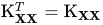
[edit]The covariance matrix is a symmetric matrix, i.e.[2]: p. 466
- .
The covariance matrix is a positive semidefinite matrix, i.e.[2]: p. 465
- .

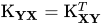
The cross-covariance matrix is simply the transpose of the matrix , i.e.
![{\displaystyle \operatorname {Cov} [\mathbf {Y} ,\mathbf {X} ]}](https://wikimedia.org/api/rest_v1/media/math/render/svg/e86490c56b48869d56250f25ecdb101769cff335)
![{\displaystyle \operatorname {Cov} [\mathbf {X} ,\mathbf {Y} ]}](https://wikimedia.org/api/rest_v1/media/math/render/svg/4d84d647f6dffb3803750a8f44ee3068f70f44f7)
- .
Uncorrelatedness
[edit]Two random vectors and are called uncorrelated if


- .
![{\displaystyle \operatorname {E} [\mathbf {X} \mathbf {Y} ^{T}]=\operatorname {E} [\mathbf {X} ]\operatorname {E} [\mathbf {Y} ]^{T}}](https://wikimedia.org/api/rest_v1/media/math/render/svg/a42871987cbf77a6e3ecf8ecbb23e4f33912ebcc)
They are uncorrelated if and only if their cross-covariance matrix is zero.[3]: p.337

Correlation and cross-correlation
[edit]Definitions
[edit]The correlation matrix (also called second moment) of an random vector is an matrix whose (i,j)th element is the correlation between the i th and the j th random variables. The correlation matrix is the expected value, element by element, of the matrix computed as , where the superscript T refers to the transpose of the indicated vector:[4]: p.190 [3]: p.334

By extension, the cross-correlation matrix between two random vectors and ( having elements and having elements) is the matrix
Properties
[edit]The correlation matrix is related to the covariance matrix by
- .
![{\displaystyle \operatorname {R} _{\mathbf {X} \mathbf {X} }=\operatorname {K} _{\mathbf {X} \mathbf {X} }+\operatorname {E} [\mathbf {X} ]\operatorname {E} [\mathbf {X} ]^{T}}](https://wikimedia.org/api/rest_v1/media/math/render/svg/adb44f1d86d971aec8db66f846cfef11d848912a)
Similarly for the cross-correlation matrix and the cross-covariance matrix:
![{\displaystyle \operatorname {R} _{\mathbf {X} \mathbf {Y} }=\operatorname {K} _{\mathbf {X} \mathbf {Y} }+\operatorname {E} [\mathbf {X} ]\operatorname {E} [\mathbf {Y} ]^{T}}](https://wikimedia.org/api/rest_v1/media/math/render/svg/4efa28447cc9ee6d8b3b0023ab2fc652c5717f2e)
Orthogonality
[edit]Two random vectors of the same size and are called orthogonal if

- .
![{\displaystyle \operatorname {E} [\mathbf {X} ^{T}\mathbf {Y} ]=0}](https://wikimedia.org/api/rest_v1/media/math/render/svg/b85a4e87960f920fc2b2e0d73fbc45ae39d9e0f7)
Independence
[edit]Two random vectors and are called independent if for all and



where and denote the cumulative distribution functions of and and denotes their joint cumulative distribution function. Independence of and is often denoted by . Written component-wise, and Failed to parse (SVG (MathML can be enabled via browser plugin): Invalid response ("Math extension cannot connect to Restbase.") from server "https://wikimedia.org/api/rest_v1/":): {\displaystyle \mathbf{Y}} are called independent if for all Failed to parse (SVG (MathML can be enabled via browser plugin): Invalid response ("Math extension cannot connect to Restbase.") from server "https://wikimedia.org/api/rest_v1/":): {\displaystyle x_1,\ldots,x_m,y_1,\ldots,y_n}


- .

Characteristic function
[edit]The characteristic function of a random vector Failed to parse (SVG (MathML can be enabled via browser plugin): Invalid response ("Math extension cannot connect to Restbase.") from server "https://wikimedia.org/api/rest_v1/":): {\displaystyle \mathbf{X} } with Failed to parse (SVG (MathML can be enabled via browser plugin): Invalid response ("Math extension cannot connect to Restbase.") from server "https://wikimedia.org/api/rest_v1/":): {\displaystyle n } components is a function Failed to parse (SVG (MathML can be enabled via browser plugin): Invalid response ("Math extension cannot connect to Restbase.") from server "https://wikimedia.org/api/rest_v1/":): {\displaystyle \mathbb{R}^n \to \mathbb{C}} that maps every vector Failed to parse (SVG (MathML can be enabled via browser plugin): Invalid response ("Math extension cannot connect to Restbase.") from server "https://wikimedia.org/api/rest_v1/":): {\displaystyle \mathbf{\omega} = (\omega_1,\ldots,\omega_n)^T} to a complex number. It is defined by[2]: p. 468
- Failed to parse (SVG (MathML can be enabled via browser plugin): Invalid response ("Math extension cannot connect to Restbase.") from server "https://wikimedia.org/api/rest_v1/":): {\displaystyle \varphi_{\mathbf{X}}(\mathbf{\omega}) = \operatorname{E} \left [ e^{i(\mathbf{\omega}^T \mathbf{X})} \right ] = \operatorname{E} \left [ e^{i( \omega_1 X_1 + \ldots + \omega_n X_n)} \right ]} .
Further properties
[edit]Expectation of a quadratic form
[edit]One can take the expectation of a quadratic form in the random vector Failed to parse (SVG (MathML can be enabled via browser plugin): Invalid response ("Math extension cannot connect to Restbase.") from server "https://wikimedia.org/api/rest_v1/":): {\displaystyle \mathbf{X}} as follows:[5]: p.170–171
- Failed to parse (SVG (MathML can be enabled via browser plugin): Invalid response ("Math extension cannot connect to Restbase.") from server "https://wikimedia.org/api/rest_v1/":): {\displaystyle \operatorname{E}[\mathbf{X}^{T}A\mathbf{X}] = \operatorname{E}[\mathbf{X}]^{T}A\operatorname{E}[\mathbf{X}] + \operatorname{tr}(A K_{\mathbf{X}\mathbf{X}}),}
where Failed to parse (SVG (MathML can be enabled via browser plugin): Invalid response ("Math extension cannot connect to Restbase.") from server "https://wikimedia.org/api/rest_v1/":): {\displaystyle K_{\mathbf{X}\mathbf{X}}} is the covariance matrix of Failed to parse (SVG (MathML can be enabled via browser plugin): Invalid response ("Math extension cannot connect to Restbase.") from server "https://wikimedia.org/api/rest_v1/":): {\displaystyle \mathbf{X}} and Failed to parse (SVG (MathML can be enabled via browser plugin): Invalid response ("Math extension cannot connect to Restbase.") from server "https://wikimedia.org/api/rest_v1/":): {\displaystyle \operatorname{tr}} refers to the trace of a matrix — that is, to the sum of the elements on its main diagonal (from upper left to lower right). Since the quadratic form is a scalar, so is its expectation.
Proof: Let Failed to parse (SVG (MathML can be enabled via browser plugin): Invalid response ("Math extension cannot connect to Restbase.") from server "https://wikimedia.org/api/rest_v1/":): {\displaystyle \mathbf{z}} be an Failed to parse (SVG (MathML can be enabled via browser plugin): Invalid response ("Math extension cannot connect to Restbase.") from server "https://wikimedia.org/api/rest_v1/":): {\displaystyle m \times 1} random vector with Failed to parse (SVG (MathML can be enabled via browser plugin): Invalid response ("Math extension cannot connect to Restbase.") from server "https://wikimedia.org/api/rest_v1/":): {\displaystyle \operatorname{E}[\mathbf{z}] = \mu} and Failed to parse (SVG (MathML can be enabled via browser plugin): Invalid response ("Math extension cannot connect to Restbase.") from server "https://wikimedia.org/api/rest_v1/":): {\displaystyle \operatorname{Cov}[\mathbf{z}]= V} and let Failed to parse (SVG (MathML can be enabled via browser plugin): Invalid response ("Math extension cannot connect to Restbase.") from server "https://wikimedia.org/api/rest_v1/":): {\displaystyle A} be an Failed to parse (SVG (MathML can be enabled via browser plugin): Invalid response ("Math extension cannot connect to Restbase.") from server "https://wikimedia.org/api/rest_v1/":): {\displaystyle m \times m} non-stochastic matrix.
Then based on the formula for the covariance, if we denote Failed to parse (SVG (MathML can be enabled via browser plugin): Invalid response ("Math extension cannot connect to Restbase.") from server "https://wikimedia.org/api/rest_v1/":): {\displaystyle \mathbf{z}^T = \mathbf{X}} and Failed to parse (SVG (MathML can be enabled via browser plugin): Invalid response ("Math extension cannot connect to Restbase.") from server "https://wikimedia.org/api/rest_v1/":): {\displaystyle \mathbf{z}^T A^T = \mathbf{Y}} , we see that:
- Failed to parse (SVG (MathML can be enabled via browser plugin): Invalid response ("Math extension cannot connect to Restbase.") from server "https://wikimedia.org/api/rest_v1/":): {\displaystyle \operatorname{Cov}[\mathbf{X},\mathbf{Y}] = \operatorname{E}[\mathbf{X}\mathbf{Y}^T]-\operatorname{E}[\mathbf{X}]\operatorname{E}[\mathbf{Y}]^T }
Hence
- Failed to parse (SVG (MathML can be enabled via browser plugin): Invalid response ("Math extension cannot connect to Restbase.") from server "https://wikimedia.org/api/rest_v1/":): {\displaystyle \begin{align} \operatorname{E}[XY^T] &= \operatorname{Cov}[X,Y]+\operatorname{E}[X]\operatorname{E}[Y]^T \\ \operatorname{E}[z^T Az] &= \operatorname{Cov}[z^T,z^T A^T] + \operatorname{E}[z^T]\operatorname{E}[z^T A^T ]^T \\ &=\operatorname{Cov}[z^T , z^T A^T] + \mu^T (\mu^T A^T)^T \\ &=\operatorname{Cov}[z^T , z^T A^T] + \mu^T A \mu , \end{align}}
which leaves us to show that
- Failed to parse (SVG (MathML can be enabled via browser plugin): Invalid response ("Math extension cannot connect to Restbase.") from server "https://wikimedia.org/api/rest_v1/":): {\displaystyle \operatorname{Cov}[z^T , z^T A^T ]=\operatorname{tr}(AV).}
This is true based on the fact that one can cyclically permute matrices when taking a trace without changing the result (e.g.: Failed to parse (SVG (MathML can be enabled via browser plugin): Invalid response ("Math extension cannot connect to Restbase.") from server "https://wikimedia.org/api/rest_v1/":): {\displaystyle \operatorname{tr}(AB) = \operatorname{tr}(BA)} ).
We see that
- Failed to parse (SVG (MathML can be enabled via browser plugin): Invalid response ("Math extension cannot connect to Restbase.") from server "https://wikimedia.org/api/rest_v1/":): {\displaystyle \begin{align} \operatorname{Cov}[z^T,z^T A^T] &= \operatorname{E} \left[\left(z^T - E(z^T) \right)\left(z^T A^T - E\left(z^T A^T \right) \right)^T \right] \\ &= \operatorname{E} \left[ (z^T - \mu^T) (z^T A^T - \mu^T A^T )^T \right]\\ &= \operatorname{E} \left[ (z - \mu)^T (Az - A\mu) \right]. \end{align}}
And since
- Failed to parse (SVG (MathML can be enabled via browser plugin): Invalid response ("Math extension cannot connect to Restbase.") from server "https://wikimedia.org/api/rest_v1/":): {\displaystyle \left( {z - \mu } \right)^T \left( {Az - A\mu } \right)}
is a scalar, then
- Failed to parse (SVG (MathML can be enabled via browser plugin): Invalid response ("Math extension cannot connect to Restbase.") from server "https://wikimedia.org/api/rest_v1/":): {\displaystyle (z - \mu)^T ( Az - A\mu)= \operatorname{tr}\left( {(z - \mu )^T (Az - A\mu )} \right) = \operatorname{tr} \left((z - \mu )^T A(z - \mu ) \right)}
trivially. Using the permutation we get:
- Failed to parse (SVG (MathML can be enabled via browser plugin): Invalid response ("Math extension cannot connect to Restbase.") from server "https://wikimedia.org/api/rest_v1/":): {\displaystyle \operatorname{tr}\left( {(z - \mu )^T A(z - \mu )} \right) = \operatorname{tr}\left( {A(z - \mu )(z - \mu )^T} \right),}
and by plugging this into the original formula we get:
- Failed to parse (SVG (MathML can be enabled via browser plugin): Invalid response ("Math extension cannot connect to Restbase.") from server "https://wikimedia.org/api/rest_v1/":): {\displaystyle \begin{align} \operatorname{Cov} \left[ {z^T,z^T A^T} \right] &= E\left[ {\left( {z - \mu } \right)^T (Az - A\mu)} \right] \\ &= E \left[ \operatorname{tr}\left( A(z - \mu )(z - \mu )^T \right) \right] \\ &= \operatorname{tr} \left( {A \cdot \operatorname{E} \left((z - \mu )(z - \mu )^T \right) } \right) \\ &= \operatorname{tr} (A V). \end{align}}
Expectation of the product of two different quadratic forms
[edit]One can take the expectation of the product of two different quadratic forms in a zero-mean Gaussian random vector Failed to parse (SVG (MathML can be enabled via browser plugin): Invalid response ("Math extension cannot connect to Restbase.") from server "https://wikimedia.org/api/rest_v1/":): {\displaystyle \mathbf{X}} as follows:[5]: pp. 162–176
- Failed to parse (SVG (MathML can be enabled via browser plugin): Invalid response ("Math extension cannot connect to Restbase.") from server "https://wikimedia.org/api/rest_v1/":): {\displaystyle \operatorname{E}\left[(\mathbf{X}^{T}A\mathbf{X})(\mathbf{X}^{T}B\mathbf{X})\right] = 2\operatorname{tr}(A K_{\mathbf{X}\mathbf{X}} B K_{\mathbf{X}\mathbf{X}}) + \operatorname{tr}(A K_{\mathbf{X}\mathbf{X}})\operatorname{tr}(B K_{\mathbf{X}\mathbf{X}})}
where again Failed to parse (SVG (MathML can be enabled via browser plugin): Invalid response ("Math extension cannot connect to Restbase.") from server "https://wikimedia.org/api/rest_v1/":): {\displaystyle K_{\mathbf{X}\mathbf{X}}} is the covariance matrix of Failed to parse (SVG (MathML can be enabled via browser plugin): Invalid response ("Math extension cannot connect to Restbase.") from server "https://wikimedia.org/api/rest_v1/":): {\displaystyle \mathbf{X}} . Again, since both quadratic forms are scalars and hence their product is a scalar, the expectation of their product is also a scalar.
Applications
[edit]Portfolio theory
[edit]In portfolio theory in finance, an objective often is to choose a portfolio of risky assets such that the distribution of the random portfolio return has desirable properties. For example, one might want to choose the portfolio return having the lowest variance for a given expected value. Here the random vector is the vector Failed to parse (SVG (MathML can be enabled via browser plugin): Invalid response ("Math extension cannot connect to Restbase.") from server "https://wikimedia.org/api/rest_v1/":): {\displaystyle \mathbf{r}} of random returns on the individual assets, and the portfolio return p (a random scalar) is the inner product of the vector of random returns with a vector w of portfolio weights — the fractions of the portfolio placed in the respective assets. Since p = wTFailed to parse (SVG (MathML can be enabled via browser plugin): Invalid response ("Math extension cannot connect to Restbase.") from server "https://wikimedia.org/api/rest_v1/":): {\displaystyle \mathbf{r}} , the expected value of the portfolio return is wTE(Failed to parse (SVG (MathML can be enabled via browser plugin): Invalid response ("Math extension cannot connect to Restbase.") from server "https://wikimedia.org/api/rest_v1/":): {\displaystyle \mathbf{r}} ) and the variance of the portfolio return can be shown to be wTCw, where C is the covariance matrix of Failed to parse (SVG (MathML can be enabled via browser plugin): Invalid response ("Math extension cannot connect to Restbase.") from server "https://wikimedia.org/api/rest_v1/":): {\displaystyle \mathbf{r}} .
Regression theory
[edit]In linear regression theory, we have data on n observations on a dependent variable y and n observations on each of k independent variables xj. The observations on the dependent variable are stacked into a column vector y; the observations on each independent variable are also stacked into column vectors, and these latter column vectors are combined into a design matrix X (not denoting a random vector in this context) of observations on the independent variables. Then the following regression equation is postulated as a description of the process that generated the data:
- Failed to parse (SVG (MathML can be enabled via browser plugin): Invalid response ("Math extension cannot connect to Restbase.") from server "https://wikimedia.org/api/rest_v1/":): {\displaystyle y = X \beta + e,}
where β is a postulated fixed but unknown vector of k response coefficients, and e is an unknown random vector reflecting random influences on the dependent variable. By some chosen technique such as ordinary least squares, a vector Failed to parse (SVG (MathML can be enabled via browser plugin): Invalid response ("Math extension cannot connect to Restbase.") from server "https://wikimedia.org/api/rest_v1/":): {\displaystyle \hat \beta} is chosen as an estimate of β, and the estimate of the vector e, denoted Failed to parse (SVG (MathML can be enabled via browser plugin): Invalid response ("Math extension cannot connect to Restbase.") from server "https://wikimedia.org/api/rest_v1/":): {\displaystyle \hat e} , is computed as
- Failed to parse (SVG (MathML can be enabled via browser plugin): Invalid response ("Math extension cannot connect to Restbase.") from server "https://wikimedia.org/api/rest_v1/":): {\displaystyle \hat e = y - X \hat \beta.}
Then the statistician must analyze the properties of Failed to parse (SVG (MathML can be enabled via browser plugin): Invalid response ("Math extension cannot connect to Restbase.") from server "https://wikimedia.org/api/rest_v1/":): {\displaystyle \hat \beta} and Failed to parse (SVG (MathML can be enabled via browser plugin): Invalid response ("Math extension cannot connect to Restbase.") from server "https://wikimedia.org/api/rest_v1/":): {\displaystyle \hat e} , which are viewed as random vectors since a randomly different selection of n cases to observe would have resulted in different values for them.
Vector time series
[edit]The evolution of a k×1 random vector Failed to parse (SVG (MathML can be enabled via browser plugin): Invalid response ("Math extension cannot connect to Restbase.") from server "https://wikimedia.org/api/rest_v1/":): {\displaystyle \mathbf{X}} through time can be modelled as a vector autoregression (VAR) as follows:
- Failed to parse (SVG (MathML can be enabled via browser plugin): Invalid response ("Math extension cannot connect to Restbase.") from server "https://wikimedia.org/api/rest_v1/":): {\displaystyle \mathbf{X}_t = c + A_1 \mathbf{X}_{t-1} + A_2 \mathbf{X}_{t-2} + \cdots + A_p \mathbf{X}_{t-p} + \mathbf{e}_t, \, }
where the i-periods-back vector observation Failed to parse (SVG (MathML can be enabled via browser plugin): Invalid response ("Math extension cannot connect to Restbase.") from server "https://wikimedia.org/api/rest_v1/":): {\displaystyle \mathbf{X}_{t-i}} is called the i-th lag of Failed to parse (SVG (MathML can be enabled via browser plugin): Invalid response ("Math extension cannot connect to Restbase.") from server "https://wikimedia.org/api/rest_v1/":): {\displaystyle \mathbf{X}} , c is a k × 1 vector of constants (intercepts), Ai is a time-invariant k × k matrix and Failed to parse (SVG (MathML can be enabled via browser plugin): Invalid response ("Math extension cannot connect to Restbase.") from server "https://wikimedia.org/api/rest_v1/":): {\displaystyle \mathbf{e}_t} is a k × 1 random vector of error terms.
References
[edit]- ↑ Gallager, Robert G. (2013). Stochastic Processes Theory for Applications. Cambridge University Press. ISBN 978-1-107-03975-9.
- ↑ 2.0 2.1 2.2 2.3 2.4 Taboga, Marco (2017). Lectures on Probability Theory and Mathematical Statistics. CreateSpace Independent Publishing Platform. ISBN 978-1981369195.
- ↑ 3.0 3.1 3.2 3.3 3.4 Gubner, John A. (2006). Probability and Random Processes for Electrical and Computer Engineers. Cambridge University Press. ISBN 978-0-521-86470-1.
- ↑ Papoulis, Athanasius (1991). Probability, Random Variables and Stochastic Processes (Third ed.). McGraw-Hill. ISBN 0-07-048477-5.
- ↑ 5.0 5.1 Kendrick, David (1981). Stochastic Control for Economic Models. McGraw-Hill. ISBN 0-07-033962-7.
Further reading
[edit]- Stark, Henry; Woods, John W. (2012). "Random Vectors". Probability, Statistics, and Random Processes for Engineers (Fourth ed.). Pearson. pp. 295–339. ISBN 978-0-13-231123-6.