Quotient group
TemplateStyles' src attribute must not be empty.
 | This article needs additional citations for verification. (June 2025) |
A quotient group or factor group is a mathematical group obtained by aggregating similar elements of a larger group using an equivalence relation that preserves some of the group structure (the rest of the structure is "factored out"). For example, the cyclic group of addition modulo n can be obtained from the group of integers under addition by identifying elements that differ by a multiple of Failed to parse (SVG (MathML can be enabled via browser plugin): Invalid response ("Math extension cannot connect to Restbase.") from server "https://wikimedia.org/api/rest_v1/":): {\displaystyle n} and defining a group structure that operates on each such class (known as a congruence class) as a single entity. It is part of the mathematical field known as group theory.
For a congruence relation on a group, the equivalence class of the identity element is always a normal subgroup of the original group, and the other equivalence classes are precisely the cosets of that normal subgroup. The resulting quotient is written Template:Tmath, where Failed to parse (SVG (MathML can be enabled via browser plugin): Invalid response ("Math extension cannot connect to Restbase.") from server "https://wikimedia.org/api/rest_v1/":): {\displaystyle G} is the original group and Failed to parse (SVG (MathML can be enabled via browser plugin): Invalid response ("Math extension cannot connect to Restbase.") from server "https://wikimedia.org/api/rest_v1/":): {\displaystyle N} is the normal subgroup. This is read as 'Template:Tmath', where Failed to parse (SVG (MathML can be enabled via browser plugin): Invalid response ("Math extension cannot connect to Restbase.") from server "https://wikimedia.org/api/rest_v1/":): {\displaystyle \text{mod}} is short for modulo. (The notation Template:Tmath should be interpreted with caution, as some authors (e.g., Vinberg[1]) use it to represent the left cosets of Failed to parse (SVG (MathML can be enabled via browser plugin): Invalid response ("Math extension cannot connect to Restbase.") from server "https://wikimedia.org/api/rest_v1/":): {\displaystyle H} in Failed to parse (SVG (MathML can be enabled via browser plugin): Invalid response ("Math extension cannot connect to Restbase.") from server "https://wikimedia.org/api/rest_v1/":): {\displaystyle G} for any subgroup Failed to parse (SVG (MathML can be enabled via browser plugin): Invalid response ("Math extension cannot connect to Restbase.") from server "https://wikimedia.org/api/rest_v1/":): {\displaystyle H} , even though these cosets do not form a group if Failed to parse (SVG (MathML can be enabled via browser plugin): Invalid response ("Math extension cannot connect to Restbase.") from server "https://wikimedia.org/api/rest_v1/":): {\displaystyle H} is not normal in Template:Tmath. Others (e.g., Dummit and Foote[2]) use this notation to refer only to the quotient group, with the appearance of this notation implying that Failed to parse (SVG (MathML can be enabled via browser plugin): Invalid response ("Math extension cannot connect to Restbase.") from server "https://wikimedia.org/api/rest_v1/":): {\displaystyle H} is normal in Template:Tmath.)
Much of the importance of quotient groups is derived from their relation to homomorphisms. The first isomorphism theorem states that the image of any group Failed to parse (SVG (MathML can be enabled via browser plugin): Invalid response ("Math extension cannot connect to Restbase.") from server "https://wikimedia.org/api/rest_v1/":): {\displaystyle G} under a homomorphism is always isomorphic to a quotient of Template:Tmath. Specifically, the image of Failed to parse (SVG (MathML can be enabled via browser plugin): Invalid response ("Math extension cannot connect to Restbase.") from server "https://wikimedia.org/api/rest_v1/":): {\displaystyle G} under a homomorphism Failed to parse (SVG (MathML can be enabled via browser plugin): Invalid response ("Math extension cannot connect to Restbase.") from server "https://wikimedia.org/api/rest_v1/":): {\displaystyle \varphi: G \rightarrow H} is isomorphic to Failed to parse (SVG (MathML can be enabled via browser plugin): Invalid response ("Math extension cannot connect to Restbase.") from server "https://wikimedia.org/api/rest_v1/":): {\displaystyle G\,/\,\ker(\varphi)} where Failed to parse (SVG (MathML can be enabled via browser plugin): Invalid response ("Math extension cannot connect to Restbase.") from server "https://wikimedia.org/api/rest_v1/":): {\displaystyle \ker(\varphi)} denotes the kernel of Template:Tmath.
The dual notion of a quotient group is a subgroup, these being the two primary ways of forming a smaller group from a larger one. Any normal subgroup has a corresponding quotient group, formed from the larger group by eliminating the distinction between elements of the subgroup. In category theory, quotient groups are examples of quotient objects, which are dual to subobjects.
Definition and illustration
Given a group Failed to parse (SVG (MathML can be enabled via browser plugin): Invalid response ("Math extension cannot connect to Restbase.") from server "https://wikimedia.org/api/rest_v1/":): {\displaystyle G} and a subgroup Template:Tmath, and a fixed element Failed to parse (SVG (MathML can be enabled via browser plugin): Invalid response ("Math extension cannot connect to Restbase.") from server "https://wikimedia.org/api/rest_v1/":): {\displaystyle a \in G} , one can consider the corresponding left coset: Template:Tmath. Cosets are a natural class of subsets of a group; for example consider the abelian group of integers, with operation defined by the usual addition, and the subgroup Failed to parse (SVG (MathML can be enabled via browser plugin): Invalid response ("Math extension cannot connect to Restbase.") from server "https://wikimedia.org/api/rest_v1/":): {\displaystyle H} of even integers. Then there are exactly two cosets: Template:Tmath, which are the even integers, and Template:Tmath, which are the odd integers (here we are using additive notation for the binary operation instead of multiplicative notation). The quotient group Failed to parse (SVG (MathML can be enabled via browser plugin): Invalid response ("Math extension cannot connect to Restbase.") from server "https://wikimedia.org/api/rest_v1/":): {\displaystyle G/H} is thus Failed to parse (SVG (MathML can be enabled via browser plugin): Invalid response ("Math extension cannot connect to Restbase.") from server "https://wikimedia.org/api/rest_v1/":): {\displaystyle \{0 + H, 1 + H\}} , a two-element group isomorphic to .


For a general subgroup Template:Tmath, it is desirable to define a compatible group operation on the set of all possible cosets, Template:Tmath. This is possible exactly when Failed to parse (SVG (MathML can be enabled via browser plugin): Invalid response ("Math extension cannot connect to Restbase.") from server "https://wikimedia.org/api/rest_v1/":): {\displaystyle H} is a normal subgroup, see below. A subgroup Failed to parse (SVG (MathML can be enabled via browser plugin): Invalid response ("Math extension cannot connect to Restbase.") from server "https://wikimedia.org/api/rest_v1/":): {\displaystyle N} of a group is normal if and only if the coset equality Failed to parse (SVG (MathML can be enabled via browser plugin): Invalid response ("Math extension cannot connect to Restbase.") from server "https://wikimedia.org/api/rest_v1/":): {\displaystyle aN = Na} holds for all Template:Tmath. A normal subgroup of Failed to parse (SVG (MathML can be enabled via browser plugin): Invalid response ("Math extension cannot connect to Restbase.") from server "https://wikimedia.org/api/rest_v1/":): {\displaystyle G} is denoted Template:Tmath.
Definition
Let Failed to parse (SVG (MathML can be enabled via browser plugin): Invalid response ("Math extension cannot connect to Restbase.") from server "https://wikimedia.org/api/rest_v1/":): {\displaystyle N} be a normal subgroup of a group Template:Tmath. Define the set Failed to parse (SVG (MathML can be enabled via browser plugin): Invalid response ("Math extension cannot connect to Restbase.") from server "https://wikimedia.org/api/rest_v1/":): {\displaystyle G\,/\,N} to be the set of all left cosets of Failed to parse (SVG (MathML can be enabled via browser plugin): Invalid response ("Math extension cannot connect to Restbase.") from server "https://wikimedia.org/api/rest_v1/":): {\displaystyle N} in Template:Tmath. That is, Template:Tmath.
Since the identity element Template:Tmath, Template:Tmath. Define a binary operation on the set of cosets, Template:Tmath, as follows. For each Failed to parse (SVG (MathML can be enabled via browser plugin): Invalid response ("Math extension cannot connect to Restbase.") from server "https://wikimedia.org/api/rest_v1/":): {\displaystyle aN} and Failed to parse (SVG (MathML can be enabled via browser plugin): Invalid response ("Math extension cannot connect to Restbase.") from server "https://wikimedia.org/api/rest_v1/":): {\displaystyle bN} in Template:Tmath, the product of Failed to parse (SVG (MathML can be enabled via browser plugin): Invalid response ("Math extension cannot connect to Restbase.") from server "https://wikimedia.org/api/rest_v1/":): {\displaystyle aN} and Template:Tmath, Template:Tmath, is Template:Tmath. This works only because Failed to parse (SVG (MathML can be enabled via browser plugin): Invalid response ("Math extension cannot connect to Restbase.") from server "https://wikimedia.org/api/rest_v1/":): {\displaystyle (ab)N} does not depend on the choice of the representatives, Failed to parse (SVG (MathML can be enabled via browser plugin): Invalid response ("Math extension cannot connect to Restbase.") from server "https://wikimedia.org/api/rest_v1/":): {\displaystyle a} and Template:Tmath, of each left coset, Failed to parse (SVG (MathML can be enabled via browser plugin): Invalid response ("Math extension cannot connect to Restbase.") from server "https://wikimedia.org/api/rest_v1/":): {\displaystyle aN} and Template:Tmath. To prove this, suppose Failed to parse (SVG (MathML can be enabled via browser plugin): Invalid response ("Math extension cannot connect to Restbase.") from server "https://wikimedia.org/api/rest_v1/":): {\displaystyle xN = aN} and Failed to parse (SVG (MathML can be enabled via browser plugin): Invalid response ("Math extension cannot connect to Restbase.") from server "https://wikimedia.org/api/rest_v1/":): {\displaystyle yN = bN} for some Template:Tmath. Then
- Failed to parse (SVG (MathML can be enabled via browser plugin): Invalid response ("Math extension cannot connect to Restbase.") from server "https://wikimedia.org/api/rest_v1/":): {\textstyle (ab)N = a(bN) = a(yN) = a(Ny) = (aN)y = (xN)y = x(Ny) = x(yN) = (xy)N .}
This depends on the fact that Template:Tmath is a normal subgroup. It still remains to be shown that this condition is not only sufficient but necessary to define the operation on Template:Tmath.
To show that it is necessary, consider that for a subgroup of Template:Tmath, we have been given that the operation is well defined. That is, for all Failed to parse (SVG (MathML can be enabled via browser plugin): Invalid response ("Math extension cannot connect to Restbase.") from server "https://wikimedia.org/api/rest_v1/":): {\displaystyle xN = aN} and Template:Tmath for Template:Tmath.

Let Failed to parse (SVG (MathML can be enabled via browser plugin): Invalid response ("Math extension cannot connect to Restbase.") from server "https://wikimedia.org/api/rest_v1/":): {\displaystyle n \in N} and Template:Tmath. Since Template:Tmath, we have Template:Tmath.
Now, Failed to parse (SVG (MathML can be enabled via browser plugin): Invalid response ("Math extension cannot connect to Restbase.") from server "https://wikimedia.org/api/rest_v1/":): {\displaystyle gN = (ng)N \Leftrightarrow N = (g^{-1}ng)N \Leftrightarrow g^{-1}ng \in N, \; \forall \, n \in N} and Template:Tmath.
Hence Failed to parse (SVG (MathML can be enabled via browser plugin): Invalid response ("Math extension cannot connect to Restbase.") from server "https://wikimedia.org/api/rest_v1/":): {\displaystyle N} is a normal subgroup of Template:Tmath.
It can also be checked that this operation on Failed to parse (SVG (MathML can be enabled via browser plugin): Invalid response ("Math extension cannot connect to Restbase.") from server "https://wikimedia.org/api/rest_v1/":): {\displaystyle G\,/\,N} is always associative, Failed to parse (SVG (MathML can be enabled via browser plugin): Invalid response ("Math extension cannot connect to Restbase.") from server "https://wikimedia.org/api/rest_v1/":): {\displaystyle G\,/\,N} has identity element Template:Tmath, and the inverse of element Failed to parse (SVG (MathML can be enabled via browser plugin): Invalid response ("Math extension cannot connect to Restbase.") from server "https://wikimedia.org/api/rest_v1/":): {\displaystyle aN} can always be represented by Template:Tmath. Therefore, the set Failed to parse (SVG (MathML can be enabled via browser plugin): Invalid response ("Math extension cannot connect to Restbase.") from server "https://wikimedia.org/api/rest_v1/":): {\displaystyle G\,/\,N} together with the operation defined by Failed to parse (SVG (MathML can be enabled via browser plugin): Invalid response ("Math extension cannot connect to Restbase.") from server "https://wikimedia.org/api/rest_v1/":): {\displaystyle (aN)(bN) = (ab)N} forms a group, the quotient group of Failed to parse (SVG (MathML can be enabled via browser plugin): Invalid response ("Math extension cannot connect to Restbase.") from server "https://wikimedia.org/api/rest_v1/":): {\displaystyle G} by Template:Tmath.
Due to the normality of Template:Tmath, the left cosets and right cosets of Failed to parse (SVG (MathML can be enabled via browser plugin): Invalid response ("Math extension cannot connect to Restbase.") from server "https://wikimedia.org/api/rest_v1/":): {\displaystyle N} in are the same, and so, could have been defined to be the set of right cosets of in Template:Tmath.

Example: Addition modulo 6
For example, consider the group with addition modulo 6: Template:Tmath. Consider the subgroup Template:Tmath, which is normal because is abelian. Then the set of (left) cosets is of size three:

The binary operation defined above makes this set into a group, known as the quotient group, which in this case is isomorphic to the cyclic group of order 3.
Motivation for the name "quotient"
The quotient group can be compared to division of integers. When dividing 12 by 3 one obtains the result 4 because one can regroup 12 objects into 4 subcollections of 3 objects. The quotient group is the same idea, although one ends up with a group for a final answer instead of a number. In general groups have more structure than an arbitrary collection of objects: in the quotient Template:Tmath, therefore the group structure is used to form a natural "regrouping". These are the cosets of in Template:Tmath. Because we started with a group and normal subgroup, the final quotient contains more information than just the number of cosets (which is what regular division yields), but instead has a group structure itself.
Examples
Even and odd integers
Consider the group of integers (under addition) and the subgroup consisting of all even integers. This is a normal subgroup, because is abelian. There are only two cosets: the set of even integers and the set of odd integers, and therefore the quotient group is the cyclic group with two elements. This quotient group is isomorphic with the set with addition modulo 2; informally, it is sometimes said that equals the set with addition modulo 2.


Example further explained...
- Let be the remainders of when dividing by Template:Tmath. Then, when is even and when is odd.
- By definition of Template:Tmath, the kernel of Template:Tmath, Template:Tmath, is the set of all even integers.
- Let Template:Tmath. Then, is a subgroup, because the identity in Template:Tmath, which is Template:Tmath, is in Template:Tmath, the sum of two even integers is even and hence if and are in Template:Tmath, is in (closure) and if is even, is also even and so contains its inverses.
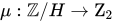
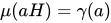
- Define as for and is the quotient group of left cosets; Template:Tmath.
- Note that we have defined Template:Tmath, is if is odd and if is even.
- Thus, is an isomorphism from to Template:Tmath.




Remainders of integer division
A slight generalization of the last example. Once again consider the group of integers under addition. Let Template:Tmath be any positive integer. We will consider the subgroup of consisting of all multiples of Template:Tmath. Once again is normal in because is abelian. The cosets are the collection Template:Tmath. An integer belongs to the coset Template:Tmath, where is the remainder when dividing by Template:Tmath. The quotient can be thought of as the group of "remainders" modulo Template:Tmath. This is a cyclic group of order Template:Tmath.


Complex integer roots of 1
The twelfth roots of unity, which are points on the complex unit circle, form a multiplicative abelian group Template:Tmath, shown on the picture on the right as colored balls with the number at each point giving its complex argument. Consider its subgroup made of the fourth roots of unity, shown as red balls. This normal subgroup splits the group into three cosets, shown in red, green and blue. One can check that the cosets form a group of three elements (the product of a red element with a blue element is blue, the inverse of a blue element is green, etc.). Thus, the quotient group is the group of three colors, which turns out to be the cyclic group with three elements.
Real numbers modulo the integers
Consider the group of real numbers under addition, and the subgroup of integers. Each coset of in is a set of the form Template:Tmath, where is a real number. Since and are identical sets when the non-integer parts of and are equal, one may impose the restriction without change of meaning. Adding such cosets is done by adding the corresponding real numbers, and subtracting 1 if the result is greater than or equal to 1. The quotient group is isomorphic to the circle group, the group of complex numbers of absolute value 1 under multiplication, or correspondingly, the group of rotations in 2D about the origin, that is, the special orthogonal group Template:Tmath. An isomorphism is given by (see Euler's identity).



Matrices of real numbers
If is the group of invertible real matrices, and is the subgroup of real matrices with determinant 1, then is normal in (since it is the kernel of the determinant homomorphism). The cosets of are the sets of matrices with a given determinant, and hence is isomorphic to the multiplicative group of non-zero real numbers. The group is known as the special linear group Template:Tmath.

Integer modular arithmetic
Consider the abelian group (that is, the set with addition modulo 4), and its subgroup Template:Tmath. The quotient group is Template:Tmath. This is a group with identity element Template:Tmath, and group operations such as Template:Tmath. Both the subgroup and the quotient group are isomorphic with Template:Tmath.



Integer multiplication
Consider the multiplicative group Template:Tmath. The set of Template:Tmathth residues is a multiplicative subgroup isomorphic to Template:Tmath. Then is normal in and the factor group has the cosets Template:Tmath. The Paillier cryptosystem is based on the conjecture that it is difficult to determine the coset of a random element of without knowing the factorization of Template:Tmath.
Properties
The quotient group is isomorphic to the trivial group (the group with one element), and is isomorphic to Template:Tmath.


The order of Template:Tmath, by definition the number of elements, is equal to Template:Tmath, the index of in Template:Tmath. If is finite, the index is also equal to the order of divided by the order of Template:Tmath. The set may be finite, although both and are infinite (for example, Template:Tmath).
There is a "natural" surjective group homomorphism Template:Tmath, sending each element of to the coset of to which belongs, that is: Template:Tmath. The mapping is sometimes called the canonical projection of onto Template:Tmath. Its kernel is Template:Tmath.


There is a bijective correspondence between the subgroups of Failed to parse (SVG (MathML can be enabled via browser plugin): Invalid response ("Math extension cannot connect to Restbase.") from server "https://wikimedia.org/api/rest_v1/":): {\displaystyle G} that contain Failed to parse (SVG (MathML can be enabled via browser plugin): Invalid response ("Math extension cannot connect to Restbase.") from server "https://wikimedia.org/api/rest_v1/":): {\displaystyle N} and the subgroups of Template:Tmath; if Failed to parse (SVG (MathML can be enabled via browser plugin): Invalid response ("Math extension cannot connect to Restbase.") from server "https://wikimedia.org/api/rest_v1/":): {\displaystyle H} is a subgroup of Failed to parse (SVG (MathML can be enabled via browser plugin): Invalid response ("Math extension cannot connect to Restbase.") from server "https://wikimedia.org/api/rest_v1/":): {\displaystyle G} containing Template:Tmath, then the corresponding subgroup of Failed to parse (SVG (MathML can be enabled via browser plugin): Invalid response ("Math extension cannot connect to Restbase.") from server "https://wikimedia.org/api/rest_v1/":): {\displaystyle G\,/\,N} is Template:Tmath. This correspondence holds for normal subgroups of Failed to parse (SVG (MathML can be enabled via browser plugin): Invalid response ("Math extension cannot connect to Restbase.") from server "https://wikimedia.org/api/rest_v1/":): {\displaystyle G} and Failed to parse (SVG (MathML can be enabled via browser plugin): Invalid response ("Math extension cannot connect to Restbase.") from server "https://wikimedia.org/api/rest_v1/":): {\displaystyle G\,/\,N} as well, and is formalized in the lattice theorem.
Several important properties of quotient groups are recorded in the fundamental theorem on homomorphisms and the isomorphism theorems.
If Failed to parse (SVG (MathML can be enabled via browser plugin): Invalid response ("Math extension cannot connect to Restbase.") from server "https://wikimedia.org/api/rest_v1/":): {\displaystyle G} is abelian, nilpotent, solvable, cyclic or finitely generated, then so is Template:Tmath.
If Failed to parse (SVG (MathML can be enabled via browser plugin): Invalid response ("Math extension cannot connect to Restbase.") from server "https://wikimedia.org/api/rest_v1/":): {\displaystyle H} is a subgroup in a finite group Template:Tmath, and the order of Failed to parse (SVG (MathML can be enabled via browser plugin): Invalid response ("Math extension cannot connect to Restbase.") from server "https://wikimedia.org/api/rest_v1/":): {\displaystyle H} is one half of the order of Template:Tmath, then Failed to parse (SVG (MathML can be enabled via browser plugin): Invalid response ("Math extension cannot connect to Restbase.") from server "https://wikimedia.org/api/rest_v1/":): {\displaystyle H} is guaranteed to be a normal subgroup, so Failed to parse (SVG (MathML can be enabled via browser plugin): Invalid response ("Math extension cannot connect to Restbase.") from server "https://wikimedia.org/api/rest_v1/":): {\displaystyle G\,/\,H} exists and is isomorphic to Template:Tmath. This result can also be stated as "any subgroup of index 2 is normal", and in this form it applies also to infinite groups. Furthermore, if Failed to parse (SVG (MathML can be enabled via browser plugin): Invalid response ("Math extension cannot connect to Restbase.") from server "https://wikimedia.org/api/rest_v1/":): {\displaystyle p} is the smallest prime number dividing the order of a finite group, Template:Tmath, then if Failed to parse (SVG (MathML can be enabled via browser plugin): Invalid response ("Math extension cannot connect to Restbase.") from server "https://wikimedia.org/api/rest_v1/":): {\displaystyle G\,/\,H} has order Template:Tmath, Failed to parse (SVG (MathML can be enabled via browser plugin): Invalid response ("Math extension cannot connect to Restbase.") from server "https://wikimedia.org/api/rest_v1/":): {\displaystyle H} must be a normal subgroup of Template:Tmath.[3]
Given Failed to parse (SVG (MathML can be enabled via browser plugin): Invalid response ("Math extension cannot connect to Restbase.") from server "https://wikimedia.org/api/rest_v1/":): {\displaystyle G} and a normal subgroup Template:Tmath, then Failed to parse (SVG (MathML can be enabled via browser plugin): Invalid response ("Math extension cannot connect to Restbase.") from server "https://wikimedia.org/api/rest_v1/":): {\displaystyle G} is a group extension of Failed to parse (SVG (MathML can be enabled via browser plugin): Invalid response ("Math extension cannot connect to Restbase.") from server "https://wikimedia.org/api/rest_v1/":): {\displaystyle G\,/\,N} by Template:Tmath. One could ask whether this extension is trivial or split; in other words, one could ask whether Failed to parse (SVG (MathML can be enabled via browser plugin): Invalid response ("Math extension cannot connect to Restbase.") from server "https://wikimedia.org/api/rest_v1/":): {\displaystyle G} is a direct product or semidirect product of Failed to parse (SVG (MathML can be enabled via browser plugin): Invalid response ("Math extension cannot connect to Restbase.") from server "https://wikimedia.org/api/rest_v1/":): {\displaystyle N} and Template:Tmath. This is a special case of the extension problem. An example where the extension is not split is as follows: Let Template:Tmath, and Template:Tmath, which is isomorphic to Template:Tmath. Then Failed to parse (SVG (MathML can be enabled via browser plugin): Invalid response ("Math extension cannot connect to Restbase.") from server "https://wikimedia.org/api/rest_v1/":): {\displaystyle G\,/\,N} is also isomorphic to Template:Tmath. But Failed to parse (SVG (MathML can be enabled via browser plugin): Invalid response ("Math extension cannot connect to Restbase.") from server "https://wikimedia.org/api/rest_v1/":): {\displaystyle \mathrm{Z}_2} has only the trivial automorphism, so the only semi-direct product of Failed to parse (SVG (MathML can be enabled via browser plugin): Invalid response ("Math extension cannot connect to Restbase.") from server "https://wikimedia.org/api/rest_v1/":): {\displaystyle N} and Failed to parse (SVG (MathML can be enabled via browser plugin): Invalid response ("Math extension cannot connect to Restbase.") from server "https://wikimedia.org/api/rest_v1/":): {\displaystyle G\,/\,N} is the direct product. Since Failed to parse (SVG (MathML can be enabled via browser plugin): Invalid response ("Math extension cannot connect to Restbase.") from server "https://wikimedia.org/api/rest_v1/":): {\displaystyle \mathrm{Z}_4} is different from Template:Tmath, we conclude that Failed to parse (SVG (MathML can be enabled via browser plugin): Invalid response ("Math extension cannot connect to Restbase.") from server "https://wikimedia.org/api/rest_v1/":): {\displaystyle G} is not a semi-direct product of Failed to parse (SVG (MathML can be enabled via browser plugin): Invalid response ("Math extension cannot connect to Restbase.") from server "https://wikimedia.org/api/rest_v1/":): {\displaystyle N} and Template:Tmath.
Quotients of Lie groups
If Failed to parse (SVG (MathML can be enabled via browser plugin): Invalid response ("Math extension cannot connect to Restbase.") from server "https://wikimedia.org/api/rest_v1/":): {\displaystyle G} is a Lie group and Failed to parse (SVG (MathML can be enabled via browser plugin): Invalid response ("Math extension cannot connect to Restbase.") from server "https://wikimedia.org/api/rest_v1/":): {\displaystyle N} is a normal and (topologically) closed Lie subgroup of Template:Tmath, the quotient Failed to parse (SVG (MathML can be enabled via browser plugin): Invalid response ("Math extension cannot connect to Restbase.") from server "https://wikimedia.org/api/rest_v1/":): {\displaystyle G\,/\,N} is also a Lie group. In this case, the original group Failed to parse (SVG (MathML can be enabled via browser plugin): Invalid response ("Math extension cannot connect to Restbase.") from server "https://wikimedia.org/api/rest_v1/":): {\displaystyle G} has the structure of a fiber bundle (specifically, a [[principal bundle|principal Template:Tmath-bundle]]), with base space Failed to parse (SVG (MathML can be enabled via browser plugin): Invalid response ("Math extension cannot connect to Restbase.") from server "https://wikimedia.org/api/rest_v1/":): {\displaystyle G\,/\,N} and fiber Template:Tmath. The dimension of Failed to parse (SVG (MathML can be enabled via browser plugin): Invalid response ("Math extension cannot connect to Restbase.") from server "https://wikimedia.org/api/rest_v1/":): {\displaystyle G\,/\,N} equals Template:Tmath.[4]
Note that the condition that Failed to parse (SVG (MathML can be enabled via browser plugin): Invalid response ("Math extension cannot connect to Restbase.") from server "https://wikimedia.org/api/rest_v1/":): {\displaystyle N} is closed is necessary. Indeed, if Failed to parse (SVG (MathML can be enabled via browser plugin): Invalid response ("Math extension cannot connect to Restbase.") from server "https://wikimedia.org/api/rest_v1/":): {\displaystyle N} is not closed then the quotient space is not a T1-space (since there is a coset in the quotient which cannot be separated from the identity by an open set), and thus not a Hausdorff space.
For a non-normal Lie subgroup Template:Tmath, the space Failed to parse (SVG (MathML can be enabled via browser plugin): Invalid response ("Math extension cannot connect to Restbase.") from server "https://wikimedia.org/api/rest_v1/":): {\displaystyle G\,/\,N} of left cosets is not a group, but simply a differentiable manifold on which Failed to parse (SVG (MathML can be enabled via browser plugin): Invalid response ("Math extension cannot connect to Restbase.") from server "https://wikimedia.org/api/rest_v1/":): {\displaystyle G} acts. The result is known as a homogeneous space.
See also
Notes
- ↑ Vinberg, Ė B. (2003). A course in algebra. Graduate studies in mathematics. Providence, R.I: American Mathematical Society. p. 157. ISBN 978-0-8218-3318-6.
- ↑ Dummit & Foote (2003, p. 95)
- ↑ Dummit & Foote (2003, p. 120)
- ↑ John M. Lee, Introduction to Smooth Manifolds, Second Edition, theorem 21.17
References
- Dummit, David S.; Foote, Richard M. (2003), Abstract Algebra (3rd ed.), New York: Wiley, ISBN 978-0-471-43334-7
- Herstein, I. N. (1975), Topics in Algebra (2nd ed.), New York: Wiley, ISBN 0-471-02371-X