Harmonic function
Template:Complex analysis sidebar
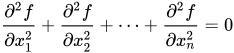
In mathematics, mathematical physics and the theory of stochastic processes, a harmonic function is a twice continuously differentiable function Template:Tmath, where Template:Tmath is an open subset of Template:Tmath, that satisfies Laplace's equation, that is, everywhere on Template:Tmath. This is usually written as or


Etymology of the term "harmonic"
[edit | edit source]The descriptor "harmonic" in the name "harmonic function" originates from a point on a taut string which is undergoing harmonic motion. The solution to the differential equation for this type of motion can be written in terms of sines and cosines, functions which are thus referred to as "harmonics." Fourier analysis involves expanding functions on the unit circle in terms of a series of these harmonics. Considering higher dimensional analogues of the harmonics on the unit n-sphere, one arrives at the spherical harmonics. These functions satisfy Laplace's equation and, over time, "harmonic" was used to refer to all functions satisfying Laplace's equation.[1]
Examples
[edit | edit source]Examples of harmonic functions of two variables are:
- The real or imaginary part of any holomorphic function. In fact, all harmonic functions defined on the plane are of this form.
- The function Template:Tmath; this is a special case of the example above, as Template:Tmath, and is a holomorphic function. The second derivative with respect to Template:Tmath is Template:Tmath, while the second derivative with respect to Template:Tmath is Template:Tmath.
- The function defined on Template:Tmath. This can describe the electric potential due to a line charge or the gravity potential due to a long cylindrical mass.


Examples of harmonic functions of three variables are given in the table below with Template:Tmath:
Function Singularity Unit point charge at origin x-directed dipole at origin Line of unit charge density on entire z-axis Line of unit charge density on negative z-axis Line of x-directed dipoles on entire z axis Line of x-directed dipoles on negative z axis


Harmonic functions that arise in physics are determined by their singularities and boundary conditions (such as Dirichlet boundary conditions or Neumann boundary conditions). On regions without boundaries, adding the real or imaginary part of any entire function will produce a harmonic function with the same singularity, so in this case the harmonic function is not determined by its singularities; however, we can make the solution unique in physical situations by requiring that the solution approaches Template:Tmath as Template:Tmath approaches infinity. In this case, uniqueness follows by Liouville's theorem.
The singular points of the harmonic functions above are expressed as "charges" and "charge densities" using the terminology of electrostatics, and so the corresponding harmonic function will be proportional to the electrostatic potential due to these charge distributions. Each function above will yield another harmonic function when multiplied by a constant, rotated, and/or has a constant added. The inversion of each function will yield another harmonic function which has singularities which are the images of the original singularities in a spherical "mirror". Also, the sum of any two harmonic functions will yield another harmonic function.
Finally, examples of harmonic functions of Template:Tmath variables are:
- The constant, linear and affine functions on all of Template:Tmath (for example, the electric potential between the plates of a capacitor, and the gravity potential of a slab)
- The function on for Template:Tmath.


Properties
[edit | edit source]The set of harmonic functions on a given open set Template:Tmath can be seen as the kernel of the Laplace operator Template:Tmath and is therefore a vector space over Template:Tmath: linear combinations of harmonic functions are again harmonic.
If Template:Tmath is a harmonic function on Template:Tmath, then all partial derivatives of Template:Tmath are also harmonic functions on Template:Tmath. The Laplace operator Template:Tmath and the partial derivative operator will commute on this class of functions.
In several ways, the harmonic functions are real analogues to holomorphic functions. All harmonic functions are analytic, that is, they can be locally expressed as power series. This is a general fact about elliptic operators, of which the Laplacian is a major example.
The uniform limit of a convergent sequence of harmonic functions is still harmonic. This is true because every continuous function satisfying the mean value property is harmonic. Consider the sequence on Template:Tmath defined by Template:Tmath; this sequence is harmonic and converges uniformly to the zero function; however note that the partial derivatives are not uniformly convergent to the zero function (the derivative of the zero function). This example shows the importance of relying on the mean value property and continuity to argue that the limit is harmonic.
Connections with complex function theory
[edit | edit source]The real and imaginary part of any holomorphic function yield harmonic functions on Template:Tmath (these are said to be a pair of harmonic conjugate functions). Conversely, any harmonic function Template:Tmath on an open subset Template:Tmath of Template:Tmath is locally the real part of a holomorphic function. This is immediately seen observing that, writing Template:Tmath, the complex function is holomorphic in Template:Tmath because it satisfies the Cauchy–Riemann equations. Therefore, Template:Tmath locally has a primitive Template:Tmath, and Template:Tmath is the real part of Template:Tmath up to a constant, as Template:Tmath is the real part of Template:Tmath.

Although the above correspondence with holomorphic functions only holds for functions of two real variables, harmonic functions in Template:Tmath variables still enjoy a number of properties typical of holomorphic functions. They are (real) analytic; they have a maximum principle and a mean-value principle; a theorem of removal of singularities as well as a Liouville theorem holds for them in analogy to the corresponding theorems in complex functions theory.
Properties of harmonic functions
[edit | edit source]Some important properties of harmonic functions can be deduced from Laplace's equation.
Regularity theorem for harmonic functions
[edit | edit source]Harmonic functions are infinitely differentiable in open sets. In fact, harmonic functions are real analytic.
Maximum principle
[edit | edit source]Harmonic functions satisfy the following maximum principle: if Template:Tmath is a nonempty compact subset of Template:Tmath, then Template:Tmath restricted to Template:Tmath attains its maximum and minimum on the boundary of Template:Tmath. If Template:Tmath is connected, this means that Template:Tmath cannot have local maxima or minima, other than the exceptional case where Template:Tmath is constant. Similar properties can be shown for subharmonic functions.
The mean value property
[edit | edit source]If Template:Tmath is a ball with center Template:Tmath and radius Template:Tmath which is completely contained in the open set Template:Tmath, then the value Template:Tmath of a harmonic function at the center of the ball is given by the average value of Template:Tmath on the surface of the ball; this average value is also equal to the average value of Template:Tmath in the interior of the ball. In other words, where Template:Tmath is the volume of the unit ball in Template:Tmath dimensions and Template:Tmath is the Template:Tmath-dimensional surface measure.


Conversely, all locally integrable functions satisfying the (volume) mean-value property are both infinitely differentiable and harmonic.
In terms of convolutions, if denotes the characteristic function of the ball with radius Template:Tmath about the origin, normalized so that Template:Tmath, the function Template:Tmath is harmonic on Template:Tmath if and only if for all Template:Tmath and Template:Tmath such that Template:Tmath.


Sketch of the proof. The proof of the mean-value property of the harmonic functions and its converse follows immediately observing that the non-homogeneous equation, for any Template:Tmath admits an easy explicit solution Template:Tmath of class Template:Tmath with compact support in Template:Tmath. Thus, if Template:Tmath is harmonic in Template:Tmath holds in the set Template:Tmath of all points Template:Tmath in Template:Tmath with Template:Tmath


Since Template:Tmath is continuous in Template:Tmath, converges to Template:Tmath as Template:Tmath showing the mean value property for Template:Tmath in Template:Tmath. Conversely, if Template:Tmath is any function satisfying the mean-value property in Template:Tmath, that is, holds in Template:Tmath for all Template:Tmath then, iterating Template:Tmath times the convolution with Template:Tmath one has: so that Template:Tmath is because the Template:Tmath-fold iterated convolution of Template:Tmath is of class with support Template:Tmath. Since Template:Tmath and Template:Tmath are arbitrary, Template:Tmath is too. Moreover, for all Template:Tmath so that Template:Tmath in Template:Tmath by the fundamental theorem of the calculus of variations, proving the equivalence between harmonicity and mean-value property.





This statement of the mean value property can be generalized as follows: If Template:Tmath is any spherically symmetric function supported in Template:Tmath such that Template:Tmath, then Template:Tmath. In other words, we can take the weighted average of Template:Tmath about a point and recover Template:Tmath. In particular, by taking Template:Tmath to be a Template:Tmath function, we can recover the value of Template:Tmath at any point even if we only know how Template:Tmath acts as a distribution. See Weyl's lemma.
Harnack's inequality
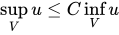
[edit | edit source]Let be a connected set in a bounded domain Template:Tmath. Then for every non-negative harmonic function Template:Tmath, Harnack's inequality holds for some constant Template:Tmath that depends only on Template:Tmath and Template:Tmath.

Removal of singularities
[edit | edit source]The following principle of removal of singularities holds for harmonic functions. If Template:Tmath is a harmonic function defined on a dotted open subset of Template:Tmath, which is less singular at Template:Tmath than the fundamental solution (for Template:Tmath), that is then Template:Tmath extends to a harmonic function on Template:Tmath (compare Riemann's theorem for functions of a complex variable).


Liouville's theorem
[edit | edit source]Theorem: If Template:Tmath is a harmonic function defined on all of Template:Tmath which is bounded above or bounded below, then Template:Tmath is constant.
(Compare Liouville's theorem for functions of a complex variable).
Edward Nelson gave a particularly short proof of this theorem for the case of bounded functions,[2] using the mean value property mentioned above:
Given two points, choose two balls with the given points as centers and of equal radius. If the radius is large enough, the two balls will coincide except for an arbitrarily small proportion of their volume. Since Template:Tmath is bounded, the averages of it over the two balls are arbitrarily close, and so Template:Tmath assumes the same value at any two points.
The proof can be adapted to the case where the harmonic function Template:Tmath is merely bounded above or below. By adding a constant and possibly multiplying by Template:Tmath, we may assume that Template:Tmath is non-negative. Then for any two points Template:Tmath and Template:Tmath, and any positive number Template:Tmath, we let Template:Tmath. We then consider the balls Template:Tmath and Template:Tmath where by the triangle inequality, the first ball is contained in the second.
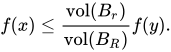
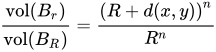
By the averaging property and the monotonicity of the integral, we have (Note that since Template:Tmath is independent of Template:Tmath, we denote it merely as Template:Tmath.) In the last expression, we may multiply and divide by Template:Tmath and use the averaging property again, to obtain But as Template:Tmath, the quantity tends to Template:Tmath. Thus, Template:Tmath. The same argument with the roles of Template:Tmath and Template:Tmath reversed shows that Template:Tmath, so that Template:Tmath.

Another proof uses the fact that given a Brownian motion Template:Tmath in Template:Tmath, such that Template:Tmath, we have for all Template:Tmath. In words, it says that a harmonic function defines a martingale for the Brownian motion. Then a probabilistic coupling argument finishes the proof.[3]
![{\displaystyle E[f(B_{t})]=f(x_{0})}](https://wikimedia.org/api/rest_v1/media/math/render/svg/4e4e041d925744c36c7e8761cb60df0eaa0bf22b)
Generalizations
[edit | edit source]Weakly harmonic function
[edit | edit source]A function (or, more generally, a distribution) is weakly harmonic if it satisfies Laplace's equation in a weak sense (or, equivalently, in the sense of distributions). A weakly harmonic function coincides almost everywhere with a strongly harmonic function, and is in particular smooth. A weakly harmonic distribution is precisely the distribution associated to a strongly harmonic function, and so also is smooth. This is Weyl's lemma.

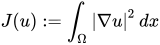
There are other weak formulations of Laplace's equation that are often useful. One of which is Dirichlet's principle, representing harmonic functions in the Sobolev space Template:Tmath as the minimizers of the Dirichlet energy integral with respect to local variations, that is, all functions such that holds for all Template:Tmath, or equivalently, for all Template:Tmath.


Harmonic functions on manifolds
[edit | edit source]Harmonic functions can be defined on an arbitrary Riemannian manifold, using the Laplace–Beltrami operator Template:Tmath. In this context, a function is called harmonic if Many of the properties of harmonic functions on domains in Euclidean space carry over to this more general setting, including the mean value theorem (over geodesic balls), the maximum principle, and the Harnack inequality. With the exception of the mean value theorem, these are easy consequences of the corresponding results for general linear elliptic partial differential equations of the second order.

Subharmonic functions
[edit | edit source]A Template:Tmath function that satisfies Template:Tmath is called subharmonic. This condition guarantees that the maximum principle will hold, although other properties of harmonic functions may fail. More generally, a function is subharmonic if and only if, in the interior of any ball in its domain, its graph lies below that of the harmonic function interpolating its boundary values on the ball.
Harmonic forms
[edit | edit source]One generalization of the study of harmonic functions is the study of harmonic forms on Riemannian manifolds, and it is related to the study of cohomology. Also, it is possible to define harmonic vector-valued functions, or harmonic maps of two Riemannian manifolds, which are critical points of a generalized Dirichlet energy functional (this includes harmonic functions as a special case, a result known as Dirichlet principle). This kind of harmonic map appears in the theory of minimal surfaces. For example, a curve, that is, a map from an interval in Template:Tmath to a Riemannian manifold, is a harmonic map if and only if it is a geodesic.
Harmonic maps between manifolds
[edit | edit source]If Template:Tmath and Template:Tmath are two Riemannian manifolds, then a harmonic map is defined to be a critical point of the Dirichlet energy in which is the differential of Template:Tmath, and the norm is that induced by the metric on Template:Tmath and that on Template:Tmath on the tensor product bundle Template:Tmath.

![{\displaystyle D[u]={\frac {1}{2}}\int _{M}\left\|du\right\|^{2}\,d\operatorname {Vol} }](https://wikimedia.org/api/rest_v1/media/math/render/svg/fbbacda9536efc8200c39ac87f74b1d65fbad3cd)


Important special cases of harmonic maps between manifolds include minimal surfaces, which are precisely the harmonic immersions of a surface into three-dimensional Euclidean space. More generally, minimal submanifolds are harmonic immersions of one manifold in another. Harmonic coordinates are a harmonic diffeomorphism from a manifold to an open subset of a Euclidean space of the same dimension.
See also
[edit | edit source]Notes
[edit | edit source]- ↑ Axler, Sheldon; Bourdon, Paul; Ramey, Wade (2001). Harmonic Function Theory. New York: Springer. p. 25. ISBN 0-387-95218-7.
- ↑ Nelson, Edward (1961). "A proof of Liouville's theorem". Proceedings of the American Mathematical Society. 12 (6): 995. doi:10.1090/S0002-9939-1961-0259149-4.
- ↑ "Probabilistic Coupling". Blame It On The Analyst. 2012-01-24. Archived from the original on 8 May 2021. Retrieved 2022-05-26.
References
[edit | edit source]- Evans, Lawrence C. (1998), Partial Differential Equations, American Mathematical Society
- Gilbarg, David; Trudinger, Neil (12 January 2001), Elliptic Partial Differential Equations of Second Order, Springer, ISBN 3-540-41160-7
- Han, Q.; Lin, F. (2000), Elliptic Partial Differential Equations, American Mathematical Society
- Jost, Jürgen (2005), Riemannian Geometry and Geometric Analysis (4th ed.), Berlin, New York: Springer-Verlag, ISBN 978-3-540-25907-7
- Axler, Sheldon; Bourdon, Paul; Ramey, Wade (2001), Harmonic Function Theory, 137 (2nd ed.), New York: Springer-Verlag, doi:10.1007/978-1-4757-8137-3, ISBN 0-387-95218-7