Injective function
In mathematics, an injective function (also known as injection, or one-to-one function[1]) is a function f that maps distinct elements of its domain to distinct elements of its codomain; that is, x1 ≠ x2 implies f(x1) Template:≠ f(x2) (equivalently by contraposition, f(x1) = f(x2) implies x1 = x2). In other words, every element of the function's codomain is the image of at most one element of its domain.[2] The term one-to-one function must not be confused with one-to-one correspondence that refers to bijective functions, which are functions such that each element in the codomain is an image of exactly one element in the domain.
A homomorphism between algebraic structures is a function that is compatible with the operations of the structures. For all common algebraic structures, and, in particular for vector spaces, an injective homomorphism is also called a monomorphism. However, in the more general context of category theory, the definition of a monomorphism differs from that of an injective homomorphism.[3] This is thus a theorem that they are equivalent for algebraic structures; see Homomorphism § Monomorphism for more details.
A function that is not injective is sometimes called many-to-one.[2]

Definition
[edit | edit source]Let be a function whose domain is a set Template:Tmath. The function is said to be injective provided that for all and in if Template:Tmath, then Template:Tmath; that is, implies Template:Tmath. Equivalently, if Template:Tmath, then in the contrapositive statement.


Symbolically, which is logically equivalent to the contrapositive,[4]An injective function (or, more generally, a monomorphism) is often denoted by using the specialized arrows ↣ or ↪ (for example, or Template:Tmath), although some authors specifically reserve ↪ for an inclusion map.[5]



Examples
[edit | edit source]For visual examples, readers are directed to the gallery section.
- For any set and any subset Template:Tmath, the inclusion map (which sends any element to itself) is injective. In particular, the identity function is always injective (and in fact bijective).
- If the domain of a function is the empty set, then the function is the empty function, which is injective.
- If the domain of a function has one element (that is, it is a singleton set), then the function is always injective.
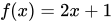
- The function defined by is injective.
- The function defined by is not injective, because (for example) However, if is redefined so that its domain is the non-negative real numbers [0, +∞), then is injective.
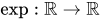
- The exponential function defined by is injective (but not surjective, as no real value maps to a negative number).
- The natural logarithm function defined by is injective.
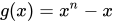
- The function defined by is not injective, since, for example, Template:Tmath.









More generally, when and are both the real line Template:Tmath, then an injective function is one whose graph is never intersected by any horizontal line more than once. This principle is referred to as the horizontal line test.[2]

Injections can be undone
[edit | edit source]Functions with left inverses are always injections. That is, given Template:Tmath, if there is a function such that for every Template:Tmath, Template:Tmath, then is injective. The proof is that


In this case, is called a retraction of Template:Tmath. Conversely, is called a section of Template:Tmath. For example: is retracted by Template:Tmath.

Conversely, every injection with a non-empty domain has a left inverse . It can be defined by choosing an element in the domain of and setting to the unique element of the pre-image (if it is non-empty) or to (otherwise).[6]

![{\displaystyle f^{-1}[y]}](https://wikimedia.org/api/rest_v1/media/math/render/svg/c5ffa43f26ddc0c27fedee54ea4051661d56fa21)
The left inverse is not necessarily an inverse of because the composition in the other order, Template:Tmath, may differ from the identity on Template:Tmath. In other words, an injective function can be "reversed" by a left inverse, but is not necessarily invertible, which requires that the function is bijective.

Injections may be made invertible
[edit | edit source]In fact, to turn an injective function into a bijective (hence invertible) function, it suffices to replace its codomain by its actual image That is, let such that for all Template:Tmath; then is bijective. Indeed, can be factored as Template:Tmath, where is the inclusion function from into Template:Tmath.


More generally, injective partial functions are called partial bijections.
Other properties
[edit | edit source]- If and are both injective then is injective.
- If is injective, then is injective (but need not be).
- is injective if and only if, given any functions Template:Tmath, whenever Template:Tmath, then Template:Tmath. In other words, injective functions are precisely the monomorphisms in the category Set of sets.
- If is injective and is a subset of Template:Tmath, then Template:Tmath. Thus, can be recovered from its image Template:Tmath.
- If is injective and and are both subsets of Template:Tmath, then Template:Tmath.
- Every function can be decomposed as for a suitable injection and surjection Template:Tmath. This decomposition is unique up to isomorphism, and may be thought of as the inclusion function of the range of as a subset of the codomain of Template:Tmath.
- If is an injective function, then has at least as many elements as in the sense of cardinal numbers. In particular, if, in addition, there is an injection from Template:Tmath to Template:Tmath, then and have the same cardinal number. (This is known as the Cantor–Bernstein–Schroeder theorem.)
- If both and are finite with the same number of elements, then is injective if and only if is surjective (in which case is bijective).
- An injective function which is a homomorphism between two algebraic structures is an embedding.
- Unlike surjectivity, which is a relation between the graph of a function and its codomain, injectivity is a property of the graph of the function alone; that is, whether a function is injective can be decided by only considering the graph (and not the codomain) of Template:Tmath.


Proving that functions are injective
[edit | edit source]A proof that a function is injective depends on how the function is presented and what properties the function holds. For functions that are given by some formula there is a basic idea. We use the definition of injectivity, namely that if Template:Tmath, then Template:Tmath.[7]
Here is an example:
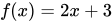
Proof: Let Template:Tmath. Suppose Template:Tmath. So implies Template:Tmath, which implies Template:Tmath. Therefore, it follows from the definition that is injective.

There are multiple other methods of proving that a function is injective. For example, in calculus if is a differentiable function defined on some interval, then it is sufficient to show that the derivative is always positive or always negative on that interval. In linear algebra, if is a linear transformation it is sufficient to show that the kernel of contains only the zero vector. If is a function with finite domain it is sufficient to look through the list of images of each domain element and check that no image occurs twice on the list.
A graphical approach for a real-valued function of a real variable is the horizontal line test. If every horizontal line intersects the curve of in at most one point, then Failed to parse (SVG (MathML can be enabled via browser plugin): Invalid response ("Math extension cannot connect to Restbase.") from server "https://wikimedia.org/api/rest_v1/":): {\displaystyle f} is injective or one-to-one.


Gallery
[edit | edit source]-
 An injective non-surjective function (injection, not a bijection)
 -
 An injective surjective function (bijection)
 -
 A non-injective surjective function (surjection, not a bijection)
 -
 A non-injective non-surjective function (also not a bijection)


-
 Not an injective function. Here Failed to parse (SVG (MathML can be enabled via browser plugin): Invalid response ("Math extension cannot connect to Restbase.") from server "https://wikimedia.org/api/rest_v1/":): {\displaystyle X_1} and Failed to parse (SVG (MathML can be enabled via browser plugin): Invalid response ("Math extension cannot connect to Restbase.") from server "https://wikimedia.org/api/rest_v1/":): {\displaystyle X_2} are subsets of Failed to parse (SVG (MathML can be enabled via browser plugin): Invalid response ("Math extension cannot connect to Restbase.") from server "https://wikimedia.org/api/rest_v1/":): {\displaystyle X, Y_1} and Failed to parse (SVG (MathML can be enabled via browser plugin): Invalid response ("Math extension cannot connect to Restbase.") from server "https://wikimedia.org/api/rest_v1/":): {\displaystyle Y_2} are subsets of Template:Tmath: for two regions where the function is not injective because more than one domain element can map to a single range element. That is, it is possible for more than one Failed to parse (SVG (MathML can be enabled via browser plugin): Invalid response ("Math extension cannot connect to Restbase.") from server "https://wikimedia.org/api/rest_v1/":): {\displaystyle x} in Failed to parse (SVG (MathML can be enabled via browser plugin): Invalid response ("Math extension cannot connect to Restbase.") from server "https://wikimedia.org/api/rest_v1/":): {\displaystyle X} to map to the same Failed to parse (SVG (MathML can be enabled via browser plugin): Invalid response ("Math extension cannot connect to Restbase.") from server "https://wikimedia.org/api/rest_v1/":): {\displaystyle y} in Template:Tmath.
 -
Making functions injective. The previous function Failed to parse (SVG (MathML can be enabled via browser plugin): Invalid response ("Math extension cannot connect to Restbase.") from server "https://wikimedia.org/api/rest_v1/":): {\displaystyle f : X \to Y} can be reduced to one or more injective functions (say) Failed to parse (SVG (MathML can be enabled via browser plugin): Invalid response ("Math extension cannot connect to Restbase.") from server "https://wikimedia.org/api/rest_v1/":): {\displaystyle f : X_1 \to Y_1} and Template:Tmath, shown by solid curves (long-dash parts of initial curve are not mapped to anymore). Notice how the rule Failed to parse (SVG (MathML can be enabled via browser plugin): Invalid response ("Math extension cannot connect to Restbase.") from server "https://wikimedia.org/api/rest_v1/":): {\displaystyle f} has not changed – only the domain and range. Failed to parse (SVG (MathML can be enabled via browser plugin): Invalid response ("Math extension cannot connect to Restbase.") from server "https://wikimedia.org/api/rest_v1/":): {\displaystyle X_1} and Failed to parse (SVG (MathML can be enabled via browser plugin): Invalid response ("Math extension cannot connect to Restbase.") from server "https://wikimedia.org/api/rest_v1/":): {\displaystyle X_2} are subsets of Failed to parse (SVG (MathML can be enabled via browser plugin): Invalid response ("Math extension cannot connect to Restbase.") from server "https://wikimedia.org/api/rest_v1/":): {\displaystyle X, Y_1} and Failed to parse (SVG (MathML can be enabled via browser plugin): Invalid response ("Math extension cannot connect to Restbase.") from server "https://wikimedia.org/api/rest_v1/":): {\displaystyle Y_2} are subsets of Template:Tmath: for two regions where the initial function can be made injective so that one domain element can map to a single range element. That is, only one Failed to parse (SVG (MathML can be enabled via browser plugin): Invalid response ("Math extension cannot connect to Restbase.") from server "https://wikimedia.org/api/rest_v1/":): {\displaystyle x} in Failed to parse (SVG (MathML can be enabled via browser plugin): Invalid response ("Math extension cannot connect to Restbase.") from server "https://wikimedia.org/api/rest_v1/":): {\displaystyle X} maps to one Failed to parse (SVG (MathML can be enabled via browser plugin): Invalid response ("Math extension cannot connect to Restbase.") from server "https://wikimedia.org/api/rest_v1/":): {\displaystyle y} in Template:Tmath.
-
Injective functions. Diagramatic interpretation in the Cartesian plane, defined by the mapping Template:Tmath, where Template:Tmath, Failed to parse (SVG (MathML can be enabled via browser plugin): Invalid response ("Math extension cannot connect to Restbase.") from server "https://wikimedia.org/api/rest_v1/":): {\displaystyle X =} domain of function, Failed to parse (SVG (MathML can be enabled via browser plugin): Invalid response ("Math extension cannot connect to Restbase.") from server "https://wikimedia.org/api/rest_v1/":): {\displaystyle Y = } range of function, and Failed to parse (SVG (MathML can be enabled via browser plugin): Invalid response ("Math extension cannot connect to Restbase.") from server "https://wikimedia.org/api/rest_v1/":): {\displaystyle \operatorname{im}(f)} denotes image of Template:Tmath. Every one Failed to parse (SVG (MathML can be enabled via browser plugin): Invalid response ("Math extension cannot connect to Restbase.") from server "https://wikimedia.org/api/rest_v1/":): {\displaystyle x} in Failed to parse (SVG (MathML can be enabled via browser plugin): Invalid response ("Math extension cannot connect to Restbase.") from server "https://wikimedia.org/api/rest_v1/":): {\displaystyle X} maps to exactly one unique Failed to parse (SVG (MathML can be enabled via browser plugin): Invalid response ("Math extension cannot connect to Restbase.") from server "https://wikimedia.org/api/rest_v1/":): {\displaystyle y} in Template:Tmath. The circled parts of the axes represent domain and range sets — in accordance with the standard diagrams above

See also
[edit | edit source]- Bijection, injection and surjection
- Injective metric space
- Monotonic function – Order-preserving mathematical function
- Univalent function
Notes
[edit | edit source]- ↑ Sometimes one-one function in Indian mathematical education. "Chapter 1: Relations and functions" (PDF). Archived (PDF) from the original on December 26, 2023 – via NCERT.
- ↑ 2.0 2.1 2.2 "Injective, Surjective and Bijective". Math is Fun. Retrieved 2019-12-07.
- ↑ "Section 7.3 (00V5): Injective and surjective maps of presheaves". The Stacks project. Retrieved 2019-12-07.
- ↑ Farlow, S. J. "Section 4.2 Injections, Surjections, and Bijections" (PDF). Mathematics & Statistics - University of Maine. Archived from the original (PDF) on Dec 7, 2019. Retrieved 2019-12-06.
- ↑ "What are usual notations for surjective, injective and bijective functions?". Mathematics Stack Exchange. Retrieved 2024-11-24.
- ↑ Unlike the corresponding statement that every surjective function has a right inverse, this does not require the axiom of choice, as the existence of is implied by the non-emptiness of the domain. However, this statement may fail in less conventional mathematics such as constructive mathematics. In constructive mathematics, the inclusion of the two-element set in the reals cannot have a left inverse, as it would violate indecomposability, by giving a retraction of the real line to the set {0,1}.
- ↑ Williams, Peter (Aug 21, 1996). "Proving Functions One-to-One". Department of Mathematics at CSU San Bernardino Reference Notes Page. Archived from the original on 4 June 2017.


References
[edit | edit source]- Bartle, Robert G. (1976), The Elements of Real Analysis (2nd ed.), New York: John Wiley & Sons, ISBN 978-0-471-05464-1, p. 17 ff.
- Halmos, Paul R. (1974), Naive Set Theory, New York: Springer, ISBN 978-0-387-90092-6, p. 38 ff.
External links
[edit | edit source] |
Wikimedia Commons has media related to Injectivity. |
 |
Look up injective in Wiktionary, the free dictionary. |