Deprecated: Use of MediaWiki\Skin\Skin::appendSpecialPagesLinkIfAbsent was deprecated in MediaWiki 1.44. [Called from MediaWiki\Skin\Skin::buildSidebar in /var/www/html/w/includes/skins/Skin.php at line 1639] in /var/www/html/w/includes/debug/MWDebug.php on line 386
The printable version is no longer supported and may have rendering errors. Please update your browser bookmarks and please use the default browser print function instead.
Page version status
The page has not been checked
There are no reviewed versions of this page, so it may not have been checked for adherence to standards.
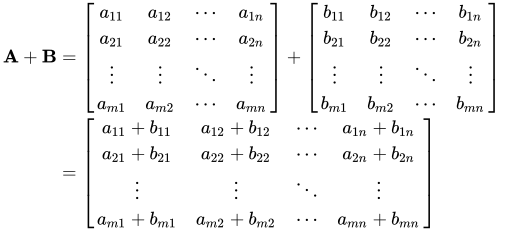
In mathematics, matrix addition is the operation of adding two matrices by adding the corresponding entries together.
For a vector, , adding two matrices would have the geometric effect of applying each matrix transformation separately onto , then adding the transformed vectors.
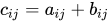
Two matrices must have an equal number of rows and columns to be added.[1] In which case, the sum of two matrices A and B will be a matrix which has the same number of rows and columns as A and B. The sum of A and B, denoted A + B, is computed by adding corresponding elements of A and B:[2][3]
Similarly, it is also possible to subtract one matrix from another, as long as they have the same dimensions. The difference of A and B, denoted A − B, is computed by subtracting elements of B from corresponding elements of A, and has the same dimensions as A and B. For example: