Multiplicative function
In number theory, a multiplicative function is an arithmetic function of a positive integer with the property that and whenever and are coprime.





An arithmetic function is said to be completely multiplicative (or totally multiplicative) if and holds for all positive integers and , even when they are not coprime.
Examples
[edit]Some multiplicative functions are defined to make formulas easier to write:
- : the constant function defined by


- : the identity function, defined by


- : the power functions, defined by for any complex number . As special cases we have
- , and
- .


- : the function defined by if and otherwise; this is the unit function, so called because it is the multiplicative identity for Dirichlet convolution. Sometimes written as ; not to be confused with .


- : the Liouville function, , where is the total number of primes (counted with multiplicity) dividing

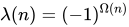

The above functions are all completely multiplicative.
- : the indicator function of the set . This function is multiplicative precisely when is closed under multiplication of coprime elements. There are also other sets (not closed under multiplication) that give rise to such functions, such as the set of square-free numbers.


Other examples of multiplicative functions include many functions of importance in number theory, such as:
- : the greatest common divisor of and , as a function of , where is a fixed integer

- : Euler's totient function, which counts the positive integers coprime to (but not bigger than)

- : the Möbius function, the parity ( for odd, for even) of the number of prime factors of square-free numbers; if is not square-free


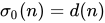
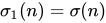
- : the divisor function, which is the sum of the -th powers of all the positive divisors of (where may be any complex number). As special cases we have
- , the number of positive divisors of ,
- , the sum of all the positive divisors of .

- : the sum of the -th powers of all unitary divisors of


- : the radical of , which is the product of the distinct prime factors of .

- : the number of non-isomorphic abelian groups of order

- , defined by , where the additive function is the number of distinct primes dividing
- : the Ramanujan tau function
- All Dirichlet characters are completely multiplicative functions, for example
- , the Legendre symbol, considered as a function of where is a fixed prime number


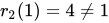
An example of a non-multiplicative function is the arithmetic function , the number of representations of as a sum of squares of two integers, positive, negative, or zero, where in counting the number of ways, reversal of order is allowed. For example:

and therefore . This shows that the function is not multiplicative. However, is multiplicative.

In the On-Line Encyclopedia of Integer Sequences, sequences of values of a multiplicative function have the keyword "mult".[1]
See arithmetic function for some other examples of non-multiplicative functions.
Properties
[edit]A multiplicative function is completely determined by its values at the powers of prime numbers, a consequence of the fundamental theorem of arithmetic. Thus, if n is a product of powers of distinct primes, say n = pa qb ..., then f(n) = f(pa) f(qb) ...
This property of multiplicative functions significantly reduces the need for computation, as in the following examples for n = 144 = 24 · 32:



Similarly, we have:

In general, if f(n) is a multiplicative function and a, b are any two positive integers, then
Every completely multiplicative function is a homomorphism of monoids and is completely determined by its restriction to the prime numbers.
Convolution
[edit]If f and g are two multiplicative functions, one defines a new multiplicative function , the Dirichlet convolution of f and g, by where the sum extends over all positive divisors d of n. With this operation, the set of all multiplicative functions turns into an abelian group; the identity element is ε. Convolution is commutative, associative, and distributive over addition.

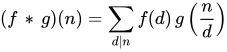
Relations among the multiplicative functions discussed above include:
- (the Möbius inversion formula)
- (generalized Möbius inversion)




The Dirichlet convolution can be defined for general arithmetic functions, and yields a ring structure, the Dirichlet ring.
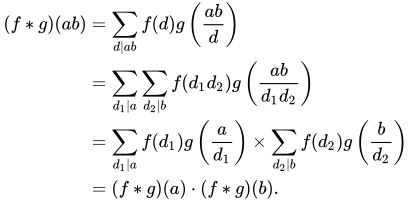
The Dirichlet convolution of two multiplicative functions is again multiplicative. A proof of this fact is given by the following expansion for relatively prime :

Dirichlet series for some multiplicative functions
[edit]- Failed to parse (SVG (MathML can be enabled via browser plugin): Invalid response ("Math extension cannot connect to Restbase.") from server "https://wikimedia.org/api/rest_v1/":): {\displaystyle \sum_{n\ge 1} \frac{d(n)^2}{n^s} = \frac{\zeta(s)^4}{\zeta(2s)}}
- Failed to parse (SVG (MathML can be enabled via browser plugin): Invalid response ("Math extension cannot connect to Restbase.") from server "https://wikimedia.org/api/rest_v1/":): {\displaystyle \sum_{n\ge 1} \frac{2^{\omega(n)}}{n^s} = \frac{\zeta(s)^2}{\zeta(2s)}}
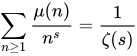
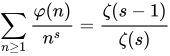
More examples are shown in the article on Dirichlet series.
Rational arithmetical functions
[edit]An arithmetical function f is said to be a rational arithmetical function of order Failed to parse (SVG (MathML can be enabled via browser plugin): Invalid response ("Math extension cannot connect to Restbase.") from server "https://wikimedia.org/api/rest_v1/":): {\displaystyle (r, s)} if there exists completely multiplicative functions g1,...,gr, h1,...,hs such that Failed to parse (SVG (MathML can be enabled via browser plugin): Invalid response ("Math extension cannot connect to Restbase.") from server "https://wikimedia.org/api/rest_v1/":): {\displaystyle f=g_1\ast\cdots\ast g_r\ast h_1^{-1}\ast\cdots\ast h_s^{-1}, } where the inverses are with respect to the Dirichlet convolution. Rational arithmetical functions of order Failed to parse (SVG (MathML can be enabled via browser plugin): Invalid response ("Math extension cannot connect to Restbase.") from server "https://wikimedia.org/api/rest_v1/":): {\displaystyle (1, 1)} are known as totient functions, and rational arithmetical functions of order Failed to parse (SVG (MathML can be enabled via browser plugin): Invalid response ("Math extension cannot connect to Restbase.") from server "https://wikimedia.org/api/rest_v1/":): {\displaystyle (2,0)} are known as quadratic functions or specially multiplicative functions. Euler's function Failed to parse (SVG (MathML can be enabled via browser plugin): Invalid response ("Math extension cannot connect to Restbase.") from server "https://wikimedia.org/api/rest_v1/":): {\displaystyle \varphi(n)} is a totient function, and the divisor function Failed to parse (SVG (MathML can be enabled via browser plugin): Invalid response ("Math extension cannot connect to Restbase.") from server "https://wikimedia.org/api/rest_v1/":): {\displaystyle \sigma_k(n)} is a quadratic function. Completely multiplicative functions are rational arithmetical functions of order Failed to parse (SVG (MathML can be enabled via browser plugin): Invalid response ("Math extension cannot connect to Restbase.") from server "https://wikimedia.org/api/rest_v1/":): {\displaystyle (1,0)} . Liouville's function Failed to parse (SVG (MathML can be enabled via browser plugin): Invalid response ("Math extension cannot connect to Restbase.") from server "https://wikimedia.org/api/rest_v1/":): {\displaystyle \lambda(n)} is completely multiplicative. The Möbius function Failed to parse (SVG (MathML can be enabled via browser plugin): Invalid response ("Math extension cannot connect to Restbase.") from server "https://wikimedia.org/api/rest_v1/":): {\displaystyle \mu(n)} is a rational arithmetical function of order Failed to parse (SVG (MathML can be enabled via browser plugin): Invalid response ("Math extension cannot connect to Restbase.") from server "https://wikimedia.org/api/rest_v1/":): {\displaystyle (0, 1)} . By convention, the identity element Failed to parse (SVG (MathML can be enabled via browser plugin): Invalid response ("Math extension cannot connect to Restbase.") from server "https://wikimedia.org/api/rest_v1/":): {\displaystyle \varepsilon} under the Dirichlet convolution is a rational arithmetical function of order Failed to parse (SVG (MathML can be enabled via browser plugin): Invalid response ("Math extension cannot connect to Restbase.") from server "https://wikimedia.org/api/rest_v1/":): {\displaystyle (0, 0)} .
All rational arithmetical functions are multiplicative. A multiplicative function f is a rational arithmetical function of order Failed to parse (SVG (MathML can be enabled via browser plugin): Invalid response ("Math extension cannot connect to Restbase.") from server "https://wikimedia.org/api/rest_v1/":): {\displaystyle (r, s)} if and only if its Bell series is of the form Failed to parse (SVG (MathML can be enabled via browser plugin): Invalid response ("Math extension cannot connect to Restbase.") from server "https://wikimedia.org/api/rest_v1/":): {\displaystyle {\displaystyle f_{p}(x)=\sum _{n=0}^{\infty }f(p^{n})x^{n}= \frac{(1-h_1(p) x)(1-h_2(p) x)\cdots (1-h_s(p) x)} {(1-g_1(p) x)(1-g_2(p) x)\cdots (1-g_r(p) x)}} } for all prime numbers Failed to parse (SVG (MathML can be enabled via browser plugin): Invalid response ("Math extension cannot connect to Restbase.") from server "https://wikimedia.org/api/rest_v1/":): {\displaystyle p} .
The concept of a rational arithmetical function originates from R. Vaidyanathaswamy (1931).
Busche-Ramanujan identities
[edit]A multiplicative function Failed to parse (SVG (MathML can be enabled via browser plugin): Invalid response ("Math extension cannot connect to Restbase.") from server "https://wikimedia.org/api/rest_v1/":): {\displaystyle f} is said to be specially multiplicative if there is a completely multiplicative function Failed to parse (SVG (MathML can be enabled via browser plugin): Invalid response ("Math extension cannot connect to Restbase.") from server "https://wikimedia.org/api/rest_v1/":): {\displaystyle f_A} such that
- Failed to parse (SVG (MathML can be enabled via browser plugin): Invalid response ("Math extension cannot connect to Restbase.") from server "https://wikimedia.org/api/rest_v1/":): {\displaystyle f(m) f(n) = \sum_{d\mid (m,n)} f(mn/d^2) f_A(d) }
for all positive integers Failed to parse (SVG (MathML can be enabled via browser plugin): Invalid response ("Math extension cannot connect to Restbase.") from server "https://wikimedia.org/api/rest_v1/":): {\displaystyle m} and Failed to parse (SVG (MathML can be enabled via browser plugin): Invalid response ("Math extension cannot connect to Restbase.") from server "https://wikimedia.org/api/rest_v1/":): {\displaystyle n} , or equivalently
- Failed to parse (SVG (MathML can be enabled via browser plugin): Invalid response ("Math extension cannot connect to Restbase.") from server "https://wikimedia.org/api/rest_v1/":): {\displaystyle f(mn) = \sum_{d\mid (m,n)} f(m/d) f(n/d) \mu(d) f_A(d) }
for all positive integers Failed to parse (SVG (MathML can be enabled via browser plugin): Invalid response ("Math extension cannot connect to Restbase.") from server "https://wikimedia.org/api/rest_v1/":): {\displaystyle m} and Failed to parse (SVG (MathML can be enabled via browser plugin): Invalid response ("Math extension cannot connect to Restbase.") from server "https://wikimedia.org/api/rest_v1/":): {\displaystyle n} , where Failed to parse (SVG (MathML can be enabled via browser plugin): Invalid response ("Math extension cannot connect to Restbase.") from server "https://wikimedia.org/api/rest_v1/":): {\displaystyle \mu} is the Möbius function. These are known as Busche-Ramanujan identities. In 1906, E. Busche stated the identity
- Failed to parse (SVG (MathML can be enabled via browser plugin): Invalid response ("Math extension cannot connect to Restbase.") from server "https://wikimedia.org/api/rest_v1/":): {\displaystyle \sigma_k(m) \sigma_k(n) = \sum_{d\mid (m,n)} \sigma_k(mn/d^2) d^k, }
and, in 1915, S. Ramanujan gave the inverse form
- Failed to parse (SVG (MathML can be enabled via browser plugin): Invalid response ("Math extension cannot connect to Restbase.") from server "https://wikimedia.org/api/rest_v1/":): {\displaystyle \sigma_k(mn) = \sum_{d\mid (m,n)} \sigma_k(m/d) \sigma_k(n/d) \mu(d) d^k }
for Failed to parse (SVG (MathML can be enabled via browser plugin): Invalid response ("Math extension cannot connect to Restbase.") from server "https://wikimedia.org/api/rest_v1/":): {\displaystyle k=0} . S. Chowla gave the inverse form for general Failed to parse (SVG (MathML can be enabled via browser plugin): Invalid response ("Math extension cannot connect to Restbase.") from server "https://wikimedia.org/api/rest_v1/":): {\displaystyle k} in 1929, see P. J. McCarthy (1986). The study of Busche-Ramanujan identities begun from an attempt to better understand the special cases given by Busche and Ramanujan.
It is known that quadratic functions Failed to parse (SVG (MathML can be enabled via browser plugin): Invalid response ("Math extension cannot connect to Restbase.") from server "https://wikimedia.org/api/rest_v1/":): {\displaystyle f=g_1\ast g_2} satisfy the Busche-Ramanujan identities with Failed to parse (SVG (MathML can be enabled via browser plugin): Invalid response ("Math extension cannot connect to Restbase.") from server "https://wikimedia.org/api/rest_v1/":): {\displaystyle f_A=g_1g_2} . Quadratic functions are exactly the same as specially multiplicative functions. Totients satisfy a restricted Busche-Ramanujan identity. For further details, see R. Vaidyanathaswamy (1931).
Multiplicative function over Fq[X]
[edit]Let A = Fq[X], the polynomial ring over the finite field with q elements. A is a principal ideal domain and therefore A is a unique factorization domain.
A complex-valued function Failed to parse (SVG (MathML can be enabled via browser plugin): Invalid response ("Math extension cannot connect to Restbase.") from server "https://wikimedia.org/api/rest_v1/":): {\displaystyle \lambda} on A is called multiplicative if Failed to parse (SVG (MathML can be enabled via browser plugin): Invalid response ("Math extension cannot connect to Restbase.") from server "https://wikimedia.org/api/rest_v1/":): {\displaystyle \lambda(fg)=\lambda(f)\lambda(g)} whenever f and g are relatively prime.
Zeta function and Dirichlet series in Fq[X]
[edit]Let h be a polynomial arithmetic function (i.e. a function on set of monic polynomials over A). Its corresponding Dirichlet series is defined to be
- Failed to parse (SVG (MathML can be enabled via browser plugin): Invalid response ("Math extension cannot connect to Restbase.") from server "https://wikimedia.org/api/rest_v1/":): {\displaystyle D_h(s)=\sum_{f\text{ monic}}h(f)|f|^{-s},}
where for Failed to parse (SVG (MathML can be enabled via browser plugin): Invalid response ("Math extension cannot connect to Restbase.") from server "https://wikimedia.org/api/rest_v1/":): {\displaystyle g\in A,} set Failed to parse (SVG (MathML can be enabled via browser plugin): Invalid response ("Math extension cannot connect to Restbase.") from server "https://wikimedia.org/api/rest_v1/":): {\displaystyle |g|=q^{\deg(g)}} if Failed to parse (SVG (MathML can be enabled via browser plugin): Invalid response ("Math extension cannot connect to Restbase.") from server "https://wikimedia.org/api/rest_v1/":): {\displaystyle g\ne 0,} and Failed to parse (SVG (MathML can be enabled via browser plugin): Invalid response ("Math extension cannot connect to Restbase.") from server "https://wikimedia.org/api/rest_v1/":): {\displaystyle |g|=0} otherwise.
The polynomial zeta function is then
- Failed to parse (SVG (MathML can be enabled via browser plugin): Invalid response ("Math extension cannot connect to Restbase.") from server "https://wikimedia.org/api/rest_v1/":): {\displaystyle \zeta_A(s)=\sum_{f\text{ monic}}|f|^{-s}.}
Similar to the situation in N, every Dirichlet series of a multiplicative function h has a product representation (Euler product):
- Failed to parse (SVG (MathML can be enabled via browser plugin): Invalid response ("Math extension cannot connect to Restbase.") from server "https://wikimedia.org/api/rest_v1/":): {\displaystyle D_{h}(s)=\prod_P \left(\sum_{n\mathop =0}^{\infty}h(P^{n})|P|^{-sn}\right),}
where the product runs over all monic irreducible polynomials P. For example, the product representation of the zeta function is as for the integers:
- Failed to parse (SVG (MathML can be enabled via browser plugin): Invalid response ("Math extension cannot connect to Restbase.") from server "https://wikimedia.org/api/rest_v1/":): {\displaystyle \zeta_A(s)=\prod_{P}(1-|P|^{-s})^{-1}.}
Unlike the classical zeta function, Failed to parse (SVG (MathML can be enabled via browser plugin): Invalid response ("Math extension cannot connect to Restbase.") from server "https://wikimedia.org/api/rest_v1/":): {\displaystyle \zeta_A(s)} is a simple rational function:
- Failed to parse (SVG (MathML can be enabled via browser plugin): Invalid response ("Math extension cannot connect to Restbase.") from server "https://wikimedia.org/api/rest_v1/":): {\displaystyle \zeta_A(s)=\sum_f |f|^{-s} = \sum_n\sum_{\deg(f)=n}q^{-sn}=\sum_n(q^{n-sn})=(1-q^{1-s})^{-1}.}
In a similar way, If f and g are two polynomial arithmetic functions, one defines f * g, the Dirichlet convolution of f and g, by
- Failed to parse (SVG (MathML can be enabled via browser plugin): Invalid response ("Math extension cannot connect to Restbase.") from server "https://wikimedia.org/api/rest_v1/":): {\displaystyle \begin{align} (f*g)(m) &= \sum_{d \mid m} f(d)g\left(\frac{m}{d}\right) \\ &= \sum_{ab = m}f(a)g(b), \end{align} }
where the sum is over all monic divisors d of m, or equivalently over all pairs (a, b) of monic polynomials whose product is m. The identity Failed to parse (SVG (MathML can be enabled via browser plugin): Invalid response ("Math extension cannot connect to Restbase.") from server "https://wikimedia.org/api/rest_v1/":): {\displaystyle D_h D_g = D_{h*g}} still holds.
Multivariate
[edit]Multivariate functions can be constructed using multiplicative model estimators. Where a matrix function of A is defined as Failed to parse (SVG (MathML can be enabled via browser plugin): Invalid response ("Math extension cannot connect to Restbase.") from server "https://wikimedia.org/api/rest_v1/":): {\displaystyle D_N = N^2 \times N(N + 1) / 2}
a sum can be distributed across the productFailed to parse (SVG (MathML can be enabled via browser plugin): Invalid response ("Math extension cannot connect to Restbase.") from server "https://wikimedia.org/api/rest_v1/":): {\displaystyle y_t = \sum(t/T)^{1/2}u_t = \sum(t/T)^{1/2}G_t^{1/2}\epsilon_t}
For the efficient estimation of Σ(.), the following two nonparametric regressions can be considered: Failed to parse (SVG (MathML can be enabled via browser plugin): Invalid response ("Math extension cannot connect to Restbase.") from server "https://wikimedia.org/api/rest_v1/":): {\displaystyle \tilde{y}^2_t = \frac{y^2_t}{g_t} = \sigma^2(t/T) + \sigma^2(t/T)(\epsilon^2_t - 1),}
and Failed to parse (SVG (MathML can be enabled via browser plugin): Invalid response ("Math extension cannot connect to Restbase.") from server "https://wikimedia.org/api/rest_v1/":): {\displaystyle y^2_t = \sigma^2(t/T) + \sigma^2(t/T)(g_t\epsilon^2_t - 1).}
Thus it gives an estimate value of Failed to parse (SVG (MathML can be enabled via browser plugin): Invalid response ("Math extension cannot connect to Restbase.") from server "https://wikimedia.org/api/rest_v1/":): {\displaystyle L_t(\tau;u) = \sum_{t=1}^T K_h(u - t/T)\begin{bmatrix} ln\tau + \frac{y^2_t}{g_t\tau} \end{bmatrix}}
with a local likelihood function for Failed to parse (SVG (MathML can be enabled via browser plugin): Invalid response ("Math extension cannot connect to Restbase.") from server "https://wikimedia.org/api/rest_v1/":): {\displaystyle y^2_t} with known Failed to parse (SVG (MathML can be enabled via browser plugin): Invalid response ("Math extension cannot connect to Restbase.") from server "https://wikimedia.org/api/rest_v1/":): {\displaystyle g_t} and unknown Failed to parse (SVG (MathML can be enabled via browser plugin): Invalid response ("Math extension cannot connect to Restbase.") from server "https://wikimedia.org/api/rest_v1/":): {\displaystyle \sigma^2(t/T)} .
Generalizations
[edit]An arithmetical function Failed to parse (SVG (MathML can be enabled via browser plugin): Invalid response ("Math extension cannot connect to Restbase.") from server "https://wikimedia.org/api/rest_v1/":): {\displaystyle f} is quasimultiplicative if there exists a nonzero constant Failed to parse (SVG (MathML can be enabled via browser plugin): Invalid response ("Math extension cannot connect to Restbase.") from server "https://wikimedia.org/api/rest_v1/":): {\displaystyle c} such that Failed to parse (SVG (MathML can be enabled via browser plugin): Invalid response ("Math extension cannot connect to Restbase.") from server "https://wikimedia.org/api/rest_v1/":): {\displaystyle c\,f(mn)=f(m)f(n) } for all positive integers Failed to parse (SVG (MathML can be enabled via browser plugin): Invalid response ("Math extension cannot connect to Restbase.") from server "https://wikimedia.org/api/rest_v1/":): {\displaystyle m, n} with . This concept originates by Lahiri (1972).

An arithmetical function is semimultiplicative if there exists a nonzero constant , a positive integer and a multiplicative function such that for all positive integers (under the convention that if is not a positive integer.) This concept is due to David Rearick (1966).





An arithmetical function Failed to parse (SVG (MathML can be enabled via browser plugin): Invalid response ("Math extension cannot connect to Restbase.") from server "https://wikimedia.org/api/rest_v1/":): {\displaystyle f} is Selberg multiplicative if for each prime Failed to parse (SVG (MathML can be enabled via browser plugin): Invalid response ("Math extension cannot connect to Restbase.") from server "https://wikimedia.org/api/rest_v1/":): {\displaystyle p} there exists a function Failed to parse (SVG (MathML can be enabled via browser plugin): Invalid response ("Math extension cannot connect to Restbase.") from server "https://wikimedia.org/api/rest_v1/":): {\displaystyle f_p} on nonnegative integers with Failed to parse (SVG (MathML can be enabled via browser plugin): Invalid response ("Math extension cannot connect to Restbase.") from server "https://wikimedia.org/api/rest_v1/":): {\displaystyle f_p(0)=1} for all but finitely many primes Failed to parse (SVG (MathML can be enabled via browser plugin): Invalid response ("Math extension cannot connect to Restbase.") from server "https://wikimedia.org/api/rest_v1/":): {\displaystyle p} such that Failed to parse (SVG (MathML can be enabled via browser plugin): Invalid response ("Math extension cannot connect to Restbase.") from server "https://wikimedia.org/api/rest_v1/":): {\displaystyle f(n)=\prod_{p} f_p(\nu_p(n)) } for all positive integers Failed to parse (SVG (MathML can be enabled via browser plugin): Invalid response ("Math extension cannot connect to Restbase.") from server "https://wikimedia.org/api/rest_v1/":): {\displaystyle n} , where Failed to parse (SVG (MathML can be enabled via browser plugin): Invalid response ("Math extension cannot connect to Restbase.") from server "https://wikimedia.org/api/rest_v1/":): {\displaystyle \nu_p(n)} is the exponent of Failed to parse (SVG (MathML can be enabled via browser plugin): Invalid response ("Math extension cannot connect to Restbase.") from server "https://wikimedia.org/api/rest_v1/":): {\displaystyle p} in the canonical factorization of Failed to parse (SVG (MathML can be enabled via browser plugin): Invalid response ("Math extension cannot connect to Restbase.") from server "https://wikimedia.org/api/rest_v1/":): {\displaystyle n} . See Selberg (1977).
It is known that the classes of semimultiplicative and Selberg multiplicative functions coincide. They both satisfy the arithmetical identity Failed to parse (SVG (MathML can be enabled via browser plugin): Invalid response ("Math extension cannot connect to Restbase.") from server "https://wikimedia.org/api/rest_v1/":): {\displaystyle f(m)f(n)=f((m, n))f([m, n]) } for all positive integers Failed to parse (SVG (MathML can be enabled via browser plugin): Invalid response ("Math extension cannot connect to Restbase.") from server "https://wikimedia.org/api/rest_v1/":): {\displaystyle m, n} . See Haukkanen (2012).
It is well known and easy to see that multiplicative functions are quasimultiplicative functions with Failed to parse (SVG (MathML can be enabled via browser plugin): Invalid response ("Math extension cannot connect to Restbase.") from server "https://wikimedia.org/api/rest_v1/":): {\displaystyle c=1} and quasimultiplicative functions are semimultiplicative functions with Failed to parse (SVG (MathML can be enabled via browser plugin): Invalid response ("Math extension cannot connect to Restbase.") from server "https://wikimedia.org/api/rest_v1/":): {\displaystyle a=1} .
See also
[edit]References
[edit]- See chapter 2 of Template:Apostol IANT
- P. J. McCarthy, Introduction to Arithmetical Functions, Universitext. New York: Springer-Verlag, 1986.
- Hafner, Christian M.; Linton, Oliver (2010). "Efficient estimation of a multivariate multiplicative volatility model" (PDF). Journal of Econometrics. 159 (1): 55–73. doi:10.1016/j.jeconom.2010.04.007. S2CID 54812323.
- P. Haukkanen (2003). "Some characterizations of specially multiplicative functions". Int. J. Math. Math. Sci. 2003 (37): 2335–2344. doi:10.1155/S0161171203301139.
- P. Haukkanen (2012). "Extensions of the class of multiplicative functions". East–West Journal of Mathematics. 14 (2): 101–113.
- DB Lahiri (1972). "Hypo-multiplicative number-theoretic functions". Aequationes Mathematicae. 8 (3): 316–317. doi:10.1007/BF01844515.
- D. Rearick (1966). "Semi-multiplicative functions". Duke Math. J. 33: 49–53. doi:10.1215/S0012-7094-66-03308-4.
- L. Tóth (2013). "Two generalizations of the Busche-Ramanujan identities". International Journal of Number Theory. 9 (5): 1301–1311. arXiv:1301.3331. doi:10.1142/S1793042113500280.
- R. Vaidyanathaswamy (1931). "The theory of multiplicative arithmetic functions". Transactions of the American Mathematical Society. 33 (2): 579–662. doi:10.1090/S0002-9947-1931-1501607-1.
- Ramanujan, S. (1916). "Some formulae in the analytic theory of numbers" (PDF). Messenger. 45: 81–84.
- E. Busche, Lösung einer Aufgabe über Teileranzahlen. Mitt. Math. Ges. Hamb. 4, 229--237 (1906)