A frustum's axis is that of the original cone or pyramid. A frustum is circular if it has circular bases; it is right if the axis is perpendicular to both bases, and oblique otherwise.
The height of a frustum is the perpendicular distance between the planes of the two bases.
Cones and pyramids can be viewed as degenerate cases of frusta, where one of the cutting planes passes through the apex (so that the corresponding base reduces to a point). The pyramidal frusta are a subclass of prismatoids.
Two frusta with two congruent bases joined at these congruent bases make a bifrustum. and also the dual is cone,pyramid,and bifrustum
Failed to parse (SVG (MathML can be enabled via browser plugin): Invalid response ("Math extension cannot connect to Restbase.") from server "https://wikimedia.org/api/rest_v1/":): {\displaystyle V = \frac{h}{3}\left(a^2 + ab + b^2\right),}
where a and b are the base and top side lengths, and h is the height.
The Egyptians knew the correct formula for the volume of such a truncated square pyramid, but no proof of this equation is given in the Moscow papyrus.
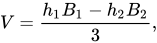
The volume of a conical or pyramidal frustum is the volume of the solid before slicing its "apex" off, minus the volume of this "apex":
where B1 and B2 are the base and top areas, and h1 and h2 are the perpendicular heights from the apex to the base and top planes.
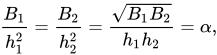
Considering that
the formula for the volume can be expressed as the third of the product of this proportionality, Failed to parse (SVG (MathML can be enabled via browser plugin): Invalid response ("Math extension cannot connect to Restbase.") from server "https://wikimedia.org/api/rest_v1/":): {\displaystyle \alpha}
, and of the difference of the cubes of the heights h1 and h2 only:
Failed to parse (SVG (MathML can be enabled via browser plugin): Invalid response ("Math extension cannot connect to Restbase.") from server "https://wikimedia.org/api/rest_v1/":): {\displaystyle V = \frac{h_1 \alpha h_1^2 - h_2 \alpha h_2^2}{3} = \alpha\frac{h_1^3 - h_2^3}{3}.}
By using the identity a3 − b3 = (a − b)(a2 + ab + b2), one gets:
Failed to parse (SVG (MathML can be enabled via browser plugin): Invalid response ("Math extension cannot connect to Restbase.") from server "https://wikimedia.org/api/rest_v1/":): {\displaystyle V = (h_1 - h_2)\alpha\frac{h_1^2 + h_1h_2 + h_2^2}{3},}
where h1 − h2 = h is the height of the frustum.
Distributing Failed to parse (SVG (MathML can be enabled via browser plugin): Invalid response ("Math extension cannot connect to Restbase.") from server "https://wikimedia.org/api/rest_v1/":): {\displaystyle \alpha}
and substituting from its definition, the Heronian mean of areas B1 and B2 is obtained:
Failed to parse (SVG (MathML can be enabled via browser plugin): Invalid response ("Math extension cannot connect to Restbase.") from server "https://wikimedia.org/api/rest_v1/":): {\displaystyle \frac{B_1 + \sqrt{B_1B_2} + B_2}{3};}
the alternative formula is therefore:
Failed to parse (SVG (MathML can be enabled via browser plugin): Invalid response ("Math extension cannot connect to Restbase.") from server "https://wikimedia.org/api/rest_v1/":): {\displaystyle V = \frac{h}{3}\left(B_1 + \sqrt{B_1B_2} + B_2\right).}
Failed to parse (SVG (MathML can be enabled via browser plugin): Invalid response ("Math extension cannot connect to Restbase.") from server "https://wikimedia.org/api/rest_v1/":): {\displaystyle V = \frac{\pi h}{3}\left(r_1^2 + r_1r_2 + r_2^2\right),}
The volume of a pyramidal frustum whose bases are regular n-gons is:
Failed to parse (SVG (MathML can be enabled via browser plugin): Invalid response ("Math extension cannot connect to Restbase.") from server "https://wikimedia.org/api/rest_v1/":): {\displaystyle V = \frac{nh}{12}\left(a_1^2 + a_1a_2 + a_2^2\right)\cot\frac{\pi}{n},}
where a1 and a2 are the base and top side lengths.
For a right circular conical frustum[3][4] the slant heightFailed to parse (SVG (MathML can be enabled via browser plugin): Invalid response ("Math extension cannot connect to Restbase.") from server "https://wikimedia.org/api/rest_v1/":): {\displaystyle s}
is
Template:Bi
the lateral surface area is
Template:Bi
and the total surface area is
Template:Bi
where r1 and r2 are the base and top radii respectively.
Ziggurats, step pyramids, and certain ancient Native American mounds also form the frustum of one or more pyramids, with additional features such as stairs added.