Preorder
In mathematics, especially in order theory, a preorder or quasiorder is a binary relation that is reflexive and transitive. The name preorder is meant to suggest that preorders are almost partial orders, but not quite, as they are not necessarily antisymmetric.
A natural example of a preorder is the divides relation "x divides y" between integers. This relation is reflexive as every integer divides itself. It is also transitive. But it is not antisymmetric, because e.g. divides Failed to parse (SVG (MathML can be enabled via browser plugin): Invalid response ("Math extension cannot connect to Restbase.") from server "https://wikimedia.org/api/rest_v1/":): {\displaystyle -1} and Failed to parse (SVG (MathML can be enabled via browser plugin): Invalid response ("Math extension cannot connect to Restbase.") from server "https://wikimedia.org/api/rest_v1/":): {\displaystyle -1} divides Failed to parse (SVG (MathML can be enabled via browser plugin): Invalid response ("Math extension cannot connect to Restbase.") from server "https://wikimedia.org/api/rest_v1/":): {\displaystyle 1} , but Failed to parse (SVG (MathML can be enabled via browser plugin): Invalid response ("Math extension cannot connect to Restbase.") from server "https://wikimedia.org/api/rest_v1/":): {\displaystyle -1} is not equal to Failed to parse (SVG (MathML can be enabled via browser plugin): Invalid response ("Math extension cannot connect to Restbase.") from server "https://wikimedia.org/api/rest_v1/":): {\displaystyle 1} . It is to this preorder that "least" refers in the phrase "least common multiple" (in contrast, using the natural order on integers, e.g. Failed to parse (SVG (MathML can be enabled via browser plugin): Invalid response ("Math extension cannot connect to Restbase.") from server "https://wikimedia.org/api/rest_v1/":): {\displaystyle 4} and Failed to parse (SVG (MathML can be enabled via browser plugin): Invalid response ("Math extension cannot connect to Restbase.") from server "https://wikimedia.org/api/rest_v1/":): {\displaystyle 6} have the common multiples Failed to parse (SVG (MathML can be enabled via browser plugin): Invalid response ("Math extension cannot connect to Restbase.") from server "https://wikimedia.org/api/rest_v1/":): {\displaystyle 24} , Failed to parse (SVG (MathML can be enabled via browser plugin): Invalid response ("Math extension cannot connect to Restbase.") from server "https://wikimedia.org/api/rest_v1/":): {\displaystyle 12} , Failed to parse (SVG (MathML can be enabled via browser plugin): Invalid response ("Math extension cannot connect to Restbase.") from server "https://wikimedia.org/api/rest_v1/":): {\displaystyle 0} , Failed to parse (SVG (MathML can be enabled via browser plugin): Invalid response ("Math extension cannot connect to Restbase.") from server "https://wikimedia.org/api/rest_v1/":): {\displaystyle -12} , Failed to parse (SVG (MathML can be enabled via browser plugin): Invalid response ("Math extension cannot connect to Restbase.") from server "https://wikimedia.org/api/rest_v1/":): {\displaystyle -24} , ..., but no least one).

Preorders are closely related to equivalence relations and (non-strict) partial orders. Both of these are special cases of a preorder: an antisymmetric preorder is a partial order, and a symmetric preorder is an equivalence relation. Moreover, a preorder on a set Failed to parse (SVG (MathML can be enabled via browser plugin): Invalid response ("Math extension cannot connect to Restbase.") from server "https://wikimedia.org/api/rest_v1/":): {\displaystyle X} can equivalently be defined as an equivalence relation on Failed to parse (SVG (MathML can be enabled via browser plugin): Invalid response ("Math extension cannot connect to Restbase.") from server "https://wikimedia.org/api/rest_v1/":): {\displaystyle X} , together with a partial order on the set of equivalence class, cf. picture. Like partial orders and equivalence relations, preorders (on a nonempty set) are never asymmetric.
A preorder can be visualized as a directed graph, with elements of the set corresponding to vertices, and the order relation between pairs of elements corresponding to the directed edges between vertices. The converse is not true: most directed graphs are neither reflexive nor transitive. A preorder that is antisymmetric no longer has cycles; it is a partial order, and corresponds to a directed acyclic graph. A preorder that is symmetric is an equivalence relation; it can be thought of as having lost the direction markers on the edges of the graph. In general, a preorder's corresponding directed graph may have many disconnected components.
A preorder is often denoted Failed to parse (SVG (MathML can be enabled via browser plugin): Invalid response ("Math extension cannot connect to Restbase.") from server "https://wikimedia.org/api/rest_v1/":): {\displaystyle \,\lesssim\,} or Failed to parse (SVG (MathML can be enabled via browser plugin): Invalid response ("Math extension cannot connect to Restbase.") from server "https://wikimedia.org/api/rest_v1/":): {\displaystyle \,\leq\,} .
Definition
[edit]A binary relation Failed to parse (SVG (MathML can be enabled via browser plugin): Invalid response ("Math extension cannot connect to Restbase.") from server "https://wikimedia.org/api/rest_v1/":): {\displaystyle \,\lesssim\,} on a set Failed to parse (SVG (MathML can be enabled via browser plugin): Invalid response ("Math extension cannot connect to Restbase.") from server "https://wikimedia.org/api/rest_v1/":): {\displaystyle X} is called a preorder or quasiorder if it is reflexive and transitive; that is, if it satisfies:
- Reflexivity: Failed to parse (SVG (MathML can be enabled via browser plugin): Invalid response ("Math extension cannot connect to Restbase.") from server "https://wikimedia.org/api/rest_v1/":): {\displaystyle a \lesssim a} for all Failed to parse (SVG (MathML can be enabled via browser plugin): Invalid response ("Math extension cannot connect to Restbase.") from server "https://wikimedia.org/api/rest_v1/":): {\displaystyle a \in X,} and
- Transitivity: if Failed to parse (SVG (MathML can be enabled via browser plugin): Invalid response ("Math extension cannot connect to Restbase.") from server "https://wikimedia.org/api/rest_v1/":): {\displaystyle a \lesssim b \text{ and } b \lesssim c \text{ then } a \lesssim c} for all Failed to parse (SVG (MathML can be enabled via browser plugin): Invalid response ("Math extension cannot connect to Restbase.") from server "https://wikimedia.org/api/rest_v1/":): {\displaystyle a, b, c \in X.}
A set that is equipped with a preorder is called a preordered set (or proset).[1]
Preorders as partial orders on partitions
[edit]Given a preorder Failed to parse (SVG (MathML can be enabled via browser plugin): Invalid response ("Math extension cannot connect to Restbase.") from server "https://wikimedia.org/api/rest_v1/":): {\displaystyle \,\lesssim\,} on Failed to parse (SVG (MathML can be enabled via browser plugin): Invalid response ("Math extension cannot connect to Restbase.") from server "https://wikimedia.org/api/rest_v1/":): {\displaystyle X} one may define an equivalence relation Failed to parse (SVG (MathML can be enabled via browser plugin): Invalid response ("Math extension cannot connect to Restbase.") from server "https://wikimedia.org/api/rest_v1/":): {\displaystyle \,\sim\,} on Failed to parse (SVG (MathML can be enabled via browser plugin): Invalid response ("Math extension cannot connect to Restbase.") from server "https://wikimedia.org/api/rest_v1/":): {\displaystyle X} by The resulting relation Failed to parse (SVG (MathML can be enabled via browser plugin): Invalid response ("Math extension cannot connect to Restbase.") from server "https://wikimedia.org/api/rest_v1/":): {\displaystyle \,\sim\,} is reflexive since the preorder Failed to parse (SVG (MathML can be enabled via browser plugin): Invalid response ("Math extension cannot connect to Restbase.") from server "https://wikimedia.org/api/rest_v1/":): {\displaystyle \,\lesssim\,} is reflexive; transitive by applying the transitivity of Failed to parse (SVG (MathML can be enabled via browser plugin): Invalid response ("Math extension cannot connect to Restbase.") from server "https://wikimedia.org/api/rest_v1/":): {\displaystyle \,\lesssim\,} twice; and symmetric by definition.

Using this relation, it is possible to construct a partial order on the quotient set Failed to parse (SVG (MathML can be enabled via browser plugin): Invalid response ("Math extension cannot connect to Restbase.") from server "https://wikimedia.org/api/rest_v1/":): {\displaystyle X / \sim} of the equivalence, by defining Failed to parse (SVG (MathML can be enabled via browser plugin): Invalid response ("Math extension cannot connect to Restbase.") from server "https://wikimedia.org/api/rest_v1/":): {\displaystyle [x] \leq [y]} if Failed to parse (SVG (MathML can be enabled via browser plugin): Invalid response ("Math extension cannot connect to Restbase.") from server "https://wikimedia.org/api/rest_v1/":): {\displaystyle x \lesssim y.} That this is well-defined, meaning that it does not depend on the particular choice of representatives Failed to parse (SVG (MathML can be enabled via browser plugin): Invalid response ("Math extension cannot connect to Restbase.") from server "https://wikimedia.org/api/rest_v1/":): {\displaystyle x} and Failed to parse (SVG (MathML can be enabled via browser plugin): Invalid response ("Math extension cannot connect to Restbase.") from server "https://wikimedia.org/api/rest_v1/":): {\displaystyle y} , follows from the definition of Failed to parse (SVG (MathML can be enabled via browser plugin): Invalid response ("Math extension cannot connect to Restbase.") from server "https://wikimedia.org/api/rest_v1/":): {\displaystyle \,\sim\,} .
Conversely, from any partial order on a partition of a set Failed to parse (SVG (MathML can be enabled via browser plugin): Invalid response ("Math extension cannot connect to Restbase.") from server "https://wikimedia.org/api/rest_v1/":): {\displaystyle X,} it is possible to construct a preorder on Failed to parse (SVG (MathML can be enabled via browser plugin): Invalid response ("Math extension cannot connect to Restbase.") from server "https://wikimedia.org/api/rest_v1/":): {\displaystyle X} itself. There is a one-to-one correspondence between preorders and pairs (partition, partial order).
Example: Let Failed to parse (SVG (MathML can be enabled via browser plugin): Invalid response ("Math extension cannot connect to Restbase.") from server "https://wikimedia.org/api/rest_v1/":): {\displaystyle X} be the set of all (valid or invalid) sentences in some subfield of mathematics, like geometry. Define Failed to parse (SVG (MathML can be enabled via browser plugin): Invalid response ("Math extension cannot connect to Restbase.") from server "https://wikimedia.org/api/rest_v1/":): {\displaystyle p \Leftarrow q} if Failed to parse (SVG (MathML can be enabled via browser plugin): Invalid response ("Math extension cannot connect to Restbase.") from server "https://wikimedia.org/api/rest_v1/":): {\displaystyle p} is a logical consequence of Failed to parse (SVG (MathML can be enabled via browser plugin): Invalid response ("Math extension cannot connect to Restbase.") from server "https://wikimedia.org/api/rest_v1/":): {\displaystyle q} . Then Failed to parse (SVG (MathML can be enabled via browser plugin): Invalid response ("Math extension cannot connect to Restbase.") from server "https://wikimedia.org/api/rest_v1/":): {\displaystyle \Leftarrow} is a preorder on Failed to parse (SVG (MathML can be enabled via browser plugin): Invalid response ("Math extension cannot connect to Restbase.") from server "https://wikimedia.org/api/rest_v1/":): {\displaystyle X} : every sentence Failed to parse (SVG (MathML can be enabled via browser plugin): Invalid response ("Math extension cannot connect to Restbase.") from server "https://wikimedia.org/api/rest_v1/":): {\displaystyle p} can be proven from itself (reflexivity), and if Failed to parse (SVG (MathML can be enabled via browser plugin): Invalid response ("Math extension cannot connect to Restbase.") from server "https://wikimedia.org/api/rest_v1/":): {\displaystyle p} can be proven from Failed to parse (SVG (MathML can be enabled via browser plugin): Invalid response ("Math extension cannot connect to Restbase.") from server "https://wikimedia.org/api/rest_v1/":): {\displaystyle q} , and Failed to parse (SVG (MathML can be enabled via browser plugin): Invalid response ("Math extension cannot connect to Restbase.") from server "https://wikimedia.org/api/rest_v1/":): {\displaystyle q} from Failed to parse (SVG (MathML can be enabled via browser plugin): Invalid response ("Math extension cannot connect to Restbase.") from server "https://wikimedia.org/api/rest_v1/":): {\displaystyle r} , then can also be proven from (transitivity). The corresponding equivalence relation is usually denoted , and defined as and ; in this case and are called "logically equivalent". The equivalence class of a sentence is the set of all sentences that are logically equivalent to ; formally: . The preordered set is a directed set: given two sentences , their logical conjunction , pronounced "both and ", is a common upper bound of them, since is a consequence of , and so is . The partially ordered set is hence also a directed set. See Lindenbaum–Tarski algebra for a related example.


![{\displaystyle [p]=\{q\mid p\Leftrightarrow q\}}](https://wikimedia.org/api/rest_v1/media/math/render/svg/01d86ca1595dd2c9654c220a8cf2f20dc0b25a22)


Relationship to strict partial orders
[edit]If reflexivity is replaced with irreflexivity (while keeping transitivity) then we get the definition of a strict partial order on . For this reason, the term strict preorder is sometimes used for a strict partial order. That is, this is a binary relation on that satisfies:


- Irreflexivity or anti-reflexivity: not for all that is, is false for all and
- Transitivity: if for all




Strict partial order induced by a preorder
[edit]Any preorder gives rise to a strict partial order defined by if and only if and not . Using the equivalence relation introduced above, if and only if and so the following holds The relation is a strict partial order and every strict partial order can be constructed this way. If the preorder is antisymmetric (and thus a partial order) then the equivalence is equality (that is, if and only if ) and so in this case, the definition of can be restated as: But importantly, this new condition is not used as (nor is it equivalent to) the general definition of the relation (that is, is not defined as: if and only if ) because if the preorder is not antisymmetric then the resulting relation would not be transitive (consider how equivalent non-equal elements relate). This is the reason for using the symbol " " instead of the "less than or equal to" symbol " ", which might cause confusion for a preorder that is not antisymmetric since it might misleadingly suggest that implies











Preorders induced by a strict partial order
[edit]Using the construction above, multiple non-strict preorders can produce the same strict preorder so without more information about how was constructed (such as knowledge of the equivalence relation for instance), it might not be possible to reconstruct the original non-strict preorder from Possible (non-strict) preorders that induce the given strict preorder include the following:


- Define as (that is, take the reflexive closure of the relation). This gives the partial order associated with the strict partial order " " through reflexive closure; in this case the equivalence is equality so the symbols and are not needed.
- Define as " " (that is, take the inverse complement of the relation), which corresponds to defining as "neither "; these relations and are in general not transitive; however, if they are then is an equivalence; in that case " " is a strict weak order. The resulting preorder is connected (formerly called total); that is, a total preorder.




If then The converse holds (that is, ) if and only if whenever then or


Examples
[edit]Graph theory
[edit]- The reachability relationship in any directed graph (possibly containing cycles) gives rise to a preorder, where in the preorder if and only if there is a path from x to y in the directed graph. Conversely, every preorder is the reachability relationship of a directed graph (for instance, the graph that has an edge from x to y for every pair (x, y) with ). However, many different graphs may have the same reachability preorder as each other. In the same way, reachability of directed acyclic graphs, directed graphs with no cycles, gives rise to partially ordered sets (preorders satisfying an additional antisymmetry property).
- The graph-minor relation is also a preorder.

Computer science
[edit]In computer science, one can find examples of the following preorders.
- Asymptotic order causes a preorder over functions . The corresponding equivalence relation is called asymptotic equivalence.
- Polynomial-time, many-one (mapping) and Turing reductions are preorders on complexity classes.
- Subtyping relations are usually preorders.[2]
- Simulation preorders are preorders (hence the name).
- Reduction relations in abstract rewriting systems.
- The encompassment preorder on the set of terms, defined by if a subterm of t is a substitution instance of s.
- Theta-subsumption,[3] which is when the literals in a disjunctive first-order formula are contained by another, after applying a substitution to the former.


Category theory
[edit]- A category with at most one morphism from any object x to any other object y is a preorder. Such categories are called thin. Here the objects correspond to the elements of and there is one morphism for objects which are related, zero otherwise. In this sense, categories "generalize" preorders by allowing more than one relation between objects: each morphism is a distinct (named) preorder relation.
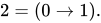
- Alternately, a preordered set can be understood as an enriched category, enriched over the category

Other
[edit]Further examples:
- Every finite topological space gives rise to a preorder on its points by defining if and only if x belongs to every neighborhood of y. Every finite preorder can be formed as the specialization preorder of a topological space in this way. That is, there is a one-to-one correspondence between finite topologies and finite preorders. However, the relation between infinite topological spaces and their specialization preorders is not one-to-one.
- A net is a directed preorder, that is, each pair of elements has an upper bound. The definition of convergence via nets is important in topology, where preorders cannot be replaced by partially ordered sets without losing important features.
- The relation defined by if where f is a function into some preorder.
- The relation defined by if there exists some injection from x to y. Injection may be replaced by surjection, or any type of structure-preserving function, such as ring homomorphism, or permutation.
- The embedding relation for countable total orderings.

Example of a total preorder:
- Preference, according to common models.[4]
Constructions
[edit]Every binary relation on a set can be extended to a preorder on by taking the transitive closure and reflexive closure, The transitive closure indicates path connection in if and only if there is an -path from to


Left residual preorder induced by a binary relation
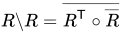
Given a binary relation the complemented composition forms a preorder called the left residual,[5] where Failed to parse (SVG (MathML can be enabled via browser plugin): Invalid response ("Math extension cannot connect to Restbase.") from server "https://wikimedia.org/api/rest_v1/":): {\displaystyle R^\textsf{T}} denotes the converse relation of Failed to parse (SVG (MathML can be enabled via browser plugin): Invalid response ("Math extension cannot connect to Restbase.") from server "https://wikimedia.org/api/rest_v1/":): {\displaystyle R,} and Failed to parse (SVG (MathML can be enabled via browser plugin): Invalid response ("Math extension cannot connect to Restbase.") from server "https://wikimedia.org/api/rest_v1/":): {\displaystyle \overline{R}} denotes the complement relation of Failed to parse (SVG (MathML can be enabled via browser plugin): Invalid response ("Math extension cannot connect to Restbase.") from server "https://wikimedia.org/api/rest_v1/":): {\displaystyle R,} while Failed to parse (SVG (MathML can be enabled via browser plugin): Invalid response ("Math extension cannot connect to Restbase.") from server "https://wikimedia.org/api/rest_v1/":): {\displaystyle \circ} denotes relation composition.

Related definitions
[edit]If a preorder is also antisymmetric, that is, Failed to parse (SVG (MathML can be enabled via browser plugin): Invalid response ("Math extension cannot connect to Restbase.") from server "https://wikimedia.org/api/rest_v1/":): {\displaystyle a \lesssim b} and Failed to parse (SVG (MathML can be enabled via browser plugin): Invalid response ("Math extension cannot connect to Restbase.") from server "https://wikimedia.org/api/rest_v1/":): {\displaystyle b \lesssim a} implies Failed to parse (SVG (MathML can be enabled via browser plugin): Invalid response ("Math extension cannot connect to Restbase.") from server "https://wikimedia.org/api/rest_v1/":): {\displaystyle a = b,} then it is a partial order.
On the other hand, if it is symmetric, that is, if Failed to parse (SVG (MathML can be enabled via browser plugin): Invalid response ("Math extension cannot connect to Restbase.") from server "https://wikimedia.org/api/rest_v1/":): {\displaystyle a \lesssim b} implies Failed to parse (SVG (MathML can be enabled via browser plugin): Invalid response ("Math extension cannot connect to Restbase.") from server "https://wikimedia.org/api/rest_v1/":): {\displaystyle b \lesssim a,} then it is an equivalence relation.
A preorder is total if Failed to parse (SVG (MathML can be enabled via browser plugin): Invalid response ("Math extension cannot connect to Restbase.") from server "https://wikimedia.org/api/rest_v1/":): {\displaystyle a \lesssim b} or Failed to parse (SVG (MathML can be enabled via browser plugin): Invalid response ("Math extension cannot connect to Restbase.") from server "https://wikimedia.org/api/rest_v1/":): {\displaystyle b \lesssim a} for all Failed to parse (SVG (MathML can be enabled via browser plugin): Invalid response ("Math extension cannot connect to Restbase.") from server "https://wikimedia.org/api/rest_v1/":): {\displaystyle a, b \in X.}
A preordered class is a class equipped with a preorder. Every set is a class and so every preordered set is a preordered class.
Uses
[edit]Preorders play a pivotal role in several situations:
- Every preorder can be given a topology, the Alexandrov topology; and indeed, every preorder on a set is in one-to-one correspondence with an Alexandrov topology on that set.
- Preorders may be used to define interior algebras.
- Preorders provide the Kripke semantics for certain types of modal logic.
- Preorders are used in forcing in set theory to prove consistency and independence results.[6]
Number of preorders
[edit]As explained above, there is a 1-to-1 correspondence between preorders and pairs (partition, partial order). Thus the number of preorders is the sum of the number of partial orders on every partition. For example:
- for Failed to parse (SVG (MathML can be enabled via browser plugin): Invalid response ("Math extension cannot connect to Restbase.") from server "https://wikimedia.org/api/rest_v1/":): {\displaystyle n = 3:}
- 1 partition of 3, giving 1 preorder
- 3 partitions of 2 + 1, giving Failed to parse (SVG (MathML can be enabled via browser plugin): Invalid response ("Math extension cannot connect to Restbase.") from server "https://wikimedia.org/api/rest_v1/":): {\displaystyle 3 \times 3 = 9} preorders
- 1 partition of 1 + 1 + 1, giving 19 preorders
- for Failed to parse (SVG (MathML can be enabled via browser plugin): Invalid response ("Math extension cannot connect to Restbase.") from server "https://wikimedia.org/api/rest_v1/":): {\displaystyle n = 4:}
- 1 partition of 4, giving 1 preorder
- 7 partitions with two classes (4 of 3 + 1 and 3 of 2 + 2), giving Failed to parse (SVG (MathML can be enabled via browser plugin): Invalid response ("Math extension cannot connect to Restbase.") from server "https://wikimedia.org/api/rest_v1/":): {\displaystyle 7 \times 3 = 21} preorders
- 6 partitions of 2 + 1 + 1, giving Failed to parse (SVG (MathML can be enabled via browser plugin): Invalid response ("Math extension cannot connect to Restbase.") from server "https://wikimedia.org/api/rest_v1/":): {\displaystyle 6 \times 19 = 114} preorders
- 1 partition of 1 + 1 + 1 + 1, giving 219 preorders
Interval
[edit]For Failed to parse (SVG (MathML can be enabled via browser plugin): Invalid response ("Math extension cannot connect to Restbase.") from server "https://wikimedia.org/api/rest_v1/":): {\displaystyle a \lesssim b,} the interval Failed to parse (SVG (MathML can be enabled via browser plugin): Invalid response ("Math extension cannot connect to Restbase.") from server "https://wikimedia.org/api/rest_v1/":): {\displaystyle [a, b]} is the set of points x satisfying Failed to parse (SVG (MathML can be enabled via browser plugin): Invalid response ("Math extension cannot connect to Restbase.") from server "https://wikimedia.org/api/rest_v1/":): {\displaystyle a \lesssim x} and Failed to parse (SVG (MathML can be enabled via browser plugin): Invalid response ("Math extension cannot connect to Restbase.") from server "https://wikimedia.org/api/rest_v1/":): {\displaystyle x \lesssim b,} also written It contains at least the points a and b. One may choose to extend the definition to all pairs Failed to parse (SVG (MathML can be enabled via browser plugin): Invalid response ("Math extension cannot connect to Restbase.") from server "https://wikimedia.org/api/rest_v1/":): {\displaystyle (a, b)} . The extra intervals are all empty.


Using the corresponding strict relation "Failed to parse (SVG (MathML can be enabled via browser plugin): Invalid response ("Math extension cannot connect to Restbase.") from server "https://wikimedia.org/api/rest_v1/":): {\displaystyle <} ", one can also define the interval Failed to parse (SVG (MathML can be enabled via browser plugin): Invalid response ("Math extension cannot connect to Restbase.") from server "https://wikimedia.org/api/rest_v1/":): {\displaystyle (a, b)} as the set of points x satisfying Failed to parse (SVG (MathML can be enabled via browser plugin): Invalid response ("Math extension cannot connect to Restbase.") from server "https://wikimedia.org/api/rest_v1/":): {\displaystyle a < x} and Failed to parse (SVG (MathML can be enabled via browser plugin): Invalid response ("Math extension cannot connect to Restbase.") from server "https://wikimedia.org/api/rest_v1/":): {\displaystyle x < b,} also written Failed to parse (SVG (MathML can be enabled via browser plugin): Invalid response ("Math extension cannot connect to Restbase.") from server "https://wikimedia.org/api/rest_v1/":): {\displaystyle a < x < b.} An open interval may be empty even if Failed to parse (SVG (MathML can be enabled via browser plugin): Invalid response ("Math extension cannot connect to Restbase.") from server "https://wikimedia.org/api/rest_v1/":): {\displaystyle a < b.}
Also Failed to parse (SVG (MathML can be enabled via browser plugin): Invalid response ("Math extension cannot connect to Restbase.") from server "https://wikimedia.org/api/rest_v1/":): {\displaystyle [a, b)} and Failed to parse (SVG (MathML can be enabled via browser plugin): Invalid response ("Math extension cannot connect to Restbase.") from server "https://wikimedia.org/api/rest_v1/":): {\displaystyle (a, b]} can be defined similarly.
See also
[edit]- Partial order – preorder that is antisymmetric
- Equivalence relation – preorder that is symmetric
- Total preorder – preorder that is total
- Total order – preorder that is antisymmetric and total
- Directed set
- Category of preordered sets
- Prewellordering
- Well-quasi-ordering
Notes
[edit]- ↑ For "proset", see e.g. Eklund, Patrik; Gähler, Werner (1990), "Generalized Cauchy spaces", Mathematische Nachrichten, 147: 219–233, doi:10.1002/mana.19901470123, MR 1127325.
- ↑ Pierce, Benjamin C. (2002). Types and Programming Languages. Cambridge, Massachusetts/London, England: The MIT Press. pp. 182ff. ISBN 0-262-16209-1.
- ↑ Robinson, J. A. (1965). "A machine-oriented logic based on the resolution principle". Journal of the ACM. 12 (1): 23–41. doi:10.1145/321250.321253. S2CID 14389185.
- ↑ Hansson, Sven Ove; Grüne-Yanoff, Till (2024), "Preferences", in Zalta, Edward N.; Nodelman, Uri (eds.), The Stanford Encyclopedia of Philosophy (Winter 2024 ed.), Metaphysics Research Lab, Stanford University, retrieved 2025-03-16
- ↑ In this context, "Failed to parse (SVG (MathML can be enabled via browser plugin): Invalid response ("Math extension cannot connect to Restbase.") from server "https://wikimedia.org/api/rest_v1/":): {\displaystyle \backslash} " does not mean "set difference".
- ↑ Kunen, Kenneth (1980), Set Theory, An Introduction to Independence Proofs, Studies in logic and the foundation of mathematics, 102, Amsterdam, the Netherlands: Elsevier.
References
[edit]- Schmidt, Gunther, "Relational Mathematics", Encyclopedia of Mathematics and its Applications, vol. 132, Cambridge University Press, 2011, ISBN 978-0-521-76268-7
- Schröder, Bernd S. W. (2002), Ordered Sets: An Introduction, Boston: Birkhäuser, ISBN 0-8176-4128-9