Binomial coefficient


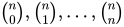
In mathematics, the binomial coefficients are the positive integers that occur as coefficients in the binomial theorem. Commonly, a binomial coefficient is indexed by a pair of integers n ≥ k ≥ 0 and is written Failed to parse (Conversion error. Server ("https://wikimedia.org/api/rest_") reported: "Cannot get mml. Server problem."): {\displaystyle {\tbinom {n}{k}}.} It is the coefficient of the xk term in the polynomial expansion of the binomial power (1 + x)n; this coefficient can be computed by the multiplicative formula

which using factorial notation can be compactly expressed as
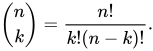
For example, the fourth power of 1 + x is
- Failed to parse (Conversion error. Server ("https://wikimedia.org/api/rest_") reported: "Cannot get mml. Server problem."): {\displaystyle {\begin{aligned}(1+x)^{4}&={\tbinom {4}{0}}x^{0}+{\tbinom {4}{1}}x^{1}+{\tbinom {4}{2}}x^{2}+{\tbinom {4}{3}}x^{3}+{\tbinom {4}{4}}x^{4}\\&=1+4x+6x^{2}+4x^{3}+x^{4},\end{aligned}}}
and the binomial coefficient Failed to parse (Conversion error. Server ("https://wikimedia.org/api/rest_") reported: "Cannot get mml. Server problem."): {\displaystyle {\tbinom {4}{2}}={\tfrac {4\times 3}{2\times 1}}={\tfrac {4!}{2!2!}}=6} is the coefficient of the x2 term.
Arranging the numbers in successive rows for n = 0, 1, 2, ... gives a triangular array called Pascal's triangle, satisfying the recurrence relation
- Failed to parse (Conversion error. Server ("https://wikimedia.org/api/rest_") reported: "Cannot get mml. Server problem."): {\displaystyle {\binom {n}{k}}={\binom {n-1}{k-1}}+{\binom {n-1}{k}}.}
The binomial coefficients occur in many areas of mathematics, and especially in combinatorics. In combinatorics the symbol is usually read as "n choose k" because there are ways to choose an (unordered) subset of k elements from a fixed set of n elements. For example, there are Failed to parse (Conversion error. Server ("https://wikimedia.org/api/rest_") reported: "Cannot get mml. Server problem."): {\displaystyle {\tbinom {4}{2}}=6} ways to choose 2 elements from {1, 2, 3, 4}, namely {1, 2}, {1, 3}, {1, 4}, {2, 3}, {2, 4} and {3, 4}.

The first form of the binomial coefficients can be generalized to Failed to parse (Conversion error. Server ("https://wikimedia.org/api/rest_") reported: "Cannot get mml. Server problem."): {\displaystyle {\tbinom {z}{k}}} for any complex number z and integer k ≥ 0, and many of their properties continue to hold in this more general form.
History and notation
[edit | edit source]Andreas von Ettingshausen introduced the notation in 1826,[1] although the numbers were known centuries earlier (see Pascal's triangle). In about 1150, the Indian mathematician Bhaskaracharya gave an exposition of binomial coefficients in his book Līlāvatī.[2]
Alternative notations include C(n, k), nCk, nCk, Ck
n,[3] Cn
k, and Cn,k, in all of which the C stands for combinations or choices; the C notation means the number of ways to choose k out of n objects. Many calculators use variants of the C notation because they can represent it on a single-line display. In this form the binomial coefficients are easily compared to the numbers of k-permutations of n, written as P(n, k), etc.
Definition and interpretations
[edit | edit source]k n |
0 | 1 | 2 | 3 | 4 | ⋯ |
|---|---|---|---|---|---|---|
| 0 | 1 | Template:SilverC | Template:SilverC | Template:SilverC | Template:SilverC | ⋯ |
| 1 | 1 | 1 | Template:SilverC | Template:SilverC | Template:SilverC | ⋯ |
| 2 | 1 | 2 | 1 | Template:SilverC | Template:SilverC | ⋯ |
| 3 | 1 | 3 | 3 | 1 | Template:SilverC | ⋯ |
| 4 | 1 | 4 | 6 | 4 | 1 | ⋯ |
| ⋮ | ⋮ | ⋮ | ⋮ | ⋮ | ⋮ | ⋱ |
| The first few binomial coefficients on a left-aligned Pascal's triangle | ||||||
For natural numbers (taken to include 0) n and k, the binomial coefficient can be defined as the coefficient of the monomial Xk in the expansion of (1 + X)n. The same coefficient also occurs (if k ≤ n) in the binomial formula Template:NumBlk2 (valid for any elements x, y of a commutative ring), which explains the name "binomial coefficient".
Another occurrence of this number is in combinatorics, where it gives the number of ways, disregarding order, that k objects can be chosen from among n objects; more formally, the number of k-element subsets (or k-combinations) of an n-element set. This number can be seen as equal to that of the first definition, independently of any of the formulas below to compute it: if in each of the n factors of the power (1 + X)n one temporarily labels the term X with an index i (running from 1 to n), then each subset of k indices gives after expansion a contribution Xk, and the coefficient of that monomial in the result will be the number of such subsets. This shows in particular that is a natural number for any natural numbers n and k. There are many other combinatorial interpretations of binomial coefficients (counting problems for which the answer is given by a binomial coefficient expression), for instance the number of words formed of n bits (digits 0 or 1) whose sum is k is given by , while the number of ways to write Failed to parse (Conversion error. Server ("https://wikimedia.org/api/rest_") reported: "Cannot get mml. Server problem."): {\displaystyle k=a_{1}+a_{2}+\cdots +a_{n}} where every ai is a nonnegative integer is given by Template:Tmath. Most of these interpretations can be shown to be equivalent to counting k-combinations.
Computing the value of binomial coefficients
[edit | edit source]Several methods exist to compute the value of without actually expanding a binomial power or counting k-combinations.
Recursive formula
[edit | edit source]One method uses the recursive, purely additive formula Failed to parse (Conversion error. Server ("https://wikimedia.org/api/rest_") reported: "Cannot get mml. Server problem."): {\displaystyle {\binom {n}{k}}={\binom {n-1}{k-1}}+{\binom {n-1}{k}}} for all integers Failed to parse (Conversion error. Server ("https://wikimedia.org/api/rest_") reported: "Cannot get mml. Server problem."): {\displaystyle n,k} such that Failed to parse (Conversion error. Server ("https://wikimedia.org/api/rest_") reported: "Cannot get mml. Server problem."): {\displaystyle 1\leq k<n,} with boundary values Failed to parse (Conversion error. Server ("https://wikimedia.org/api/rest_") reported: "Cannot get mml. Server problem."): {\displaystyle {\binom {n}{0}}={\binom {n}{n}}=1} for all integers n ≥ 0.
The formula follows from considering the set {1, 2, 3, ..., n} and counting separately (a) the k-element groupings that include a particular set element, say "i", in every group (since "i" is already chosen to fill one spot in every group, we need only choose k − 1 from the remaining n − 1) and (b) all the k-groupings that don't include "i"; this enumerates all the possible k-combinations of n elements. It also follows from tracing the contributions to Xk in (1 + X)n−1(1 + X). As there is zero Xn+1 or X−1 in (1 + X)n, one might extend the definition beyond the above boundaries to include Failed to parse (Conversion error. Server ("https://wikimedia.org/api/rest_") reported: "Cannot get mml. Server problem."): {\displaystyle {\tbinom {n}{k}}=0} when either k > n or k < 0. This recursive formula then allows the construction of Pascal's triangle, surrounded by white spaces where the zeros, or the trivial coefficients, would be.
Multiplicative formula
[edit | edit source]A more efficient method to compute individual binomial coefficients is given by the formula Failed to parse (Conversion error. Server ("https://wikimedia.org/api/rest_") reported: "Cannot get mml. Server problem."): {\displaystyle {\binom {n}{k}}={\frac {n^{\underline {k}}}{k!}}={\frac {n(n-1)(n-2)\cdots (n-(k-1))}{k(k-1)(k-2)\cdots 1}}=\prod _{i=1}^{k}{\frac {n+1-i}{i}},} where the numerator of the first fraction, , is a falling factorial. This formula is easiest to understand for the combinatorial interpretation of binomial coefficients. The numerator gives the number of ways to select a sequence of k distinct objects, retaining the order of selection, from a set of n objects. The denominator counts the number of distinct sequences that define the same k-combination when order is disregarded. This formula can also be stated in a recursive form. Using the "C" notation from above, , where Failed to parse (Conversion error. Server ("https://wikimedia.org/api/rest_") reported: "Cannot get mml. Server problem."): {\displaystyle C_{n,0}=1} . It is readily derived by evaluating and can intuitively be understood as starting at the leftmost coefficient of the -th row of Pascal's triangle, whose value is always , and recursively computing the next coefficient to its right until the -th one is reached.


Due to the symmetry of the binomial coefficients with regard to k and n − k, calculation of the above product, as well as the recursive relation, may be optimised by setting its upper limit to the smaller of k and n − k.
Factorial formula
[edit | edit source]Finally, though computationally unsuitable, there is the compact form, often used in proofs and derivations, which makes repeated use of the familiar factorial function: Failed to parse (Conversion error. Server ("https://wikimedia.org/api/rest_") reported: "Cannot get mml. Server problem."): {\displaystyle {\binom {n}{k}}={\frac {n!}{k!\,(n-k)!}}\quad {\text{for }}\ 0\leq k\leq n,} where n! denotes the factorial of n. This formula follows from the multiplicative formula above by multiplying numerator and denominator by (n − k)!; as a consequence it involves many factors common to numerator and denominator. It is less practical for explicit computation (in the case that k is small and n is large) unless common factors are first cancelled (in particular since factorial values grow very rapidly). The formula does exhibit a symmetry that is less evident from the multiplicative formula (though it is from the definitions) Template:NumBlk2 which leads to a more efficient multiplicative computational routine. Using the falling factorial notation, Failed to parse (Conversion error. Server ("https://wikimedia.org/api/rest_") reported: "Cannot get mml. Server problem."): {\displaystyle {\binom {n}{k}}={\begin{cases}n^{\underline {k}}/k!&{\text{if }}\ k\leq {\frac {n}{2}}\\n^{\underline {n-k}}/(n-k)!&{\text{if }}\ k>{\frac {n}{2}}\end{cases}}.}
Generalization and connection to the binomial series
[edit | edit source]The multiplicative formula allows the definition of binomial coefficients to be extended[4] by replacing n by an arbitrary number α (negative, real, complex) or even an element of any commutative ring in which all positive integers are invertible: Failed to parse (Conversion error. Server ("https://wikimedia.org/api/rest_") reported: "Cannot get mml. Server problem."): {\displaystyle {\binom {\alpha }{k}}={\frac {\alpha ^{\underline {k}}}{k!}}={\frac {\alpha (\alpha -1)(\alpha -2)\cdots (\alpha -k+1)}{k(k-1)(k-2)\cdots 1}}\quad {\text{for }}k\in \mathbb {N} {\text{ and arbitrary }}\alpha .}
With this definition one has a generalization of the binomial formula (with one of the variables set to 1), which justifies still calling the Failed to parse (Conversion error. Server ("https://wikimedia.org/api/rest_") reported: "Cannot get mml. Server problem."): {\displaystyle {\tbinom {\alpha }{k}}} binomial coefficients: Template:NumBlk2
This formula is valid for all complex numbers α and X with |X| < 1. It can also be interpreted as an identity of formal power series in X, where it actually can serve as definition of arbitrary powers of power series with constant coefficient equal to 1; the point is that with this definition all identities hold that one expects for exponentiation, notably Failed to parse (Conversion error. Server ("https://wikimedia.org/api/rest_") reported: "Cannot get mml. Server problem."): {\displaystyle (1+X)^{\alpha }(1+X)^{\beta }=(1+X)^{\alpha +\beta }\quad {\text{and}}\quad ((1+X)^{\alpha })^{\beta }=(1+X)^{\alpha \beta }.}
If α is a nonnegative integer n, then all terms with k > n are zero,[5] and the infinite series becomes a finite sum, thereby recovering the binomial formula. However, for other values of α, including negative integers and rational numbers, the series is really infinite.
Pascal's triangle
[edit | edit source]
Pascal's rule is the important recurrence relation Template:NumBlk2 which can be used to prove by mathematical induction that is a natural number for all integer n ≥ 0 and all integer k, a fact that is not immediately obvious from formula (1). To the left and right of Pascal's triangle, the entries (shown as blanks) are all zero.
Pascal's rule also gives rise to Pascal's triangle:
| 0: | 1 | ||||||||||||||||
| 1: | 1 | 1 | |||||||||||||||
| 2: | 1 | 2 | 1 | ||||||||||||||
| 3: | 1 | 3 | 3 | 1 | |||||||||||||
| 4: | 1 | 4 | 6 | 4 | 1 | ||||||||||||
| 5: | 1 | 5 | 10 | 10 | 5 | 1 | |||||||||||
| 6: | 1 | 6 | 15 | 20 | 15 | 6 | 1 | ||||||||||
| 7: | 1 | 7 | 21 | 35 | 35 | 21 | 7 | 1 | |||||||||
| 8: | 1 | 8 | 28 | 56 | 70 | 56 | 28 | 8 | 1 |
Row number n contains the numbers for k = 0, …, n. It is constructed by first placing 1s in the outermost positions, and then filling each inner position with the sum of the two numbers directly above. This method allows the quick calculation of binomial coefficients without the need for fractions or multiplications. For instance, by looking at row number 5 of the triangle, one can quickly read off that
- Failed to parse (Conversion error. Server ("https://wikimedia.org/api/rest_") reported: "Cannot get mml. Server problem."): {\displaystyle (x+y)^{5}={\underline {1}}x^{5}+{\underline {5}}x^{4}y+{\underline {10}}x^{3}y^{2}+{\underline {10}}x^{2}y^{3}+{\underline {5}}xy^{4}+{\underline {1}}y^{5}.}
Combinatorics and statistics
[edit | edit source]Binomial coefficients are of importance in combinatorics because they provide ready formulas for certain frequent counting problems:
- There are ways to choose k elements from a set of n elements. See Combination.
- There are Failed to parse (Conversion error. Server ("https://wikimedia.org/api/rest_") reported: "Cannot get mml. Server problem."): {\displaystyle {\tbinom {n+k-1}{k}}} ways to choose k elements from a set of n elements if repetitions are allowed. See Multiset.
- There are strings containing k ones and n zeros.
- There are strings consisting of k ones and n zeros such that no two ones are adjacent.[6]
- The Catalan numbers are Failed to parse (Conversion error. Server ("https://wikimedia.org/api/rest_") reported: "Cannot get mml. Server problem."): {\displaystyle {\tfrac {1}{n+1}}{\tbinom {2n}{n}}.}
- The binomial distribution in statistics is Failed to parse (Conversion error. Server ("https://wikimedia.org/api/rest_") reported: "Cannot get mml. Server problem."): {\displaystyle {\tbinom {n}{k}}p^{k}(1-p)^{n-k}.}


Binomial coefficients as polynomials
[edit | edit source]For any nonnegative integer k, the expression can be written as a polynomial with denominator k!:

- Failed to parse (Conversion error. Server ("https://wikimedia.org/api/rest_") reported: "Cannot get mml. Server problem."): {\displaystyle {\binom {t}{k}}={\frac {t^{\underline {k}}}{k!}}={\frac {t(t-1)(t-2)\cdots (t-k+1)}{k(k-1)(k-2)\cdots 2\cdot 1}};}
this presents a polynomial in t with rational coefficients.
As such, it can be evaluated at any real or complex number t to define binomial coefficients with such first arguments. These "generalized binomial coefficients" appear in Newton's generalized binomial theorem.
For each k, the polynomial can be characterized as the unique degree k polynomial p(t) satisfying p(0) = p(1) = ⋯ = p(k − 1) = 0 and p(k) = 1.

Its coefficients are expressible in terms of Stirling numbers of the first kind:
- Failed to parse (Conversion error. Server ("https://wikimedia.org/api/rest_") reported: "Cannot get mml. Server problem."): {\displaystyle {\binom {t}{k}}=\sum _{i=0}^{k}s(k,i){\frac {t^{i}}{k!}}.}
The derivative of can be calculated by logarithmic differentiation:
- Failed to parse (Conversion error. Server ("https://wikimedia.org/api/rest_") reported: "Cannot get mml. Server problem."): {\displaystyle {\frac {\mathrm {d} }{\mathrm {d} t}}{\binom {t}{k}}={\binom {t}{k}}\sum _{i=0}^{k-1}{\frac {1}{t-i}}.}
This can cause a problem when evaluated at integers from to Failed to parse (Conversion error. Server ("https://wikimedia.org/api/rest_") reported: "Cannot get mml. Server problem."): {\displaystyle t-1} , but using identities below we can compute the derivative as:

- Failed to parse (Conversion error. Server ("https://wikimedia.org/api/rest_") reported: "Cannot get mml. Server problem."): {\displaystyle {\frac {\mathrm {d} }{\mathrm {d} t}}{\binom {t}{k}}=\sum _{i=0}^{k-1}{\frac {(-1)^{k-i-1}}{k-i}}{\binom {t}{i}}.}
Binomial coefficients as a basis for the space of polynomials
[edit | edit source]Over any field of characteristic 0 (that is, any field that contains the rational numbers), each polynomial p(t) of degree at most d is uniquely expressible as a linear combination Failed to parse (Conversion error. Server ("https://wikimedia.org/api/rest_") reported: "Cannot get mml. Server problem."): {\textstyle \sum _{k=0}^{d}a_{k}{\binom {t}{k}}} of binomial coefficients, because the binomial coefficients consist of one polynomial of each degree. The coefficient ak is the kth difference of the sequence p(0), p(1), ..., p(k). Explicitly,[7] Template:NumBlk2
Integer-valued polynomials
[edit | edit source]Each polynomial is integer-valued: it has an integer value at all integer inputs . (One way to prove this is by induction on k using Pascal's identity.) Therefore, any integer linear combination of binomial coefficient polynomials is integer-valued too. Conversely, (4) shows that any integer-valued polynomial is an integer linear combination of these binomial coefficient polynomials. More generally, for any subring R of a characteristic 0 field K, a polynomial in K[t] takes values in R at all integers if and only if it is an R-linear combination of binomial coefficient polynomials.

Example
[edit | edit source]The integer-valued polynomial 3t(3t + 1) / 2 can be rewritten as
- Failed to parse (Conversion error. Server ("https://wikimedia.org/api/rest_") reported: "Cannot get mml. Server problem."): {\displaystyle 9{\binom {t}{2}}+6{\binom {t}{1}}+0{\binom {t}{0}}.}
Identities involving binomial coefficients
[edit | edit source]The factorial formula facilitates relating nearby binomial coefficients. For instance, if k is a positive integer and n is arbitrary, then Template:NumBlk2 and, with a little more work,
- Failed to parse (Conversion error. Server ("https://wikimedia.org/api/rest_") reported: "Cannot get mml. Server problem."): {\displaystyle {\binom {n-1}{k}}-{\binom {n-1}{k-1}}={\frac {n-2k}{n}}{\binom {n}{k}}.}
We can also get
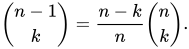
Moreover, the following may be useful:
- Failed to parse (Conversion error. Server ("https://wikimedia.org/api/rest_") reported: "Cannot get mml. Server problem."): {\displaystyle {\binom {n}{k}}{\binom {k}{j}}={\binom {n}{j}}{\binom {n-j}{k-j}}={\binom {n}{k-j}}{\binom {n-k+j}{j}}.}
For constant n, we have the following recurrence:
- Failed to parse (Conversion error. Server ("https://wikimedia.org/api/rest_") reported: "Cannot get mml. Server problem."): {\displaystyle {\binom {n}{k}}={\frac {n-k+1}{k}}{\binom {n}{k-1}}.}
To sum up, we have
- Failed to parse (Conversion error. Server ("https://wikimedia.org/api/rest_") reported: "Cannot get mml. Server problem."): {\displaystyle {\binom {n}{k}}={\binom {n}{n-k}}={\frac {n-k+1}{k}}{\binom {n}{k-1}}={\frac {n}{n-k}}{\binom {n-1}{k}}}

Sums of the binomial coefficients
[edit | edit source]The formula Template:NumBlk2 says that the elements in the nth row of Pascal's triangle always add up to 2 raised to the nth power. This is obtained from the binomial theorem (∗) by setting x = 1 and y = 1. The formula also has a natural combinatorial interpretation: the left side sums the number of subsets of {1, ..., n} of sizes k = 0, 1, ..., n, giving the total number of subsets. (That is, the left side counts the power set of {1, ..., n}.) However, these subsets can also be generated by successively choosing or excluding each element 1, ..., n; the n independent binary choices (bit-strings) allow a total of Failed to parse (Conversion error. Server ("https://wikimedia.org/api/rest_") reported: "Cannot get mml. Server problem."): {\displaystyle 2^{n}} choices. The left and right sides are two ways to count the same collection of subsets, so they are equal.
The formulas Template:NumBlk2 and
- Failed to parse (Conversion error. Server ("https://wikimedia.org/api/rest_") reported: "Cannot get mml. Server problem."): {\displaystyle \sum _{k=0}^{n}k^{2}{\binom {n}{k}}=(n+n^{2})2^{n-2}}
follow from the binomial theorem after differentiating with respect to x (twice for the latter) and then substituting x = y = 1.
The Chu–Vandermonde identity, which holds for any complex values m and n and any non-negative integer k, is Template:NumBlk2 and can be found by examination of the coefficient of Failed to parse (Conversion error. Server ("https://wikimedia.org/api/rest_") reported: "Cannot get mml. Server problem."): {\displaystyle x^{k}} in the expansion of (1 + x)m(1 + x)n−m = (1 + x)n using equation (2). When m = 1, equation (7) reduces to equation (3). In the special case n = 2m, k = m, using (1), the expansion (7) becomes (as seen in Pascal's triangle at right)
Template:NumBlk2 where the term on the right side is a central binomial coefficient.
Another form of the Chu–Vandermonde identity, which applies for any integers j, k, and n satisfying 0 ≤ j ≤ k ≤ n, is Template:NumBlk2 The proof is similar, but uses the binomial series expansion (2) with negative integer exponents. When j = k, equation (9) gives the hockey-stick identity
- Failed to parse (Conversion error. Server ("https://wikimedia.org/api/rest_") reported: "Cannot get mml. Server problem."): {\displaystyle \sum _{m=k}^{n}{\binom {m}{k}}={\binom {n+1}{k+1}}}
and its relative
- Failed to parse (Conversion error. Server ("https://wikimedia.org/api/rest_") reported: "Cannot get mml. Server problem."): {\displaystyle \sum _{r=0}^{m}{\binom {n+r}{r}}={\binom {n+m+1}{m}}.}
Let F(n) denote the n-th Fibonacci number. Then
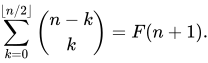
This can be proved by induction using (3) or by Zeckendorf's representation. A combinatorial proof is given below.
Multisections of sums
[edit | edit source]For integers s and t such that Failed to parse (Conversion error. Server ("https://wikimedia.org/api/rest_") reported: "Cannot get mml. Server problem."): {\displaystyle 0\leq t<s,} series multisection gives the following identity for the sum of binomial coefficients:
- Failed to parse (Conversion error. Server ("https://wikimedia.org/api/rest_") reported: "Cannot get mml. Server problem."): {\displaystyle {\binom {n}{t}}+{\binom {n}{t+s}}+{\binom {n}{t+2s}}+\ldots ={\frac {1}{s}}\sum _{j=0}^{s-1}\left(2\cos {\frac {\pi j}{s}}\right)^{n}\cos {\frac {\pi (n-2t)j}{s}}.}
For small s, these series have particularly nice forms; for example,[8]
- Failed to parse (Conversion error. Server ("https://wikimedia.org/api/rest_") reported: "Cannot get mml. Server problem."): {\displaystyle {\binom {n}{0}}+{\binom {n}{3}}+{\binom {n}{6}}+\cdots ={\frac {1}{3}}\left(2^{n}+2\cos {\frac {n\pi }{3}}\right)}
- Failed to parse (Conversion error. Server ("https://wikimedia.org/api/rest_") reported: "Cannot get mml. Server problem."): {\displaystyle {\binom {n}{1}}+{\binom {n}{4}}+{\binom {n}{7}}+\cdots ={\frac {1}{3}}\left(2^{n}+2\cos {\frac {(n-2)\pi }{3}}\right)}
- Failed to parse (Conversion error. Server ("https://wikimedia.org/api/rest_") reported: "Cannot get mml. Server problem."): {\displaystyle {\binom {n}{0}}+{\binom {n}{4}}+{\binom {n}{8}}+\cdots ={\frac {1}{2}}\left(2^{n-1}+2^{\frac {n}{2}}\cos {\frac {n\pi }{4}}\right)}
- Failed to parse (Conversion error. Server ("https://wikimedia.org/api/rest_") reported: "Cannot get mml. Server problem."): {\displaystyle {\binom {n}{1}}+{\binom {n}{5}}+{\binom {n}{9}}+\cdots ={\frac {1}{2}}\left(2^{n-1}+2^{\frac {n}{2}}\sin {\frac {n\pi }{4}}\right)}
- Failed to parse (Conversion error. Server ("https://wikimedia.org/api/rest_") reported: "Cannot get mml. Server problem."): {\displaystyle {\binom {n}{2}}+{\binom {n}{6}}+{\binom {n}{10}}+\cdots ={\frac {1}{2}}\left(2^{n-1}-2^{\frac {n}{2}}\cos {\frac {n\pi }{4}}\right)}
- Failed to parse (Conversion error. Server ("https://wikimedia.org/api/rest_") reported: "Cannot get mml. Server problem."): {\displaystyle {\binom {n}{3}}+{\binom {n}{7}}+{\binom {n}{11}}+\cdots ={\frac {1}{2}}\left(2^{n-1}-2^{\frac {n}{2}}\sin {\frac {n\pi }{4}}\right)}

Partial sums
[edit | edit source]Although there is no closed formula for partial sums
- Failed to parse (Conversion error. Server ("https://wikimedia.org/api/rest_") reported: "Cannot get mml. Server problem."): {\displaystyle \sum _{j=0}^{k}{\binom {n}{j}}}
of binomial coefficients,[9] one can again use (3) and induction to show that for k = 0, …, n − 1,
- Failed to parse (Conversion error. Server ("https://wikimedia.org/api/rest_") reported: "Cannot get mml. Server problem."): {\displaystyle \sum _{j=0}^{k}(-1)^{j}{\binom {n}{j}}=(-1)^{k}{\binom {n-1}{k}},}
with special case[10]
- Failed to parse (Conversion error. Server ("https://wikimedia.org/api/rest_") reported: "Cannot get mml. Server problem."): {\displaystyle \sum _{j=0}^{n}(-1)^{j}{\binom {n}{j}}=0}
for n > 0. This latter result is also a special case of the result from the theory of finite differences that for any polynomial P(x) of degree less than n,[11]
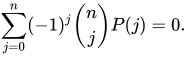
Differentiating (2) k times and setting x = −1 yields this for Failed to parse (Conversion error. Server ("https://wikimedia.org/api/rest_") reported: "Cannot get mml. Server problem."): {\displaystyle P(x)=x(x-1)\cdots (x-k+1)} , when 0 ≤ k < n, and the general case follows by taking linear combinations of these.
When P(x) is of degree less than or equal to n, Template:NumBlk2 where Failed to parse (Conversion error. Server ("https://wikimedia.org/api/rest_") reported: "Cannot get mml. Server problem."): {\displaystyle a_{n}} is the coefficient of degree n in P(x).
More generally for (10),
- Failed to parse (Conversion error. Server ("https://wikimedia.org/api/rest_") reported: "Cannot get mml. Server problem."): {\displaystyle \sum _{j=0}^{n}(-1)^{j}{\binom {n}{j}}P(m+(n-j)d)=d^{n}n!a_{n}}
where m and d are complex numbers. This follows immediately applying (10) to the polynomial Template:Tmath instead of Template:Tmath, and observing that Template:Tmath still has degree less than or equal to n, and that its coefficient of degree n is dnan.
The series Failed to parse (Conversion error. Server ("https://wikimedia.org/api/rest_") reported: "Cannot get mml. Server problem."): {\textstyle {\frac {k-1}{k}}\sum _{j=0}^{\infty }{\frac {1}{\binom {j+x}{k}}}={\frac {1}{\binom {x-1}{k-1}}}} is convergent for k ≥ 2. This formula is used in the analysis of the German tank problem. It follows from Failed to parse (SVG (MathML can be enabled via browser plugin): Invalid response ("Math extension cannot connect to Restbase.") from server "https://wikimedia.org/api/rest_v1/":): {\textstyle \frac{k-1}k\sum_{j=0}^{M}\frac 1 {\binom{j+x} k}=\frac 1{\binom{x-1}{k-1}}-\frac 1{\binom{M+x}{k-1}}} which is proved by induction on M.
Identities with combinatorial proofs
[edit | edit source]Many identities involving binomial coefficients can be proved by combinatorial means. For example, for nonnegative integers , the identity

- Failed to parse (Conversion error. Server ("https://wikimedia.org/api/rest_") reported: "Cannot get mml. Server problem."): {\displaystyle \sum _{k=q}^{n}{\binom {n}{k}}{\binom {k}{q}}=2^{n-q}{\binom {n}{q}}}
(which reduces to (6) when q = 1) can be given a double counting proof, as follows. The left side counts the number of ways of selecting a subset of [n] = {1, 2, ..., n} with at least q elements, and marking q elements among those selected. The right side counts the same thing, because there are Failed to parse (Conversion error. Server ("https://wikimedia.org/api/rest_") reported: "Cannot get mml. Server problem."): {\displaystyle {\tbinom {n}{q}}} ways of choosing a set of q elements to mark, and Failed to parse (SVG (MathML can be enabled via browser plugin): Invalid response ("Math extension cannot connect to Restbase.") from server "https://wikimedia.org/api/rest_v1/":): {\displaystyle 2^{n-q}} to choose which of the remaining elements of [n] also belong to the subset.
In Pascal's identity
- Failed to parse (SVG (MathML can be enabled via browser plugin): Invalid response ("Math extension cannot connect to Restbase.") from server "https://wikimedia.org/api/rest_v1/":): {\displaystyle {n \choose k} = {n-1 \choose k-1} + {n-1 \choose k},}
both sides count the number of k-element subsets of [n]: the two terms on the right side group them into those that contain element n and those that do not.
The identity (8) also has a combinatorial proof. The identity reads
- Failed to parse (SVG (MathML can be enabled via browser plugin): Invalid response ("Math extension cannot connect to Restbase.") from server "https://wikimedia.org/api/rest_v1/":): {\displaystyle \sum_{k=0}^n \binom{n}{k}^2 = \binom{2n}{n}.}
Suppose you have Failed to parse (SVG (MathML can be enabled via browser plugin): Invalid response ("Math extension cannot connect to Restbase.") from server "https://wikimedia.org/api/rest_v1/":): {\displaystyle 2n} empty squares arranged in a row and you want to mark (select) n of them. There are Failed to parse (SVG (MathML can be enabled via browser plugin): Invalid response ("Math extension cannot connect to Restbase.") from server "https://wikimedia.org/api/rest_v1/":): {\displaystyle \tbinom {2n}n} ways to do this. On the other hand, you may select your n squares by selecting k squares from among the first n and Failed to parse (SVG (MathML can be enabled via browser plugin): Invalid response ("Math extension cannot connect to Restbase.") from server "https://wikimedia.org/api/rest_v1/":): {\displaystyle n-k} squares from the remaining n squares; any k from 0 to n will work. This gives
- Failed to parse (SVG (MathML can be enabled via browser plugin): Invalid response ("Math extension cannot connect to Restbase.") from server "https://wikimedia.org/api/rest_v1/":): {\displaystyle \sum_{k=0}^n\binom n k\binom n{n-k} = \binom {2n} n.}
Now apply (1) to get the result.
If one denotes by F(i) the sequence of Fibonacci numbers, indexed so that F(0) = F(1) = 1, then the identity Failed to parse (SVG (MathML can be enabled via browser plugin): Invalid response ("Math extension cannot connect to Restbase.") from server "https://wikimedia.org/api/rest_v1/":): {\displaystyle \sum_{k=0}^{\left\lfloor\frac{n}{2}\right\rfloor} \binom {n-k} k = F(n)} has the following combinatorial proof.[12] One may show by induction that F(n) counts the number of ways that a n × 1 strip of squares may be covered by 2 × 1 and 1 × 1 tiles. On the other hand, if such a tiling uses exactly k of the 2 × 1 tiles, then it uses n − 2k of the 1 × 1 tiles, and so uses n − k tiles total. There are Failed to parse (SVG (MathML can be enabled via browser plugin): Invalid response ("Math extension cannot connect to Restbase.") from server "https://wikimedia.org/api/rest_v1/":): {\displaystyle \tbinom{n-k}{k}} ways to order these tiles, and so summing this coefficient over all possible values of k gives the identity.
Sum of coefficients row
[edit | edit source]The number of k-combinations for all k, Failed to parse (SVG (MathML can be enabled via browser plugin): Invalid response ("Math extension cannot connect to Restbase.") from server "https://wikimedia.org/api/rest_v1/":): {\textstyle \sum_{0\leq{k}\leq{n}}\binom nk = 2^n} , is the sum of the nth row (counting from 0) of the binomial coefficients. These combinations are enumerated by the 1 digits of the set of base 2 numbers counting from 0 to Failed to parse (SVG (MathML can be enabled via browser plugin): Invalid response ("Math extension cannot connect to Restbase.") from server "https://wikimedia.org/api/rest_v1/":): {\displaystyle 2^n - 1} , where each digit position is an item from the set of n.
Dixon's identity
[edit | edit source]- Failed to parse (SVG (MathML can be enabled via browser plugin): Invalid response ("Math extension cannot connect to Restbase.") from server "https://wikimedia.org/api/rest_v1/":): {\displaystyle \sum_{k=-a}^{a}(-1)^{k}{2a\choose k+a}^3 =\frac{(3a)!}{(a!)^3}}
or, more generally,
- Failed to parse (SVG (MathML can be enabled via browser plugin): Invalid response ("Math extension cannot connect to Restbase.") from server "https://wikimedia.org/api/rest_v1/":): {\displaystyle \sum_{k=-a}^a(-1)^k{a+b\choose a+k} {b+c\choose b+k}{c+a\choose c+k} = \frac{(a+b+c)!}{a!\,b!\,c!}\,,}
where a, b, and c are non-negative integers.
Continuous identities
[edit | edit source]Certain trigonometric integrals have values expressible in terms of binomial coefficients: For any Failed to parse (SVG (MathML can be enabled via browser plugin): Invalid response ("Math extension cannot connect to Restbase.") from server "https://wikimedia.org/api/rest_v1/":): {\displaystyle m, n \in \N,}
- Failed to parse (SVG (MathML can be enabled via browser plugin): Invalid response ("Math extension cannot connect to Restbase.") from server "https://wikimedia.org/api/rest_v1/":): {\displaystyle \int_{-\pi}^{\pi} \cos((2m-n)x)\cos^n(x)\ dx = \frac{\pi}{2^{n-1}} \binom{n}{m}}
- Failed to parse (SVG (MathML can be enabled via browser plugin): Invalid response ("Math extension cannot connect to Restbase.") from server "https://wikimedia.org/api/rest_v1/":): {\displaystyle \int_{-\pi}^{\pi} \sin((2m-n)x)\sin^n(x)\ dx = \begin{cases} (-1)^{m+(n+1)/2} \frac{\pi}{2^{n-1}} \binom{n}{m}, & n \text{ odd} \\ 0, & \text{otherwise} \end{cases}}
- Failed to parse (SVG (MathML can be enabled via browser plugin): Invalid response ("Math extension cannot connect to Restbase.") from server "https://wikimedia.org/api/rest_v1/":): {\displaystyle \int_{-\pi}^{\pi} \cos((2m-n)x)\sin^n(x)\ dx = \begin{cases} (-1)^{m+(n/2)} \frac{\pi}{2^{n-1}} \binom{n}{m}, & n \text{ even} \\ 0, & \text{otherwise} \end{cases}}
These can be proved by using Euler's formula to convert trigonometric functions to complex exponentials, expanding using the binomial theorem, and integrating term by term.
Congruences
[edit | edit source]If n is prime, then Failed to parse (SVG (MathML can be enabled via browser plugin): Invalid response ("Math extension cannot connect to Restbase.") from server "https://wikimedia.org/api/rest_v1/":): {\displaystyle \binom {n-1}k \equiv (-1)^k \mod n} for every k with Failed to parse (SVG (MathML can be enabled via browser plugin): Invalid response ("Math extension cannot connect to Restbase.") from server "https://wikimedia.org/api/rest_v1/":): {\displaystyle 0\leq k \leq n-1.} More generally, this remains true if n is any number and k is such that all the numbers between 1 and k are coprime to n.
Indeed, we have
- Failed to parse (SVG (MathML can be enabled via browser plugin): Invalid response ("Math extension cannot connect to Restbase.") from server "https://wikimedia.org/api/rest_v1/":): {\displaystyle \binom {n-1} k = {(n-1)(n-2)\cdots(n-k)\over 1\cdot 2\cdots k} = \prod_{i=1}^{k}{n-i\over i}\equiv \prod_{i=1}^{k}{-i\over i} = (-1)^k \mod n. }
Generating functions
[edit | edit source]Ordinary generating functions
[edit | edit source]For a fixed n, the ordinary generating function of the sequence Failed to parse (SVG (MathML can be enabled via browser plugin): Invalid response ("Math extension cannot connect to Restbase.") from server "https://wikimedia.org/api/rest_v1/":): {\displaystyle \tbinom n0,\tbinom n1,\tbinom n2,\ldots} is
- Failed to parse (SVG (MathML can be enabled via browser plugin): Invalid response ("Math extension cannot connect to Restbase.") from server "https://wikimedia.org/api/rest_v1/":): {\displaystyle \sum_{k=0}^\infty {n\choose k} x^k = (1+x)^n.}
For a fixed k, the ordinary generating function of the sequence Failed to parse (SVG (MathML can be enabled via browser plugin): Invalid response ("Math extension cannot connect to Restbase.") from server "https://wikimedia.org/api/rest_v1/":): {\displaystyle \tbinom 0k,\tbinom 1k, \tbinom 2k,\ldots,} is
- Failed to parse (SVG (MathML can be enabled via browser plugin): Invalid response ("Math extension cannot connect to Restbase.") from server "https://wikimedia.org/api/rest_v1/":): {\displaystyle \sum_{n=0}^\infty {n\choose k} y^n = \frac{y^k}{(1-y)^{k+1}}.}
The bivariate generating function of the binomial coefficients is
- Failed to parse (SVG (MathML can be enabled via browser plugin): Invalid response ("Math extension cannot connect to Restbase.") from server "https://wikimedia.org/api/rest_v1/":): {\displaystyle \sum_{n=0}^\infty \sum_{k=0}^n {n\choose k} x^k y^n = \frac{1}{1-y-xy}.}
A symmetric bivariate generating function of the binomial coefficients is
- Failed to parse (SVG (MathML can be enabled via browser plugin): Invalid response ("Math extension cannot connect to Restbase.") from server "https://wikimedia.org/api/rest_v1/":): {\displaystyle \sum_{n=0}^\infty \sum_{k=0}^\infty {n+k\choose k} x^k y^n = \frac{1}{1-x-y}.}
which is the same as the previous generating function after the substitution Failed to parse (SVG (MathML can be enabled via browser plugin): Invalid response ("Math extension cannot connect to Restbase.") from server "https://wikimedia.org/api/rest_v1/":): {\displaystyle x\to xy} .
Exponential generating function
[edit | edit source]A symmetric exponential bivariate generating function of the binomial coefficients is:
- Failed to parse (SVG (MathML can be enabled via browser plugin): Invalid response ("Math extension cannot connect to Restbase.") from server "https://wikimedia.org/api/rest_v1/":): {\displaystyle \sum_{n=0}^\infty \sum_{k=0}^\infty {n+k\choose k} \frac{x^k y^n}{(n+k)!} = e^{x+y}.}
Divisibility properties
[edit | edit source]In 1852, Kummer proved that if m and n are nonnegative integers and p is a prime number, then the largest power of p dividing Failed to parse (SVG (MathML can be enabled via browser plugin): Invalid response ("Math extension cannot connect to Restbase.") from server "https://wikimedia.org/api/rest_v1/":): {\displaystyle \tbinom{m+n}{m}} equals pc, where c is the number of carries when m and n are added in base p. Equivalently, the exponent of a prime p in Failed to parse (SVG (MathML can be enabled via browser plugin): Invalid response ("Math extension cannot connect to Restbase.") from server "https://wikimedia.org/api/rest_v1/":): {\displaystyle \tbinom n k} equals the number of nonnegative integers j such that the fractional part of k/pj is greater than the fractional part of n/pj. It can be deduced from this that Failed to parse (SVG (MathML can be enabled via browser plugin): Invalid response ("Math extension cannot connect to Restbase.") from server "https://wikimedia.org/api/rest_v1/":): {\displaystyle \tbinom n k} is divisible by n/gcd(n,k). In particular therefore it follows that p divides Failed to parse (SVG (MathML can be enabled via browser plugin): Invalid response ("Math extension cannot connect to Restbase.") from server "https://wikimedia.org/api/rest_v1/":): {\displaystyle \tbinom{p^r}{s}} for all positive integers r and s such that s < pr. However this is not true of higher powers of p: for example 9 does not divide Failed to parse (SVG (MathML can be enabled via browser plugin): Invalid response ("Math extension cannot connect to Restbase.") from server "https://wikimedia.org/api/rest_v1/":): {\displaystyle \tbinom{9}{6}} .
A somewhat surprising result by David Singmaster (1974) is that any integer divides almost all binomial coefficients. More precisely, fix an integer d and let f(N) denote the number of binomial coefficients Failed to parse (SVG (MathML can be enabled via browser plugin): Invalid response ("Math extension cannot connect to Restbase.") from server "https://wikimedia.org/api/rest_v1/":): {\displaystyle \tbinom n k} with Failed to parse (SVG (MathML can be enabled via browser plugin): Invalid response ("Math extension cannot connect to Restbase.") from server "https://wikimedia.org/api/rest_v1/":): {\displaystyle n < N} such that d divides Failed to parse (SVG (MathML can be enabled via browser plugin): Invalid response ("Math extension cannot connect to Restbase.") from server "https://wikimedia.org/api/rest_v1/":): {\displaystyle \tbinom n k} . Then
- Failed to parse (SVG (MathML can be enabled via browser plugin): Invalid response ("Math extension cannot connect to Restbase.") from server "https://wikimedia.org/api/rest_v1/":): {\displaystyle \lim_{N\to\infty} \frac{f(N)}{N(N+1)/2} = 1. }
Since the number of binomial coefficients Failed to parse (SVG (MathML can be enabled via browser plugin): Invalid response ("Math extension cannot connect to Restbase.") from server "https://wikimedia.org/api/rest_v1/":): {\displaystyle \tbinom n k} with n < N is N(N + 1) / 2, this implies that the density of binomial coefficients divisible by d goes to 1.
Binomial coefficients have divisibility properties related to least common multiples of consecutive integers. For example:[13]
- Failed to parse (SVG (MathML can be enabled via browser plugin): Invalid response ("Math extension cannot connect to Restbase.") from server "https://wikimedia.org/api/rest_v1/":): {\displaystyle \binom{n+k}k} divides Failed to parse (SVG (MathML can be enabled via browser plugin): Invalid response ("Math extension cannot connect to Restbase.") from server "https://wikimedia.org/api/rest_v1/":): {\displaystyle \frac{\operatorname{lcm}(n,n+1,\ldots,n+k)}n} .
- Failed to parse (SVG (MathML can be enabled via browser plugin): Invalid response ("Math extension cannot connect to Restbase.") from server "https://wikimedia.org/api/rest_v1/":): {\displaystyle \binom{n+k}k} is a multiple of Failed to parse (SVG (MathML can be enabled via browser plugin): Invalid response ("Math extension cannot connect to Restbase.") from server "https://wikimedia.org/api/rest_v1/":): {\displaystyle \frac{\operatorname{lcm}(n,n+1,\ldots,n+k)}{n\cdot \operatorname{lcm}(\binom{k}0,\binom{k}1,\ldots,\binom{k}k)}} .
Another fact: An integer n ≥ 2 is prime if and only if all the intermediate binomial coefficients
- Failed to parse (SVG (MathML can be enabled via browser plugin): Invalid response ("Math extension cannot connect to Restbase.") from server "https://wikimedia.org/api/rest_v1/":): {\displaystyle \binom n 1, \binom n 2, \ldots, \binom n{n-1} }
are divisible by n.
Proof: When p is prime, p divides
- Failed to parse (SVG (MathML can be enabled via browser plugin): Invalid response ("Math extension cannot connect to Restbase.") from server "https://wikimedia.org/api/rest_v1/":): {\displaystyle \binom p k = \frac{p \cdot (p-1) \cdots (p-k+1)}{k \cdot (k-1) \cdots 1} } for all 0 < k < p
because Failed to parse (SVG (MathML can be enabled via browser plugin): Invalid response ("Math extension cannot connect to Restbase.") from server "https://wikimedia.org/api/rest_v1/":): {\displaystyle \tbinom p k} is a natural number and p divides the numerator but not the denominator. When n is composite, let p be the smallest prime factor of n and let k = n/p. Then 0 < p < n and
- Failed to parse (SVG (MathML can be enabled via browser plugin): Invalid response ("Math extension cannot connect to Restbase.") from server "https://wikimedia.org/api/rest_v1/":): {\displaystyle \binom n p = \frac{n(n-1)(n-2)\cdots(n-p+1)}{p!}=\frac{k(n-1)(n-2)\cdots(n-p+1)}{(p-1)!}\not\equiv 0 \pmod{n}}
otherwise the numerator k(n − 1)(n − 2)⋯(n − p + 1) has to be divisible by n = k×p, this can only be the case when (n − 1)(n − 2)⋯(n − p + 1) is divisible by p. But n is divisible by p, so p does not divide n − 1, n − 2, …, n − p + 1 and because p is prime, we know that p does not divide (n − 1)(n − 2)⋯(n − p + 1) and so the numerator cannot be divisible by n.
Bounds and asymptotic formulas
[edit | edit source]The following bounds for Failed to parse (SVG (MathML can be enabled via browser plugin): Invalid response ("Math extension cannot connect to Restbase.") from server "https://wikimedia.org/api/rest_v1/":): {\displaystyle \tbinom n k} hold for all values of n and k such that 1 ≤ k ≤ n: Failed to parse (SVG (MathML can be enabled via browser plugin): Invalid response ("Math extension cannot connect to Restbase.") from server "https://wikimedia.org/api/rest_v1/":): {\displaystyle \frac{n^k}{k^k} \le {n \choose k} \le \frac{n^k}{k!} < \left(\frac{n\cdot e}{k}\right)^k.} The first inequality follows from the fact that Failed to parse (SVG (MathML can be enabled via browser plugin): Invalid response ("Math extension cannot connect to Restbase.") from server "https://wikimedia.org/api/rest_v1/":): {\displaystyle {n \choose k} = \frac{n}{k} \cdot \frac{n-1}{k-1} \cdots \frac{n-(k-1)}{1} } and each of these Failed to parse (SVG (MathML can be enabled via browser plugin): Invalid response ("Math extension cannot connect to Restbase.") from server "https://wikimedia.org/api/rest_v1/":): {\displaystyle k } terms in this product is Failed to parse (SVG (MathML can be enabled via browser plugin): Invalid response ("Math extension cannot connect to Restbase.") from server "https://wikimedia.org/api/rest_v1/":): {\textstyle \geq \frac{n}{k} } . A similar argument can be made to show the second inequality. The final strict inequality is equivalent to Failed to parse (SVG (MathML can be enabled via browser plugin): Invalid response ("Math extension cannot connect to Restbase.") from server "https://wikimedia.org/api/rest_v1/":): {\textstyle e^k > k^k / k!} , that is clear since the RHS is a term of the exponential series Failed to parse (SVG (MathML can be enabled via browser plugin): Invalid response ("Math extension cannot connect to Restbase.") from server "https://wikimedia.org/api/rest_v1/":): {\textstyle e^k = \sum_{j=0}^\infty k^j/j! } .
From the divisibility properties we can infer that Failed to parse (SVG (MathML can be enabled via browser plugin): Invalid response ("Math extension cannot connect to Restbase.") from server "https://wikimedia.org/api/rest_v1/":): {\displaystyle \frac{\operatorname{lcm}(n-k, \ldots, n)}{(n-k) \cdot \operatorname{lcm}\left(\binom{k}{0}, \ldots, \binom{k}{k}\right)}\leq\binom{n}{k} \leq \frac{\operatorname{lcm}(n-k, \ldots, n)}{n - k},} where both equalities can be achieved.[13]
The following bounds are useful in information theory:[14]: 353 Failed to parse (SVG (MathML can be enabled via browser plugin): Invalid response ("Math extension cannot connect to Restbase.") from server "https://wikimedia.org/api/rest_v1/":): {\displaystyle \frac{1}{n+1} 2^{nH(k/n)} \leq {n \choose k} \leq 2^{nH(k/n)} } where Failed to parse (SVG (MathML can be enabled via browser plugin): Invalid response ("Math extension cannot connect to Restbase.") from server "https://wikimedia.org/api/rest_v1/":): {\displaystyle H(p) = -p\log_2(p) -(1-p)\log_2(1-p)} is the binary entropy function. It can be further tightened to Failed to parse (SVG (MathML can be enabled via browser plugin): Invalid response ("Math extension cannot connect to Restbase.") from server "https://wikimedia.org/api/rest_v1/":): {\displaystyle \sqrt{\frac{n}{8k(n-k)}} 2^{nH(k/n)} \leq {n \choose k} \leq \sqrt{\frac{n}{2\pi k(n-k)}} 2^{nH(k/n)}} for all .[15]: 309

Both n and k large
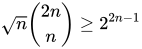
[edit | edit source]Stirling's approximation yields the following approximation, valid when Failed to parse (Conversion error. Server ("https://wikimedia.org/api/rest_") reported: "Cannot get mml. Server problem."): {\displaystyle n-k,k} both tend to infinity: Failed to parse (Conversion error. Server ("https://wikimedia.org/api/rest_") reported: "Cannot get mml. Server problem."): {\displaystyle {n \choose k}\sim {\sqrt {n \over 2\pi k(n-k)}}\cdot {n^{n} \over k^{k}(n-k)^{n-k}}} Because the inequality forms of Stirling's formula also bound the factorials, slight variants on the above asymptotic approximation give exact bounds. In particular, when is sufficiently large, one has Failed to parse (Conversion error. Server ("https://wikimedia.org/api/rest_") reported: "Cannot get mml. Server problem."): {\displaystyle {2n \choose n}\sim {\frac {2^{2n}}{\sqrt {n\pi }}}} and . More generally, for m ≥ 2 and n ≥ 1 (again, by applying Stirling's formula to the factorials in the binomial coefficient), Failed to parse (Conversion error. Server ("https://wikimedia.org/api/rest_") reported: "Cannot get mml. Server problem."): {\displaystyle {\sqrt {n}}{mn \choose n}\geq {\frac {m^{m(n-1)+1}}{(m-1)^{(m-1)(n-1)}}}.}
If n is large and k is linear in n, various precise asymptotic estimates exist for the binomial coefficient . For example, if Failed to parse (Conversion error. Server ("https://wikimedia.org/api/rest_") reported: "Cannot get mml. Server problem."): {\displaystyle |n/2-k|=o(n^{2/3})} then Failed to parse (SVG (MathML can be enabled via browser plugin): Invalid response ("Math extension cannot connect to Restbase.") from server "https://wikimedia.org/api/rest_v1/":): {\displaystyle \binom{n}{k} \sim \binom{n}{\frac{n}{2}} e^{-d^2/(2n)} \sim \frac{2^n}{\sqrt{\frac{1}{2}n \pi }} e^{-d^2/(2n)}} where d = n − 2k.[16]

n much larger than k
[edit | edit source]If n is large and k is o(n) (that is, if k/n → 0), then Failed to parse (SVG (MathML can be enabled via browser plugin): Invalid response ("Math extension cannot connect to Restbase.") from server "https://wikimedia.org/api/rest_v1/":): {\displaystyle \binom{n}{k} \sim \left(\frac{n e}{k} \right)^k \cdot (2\pi k)^{-1/2} \cdot \exp\left(- \frac{k^2}{2n}(1 + o(1))\right)} where again o is the little o notation.[17]
Sums of binomial coefficients
[edit | edit source]A simple and rough upper bound for the sum of binomial coefficients can be obtained using the binomial theorem: Failed to parse (SVG (MathML can be enabled via browser plugin): Invalid response ("Math extension cannot connect to Restbase.") from server "https://wikimedia.org/api/rest_v1/":): {\displaystyle \sum_{i=0}^k {n \choose i} \leq \sum_{i=0}^k n^i\cdot 1^{k-i} \leq (1+n)^k} More precise bounds are given by Failed to parse (SVG (MathML can be enabled via browser plugin): Invalid response ("Math extension cannot connect to Restbase.") from server "https://wikimedia.org/api/rest_v1/":): {\displaystyle \frac{1}{\sqrt{8n\varepsilon(1-\varepsilon)}} \cdot 2^{H(\varepsilon) \cdot n} \leq \sum_{i=0}^{k} \binom{n}{i} \leq 2^{H(\varepsilon) \cdot n},} valid for all integers Failed to parse (SVG (MathML can be enabled via browser plugin): Invalid response ("Math extension cannot connect to Restbase.") from server "https://wikimedia.org/api/rest_v1/":): {\displaystyle n > k \geq 1} with Failed to parse (SVG (MathML can be enabled via browser plugin): Invalid response ("Math extension cannot connect to Restbase.") from server "https://wikimedia.org/api/rest_v1/":): {\displaystyle \varepsilon \doteq k/n \leq 1/2} .[18]
Generalized binomial coefficients
[edit | edit source]The infinite product formula for the gamma function also gives an expression for binomial coefficients Failed to parse (SVG (MathML can be enabled via browser plugin): Invalid response ("Math extension cannot connect to Restbase.") from server "https://wikimedia.org/api/rest_v1/":): {\displaystyle (-1)^k {z \choose k}= {-z+k-1 \choose k} = \frac{1}{\Gamma(-z)} \frac{1}{(k+1)^{z+1}} \prod_{j=k+1} \frac{\left(1+\frac{1}{j}\right)^{-z-1}}{1-\frac{z+1}{j}}} which yields the asymptotic formulas Failed to parse (SVG (MathML can be enabled via browser plugin): Invalid response ("Math extension cannot connect to Restbase.") from server "https://wikimedia.org/api/rest_v1/":): {\displaystyle {z \choose k} \approx \frac{(-1)^k}{\Gamma(-z) k^{z+1}} \qquad \text{and} \qquad {z+k \choose k} = \frac{k^z}{\Gamma(z+1)}\left( 1+\frac{z(z+1)}{2k}+\mathcal{O}\left(k^{-2}\right)\right)} as Failed to parse (SVG (MathML can be enabled via browser plugin): Invalid response ("Math extension cannot connect to Restbase.") from server "https://wikimedia.org/api/rest_v1/":): {\displaystyle k \to \infty} .
This asymptotic behaviour is contained in the approximation Failed to parse (SVG (MathML can be enabled via browser plugin): Invalid response ("Math extension cannot connect to Restbase.") from server "https://wikimedia.org/api/rest_v1/":): {\displaystyle {z+k \choose k}\approx \frac{e^{z(H_k-\gamma)}}{\Gamma(z+1)}} as well. (Here Failed to parse (SVG (MathML can be enabled via browser plugin): Invalid response ("Math extension cannot connect to Restbase.") from server "https://wikimedia.org/api/rest_v1/":): {\displaystyle H_k} is the k-th harmonic number and Failed to parse (SVG (MathML can be enabled via browser plugin): Invalid response ("Math extension cannot connect to Restbase.") from server "https://wikimedia.org/api/rest_v1/":): {\displaystyle \gamma} is the Euler–Mascheroni constant.)
Further, the asymptotic formula Failed to parse (SVG (MathML can be enabled via browser plugin): Invalid response ("Math extension cannot connect to Restbase.") from server "https://wikimedia.org/api/rest_v1/":): {\displaystyle \frac{{z+k\choose j}}{{k\choose j}}\to \left(1-\frac{j}{k}\right)^{-z}\quad\text{and}\quad \frac{{j\choose j-k}}{{j-z\choose j-k}}\to \left(\frac{j}{k}\right)^z} hold true, whenever Failed to parse (SVG (MathML can be enabled via browser plugin): Invalid response ("Math extension cannot connect to Restbase.") from server "https://wikimedia.org/api/rest_v1/":): {\displaystyle k\to\infty} and Failed to parse (SVG (MathML can be enabled via browser plugin): Invalid response ("Math extension cannot connect to Restbase.") from server "https://wikimedia.org/api/rest_v1/":): {\displaystyle j/k \to x} for some complex number Failed to parse (SVG (MathML can be enabled via browser plugin): Invalid response ("Math extension cannot connect to Restbase.") from server "https://wikimedia.org/api/rest_v1/":): {\displaystyle x} .
Generalizations
[edit | edit source]Generalization to multinomials
[edit | edit source]Binomial coefficients can be generalized to multinomial coefficients defined to be the number:
- Failed to parse (SVG (MathML can be enabled via browser plugin): Invalid response ("Math extension cannot connect to Restbase.") from server "https://wikimedia.org/api/rest_v1/":): {\displaystyle {n\choose k_1,k_2,\ldots,k_r} =\frac{n!}{k_1!k_2!\cdots k_r!}}
where
- Failed to parse (SVG (MathML can be enabled via browser plugin): Invalid response ("Math extension cannot connect to Restbase.") from server "https://wikimedia.org/api/rest_v1/":): {\displaystyle \sum_{i=1}^rk_i=n.}
While the binomial coefficients represent the coefficients of (x + y)n, the multinomial coefficients represent the coefficients of the polynomial
- Failed to parse (SVG (MathML can be enabled via browser plugin): Invalid response ("Math extension cannot connect to Restbase.") from server "https://wikimedia.org/api/rest_v1/":): {\displaystyle (x_1 + x_2 + \cdots + x_r)^n.}
The case r = 2 gives binomial coefficients:
- Failed to parse (SVG (MathML can be enabled via browser plugin): Invalid response ("Math extension cannot connect to Restbase.") from server "https://wikimedia.org/api/rest_v1/":): {\displaystyle {n\choose k_1,k_2}={n\choose k_1, n-k_1}={n\choose k_1}= {n\choose k_2}.}
The combinatorial interpretation of multinomial coefficients is distribution of n distinguishable elements over r (distinguishable) containers, each containing exactly ki elements, where i is the index of the container.
Multinomial coefficients have many properties similar to those of binomial coefficients, for example the recurrence relation:
- Failed to parse (SVG (MathML can be enabled via browser plugin): Invalid response ("Math extension cannot connect to Restbase.") from server "https://wikimedia.org/api/rest_v1/":): {\displaystyle {n\choose k_1,k_2,\ldots,k_r} ={n-1\choose k_1-1,k_2,\ldots,k_r}+{n-1\choose k_1,k_2-1,\ldots,k_r}+\ldots+{n-1\choose k_1,k_2,\ldots,k_r-1}}
and symmetry:
- Failed to parse (SVG (MathML can be enabled via browser plugin): Invalid response ("Math extension cannot connect to Restbase.") from server "https://wikimedia.org/api/rest_v1/":): {\displaystyle {n\choose k_1,k_2,\ldots,k_r} ={n\choose k_{\sigma_1},k_{\sigma_2},\ldots,k_{\sigma_r}}}
where Failed to parse (SVG (MathML can be enabled via browser plugin): Invalid response ("Math extension cannot connect to Restbase.") from server "https://wikimedia.org/api/rest_v1/":): {\displaystyle (\sigma_i)} is a permutation of (1, 2, ..., r).
Taylor series
[edit | edit source]Using Stirling numbers of the first kind the series expansion around any arbitrarily chosen point Failed to parse (SVG (MathML can be enabled via browser plugin): Invalid response ("Math extension cannot connect to Restbase.") from server "https://wikimedia.org/api/rest_v1/":): {\displaystyle z_0} is
- Failed to parse (SVG (MathML can be enabled via browser plugin): Invalid response ("Math extension cannot connect to Restbase.") from server "https://wikimedia.org/api/rest_v1/":): {\displaystyle \begin{align} {z \choose k} = \frac{1}{k!}\sum_{i=0}^k z^i s_{k,i}&=\sum_{i=0}^k (z- z_0)^i \sum_{j=i}^k {z_0 \choose j-i} \frac{s_{k+i-j,i}}{(k+i-j)!} \\ &=\sum_{i=0}^k (z-z_0)^i \sum_{j=i}^k z_0^{j-i} {j \choose i} \frac{s_{k,j}}{k!}.\end{align}}
Binomial coefficient with n = 1/2
[edit | edit source]The definition of the binomial coefficients can be extended to the case where Failed to parse (SVG (MathML can be enabled via browser plugin): Invalid response ("Math extension cannot connect to Restbase.") from server "https://wikimedia.org/api/rest_v1/":): {\displaystyle n} is real and Failed to parse (SVG (MathML can be enabled via browser plugin): Invalid response ("Math extension cannot connect to Restbase.") from server "https://wikimedia.org/api/rest_v1/":): {\displaystyle k} is integer.
In particular, the following identity holds for any non-negative integer Failed to parse (SVG (MathML can be enabled via browser plugin): Invalid response ("Math extension cannot connect to Restbase.") from server "https://wikimedia.org/api/rest_v1/":): {\displaystyle k} :
- Failed to parse (SVG (MathML can be enabled via browser plugin): Invalid response ("Math extension cannot connect to Restbase.") from server "https://wikimedia.org/api/rest_v1/":): {\displaystyle {{1/2}\choose{k}}={{2k}\choose{k}}\frac{(-1)^{k+1}}{2^{2k}(2k-1)}.}
This shows up when expanding Failed to parse (SVG (MathML can be enabled via browser plugin): Invalid response ("Math extension cannot connect to Restbase.") from server "https://wikimedia.org/api/rest_v1/":): {\displaystyle \sqrt{1+x}} into a power series using the Newton binomial series :
- Failed to parse (SVG (MathML can be enabled via browser plugin): Invalid response ("Math extension cannot connect to Restbase.") from server "https://wikimedia.org/api/rest_v1/":): {\displaystyle \sqrt{1+x}=\sum_{k\geq 0}{\binom{1/2}{k}}x^k.}
Products of binomial coefficients
[edit | edit source]One can express the product of two binomial coefficients as a linear combination of binomial coefficients:
- Failed to parse (SVG (MathML can be enabled via browser plugin): Invalid response ("Math extension cannot connect to Restbase.") from server "https://wikimedia.org/api/rest_v1/":): {\displaystyle {z \choose m} {z\choose n} = \sum_{k=0}^{\min(m,n)} {m + n - k \choose k, m - k, n - k} {z \choose m + n - k},}
where the connection coefficients are multinomial coefficients. In terms of labelled combinatorial objects, the connection coefficients represent the number of ways to assign m + n − k labels to a pair of labelled combinatorial objects—of weight m and n respectively—that have had their first k labels identified, or glued together to get a new labelled combinatorial object of weight m + n − k. (That is, to separate the labels into three portions to apply to the glued part, the unglued part of the first object, and the unglued part of the second object.) In this regard, binomial coefficients are to exponential generating series what falling factorials are to ordinary generating series.
The product of all binomial coefficients in the nth row of the Pascal triangle is given by the formula:
- Failed to parse (SVG (MathML can be enabled via browser plugin): Invalid response ("Math extension cannot connect to Restbase.") from server "https://wikimedia.org/api/rest_v1/":): {\displaystyle \prod_{k=0}^{n}\binom{n}{k}=\prod_{k=1}^{n}k^{2k-n-1}.}
Partial fraction decomposition
[edit | edit source]The partial fraction decomposition of the reciprocal is given by
- Failed to parse (SVG (MathML can be enabled via browser plugin): Invalid response ("Math extension cannot connect to Restbase.") from server "https://wikimedia.org/api/rest_v1/":): {\displaystyle \frac{1}{{z \choose n}}= \sum_{i=0}^{n-1} (-1)^{n-1-i} {n \choose i} \frac{n-i}{z-i}, \qquad \frac{1}{{z+n \choose n}}= \sum_{i=1}^n (-1)^{i-1} {n \choose i} \frac{i}{z+i}.}
Newton's binomial series
[edit | edit source]Newton's binomial series, named after Sir Isaac Newton, is a generalization of the binomial theorem to infinite series:
- Failed to parse (SVG (MathML can be enabled via browser plugin): Invalid response ("Math extension cannot connect to Restbase.") from server "https://wikimedia.org/api/rest_v1/":): {\displaystyle (1+z)^{\alpha} = \sum_{n=0}^{\infty}{\alpha\choose n}z^n = 1+{\alpha\choose1}z+{\alpha\choose 2}z^2+\cdots.}
The identity can be obtained by showing that both sides satisfy the differential equation (1 + z) f'(z) = α f(z).
The radius of convergence of this series is 1. An alternative expression is
- Failed to parse (SVG (MathML can be enabled via browser plugin): Invalid response ("Math extension cannot connect to Restbase.") from server "https://wikimedia.org/api/rest_v1/":): {\displaystyle \frac{1}{(1-z)^{\alpha+1}} = \sum_{n=0}^{\infty}{n+\alpha \choose n}z^n}
where the identity
- Failed to parse (SVG (MathML can be enabled via browser plugin): Invalid response ("Math extension cannot connect to Restbase.") from server "https://wikimedia.org/api/rest_v1/":): {\displaystyle {n \choose k} = (-1)^k {k-n-1 \choose k}}
is applied.
Multiset (rising) binomial coefficient
[edit | edit source]Binomial coefficients count subsets of prescribed size from a given set. A related combinatorial problem is to count multisets of prescribed size with elements drawn from a given set, that is, to count the number of ways to select a certain number of elements from a given set with the possibility of selecting the same element repeatedly. The resulting numbers are called multiset coefficients;[19] the number of ways to "multichoose" (i.e., choose with replacement) k items from an n element set is denoted Failed to parse (SVG (MathML can be enabled via browser plugin): Invalid response ("Math extension cannot connect to Restbase.") from server "https://wikimedia.org/api/rest_v1/":): {\textstyle \left(\!\!\binom n k\!\!\right)} .
To avoid ambiguity and confusion with n's main denotation in this article,
let f = n = r + (k − 1) and r = f − (k − 1).
Multiset coefficients may be expressed in terms of binomial coefficients by the rule Failed to parse (SVG (MathML can be enabled via browser plugin): Invalid response ("Math extension cannot connect to Restbase.") from server "https://wikimedia.org/api/rest_v1/":): {\displaystyle \binom{f}{k}=\left(\!\!\binom{r}{k}\!\!\right)=\binom{r+k-1}{k}.} One possible alternative characterization of this identity is as follows: We may define the falling factorial as Failed to parse (SVG (MathML can be enabled via browser plugin): Invalid response ("Math extension cannot connect to Restbase.") from server "https://wikimedia.org/api/rest_v1/":): {\displaystyle (f)_{k}=f^{\underline k}=(f-k+1)\cdots(f-3)\cdot(f-2)\cdot(f-1)\cdot f,} and the corresponding rising factorial as Failed to parse (SVG (MathML can be enabled via browser plugin): Invalid response ("Math extension cannot connect to Restbase.") from server "https://wikimedia.org/api/rest_v1/":): {\displaystyle r^{(k)}=\,r^{\overline k}=\,r\cdot(r+1)\cdot(r+2)\cdot(r+3)\cdots(r+k-1);} so, for example, Failed to parse (SVG (MathML can be enabled via browser plugin): Invalid response ("Math extension cannot connect to Restbase.") from server "https://wikimedia.org/api/rest_v1/":): {\displaystyle 17\cdot18\cdot19\cdot20\cdot21=(21)_{5}=21^{\underline 5}=17^{\overline 5}=17^{(5)}.} Then the binomial coefficients may be written as Failed to parse (SVG (MathML can be enabled via browser plugin): Invalid response ("Math extension cannot connect to Restbase.") from server "https://wikimedia.org/api/rest_v1/":): {\displaystyle \binom{f}{k} = \frac{(f)_{k}}{k!} =\frac{(f-k+1)\cdots(f-2)\cdot(f-1)\cdot f}{1\cdot2\cdot3\cdot4\cdot5\cdots k} ,} while the corresponding multiset coefficient is defined by replacing the falling with the rising factorial: Failed to parse (SVG (MathML can be enabled via browser plugin): Invalid response ("Math extension cannot connect to Restbase.") from server "https://wikimedia.org/api/rest_v1/":): {\displaystyle \left(\!\!\binom{r}{k}\!\!\right)=\frac{r^{(k)}}{k!}=\frac{r\cdot(r+1)\cdot(r+2)\cdots(r+k-1)}{1\cdot2\cdot3\cdot4\cdot5\cdots k}.}
Generalization to negative integers n
[edit | edit source]Template:Pascal triangle extended.svg For any n,

- Failed to parse (SVG (MathML can be enabled via browser plugin): Invalid response ("Math extension cannot connect to Restbase.") from server "https://wikimedia.org/api/rest_v1/":): {\displaystyle \begin{align}\binom{-n}{k} &= \frac{-n\cdot-(n+1)\dots-(n+k-2)\cdot-(n+k-1)}{k!}\\ &=(-1)^k\;\frac{n\cdot(n+1)\cdot(n+2)\cdots (n + k - 1)}{k!}\\ &=(-1)^k\binom{n + k - 1}{k}\\ &=(-1)^k\left(\!\!\binom{n}{k}\!\!\right)\;.\end{align}}
In particular, binomial coefficients evaluated at negative integers n are given by signed multiset coefficients. In the special case Failed to parse (SVG (MathML can be enabled via browser plugin): Invalid response ("Math extension cannot connect to Restbase.") from server "https://wikimedia.org/api/rest_v1/":): {\displaystyle n = -1} , this reduces to Failed to parse (SVG (MathML can be enabled via browser plugin): Invalid response ("Math extension cannot connect to Restbase.") from server "https://wikimedia.org/api/rest_v1/":): {\displaystyle (-1)^k=\binom{-1}{k}=\left(\!\!\binom{-k}{k}\!\!\right) .}
For example, if n = −4 and k = 7, then r = 4 and f = 10:
- Failed to parse (SVG (MathML can be enabled via browser plugin): Invalid response ("Math extension cannot connect to Restbase.") from server "https://wikimedia.org/api/rest_v1/":): {\displaystyle \begin{align}\binom{-4}{7} &= \frac {-10\cdot-9\cdot-8\cdot-7\cdot-6\cdot-5\cdot-4} {1\cdot2\cdot3\cdot4\cdot5\cdot6\cdot7}\\ &=(-1)^7\;\frac{4\cdot5\cdot6\cdot7\cdot8\cdot9\cdot10} {1\cdot2\cdot3\cdot4\cdot5\cdot6\cdot7}\\ &=\left(\!\!\binom{-7}{7}\!\!\right)\left(\!\!\binom{4}{7}\!\!\right)=\binom{-1}{7}\binom{10}{7}.\end{align}}
Two real or complex valued arguments
[edit | edit source]The binomial coefficient is generalized to two real or complex valued arguments using the gamma function or beta function via
- Failed to parse (SVG (MathML can be enabled via browser plugin): Invalid response ("Math extension cannot connect to Restbase.") from server "https://wikimedia.org/api/rest_v1/":): {\displaystyle {x \choose y}= \frac{\Gamma(x+1)}{\Gamma(y+1) \Gamma(x-y+1)}= \frac{1}{(x+1) \Beta(y+1, x-y+1)}.}
This definition inherits these following additional properties from Failed to parse (SVG (MathML can be enabled via browser plugin): Invalid response ("Math extension cannot connect to Restbase.") from server "https://wikimedia.org/api/rest_v1/":): {\displaystyle \Gamma} :
- Failed to parse (SVG (MathML can be enabled via browser plugin): Invalid response ("Math extension cannot connect to Restbase.") from server "https://wikimedia.org/api/rest_v1/":): {\displaystyle {x \choose y}= \frac{\sin (y \pi)}{\sin(x \pi)} {-y-1 \choose -x-1}= \frac{\sin((x-y) \pi)}{\sin (x \pi)} {y-x-1 \choose y};}
moreover,
- Failed to parse (SVG (MathML can be enabled via browser plugin): Invalid response ("Math extension cannot connect to Restbase.") from server "https://wikimedia.org/api/rest_v1/":): {\displaystyle {x \choose y} \cdot {y \choose x}= \frac{\sin((x-y) \pi)}{(x-y) \pi}.}
The resulting function has been little-studied, apparently first being graphed in (Fowler 1996). Notably, many binomial identities fail: Failed to parse (SVG (MathML can be enabled via browser plugin): Invalid response ("Math extension cannot connect to Restbase.") from server "https://wikimedia.org/api/rest_v1/":): {\textstyle \binom{n }{ m} = \binom{n }{ n-m}} but Failed to parse (SVG (MathML can be enabled via browser plugin): Invalid response ("Math extension cannot connect to Restbase.") from server "https://wikimedia.org/api/rest_v1/":): {\textstyle \binom{-n}{m} \neq \binom{-n}{-n-m}} for n positive (so Failed to parse (SVG (MathML can be enabled via browser plugin): Invalid response ("Math extension cannot connect to Restbase.") from server "https://wikimedia.org/api/rest_v1/":): {\displaystyle -n} negative). The behavior is quite complex, and markedly different in various octants (that is, with respect to the x and y axes and the line Failed to parse (SVG (MathML can be enabled via browser plugin): Invalid response ("Math extension cannot connect to Restbase.") from server "https://wikimedia.org/api/rest_v1/":): {\displaystyle y=x} ), with the behavior for negative x having singularities at negative integer values and a checkerboard of positive and negative regions:
- in the octant Failed to parse (SVG (MathML can be enabled via browser plugin): Invalid response ("Math extension cannot connect to Restbase.") from server "https://wikimedia.org/api/rest_v1/":): {\displaystyle 0 \leq y \leq x} it is a smoothly interpolated form of the usual binomial, with a ridge ("Pascal's ridge").
- in the octant Failed to parse (SVG (MathML can be enabled via browser plugin): Invalid response ("Math extension cannot connect to Restbase.") from server "https://wikimedia.org/api/rest_v1/":): {\displaystyle 0 \leq x \leq y} and in the quadrant Failed to parse (SVG (MathML can be enabled via browser plugin): Invalid response ("Math extension cannot connect to Restbase.") from server "https://wikimedia.org/api/rest_v1/":): {\displaystyle x \geq 0, y \leq 0} the function is close to zero.
- in the quadrant Failed to parse (SVG (MathML can be enabled via browser plugin): Invalid response ("Math extension cannot connect to Restbase.") from server "https://wikimedia.org/api/rest_v1/":): {\displaystyle x \leq 0, y \geq 0} the function is alternatingly very large positive and negative on the parallelograms with vertices Failed to parse (SVG (MathML can be enabled via browser plugin): Invalid response ("Math extension cannot connect to Restbase.") from server "https://wikimedia.org/api/rest_v1/":): {\displaystyle (-n,m+1), (-n,m), (-n-1,m-1), (-n-1,m)}
- in the octant Failed to parse (SVG (MathML can be enabled via browser plugin): Invalid response ("Math extension cannot connect to Restbase.") from server "https://wikimedia.org/api/rest_v1/":): {\displaystyle 0 > x > y} the behavior is again alternatingly very large positive and negative, but on a square grid.
- in the octant Failed to parse (SVG (MathML can be enabled via browser plugin): Invalid response ("Math extension cannot connect to Restbase.") from server "https://wikimedia.org/api/rest_v1/":): {\displaystyle -1 > y > x + 1} it is close to zero, except for near the singularities.
Generalization to q-series
[edit | edit source]The binomial coefficient has a q-analog generalization known as the Gaussian binomial coefficient. These coefficients are polynomials in an indeterminate (traditionally denoted q) and have applications to many enumerative problems in combinatorics, such as counting the number of linear subspaces of a vector space over a finite field and counting the number of subsets of {1, 2, ..., n} with certain symmetries (an instance of the cyclic sieving phenomenon).
Generalization to infinite cardinals
[edit | edit source]The definition of the binomial coefficient can be generalized to infinite cardinals by defining:
- Failed to parse (SVG (MathML can be enabled via browser plugin): Invalid response ("Math extension cannot connect to Restbase.") from server "https://wikimedia.org/api/rest_v1/":): {\displaystyle {\alpha \choose \beta} = \left| \left\{ B \subseteq A : \left|B\right| = \beta \right\} \right|}
where A is some set with cardinality Failed to parse (SVG (MathML can be enabled via browser plugin): Invalid response ("Math extension cannot connect to Restbase.") from server "https://wikimedia.org/api/rest_v1/":): {\displaystyle \alpha} . One can show that the generalized binomial coefficient is well-defined, in the sense that no matter what set we choose to represent the cardinal number Failed to parse (SVG (MathML can be enabled via browser plugin): Invalid response ("Math extension cannot connect to Restbase.") from server "https://wikimedia.org/api/rest_v1/":): {\displaystyle \alpha} , Failed to parse (SVG (MathML can be enabled via browser plugin): Invalid response ("Math extension cannot connect to Restbase.") from server "https://wikimedia.org/api/rest_v1/":): {\textstyle {\alpha \choose \beta}} will remain the same. For finite cardinals, this definition coincides with the standard definition of the binomial coefficient.
Assuming the Axiom of Choice, one can show that Failed to parse (SVG (MathML can be enabled via browser plugin): Invalid response ("Math extension cannot connect to Restbase.") from server "https://wikimedia.org/api/rest_v1/":): {\textstyle {\alpha \choose \alpha} = 2^{\alpha}} for any infinite cardinal Failed to parse (SVG (MathML can be enabled via browser plugin): Invalid response ("Math extension cannot connect to Restbase.") from server "https://wikimedia.org/api/rest_v1/":): {\displaystyle \alpha} .
See also
[edit | edit source]- Binomial transform
- Delannoy number
- Eulerian number
- Hypergeometric function
- List of factorial and binomial topics
- Macaulay representation of an integer
- Motzkin number
- Multiplicities of entries in Pascal's triangle
- Narayana number
- Star of David theorem
- Sun's curious identity
- Table of Newtonian series
- Trinomial expansion
Notes
[edit | edit source]- ↑ Higham (1998)
- ↑ Lilavati Section 6, Chapter 4 (see Knuth (1997)).
- ↑ Uspensky 1937, p. 18
- ↑ See (Graham, Knuth & Patashnik 1994), which also defines Failed to parse (SVG (MathML can be enabled via browser plugin): Invalid response ("Math extension cannot connect to Restbase.") from server "https://wikimedia.org/api/rest_v1/":): {\displaystyle \tbinom n k = 0} for Failed to parse (SVG (MathML can be enabled via browser plugin): Invalid response ("Math extension cannot connect to Restbase.") from server "https://wikimedia.org/api/rest_v1/":): {\displaystyle k<0} . Alternative generalizations, such as to two real or complex valued arguments using the Gamma function assign nonzero values to Failed to parse (SVG (MathML can be enabled via browser plugin): Invalid response ("Math extension cannot connect to Restbase.") from server "https://wikimedia.org/api/rest_v1/":): {\displaystyle \tbinom n k} for Failed to parse (SVG (MathML can be enabled via browser plugin): Invalid response ("Math extension cannot connect to Restbase.") from server "https://wikimedia.org/api/rest_v1/":): {\displaystyle k < 0} , but this causes most binomial coefficient identities to fail, and thus is not widely used by the majority of definitions. One such choice of nonzero values leads to the aesthetically pleasing "Pascal windmill" in Hilton, Holton and Pedersen, Mathematical reflections: in a room with many mirrors, Springer, 1997, but causes even Pascal's identity to fail (at the origin).
- ↑ When Failed to parse (SVG (MathML can be enabled via browser plugin): Invalid response ("Math extension cannot connect to Restbase.") from server "https://wikimedia.org/api/rest_v1/":): {\displaystyle \alpha = n} is a nonnegative integer, Failed to parse (SVG (MathML can be enabled via browser plugin): Invalid response ("Math extension cannot connect to Restbase.") from server "https://wikimedia.org/api/rest_v1/":): {\displaystyle \textstyle \binom{n}{k} = 0} for Failed to parse (SVG (MathML can be enabled via browser plugin): Invalid response ("Math extension cannot connect to Restbase.") from server "https://wikimedia.org/api/rest_v1/":): {\displaystyle k > n} because the Failed to parse (SVG (MathML can be enabled via browser plugin): Invalid response ("Math extension cannot connect to Restbase.") from server "https://wikimedia.org/api/rest_v1/":): {\displaystyle (k = n+1)} -th factor of the numerator is Failed to parse (SVG (MathML can be enabled via browser plugin): Invalid response ("Math extension cannot connect to Restbase.") from server "https://wikimedia.org/api/rest_v1/":): {\displaystyle n - (n+1) + 1 = 0} . Thus, the Failed to parse (SVG (MathML can be enabled via browser plugin): Invalid response ("Math extension cannot connect to Restbase.") from server "https://wikimedia.org/api/rest_v1/":): {\displaystyle k} -th term is a zero product for all Failed to parse (SVG (MathML can be enabled via browser plugin): Invalid response ("Math extension cannot connect to Restbase.") from server "https://wikimedia.org/api/rest_v1/":): {\displaystyle k \geq n + 1} .
- ↑ Muir, Thomas (1902). "Note on Selected Combinations". Proceedings of the Royal Society of Edinburgh.
- ↑ This can be seen as a discrete analog of Taylor's theorem. It is closely related to Newton's polynomial. Alternating sums of this form may be expressed as the Nörlund–Rice integral.
- ↑ Gradshteyn & Ryzhik (2014, pp. 3–4).
- ↑ Boardman, Michael (2004), "The Egg-Drop Numbers", Mathematics Magazine, 77 (5): 368–372, doi:10.2307/3219201, JSTOR 3219201, MR 1573776,
it is well known that there is no closed form (that is, direct formula) for the partial sum of binomial coefficients
. - ↑ see induction developed in eq (7) p. 1389 in Aupetit, Michael (2009), "Nearly homogeneous multi-partitioning with a deterministic generator", Neurocomputing, 72 (7–9): 1379–1389, doi:10.1016/j.neucom.2008.12.024, ISSN 0925-2312.
- ↑ Ruiz, Sebastian (1996). "An Algebraic Identity Leading to Wilson's Theorem". The Mathematical Gazette. 80 (489): 579–582. arXiv:math/0406086. doi:10.2307/3618534. JSTOR 3618534. S2CID 125556648.
- ↑ Benjamin & Quinn 2003, pp. 4−5
- ↑ 13.0 13.1 Farhi, Bakir (2007). "Nontrivial lower bounds for the least common multiple of some finite sequence of integers". Journal of Number Theory. 125 (2): 393–411. arXiv:0803.0290. doi:10.1016/j.jnt.2006.10.017. S2CID 115167580.
- ↑ Thomas M. Cover; Joy A. Thomas (18 July 2006). Elements of Information Theory. Hoboken, New Jersey: Wiley. ISBN 0-471-24195-4.
- ↑ F. J. MacWilliams; N. J. A. Sloane (1981). The Theory of Error-Correcting Codes. 16 (3rd ed.). North-Holland. ISBN 0-444-85009-0.
- ↑ Spencer, Joel; Florescu, Laura (2014). Asymptopia. Student mathematical library. 71. AMS. p. 66. ISBN 978-1-4704-0904-3. OCLC 865574788.
- ↑ Spencer, Joel; Florescu, Laura (2014). Asymptopia. Student mathematical library. 71. AMS. p. 59. ISBN 978-1-4704-0904-3. OCLC 865574788.
- ↑ see e.g. Ash (1990, p. 121) or Flum & Grohe (2006, p. 427).
- ↑ Munarini, Emanuele (2011), "Riordan matrices and sums of harmonic numbers" (PDF), Applicable Analysis and Discrete Mathematics, 5 (2): 176–200, doi:10.2298/AADM110609014M, MR 2867317.
References
[edit | edit source]- Ash, Robert B. (1990) [1965]. Information Theory. Dover Publications, Inc. ISBN 0-486-66521-6.
- Benjamin, Arthur T.; Quinn, Jennifer J. (2003). Proofs that Really Count: The Art of Combinatorial Proof. Dolciani Mathematical Expositions. 27. Mathematical Association of America. ISBN 978-0-88385-333-7.
- Bryant, Victor (1993). Aspects of combinatorics. Cambridge University Press. ISBN 0-521-41974-3.
- Flum, Jörg; Grohe, Martin (2006). Parameterized Complexity Theory. Springer. ISBN 978-3-540-29952-3. Archived from the original on 2007-11-18. Retrieved 2017-08-28.
- Fowler, David (January 1996). "The Binomial Coefficient Function". The American Mathematical Monthly. Mathematical Association of America. 103 (1): 1–17. doi:10.2307/2975209. JSTOR 2975209.
- Goetgheluck, P. (1987). "Computing Binomial Coefficients". American Mathematical Monthly. 94 (4): 360–365. doi:10.2307/2323099. JSTOR 2323099.
- Graham, Ronald L.; Knuth, Donald E.; Patashnik, Oren (February 1994). Concrete Mathematics - A foundation for computer science (2nd ed.). Reading, MA, USA: Addison-Wesley Professional. pp. 154–155. ISBN 0-201-55802-5. MR 1397498.
- Gradshteyn, I. S.; Ryzhik, I. M. (2014). Table of Integrals, Series, and Products (8th ed.). Academic Press. ISBN 978-0-12-384933-5.
- Grinshpan, A. Z. (2010), "Weighted inequalities and negative binomials", Advances in Applied Mathematics, 45 (4): 564–606, doi:10.1016/j.aam.2010.04.004
- Higham, Nicholas J. (1998). Handbook of writing for the mathematical sciences. SIAM. p. 25. ISBN 0-89871-420-6.
- Knuth, Donald E. (1997). The Art of Computer Programming, Volume 1: Fundamental Algorithms (Third ed.). Addison-Wesley. pp. 52–74. ISBN 0-201-89683-4.
- Singmaster, David (1974). "Notes on binomial coefficients. III. Any integer divides almost all binomial coefficients". Journal of the London Mathematical Society. 8 (3): 555–560. doi:10.1112/jlms/s2-8.3.555.
- Shilov, G. E. (1977). Linear algebra. Dover Publications. ISBN 978-0-486-63518-7.
- Uspensky, James (1937), Introduction to Mathematical Probability, McGraw-Hill
External links
[edit | edit source]- Template:Springer
- Andrew Granville (1997). "Arithmetic Properties of Binomial Coefficients I. Binomial coefficients modulo prime powers". CMS Conf. Proc. 20: 151–162. Archived from the original on 2015-09-23. Retrieved 2013-09-03.