Location parameter
TemplateStyles' src attribute must not be empty.
This article has multiple issues. Please help improve it or discuss these issues on the talk page. (Learn how and when to remove these template messages)
TemplateStyles'
src attribute must not be empty.
src attribute must not be empty.
|

In statistics, a location parameter of a probability distribution is a scalar- or vector-valued parameter , which determines the "location" or shift of the distribution. In the literature of location parameter estimation, the probability distributions with such parameter are found to be formally defined in one of the following equivalent ways:

- either as having a probability density function or probability mass function Failed to parse (SVG (MathML can be enabled via browser plugin): Invalid response ("Math extension cannot connect to Restbase.") from server "https://wikimedia.org/api/rest_v1/":): {\displaystyle f(x - x_0)} ;[1] or
- having a cumulative distribution function Failed to parse (SVG (MathML can be enabled via browser plugin): Invalid response ("Math extension cannot connect to Restbase.") from server "https://wikimedia.org/api/rest_v1/":): {\displaystyle F(x - x_0)} ;[2] or
- being defined as resulting from the random variable transformation Failed to parse (SVG (MathML can be enabled via browser plugin): Invalid response ("Math extension cannot connect to Restbase.") from server "https://wikimedia.org/api/rest_v1/":): {\displaystyle x_0 + X} , where Failed to parse (SVG (MathML can be enabled via browser plugin): Invalid response ("Math extension cannot connect to Restbase.") from server "https://wikimedia.org/api/rest_v1/":): {\displaystyle X} is a random variable with a certain, possibly unknown, distribution.[3] See also § Additive noise.
A direct example of a location parameter is the parameter Failed to parse (SVG (MathML can be enabled via browser plugin): Invalid response ("Math extension cannot connect to Restbase.") from server "https://wikimedia.org/api/rest_v1/":): {\displaystyle \mu} of the normal distribution. To see this, note that the probability density function Failed to parse (SVG (MathML can be enabled via browser plugin): Invalid response ("Math extension cannot connect to Restbase.") from server "https://wikimedia.org/api/rest_v1/":): {\displaystyle f(x | \mu, \sigma)} of a normal distribution Failed to parse (SVG (MathML can be enabled via browser plugin): Invalid response ("Math extension cannot connect to Restbase.") from server "https://wikimedia.org/api/rest_v1/":): {\displaystyle \mathcal{N}(\mu,\sigma^2)} can have the parameter Failed to parse (SVG (MathML can be enabled via browser plugin): Invalid response ("Math extension cannot connect to Restbase.") from server "https://wikimedia.org/api/rest_v1/":): {\displaystyle \mu} factored out and be written as: Failed to parse (SVG (MathML can be enabled via browser plugin): Invalid response ("Math extension cannot connect to Restbase.") from server "https://wikimedia.org/api/rest_v1/":): {\displaystyle g(x' = x - \mu | \sigma) = \frac{1}{\sigma \sqrt{2\pi} } \exp\left(-\frac{1}{2}\left(\frac{x'}{\sigma}\right)^2\right) } thus fulfilling the first of the definitions given above.
The above definition indicates, in the one-dimensional case, that if Failed to parse (SVG (MathML can be enabled via browser plugin): Invalid response ("Math extension cannot connect to Restbase.") from server "https://wikimedia.org/api/rest_v1/":): {\displaystyle x_0} is increased, the probability density or mass function shifts rigidly to the right, maintaining its exact shape.
A location parameter can also be found in families having more than one parameter, such as location–scale families. In this case, the probability density function or probability mass function will be a special case of the more general form Failed to parse (SVG (MathML can be enabled via browser plugin): Invalid response ("Math extension cannot connect to Restbase.") from server "https://wikimedia.org/api/rest_v1/":): {\displaystyle f_{x_0,\theta}(x) = f_\theta(x-x_0)} where Failed to parse (SVG (MathML can be enabled via browser plugin): Invalid response ("Math extension cannot connect to Restbase.") from server "https://wikimedia.org/api/rest_v1/":): {\displaystyle x_0} is the location parameter, θ represents additional parameters, and Failed to parse (SVG (MathML can be enabled via browser plugin): Invalid response ("Math extension cannot connect to Restbase.") from server "https://wikimedia.org/api/rest_v1/":): {\displaystyle f_\theta} is a function parametrized on the additional parameters.
Definition
[edit]Source:[4]
Let Failed to parse (SVG (MathML can be enabled via browser plugin): Invalid response ("Math extension cannot connect to Restbase.") from server "https://wikimedia.org/api/rest_v1/":): {\displaystyle f(x)} be any probability density function and let Failed to parse (SVG (MathML can be enabled via browser plugin): Invalid response ("Math extension cannot connect to Restbase.") from server "https://wikimedia.org/api/rest_v1/":): {\displaystyle \mu} and Failed to parse (SVG (MathML can be enabled via browser plugin): Invalid response ("Math extension cannot connect to Restbase.") from server "https://wikimedia.org/api/rest_v1/":): {\displaystyle \sigma > 0} be any given constants. Then the function
Failed to parse (SVG (MathML can be enabled via browser plugin): Invalid response ("Math extension cannot connect to Restbase.") from server "https://wikimedia.org/api/rest_v1/":): {\displaystyle g(x| \mu, \sigma)= \frac{1}{\sigma} f{\left(\frac{x-\mu}{\sigma}\right)}}
is a probability density function.
The location family is then defined as follows:
Let Failed to parse (SVG (MathML can be enabled via browser plugin): Invalid response ("Math extension cannot connect to Restbase.") from server "https://wikimedia.org/api/rest_v1/":): {\displaystyle f(x) } be any probability density function. Then the family of probability density functions Failed to parse (SVG (MathML can be enabled via browser plugin): Invalid response ("Math extension cannot connect to Restbase.") from server "https://wikimedia.org/api/rest_v1/":): {\displaystyle \mathcal{F} = \{f(x-\mu) : \mu \in \mathbb{R}\} } is called the location family with standard probability density function Failed to parse (SVG (MathML can be enabled via browser plugin): Invalid response ("Math extension cannot connect to Restbase.") from server "https://wikimedia.org/api/rest_v1/":): {\displaystyle f(x) } , where Failed to parse (SVG (MathML can be enabled via browser plugin): Invalid response ("Math extension cannot connect to Restbase.") from server "https://wikimedia.org/api/rest_v1/":): {\displaystyle \mu } is called the location parameter for the family.
Additive noise
[edit]An alternative way of thinking of location families is through the concept of additive noise. If Failed to parse (SVG (MathML can be enabled via browser plugin): Invalid response ("Math extension cannot connect to Restbase.") from server "https://wikimedia.org/api/rest_v1/":): {\displaystyle x_0} is a constant and W is random noise with probability density Failed to parse (SVG (MathML can be enabled via browser plugin): Invalid response ("Math extension cannot connect to Restbase.") from server "https://wikimedia.org/api/rest_v1/":): {\displaystyle f_W(w),} then Failed to parse (SVG (MathML can be enabled via browser plugin): Invalid response ("Math extension cannot connect to Restbase.") from server "https://wikimedia.org/api/rest_v1/":): {\displaystyle X = x_0 + W} has probability density Failed to parse (SVG (MathML can be enabled via browser plugin): Invalid response ("Math extension cannot connect to Restbase.") from server "https://wikimedia.org/api/rest_v1/":): {\displaystyle f_{x_0}(x) = f_W(x-x_0)} and its distribution is therefore part of a location family.
Proofs
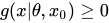
[edit]For the continuous univariate case, consider a probability density function Failed to parse (SVG (MathML can be enabled via browser plugin): Invalid response ("Math extension cannot connect to Restbase.") from server "https://wikimedia.org/api/rest_v1/":): {\displaystyle f(x | \theta), x \in [a, b] \subset \mathbb{R}} , where Failed to parse (SVG (MathML can be enabled via browser plugin): Invalid response ("Math extension cannot connect to Restbase.") from server "https://wikimedia.org/api/rest_v1/":): {\displaystyle \theta} is a vector of parameters. A location parameter Failed to parse (SVG (MathML can be enabled via browser plugin): Invalid response ("Math extension cannot connect to Restbase.") from server "https://wikimedia.org/api/rest_v1/":): {\displaystyle x_0} can be added by defining: Failed to parse (SVG (MathML can be enabled via browser plugin): Invalid response ("Math extension cannot connect to Restbase.") from server "https://wikimedia.org/api/rest_v1/":): {\displaystyle g(x | \theta, x_0) = f(x - x_0 | \theta), \; x \in [a + x_0, b + x_0] } it can be proved that Failed to parse (SVG (MathML can be enabled via browser plugin): Invalid response ("Math extension cannot connect to Restbase.") from server "https://wikimedia.org/api/rest_v1/":): {\displaystyle g} is a p.d.f. by verifying if it respects the two conditions[5] Failed to parse (SVG (MathML can be enabled via browser plugin): Invalid response ("Math extension cannot connect to Restbase.") from server "https://wikimedia.org/api/rest_v1/":): {\displaystyle g(x | \theta, x_0) \ge 0} and Failed to parse (SVG (MathML can be enabled via browser plugin): Invalid response ("Math extension cannot connect to Restbase.") from server "https://wikimedia.org/api/rest_v1/":): {\displaystyle \int_{-\infty}^{\infty} g(x | \theta, x_0) dx = 1} . Failed to parse (SVG (MathML can be enabled via browser plugin): Invalid response ("Math extension cannot connect to Restbase.") from server "https://wikimedia.org/api/rest_v1/":): {\displaystyle g} integrates to 1 because: Failed to parse (SVG (MathML can be enabled via browser plugin): Invalid response ("Math extension cannot connect to Restbase.") from server "https://wikimedia.org/api/rest_v1/":): {\displaystyle \int_{-\infty}^{\infty} g(x | \theta, x_0) dx = \int_{a + x_0}^{b + x_0} g(x | \theta, x_0) dx = \int_{a + x_0}^{b + x_0} f(x - x_0 | \theta) dx } now making the variable change Failed to parse (SVG (MathML can be enabled via browser plugin): Invalid response ("Math extension cannot connect to Restbase.") from server "https://wikimedia.org/api/rest_v1/":): {\displaystyle u = x - x_0} and updating the integration interval accordingly yields: Failed to parse (SVG (MathML can be enabled via browser plugin): Invalid response ("Math extension cannot connect to Restbase.") from server "https://wikimedia.org/api/rest_v1/":): {\displaystyle \int_{a}^{b} f(u | \theta) du = 1 } because Failed to parse (SVG (MathML can be enabled via browser plugin): Invalid response ("Math extension cannot connect to Restbase.") from server "https://wikimedia.org/api/rest_v1/":): {\displaystyle f(x | \theta)} is a p.d.f. by hypothesis. follows from Failed to parse (SVG (MathML can be enabled via browser plugin): Invalid response ("Math extension cannot connect to Restbase.") from server "https://wikimedia.org/api/rest_v1/":): {\displaystyle g} sharing the same image of Failed to parse (SVG (MathML can be enabled via browser plugin): Invalid response ("Math extension cannot connect to Restbase.") from server "https://wikimedia.org/api/rest_v1/":): {\displaystyle f} , which is a p.d.f. so its range is contained in Failed to parse (SVG (MathML can be enabled via browser plugin): Invalid response ("Math extension cannot connect to Restbase.") from server "https://wikimedia.org/api/rest_v1/":): {\displaystyle [0, 1]} .


See also
[edit]References
[edit]- ↑ Takeuchi, Kei (1971). "A Uniformly Asymptotically Efficient Estimator of a Location Parameter". Journal of the American Statistical Association. 66 (334): 292–301. doi:10.1080/01621459.1971.10482258. S2CID 120949417.
- ↑ Huber, Peter J. (1992). "Robust Estimation of a Location Parameter". Breakthroughs in Statistics. Springer Series in Statistics. Springer. pp. 492–518. doi:10.1007/978-1-4612-4380-9_35. ISBN 978-0-387-94039-7.
- ↑ Stone, Charles J. (1975). "Adaptive Maximum Likelihood Estimators of a Location Parameter". The Annals of Statistics. 3 (2): 267–284. doi:10.1214/aos/1176343056.
- ↑ Casella, George; Berger, Roger (2001). Statistical Inference (2nd ed.). Thomson Learning. p. 116. ISBN 978-0534243128.
- ↑ Ross, Sheldon (2010). Introduction to probability models. Amsterdam Boston: Academic Press. ISBN 978-0-12-375686-2. OCLC 444116127.
General references
[edit]- "1.3.6.4. Location and Scale Parameters". National Institute of Standards and Technology. Retrieved 2025-03-17.