Divisor
 | This article includes a list of general references, but it remains largely unverified because it lacks sufficient corresponding inline citations. (June 2015) |
In mathematics, a divisor of an integer also called a factor of is an integer that may be multiplied by some integer to produce [1] In this case, one also says that is a multiple of An integer is divisible or evenly divisible by another integer if is a divisor of ; this implies dividing by leaves no remainder.


The concept of a divisor is extended, with the same definition, to elements of any ring; see Divisibility (ring theory).
Definition
[edit | edit source]An integer is divisible by a nonzero integer if there exists an integer such that This is written as


This may be read as that divides is a divisor of is a factor of or is a multiple of If does not divide then the notation is [2][3]

There are two conventions, distinguished by whether is permitted to be zero:
- With the convention without an additional constraint on for every integer [2][3]
- With the convention that be nonzero, for every nonzero integer [4][5]


General
[edit | edit source]Divisors can be negative as well as positive, although often the term is restricted to positive divisors. For example, there are six divisors of 4; they are 1, 2, 4, −1, −2, and −4, but only the positive ones (1, 2, and 4) would usually be mentioned.
1 and −1 divide (are divisors of) every integer. Every integer (and its negation) is a divisor of itself. Integers divisible by 2 are called even, and integers not divisible by 2 are called odd.
1, −1, and are known as the trivial divisors of A divisor of that is not a trivial divisor is known as a non-trivial divisor (or strict divisor[6]). A nonzero integer with at least one non-trivial divisor is known as a composite number, while the units −1 and 1 and prime numbers have no non-trivial divisors.

There are divisibility rules that allow one to recognize certain divisors of a number from the number's digits.
Examples
[edit | edit source]- 7 is a divisor of 42 because so we can say It can also be said that 42 is divisible by 7, 42 is a multiple of 7, 7 divides 42, or 7 is a factor of 42.
- The non-trivial divisors of 6 are 2, −2, 3, −3.
- The positive divisors of 42 are 1, 2, 3, 6, 7, 14, 21, 42.
- The set of all positive divisors of 60, partially ordered by divisibility, has the Hasse diagram:



Further notions and facts
[edit | edit source]There are some elementary rules:
- If and then that is, divisibility is a transitive relation.
- If and then or (That is, and are associates.)
- If and then holds, as does [lower-alpha 1] However, if and then does not always hold (for example, and but 5 does not divide 6).
- for nonzero . This follows immediately from writing .


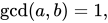
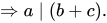
If and then [lower-alpha 2] This is called Euclid's lemma.


If is a prime number and then or


A positive divisor of that is different from is called a proper divisor or an aliquot part of (for example, the proper divisors of 6 are 1, 2, and 3). A number that does not evenly divide but leaves a remainder is sometimes called an aliquant part of
An integer whose only proper divisor is 1 is called a prime number. Equivalently, a prime number is a positive integer that has exactly two positive factors: 1 and itself.

Any positive divisor of Failed to parse (SVG (MathML can be enabled via browser plugin): Invalid response ("Math extension cannot connect to Restbase.") from server "https://wikimedia.org/api/rest_v1/":): {\displaystyle n} is a product of prime divisors of Failed to parse (SVG (MathML can be enabled via browser plugin): Invalid response ("Math extension cannot connect to Restbase.") from server "https://wikimedia.org/api/rest_v1/":): {\displaystyle n} , each raised to some power. This is a consequence of the fundamental theorem of arithmetic.
A number Failed to parse (SVG (MathML can be enabled via browser plugin): Invalid response ("Math extension cannot connect to Restbase.") from server "https://wikimedia.org/api/rest_v1/":): {\displaystyle n} is said to be perfect if it equals the sum of its proper divisors, deficient if the sum of its proper divisors is less than Failed to parse (SVG (MathML can be enabled via browser plugin): Invalid response ("Math extension cannot connect to Restbase.") from server "https://wikimedia.org/api/rest_v1/":): {\displaystyle n,} and abundant if this sum exceeds Failed to parse (SVG (MathML can be enabled via browser plugin): Invalid response ("Math extension cannot connect to Restbase.") from server "https://wikimedia.org/api/rest_v1/":): {\displaystyle n.}
The total number of positive divisors of Failed to parse (SVG (MathML can be enabled via browser plugin): Invalid response ("Math extension cannot connect to Restbase.") from server "https://wikimedia.org/api/rest_v1/":): {\displaystyle n} is a multiplicative function Failed to parse (SVG (MathML can be enabled via browser plugin): Invalid response ("Math extension cannot connect to Restbase.") from server "https://wikimedia.org/api/rest_v1/":): {\displaystyle d(n),} meaning that when two numbers Failed to parse (SVG (MathML can be enabled via browser plugin): Invalid response ("Math extension cannot connect to Restbase.") from server "https://wikimedia.org/api/rest_v1/":): {\displaystyle m} and Failed to parse (SVG (MathML can be enabled via browser plugin): Invalid response ("Math extension cannot connect to Restbase.") from server "https://wikimedia.org/api/rest_v1/":): {\displaystyle n} are relatively prime, then Failed to parse (SVG (MathML can be enabled via browser plugin): Invalid response ("Math extension cannot connect to Restbase.") from server "https://wikimedia.org/api/rest_v1/":): {\displaystyle d(mn)=d(m)\times d(n).} For instance, Failed to parse (SVG (MathML can be enabled via browser plugin): Invalid response ("Math extension cannot connect to Restbase.") from server "https://wikimedia.org/api/rest_v1/":): {\displaystyle d(42) = 8 = 2 \times 2 \times 2 = d(2) \times d(3) \times d(7)} ; the eight divisors of 42 are 1, 2, 3, 6, 7, 14, 21 and 42. However, the number of positive divisors is not a totally multiplicative function: if the two numbers Failed to parse (SVG (MathML can be enabled via browser plugin): Invalid response ("Math extension cannot connect to Restbase.") from server "https://wikimedia.org/api/rest_v1/":): {\displaystyle m} and Failed to parse (SVG (MathML can be enabled via browser plugin): Invalid response ("Math extension cannot connect to Restbase.") from server "https://wikimedia.org/api/rest_v1/":): {\displaystyle n} share a common divisor, then it might not be true that Failed to parse (SVG (MathML can be enabled via browser plugin): Invalid response ("Math extension cannot connect to Restbase.") from server "https://wikimedia.org/api/rest_v1/":): {\displaystyle d(mn)=d(m)\times d(n).} The sum of the positive divisors of Failed to parse (SVG (MathML can be enabled via browser plugin): Invalid response ("Math extension cannot connect to Restbase.") from server "https://wikimedia.org/api/rest_v1/":): {\displaystyle n} is another multiplicative function Failed to parse (SVG (MathML can be enabled via browser plugin): Invalid response ("Math extension cannot connect to Restbase.") from server "https://wikimedia.org/api/rest_v1/":): {\displaystyle \sigma (n)} (for example, Failed to parse (SVG (MathML can be enabled via browser plugin): Invalid response ("Math extension cannot connect to Restbase.") from server "https://wikimedia.org/api/rest_v1/":): {\displaystyle \sigma (42) = 96 = 3 \times 4 \times 8 = \sigma (2) \times \sigma (3) \times \sigma (7) = 1+2+3+6+7+14+21+42} ). Both of these functions are examples of divisor functions.
If the prime factorization of Failed to parse (SVG (MathML can be enabled via browser plugin): Invalid response ("Math extension cannot connect to Restbase.") from server "https://wikimedia.org/api/rest_v1/":): {\displaystyle n} is given by
- Failed to parse (SVG (MathML can be enabled via browser plugin): Invalid response ("Math extension cannot connect to Restbase.") from server "https://wikimedia.org/api/rest_v1/":): {\displaystyle n = p_1^{\nu_1} \, p_2^{\nu_2} \cdots p_k^{\nu_k} }
then the number of positive divisors of Failed to parse (SVG (MathML can be enabled via browser plugin): Invalid response ("Math extension cannot connect to Restbase.") from server "https://wikimedia.org/api/rest_v1/":): {\displaystyle n} is
- Failed to parse (SVG (MathML can be enabled via browser plugin): Invalid response ("Math extension cannot connect to Restbase.") from server "https://wikimedia.org/api/rest_v1/":): {\displaystyle d(n) = (\nu_1 + 1) (\nu_2 + 1) \cdots (\nu_k + 1), }
and each of the divisors has the form
- Failed to parse (SVG (MathML can be enabled via browser plugin): Invalid response ("Math extension cannot connect to Restbase.") from server "https://wikimedia.org/api/rest_v1/":): {\displaystyle p_1^{\mu_1} \, p_2^{\mu_2} \cdots p_k^{\mu_k} }
where Failed to parse (SVG (MathML can be enabled via browser plugin): Invalid response ("Math extension cannot connect to Restbase.") from server "https://wikimedia.org/api/rest_v1/":): {\displaystyle 0 \le \mu_i \le \nu_i } for each Failed to parse (SVG (MathML can be enabled via browser plugin): Invalid response ("Math extension cannot connect to Restbase.") from server "https://wikimedia.org/api/rest_v1/":): {\displaystyle 1 \le i \le k.}
For every natural Failed to parse (SVG (MathML can be enabled via browser plugin): Invalid response ("Math extension cannot connect to Restbase.") from server "https://wikimedia.org/api/rest_v1/":): {\displaystyle n,} Failed to parse (SVG (MathML can be enabled via browser plugin): Invalid response ("Math extension cannot connect to Restbase.") from server "https://wikimedia.org/api/rest_v1/":): {\displaystyle d(n) < 2 \sqrt{n}.}
Also,[7]
- Failed to parse (SVG (MathML can be enabled via browser plugin): Invalid response ("Math extension cannot connect to Restbase.") from server "https://wikimedia.org/api/rest_v1/":): {\displaystyle d(1)+d(2)+ \cdots +d(n) = n \ln n + (2 \gamma -1) n + O(\sqrt{n}),}
where Failed to parse (SVG (MathML can be enabled via browser plugin): Invalid response ("Math extension cannot connect to Restbase.") from server "https://wikimedia.org/api/rest_v1/":): {\displaystyle \gamma } is Euler–Mascheroni constant. One interpretation of this result is that a randomly chosen positive integer n has an average number of divisors of about Failed to parse (SVG (MathML can be enabled via browser plugin): Invalid response ("Math extension cannot connect to Restbase.") from server "https://wikimedia.org/api/rest_v1/":): {\displaystyle \ln n.} However, this is a result from the contributions of numbers with "abnormally many" divisors.
Division lattice
[edit | edit source]In definitions that allow the divisor to be 0, the relation of divisibility turns the set Failed to parse (SVG (MathML can be enabled via browser plugin): Invalid response ("Math extension cannot connect to Restbase.") from server "https://wikimedia.org/api/rest_v1/":): {\displaystyle \mathbb{N}} of non-negative integers into a partially ordered set that is a complete distributive lattice. The largest element of this lattice is 0 and the smallest is 1. The meet operation ∧ is given by the greatest common divisor and the join operation ∨ by the least common multiple. This lattice is isomorphic to the dual of the lattice of subgroups of the infinite cyclic group Z.
See also
[edit | edit source]- Arithmetic functions
- Euclidean algorithm
- Fraction (mathematics)
- Integer factorization
- Table of divisors – A table of prime and non-prime divisors for 1–1000
- Table of prime factors – A table of prime factors for 1–1000
- Unitary divisor
Notes
[edit | edit source]- ↑ Similarly,
- ↑ refers to the greatest common divisor.






Citations
[edit | edit source]- ↑ Tanton 2005, p. 185
- ↑ 2.0 2.1 Hardy & Wright 1960, p. 1
- ↑ 3.0 3.1 Niven, Zuckerman & Montgomery 1991, p. 4
- ↑ Sims 1984, p. 42
- ↑ Durbin (2009), p. 57, Chapter III Section 10
- ↑ "FoCaLiZe and Dedukti to the Rescue for Proof Interoperability by Raphael Cauderlier and Catherine Dubois" (PDF).
- ↑ Hardy & Wright 1960, p. 264, Theorem 320
References
[edit | edit source]- Durbin, John R. (2009). Modern Algebra: An Introduction (6th ed.). New York: Wiley. ISBN 978-0470-38443-5.
- Guy, Richard K. (2004), Unsolved Problems in Number Theory (3rd ed.), Springer Verlag, ISBN 0-387-20860-7; section B
- Hardy, G. H.; Wright, E. M. (1960). An Introduction to the Theory of Numbers (4th ed.). Oxford University Press.
- Herstein, I. N. (1986), Abstract Algebra, New York: Macmillan Publishing Company, ISBN 0-02-353820-1
- Niven, Ivan; Zuckerman, Herbert S.; Montgomery, Hugh L. (1991). An Introduction to the Theory of Numbers (5th ed.). John Wiley & Sons. ISBN 0-471-62546-9.
- Øystein Ore, Number Theory and its History, McGraw–Hill, NY, 1944 (and Dover reprints).
- Sims, Charles C. (1984), Abstract Algebra: A Computational Approach, New York: John Wiley & Sons, ISBN 0-471-09846-9
- Tanton, James (2005). Encyclopedia of mathematics. New York: Facts on File. ISBN 0-8160-5124-0. OCLC 56057904.