Euler's criterion
In number theory, Euler's criterion is a formula for determining whether an integer is a quadratic residue modulo a prime. Precisely,
Let p be an odd prime and a be an integer coprime to p. Then[1][2][3]
- Failed to parse (SVG (MathML can be enabled via browser plugin): Invalid response ("Math extension cannot connect to Restbase.") from server "https://wikimedia.org/api/rest_v1/":): {\displaystyle a^{\tfrac{p-1}{2}} \equiv \begin{cases} \;\;\,1\pmod{p}& \text{ if there is an integer }x \text{ such that }x^2\equiv a \pmod{p},\\ -1\pmod{p}& \text{ if there is no such integer.} \end{cases} }
Euler's criterion can be concisely reformulated using the Legendre symbol:[4]
- Failed to parse (SVG (MathML can be enabled via browser plugin): Invalid response ("Math extension cannot connect to Restbase.") from server "https://wikimedia.org/api/rest_v1/":): {\displaystyle \left(\frac{a}{p}\right) \equiv a^{\tfrac{p-1}{2}} \pmod p. }
The criterion dates from a 1748 paper by Leonhard Euler.[5][6]
Proof
[edit]The proof uses the fact that the residue classes modulo a prime number are a field. See the article prime field for more details.
Because the modulus is prime, Lagrange's theorem applies: a polynomial of degree k can only have at most k roots. In particular, x2 ≡ a (mod p) has at most 2 solutions for each a. This immediately implies that besides 0 there are at least p − 1/2 distinct quadratic residues modulo p: each of the p − 1 possible values of x can only be accompanied by one other to give the same residue.
In fact, Failed to parse (SVG (MathML can be enabled via browser plugin): Invalid response ("Math extension cannot connect to Restbase.") from server "https://wikimedia.org/api/rest_v1/":): {\displaystyle (p-x)^{2}\equiv x^{2} \pmod p.} This is because Failed to parse (SVG (MathML can be enabled via browser plugin): Invalid response ("Math extension cannot connect to Restbase.") from server "https://wikimedia.org/api/rest_v1/":): {\displaystyle (p-x)^{2} \equiv p^{2}-{2}{x}{p}+x^{2} \equiv x^{2} \pmod p.} So, the Failed to parse (SVG (MathML can be enabled via browser plugin): Invalid response ("Math extension cannot connect to Restbase.") from server "https://wikimedia.org/api/rest_v1/":): {\displaystyle \tfrac{p-1}{2}} distinct quadratic residues are: Failed to parse (SVG (MathML can be enabled via browser plugin): Invalid response ("Math extension cannot connect to Restbase.") from server "https://wikimedia.org/api/rest_v1/":): {\displaystyle 1^{2}, 2^{2}, ... , (\tfrac{p-1}{2})^{2} \pmod p. }
As a is coprime to p, Fermat's little theorem says that
- Failed to parse (SVG (MathML can be enabled via browser plugin): Invalid response ("Math extension cannot connect to Restbase.") from server "https://wikimedia.org/api/rest_v1/":): {\displaystyle a^{p-1}\equiv 1 \pmod p, }
which can be written as
- Failed to parse (SVG (MathML can be enabled via browser plugin): Invalid response ("Math extension cannot connect to Restbase.") from server "https://wikimedia.org/api/rest_v1/":): {\displaystyle \left( a^{\tfrac{p-1}{2}}-1 \right)\left( a^{\tfrac{p-1}{2}}+1 \right) \equiv 0 \pmod p. }
Since the integers mod p form a field, for each a, one or the other of these factors must be zero. Therefore,
- Failed to parse (SVG (MathML can be enabled via browser plugin): Invalid response ("Math extension cannot connect to Restbase.") from server "https://wikimedia.org/api/rest_v1/":): {\displaystyle a^{\tfrac{p-1}{2}}\equiv 1\pmod p } or
- Failed to parse (SVG (MathML can be enabled via browser plugin): Invalid response ("Math extension cannot connect to Restbase.") from server "https://wikimedia.org/api/rest_v1/":): {\displaystyle a^{\tfrac{p-1}{2}} \equiv {-1}\pmod p. }
Now if a is a quadratic residue, a ≡ x2,
- Failed to parse (SVG (MathML can be enabled via browser plugin): Invalid response ("Math extension cannot connect to Restbase.") from server "https://wikimedia.org/api/rest_v1/":): {\displaystyle a^{\tfrac{p-1}{2}}\equiv {(x^2)}^{\tfrac{p-1}{2}} \equiv x^{p-1}\equiv1\pmod p. }
So every quadratic residue (mod p) makes the first factor zero.
Applying Lagrange's theorem again, we note that there can be no more than p − 1/2 values of a that make the first factor zero. But as we noted at the beginning, there are at least p − 1/2 distinct quadratic residues (mod p) (besides 0). Therefore, they are precisely the residue classes that make the first factor zero. The other p − 1/2 residue classes, the nonresidues, must make the second factor zero, or they would not satisfy Fermat's little theorem. This is Euler's criterion.
Alternative proof
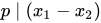
[edit]This proof only uses the fact that any congruence Failed to parse (SVG (MathML can be enabled via browser plugin): Invalid response ("Math extension cannot connect to Restbase.") from server "https://wikimedia.org/api/rest_v1/":): {\displaystyle kx\equiv l\!\!\! \pmod p} has a unique (modulo Failed to parse (SVG (MathML can be enabled via browser plugin): Invalid response ("Math extension cannot connect to Restbase.") from server "https://wikimedia.org/api/rest_v1/":): {\displaystyle p} ) solution Failed to parse (SVG (MathML can be enabled via browser plugin): Invalid response ("Math extension cannot connect to Restbase.") from server "https://wikimedia.org/api/rest_v1/":): {\displaystyle x} provided Failed to parse (SVG (MathML can be enabled via browser plugin): Invalid response ("Math extension cannot connect to Restbase.") from server "https://wikimedia.org/api/rest_v1/":): {\displaystyle p} does not divide Failed to parse (SVG (MathML can be enabled via browser plugin): Invalid response ("Math extension cannot connect to Restbase.") from server "https://wikimedia.org/api/rest_v1/":): {\displaystyle k} . (This is true because as Failed to parse (SVG (MathML can be enabled via browser plugin): Invalid response ("Math extension cannot connect to Restbase.") from server "https://wikimedia.org/api/rest_v1/":): {\displaystyle x} runs through all nonzero remainders modulo Failed to parse (SVG (MathML can be enabled via browser plugin): Invalid response ("Math extension cannot connect to Restbase.") from server "https://wikimedia.org/api/rest_v1/":): {\displaystyle p} without repetitions, so does Failed to parse (SVG (MathML can be enabled via browser plugin): Invalid response ("Math extension cannot connect to Restbase.") from server "https://wikimedia.org/api/rest_v1/":): {\displaystyle kx} : if we have Failed to parse (SVG (MathML can be enabled via browser plugin): Invalid response ("Math extension cannot connect to Restbase.") from server "https://wikimedia.org/api/rest_v1/":): {\displaystyle kx_1\equiv kx_2 \pmod p} , then Failed to parse (SVG (MathML can be enabled via browser plugin): Invalid response ("Math extension cannot connect to Restbase.") from server "https://wikimedia.org/api/rest_v1/":): {\displaystyle p\mid k(x_1-x_2)} , hence , but Failed to parse (SVG (MathML can be enabled via browser plugin): Invalid response ("Math extension cannot connect to Restbase.") from server "https://wikimedia.org/api/rest_v1/":): {\displaystyle x_1} and Failed to parse (SVG (MathML can be enabled via browser plugin): Invalid response ("Math extension cannot connect to Restbase.") from server "https://wikimedia.org/api/rest_v1/":): {\displaystyle x_2} aren't congruent modulo Failed to parse (SVG (MathML can be enabled via browser plugin): Invalid response ("Math extension cannot connect to Restbase.") from server "https://wikimedia.org/api/rest_v1/":): {\displaystyle p} .) It follows from this fact that all nonzero remainders modulo Failed to parse (SVG (MathML can be enabled via browser plugin): Invalid response ("Math extension cannot connect to Restbase.") from server "https://wikimedia.org/api/rest_v1/":): {\displaystyle p} the square of which isn't congruent to Failed to parse (SVG (MathML can be enabled via browser plugin): Invalid response ("Math extension cannot connect to Restbase.") from server "https://wikimedia.org/api/rest_v1/":): {\displaystyle a} can be grouped into unordered pairs Failed to parse (SVG (MathML can be enabled via browser plugin): Invalid response ("Math extension cannot connect to Restbase.") from server "https://wikimedia.org/api/rest_v1/":): {\displaystyle (x,y)} according to the rule that the product of the members of each pair is congruent to Failed to parse (SVG (MathML can be enabled via browser plugin): Invalid response ("Math extension cannot connect to Restbase.") from server "https://wikimedia.org/api/rest_v1/":): {\displaystyle a} modulo Failed to parse (SVG (MathML can be enabled via browser plugin): Invalid response ("Math extension cannot connect to Restbase.") from server "https://wikimedia.org/api/rest_v1/":): {\displaystyle p} (since by this fact for every Failed to parse (SVG (MathML can be enabled via browser plugin): Invalid response ("Math extension cannot connect to Restbase.") from server "https://wikimedia.org/api/rest_v1/":): {\displaystyle y} we can find such an Failed to parse (SVG (MathML can be enabled via browser plugin): Invalid response ("Math extension cannot connect to Restbase.") from server "https://wikimedia.org/api/rest_v1/":): {\displaystyle x} , uniquely, and vice versa, and they will differ from each other if Failed to parse (SVG (MathML can be enabled via browser plugin): Invalid response ("Math extension cannot connect to Restbase.") from server "https://wikimedia.org/api/rest_v1/":): {\displaystyle y^2} is not congruent to Failed to parse (SVG (MathML can be enabled via browser plugin): Invalid response ("Math extension cannot connect to Restbase.") from server "https://wikimedia.org/api/rest_v1/":): {\displaystyle a} ). If Failed to parse (SVG (MathML can be enabled via browser plugin): Invalid response ("Math extension cannot connect to Restbase.") from server "https://wikimedia.org/api/rest_v1/":): {\displaystyle a} is not a quadratic residue, this is simply a regrouping of all Failed to parse (SVG (MathML can be enabled via browser plugin): Invalid response ("Math extension cannot connect to Restbase.") from server "https://wikimedia.org/api/rest_v1/":): {\displaystyle p-1} nonzero residues into Failed to parse (SVG (MathML can be enabled via browser plugin): Invalid response ("Math extension cannot connect to Restbase.") from server "https://wikimedia.org/api/rest_v1/":): {\displaystyle (p-1)/2} pairs, hence we conclude that Failed to parse (SVG (MathML can be enabled via browser plugin): Invalid response ("Math extension cannot connect to Restbase.") from server "https://wikimedia.org/api/rest_v1/":): {\displaystyle 1\cdot2\cdot ... \cdot (p-1)\equiv a^{\frac{p-1}{2}} \!\!\! \pmod p} . If Failed to parse (SVG (MathML can be enabled via browser plugin): Invalid response ("Math extension cannot connect to Restbase.") from server "https://wikimedia.org/api/rest_v1/":): {\displaystyle a} is a quadratic residue, exactly two remainders were not among those paired, Failed to parse (SVG (MathML can be enabled via browser plugin): Invalid response ("Math extension cannot connect to Restbase.") from server "https://wikimedia.org/api/rest_v1/":): {\displaystyle r} and Failed to parse (SVG (MathML can be enabled via browser plugin): Invalid response ("Math extension cannot connect to Restbase.") from server "https://wikimedia.org/api/rest_v1/":): {\displaystyle -r} such that Failed to parse (SVG (MathML can be enabled via browser plugin): Invalid response ("Math extension cannot connect to Restbase.") from server "https://wikimedia.org/api/rest_v1/":): {\displaystyle r^2\equiv a\!\!\! \pmod p} . If we pair those two absent remainders together, their product will be Failed to parse (SVG (MathML can be enabled via browser plugin): Invalid response ("Math extension cannot connect to Restbase.") from server "https://wikimedia.org/api/rest_v1/":): {\displaystyle -a} rather than Failed to parse (SVG (MathML can be enabled via browser plugin): Invalid response ("Math extension cannot connect to Restbase.") from server "https://wikimedia.org/api/rest_v1/":): {\displaystyle a} , whence in this case Failed to parse (SVG (MathML can be enabled via browser plugin): Invalid response ("Math extension cannot connect to Restbase.") from server "https://wikimedia.org/api/rest_v1/":): {\displaystyle 1\cdot2\cdot ... \cdot (p-1)\equiv -a^{\frac{p-1}{2}} \!\!\! \pmod p} . In summary, considering these two cases we have demonstrated that for Failed to parse (SVG (MathML can be enabled via browser plugin): Invalid response ("Math extension cannot connect to Restbase.") from server "https://wikimedia.org/api/rest_v1/":): {\displaystyle a\not\equiv 0 \!\!\! \pmod p} we have Failed to parse (SVG (MathML can be enabled via browser plugin): Invalid response ("Math extension cannot connect to Restbase.") from server "https://wikimedia.org/api/rest_v1/":): {\displaystyle 1\cdot2\cdot ... \cdot (p-1)\equiv -\left(\frac{a}{p}\right)a^{\frac{p-1}{2}} \!\!\! \pmod p} . It remains to substitute Failed to parse (SVG (MathML can be enabled via browser plugin): Invalid response ("Math extension cannot connect to Restbase.") from server "https://wikimedia.org/api/rest_v1/":): {\displaystyle a=1} (which is obviously a square) into this formula to obtain at once Wilson's theorem, Euler's criterion, and (by squaring both sides of Euler's criterion) Fermat's little theorem.
Examples
[edit]Example 1: Finding primes for which a is a residue
Let a = 17. For which primes p is 17 a quadratic residue?
We can test prime p's manually given the formula above.
In one case, testing p = 3, we have 17(3 − 1)/2 = 171 ≡ 2 ≡ −1 (mod 3), therefore 17 is not a quadratic residue modulo 3.
In another case, testing p = 13, we have 17(13 − 1)/2 = 176 ≡ 1 (mod 13), therefore 17 is a quadratic residue modulo 13. As confirmation, note that 17 ≡ 4 (mod 13), and 22 = 4.
We can do these calculations faster by using various modular arithmetic and Legendre symbol properties.
If we keep calculating the values, we find:
- (17/p) = +1 for p = {13, 19, ...} (17 is a quadratic residue modulo these values)
- (17/p) = −1 for p = {3, 5, 7, 11, 23, ...} (17 is not a quadratic residue modulo these values).
Example 2: Finding residues given a prime modulus p
Which numbers are squares modulo 17 (quadratic residues modulo 17)?
We can manually calculate it as:
- 12 = 1
- 22 = 4
- 32 = 9
- 42 = 16
- 52 = 25 ≡ 8 (mod 17)
- 62 = 36 ≡ 2 (mod 17)
- 72 = 49 ≡ 15 (mod 17)
- 82 = 64 ≡ 13 (mod 17).
So the set of the quadratic residues modulo 17 is {1,2,4,8,9,13,15,16}. Note that we did not need to calculate squares for the values 9 through 16, as they are all negatives of the previously squared values (e.g. 9 ≡ −8 (mod 17), so 92 ≡ (−8)2 = 64 ≡ 13 (mod 17)).
We can find quadratic residues or verify them using the above formula. To test if 2 is a quadratic residue modulo 17, we calculate 2(17 − 1)/2 = 28 ≡ 1 (mod 17), so it is a quadratic residue. To test if 3 is a quadratic residue modulo 17, we calculate 3(17 − 1)/2 = 38 ≡ 16 ≡ −1 (mod 17), so it is not a quadratic residue.
Euler's criterion is related to the law of quadratic reciprocity.
Applications
[edit]In practice, it is more efficient to use an extended variant of Euclid's algorithm to calculate the Jacobi symbol Failed to parse (SVG (MathML can be enabled via browser plugin): Invalid response ("Math extension cannot connect to Restbase.") from server "https://wikimedia.org/api/rest_v1/":): {\displaystyle \left(\frac{a}{n}\right)} . If Failed to parse (SVG (MathML can be enabled via browser plugin): Invalid response ("Math extension cannot connect to Restbase.") from server "https://wikimedia.org/api/rest_v1/":): {\displaystyle n} is an odd prime, this is equal to the Legendre symbol, and decides whether Failed to parse (SVG (MathML can be enabled via browser plugin): Invalid response ("Math extension cannot connect to Restbase.") from server "https://wikimedia.org/api/rest_v1/":): {\displaystyle a} is a quadratic residue modulo Failed to parse (SVG (MathML can be enabled via browser plugin): Invalid response ("Math extension cannot connect to Restbase.") from server "https://wikimedia.org/api/rest_v1/":): {\displaystyle n} .
On the other hand, since the equivalence of Failed to parse (SVG (MathML can be enabled via browser plugin): Invalid response ("Math extension cannot connect to Restbase.") from server "https://wikimedia.org/api/rest_v1/":): {\displaystyle a^\frac{n-1}{2}} to the Jacobi symbol holds for all odd primes, but not necessarily for composite numbers, calculating both and comparing them can be used as a primality test, specifically the Solovay–Strassen primality test. Composite numbers for which the congruence holds for a given Failed to parse (SVG (MathML can be enabled via browser plugin): Invalid response ("Math extension cannot connect to Restbase.") from server "https://wikimedia.org/api/rest_v1/":): {\displaystyle a} are called Euler–Jacobi pseudoprimes to base Failed to parse (SVG (MathML can be enabled via browser plugin): Invalid response ("Math extension cannot connect to Restbase.") from server "https://wikimedia.org/api/rest_v1/":): {\displaystyle a} .
Notes
[edit]- ↑ Gauss, DA, Art. 106
- ↑ Dense, Joseph B.; Dence, Thomas P. (1999). "Theorem 6.4, Chap 6. Residues". Elements of the Theory of Numbers. Harcourt Academic Press. p. 197. ISBN 9780122091308.
- ↑ Leonard Eugene Dickson, "History Of The Theory Of Numbers", vol 1, p 205, Chelsea Publishing 1952
- ↑ Hardy & Wright, thm. 83
- ↑ Lemmermeyer, p. 4 cites two papers, E134 and E262 in the Euler Archive
- ↑ L Euler, Novi commentarii Academiae Scientiarum Imperialis Petropolitanae, 8, 1760-1, 74; Opusc Anal. 1, 1772, 121; Comm. Arith, 1, 274, 487
References
[edit]The Disquisitiones Arithmeticae has been translated from Gauss's Ciceronian Latin into English and German. The German edition includes all of his papers on number theory: all the proofs of quadratic reciprocity, the determination of the sign of the Gauss sum, the investigations into biquadratic reciprocity, and unpublished notes.
- Gauss, Carl Friedrich (1986), Disquisitiones Arithemeticae (Second, corrected edition), translated by Clarke, Arthur A. (English), New York: Springer, ISBN 0-387-96254-9
- Gauss, Carl Friedrich (1965), Untersuchungen über höhere Arithmetik (Disquisitiones Arithemeticae & other papers on number theory) (Second edition), translated by Maser, H. (German), New York: Chelsea, ISBN 0-8284-0191-8
- Hardy, G. H.; Wright, E. M. (1980), An Introduction to the Theory of Numbers (Fifth edition), Oxford: Oxford University Press, ISBN 978-0-19-853171-5
- Lemmermeyer, Franz (2000), Reciprocity Laws: from Euler to Eisenstein, Berlin: Springer, ISBN 3-540-66957-4