Euler's sum of powers conjecture
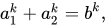
In number theory, Euler's conjecture is a disproved conjecture related to Fermat's Last Theorem. It was proposed by Leonhard Euler in 1769. It states that for all integers n and k greater than 1, if the sum of n many kth powers of positive integers is itself a kth power, then n is greater than or equal to k:
Failed to parse (Conversion error. Server ("https://wikimedia.org/api/rest_") reported: "Cannot get mml. Server problem."): {\displaystyle a_{1}^{k}+a_{2}^{k}+\dots +a_{n}^{k}=b^{k}\implies n\geq k}
The conjecture represents an attempt to generalize Fermat's Last Theorem, which is the special case n = 2: if then 2 ≥ k.
Although the conjecture holds for the case k = 3 (which follows from Fermat's Last Theorem for the third powers), it was disproved for k = 4 and k = 5. It is unknown whether the conjecture fails or holds for any value k ≥ 6.
Background
Euler was aware of the equality 594 + 1584 = 1334 + 1344 involving sums of four fourth powers; this, however, is not a counterexample because no term is isolated on one side of the equation. He also provided a complete solution to the four cubes problem as in Plato's number 33 + 43 + 53 = 63 or the taxicab number 1729.[1][2] The general solution of the equation Failed to parse (Conversion error. Server ("https://wikimedia.org/api/rest_") reported: "Cannot get mml. Server problem."): {\displaystyle x_{1}^{3}+x_{2}^{3}=x_{3}^{3}+x_{4}^{3}} is
Failed to parse (Conversion error. Server ("https://wikimedia.org/api/rest_") reported: "Cannot get mml. Server problem."): {\displaystyle {\begin{aligned}x_{1}&=\lambda (1-(a-3b)(a^{2}+3b^{2}))\\[2pt]x_{2}&=\lambda ((a+3b)(a^{2}+3b^{2})-1)\\[2pt]x_{3}&=\lambda ((a+3b)-(a^{2}+3b^{2})^{2})\\[2pt]x_{4}&=\lambda ((a^{2}+3b^{2})^{2}-(a-3b))\end{aligned}}}
where a, b and Failed to parse (SVG (MathML can be enabled via browser plugin): Invalid response ("Math extension cannot connect to Restbase.") from server "https://wikimedia.org/api/rest_v1/":): {\displaystyle {\lambda}} are any rational numbers.
Counterexamples
Euler's conjecture was disproven by L. J. Lander and T. R. Parkin in 1966 when, through a direct computer search on a CDC 6600, they found a counterexample for k = 5.[3] This was published in a paper comprising just two sentences.[3] A total of four primitive (that is, in which the summands do not all have a common factor) counterexamples are known: Failed to parse (SVG (MathML can be enabled via browser plugin): Invalid response ("Math extension cannot connect to Restbase.") from server "https://wikimedia.org/api/rest_v1/":): {\displaystyle \begin{align} 144^5 &= 27^5 + 84^5 + 110^5 + 133^5 \\ 14132^5 &= (-220)^5 + 5027^5 + 6237^5 + 14068^5 \\ 85359^5 &= 55^5 + 3183^5 + 28969^5 + 85282^5 \\ 1956878^5 &= 719115^5 + 1331622^5 + (-1340632)^5 + 1956213^5 \end{align}} (Lander & Parkin, 1966); (Scher & Seidl, 1996); (Frye, 2004); (Braun, 2026).
In 1988, Noam Elkies published a method to construct an infinite sequence of counterexamples for the k = 4 case.[4] His smallest counterexample was Failed to parse (SVG (MathML can be enabled via browser plugin): Invalid response ("Math extension cannot connect to Restbase.") from server "https://wikimedia.org/api/rest_v1/":): {\displaystyle 20615673^4 = 2682440^4 + 15365639^4 + 18796760^4.}
A particular case of Elkies' solutions can be reduced to the identity[5][6] Failed to parse (SVG (MathML can be enabled via browser plugin): Invalid response ("Math extension cannot connect to Restbase.") from server "https://wikimedia.org/api/rest_v1/":): {\displaystyle (85v^2 + 484v - 313)^4 + (68v^2 - 586v + 10)^4 + (2u)^4 = (357v^2 - 204v + 363)^4,} where Failed to parse (SVG (MathML can be enabled via browser plugin): Invalid response ("Math extension cannot connect to Restbase.") from server "https://wikimedia.org/api/rest_v1/":): {\displaystyle u^2 = 22030 + 28849v - 56158v^2 + 36941v^3 - 31790v^4.} This is an elliptic curve with a rational point at v1 = −31/467. From this initial rational point, one can compute an infinite collection of others. Substituting v1 into the identity and removing common factors gives the numerical example cited above.
In 1988, Roger Frye found the smallest possible counterexample Failed to parse (SVG (MathML can be enabled via browser plugin): Invalid response ("Math extension cannot connect to Restbase.") from server "https://wikimedia.org/api/rest_v1/":): {\displaystyle 95800^4 + 217519^4 + 414560^4 = 422481^4} for k = 4 by a direct computer search using techniques suggested by Elkies. This solution is the only one with values of the variables below 1,000,000.[7]
Generalizations

In 1967, L. J. Lander, T. R. Parkin, and John Selfridge conjectured[8] that if
- Failed to parse (SVG (MathML can be enabled via browser plugin): Invalid response ("Math extension cannot connect to Restbase.") from server "https://wikimedia.org/api/rest_v1/":): {\displaystyle \sum_{i=1}^{n} a_i^k = \sum_{j=1}^{m} b_j^k} ,
where ai ≠ bj are positive integers for all 1 ≤ i ≤ n and 1 ≤ j ≤ m, then m + n ≥ k. In the special case m = 1, the conjecture states that if
- Failed to parse (SVG (MathML can be enabled via browser plugin): Invalid response ("Math extension cannot connect to Restbase.") from server "https://wikimedia.org/api/rest_v1/":): {\displaystyle \sum_{i=1}^{n} a_i^k = b^k}
(under the conditions given above) then n ≥ k − 1.
The special case may be described as the problem of giving a partition of a perfect power into few like powers. For k = 4, 5, 7, 8 and n = k or k − 1, there are many known solutions. Some of these are listed below.
See Template:OEIS2C for more data.
k = 3
From Fermat's Last Theorem, we know that there can't be a solution to Failed to parse (SVG (MathML can be enabled via browser plugin): Invalid response ("Math extension cannot connect to Restbase.") from server "https://wikimedia.org/api/rest_v1/":): {\displaystyle a^3 + b^3 = c^3} . (The minimum positive value of a sum of third powers is Failed to parse (SVG (MathML can be enabled via browser plugin): Invalid response ("Math extension cannot connect to Restbase.") from server "https://wikimedia.org/api/rest_v1/":): {\displaystyle 9^3 - 8^3 - 6^3 = 1 } , which provides a solution to the equation (a = (1, 6, 8), b = 9), where however the smallest member isn't larger than 1.)
The smallest solution with terms > 1 is Failed to parse (SVG (MathML can be enabled via browser plugin): Invalid response ("Math extension cannot connect to Restbase.") from server "https://wikimedia.org/api/rest_v1/":): {\displaystyle 3^3 + 4^3 + 5^3 = 6^3} (Plato's number 216) This is the case a = 1, b = 0 of Srinivasa Ramanujan's formula[9] Failed to parse (SVG (MathML can be enabled via browser plugin): Invalid response ("Math extension cannot connect to Restbase.") from server "https://wikimedia.org/api/rest_v1/":): {\displaystyle (3a^2+5ab-5b^2)^3 + (4a^2-4ab+6b^2)^3 + (5a^2-5ab-3b^2)^3 = (6a^2-4ab+4b^2)^3}
A cube as the sum of three cubes can also be parameterized in one of two ways:[9] Failed to parse (SVG (MathML can be enabled via browser plugin): Invalid response ("Math extension cannot connect to Restbase.") from server "https://wikimedia.org/api/rest_v1/":): {\displaystyle \begin{align} a^3(a^3+b^3)^3 &= b^3(a^3+b^3)^3+a^3(a^3-2b^3)^3+b^3(2a^3-b^3)^3 \\[6pt] a^3(a^3+2b^3)^3 &= a^3(a^3-b^3)^3+b^3(a^3-b^3)^3+b^3(2a^3+b^3)^3. \end{align}} The number 2,100,0003 can be expressed as the sum of three positive cubes in nine different ways.[9]
k = 4
Failed to parse (SVG (MathML can be enabled via browser plugin): Invalid response ("Math extension cannot connect to Restbase.") from server "https://wikimedia.org/api/rest_v1/":): {\displaystyle \begin{align} 422481^4 &= 95800^4 + 217519^4 + 414560^4 \\[4pt] 353^4 &= 30^4 + 120^4 + 272^4 + 315^4 \end{align}} (R. Frye, 1988);[4] (R. Norrie, smallest, 1911).[8]
k = 5
Failed to parse (SVG (MathML can be enabled via browser plugin): Invalid response ("Math extension cannot connect to Restbase.") from server "https://wikimedia.org/api/rest_v1/":): {\displaystyle \begin{align} 144^5 &= 27^5 + 84^5 + 110^5 + 133^5 \\[2pt] 72^5 &= 19^5 + 43^5 + 46^5 + 47^5 + 67^5 \\[2pt] 94^5 &= 21^5 + 23^5 + 37^5 + 79^5 + 84^5 \\[2pt] 107^5 &= 7^5 + 43^5 + 57^5 + 80^5 + 100^5 \end{align}}
(Lander & Parkin, 1966);[10][11][12] (Lander, Parkin, Selfridge, smallest, 1967);[8] (Lander, Parkin, Selfridge, second smallest, 1967);[8] (Sastry, 1934, third smallest).[8]
k = 6
It has been known since 2002 that there are no solutions for k = 6 whose final term is ≤ 730000.[13]
k = 7
Failed to parse (SVG (MathML can be enabled via browser plugin): Invalid response ("Math extension cannot connect to Restbase.") from server "https://wikimedia.org/api/rest_v1/":): {\displaystyle 568^7 = 127^7 + 258^7 + 266^7 + 413^7 + 430^7 + 439^7 + 525^7}
(M. Dodrill, 1999).[14]
k = 8
Failed to parse (SVG (MathML can be enabled via browser plugin): Invalid response ("Math extension cannot connect to Restbase.") from server "https://wikimedia.org/api/rest_v1/":): {\displaystyle 1409^8 = 90^8 + 223^8 + 478^8 + 524^8 + 748^8 + 1088^8 + 1190^8 + 1324^8 }
(S. Chase, 2000).[15]
See also
- Jacobi–Madden equation
- Prouhet–Tarry–Escott problem
- Beal conjecture
- Pythagorean quadruple
- Generalized taxicab number
- Sums of powers, a list of related conjectures and theorems
References
- ↑ Dunham, William, ed. (2007). The Genius of Euler: Reflections on His Life and Work. The MAA. p. 220. ISBN 978-0-88385-558-4.
- ↑ Titus, III, Piezas (2005). "Euler's Extended Conjecture".
- ↑ 3.0 3.1 Lander, L. J.; Parkin, T. R. (1966). "Counterexample to Euler's conjecture on sums of like powers". Bull. Amer. Math. Soc. 72 (6): 1079. doi:10.1090/S0002-9904-1966-11654-3.
- ↑ 4.0 4.1 Elkies, Noam (1988). "On A4 + B4 + C4 = D4" (PDF). Mathematics of Computation. 51 (184): 825–835. doi:10.1090/S0025-5718-1988-0930224-9. JSTOR 2008781. MR 0930224.
- ↑ "Elkies' a4+b4+c4 = d4".
- ↑ Piezas III, Tito (2010). "Sums of Three Fourth Powers (Part 1)". A Collection of Algebraic Identities. Retrieved April 11, 2022.
- ↑ Frye, Roger E. (1988), "Finding 958004 + 2175194 + 4145604 = 4224814 on the Connection Machine", Proceedings of Supercomputing 88, Vol.II: Science and Applications, pp. 106–116, doi:10.1109/SUPERC.1988.74138, S2CID 58501120
- ↑ 8.0 8.1 8.2 8.3 8.4 Lander, L. J.; Parkin, T. R.; Selfridge, J. L. (1967). "A Survey of Equal Sums of Like Powers". Mathematics of Computation. 21 (99): 446–459. doi:10.1090/S0025-5718-1967-0222008-0. JSTOR 2003249.
- ↑ 9.0 9.1 9.2 "MathWorld : Diophantine Equation--3rd Powers".
- ↑ Burkard Polster (March 24, 2018). "Euler's and Fermat's last theorems, the Simpsons and CDC6600". YouTube (video). Archived from the original on 2021-12-11. Retrieved 2018-03-24.
- ↑ "MathWorld: Diophantine Equation--5th Powers".
- ↑ "A Table of Fifth Powers equal to Sums of Five Fifth Powers".
- ↑ Giovanni Resta and Jean-Charles Meyrignac (2002). The Smallest Solutions to the Diophantine Equation Failed to parse (SVG (MathML can be enabled via browser plugin): Invalid response ("Math extension cannot connect to Restbase.") from server "https://wikimedia.org/api/rest_v1/":): {\displaystyle a^6+b^6+c^6+d^6+e^6=x^6+y^6} , Mathematics of Computation, v. 72, p. 1054 (See further work section).
- ↑ "MathWorld: Diophantine Equation--7th Powers".
- ↑ "MathWorld: Diophantine Equation--8th Powers".
External links
- Tito Piezas III, A Collection of Algebraic Identities Archived 2011-10-01 at the Wayback Machine
- Jaroslaw Wroblewski, Equal Sums of Like Powers
- Ed Pegg Jr., Math Games, Power Sums
- James Waldby, A Table of Fifth Powers equal to a Fifth Power (2009)
- R. Gerbicz, J.-C. Meyrignac, U. Beckert, All solutions of the Diophantine equation a6 + b6 = c6 + d6 + e6 + f6 + g6 for a,b,c,d,e,f,g < 250000 found with a distributed Boinc project
- EulerNet: Computing Minimal Equal Sums Of Like Powers
- Weisstein, Eric W. "Euler's Sum of Powers Conjecture". MathWorld.
- Weisstein, Eric W. "Euler Quartic Conjecture". MathWorld.
- Weisstein, Eric W. "Diophantine Equation--4th Powers". MathWorld.
- Euler's Conjecture at library.thinkquest.org
- A simple explanation of Euler's Conjecture at Maths Is Good For You!