Group isomorphism
 | This article needs additional citations for verification. (June 2015) |
In abstract algebra, a group isomorphism is a function between two groups that sets up a bijection between the elements of the groups in a way that respects the given group operations. If there exists an isomorphism between two groups, then the groups are called isomorphic. From the standpoint of group theory, isomorphic groups have the same properties and need not be distinguished.[1]
Definition and notation
[edit | edit source]Given two groups and a group isomorphism from to is a bijective group homomorphism from to Spelled out, this means that a group isomorphism is a bijective function such that for all and in it holds that Failed to parse (Conversion error. Server ("https://wikimedia.org/api/rest_") reported: "Cannot get mml. Server problem."): {\displaystyle f(u*v)=f(u)\odot f(v).}


The two groups and are isomorphic if there exists an isomorphism from one to the other.[1][2] This is written Failed to parse (Conversion error. Server ("https://wikimedia.org/api/rest_") reported: "Cannot get mml. Server problem."): {\displaystyle (G,*)\cong (H,\odot ).}
Often shorter and simpler notations can be used. When the relevant group operations are understood, they are omitted and one writes

Sometimes one can even simply write Whether such a notation is possible without confusion or ambiguity depends on context. For example, the equals sign is not very suitable when the groups are both subgroups of the same group. See also the examples.

Conversely, given a group a set Failed to parse (Conversion error. Server ("https://wikimedia.org/api/rest_") reported: "Cannot get mml. Server problem."): {\displaystyle H,} and a bijection we can make a group by defining Failed to parse (Conversion error. Server ("https://wikimedia.org/api/rest_") reported: "Cannot get mml. Server problem."): {\displaystyle f(u)\odot f(v)=f(u*v).}


If Failed to parse (Conversion error. Server ("https://wikimedia.org/api/rest_") reported: "Cannot get mml. Server problem."): {\displaystyle H=G} and Failed to parse (Conversion error. Server ("https://wikimedia.org/api/rest_") reported: "Cannot get mml. Server problem."): {\displaystyle \odot =*} then the bijection is an automorphism (q.v.).
Intuitively, group theorists view two isomorphic groups as follows: For every element of a group there exists an element of such that "behaves in the same way" as (operates with other elements of the group in the same way as ). For instance, if generates then so does Failed to parse (Conversion error. Server ("https://wikimedia.org/api/rest_") reported: "Cannot get mml. Server problem."): {\displaystyle h.} This implies, in particular, that and are in bijective correspondence. Thus, the definition of an isomorphism is quite natural.


An isomorphism of groups may equivalently be defined as an invertible group homomorphism (the inverse function of a bijective group homomorphism is also a group homomorphism).
Examples
[edit | edit source]In this section some notable examples of isomorphic groups are listed.
- The group of all real numbers under addition, , is isomorphic to the group of positive real numbers under multiplication Failed to parse (Conversion error. Server ("https://wikimedia.org/api/rest_") reported: "Cannot get mml. Server problem."): {\displaystyle (\mathbb {R} ^{+},\times )}
:
- Failed to parse (Conversion error. Server ("https://wikimedia.org/api/rest_") reported: "Cannot get mml. Server problem."): {\displaystyle (\mathbb {R} ,+)\cong (\mathbb {R} ^{+},\times )} via the isomorphism Failed to parse (Conversion error. Server ("https://wikimedia.org/api/rest_") reported: "Cannot get mml. Server problem."): {\displaystyle f(x)=e^{x}} .
- The group of integers (with addition) is a subgroup of and the factor group Failed to parse (Conversion error. Server ("https://wikimedia.org/api/rest_") reported: "Cannot get mml. Server problem."): {\displaystyle \mathbb {R} /\mathbb {Z} }
is isomorphic to the group of complex numbers of absolute value 1 (under multiplication):
- Failed to parse (Conversion error. Server ("https://wikimedia.org/api/rest_") reported: "Cannot get mml. Server problem."): {\displaystyle \mathbb {R} /\mathbb {Z} \cong S^{1}}
- The Klein four-group is isomorphic to the direct product of two copies of , and can therefore be written Failed to parse (Conversion error. Server ("https://wikimedia.org/api/rest_") reported: "Cannot get mml. Server problem."): {\displaystyle \mathbb {Z} _{2}\times \mathbb {Z} _{2}.} Another notation is Failed to parse (Conversion error. Server ("https://wikimedia.org/api/rest_") reported: "Cannot get mml. Server problem."): {\displaystyle \operatorname {Dih} _{2},} because it is a dihedral group.
- Generalizing this, for all odd is isomorphic to the direct product of Failed to parse (Conversion error. Server ("https://wikimedia.org/api/rest_") reported: "Cannot get mml. Server problem."): {\displaystyle \operatorname {Dih} _{n}} and Failed to parse (Conversion error. Server ("https://wikimedia.org/api/rest_") reported: "Cannot get mml. Server problem."): {\displaystyle \mathbb {Z} _{2}.}
- If is an infinite cyclic group, then is isomorphic to the integers (with the addition operation). From an algebraic point of view, this means that the set of all integers (with the addition operation) is the "only" infinite cyclic group.


Some groups can be proven to be isomorphic, relying on the axiom of choice, but the proof does not indicate how to construct a concrete isomorphism. Examples:
- The group is isomorphic to the group Failed to parse (Conversion error. Server ("https://wikimedia.org/api/rest_") reported: "Cannot get mml. Server problem."): {\displaystyle (\mathbb {C} ,+)} of all complex numbers under addition.[3]
- The group Failed to parse (Conversion error. Server ("https://wikimedia.org/api/rest_") reported: "Cannot get mml. Server problem."): {\displaystyle (\mathbb {C} ^{*},\cdot )} of non-zero complex numbers with multiplication as the operation is isomorphic to the group mentioned above.
Properties
[edit | edit source]The kernel of an isomorphism from to is always {eG}, where eG is the identity of the group
If and are isomorphic, then is abelian if and only if is abelian.
If is an isomorphism from to then for any Failed to parse (Conversion error. Server ("https://wikimedia.org/api/rest_") reported: "Cannot get mml. Server problem."): {\displaystyle a\in G,} the order of equals the order of Failed to parse (Conversion error. Server ("https://wikimedia.org/api/rest_") reported: "Cannot get mml. Server problem."): {\displaystyle f(a).}


If and are isomorphic, then is a locally finite group if and only if is locally finite.
The number of distinct groups (up to isomorphism) of order is given by sequence A000001 in the OEIS. The first few numbers are 0, 1, 1, 1 and 2 meaning that 4 is the lowest order with more than one group.

Cyclic groups
[edit | edit source]All cyclic groups of a given order are isomorphic to Failed to parse (Conversion error. Server ("https://wikimedia.org/api/rest_") reported: "Cannot get mml. Server problem."): {\displaystyle (\mathbb {Z} _{n},+_{n}),} where Failed to parse (Conversion error. Server ("https://wikimedia.org/api/rest_") reported: "Cannot get mml. Server problem."): {\displaystyle +_{n}} denotes addition modulo

Let be a cyclic group and be the order of Failed to parse (Conversion error. Server ("https://wikimedia.org/api/rest_") reported: "Cannot get mml. Server problem."): {\displaystyle G.} Letting be a generator of , is then equal to Failed to parse (Conversion error. Server ("https://wikimedia.org/api/rest_") reported: "Cannot get mml. Server problem."): {\displaystyle \langle x\rangle =\left\{e,x,\ldots ,x^{n-1}\right\}.} We will show that

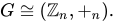
Define so that Failed to parse (Conversion error. Server ("https://wikimedia.org/api/rest_") reported: "Cannot get mml. Server problem."): {\displaystyle \varphi (x^{a})=a.} Clearly, Failed to parse (Conversion error. Server ("https://wikimedia.org/api/rest_") reported: "Cannot get mml. Server problem."): {\displaystyle \varphi } is bijective. Then which proves that


Consequences
[edit | edit source]From the definition, it follows that any isomorphism will map the identity element of to the identity element of Failed to parse (Conversion error. Server ("https://wikimedia.org/api/rest_") reported: "Cannot get mml. Server problem."): {\displaystyle H,} Failed to parse (Conversion error. Server ("https://wikimedia.org/api/rest_") reported: "Cannot get mml. Server problem."): {\displaystyle f(e_{G})=e_{H},} that it will map inverses to inverses, Failed to parse (Conversion error. Server ("https://wikimedia.org/api/rest_") reported: "Cannot get mml. Server problem."): {\displaystyle f(u^{-1})=f(u)^{-1}\quad {\text{ for all }}u\in G,} and more generally, th powers to th powers, Failed to parse (Conversion error. Server ("https://wikimedia.org/api/rest_") reported: "Cannot get mml. Server problem."): {\displaystyle f(u^{n})=f(u)^{n}\quad {\text{ for all }}u\in G,} and that the inverse map Failed to parse (SVG (MathML can be enabled via browser plugin): Invalid response ("Math extension cannot connect to Restbase.") from server "https://wikimedia.org/api/rest_v1/":): {\displaystyle f^{-1} : H \to G} is also a group isomorphism.
The relation "being isomorphic" is an equivalence relation. If Failed to parse (SVG (MathML can be enabled via browser plugin): Invalid response ("Math extension cannot connect to Restbase.") from server "https://wikimedia.org/api/rest_v1/":): {\displaystyle f} is an isomorphism between two groups Failed to parse (SVG (MathML can be enabled via browser plugin): Invalid response ("Math extension cannot connect to Restbase.") from server "https://wikimedia.org/api/rest_v1/":): {\displaystyle G} and Failed to parse (SVG (MathML can be enabled via browser plugin): Invalid response ("Math extension cannot connect to Restbase.") from server "https://wikimedia.org/api/rest_v1/":): {\displaystyle H,} then everything that is true about Failed to parse (SVG (MathML can be enabled via browser plugin): Invalid response ("Math extension cannot connect to Restbase.") from server "https://wikimedia.org/api/rest_v1/":): {\displaystyle G} that is only related to the group structure can be translated via Failed to parse (SVG (MathML can be enabled via browser plugin): Invalid response ("Math extension cannot connect to Restbase.") from server "https://wikimedia.org/api/rest_v1/":): {\displaystyle f} into a true ditto statement about Failed to parse (SVG (MathML can be enabled via browser plugin): Invalid response ("Math extension cannot connect to Restbase.") from server "https://wikimedia.org/api/rest_v1/":): {\displaystyle H,} and vice versa.
Automorphisms
[edit | edit source]An isomorphism from a group Failed to parse (SVG (MathML can be enabled via browser plugin): Invalid response ("Math extension cannot connect to Restbase.") from server "https://wikimedia.org/api/rest_v1/":): {\displaystyle (G, *)} to itself is called an automorphism of the group. Thus it is a bijection Failed to parse (SVG (MathML can be enabled via browser plugin): Invalid response ("Math extension cannot connect to Restbase.") from server "https://wikimedia.org/api/rest_v1/":): {\displaystyle f : G \to G} such that Failed to parse (SVG (MathML can be enabled via browser plugin): Invalid response ("Math extension cannot connect to Restbase.") from server "https://wikimedia.org/api/rest_v1/":): {\displaystyle f(u) * f(v) = f(u * v).}
The image under an automorphism of a conjugacy class is always a conjugacy class (the same or another).
The composition of two automorphisms is again an automorphism, and with this operation the set of all automorphisms of a group Failed to parse (SVG (MathML can be enabled via browser plugin): Invalid response ("Math extension cannot connect to Restbase.") from server "https://wikimedia.org/api/rest_v1/":): {\displaystyle G,} denoted by Failed to parse (SVG (MathML can be enabled via browser plugin): Invalid response ("Math extension cannot connect to Restbase.") from server "https://wikimedia.org/api/rest_v1/":): {\displaystyle \operatorname{Aut}(G),} itself forms a group, the automorphism group of Failed to parse (SVG (MathML can be enabled via browser plugin): Invalid response ("Math extension cannot connect to Restbase.") from server "https://wikimedia.org/api/rest_v1/":): {\displaystyle G.}
For all abelian groups there is at least the automorphism that replaces the group elements by their inverses. However, in groups where all elements are equal to their inverses this is the trivial automorphism, e.g. in the Klein four-group. For that group all permutations of the three non-identity elements are automorphisms, so the automorphism group is isomorphic to Failed to parse (SVG (MathML can be enabled via browser plugin): Invalid response ("Math extension cannot connect to Restbase.") from server "https://wikimedia.org/api/rest_v1/":): {\displaystyle S_3} (which itself is isomorphic to Failed to parse (SVG (MathML can be enabled via browser plugin): Invalid response ("Math extension cannot connect to Restbase.") from server "https://wikimedia.org/api/rest_v1/":): {\displaystyle \operatorname{Dih}_3} ).
In Failed to parse (SVG (MathML can be enabled via browser plugin): Invalid response ("Math extension cannot connect to Restbase.") from server "https://wikimedia.org/api/rest_v1/":): {\displaystyle \Z_p} for a prime number Failed to parse (SVG (MathML can be enabled via browser plugin): Invalid response ("Math extension cannot connect to Restbase.") from server "https://wikimedia.org/api/rest_v1/":): {\displaystyle p,} one non-identity element can be replaced by any other, with corresponding changes in the other elements. The automorphism group is isomorphic to Failed to parse (SVG (MathML can be enabled via browser plugin): Invalid response ("Math extension cannot connect to Restbase.") from server "https://wikimedia.org/api/rest_v1/":): {\displaystyle \Z_{p-1}} For example, for Failed to parse (SVG (MathML can be enabled via browser plugin): Invalid response ("Math extension cannot connect to Restbase.") from server "https://wikimedia.org/api/rest_v1/":): {\displaystyle n = 7,} multiplying all elements of Failed to parse (SVG (MathML can be enabled via browser plugin): Invalid response ("Math extension cannot connect to Restbase.") from server "https://wikimedia.org/api/rest_v1/":): {\displaystyle \Z_7} by 3, modulo 7, is an automorphism of order 6 in the automorphism group, because Failed to parse (SVG (MathML can be enabled via browser plugin): Invalid response ("Math extension cannot connect to Restbase.") from server "https://wikimedia.org/api/rest_v1/":): {\displaystyle 3^6 \equiv 1 \pmod 7,} while lower powers do not give 1. Thus this automorphism generates Failed to parse (SVG (MathML can be enabled via browser plugin): Invalid response ("Math extension cannot connect to Restbase.") from server "https://wikimedia.org/api/rest_v1/":): {\displaystyle \Z_6.} There is one more automorphism with this property: multiplying all elements of Failed to parse (SVG (MathML can be enabled via browser plugin): Invalid response ("Math extension cannot connect to Restbase.") from server "https://wikimedia.org/api/rest_v1/":): {\displaystyle \Z_7} by 5, modulo 7. Therefore, these two correspond to the elements 1 and 5 of Failed to parse (SVG (MathML can be enabled via browser plugin): Invalid response ("Math extension cannot connect to Restbase.") from server "https://wikimedia.org/api/rest_v1/":): {\displaystyle \Z_6,} in that order or conversely.
The automorphism group of Failed to parse (SVG (MathML can be enabled via browser plugin): Invalid response ("Math extension cannot connect to Restbase.") from server "https://wikimedia.org/api/rest_v1/":): {\displaystyle \Z_6} is isomorphic to Failed to parse (SVG (MathML can be enabled via browser plugin): Invalid response ("Math extension cannot connect to Restbase.") from server "https://wikimedia.org/api/rest_v1/":): {\displaystyle \Z_2,} because only each of the two elements 1 and 5 generate Failed to parse (SVG (MathML can be enabled via browser plugin): Invalid response ("Math extension cannot connect to Restbase.") from server "https://wikimedia.org/api/rest_v1/":): {\displaystyle \Z_6,} so apart from the identity we can only interchange these.
The automorphism group of Failed to parse (SVG (MathML can be enabled via browser plugin): Invalid response ("Math extension cannot connect to Restbase.") from server "https://wikimedia.org/api/rest_v1/":): {\displaystyle \Z_2 \oplus \Z_2 \oplus \Z_2 = \operatorname{Dih}_2 \oplus \Z_2} has order 168, as can be found as follows. All 7 non-identity elements play the same role, so we can choose which plays the role of Failed to parse (SVG (MathML can be enabled via browser plugin): Invalid response ("Math extension cannot connect to Restbase.") from server "https://wikimedia.org/api/rest_v1/":): {\displaystyle (1,0,0).} Any of the remaining 6 can be chosen to play the role of (0,1,0). This determines which element corresponds to Failed to parse (SVG (MathML can be enabled via browser plugin): Invalid response ("Math extension cannot connect to Restbase.") from server "https://wikimedia.org/api/rest_v1/":): {\displaystyle (1,1,0).} For Failed to parse (SVG (MathML can be enabled via browser plugin): Invalid response ("Math extension cannot connect to Restbase.") from server "https://wikimedia.org/api/rest_v1/":): {\displaystyle (0,0,1)} we can choose from 4, which determines the rest. Thus we have Failed to parse (SVG (MathML can be enabled via browser plugin): Invalid response ("Math extension cannot connect to Restbase.") from server "https://wikimedia.org/api/rest_v1/":): {\displaystyle 7 \times 6 \times 4 = 168} automorphisms. They correspond to those of the Fano plane, of which the 7 points correspond to the 7 non-identity elements. The lines connecting three points correspond to the group operation: Failed to parse (SVG (MathML can be enabled via browser plugin): Invalid response ("Math extension cannot connect to Restbase.") from server "https://wikimedia.org/api/rest_v1/":): {\displaystyle a, b,} and Failed to parse (SVG (MathML can be enabled via browser plugin): Invalid response ("Math extension cannot connect to Restbase.") from server "https://wikimedia.org/api/rest_v1/":): {\displaystyle c} on one line means Failed to parse (SVG (MathML can be enabled via browser plugin): Invalid response ("Math extension cannot connect to Restbase.") from server "https://wikimedia.org/api/rest_v1/":): {\displaystyle a + b = c,} Failed to parse (SVG (MathML can be enabled via browser plugin): Invalid response ("Math extension cannot connect to Restbase.") from server "https://wikimedia.org/api/rest_v1/":): {\displaystyle a + c = b,} and Failed to parse (SVG (MathML can be enabled via browser plugin): Invalid response ("Math extension cannot connect to Restbase.") from server "https://wikimedia.org/api/rest_v1/":): {\displaystyle b + c = a.} See also general linear group over finite fields.
For abelian groups, all non-trivial automorphisms are outer automorphisms.
Non-abelian groups have a non-trivial inner automorphism group, and possibly also outer automorphisms.
See also
[edit | edit source]- Group isomorphism problem
- Bijection – One-to-one correspondence
References
[edit | edit source]- Herstein, I. N. (1975). Topics in Algebra (2nd ed.). New York: John Wiley & Sons. ISBN 0471010901.
- ↑ 1.0 1.1 Barnard, Tony & Neil, Hugh (2017). Discovering Group Theory: A Transition to Advanced Mathematics. Boca Ratan: CRC Press. p. 94. ISBN 9781138030169.
- ↑ Budden, F. J. (1972). The Fascination of Groups (PDF). Cambridge: Cambridge University Press. p. 142. ISBN 0521080169. Retrieved 12 October 2022 – via VDOC.PUB.
- ↑ Ash (1973). "A Consequence of the Axiom of Choice". Journal of the Australian Mathematical Society. 19 (3): 306–308. doi:10.1017/S1446788700031505. Retrieved 21 September 2013.