Law of sines
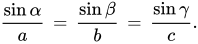
Template:Trigonometry In trigonometry, the law of sines (sometimes called the sine formula or sine rule) is a mathematical equation relating the lengths of the sides of any triangle to the sines of its angles. According to the law, where a, b, and c are the lengths of the sides of a triangle, and α, β, and γ are the opposite angles (see figure 2), while R is the radius of the triangle's circumcircle. When the last part of the equation is not used, the law is sometimes stated using the reciprocals; The law of sines can be used to compute the remaining sides of a triangle when two angles and a side are known—a technique known as triangulation. It can also be used when two sides and one of the non-enclosed angles are known. In some such cases, the triangle is not uniquely determined by this data (called the ambiguous case) and the technique gives two possible values for the enclosed angle.

The law of sines is one of two trigonometric equations commonly applied to find lengths and angles in scalene triangles, with the other being the law of cosines.
The law of sines can be generalized to higher dimensions on surfaces with constant curvature.[1]
Proof
[edit | edit source]With the side of length a as the base, the triangle's altitude can be computed as b sin γ or as c sin β. Equating these two expressions gives and similar equations arise by choosing the side of length b or the side of length c as the base of the triangle. For a proof that these expressions are equal to , see Relation to the circumcircle.


Ambiguous case of triangle solution
[edit | edit source]When using the law of sines to find a side of a triangle, an ambiguous case occurs when two separate triangles can be constructed from the data provided (i.e., there are two different possible solutions to the triangle). In the case shown below they are triangles ABC and ABC′.
Given a general triangle, the following conditions would need to be fulfilled for the case to be ambiguous:
- The only information known about the triangle is the angle α and the sides a and c.
- The angle α is acute (i.e., α < 90°).
- The side a is shorter than the side c (i.e., a < c).
- The side a is longer than the altitude h from angle β, where h = c sin α (i.e., a > h).
If all the above conditions are true, then each of angles β and β′ produces a valid triangle, meaning that both of the following are true: Failed to parse (Conversion error. Server ("https://wikimedia.org/api/rest_") reported: "Cannot get mml. Server problem."): {\displaystyle {\gamma }'=\arcsin {\frac {c\sin {\alpha }}{a}}\quad {\text{or}}\quad {\gamma }=\pi -\arcsin {\frac {c\sin {\alpha }}{a}}.}
From there we can find the corresponding β and b or β′ and b′ if required, where b is the side bounded by vertices A and C and b′ is bounded by A and C′.
Examples
[edit | edit source]The following are examples of how to solve a problem using the law of sines.
Example 1
[edit | edit source]Given: side a = 20, side c = 24, and angle γ = 40°. Angle α is desired.
Using the law of sines, we conclude that Failed to parse (Conversion error. Server ("https://wikimedia.org/api/rest_") reported: "Cannot get mml. Server problem."): {\displaystyle {\frac {\sin \alpha }{20}}={\frac {\sin(40^{\circ })}{24}}.} Failed to parse (Conversion error. Server ("https://wikimedia.org/api/rest_") reported: "Cannot get mml. Server problem."): {\displaystyle \alpha =\arcsin \left({\frac {20\sin(40^{\circ })}{24}}\right)\approx 32.39^{\circ }.}
Note that the potential solution α = 147.61° is excluded because that would necessarily give α + β + γ > 180°.
Example 2
[edit | edit source]If the lengths of two sides of the triangle a and b are equal to x, the third side has length c, and the angles opposite the sides of lengths a, b, and c are α, β, and γ respectively then
![{\displaystyle {\begin{aligned}&\alpha =\beta ={\frac {180^{\circ }-\gamma }{2}}=90^{\circ }-{\frac {\gamma }{2}}\\[6pt]&\sin \alpha =\sin \beta =\sin \left(90^{\circ }-{\frac {\gamma }{2}}\right)=\cos \left({\frac {\gamma }{2}}\right)\\[6pt]&{\frac {c}{\sin \gamma }}={\frac {a}{\sin \alpha }}={\frac {x}{\cos \left({\frac {\gamma }{2}}\right)}}\\[6pt]&{\frac {c\cos \left({\frac {\gamma }{2}}\right)}{\sin \gamma }}=x\end{aligned}}}](https://wikimedia.org/api/rest_v1/media/math/render/svg/31c04742b006ecbfdbe47aa89107f544c1941a5c)
Relation to the circumcircle
[edit | edit source]In the identity Failed to parse (Conversion error. Server ("https://wikimedia.org/api/rest_") reported: "Cannot get mml. Server problem."): {\displaystyle {\frac {a}{\sin {\alpha }}}={\frac {b}{\sin {\beta }}}={\frac {c}{\sin {\gamma }}},} the common value of the three fractions is actually the diameter of the triangle's circumcircle. This result dates back to Ptolemy.[2][3]
Proof
[edit | edit source]As shown in the figure, let there be a circle with inscribed Failed to parse (Conversion error. Server ("https://wikimedia.org/api/rest_") reported: "Cannot get mml. Server problem."): {\displaystyle \triangle ABC} and another inscribed that passes through the circle's center O. The Failed to parse (Conversion error. Server ("https://wikimedia.org/api/rest_") reported: "Cannot get mml. Server problem."): {\displaystyle \angle AOD} has a central angle of Failed to parse (Conversion error. Server ("https://wikimedia.org/api/rest_") reported: "Cannot get mml. Server problem."): {\displaystyle 180^{\circ }} and thus Failed to parse (Conversion error. Server ("https://wikimedia.org/api/rest_") reported: "Cannot get mml. Server problem."): {\displaystyle \angle ABD=90^{\circ }} , by Thales's theorem. Since Failed to parse (Conversion error. Server ("https://wikimedia.org/api/rest_") reported: "Cannot get mml. Server problem."): {\displaystyle \triangle ABD} is a right triangle, Failed to parse (Conversion error. Server ("https://wikimedia.org/api/rest_") reported: "Cannot get mml. Server problem."): {\displaystyle \sin {\delta }={\frac {\text{opposite}}{\text{hypotenuse}}}={\frac {c}{2R}},} where is the radius of the circumscribing circle of the triangle.[3] Angles and Failed to parse (Conversion error. Server ("https://wikimedia.org/api/rest_") reported: "Cannot get mml. Server problem."): {\displaystyle {\delta }} lie on the same circle and subtend the same chord c; thus, by the inscribed angle theorem, Failed to parse (Conversion error. Server ("https://wikimedia.org/api/rest_") reported: "Cannot get mml. Server problem."): {\displaystyle {\gamma }={\delta }} . Therefore, Failed to parse (Conversion error. Server ("https://wikimedia.org/api/rest_") reported: "Cannot get mml. Server problem."): {\displaystyle \sin {\delta }=\sin {\gamma }={\frac {c}{2R}}.}


Rearranging yields Failed to parse (Conversion error. Server ("https://wikimedia.org/api/rest_") reported: "Cannot get mml. Server problem."): {\displaystyle 2R={\frac {c}{\sin {\gamma }}}.}
Repeating the process of creating with other points gives
Relationship to the area of the triangle
[edit | edit source]The area of a triangle is given by Failed to parse (Conversion error. Server ("https://wikimedia.org/api/rest_") reported: "Cannot get mml. Server problem."): {\textstyle T={\frac {1}{2}}ab\sin \theta } , where is the angle enclosed by the sides of lengths a and b. Substituting the sine law into this equation gives Failed to parse (Conversion error. Server ("https://wikimedia.org/api/rest_") reported: "Cannot get mml. Server problem."): {\displaystyle T={\frac {1}{2}}ab\cdot {\frac {c}{2R}}.}

Taking as the circumscribing radius,[4]

It can also be shown that this equality implies where T is the area of the triangle and s is the semiperimeter Failed to parse (Conversion error. Server ("https://wikimedia.org/api/rest_") reported: "Cannot get mml. Server problem."): {\textstyle s={\frac {1}{2}}\left(a+b+c\right).}
![{\displaystyle {\begin{aligned}{\frac {abc}{2T}}&={\frac {abc}{2{\sqrt {s(s-a)(s-b)(s-c)}}}}\\[6pt]&={\frac {2abc}{\sqrt {{(a^{2}+b^{2}+c^{2})}^{2}-2(a^{4}+b^{4}+c^{4})}}},\end{aligned}}}](https://wikimedia.org/api/rest_v1/media/math/render/svg/b0791f9e5aaf7e592ffdd98ae27e4b34555d1a68)
The second equality above readily simplifies to Heron's formula for the area.
The sine rule can also be used in deriving the following formula for the triangle's area: denoting the semi-sum of the angles' sines as , we have[5]

where is the radius of the circumcircle: .

Spherical law of sines
[edit | edit source]The spherical law of sines deals with triangles on a sphere, whose sides are arcs of great circles.
Suppose the radius of the sphere is 1. Let a, b, and c be the lengths of the great-arcs that are the sides of the triangle. Because it is a unit sphere, a, b, and c are the angles at the center of the sphere subtended by those arcs, in radians. Let A, B, and C be the angles opposite those respective sides. These are dihedral angles between the planes of the three great circles.
Then the spherical law of sines says: Failed to parse (Conversion error. Server ("https://wikimedia.org/api/rest_") reported: "Cannot get mml. Server problem."): {\displaystyle {\frac {\sin A}{\sin a}}={\frac {\sin B}{\sin b}}={\frac {\sin C}{\sin c}}.}
Vector proof
[edit | edit source]Consider a unit sphere with three unit vectors OA, OB and OC drawn from the origin to the vertices of the triangle. Thus the angles α, β, and γ are the angles a, b, and c, respectively. The arc BC subtends an angle of magnitude a at the centre. Introduce a Cartesian basis with OA along the z-axis and OB in the xz-plane making an angle c with the z-axis. The vector OC projects to ON in the xy-plane and the angle between ON and the x-axis is A. Therefore, the three vectors have components: Failed to parse (Conversion error. Server ("https://wikimedia.org/api/rest_") reported: "Cannot get mml. Server problem."): {\displaystyle \mathbf {OA} ={\begin{pmatrix}0\\0\\1\end{pmatrix}},\quad \mathbf {OB} ={\begin{pmatrix}\sin c\\0\\\cos c\end{pmatrix}},\quad \mathbf {OC} ={\begin{pmatrix}\sin b\cos A\\\sin b\sin A\\\cos b\end{pmatrix}}.}
The scalar triple product, OA ⋅ (OB × OC) is the volume of the parallelepiped formed by the position vectors of the vertices of the spherical triangle OA, OB and OC. This volume is invariant to the specific coordinate system used to represent OA, OB and OC. The value of the scalar triple product OA ⋅ (OB × OC) is the 3 × 3 determinant with OA, OB and OC as its rows. With the z-axis along OA the square of this determinant is Failed to parse (Conversion error. Server ("https://wikimedia.org/api/rest_") reported: "Cannot get mml. Server problem."): {\displaystyle {\begin{aligned}{\bigl (}\mathbf {OA} \cdot (\mathbf {OB} \times \mathbf {OC} ){\bigr )}^{2}&=\left(\det {\begin{pmatrix}\mathbf {OA} &\mathbf {OB} &\mathbf {OC} \end{pmatrix}}\right)^{2}\\[4pt]&={\begin{vmatrix}0&0&1\\\sin c&0&\cos c\\\sin b\cos A&\sin b\sin A&\cos b\end{vmatrix}}^{2}=\left(\sin b\sin c\sin A\right)^{2}.\end{aligned}}} Repeating this calculation with the z-axis along OB gives (sin c sin a sin B)2, while with the z-axis along OC it is (sin a sin b sin C)2. Equating these expressions and dividing throughout by (sin a sin b sin c)2 gives where V is the volume of the parallelepiped formed by the position vector of the vertices of the spherical triangle. Consequently, the result follows.


.svg)
.svg)
.svg)
.svg)

It is easy to see how for small spherical triangles, when the radius of the sphere is much greater than the sides of the triangle, this formula becomes the planar formula at the limit, since Failed to parse (Conversion error. Server ("https://wikimedia.org/api/rest_") reported: "Cannot get mml. Server problem."): {\displaystyle \lim _{a\to 0}{\frac {\sin a}{a}}=1} and the same for sin b and sin c.

Geometric proof
[edit | edit source]Consider a unit sphere with: Failed to parse (SVG (MathML can be enabled via browser plugin): Invalid response ("Math extension cannot connect to Restbase.") from server "https://wikimedia.org/api/rest_v1/":): {\displaystyle OA = OB = OC = 1}
Construct point Failed to parse (SVG (MathML can be enabled via browser plugin): Invalid response ("Math extension cannot connect to Restbase.") from server "https://wikimedia.org/api/rest_v1/":): {\displaystyle D} and point Failed to parse (SVG (MathML can be enabled via browser plugin): Invalid response ("Math extension cannot connect to Restbase.") from server "https://wikimedia.org/api/rest_v1/":): {\displaystyle E} such that Failed to parse (SVG (MathML can be enabled via browser plugin): Invalid response ("Math extension cannot connect to Restbase.") from server "https://wikimedia.org/api/rest_v1/":): {\displaystyle \angle ADO = \angle AEO = 90^\circ}
Construct point Failed to parse (SVG (MathML can be enabled via browser plugin): Invalid response ("Math extension cannot connect to Restbase.") from server "https://wikimedia.org/api/rest_v1/":): {\displaystyle A'} such that Failed to parse (SVG (MathML can be enabled via browser plugin): Invalid response ("Math extension cannot connect to Restbase.") from server "https://wikimedia.org/api/rest_v1/":): {\displaystyle \angle A'DO = \angle A'EO = 90^\circ}
It can therefore be seen that Failed to parse (SVG (MathML can be enabled via browser plugin): Invalid response ("Math extension cannot connect to Restbase.") from server "https://wikimedia.org/api/rest_v1/":): {\displaystyle \angle ADA' = B} and Failed to parse (SVG (MathML can be enabled via browser plugin): Invalid response ("Math extension cannot connect to Restbase.") from server "https://wikimedia.org/api/rest_v1/":): {\displaystyle \angle AEA' = C}
Notice that Failed to parse (SVG (MathML can be enabled via browser plugin): Invalid response ("Math extension cannot connect to Restbase.") from server "https://wikimedia.org/api/rest_v1/":): {\displaystyle A'} is the projection of Failed to parse (SVG (MathML can be enabled via browser plugin): Invalid response ("Math extension cannot connect to Restbase.") from server "https://wikimedia.org/api/rest_v1/":): {\displaystyle A} on plane Failed to parse (SVG (MathML can be enabled via browser plugin): Invalid response ("Math extension cannot connect to Restbase.") from server "https://wikimedia.org/api/rest_v1/":): {\displaystyle OBC} . Therefore Failed to parse (SVG (MathML can be enabled via browser plugin): Invalid response ("Math extension cannot connect to Restbase.") from server "https://wikimedia.org/api/rest_v1/":): {\displaystyle \angle AA'D = \angle AA'E = 90^\circ}
By basic trigonometry, we have: Failed to parse (SVG (MathML can be enabled via browser plugin): Invalid response ("Math extension cannot connect to Restbase.") from server "https://wikimedia.org/api/rest_v1/":): {\displaystyle \begin{align} AD &= \sin c \\ AE &= \sin b \end{align}}
But Failed to parse (SVG (MathML can be enabled via browser plugin): Invalid response ("Math extension cannot connect to Restbase.") from server "https://wikimedia.org/api/rest_v1/":): {\displaystyle AA' = AD \sin B = AE \sin C }
Combining them we have: Failed to parse (SVG (MathML can be enabled via browser plugin): Invalid response ("Math extension cannot connect to Restbase.") from server "https://wikimedia.org/api/rest_v1/":): {\displaystyle \begin{align} \sin c \sin B &= \sin b \sin C \\ \Rightarrow \frac{\sin B}{\sin b} &=\frac{\sin C}{\sin c} \end{align}}
By applying similar reasoning, we obtain the spherical law of sines: Failed to parse (SVG (MathML can be enabled via browser plugin): Invalid response ("Math extension cannot connect to Restbase.") from server "https://wikimedia.org/api/rest_v1/":): {\displaystyle \frac{\sin A}{\sin a} =\frac{\sin B}{\sin b} =\frac{\sin C}{\sin c} }
Other proofs
[edit | edit source]A purely algebraic proof can be constructed from the spherical law of cosines. From the identity Failed to parse (SVG (MathML can be enabled via browser plugin): Invalid response ("Math extension cannot connect to Restbase.") from server "https://wikimedia.org/api/rest_v1/":): {\displaystyle \sin^2 A = 1 - \cos^2 A} and the explicit expression for Failed to parse (SVG (MathML can be enabled via browser plugin): Invalid response ("Math extension cannot connect to Restbase.") from server "https://wikimedia.org/api/rest_v1/":): {\displaystyle \cos A} from the spherical law of cosines Failed to parse (SVG (MathML can be enabled via browser plugin): Invalid response ("Math extension cannot connect to Restbase.") from server "https://wikimedia.org/api/rest_v1/":): {\displaystyle \begin{align} \sin^2\!A &= 1-\left(\frac{\cos a - \cos b\, \cos c}{\sin b \,\sin c}\right)^2\\ &=\frac{\left(1-\cos^2\!b\right) \left(1-\cos^2\!c\right)-\left(\cos a - \cos b\, \cos c\right)^2} {\sin^2\!b \,\sin^2\!c}\\[8pt] \frac{\sin A}{\sin a} &= \frac{\left[1-\cos^2\!a-\cos^2\!b-\cos^2\!c + 2\cos a\cos b\cos c\right]^{1/2}}{\sin a\sin b\sin c}. \end{align}} Since the right hand side is invariant under a cyclic permutation of Failed to parse (SVG (MathML can be enabled via browser plugin): Invalid response ("Math extension cannot connect to Restbase.") from server "https://wikimedia.org/api/rest_v1/":): {\displaystyle a,\;b,\;c} the spherical sine rule follows immediately.
The figure used in the Geometric proof above is used by and also provided in Banerjee[6] (see Figure 3 in this paper) to derive the sine law using elementary linear algebra and projection matrices.
Hyperbolic case
[edit | edit source]In hyperbolic geometry when the curvature is −1, the law of sines becomes Failed to parse (SVG (MathML can be enabled via browser plugin): Invalid response ("Math extension cannot connect to Restbase.") from server "https://wikimedia.org/api/rest_v1/":): {\displaystyle \frac{\sin A}{\sinh a} = \frac{\sin B}{\sinh b} = \frac{\sin C}{\sinh c} \,.}
In the special case when B is a right angle, one gets Failed to parse (SVG (MathML can be enabled via browser plugin): Invalid response ("Math extension cannot connect to Restbase.") from server "https://wikimedia.org/api/rest_v1/":): {\displaystyle \sin C = \frac{\sinh c}{\sinh b} }
which is the analog of the formula in Euclidean geometry expressing the sine of an angle as the opposite side divided by the hypotenuse.
The case of surfaces of constant curvature
[edit | edit source]Define a generalized sine function, depending also on a real parameter Failed to parse (SVG (MathML can be enabled via browser plugin): Invalid response ("Math extension cannot connect to Restbase.") from server "https://wikimedia.org/api/rest_v1/":): {\displaystyle \kappa} : Failed to parse (SVG (MathML can be enabled via browser plugin): Invalid response ("Math extension cannot connect to Restbase.") from server "https://wikimedia.org/api/rest_v1/":): {\displaystyle \sin_\kappa(x) = x - \frac{\kappa}{3!}x^3 + \frac{\kappa^2}{5!}x^5 - \frac{\kappa^3}{7!}x^7 + \cdots = \sum_{n=0}^\infty \frac{(-1)^n \kappa^n}{(2n+1)!}x^{2n+1}.}
The law of sines in constant curvature Failed to parse (SVG (MathML can be enabled via browser plugin): Invalid response ("Math extension cannot connect to Restbase.") from server "https://wikimedia.org/api/rest_v1/":): {\displaystyle \kappa} reads as[1] Failed to parse (SVG (MathML can be enabled via browser plugin): Invalid response ("Math extension cannot connect to Restbase.") from server "https://wikimedia.org/api/rest_v1/":): {\displaystyle \frac{\sin A}{\sin_\kappa a} = \frac{\sin B}{\sin_\kappa b} = \frac{\sin C}{\sin_\kappa c} \,.}
By substituting Failed to parse (SVG (MathML can be enabled via browser plugin): Invalid response ("Math extension cannot connect to Restbase.") from server "https://wikimedia.org/api/rest_v1/":): {\displaystyle \kappa=0} , Failed to parse (SVG (MathML can be enabled via browser plugin): Invalid response ("Math extension cannot connect to Restbase.") from server "https://wikimedia.org/api/rest_v1/":): {\displaystyle \kappa=1} , and Failed to parse (SVG (MathML can be enabled via browser plugin): Invalid response ("Math extension cannot connect to Restbase.") from server "https://wikimedia.org/api/rest_v1/":): {\displaystyle \kappa=-1} , one obtains respectively Failed to parse (SVG (MathML can be enabled via browser plugin): Invalid response ("Math extension cannot connect to Restbase.") from server "https://wikimedia.org/api/rest_v1/":): {\displaystyle \sin_{0}(x) = x} , Failed to parse (SVG (MathML can be enabled via browser plugin): Invalid response ("Math extension cannot connect to Restbase.") from server "https://wikimedia.org/api/rest_v1/":): {\displaystyle \sin_{1}(x) = \sin x} , and Failed to parse (SVG (MathML can be enabled via browser plugin): Invalid response ("Math extension cannot connect to Restbase.") from server "https://wikimedia.org/api/rest_v1/":): {\displaystyle \sin_{-1}(x) = \sinh x} , that is, the Euclidean, spherical, and hyperbolic cases of the law of sines described above.[1]
Let Failed to parse (SVG (MathML can be enabled via browser plugin): Invalid response ("Math extension cannot connect to Restbase.") from server "https://wikimedia.org/api/rest_v1/":): {\displaystyle p_\kappa(r)} indicate the circumference of a circle of radius Failed to parse (SVG (MathML can be enabled via browser plugin): Invalid response ("Math extension cannot connect to Restbase.") from server "https://wikimedia.org/api/rest_v1/":): {\displaystyle r} in a space of constant curvature Failed to parse (SVG (MathML can be enabled via browser plugin): Invalid response ("Math extension cannot connect to Restbase.") from server "https://wikimedia.org/api/rest_v1/":): {\displaystyle \kappa} . Then Failed to parse (SVG (MathML can be enabled via browser plugin): Invalid response ("Math extension cannot connect to Restbase.") from server "https://wikimedia.org/api/rest_v1/":): {\displaystyle p_\kappa(r)=2\pi\sin_\kappa(r)} . Therefore, the law of sines can also be expressed as: Failed to parse (SVG (MathML can be enabled via browser plugin): Invalid response ("Math extension cannot connect to Restbase.") from server "https://wikimedia.org/api/rest_v1/":): {\displaystyle \frac{\sin A}{p_\kappa(a)} = \frac{\sin B}{p_\kappa(b)} = \frac{\sin C}{p_\kappa(c)} \,.}
This formulation was discovered by János Bolyai.[7]
Higher dimensions
[edit | edit source]A tetrahedron has four triangular facets. The absolute value of the polar sine (psin) of the normal vectors to the three facets that share a vertex of the tetrahedron, divided by the area of the fourth facet will not depend upon the choice of the vertex:[8]
Failed to parse (SVG (MathML can be enabled via browser plugin): Invalid response ("Math extension cannot connect to Restbase.") from server "https://wikimedia.org/api/rest_v1/":): {\displaystyle \begin{align} & \frac{\left|\operatorname{psin}(\mathbf{b}, \mathbf{c}, \mathbf{d})\right|}{\mathrm{Area}_a} = \frac{\left|\operatorname{psin}(\mathbf{a}, \mathbf{c}, \mathbf{d})\right|}{\mathrm{Area}_b} = \frac{\left|\operatorname{psin}(\mathbf{a}, \mathbf{b}, \mathbf{d})\right|}{\mathrm{Area}_c} = \frac{\left|\operatorname{psin}(\mathbf{a}, \mathbf{b}, \mathbf{c})\right|}{\mathrm{Area}_d} \\[4pt] = {} & \frac{(3~\mathrm{Volume}_\mathrm{tetrahedron})^2}{2~\mathrm{Area}_a \mathrm{Area}_b \mathrm{Area}_c \mathrm{Area}_d}\,. \end{align}}
More generally, for an n-dimensional simplex (i.e., triangle (n = 2), tetrahedron (n = 3), pentatope (n = 4), etc.) in n-dimensional Euclidean space, the absolute value of the polar sine of the normal vectors of the facets that meet at a vertex, divided by the hyperarea of the facet opposite the vertex is independent of the choice of the vertex. Writing V for the hypervolume of the n-dimensional simplex and P for the product of the hyperareas of its (n − 1)-dimensional facets, the common ratio is Failed to parse (SVG (MathML can be enabled via browser plugin): Invalid response ("Math extension cannot connect to Restbase.") from server "https://wikimedia.org/api/rest_v1/":): {\displaystyle \frac{\left|\operatorname{psin}(\mathbf{b}, \ldots, \mathbf{z})\right|}{\mathrm{Area}_a} = \cdots = \frac{\left|\operatorname{psin}(\mathbf{a}, \ldots, \mathbf{y})\right|}{\mathrm{Area}_z} = \frac{(nV)^{n-1}}{(n-1)! P}.}
Note that when the vectors v1, ..., vn, from a selected vertex to each of the other vertices, are the columns of a matrix V then the columns of the matrix Failed to parse (SVG (MathML can be enabled via browser plugin): Invalid response ("Math extension cannot connect to Restbase.") from server "https://wikimedia.org/api/rest_v1/":): {\displaystyle N = -V (V^TV)^{-1} \sqrt{\det{V^TV}} / (n-1)!} are outward-facing normal vectors of those facets that meet at the selected vertex. This formula also works when the vectors are in a m-dimensional space having m > n. In the m = n case that V is square, the formula simplifies to Failed to parse (SVG (MathML can be enabled via browser plugin): Invalid response ("Math extension cannot connect to Restbase.") from server "https://wikimedia.org/api/rest_v1/":): {\displaystyle N = -(V^T)^{-1} |\det{V}| / (n-1)!\,.}
History
[edit | edit source]An equivalent of the law of sines, that the sides of a triangle are proportional to the chords of double the opposite angles, was known to the 2nd century Hellenistic astronomer Ptolemy and used occasionally in his Almagest.[9]
Statements related to the law of sines appear in the astronomical and trigonometric work of 7th century Indian mathematician Brahmagupta. In his Brāhmasphuṭasiddhānta, Brahmagupta expresses the circumradius of a triangle as the product of two sides divided by twice the altitude; the law of sines can be derived by alternately expressing the altitude as the sine of one or the other base angle times its opposite side, then equating the two resulting variants.[10] An equation even closer to the modern law of sines appears in Brahmagupta's Khaṇḍakhādyaka, in a method for finding the distance between the Earth and a planet following an epicycle; however, Brahmagupta never treated the law of sines as an independent subject or used it systematically for solving triangles.[11]
The spherical law of sines is sometimes credited to 10th century scholars Abu-Mahmud Khujandi or Abū al-Wafāʾ (it appears in his Almagest), but it is given prominence in Abū Naṣr Manṣūr's Treatise on the Determination of Spherical Arcs, and was credited to Abū Naṣr Manṣūr by his student al-Bīrūnī in his Keys to Astronomy.[12] Ibn Muʿādh al-Jayyānī's 11th-century Book of Unknown Arcs of a Sphere also contains the spherical law of sines.[13]
The 13th-century Persian mathematician Naṣīr al-Dīn al-Ṭūsī stated and proved the planar law of sines:[14]
In any plane triangle, the ratio of the sides is equal to the ratio of the sines of the angles opposite to those sides. That is, in triangle ABC, we have AB : AC = Sin(∠ACB) : Sin(∠ABC)
By employing the law of sines, al-Tusi could solve triangles where either two angles and a side were known or two sides and an angle opposite one of them were given. For triangles with two sides and the included angle, he divided them into right triangles that he could then solve. When three sides were given, he dropped a perpendicular line and then used Proposition II-13 of Euclid's Elements (a geometric version of the law of cosines). Al-Tusi established the important result that if the sum or difference of two arcs is provided along with the ratio of their sines, then the arcs can be calculated.[15]
According to Glen Van Brummelen, "The Law of Sines is really Regiomontanus's foundation for his solutions of right-angled triangles in Book IV, and these solutions are in turn the bases for his solutions of general triangles."[16] Regiomontanus was a 15th-century German mathematician.
See also
[edit | edit source]- Gersonides – Medieval Jewish philosopher
- Half-side formula – for solving spherical triangles
- Law of cosines
- Law of tangents
- Law of cotangents
- Mollweide's formula – for checking solutions of triangles
- Solution of triangles
- Surveying
References
[edit | edit source]- ↑ 1.0 1.1 1.2 "Generalized law of sines". mathworld.
- ↑ Coxeter, H. S. M. and Greitzer, S. L. Geometry Revisited. Washington, DC: Math. Assoc. Amer., pp. 1–3, 1967
- ↑ 3.0 3.1 "Law of Sines". www.pballew.net. Archived from the original on December 29, 2002. Retrieved 2018-09-18.CS1 maint: unfit URL (link)
- ↑ Mr. T's Math Videos (2015-06-10), Area of a Triangle and Radius of its Circumscribed Circle, archived from the original on 2021-12-11, retrieved 2018-09-18
- ↑ Mitchell, Douglas W., "A Heron-type area formula in terms of sines," Mathematical Gazette 93, March 2009, 108–109.
- ↑ Banerjee, Sudipto (2004), "Revisiting Spherical Trigonometry with Orthogonal Projectors" (PDF), The College Mathematics Journal, Mathematical Association of America, 35 (5): 375–381, doi:10.1080/07468342.2004.11922099, archived from the original (PDF) on 2004-10-29, retrieved 2024-02-08
- ↑ Katok, Svetlana (1992). Fuchsian groups. Chicago: University of Chicago Press. p. 22. ISBN 0-226-42583-5.
- ↑ Eriksson, Folke (1978). "The law of sines for tetrahedra and n-simplices". Geometriae Dedicata. 7 (1): 71–80. doi:10.1007/bf00181352.
- ↑ Toomer, Gerald J., ed. (1998). Ptolemy's Almagest. Princeton University Press. pp. 7, fn. 10, 462, fn. 96.
- ↑ Winter, Henry James Jacques (1952). Eastern Science. John Murray. p. 46. Colebrooke, Henry Thomas (1817). Algebra, with Arithmetic and Mensuration from the Sanscrit of Brahmegupta and Bhascara. London: John Murray. pp. 299–300.
- ↑ Van Brummelen, Glen (2009). The Mathematics of the Heavens and the Earth. Princeton University Press. pp. 109–111. ISBN 978-0-691-12973-0. Brahmagupta (1934). The Khandakhadyaka: An Astronomical Treatise of Brahmagupta. Translated by Sengupta, Prabodh Chandra. University of Calcutta.
- ↑ Sesiano, Jacques (2000). "Islamic mathematics". In Selin, Helaine; D'Ambrosio, Ubiratan (eds.). Mathematics Across Cultures: The History of Non-western Mathematics. Springer. pp. 137–157. ISBN 1-4020-0260-2. Van Brummelen, Glen (2009). The Mathematics of the Heavens and the Earth. Princeton University Press. pp. 183–185. ISBN 978-0-691-12973-0.
- ↑ O'Connor, John J.; Robertson, Edmund F., "Abu Abd Allah Muhammad ibn Muadh Al-Jayyani", MacTutor History of Mathematics archive, University of St Andrews
- ↑ "Nasir al-Din al-Tusi - Biography". Maths History. Retrieved 2025-03-10.
- ↑ Katz, Victor J. (2017-03-21). A History of Mathematics: An Introduction. Pearson. p. 315. ISBN 978-0-13-468952-4.
- ↑ Van Brummelen, Glen (2009). The Mathematics of the Heavens and the Earth: The Early History of Trigonometry. Princeton University Press. p. 259. ISBN 978-0-691-12973-0.
External links
[edit | edit source] |
Wikimedia Commons has media related to Law of sines. |