Removable singularity
TemplateStyles' src attribute must not be empty.
 | This article needs additional citations for verification. (July 2021) |
In complex analysis, a removable singularity of a holomorphic function is a point at which the function is undefined, but it is possible to redefine the function at that point in such a way that the resulting function is regular in a neighbourhood of that point.
For instance, the (unnormalized) sinc function, as defined by

has a singularity at Template:Tmath. This singularity can be removed by defining Template:Tmath, which is the limit of sinc as Template:Tmath tends to Template:Tmath. The resulting function is holomorphic. In this case the problem was caused by sinc being given an indeterminate form. Taking a power series expansion for Template:Tmath around the singular point shows that

Formally, if is an open subset of the complex plane Template:Tmath, a point of Template:Tmath, and is a holomorphic function, then is called a removable singularity for if there exists a holomorphic function which coincides with on Template:Tmath. We say is holomorphically extendable over if such a exists.


Riemann's theorem
Riemann's theorem on removable singularities is as follows:
The implications 1 ⇒ 2 ⇒ 3 ⇒ 4 are trivial. To prove 4 ⇒ 1, we first recall that the holomorphy of a function at is equivalent to it being analytic at (proof), i.e. having a power series representation. Define
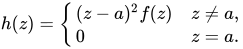
Clearly, Template:Tmath is holomorphic on Template:Tmath, and there exists

by 4, hence Template:Tmath is holomorphic on Template:Tmath and has a Taylor series about Template:Tmath:

We have Template:Tmath and Template:Tmath; therefore

Hence, where Template:Tmath, we have:

However,

is holomorphic on Template:Tmath, thus an extension of Template:Tmath.
Other kinds of singularities
Unlike functions of a real variable, holomorphic functions are sufficiently rigid that their isolated singularities can be completely classified. A holomorphic function's singularity is either not really a singularity at all, i.e. a removable singularity, or one of the following two types:
- In light of Riemann's theorem, given a non-removable singularity, one might ask whether there exists a natural number such that Template:Tmath. If so, is called a pole of and the smallest such is the order of Template:Tmath. So removable singularities are precisely the poles of order Template:Tmath. A meromorphic function blows up uniformly near its other poles.
- If an isolated singularity Failed to parse (SVG (MathML can be enabled via browser plugin): Invalid response ("Math extension cannot connect to Restbase.") from server "https://wikimedia.org/api/rest_v1/":): {\displaystyle a} of Failed to parse (SVG (MathML can be enabled via browser plugin): Invalid response ("Math extension cannot connect to Restbase.") from server "https://wikimedia.org/api/rest_v1/":): {\displaystyle f} is neither removable nor a pole, it is called an essential singularity. The Great Picard Theorem shows that such an Failed to parse (SVG (MathML can be enabled via browser plugin): Invalid response ("Math extension cannot connect to Restbase.") from server "https://wikimedia.org/api/rest_v1/":): {\displaystyle f} maps every punctured open neighborhood Failed to parse (SVG (MathML can be enabled via browser plugin): Invalid response ("Math extension cannot connect to Restbase.") from server "https://wikimedia.org/api/rest_v1/":): {\displaystyle U \smallsetminus \{a\}} to the entire complex plane, with the possible exception of at most one point.


See also
External links
- Removable singular point at Encyclopedia of Mathematics Archived 2012-12-20 at archive.today