Diffeomorphism
In mathematics, a diffeomorphism is an isomorphism of differentiable manifolds. It is an invertible function that maps one differentiable manifold to another such that both the function and its inverse are continuously differentiable.
Definition
[edit]Given two differentiable manifolds and , a continuously differentiable map is a diffeomorphism if it is a bijection and its inverse is differentiable as well. If these functions are times continuously differentiable, is called a -diffeomorphism.


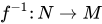


Two manifolds and are diffeomorphic (usually denoted ) if there is a diffeomorphism from to . Two -differentiable manifolds are -diffeomorphic if there is an times continuously differentiable bijective map between them whose inverse is also times continuously differentiable. A -diffeomorphism is simply a diffeomorphism, and a -diffeomorphism is a homeomorphism.


Diffeomorphisms of subsets of manifolds
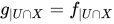
[edit]Given a subset of a manifold and a subset of a manifold , a function is said to be smooth if for all in there is a neighborhood of and a smooth function such that the restrictions agree: (note that is an extension of ). The function is said to be a diffeomorphism if it is bijective, smooth and its inverse is smooth.



Local description
[edit]Testing whether a differentiable map is a diffeomorphism can be made locally under some mild restrictions. This is the Hadamard-Caccioppoli theorem:[1]
If , are connected open subsets of such that is simply connected, a differentiable map is a diffeomorphism if it is proper and if the differential Failed to parse (Conversion error. Server ("https://wikimedia.org/api/rest_") reported: "Cannot get mml. Server problem."): {\displaystyle Df_{x}:\mathbb {R} ^{n}\to \mathbb {R} ^{n}} is bijective (and hence a linear isomorphism) at each point in .


Some remarks:
It is essential for to be simply connected for the function to be globally invertible (under the sole condition that its derivative be a bijective map at each point). For example, consider the "realification" of the complex square function

Then is surjective and it satisfies

Thus, though is bijective at each point, is not invertible because it fails to be injective (e.g. Failed to parse (Conversion error. Server ("https://wikimedia.org/api/rest_") reported: "Cannot get mml. Server problem."): {\displaystyle f(1,0)=(1,0)=f(-1,0)} ).

Since the differential at a point (for a differentiable function)

is a linear map, it has a well-defined inverse if and only if is a bijection. The matrix representation of is the matrix of first-order partial derivatives whose entry in the -th row and -th column is Failed to parse (Conversion error. Server ("https://wikimedia.org/api/rest_") reported: "Cannot get mml. Server problem."): {\displaystyle \partial f_{i}/\partial x_{j}} . This so-called Jacobian matrix is often used for explicit computations.


Diffeomorphisms are necessarily between manifolds of the same dimension. Imagine going from dimension to dimension . If then could never be surjective, and if Failed to parse (Conversion error. Server ("https://wikimedia.org/api/rest_") reported: "Cannot get mml. Server problem."): {\displaystyle n>k} then could never be injective. In both cases, therefore, fails to be a bijection.


If is a bijection at then is said to be a local diffeomorphism (since, by continuity, will also be bijective for all sufficiently close to ).


Given a smooth map from dimension to dimension , if (or, locally, ) is surjective, is said to be a submersion (or, locally, a "local submersion"); and if (or, locally, ) is injective, Failed to parse (SVG (MathML can be enabled via browser plugin): Invalid response ("Math extension cannot connect to Restbase.") from server "https://wikimedia.org/api/rest_v1/":): {\displaystyle f} is said to be an immersion (or, locally, a "local immersion").

A differentiable bijection is not necessarily a diffeomorphism. Failed to parse (SVG (MathML can be enabled via browser plugin): Invalid response ("Math extension cannot connect to Restbase.") from server "https://wikimedia.org/api/rest_v1/":): {\displaystyle f(x)=x^3} , for example, is not a diffeomorphism from Failed to parse (SVG (MathML can be enabled via browser plugin): Invalid response ("Math extension cannot connect to Restbase.") from server "https://wikimedia.org/api/rest_v1/":): {\displaystyle \R} to itself because its derivative vanishes at 0 (and hence its inverse is not differentiable at 0). This is an example of a homeomorphism that is not a diffeomorphism.
When Failed to parse (SVG (MathML can be enabled via browser plugin): Invalid response ("Math extension cannot connect to Restbase.") from server "https://wikimedia.org/api/rest_v1/":): {\displaystyle f} is a map between differentiable manifolds, a diffeomorphic Failed to parse (SVG (MathML can be enabled via browser plugin): Invalid response ("Math extension cannot connect to Restbase.") from server "https://wikimedia.org/api/rest_v1/":): {\displaystyle f} is a stronger condition than a homeomorphic Failed to parse (SVG (MathML can be enabled via browser plugin): Invalid response ("Math extension cannot connect to Restbase.") from server "https://wikimedia.org/api/rest_v1/":): {\displaystyle f} . For a diffeomorphism, Failed to parse (SVG (MathML can be enabled via browser plugin): Invalid response ("Math extension cannot connect to Restbase.") from server "https://wikimedia.org/api/rest_v1/":): {\displaystyle f} and its inverse need to be differentiable; for a homeomorphism, Failed to parse (SVG (MathML can be enabled via browser plugin): Invalid response ("Math extension cannot connect to Restbase.") from server "https://wikimedia.org/api/rest_v1/":): {\displaystyle f} and its inverse need only be continuous. Every diffeomorphism is a homeomorphism, but not every homeomorphism is a diffeomorphism.
Failed to parse (SVG (MathML can be enabled via browser plugin): Invalid response ("Math extension cannot connect to Restbase.") from server "https://wikimedia.org/api/rest_v1/":): {\displaystyle f:M\to N} is a diffeomorphism if, in coordinate charts, it satisfies the definition above. More precisely: Pick any cover of Failed to parse (SVG (MathML can be enabled via browser plugin): Invalid response ("Math extension cannot connect to Restbase.") from server "https://wikimedia.org/api/rest_v1/":): {\displaystyle M} by compatible coordinate charts and do the same for Failed to parse (SVG (MathML can be enabled via browser plugin): Invalid response ("Math extension cannot connect to Restbase.") from server "https://wikimedia.org/api/rest_v1/":): {\displaystyle N} . Let Failed to parse (SVG (MathML can be enabled via browser plugin): Invalid response ("Math extension cannot connect to Restbase.") from server "https://wikimedia.org/api/rest_v1/":): {\displaystyle \phi} and Failed to parse (SVG (MathML can be enabled via browser plugin): Invalid response ("Math extension cannot connect to Restbase.") from server "https://wikimedia.org/api/rest_v1/":): {\displaystyle \psi} be charts on, respectively, Failed to parse (SVG (MathML can be enabled via browser plugin): Invalid response ("Math extension cannot connect to Restbase.") from server "https://wikimedia.org/api/rest_v1/":): {\displaystyle M} and Failed to parse (SVG (MathML can be enabled via browser plugin): Invalid response ("Math extension cannot connect to Restbase.") from server "https://wikimedia.org/api/rest_v1/":): {\displaystyle N} , with Failed to parse (SVG (MathML can be enabled via browser plugin): Invalid response ("Math extension cannot connect to Restbase.") from server "https://wikimedia.org/api/rest_v1/":): {\displaystyle U} and Failed to parse (SVG (MathML can be enabled via browser plugin): Invalid response ("Math extension cannot connect to Restbase.") from server "https://wikimedia.org/api/rest_v1/":): {\displaystyle V} as, respectively, the images of Failed to parse (SVG (MathML can be enabled via browser plugin): Invalid response ("Math extension cannot connect to Restbase.") from server "https://wikimedia.org/api/rest_v1/":): {\displaystyle \phi} and Failed to parse (SVG (MathML can be enabled via browser plugin): Invalid response ("Math extension cannot connect to Restbase.") from server "https://wikimedia.org/api/rest_v1/":): {\displaystyle \psi} . The map Failed to parse (SVG (MathML can be enabled via browser plugin): Invalid response ("Math extension cannot connect to Restbase.") from server "https://wikimedia.org/api/rest_v1/":): {\displaystyle \psi f\phi^{-1}:U\to V} is then a diffeomorphism as in the definition above, whenever Failed to parse (SVG (MathML can be enabled via browser plugin): Invalid response ("Math extension cannot connect to Restbase.") from server "https://wikimedia.org/api/rest_v1/":): {\displaystyle f(\phi^{-1}(U))\subseteq\psi^{-1}(V)} .
Examples
[edit]Since any manifold can be locally parametrised, we can consider some explicit maps from Failed to parse (SVG (MathML can be enabled via browser plugin): Invalid response ("Math extension cannot connect to Restbase.") from server "https://wikimedia.org/api/rest_v1/":): {\displaystyle \R^2} into Failed to parse (SVG (MathML can be enabled via browser plugin): Invalid response ("Math extension cannot connect to Restbase.") from server "https://wikimedia.org/api/rest_v1/":): {\displaystyle \R^2} .
- Let
- Failed to parse (SVG (MathML can be enabled via browser plugin): Invalid response ("Math extension cannot connect to Restbase.") from server "https://wikimedia.org/api/rest_v1/":): {\displaystyle f(x,y) = \left (x^2 + y^3, x^2 - y^3 \right ).}
- We can calculate the Jacobian matrix:
- Failed to parse (SVG (MathML can be enabled via browser plugin): Invalid response ("Math extension cannot connect to Restbase.") from server "https://wikimedia.org/api/rest_v1/":): {\displaystyle J_f = \begin{pmatrix} 2x & 3y^2 \\ 2x & -3y^2 \end{pmatrix} . }
- The Jacobian matrix has zero determinant if and only if Failed to parse (SVG (MathML can be enabled via browser plugin): Invalid response ("Math extension cannot connect to Restbase.") from server "https://wikimedia.org/api/rest_v1/":): {\displaystyle xy=0} . We see that Failed to parse (SVG (MathML can be enabled via browser plugin): Invalid response ("Math extension cannot connect to Restbase.") from server "https://wikimedia.org/api/rest_v1/":): {\displaystyle f} could only be a diffeomorphism away from the Failed to parse (SVG (MathML can be enabled via browser plugin): Invalid response ("Math extension cannot connect to Restbase.") from server "https://wikimedia.org/api/rest_v1/":): {\displaystyle x} -axis and the Failed to parse (SVG (MathML can be enabled via browser plugin): Invalid response ("Math extension cannot connect to Restbase.") from server "https://wikimedia.org/api/rest_v1/":): {\displaystyle y} -axis. However, Failed to parse (SVG (MathML can be enabled via browser plugin): Invalid response ("Math extension cannot connect to Restbase.") from server "https://wikimedia.org/api/rest_v1/":): {\displaystyle f} is not bijective since Failed to parse (SVG (MathML can be enabled via browser plugin): Invalid response ("Math extension cannot connect to Restbase.") from server "https://wikimedia.org/api/rest_v1/":): {\displaystyle f(x,y)=f(-x,y)} , and thus it cannot be a diffeomorphism.
- Let
- Failed to parse (SVG (MathML can be enabled via browser plugin): Invalid response ("Math extension cannot connect to Restbase.") from server "https://wikimedia.org/api/rest_v1/":): {\displaystyle g(x,y) = \left (a_0 + a_{1,0}x + a_{0,1}y + \cdots, \ b_0 + b_{1,0}x + b_{0,1}y + \cdots \right )}
- where the Failed to parse (SVG (MathML can be enabled via browser plugin): Invalid response ("Math extension cannot connect to Restbase.") from server "https://wikimedia.org/api/rest_v1/":): {\displaystyle a_{i,j}}
and Failed to parse (SVG (MathML can be enabled via browser plugin): Invalid response ("Math extension cannot connect to Restbase.") from server "https://wikimedia.org/api/rest_v1/":): {\displaystyle b_{i,j}}
are arbitrary real numbers, and the omitted terms are of degree at least two in x and y. We can calculate the Jacobian matrix at 0:
- Failed to parse (SVG (MathML can be enabled via browser plugin): Invalid response ("Math extension cannot connect to Restbase.") from server "https://wikimedia.org/api/rest_v1/":): {\displaystyle J_g(0,0) = \begin{pmatrix} a_{1,0} & a_{0,1} \\ b_{1,0} & b_{0,1} \end{pmatrix}. }
- We see that g is a local diffeomorphism at 0 if, and only if,
- Failed to parse (SVG (MathML can be enabled via browser plugin): Invalid response ("Math extension cannot connect to Restbase.") from server "https://wikimedia.org/api/rest_v1/":): {\displaystyle a_{1,0}b_{0,1} - a_{0,1}b_{1,0} \neq 0,}
- i.e. the linear terms in the components of g are linearly independent as polynomials.
- Let
- Failed to parse (SVG (MathML can be enabled via browser plugin): Invalid response ("Math extension cannot connect to Restbase.") from server "https://wikimedia.org/api/rest_v1/":): {\displaystyle h(x,y) = \left (\sin(x^2 + y^2), \cos(x^2 + y^2) \right ).}
- We can calculate the Jacobian matrix:
- Failed to parse (SVG (MathML can be enabled via browser plugin): Invalid response ("Math extension cannot connect to Restbase.") from server "https://wikimedia.org/api/rest_v1/":): {\displaystyle J_h = \begin{pmatrix} 2x\cos(x^2 + y^2) & 2y\cos(x^2 + y^2) \\ -2x\sin(x^2+y^2) & -2y\sin(x^2 + y^2) \end{pmatrix} . }
- The Jacobian matrix has zero determinant everywhere! In fact we see that the image of h is the unit circle.
Surface deformations
[edit]In mechanics, a stress-induced transformation is called a deformation and may be described by a diffeomorphism. A diffeomorphism Failed to parse (SVG (MathML can be enabled via browser plugin): Invalid response ("Math extension cannot connect to Restbase.") from server "https://wikimedia.org/api/rest_v1/":): {\displaystyle f:U\to V} between two surfaces Failed to parse (SVG (MathML can be enabled via browser plugin): Invalid response ("Math extension cannot connect to Restbase.") from server "https://wikimedia.org/api/rest_v1/":): {\displaystyle U} and Failed to parse (SVG (MathML can be enabled via browser plugin): Invalid response ("Math extension cannot connect to Restbase.") from server "https://wikimedia.org/api/rest_v1/":): {\displaystyle V} has a Jacobian matrix Failed to parse (SVG (MathML can be enabled via browser plugin): Invalid response ("Math extension cannot connect to Restbase.") from server "https://wikimedia.org/api/rest_v1/":): {\displaystyle Df} that is an invertible matrix. In fact, it is required that for Failed to parse (SVG (MathML can be enabled via browser plugin): Invalid response ("Math extension cannot connect to Restbase.") from server "https://wikimedia.org/api/rest_v1/":): {\displaystyle p} in Failed to parse (SVG (MathML can be enabled via browser plugin): Invalid response ("Math extension cannot connect to Restbase.") from server "https://wikimedia.org/api/rest_v1/":): {\displaystyle U} , there is a neighborhood of Failed to parse (SVG (MathML can be enabled via browser plugin): Invalid response ("Math extension cannot connect to Restbase.") from server "https://wikimedia.org/api/rest_v1/":): {\displaystyle p} in which the Jacobian Failed to parse (SVG (MathML can be enabled via browser plugin): Invalid response ("Math extension cannot connect to Restbase.") from server "https://wikimedia.org/api/rest_v1/":): {\displaystyle Df} stays non-singular. Suppose that in a chart of the surface, Failed to parse (SVG (MathML can be enabled via browser plugin): Invalid response ("Math extension cannot connect to Restbase.") from server "https://wikimedia.org/api/rest_v1/":): {\displaystyle f(x,y) = (u,v).}
The total differential of u is
- Failed to parse (SVG (MathML can be enabled via browser plugin): Invalid response ("Math extension cannot connect to Restbase.") from server "https://wikimedia.org/api/rest_v1/":): {\displaystyle du = \frac{\partial u}{\partial x} dx + \frac{\partial u}{\partial y} dy} , and similarly for v.
Then the image Failed to parse (SVG (MathML can be enabled via browser plugin): Invalid response ("Math extension cannot connect to Restbase.") from server "https://wikimedia.org/api/rest_v1/":): {\displaystyle (du, dv) = (dx, dy) Df } is a linear transformation, fixing the origin, and expressible as the action of a complex number of a particular type. When (dx, dy) is also interpreted as that type of complex number, the action is of complex multiplication in the appropriate complex number plane. As such, there is a type of angle (Euclidean, hyperbolic, or slope) that is preserved in such a multiplication. Due to Df being invertible, the type of complex number is uniform over the surface. Consequently, a surface deformation or diffeomorphism of surfaces has the conformal property of preserving (the appropriate type of) angles.
Diffeomorphism group
[edit]Let Failed to parse (SVG (MathML can be enabled via browser plugin): Invalid response ("Math extension cannot connect to Restbase.") from server "https://wikimedia.org/api/rest_v1/":): {\displaystyle M} be a differentiable manifold that is second-countable and Hausdorff. The diffeomorphism group of Failed to parse (SVG (MathML can be enabled via browser plugin): Invalid response ("Math extension cannot connect to Restbase.") from server "https://wikimedia.org/api/rest_v1/":): {\displaystyle M} is the group of all Failed to parse (SVG (MathML can be enabled via browser plugin): Invalid response ("Math extension cannot connect to Restbase.") from server "https://wikimedia.org/api/rest_v1/":): {\displaystyle C^r} diffeomorphisms of Failed to parse (SVG (MathML can be enabled via browser plugin): Invalid response ("Math extension cannot connect to Restbase.") from server "https://wikimedia.org/api/rest_v1/":): {\displaystyle M} to itself, denoted by Failed to parse (SVG (MathML can be enabled via browser plugin): Invalid response ("Math extension cannot connect to Restbase.") from server "https://wikimedia.org/api/rest_v1/":): {\displaystyle \text{Diff}^r(M)} or, when Failed to parse (SVG (MathML can be enabled via browser plugin): Invalid response ("Math extension cannot connect to Restbase.") from server "https://wikimedia.org/api/rest_v1/":): {\displaystyle r} is understood, Failed to parse (SVG (MathML can be enabled via browser plugin): Invalid response ("Math extension cannot connect to Restbase.") from server "https://wikimedia.org/api/rest_v1/":): {\displaystyle \text{Diff}(M)} . This is a "large" group, in the sense that—provided Failed to parse (SVG (MathML can be enabled via browser plugin): Invalid response ("Math extension cannot connect to Restbase.") from server "https://wikimedia.org/api/rest_v1/":): {\displaystyle M} is not zero-dimensional—it is not locally compact.
Topology
[edit]The diffeomorphism group has two natural topologies: weak and strong (Hirsch 1997). When the manifold is compact, these two topologies agree. The weak topology is always metrizable. When the manifold is not compact, the strong topology captures the behavior of functions "at infinity" and is not metrizable. It is, however, still Baire.
Fixing a Riemannian metric on Failed to parse (SVG (MathML can be enabled via browser plugin): Invalid response ("Math extension cannot connect to Restbase.") from server "https://wikimedia.org/api/rest_v1/":): {\displaystyle M} , the weak topology is the topology induced by the family of metrics
- Failed to parse (SVG (MathML can be enabled via browser plugin): Invalid response ("Math extension cannot connect to Restbase.") from server "https://wikimedia.org/api/rest_v1/":): {\displaystyle d_K(f,g) = \sup\nolimits_{x\in K} d(f(x),g(x)) + \sum\nolimits_{1\le p\le r} \sup\nolimits_{x\in K} \left \|D^pf(x) - D^pg(x) \right \|}
as Failed to parse (SVG (MathML can be enabled via browser plugin): Invalid response ("Math extension cannot connect to Restbase.") from server "https://wikimedia.org/api/rest_v1/":): {\displaystyle K} varies over compact subsets of Failed to parse (SVG (MathML can be enabled via browser plugin): Invalid response ("Math extension cannot connect to Restbase.") from server "https://wikimedia.org/api/rest_v1/":): {\displaystyle M} . Indeed, since Failed to parse (SVG (MathML can be enabled via browser plugin): Invalid response ("Math extension cannot connect to Restbase.") from server "https://wikimedia.org/api/rest_v1/":): {\displaystyle M} is Failed to parse (SVG (MathML can be enabled via browser plugin): Invalid response ("Math extension cannot connect to Restbase.") from server "https://wikimedia.org/api/rest_v1/":): {\displaystyle \sigma} -compact, there is a sequence of compact subsets Failed to parse (SVG (MathML can be enabled via browser plugin): Invalid response ("Math extension cannot connect to Restbase.") from server "https://wikimedia.org/api/rest_v1/":): {\displaystyle K_n} whose union is Failed to parse (SVG (MathML can be enabled via browser plugin): Invalid response ("Math extension cannot connect to Restbase.") from server "https://wikimedia.org/api/rest_v1/":): {\displaystyle M} . Then:
- Failed to parse (SVG (MathML can be enabled via browser plugin): Invalid response ("Math extension cannot connect to Restbase.") from server "https://wikimedia.org/api/rest_v1/":): {\displaystyle d(f,g) = \sum\nolimits_n 2^{-n}\frac{d_{K_n}(f,g)}{1+d_{K_n}(f,g)}.}
The diffeomorphism group equipped with its weak topology is locally homeomorphic to the space of Failed to parse (SVG (MathML can be enabled via browser plugin): Invalid response ("Math extension cannot connect to Restbase.") from server "https://wikimedia.org/api/rest_v1/":): {\displaystyle C^r} vector fields (Leslie 1967). Over a compact subset of Failed to parse (SVG (MathML can be enabled via browser plugin): Invalid response ("Math extension cannot connect to Restbase.") from server "https://wikimedia.org/api/rest_v1/":): {\displaystyle M} , this follows by fixing a Riemannian metric on Failed to parse (SVG (MathML can be enabled via browser plugin): Invalid response ("Math extension cannot connect to Restbase.") from server "https://wikimedia.org/api/rest_v1/":): {\displaystyle M} and using the exponential map for that metric. If Failed to parse (SVG (MathML can be enabled via browser plugin): Invalid response ("Math extension cannot connect to Restbase.") from server "https://wikimedia.org/api/rest_v1/":): {\displaystyle r} is finite and the manifold is compact, the space of vector fields is a Banach space. Moreover, the transition maps from one chart of this atlas to another are smooth, making the diffeomorphism group into a Banach manifold with smooth right translations; left translations and inversion are only continuous. If Failed to parse (SVG (MathML can be enabled via browser plugin): Invalid response ("Math extension cannot connect to Restbase.") from server "https://wikimedia.org/api/rest_v1/":): {\displaystyle r=\infty} , the space of vector fields is a Fréchet space. Moreover, the transition maps are smooth, making the diffeomorphism group into a Fréchet manifold and even into a regular Fréchet Lie group. If the manifold is Failed to parse (SVG (MathML can be enabled via browser plugin): Invalid response ("Math extension cannot connect to Restbase.") from server "https://wikimedia.org/api/rest_v1/":): {\displaystyle \sigma} -compact and not compact the full diffeomorphism group is not locally contractible for any of the two topologies. One has to restrict the group by controlling the deviation from the identity near infinity to obtain a diffeomorphism group which is a manifold; see (Michor & Mumford 2013).
Lie algebra
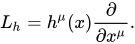
[edit]The Lie algebra of the diffeomorphism group of consists of all vector fields on equipped with the Lie bracket of vector fields. Somewhat formally, this is seen by making a small change to the coordinate at each point in space:

so the infinitesimal generators are the vector fields
Examples
[edit]- When is a Lie group, there is a natural inclusion of in its own diffeomorphism group via left-translation. Let denote the diffeomorphism group of , then there is a splitting , where is the subgroup of that fixes the identity element of the group.
- The diffeomorphism group of Euclidean space consists of two components, consisting of the orientation-preserving and orientation-reversing diffeomorphisms. In fact, the general linear group is a deformation retract of the subgroup of diffeomorphisms fixing the origin under the map Failed to parse (Conversion error. Server ("https://wikimedia.org/api/rest_") reported: "Cannot get mml. Server problem."): {\displaystyle f(x)\to f(tx)/t,t\in (0,1]} . In particular, the general linear group is also a deformation retract of the full diffeomorphism group.
- For a finite set of points, the diffeomorphism group is simply the symmetric group. Similarly, if is any manifold there is a group extension . Here is the subgroup of that preserves all the components of , and is the permutation group of the set (the components of Failed to parse (SVG (MathML can be enabled via browser plugin): Invalid response ("Math extension cannot connect to Restbase.") from server "https://wikimedia.org/api/rest_v1/":): {\displaystyle M} ). Moreover, the image of the map is the bijections of Failed to parse (SVG (MathML can be enabled via browser plugin): Invalid response ("Math extension cannot connect to Restbase.") from server "https://wikimedia.org/api/rest_v1/":): {\displaystyle \pi_0(M)} that preserve diffeomorphism classes.










Transitivity
[edit]For a connected manifold Failed to parse (SVG (MathML can be enabled via browser plugin): Invalid response ("Math extension cannot connect to Restbase.") from server "https://wikimedia.org/api/rest_v1/":): {\displaystyle M} , the diffeomorphism group acts transitively on Failed to parse (SVG (MathML can be enabled via browser plugin): Invalid response ("Math extension cannot connect to Restbase.") from server "https://wikimedia.org/api/rest_v1/":): {\displaystyle M} . More generally, the diffeomorphism group acts transitively on the configuration space Failed to parse (SVG (MathML can be enabled via browser plugin): Invalid response ("Math extension cannot connect to Restbase.") from server "https://wikimedia.org/api/rest_v1/":): {\displaystyle C_k M} . If Failed to parse (SVG (MathML can be enabled via browser plugin): Invalid response ("Math extension cannot connect to Restbase.") from server "https://wikimedia.org/api/rest_v1/":): {\displaystyle M} is at least two-dimensional, the diffeomorphism group acts transitively on the configuration space Failed to parse (SVG (MathML can be enabled via browser plugin): Invalid response ("Math extension cannot connect to Restbase.") from server "https://wikimedia.org/api/rest_v1/":): {\displaystyle F_k M} and the action on Failed to parse (SVG (MathML can be enabled via browser plugin): Invalid response ("Math extension cannot connect to Restbase.") from server "https://wikimedia.org/api/rest_v1/":): {\displaystyle M} is multiply transitive (Banyaga 1997, p. 29).
Extensions of diffeomorphisms
[edit]In 1926, Tibor Radó asked whether the harmonic extension of any homeomorphism or diffeomorphism of the unit circle to the unit disc yields a diffeomorphism on the open disc. An elegant proof was provided shortly afterwards by Hellmuth Kneser. In 1945, Gustave Choquet, apparently unaware of this result, produced a completely different proof.
The (orientation-preserving) diffeomorphism group of the circle is pathwise connected. This can be seen by noting that any such diffeomorphism can be lifted to a diffeomorphism Failed to parse (SVG (MathML can be enabled via browser plugin): Invalid response ("Math extension cannot connect to Restbase.") from server "https://wikimedia.org/api/rest_v1/":): {\displaystyle f} of the reals satisfying Failed to parse (SVG (MathML can be enabled via browser plugin): Invalid response ("Math extension cannot connect to Restbase.") from server "https://wikimedia.org/api/rest_v1/":): {\displaystyle [f(x+1)=f(x)+1]} ; this space is convex and hence path-connected. A smooth, eventually constant path to the identity gives a second more elementary way of extending a diffeomorphism from the circle to the open unit disc (a special case of the Alexander trick). Moreover, the diffeomorphism group of the circle has the homotopy-type of the orthogonal group Failed to parse (SVG (MathML can be enabled via browser plugin): Invalid response ("Math extension cannot connect to Restbase.") from server "https://wikimedia.org/api/rest_v1/":): {\displaystyle O(2)} .
The corresponding extension problem for diffeomorphisms of higher-dimensional spheres Failed to parse (SVG (MathML can be enabled via browser plugin): Invalid response ("Math extension cannot connect to Restbase.") from server "https://wikimedia.org/api/rest_v1/":): {\displaystyle S^{n-1}} was much studied in the 1950s and 1960s, with notable contributions from René Thom, John Milnor and Stephen Smale. An obstruction to such extensions is given by the finite abelian group Failed to parse (SVG (MathML can be enabled via browser plugin): Invalid response ("Math extension cannot connect to Restbase.") from server "https://wikimedia.org/api/rest_v1/":): {\displaystyle \Gamma_n} , the "group of twisted spheres", defined as the quotient of the abelian component group of the diffeomorphism group by the subgroup of classes extending to diffeomorphisms of the ball Failed to parse (SVG (MathML can be enabled via browser plugin): Invalid response ("Math extension cannot connect to Restbase.") from server "https://wikimedia.org/api/rest_v1/":): {\displaystyle B^n} .
Connectedness
[edit]For manifolds, the diffeomorphism group is usually not connected. Its component group is called the mapping class group. In dimension 2 (i.e. surfaces), the mapping class group is a finitely presented group generated by Dehn twists; this has been proved by Max Dehn, W. B. R. Lickorish, and Allen Hatcher).[citation needed] Max Dehn and Jakob Nielsen showed that it can be identified with the outer automorphism group of the fundamental group of the surface.
William Thurston refined this analysis by classifying elements of the mapping class group into three types: those equivalent to a periodic diffeomorphism; those equivalent to a diffeomorphism leaving a simple closed curve invariant; and those equivalent to pseudo-Anosov diffeomorphisms. In the case of the torus Failed to parse (SVG (MathML can be enabled via browser plugin): Invalid response ("Math extension cannot connect to Restbase.") from server "https://wikimedia.org/api/rest_v1/":): {\displaystyle S^1\times S^1=\R^2/\Z^2} , the mapping class group is simply the modular group Failed to parse (SVG (MathML can be enabled via browser plugin): Invalid response ("Math extension cannot connect to Restbase.") from server "https://wikimedia.org/api/rest_v1/":): {\displaystyle \text{SL}(2,\Z)} and the classification becomes classical in terms of elliptic, parabolic and hyperbolic matrices. Thurston accomplished his classification by observing that the mapping class group acted naturally on a compactification of Teichmüller space; as this enlarged space was homeomorphic to a closed ball, the Brouwer fixed-point theorem became applicable. Smale conjectured that if Failed to parse (SVG (MathML can be enabled via browser plugin): Invalid response ("Math extension cannot connect to Restbase.") from server "https://wikimedia.org/api/rest_v1/":): {\displaystyle M} is an oriented smooth closed manifold, the identity component of the group of orientation-preserving diffeomorphisms is simple. This had first been proved for a product of circles by Michel Herman; it was proved in full generality by Thurston.
Homotopy types
[edit]- The diffeomorphism group of Failed to parse (SVG (MathML can be enabled via browser plugin): Invalid response ("Math extension cannot connect to Restbase.") from server "https://wikimedia.org/api/rest_v1/":): {\displaystyle S^2} has the homotopy-type of the subgroup Failed to parse (SVG (MathML can be enabled via browser plugin): Invalid response ("Math extension cannot connect to Restbase.") from server "https://wikimedia.org/api/rest_v1/":): {\displaystyle \mathrm{O}(3)} . This was proven by Stephen Smale.[2]
- The diffeomorphism group of the torus has the homotopy-type of its linear automorphisms: Failed to parse (SVG (MathML can be enabled via browser plugin): Invalid response ("Math extension cannot connect to Restbase.") from server "https://wikimedia.org/api/rest_v1/":): {\displaystyle S^1\times S^1\times\text{GL}(2,\Z)} .
- The diffeomorphism groups of orientable surfaces of genus Failed to parse (SVG (MathML can be enabled via browser plugin): Invalid response ("Math extension cannot connect to Restbase.") from server "https://wikimedia.org/api/rest_v1/":): {\displaystyle g>1} have the homotopy-type of their mapping class groups (i.e. the components are contractible).
- The homotopy-type of the diffeomorphism groups of 3-manifolds are fairly well understood via the work of Ivanov, Hatcher, Gabai and Rubinstein, although there are a few outstanding open cases (primarily 3-manifolds with finite fundamental groups).
- The homotopy-type of diffeomorphism groups of Failed to parse (SVG (MathML can be enabled via browser plugin): Invalid response ("Math extension cannot connect to Restbase.") from server "https://wikimedia.org/api/rest_v1/":): {\displaystyle n} -manifolds for Failed to parse (SVG (MathML can be enabled via browser plugin): Invalid response ("Math extension cannot connect to Restbase.") from server "https://wikimedia.org/api/rest_v1/":): {\displaystyle n>3} are poorly understood. For example, it is an open problem whether or not Failed to parse (SVG (MathML can be enabled via browser plugin): Invalid response ("Math extension cannot connect to Restbase.") from server "https://wikimedia.org/api/rest_v1/":): {\displaystyle \mathrm{Diff}(S^4)} has more than two components. Via Milnor, Kahn and Antonelli, however, it is known that provided Failed to parse (SVG (MathML can be enabled via browser plugin): Invalid response ("Math extension cannot connect to Restbase.") from server "https://wikimedia.org/api/rest_v1/":): {\displaystyle n>6} , Failed to parse (SVG (MathML can be enabled via browser plugin): Invalid response ("Math extension cannot connect to Restbase.") from server "https://wikimedia.org/api/rest_v1/":): {\displaystyle \mathrm{Diff}(S^n)} does not have the homotopy-type of a finite CW-complex.
Homeomorphism and diffeomorphism
[edit]Since every diffeomorphism is a homeomorphism, given a pair of manifolds which are diffeomorphic to each other they are in particular homeomorphic to each other. The converse is not true in general.
While it is easy to find homeomorphisms that are not diffeomorphisms, it is more difficult to find a pair of homeomorphic manifolds that are not diffeomorphic. In dimensions 1, 2 and 3, any pair of homeomorphic smooth manifolds are diffeomorphic. In dimension 4 or greater, examples of homeomorphic but not diffeomorphic pairs exist. The first such example was constructed by John Milnor in dimension 7. He constructed a smooth 7-dimensional manifold (called now Milnor's sphere) that is homeomorphic to the standard 7-sphere but not diffeomorphic to it. There are, in fact, 28 oriented diffeomorphism classes of manifolds homeomorphic to the 7-sphere (each of them is the total space of a fiber bundle over the 4-sphere with the 3-sphere as the fiber).
More unusual phenomena occur for 4-manifolds. In the early 1980s, a combination of results due to Simon Donaldson and Michael Freedman led to the discovery of exotic Failed to parse (SVG (MathML can be enabled via browser plugin): Invalid response ("Math extension cannot connect to Restbase.") from server "https://wikimedia.org/api/rest_v1/":): {\displaystyle \R^4} : there are uncountably many pairwise non-diffeomorphic open subsets of Failed to parse (SVG (MathML can be enabled via browser plugin): Invalid response ("Math extension cannot connect to Restbase.") from server "https://wikimedia.org/api/rest_v1/":): {\displaystyle \R^4} each of which is homeomorphic to Failed to parse (SVG (MathML can be enabled via browser plugin): Invalid response ("Math extension cannot connect to Restbase.") from server "https://wikimedia.org/api/rest_v1/":): {\displaystyle \R^4} , and also there are uncountably many pairwise non-diffeomorphic differentiable manifolds homeomorphic to Failed to parse (SVG (MathML can be enabled via browser plugin): Invalid response ("Math extension cannot connect to Restbase.") from server "https://wikimedia.org/api/rest_v1/":): {\displaystyle \R^4} that do not embed smoothly in Failed to parse (SVG (MathML can be enabled via browser plugin): Invalid response ("Math extension cannot connect to Restbase.") from server "https://wikimedia.org/api/rest_v1/":): {\displaystyle \R^4} .
See also
[edit]- Anosov diffeomorphism such as Arnold's cat map
- Diffeo anomaly also known as a gravitational anomaly, a type anomaly in quantum mechanics
- Diffeology, smooth parameterizations on a set, which makes a diffeological space
- Diffeomorphometry, metric study of shape and form in computational anatomy
- Étale morphism
- Large diffeomorphism
- Local diffeomorphism
- Superdiffeomorphism
Notes
[edit]- ↑ Steven G. Krantz; Harold R. Parks (2013). The implicit function theorem: history, theory, and applications. Springer. p. Theorem 6.2.4. ISBN 978-1-4614-5980-4.
- ↑ Smale (1959). "Diffeomorphisms of the 2-sphere". Proc. Amer. Math. Soc. 10 (4): 621–626. doi:10.1090/s0002-9939-1959-0112149-8.
References
[edit]- Krantz, Steven G.; Parks, Harold R. (2013). The implicit function theorem: history, theory, and applications. Modern Birkhäuser classics. Boston. ISBN 978-1-4614-5980-4.
- Chaudhuri, Shyamoli; Kawai, Hikaru; Tye, S.-H. Henry (1987-08-15). "Path-integral formulation of closed strings" (PDF). Physical Review D. 36 (4): 1148–1168. Bibcode:1987PhRvD..36.1148C. doi:10.1103/physrevd.36.1148. ISSN 0556-2821. PMID 9958280. S2CID 41709882. Archived (PDF) from the original on 2018-07-21.
- Banyaga, Augustin (1997), The structure of classical diffeomorphism groups, Mathematics and its Applications, 400, Kluwer Academic, ISBN 0-7923-4475-8
- Duren, Peter L. (2004), Harmonic Mappings in the Plane, Cambridge Mathematical Tracts, 156, Cambridge University Press, ISBN 0-521-64121-7
- Template:Springer
- Hirsch, Morris (1997), Differential Topology, Berlin, New York: Springer-Verlag, ISBN 978-0-387-90148-0
- Kriegl, Andreas; Michor, Peter (1997), The convenient setting of global analysis, Mathematical Surveys and Monographs, 53, American Mathematical Society, ISBN 0-8218-0780-3
- Leslie, J. A. (1967), "On a differential structure for the group of diffeomorphisms", Topology, 6 (2): 263–271, doi:10.1016/0040-9383(67)90038-9, ISSN 0040-9383, MR 0210147
- Michor, Peter W.; Mumford, David (2013), "A zoo of diffeomorphism groups on Rn.", Annals of Global Analysis and Geometry, 44 (4): 529–540, arXiv:1211.5704, doi:10.1007/s10455-013-9380-2, S2CID 118624866
- Milnor, John W. (2007), Collected Works Vol. III, Differential Topology, American Mathematical Society, ISBN 978-0-8218-4230-0
- Omori, Hideki (1997), Infinite-dimensional Lie groups, Translations of Mathematical Monographs, 158, American Mathematical Society, ISBN 0-8218-4575-6
- Kneser, Hellmuth (1926), "Lösung der Aufgabe 41.", Jahresbericht der Deutschen Mathematiker-Vereinigung (in German), 35 (2): 123