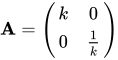
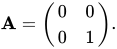
In mathematics, and more specifically in linear algebra, a linear map (or linear mapping) is a particular kind of function between vector spaces, which respects the basic operations of vector addition and scalar multiplication. A standard example of a linear map is an matrix, which takes vectors in -dimensions into vectors in -dimensions in a way that is compatible with addition of vectors, and multiplication of vectors by scalars.
Let and be vector spaces over the same fieldTemplate:Tmath, such as the real or complex numbers.
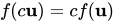
A function is said to be a linear map if for any two vectors and any scalar the following two conditions are satisfied:
Homogeneity of degree 1 / operation of scalar multiplication
Thus, a linear map is said to be operation preserving. In other words, it does not matter whether the linear map is applied before (the right sides of the above examples) or after (the left sides of the examples) the operations of addition and scalar multiplication.
Denoting the zero elements of the vector spaces and by and respectively, it follows that Template:Tmath. Let and in the equation for homogeneity of degree 1:
A linear map with viewed as a one-dimensional vector space over itself is called a linear functional.[5]
These statements generalize to any left-module over a ring without modification, and to any right-module upon reversing of the scalar multiplication.
A definite integral over some intervalI is a linear map from the space of all real-valued integrable functions on I to Template:Tmath. Indeed,
An indefinite integral (or antiderivative) with a fixed integration starting point defines a linear map from the space of all real-valued integrable functions on to the space of all real-valued, differentiable functions on Template:Tmath. Without a fixed starting point, the antiderivative maps to the quotient space of the differentiable functions by the linear space of constant functions.
If and are finite-dimensional vector spaces over a field F, of respective dimensions m and n, then the function that maps linear maps to n × m matrices in the way described in § Matrices (below) is a linear map, and even a linear isomorphism.
If a linear map is a bijection then it is called a linear isomorphism. In the case where Template:Tmath, a linear map is called a linear endomorphism. Sometimes the term linear operator refers to this case,[8] but the term "linear operator" can have different meanings for different conventions.
Often, a linear map is constructed by defining it on a subset of a vector space and then extending by linearity to the linear span of the domain.
Suppose and are vector spaces and is a function defined on some subset Template:Tmath.
Then a linear extension of to if it exists, is a linear map defined on that extends[note 1] (meaning that for all Template:Tmath) and takes its values from the codomain of Template:Tmath.[9]
When the subset is a vector subspace of then a (Template:Tmath-valued) linear extension of to all of is guaranteed to exist if (and only if) is a linear map.[9] In particular, if has a linear extension to then it has a linear extension to all of Template:Tmath.
The map can be extended to a linear map if and only if whenever is an integer, are scalars, and are vectors such that Template:Tmath, then necessarily Template:Tmath.[10]
If a linear extension of exists then the linear extension Failed to parse (SVG (MathML can be enabled via browser plugin): Invalid response ("Math extension cannot connect to Restbase.") from server "https://wikimedia.org/api/rest_v1/":): {\displaystyle F : \operatorname{span} S \to Y}
is unique and
Failed to parse (SVG (MathML can be enabled via browser plugin): Invalid response ("Math extension cannot connect to Restbase.") from server "https://wikimedia.org/api/rest_v1/":): {\displaystyle F\left(c_1 s_1 + \cdots c_n s_n\right) = c_1 f\left(s_1\right) + \cdots + c_n f\left(s_n\right)}
holds for all Template:Tmath, and Failed to parse (SVG (MathML can be enabled via browser plugin): Invalid response ("Math extension cannot connect to Restbase.") from server "https://wikimedia.org/api/rest_v1/":): {\displaystyle s_1, \ldots, s_n}
as above.[10]
If is linearly independent then every function Failed to parse (SVG (MathML can be enabled via browser plugin): Invalid response ("Math extension cannot connect to Restbase.") from server "https://wikimedia.org/api/rest_v1/":): {\displaystyle f : S \to Y}
into any vector space has a linear extension to a (linear) map Failed to parse (SVG (MathML can be enabled via browser plugin): Invalid response ("Math extension cannot connect to Restbase.") from server "https://wikimedia.org/api/rest_v1/":): {\displaystyle \operatorname{span} S \to Y}
(the converse is also true).
For example, if Failed to parse (SVG (MathML can be enabled via browser plugin): Invalid response ("Math extension cannot connect to Restbase.") from server "https://wikimedia.org/api/rest_v1/":): {\displaystyle X = \R^2}
and Failed to parse (SVG (MathML can be enabled via browser plugin): Invalid response ("Math extension cannot connect to Restbase.") from server "https://wikimedia.org/api/rest_v1/":): {\displaystyle Y = \R}
then the assignment Failed to parse (SVG (MathML can be enabled via browser plugin): Invalid response ("Math extension cannot connect to Restbase.") from server "https://wikimedia.org/api/rest_v1/":): {\displaystyle (1, 0) \to -1}
and Failed to parse (SVG (MathML can be enabled via browser plugin): Invalid response ("Math extension cannot connect to Restbase.") from server "https://wikimedia.org/api/rest_v1/":): {\displaystyle (0, 1) \to 2}
can be linearly extended from the linearly independent set of vectors Failed to parse (SVG (MathML can be enabled via browser plugin): Invalid response ("Math extension cannot connect to Restbase.") from server "https://wikimedia.org/api/rest_v1/":): {\displaystyle S := \{(1,0), (0, 1)\}}
to a linear map on Template:Tmath. The unique linear extension Failed to parse (SVG (MathML can be enabled via browser plugin): Invalid response ("Math extension cannot connect to Restbase.") from server "https://wikimedia.org/api/rest_v1/":): {\displaystyle F : \R^2 \to \R}
is the map that sends Failed to parse (SVG (MathML can be enabled via browser plugin): Invalid response ("Math extension cannot connect to Restbase.") from server "https://wikimedia.org/api/rest_v1/":): {\displaystyle (x, y) = x (1, 0) + y (0, 1) \in \R^2}
to
Failed to parse (SVG (MathML can be enabled via browser plugin): Invalid response ("Math extension cannot connect to Restbase.") from server "https://wikimedia.org/api/rest_v1/":): {\displaystyle F(x, y) = x (-1) + y (2) = - x + 2 y.}
Every (scalar-valued) linear functionalFailed to parse (SVG (MathML can be enabled via browser plugin): Invalid response ("Math extension cannot connect to Restbase.") from server "https://wikimedia.org/api/rest_v1/":): {\displaystyle f}
defined on a vector subspace of a real or complex vector space Failed to parse (SVG (MathML can be enabled via browser plugin): Invalid response ("Math extension cannot connect to Restbase.") from server "https://wikimedia.org/api/rest_v1/":): {\displaystyle X}
has a linear extension to all of Template:Tmath.
Indeed, the Hahn–Banach dominated extension theorem even guarantees that when this linear functional Failed to parse (SVG (MathML can be enabled via browser plugin): Invalid response ("Math extension cannot connect to Restbase.") from server "https://wikimedia.org/api/rest_v1/":): {\displaystyle f}
is dominated by some given seminormFailed to parse (SVG (MathML can be enabled via browser plugin): Invalid response ("Math extension cannot connect to Restbase.") from server "https://wikimedia.org/api/rest_v1/":): {\displaystyle p : X \to \R}
(meaning that Failed to parse (SVG (MathML can be enabled via browser plugin): Invalid response ("Math extension cannot connect to Restbase.") from server "https://wikimedia.org/api/rest_v1/":): {\displaystyle |f(m)| \leq p(m)}
holds for all Failed to parse (SVG (MathML can be enabled via browser plugin): Invalid response ("Math extension cannot connect to Restbase.") from server "https://wikimedia.org/api/rest_v1/":): {\displaystyle m}
in the domain of Template:Tmath) then there exists a linear extension to Failed to parse (SVG (MathML can be enabled via browser plugin): Invalid response ("Math extension cannot connect to Restbase.") from server "https://wikimedia.org/api/rest_v1/":): {\displaystyle X}
that is also dominated by Template:Tmath.
If Failed to parse (SVG (MathML can be enabled via browser plugin): Invalid response ("Math extension cannot connect to Restbase.") from server "https://wikimedia.org/api/rest_v1/":): {\displaystyle V}
and Failed to parse (SVG (MathML can be enabled via browser plugin): Invalid response ("Math extension cannot connect to Restbase.") from server "https://wikimedia.org/api/rest_v1/":): {\displaystyle W}
are finite-dimensional vector spaces and a basis is defined for each vector space, then every linear map from Failed to parse (SVG (MathML can be enabled via browser plugin): Invalid response ("Math extension cannot connect to Restbase.") from server "https://wikimedia.org/api/rest_v1/":): {\displaystyle V}
to Failed to parse (SVG (MathML can be enabled via browser plugin): Invalid response ("Math extension cannot connect to Restbase.") from server "https://wikimedia.org/api/rest_v1/":): {\displaystyle W}
can be represented by a matrix.[11] This is useful because it allows concrete calculations. Matrices yield examples of linear maps: if Failed to parse (SVG (MathML can be enabled via browser plugin): Invalid response ("Math extension cannot connect to Restbase.") from server "https://wikimedia.org/api/rest_v1/":): {\displaystyle A}
is a real Failed to parse (SVG (MathML can be enabled via browser plugin): Invalid response ("Math extension cannot connect to Restbase.") from server "https://wikimedia.org/api/rest_v1/":): {\displaystyle m \times n}
matrix, then Failed to parse (SVG (MathML can be enabled via browser plugin): Invalid response ("Math extension cannot connect to Restbase.") from server "https://wikimedia.org/api/rest_v1/":): {\displaystyle f(\mathbf x) = A \mathbf x}
describes a linear map Failed to parse (SVG (MathML can be enabled via browser plugin): Invalid response ("Math extension cannot connect to Restbase.") from server "https://wikimedia.org/api/rest_v1/":): {\displaystyle \R^n \to \R^m}
(see Euclidean space).
Let Failed to parse (SVG (MathML can be enabled via browser plugin): Invalid response ("Math extension cannot connect to Restbase.") from server "https://wikimedia.org/api/rest_v1/":): {\displaystyle \{ \mathbf {v}_1, \ldots , \mathbf {v}_n \}}
be a basis for Template:Tmath. Then every vector Failed to parse (SVG (MathML can be enabled via browser plugin): Invalid response ("Math extension cannot connect to Restbase.") from server "https://wikimedia.org/api/rest_v1/":): {\displaystyle \mathbf {v} \in V}
is uniquely determined by the coefficients Failed to parse (SVG (MathML can be enabled via browser plugin): Invalid response ("Math extension cannot connect to Restbase.") from server "https://wikimedia.org/api/rest_v1/":): {\displaystyle c_1, \ldots , c_n}
in the field Template:Tmath:
Failed to parse (SVG (MathML can be enabled via browser plugin): Invalid response ("Math extension cannot connect to Restbase.") from server "https://wikimedia.org/api/rest_v1/":): {\displaystyle \mathbf{v} = c_1 \mathbf{v}_1 + \cdots + c_n \mathbf {v}_n.}
If Failed to parse (SVG (MathML can be enabled via browser plugin): Invalid response ("Math extension cannot connect to Restbase.") from server "https://wikimedia.org/api/rest_v1/":): {\textstyle f: V \to W}
is a linear map,
Failed to parse (SVG (MathML can be enabled via browser plugin): Invalid response ("Math extension cannot connect to Restbase.") from server "https://wikimedia.org/api/rest_v1/":): {\displaystyle f(\mathbf{v}) = f(c_1 \mathbf{v}_1 + \cdots + c_n \mathbf{v}_n) = c_1 f(\mathbf{v}_1) + \cdots + c_n f\left(\mathbf{v}_n\right),}
which implies that the function f is entirely determined by the vectors Template:Tmath. Now let Failed to parse (SVG (MathML can be enabled via browser plugin): Invalid response ("Math extension cannot connect to Restbase.") from server "https://wikimedia.org/api/rest_v1/":): {\displaystyle \{ \mathbf {w}_1, \ldots , \mathbf {w}_m \}}
be a basis for Template:Tmath. Then we can represent each vector Failed to parse (SVG (MathML can be enabled via browser plugin): Invalid response ("Math extension cannot connect to Restbase.") from server "https://wikimedia.org/api/rest_v1/":): {\displaystyle f(\mathbf {v}_j)}
as
Failed to parse (SVG (MathML can be enabled via browser plugin): Invalid response ("Math extension cannot connect to Restbase.") from server "https://wikimedia.org/api/rest_v1/":): {\displaystyle f\left(\mathbf{v}_j\right) = a_{1j} \mathbf{w}_1 + \cdots + a_{mj} \mathbf{w}_m.}
Thus, the function Failed to parse (SVG (MathML can be enabled via browser plugin): Invalid response ("Math extension cannot connect to Restbase.") from server "https://wikimedia.org/api/rest_v1/":): {\displaystyle f}
is entirely determined by the values of Template:Tmath. If we put these values into an Failed to parse (SVG (MathML can be enabled via browser plugin): Invalid response ("Math extension cannot connect to Restbase.") from server "https://wikimedia.org/api/rest_v1/":): {\displaystyle m \times n}
matrix Template:Tmath, then we can conveniently use it to compute the vector output of Failed to parse (SVG (MathML can be enabled via browser plugin): Invalid response ("Math extension cannot connect to Restbase.") from server "https://wikimedia.org/api/rest_v1/":): {\displaystyle f}
for any vector in Template:Tmath. To get Template:Tmath, every column Failed to parse (SVG (MathML can be enabled via browser plugin): Invalid response ("Math extension cannot connect to Restbase.") from server "https://wikimedia.org/api/rest_v1/":): {\displaystyle j}
of Failed to parse (SVG (MathML can be enabled via browser plugin): Invalid response ("Math extension cannot connect to Restbase.") from server "https://wikimedia.org/api/rest_v1/":): {\displaystyle M}
is a vector
Failed to parse (SVG (MathML can be enabled via browser plugin): Invalid response ("Math extension cannot connect to Restbase.") from server "https://wikimedia.org/api/rest_v1/":): {\displaystyle \begin{pmatrix} a_{1j} \\ \vdots \\ a_{mj} \end{pmatrix}}
corresponding to Failed to parse (SVG (MathML can be enabled via browser plugin): Invalid response ("Math extension cannot connect to Restbase.") from server "https://wikimedia.org/api/rest_v1/":): {\displaystyle f(\mathbf {v}_j)}
as defined above. To define it more clearly, for some column Failed to parse (SVG (MathML can be enabled via browser plugin): Invalid response ("Math extension cannot connect to Restbase.") from server "https://wikimedia.org/api/rest_v1/":): {\displaystyle j}
that corresponds to the mapping Template:Tmath,
Failed to parse (SVG (MathML can be enabled via browser plugin): Invalid response ("Math extension cannot connect to Restbase.") from server "https://wikimedia.org/api/rest_v1/":): {\displaystyle \mathbf{M} = \begin{pmatrix} \ \cdots & a_{1j} & \cdots\ \\ & \vdots & \\ & a_{mj} & \end{pmatrix}}
where Failed to parse (SVG (MathML can be enabled via browser plugin): Invalid response ("Math extension cannot connect to Restbase.") from server "https://wikimedia.org/api/rest_v1/":): {\displaystyle M}
is the matrix of Template:Tmath. In other words, every column Failed to parse (SVG (MathML can be enabled via browser plugin): Invalid response ("Math extension cannot connect to Restbase.") from server "https://wikimedia.org/api/rest_v1/":): {\displaystyle j = 1, \ldots, n}
has a corresponding vector Failed to parse (SVG (MathML can be enabled via browser plugin): Invalid response ("Math extension cannot connect to Restbase.") from server "https://wikimedia.org/api/rest_v1/":): {\displaystyle f(\mathbf {v}_j)}
whose coordinates Failed to parse (SVG (MathML can be enabled via browser plugin): Invalid response ("Math extension cannot connect to Restbase.") from server "https://wikimedia.org/api/rest_v1/":): {\displaystyle a_{1j}, \cdots, a_{mj}}
are the elements of column Template:Tmath. A single linear map may be represented by many matrices. This is because the values of the elements of a matrix depend on the bases chosen.
The matrices of a linear transformation can be represented visually:
Matrix for Failed to parse (SVG (MathML can be enabled via browser plugin): Invalid response ("Math extension cannot connect to Restbase.") from server "https://wikimedia.org/api/rest_v1/":): {\textstyle T}
relative to Template:Tmath: Failed to parse (SVG (MathML can be enabled via browser plugin): Invalid response ("Math extension cannot connect to Restbase.") from server "https://wikimedia.org/api/rest_v1/":): {\textstyle A}
Matrix for Failed to parse (SVG (MathML can be enabled via browser plugin): Invalid response ("Math extension cannot connect to Restbase.") from server "https://wikimedia.org/api/rest_v1/":): {\textstyle T}
relative to Template:Tmath: Failed to parse (SVG (MathML can be enabled via browser plugin): Invalid response ("Math extension cannot connect to Restbase.") from server "https://wikimedia.org/api/rest_v1/":): {\textstyle A'}
Transition matrix from Failed to parse (SVG (MathML can be enabled via browser plugin): Invalid response ("Math extension cannot connect to Restbase.") from server "https://wikimedia.org/api/rest_v1/":): {\textstyle B'}
to Template:Tmath: Failed to parse (SVG (MathML can be enabled via browser plugin): Invalid response ("Math extension cannot connect to Restbase.") from server "https://wikimedia.org/api/rest_v1/":): {\textstyle P}
Transition matrix from Failed to parse (SVG (MathML can be enabled via browser plugin): Invalid response ("Math extension cannot connect to Restbase.") from server "https://wikimedia.org/api/rest_v1/":): {\textstyle B}
to Template:Tmath: Failed to parse (SVG (MathML can be enabled via browser plugin): Invalid response ("Math extension cannot connect to Restbase.") from server "https://wikimedia.org/api/rest_v1/":): {\textstyle P^{-1}}
Such that starting in the bottom left corner Failed to parse (SVG (MathML can be enabled via browser plugin): Invalid response ("Math extension cannot connect to Restbase.") from server "https://wikimedia.org/api/rest_v1/":): {\textstyle \left[\mathbf{v}\right]_{B'}}
and looking for the bottom right corner Template:Tmath, one would left-multiply—that is, Template:Tmath. The equivalent method would be the "longer" method going clockwise from the same point such that Failed to parse (SVG (MathML can be enabled via browser plugin): Invalid response ("Math extension cannot connect to Restbase.") from server "https://wikimedia.org/api/rest_v1/":): {\textstyle \left[\mathbf{v}\right]_{B'}}
is left-multiplied with Template:Tmath, or Template:Tmath.
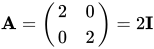
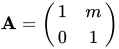
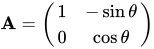
by 90 degrees counterclockwise: Failed to parse (SVG (MathML can be enabled via browser plugin): Invalid response ("Math extension cannot connect to Restbase.") from server "https://wikimedia.org/api/rest_v1/":): {\displaystyle \mathbf{A} = \begin{pmatrix} 0 & -1\\ 1 & 0\end{pmatrix}}
by an angle θ counterclockwise: Failed to parse (SVG (MathML can be enabled via browser plugin): Invalid response ("Math extension cannot connect to Restbase.") from server "https://wikimedia.org/api/rest_v1/":): {\displaystyle \mathbf{A} = \begin{pmatrix} \cos\theta & -\sin\theta \\ \sin\theta & \cos\theta \end{pmatrix}}
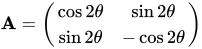
through the x axis: Failed to parse (SVG (MathML can be enabled via browser plugin): Invalid response ("Math extension cannot connect to Restbase.") from server "https://wikimedia.org/api/rest_v1/":): {\displaystyle \mathbf{A} = \begin{pmatrix} 1 & 0\\ 0 & -1\end{pmatrix}}
through the y axis: Failed to parse (SVG (MathML can be enabled via browser plugin): Invalid response ("Math extension cannot connect to Restbase.") from server "https://wikimedia.org/api/rest_v1/":): {\displaystyle \mathbf{A} = \begin{pmatrix}-1 & 0\\ 0 & 1\end{pmatrix}}
The composition of linear maps is linear: if and are linear, then so is their compositionTemplate:Tmath. It follows from this that the class of all vector spaces over a given field K, together with K-linear maps as morphisms, forms a category.
The inverse of a linear map, when defined, is again a linear map.
Thus the set of linear maps from to itself forms a vector space over Template:Tmath,[12] sometimes denoted Template:Tmath.[13] Furthermore, in the case that Template:Tmath, this vector space, denoted Template:Tmath, is an associative algebra under composition of maps, since the composition of two linear maps is again a linear map, and the composition of maps is always associative. This case is discussed in more detail below.
Given again the finite-dimensional case, if bases have been chosen, then the composition of linear maps corresponds to the matrix multiplication, the addition of linear maps corresponds to the matrix addition, and the multiplication of linear maps with scalars corresponds to the multiplication of matrices with scalars.
A linear transformation Failed to parse (SVG (MathML can be enabled via browser plugin): Invalid response ("Math extension cannot connect to Restbase.") from server "https://wikimedia.org/api/rest_v1/":): {\textstyle f : V \to V}
is an endomorphism of Failed to parse (SVG (MathML can be enabled via browser plugin): Invalid response ("Math extension cannot connect to Restbase.") from server "https://wikimedia.org/api/rest_v1/":): {\textstyle V}
; the set of all such endomorphisms Failed to parse (SVG (MathML can be enabled via browser plugin): Invalid response ("Math extension cannot connect to Restbase.") from server "https://wikimedia.org/api/rest_v1/":): {\textstyle \operatorname{End}(V)}
together with addition, composition and scalar multiplication as defined above forms an associative algebra with identity element over the field Failed to parse (SVG (MathML can be enabled via browser plugin): Invalid response ("Math extension cannot connect to Restbase.") from server "https://wikimedia.org/api/rest_v1/":): {\textstyle K}
(and in particular a ring). The multiplicative identity element of this algebra is the identity mapTemplate:Tmath.
An endomorphism of Failed to parse (SVG (MathML can be enabled via browser plugin): Invalid response ("Math extension cannot connect to Restbase.") from server "https://wikimedia.org/api/rest_v1/":): {\textstyle V}
that is also an isomorphism is called an automorphism of Template:Tmath. The composition of two automorphisms is again an automorphism, and the set of all automorphisms of Failed to parse (SVG (MathML can be enabled via browser plugin): Invalid response ("Math extension cannot connect to Restbase.") from server "https://wikimedia.org/api/rest_v1/":): {\textstyle V}
forms a group, the automorphism group of Failed to parse (SVG (MathML can be enabled via browser plugin): Invalid response ("Math extension cannot connect to Restbase.") from server "https://wikimedia.org/api/rest_v1/":): {\textstyle V}
which is denoted by Failed to parse (SVG (MathML can be enabled via browser plugin): Invalid response ("Math extension cannot connect to Restbase.") from server "https://wikimedia.org/api/rest_v1/":): {\textstyle \operatorname{Aut}(V)}
or Template:Tmath. Since the automorphisms are precisely those endomorphisms which possess inverses under composition, Failed to parse (SVG (MathML can be enabled via browser plugin): Invalid response ("Math extension cannot connect to Restbase.") from server "https://wikimedia.org/api/rest_v1/":): {\textstyle \operatorname{Aut}(V)}
is the group of units in the ring Template:Tmath.
If Failed to parse (SVG (MathML can be enabled via browser plugin): Invalid response ("Math extension cannot connect to Restbase.") from server "https://wikimedia.org/api/rest_v1/":): {\textstyle V}
has finite dimension Template:Tmath, then Failed to parse (SVG (MathML can be enabled via browser plugin): Invalid response ("Math extension cannot connect to Restbase.") from server "https://wikimedia.org/api/rest_v1/":): {\textstyle \operatorname{End}(V)}
is isomorphic to the associative algebra of all Failed to parse (SVG (MathML can be enabled via browser plugin): Invalid response ("Math extension cannot connect to Restbase.") from server "https://wikimedia.org/api/rest_v1/":): {\textstyle n \times n}
matrices with entries in Template:Tmath. The automorphism group of Failed to parse (SVG (MathML can be enabled via browser plugin): Invalid response ("Math extension cannot connect to Restbase.") from server "https://wikimedia.org/api/rest_v1/":): {\textstyle V}
is isomorphic to the general linear groupFailed to parse (SVG (MathML can be enabled via browser plugin): Invalid response ("Math extension cannot connect to Restbase.") from server "https://wikimedia.org/api/rest_v1/":): {\textstyle \operatorname{GL}(n, K)}
of all Failed to parse (SVG (MathML can be enabled via browser plugin): Invalid response ("Math extension cannot connect to Restbase.") from server "https://wikimedia.org/api/rest_v1/":): {\textstyle n \times n}
invertible matrices with entries in Template:Tmath.
If Failed to parse (SVG (MathML can be enabled via browser plugin): Invalid response ("Math extension cannot connect to Restbase.") from server "https://wikimedia.org/api/rest_v1/":): {\textstyle f: V \to W}
is linear, we define the kernel and the image or range of Failed to parse (SVG (MathML can be enabled via browser plugin): Invalid response ("Math extension cannot connect to Restbase.") from server "https://wikimedia.org/api/rest_v1/":): {\textstyle f}
by
Failed to parse (SVG (MathML can be enabled via browser plugin): Invalid response ("Math extension cannot connect to Restbase.") from server "https://wikimedia.org/api/rest_v1/":): {\displaystyle \begin{align} \ker(f) &= \{\,\mathbf x \in V: f(\mathbf x) = \mathbf 0\,\} \\ \operatorname{im}(f) &= \{\,\mathbf w \in W: \mathbf w = f(\mathbf x), \mathbf x \in V\,\} \end{align}}
Failed to parse (SVG (MathML can be enabled via browser plugin): Invalid response ("Math extension cannot connect to Restbase.") from server "https://wikimedia.org/api/rest_v1/":): {\textstyle \ker(f)}
is a subspace of Failed to parse (SVG (MathML can be enabled via browser plugin): Invalid response ("Math extension cannot connect to Restbase.") from server "https://wikimedia.org/api/rest_v1/":): {\textstyle V}
and Failed to parse (SVG (MathML can be enabled via browser plugin): Invalid response ("Math extension cannot connect to Restbase.") from server "https://wikimedia.org/api/rest_v1/":): {\textstyle \operatorname{im}(f)}
is a subspace of Template:Tmath. The following dimension formula is known as the rank–nullity theorem:[14]Failed to parse (SVG (MathML can be enabled via browser plugin): Invalid response ("Math extension cannot connect to Restbase.") from server "https://wikimedia.org/api/rest_v1/":): {\displaystyle \dim(\ker( f )) + \dim(\operatorname{im}( f )) = \dim( V ).}
The number Failed to parse (SVG (MathML can be enabled via browser plugin): Invalid response ("Math extension cannot connect to Restbase.") from server "https://wikimedia.org/api/rest_v1/":): {\textstyle \dim(\operatorname{im}(f))}
is also called the rank of Failed to parse (SVG (MathML can be enabled via browser plugin): Invalid response ("Math extension cannot connect to Restbase.") from server "https://wikimedia.org/api/rest_v1/":): {\textstyle f}
and written as Template:Tmath, or sometimes, Template:Tmath;[15][16] the number Failed to parse (SVG (MathML can be enabled via browser plugin): Invalid response ("Math extension cannot connect to Restbase.") from server "https://wikimedia.org/api/rest_v1/":): {\textstyle \dim(\ker(f))}
is called the nullity of Failed to parse (SVG (MathML can be enabled via browser plugin): Invalid response ("Math extension cannot connect to Restbase.") from server "https://wikimedia.org/api/rest_v1/":): {\textstyle f}
and written as Failed to parse (SVG (MathML can be enabled via browser plugin): Invalid response ("Math extension cannot connect to Restbase.") from server "https://wikimedia.org/api/rest_v1/":): {\textstyle \operatorname{null}(f)}
or Template:Tmath.[15][16] If Failed to parse (SVG (MathML can be enabled via browser plugin): Invalid response ("Math extension cannot connect to Restbase.") from server "https://wikimedia.org/api/rest_v1/":): {\textstyle V}
and Failed to parse (SVG (MathML can be enabled via browser plugin): Invalid response ("Math extension cannot connect to Restbase.") from server "https://wikimedia.org/api/rest_v1/":): {\textstyle W}
are finite-dimensional, bases have been chosen and Failed to parse (SVG (MathML can be enabled via browser plugin): Invalid response ("Math extension cannot connect to Restbase.") from server "https://wikimedia.org/api/rest_v1/":): {\textstyle f}
is represented by the matrix Template:Tmath, then the rank and nullity of Failed to parse (SVG (MathML can be enabled via browser plugin): Invalid response ("Math extension cannot connect to Restbase.") from server "https://wikimedia.org/api/rest_v1/":): {\textstyle f}
are equal to the rank and nullity of the matrix Template:Tmath, respectively.
A subtler invariant of a linear transformation Failed to parse (SVG (MathML can be enabled via browser plugin): Invalid response ("Math extension cannot connect to Restbase.") from server "https://wikimedia.org/api/rest_v1/":): {\textstyle f : V \to W}
is the cokernel, which is defined as
Failed to parse (SVG (MathML can be enabled via browser plugin): Invalid response ("Math extension cannot connect to Restbase.") from server "https://wikimedia.org/api/rest_v1/":): {\displaystyle \operatorname{coker}(f) := W/f(V) = W/\operatorname{im}(f).}
This is the dual notion to the kernel: just as the kernel is a subspace of the domain, the co-kernel is a quotient space of the target. Formally, one has the exact sequenceFailed to parse (SVG (MathML can be enabled via browser plugin): Invalid response ("Math extension cannot connect to Restbase.") from server "https://wikimedia.org/api/rest_v1/":): {\displaystyle 0 \to \ker(f) \to V \to W \to \operatorname{coker}(f) \to 0.}
These can be interpreted thus: given a linear equation f(v) = w to solve,
the kernel is the space of solutions to the homogeneous equation f(v) = 0, and its dimension is the number of degrees of freedom in the space of solutions, if it is not empty;
the co-kernel is the space of constraints that the solutions must satisfy, and its dimension is the maximal number of independent constraints.
The dimension of the co-kernel and the dimension of the image (the rank) add up to the dimension of the target space. For finite dimensions, this means that the dimension of the quotient space W / f(V) is the dimension of the target space minus the dimension of the image.
As a simple example, consider the map f : R2 → R2, given by f(x, y) = (0, y). Then for an equation f(x, y) = (a, b) to have a solution, we must have a = 0 (one constraint), and in that case the solution space is (x, b) or equivalently stated,
(0, b) + (x, 0), (one degree of freedom). The kernel may be expressed as the subspace (x, 0) < V: the value of x is the freedom in a solution – while the cokernel may be expressed via the map W → R, Template:Tmath: given a vector (a, b), the value of a is the obstruction to there being a solution.
An example illustrating the infinite-dimensional case is afforded by the map f : R∞ → R∞, Failed to parse (SVG (MathML can be enabled via browser plugin): Invalid response ("Math extension cannot connect to Restbase.") from server "https://wikimedia.org/api/rest_v1/":): {\textstyle \left\{a_n\right\} \mapsto \left\{b_n\right\}}
with b1 = 0 and bn + 1 = an for n > 0. Its image consists of all sequences with first element 0, and thus its cokernel consists of the classes of sequences with identical first element. Thus, whereas its kernel has dimension 0 (it maps only the zero sequence to the zero sequence), its co-kernel has dimension 1. Since the domain and the target space are the same, the rank and the dimension of the kernel add up to the same sum as the rank and the dimension of the co-kernel (Template:Tmath), but in the infinite-dimensional case it cannot be inferred that the kernel and the co-kernel of an endomorphism have the same dimension (0 ≠ 1). The reverse situation obtains for the map h : R∞ → R∞, Failed to parse (SVG (MathML can be enabled via browser plugin): Invalid response ("Math extension cannot connect to Restbase.") from server "https://wikimedia.org/api/rest_v1/":): {\textstyle \left\{a_n\right\} \mapsto \left\{c_n\right\}}
with cn = an + 1. Its image is the entire target space, and hence its co-kernel has dimension 0, but since it maps all sequences in which only the first element is non-zero to the zero sequence, its kernel has dimension 1.
For a linear operator with finite-dimensional kernel and co-kernel, one may define index as:
Failed to parse (SVG (MathML can be enabled via browser plugin): Invalid response ("Math extension cannot connect to Restbase.") from server "https://wikimedia.org/api/rest_v1/":): {\displaystyle \operatorname{ind}(f) := \dim(\ker(f)) - \dim(\operatorname{coker}(f)),}
namely the degrees of freedom minus the number of constraints.
For a transformation between finite-dimensional vector spaces, this is just the difference dim(V) − dim(W), by rank–nullity. This gives an indication of how many solutions or how many constraints one has: if mapping from a larger space to a smaller one, the map may be onto, and thus will have degrees of freedom even without constraints. Conversely, if mapping from a smaller space to a larger one, the map cannot be onto, and thus one will have constraints even without degrees of freedom.
No classification of linear maps could be exhaustive. The following incomplete list enumerates some important classifications that do not require any additional structure on the vector space.
Let V and W denote vector spaces over a field F and let T : V → W be a linear map.
T is monic or left-cancellable, which is to say, for any vector space U and any pair of linear maps R: U → V and S : U → V, the equation TR = TS implies R = S.
T is left-invertible, which is to say there exists a linear map S : W → V such that ST is the identity map on V.
T is epic or right-cancellable, which is to say, for any vector space U and any pair of linear maps R : W → U and S : W → U, the equation RT = ST implies R = S.
T is right-invertible, which is to say there exists a linear map S : W → V such that TS is the identity map on W.
T is said to be an isomorphism if it is both left- and right-invertible. This is equivalent to T being both one-to-one and onto (a bijection of sets) or also to T being both epic and monic, and so being a bimorphism.
If T : V → V is an endomorphism, then:
If, for some positive integer n, the nth iterate of T, Tn, is identically zero, then T is said to be nilpotent.
Given a linear map which is an endomorphism whose matrix is A, in the basis B of the space it transforms vector coordinates [u] as [v] = A[u]. As vectors change with the inverse of B (vectors coordinates are contravariant) its inverse transformation is [v] = B[v′].
Substituting this in the first expression
Failed to parse (SVG (MathML can be enabled via browser plugin): Invalid response ("Math extension cannot connect to Restbase.") from server "https://wikimedia.org/api/rest_v1/":): {\displaystyle B\left[v'\right] = AB\left[u'\right]}
hence
Failed to parse (SVG (MathML can be enabled via browser plugin): Invalid response ("Math extension cannot connect to Restbase.") from server "https://wikimedia.org/api/rest_v1/":): {\displaystyle \left[v'\right] = B^{-1}AB\left[u'\right] = A'\left[u'\right].}
Therefore, the matrix in the new basis is A′ = B−1AB, being B the matrix of the given basis.
Therefore, linear maps are said to be 1-co- 1-contra-variant objects, or type (1, 1) tensors.
An example of an unbounded, hence discontinuous, linear transformation is differentiation on the space of smooth functions equipped with the supremum norm (a function with small values can have a derivative with large values, while the derivative of 0 is 0). For a specific example, sin(nx)/n converges to 0, but its derivative cos(nx) does not, so differentiation is not continuous at 0 (and by a variation of this argument, it is not continuous anywhere).
A specific application of linear maps is for geometric transformations, such as those performed in computer graphics, where the translation, rotation and scaling of 2D or 3D objects is performed by the use of a transformation matrix. Linear mappings also are used as a mechanism for describing change: for example in calculus correspond to derivatives; or in relativity, used as a device to keep track of the local transformations of reference frames.
↑Rudin 1991, p. 14 Here are some properties of linear mappings Failed to parse (SVG (MathML can be enabled via browser plugin): Invalid response ("Math extension cannot connect to Restbase.") from server "https://wikimedia.org/api/rest_v1/":): {\textstyle \Lambda: X \to Y}
whose proofs are so easy that we omit them; it is assumed that Failed to parse (SVG (MathML can be enabled via browser plugin): Invalid response ("Math extension cannot connect to Restbase.") from server "https://wikimedia.org/api/rest_v1/":): {\textstyle A \subset X}
and Failed to parse (SVG (MathML can be enabled via browser plugin): Invalid response ("Math extension cannot connect to Restbase.") from server "https://wikimedia.org/api/rest_v1/":): {\textstyle B \subset Y}
:
Failed to parse (SVG (MathML can be enabled via browser plugin): Invalid response ("Math extension cannot connect to Restbase.") from server "https://wikimedia.org/api/rest_v1/":): {\textstyle \Lambda 0 = 0.}
If A is a subspace (or a convex set, or a balanced set) the same is true of Failed to parse (SVG (MathML can be enabled via browser plugin): Invalid response ("Math extension cannot connect to Restbase.") from server "https://wikimedia.org/api/rest_v1/":): {\textstyle \Lambda(A)}
If B is a subspace (or a convex set, or a balanced set) the same is true of Failed to parse (SVG (MathML can be enabled via browser plugin): Invalid response ("Math extension cannot connect to Restbase.") from server "https://wikimedia.org/api/rest_v1/":): {\textstyle \Lambda^{-1}(B)}
In particular, the set: Failed to parse (SVG (MathML can be enabled via browser plugin): Invalid response ("Math extension cannot connect to Restbase.") from server "https://wikimedia.org/api/rest_v1/":): {\displaystyle \Lambda^{-1}(\{0\}) = \{\mathbf x \in X: \Lambda \mathbf x = 0\} = {N}(\Lambda)}
is a subspace of X, called the null space of Template:Tmath
↑Rudin 1991, p. 14. Suppose now that X and Y are vector spaces over the same scalar field. A mapping Failed to parse (SVG (MathML can be enabled via browser plugin): Invalid response ("Math extension cannot connect to Restbase.") from server "https://wikimedia.org/api/rest_v1/":): {\textstyle \Lambda: X \to Y}
is said to be linear if Failed to parse (SVG (MathML can be enabled via browser plugin): Invalid response ("Math extension cannot connect to Restbase.") from server "https://wikimedia.org/api/rest_v1/":): {\textstyle \Lambda(\alpha \mathbf x + \beta \mathbf y) = \alpha \Lambda \mathbf x + \beta \Lambda \mathbf y}
for all Failed to parse (SVG (MathML can be enabled via browser plugin): Invalid response ("Math extension cannot connect to Restbase.") from server "https://wikimedia.org/api/rest_v1/":): {\textstyle \mathbf x, \mathbf y \in X}
and all scalars Failed to parse (SVG (MathML can be enabled via browser plugin): Invalid response ("Math extension cannot connect to Restbase.") from server "https://wikimedia.org/api/rest_v1/":): {\textstyle \alpha}
and Template:Tmath. Note that one often writes Template:Tmath, rather than Template:Tmath, when Failed to parse (SVG (MathML can be enabled via browser plugin): Invalid response ("Math extension cannot connect to Restbase.") from server "https://wikimedia.org/api/rest_v1/":): {\textstyle \Lambda}
is linear.
↑Rudin 1976, p. 206. A mapping A of a vector space X into a vector space Y is said to be a linear transformation if: Failed to parse (SVG (MathML can be enabled via browser plugin): Invalid response ("Math extension cannot connect to Restbase.") from server "https://wikimedia.org/api/rest_v1/":): {\textstyle A\left(\mathbf{x}_1 + \mathbf{x}_2\right) = A\mathbf{x}_1 + A\mathbf{x}_2,\ A(c\mathbf{x}) = c A\mathbf{x}}
for all Failed to parse (SVG (MathML can be enabled via browser plugin): Invalid response ("Math extension cannot connect to Restbase.") from server "https://wikimedia.org/api/rest_v1/":): {\textstyle \mathbf{x}, \mathbf{x}_1, \mathbf{x}_2 \in X}
and all scalars c. Note that one often writes Failed to parse (SVG (MathML can be enabled via browser plugin): Invalid response ("Math extension cannot connect to Restbase.") from server "https://wikimedia.org/api/rest_v1/":): {\textstyle A\mathbf{x}}
instead of Failed to parse (SVG (MathML can be enabled via browser plugin): Invalid response ("Math extension cannot connect to Restbase.") from server "https://wikimedia.org/api/rest_v1/":): {\textstyle A(\mathbf {x})}
if A is linear.
↑Rudin 1991, p. 14.
Linear mappings of X onto its scalar field are called linear functionals.
↑Template:SpringerEOM: "The main question in index theory is to provide index formulas for classes of Fredholm operators ... Index theory has become a subject on its own only after M. F. Atiyah and I. Singer published their index theorems"
↑Rudin 1991, p. 15
1.18 TheoremLet Failed to parse (SVG (MathML can be enabled via browser plugin): Invalid response ("Math extension cannot connect to Restbase.") from server "https://wikimedia.org/api/rest_v1/":): {\textstyle \Lambda}
be a linear functional on a topological vector space X. Assume Template:Tmath for some Template:Tmath. Then each of the following four properties implies the other three:
Failed to parse (SVG (MathML can be enabled via browser plugin): Invalid response ("Math extension cannot connect to Restbase.") from server "https://wikimedia.org/api/rest_v1/":): {\textstyle \Lambda}
is continuous
The null space Failed to parse (SVG (MathML can be enabled via browser plugin): Invalid response ("Math extension cannot connect to Restbase.") from server "https://wikimedia.org/api/rest_v1/":): {\textstyle N(\Lambda)}
is closed.
Failed to parse (SVG (MathML can be enabled via browser plugin): Invalid response ("Math extension cannot connect to Restbase.") from server "https://wikimedia.org/api/rest_v1/":): {\textstyle N(\Lambda)}
is not dense in X.
Failed to parse (SVG (MathML can be enabled via browser plugin): Invalid response ("Math extension cannot connect to Restbase.") from server "https://wikimedia.org/api/rest_v1/":): {\textstyle \Lambda}
is bounded in some neighbourhood V of 0.
↑One map Failed to parse (SVG (MathML can be enabled via browser plugin): Invalid response ("Math extension cannot connect to Restbase.") from server "https://wikimedia.org/api/rest_v1/":): {\displaystyle F}
is said to extend another map Failed to parse (SVG (MathML can be enabled via browser plugin): Invalid response ("Math extension cannot connect to Restbase.") from server "https://wikimedia.org/api/rest_v1/":): {\displaystyle f}
if when Failed to parse (SVG (MathML can be enabled via browser plugin): Invalid response ("Math extension cannot connect to Restbase.") from server "https://wikimedia.org/api/rest_v1/":): {\displaystyle f}
is defined at a point Template:Tmath, then so is Failed to parse (SVG (MathML can be enabled via browser plugin): Invalid response ("Math extension cannot connect to Restbase.") from server "https://wikimedia.org/api/rest_v1/":): {\displaystyle F}
and Failed to parse (SVG (MathML can be enabled via browser plugin): Invalid response ("Math extension cannot connect to Restbase.") from server "https://wikimedia.org/api/rest_v1/":): {\displaystyle F(s) = f(s).}













![{\displaystyle E[X+Y]=E[X]+E[Y]}](https://wikimedia.org/api/rest_v1/media/math/render/svg/ea2251900ec2b03db1d6f870336155a2a09ff7f1)