Variance
In probability theory and statistics, variance is the expected value of the squared deviation from the mean of a random variable. The standard deviation is obtained as the square root of the variance. Variance is a measure of dispersion, meaning it is a measure of how far a set of numbers are spread out from their average value. It is the second central moment of a distribution, and the covariance of the random variable with itself, and it is often represented by Template:Tmath, Template:Tmath, Template:Tmath, Template:Tmath, or Template:Tmath.[1]
An advantage of variance as a measure of dispersion is that it is more amenable to algebraic manipulation than other measures of dispersion such as the expected absolute deviation; for example, the variance of a sum of uncorrelated random variables is equal to the sum of their variances. A disadvantage of the variance for practical applications is that, unlike the standard deviation, its units differ from the random variable, which is why the standard deviation is more commonly reported as a measure of dispersion once the calculation is finished. Another disadvantage is that the variance is not finite for many distributions.
There are two distinct concepts that are both called "variance". One, as discussed above, is part of a theoretical probability distribution and is defined by an equation. The other variance is a characteristic of a set of observations. When variance is calculated from observations, those observations are typically measured from a real-world system. If all possible observations of the system are present, then the calculated variance is called the population variance. Normally, however, only a subset is available, and the variance calculated from this is called the sample variance. The variance calculated from a sample is considered an estimate of the full population variance. There are multiple ways to estimate the population variance on the basis of the sample variance, as discussed in the section below.
The two kinds of variance are closely related. To see how, consider that a theoretical probability distribution can be used as a generator of hypothetical observations. If an infinite number of observations are generated using a distribution, then the sample variance calculated from that infinite set will match the value calculated using the distribution's equation for variance. Variance has a central role in statistics, where some ideas that use it include descriptive statistics, statistical inference, hypothesis testing, goodness of fit, and Monte Carlo sampling.
- A frequency distribution is constructed.
- The centroid of the distribution gives its mean.
- A square with sides equal to the difference of each value from the mean is formed for each value.
- Arranging the squares into a rectangle with one side equal to the number of values, n, results in the other side being the distribution's variance, σ2.
Definition
[edit | edit source]The variance of a random variable is the expected value of the squared deviation from the mean of Template:Tmath, Template:Tmath: This definition encompasses random variables that are generated by processes that are discrete, continuous, neither, or mixed. The variance can also be thought of as the covariance of a random variable with itself:

![{\displaystyle \operatorname {Var} (X)=\operatorname {E} \left[(X-\mu )^{2}\right].}](https://wikimedia.org/api/rest_v1/media/math/render/svg/55622d2a1cf5e46f2926ab389a8e3438edb53731)

The variance is also equivalent to the second cumulant of a probability distribution that generates Template:Tmath. The variance is typically designated as Template:Tmath, or sometimes as or Template:Tmath, or symbolically as Template:Tmath or simply (pronounced "sigma squared"). The expression for the variance can be expanded as follows:


![{\displaystyle {\begin{aligned}\operatorname {Var} (X)&=\operatorname {E} \left[{\left(X-\operatorname {E} [X]\right)}^{2}\right]\\[4pt]&=\operatorname {E} \left[X^{2}-2X\operatorname {E} [X]+\operatorname {E} [X]^{2}\right]\\[4pt]&=\operatorname {E} \left[X^{2}\right]-2\operatorname {E} [X]\operatorname {E} [X]+\operatorname {E} [X]^{2}\\[4pt]&=\operatorname {E} \left[X^{2}\right]-2\operatorname {E} [X]^{2}+\operatorname {E} [X]^{2}\\[4pt]&=\operatorname {E} \left[X^{2}\right]-\operatorname {E} [X]^{2}\end{aligned}}}](https://wikimedia.org/api/rest_v1/media/math/render/svg/585a9f8a8fef3eadeae1fffda36eaafb13d2fbcf)
In other words, the variance of Template:Tmath is equal to the mean of the square of Template:Tmath minus the square of the mean of Template:Tmath. This equation should not be used for computations using floating-point arithmetic, because it suffers from catastrophic cancellation if the two components of the equation are similar in magnitude. For other numerically stable alternatives, see Algorithms for calculating variance.
Discrete random variable
[edit | edit source]If the generator of random variable is discrete with probability mass function , then where is the expected value. That is, (When such a discrete weighted variance is specified by weights whose sum is not 1, then one divides by the sum of the weights.)



The variance of a collection of equally likely values can be written as where is the average value. That is,

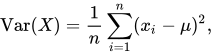
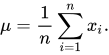
The variance of a set of equally likely values can be equivalently expressed, without directly referring to the mean, in terms of squared deviations of all pairwise squared distances of points from each other:[2]

Absolutely continuous random variable
[edit | edit source]If the random variable has a probability density function Template:Tmath, and is the corresponding cumulative distribution function, then or equivalently, where is the expected value of given by

![{\displaystyle {\begin{aligned}\operatorname {Var} (X)=\sigma ^{2}&=\int _{\mathbb {R} }{\left(x-\mu \right)}^{2}f(x)\,dx\\[4pt]&=\int _{\mathbb {R} }x^{2}f(x)\,dx-2\mu \int _{\mathbb {R} }xf(x)\,dx+\mu ^{2}\int _{\mathbb {R} }f(x)\,dx\\[4pt]&=\int _{\mathbb {R} }x^{2}\,dF(x)-2\mu \int _{\mathbb {R} }x\,dF(x)+\mu ^{2}\int _{\mathbb {R} }\,dF(x)\\[4pt]&=\int _{\mathbb {R} }x^{2}\,dF(x)-2\mu \cdot \mu +\mu ^{2}\cdot 1\\[4pt]&=\int _{\mathbb {R} }x^{2}\,dF(x)-\mu ^{2},\end{aligned}}}](https://wikimedia.org/api/rest_v1/media/math/render/svg/aaea988ed1efdf962e37d57a8eb05cb1b6ca85da)


In these formulas, the integrals with respect to and are Lebesgue and Lebesgue–Stieltjes integrals, respectively.


If the function is Riemann-integrable on every finite interval then where the integral is an improper Riemann integral.

![{\displaystyle [a,b]\subset \mathbb {R} ,}](https://wikimedia.org/api/rest_v1/media/math/render/svg/c16929783780dae7bb2272902a6ee9345436b481)

Examples
[edit | edit source]Exponential distribution
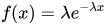
[edit | edit source]The exponential distribution with parameter Template:Tmath is a continuous distribution whose probability density function is given by on the interval [0, ∞). Its mean can be shown to be
![{\displaystyle \operatorname {E} [X]=\int _{0}^{\infty }x\lambda e^{-\lambda x}\,dx={\frac {1}{\lambda }}.}](https://wikimedia.org/api/rest_v1/media/math/render/svg/df94d1e04be55285495cdd70755f439ef7ead6c8)
Using integration by parts and making use of the expected value already calculated, we have:
![{\displaystyle {\begin{aligned}\operatorname {E} \left[X^{2}\right]&=\int _{0}^{\infty }x^{2}\lambda e^{-\lambda x}\,dx\\&={\left[-x^{2}e^{-\lambda x}\right]}_{0}^{\infty }+\int _{0}^{\infty }2xe^{-\lambda x}\,dx\\&=0+{\frac {2}{\lambda }}\operatorname {E} [X]\\&={\frac {2}{\lambda ^{2}}}.\end{aligned}}}](https://wikimedia.org/api/rest_v1/media/math/render/svg/1a34e6570e22517596b887949af797b1c824799a)
Thus, the variance of Template:Tmath is given by
![{\displaystyle \operatorname {Var} (X)=\operatorname {E} \left[X^{2}\right]-\operatorname {E} [X]^{2}={\frac {2}{\lambda ^{2}}}-\left({\frac {1}{\lambda }}\right)^{2}={\frac {1}{\lambda ^{2}}}.}](https://wikimedia.org/api/rest_v1/media/math/render/svg/a5064d28d7da067a7a675ae68d992b83bc339c32)
Fair die
[edit | edit source]A fair six-sided die can be modeled as a discrete random variable, Template:Tmath, with outcomes 1 through 6, each with equal probability 1/6. The expected value of Template:Tmath is Therefore, the variance of Template:Tmath is

![{\displaystyle {\begin{aligned}\operatorname {Var} (X)&=\sum _{i=1}^{6}{\frac {1}{6}}\left(i-{\frac {7}{2}}\right)^{2}\\[5pt]&={\frac {1}{6}}\left((-5/2)^{2}+(-3/2)^{2}+(-1/2)^{2}+(1/2)^{2}+(3/2)^{2}+(5/2)^{2}\right)\\[5pt]&={\frac {35}{12}}\approx 2.92.\end{aligned}}}](https://wikimedia.org/api/rest_v1/media/math/render/svg/6b1b6a74f544d9422366dc015805d67149030ec7)
The general formula for the variance of the outcome, Template:Tmath, of an Template:Tmath-sided die is
![{\displaystyle {\begin{aligned}\operatorname {Var} (X)&=\operatorname {E} \left(X^{2}\right)-(\operatorname {E} (X))^{2}\\[5pt]&={\frac {1}{n}}\sum _{i=1}^{n}i^{2}-\left({\frac {1}{n}}\sum _{i=1}^{n}i\right)^{2}\\[5pt]&={\frac {(n+1)(2n+1)}{6}}-\left({\frac {n+1}{2}}\right)^{2}\\[4pt]&={\frac {n^{2}-1}{12}}.\end{aligned}}}](https://wikimedia.org/api/rest_v1/media/math/render/svg/9a476607e0a4d7f3ba660d8f260abd520b2ffbed)
Commonly used probability distributions
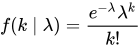
[edit | edit source]The following table lists the variance for some commonly used probability distributions.
| Name of the probability distribution | Probability distribution function | Mean | Variance |
|---|---|---|---|
| Binomial distribution | |||
| Geometric distribution | |||
| Normal distribution | |||
| Uniform distribution (continuous) | |||
| Exponential distribution | |||
| Poisson distribution |






![{\displaystyle f(x\mid a,b)={\begin{cases}{\frac {1}{b-a}}&{\text{for }}a\leq x\leq b,\\[3pt]0&{\text{for }}x<a{\text{ or }}x>b\end{cases}}}](https://wikimedia.org/api/rest_v1/media/math/render/svg/a49d9ce0f31f14565d14be7083c467987eb0823f)






Properties
[edit | edit source]Basic properties
[edit | edit source]Variance is non-negative because the squares are positive or zero:
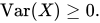
The variance of a constant is zero.

Conversely, if the variance of a random variable is 0, then it is almost surely a constant. That is, it always has the same value:

Issues of finiteness
[edit | edit source]If a distribution does not have a finite expected value, as is the case for the Cauchy distribution, then the variance cannot be finite either. However, some distributions may not have a finite variance, despite their expected value being finite. An example is a Pareto distribution whose index satisfies


Decomposition
[edit | edit source]The general formula for variance decomposition or the law of total variance is: If and are two random variables, and the variance of exists, then

![{\displaystyle \operatorname {Var} [X]=\operatorname {E} (\operatorname {Var} [X\mid Y])+\operatorname {Var} (\operatorname {E} [X\mid Y]).}](https://wikimedia.org/api/rest_v1/media/math/render/svg/d096b66af734c89681ab5cb61b24fbea63a48669)
The conditional expectation of given , and the conditional variance may be understood as follows. Given any particular value y of the random variable Y, there is a conditional expectation given the event Y = y. This quantity depends on the particular value y; it is a function . That same function evaluated at the random variable Y is the conditional expectation Template:Tmath.


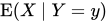

In particular, if is a discrete random variable assuming possible values with corresponding probabilities , then in the formula for total variance, the first term on the right-hand side becomes where . Similarly, the second term on the right-hand side becomes where Template:Tmath and Template:Tmath. Thus the total variance is given by


![{\displaystyle \operatorname {E} (\operatorname {Var} [X\mid Y])=\sum _{i}p_{i}\sigma _{i}^{2},}](https://wikimedia.org/api/rest_v1/media/math/render/svg/dc52b9938aac880c80b76dfe0bacc302c1d0f1d3)
![{\displaystyle \sigma _{i}^{2}=\operatorname {Var} [X\mid Y=y_{i}]}](https://wikimedia.org/api/rest_v1/media/math/render/svg/5f02e555171b20f14167f31a43ad480f720a6fa6)
![{\displaystyle \operatorname {Var} (\operatorname {E} [X\mid Y])=\sum _{i}p_{i}\mu _{i}^{2}-\left(\sum _{i}p_{i}\mu _{i}\right)^{2}=\sum _{i}p_{i}\mu _{i}^{2}-\mu ^{2},}](https://wikimedia.org/api/rest_v1/media/math/render/svg/069ee9f564216faf173487039b77447b1ef07da2)
![{\displaystyle \operatorname {Var} [X]=\sum _{i}p_{i}\sigma _{i}^{2}+\left(\sum _{i}p_{i}\mu _{i}^{2}-\mu ^{2}\right).}](https://wikimedia.org/api/rest_v1/media/math/render/svg/5653ed0b0a55e26b4763766d3e118bc05ed569f4)
A similar formula is applied in analysis of variance, where the corresponding formula is here refers to the Mean of the Squares. In linear regression analysis the corresponding formula is



This can also be derived from the additivity of variances, since the total (observed) score is the sum of the predicted score and the error score, where the latter two are uncorrelated.
Similar decompositions are possible for the sum of squared deviations (sum of squares, ):



Calculation from the CDF
[edit | edit source]The population variance for a non-negative random variable can be expressed in terms of the cumulative distribution function F using
![{\displaystyle 2\int _{0}^{\infty }u(1-F(u))\,du-{\left[\int _{0}^{\infty }(1-F(u))\,du\right]}^{2}.}](https://wikimedia.org/api/rest_v1/media/math/render/svg/73eef824f2fbc50de74a86a8a272ea9f894f5d73)
This expression can be used to calculate the variance in situations where the CDF, but not the density, can be conveniently expressed.
Characteristic property
[edit | edit source]The second moment of a random variable attains the minimum value when taken around the first moment (i.e., mean) of the random variable, i.e. Template:Tmath. Conversely, if a continuous function satisfies Failed to parse (SVG (MathML can be enabled via browser plugin): Invalid response ("Math extension cannot connect to Restbase.") from server "https://wikimedia.org/api/rest_v1/":): {\displaystyle \mathrm{argmin}_m\,\mathrm{E}(\varphi(X - m)) = \mathrm{E}(X)} for all random variables X, then it is necessarily of the form Template:Tmath, where a > 0. This also holds in the multidimensional case.[3]

Units of measurement
[edit | edit source]Unlike the expected absolute deviation, the variance of a variable has units that are the square of the units of the variable itself. For example, a variable measured in meters will have a variance measured in meters squared. For this reason, describing data sets via their standard deviation or root mean square deviation is often preferred over using the variance. In the dice example the standard deviation is √2.9 ≈ 1.7, slightly larger than the expected absolute deviation of 1.5.
The standard deviation and the expected absolute deviation can both be used as an indicator of the "spread" of a distribution. The standard deviation is more amenable to algebraic manipulation than the expected absolute deviation, and, together with variance and its generalization covariance, is used frequently in theoretical statistics; however the expected absolute deviation tends to be more robust as it is less sensitive to outliers arising from measurement anomalies or an unduly heavy-tailed distribution.
Propagation
[edit | edit source]Addition and multiplication by a constant
[edit | edit source]Variance is invariant with respect to changes in a location parameter. That is, if a constant is added to all values of the variable, the variance is unchanged:

If all values are scaled by a constant, the variance is scaled by the square of that constant: Failed to parse (SVG (MathML can be enabled via browser plugin): Invalid response ("Math extension cannot connect to Restbase.") from server "https://wikimedia.org/api/rest_v1/":): {\displaystyle \operatorname{Var}(aX)=a^2\operatorname{Var}(X).}
The variance of a sum of two random variables is given by Failed to parse (SVG (MathML can be enabled via browser plugin): Invalid response ("Math extension cannot connect to Restbase.") from server "https://wikimedia.org/api/rest_v1/":): {\displaystyle \begin{align} \operatorname{Var}(aX + bY) &= a^2\operatorname{Var}(X) + b^2\operatorname{Var}(Y) + 2ab\, \operatorname{Cov}(X,Y) \\[1ex] \operatorname{Var}(aX - bY) &= a^2\operatorname{Var}(X) + b^2\operatorname{Var}(Y) - 2ab\, \operatorname{Cov}(X,Y) \end{align}} where Failed to parse (SVG (MathML can be enabled via browser plugin): Invalid response ("Math extension cannot connect to Restbase.") from server "https://wikimedia.org/api/rest_v1/":): {\displaystyle \operatorname{Cov}(X,Y)} is the covariance.
Linear combinations
[edit | edit source]In general, for the sum of Failed to parse (SVG (MathML can be enabled via browser plugin): Invalid response ("Math extension cannot connect to Restbase.") from server "https://wikimedia.org/api/rest_v1/":): {\displaystyle N} random variables Template:Tmath, the variance becomes: Failed to parse (SVG (MathML can be enabled via browser plugin): Invalid response ("Math extension cannot connect to Restbase.") from server "https://wikimedia.org/api/rest_v1/":): {\displaystyle \operatorname{Var}\left(\sum_{i=1}^N X_i\right) = \sum_{i,j=1}^N\operatorname{Cov}(X_i,X_j) = \sum_{i=1}^N\operatorname{Var}(X_i) + \sum_{i,j=1,i\ne j}^N\operatorname{Cov}(X_i,X_j),} see also general Bienaymé's identity.
These results lead to the variance of a linear combination as: Failed to parse (SVG (MathML can be enabled via browser plugin): Invalid response ("Math extension cannot connect to Restbase.") from server "https://wikimedia.org/api/rest_v1/":): {\displaystyle \begin{align} \operatorname{Var}\left( \sum_{i=1}^N a_iX_i\right) &=\sum_{i,j=1}^{N} a_ia_j\operatorname{Cov}(X_i,X_j) \\ &= \sum_{i=1}^N a_i^2 \operatorname{Var}(X_i) + \sum_{i \neq j} a_i a_j \operatorname{Cov}(X_i,X_j)\\ &= \sum_{i=1}^N a_i^2 \operatorname{Var}(X_i) + 2 \sum_{1 \leq i < j \leq N} a_i a_j \operatorname{Cov}(X_i,X_j). \end{align}}
If the random variables Failed to parse (SVG (MathML can be enabled via browser plugin): Invalid response ("Math extension cannot connect to Restbase.") from server "https://wikimedia.org/api/rest_v1/":): {\displaystyle X_1,\dots,X_N} are such that Failed to parse (SVG (MathML can be enabled via browser plugin): Invalid response ("Math extension cannot connect to Restbase.") from server "https://wikimedia.org/api/rest_v1/":): {\displaystyle \operatorname{Cov}(X_i,X_j)=0\ ,\ \forall\ (i\ne j) ,} then they are said to be uncorrelated. It follows immediately from the expression given earlier that if the random variables Failed to parse (SVG (MathML can be enabled via browser plugin): Invalid response ("Math extension cannot connect to Restbase.") from server "https://wikimedia.org/api/rest_v1/":): {\displaystyle X_1,\dots,X_N} are uncorrelated, then the variance of their sum is equal to the sum of their variances, or, expressed symbolically: Failed to parse (SVG (MathML can be enabled via browser plugin): Invalid response ("Math extension cannot connect to Restbase.") from server "https://wikimedia.org/api/rest_v1/":): {\displaystyle \operatorname{Var}\left(\sum_{i=1}^N X_i\right) = \sum_{i=1}^N\operatorname{Var}(X_i).}
Since independent random variables are always uncorrelated (see Covariance § Uncorrelatedness and independence), the equation above holds in particular when the random variables Failed to parse (SVG (MathML can be enabled via browser plugin): Invalid response ("Math extension cannot connect to Restbase.") from server "https://wikimedia.org/api/rest_v1/":): {\displaystyle X_1,\dots,X_n} are independent. Thus, independence is sufficient but not necessary for the variance of the sum to equal the sum of the variances.
Matrix notation for the variance of a linear combination
[edit | edit source]Define Failed to parse (SVG (MathML can be enabled via browser plugin): Invalid response ("Math extension cannot connect to Restbase.") from server "https://wikimedia.org/api/rest_v1/":): {\displaystyle X} as a column vector of Failed to parse (SVG (MathML can be enabled via browser plugin): Invalid response ("Math extension cannot connect to Restbase.") from server "https://wikimedia.org/api/rest_v1/":): {\displaystyle n} random variables Template:Tmath, and Failed to parse (SVG (MathML can be enabled via browser plugin): Invalid response ("Math extension cannot connect to Restbase.") from server "https://wikimedia.org/api/rest_v1/":): {\displaystyle c} as a column vector of Failed to parse (SVG (MathML can be enabled via browser plugin): Invalid response ("Math extension cannot connect to Restbase.") from server "https://wikimedia.org/api/rest_v1/":): {\displaystyle n} scalars Template:Tmath. Therefore, Failed to parse (SVG (MathML can be enabled via browser plugin): Invalid response ("Math extension cannot connect to Restbase.") from server "https://wikimedia.org/api/rest_v1/":): {\displaystyle c^\mathsf{T} X} is a linear combination of these random variables, where Failed to parse (SVG (MathML can be enabled via browser plugin): Invalid response ("Math extension cannot connect to Restbase.") from server "https://wikimedia.org/api/rest_v1/":): {\displaystyle c^\mathsf{T}} denotes the transpose of Template:Tmath. Also let Failed to parse (SVG (MathML can be enabled via browser plugin): Invalid response ("Math extension cannot connect to Restbase.") from server "https://wikimedia.org/api/rest_v1/":): {\displaystyle \Sigma} be the covariance matrix of Template:Tmath. The variance of Failed to parse (SVG (MathML can be enabled via browser plugin): Invalid response ("Math extension cannot connect to Restbase.") from server "https://wikimedia.org/api/rest_v1/":): {\displaystyle c^\mathsf{T}X} is then given by:[4] Failed to parse (SVG (MathML can be enabled via browser plugin): Invalid response ("Math extension cannot connect to Restbase.") from server "https://wikimedia.org/api/rest_v1/":): {\displaystyle \operatorname{Var}\left(c^\mathsf{T} X\right) = c^\mathsf{T} \Sigma c.}
This implies that the variance of the mean can be written as (with a column vector of ones) Failed to parse (SVG (MathML can be enabled via browser plugin): Invalid response ("Math extension cannot connect to Restbase.") from server "https://wikimedia.org/api/rest_v1/":): {\displaystyle \operatorname{Var}\left(\bar{x}\right) = \operatorname{Var}\left(\frac{1}{n} 1'X\right) = \frac{1}{n^2} 1'\Sigma 1.}
Sum of variables
[edit | edit source]Sum of uncorrelated variables
[edit | edit source]One reason for the use of the variance in preference to other measures of dispersion is that the variance of the sum (or the difference) of uncorrelated random variables is the sum of their variances: Failed to parse (SVG (MathML can be enabled via browser plugin): Invalid response ("Math extension cannot connect to Restbase.") from server "https://wikimedia.org/api/rest_v1/":): {\displaystyle \operatorname{Var}\left(\sum_{i=1}^n X_i\right) = \sum_{i=1}^n \operatorname{Var}(X_i).}
This statement is called the Bienaymé formula[5] and was discovered in 1853.[6][7] It is often made with the stronger condition that the variables are independent, but being uncorrelated suffices. So if all the variables have the same variance σ2, then, since division by n is a linear transformation, this formula immediately implies that the variance of their mean is Failed to parse (SVG (MathML can be enabled via browser plugin): Invalid response ("Math extension cannot connect to Restbase.") from server "https://wikimedia.org/api/rest_v1/":): {\displaystyle \operatorname{Var}\left(\overline{X}\right) = \operatorname{Var}\left(\frac{1}{n} \sum_{i=1}^n X_i\right) = \frac{1}{n^2}\sum_{i=1}^n \operatorname{Var}\left(X_i\right) = \frac{1}{n^2}n\sigma^2 = \frac{\sigma^2}{n}. }
That is, the variance of the mean decreases when n increases. This formula for the variance of the mean is used in the definition of the standard error of the sample mean, which is used in the central limit theorem.
To prove the initial statement, it suffices to show that Failed to parse (SVG (MathML can be enabled via browser plugin): Invalid response ("Math extension cannot connect to Restbase.") from server "https://wikimedia.org/api/rest_v1/":): {\displaystyle \operatorname{Var}(X + Y) = \operatorname{Var}(X) + \operatorname{Var}(Y).}
The general result then follows by induction. Starting with the definition, Failed to parse (SVG (MathML can be enabled via browser plugin): Invalid response ("Math extension cannot connect to Restbase.") from server "https://wikimedia.org/api/rest_v1/":): {\displaystyle \begin{align} \operatorname{Var}(X + Y) &= \operatorname{E}\left[(X + Y)^2\right] - (\operatorname{E}[X + Y])^2 \\[5pt] &= \operatorname{E}\left[X^2 + 2XY + Y^2\right] - (\operatorname{E}[X] + \operatorname{E}[Y])^2. \end{align}}
Using the linearity of the expectation operator and the assumption of independence (or uncorrelatedness) of X and Y, this further simplifies as follows: Failed to parse (SVG (MathML can be enabled via browser plugin): Invalid response ("Math extension cannot connect to Restbase.") from server "https://wikimedia.org/api/rest_v1/":): {\displaystyle \begin{align} \operatorname{Var}(X + Y) &= \operatorname{E}{\left[X^2\right]} + 2\operatorname{E}[XY] + \operatorname{E}{\left[Y^2\right]} - \left(\operatorname{E}[X]^2 + 2\operatorname{E}[X] \operatorname{E}[Y] + \operatorname{E}[Y]^2\right) \\[5pt] &= \operatorname{E}\left[X^2\right] + \operatorname{E}\left[Y^2\right] - \operatorname{E}[X]^2 - \operatorname{E}[Y]^2 \\[5pt] &= \operatorname{Var}(X) + \operatorname{Var}(Y). \end{align}}
Sum of correlated variables
[edit | edit source]Sum of correlated variables with fixed sample size
[edit | edit source]In general, the variance of the sum of n variables is the sum of their covariances: Failed to parse (SVG (MathML can be enabled via browser plugin): Invalid response ("Math extension cannot connect to Restbase.") from server "https://wikimedia.org/api/rest_v1/":): {\displaystyle \operatorname{Var}\left(\sum_{i=1}^n X_i\right) = \sum_{i=1}^n \sum_{j=1}^n \operatorname{Cov}\left(X_i, X_j\right) = \sum_{i=1}^n \operatorname{Var}\left(X_i\right) + 2 \sum_{1 \leq i < j\leq n} \operatorname{Cov}\left(X_i, X_j\right).} (Note: The second equality comes from the fact that Cov(Xi, Xi) = Var(Xi).)
Here, Failed to parse (SVG (MathML can be enabled via browser plugin): Invalid response ("Math extension cannot connect to Restbase.") from server "https://wikimedia.org/api/rest_v1/":): {\displaystyle \operatorname{Cov}(\cdot,\cdot)} is the covariance, which is zero for independent random variables (if it exists). The formula states that the variance of a sum is equal to the sum of all elements in the covariance matrix of the components. The next expression states equivalently that the variance of the sum is the sum of the diagonal of covariance matrix plus two times the sum of its upper triangular elements (or its lower triangular elements); this emphasizes that the covariance matrix is symmetric. This formula is used in the theory of Cronbach's alpha in classical test theory.
So, if the variables have equal variance σ2 and the average correlation of distinct variables is ρ, then the variance of their mean is Failed to parse (SVG (MathML can be enabled via browser plugin): Invalid response ("Math extension cannot connect to Restbase.") from server "https://wikimedia.org/api/rest_v1/":): {\displaystyle \operatorname{Var}\left(\overline{X}\right) = \frac{\sigma^2}{n} + \frac{n - 1}{n}\rho\sigma^2.}
This implies that the variance of the mean increases with the average of the correlations. In other words, additional correlated observations are not as effective as additional independent observations at reducing the uncertainty of the mean. Moreover, if the variables have unit variance, for example if they are standardized, then this simplifies to Failed to parse (SVG (MathML can be enabled via browser plugin): Invalid response ("Math extension cannot connect to Restbase.") from server "https://wikimedia.org/api/rest_v1/":): {\displaystyle \operatorname{Var}\left(\overline{X}\right) = \frac{1}{n} + \frac{n - 1}{n}\rho.}
This formula is used in the Spearman–Brown prediction formula of classical test theory. This converges to ρ if n goes to infinity, provided that the average correlation remains constant or converges too. So for the variance of the mean of standardized variables with equal correlations or converging average correlation we have Failed to parse (SVG (MathML can be enabled via browser plugin): Invalid response ("Math extension cannot connect to Restbase.") from server "https://wikimedia.org/api/rest_v1/":): {\displaystyle \lim_{n \to \infty} \operatorname{Var}\left(\overline{X}\right) = \rho.}
Therefore, the variance of the mean of a large number of standardized variables is approximately equal to their average correlation. This makes clear that the sample mean of correlated variables does not generally converge to the population mean, even though the law of large numbers states that the sample mean will converge for independent variables.
Sum of uncorrelated variables with random sample size
[edit | edit source]There are cases when a sample is taken without knowing, in advance, how many observations will be acceptable according to some criterion. In such cases, the sample size N is a random variable whose variation adds to the variation of X, such that,[8] Failed to parse (SVG (MathML can be enabled via browser plugin): Invalid response ("Math extension cannot connect to Restbase.") from server "https://wikimedia.org/api/rest_v1/":): {\displaystyle \operatorname{Var}\left(\sum_{i=1}^{N}X_i\right)=\operatorname{E}\left[N\right]\operatorname{Var}(X)+\operatorname{Var}(N)(\operatorname{E}\left[X\right])^2} which follows from the law of total variance.
If N has a Poisson distribution, then Failed to parse (SVG (MathML can be enabled via browser plugin): Invalid response ("Math extension cannot connect to Restbase.") from server "https://wikimedia.org/api/rest_v1/":): {\displaystyle \operatorname{E}[N]=\operatorname{Var}(N)} with estimator n = N. So, the estimator of Failed to parse (SVG (MathML can be enabled via browser plugin): Invalid response ("Math extension cannot connect to Restbase.") from server "https://wikimedia.org/api/rest_v1/":): {\displaystyle \textstyle \operatorname{Var}\left(\sum_{i=1}^{n}X_i\right)} becomes Template:Tmath, giving Failed to parse (SVG (MathML can be enabled via browser plugin): Invalid response ("Math extension cannot connect to Restbase.") from server "https://wikimedia.org/api/rest_v1/":): {\displaystyle \textstyle \operatorname{SE}(\bar{X})=\sqrt{{({S_x}^2+\bar{X}^2)}/{n}}} (see Standard error § Standard error of the sample mean).
Weighted sum of variables
[edit | edit source]The scaling property and the Bienaymé formula, along with the property of the covariance Cov(aX, bY) = ab Cov(X, Y) jointly imply that Failed to parse (SVG (MathML can be enabled via browser plugin): Invalid response ("Math extension cannot connect to Restbase.") from server "https://wikimedia.org/api/rest_v1/":): {\displaystyle \operatorname{Var}(aX \pm bY) =a^2 \operatorname{Var}(X) + b^2 \operatorname{Var}(Y) \pm 2ab\, \operatorname{Cov}(X, Y).}
This implies that in a weighted sum of variables, the variable with the largest weight will have a disproportionally large weight in the variance of the total. For example, if X and Y are uncorrelated and the weight of X is two times the weight of Y, then the weight of the variance of X will be four times the weight of the variance of Y.
The expression above can be extended to a weighted sum of multiple variables: Failed to parse (SVG (MathML can be enabled via browser plugin): Invalid response ("Math extension cannot connect to Restbase.") from server "https://wikimedia.org/api/rest_v1/":): {\displaystyle \operatorname{Var}\left(\sum_{i}^n a_iX_i\right) = \sum_{i=1}^na_i^2 \operatorname{Var}(X_i) + 2\sum_{1\le i}\sum_{<j\le n}a_ia_j\operatorname{Cov}(X_i,X_j)}
Product of variables
[edit | edit source]Product of independent variables
[edit | edit source]If two variables X and Y are independent, the variance of their product is given by[9] Failed to parse (SVG (MathML can be enabled via browser plugin): Invalid response ("Math extension cannot connect to Restbase.") from server "https://wikimedia.org/api/rest_v1/":): {\displaystyle \operatorname{Var}(XY) = [\operatorname{E}(X)]^2 \operatorname{Var}(Y) + [\operatorname{E}(Y)]^2 \operatorname{Var}(X) + \operatorname{Var}(X)\operatorname{Var}(Y).}
Equivalently, using the basic properties of expectation, it is given by Failed to parse (SVG (MathML can be enabled via browser plugin): Invalid response ("Math extension cannot connect to Restbase.") from server "https://wikimedia.org/api/rest_v1/":): {\displaystyle \operatorname{Var}(XY) = \operatorname{E}\left(X^2\right) \operatorname{E}\left(Y^2\right) - [\operatorname{E}(X)]^2 [\operatorname{E}(Y)]^2.}
Product of statistically dependent variables
[edit | edit source]In general, if two variables are statistically dependent, then the variance of their product is given by:
Failed to parse (SVG (MathML can be enabled via browser plugin): Invalid response ("Math extension cannot connect to Restbase.") from server "https://wikimedia.org/api/rest_v1/":): {\displaystyle \begin{align} \operatorname{Var}(XY) ={} &\operatorname{E}\left[X^2 Y^2\right] - [\operatorname{E}(XY)]^2 \\[5pt] ={} &\operatorname{Cov}\left(X^2, Y^2\right) + \operatorname{E}(X^2)\operatorname{E}\left(Y^2\right) - [\operatorname{E}(XY)]^2 \\[5pt] ={} &\operatorname{Cov}\left(X^2, Y^2\right) + \left(\operatorname{Var}(X) + [\operatorname{E}(X)]^2\right) \left(\operatorname{Var}(Y) + [\operatorname{E}(Y)]^2\right) \\[5pt] &- [\operatorname{Cov}(X, Y) + \operatorname{E}(X)\operatorname{E}(Y)]^2 \end{align}}
Arbitrary functions
[edit | edit source]The delta method uses second-order Taylor expansions to approximate the variance of a function of one or more random variables (see Taylor expansions for the moments of functions of random variables). For example, the approximate variance of a function of one variable is given by Failed to parse (SVG (MathML can be enabled via browser plugin): Invalid response ("Math extension cannot connect to Restbase.") from server "https://wikimedia.org/api/rest_v1/":): {\displaystyle \operatorname{Var}\left[f(X)\right] \approx \left(f'(\operatorname{E}\left[X\right])\right)^2\operatorname{Var}\left[X\right]} provided that f is twice differentiable and that the mean and variance of X are finite.
Population variance and sample variance
[edit | edit source]
Real-world observations such as the measurements of yesterday's rain throughout the day typically cannot be complete sets of all possible observations that could be made. As such, the variance calculated from the finite set will in general not match the variance that would have been calculated from the full population of possible observations. This means that one estimates the mean and variance from a limited set of observations by using an estimator equation. The estimator is a function of the sample of n observations drawn without observational bias from the whole population of potential observations. In this example, the sample would be the set of actual measurements of yesterday's rainfall from available rain gauges within the geography of interest.
The simplest estimators for population mean and population variance are simply the mean and variance of the sample, the sample mean and (uncorrected) sample variance – these are consistent estimators (they converge to the value of the whole population as the number of samples increases) but can be improved. Most simply, the sample variance is computed as the sum of squared deviations about the (sample) mean, divided by n as the number of samples. However, using values other than n improves the estimator in various ways. Four common values for the denominator are n, n − 1, n + 1, and n − 1.5: n is the simplest (the variance of the sample), n − 1 eliminates bias,[10] n + 1 minimizes mean squared error for the normal distribution,[11] and n − 1.5 mostly eliminates bias in unbiased estimation of standard deviation for the normal distribution.[12]
Firstly, if the true population mean is unknown, then the sample variance (which uses the sample mean in place of the true mean) is a biased estimator: it underestimates the variance by a factor of (n − 1) / n; correcting this factor, resulting in the sum of squared deviations about the sample mean divided by n − 1 instead of n, is called Bessel's correction.[10] The resulting estimator is unbiased and is called the (corrected) sample variance or unbiased sample variance. If the mean is determined in some other way than from the same samples used to estimate the variance, then this bias does not arise, and the variance can safely be estimated as that of the samples about the (independently known) mean.
Secondly, the sample variance does not generally minimize mean squared error between sample variance and population variance. Correcting for bias often makes this worse: one can always choose a scale factor that performs better than the corrected sample variance, though the optimal scale factor depends on the excess kurtosis of the population (see Mean squared error § Variance) and introduces bias. This always consists of scaling down the unbiased estimator (dividing by a number larger than n − 1) and is a simple example of a shrinkage estimator: one "shrinks" the unbiased estimator towards zero. For the normal distribution, dividing by n + 1 (instead of n − 1 or n) minimizes mean squared error.[11] The resulting estimator is biased, however, and is known as the biased sample variation.
Population variance
[edit | edit source]In general, the population variance of a finite population of size Template:Tmath with values xi is given by Failed to parse (SVG (MathML can be enabled via browser plugin): Invalid response ("Math extension cannot connect to Restbase.") from server "https://wikimedia.org/api/rest_v1/":): {\displaystyle \begin{align} \sigma^2 &= \frac{1}{N} \sum_{i=1}^N {\left(x_i - \mu\right)}^2 = \frac{1}{N} \sum_{i=1}^N \left(x_i^2 - 2 \mu x_i + \mu^2 \right) \\[5pt] &= \left(\frac{1}{N} \sum_{i=1}^N x_i^2\right) - 2\mu \left(\frac{1}{N} \sum_{i=1}^N x_i\right) + \mu^2 \\[5pt] &= \operatorname{E}[x_i^2] - \mu^2 , \end{align}} where the population mean is Failed to parse (SVG (MathML can be enabled via browser plugin): Invalid response ("Math extension cannot connect to Restbase.") from server "https://wikimedia.org/api/rest_v1/":): {\textstyle \mu = \operatorname{E}[x_i] = \frac 1N \sum_{i=1}^N x_i} and Template:Tmath, where Failed to parse (SVG (MathML can be enabled via browser plugin): Invalid response ("Math extension cannot connect to Restbase.") from server "https://wikimedia.org/api/rest_v1/":): {\textstyle \operatorname{E}} is the expectation value operator.
The population variance can also be computed using[13] Failed to parse (SVG (MathML can be enabled via browser plugin): Invalid response ("Math extension cannot connect to Restbase.") from server "https://wikimedia.org/api/rest_v1/":): {\displaystyle \sigma^2 = \frac {1} {N^2}\sum_{i<j}\left( x_i-x_j \right)^2 = \frac{1}{2N^2} \sum_{i, j=1}^N\left( x_i-x_j \right)^2.}
(The right side has duplicate terms in the sum while the middle side has only unique terms to sum.) This is true because Failed to parse (SVG (MathML can be enabled via browser plugin): Invalid response ("Math extension cannot connect to Restbase.") from server "https://wikimedia.org/api/rest_v1/":): {\displaystyle \begin{align} &\frac{1}{2N^2} \sum_{i, j=1}^N {\left( x_i - x_j \right)}^2 \\[5pt] ={} &\frac{1}{2N^2} \sum_{i, j=1}^N \left( x_i^2 - 2x_i x_j + x_j^2 \right) \\[5pt] ={} &\frac{1}{2N} \sum_{j=1}^N \left(\frac{1}{N} \sum_{i=1}^N x_i^2\right) - \left(\frac{1}{N} \sum_{i=1}^N x_i\right) \left(\frac{1}{N} \sum_{j=1}^N x_j\right) + \frac{1}{2N} \sum_{i=1}^N \left(\frac{1}{N} \sum_{j=1}^N x_j^2\right) \\[5pt] ={} &\frac{1}{2} \left( \sigma^2 + \mu^2 \right) - \mu^2 + \frac{1}{2} \left( \sigma^2 + \mu^2 \right) \\[5pt] ={} &\sigma^2. \end{align}}
The population variance matches the variance of the generating probability distribution. In this sense, the concept of population can be extended to continuous random variables with infinite populations.
Sample variance
[edit | edit source]Biased sample variance
[edit | edit source]In many practical situations, the true variance of a population is not known a priori and must be computed somehow. When dealing with extremely large populations, it is not possible to count every object in the population, so the computation must be performed on a sample of the population.[14] This is generally referred to as sample variance or empirical variance. Sample variance can also be applied to the estimation of the variance of a continuous distribution from a sample of that distribution.
We take a sample with replacement of Template:Tmath values Y1, ..., Yn from the population of size Template:Tmath, where n < N, and estimate the variance on the basis of this sample.[15] Directly taking the variance of the sample data gives the average of the squared deviations:[16] Failed to parse (SVG (MathML can be enabled via browser plugin): Invalid response ("Math extension cannot connect to Restbase.") from server "https://wikimedia.org/api/rest_v1/":): {\displaystyle \tilde{S}_Y^2 = \frac{1}{n} \sum_{i=1}^n \left(Y_i - \overline{Y}\right)^2 = \left(\frac 1n \sum_{i=1}^n Y_i^2\right) - \overline{Y}^2 = \frac{1}{n^2} \sum_{i,j\,:\,i<j}\left(Y_i - Y_j\right)^2. } (See the section § Population variance for the derivation of this formula.) Here, Failed to parse (SVG (MathML can be enabled via browser plugin): Invalid response ("Math extension cannot connect to Restbase.") from server "https://wikimedia.org/api/rest_v1/":): {\displaystyle \overline{Y}} denotes the sample mean: Failed to parse (SVG (MathML can be enabled via browser plugin): Invalid response ("Math extension cannot connect to Restbase.") from server "https://wikimedia.org/api/rest_v1/":): {\displaystyle \overline{Y} = \frac{1}{n} \sum_{i=1}^n Y_i.}
Since the Yi are selected randomly, both Failed to parse (SVG (MathML can be enabled via browser plugin): Invalid response ("Math extension cannot connect to Restbase.") from server "https://wikimedia.org/api/rest_v1/":): {\displaystyle \overline{Y}} and Failed to parse (SVG (MathML can be enabled via browser plugin): Invalid response ("Math extension cannot connect to Restbase.") from server "https://wikimedia.org/api/rest_v1/":): {\displaystyle \tilde{S}_Y^2} are random variables. Their expected values can be evaluated by averaging over the ensemble of all possible samples {Yi} of size Template:Tmath from the population. For Failed to parse (SVG (MathML can be enabled via browser plugin): Invalid response ("Math extension cannot connect to Restbase.") from server "https://wikimedia.org/api/rest_v1/":): {\displaystyle \tilde{S}_Y^2} this gives: Failed to parse (SVG (MathML can be enabled via browser plugin): Invalid response ("Math extension cannot connect to Restbase.") from server "https://wikimedia.org/api/rest_v1/":): {\displaystyle \begin{align} \operatorname{E}[\tilde{S}_Y^2] &= \operatorname{E}\left[ \frac{1}{n} \sum_{i=1}^n {\left(Y_i - \frac{1}{n} \sum_{j=1}^n Y_j \right)}^2 \right] \\[5pt] &= \frac 1n \sum_{i=1}^n \operatorname{E}\left[ Y_i^2 - \frac{2}{n} Y_i \sum_{j=1}^n Y_j + \frac{1}{n^2} \sum_{j=1}^n Y_j \sum_{k=1}^n Y_k \right] \\[5pt] &= \frac 1n \sum_{i=1}^n \left( \operatorname{E}\left[Y_i^2\right] - \frac{2}{n} \left( \sum_{j \neq i} \operatorname{E}\left[Y_i Y_j\right] + \operatorname{E}\left[Y_i^2\right] \right) + \frac{1}{n^2} \sum_{j=1}^n \sum_{k \neq j}^n \operatorname{E}\left[Y_j Y_k\right] +\frac{1}{n^2} \sum_{j=1}^n \operatorname{E}\left[Y_j^2\right] \right) \\[5pt] &= \frac 1n \sum_{i=1}^n \left( \frac{n - 2}{n} \operatorname{E}\left[Y_i^2\right] - \frac{2}{n} \sum_{j \neq i} \operatorname{E}\left[Y_i Y_j\right] + \frac{1}{n^2} \sum_{j=1}^n \sum_{k \neq j}^n \operatorname{E}\left[Y_j Y_k\right] +\frac{1}{n^2} \sum_{j=1}^n \operatorname{E}\left[Y_j^2\right] \right) \\[5pt] &= \frac 1n \sum_{i=1}^n \left[ \frac{n - 2}{n} \left(\sigma^2 + \mu^2\right) - \frac{2}{n} (n - 1)\mu^2 + \frac{1}{n^2} n(n - 1)\mu^2 + \frac{1}{n} \left(\sigma^2 + \mu^2\right) \right] \\[5pt] &= \frac{n - 1}{n} \sigma^2. \end{align}}
Here Failed to parse (SVG (MathML can be enabled via browser plugin): Invalid response ("Math extension cannot connect to Restbase.") from server "https://wikimedia.org/api/rest_v1/":): {\textstyle \sigma^2 = \operatorname{E}[Y_i^2] - \mu^2} derived in the section is population variance and Failed to parse (SVG (MathML can be enabled via browser plugin): Invalid response ("Math extension cannot connect to Restbase.") from server "https://wikimedia.org/api/rest_v1/":): {\textstyle \operatorname{E}[Y_i Y_j] = \operatorname{E}[Y_i] \operatorname{E}[Y_j] = \mu^2} due to independency of Failed to parse (SVG (MathML can be enabled via browser plugin): Invalid response ("Math extension cannot connect to Restbase.") from server "https://wikimedia.org/api/rest_v1/":): {\displaystyle Y_i} and Template:Tmath.
Hence Failed to parse (SVG (MathML can be enabled via browser plugin): Invalid response ("Math extension cannot connect to Restbase.") from server "https://wikimedia.org/api/rest_v1/":): {\textstyle \tilde{S}_Y^2} gives an estimate of the population variance Failed to parse (SVG (MathML can be enabled via browser plugin): Invalid response ("Math extension cannot connect to Restbase.") from server "https://wikimedia.org/api/rest_v1/":): {\textstyle \sigma^2} that is biased by a factor of Failed to parse (SVG (MathML can be enabled via browser plugin): Invalid response ("Math extension cannot connect to Restbase.") from server "https://wikimedia.org/api/rest_v1/":): {\textstyle \frac{n - 1}{n}} because the expectation value of Failed to parse (SVG (MathML can be enabled via browser plugin): Invalid response ("Math extension cannot connect to Restbase.") from server "https://wikimedia.org/api/rest_v1/":): {\textstyle \tilde{S}_Y^2} is smaller than the population variance (true variance) by that factor. For this reason, Failed to parse (SVG (MathML can be enabled via browser plugin): Invalid response ("Math extension cannot connect to Restbase.") from server "https://wikimedia.org/api/rest_v1/":): {\textstyle \tilde{S}_Y^2} is referred to as the biased sample variance.
Unbiased sample variance
[edit | edit source]Correcting for this bias yields the unbiased sample variance, denoted Template:Tmath: Failed to parse (SVG (MathML can be enabled via browser plugin): Invalid response ("Math extension cannot connect to Restbase.") from server "https://wikimedia.org/api/rest_v1/":): {\displaystyle S^2 = \frac{n}{n - 1} \tilde{S}_Y^2 = \frac{n}{n - 1} \left[ \frac{1}{n} \sum_{i=1}^n \left(Y_i - \overline{Y}\right)^2 \right] = \frac{1}{n - 1} \sum_{i=1}^n \left(Y_i - \overline{Y} \right)^2}
Either estimator may be simply referred to as the sample variance when the version can be determined by context. The same proof is also applicable for samples taken from a continuous probability distribution.
The use of the term n − 1 is called Bessel's correction, and it is also used in sample covariance and the sample standard deviation (the square root of variance). The square root is a concave function and thus introduces negative bias (by Jensen's inequality), which depends on the distribution, and thus the corrected sample standard deviation (using Bessel's correction) is biased. The unbiased estimation of standard deviation is a technically involved problem, though for the normal distribution using the term n − 1.5 yields an almost unbiased estimator.
The unbiased sample variance is a U-statistic for the function f(y1, y2) = (y1 − y2)2/2, meaning that it is obtained by averaging a 2-sample statistic over 2-element subsets of the population.
Example
[edit | edit source]For a set of numbers {10, 15, 30, 45, 57, 52, 63, 72, 81, 93, 102, 105}, if this set is the whole data population for some measurement, then variance is the population variance 932.743 as the sum of the squared deviations about the mean of this set, divided by 12 as the number of the set members. If the set is a sample from the whole population, then the unbiased sample variance can be calculated as 1017.538 that is the sum of the squared deviations about the mean of the sample, divided by 11 instead of 12. A function VAR.S in Microsoft Excel gives the unbiased sample variance while VAR.P is for population variance.
Distribution of the sample variance
[edit | edit source]Being a function of random variables, the sample variance is itself a random variable, and it is natural to study its distribution. In the case that Yi are independent observations from a normal distribution, Cochran's theorem shows that the unbiased sample variance S2 follows a scaled chi-squared distribution (see also: asymptotic properties and an elementary proof):[17] Failed to parse (SVG (MathML can be enabled via browser plugin): Invalid response ("Math extension cannot connect to Restbase.") from server "https://wikimedia.org/api/rest_v1/":): {\displaystyle (n - 1) \frac{S^2}{\sigma^2} \sim \chi^2_{n-1} , } where σ2 is the population variance. As a direct consequence, it follows that and[18]
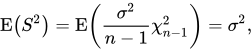
![{\displaystyle \operatorname {Var} \left[S^{2}\right]=\operatorname {Var} \left({\frac {\sigma ^{2}}{n-1}}\chi _{n-1}^{2}\right)={\frac {\sigma ^{4}}{{\left(n-1\right)}^{2}}}\operatorname {Var} \left(\chi _{n-1}^{2}\right)={\frac {2\sigma ^{4}}{n-1}}.}](https://wikimedia.org/api/rest_v1/media/math/render/svg/2479af870c1e7c8943e0acaf40c63cfb6ba46d87)
If Yi are independent and identically distributed, but not necessarily normally distributed, then[19] where κ is the kurtosis of the distribution and μ4 is the fourth central moment.
![{\displaystyle \operatorname {E} \left[S^{2}\right]=\sigma ^{2};\quad \operatorname {Var} \left[S^{2}\right]={\frac {\sigma ^{4}}{n}}\left(\kappa -1+{\frac {2}{n-1}}\right)={\frac {1}{n}}\left(\mu _{4}-{\frac {n-3}{n-1}}\sigma ^{4}\right),}](https://wikimedia.org/api/rest_v1/media/math/render/svg/4fed75de66c2780b27e9ddbe66514418842cce06)
If the conditions of the law of large numbers hold for the squared observations, S2 is a consistent estimator of σ2. One can see indeed that the variance of the estimator tends asymptotically to zero. An asymptotically equivalent formula was given in Kenney and Keeping (1951:164), Rose and Smith (2002:264), and Weisstein (n.d.).[20][21][22]
Samuelson's inequality
[edit | edit source]Samuelson's inequality is a result that states bounds on the values that individual observations in a sample can take, given that the sample mean and (biased) variance have been calculated.[23] Values must lie within the limits Template:Tmath.
Effect of adding one observation on variance
[edit | edit source]When a single new observation is added to a set of observations with mean and variance , the new variance can be expressed using a recursive updating formula. Based on the identity for the sum of squares provided by Chan et al. (1983)[24]:


From this relationship, the impact of the new observation on the variance depends on its distance from the current mean. If , then the variance will remain unchanged. Accordingly, if the new observation is closer to the mean (), then the variance will decrease - and if is further from the mean (), then the variance will increase.


Derivation for Sample Variance
Using the updating formula for the sum of squares ():


Substituting the relationship for sample variance ():


- Failed to parse (SVG (MathML can be enabled via browser plugin): Invalid response ("Math extension cannot connect to Restbase.") from server "https://wikimedia.org/api/rest_v1/":): {\displaystyle n s^2_{n+1} = (n-1)s^2_n + \frac{n}{n+1}(x_{n+1} - \bar{x}_n)^2}
Setting Failed to parse (SVG (MathML can be enabled via browser plugin): Invalid response ("Math extension cannot connect to Restbase.") from server "https://wikimedia.org/api/rest_v1/":): {\displaystyle s^2_{n+1} = s^2_n} :
- Failed to parse (SVG (MathML can be enabled via browser plugin): Invalid response ("Math extension cannot connect to Restbase.") from server "https://wikimedia.org/api/rest_v1/":): {\displaystyle n s^2_n = (n-1)s^2_n + \frac{n}{n+1}(x_{n+1} - \bar{x}_n)^2}
- Failed to parse (SVG (MathML can be enabled via browser plugin): Invalid response ("Math extension cannot connect to Restbase.") from server "https://wikimedia.org/api/rest_v1/":): {\displaystyle s^2_n = \frac{n}{n+1}(x_{n+1} - \bar{x}_n)^2}
Solving for Failed to parse (SVG (MathML can be enabled via browser plugin): Invalid response ("Math extension cannot connect to Restbase.") from server "https://wikimedia.org/api/rest_v1/":): {\displaystyle x_{n+1}} yields:
- Failed to parse (SVG (MathML can be enabled via browser plugin): Invalid response ("Math extension cannot connect to Restbase.") from server "https://wikimedia.org/api/rest_v1/":): {\displaystyle x_{n+1} = \bar{x}_n \pm s_n \sqrt{\frac{n+1}{n}}}
Derivation for Population Variance
For population variance (Failed to parse (SVG (MathML can be enabled via browser plugin): Invalid response ("Math extension cannot connect to Restbase.") from server "https://wikimedia.org/api/rest_v1/":): {\displaystyle \sigma^2 = \frac{SS}{n}} ), the updating formula is:
- Failed to parse (SVG (MathML can be enabled via browser plugin): Invalid response ("Math extension cannot connect to Restbase.") from server "https://wikimedia.org/api/rest_v1/":): {\displaystyle (n+1)\sigma^2_{n+1} = n\sigma^2_n + \frac{n}{n+1}(x_{n+1} - \mu_n)^2}
Setting Failed to parse (SVG (MathML can be enabled via browser plugin): Invalid response ("Math extension cannot connect to Restbase.") from server "https://wikimedia.org/api/rest_v1/":): {\displaystyle \sigma^2_{n+1} = \sigma^2_n} :
- Failed to parse (SVG (MathML can be enabled via browser plugin): Invalid response ("Math extension cannot connect to Restbase.") from server "https://wikimedia.org/api/rest_v1/":): {\displaystyle (n+1)\sigma^2_n = n\sigma^2_n + \frac{n}{n+1}(x_{n+1} - \mu_n)^2}
- Failed to parse (SVG (MathML can be enabled via browser plugin): Invalid response ("Math extension cannot connect to Restbase.") from server "https://wikimedia.org/api/rest_v1/":): {\displaystyle \sigma^2_n = \frac{n}{n+1}(x_{n+1} - \mu_n)^2}
Solving for Failed to parse (SVG (MathML can be enabled via browser plugin): Invalid response ("Math extension cannot connect to Restbase.") from server "https://wikimedia.org/api/rest_v1/":): {\displaystyle x_{n+1}} yields:
- Failed to parse (SVG (MathML can be enabled via browser plugin): Invalid response ("Math extension cannot connect to Restbase.") from server "https://wikimedia.org/api/rest_v1/":): {\displaystyle x_{n+1} = \mu_n \pm \sigma_n \sqrt{\frac{n+1}{n}}}
Relations with the harmonic and arithmetic means
[edit | edit source]It has been shown[25] that for a sample {yi} of positive real numbers, Failed to parse (SVG (MathML can be enabled via browser plugin): Invalid response ("Math extension cannot connect to Restbase.") from server "https://wikimedia.org/api/rest_v1/":): {\displaystyle \sigma_y^2 \le 2y_{\max} (A - H) , } where ymax is the maximum of the sample, Template:Tmath is the arithmetic mean, Template:Tmath is the harmonic mean of the sample and Failed to parse (SVG (MathML can be enabled via browser plugin): Invalid response ("Math extension cannot connect to Restbase.") from server "https://wikimedia.org/api/rest_v1/":): {\displaystyle \sigma_y^2} is the (biased) variance of the sample.
This bound has been improved, and it is known that variance is bounded by Failed to parse (SVG (MathML can be enabled via browser plugin): Invalid response ("Math extension cannot connect to Restbase.") from server "https://wikimedia.org/api/rest_v1/":): {\displaystyle \begin{align} \sigma_y^2 &\le \frac{y_{\max} (A - H)(y_\max - A)}{y_\max - H}, \\[1ex] \sigma_y^2 &\ge \frac{y_{\min} (A - H)(A - y_\min)}{H - y_\min}, \end{align}} where ymin is the minimum of the sample.[26]
Tests of equality of variances
[edit | edit source]The F-test of equality of variances and the chi square tests are adequate when the sample is normally distributed. Non-normality makes testing for the equality of two or more variances more difficult.
Several non parametric tests have been proposed: these include the Barton–David–Ansari–Freund–Siegel–Tukey test, the Capon test, Mood test, the Klotz test and the Sukhatme test. The Sukhatme test applies to two variances and requires that both medians be known and equal to zero. The Mood, Klotz, Capon and Barton–David–Ansari–Freund–Siegel–Tukey tests also apply to two variances. They allow the median to be unknown but do require that the two medians are equal.
The Lehmann test is a parametric test of two variances. Of this test there are several variants known. Other tests of the equality of variances include the Box test, the Box–Anderson test and the Moses test.
Resampling methods, which include the bootstrap and the jackknife, may be used to test the equality of variances.
Moment of inertia
[edit | edit source]The variance of a probability distribution is analogous to the moment of inertia in classical mechanics of a corresponding mass distribution along a line, with respect to rotation about its center of mass.[27] It is because of this analogy that such things as the variance are called moments of probability distributions.[27] The covariance matrix is related to the moment of inertia tensor for multivariate distributions. The moment of inertia of a cloud of n points with a covariance matrix of Failed to parse (SVG (MathML can be enabled via browser plugin): Invalid response ("Math extension cannot connect to Restbase.") from server "https://wikimedia.org/api/rest_v1/":): {\displaystyle \Sigma} is given by[citation needed] Failed to parse (SVG (MathML can be enabled via browser plugin): Invalid response ("Math extension cannot connect to Restbase.") from server "https://wikimedia.org/api/rest_v1/":): {\displaystyle I = n\left(\mathbf{1}_{3\times 3} \operatorname{tr}(\Sigma) - \Sigma\right).}
This difference between moment of inertia in physics and in statistics is clear for points that are gathered along a line. Suppose many points are close to the x axis and distributed along it. The covariance matrix might look like Failed to parse (SVG (MathML can be enabled via browser plugin): Invalid response ("Math extension cannot connect to Restbase.") from server "https://wikimedia.org/api/rest_v1/":): {\displaystyle \Sigma = \begin{bmatrix} 10 & 0 & 0 \\ 0 & 0.1 & 0 \\ 0 & 0 & 0.1 \end{bmatrix}.}
That is, there is the most variance in the x direction. Physicists would consider this to have a low moment about the x axis so the moment-of-inertia tensor is Failed to parse (SVG (MathML can be enabled via browser plugin): Invalid response ("Math extension cannot connect to Restbase.") from server "https://wikimedia.org/api/rest_v1/":): {\displaystyle I = n\begin{bmatrix} 0.2 & 0 & 0 \\ 0 & 10.1 & 0 \\ 0 & 0 & 10.1 \end{bmatrix}.}
Semivariance
[edit | edit source]The semivariance is calculated in the same manner as the variance but only those observations that fall below the mean are included in the calculation: Failed to parse (SVG (MathML can be enabled via browser plugin): Invalid response ("Math extension cannot connect to Restbase.") from server "https://wikimedia.org/api/rest_v1/":): {\displaystyle \text{Semivariance} = \frac{1}{n} \sum_{i:x_i < \mu} {\left(x_i - \mu\right)}^2} It is also described as a specific measure in different fields of application. For skewed distributions, the semivariance can provide additional information that a variance does not.[28]
For inequalities associated with the semivariance, see Chebyshev's inequality § Semivariances.
Etymology
[edit | edit source]The term variance was first introduced by Ronald Fisher in his 1918 paper The Correlation Between Relatives on the Supposition of Mendelian Inheritance:[29]
The great body of available statistics show us that the deviations of a human measurement from its mean follow very closely the Normal Law of Errors, and, therefore, that the variability may be uniformly measured by the standard deviation corresponding to the square root of the mean square error. When there are two independent causes of variability capable of producing in an otherwise uniform population distributions with standard deviations Failed to parse (SVG (MathML can be enabled via browser plugin): Invalid response ("Math extension cannot connect to Restbase.") from server "https://wikimedia.org/api/rest_v1/":): {\displaystyle \sigma_1} and Failed to parse (SVG (MathML can be enabled via browser plugin): Invalid response ("Math extension cannot connect to Restbase.") from server "https://wikimedia.org/api/rest_v1/":): {\displaystyle \sigma_2} , it is found that the distribution, when both causes act together, has a standard deviation Failed to parse (SVG (MathML can be enabled via browser plugin): Invalid response ("Math extension cannot connect to Restbase.") from server "https://wikimedia.org/api/rest_v1/":): {\displaystyle \sqrt{\sigma_1^2 + \sigma_2^2}} . It is therefore desirable in analysing the causes of variability to deal with the square of the standard deviation as the measure of variability. We shall term this quantity the Variance...
Generalizations
[edit | edit source]For complex variables
[edit | edit source]If Failed to parse (SVG (MathML can be enabled via browser plugin): Invalid response ("Math extension cannot connect to Restbase.") from server "https://wikimedia.org/api/rest_v1/":): {\displaystyle x} is a scalar complex-valued random variable, with values in Template:Tmath, then its variance is Template:Tmath, where Failed to parse (SVG (MathML can be enabled via browser plugin): Invalid response ("Math extension cannot connect to Restbase.") from server "https://wikimedia.org/api/rest_v1/":): {\displaystyle x^*} is the complex conjugate of Template:Tmath. This variance is a real scalar.
For vector-valued random variables
[edit | edit source]As a matrix
[edit | edit source]If Failed to parse (SVG (MathML can be enabled via browser plugin): Invalid response ("Math extension cannot connect to Restbase.") from server "https://wikimedia.org/api/rest_v1/":): {\displaystyle X} is a vector-valued random variable, with values in Failed to parse (SVG (MathML can be enabled via browser plugin): Invalid response ("Math extension cannot connect to Restbase.") from server "https://wikimedia.org/api/rest_v1/":): {\displaystyle \mathbb{R}^n,} and thought of as a column vector, then a natural generalization of variance is Failed to parse (SVG (MathML can be enabled via browser plugin): Invalid response ("Math extension cannot connect to Restbase.") from server "https://wikimedia.org/api/rest_v1/":): {\displaystyle \operatorname{E}\left[(X - \mu) {(X - \mu)}^{\mathsf{T}}\right],} where Failed to parse (SVG (MathML can be enabled via browser plugin): Invalid response ("Math extension cannot connect to Restbase.") from server "https://wikimedia.org/api/rest_v1/":): {\displaystyle \mu = \operatorname{E}(X)} and Failed to parse (SVG (MathML can be enabled via browser plugin): Invalid response ("Math extension cannot connect to Restbase.") from server "https://wikimedia.org/api/rest_v1/":): {\displaystyle X^{\mathsf{T}}} is the transpose of Template:Tmath, and so is a row vector. The result is a positive semi-definite square matrix, commonly referred to as the variance-covariance matrix (or simply as the covariance matrix).
If Failed to parse (SVG (MathML can be enabled via browser plugin): Invalid response ("Math extension cannot connect to Restbase.") from server "https://wikimedia.org/api/rest_v1/":): {\displaystyle X} is a vector- and complex-valued random variable, with values in Template:Tmath, then the covariance matrix is Template:Tmath, where Failed to parse (SVG (MathML can be enabled via browser plugin): Invalid response ("Math extension cannot connect to Restbase.") from server "https://wikimedia.org/api/rest_v1/":): {\displaystyle X^\dagger} is the conjugate transpose of Template:Tmath.[citation needed] This matrix is also positive semi-definite and square.
As a scalar
[edit | edit source]Another generalization of variance for vector-valued random variables Failed to parse (SVG (MathML can be enabled via browser plugin): Invalid response ("Math extension cannot connect to Restbase.") from server "https://wikimedia.org/api/rest_v1/":): {\displaystyle X,} which results in a scalar value rather than in a matrix, is the generalized variance Template:Tmath, the determinant of the covariance matrix. The generalized variance can be shown to be related to the multidimensional scatter of points around their mean.[30]
A different generalization is obtained by considering the equation for the scalar variance, Failed to parse (SVG (MathML can be enabled via browser plugin): Invalid response ("Math extension cannot connect to Restbase.") from server "https://wikimedia.org/api/rest_v1/":): {\displaystyle \operatorname{Var}(X) = \operatorname{E}\left[(X - \mu)^2 \right],} and reinterpreting Failed to parse (SVG (MathML can be enabled via browser plugin): Invalid response ("Math extension cannot connect to Restbase.") from server "https://wikimedia.org/api/rest_v1/":): {\displaystyle (X - \mu)^2} as the squared Euclidean distance between the random variable and its mean, or, simply as the scalar product of the vector Failed to parse (SVG (MathML can be enabled via browser plugin): Invalid response ("Math extension cannot connect to Restbase.") from server "https://wikimedia.org/api/rest_v1/":): {\displaystyle X - \mu} with itself. This results in Failed to parse (SVG (MathML can be enabled via browser plugin): Invalid response ("Math extension cannot connect to Restbase.") from server "https://wikimedia.org/api/rest_v1/":): {\displaystyle \operatorname{E}\left[(X - \mu)^{\mathsf{T}}(X - \mu)\right] = \operatorname{tr}(C),} which is the trace of the covariance matrix.
See also
[edit | edit source]| File:Wiktionary-logo-en-v2.svg | Look up variance in Wiktionary, the free dictionary. |

- Bhatia–Davis inequality
- Coefficient of variation
- Homoscedasticity
- Least-squares spectral analysis for computing a frequency spectrum with spectral magnitudes in % of variance or in dB
- Modern portfolio theory
- Popoviciu's inequality on variances
- Measures for statistical dispersion
- Variance-stabilizing transformation
Types of variance
[edit | edit source]References
[edit | edit source]- ↑ Wasserman, Larry (2005). All of Statistics: a concise course in statistical inference. Springer texts in statistics. p. 51. ISBN 978-1-4419-2322-6.
- ↑ Yuli Zhang; Huaiyu Wu; Lei Cheng (June 2012). Some new deformation formulas about variance and covariance. Proceedings of 4th International Conference on Modelling, Identification and Control(ICMIC2012). pp. 987–992.
- ↑ Kagan, A.; Shepp, L. A. (1998). "Why the variance?". Statistics & Probability Letters. 38 (4): 329–333. doi:10.1016/S0167-7152(98)00041-8.
- ↑ Johnson, Richard; Wichern, Dean (2001). Applied Multivariate Statistical Analysis. Prentice Hall. p. 76. ISBN 0-13-187715-1.
- ↑ Loève, M. (1977) "Probability Theory", Graduate Texts in Mathematics, Volume 45, 4th edition, Springer-Verlag, p. 12.
- ↑ Bienaymé, I.-J. (1853) "Considérations à l'appui de la découverte de Laplace sur la loi de probabilité dans la méthode des moindres carrés", Comptes rendus de l'Académie des sciences Paris, 37, p. 309–317; digital copy available [1] Archived 2018-06-23 at the Wayback Machine
- ↑ Bienaymé, I.-J. (1867) "Considérations à l'appui de la découverte de Laplace sur la loi de probabilité dans la méthode des moindres carrés", Journal de Mathématiques Pures et Appliquées, Série 2, Tome 12, p. 158–167; digital copy available [2][3]
- ↑ Cornell, J R, and Benjamin, C A, Probability, Statistics, and Decisions for Civil Engineers, McGraw-Hill, NY, 1970, pp. 178-9.
- ↑ Goodman, Leo A. (December 1960). "On the Exact Variance of Products". Journal of the American Statistical Association. 55 (292): 708–713. doi:10.2307/2281592. JSTOR 2281592.
- ↑ 10.0 10.1 Reichmann, W. J. (1961). "Appendix 8". Use and Abuse of Statistics (Reprinted 1964–1970 by Pelican ed.). London: Methuen.
- ↑ 11.0 11.1 Kourouklis, Stavros (2012). "A New Estimator of the Variance Based on Minimizing Mean Squared Error". The American Statistician. 66 (4): 234–236. doi:10.1080/00031305.2012.735209. ISSN 0003-1305. JSTOR 23339501.
- ↑ Brugger, R. M. (1969). "A Note on Unbiased Estimation of the Standard Deviation". The American Statistician. 23 (4): 32. doi:10.1080/00031305.1969.10481865.
- ↑ Yuli Zhang; Huaiyu Wu; Lei Cheng (June 2012). Some new deformation formulas about variance and covariance. Proceedings of 4th International Conference on Modelling, Identification and Control(ICMIC2012). pp. 987–992.
- ↑ Navidi, William (2006). Statistics for Engineers and Scientists. McGraw-Hill. p. 14.
- ↑ Montgomery, D. C. and Runger, G. C. (1994) Applied statistics and probability for engineers, page 201. John Wiley & Sons New York
- ↑ Yuli Zhang; Huaiyu Wu; Lei Cheng (June 2012). Some new deformation formulas about variance and covariance. Proceedings of 4th International Conference on Modelling, Identification and Control(ICMIC2012). pp. 987–992.
- ↑ Knight, K. (2000). Mathematical Statistics. New York: Chapman and Hall. proposition 2.11.
- ↑ Casella, George; Berger, Roger L. (2002). Statistical Inference (2nd ed.). Example 7.3.3, p. 331. ISBN 0-534-24312-6.
- ↑ Mood, A. M., Graybill, F. A., and Boes, D.C. (1974) Introduction to the Theory of Statistics, 3rd Edition, McGraw-Hill, New York, p. 229
- ↑ Kenney, John F.; Keeping, E.S. (1951). Mathematics of Statistics. Part Two (PDF) (2nd ed.). Princeton, New Jersey: D. Van Nostrand Company, Inc. Archived from the original (PDF) on Nov 17, 2018 – via KrishiKosh.
- ↑ Rose, Colin; Smith, Murray D. (2002). "Mathematical Statistics with Mathematica". Springer-Verlag, New York.
- ↑ Weisstein, Eric W. "Sample Variance Distribution". MathWorld Wolfram.
- ↑ Samuelson, Paul (1968). "How Deviant Can You Be?". Journal of the American Statistical Association. 63 (324): 1522–1525. doi:10.1080/01621459.1968.10480944. JSTOR 2285901.
- ↑ Chan, Tony F.; Golub, Gene H.; LeVeque, Randall J. (1983). "Algorithms for Computing the Sample Variance: Analysis and Recommendations". The American Statistician. 37 (3): 242–247. doi:10.2307/2683386. formula 1.3(b page 1
- ↑ Mercer, A. McD. (2000). "Bounds for A–G, A–H, G–H, and a family of inequalities of Ky Fan's type, using a general method". J. Math. Anal. Appl. 243 (1): 163–173. doi:10.1006/jmaa.1999.6688.
- ↑ Sharma, R. (2008). "Some more inequalities for arithmetic mean, harmonic mean and variance". Journal of Mathematical Inequalities. 2 (1): 109–114. CiteSeerX 10.1.1.551.9397. doi:10.7153/jmi-02-11.
- ↑ 27.0 27.1 Magnello, M. Eileen. "Karl Pearson and the Origins of Modern Statistics: An Elastician becomes a Statistician". The Rutherford Journal.
- ↑ Fama, Eugene F.; French, Kenneth R. (2010-04-21). "Q&A: Semi-Variance: A Better Risk Measure?". Fama/French Forum.
- ↑ Ronald Fisher (1918) The correlation between relatives on the supposition of Mendelian Inheritance
- ↑ Kocherlakota, S.; Kocherlakota, K. (2004). "Generalized Variance". Encyclopedia of Statistical Sciences. Wiley Online Library. doi:10.1002/0471667196.ess0869. ISBN 0-471-66719-6.
Template:Theory of probability distributions Template:Statistics