Generalized mean
TemplateStyles' src attribute must not be empty.
 | This article needs additional citations for verification. (June 2020) |

In mathematics, generalized means (or power mean or Hölder mean from Otto Hölder)[1] are a family of functions for aggregating sets of numbers. These include as special cases the Pythagorean means (arithmetic, geometric, and harmonic means).
Definition
If p is a non-zero real number, and are positive real numbers, then the generalized mean or power mean with exponent p of these positive real numbers is[2][3]

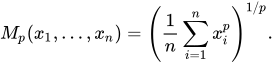
(See p-norm). For p = 0 we set it equal to the geometric mean (which is the limit of means with exponents approaching zero, as proved below):
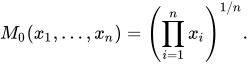
Furthermore, for a sequence of positive weights wi we define the weighted power mean as[2] and when p = 0, it is equal to the weighted geometric mean:
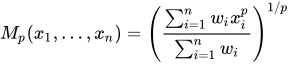

The unweighted means correspond to setting all wi = 1.
Special cases
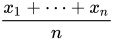
For some values of , the mean corresponds to a well known mean.




| Name | Exponent | Value |
|---|---|---|
| Minimum | ||
| Harmonic mean | ||
| Geometric mean | ||
| Arithmetic mean | ||
| Root mean square | ||
| Cubic mean | ||
| Maximum |




![{\displaystyle {\sqrt[{n}]{x_{1}\dots x_{n}}}}](https://wikimedia.org/api/rest_v1/media/math/render/svg/1af36d22e6641f7ad5ac4cb1973aed19f22c360f)



![{\displaystyle {\sqrt[{3}]{\frac {x_{1}^{3}+\dots +x_{n}^{3}}{n}}}}](https://wikimedia.org/api/rest_v1/media/math/render/svg/e82e4236bdf98c1e7d86ce7b481d2c49d34a4676)


Properties
Let be a sequence of positive real numbers, then the following properties hold:[1]
- .Each generalized mean always lies between the smallest and largest of the x values.
- , where is a permutation operator.Each generalized mean is a symmetric function of its arguments; permuting the arguments of a generalized mean does not change its value.
- .Like most means, the generalized mean is a homogeneous function of its arguments x1, ..., xn. That is, if b is a positive real number, then the generalized mean with exponent p of the numbers is equal to b times the generalized mean of the numbers x1, ..., xn.
- .Like the quasi-arithmetic means, the computation of the mean can be split into computations of equal sized sub-blocks. This enables use of a divide and conquer algorithm to calculate the means, when desirable.





![{\displaystyle M_{p}(x_{1},\dots ,x_{n\cdot k})=M_{p}\left[M_{p}(x_{1},\dots ,x_{k}),M_{p}(x_{k+1},\dots ,x_{2\cdot k}),\dots ,M_{p}(x_{(n-1)\cdot k+1},\dots ,x_{n\cdot k})\right]}](https://wikimedia.org/api/rest_v1/media/math/render/svg/123bdbdd17dee6edcaf0853d80b4fb9d949a5cea)
Generalized mean inequality
Template:QM AM GM HM inequality visual proof.svg In general, if p < q, then and the two means are equal if and only if x1 = x2 = ... = xn.

The inequality is true for real values of p and q, as well as positive and negative infinity values.
It follows from the fact that, for all real p, which can be proved using Jensen's inequality.
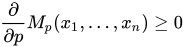
In particular, for p in {−1, 0, 1}, the generalized mean inequality implies the Pythagorean means inequality as well as the inequality of arithmetic and geometric means.
Proof of the weighted inequality
We will prove the weighted power mean inequality. For the purpose of the proof we will assume the following without loss of generality:
![{\displaystyle {\begin{aligned}w_{i}\in [0,1]\\\sum _{i=1}^{n}w_{i}=1\end{aligned}}}](https://wikimedia.org/api/rest_v1/media/math/render/svg/b74495b015da1fdf962f200e45159932bbc89b29)
The proof for unweighted power means can be easily obtained by substituting wi = 1/n.
Equivalence of inequalities between means of opposite signs
Suppose an average between power means with exponents p and q holds: applying this, then: Failed to parse (SVG (MathML can be enabled via browser plugin): Invalid response ("Math extension cannot connect to Restbase.") from server "https://wikimedia.org/api/rest_v1/":): {\displaystyle \left(\sum_{i=1}^n\frac{w_i}{x_i^p}\right)^{1/p} \geq \left(\sum_{i=1}^n\frac{w_i}{x_i^q}\right)^{1/q}}
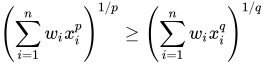


We raise both sides to the power of −1 (strictly decreasing function in positive reals): Failed to parse (SVG (MathML can be enabled via browser plugin): Invalid response ("Math extension cannot connect to Restbase.") from server "https://wikimedia.org/api/rest_v1/":): {\displaystyle \left(\sum_{i=1}^nw_ix_i^{-p}\right)^{-1/p} = \left(\frac{1}{\sum_{i=1}^nw_i\frac{1}{x_i^p}}\right)^{1/p} \leq \left(\frac{1}{\sum_{i=1}^nw_i\frac{1}{x_i^q}}\right)^{1/q} = \left(\sum_{i=1}^nw_ix_i^{-q}\right)^{-1/q}}
We get the inequality for means with exponents −p and −q, and we can use the same reasoning backwards, thus proving the inequalities to be equivalent, which will be used in some of the later proofs.
Geometric mean
For any q > 0 and non-negative weights summing to 1, the following inequality holds: Failed to parse (SVG (MathML can be enabled via browser plugin): Invalid response ("Math extension cannot connect to Restbase.") from server "https://wikimedia.org/api/rest_v1/":): {\displaystyle \left(\sum_{i=1}^n w_i x_i^{-q}\right)^{-1/q} \leq \prod_{i=1}^n x_i^{w_i} \leq \left(\sum_{i=1}^n w_i x_i^q\right)^{1/q}.}
The proof follows from Jensen's inequality, making use of the fact the logarithm is concave: Failed to parse (SVG (MathML can be enabled via browser plugin): Invalid response ("Math extension cannot connect to Restbase.") from server "https://wikimedia.org/api/rest_v1/":): {\displaystyle \log \prod_{i=1}^n x_i^{w_i} = \sum_{i=1}^n w_i\log x_i \leq \log \sum_{i=1}^n w_i x_i.}
By applying the exponential function to both sides and observing that as a strictly increasing function it preserves the sign of the inequality, we get Failed to parse (SVG (MathML can be enabled via browser plugin): Invalid response ("Math extension cannot connect to Restbase.") from server "https://wikimedia.org/api/rest_v1/":): {\displaystyle \prod_{i=1}^n x_i^{w_i} \leq \sum_{i=1}^n w_i x_i.}
Taking q-th powers of the xi yields Failed to parse (SVG (MathML can be enabled via browser plugin): Invalid response ("Math extension cannot connect to Restbase.") from server "https://wikimedia.org/api/rest_v1/":): {\displaystyle \begin{align} &\prod_{i=1}^n x_i^{q{\cdot}w_i} \leq \sum_{i=1}^n w_i x_i^q \\ &\prod_{i=1}^n x_i^{w_i} \leq \left(\sum_{i=1}^n w_i x_i^q\right)^{1/q}.\end{align}}
Thus, we are done for the inequality with positive q; the case for negatives is identical but for the swapped signs in the last step:
Failed to parse (SVG (MathML can be enabled via browser plugin): Invalid response ("Math extension cannot connect to Restbase.") from server "https://wikimedia.org/api/rest_v1/":): {\displaystyle \prod_{i=1}^n x_i^{-q{\cdot}w_i} \leq \sum_{i=1}^n w_i x_i^{-q}.}
Of course, taking each side to the power of a negative number -1/q swaps the direction of the inequality.
Failed to parse (SVG (MathML can be enabled via browser plugin): Invalid response ("Math extension cannot connect to Restbase.") from server "https://wikimedia.org/api/rest_v1/":): {\displaystyle \prod_{i=1}^n x_i^{w_i} \geq \left(\sum_{i=1}^n w_i x_i^{-q}\right)^{-1/q}.}
Inequality between any two power means
We are to prove that for any p < q the following inequality holds: Failed to parse (SVG (MathML can be enabled via browser plugin): Invalid response ("Math extension cannot connect to Restbase.") from server "https://wikimedia.org/api/rest_v1/":): {\displaystyle \left(\sum_{i=1}^n w_i x_i^p\right)^{1/p} \leq \left(\sum_{i=1}^nw_ix_i^q\right)^{1/q}} if p is negative, and q is positive, the inequality is equivalent to the one proved above: Failed to parse (SVG (MathML can be enabled via browser plugin): Invalid response ("Math extension cannot connect to Restbase.") from server "https://wikimedia.org/api/rest_v1/":): {\displaystyle \left(\sum_{i=1}^nw_i x_i^p\right)^{1/p} \leq \prod_{i=1}^n x_i^{w_i} \leq \left(\sum_{i=1}^n w_i x_i^q\right)^{1/q}}
The proof for positive p and q is as follows: Define the following function: f : R+ → R+ Failed to parse (SVG (MathML can be enabled via browser plugin): Invalid response ("Math extension cannot connect to Restbase.") from server "https://wikimedia.org/api/rest_v1/":): {\displaystyle f(x)=x^{\frac{q}{p}}} . f is a power function, so it does have a second derivative: Failed to parse (SVG (MathML can be enabled via browser plugin): Invalid response ("Math extension cannot connect to Restbase.") from server "https://wikimedia.org/api/rest_v1/":): {\displaystyle f''(x) = \left(\frac{q}{p} \right) \left( \frac{q}{p}-1 \right)x^{\frac{q}{p}-2}} which is strictly positive within the domain of f, since q > p, so we know f is convex.
Using this, and the Jensen's inequality we get: Failed to parse (SVG (MathML can be enabled via browser plugin): Invalid response ("Math extension cannot connect to Restbase.") from server "https://wikimedia.org/api/rest_v1/":): {\displaystyle \begin{align} f \left( \sum_{i=1}^nw_ix_i^p \right) &\leq \sum_{i=1}^nw_if(x_i^p) \\[3pt] \left(\sum_{i=1}^n w_i x_i^p\right)^{q/p} &\leq \sum_{i=1}^nw_ix_i^q \end{align}} after raising both side to the power of 1/q (an increasing function, since 1/q is positive) we get the inequality which was to be proven:
Failed to parse (SVG (MathML can be enabled via browser plugin): Invalid response ("Math extension cannot connect to Restbase.") from server "https://wikimedia.org/api/rest_v1/":): {\displaystyle \left(\sum_{i=1}^n w_i x_i^p\right)^{1/p} \leq \left(\sum_{i=1}^n w_i x_i^q\right)^{1/q}}
Using the previously shown equivalence we can prove the inequality for negative p and q by replacing them with −q and −p, respectively.
Generalized f-mean
The power mean could be generalized further to the generalized f-mean:
Failed to parse (SVG (MathML can be enabled via browser plugin): Invalid response ("Math extension cannot connect to Restbase.") from server "https://wikimedia.org/api/rest_v1/":): {\displaystyle M_f(x_1,\dots,x_n) = f^{-1} \left({\frac{1}{n}\cdot\sum_{i=1}^n{f(x_i)}}\right) }
This covers the geometric mean without using a limit with f(x) = log(x). The power mean is obtained for f(x) = xp. Properties of these means are studied in de Carvalho (2016).[3]
Applications
Signal processing
A power mean serves a non-linear moving average which is shifted towards small signal values for small p and emphasizes big signal values for big p. Given an efficient implementation of a moving arithmetic mean called smooth one can implement a moving power mean according to the following Haskell code.
powerSmooth :: Floating a => ([a] -> [a]) -> a -> [a] -> [a]
powerSmooth smooth p = map (** recip p) . smooth . map (**p)
- For big p it can serve as an envelope detector on a rectified signal.
- For small p it can serve as a baseline detector on a mass spectrum.
See also
- Arithmetic–geometric mean
- Average
- Heronian mean
- Inequality of arithmetic and geometric means
- Lehmer mean – also a mean related to powers
- Minkowski distance
- Quasi-arithmetic mean – another name for the generalized f-mean mentioned above
- Root mean square
Notes
References
- ↑ 1.0 1.1 Sýkora, Stanislav (2009). "Mathematical means and averages: basic properties". Stan's Library. Castano Primo, Italy. III. doi:10.3247/SL3Math09.001.
- ↑ 2.0 2.1 Cite error: Invalid
<ref>tag; no text was provided for refs namedBullen1 - ↑ 3.0 3.1 de Carvalho, Miguel (2016). "Mean, what do you Mean?". The American Statistician. 70 (3): 764‒776. doi:10.1080/00031305.2016.1148632. hdl:20.500.11820/fd7a8991-69a4-4fe5-876f-abcd2957a88c.
Further reading
- Bullen, P. S. (2003). "Chapter III - The Power Means". Handbook of Means and Their Inequalities. Dordrecht, Netherlands: Kluwer. pp. 175–265.