Arithmetic–geometric mean
In mathematics, the arithmetic–geometric mean (AGM or agM[1]) of two positive real numbers x and y is the mutual limit of a sequence of arithmetic means and a sequence of geometric means. The arithmetic–geometric mean is used in fast algorithms for exponential, trigonometric functions, and other special functions, as well as some mathematical constants, in particular, computing π.

The AGM is defined as the limit of the interdependent sequences and . Assuming , we write:Failed to parse (Conversion error. Server ("https://wikimedia.org/api/rest_") reported: "Cannot get mml. Server problem."): {\displaystyle {\begin{aligned}a_{0}&=x,\\g_{0}&=y\\a_{n+1}&={\tfrac {1}{2}}(a_{n}+g_{n}),\\g_{n+1}&={\sqrt {a_{n}g_{n}}}\,.\end{aligned}}} These two sequences converge to the same number, the arithmetic–geometric mean of x and y; it is denoted by M(x, y), or sometimes by agm(x, y) or AGM(x, y).


The arithmetic–geometric mean can be extended to complex numbers and, when the branches of the square root are allowed to be taken inconsistently, it is a multivalued function.[1]
Example
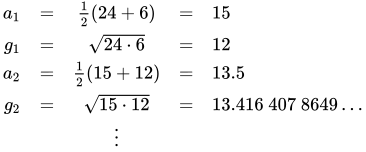
[edit]To find the arithmetic–geometric mean of a0 = 24 and g0 = 6, iterate as follows: The first five iterations give the following values:
| n | an | gn |
|---|---|---|
| 0 | 24 | 6 |
| 1 | 15 | 12 |
| 2 | 13.5 | 13.416 407 864 998 738 178 455 042... |
| 3 | 13.458 203 932 499 369 089 227 521... | 13.458 139 030 990 984 877 207 090... |
| 4 | 13.458 171 481 745 176 983 217 305... | 13.458 171 481 706 053 858 316 334... |
| 5 | 13.458 171 481 725 615 420 766 820... | 13.458 171 481 725 615 420 766 806... |
The number of digits in which an and gn agree (underlined) approximately doubles with each iteration. The arithmetic–geometric mean of 24 and 6 is the common limit of these two sequences, which is approximately 13.4581714817256154207668131569743992430538388544.[2]
History
[edit]The first algorithm based on this sequence pair appeared in the works of Joseph-Louis Lagrange. Its properties were further analyzed by Carl Friedrich Gauss.[1]
Properties
[edit]Both the geometric mean and arithmetic mean of two positive numbers x and y are between the two numbers. (They are strictly between when x ≠ y.) The geometric mean of two positive numbers is never greater than the arithmetic mean.[3] So the geometric means are an increasing sequence g0 ≤ g1 ≤ g2 ≤ ...; the arithmetic means are a decreasing sequence a0 ≥ a1 ≥ a2 ≥ ...; and gn ≤ M(x, y) ≤ an for any n. These are strict inequalities if x ≠ y.
M(x, y) is thus a number between x and y; it is also between the geometric and arithmetic mean of x and y.
If r ≥ 0 then M(rx, ry) = r M(x, y).
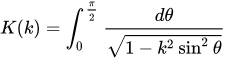
There is an integral-form expression for M(x, y):[4]Failed to parse (Conversion error. Server ("https://wikimedia.org/api/rest_") reported: "Cannot get mml. Server problem."): {\displaystyle {\begin{aligned}M(x,y)&={\frac {\pi }{2}}\left(\int _{0}^{\frac {\pi }{2}}{\frac {d\theta }{\sqrt {x^{2}\cos ^{2}\theta +y^{2}\sin ^{2}\theta }}}\right)^{-1}\\&=\pi \left(\int _{0}^{\infty }{\frac {dt}{\sqrt {t(t+x^{2})(t+y^{2})}}}\right)^{-1}\\&={\frac {\pi }{4}}\cdot {\frac {x+y}{K\left({\frac {x-y}{x+y}}\right)}}\end{aligned}}} where K(k) is the complete elliptic integral of the first kind: Since the arithmetic–geometric process converges so quickly, it provides an efficient way to compute elliptic integrals, which are used, for example, in elliptic filter design.[5]
The arithmetic–geometric mean is connected to the Jacobi theta function Failed to parse (Conversion error. Server ("https://wikimedia.org/api/rest_") reported: "Cannot get mml. Server problem."): {\displaystyle \theta _{3}}
by[6] which upon setting Failed to parse (Conversion error. Server ("https://wikimedia.org/api/rest_") reported: "Cannot get mml. Server problem."): {\displaystyle x=1/{\sqrt {2}}}
givesFailed to parse (Conversion error. Server ("https://wikimedia.org/api/rest_") reported: "Cannot get mml. Server problem."): {\displaystyle M(1,1/{\sqrt {2}})=\left(\sum _{n\in \mathbb {Z} }e^{-n^{2}\pi }\right)^{-2}.}

Related concepts
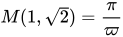
[edit]The reciprocal of the arithmetic–geometric mean of 1 and the square root of 2 is Gauss's constant.Failed to parse (Conversion error. Server ("https://wikimedia.org/api/rest_") reported: "Cannot get mml. Server problem."): {\displaystyle {\frac {1}{M(1,{\sqrt {2}})}}=G=0.8346268\dots } In 1799, Gauss proved[note 1] that where Failed to parse (Conversion error. Server ("https://wikimedia.org/api/rest_") reported: "Cannot get mml. Server problem."): {\displaystyle \varpi } is the lemniscate constant.
In 1941, Failed to parse (Conversion error. Server ("https://wikimedia.org/api/rest_") reported: "Cannot get mml. Server problem."): {\displaystyle M(1,{\sqrt {2}})}
(and hence ) was proved transcendental by Theodor Schneider.[note 2][7][8] The set is algebraically independent over ,[9][10] but the set Failed to parse (Conversion error. Server ("https://wikimedia.org/api/rest_") reported: "Cannot get mml. Server problem."): {\displaystyle \{\pi ,M(1,1/{\sqrt {2}}),M'(1,1/{\sqrt {2}})\}}
(where the prime denotes the derivative with respect to the second variable) is not algebraically independent over Failed to parse (SVG (MathML can be enabled via browser plugin): Invalid response ("Math extension cannot connect to Restbase.") from server "https://wikimedia.org/api/rest_v1/":): {\displaystyle \mathbb{Q}}
. In fact,[11]Failed to parse (SVG (MathML can be enabled via browser plugin): Invalid response ("Math extension cannot connect to Restbase.") from server "https://wikimedia.org/api/rest_v1/":): {\displaystyle \pi=2\sqrt{2}\frac{M^3(1,1/\sqrt{2})}{M'(1,1/\sqrt{2})}.}
The geometric–harmonic mean GH can be calculated using analogous sequences of geometric and harmonic means, and in fact GH(x, y) = 1/M(1/x, 1/y) = xy/M(x, y).[12]
The arithmetic–harmonic mean is equivalent to the geometric mean.


The arithmetic–geometric mean can be used to compute – among others – logarithms, complete and incomplete elliptic integrals of the first and second kind,[13] and Jacobi elliptic functions.[14]
Proof of existence
[edit]The inequality of arithmetic and geometric means implies thatFailed to parse (SVG (MathML can be enabled via browser plugin): Invalid response ("Math extension cannot connect to Restbase.") from server "https://wikimedia.org/api/rest_v1/":): {\displaystyle g_n \leq a_n} and thusFailed to parse (SVG (MathML can be enabled via browser plugin): Invalid response ("Math extension cannot connect to Restbase.") from server "https://wikimedia.org/api/rest_v1/":): {\displaystyle g_{n + 1} = \sqrt{g_n \cdot a_n} \geq \sqrt{g_n \cdot g_n} = g_n} that is, the sequence gn is nondecreasing and bounded above by the larger of x and y. By the monotone convergence theorem, the sequence is convergent, so there exists a g such that:Failed to parse (SVG (MathML can be enabled via browser plugin): Invalid response ("Math extension cannot connect to Restbase.") from server "https://wikimedia.org/api/rest_v1/":): {\displaystyle \lim_{n\to \infty}g_n = g} However, we can also see that:Failed to parse (SVG (MathML can be enabled via browser plugin): Invalid response ("Math extension cannot connect to Restbase.") from server "https://wikimedia.org/api/rest_v1/":): {\displaystyle a_n = \frac{g_{n + 1}^2}{g_n}} and so: Failed to parse (SVG (MathML can be enabled via browser plugin): Invalid response ("Math extension cannot connect to Restbase.") from server "https://wikimedia.org/api/rest_v1/":): {\displaystyle \lim_{n\to \infty}a_n = \lim_{n\to \infty}\frac{g_{n + 1}^2}{g_{n}} = \frac{g^2}{g} = g}
Proof of the integral-form expression
[edit]This proof is given by Gauss.[1] Let
Failed to parse (SVG (MathML can be enabled via browser plugin): Invalid response ("Math extension cannot connect to Restbase.") from server "https://wikimedia.org/api/rest_v1/":): {\displaystyle I(x,y) = \int_0^{\pi/2}\frac{d\theta}{\sqrt{x^2\cos^2\theta+y^2\sin^2\theta}} ,}
Changing the variable of integration to Failed to parse (SVG (MathML can be enabled via browser plugin): Invalid response ("Math extension cannot connect to Restbase.") from server "https://wikimedia.org/api/rest_v1/":): {\displaystyle \theta'} , where
Failed to parse (SVG (MathML can be enabled via browser plugin): Invalid response ("Math extension cannot connect to Restbase.") from server "https://wikimedia.org/api/rest_v1/":): {\displaystyle \begin{align} \sin\theta &= \frac{2x\sin\theta'}{(x+y)+(x-y)\sin^2\theta'} \\ \Rightarrow d(\sin\theta) &= d\left(\frac{2x\sin\theta'}{(x+y)+(x-y)\sin^2\theta'}\right)\\ \Rightarrow \cos\theta\ d\theta &= 2x \frac{(x+y)-(x-y)\sin^2\theta'}{((x+y)+(x-y)\sin^2\theta')^2}\ \cos\theta' d\theta' \end{align} }
Failed to parse (SVG (MathML can be enabled via browser plugin): Invalid response ("Math extension cannot connect to Restbase.") from server "https://wikimedia.org/api/rest_v1/":): {\displaystyle \begin{align} \cos\theta &= \frac{\sqrt{(x+y)^2-2(x^2+y^2)\sin^2\theta'+(x-y)^2\sin^4\theta'}}{(x+y)+(x-y)\sin^2\theta'}\\ &= \frac{\cos\theta'\sqrt{(x-y)^2\cos^2\theta'+4xy}}{(x+y)+(x-y)\sin^2\theta'}\\ &= \frac{\cos\theta'\sqrt{(x+y)^2\cos^2\theta'+4xy\sin^2\theta'}}{(x+y)+(x-y)\sin^2\theta'}, \end{align} }
Failed to parse (SVG (MathML can be enabled via browser plugin): Invalid response ("Math extension cannot connect to Restbase.") from server "https://wikimedia.org/api/rest_v1/":): {\displaystyle \Rightarrow \cos\theta\ d\theta =\frac{\cos\theta'\sqrt{(x+y)^2\cos^2\theta'+4xy\sin^2\theta'}}{(x+y)+(x-y)\sin^2\theta'}\ d\theta =2x \frac{(x+y)-(x-y)\sin^2\theta'}{((x+y)+(x-y)\sin^2\theta')^2}\ \cos\theta' d\theta' , }
Failed to parse (SVG (MathML can be enabled via browser plugin): Invalid response ("Math extension cannot connect to Restbase.") from server "https://wikimedia.org/api/rest_v1/":): {\displaystyle \Rightarrow d\theta = \frac{x((x+y)-(x-y)\sin^2\theta')}{((x+y)+(x-y)\sin^2\theta')} \frac{2 d\theta'}{\sqrt{(x+y)^2\cos^2\theta'+4xy\sin^2\theta'}} \ , }
Failed to parse (SVG (MathML can be enabled via browser plugin): Invalid response ("Math extension cannot connect to Restbase.") from server "https://wikimedia.org/api/rest_v1/":): {\displaystyle \begin{align} \sqrt{x^2\cos^2\theta+y^2\sin^2\theta} &= \frac{\sqrt{{x^2 ((x+y)^2-2(x^2+y^2)\sin^2\theta'+(x-y)^2\sin^4\theta')+4x^2y^2\sin^2\theta'}}}{((x+y)+(x-y)\sin^2\theta')}\\ &= \frac{x ((x+y)-(x-y)\sin^2\theta')}{((x+y)+(x-y)\sin^2\theta')} \end{align} }
This yields Failed to parse (SVG (MathML can be enabled via browser plugin): Invalid response ("Math extension cannot connect to Restbase.") from server "https://wikimedia.org/api/rest_v1/":): {\displaystyle \frac{d\theta}{\sqrt{x^2\cos^2\theta+y^2\sin^2\theta}} = \frac{2 d\theta'}{\sqrt{(x+y)^2\cos^2\theta'+4xy\sin^2\theta'}} = \frac{d\theta'}{\sqrt{((\frac{x+y}{2})^2\cos^2\theta'+(\sqrt{xy})^2\sin^2\theta'}}, }
gives
Failed to parse (SVG (MathML can be enabled via browser plugin): Invalid response ("Math extension cannot connect to Restbase.") from server "https://wikimedia.org/api/rest_v1/":): {\displaystyle \begin{align} I(x,y) &= \int_0^{\pi/2}\frac{d\theta'}{\sqrt{((\frac{x+y}{2})^2\cos^2\theta'+(\sqrt{xy})^2\sin^2\theta'}}\\ &= I\bigl(\tfrac{x+y}{2},\sqrt{xy}\bigr) . \end{align}}
Thus, we have
Failed to parse (SVG (MathML can be enabled via browser plugin): Invalid response ("Math extension cannot connect to Restbase.") from server "https://wikimedia.org/api/rest_v1/":): {\displaystyle \begin{align} I(x,y) &= I(a_1, g_1) = I(a_2, g_2) = \cdots\\ &= I\bigl(M(x,y),M(x,y)\bigr) = \pi/\bigr(2M(x,y)\bigl) . \end{align} } The last equality comes from observing that Failed to parse (SVG (MathML can be enabled via browser plugin): Invalid response ("Math extension cannot connect to Restbase.") from server "https://wikimedia.org/api/rest_v1/":): {\displaystyle I(z,z) = \pi/(2z)} .
Finally, we obtain the desired result
Failed to parse (SVG (MathML can be enabled via browser plugin): Invalid response ("Math extension cannot connect to Restbase.") from server "https://wikimedia.org/api/rest_v1/":): {\displaystyle M(x,y) = \pi/\bigl(2 I(x,y) \bigr) .}
Applications
[edit]The number π
[edit]According to the Gauss–Legendre algorithm,[15]
Failed to parse (SVG (MathML can be enabled via browser plugin): Invalid response ("Math extension cannot connect to Restbase.") from server "https://wikimedia.org/api/rest_v1/":): {\displaystyle \pi = \frac{4\,M(1,1/\sqrt{2})^2} {1 - \displaystyle\sum_{j=1}^\infty 2^{j+1} c_j^2} ,}
where
Failed to parse (SVG (MathML can be enabled via browser plugin): Invalid response ("Math extension cannot connect to Restbase.") from server "https://wikimedia.org/api/rest_v1/":): {\displaystyle c_j = \frac{1}{2}\left(a_{j-1}-g_{j-1}\right) ,}
with Failed to parse (SVG (MathML can be enabled via browser plugin): Invalid response ("Math extension cannot connect to Restbase.") from server "https://wikimedia.org/api/rest_v1/":): {\displaystyle a_0=1} and Failed to parse (SVG (MathML can be enabled via browser plugin): Invalid response ("Math extension cannot connect to Restbase.") from server "https://wikimedia.org/api/rest_v1/":): {\displaystyle g_0=1/\sqrt{2}} , which can be computed without loss of precision using
Failed to parse (SVG (MathML can be enabled via browser plugin): Invalid response ("Math extension cannot connect to Restbase.") from server "https://wikimedia.org/api/rest_v1/":): {\displaystyle c_j = \frac{c_{j-1}^2}{4a_j} .}
Complete elliptic integral K(sinα)
[edit]Taking Failed to parse (SVG (MathML can be enabled via browser plugin): Invalid response ("Math extension cannot connect to Restbase.") from server "https://wikimedia.org/api/rest_v1/":): {\displaystyle a_0 = 1} and Failed to parse (SVG (MathML can be enabled via browser plugin): Invalid response ("Math extension cannot connect to Restbase.") from server "https://wikimedia.org/api/rest_v1/":): {\displaystyle g_0 = \cos\alpha} yields the AGM
Failed to parse (SVG (MathML can be enabled via browser plugin): Invalid response ("Math extension cannot connect to Restbase.") from server "https://wikimedia.org/api/rest_v1/":): {\displaystyle M(1,\cos\alpha) = \frac{\pi}{2K(\sin \alpha)} ,}
where K(k) is a complete elliptic integral of the first kind:
Failed to parse (SVG (MathML can be enabled via browser plugin): Invalid response ("Math extension cannot connect to Restbase.") from server "https://wikimedia.org/api/rest_v1/":): {\displaystyle K(k) = \int_0^{\pi/2}(1 - k^2 \sin^2\theta)^{-1/2} \, d\theta.}
That is to say that this quarter period may be efficiently computed through the AGM, Failed to parse (SVG (MathML can be enabled via browser plugin): Invalid response ("Math extension cannot connect to Restbase.") from server "https://wikimedia.org/api/rest_v1/":): {\displaystyle K(k) = \frac{\pi}{2M(1,\sqrt{1-k^2})} .}
Other applications
[edit]Using this property of the AGM along with the ascending transformations of John Landen,[16] Richard P. Brent[17] suggested the first AGM algorithms for the fast evaluation of elementary transcendental functions (ex, cos x, sin x). Subsequently, many authors went on to study the use of the AGM algorithms.[18]
See also
[edit]References
[edit]Notes
[edit]- ↑ By 1799, Gauss had two proofs of the theorem, but neither of them was rigorous from the modern point of view.
- ↑ In particular, he proved that the beta function Failed to parse (SVG (MathML can be enabled via browser plugin): Invalid response ("Math extension cannot connect to Restbase.") from server "https://wikimedia.org/api/rest_v1/":): {\displaystyle \Beta (a,b)} is transcendental for all Failed to parse (SVG (MathML can be enabled via browser plugin): Invalid response ("Math extension cannot connect to Restbase.") from server "https://wikimedia.org/api/rest_v1/":): {\displaystyle a,b\in\mathbb{Q}\setminus\mathbb{Z}} such that Failed to parse (SVG (MathML can be enabled via browser plugin): Invalid response ("Math extension cannot connect to Restbase.") from server "https://wikimedia.org/api/rest_v1/":): {\displaystyle a+b\notin \mathbb{Z}_0^-} . The fact that Failed to parse (SVG (MathML can be enabled via browser plugin): Invalid response ("Math extension cannot connect to Restbase.") from server "https://wikimedia.org/api/rest_v1/":): {\displaystyle M(1,\sqrt{2})} is transcendental follows from Failed to parse (SVG (MathML can be enabled via browser plugin): Invalid response ("Math extension cannot connect to Restbase.") from server "https://wikimedia.org/api/rest_v1/":): {\displaystyle M(1,\sqrt{2})=\tfrac{1}{2}\Beta \left(\tfrac{1}{2},\tfrac{3}{4}\right).}
Citations
[edit]- ↑ 1.0 1.1 1.2 1.3 Cox, David (January 1984). "The Arithmetic-Geometric Mean of Gauss". L'Enseignement Mathématique. 30 (2): 275–330.
- ↑ agm(24, 6) at Wolfram Alpha
- ↑ Bullen, P. S. (2003). "The Arithmetic, Geometric and Harmonic Means". Handbook of Means and Their Inequalities. Dordrecht: Springer Netherlands. pp. 60–174. doi:10.1007/978-94-017-0399-4_2. ISBN 978-90-481-6383-0. Retrieved 2023-12-11.
- ↑ Template:Dlmf
- ↑ Dimopoulos, Hercules G. (2011). Analog Electronic Filters: Theory, Design and Synthesis. Springer. pp. 147–155. ISBN 978-94-007-2189-0.
- ↑ Borwein, Jonathan M.; Borwein, Peter B. (1987). Pi and the AGM: A Study in Analytic Number Theory and Computational Complexity (First ed.). Wiley-Interscience. ISBN 0-471-83138-7. pages 35, 40
- ↑ Schneider, Theodor (1941). "Zur Theorie der Abelschen Funktionen und Integrale". Journal für die reine und angewandte Mathematik. 183 (19): 110–128. doi:10.1515/crll.1941.183.110. S2CID 118624331.
- ↑ Todd, John (1975). "The Lemniscate Constants". Communications of the ACM. 18 (1): 14–19. doi:10.1145/360569.360580. S2CID 85873.
- ↑ G. V. Choodnovsky: Algebraic independence of constants connected with the functions of analysis, Notices of the AMS 22, 1975, p. A-486
- ↑ G. V. Chudnovsky: Contributions to The Theory of Transcendental Numbers, American Mathematical Society, 1984, p. 6
- ↑ Borwein, Jonathan M.; Borwein, Peter B. (1987). Pi and the AGM: A Study in Analytic Number Theory and Computational Complexity (First ed.). Wiley-Interscience. ISBN 0-471-83138-7. p. 45
- ↑ Newman, D. J. (1985). "A simplified version of the fast algorithms of Brent and Salamin". Mathematics of Computation. 44 (169): 207–210. doi:10.2307/2007804. JSTOR 2007804.
- ↑ Template:AS ref
- ↑ King, Louis V. (1924). On the Direct Numerical Calculation of Elliptic Functions and Integrals. Cambridge University Press.
- ↑ Salamin, Eugene (1976). "Computation of π using arithmetic–geometric mean". Mathematics of Computation. 30 (135): 565–570. doi:10.2307/2005327. JSTOR 2005327. MR 0404124.
- ↑ Landen, John (1775). "An investigation of a general theorem for finding the length of any arc of any conic hyperbola, by means of two elliptic arcs, with some other new and useful theorems deduced therefrom". Philosophical Transactions of the Royal Society. 65: 283–289. doi:10.1098/rstl.1775.0028. S2CID 186208828.
- ↑ Brent, Richard P. (1976). "Fast Multiple-Precision Evaluation of Elementary Functions". Journal of the ACM. 23 (2): 242–251. CiteSeerX 10.1.1.98.4721. doi:10.1145/321941.321944. MR 0395314. S2CID 6761843.
- ↑ Borwein, Jonathan M.; Borwein, Peter B. (1987). Pi and the AGM. New York: Wiley. ISBN 0-471-83138-7. MR 0877728.
Sources
[edit]- Daróczy, Zoltán; Páles, Zsolt (2002). "Gauss-composition of means and the solution of the Matkowski–Suto problem". Publicationes Mathematicae Debrecen. 61 (1–2): 157–218. doi:10.5486/PMD.2002.2713. hdl:2437/110605.
- Template:SpringerEOM
- Template:Mathworld