Bilinear map
In mathematics, a bilinear map is a function combining elements of two vector spaces to yield an element of a third vector space, and is linear in each of its arguments. Matrix multiplication is an example.
A bilinear map can also be defined for modules. For that, see the article pairing.
Definition
Vector spaces
Let and be three vector spaces over the same base field . A bilinear map is a function such that for all , the map is a linear map from to and for all , the map is a linear map from to In other words, when we hold the second entry of the bilinear map fixed while letting the first entry vary, yielding , the result is a linear operator, and similarly for when we hold the first entry fixed.





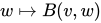


Such a map satisfies the following properties.

- For any ,
- The map is additive in both components: if and Failed to parse (SVG (MathML can be enabled via browser plugin): Invalid response ("Math extension cannot connect to Restbase.") from server "https://wikimedia.org/api/rest_v1/":): {\displaystyle w_1, w_2 \in W,} then Failed to parse (SVG (MathML can be enabled via browser plugin): Invalid response ("Math extension cannot connect to Restbase.") from server "https://wikimedia.org/api/rest_v1/":): {\displaystyle B(v_1 + v_2, w) = B(v_1, w) + B(v_2, w)} and Failed to parse (SVG (MathML can be enabled via browser plugin): Invalid response ("Math extension cannot connect to Restbase.") from server "https://wikimedia.org/api/rest_v1/":): {\displaystyle B(v, w_1 + w_2) = B(v, w_1) + B(v, w_2).}



If Failed to parse (SVG (MathML can be enabled via browser plugin): Invalid response ("Math extension cannot connect to Restbase.") from server "https://wikimedia.org/api/rest_v1/":): {\displaystyle V = W} and we have B(v, w) = B(w, v) for all Failed to parse (SVG (MathML can be enabled via browser plugin): Invalid response ("Math extension cannot connect to Restbase.") from server "https://wikimedia.org/api/rest_v1/":): {\displaystyle v, w \in V,} then we say that B is symmetric. If X is the base field F, then the map is called a bilinear form, which are well-studied (for example: scalar product, inner product, and quadratic form).
Modules
The definition works without any changes if instead of vector spaces over a field F, we use modules over a commutative ring R. It generalizes to n-ary functions, where the proper term is multilinear.
For non-commutative rings R and S, a left R-module M and a right S-module N, a bilinear map is a map B : M × N → T with T an (R, S)-bimodule, and for which any n in N, m ↦ B(m, n) is an R-module homomorphism, and for any m in M, n ↦ B(m, n) is an S-module homomorphism. This satisfies
- B(r ⋅ m, n) = r ⋅ B(m, n)
- B(m, n ⋅ s) = B(m, n) ⋅ s
for all m in M, n in N, r in R and s in S, as well as B being additive in each argument.
Properties
An immediate consequence of the definition is that B(v, w) = 0X whenever v = 0V or w = 0W. This may be seen by writing the zero vector 0V as 0 ⋅ 0V (and similarly for 0W) and moving the scalar 0 "outside", in front of B, by linearity.
The set L(V, W; X) of all bilinear maps is a linear subspace of the space (viz. vector space, module) of all maps from V × W into X.
If V, W, X are finite-dimensional, then so is L(V, W; X). For Failed to parse (SVG (MathML can be enabled via browser plugin): Invalid response ("Math extension cannot connect to Restbase.") from server "https://wikimedia.org/api/rest_v1/":): {\displaystyle X = F,} that is, bilinear forms, the dimension of this space is dim V × dim W (while the space L(V × W; F) of linear forms is of dimension dim V + dim W). To see this, choose a basis for V and W; then each bilinear map can be uniquely represented by the matrix B(ei, fj), and vice versa. Now, if X is a space of higher dimension, we obviously have dim L(V, W; X) = dim V × dim W × dim X.
Examples
- Matrix multiplication is a bilinear map M(m, n) × M(n, p) → M(m, p).
- If a vector space V over the real numbers Failed to parse (SVG (MathML can be enabled via browser plugin): Invalid response ("Math extension cannot connect to Restbase.") from server "https://wikimedia.org/api/rest_v1/":): {\displaystyle \R} carries an inner product, then the inner product is a bilinear map Failed to parse (SVG (MathML can be enabled via browser plugin): Invalid response ("Math extension cannot connect to Restbase.") from server "https://wikimedia.org/api/rest_v1/":): {\displaystyle V \times V \to \R.}
- In general, for a vector space V over a field F, a bilinear form on V is the same as a bilinear map V × V → F.
- If V is a vector space with dual space V∗, then the canonical evaluation map, b(f, v) = f(v) is a bilinear map from V∗ × V to the base field.
- Let V and W be vector spaces over the same base field F. If f is a member of V∗ and g a member of W∗, then b(v, w) = f(v)g(w) defines a bilinear map V × W → F.
- The cross product in Failed to parse (SVG (MathML can be enabled via browser plugin): Invalid response ("Math extension cannot connect to Restbase.") from server "https://wikimedia.org/api/rest_v1/":): {\displaystyle \R^3} is a bilinear map Failed to parse (SVG (MathML can be enabled via browser plugin): Invalid response ("Math extension cannot connect to Restbase.") from server "https://wikimedia.org/api/rest_v1/":): {\displaystyle \R^3 \times \R^3 \to \R^3.}
- Let Failed to parse (SVG (MathML can be enabled via browser plugin): Invalid response ("Math extension cannot connect to Restbase.") from server "https://wikimedia.org/api/rest_v1/":): {\displaystyle B : V \times W \to X} be a bilinear map, and Failed to parse (SVG (MathML can be enabled via browser plugin): Invalid response ("Math extension cannot connect to Restbase.") from server "https://wikimedia.org/api/rest_v1/":): {\displaystyle L : U \to W} be a linear map, then (v, u) ↦ B(v, Lu) is a bilinear map on V × U.
Continuity and separate continuity
Suppose Failed to parse (SVG (MathML can be enabled via browser plugin): Invalid response ("Math extension cannot connect to Restbase.") from server "https://wikimedia.org/api/rest_v1/":): {\displaystyle X, Y,} and Failed to parse (SVG (MathML can be enabled via browser plugin): Invalid response ("Math extension cannot connect to Restbase.") from server "https://wikimedia.org/api/rest_v1/":): {\displaystyle Z} are topological vector spaces and let Failed to parse (SVG (MathML can be enabled via browser plugin): Invalid response ("Math extension cannot connect to Restbase.") from server "https://wikimedia.org/api/rest_v1/":): {\displaystyle b : X \times Y \to Z} be a bilinear map. Then b is said to be separately continuous if the following two conditions hold:
- for all Failed to parse (SVG (MathML can be enabled via browser plugin): Invalid response ("Math extension cannot connect to Restbase.") from server "https://wikimedia.org/api/rest_v1/":): {\displaystyle x \in X,} the map Failed to parse (SVG (MathML can be enabled via browser plugin): Invalid response ("Math extension cannot connect to Restbase.") from server "https://wikimedia.org/api/rest_v1/":): {\displaystyle Y \to Z} given by Failed to parse (SVG (MathML can be enabled via browser plugin): Invalid response ("Math extension cannot connect to Restbase.") from server "https://wikimedia.org/api/rest_v1/":): {\displaystyle y \mapsto b(x, y)} is continuous;
- for all Failed to parse (SVG (MathML can be enabled via browser plugin): Invalid response ("Math extension cannot connect to Restbase.") from server "https://wikimedia.org/api/rest_v1/":): {\displaystyle y \in Y,} the map given by Failed to parse (SVG (MathML can be enabled via browser plugin): Invalid response ("Math extension cannot connect to Restbase.") from server "https://wikimedia.org/api/rest_v1/":): {\displaystyle x \mapsto b(x, y)} is continuous.

Many separately continuous bilinear that are not continuous satisfy an additional property: hypocontinuity.[1] All continuous bilinear maps are hypocontinuous.
Sufficient conditions for continuity
Many bilinear maps that occur in practice are separately continuous but not all are continuous. We list here sufficient conditions for a separately continuous bilinear map to be continuous.
- If X is a Baire space and Y is metrizable then every separately continuous bilinear map Failed to parse (SVG (MathML can be enabled via browser plugin): Invalid response ("Math extension cannot connect to Restbase.") from server "https://wikimedia.org/api/rest_v1/":): {\displaystyle b : X \times Y \to Z} is continuous.[1]
- If Failed to parse (SVG (MathML can be enabled via browser plugin): Invalid response ("Math extension cannot connect to Restbase.") from server "https://wikimedia.org/api/rest_v1/":): {\displaystyle X, Y, \text{ and } Z} are the strong duals of Fréchet spaces then every separately continuous bilinear map Failed to parse (SVG (MathML can be enabled via browser plugin): Invalid response ("Math extension cannot connect to Restbase.") from server "https://wikimedia.org/api/rest_v1/":): {\displaystyle b : X \times Y \to Z} is continuous.[1]
- If a bilinear map is continuous at (0, 0) then it is continuous everywhere.[2]
Composition map
Let Failed to parse (SVG (MathML can be enabled via browser plugin): Invalid response ("Math extension cannot connect to Restbase.") from server "https://wikimedia.org/api/rest_v1/":): {\displaystyle X, Y, \text{ and } Z} be locally convex Hausdorff spaces and let Failed to parse (SVG (MathML can be enabled via browser plugin): Invalid response ("Math extension cannot connect to Restbase.") from server "https://wikimedia.org/api/rest_v1/":): {\displaystyle C : L(X; Y) \times L(Y; Z) \to L(X; Z)} be the composition map defined by Failed to parse (SVG (MathML can be enabled via browser plugin): Invalid response ("Math extension cannot connect to Restbase.") from server "https://wikimedia.org/api/rest_v1/":): {\displaystyle C(u, v) := v \circ u.} In general, the bilinear map Failed to parse (SVG (MathML can be enabled via browser plugin): Invalid response ("Math extension cannot connect to Restbase.") from server "https://wikimedia.org/api/rest_v1/":): {\displaystyle C} is not continuous (no matter what topologies the spaces of linear maps are given). We do, however, have the following results:
Give all three spaces of linear maps one of the following topologies:
- give all three the topology of bounded convergence;
- give all three the topology of compact convergence;
- give all three the topology of pointwise convergence.
- If Failed to parse (SVG (MathML can be enabled via browser plugin): Invalid response ("Math extension cannot connect to Restbase.") from server "https://wikimedia.org/api/rest_v1/":): {\displaystyle E} is an equicontinuous subset of Failed to parse (SVG (MathML can be enabled via browser plugin): Invalid response ("Math extension cannot connect to Restbase.") from server "https://wikimedia.org/api/rest_v1/":): {\displaystyle L(Y; Z)} then the restriction Failed to parse (SVG (MathML can be enabled via browser plugin): Invalid response ("Math extension cannot connect to Restbase.") from server "https://wikimedia.org/api/rest_v1/":): {\displaystyle C\big\vert_{L(X; Y) \times E} : L(X; Y) \times E \to L(X; Z)} is continuous for all three topologies.[1]
- If Failed to parse (SVG (MathML can be enabled via browser plugin): Invalid response ("Math extension cannot connect to Restbase.") from server "https://wikimedia.org/api/rest_v1/":): {\displaystyle Y} is a barreled space then for every sequence Failed to parse (SVG (MathML can be enabled via browser plugin): Invalid response ("Math extension cannot connect to Restbase.") from server "https://wikimedia.org/api/rest_v1/":): {\displaystyle \left(u_i\right)_{i=1}^{\infty}} converging to Failed to parse (SVG (MathML can be enabled via browser plugin): Invalid response ("Math extension cannot connect to Restbase.") from server "https://wikimedia.org/api/rest_v1/":): {\displaystyle u} in Failed to parse (SVG (MathML can be enabled via browser plugin): Invalid response ("Math extension cannot connect to Restbase.") from server "https://wikimedia.org/api/rest_v1/":): {\displaystyle L(X; Y)} and every sequence Failed to parse (SVG (MathML can be enabled via browser plugin): Invalid response ("Math extension cannot connect to Restbase.") from server "https://wikimedia.org/api/rest_v1/":): {\displaystyle \left(v_i\right)_{i=1}^{\infty}} converging to Failed to parse (SVG (MathML can be enabled via browser plugin): Invalid response ("Math extension cannot connect to Restbase.") from server "https://wikimedia.org/api/rest_v1/":): {\displaystyle v} in Failed to parse (SVG (MathML can be enabled via browser plugin): Invalid response ("Math extension cannot connect to Restbase.") from server "https://wikimedia.org/api/rest_v1/":): {\displaystyle L(Y; Z),} the sequence Failed to parse (SVG (MathML can be enabled via browser plugin): Invalid response ("Math extension cannot connect to Restbase.") from server "https://wikimedia.org/api/rest_v1/":): {\displaystyle \left(v_i \circ u_i\right)_{i=1}^{\infty}} converges to Failed to parse (SVG (MathML can be enabled via browser plugin): Invalid response ("Math extension cannot connect to Restbase.") from server "https://wikimedia.org/api/rest_v1/":): {\displaystyle v \circ u} in Failed to parse (SVG (MathML can be enabled via browser plugin): Invalid response ("Math extension cannot connect to Restbase.") from server "https://wikimedia.org/api/rest_v1/":): {\displaystyle L(Y; Z).} [1]
See also
- Tensor product – Mathematical operation on vector spaces
- Sesquilinear form
- Bilinear filtering
- Multilinear map
References
- ↑ 1.0 1.1 1.2 1.3 1.4 Trèves 2006, pp. 424–426.
- ↑ Schaefer & Wolff 1999, p. 118.