Convolution theorem
In mathematics, the convolution theorem states that under suitable conditions the Fourier transform of a convolution of two functions (or signals) is the product of their Fourier transforms. More generally, convolution in one domain (e.g., time domain) equals point-wise multiplication in the other domain (e.g., frequency domain). Other versions of the convolution theorem are applicable to various Fourier-related transforms.
Functions of a continuous variable
[edit | edit source]Consider two functions and Failed to parse (Conversion error. Server ("https://wikimedia.org/api/rest_") reported: "Cannot get mml. Server problem."): {\displaystyle v(x)} with Fourier transforms and :


Failed to parse (Conversion error. Server ("https://wikimedia.org/api/rest_") reported: "Cannot get mml. Server problem."): {\displaystyle {\begin{aligned}U(f)&\triangleq {\mathcal {F}}\{u\}(f)=\int _{-\infty }^{\infty }u(x)e^{-i2\pi fx}\,dx,\quad f\in \mathbb {R} \\[1ex]V(f)&\triangleq {\mathcal {F}}\{v\}(f)=\int _{-\infty }^{\infty }v(x)e^{-i2\pi fx}\,dx,\quad f\in \mathbb {R} \end{aligned}}}
where denotes the Fourier transform operator. The transform may be normalized in other ways, in which case constant scaling factors (typically or Failed to parse (Conversion error. Server ("https://wikimedia.org/api/rest_") reported: "Cannot get mml. Server problem."): {\displaystyle {\sqrt {2\pi }}} ) will appear in the convolution theorem below. The convolution of and is defined by:



In this context the asterisk denotes convolution, instead of standard multiplication. The tensor product symbol is sometimes used instead.

The convolution theorem states that:[1][2]: eq.8
Applying the inverse Fourier transform Failed to parse (Conversion error. Server ("https://wikimedia.org/api/rest_") reported: "Cannot get mml. Server problem."): {\displaystyle {\mathcal {F}}^{-1},} produces the corollary:[2]: eqs.7, 10
The theorem also generally applies to multi-dimensional functions.
Multi-dimensional derivation of Eq.1
|
|---|
|
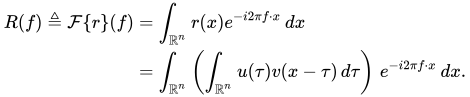
Consider functions Failed to parse (Conversion error. Server ("https://wikimedia.org/api/rest_") reported: "Cannot get mml. Server problem."): {\displaystyle u,v} in Lp-space Failed to parse (Conversion error. Server ("https://wikimedia.org/api/rest_") reported: "Cannot get mml. Server problem."): {\displaystyle L^{1}(\mathbb {R} ^{n}),} with Fourier transforms Failed to parse (Conversion error. Server ("https://wikimedia.org/api/rest_") reported: "Cannot get mml. Server problem."): {\displaystyle U,V} : Failed to parse (Conversion error. Server ("https://wikimedia.org/api/rest_") reported: "Cannot get mml. Server problem."): {\displaystyle {\begin{aligned}U(f)&\triangleq {\mathcal {F}}\{u\}(f)=\int _{\mathbb {R} ^{n}}u(x)e^{-i2\pi f\cdot x}\,dx,\quad f\in \mathbb {R} ^{n}\\V(f)&\triangleq {\mathcal {F}}\{v\}(f)=\int _{\mathbb {R} ^{n}}v(x)e^{-i2\pi f\cdot x}\,dx,\end{aligned}}} where Failed to parse (Conversion error. Server ("https://wikimedia.org/api/rest_") reported: "Cannot get mml. Server problem."): {\displaystyle f\cdot x} indicates the inner product of : Failed to parse (Conversion error. Server ("https://wikimedia.org/api/rest_") reported: "Cannot get mml. Server problem."): {\displaystyle f\cdot x=\sum _{j=1}^{n}{f}_{j}x_{j},} and Failed to parse (Conversion error. Server ("https://wikimedia.org/api/rest_") reported: "Cannot get mml. Server problem."): {\displaystyle dx=\prod _{j=1}^{n}dx_{j}.} The convolution of and is defined by: Failed to parse (Conversion error. Server ("https://wikimedia.org/api/rest_") reported: "Cannot get mml. Server problem."): {\displaystyle r(x)\triangleq \int _{\mathbb {R} ^{n}}u(\tau )v(x-\tau )\,d\tau .} Also: Failed to parse (Conversion error. Server ("https://wikimedia.org/api/rest_") reported: "Cannot get mml. Server problem."): {\displaystyle \iint |u(\tau )v(x-\tau )|\,dx\,d\tau =\int \left(|u(\tau )|\int |v(x-\tau )|\,dx\right)\,d\tau =\int |u(\tau )|\,\|v\|_{1}\,d\tau =\|u\|_{1}\|v\|_{1}.} Hence by Fubini's theorem we have that Failed to parse (Conversion error. Server ("https://wikimedia.org/api/rest_") reported: "Cannot get mml. Server problem."): {\displaystyle r\in L^{1}(\mathbb {R} ^{n})} so its Fourier transform is defined by the integral formula:
Note that Failed to parse (Conversion error. Server ("https://wikimedia.org/api/rest_") reported: "Cannot get mml. Server problem."): {\displaystyle |u(\tau )v(x-\tau )e^{-i2\pi f\cdot x}|=|u(\tau )v(x-\tau )|,} Hence by the argument above we may apply Fubini's theorem again (i.e. interchange the order of integration): Failed to parse (Conversion error. Server ("https://wikimedia.org/api/rest_") reported: "Cannot get mml. Server problem."): {\displaystyle {\begin{aligned}R(f)&=\int _{\mathbb {R} ^{n}}u(\tau )\underbrace {\left(\int _{\mathbb {R} ^{n}}v(x-\tau )\ e^{-i2\pi f\cdot x}\,dx\right)} _{V(f)\ e^{-i2\pi f\cdot \tau }}\,d\tau \\&=\underbrace {\left(\int _{\mathbb {R} ^{n}}u(\tau )\ e^{-i2\pi f\cdot \tau }\,d\tau \right)} _{U(f)}\ V(f).\end{aligned}}} |


This theorem also holds for the Laplace transform, the two-sided Laplace transform and, when suitably modified, for the Mellin transform and Hartley transform (see Mellin inversion theorem). It can be extended to the Fourier transform of abstract harmonic analysis defined over locally compact abelian groups.
Periodic convolution (Fourier series coefficients)
[edit | edit source]Consider -periodic functions Failed to parse (Conversion error. Server ("https://wikimedia.org/api/rest_") reported: "Cannot get mml. Server problem."): {\displaystyle u_{_{P}}} and Failed to parse (Conversion error. Server ("https://wikimedia.org/api/rest_") reported: "Cannot get mml. Server problem."): {\displaystyle v_{_{P}},} which can be expressed as periodic summations:

Failed to parse (Conversion error. Server ("https://wikimedia.org/api/rest_") reported: "Cannot get mml. Server problem."): {\displaystyle u_{_{P}}(x)\ \triangleq \sum _{m=-\infty }^{\infty }u(x-mP)} andFailed to parse (Conversion error. Server ("https://wikimedia.org/api/rest_") reported: "Cannot get mml. Server problem."): {\displaystyle v_{_{P}}(x)\ \triangleq \sum _{m=-\infty }^{\infty }v(x-mP).}
In practice the non-zero portion of components and are often limited to duration but nothing in the theorem requires that.

The Fourier series coefficients are:
Failed to parse (Conversion error. Server ("https://wikimedia.org/api/rest_") reported: "Cannot get mml. Server problem."): {\displaystyle {\begin{aligned}U[k]&\triangleq {\mathcal {F}}\{u_{_{P}}\}[k]={\frac {1}{P}}\int _{P}u_{_{P}}(x)e^{-i2\pi kx/P}\,dx,\quad k\in \mathbb {Z} ;\quad \quad \scriptstyle {\text{integration over any interval of length }}P\\V[k]&\triangleq {\mathcal {F}}\{v_{_{P}}\}[k]={\frac {1}{P}}\int _{P}v_{_{P}}(x)e^{-i2\pi kx/P}\,dx,\quad k\in \mathbb {Z} \end{aligned}}}
where denotes the Fourier series integral.
- The product: Failed to parse (Conversion error. Server ("https://wikimedia.org/api/rest_") reported: "Cannot get mml. Server problem."): {\displaystyle u_{_{P}}(x)\cdot v_{_{P}}(x)} is also -periodic, and its Fourier series coefficients are given by the discrete convolution of the and sequences: Failed to parse (Conversion error. Server ("https://wikimedia.org/api/rest_") reported: "Cannot get mml. Server problem."): {\displaystyle {\mathcal {F}}\{u_{_{P}}\cdot v_{_{P}}\}[k]=\{U*V\}[k].}
- The convolution: Failed to parse (Conversion error. Server ("https://wikimedia.org/api/rest_") reported: "Cannot get mml. Server problem."): {\displaystyle {\begin{aligned}\{u_{_{P}}*v\}(x)\ &\triangleq \int _{-\infty }^{\infty }u_{_{P}}(x-\tau )\cdot v(\tau )\ d\tau \\&\equiv \int _{P}u_{_{P}}(x-\tau )\cdot v_{_{P}}(\tau )\ d\tau ;\quad \quad \scriptstyle {\text{integration over any interval of length }}P\end{aligned}}} is also -periodic, and is called a periodic convolution.
Derivation of periodic convolution
|
|---|
|
Failed to parse (Conversion error. Server ("https://wikimedia.org/api/rest_") reported: "Cannot get mml. Server problem."): {\displaystyle {\begin{aligned}\int _{-\infty }^{\infty }u_{_{P}}(x-\tau )\cdot v(\tau )\,d\tau &=\sum _{k=-\infty }^{\infty }\left[\int _{x_{o}+kP}^{x_{o}+(k+1)P}u_{_{P}}(x-\tau )\cdot v(\tau )\ d\tau \right]\quad x_{0}{\text{ is an arbitrary parameter}}\\&=\sum _{k=-\infty }^{\infty }\left[\int _{x_{o}}^{x_{o}+P}\underbrace {u_{_{P}}(x-\tau -kP)} _{u_{_{P}}(x-\tau ),{\text{ by periodicity}}}\cdot v(\tau +kP)\ d\tau \right]\quad {\text{substituting }}\tau \rightarrow \tau +kP\\&=\int _{x_{o}}^{x_{o}+P}u_{_{P}}(x-\tau )\cdot \underbrace {\left[\sum _{k=-\infty }^{\infty }v(\tau +kP)\right]} _{\triangleq \ v_{_{P}}(\tau )}\ d\tau \end{aligned}}} |
The corresponding convolution theorem is:
Derivation of Eq.2
|
|---|
|
|
![{\displaystyle {\begin{aligned}{\mathcal {F}}\{u_{_{P}}*v\}[k]&\triangleq {\frac {1}{P}}\int _{P}\left(\int _{P}u_{_{P}}(\tau )\cdot v_{_{P}}(x-\tau )\ d\tau \right)e^{-i2\pi kx/P}\,dx\\&=\int _{P}u_{_{P}}(\tau )\left({\frac {1}{P}}\int _{P}v_{_{P}}(x-\tau )\ e^{-i2\pi kx/P}dx\right)\,d\tau \\&=\int _{P}u_{_{P}}(\tau )\ e^{-i2\pi k\tau /P}\underbrace {\left({\frac {1}{P}}\int _{P}v_{_{P}}(x-\tau )\ e^{-i2\pi k(x-\tau )/P}dx\right)} _{V[k],\quad {\text{due to periodicity}}}\,d\tau \\&=\underbrace {\left(\int _{P}\ u_{_{P}}(\tau )\ e^{-i2\pi k\tau /P}d\tau \right)} _{P\cdot U[k]}\ V[k].\end{aligned}}}](https://wikimedia.org/api/rest_v1/media/math/render/svg/252a143162a38ecc1ee2c1780ed231edf64ed597)
Functions of a discrete variable (sequences)
[edit | edit source]By a derivation similar to Eq.1, there is an analogous theorem for sequences, such as samples of two continuous functions, where now denotes the discrete-time Fourier transform (DTFT) operator. Consider two sequences Failed to parse (Conversion error. Server ("https://wikimedia.org/api/rest_") reported: "Cannot get mml. Server problem."): {\displaystyle u[n]} and Failed to parse (Conversion error. Server ("https://wikimedia.org/api/rest_") reported: "Cannot get mml. Server problem."): {\displaystyle v[n]} with transforms and :
Failed to parse (Conversion error. Server ("https://wikimedia.org/api/rest_") reported: "Cannot get mml. Server problem."): {\displaystyle {\begin{aligned}U(f)&\triangleq {\mathcal {F}}\{u\}(f)=\sum _{n=-\infty }^{\infty }u[n]\cdot e^{-i2\pi fn}\;,\quad f\in \mathbb {R} ,\\V(f)&\triangleq {\mathcal {F}}\{v\}(f)=\sum _{n=-\infty }^{\infty }v[n]\cdot e^{-i2\pi fn}\;,\quad f\in \mathbb {R} .\end{aligned}}}
The § Discrete convolution of and is defined by:
Failed to parse (Conversion error. Server ("https://wikimedia.org/api/rest_") reported: "Cannot get mml. Server problem."): {\displaystyle r[n]\triangleq (u*v)[n]=\sum _{m=-\infty }^{\infty }u[m]\cdot v[n-m]=\sum _{m=-\infty }^{\infty }u[n-m]\cdot v[m].}
The convolution theorem for discrete sequences is:[3][4]: p.60 (2.169)
Periodic convolution
[edit | edit source]Failed to parse (Conversion error. Server ("https://wikimedia.org/api/rest_") reported: "Cannot get mml. Server problem."): {\displaystyle U(f)} and Failed to parse (Conversion error. Server ("https://wikimedia.org/api/rest_") reported: "Cannot get mml. Server problem."): {\displaystyle V(f),} as defined above, are periodic, with a period of 1. Consider -periodic sequences Failed to parse (Conversion error. Server ("https://wikimedia.org/api/rest_") reported: "Cannot get mml. Server problem."): {\displaystyle u_{_{N}}} and Failed to parse (Conversion error. Server ("https://wikimedia.org/api/rest_") reported: "Cannot get mml. Server problem."): {\displaystyle v_{_{N}}} :

Failed to parse (Conversion error. Server ("https://wikimedia.org/api/rest_") reported: "Cannot get mml. Server problem."): {\displaystyle u_{_{N}}[n]\ \triangleq \sum _{m=-\infty }^{\infty }u[n-mN]} and
![{\displaystyle v_{_{N}}[n]\ \triangleq \sum _{m=-\infty }^{\infty }v[n-mN],\quad n\in \mathbb {Z} .}](https://wikimedia.org/api/rest_v1/media/math/render/svg/62b3cb372f16be04589aa1f446455da9d8bcd8f0)
These functions occur as the result of sampling and at intervals of and performing an inverse discrete Fourier transform (DFT) on samples (see § Sampling the DTFT). The discrete convolution:

Failed to parse (Conversion error. Server ("https://wikimedia.org/api/rest_") reported: "Cannot get mml. Server problem."): {\displaystyle \{u_{_{N}}*v\}[n]\ \triangleq \sum _{m=-\infty }^{\infty }u_{_{N}}[m]\cdot v[n-m]\equiv \sum _{m=0}^{N-1}u_{_{N}}[m]\cdot v_{_{N}}[n-m]}
is also -periodic, and is called a periodic convolution. Redefining the operator as the -length DFT, the corresponding theorem is:[5][4]: p. 548
And therefore:
Under the right conditions, it is possible for this -length sequence to contain a distortion-free segment of a Failed to parse (Conversion error. Server ("https://wikimedia.org/api/rest_") reported: "Cannot get mml. Server problem."): {\displaystyle u*v} convolution. But when the non-zero portion of the Failed to parse (Conversion error. Server ("https://wikimedia.org/api/rest_") reported: "Cannot get mml. Server problem."): {\displaystyle u(n)} or Failed to parse (Conversion error. Server ("https://wikimedia.org/api/rest_") reported: "Cannot get mml. Server problem."): {\displaystyle v(n)} sequence is equal or longer than Failed to parse (Conversion error. Server ("https://wikimedia.org/api/rest_") reported: "Cannot get mml. Server problem."): {\displaystyle N,} some distortion is inevitable. Such is the case when the Failed to parse (Conversion error. Server ("https://wikimedia.org/api/rest_") reported: "Cannot get mml. Server problem."): {\displaystyle V(k/N)} sequence is obtained by directly sampling the DTFT of the infinitely long § Discrete Hilbert transform impulse response.Template:Efn-ua
For and sequences whose non-zero duration is less than or equal to Failed to parse (SVG (MathML can be enabled via browser plugin): Invalid response ("Math extension cannot connect to Restbase.") from server "https://wikimedia.org/api/rest_v1/":): {\displaystyle N,} a final simplification is: Template:Equation box 1
This form is often used to efficiently implement numerical convolution by computer. (see § Fast convolution algorithms and § Example)
As a partial reciprocal, it has been shown [6] that any linear transform that turns convolution into a product is the DFT (up to a permutation of coefficients).
Derivations of Eq.4
|
|---|
|
A time-domain derivation proceeds as follows:
A frequency-domain derivation follows from § Periodic data, which indicates that the DTFTs can be written as: Failed to parse (Conversion error. Server ("https://wikimedia.org/api/rest_") reported: "Cannot get mml. Server problem."): {\displaystyle {\mathcal {F}}\{u_{_{N}}*v\}(f)={\frac {1}{N}}\sum _{k=-\infty }^{\infty }\left(\scriptstyle {\rm {DFT}}\displaystyle \{u_{_{N}}*v\}[k]\right)\cdot \delta \left(f-k/N\right).\quad \scriptstyle {\mathsf {(Eq.5a)}}} Failed to parse (Conversion error. Server ("https://wikimedia.org/api/rest_") reported: "Cannot get mml. Server problem."): {\displaystyle {\mathcal {F}}\{u_{_{N}}\}(f)={\frac {1}{N}}\sum _{k=-\infty }^{\infty }\left(\scriptstyle {\rm {DFT}}\displaystyle \{u_{_{N}}\}[k]\right)\cdot \delta \left(f-k/N\right).} The product with Failed to parse (Conversion error. Server ("https://wikimedia.org/api/rest_") reported: "Cannot get mml. Server problem."): {\displaystyle V(f)} is thereby reduced to a discrete-frequency function: Failed to parse (SVG (MathML can be enabled via browser plugin): Invalid response ("Math extension cannot connect to Restbase.") from server "https://wikimedia.org/api/rest_v1/":): {\displaystyle \begin{align} \mathcal{F}\{u_{_N} * v\}(f) &= G_{_N}(f) V(f) \\ &= \frac{1}{N} \sum_{k=-\infty}^{\infty} \left(\scriptstyle{\rm DFT}\displaystyle\{u_{_N}\}[k]\right)\cdot V(f)\cdot \delta\left(f-k/N\right)\\ &= \frac{1}{N} \sum_{k=-\infty}^{\infty} \left(\scriptstyle{\rm DFT}\displaystyle\{u_{_N}\}[k]\right)\cdot V(k/N)\cdot \delta\left(f-k/N\right)\\ &= \frac{1}{N} \sum_{k=-\infty}^{\infty} \left(\scriptstyle{\rm DFT}\displaystyle\{u_{_N}\}[k]\right)\cdot \left(\scriptstyle{\rm DFT}\displaystyle\{v_{_N}\}[k]\right) \cdot \delta\left(f-k/N\right), \quad \scriptstyle \mathsf{(Eq.5b)} \end{align} } where the equivalence of Failed to parse (Conversion error. Server ("https://wikimedia.org/api/rest_") reported: "Cannot get mml. Server problem."): {\displaystyle V(k/N)} and Failed to parse (Conversion error. Server ("https://wikimedia.org/api/rest_") reported: "Cannot get mml. Server problem."): {\displaystyle \left(\scriptstyle {\rm {DFT}}\displaystyle \{v_{_{N}}\}[k]\right)} follows from § Sampling the DTFT. Therefore, the equivalence of (5a) and (5b) requires: Failed to parse (SVG (MathML can be enabled via browser plugin): Invalid response ("Math extension cannot connect to Restbase.") from server "https://wikimedia.org/api/rest_v1/":): {\displaystyle \scriptstyle{\rm DFT} \displaystyle {\{u_{_N} * v\}[k]} = \left(\scriptstyle{\rm DFT} \displaystyle\{u_{_N}\}[k]\right)\cdot \left(\scriptstyle{\rm DFT}\displaystyle\{v_{_N}\}[k]\right).}
Failed to parse (SVG (MathML can be enabled via browser plugin): Invalid response ("Math extension cannot connect to Restbase.") from server "https://wikimedia.org/api/rest_v1/":): {\displaystyle \begin{align} (u_{_N} * v)[n] & = \int_{0}^{1} \left(\frac{1}{N} \sum_{k=-\infty}^{\infty} \scriptstyle{\rm DFT}\displaystyle\{u_{_N}\}[k]\cdot \scriptstyle{\rm DFT}\displaystyle\{v_{_N}\}[k]\cdot \delta\left(f-k/N\right)\right)\cdot e^{i 2 \pi f n} df \\ & = \frac{1}{N} \sum_{k=-\infty}^{\infty} \scriptstyle{\rm DFT}\displaystyle\{u_{_N}\}[k]\cdot \scriptstyle{\rm DFT}\displaystyle\{v_{_N}\}[k]\cdot \underbrace{\left(\int_{0}^{1} \delta\left(f-k/N\right)\cdot e^{i 2 \pi f n} df\right)}_{\text{0, for} \ k\ \notin\ [0,\ N)} \\ & = \frac{1}{N} \sum_{k=0}^{N-1} \bigg(\scriptstyle{\rm DFT}\displaystyle\{u_{_N}\}[k]\cdot \scriptstyle{\rm DFT}\displaystyle\{v_{_N}\}[k]\bigg)\cdot e^{i 2 \pi \frac{n}{N} k}\\ &=\ \scriptstyle{\rm DFT}^{-1} \displaystyle \bigg( \scriptstyle{\rm DFT}\displaystyle \{u_{_N}\}\cdot \scriptstyle{\rm DFT}\displaystyle \{v_{_N}\} \bigg). \end{align}} |
![{\displaystyle {\begin{aligned}\scriptstyle {\rm {DFT}}\displaystyle \{u_{_{N}}*v\}[k]&\triangleq \sum _{n=0}^{N-1}\left(\sum _{m=0}^{N-1}u_{_{N}}[m]\cdot v_{_{N}}[n-m]\right)e^{-i2\pi kn/N}\\&=\sum _{m=0}^{N-1}u_{_{N}}[m]\left(\sum _{n=0}^{N-1}v_{_{N}}[n-m]\cdot e^{-i2\pi kn/N}\right)\\&=\sum _{m=0}^{N-1}u_{_{N}}[m]\cdot e^{-i2\pi km/N}\underbrace {\left(\sum _{n=0}^{N-1}v_{_{N}}[n-m]\cdot e^{-i2\pi k(n-m)/N}\right)} _{\scriptstyle {\rm {DFT}}\displaystyle \{v_{_{N}}\}[k]\quad \scriptstyle {\text{due to periodicity}}}\\&=\underbrace {\left(\sum _{m=0}^{N-1}u_{_{N}}[m]\cdot e^{-i2\pi km/N}\right)} _{\scriptstyle {\rm {DFT}}\displaystyle \{u_{_{N}}\}[k]}\left(\scriptstyle {\rm {DFT}}\displaystyle \{v_{_{N}}\}[k]\right).\end{aligned}}}](https://wikimedia.org/api/rest_v1/media/math/render/svg/61dd82c63ec339357bb750973d87a819d0490c8e)
Convolution theorem for inverse Fourier transform
[edit | edit source]There is also a convolution theorem for the inverse Fourier transform:
Here, "Failed to parse (SVG (MathML can be enabled via browser plugin): Invalid response ("Math extension cannot connect to Restbase.") from server "https://wikimedia.org/api/rest_v1/":): {\displaystyle \cdot} " represents the Hadamard product, and "Failed to parse (SVG (MathML can be enabled via browser plugin): Invalid response ("Math extension cannot connect to Restbase.") from server "https://wikimedia.org/api/rest_v1/":): {\displaystyle *} " represents a convolution between the two matrices.
Failed to parse (SVG (MathML can be enabled via browser plugin): Invalid response ("Math extension cannot connect to Restbase.") from server "https://wikimedia.org/api/rest_v1/":): {\displaystyle \begin{align} &\mathcal{F}\{u*v\} = \mathcal{F}\{u\} \cdot \mathcal{F}\{v\}\\ &\mathcal{F}\{u \cdot v\}= \mathcal{F}\{u\}*\mathcal{F}\{v\} \end{align}}
so that
Failed to parse (SVG (MathML can be enabled via browser plugin): Invalid response ("Math extension cannot connect to Restbase.") from server "https://wikimedia.org/api/rest_v1/":): {\displaystyle \begin{align} &u*v= \mathcal{F}^{-1}\left\{\mathcal{F}\{u\}\cdot\mathcal{F}\{v\}\right\}\\ &u \cdot v= \mathcal{F}^{-1}\left\{\mathcal{F}\{u\}*\mathcal{F}\{v\}\right\} \end{align}}
Convolution theorem for tempered distributions
[edit | edit source]The convolution theorem extends to tempered distributions. Here, Failed to parse (SVG (MathML can be enabled via browser plugin): Invalid response ("Math extension cannot connect to Restbase.") from server "https://wikimedia.org/api/rest_v1/":): {\displaystyle v} is an arbitrary tempered distribution:
Failed to parse (SVG (MathML can be enabled via browser plugin): Invalid response ("Math extension cannot connect to Restbase.") from server "https://wikimedia.org/api/rest_v1/":): {\displaystyle \begin{align} &\mathcal{F}\{u*v\} = \mathcal{F}\{u\} \cdot \mathcal{F}\{v\}\\ &\mathcal{F}\{u \cdot v\}= \mathcal{F}\{u\}*\mathcal{F}\{v\}. \end{align}}
But Failed to parse (SVG (MathML can be enabled via browser plugin): Invalid response ("Math extension cannot connect to Restbase.") from server "https://wikimedia.org/api/rest_v1/":): {\displaystyle \alpha = F\{u\}} must be "rapidly decreasing" towards Failed to parse (SVG (MathML can be enabled via browser plugin): Invalid response ("Math extension cannot connect to Restbase.") from server "https://wikimedia.org/api/rest_v1/":): {\displaystyle -\infty} and Failed to parse (SVG (MathML can be enabled via browser plugin): Invalid response ("Math extension cannot connect to Restbase.") from server "https://wikimedia.org/api/rest_v1/":): {\displaystyle +\infty} in order to guarantee the existence of both, convolution and multiplication product. Equivalently, if Failed to parse (SVG (MathML can be enabled via browser plugin): Invalid response ("Math extension cannot connect to Restbase.") from server "https://wikimedia.org/api/rest_v1/":): {\displaystyle u = F^{-1}\{\alpha\}} is a smooth "slowly growing" ordinary function, it guarantees the existence of both, multiplication and convolution product.[7][8][9]
In particular, every compactly supported tempered distribution, such as the Dirac delta, is "rapidly decreasing". Equivalently, bandlimited functions, such as the function that is constantly Failed to parse (SVG (MathML can be enabled via browser plugin): Invalid response ("Math extension cannot connect to Restbase.") from server "https://wikimedia.org/api/rest_v1/":): {\displaystyle 1} are smooth "slowly growing" ordinary functions. If, for example, Failed to parse (SVG (MathML can be enabled via browser plugin): Invalid response ("Math extension cannot connect to Restbase.") from server "https://wikimedia.org/api/rest_v1/":): {\displaystyle v\equiv\operatorname{\text{Ш}}} is the Dirac comb both equations yield the Poisson summation formula and if, furthermore, Failed to parse (SVG (MathML can be enabled via browser plugin): Invalid response ("Math extension cannot connect to Restbase.") from server "https://wikimedia.org/api/rest_v1/":): {\displaystyle u\equiv\delta} is the Dirac delta then Failed to parse (SVG (MathML can be enabled via browser plugin): Invalid response ("Math extension cannot connect to Restbase.") from server "https://wikimedia.org/api/rest_v1/":): {\displaystyle \alpha \equiv 1} is constantly one and these equations yield the Dirac comb identity.
See also
[edit | edit source]Notes
[edit | edit source]References
[edit | edit source]- ↑ McGillem, Clare D.; Cooper, George R. (1984). Continuous and Discrete Signal and System Analysis (2 ed.). Holt, Rinehart and Winston. p. 118 (3–102). ISBN 0-03-061703-0.
- ↑ 2.0 2.1 Weisstein, Eric W. "Convolution Theorem". From MathWorld--A Wolfram Web Resource. Retrieved 8 February 2021.
- ↑ Proakis, John G.; Manolakis, Dimitri G. (1996), Digital Signal Processing: Principles, Algorithms and Applications (3 ed.), New Jersey: Prentice-Hall International, p. 297, Bibcode:1996dspp.book.....P, ISBN 9780133942897, sAcfAQAAIAAJ
- ↑ 4.0 4.1 Oppenheim, Alan V.; Schafer, Ronald W.; Buck, John R. (1999). Discrete-time signal processing (2nd ed.). Upper Saddle River, N.J.: Prentice Hall. ISBN 0-13-754920-2.
- ↑ Rabiner, Lawrence R.; Gold, Bernard (1975). Theory and application of digital signal processing. Englewood Cliffs, NJ: Prentice-Hall, Inc. p. 59 (2.163). ISBN 978-0139141010.
- ↑ Amiot, Emmanuel (2016). Music through Fourier Space. Computational Music Science. Zürich: Springer. p. 8. doi:10.1007/978-3-319-45581-5. ISBN 978-3-319-45581-5. S2CID 6224021.
- ↑ Horváth, John (1966). Topological Vector Spaces and Distributions. Reading, MA: Addison-Wesley Publishing Company.
- ↑ Barros-Neto, José (1973). An Introduction to the Theory of Distributions. New York, NY: Dekker.
- ↑ Petersen, Bent E. (1983). Introduction to the Fourier Transform and Pseudo-Differential Operators. Boston, MA: Pitman Publishing.
Further reading
[edit | edit source]- Katznelson, Yitzhak (1976), An introduction to Harmonic Analysis, Dover, ISBN 0-486-63331-4
- Li, Bing; Babu, G. Jogesh (2019), "Convolution Theorem and Asymptotic Efficiency", A Graduate Course on Statistical Inference, New York: Springer, pp. 295–327, ISBN 978-1-4939-9759-6
- Crutchfield, Steve (October 9, 2010), "The Joy of Convolution", Johns Hopkins University, retrieved November 19, 2010
Additional resources
[edit | edit source]For a visual representation of the use of the convolution theorem in signal processing, see:
- Johns Hopkins University's Java-aided simulation: http://www.jhu.edu/signals/convolve/index.html