Tensor product
In mathematics, the tensor product Failed to parse (SVG (MathML can be enabled via browser plugin): Invalid response ("Math extension cannot connect to Restbase.") from server "https://wikimedia.org/api/rest_v1/":): {\displaystyle V \otimes W} of two vector spaces Failed to parse (SVG (MathML can be enabled via browser plugin): Invalid response ("Math extension cannot connect to Restbase.") from server "https://wikimedia.org/api/rest_v1/":): {\displaystyle V} and Failed to parse (SVG (MathML can be enabled via browser plugin): Invalid response ("Math extension cannot connect to Restbase.") from server "https://wikimedia.org/api/rest_v1/":): {\displaystyle W} (over the same field) is a vector space to which is associated a bilinear map Failed to parse (SVG (MathML can be enabled via browser plugin): Invalid response ("Math extension cannot connect to Restbase.") from server "https://wikimedia.org/api/rest_v1/":): {\displaystyle V\times W \rightarrow V\otimes W} that maps a pair Failed to parse (SVG (MathML can be enabled via browser plugin): Invalid response ("Math extension cannot connect to Restbase.") from server "https://wikimedia.org/api/rest_v1/":): {\displaystyle (v,w)} , where Failed to parse (SVG (MathML can be enabled via browser plugin): Invalid response ("Math extension cannot connect to Restbase.") from server "https://wikimedia.org/api/rest_v1/":): {\displaystyle v\in V, w\in W} , to an element of Failed to parse (SVG (MathML can be enabled via browser plugin): Invalid response ("Math extension cannot connect to Restbase.") from server "https://wikimedia.org/api/rest_v1/":): {\displaystyle V \otimes W} denoted Template:Tmath.[1]
An element of the form Failed to parse (SVG (MathML can be enabled via browser plugin): Invalid response ("Math extension cannot connect to Restbase.") from server "https://wikimedia.org/api/rest_v1/":): {\displaystyle v \otimes w} is called the tensor product of Failed to parse (SVG (MathML can be enabled via browser plugin): Invalid response ("Math extension cannot connect to Restbase.") from server "https://wikimedia.org/api/rest_v1/":): {\displaystyle v} and Failed to parse (Conversion error. Server ("https://wikimedia.org/api/rest_") reported: "Cannot get mml. Server problem."): {\displaystyle w} . An element of Failed to parse (Conversion error. Server ("https://wikimedia.org/api/rest_") reported: "Cannot get mml. Server problem."): {\displaystyle V\otimes W} is a tensor, and the tensor product of two vectors is sometimes called an elementary tensor or a decomposable tensor. The elementary tensors span Failed to parse (Conversion error. Server ("https://wikimedia.org/api/rest_") reported: "Cannot get mml. Server problem."): {\displaystyle V\otimes W} in the sense that every element of Failed to parse (Conversion error. Server ("https://wikimedia.org/api/rest_") reported: "Cannot get mml. Server problem."): {\displaystyle V\otimes W} is a sum of elementary tensors. If bases are given for and , a basis of is formed by all tensor products of a basis element of and a basis element of .


The tensor product of two vector spaces captures the properties of all bilinear maps in the sense that a bilinear map from Failed to parse (Conversion error. Server ("https://wikimedia.org/api/rest_") reported: "Cannot get mml. Server problem."): {\displaystyle V\times W} into another vector space Failed to parse (Conversion error. Server ("https://wikimedia.org/api/rest_") reported: "Cannot get mml. Server problem."): {\displaystyle Z} factors uniquely through a linear map Failed to parse (Conversion error. Server ("https://wikimedia.org/api/rest_") reported: "Cannot get mml. Server problem."): {\displaystyle V\otimes W\to Z} (see § Universal property), i.e. the bilinear map is associated to a unique linear map from the tensor product to Failed to parse (Conversion error. Server ("https://wikimedia.org/api/rest_") reported: "Cannot get mml. Server problem."): {\displaystyle Z} .
Tensor products are used in many application areas, including physics and engineering. For example, in general relativity, the gravitational field is described through the metric tensor, which is a tensor field with one tensor at each point of the space-time manifold, and each belonging to the tensor product of the cotangent space at the point with itself.
Definitions and constructions
[edit | edit source]The tensor product of two vector spaces is a vector space that is defined up to an isomorphism. There are several equivalent ways to define it. Most consist of defining explicitly a vector space that is called a tensor product, and, generally, the equivalence proof results almost immediately from the basic properties of the vector spaces that are so defined.
The tensor product can also be defined through a universal property; see § Universal property, below. As for every universal property, all objects that satisfy the property are isomorphic through a unique isomorphism that is compatible with the universal property. When this definition is used, the other definitions may be viewed as constructions of objects satisfying the universal property and as proofs that there are objects satisfying the universal property, that is that tensor products exist.
From bases
[edit | edit source]Let V and W be two vector spaces over a field F, with respective bases Failed to parse (Conversion error. Server ("https://wikimedia.org/api/rest_") reported: "Cannot get mml. Server problem."): {\displaystyle B_{V}} and Template:Tmath.
The tensor product of V and W is a vector space that has as a basis the set of all Failed to parse (Conversion error. Server ("https://wikimedia.org/api/rest_") reported: "Cannot get mml. Server problem."): {\displaystyle v\otimes w} with Failed to parse (Conversion error. Server ("https://wikimedia.org/api/rest_") reported: "Cannot get mml. Server problem."): {\displaystyle v\in B_{V}} and Template:Tmath, regarded purely as symbols with no further meaning. This definition can be formalized in the following way (this formalization is rarely used in practice, as the preceding informal definition is generally sufficient): is the set of functions from the Cartesian product Failed to parse (Conversion error. Server ("https://wikimedia.org/api/rest_") reported: "Cannot get mml. Server problem."): {\displaystyle B_{V}\times B_{W}} to F that have a finite number of nonzero values. The pointwise operations make a vector space. The function that maps to 1 and the other elements of Failed to parse (Conversion error. Server ("https://wikimedia.org/api/rest_") reported: "Cannot get mml. Server problem."): {\displaystyle B_{V}\times B_{W}} to 0 is denoted Template:Tmath.

The set Failed to parse (Conversion error. Server ("https://wikimedia.org/api/rest_") reported: "Cannot get mml. Server problem."): {\displaystyle \{v\otimes w\mid v\in B_{V},w\in B_{W}\}} , called the tensor product of the bases Failed to parse (Conversion error. Server ("https://wikimedia.org/api/rest_") reported: "Cannot get mml. Server problem."): {\displaystyle B_{V}} and Template:Tmath, is straightforwardly a basis of Template:Tmath.
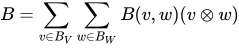
Equivalently, we can define to be the set of bilinear forms on Failed to parse (Conversion error. Server ("https://wikimedia.org/api/rest_") reported: "Cannot get mml. Server problem."): {\displaystyle V\times W} that are nonzero at only a finite number of elements of Template:Tmath. To see this, given Failed to parse (Conversion error. Server ("https://wikimedia.org/api/rest_") reported: "Cannot get mml. Server problem."): {\displaystyle (x,y)\in V\times W} and a bilinear form Template:Tmath, we can decompose and in the bases and Failed to parse (Conversion error. Server ("https://wikimedia.org/api/rest_") reported: "Cannot get mml. Server problem."): {\displaystyle B_{W}} as: Failed to parse (Conversion error. Server ("https://wikimedia.org/api/rest_") reported: "Cannot get mml. Server problem."): {\displaystyle x=\sum _{v\in B_{V}}x_{v}\,v\quad {\text{and}}\quad y=\sum _{w\in B_{W}}y_{w}\,w,} where only a finite number of Failed to parse (Conversion error. Server ("https://wikimedia.org/api/rest_") reported: "Cannot get mml. Server problem."): {\displaystyle x_{v}} 's and Failed to parse (Conversion error. Server ("https://wikimedia.org/api/rest_") reported: "Cannot get mml. Server problem."): {\displaystyle y_{w}} 's are nonzero, and find by the bilinearity of that: Failed to parse (Conversion error. Server ("https://wikimedia.org/api/rest_") reported: "Cannot get mml. Server problem."): {\displaystyle B(x,y)=\sum _{v\in B_{V}}\sum _{w\in B_{W}}x_{v}y_{w}\,B(v,w)}


Hence, we see that the value of for any Failed to parse (Conversion error. Server ("https://wikimedia.org/api/rest_") reported: "Cannot get mml. Server problem."): {\displaystyle (x,y)\in V\times W} is uniquely and totally determined by the values that it takes on Template:Tmath. This lets us extend the maps Failed to parse (Conversion error. Server ("https://wikimedia.org/api/rest_") reported: "Cannot get mml. Server problem."): {\displaystyle v\otimes w} defined on Failed to parse (Conversion error. Server ("https://wikimedia.org/api/rest_") reported: "Cannot get mml. Server problem."): {\displaystyle B_{V}\times B_{W}} as before into bilinear maps Failed to parse (Conversion error. Server ("https://wikimedia.org/api/rest_") reported: "Cannot get mml. Server problem."): {\displaystyle v\otimes w:V\times W\to F} , by letting: Failed to parse (Conversion error. Server ("https://wikimedia.org/api/rest_") reported: "Cannot get mml. Server problem."): {\displaystyle (v\otimes w)(x,y):=\sum _{v'\in B_{V}}\sum _{w'\in B_{W}}x_{v'}y_{w'}\,(v\otimes w)(v',w')=x_{v}\,y_{w}.}
Then we can express any bilinear form as a (potentially infinite) formal linear combination of the Failed to parse (Conversion error. Server ("https://wikimedia.org/api/rest_") reported: "Cannot get mml. Server problem."): {\displaystyle v\otimes w} maps according to: making these maps similar to a Schauder basis for the vector space Failed to parse (Conversion error. Server ("https://wikimedia.org/api/rest_") reported: "Cannot get mml. Server problem."): {\displaystyle {\text{Hom}}(V,W;F)} of all bilinear forms on Template:Tmath. To instead have it be a proper Hamel basis, it only remains to add the requirement that is nonzero at an only a finite number of elements of Template:Tmath, and consider the subspace of such maps instead.
In either construction, the tensor product of two vectors is defined from their decomposition on the bases. More precisely, taking the basis decompositions of Failed to parse (Conversion error. Server ("https://wikimedia.org/api/rest_") reported: "Cannot get mml. Server problem."): {\displaystyle x\in V} and Failed to parse (Conversion error. Server ("https://wikimedia.org/api/rest_") reported: "Cannot get mml. Server problem."): {\displaystyle y\in W} as before: Failed to parse (SVG (MathML can be enabled via browser plugin): Invalid response ("Math extension cannot connect to Restbase.") from server "https://wikimedia.org/api/rest_v1/":): {\displaystyle \begin{align} x\otimes y&=\biggl(\sum_{v\in B_V} x_v\, v\biggr) \otimes \biggl(\sum_{w\in B_W} y_w\, w\biggr)\\[5mu] &=\sum_{v\in B_V}\sum_{w\in B_W} x_v y_w\, v\otimes w. \end{align}}
This definition is quite clearly derived from the coefficients of Failed to parse (SVG (MathML can be enabled via browser plugin): Invalid response ("Math extension cannot connect to Restbase.") from server "https://wikimedia.org/api/rest_v1/":): {\displaystyle B(v, w)} in the expansion by bilinearity of Failed to parse (SVG (MathML can be enabled via browser plugin): Invalid response ("Math extension cannot connect to Restbase.") from server "https://wikimedia.org/api/rest_v1/":): {\displaystyle B(x, y)} using the bases Failed to parse (SVG (MathML can be enabled via browser plugin): Invalid response ("Math extension cannot connect to Restbase.") from server "https://wikimedia.org/api/rest_v1/":): {\displaystyle B_V} and Template:Tmath, as done above. It is then straightforward to verify that with this definition, the map Failed to parse (SVG (MathML can be enabled via browser plugin): Invalid response ("Math extension cannot connect to Restbase.") from server "https://wikimedia.org/api/rest_v1/":): {\displaystyle {\otimes} : (x,y)\mapsto x\otimes y} is a bilinear map from Failed to parse (SVG (MathML can be enabled via browser plugin): Invalid response ("Math extension cannot connect to Restbase.") from server "https://wikimedia.org/api/rest_v1/":): {\displaystyle V\times W} to Failed to parse (SVG (MathML can be enabled via browser plugin): Invalid response ("Math extension cannot connect to Restbase.") from server "https://wikimedia.org/api/rest_v1/":): {\displaystyle V\otimes W} satisfying the universal property that any construction of the tensor product satisfies (see below).
If arranged into a rectangular array, the coordinate vector of Failed to parse (SVG (MathML can be enabled via browser plugin): Invalid response ("Math extension cannot connect to Restbase.") from server "https://wikimedia.org/api/rest_v1/":): {\displaystyle x\otimes y} is the outer product of the coordinate vectors of Failed to parse (SVG (MathML can be enabled via browser plugin): Invalid response ("Math extension cannot connect to Restbase.") from server "https://wikimedia.org/api/rest_v1/":): {\displaystyle x} and Template:Tmath. Therefore, the tensor product is a generalization of the outer product, that is, an abstraction of it beyond coordinate vectors.
A limitation of this definition of the tensor product is that, if one changes bases, a different tensor product is defined. However, the decomposition on one basis of the elements of the other basis defines a canonical isomorphism between the two tensor products of vector spaces, which allows identifying them. Also, contrarily to the two following alternative definitions, this definition cannot be extended into a definition of the tensor product of modules over a ring.
As a quotient space
[edit | edit source]A construction of the tensor product that is basis independent can be obtained in the following way.
Let V and W be two vector spaces over a field F.
One considers first a vector space L that has the Cartesian product Failed to parse (SVG (MathML can be enabled via browser plugin): Invalid response ("Math extension cannot connect to Restbase.") from server "https://wikimedia.org/api/rest_v1/":): {\displaystyle V\times W} as a basis. That is, the basis elements of L are the pairs Failed to parse (SVG (MathML can be enabled via browser plugin): Invalid response ("Math extension cannot connect to Restbase.") from server "https://wikimedia.org/api/rest_v1/":): {\displaystyle (v,w)} with Failed to parse (SVG (MathML can be enabled via browser plugin): Invalid response ("Math extension cannot connect to Restbase.") from server "https://wikimedia.org/api/rest_v1/":): {\displaystyle v\in V} and Template:Tmath. To get such a vector space, one can define it as the vector space of the functions Failed to parse (SVG (MathML can be enabled via browser plugin): Invalid response ("Math extension cannot connect to Restbase.") from server "https://wikimedia.org/api/rest_v1/":): {\displaystyle V\times W \to F} that have a finite number of nonzero values and identifying Failed to parse (SVG (MathML can be enabled via browser plugin): Invalid response ("Math extension cannot connect to Restbase.") from server "https://wikimedia.org/api/rest_v1/":): {\displaystyle (v,w)} with the function that takes the value 1 on Failed to parse (SVG (MathML can be enabled via browser plugin): Invalid response ("Math extension cannot connect to Restbase.") from server "https://wikimedia.org/api/rest_v1/":): {\displaystyle (v,w)} and 0 otherwise.
Let R be the linear subspace of L that is spanned by the relations that the tensor product must satisfy. More precisely, R is spanned by the elements of one of the forms:
- Failed to parse (SVG (MathML can be enabled via browser plugin): Invalid response ("Math extension cannot connect to Restbase.") from server "https://wikimedia.org/api/rest_v1/":): {\displaystyle \begin{align} (v_1 + v_2, w)&-(v_1, w)-(v_2, w),\\ (v, w_1+w_2)&-(v, w_1)-(v, w_2),\\ (sv,w)&-s(v,w),\\ (v,sw)&-s(v,w), \end{align}}
where Template:Tmath, Failed to parse (SVG (MathML can be enabled via browser plugin): Invalid response ("Math extension cannot connect to Restbase.") from server "https://wikimedia.org/api/rest_v1/":): {\displaystyle w, w_1, w_2 \in W} and Template:Tmath.
Then, the tensor product is defined as the quotient space:
- Failed to parse (SVG (MathML can be enabled via browser plugin): Invalid response ("Math extension cannot connect to Restbase.") from server "https://wikimedia.org/api/rest_v1/":): {\displaystyle V\otimes W=L/R,}
and the image of Failed to parse (SVG (MathML can be enabled via browser plugin): Invalid response ("Math extension cannot connect to Restbase.") from server "https://wikimedia.org/api/rest_v1/":): {\displaystyle (v,w)} in this quotient is denoted Template:Tmath.
It is straightforward to prove that the result of this construction satisfies the universal property considered below. (A very similar construction can be used to define the tensor product of modules.)
Universal property
[edit | edit source]In this section, the universal property satisfied by the tensor product is described. As for every universal property, two objects that satisfy the property are related by a unique isomorphism. It follows that this is a (non-constructive) way to define the tensor product of two vector spaces. In this context, the preceding constructions of tensor products may be viewed as proofs of existence of the tensor product so defined.
A consequence of this approach is that every property of the tensor product can be deduced from the universal property, and that, in practice, one may forget the method that has been used to prove its existence.
The "universal-property definition" of the tensor product of two vector spaces is the following (recall that a bilinear map is a function that is separately linear in each of its arguments):
- The tensor product of two vector spaces V and W is a vector space denoted as Template:Tmath, together with a bilinear map Failed to parse (SVG (MathML can be enabled via browser plugin): Invalid response ("Math extension cannot connect to Restbase.") from server "https://wikimedia.org/api/rest_v1/":): {\displaystyle {\varphi} : (v,w)\mapsto v\otimes w} from Failed to parse (SVG (MathML can be enabled via browser plugin): Invalid response ("Math extension cannot connect to Restbase.") from server "https://wikimedia.org/api/rest_v1/":): {\displaystyle V\times W} to Template:Tmath, such that, for every bilinear map Template:Tmath, there is a unique linear map Template:Tmath, such that Failed to parse (SVG (MathML can be enabled via browser plugin): Invalid response ("Math extension cannot connect to Restbase.") from server "https://wikimedia.org/api/rest_v1/":): {\displaystyle h=\tilde h \circ {\varphi}} (that is, Failed to parse (SVG (MathML can be enabled via browser plugin): Invalid response ("Math extension cannot connect to Restbase.") from server "https://wikimedia.org/api/rest_v1/":): {\displaystyle h(v, w)= \tilde h(v\otimes w)} for every Failed to parse (SVG (MathML can be enabled via browser plugin): Invalid response ("Math extension cannot connect to Restbase.") from server "https://wikimedia.org/api/rest_v1/":): {\displaystyle v\in V} and Template:Tmath).
Linearly disjoint
[edit | edit source]Like the universal property above, the following characterization may also be used to determine whether or not a given vector space and given bilinear map form a tensor product.[2]
For example, it follows immediately that if Template:Tmath and Template:Tmath, where Failed to parse (SVG (MathML can be enabled via browser plugin): Invalid response ("Math extension cannot connect to Restbase.") from server "https://wikimedia.org/api/rest_v1/":): {\displaystyle m} and Failed to parse (SVG (MathML can be enabled via browser plugin): Invalid response ("Math extension cannot connect to Restbase.") from server "https://wikimedia.org/api/rest_v1/":): {\displaystyle n} are positive integers, then one may set Failed to parse (SVG (MathML can be enabled via browser plugin): Invalid response ("Math extension cannot connect to Restbase.") from server "https://wikimedia.org/api/rest_v1/":): {\displaystyle Z = \Complex^{mn}} and define the bilinear map as Failed to parse (SVG (MathML can be enabled via browser plugin): Invalid response ("Math extension cannot connect to Restbase.") from server "https://wikimedia.org/api/rest_v1/":): {\displaystyle \begin{align} T : \Complex^m \times \Complex^n &\to \Complex^{mn}\\ (x, y) = ((x_1, \ldots, x_m), (y_1, \ldots, y_n)) &\mapsto (x_i y_j)_{\stackrel{i=1,\ldots,m}{j=1,\ldots,n}}\end{align}} to form the tensor product of Failed to parse (SVG (MathML can be enabled via browser plugin): Invalid response ("Math extension cannot connect to Restbase.") from server "https://wikimedia.org/api/rest_v1/":): {\displaystyle X } and Template:Tmath.[3] Often, this map Failed to parse (SVG (MathML can be enabled via browser plugin): Invalid response ("Math extension cannot connect to Restbase.") from server "https://wikimedia.org/api/rest_v1/":): {\displaystyle T} is denoted by Failed to parse (SVG (MathML can be enabled via browser plugin): Invalid response ("Math extension cannot connect to Restbase.") from server "https://wikimedia.org/api/rest_v1/":): {\displaystyle \,\otimes\,} so that Failed to parse (SVG (MathML can be enabled via browser plugin): Invalid response ("Math extension cannot connect to Restbase.") from server "https://wikimedia.org/api/rest_v1/":): {\displaystyle x \otimes y = T(x, y).}
As another example, suppose that Failed to parse (SVG (MathML can be enabled via browser plugin): Invalid response ("Math extension cannot connect to Restbase.") from server "https://wikimedia.org/api/rest_v1/":): {\displaystyle \Complex^S} is the vector space of all complex-valued functions on a set Failed to parse (SVG (MathML can be enabled via browser plugin): Invalid response ("Math extension cannot connect to Restbase.") from server "https://wikimedia.org/api/rest_v1/":): {\displaystyle S} with addition and scalar multiplication defined pointwise (meaning that Failed to parse (SVG (MathML can be enabled via browser plugin): Invalid response ("Math extension cannot connect to Restbase.") from server "https://wikimedia.org/api/rest_v1/":): {\displaystyle f + g} is the map Failed to parse (SVG (MathML can be enabled via browser plugin): Invalid response ("Math extension cannot connect to Restbase.") from server "https://wikimedia.org/api/rest_v1/":): {\displaystyle s \mapsto f(s) + g(s)} and Failed to parse (SVG (MathML can be enabled via browser plugin): Invalid response ("Math extension cannot connect to Restbase.") from server "https://wikimedia.org/api/rest_v1/":): {\displaystyle c f} is the map Template:Tmath). Let Failed to parse (SVG (MathML can be enabled via browser plugin): Invalid response ("Math extension cannot connect to Restbase.") from server "https://wikimedia.org/api/rest_v1/":): {\displaystyle S} and Failed to parse (SVG (MathML can be enabled via browser plugin): Invalid response ("Math extension cannot connect to Restbase.") from server "https://wikimedia.org/api/rest_v1/":): {\displaystyle T} be any sets and for any Failed to parse (SVG (MathML can be enabled via browser plugin): Invalid response ("Math extension cannot connect to Restbase.") from server "https://wikimedia.org/api/rest_v1/":): {\displaystyle f \in \Complex^S} and Template:Tmath, let Failed to parse (SVG (MathML can be enabled via browser plugin): Invalid response ("Math extension cannot connect to Restbase.") from server "https://wikimedia.org/api/rest_v1/":): {\displaystyle f \otimes g \in \Complex^{S \times T}} denote the function defined by Template:Tmath. If Failed to parse (SVG (MathML can be enabled via browser plugin): Invalid response ("Math extension cannot connect to Restbase.") from server "https://wikimedia.org/api/rest_v1/":): {\displaystyle X \subseteq \Complex^S} and Failed to parse (SVG (MathML can be enabled via browser plugin): Invalid response ("Math extension cannot connect to Restbase.") from server "https://wikimedia.org/api/rest_v1/":): {\displaystyle Y \subseteq \Complex^T} are vector subspaces then the vector subspace Failed to parse (SVG (MathML can be enabled via browser plugin): Invalid response ("Math extension cannot connect to Restbase.") from server "https://wikimedia.org/api/rest_v1/":): {\displaystyle Z := \operatorname{span} \left\{f \otimes g : f \in X, g \in Y\right\}} of Failed to parse (SVG (MathML can be enabled via browser plugin): Invalid response ("Math extension cannot connect to Restbase.") from server "https://wikimedia.org/api/rest_v1/":): {\displaystyle \Complex^{S \times T}} together with the bilinear map: Failed to parse (SVG (MathML can be enabled via browser plugin): Invalid response ("Math extension cannot connect to Restbase.") from server "https://wikimedia.org/api/rest_v1/":): {\displaystyle \begin{alignat}{4} \;&& X \times Y &&\;\to \;& Z \\[0.3ex] && (f, g) &&\;\mapsto\;& f \otimes g \\ \end{alignat}} form a tensor product of Failed to parse (SVG (MathML can be enabled via browser plugin): Invalid response ("Math extension cannot connect to Restbase.") from server "https://wikimedia.org/api/rest_v1/":): {\displaystyle X} and Template:Tmath.[3]
Properties
[edit | edit source]Dimension
[edit | edit source]If V and W are vector spaces of finite dimension, then Failed to parse (SVG (MathML can be enabled via browser plugin): Invalid response ("Math extension cannot connect to Restbase.") from server "https://wikimedia.org/api/rest_v1/":): {\displaystyle V\otimes W} is finite-dimensional, and its dimension is the product of the dimensions of V and W.
This results from the fact that a basis of Failed to parse (SVG (MathML can be enabled via browser plugin): Invalid response ("Math extension cannot connect to Restbase.") from server "https://wikimedia.org/api/rest_v1/":): {\displaystyle V\otimes W} is formed by taking all tensor products of a basis element of V and a basis element of W.
Associativity
[edit | edit source]The tensor product is associative in the sense that, given three vector spaces Template:Tmath, there is a canonical isomorphism:
- Failed to parse (SVG (MathML can be enabled via browser plugin): Invalid response ("Math extension cannot connect to Restbase.") from server "https://wikimedia.org/api/rest_v1/":): {\displaystyle (U\otimes V)\otimes W\cong U\otimes (V\otimes W),}
that maps Failed to parse (SVG (MathML can be enabled via browser plugin): Invalid response ("Math extension cannot connect to Restbase.") from server "https://wikimedia.org/api/rest_v1/":): {\displaystyle (u\otimes v)\otimes w} to Template:Tmath.
This allows omitting parentheses in the tensor product of more than two vector spaces or vectors.
Commutativity as vector space operation
[edit | edit source]The tensor product of two vector spaces Failed to parse (SVG (MathML can be enabled via browser plugin): Invalid response ("Math extension cannot connect to Restbase.") from server "https://wikimedia.org/api/rest_v1/":): {\displaystyle V} and Failed to parse (SVG (MathML can be enabled via browser plugin): Invalid response ("Math extension cannot connect to Restbase.") from server "https://wikimedia.org/api/rest_v1/":): {\displaystyle W} is commutative in the sense that there is a canonical isomorphism:
- Failed to parse (SVG (MathML can be enabled via browser plugin): Invalid response ("Math extension cannot connect to Restbase.") from server "https://wikimedia.org/api/rest_v1/":): {\displaystyle V \otimes W \cong W\otimes V,}
that maps Failed to parse (SVG (MathML can be enabled via browser plugin): Invalid response ("Math extension cannot connect to Restbase.") from server "https://wikimedia.org/api/rest_v1/":): {\displaystyle v \otimes w} to Template:Tmath.
On the other hand, even when Template:Tmath, the tensor product of vectors is not commutative; that is Template:Tmath, in general.
The map Failed to parse (SVG (MathML can be enabled via browser plugin): Invalid response ("Math extension cannot connect to Restbase.") from server "https://wikimedia.org/api/rest_v1/":): {\displaystyle x\otimes y \mapsto y\otimes x} from Failed to parse (SVG (MathML can be enabled via browser plugin): Invalid response ("Math extension cannot connect to Restbase.") from server "https://wikimedia.org/api/rest_v1/":): {\displaystyle V\otimes V} to itself induces a linear automorphism that is called a braiding map. More generally and as usual (see tensor algebra), let Failed to parse (SVG (MathML can be enabled via browser plugin): Invalid response ("Math extension cannot connect to Restbase.") from server "https://wikimedia.org/api/rest_v1/":): {\displaystyle V^{\otimes n}} denote the tensor product of n copies of the vector space V. For every permutation s of the first n positive integers, the map:
- Failed to parse (SVG (MathML can be enabled via browser plugin): Invalid response ("Math extension cannot connect to Restbase.") from server "https://wikimedia.org/api/rest_v1/":): {\displaystyle x_1\otimes \cdots \otimes x_n \mapsto x_{s(1)}\otimes \cdots \otimes x_{s(n)}}
induces a linear automorphism of Template:Tmath, which is called a braiding map. This determines a right action of the symmetric group Failed to parse (SVG (MathML can be enabled via browser plugin): Invalid response ("Math extension cannot connect to Restbase.") from server "https://wikimedia.org/api/rest_v1/":): {\displaystyle S_n} on Failed to parse (SVG (MathML can be enabled via browser plugin): Invalid response ("Math extension cannot connect to Restbase.") from server "https://wikimedia.org/api/rest_v1/":): {\displaystyle V^{\otimes n}} .
Tensor product of linear maps
[edit | edit source]Given a linear map Template:Tmath, and a vector space W, the tensor product:
- Failed to parse (SVG (MathML can be enabled via browser plugin): Invalid response ("Math extension cannot connect to Restbase.") from server "https://wikimedia.org/api/rest_v1/":): {\displaystyle f\otimes W : U\otimes W\to V\otimes W}
is the unique linear map such that:
- Failed to parse (SVG (MathML can be enabled via browser plugin): Invalid response ("Math extension cannot connect to Restbase.") from server "https://wikimedia.org/api/rest_v1/":): {\displaystyle (f\otimes W)(u\otimes w)=f(u)\otimes w.}
The tensor product Failed to parse (SVG (MathML can be enabled via browser plugin): Invalid response ("Math extension cannot connect to Restbase.") from server "https://wikimedia.org/api/rest_v1/":): {\displaystyle W\otimes f} is defined similarly.
Given two linear maps Failed to parse (SVG (MathML can be enabled via browser plugin): Invalid response ("Math extension cannot connect to Restbase.") from server "https://wikimedia.org/api/rest_v1/":): {\displaystyle f : U\to V} and Template:Tmath, their tensor product:
- Failed to parse (SVG (MathML can be enabled via browser plugin): Invalid response ("Math extension cannot connect to Restbase.") from server "https://wikimedia.org/api/rest_v1/":): {\displaystyle f\otimes g : U\otimes W\to V\otimes Z}
is the unique linear map that satisfies:
- Failed to parse (SVG (MathML can be enabled via browser plugin): Invalid response ("Math extension cannot connect to Restbase.") from server "https://wikimedia.org/api/rest_v1/":): {\displaystyle (f\otimes g)(u\otimes w)=f(u)\otimes g(w).}
One has:
- Failed to parse (SVG (MathML can be enabled via browser plugin): Invalid response ("Math extension cannot connect to Restbase.") from server "https://wikimedia.org/api/rest_v1/":): {\displaystyle f\otimes g= (f\otimes Z)\circ (U\otimes g) = (V\otimes g)\circ (f\otimes W).}
In terms of category theory, this means that the tensor product is a bifunctor from the category of vector spaces to itself.[4]
If f and g are both injective or surjective, then the same is true for all above defined linear maps. In particular, the tensor product with a vector space is an exact functor; this means that every exact sequence is mapped to an exact sequence (tensor products of modules do not transform injections into injections, but they are right exact functors).
By choosing bases of all vector spaces involved, the linear maps f and g can be represented by matrices. Then, depending on how the tensor Failed to parse (SVG (MathML can be enabled via browser plugin): Invalid response ("Math extension cannot connect to Restbase.") from server "https://wikimedia.org/api/rest_v1/":): {\displaystyle v \otimes w} is vectorized, the matrix describing the tensor product Failed to parse (SVG (MathML can be enabled via browser plugin): Invalid response ("Math extension cannot connect to Restbase.") from server "https://wikimedia.org/api/rest_v1/":): {\displaystyle f \otimes g} is the Kronecker product of the two matrices. For example, if V, X, W, and U above are all two-dimensional and bases have been fixed for all of them, and f and g are given by the matrices: Failed to parse (SVG (MathML can be enabled via browser plugin): Invalid response ("Math extension cannot connect to Restbase.") from server "https://wikimedia.org/api/rest_v1/":): {\displaystyle A=\begin{bmatrix} a_{1,1} & a_{1,2} \\ a_{2,1} & a_{2,2} \\ \end{bmatrix}, \qquad B=\begin{bmatrix} b_{1,1} & b_{1,2} \\ b_{2,1} & b_{2,2} \\ \end{bmatrix},} respectively, then the tensor product of these two matrices is: Failed to parse (SVG (MathML can be enabled via browser plugin): Invalid response ("Math extension cannot connect to Restbase.") from server "https://wikimedia.org/api/rest_v1/":): {\displaystyle \begin{align} \begin{bmatrix} a_{1,1} & a_{1,2} \\ a_{2,1} & a_{2,2} \\ \end{bmatrix} \otimes \begin{bmatrix} b_{1,1} & b_{1,2} \\ b_{2,1} & b_{2,2} \\ \end{bmatrix} &= \begin{bmatrix} a_{1,1} \begin{bmatrix} b_{1,1} & b_{1,2} \\ b_{2,1} & b_{2,2} \\ \end{bmatrix} & a_{1,2} \begin{bmatrix} b_{1,1} & b_{1,2} \\ b_{2,1} & b_{2,2} \\ \end{bmatrix} \\[3pt] a_{2,1} \begin{bmatrix} b_{1,1} & b_{1,2} \\ b_{2,1} & b_{2,2} \\ \end{bmatrix} & a_{2,2} \begin{bmatrix} b_{1,1} & b_{1,2} \\ b_{2,1} & b_{2,2} \\ \end{bmatrix} \\ \end{bmatrix} \\ &= \begin{bmatrix} a_{1,1} b_{1,1} & a_{1,1} b_{1,2} & a_{1,2} b_{1,1} & a_{1,2} b_{1,2} \\ a_{1,1} b_{2,1} & a_{1,1} b_{2,2} & a_{1,2} b_{2,1} & a_{1,2} b_{2,2} \\ a_{2,1} b_{1,1} & a_{2,1} b_{1,2} & a_{2,2} b_{1,1} & a_{2,2} b_{1,2} \\ a_{2,1} b_{2,1} & a_{2,1} b_{2,2} & a_{2,2} b_{2,1} & a_{2,2} b_{2,2} \\ \end{bmatrix}. \end{align} }
The resultant rank is at most 4, and thus the resultant dimension is 4. rank here denotes the tensor rank i.e. the number of requisite indices (while the matrix rank counts the number of degrees of freedom in the resulting array).[clarification needed] Template:Tmath.
A dyadic product is the special case of the tensor product between two vectors of the same dimension.
General tensors
[edit | edit source]For non-negative integers r and s a type Failed to parse (SVG (MathML can be enabled via browser plugin): Invalid response ("Math extension cannot connect to Restbase.") from server "https://wikimedia.org/api/rest_v1/":): {\displaystyle (r, s)} tensor on a vector space V is an element of: Failed to parse (SVG (MathML can be enabled via browser plugin): Invalid response ("Math extension cannot connect to Restbase.") from server "https://wikimedia.org/api/rest_v1/":): {\displaystyle T^r_s(V) = \underbrace{ V \otimes \cdots \otimes V}_r \otimes \underbrace{ V^* \otimes \cdots \otimes V^*}_s = V^{\otimes r} \otimes \left(V^*\right)^{\otimes s}.} Here Failed to parse (SVG (MathML can be enabled via browser plugin): Invalid response ("Math extension cannot connect to Restbase.") from server "https://wikimedia.org/api/rest_v1/":): {\displaystyle V^*} is the dual vector space (which consists of all linear maps f from V to the ground field K).
There is a product map, called the (tensor) product of tensors:[5] Failed to parse (SVG (MathML can be enabled via browser plugin): Invalid response ("Math extension cannot connect to Restbase.") from server "https://wikimedia.org/api/rest_v1/":): {\displaystyle T^r_s (V) \otimes_K T^{r'}_{s'} (V) \to T^{r+r'}_{s+s'}(V).}
It is defined by grouping all occurring "factors" V together: writing Failed to parse (SVG (MathML can be enabled via browser plugin): Invalid response ("Math extension cannot connect to Restbase.") from server "https://wikimedia.org/api/rest_v1/":): {\displaystyle v_i} for an element of V and Failed to parse (SVG (MathML can be enabled via browser plugin): Invalid response ("Math extension cannot connect to Restbase.") from server "https://wikimedia.org/api/rest_v1/":): {\displaystyle f_i} for an element of the dual space: Failed to parse (SVG (MathML can be enabled via browser plugin): Invalid response ("Math extension cannot connect to Restbase.") from server "https://wikimedia.org/api/rest_v1/":): {\displaystyle (v_1 \otimes f_1) \otimes (v'_1) = v_1 \otimes v'_1 \otimes f_1.}
If V is finite dimensional, then picking a basis of V and the corresponding dual basis of Failed to parse (SVG (MathML can be enabled via browser plugin): Invalid response ("Math extension cannot connect to Restbase.") from server "https://wikimedia.org/api/rest_v1/":): {\displaystyle V^*} naturally induces a basis of Failed to parse (SVG (MathML can be enabled via browser plugin): Invalid response ("Math extension cannot connect to Restbase.") from server "https://wikimedia.org/api/rest_v1/":): {\displaystyle T_s^r(V)} (this basis is described in the article on Kronecker products). In terms of these bases, the components of a (tensor) product of two (or more) tensors can be computed. For example, if F and G are two covariant tensors of orders m and n respectively (i.e. Failed to parse (SVG (MathML can be enabled via browser plugin): Invalid response ("Math extension cannot connect to Restbase.") from server "https://wikimedia.org/api/rest_v1/":): {\displaystyle F \in T_m^0} and Template:Tmath), then the components of their tensor product are given by:[6] Failed to parse (SVG (MathML can be enabled via browser plugin): Invalid response ("Math extension cannot connect to Restbase.") from server "https://wikimedia.org/api/rest_v1/":): {\displaystyle (F \otimes G)_{i_1 i_2 \cdots i_{m+n}} = F_{i_1 i_2 \cdots i_m} G_{i_{m+1} i_{m+2} i_{m+3} \cdots i_{m+n}}.}
Thus, the components of the tensor product of two tensors are the ordinary product of the components of each tensor. Another example: let U be a tensor of type (1, 1) with components Template:Tmath, and let V be a tensor of type Failed to parse (SVG (MathML can be enabled via browser plugin): Invalid response ("Math extension cannot connect to Restbase.") from server "https://wikimedia.org/api/rest_v1/":): {\displaystyle (1, 0)} with components Template:Tmath. Then: Failed to parse (SVG (MathML can be enabled via browser plugin): Invalid response ("Math extension cannot connect to Restbase.") from server "https://wikimedia.org/api/rest_v1/":): {\displaystyle \left(U \otimes V\right)^\alpha {}_\beta {}^\gamma = U^\alpha {}_\beta V^\gamma} and: Failed to parse (SVG (MathML can be enabled via browser plugin): Invalid response ("Math extension cannot connect to Restbase.") from server "https://wikimedia.org/api/rest_v1/":): {\displaystyle (V \otimes U)^{\mu\nu} {}_\sigma = V^\mu U^\nu {}_\sigma.}
Tensors equipped with their product operation form an algebra, called the tensor algebra, which is graded by the order of a tensor.
Evaluation map and tensor contraction
[edit | edit source]For tensors of type (1, 1) there is a canonical evaluation map: Failed to parse (SVG (MathML can be enabled via browser plugin): Invalid response ("Math extension cannot connect to Restbase.") from server "https://wikimedia.org/api/rest_v1/":): {\displaystyle V \otimes V^* \to K} defined by its action on pure tensors: Failed to parse (SVG (MathML can be enabled via browser plugin): Invalid response ("Math extension cannot connect to Restbase.") from server "https://wikimedia.org/api/rest_v1/":): {\displaystyle v \otimes f \mapsto f(v).}
More generally, for tensors of type Template:Tmath, with r, s > 0, there is a map, called tensor contraction: Failed to parse (SVG (MathML can be enabled via browser plugin): Invalid response ("Math extension cannot connect to Restbase.") from server "https://wikimedia.org/api/rest_v1/":): {\displaystyle T^r_s (V) \to T^{r-1}_{s-1}(V).} (The copies of Failed to parse (SVG (MathML can be enabled via browser plugin): Invalid response ("Math extension cannot connect to Restbase.") from server "https://wikimedia.org/api/rest_v1/":): {\displaystyle V} and Failed to parse (Conversion error. Server ("https://wikimedia.org/api/rest_") reported: "Cannot get mml. Server problem."): {\displaystyle V^{*}} on which this map is to be applied must be specified.)
On the other hand, if is finite-dimensional, there is a canonical map in the other direction (called the coevaluation map): Failed to parse (Conversion error. Server ("https://wikimedia.org/api/rest_") reported: "Cannot get mml. Server problem."): {\displaystyle {\begin{cases}K\to V\otimes V^{*}\\\lambda \mapsto \sum _{i}\lambda v_{i}\otimes v_{i}^{*}\end{cases}}} where Failed to parse (Conversion error. Server ("https://wikimedia.org/api/rest_") reported: "Cannot get mml. Server problem."): {\displaystyle v_{1},\ldots ,v_{n}} is any basis of Template:Tmath, and Failed to parse (Conversion error. Server ("https://wikimedia.org/api/rest_") reported: "Cannot get mml. Server problem."): {\displaystyle v_{i}^{*}} is its dual basis. This map does not depend on the choice of basis.[7]
The interplay of evaluation and coevaluation can be used to characterize finite-dimensional vector spaces without referring to bases.[8]
Adjoint representation
[edit | edit source]The tensor product Failed to parse (Conversion error. Server ("https://wikimedia.org/api/rest_") reported: "Cannot get mml. Server problem."): {\displaystyle T_{s}^{r}(V)} may be naturally viewed as a module for the Lie algebra Failed to parse (Conversion error. Server ("https://wikimedia.org/api/rest_") reported: "Cannot get mml. Server problem."): {\displaystyle \mathrm {End} (V)} by means of the diagonal action: for simplicity let us assume Template:Tmath, then, for each Template:Tmath, Failed to parse (Conversion error. Server ("https://wikimedia.org/api/rest_") reported: "Cannot get mml. Server problem."): {\displaystyle u(a\otimes b)=u(a)\otimes b-a\otimes u^{*}(b),} where is the transpose of u, that is, in terms of the obvious pairing on Template:Tmath, Failed to parse (SVG (MathML can be enabled via browser plugin): Invalid response ("Math extension cannot connect to Restbase.") from server "https://wikimedia.org/api/rest_v1/":): {\displaystyle \langle u(a), b \rangle = \langle a, u^*(b) \rangle.}


There is a canonical isomorphism Failed to parse (SVG (MathML can be enabled via browser plugin): Invalid response ("Math extension cannot connect to Restbase.") from server "https://wikimedia.org/api/rest_v1/":): {\displaystyle T^1_1(V) \to \mathrm{End}(V)} given by: Failed to parse (SVG (MathML can be enabled via browser plugin): Invalid response ("Math extension cannot connect to Restbase.") from server "https://wikimedia.org/api/rest_v1/":): {\displaystyle (a \otimes b)(x) = \langle x, b \rangle a.}
Under this isomorphism, every u in Failed to parse (SVG (MathML can be enabled via browser plugin): Invalid response ("Math extension cannot connect to Restbase.") from server "https://wikimedia.org/api/rest_v1/":): {\displaystyle \mathrm{End}(V)} may be first viewed as an endomorphism of Failed to parse (SVG (MathML can be enabled via browser plugin): Invalid response ("Math extension cannot connect to Restbase.") from server "https://wikimedia.org/api/rest_v1/":): {\displaystyle T^1_1(V)} and then viewed as an endomorphism of Template:Tmath. In fact it is the adjoint representation ad(u) of Template:Tmath.
Linear maps as tensors
[edit | edit source]Given two finite dimensional vector spaces U, V over the same field K, denote the dual space of U as U*, and the K-vector space of all linear maps from U to V as Hom(U,V). There is an isomorphism: Failed to parse (SVG (MathML can be enabled via browser plugin): Invalid response ("Math extension cannot connect to Restbase.") from server "https://wikimedia.org/api/rest_v1/":): {\displaystyle U^* \otimes V \cong \mathrm{Hom}(U, V),} defined by an action of the pure tensor Failed to parse (SVG (MathML can be enabled via browser plugin): Invalid response ("Math extension cannot connect to Restbase.") from server "https://wikimedia.org/api/rest_v1/":): {\displaystyle f \otimes v \in U^*\otimes V} on an element of Template:Tmath, Failed to parse (SVG (MathML can be enabled via browser plugin): Invalid response ("Math extension cannot connect to Restbase.") from server "https://wikimedia.org/api/rest_v1/":): {\displaystyle (f \otimes v)(u) = f(u) v.}
Its "inverse" can be defined using a basis Failed to parse (SVG (MathML can be enabled via browser plugin): Invalid response ("Math extension cannot connect to Restbase.") from server "https://wikimedia.org/api/rest_v1/":): {\displaystyle \{u_i\}} and its dual basis Failed to parse (SVG (MathML can be enabled via browser plugin): Invalid response ("Math extension cannot connect to Restbase.") from server "https://wikimedia.org/api/rest_v1/":): {\displaystyle \{u^*_i\}} as in the section "Evaluation map and tensor contraction" above: Failed to parse (SVG (MathML can be enabled via browser plugin): Invalid response ("Math extension cannot connect to Restbase.") from server "https://wikimedia.org/api/rest_v1/":): {\displaystyle \begin{cases} \mathrm{Hom} (U,V) \to U^* \otimes V \\ F \mapsto \sum_i u^*_i \otimes F(u_i). \end{cases}}
This result implies: Failed to parse (SVG (MathML can be enabled via browser plugin): Invalid response ("Math extension cannot connect to Restbase.") from server "https://wikimedia.org/api/rest_v1/":): {\displaystyle \dim(U \otimes V) = \dim(U)\dim(V),} which automatically gives the important fact that Failed to parse (SVG (MathML can be enabled via browser plugin): Invalid response ("Math extension cannot connect to Restbase.") from server "https://wikimedia.org/api/rest_v1/":): {\displaystyle \{u_i\otimes v_j\}} forms a basis of Failed to parse (SVG (MathML can be enabled via browser plugin): Invalid response ("Math extension cannot connect to Restbase.") from server "https://wikimedia.org/api/rest_v1/":): {\displaystyle U \otimes V} where Failed to parse (SVG (MathML can be enabled via browser plugin): Invalid response ("Math extension cannot connect to Restbase.") from server "https://wikimedia.org/api/rest_v1/":): {\displaystyle \{u_i\}, \{v_j\}} are bases of U and V.
Furthermore, given three vector spaces U, V, W the tensor product is linked to the vector space of all linear maps, as follows: Failed to parse (SVG (MathML can be enabled via browser plugin): Invalid response ("Math extension cannot connect to Restbase.") from server "https://wikimedia.org/api/rest_v1/":): {\displaystyle \mathrm{Hom} (U \otimes V, W) \cong \mathrm{Hom} (U, \mathrm{Hom}(V, W)).} This is an example of adjoint functors: the tensor product is "left adjoint" to Hom.
Tensor products of modules over a ring
[edit | edit source]The tensor product of two modules A and B over a commutative ring R is defined in exactly the same way as the tensor product of vector spaces over a field: Failed to parse (SVG (MathML can be enabled via browser plugin): Invalid response ("Math extension cannot connect to Restbase.") from server "https://wikimedia.org/api/rest_v1/":): {\displaystyle A \otimes_R B := F (A \times B) / G ,} where now Failed to parse (SVG (MathML can be enabled via browser plugin): Invalid response ("Math extension cannot connect to Restbase.") from server "https://wikimedia.org/api/rest_v1/":): {\displaystyle F(A \times B)} is the free R-module generated by the cartesian product and G is the R-module generated by these relations.
More generally, the tensor product can be defined even if the ring is non-commutative. In this case A has to be a right-R-module and B is a left-R-module, and instead of the last two relations above, the relation: Failed to parse (SVG (MathML can be enabled via browser plugin): Invalid response ("Math extension cannot connect to Restbase.") from server "https://wikimedia.org/api/rest_v1/":): {\displaystyle (ar,b)\sim (a,rb)} is imposed. If R is non-commutative, this is no longer an R-module, but just an abelian group.
The universal property also carries over, slightly modified: the map Failed to parse (SVG (MathML can be enabled via browser plugin): Invalid response ("Math extension cannot connect to Restbase.") from server "https://wikimedia.org/api/rest_v1/":): {\displaystyle \varphi : A \times B \to A \otimes_R B} defined by Failed to parse (SVG (MathML can be enabled via browser plugin): Invalid response ("Math extension cannot connect to Restbase.") from server "https://wikimedia.org/api/rest_v1/":): {\displaystyle (a, b) \mapsto a \otimes b} is a middle linear map (referred to as "the canonical middle linear map"[9]); that is, it satisfies:[10] Failed to parse (SVG (MathML can be enabled via browser plugin): Invalid response ("Math extension cannot connect to Restbase.") from server "https://wikimedia.org/api/rest_v1/":): {\displaystyle \begin{align} \varphi(a + a', b) &= \varphi(a, b) + \varphi(a', b) \\ \varphi(a, b + b') &= \varphi(a, b) + \varphi(a, b') \\ \varphi(ar, b) &= \varphi(a, rb) \end{align}}
The first two properties make φ a bilinear map of the abelian group Template:Tmath. For any middle linear map Failed to parse (SVG (MathML can be enabled via browser plugin): Invalid response ("Math extension cannot connect to Restbase.") from server "https://wikimedia.org/api/rest_v1/":): {\displaystyle \psi} of Template:Tmath, a unique group homomorphism f of Failed to parse (SVG (MathML can be enabled via browser plugin): Invalid response ("Math extension cannot connect to Restbase.") from server "https://wikimedia.org/api/rest_v1/":): {\displaystyle A \otimes_R B} satisfies Template:Tmath, and this property determines Failed to parse (SVG (MathML can be enabled via browser plugin): Invalid response ("Math extension cannot connect to Restbase.") from server "https://wikimedia.org/api/rest_v1/":): {\displaystyle \varphi} within group isomorphism. See the main article for details.
Tensor product of modules over a non-commutative ring
[edit | edit source]Let A be a right R-module and B be a left R-module. Then the tensor product of A and B is an abelian group defined by: Failed to parse (SVG (MathML can be enabled via browser plugin): Invalid response ("Math extension cannot connect to Restbase.") from server "https://wikimedia.org/api/rest_v1/":): {\displaystyle A \otimes_R B := F (A \times B) / G} where Failed to parse (SVG (MathML can be enabled via browser plugin): Invalid response ("Math extension cannot connect to Restbase.") from server "https://wikimedia.org/api/rest_v1/":): {\displaystyle F (A \times B)} is a free abelian group over Failed to parse (SVG (MathML can be enabled via browser plugin): Invalid response ("Math extension cannot connect to Restbase.") from server "https://wikimedia.org/api/rest_v1/":): {\displaystyle A \times B} and G is the subgroup of Failed to parse (SVG (MathML can be enabled via browser plugin): Invalid response ("Math extension cannot connect to Restbase.") from server "https://wikimedia.org/api/rest_v1/":): {\displaystyle F (A \times B)} generated by relations: Failed to parse (SVG (MathML can be enabled via browser plugin): Invalid response ("Math extension cannot connect to Restbase.") from server "https://wikimedia.org/api/rest_v1/":): {\displaystyle \begin{align} &\forall a, a_1, a_2 \in A, \forall b, b_1, b_2 \in B, \text{ for all } r \in R:\\ &(a_1,b) + (a_2,b) - (a_1 + a_2,b),\\ &(a,b_1) + (a,b_2) - (a,b_1+b_2),\\ &(ar,b) - (a,rb).\\ \end{align}}
The universal property can be stated as follows. Let G be an abelian group with a map Failed to parse (SVG (MathML can be enabled via browser plugin): Invalid response ("Math extension cannot connect to Restbase.") from server "https://wikimedia.org/api/rest_v1/":): {\displaystyle q:A\times B \to G} that is bilinear, in the sense that: Failed to parse (SVG (MathML can be enabled via browser plugin): Invalid response ("Math extension cannot connect to Restbase.") from server "https://wikimedia.org/api/rest_v1/":): {\displaystyle \begin{align} q(a_1 + a_2, b) &= q(a_1, b) + q(a_2, b),\\ q(a, b_1 + b_2) &= q(a, b_1) + q(a, b_2),\\ q(ar, b) &= q(a, rb). \end{align}}
Then there is a unique map Failed to parse (SVG (MathML can be enabled via browser plugin): Invalid response ("Math extension cannot connect to Restbase.") from server "https://wikimedia.org/api/rest_v1/":): {\displaystyle \overline{q}:A\otimes B \to G} such that Failed to parse (SVG (MathML can be enabled via browser plugin): Invalid response ("Math extension cannot connect to Restbase.") from server "https://wikimedia.org/api/rest_v1/":): {\displaystyle \overline{q}(a\otimes b) = q(a,b)} for all Failed to parse (SVG (MathML can be enabled via browser plugin): Invalid response ("Math extension cannot connect to Restbase.") from server "https://wikimedia.org/api/rest_v1/":): {\displaystyle a \in A} and Template:Tmath.
Furthermore, we can give Failed to parse (SVG (MathML can be enabled via browser plugin): Invalid response ("Math extension cannot connect to Restbase.") from server "https://wikimedia.org/api/rest_v1/":): {\displaystyle A \otimes_R B} a module structure under some extra conditions:
- If A is a (S,R)-bimodule, then Failed to parse (SVG (MathML can be enabled via browser plugin): Invalid response ("Math extension cannot connect to Restbase.") from server "https://wikimedia.org/api/rest_v1/":): {\displaystyle A \otimes_R B} is a left S-module, where Template:Tmath.
- If B is a (R,S)-bimodule, then Failed to parse (SVG (MathML can be enabled via browser plugin): Invalid response ("Math extension cannot connect to Restbase.") from server "https://wikimedia.org/api/rest_v1/":): {\displaystyle A \otimes_R B} is a right S-module, where Template:Tmath.
- If A is a (S,R)-bimodule and B is a (R,T)-bimodule, then Failed to parse (SVG (MathML can be enabled via browser plugin): Invalid response ("Math extension cannot connect to Restbase.") from server "https://wikimedia.org/api/rest_v1/":): {\displaystyle A \otimes_R B} is a (S,T)-bimodule, where the left and right actions are defined in the same way as the previous two examples.
- If R is a commutative ring, then A and B are (R,R)-bimodules where Failed to parse (SVG (MathML can be enabled via browser plugin): Invalid response ("Math extension cannot connect to Restbase.") from server "https://wikimedia.org/api/rest_v1/":): {\displaystyle ra:=ar} and Template:Tmath. By 3), we can conclude Failed to parse (SVG (MathML can be enabled via browser plugin): Invalid response ("Math extension cannot connect to Restbase.") from server "https://wikimedia.org/api/rest_v1/":): {\displaystyle A \otimes_R B} is a (R,R)-bimodule.
Computing the tensor product
[edit | edit source]For vector spaces, the tensor product Failed to parse (SVG (MathML can be enabled via browser plugin): Invalid response ("Math extension cannot connect to Restbase.") from server "https://wikimedia.org/api/rest_v1/":): {\displaystyle V \otimes W} is quickly computed since bases of V of W immediately determine a basis of Template:Tmath, as was mentioned above. For modules over a general (commutative) ring, not every module is free. For example, Z/nZ is not a free abelian group (Z-module). The tensor product with Z/nZ is given by: Failed to parse (SVG (MathML can be enabled via browser plugin): Invalid response ("Math extension cannot connect to Restbase.") from server "https://wikimedia.org/api/rest_v1/":): {\displaystyle M \otimes_\mathbf{Z} \mathbf{Z}/n\mathbf{Z} = M/nM.}
More generally, given a presentation of some R-module M, that is, a number of generators Failed to parse (SVG (MathML can be enabled via browser plugin): Invalid response ("Math extension cannot connect to Restbase.") from server "https://wikimedia.org/api/rest_v1/":): {\displaystyle m_i \in M, i \in I} together with relations: Failed to parse (SVG (MathML can be enabled via browser plugin): Invalid response ("Math extension cannot connect to Restbase.") from server "https://wikimedia.org/api/rest_v1/":): {\displaystyle \sum_{j \in J} a_{ji} m_i = 0,\qquad a_{ij} \in R,} the tensor product can be computed as the following cokernel: Failed to parse (SVG (MathML can be enabled via browser plugin): Invalid response ("Math extension cannot connect to Restbase.") from server "https://wikimedia.org/api/rest_v1/":): {\displaystyle M \otimes_R N = \operatorname{coker} \left(N^J \to N^I\right)}
Here Template:Tmath, and the map Failed to parse (SVG (MathML can be enabled via browser plugin): Invalid response ("Math extension cannot connect to Restbase.") from server "https://wikimedia.org/api/rest_v1/":): {\displaystyle N^J \to N^I} is determined by sending some Failed to parse (SVG (MathML can be enabled via browser plugin): Invalid response ("Math extension cannot connect to Restbase.") from server "https://wikimedia.org/api/rest_v1/":): {\displaystyle n \in N} in the jth copy of Failed to parse (SVG (MathML can be enabled via browser plugin): Invalid response ("Math extension cannot connect to Restbase.") from server "https://wikimedia.org/api/rest_v1/":): {\displaystyle N^J} to Failed to parse (SVG (MathML can be enabled via browser plugin): Invalid response ("Math extension cannot connect to Restbase.") from server "https://wikimedia.org/api/rest_v1/":): {\displaystyle a_{ij} n} (in Template:Tmath). Colloquially, this may be rephrased by saying that a presentation of M gives rise to a presentation of Template:Tmath. This is referred to by saying that the tensor product is a right exact functor. It is not in general left exact, that is, given an injective map of R-modules Template:Tmath, the tensor product: Failed to parse (SVG (MathML can be enabled via browser plugin): Invalid response ("Math extension cannot connect to Restbase.") from server "https://wikimedia.org/api/rest_v1/":): {\displaystyle M_1 \otimes_R N \to M_2 \otimes_R N} is not usually injective. For example, tensoring the (injective) map given by multiplication with n, n : Z → Z with Z/nZ yields the zero map 0 : Z/nZ → Z/nZ, which is not injective. Higher Tor functors measure the defect of the tensor product being not left exact. All higher Tor functors are assembled in the derived tensor product.
Tensor product of algebras
[edit | edit source]Let R be a commutative ring. The tensor product of R-modules applies, in particular, if A and B are R-algebras. In this case, the tensor product Failed to parse (SVG (MathML can be enabled via browser plugin): Invalid response ("Math extension cannot connect to Restbase.") from server "https://wikimedia.org/api/rest_v1/":): {\displaystyle A \otimes_R B} is an R-algebra itself by putting: Failed to parse (SVG (MathML can be enabled via browser plugin): Invalid response ("Math extension cannot connect to Restbase.") from server "https://wikimedia.org/api/rest_v1/":): {\displaystyle (a_1 \otimes b_1) \cdot (a_2 \otimes b_2) = (a_1 \cdot a_2) \otimes (b_1 \cdot b_2).} For example: Failed to parse (SVG (MathML can be enabled via browser plugin): Invalid response ("Math extension cannot connect to Restbase.") from server "https://wikimedia.org/api/rest_v1/":): {\displaystyle R[x] \otimes_R R[y] \cong R[x, y].}
A particular example is when A and B are fields containing a common subfield R. The tensor product of fields is closely related to Galois theory: if, say, A = R[x] / f(x), where f is some irreducible polynomial with coefficients in R, the tensor product can be calculated as: Failed to parse (SVG (MathML can be enabled via browser plugin): Invalid response ("Math extension cannot connect to Restbase.") from server "https://wikimedia.org/api/rest_v1/":): {\displaystyle A \otimes_R B \cong B[x] / f(x)} where now f is interpreted as the same polynomial, but with its coefficients regarded as elements of B. In the larger field B, the polynomial may become reducible, which brings in Galois theory. For example, if A = B is a Galois extension of R, then: Failed to parse (SVG (MathML can be enabled via browser plugin): Invalid response ("Math extension cannot connect to Restbase.") from server "https://wikimedia.org/api/rest_v1/":): {\displaystyle A \otimes_R A \cong A[x] / f(x)} is isomorphic (as an A-algebra) to Template:Tmath.
Eigenconfigurations of tensors
[edit | edit source]Square matrices Failed to parse (SVG (MathML can be enabled via browser plugin): Invalid response ("Math extension cannot connect to Restbase.") from server "https://wikimedia.org/api/rest_v1/":): {\displaystyle A} with entries in a field Failed to parse (SVG (MathML can be enabled via browser plugin): Invalid response ("Math extension cannot connect to Restbase.") from server "https://wikimedia.org/api/rest_v1/":): {\displaystyle K} represent linear maps of vector spaces, say Template:Tmath, and thus linear maps Failed to parse (SVG (MathML can be enabled via browser plugin): Invalid response ("Math extension cannot connect to Restbase.") from server "https://wikimedia.org/api/rest_v1/":): {\displaystyle \psi : \mathbb{P}^{n-1} \to \mathbb{P}^{n-1}} of projective spaces over Template:Tmath. If Failed to parse (SVG (MathML can be enabled via browser plugin): Invalid response ("Math extension cannot connect to Restbase.") from server "https://wikimedia.org/api/rest_v1/":): {\displaystyle A} is nonsingular then Failed to parse (SVG (MathML can be enabled via browser plugin): Invalid response ("Math extension cannot connect to Restbase.") from server "https://wikimedia.org/api/rest_v1/":): {\displaystyle \psi} is well-defined everywhere, and the eigenvectors of Failed to parse (SVG (MathML can be enabled via browser plugin): Invalid response ("Math extension cannot connect to Restbase.") from server "https://wikimedia.org/api/rest_v1/":): {\displaystyle A} correspond to the fixed points of Template:Tmath. The eigenconfiguration of Failed to parse (SVG (MathML can be enabled via browser plugin): Invalid response ("Math extension cannot connect to Restbase.") from server "https://wikimedia.org/api/rest_v1/":): {\displaystyle A} consists of Failed to parse (SVG (MathML can be enabled via browser plugin): Invalid response ("Math extension cannot connect to Restbase.") from server "https://wikimedia.org/api/rest_v1/":): {\displaystyle n} points in Template:Tmath, provided Failed to parse (SVG (MathML can be enabled via browser plugin): Invalid response ("Math extension cannot connect to Restbase.") from server "https://wikimedia.org/api/rest_v1/":): {\displaystyle A} is generic and Failed to parse (SVG (MathML can be enabled via browser plugin): Invalid response ("Math extension cannot connect to Restbase.") from server "https://wikimedia.org/api/rest_v1/":): {\displaystyle K} is algebraically closed. The fixed points of nonlinear maps are the eigenvectors of tensors. Let Failed to parse (SVG (MathML can be enabled via browser plugin): Invalid response ("Math extension cannot connect to Restbase.") from server "https://wikimedia.org/api/rest_v1/":): {\displaystyle A = (a_{i_1 i_2 \cdots i_d})} be a Failed to parse (SVG (MathML can be enabled via browser plugin): Invalid response ("Math extension cannot connect to Restbase.") from server "https://wikimedia.org/api/rest_v1/":): {\displaystyle d} -dimensional tensor of format Failed to parse (SVG (MathML can be enabled via browser plugin): Invalid response ("Math extension cannot connect to Restbase.") from server "https://wikimedia.org/api/rest_v1/":): {\displaystyle n \times n \times \cdots \times n} with entries Failed to parse (SVG (MathML can be enabled via browser plugin): Invalid response ("Math extension cannot connect to Restbase.") from server "https://wikimedia.org/api/rest_v1/":): {\displaystyle (a_{i_1 i_2 \cdots i_d})} lying in an algebraically closed field Failed to parse (SVG (MathML can be enabled via browser plugin): Invalid response ("Math extension cannot connect to Restbase.") from server "https://wikimedia.org/api/rest_v1/":): {\displaystyle K} of characteristic zero. Such a tensor Failed to parse (SVG (MathML can be enabled via browser plugin): Invalid response ("Math extension cannot connect to Restbase.") from server "https://wikimedia.org/api/rest_v1/":): {\displaystyle A \in (K^{n})^{\otimes d}} defines polynomial maps Failed to parse (SVG (MathML can be enabled via browser plugin): Invalid response ("Math extension cannot connect to Restbase.") from server "https://wikimedia.org/api/rest_v1/":): {\displaystyle K^n \to K^n} and Failed to parse (SVG (MathML can be enabled via browser plugin): Invalid response ("Math extension cannot connect to Restbase.") from server "https://wikimedia.org/api/rest_v1/":): {\displaystyle \mathbb{P}^{n-1} \to \mathbb{P}^{n-1}} with coordinates: Failed to parse (SVG (MathML can be enabled via browser plugin): Invalid response ("Math extension cannot connect to Restbase.") from server "https://wikimedia.org/api/rest_v1/":): {\displaystyle \psi_i(x_1, \ldots, x_n) = \sum_{j_2=1}^n \sum_{j_3=1}^n \cdots \sum_{j_d = 1}^n a_{i j_2 j_3 \cdots j_d} x_{j_2} x_{j_3}\cdots x_{j_d} \;\; \mbox{for } i = 1, \ldots, n}
Thus each of the Failed to parse (SVG (MathML can be enabled via browser plugin): Invalid response ("Math extension cannot connect to Restbase.") from server "https://wikimedia.org/api/rest_v1/":): {\displaystyle n} coordinates of Failed to parse (SVG (MathML can be enabled via browser plugin): Invalid response ("Math extension cannot connect to Restbase.") from server "https://wikimedia.org/api/rest_v1/":): {\displaystyle \psi} is a homogeneous polynomial Failed to parse (SVG (MathML can be enabled via browser plugin): Invalid response ("Math extension cannot connect to Restbase.") from server "https://wikimedia.org/api/rest_v1/":): {\displaystyle \psi_i} of degree Failed to parse (SVG (MathML can be enabled via browser plugin): Invalid response ("Math extension cannot connect to Restbase.") from server "https://wikimedia.org/api/rest_v1/":): {\displaystyle d-1} in Template:Tmath. The eigenvectors of Failed to parse (SVG (MathML can be enabled via browser plugin): Invalid response ("Math extension cannot connect to Restbase.") from server "https://wikimedia.org/api/rest_v1/":): {\displaystyle A} are the solutions of the constraint: Failed to parse (SVG (MathML can be enabled via browser plugin): Invalid response ("Math extension cannot connect to Restbase.") from server "https://wikimedia.org/api/rest_v1/":): {\displaystyle \mbox{rank} \begin{pmatrix} x_1 & x_2 & \cdots & x_n \\ \psi_1(\mathbf{x}) & \psi_2(\mathbf{x}) & \cdots & \psi_n(\mathbf{x}) \end{pmatrix} \leq 1 } and the eigenconfiguration is given by the variety of the Failed to parse (SVG (MathML can be enabled via browser plugin): Invalid response ("Math extension cannot connect to Restbase.") from server "https://wikimedia.org/api/rest_v1/":): {\displaystyle 2 \times 2} minors of this matrix.[11]
Other examples of tensor products
[edit | edit source]Topological tensor products
[edit | edit source]Hilbert spaces generalize finite-dimensional vector spaces to arbitrary dimensions. There is an analogous operation, also called the "tensor product," that makes Hilbert spaces a symmetric monoidal category. It is essentially constructed as the metric space completion of the algebraic tensor product discussed above. However, it does not satisfy the obvious analogue of the universal property defining tensor products;[12] the morphisms for that property must be restricted to Hilbert–Schmidt operators.[13]
In situations where the imposition of an inner product is inappropriate, one can still attempt to complete the algebraic tensor product, as a topological tensor product. However, such a construction is no longer uniquely specified: in many cases, there are multiple natural topologies on the algebraic tensor product.
Tensor product of graded vector spaces
[edit | edit source]Some vector spaces can be decomposed into direct sums of subspaces. In such cases, the tensor product of two spaces can be decomposed into sums of products of the subspaces (in analogy to the way that multiplication distributes over addition).
Tensor product of representations
[edit | edit source]Vector spaces endowed with an additional multiplicative structure are called algebras. The tensor product of such algebras is described by the Littlewood–Richardson rule.
Tensor product of algebraic fields
[edit | edit source]Given two fields that are algebraic extensions of a common base field, their tensor product over the base field is again algebraic over the base field. Specifically, it is the algebraic extension generated by the products of the generators of the original two fields.[citation needed] For example, the tensor product over the rational numbers of Failed to parse (SVG (MathML can be enabled via browser plugin): Invalid response ("Math extension cannot connect to Restbase.") from server "https://wikimedia.org/api/rest_v1/":): {\displaystyle \Q[\sqrt{2}]} and Failed to parse (SVG (MathML can be enabled via browser plugin): Invalid response ("Math extension cannot connect to Restbase.") from server "https://wikimedia.org/api/rest_v1/":): {\displaystyle \Q[\sqrt{3}]} is generated by Failed to parse (SVG (MathML can be enabled via browser plugin): Invalid response ("Math extension cannot connect to Restbase.") from server "https://wikimedia.org/api/rest_v1/":): {\displaystyle 1\cdot1=1} , Failed to parse (SVG (MathML can be enabled via browser plugin): Invalid response ("Math extension cannot connect to Restbase.") from server "https://wikimedia.org/api/rest_v1/":): {\displaystyle 1\cdot\sqrt{2}=\sqrt{2}} , Failed to parse (SVG (MathML can be enabled via browser plugin): Invalid response ("Math extension cannot connect to Restbase.") from server "https://wikimedia.org/api/rest_v1/":): {\displaystyle 1\cdot\sqrt{3}=\sqrt{3}} , and Failed to parse (SVG (MathML can be enabled via browser plugin): Invalid response ("Math extension cannot connect to Restbase.") from server "https://wikimedia.org/api/rest_v1/":): {\displaystyle \sqrt{2}\cdot\sqrt{3}=\sqrt{6}} , and can be denoted Failed to parse (SVG (MathML can be enabled via browser plugin): Invalid response ("Math extension cannot connect to Restbase.") from server "https://wikimedia.org/api/rest_v1/":): {\displaystyle \Q[\sqrt{2}, \sqrt{3}]} .
Tensor product of quadratic forms
[edit | edit source]Tensor product of multilinear forms
[edit | edit source]Given two multilinear forms Failed to parse (SVG (MathML can be enabled via browser plugin): Invalid response ("Math extension cannot connect to Restbase.") from server "https://wikimedia.org/api/rest_v1/":): {\displaystyle f(x_1,\dots,x_k)} and Failed to parse (Conversion error. Server ("https://wikimedia.org/api/rest_") reported: "Cannot get mml. Server problem."): {\displaystyle g(x_{1},\dots ,x_{m})} on a vector space Failed to parse (SVG (MathML can be enabled via browser plugin): Invalid response ("Math extension cannot connect to Restbase.") from server "https://wikimedia.org/api/rest_v1/":): {\displaystyle V} over the field Failed to parse (SVG (MathML can be enabled via browser plugin): Invalid response ("Math extension cannot connect to Restbase.") from server "https://wikimedia.org/api/rest_v1/":): {\displaystyle K} their tensor product is the multilinear form:[14] Failed to parse (SVG (MathML can be enabled via browser plugin): Invalid response ("Math extension cannot connect to Restbase.") from server "https://wikimedia.org/api/rest_v1/":): {\displaystyle (f \otimes g) (x_1,\dots,x_{k+m}) = f(x_1,\dots,x_k) g(x_{k+1},\dots,x_{k+m}).}
This is a special case of the product of tensors if they are seen as multilinear maps (see also tensors as multilinear maps). Thus the components of the tensor product of multilinear forms can be computed by the Kronecker product.
Tensor product of sheaves of modules
[edit | edit source]Tensor product of line bundles
[edit | edit source]Tensor product of fields
[edit | edit source]Tensor product of graphs
[edit | edit source]It should be mentioned that, though called "tensor product", this is not a tensor product of graphs in the above sense; actually it is the category-theoretic product in the category of graphs and graph homomorphisms. However it is actually the Kronecker tensor product of the adjacency matrices of the graphs. Compare also the section Tensor product of linear maps above.
Monoidal categories
[edit | edit source]The most general setting for the tensor product is the monoidal category. It captures the algebraic essence of tensoring, without making any specific reference to what is being tensored. Thus, all tensor products can be expressed as an application of the monoidal category to some particular setting, acting on some particular objects.
Quotient algebras
[edit | edit source]A number of important subspaces of the tensor algebra can be constructed as quotients: these include the exterior algebra, the symmetric algebra, the Clifford algebra, the Weyl algebra, and the universal enveloping algebra in general.
The exterior algebra is constructed from the exterior product. Given a vector space V, the exterior product Failed to parse (SVG (MathML can be enabled via browser plugin): Invalid response ("Math extension cannot connect to Restbase.") from server "https://wikimedia.org/api/rest_v1/":): {\displaystyle V \wedge V} is defined as: Failed to parse (SVG (MathML can be enabled via browser plugin): Invalid response ("Math extension cannot connect to Restbase.") from server "https://wikimedia.org/api/rest_v1/":): {\displaystyle V \wedge V := V \otimes V \big/ \{v\otimes v \mid v\in V\}.}
When the underlying field of V does not have characteristic 2, then this definition is equivalent to: Failed to parse (SVG (MathML can be enabled via browser plugin): Invalid response ("Math extension cannot connect to Restbase.") from server "https://wikimedia.org/api/rest_v1/":): {\displaystyle V \wedge V := V \otimes V \big/ \bigl\{v_1 \otimes v_2 + v_2 \otimes v_1 \mid (v_1, v_2) \in V^2\bigr\}.}
The image of Failed to parse (SVG (MathML can be enabled via browser plugin): Invalid response ("Math extension cannot connect to Restbase.") from server "https://wikimedia.org/api/rest_v1/":): {\displaystyle v_1 \otimes v_2} in the exterior product is usually denoted Failed to parse (SVG (MathML can be enabled via browser plugin): Invalid response ("Math extension cannot connect to Restbase.") from server "https://wikimedia.org/api/rest_v1/":): {\displaystyle v_1 \wedge v_2} and satisfies, by construction, Template:Tmath. Similar constructions are possible for Failed to parse (SVG (MathML can be enabled via browser plugin): Invalid response ("Math extension cannot connect to Restbase.") from server "https://wikimedia.org/api/rest_v1/":): {\displaystyle V \otimes \dots \otimes V} (n factors), giving rise to Template:Tmath, the nth exterior power of V. The latter notion is the basis of differential n-forms.
The symmetric algebra is constructed in a similar manner, from the symmetric product: Failed to parse (SVG (MathML can be enabled via browser plugin): Invalid response ("Math extension cannot connect to Restbase.") from server "https://wikimedia.org/api/rest_v1/":): {\displaystyle V \odot V := V \otimes V \big/ \bigl\{ v_1 \otimes v_2 - v_2 \otimes v_1 \mid (v_1, v_2) \in V^2\bigr\}.}
More generally: Failed to parse (SVG (MathML can be enabled via browser plugin): Invalid response ("Math extension cannot connect to Restbase.") from server "https://wikimedia.org/api/rest_v1/":): {\displaystyle \operatorname{Sym}^n V := \underbrace{V \otimes \dots \otimes V}_n \big/ (\dots \otimes v_i \otimes v_{i+1} \otimes \dots - \dots \otimes v_{i+1} \otimes v_{i} \otimes \dots)}
That is, in the symmetric algebra two adjacent vectors (and therefore all of them) can be interchanged. The resulting objects are called symmetric tensors.
Tensor product in programming
[edit | edit source]Array programming languages
[edit | edit source]Array programming languages may have this pattern built in. For example, in APL the tensor product is expressed as ○.× (for example A ○.× B or A ○.× B ○.× C). In J the tensor product is the dyadic form of */ (for example a */ b or a */ b */ c).
J's treatment also allows the representation of some tensor fields, as a and b may be functions instead of constants. This product of two functions is a derived function, and if a and b are differentiable, then a */ b is differentiable.
However, these kinds of notation are not universally present in array languages. Other array languages may require explicit treatment of indices (for example, MATLAB), and/or may not support higher-order functions such as the Jacobian derivative (for example, Fortran/APL).
See also
[edit | edit source] |
Look up tensor product in Wiktionary, the free dictionary. |
- Dyadics
- Extension of scalars
- Monoidal category
- Tensor algebra
- Tensor contraction
- Topological tensor product
Notes
[edit | edit source]- ↑ Introduction to the Tensor Product
- ↑ Trèves 2006, pp. 403–404.
- ↑ 3.0 3.1 Trèves 2006, pp. 407.
- ↑ Hazewinkel, Michiel; Gubareni, Nadezhda Mikhaĭlovna; Gubareni, Nadiya; Kirichenko, Vladimir V. (2004). Algebras, rings and modules. Springer. p. 100. ISBN 978-1-4020-2690-4.
- ↑ Bourbaki (1989), p. 244 defines the usage "tensor product of x and y", elements of the respective modules.
- ↑ Analogous formulas also hold for contravariant tensors, as well as tensors of mixed variance. Although in many cases such as when there is an inner product defined, the distinction is irrelevant.
- ↑ "The Coevaluation on Vector Spaces". The Unapologetic Mathematician. 2008-11-13. Archived from the original on 2017-02-02. Retrieved 2017-01-26.
- ↑ See Dualizable object.
- ↑ Hungerford, Thomas W. (1974). Algebra. Springer. ISBN 0-387-90518-9.
- ↑ Chen, Jungkai Alfred (Spring 2004), "Tensor product" (PDF), Advanced Algebra II (lecture notes), National Taiwan University, archived (PDF) from the original on 2016-03-04
- ↑ Abo, H.; Seigal, A.; Sturmfels, B. (2015). "Eigenconfigurations of Tensors". arXiv:1505.05729 [math.AG].
- ↑ Garrett, Paul (July 22, 2010). "Non-existence of tensor products of Hilbert spaces" (PDF).
- ↑ Kadison, Richard V.; Ringrose, John R. (1997). Fundamentals of the theory of operator algebras. Graduate Studies in Mathematics. I. Providence, R.I.: American Mathematical Society. Thm. 2.6.4. ISBN 978-0-8218-0819-1. MR 1468229.
- ↑ Tu, L. W. (2010). An Introduction to Manifolds. Universitext. Springer. p. 25. ISBN 978-1-4419-7399-3.
References
[edit | edit source]- Bourbaki, Nicolas (1989). Elements of mathematics, Algebra I. Springer-Verlag. ISBN 3-540-64243-9.
- Gowers, Timothy. "How to lose your fear of tensor products". Archived from the original on 7 May 2021.
- Grillet, Pierre A. (2007). Abstract Algebra. Springer Science+Business Media, LLC. ISBN 978-0387715674.
- Halmos, Paul (1974). Finite dimensional vector spaces. Springer. ISBN 0-387-90093-4.
- Hungerford, Thomas W. (2003). Algebra. Springer. ISBN 0387905189.
- Template:Lang Algebra
- Mac Lane, S.; Birkhoff, G. (1999). Algebra. AMS Chelsea. ISBN 0-8218-1646-2.
- Aguiar, M.; Mahajan, S. (2010). Monoidal functors, species and Hopf algebras. CRM Monograph Series Vol 29. ISBN 978-0-8218-4776-3.
- Template:Trèves François Topological vector spaces, distributions and kernels
- "Bibliography on the nonabelian tensor product of groups".