Lie algebra
 | This article has multiple issues. Please help improve it or discuss these issues on the talk page. (Learn how and when to remove these template messages)
|


Template:Lie groups Template:Ring theory sidebar
In mathematics, a Lie algebra (pronounced /liː/ LEE) is a vector space Failed to parse (SVG (MathML can be enabled via browser plugin): Invalid response ("Math extension cannot connect to Restbase.") from server "https://wikimedia.org/api/rest_v1/":): {\displaystyle \mathfrak g} together with an operation called the Lie bracket, an alternating bilinear map , that satisfies the Jacobi identity. In other words, a Lie algebra is an algebra over a field for which the multiplication operation (called the Lie bracket) is alternating and satisfies the Jacobi identity. The Lie bracket of two vectors and is denoted . A Lie algebra is typically a non-associative algebra. However, every associative algebra gives rise to a Lie algebra, consisting of the same vector space with the commutator Lie bracket, .


![{\displaystyle [x,y]}](https://wikimedia.org/api/rest_v1/media/math/render/svg/1b7bd6292c6023626c6358bfd3943a031b27d663)
![{\displaystyle [x,y]=xy-yx}](https://wikimedia.org/api/rest_v1/media/math/render/svg/42b4220c8122ebd2a21c517ca80639581679cfa6)
Lie algebras are closely related to Lie groups, which are groups that are also smooth manifolds: every Lie group gives rise to a Lie algebra, which is the tangent space at the identity. (In this case, the Lie bracket measures the failure of commutativity for the Lie group.) Conversely, to any finite-dimensional Lie algebra over the real or complex numbers, there is a corresponding connected Lie group, unique up to covering spaces (Lie's third theorem). This correspondence allows one to study the structure and classification of Lie groups in terms of Lie algebras, which are simpler objects of linear algebra.
In more detail: for any Lie group, the multiplication operation near the identity element 1 is commutative to first order. In other words, every Lie group G is (to first order) approximately a real vector space, namely the tangent space to G at the identity. To second order, the group operation may be non-commutative, and the second-order terms describing the non-commutativity of G near the identity give the structure of a Lie algebra. It is a remarkable fact that these second-order terms (the Lie algebra) completely determine the group structure of G near the identity. They even determine G globally, up to covering spaces.

In physics, Lie groups appear as symmetry groups of physical systems, and their Lie algebras (tangent vectors near the identity) may be thought of as infinitesimal symmetry motions. Thus Lie algebras and their representations are used extensively in physics, notably in quantum mechanics and particle physics.
An elementary example (not directly coming from an associative algebra) is the 3-dimensional space with Lie bracket defined by the cross product This is skew-symmetric since , and instead of associativity it satisfies the Jacobi identity:

![{\displaystyle [x,y]=x\times y.}](https://wikimedia.org/api/rest_v1/media/math/render/svg/07242b4e095b05677a80bd7d7fde5f2fb3d76233)


This is the Lie algebra of the Lie group of rotations of space, and each vector may be pictured as an infinitesimal rotation around the axis , with angular speed equal to the magnitude of . The Lie bracket is a measure of the non-commutativity between two rotations. Since a rotation commutes with itself, one has the alternating property .


![{\displaystyle [x,x]=x\times x=0}](https://wikimedia.org/api/rest_v1/media/math/render/svg/288c71f1e200894aee3e95818f3cf34f95b02eb6)
A fundamental example of a Lie algebra is the space of all linear maps from a vector space to itself, as discussed below. When the vector space has dimension n, this Lie algebra is called the general linear Lie algebra, . Equivalently, this is the space of all matrices. The Lie bracket is defined to be the commutator of matrices (or linear maps), .


![{\displaystyle [X,Y]=XY-YX}](https://wikimedia.org/api/rest_v1/media/math/render/svg/838f73010b4f791eeaf245317fb4b6e07c45d741)
History
[edit | edit source]Lie algebras were introduced to study the concept of infinitesimal transformations by Sophus Lie in the 1870s,[1] and independently discovered by Wilhelm Killing[2] in the 1880s. The name Lie algebra was given by Hermann Weyl in the 1930s; in older texts, the term infinitesimal group was used.
Definition
[edit | edit source]A Lie algebra is a vector space over a field together with a binary operation called the Lie bracket, satisfying the following axioms:[lower-alpha 1]


![{\displaystyle [\,\cdot \,,\cdot \,]:{\mathfrak {g}}\times {\mathfrak {g}}\to {\mathfrak {g}}}](https://wikimedia.org/api/rest_v1/media/math/render/svg/6296f764a7944984cdc7eaa85de74a9566993bdd)
![{\displaystyle {\begin{aligned}\left[ax+by,z\right]=a\left[x,z\right]+b\left[y,z\right]&,\\\left[z,ax+by\right]=a\left[z,x\right]+b\left[z,y\right]\end{aligned}}}](https://wikimedia.org/api/rest_v1/media/math/render/svg/fa4b4de600fee5da84c9b5c0f092dd90f2f19945)
- for all scalars in and all elements in .


- The alternating property:
![{\displaystyle [x,x]=0}](https://wikimedia.org/api/rest_v1/media/math/render/svg/94ccb967db9ab0773c5aa2e0fc234cd33373f193)
- for all in .
- The Jacobi identity:
![{\displaystyle [x,[y,z]]+[z,[x,y]]+[y,[z,x]]=0}](https://wikimedia.org/api/rest_v1/media/math/render/svg/545ad564e63766577ce49ffd06dbf66720676322)
- for all in .[3]
Given a Lie group, the Jacobi identity for its Lie algebra follows from the associativity of the group operation.
Using bilinearity to expand the Lie bracket and using the alternating property shows that for all in . Thus bilinearity and the alternating property together imply
![{\displaystyle [x+y,x+y]}](https://wikimedia.org/api/rest_v1/media/math/render/svg/b5c0808f3e1cacefc5287673604694a416f91361)
![{\displaystyle [x,y]+[y,x]=0}](https://wikimedia.org/api/rest_v1/media/math/render/svg/5ba3f4019700f26de2bd59625e7b078ba3d11929)

![{\displaystyle [x,y]=-[y,x]}](https://wikimedia.org/api/rest_v1/media/math/render/svg/f70fcda86c14de45e211c3a9a889845038bb7348)
- for all in . If the field does not have characteristic 2, then anticommutativity implies the alternating property, since it implies .[3]
![{\displaystyle [x,x]=-[x,x]}](https://wikimedia.org/api/rest_v1/media/math/render/svg/44ffd2a515d3bfc2058a5d417ad498c144930e7a)
- Derivation property, the anti commutativity of the Lie bracket allows to rewrite the Jacobi identity as a "Leibnitz rule" for :
![{\displaystyle \mathrm {ad} _{x}=[x,-]}](https://wikimedia.org/api/rest_v1/media/math/render/svg/0ce59d5b2f0966003d386c1a928bec63aea21b0e)
![{\displaystyle [x,[y,z]]=[[x,y],z]+[y,[x,z]]}](https://wikimedia.org/api/rest_v1/media/math/render/svg/82b9fc692a325bc236378250d679ccaede0a1d1a)
- for all in .
It is customary to denote a Lie algebra by a lower-case fraktur letter such as . If a Lie algebra is associated with a Lie group, then the algebra is denoted by the fraktur version of the group's name: for example, the Lie algebra of SU(n) is .


Generators and dimension
[edit | edit source]The dimension of a Lie algebra over a field means its dimension as a vector space. In physics, a vector space basis of the Lie algebra of a Lie group may be called a set of generators for . (They are "infinitesimal generators" for , so to speak.) In mathematics, a set of generators for a Lie algebra means a subset of such that any Lie subalgebra (as defined below) that contains must be all of . Equivalently, is spanned (as a vector space) by all iterated brackets of elements of .


Basic examples
[edit | edit source]Abelian Lie algebras
[edit | edit source]A Lie algebra is called abelian if its Lie bracket is identically zero. Any vector space endowed with the identically zero Lie bracket becomes a Lie algebra. Every one-dimensional Lie algebra is abelian, by the alternating property of the Lie bracket.

The Lie algebra of matrices
[edit | edit source]- On an associative algebra over a field with multiplication written as , a Lie bracket may be defined by the commutator . With this bracket, is a Lie algebra. (The Jacobi identity follows from the associativity of the multiplication on .) [4]
- The endomorphism ring of an -vector space with the above Lie bracket is denoted .
- For a field and a positive integer Failed to parse (SVG (MathML can be enabled via browser plugin): Invalid response ("Math extension cannot connect to Restbase.") from server "https://wikimedia.org/api/rest_v1/":): {\displaystyle n} , the space of Failed to parse (SVG (MathML can be enabled via browser plugin): Invalid response ("Math extension cannot connect to Restbase.") from server "https://wikimedia.org/api/rest_v1/":): {\displaystyle n\times n} matrices over Failed to parse (SVG (MathML can be enabled via browser plugin): Invalid response ("Math extension cannot connect to Restbase.") from server "https://wikimedia.org/api/rest_v1/":): {\displaystyle F} , denoted Failed to parse (SVG (MathML can be enabled via browser plugin): Invalid response ("Math extension cannot connect to Restbase.") from server "https://wikimedia.org/api/rest_v1/":): {\displaystyle \mathfrak{gl}(n, F)} or Failed to parse (SVG (MathML can be enabled via browser plugin): Invalid response ("Math extension cannot connect to Restbase.") from server "https://wikimedia.org/api/rest_v1/":): {\displaystyle \mathfrak{gl}_n(F)} , is a Lie algebra with bracket given by the commutator of matrices: Failed to parse (SVG (MathML can be enabled via browser plugin): Invalid response ("Math extension cannot connect to Restbase.") from server "https://wikimedia.org/api/rest_v1/":): {\displaystyle [X,Y]=XY-YX} .[5] This is a special case of the previous example; it is a key example of a Lie algebra. It is called the general linear Lie algebra.


- When Failed to parse (SVG (MathML can be enabled via browser plugin): Invalid response ("Math extension cannot connect to Restbase.") from server "https://wikimedia.org/api/rest_v1/":): {\displaystyle F} is the real numbers, Failed to parse (SVG (MathML can be enabled via browser plugin): Invalid response ("Math extension cannot connect to Restbase.") from server "https://wikimedia.org/api/rest_v1/":): {\displaystyle \mathfrak{gl}(n,\mathbb{R})} is the Lie algebra of the general linear group Failed to parse (SVG (MathML can be enabled via browser plugin): Invalid response ("Math extension cannot connect to Restbase.") from server "https://wikimedia.org/api/rest_v1/":): {\displaystyle \mathrm{GL}(n,\mathbb{R})} , the group of invertible Failed to parse (SVG (MathML can be enabled via browser plugin): Invalid response ("Math extension cannot connect to Restbase.") from server "https://wikimedia.org/api/rest_v1/":): {\displaystyle n\times n} real matrices (or equivalently, matrices with nonzero determinant), where the group operation is matrix multiplication. Likewise, Failed to parse (SVG (MathML can be enabled via browser plugin): Invalid response ("Math extension cannot connect to Restbase.") from server "https://wikimedia.org/api/rest_v1/":): {\displaystyle \mathfrak{gl}(n,\mathbb{C})} is the Lie algebra of the complex Lie group Failed to parse (SVG (MathML can be enabled via browser plugin): Invalid response ("Math extension cannot connect to Restbase.") from server "https://wikimedia.org/api/rest_v1/":): {\displaystyle \mathrm{GL}(n,\mathbb{C})} . The Lie bracket on Failed to parse (SVG (MathML can be enabled via browser plugin): Invalid response ("Math extension cannot connect to Restbase.") from server "https://wikimedia.org/api/rest_v1/":): {\displaystyle \mathfrak{gl}(n,\R)} describes the failure of commutativity for matrix multiplication, or equivalently for the composition of linear maps. For any field Failed to parse (SVG (MathML can be enabled via browser plugin): Invalid response ("Math extension cannot connect to Restbase.") from server "https://wikimedia.org/api/rest_v1/":): {\displaystyle F} , Failed to parse (SVG (MathML can be enabled via browser plugin): Invalid response ("Math extension cannot connect to Restbase.") from server "https://wikimedia.org/api/rest_v1/":): {\displaystyle \mathfrak{gl}(n,F)} can be viewed as the Lie algebra of the algebraic group Failed to parse (SVG (MathML can be enabled via browser plugin): Invalid response ("Math extension cannot connect to Restbase.") from server "https://wikimedia.org/api/rest_v1/":): {\displaystyle \mathrm{GL}(n)} over Failed to parse (SVG (MathML can be enabled via browser plugin): Invalid response ("Math extension cannot connect to Restbase.") from server "https://wikimedia.org/api/rest_v1/":): {\displaystyle F} .
Basic constructions
[edit | edit source]Subalgebras, ideals and homomorphisms
[edit | edit source]The Lie bracket is not required to be associative, meaning that Failed to parse (SVG (MathML can be enabled via browser plugin): Invalid response ("Math extension cannot connect to Restbase.") from server "https://wikimedia.org/api/rest_v1/":): {\displaystyle [[x,y],z]} need not be equal to Failed to parse (SVG (MathML can be enabled via browser plugin): Invalid response ("Math extension cannot connect to Restbase.") from server "https://wikimedia.org/api/rest_v1/":): {\displaystyle [x,[y,z]]} . Nonetheless, much of the terminology for associative rings and algebras (and also for groups) has analogs for Lie algebras. A Lie subalgebra is a linear subspace Failed to parse (SVG (MathML can be enabled via browser plugin): Invalid response ("Math extension cannot connect to Restbase.") from server "https://wikimedia.org/api/rest_v1/":): {\displaystyle \mathfrak{h} \subseteq \mathfrak{g}} which is closed under the Lie bracket. An ideal Failed to parse (SVG (MathML can be enabled via browser plugin): Invalid response ("Math extension cannot connect to Restbase.") from server "https://wikimedia.org/api/rest_v1/":): {\displaystyle \mathfrak i\subseteq\mathfrak{g}} is a linear subspace that satisfies the stronger condition[lower-alpha 2][6]
- Failed to parse (SVG (MathML can be enabled via browser plugin): Invalid response ("Math extension cannot connect to Restbase.") from server "https://wikimedia.org/api/rest_v1/":): {\displaystyle [\mathfrak{g},\mathfrak i]\subseteq \mathfrak i.}
In the correspondence between Lie groups and Lie algebras, subgroups correspond to Lie subalgebras, and normal subgroups correspond to ideals.
A Lie algebra homomorphism is a linear map compatible with the respective Lie brackets[7]:
- Failed to parse (SVG (MathML can be enabled via browser plugin): Invalid response ("Math extension cannot connect to Restbase.") from server "https://wikimedia.org/api/rest_v1/":): {\displaystyle \varphi\colon \mathfrak{g}\to\mathfrak{h}, \quad \varphi([x,y])=[\varphi(x),\varphi(y)]\ \text{for all}\ x,y \in \mathfrak g. }
An isomorphism of Lie algebras is a bijective homomorphism.
As with normal subgroups in groups, ideals in Lie algebras are precisely the kernels of homomorphisms. Given a Lie algebra Failed to parse (SVG (MathML can be enabled via browser plugin): Invalid response ("Math extension cannot connect to Restbase.") from server "https://wikimedia.org/api/rest_v1/":): {\displaystyle \mathfrak{g}} and an ideal Failed to parse (SVG (MathML can be enabled via browser plugin): Invalid response ("Math extension cannot connect to Restbase.") from server "https://wikimedia.org/api/rest_v1/":): {\displaystyle \mathfrak i} in it, the quotient Lie algebra Failed to parse (SVG (MathML can be enabled via browser plugin): Invalid response ("Math extension cannot connect to Restbase.") from server "https://wikimedia.org/api/rest_v1/":): {\displaystyle \mathfrak{g}/\mathfrak{i}} is defined, with a surjective homomorphism Failed to parse (SVG (MathML can be enabled via browser plugin): Invalid response ("Math extension cannot connect to Restbase.") from server "https://wikimedia.org/api/rest_v1/":): {\displaystyle \mathfrak{g}\to\mathfrak{g}/\mathfrak{i}} of Lie algebras. The first isomorphism theorem holds for Lie algebras: for any homomorphism Failed to parse (SVG (MathML can be enabled via browser plugin): Invalid response ("Math extension cannot connect to Restbase.") from server "https://wikimedia.org/api/rest_v1/":): {\displaystyle \varphi\colon\mathfrak{g}\to\mathfrak{h}} of Lie algebras, the image of Failed to parse (SVG (MathML can be enabled via browser plugin): Invalid response ("Math extension cannot connect to Restbase.") from server "https://wikimedia.org/api/rest_v1/":): {\displaystyle \varphi} is a Lie subalgebra of Failed to parse (SVG (MathML can be enabled via browser plugin): Invalid response ("Math extension cannot connect to Restbase.") from server "https://wikimedia.org/api/rest_v1/":): {\displaystyle \mathfrak{h}} that is isomorphic to Failed to parse (SVG (MathML can be enabled via browser plugin): Invalid response ("Math extension cannot connect to Restbase.") from server "https://wikimedia.org/api/rest_v1/":): {\displaystyle \mathfrak{g}/\ker(\varphi)} .
For the Lie algebra of a Lie group, the Lie bracket is a kind of infinitesimal commutator. As a result, for any Lie algebra, two elements Failed to parse (SVG (MathML can be enabled via browser plugin): Invalid response ("Math extension cannot connect to Restbase.") from server "https://wikimedia.org/api/rest_v1/":): {\displaystyle x,y\in\mathfrak g} are said to commute if their bracket vanishes: Failed to parse (SVG (MathML can be enabled via browser plugin): Invalid response ("Math extension cannot connect to Restbase.") from server "https://wikimedia.org/api/rest_v1/":): {\displaystyle [x,y]=0} .[8]
The centralizer subalgebra of a subset Failed to parse (SVG (MathML can be enabled via browser plugin): Invalid response ("Math extension cannot connect to Restbase.") from server "https://wikimedia.org/api/rest_v1/":): {\displaystyle S\subset \mathfrak{g}} is the set of elements commuting with Failed to parse (SVG (MathML can be enabled via browser plugin): Invalid response ("Math extension cannot connect to Restbase.") from server "https://wikimedia.org/api/rest_v1/":): {\displaystyle S} : that is, Failed to parse (SVG (MathML can be enabled via browser plugin): Invalid response ("Math extension cannot connect to Restbase.") from server "https://wikimedia.org/api/rest_v1/":): {\displaystyle \mathfrak{z}_{\mathfrak g}(S) = \{x\in\mathfrak g : [x, s] = 0 \ \text{ for all } s\in S\}} . The centralizer of Failed to parse (SVG (MathML can be enabled via browser plugin): Invalid response ("Math extension cannot connect to Restbase.") from server "https://wikimedia.org/api/rest_v1/":): {\displaystyle \mathfrak{g}} itself is the center Failed to parse (SVG (MathML can be enabled via browser plugin): Invalid response ("Math extension cannot connect to Restbase.") from server "https://wikimedia.org/api/rest_v1/":): {\displaystyle \mathfrak{z}(\mathfrak{g})} . Similarly, for a subspace S, the normalizer subalgebra of Failed to parse (SVG (MathML can be enabled via browser plugin): Invalid response ("Math extension cannot connect to Restbase.") from server "https://wikimedia.org/api/rest_v1/":): {\displaystyle S} is Failed to parse (SVG (MathML can be enabled via browser plugin): Invalid response ("Math extension cannot connect to Restbase.") from server "https://wikimedia.org/api/rest_v1/":): {\displaystyle \mathfrak{n}_{\mathfrak g}(S) = \{x\in\mathfrak g : [x,s]\in S \ \text{ for all}\ s\in S\}} .[9][10] If Failed to parse (SVG (MathML can be enabled via browser plugin): Invalid response ("Math extension cannot connect to Restbase.") from server "https://wikimedia.org/api/rest_v1/":): {\displaystyle S} is a Lie subalgebra, Failed to parse (SVG (MathML can be enabled via browser plugin): Invalid response ("Math extension cannot connect to Restbase.") from server "https://wikimedia.org/api/rest_v1/":): {\displaystyle \mathfrak{n}_{\mathfrak g}(S)} is the largest subalgebra such that Failed to parse (SVG (MathML can be enabled via browser plugin): Invalid response ("Math extension cannot connect to Restbase.") from server "https://wikimedia.org/api/rest_v1/":): {\displaystyle S} is an ideal of Failed to parse (SVG (MathML can be enabled via browser plugin): Invalid response ("Math extension cannot connect to Restbase.") from server "https://wikimedia.org/api/rest_v1/":): {\displaystyle \mathfrak{n}_{\mathfrak g}(S)} .
Example
[edit | edit source]The subspace Failed to parse (SVG (MathML can be enabled via browser plugin): Invalid response ("Math extension cannot connect to Restbase.") from server "https://wikimedia.org/api/rest_v1/":): {\displaystyle \mathfrak{t}_n} of diagonal matrices in Failed to parse (SVG (MathML can be enabled via browser plugin): Invalid response ("Math extension cannot connect to Restbase.") from server "https://wikimedia.org/api/rest_v1/":): {\displaystyle \mathfrak{gl}(n,F)} is an abelian Lie subalgebra. (It is a Cartan subalgebra of Failed to parse (SVG (MathML can be enabled via browser plugin): Invalid response ("Math extension cannot connect to Restbase.") from server "https://wikimedia.org/api/rest_v1/":): {\displaystyle \mathfrak{gl}(n)} , analogous to a maximal torus in the theory of compact Lie groups.) Here Failed to parse (SVG (MathML can be enabled via browser plugin): Invalid response ("Math extension cannot connect to Restbase.") from server "https://wikimedia.org/api/rest_v1/":): {\displaystyle \mathfrak{t}_n} is not an ideal in Failed to parse (SVG (MathML can be enabled via browser plugin): Invalid response ("Math extension cannot connect to Restbase.") from server "https://wikimedia.org/api/rest_v1/":): {\displaystyle \mathfrak{gl}(n)} for Failed to parse (SVG (MathML can be enabled via browser plugin): Invalid response ("Math extension cannot connect to Restbase.") from server "https://wikimedia.org/api/rest_v1/":): {\displaystyle n\geq 2} . For example, when Failed to parse (SVG (MathML can be enabled via browser plugin): Invalid response ("Math extension cannot connect to Restbase.") from server "https://wikimedia.org/api/rest_v1/":): {\displaystyle n=2} , this follows from the calculation: Failed to parse (SVG (MathML can be enabled via browser plugin): Invalid response ("Math extension cannot connect to Restbase.") from server "https://wikimedia.org/api/rest_v1/":): {\displaystyle \begin{align} \left[ \begin{bmatrix} a & b \\ c & d \end{bmatrix}, \begin{bmatrix} x & 0 \\ 0 & y \end{bmatrix} \right] &= \begin{bmatrix} ax & by\\ cx & dy \\ \end{bmatrix} - \begin{bmatrix} ax & bx\\ cy & dy \\ \end{bmatrix} \\[6pt] &= \begin{bmatrix} 0 & b(y-x) \\ c(x-y) & 0 \end{bmatrix} \end{align}} (which is not always in Failed to parse (SVG (MathML can be enabled via browser plugin): Invalid response ("Math extension cannot connect to Restbase.") from server "https://wikimedia.org/api/rest_v1/":): {\displaystyle \mathfrak{t}_2} ).
Every one-dimensional linear subspace of a Lie algebra Failed to parse (SVG (MathML can be enabled via browser plugin): Invalid response ("Math extension cannot connect to Restbase.") from server "https://wikimedia.org/api/rest_v1/":): {\displaystyle \mathfrak{g}} is an abelian Lie subalgebra, but it need not be an ideal.
Product and semidirect product
[edit | edit source]For two Lie algebras Failed to parse (SVG (MathML can be enabled via browser plugin): Invalid response ("Math extension cannot connect to Restbase.") from server "https://wikimedia.org/api/rest_v1/":): {\displaystyle \mathfrak{g}} and Failed to parse (SVG (MathML can be enabled via browser plugin): Invalid response ("Math extension cannot connect to Restbase.") from server "https://wikimedia.org/api/rest_v1/":): {\displaystyle \mathfrak{g'}} , the product Lie algebra is the vector space Failed to parse (SVG (MathML can be enabled via browser plugin): Invalid response ("Math extension cannot connect to Restbase.") from server "https://wikimedia.org/api/rest_v1/":): {\displaystyle \mathfrak{g}\times \mathfrak{g'}} consisting of all ordered pairs Failed to parse (SVG (MathML can be enabled via browser plugin): Invalid response ("Math extension cannot connect to Restbase.") from server "https://wikimedia.org/api/rest_v1/":): {\displaystyle (x,x'), \,x\in\mathfrak{g}, \ x'\in\mathfrak{g'}} , with Lie bracket[11]
- Failed to parse (SVG (MathML can be enabled via browser plugin): Invalid response ("Math extension cannot connect to Restbase.") from server "https://wikimedia.org/api/rest_v1/":): {\displaystyle [(x,x'),(y,y')]=([x,y],[x',y']).}
This is the product in the category of Lie algebras. Note that the copies of Failed to parse (SVG (MathML can be enabled via browser plugin): Invalid response ("Math extension cannot connect to Restbase.") from server "https://wikimedia.org/api/rest_v1/":): {\displaystyle \mathfrak g} and Failed to parse (SVG (MathML can be enabled via browser plugin): Invalid response ("Math extension cannot connect to Restbase.") from server "https://wikimedia.org/api/rest_v1/":): {\displaystyle \mathfrak g'} in Failed to parse (SVG (MathML can be enabled via browser plugin): Invalid response ("Math extension cannot connect to Restbase.") from server "https://wikimedia.org/api/rest_v1/":): {\displaystyle \mathfrak{g}\times \mathfrak{g'}} commute with each other: Failed to parse (SVG (MathML can be enabled via browser plugin): Invalid response ("Math extension cannot connect to Restbase.") from server "https://wikimedia.org/api/rest_v1/":): {\displaystyle [(x,0), (0,x')] = 0.}
Let Failed to parse (SVG (MathML can be enabled via browser plugin): Invalid response ("Math extension cannot connect to Restbase.") from server "https://wikimedia.org/api/rest_v1/":): {\displaystyle \mathfrak{g}} be a Lie algebra and Failed to parse (SVG (MathML can be enabled via browser plugin): Invalid response ("Math extension cannot connect to Restbase.") from server "https://wikimedia.org/api/rest_v1/":): {\displaystyle \mathfrak{i}} an ideal of Failed to parse (SVG (MathML can be enabled via browser plugin): Invalid response ("Math extension cannot connect to Restbase.") from server "https://wikimedia.org/api/rest_v1/":): {\displaystyle \mathfrak{g}} . If the canonical map Failed to parse (SVG (MathML can be enabled via browser plugin): Invalid response ("Math extension cannot connect to Restbase.") from server "https://wikimedia.org/api/rest_v1/":): {\displaystyle \mathfrak{g} \to \mathfrak{g}/\mathfrak{i}} splits (i.e., admits a section Failed to parse (SVG (MathML can be enabled via browser plugin): Invalid response ("Math extension cannot connect to Restbase.") from server "https://wikimedia.org/api/rest_v1/":): {\displaystyle \mathfrak{g}/\mathfrak{i}\to \mathfrak{g}} , as a homomorphism of Lie algebras), then Failed to parse (SVG (MathML can be enabled via browser plugin): Invalid response ("Math extension cannot connect to Restbase.") from server "https://wikimedia.org/api/rest_v1/":): {\displaystyle \mathfrak{g}} is said to be a semidirect product of Failed to parse (SVG (MathML can be enabled via browser plugin): Invalid response ("Math extension cannot connect to Restbase.") from server "https://wikimedia.org/api/rest_v1/":): {\displaystyle \mathfrak{i}} and Failed to parse (SVG (MathML can be enabled via browser plugin): Invalid response ("Math extension cannot connect to Restbase.") from server "https://wikimedia.org/api/rest_v1/":): {\displaystyle \mathfrak{g}/\mathfrak{i}} , written Failed to parse (SVG (MathML can be enabled via browser plugin): Invalid response ("Math extension cannot connect to Restbase.") from server "https://wikimedia.org/api/rest_v1/":): {\displaystyle \mathfrak{g}=\mathfrak{g}/\mathfrak{i}\ltimes\mathfrak{i}} . See also semidirect sum of Lie algebras.
Derivations
[edit | edit source]For an algebra A over a field F, a derivation of A over F is a linear map Failed to parse (SVG (MathML can be enabled via browser plugin): Invalid response ("Math extension cannot connect to Restbase.") from server "https://wikimedia.org/api/rest_v1/":): {\displaystyle D\colon A\to A} that satisfies the Leibniz rule
- Failed to parse (SVG (MathML can be enabled via browser plugin): Invalid response ("Math extension cannot connect to Restbase.") from server "https://wikimedia.org/api/rest_v1/":): {\displaystyle D(xy) = D(x)y + xD(y)}
for all Failed to parse (SVG (MathML can be enabled via browser plugin): Invalid response ("Math extension cannot connect to Restbase.") from server "https://wikimedia.org/api/rest_v1/":): {\displaystyle x,y\in A} . (The definition makes sense for a possibly non-associative algebra.) Given two derivations Failed to parse (SVG (MathML can be enabled via browser plugin): Invalid response ("Math extension cannot connect to Restbase.") from server "https://wikimedia.org/api/rest_v1/":): {\displaystyle D_1} and Failed to parse (SVG (MathML can be enabled via browser plugin): Invalid response ("Math extension cannot connect to Restbase.") from server "https://wikimedia.org/api/rest_v1/":): {\displaystyle D_2} , their commutator Failed to parse (SVG (MathML can be enabled via browser plugin): Invalid response ("Math extension cannot connect to Restbase.") from server "https://wikimedia.org/api/rest_v1/":): {\displaystyle [D_1,D_2]:=D_1D_2-D_2D_1} is again a derivation. This operation makes the space Failed to parse (SVG (MathML can be enabled via browser plugin): Invalid response ("Math extension cannot connect to Restbase.") from server "https://wikimedia.org/api/rest_v1/":): {\displaystyle \text{Der}_F(A)} of all derivations of A over F into a Lie algebra.[12]
Informally speaking, the space of derivations of A is the Lie algebra of the automorphism group of A. (This is literally true when the automorphism group is a Lie group, for example when F is the real numbers and A has finite dimension as a vector space.) For this reason, spaces of derivations are a natural way to construct Lie algebras: they are the "infinitesimal automorphisms" of A. Indeed, writing out the condition that
- Failed to parse (SVG (MathML can be enabled via browser plugin): Invalid response ("Math extension cannot connect to Restbase.") from server "https://wikimedia.org/api/rest_v1/":): {\displaystyle (1+\varepsilon D)(xy) \equiv (1+\varepsilon D)(x)\cdot (1+\varepsilon D)(y) \pmod{\varepsilon^2}}
(where 1 denotes the identity map on A) gives exactly the definition of D being a derivation.
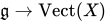
Example: the Lie algebra of vector fields. Let A be the ring Failed to parse (SVG (MathML can be enabled via browser plugin): Invalid response ("Math extension cannot connect to Restbase.") from server "https://wikimedia.org/api/rest_v1/":): {\displaystyle C^\infty(X)} of smooth functions on a smooth manifold X. Then a derivation of A over is equivalent to a vector field on X. (A vector field v gives a derivation of the space of smooth functions by differentiating functions in the direction of v.) This makes the space of vector fields into a Lie algebra (see Lie bracket of vector fields).[13] Informally speaking, is the Lie algebra of the diffeomorphism group of X. So the Lie bracket of vector fields describes the non-commutativity of the diffeomorphism group. An action of a Lie group G on a manifold X determines a homomorphism of Lie algebras . (An example is illustrated below.)


A Lie algebra can be viewed as a non-associative algebra, and so each Lie algebra over a field F determines its Lie algebra of derivations, . That is, a derivation of is a linear map such that


- .
![{\displaystyle D([x,y])=[D(x),y]+[x,D(y)]}](https://wikimedia.org/api/rest_v1/media/math/render/svg/7928320c889c67cf1cf513999888fc45c9fc38b6)
The inner derivation associated to any is the adjoint mapping defined by . (This is a derivation as a consequence of the Jacobi identity.) That gives a homomorphism of Lie algebras, . The image is an ideal in , and the Lie algebra of outer derivations is defined as the quotient Lie algebra, Failed to parse (SVG (MathML can be enabled via browser plugin): Invalid response ("Math extension cannot connect to Restbase.") from server "https://wikimedia.org/api/rest_v1/":): {\displaystyle \text{Out}_F(\mathfrak{g})=\text{Der}_F(\mathfrak{g})/\text{Inn}_F(\mathfrak{g})} . (This is exactly analogous to the outer automorphism group of a group.) For a semisimple Lie algebra (defined below) over a field of characteristic zero, every derivation is inner.[14] This is related to the theorem that the outer automorphism group of a semisimple Lie group is finite.[15]


![{\displaystyle \mathrm {ad} _{x}(y):=[x,y]}](https://wikimedia.org/api/rest_v1/media/math/render/svg/883a92018bbd927d508c0901ce8c4b5f2ac35dd8)


In contrast, an abelian Lie algebra has many outer derivations. Namely, for a vector space Failed to parse (SVG (MathML can be enabled via browser plugin): Invalid response ("Math extension cannot connect to Restbase.") from server "https://wikimedia.org/api/rest_v1/":): {\displaystyle V} with Lie bracket zero, the Lie algebra Failed to parse (SVG (MathML can be enabled via browser plugin): Invalid response ("Math extension cannot connect to Restbase.") from server "https://wikimedia.org/api/rest_v1/":): {\displaystyle \text{Out}_F(V)} can be identified with Failed to parse (SVG (MathML can be enabled via browser plugin): Invalid response ("Math extension cannot connect to Restbase.") from server "https://wikimedia.org/api/rest_v1/":): {\displaystyle \mathfrak{gl}(V)} .
Examples
[edit | edit source]Matrix Lie algebras
[edit | edit source]A matrix group is a Lie group consisting of invertible matrices, Failed to parse (SVG (MathML can be enabled via browser plugin): Invalid response ("Math extension cannot connect to Restbase.") from server "https://wikimedia.org/api/rest_v1/":): {\displaystyle G\subset \mathrm{GL}(n,\mathbb{R})} , where the group operation of G is matrix multiplication. The corresponding Lie algebra Failed to parse (SVG (MathML can be enabled via browser plugin): Invalid response ("Math extension cannot connect to Restbase.") from server "https://wikimedia.org/api/rest_v1/":): {\displaystyle \mathfrak g} is the space of matrices which are tangent vectors to G inside the linear space Failed to parse (SVG (MathML can be enabled via browser plugin): Invalid response ("Math extension cannot connect to Restbase.") from server "https://wikimedia.org/api/rest_v1/":): {\displaystyle M_n(\mathbb{R})} : this consists of derivatives of smooth curves in G at the identity matrix Failed to parse (SVG (MathML can be enabled via browser plugin): Invalid response ("Math extension cannot connect to Restbase.") from server "https://wikimedia.org/api/rest_v1/":): {\displaystyle I} :
- Failed to parse (SVG (MathML can be enabled via browser plugin): Invalid response ("Math extension cannot connect to Restbase.") from server "https://wikimedia.org/api/rest_v1/":): {\displaystyle \mathfrak{g} = \{ X = c'(0) \in M_n(\mathbb{R}) : \text{ smooth } c: \mathbb{R}\to G, \ c(0) = I \}.}
The Lie bracket of Failed to parse (SVG (MathML can be enabled via browser plugin): Invalid response ("Math extension cannot connect to Restbase.") from server "https://wikimedia.org/api/rest_v1/":): {\displaystyle \mathfrak{g}} is given by the commutator of matrices, Failed to parse (SVG (MathML can be enabled via browser plugin): Invalid response ("Math extension cannot connect to Restbase.") from server "https://wikimedia.org/api/rest_v1/":): {\displaystyle [X,Y]=XY-YX} . Given a Lie algebra Failed to parse (SVG (MathML can be enabled via browser plugin): Invalid response ("Math extension cannot connect to Restbase.") from server "https://wikimedia.org/api/rest_v1/":): {\displaystyle \mathfrak{g}\subset \mathfrak{gl}(n,\mathbb{R})} , one can recover the Lie group as the subgroup generated by the matrix exponential of elements of Failed to parse (SVG (MathML can be enabled via browser plugin): Invalid response ("Math extension cannot connect to Restbase.") from server "https://wikimedia.org/api/rest_v1/":): {\displaystyle \mathfrak{g}} .[16] (To be precise, this gives the identity component of G, if G is not connected.) Here the exponential mapping Failed to parse (SVG (MathML can be enabled via browser plugin): Invalid response ("Math extension cannot connect to Restbase.") from server "https://wikimedia.org/api/rest_v1/":): {\displaystyle \exp: M_n(\mathbb{R})\to M_n(\mathbb{R})} is defined by Failed to parse (SVG (MathML can be enabled via browser plugin): Invalid response ("Math extension cannot connect to Restbase.") from server "https://wikimedia.org/api/rest_v1/":): {\displaystyle \exp(X) = I + X + \tfrac{1}{2!}X^2 + \tfrac{1}{3!}X^3 + \cdots} , which converges for every matrix Failed to parse (SVG (MathML can be enabled via browser plugin): Invalid response ("Math extension cannot connect to Restbase.") from server "https://wikimedia.org/api/rest_v1/":): {\displaystyle X} .
The same comments apply to complex Lie subgroups of Failed to parse (SVG (MathML can be enabled via browser plugin): Invalid response ("Math extension cannot connect to Restbase.") from server "https://wikimedia.org/api/rest_v1/":): {\displaystyle GL(n,\mathbb{C})} and the complex matrix exponential, Failed to parse (SVG (MathML can be enabled via browser plugin): Invalid response ("Math extension cannot connect to Restbase.") from server "https://wikimedia.org/api/rest_v1/":): {\displaystyle \exp: M_n(\mathbb{C})\to M_n(\mathbb{C})} (defined by the same formula).
Here are some matrix Lie groups and their Lie algebras.[17]
- For a positive integer n, the special linear group Failed to parse (SVG (MathML can be enabled via browser plugin): Invalid response ("Math extension cannot connect to Restbase.") from server "https://wikimedia.org/api/rest_v1/":): {\displaystyle \mathrm{SL}(n,\mathbb{R})} consists of all real n × n matrices with determinant 1. This is the group of linear maps from Failed to parse (SVG (MathML can be enabled via browser plugin): Invalid response ("Math extension cannot connect to Restbase.") from server "https://wikimedia.org/api/rest_v1/":): {\displaystyle \mathbb{R}^n} to itself that preserve volume and orientation. More abstractly, Failed to parse (SVG (MathML can be enabled via browser plugin): Invalid response ("Math extension cannot connect to Restbase.") from server "https://wikimedia.org/api/rest_v1/":): {\displaystyle \mathrm{SL}(n,\mathbb{R})} is the commutator subgroup of the general linear group Failed to parse (SVG (MathML can be enabled via browser plugin): Invalid response ("Math extension cannot connect to Restbase.") from server "https://wikimedia.org/api/rest_v1/":): {\displaystyle \mathrm{GL}(n,\R)} . Its Lie algebra Failed to parse (SVG (MathML can be enabled via browser plugin): Invalid response ("Math extension cannot connect to Restbase.") from server "https://wikimedia.org/api/rest_v1/":): {\displaystyle \mathfrak{sl}(n,\mathbb{R})} consists of all real n × n matrices with trace 0. Similarly, one can define the analogous complex Lie group Failed to parse (SVG (MathML can be enabled via browser plugin): Invalid response ("Math extension cannot connect to Restbase.") from server "https://wikimedia.org/api/rest_v1/":): {\displaystyle {\rm SL}(n,\mathbb{C})} and its Lie algebra Failed to parse (SVG (MathML can be enabled via browser plugin): Invalid response ("Math extension cannot connect to Restbase.") from server "https://wikimedia.org/api/rest_v1/":): {\displaystyle \mathfrak{sl}(n,\mathbb{C})} .
- The orthogonal group Failed to parse (SVG (MathML can be enabled via browser plugin): Invalid response ("Math extension cannot connect to Restbase.") from server "https://wikimedia.org/api/rest_v1/":): {\displaystyle \mathrm{O}(n)} plays a basic role in geometry: it is the group of linear maps from Failed to parse (SVG (MathML can be enabled via browser plugin): Invalid response ("Math extension cannot connect to Restbase.") from server "https://wikimedia.org/api/rest_v1/":): {\displaystyle \mathbb{R}^n} to itself that preserve the length of vectors. For example, rotations and reflections belong to Failed to parse (SVG (MathML can be enabled via browser plugin): Invalid response ("Math extension cannot connect to Restbase.") from server "https://wikimedia.org/api/rest_v1/":): {\displaystyle \mathrm{O}(n)} . Equivalently, this is the group of n x n orthogonal matrices, meaning that Failed to parse (SVG (MathML can be enabled via browser plugin): Invalid response ("Math extension cannot connect to Restbase.") from server "https://wikimedia.org/api/rest_v1/":): {\displaystyle A^{\mathrm{T}}=A^{-1}} , where Failed to parse (SVG (MathML can be enabled via browser plugin): Invalid response ("Math extension cannot connect to Restbase.") from server "https://wikimedia.org/api/rest_v1/":): {\displaystyle A^{\mathrm{T}}} denotes the transpose of a matrix. The orthogonal group has two connected components; the identity component is called the special orthogonal group Failed to parse (SVG (MathML can be enabled via browser plugin): Invalid response ("Math extension cannot connect to Restbase.") from server "https://wikimedia.org/api/rest_v1/":): {\displaystyle \mathrm{SO}(n)} , consisting of the orthogonal matrices with determinant 1. Both groups have the same Lie algebra Failed to parse (SVG (MathML can be enabled via browser plugin): Invalid response ("Math extension cannot connect to Restbase.") from server "https://wikimedia.org/api/rest_v1/":): {\displaystyle \mathfrak{so}(n)} , the subspace of skew-symmetric matrices in Failed to parse (SVG (MathML can be enabled via browser plugin): Invalid response ("Math extension cannot connect to Restbase.") from server "https://wikimedia.org/api/rest_v1/":): {\displaystyle \mathfrak{gl}(n,\mathbb{R})} (Failed to parse (SVG (MathML can be enabled via browser plugin): Invalid response ("Math extension cannot connect to Restbase.") from server "https://wikimedia.org/api/rest_v1/":): {\displaystyle X^{\rm T}=-X} ). See also infinitesimal rotations with skew-symmetric matrices.
- The complex orthogonal group Failed to parse (SVG (MathML can be enabled via browser plugin): Invalid response ("Math extension cannot connect to Restbase.") from server "https://wikimedia.org/api/rest_v1/":): {\displaystyle \mathrm{O}(n,\mathbb{C})} , its identity component Failed to parse (SVG (MathML can be enabled via browser plugin): Invalid response ("Math extension cannot connect to Restbase.") from server "https://wikimedia.org/api/rest_v1/":): {\displaystyle \mathrm{SO}(n,\mathbb{C})} , and the Lie algebra Failed to parse (SVG (MathML can be enabled via browser plugin): Invalid response ("Math extension cannot connect to Restbase.") from server "https://wikimedia.org/api/rest_v1/":): {\displaystyle \mathfrak{so}(n,\mathbb{C})} are given by the same formulas applied to n x n complex matrices. Equivalently, Failed to parse (SVG (MathML can be enabled via browser plugin): Invalid response ("Math extension cannot connect to Restbase.") from server "https://wikimedia.org/api/rest_v1/":): {\displaystyle \mathrm{O}(n,\mathbb{C})} is the subgroup of Failed to parse (SVG (MathML can be enabled via browser plugin): Invalid response ("Math extension cannot connect to Restbase.") from server "https://wikimedia.org/api/rest_v1/":): {\displaystyle \mathrm{GL}(n,\mathbb{C})} that preserves the standard symmetric bilinear form on Failed to parse (SVG (MathML can be enabled via browser plugin): Invalid response ("Math extension cannot connect to Restbase.") from server "https://wikimedia.org/api/rest_v1/":): {\displaystyle \mathbb{C}^n} .
- The unitary group Failed to parse (SVG (MathML can be enabled via browser plugin): Invalid response ("Math extension cannot connect to Restbase.") from server "https://wikimedia.org/api/rest_v1/":): {\displaystyle \mathrm{U}(n)} is the subgroup of Failed to parse (SVG (MathML can be enabled via browser plugin): Invalid response ("Math extension cannot connect to Restbase.") from server "https://wikimedia.org/api/rest_v1/":): {\displaystyle \mathrm{GL}(n,\mathbb{C})} that preserves the length of vectors in Failed to parse (SVG (MathML can be enabled via browser plugin): Invalid response ("Math extension cannot connect to Restbase.") from server "https://wikimedia.org/api/rest_v1/":): {\displaystyle \mathbb{C}^n} (with respect to the standard Hermitian inner product). Equivalently, this is the group of n × n unitary matrices (satisfying Failed to parse (SVG (MathML can be enabled via browser plugin): Invalid response ("Math extension cannot connect to Restbase.") from server "https://wikimedia.org/api/rest_v1/":): {\displaystyle A^*=A^{-1}} , where Failed to parse (SVG (MathML can be enabled via browser plugin): Invalid response ("Math extension cannot connect to Restbase.") from server "https://wikimedia.org/api/rest_v1/":): {\displaystyle A^*} denotes the conjugate transpose of a matrix). Its Lie algebra Failed to parse (SVG (MathML can be enabled via browser plugin): Invalid response ("Math extension cannot connect to Restbase.") from server "https://wikimedia.org/api/rest_v1/":): {\displaystyle \mathfrak{u}(n)} consists of the skew-hermitian matrices in Failed to parse (SVG (MathML can be enabled via browser plugin): Invalid response ("Math extension cannot connect to Restbase.") from server "https://wikimedia.org/api/rest_v1/":): {\displaystyle \mathfrak{gl}(n,\mathbb{C})} (Failed to parse (SVG (MathML can be enabled via browser plugin): Invalid response ("Math extension cannot connect to Restbase.") from server "https://wikimedia.org/api/rest_v1/":): {\displaystyle X^*=-X} ). This is a Lie algebra over Failed to parse (SVG (MathML can be enabled via browser plugin): Invalid response ("Math extension cannot connect to Restbase.") from server "https://wikimedia.org/api/rest_v1/":): {\displaystyle \mathbb{R}} , not over Failed to parse (SVG (MathML can be enabled via browser plugin): Invalid response ("Math extension cannot connect to Restbase.") from server "https://wikimedia.org/api/rest_v1/":): {\displaystyle \mathbb{C}} . (Indeed, i times a skew-hermitian matrix is hermitian, rather than skew-hermitian.) Likewise, the unitary group Failed to parse (SVG (MathML can be enabled via browser plugin): Invalid response ("Math extension cannot connect to Restbase.") from server "https://wikimedia.org/api/rest_v1/":): {\displaystyle \mathrm{U}(n)} is a real Lie subgroup of the complex Lie group Failed to parse (SVG (MathML can be enabled via browser plugin): Invalid response ("Math extension cannot connect to Restbase.") from server "https://wikimedia.org/api/rest_v1/":): {\displaystyle \mathrm{GL}(n,\mathbb{C})} . For example, Failed to parse (SVG (MathML can be enabled via browser plugin): Invalid response ("Math extension cannot connect to Restbase.") from server "https://wikimedia.org/api/rest_v1/":): {\displaystyle \mathrm{U}(1)} is the circle group, and its Lie algebra (from this point of view) is Failed to parse (SVG (MathML can be enabled via browser plugin): Invalid response ("Math extension cannot connect to Restbase.") from server "https://wikimedia.org/api/rest_v1/":): {\displaystyle i\mathbb{R}\subset \mathbb{C}=\mathfrak{gl}(1,\mathbb{C})} .
- The special unitary group Failed to parse (SVG (MathML can be enabled via browser plugin): Invalid response ("Math extension cannot connect to Restbase.") from server "https://wikimedia.org/api/rest_v1/":): {\displaystyle \mathrm{SU}(n)} is the subgroup of matrices with determinant 1 in Failed to parse (SVG (MathML can be enabled via browser plugin): Invalid response ("Math extension cannot connect to Restbase.") from server "https://wikimedia.org/api/rest_v1/":): {\displaystyle \mathrm{U}(n)} . Its Lie algebra Failed to parse (SVG (MathML can be enabled via browser plugin): Invalid response ("Math extension cannot connect to Restbase.") from server "https://wikimedia.org/api/rest_v1/":): {\displaystyle \mathfrak{su}(n)} consists of the skew-hermitian matrices with trace zero.
- The symplectic group Failed to parse (SVG (MathML can be enabled via browser plugin): Invalid response ("Math extension cannot connect to Restbase.") from server "https://wikimedia.org/api/rest_v1/":): {\displaystyle \mathrm{Sp}(2n,\R)} is the subgroup of Failed to parse (SVG (MathML can be enabled via browser plugin): Invalid response ("Math extension cannot connect to Restbase.") from server "https://wikimedia.org/api/rest_v1/":): {\displaystyle \mathrm{GL}(2n,\mathbb{R})} that preserves the standard alternating bilinear form on Failed to parse (SVG (MathML can be enabled via browser plugin): Invalid response ("Math extension cannot connect to Restbase.") from server "https://wikimedia.org/api/rest_v1/":): {\displaystyle \mathbb{R}^{2n}} . Its Lie algebra is the symplectic Lie algebra Failed to parse (SVG (MathML can be enabled via browser plugin): Invalid response ("Math extension cannot connect to Restbase.") from server "https://wikimedia.org/api/rest_v1/":): {\displaystyle \mathfrak{sp}(2n,\mathbb{R})} .
- The classical Lie algebras are those listed above, along with variants over any field.
Two dimensions
[edit | edit source]Some Lie algebras of low dimension are described here. See the classification of low-dimensional real Lie algebras for further examples.
- There is a unique nonabelian Lie algebra Failed to parse (SVG (MathML can be enabled via browser plugin): Invalid response ("Math extension cannot connect to Restbase.") from server "https://wikimedia.org/api/rest_v1/":): {\displaystyle \mathfrak{g}} of dimension 2 over any field F, up to isomorphism.[18] Here Failed to parse (SVG (MathML can be enabled via browser plugin): Invalid response ("Math extension cannot connect to Restbase.") from server "https://wikimedia.org/api/rest_v1/":): {\displaystyle \mathfrak{g}} has a basis Failed to parse (SVG (MathML can be enabled via browser plugin): Invalid response ("Math extension cannot connect to Restbase.") from server "https://wikimedia.org/api/rest_v1/":): {\displaystyle X,Y} for which the bracket is given by Failed to parse (SVG (MathML can be enabled via browser plugin): Invalid response ("Math extension cannot connect to Restbase.") from server "https://wikimedia.org/api/rest_v1/":): {\displaystyle \left [X, Y\right ] = Y} . (This determines the Lie bracket completely, because the axioms imply that Failed to parse (SVG (MathML can be enabled via browser plugin): Invalid response ("Math extension cannot connect to Restbase.") from server "https://wikimedia.org/api/rest_v1/":): {\displaystyle [X,X]=0} and Failed to parse (SVG (MathML can be enabled via browser plugin): Invalid response ("Math extension cannot connect to Restbase.") from server "https://wikimedia.org/api/rest_v1/":): {\displaystyle [Y,Y]=0} .) Over the real numbers, Failed to parse (SVG (MathML can be enabled via browser plugin): Invalid response ("Math extension cannot connect to Restbase.") from server "https://wikimedia.org/api/rest_v1/":): {\displaystyle \mathfrak{g}} can be viewed as the Lie algebra of the Lie group Failed to parse (SVG (MathML can be enabled via browser plugin): Invalid response ("Math extension cannot connect to Restbase.") from server "https://wikimedia.org/api/rest_v1/":): {\displaystyle G=\mathrm{Aff}(1,\mathbb{R})} of affine transformations of the real line, Failed to parse (SVG (MathML can be enabled via browser plugin): Invalid response ("Math extension cannot connect to Restbase.") from server "https://wikimedia.org/api/rest_v1/":): {\displaystyle x\mapsto ax+b} .
- The affine group G can be identified with the group of matrices
- Failed to parse (SVG (MathML can be enabled via browser plugin): Invalid response ("Math extension cannot connect to Restbase.") from server "https://wikimedia.org/api/rest_v1/":): {\displaystyle \left( \begin{array}{cc} a & b\\ 0 & 1 \end{array} \right) }
- under matrix multiplication, with Failed to parse (SVG (MathML can be enabled via browser plugin): Invalid response ("Math extension cannot connect to Restbase.") from server "https://wikimedia.org/api/rest_v1/":): {\displaystyle a,b \in \mathbb{R} }
, Failed to parse (SVG (MathML can be enabled via browser plugin): Invalid response ("Math extension cannot connect to Restbase.") from server "https://wikimedia.org/api/rest_v1/":): {\displaystyle a \neq 0}
. Its Lie algebra is the Lie subalgebra Failed to parse (SVG (MathML can be enabled via browser plugin): Invalid response ("Math extension cannot connect to Restbase.") from server "https://wikimedia.org/api/rest_v1/":): {\displaystyle \mathfrak{g}}
of Failed to parse (SVG (MathML can be enabled via browser plugin): Invalid response ("Math extension cannot connect to Restbase.") from server "https://wikimedia.org/api/rest_v1/":): {\displaystyle \mathfrak{gl}(2,\mathbb{R})}
consisting of all matrices
- Failed to parse (SVG (MathML can be enabled via browser plugin): Invalid response ("Math extension cannot connect to Restbase.") from server "https://wikimedia.org/api/rest_v1/":): {\displaystyle \left( \begin{array}{cc} c & d\\ 0 & 0 \end{array}\right). }
- In these terms, the basis above for Failed to parse (SVG (MathML can be enabled via browser plugin): Invalid response ("Math extension cannot connect to Restbase.") from server "https://wikimedia.org/api/rest_v1/":): {\displaystyle \mathfrak{g}}
is given by the matrices
- Failed to parse (SVG (MathML can be enabled via browser plugin): Invalid response ("Math extension cannot connect to Restbase.") from server "https://wikimedia.org/api/rest_v1/":): {\displaystyle X= \left( \begin{array}{cc} 1 & 0\\ 0 & 0 \end{array}\right), \qquad Y= \left( \begin{array}{cc} 0 & 1\\ 0 & 0 \end{array}\right). }
- For any field Failed to parse (SVG (MathML can be enabled via browser plugin): Invalid response ("Math extension cannot connect to Restbase.") from server "https://wikimedia.org/api/rest_v1/":): {\displaystyle F} , the 1-dimensional subspace Failed to parse (SVG (MathML can be enabled via browser plugin): Invalid response ("Math extension cannot connect to Restbase.") from server "https://wikimedia.org/api/rest_v1/":): {\displaystyle F\cdot Y} is an ideal in the 2-dimensional Lie algebra Failed to parse (SVG (MathML can be enabled via browser plugin): Invalid response ("Math extension cannot connect to Restbase.") from server "https://wikimedia.org/api/rest_v1/":): {\displaystyle \mathfrak{g}} , by the formula Failed to parse (SVG (MathML can be enabled via browser plugin): Invalid response ("Math extension cannot connect to Restbase.") from server "https://wikimedia.org/api/rest_v1/":): {\displaystyle [X,Y]=Y\in F\cdot Y} . Both of the Lie algebras Failed to parse (SVG (MathML can be enabled via browser plugin): Invalid response ("Math extension cannot connect to Restbase.") from server "https://wikimedia.org/api/rest_v1/":): {\displaystyle F\cdot Y} and Failed to parse (SVG (MathML can be enabled via browser plugin): Invalid response ("Math extension cannot connect to Restbase.") from server "https://wikimedia.org/api/rest_v1/":): {\displaystyle \mathfrak{g}/(F\cdot Y)} are abelian (because 1-dimensional). In this sense, can be broken into abelian "pieces", meaning that it is solvable (though not nilpotent), in the terminology below.
Three dimensions
[edit | edit source]- The Heisenberg algebra over a field F is the three-dimensional Lie algebra with a basis such that[19]


- .
- It can be viewed as the Lie algebra of 3×3 strictly upper-triangular matrices, with the commutator Lie bracket and the basis
![{\displaystyle [X,Y]=Z,\quad [X,Z]=0,\quad [Y,Z]=0}](https://wikimedia.org/api/rest_v1/media/math/render/svg/3b52052aefb28559d76f31f6c797c368d3e96929)

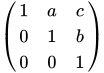
- Over the real numbers, is the Lie algebra of the Heisenberg group , that is, the group of matrices
- under matrix multiplication.


- For any field F, the center of is the 1-dimensional ideal Failed to parse (SVG (MathML can be enabled via browser plugin): Invalid response ("Math extension cannot connect to Restbase.") from server "https://wikimedia.org/api/rest_v1/":): {\displaystyle F\cdot Z} , and the quotient Failed to parse (SVG (MathML can be enabled via browser plugin): Invalid response ("Math extension cannot connect to Restbase.") from server "https://wikimedia.org/api/rest_v1/":): {\displaystyle \mathfrak{h}_3(F)/(F\cdot Z)} is abelian, isomorphic to Failed to parse (SVG (MathML can be enabled via browser plugin): Invalid response ("Math extension cannot connect to Restbase.") from server "https://wikimedia.org/api/rest_v1/":): {\displaystyle F^2} . In the terminology below, it follows that Failed to parse (SVG (MathML can be enabled via browser plugin): Invalid response ("Math extension cannot connect to Restbase.") from server "https://wikimedia.org/api/rest_v1/":): {\displaystyle \mathfrak{h}_3(F)} is nilpotent (though not abelian).
- The Lie algebra Failed to parse (SVG (MathML can be enabled via browser plugin): Invalid response ("Math extension cannot connect to Restbase.") from server "https://wikimedia.org/api/rest_v1/":): {\displaystyle \mathfrak{so}(3)} of the rotation group SO(3) is the space of skew-symmetric 3 x 3 matrices over Failed to parse (SVG (MathML can be enabled via browser plugin): Invalid response ("Math extension cannot connect to Restbase.") from server "https://wikimedia.org/api/rest_v1/":): {\displaystyle \mathbb{R}} . A basis is given by the three matrices[20]
- Failed to parse (SVG (MathML can be enabled via browser plugin): Invalid response ("Math extension cannot connect to Restbase.") from server "https://wikimedia.org/api/rest_v1/":): {\displaystyle F_1 = \left( \begin{array}{ccc} 0&0&0\\ 0&0&-1\\ 0&1&0 \end{array}\right),\quad F_2 = \left( \begin{array}{ccc} 0&0&1\\ 0&0&0\\ -1&0&0 \end{array}\right),\quad F_3 = \left( \begin{array}{ccc} 0&-1&0\\ 1&0&0\\ 0&0&0 \end{array}\right)~.\quad }
- The commutation relations among these generators are
- Failed to parse (SVG (MathML can be enabled via browser plugin): Invalid response ("Math extension cannot connect to Restbase.") from server "https://wikimedia.org/api/rest_v1/":): {\displaystyle [F_1, F_2] = F_3,}
- Failed to parse (SVG (MathML can be enabled via browser plugin): Invalid response ("Math extension cannot connect to Restbase.") from server "https://wikimedia.org/api/rest_v1/":): {\displaystyle [F_2, F_3] = F_1,}
- Failed to parse (SVG (MathML can be enabled via browser plugin): Invalid response ("Math extension cannot connect to Restbase.") from server "https://wikimedia.org/api/rest_v1/":): {\displaystyle [F_3, F_1] = F_2.}
- The cross product of vectors in Failed to parse (SVG (MathML can be enabled via browser plugin): Invalid response ("Math extension cannot connect to Restbase.") from server "https://wikimedia.org/api/rest_v1/":): {\displaystyle \mathbb{R}^3} is given by the same formula in terms of the standard basis; so that Lie algebra is isomorphic to Failed to parse (SVG (MathML can be enabled via browser plugin): Invalid response ("Math extension cannot connect to Restbase.") from server "https://wikimedia.org/api/rest_v1/":): {\displaystyle \mathfrak{so}(3)} . Also, Failed to parse (SVG (MathML can be enabled via browser plugin): Invalid response ("Math extension cannot connect to Restbase.") from server "https://wikimedia.org/api/rest_v1/":): {\displaystyle \mathfrak{so}(3)} is equivalent to the Spin (physics) angular-momentum component operators for spin-1 particles in quantum mechanics.[21]
- The Lie algebra Failed to parse (SVG (MathML can be enabled via browser plugin): Invalid response ("Math extension cannot connect to Restbase.") from server "https://wikimedia.org/api/rest_v1/":): {\displaystyle \mathfrak{so}(3)} cannot be broken into pieces in the way that the previous examples can: it is simple, meaning that it is not abelian and its only ideals are 0 and all of Failed to parse (SVG (MathML can be enabled via browser plugin): Invalid response ("Math extension cannot connect to Restbase.") from server "https://wikimedia.org/api/rest_v1/":): {\displaystyle \mathfrak{so}(3)} .
- Another simple Lie algebra of dimension 3, in this case over Failed to parse (SVG (MathML can be enabled via browser plugin): Invalid response ("Math extension cannot connect to Restbase.") from server "https://wikimedia.org/api/rest_v1/":): {\displaystyle \mathbb{C}} , is the space Failed to parse (SVG (MathML can be enabled via browser plugin): Invalid response ("Math extension cannot connect to Restbase.") from server "https://wikimedia.org/api/rest_v1/":): {\displaystyle \mathfrak{sl}(2,\mathbb{C})} of 2 x 2 matrices of trace zero. A basis is given by the three matrices
- Failed to parse (SVG (MathML can be enabled via browser plugin): Invalid response ("Math extension cannot connect to Restbase.") from server "https://wikimedia.org/api/rest_v1/":): {\displaystyle H= \left( \begin{array}{cc} 1 & 0\\ 0 & -1 \end{array} \right),\ E =\left ( \begin{array}{cc} 0 & 1\\ 0 & 0 \end{array} \right),\ F =\left( \begin{array}{cc} 0 & 0\\ 1 & 0 \end{array} \right).}
- The Lie bracket is given by:
- Failed to parse (SVG (MathML can be enabled via browser plugin): Invalid response ("Math extension cannot connect to Restbase.") from server "https://wikimedia.org/api/rest_v1/":): {\displaystyle [H, E] = 2E,}
- Failed to parse (SVG (MathML can be enabled via browser plugin): Invalid response ("Math extension cannot connect to Restbase.") from server "https://wikimedia.org/api/rest_v1/":): {\displaystyle [H, F] = -2F,}
- Failed to parse (SVG (MathML can be enabled via browser plugin): Invalid response ("Math extension cannot connect to Restbase.") from server "https://wikimedia.org/api/rest_v1/":): {\displaystyle [E, F] = H.}
- Using these formulas, one can show that the Lie algebra Failed to parse (SVG (MathML can be enabled via browser plugin): Invalid response ("Math extension cannot connect to Restbase.") from server "https://wikimedia.org/api/rest_v1/":): {\displaystyle \mathfrak{sl}(2,\mathbb{C})} is simple, and classify its finite-dimensional representations (defined below).[22] In the terminology of quantum mechanics, one can think of E and F as raising and lowering operators. Indeed, for any representation of Failed to parse (SVG (MathML can be enabled via browser plugin): Invalid response ("Math extension cannot connect to Restbase.") from server "https://wikimedia.org/api/rest_v1/":): {\displaystyle \mathfrak{sl}(2,\mathbb{C})} , the relations above imply that E maps the c-eigenspace of H (for a complex number c) into the Failed to parse (SVG (MathML can be enabled via browser plugin): Invalid response ("Math extension cannot connect to Restbase.") from server "https://wikimedia.org/api/rest_v1/":): {\displaystyle (c+2)} -eigenspace, while F maps the c-eigenspace into the Failed to parse (SVG (MathML can be enabled via browser plugin): Invalid response ("Math extension cannot connect to Restbase.") from server "https://wikimedia.org/api/rest_v1/":): {\displaystyle (c-2)} -eigenspace.
- The Lie algebra Failed to parse (SVG (MathML can be enabled via browser plugin): Invalid response ("Math extension cannot connect to Restbase.") from server "https://wikimedia.org/api/rest_v1/":): {\displaystyle \mathfrak{sl}(2,\mathbb{C})} is isomorphic to the complexification of Failed to parse (SVG (MathML can be enabled via browser plugin): Invalid response ("Math extension cannot connect to Restbase.") from server "https://wikimedia.org/api/rest_v1/":): {\displaystyle \mathfrak{so}(3)} , meaning the tensor product Failed to parse (SVG (MathML can be enabled via browser plugin): Invalid response ("Math extension cannot connect to Restbase.") from server "https://wikimedia.org/api/rest_v1/":): {\displaystyle \mathfrak{so}(3)\otimes_{\mathbb{R}}\mathbb{C}} . The formulas for the Lie bracket are easier to analyze in the case of Failed to parse (SVG (MathML can be enabled via browser plugin): Invalid response ("Math extension cannot connect to Restbase.") from server "https://wikimedia.org/api/rest_v1/":): {\displaystyle \mathfrak{sl}(2,\mathbb{C})} . As a result, it is common to analyze complex representations of the group Failed to parse (SVG (MathML can be enabled via browser plugin): Invalid response ("Math extension cannot connect to Restbase.") from server "https://wikimedia.org/api/rest_v1/":): {\displaystyle \mathrm{SO}(3)} by relating them to representations of the Lie algebra Failed to parse (SVG (MathML can be enabled via browser plugin): Invalid response ("Math extension cannot connect to Restbase.") from server "https://wikimedia.org/api/rest_v1/":): {\displaystyle \mathfrak{sl}(2,\mathbb{C})} .
Infinite dimensions
[edit | edit source]- The Lie algebra of vector fields on a smooth manifold of positive dimension is an infinite-dimensional Lie algebra over Failed to parse (SVG (MathML can be enabled via browser plugin): Invalid response ("Math extension cannot connect to Restbase.") from server "https://wikimedia.org/api/rest_v1/":): {\displaystyle \mathbb{R}} .
- The Kac–Moody algebras are a large class of infinite-dimensional Lie algebras, say over Failed to parse (SVG (MathML can be enabled via browser plugin): Invalid response ("Math extension cannot connect to Restbase.") from server "https://wikimedia.org/api/rest_v1/":): {\displaystyle \mathbb{C}} , with structure much like that of the finite-dimensional simple Lie algebras (such as Failed to parse (SVG (MathML can be enabled via browser plugin): Invalid response ("Math extension cannot connect to Restbase.") from server "https://wikimedia.org/api/rest_v1/":): {\displaystyle \mathfrak{sl}(n,\C)} ).
- The Moyal algebra is an infinite-dimensional Lie algebra that contains all the classical Lie algebras as subalgebras.
- The Virasoro algebra is important in string theory.
- The functor that takes a Lie algebra over a field F to the underlying vector space has a left adjoint Failed to parse (SVG (MathML can be enabled via browser plugin): Invalid response ("Math extension cannot connect to Restbase.") from server "https://wikimedia.org/api/rest_v1/":): {\displaystyle V\mapsto L(V)} , called the free Lie algebra on a vector space V. It is spanned by all iterated Lie brackets of elements of V, modulo only the relations coming from the definition of a Lie algebra. The free Lie algebra Failed to parse (SVG (MathML can be enabled via browser plugin): Invalid response ("Math extension cannot connect to Restbase.") from server "https://wikimedia.org/api/rest_v1/":): {\displaystyle L(V)} is infinite-dimensional for V of dimension at least 2.[23]
Representations
[edit | edit source]Definitions
[edit | edit source]Given a vector space V, let Failed to parse (SVG (MathML can be enabled via browser plugin): Invalid response ("Math extension cannot connect to Restbase.") from server "https://wikimedia.org/api/rest_v1/":): {\displaystyle \mathfrak{gl}(V)} denote the Lie algebra consisting of all linear maps from V to itself, with bracket given by Failed to parse (SVG (MathML can be enabled via browser plugin): Invalid response ("Math extension cannot connect to Restbase.") from server "https://wikimedia.org/api/rest_v1/":): {\displaystyle [X,Y]=XY-YX} . A representation of a Lie algebra Failed to parse (SVG (MathML can be enabled via browser plugin): Invalid response ("Math extension cannot connect to Restbase.") from server "https://wikimedia.org/api/rest_v1/":): {\displaystyle \mathfrak{g}} on V is a Lie algebra homomorphism
- Failed to parse (SVG (MathML can be enabled via browser plugin): Invalid response ("Math extension cannot connect to Restbase.") from server "https://wikimedia.org/api/rest_v1/":): {\displaystyle \pi\colon \mathfrak g \to \mathfrak{gl}(V).}
That is, Failed to parse (SVG (MathML can be enabled via browser plugin): Invalid response ("Math extension cannot connect to Restbase.") from server "https://wikimedia.org/api/rest_v1/":): {\displaystyle \pi} sends each element of Failed to parse (SVG (MathML can be enabled via browser plugin): Invalid response ("Math extension cannot connect to Restbase.") from server "https://wikimedia.org/api/rest_v1/":): {\displaystyle \mathfrak{g}} to a linear map from V to itself, in such a way that the Lie bracket on Failed to parse (SVG (MathML can be enabled via browser plugin): Invalid response ("Math extension cannot connect to Restbase.") from server "https://wikimedia.org/api/rest_v1/":): {\displaystyle \mathfrak{g}} corresponds to the commutator of linear maps.[24]
A representation is said to be faithful if its kernel is zero. Ado's theorem states that every finite-dimensional Lie algebra over a field of characteristic zero has a faithful representation on a finite-dimensional vector space. Kenkichi Iwasawa extended this result to finite-dimensional Lie algebras over a field of any characteristic.[25] Equivalently, every finite-dimensional Lie algebra over a field F is isomorphic to a Lie subalgebra of Failed to parse (SVG (MathML can be enabled via browser plugin): Invalid response ("Math extension cannot connect to Restbase.") from server "https://wikimedia.org/api/rest_v1/":): {\displaystyle \mathfrak{gl}(n,F)} for some positive integer n.
Adjoint representation
[edit | edit source]For any Lie algebra Failed to parse (SVG (MathML can be enabled via browser plugin): Invalid response ("Math extension cannot connect to Restbase.") from server "https://wikimedia.org/api/rest_v1/":): {\displaystyle \mathfrak{g}} , the adjoint representation is the representation[26]
- Failed to parse (SVG (MathML can be enabled via browser plugin): Invalid response ("Math extension cannot connect to Restbase.") from server "https://wikimedia.org/api/rest_v1/":): {\displaystyle \operatorname{ad}\colon\mathfrak{g} \to \mathfrak{gl}(\mathfrak{g})}
given by Failed to parse (SVG (MathML can be enabled via browser plugin): Invalid response ("Math extension cannot connect to Restbase.") from server "https://wikimedia.org/api/rest_v1/":): {\displaystyle \operatorname{ad}(x)(y) = [x, y]} . (This is a representation of Failed to parse (SVG (MathML can be enabled via browser plugin): Invalid response ("Math extension cannot connect to Restbase.") from server "https://wikimedia.org/api/rest_v1/":): {\displaystyle \mathfrak{g}} by the Jacobi identity.)
Goals of representation theory
[edit | edit source]One important aspect of the study of Lie algebras (especially semisimple Lie algebras, as defined below) is the study of their representations. Although Ado's theorem is an important result, the primary goal of representation theory is not to find a faithful representation of a given Lie algebra Failed to parse (SVG (MathML can be enabled via browser plugin): Invalid response ("Math extension cannot connect to Restbase.") from server "https://wikimedia.org/api/rest_v1/":): {\displaystyle \mathfrak{g}} . Indeed, in the semisimple case, the adjoint representation is already faithful. Rather, the goal is to understand all possible representations of Failed to parse (SVG (MathML can be enabled via browser plugin): Invalid response ("Math extension cannot connect to Restbase.") from server "https://wikimedia.org/api/rest_v1/":): {\displaystyle \mathfrak{g}} . For a semisimple Lie algebra over a field of characteristic zero, Weyl's theorem[27] says that every finite-dimensional representation is a direct sum of irreducible representations (those with no nontrivial invariant subspaces). The finite-dimensional irreducible representations are well understood from several points of view; see the representation theory of semisimple Lie algebras and the Weyl character formula.
Universal enveloping algebra
[edit | edit source]The functor that takes an associative algebra A over a field F to A as a Lie algebra (by Failed to parse (SVG (MathML can be enabled via browser plugin): Invalid response ("Math extension cannot connect to Restbase.") from server "https://wikimedia.org/api/rest_v1/":): {\displaystyle [X,Y]:=XY-YX} ) has a left adjoint Failed to parse (SVG (MathML can be enabled via browser plugin): Invalid response ("Math extension cannot connect to Restbase.") from server "https://wikimedia.org/api/rest_v1/":): {\displaystyle \mathfrak{g}\mapsto U(\mathfrak{g})} , called the universal enveloping algebra. To construct this: given a Lie algebra Failed to parse (SVG (MathML can be enabled via browser plugin): Invalid response ("Math extension cannot connect to Restbase.") from server "https://wikimedia.org/api/rest_v1/":): {\displaystyle \mathfrak{g}} over F, let
- Failed to parse (SVG (MathML can be enabled via browser plugin): Invalid response ("Math extension cannot connect to Restbase.") from server "https://wikimedia.org/api/rest_v1/":): {\displaystyle T(\mathfrak{g})=F\oplus \mathfrak{g} \oplus (\mathfrak{g}\otimes\mathfrak{g}) \oplus (\mathfrak{g}\otimes\mathfrak{g}\otimes\mathfrak{g})\oplus \cdots}
be the tensor algebra on Failed to parse (SVG (MathML can be enabled via browser plugin): Invalid response ("Math extension cannot connect to Restbase.") from server "https://wikimedia.org/api/rest_v1/":): {\displaystyle \mathfrak{g}} , also called the free associative algebra on the vector space Failed to parse (SVG (MathML can be enabled via browser plugin): Invalid response ("Math extension cannot connect to Restbase.") from server "https://wikimedia.org/api/rest_v1/":): {\displaystyle \mathfrak{g}} . Here Failed to parse (SVG (MathML can be enabled via browser plugin): Invalid response ("Math extension cannot connect to Restbase.") from server "https://wikimedia.org/api/rest_v1/":): {\displaystyle \otimes} denotes the tensor product of F-vector spaces. Let I be the two-sided ideal in Failed to parse (SVG (MathML can be enabled via browser plugin): Invalid response ("Math extension cannot connect to Restbase.") from server "https://wikimedia.org/api/rest_v1/":): {\displaystyle T(\mathfrak{g})} generated by the elements Failed to parse (SVG (MathML can be enabled via browser plugin): Invalid response ("Math extension cannot connect to Restbase.") from server "https://wikimedia.org/api/rest_v1/":): {\displaystyle XY-YX-[X,Y]} for Failed to parse (SVG (MathML can be enabled via browser plugin): Invalid response ("Math extension cannot connect to Restbase.") from server "https://wikimedia.org/api/rest_v1/":): {\displaystyle X,Y\in\mathfrak{g}} ; then the universal enveloping algebra is the quotient ring Failed to parse (SVG (MathML can be enabled via browser plugin): Invalid response ("Math extension cannot connect to Restbase.") from server "https://wikimedia.org/api/rest_v1/":): {\displaystyle U(\mathfrak{g}) = T(\mathfrak{g}) / I} . It satisfies the Poincaré–Birkhoff–Witt theorem: if Failed to parse (SVG (MathML can be enabled via browser plugin): Invalid response ("Math extension cannot connect to Restbase.") from server "https://wikimedia.org/api/rest_v1/":): {\displaystyle e_1,\ldots,e_n} is a basis for Failed to parse (SVG (MathML can be enabled via browser plugin): Invalid response ("Math extension cannot connect to Restbase.") from server "https://wikimedia.org/api/rest_v1/":): {\displaystyle \mathfrak{g}} as an F-vector space, then a basis for Failed to parse (SVG (MathML can be enabled via browser plugin): Invalid response ("Math extension cannot connect to Restbase.") from server "https://wikimedia.org/api/rest_v1/":): {\displaystyle U(\mathfrak{g})} is given by all ordered products Failed to parse (SVG (MathML can be enabled via browser plugin): Invalid response ("Math extension cannot connect to Restbase.") from server "https://wikimedia.org/api/rest_v1/":): {\displaystyle e_1^{i_1}\cdots e_n^{i_n}} with Failed to parse (SVG (MathML can be enabled via browser plugin): Invalid response ("Math extension cannot connect to Restbase.") from server "https://wikimedia.org/api/rest_v1/":): {\displaystyle i_1,\ldots,i_n} natural numbers. In particular, the map Failed to parse (SVG (MathML can be enabled via browser plugin): Invalid response ("Math extension cannot connect to Restbase.") from server "https://wikimedia.org/api/rest_v1/":): {\displaystyle \mathfrak{g}\to U(\mathfrak{g})} is injective.[28]
Representations of Failed to parse (SVG (MathML can be enabled via browser plugin): Invalid response ("Math extension cannot connect to Restbase.") from server "https://wikimedia.org/api/rest_v1/":): {\displaystyle \mathfrak{g}} are equivalent to modules over the universal enveloping algebra. The fact that Failed to parse (SVG (MathML can be enabled via browser plugin): Invalid response ("Math extension cannot connect to Restbase.") from server "https://wikimedia.org/api/rest_v1/":): {\displaystyle \mathfrak{g}\to U(\mathfrak{g})} is injective implies that every Lie algebra (possibly of infinite dimension) has a faithful representation (of infinite dimension), namely its representation on Failed to parse (SVG (MathML can be enabled via browser plugin): Invalid response ("Math extension cannot connect to Restbase.") from server "https://wikimedia.org/api/rest_v1/":): {\displaystyle U(\mathfrak{g})} . This also shows that every Lie algebra is contained in the Lie algebra associated to some associative algebra.
Representation theory in physics
[edit | edit source]The representation theory of Lie algebras plays an important role in various parts of theoretical physics. There, one considers operators on the space of states that satisfy certain natural commutation relations. These commutation relations typically come from a symmetry of the problem—specifically, they are the relations of the Lie algebra of the relevant symmetry group. An example is the angular momentum operators, whose commutation relations are those of the Lie algebra Failed to parse (SVG (MathML can be enabled via browser plugin): Invalid response ("Math extension cannot connect to Restbase.") from server "https://wikimedia.org/api/rest_v1/":): {\displaystyle \mathfrak{so}(3)} of the rotation group Failed to parse (SVG (MathML can be enabled via browser plugin): Invalid response ("Math extension cannot connect to Restbase.") from server "https://wikimedia.org/api/rest_v1/":): {\displaystyle \mathrm{SO}(3)} . Typically, the space of states is far from being irreducible under the pertinent operators, but one can attempt to decompose it into irreducible pieces. In doing so, one needs to know the irreducible representations of the given Lie algebra. In the study of the hydrogen atom, for example, quantum mechanics textbooks classify (more or less explicitly) the finite-dimensional irreducible representations of the Lie algebra Failed to parse (SVG (MathML can be enabled via browser plugin): Invalid response ("Math extension cannot connect to Restbase.") from server "https://wikimedia.org/api/rest_v1/":): {\displaystyle \mathfrak{so}(3)} .[21]
Structure theory and classification
[edit | edit source]Lie algebras can be classified to some extent. This is a powerful approach to the classification of Lie groups.
Abelian, nilpotent, and solvable
[edit | edit source]Analogously to abelian, nilpotent, and solvable groups, one can define abelian, nilpotent, and solvable Lie algebras.
A Lie algebra Failed to parse (SVG (MathML can be enabled via browser plugin): Invalid response ("Math extension cannot connect to Restbase.") from server "https://wikimedia.org/api/rest_v1/":): {\displaystyle \mathfrak{g}} is abelian if the Lie bracket vanishes; that is, [x,y] = 0 for all x and y in Failed to parse (SVG (MathML can be enabled via browser plugin): Invalid response ("Math extension cannot connect to Restbase.") from server "https://wikimedia.org/api/rest_v1/":): {\displaystyle \mathfrak{g}} . In particular, the Lie algebra of an abelian Lie group (such as the group Failed to parse (SVG (MathML can be enabled via browser plugin): Invalid response ("Math extension cannot connect to Restbase.") from server "https://wikimedia.org/api/rest_v1/":): {\displaystyle \mathbb{R}^n} under addition or the torus group Failed to parse (SVG (MathML can be enabled via browser plugin): Invalid response ("Math extension cannot connect to Restbase.") from server "https://wikimedia.org/api/rest_v1/":): {\displaystyle \mathbb{T}^n} ) is abelian. Every finite-dimensional abelian Lie algebra over a field Failed to parse (SVG (MathML can be enabled via browser plugin): Invalid response ("Math extension cannot connect to Restbase.") from server "https://wikimedia.org/api/rest_v1/":): {\displaystyle F} is isomorphic to Failed to parse (SVG (MathML can be enabled via browser plugin): Invalid response ("Math extension cannot connect to Restbase.") from server "https://wikimedia.org/api/rest_v1/":): {\displaystyle F^n} for some Failed to parse (SVG (MathML can be enabled via browser plugin): Invalid response ("Math extension cannot connect to Restbase.") from server "https://wikimedia.org/api/rest_v1/":): {\displaystyle n\geq 0} , meaning an n-dimensional vector space with Lie bracket zero.
A more general class of Lie algebras is defined by the vanishing of all commutators of given length. First, the commutator subalgebra (or derived subalgebra) of a Lie algebra Failed to parse (SVG (MathML can be enabled via browser plugin): Invalid response ("Math extension cannot connect to Restbase.") from server "https://wikimedia.org/api/rest_v1/":): {\displaystyle \mathfrak{g}} is Failed to parse (SVG (MathML can be enabled via browser plugin): Invalid response ("Math extension cannot connect to Restbase.") from server "https://wikimedia.org/api/rest_v1/":): {\displaystyle [\mathfrak{g},\mathfrak{g}]} , meaning the linear subspace spanned by all brackets Failed to parse (SVG (MathML can be enabled via browser plugin): Invalid response ("Math extension cannot connect to Restbase.") from server "https://wikimedia.org/api/rest_v1/":): {\displaystyle [x,y]} with Failed to parse (SVG (MathML can be enabled via browser plugin): Invalid response ("Math extension cannot connect to Restbase.") from server "https://wikimedia.org/api/rest_v1/":): {\displaystyle x,y\in\mathfrak{g}} . The commutator subalgebra is an ideal in Failed to parse (SVG (MathML can be enabled via browser plugin): Invalid response ("Math extension cannot connect to Restbase.") from server "https://wikimedia.org/api/rest_v1/":): {\displaystyle \mathfrak{g}} , in fact the smallest ideal such that the quotient Lie algebra is abelian. It is analogous to the commutator subgroup of a group.
A Lie algebra is nilpotent if the lower central series
![{\displaystyle {\mathfrak {g}}\supseteq [{\mathfrak {g}},{\mathfrak {g}}]\supseteq [[{\mathfrak {g}},{\mathfrak {g}}],{\mathfrak {g}}]\supseteq [[[{\mathfrak {g}},{\mathfrak {g}}],{\mathfrak {g}}],{\mathfrak {g}}]\supseteq \cdots }](https://wikimedia.org/api/rest_v1/media/math/render/svg/91dd572bb8c426d9126a9f99523ee5495b1ec1e5)
becomes zero after finitely many steps. Equivalently, is nilpotent if there is a finite sequence of ideals in ,

such that is central in for each j. By Engel's theorem, a Lie algebra over any field is nilpotent if and only if for every u in the adjoint endomorphism


![{\displaystyle \operatorname {ad} (u):{\mathfrak {g}}\to {\mathfrak {g}},\quad \operatorname {ad} (u)v=[u,v]}](https://wikimedia.org/api/rest_v1/media/math/render/svg/9e1b5c04d185bd495cc049795d628ba972f21ba9)


More generally, a Lie algebra Failed to parse (SVG (MathML can be enabled via browser plugin): Invalid response ("Math extension cannot connect to Restbase.") from server "https://wikimedia.org/api/rest_v1/":): {\displaystyle \mathfrak{g}} is said to be solvable if the derived series:
- Failed to parse (SVG (MathML can be enabled via browser plugin): Invalid response ("Math extension cannot connect to Restbase.") from server "https://wikimedia.org/api/rest_v1/":): {\displaystyle \mathfrak{g} \supseteq [\mathfrak{g},\mathfrak{g}] \supseteq [[\mathfrak{g},\mathfrak{g}],[\mathfrak{g},\mathfrak{g}]] \supseteq [[[\mathfrak{g},\mathfrak{g}],[\mathfrak{g},\mathfrak{g}]],[[\mathfrak{g},\mathfrak{g}],[\mathfrak{g},\mathfrak{g}]]] \supseteq \cdots}
becomes zero after finitely many steps. Equivalently, Failed to parse (SVG (MathML can be enabled via browser plugin): Invalid response ("Math extension cannot connect to Restbase.") from server "https://wikimedia.org/api/rest_v1/":): {\displaystyle \mathfrak{g}} is solvable if there is a finite sequence of Lie subalgebras,
- Failed to parse (SVG (MathML can be enabled via browser plugin): Invalid response ("Math extension cannot connect to Restbase.") from server "https://wikimedia.org/api/rest_v1/":): {\displaystyle 0=\mathfrak{m}_0 \subseteq \mathfrak{m}_1 \subseteq \cdots \subseteq \mathfrak{m}_r = \mathfrak{g},}
such that Failed to parse (SVG (MathML can be enabled via browser plugin): Invalid response ("Math extension cannot connect to Restbase.") from server "https://wikimedia.org/api/rest_v1/":): {\displaystyle \mathfrak{m}_{j-1}} is an ideal in Failed to parse (SVG (MathML can be enabled via browser plugin): Invalid response ("Math extension cannot connect to Restbase.") from server "https://wikimedia.org/api/rest_v1/":): {\displaystyle \mathfrak{m}_{j}} with Failed to parse (SVG (MathML can be enabled via browser plugin): Invalid response ("Math extension cannot connect to Restbase.") from server "https://wikimedia.org/api/rest_v1/":): {\displaystyle \mathfrak{m}_{j}/\mathfrak{m}_{j-1}} abelian for each j.[30]
Every finite-dimensional Lie algebra over a field has a unique maximal solvable ideal, called its radical.[31] Under the Lie correspondence, nilpotent (respectively, solvable) Lie groups correspond to nilpotent (respectively, solvable) Lie algebras over Failed to parse (SVG (MathML can be enabled via browser plugin): Invalid response ("Math extension cannot connect to Restbase.") from server "https://wikimedia.org/api/rest_v1/":): {\displaystyle \mathbb{R}} .
For example, for a positive integer n and a field F of characteristic zero, the radical of Failed to parse (SVG (MathML can be enabled via browser plugin): Invalid response ("Math extension cannot connect to Restbase.") from server "https://wikimedia.org/api/rest_v1/":): {\displaystyle \mathfrak{gl}(n,F)} is its center, the 1-dimensional subspace spanned by the identity matrix. An example of a solvable Lie algebra is the space Failed to parse (SVG (MathML can be enabled via browser plugin): Invalid response ("Math extension cannot connect to Restbase.") from server "https://wikimedia.org/api/rest_v1/":): {\displaystyle \mathfrak{b}_{n}} of upper-triangular matrices in Failed to parse (SVG (MathML can be enabled via browser plugin): Invalid response ("Math extension cannot connect to Restbase.") from server "https://wikimedia.org/api/rest_v1/":): {\displaystyle \mathfrak{gl}(n)} ; this is not nilpotent when Failed to parse (SVG (MathML can be enabled via browser plugin): Invalid response ("Math extension cannot connect to Restbase.") from server "https://wikimedia.org/api/rest_v1/":): {\displaystyle n\geq 2} . An example of a nilpotent Lie algebra is the space Failed to parse (SVG (MathML can be enabled via browser plugin): Invalid response ("Math extension cannot connect to Restbase.") from server "https://wikimedia.org/api/rest_v1/":): {\displaystyle \mathfrak{u}_{n}} of strictly upper-triangular matrices in Failed to parse (SVG (MathML can be enabled via browser plugin): Invalid response ("Math extension cannot connect to Restbase.") from server "https://wikimedia.org/api/rest_v1/":): {\displaystyle \mathfrak{gl}(n)} ; this is not abelian when Failed to parse (SVG (MathML can be enabled via browser plugin): Invalid response ("Math extension cannot connect to Restbase.") from server "https://wikimedia.org/api/rest_v1/":): {\displaystyle n\geq 3} .
Simple and semisimple
[edit | edit source]A Lie algebra Failed to parse (SVG (MathML can be enabled via browser plugin): Invalid response ("Math extension cannot connect to Restbase.") from server "https://wikimedia.org/api/rest_v1/":): {\displaystyle \mathfrak{g}} is called simple if it is not abelian and the only ideals in Failed to parse (SVG (MathML can be enabled via browser plugin): Invalid response ("Math extension cannot connect to Restbase.") from server "https://wikimedia.org/api/rest_v1/":): {\displaystyle \mathfrak{g}} are 0 and Failed to parse (SVG (MathML can be enabled via browser plugin): Invalid response ("Math extension cannot connect to Restbase.") from server "https://wikimedia.org/api/rest_v1/":): {\displaystyle \mathfrak{g}} . (In particular, a one-dimensional—necessarily abelian—Lie algebra Failed to parse (SVG (MathML can be enabled via browser plugin): Invalid response ("Math extension cannot connect to Restbase.") from server "https://wikimedia.org/api/rest_v1/":): {\displaystyle \mathfrak{g}} is by definition not simple, even though its only ideals are 0 and Failed to parse (SVG (MathML can be enabled via browser plugin): Invalid response ("Math extension cannot connect to Restbase.") from server "https://wikimedia.org/api/rest_v1/":): {\displaystyle \mathfrak{g}} .) A finite-dimensional Lie algebra Failed to parse (SVG (MathML can be enabled via browser plugin): Invalid response ("Math extension cannot connect to Restbase.") from server "https://wikimedia.org/api/rest_v1/":): {\displaystyle \mathfrak{g}} is called semisimple if the only solvable ideal in Failed to parse (SVG (MathML can be enabled via browser plugin): Invalid response ("Math extension cannot connect to Restbase.") from server "https://wikimedia.org/api/rest_v1/":): {\displaystyle \mathfrak{g}} is 0. In characteristic zero, a Lie algebra Failed to parse (SVG (MathML can be enabled via browser plugin): Invalid response ("Math extension cannot connect to Restbase.") from server "https://wikimedia.org/api/rest_v1/":): {\displaystyle \mathfrak{g}} is semisimple if and only if it is isomorphic to a product of simple Lie algebras, Failed to parse (SVG (MathML can be enabled via browser plugin): Invalid response ("Math extension cannot connect to Restbase.") from server "https://wikimedia.org/api/rest_v1/":): {\displaystyle \mathfrak{g} \cong \mathfrak{g}_1 \times \cdots \times \mathfrak{g}_r} .[32]
For example, the Lie algebra Failed to parse (SVG (MathML can be enabled via browser plugin): Invalid response ("Math extension cannot connect to Restbase.") from server "https://wikimedia.org/api/rest_v1/":): {\displaystyle \mathfrak{sl}(n,F)} is simple for every Failed to parse (SVG (MathML can be enabled via browser plugin): Invalid response ("Math extension cannot connect to Restbase.") from server "https://wikimedia.org/api/rest_v1/":): {\displaystyle n\geq 2} and every field F of characteristic zero (or just of characteristic not dividing n). The Lie algebra Failed to parse (SVG (MathML can be enabled via browser plugin): Invalid response ("Math extension cannot connect to Restbase.") from server "https://wikimedia.org/api/rest_v1/":): {\displaystyle \mathfrak{su}(n)} over Failed to parse (SVG (MathML can be enabled via browser plugin): Invalid response ("Math extension cannot connect to Restbase.") from server "https://wikimedia.org/api/rest_v1/":): {\displaystyle \mathbb{R}} is simple for every Failed to parse (SVG (MathML can be enabled via browser plugin): Invalid response ("Math extension cannot connect to Restbase.") from server "https://wikimedia.org/api/rest_v1/":): {\displaystyle n\geq 2} . The Lie algebra Failed to parse (SVG (MathML can be enabled via browser plugin): Invalid response ("Math extension cannot connect to Restbase.") from server "https://wikimedia.org/api/rest_v1/":): {\displaystyle \mathfrak{so}(n)} over Failed to parse (SVG (MathML can be enabled via browser plugin): Invalid response ("Math extension cannot connect to Restbase.") from server "https://wikimedia.org/api/rest_v1/":): {\displaystyle \mathbb{R}} is simple if Failed to parse (SVG (MathML can be enabled via browser plugin): Invalid response ("Math extension cannot connect to Restbase.") from server "https://wikimedia.org/api/rest_v1/":): {\displaystyle n=3} or Failed to parse (SVG (MathML can be enabled via browser plugin): Invalid response ("Math extension cannot connect to Restbase.") from server "https://wikimedia.org/api/rest_v1/":): {\displaystyle n\geq 5} .[33] (There are "exceptional isomorphisms" Failed to parse (SVG (MathML can be enabled via browser plugin): Invalid response ("Math extension cannot connect to Restbase.") from server "https://wikimedia.org/api/rest_v1/":): {\displaystyle \mathfrak{so}(3)\cong\mathfrak{su}(2)} and Failed to parse (SVG (MathML can be enabled via browser plugin): Invalid response ("Math extension cannot connect to Restbase.") from server "https://wikimedia.org/api/rest_v1/":): {\displaystyle \mathfrak{so}(4)\cong\mathfrak{su}(2) \times \mathfrak{su}(2)} .)
The concept of semisimplicity for Lie algebras is closely related with the complete reducibility (semisimplicity) of their representations. When the ground field F has characteristic zero, every finite-dimensional representation of a semisimple Lie algebra is semisimple (that is, a direct sum of irreducible representations).[27]
A finite-dimensional Lie algebra over a field of characteristic zero is called reductive if its adjoint representation is semisimple. Every reductive Lie algebra is isomorphic to the product of an abelian Lie algebra and a semisimple Lie algebra.[34]
For example, Failed to parse (SVG (MathML can be enabled via browser plugin): Invalid response ("Math extension cannot connect to Restbase.") from server "https://wikimedia.org/api/rest_v1/":): {\displaystyle \mathfrak{gl}(n,F)} is reductive for F of characteristic zero: for Failed to parse (SVG (MathML can be enabled via browser plugin): Invalid response ("Math extension cannot connect to Restbase.") from server "https://wikimedia.org/api/rest_v1/":): {\displaystyle n\geq 2} , it is isomorphic to the product
- Failed to parse (SVG (MathML can be enabled via browser plugin): Invalid response ("Math extension cannot connect to Restbase.") from server "https://wikimedia.org/api/rest_v1/":): {\displaystyle \mathfrak{gl}(n,F) \cong F\times \mathfrak{sl}(n,F),}
where F denotes the center of Failed to parse (SVG (MathML can be enabled via browser plugin): Invalid response ("Math extension cannot connect to Restbase.") from server "https://wikimedia.org/api/rest_v1/":): {\displaystyle \mathfrak{gl}(n,F)} , the 1-dimensional subspace spanned by the identity matrix. Since the special linear Lie algebra Failed to parse (SVG (MathML can be enabled via browser plugin): Invalid response ("Math extension cannot connect to Restbase.") from server "https://wikimedia.org/api/rest_v1/":): {\displaystyle \mathfrak{sl}(n,F)} is simple, Failed to parse (SVG (MathML can be enabled via browser plugin): Invalid response ("Math extension cannot connect to Restbase.") from server "https://wikimedia.org/api/rest_v1/":): {\displaystyle \mathfrak{gl}(n,F)} contains few ideals: only 0, the center F, Failed to parse (SVG (MathML can be enabled via browser plugin): Invalid response ("Math extension cannot connect to Restbase.") from server "https://wikimedia.org/api/rest_v1/":): {\displaystyle \mathfrak{sl}(n,F)} , and all of Failed to parse (SVG (MathML can be enabled via browser plugin): Invalid response ("Math extension cannot connect to Restbase.") from server "https://wikimedia.org/api/rest_v1/":): {\displaystyle \mathfrak{gl}(n,F)} .
Cartan's criterion
[edit | edit source]Cartan's criterion (by Élie Cartan) gives conditions for a finite-dimensional Lie algebra of characteristic zero to be solvable or semisimple. It is expressed in terms of the Killing form, the symmetric bilinear form on Failed to parse (SVG (MathML can be enabled via browser plugin): Invalid response ("Math extension cannot connect to Restbase.") from server "https://wikimedia.org/api/rest_v1/":): {\displaystyle \mathfrak{g}} defined by
- Failed to parse (SVG (MathML can be enabled via browser plugin): Invalid response ("Math extension cannot connect to Restbase.") from server "https://wikimedia.org/api/rest_v1/":): {\displaystyle K(u,v)=\operatorname{tr}(\operatorname{ad}(u)\operatorname{ad}(v)),}
where tr denotes the trace of a linear operator. Namely: a Lie algebra Failed to parse (SVG (MathML can be enabled via browser plugin): Invalid response ("Math extension cannot connect to Restbase.") from server "https://wikimedia.org/api/rest_v1/":): {\displaystyle \mathfrak{g}} is semisimple if and only if the Killing form is nondegenerate. A Lie algebra Failed to parse (SVG (MathML can be enabled via browser plugin): Invalid response ("Math extension cannot connect to Restbase.") from server "https://wikimedia.org/api/rest_v1/":): {\displaystyle \mathfrak{g}} is solvable if and only if Failed to parse (SVG (MathML can be enabled via browser plugin): Invalid response ("Math extension cannot connect to Restbase.") from server "https://wikimedia.org/api/rest_v1/":): {\displaystyle K(\mathfrak{g},[\mathfrak{g},\mathfrak{g}])=0.} [35]
Classification
[edit | edit source]The Levi decomposition asserts that every finite-dimensional Lie algebra over a field of characteristic zero is a semidirect product of its solvable radical and a semisimple Lie algebra.[36] Moreover, a semisimple Lie algebra in characteristic zero is a product of simple Lie algebras, as mentioned above. This focuses attention on the problem of classifying the simple Lie algebras.
The simple Lie algebras of finite dimension over an algebraically closed field F of characteristic zero were classified by Killing and Cartan in the 1880s and 1890s, using root systems. Namely, every simple Lie algebra is of type An, Bn, Cn, Dn, E6, E7, E8, F4, or G2.[37] Here the simple Lie algebra of type An is Failed to parse (SVG (MathML can be enabled via browser plugin): Invalid response ("Math extension cannot connect to Restbase.") from server "https://wikimedia.org/api/rest_v1/":): {\displaystyle \mathfrak{sl}(n+1,F)} , Bn is Failed to parse (SVG (MathML can be enabled via browser plugin): Invalid response ("Math extension cannot connect to Restbase.") from server "https://wikimedia.org/api/rest_v1/":): {\displaystyle \mathfrak{so}(2n+1,F)} , Cn is Failed to parse (SVG (MathML can be enabled via browser plugin): Invalid response ("Math extension cannot connect to Restbase.") from server "https://wikimedia.org/api/rest_v1/":): {\displaystyle \mathfrak{sp}(2n,F)} , and Dn is Failed to parse (SVG (MathML can be enabled via browser plugin): Invalid response ("Math extension cannot connect to Restbase.") from server "https://wikimedia.org/api/rest_v1/":): {\displaystyle \mathfrak{so}(2n,F)} . The other five are known as the exceptional Lie algebras.
The classification of finite-dimensional simple Lie algebras over Failed to parse (SVG (MathML can be enabled via browser plugin): Invalid response ("Math extension cannot connect to Restbase.") from server "https://wikimedia.org/api/rest_v1/":): {\displaystyle \mathbb{R}} is more complicated, but it was also solved by Cartan (see simple Lie group for an equivalent classification). One can analyze a Lie algebra Failed to parse (SVG (MathML can be enabled via browser plugin): Invalid response ("Math extension cannot connect to Restbase.") from server "https://wikimedia.org/api/rest_v1/":): {\displaystyle \mathfrak{g}} over Failed to parse (SVG (MathML can be enabled via browser plugin): Invalid response ("Math extension cannot connect to Restbase.") from server "https://wikimedia.org/api/rest_v1/":): {\displaystyle \mathbb{R}} by considering its complexification Failed to parse (SVG (MathML can be enabled via browser plugin): Invalid response ("Math extension cannot connect to Restbase.") from server "https://wikimedia.org/api/rest_v1/":): {\displaystyle \mathfrak{g}\otimes_{\mathbb{R}}\mathbb{C}} .
In the years leading up to 2004, the finite-dimensional simple Lie algebras over an algebraically closed field of characteristic Failed to parse (SVG (MathML can be enabled via browser plugin): Invalid response ("Math extension cannot connect to Restbase.") from server "https://wikimedia.org/api/rest_v1/":): {\displaystyle p>3} were classified by Richard Earl Block, Robert Lee Wilson, Alexander Premet, and Helmut Strade. (See restricted Lie algebra#Classification of simple Lie algebras.) It turns out that there are many more simple Lie algebras in positive characteristic than in characteristic zero.
Relation to Lie groups
[edit | edit source]
Although Lie algebras can be studied in their own right, historically they arose as a means to study Lie groups.
The relationship between Lie groups and Lie algebras can be summarized as follows. Each Lie group determines a Lie algebra over Failed to parse (SVG (MathML can be enabled via browser plugin): Invalid response ("Math extension cannot connect to Restbase.") from server "https://wikimedia.org/api/rest_v1/":): {\displaystyle \mathbb{R}} (concretely, the tangent space at the identity). Conversely, for every finite-dimensional Lie algebra Failed to parse (SVG (MathML can be enabled via browser plugin): Invalid response ("Math extension cannot connect to Restbase.") from server "https://wikimedia.org/api/rest_v1/":): {\displaystyle \mathfrak g} , there is a connected Lie group Failed to parse (SVG (MathML can be enabled via browser plugin): Invalid response ("Math extension cannot connect to Restbase.") from server "https://wikimedia.org/api/rest_v1/":): {\displaystyle G} with Lie algebra Failed to parse (SVG (MathML can be enabled via browser plugin): Invalid response ("Math extension cannot connect to Restbase.") from server "https://wikimedia.org/api/rest_v1/":): {\displaystyle \mathfrak g} . This is Lie's third theorem; see the Baker–Campbell–Hausdorff formula. This Lie group is not determined uniquely; however, any two Lie groups with the same Lie algebra are locally isomorphic, and more strongly, they have the same universal cover. For instance, the special orthogonal group SO(3) and the special unitary group SU(2) have isomorphic Lie algebras, but SU(2) is a simply connected double cover of SO(3).
For simply connected Lie groups, there is a complete correspondence: taking the Lie algebra gives an equivalence of categories from simply connected Lie groups to Lie algebras of finite dimension over Failed to parse (SVG (MathML can be enabled via browser plugin): Invalid response ("Math extension cannot connect to Restbase.") from server "https://wikimedia.org/api/rest_v1/":): {\displaystyle \mathbb{R}} .[38]
The correspondence between Lie algebras and Lie groups is used in several ways, including in the classification of Lie groups and the representation theory of Lie groups. For finite-dimensional representations, there is an equivalence of categories between representations of a real Lie algebra and representations of the corresponding simply connected Lie group. This simplifies the representation theory of Lie groups: it is often easier to classify the representations of a Lie algebra, using linear algebra.
Every connected Lie group is isomorphic to its universal cover modulo a discrete central subgroup.[39] So classifying Lie groups becomes simply a matter of counting the discrete subgroups of the center, once the Lie algebra is known. For example, the real semisimple Lie algebras were classified by Cartan, and so the classification of semisimple Lie groups is well understood.
For infinite-dimensional Lie algebras, Lie theory works less well. The exponential map need not be a local homeomorphism (for example, in the diffeomorphism group of the circle, there are diffeomorphisms arbitrarily close to the identity that are not in the image of the exponential map). Moreover, in terms of the existing notions of infinite-dimensional Lie groups, some infinite-dimensional Lie algebras do not come from any group.[40]
Lie theory also does not work so neatly for infinite-dimensional representations of a finite-dimensional group. Even for the additive group Failed to parse (SVG (MathML can be enabled via browser plugin): Invalid response ("Math extension cannot connect to Restbase.") from server "https://wikimedia.org/api/rest_v1/":): {\displaystyle G=\mathbb{R}} , an infinite-dimensional representation of Failed to parse (SVG (MathML can be enabled via browser plugin): Invalid response ("Math extension cannot connect to Restbase.") from server "https://wikimedia.org/api/rest_v1/":): {\displaystyle G} can usually not be differentiated to produce a representation of its Lie algebra on the same space, or vice versa.[41] The theory of Harish-Chandra modules is a more subtle relation between infinite-dimensional representations for groups and Lie algebras.
Real form and complexification
[edit | edit source]Given a complex Lie algebra Failed to parse (SVG (MathML can be enabled via browser plugin): Invalid response ("Math extension cannot connect to Restbase.") from server "https://wikimedia.org/api/rest_v1/":): {\displaystyle \mathfrak g} , a real Lie algebra Failed to parse (SVG (MathML can be enabled via browser plugin): Invalid response ("Math extension cannot connect to Restbase.") from server "https://wikimedia.org/api/rest_v1/":): {\displaystyle \mathfrak{g}_0} is said to be a real form of Failed to parse (SVG (MathML can be enabled via browser plugin): Invalid response ("Math extension cannot connect to Restbase.") from server "https://wikimedia.org/api/rest_v1/":): {\displaystyle \mathfrak g} if the complexification Failed to parse (SVG (MathML can be enabled via browser plugin): Invalid response ("Math extension cannot connect to Restbase.") from server "https://wikimedia.org/api/rest_v1/":): {\displaystyle \mathfrak{g}_0 \otimes_{\mathbb R} \mathbb{C}} is isomorphic to Failed to parse (SVG (MathML can be enabled via browser plugin): Invalid response ("Math extension cannot connect to Restbase.") from server "https://wikimedia.org/api/rest_v1/":): {\displaystyle \mathfrak{g}} . A real form need not be unique; for example, Failed to parse (SVG (MathML can be enabled via browser plugin): Invalid response ("Math extension cannot connect to Restbase.") from server "https://wikimedia.org/api/rest_v1/":): {\displaystyle \mathfrak{sl}(2,\mathbb{C})} has two real forms up to isomorphism, Failed to parse (SVG (MathML can be enabled via browser plugin): Invalid response ("Math extension cannot connect to Restbase.") from server "https://wikimedia.org/api/rest_v1/":): {\displaystyle \mathfrak{sl}(2,\mathbb{R})} and Failed to parse (SVG (MathML can be enabled via browser plugin): Invalid response ("Math extension cannot connect to Restbase.") from server "https://wikimedia.org/api/rest_v1/":): {\displaystyle \mathfrak{su}(2)} .[42]
Given a semisimple complex Lie algebra Failed to parse (SVG (MathML can be enabled via browser plugin): Invalid response ("Math extension cannot connect to Restbase.") from server "https://wikimedia.org/api/rest_v1/":): {\displaystyle \mathfrak g} , a split form of it is a real form that splits; i.e., it has a Cartan subalgebra which acts via an adjoint representation with real eigenvalues. A split form exists and is unique (up to isomorphism). A compact form is a real form that is the Lie algebra of a compact Lie group. A compact form exists and is also unique up to isomorphism.[42]
Lie algebra with additional structures
[edit | edit source]A Lie algebra may be equipped with additional structures that are compatible with the Lie bracket. For example, a graded Lie algebra is a Lie algebra (or more generally a Lie superalgebra) with a compatible grading. A differential graded Lie algebra also comes with a differential, making the underlying vector space a chain complex.
For example, the homotopy groups of a simply connected topological space form a graded Lie algebra, using the Whitehead product. In a related construction, Daniel Quillen used differential graded Lie algebras over the rational numbers Failed to parse (SVG (MathML can be enabled via browser plugin): Invalid response ("Math extension cannot connect to Restbase.") from server "https://wikimedia.org/api/rest_v1/":): {\displaystyle \mathbb{Q}} to describe rational homotopy theory in algebraic terms.[43]
Lie ring
[edit | edit source]The definition of a Lie algebra over a field extends to define a Lie algebra over any commutative ring R. Namely, a Lie algebra Failed to parse (SVG (MathML can be enabled via browser plugin): Invalid response ("Math extension cannot connect to Restbase.") from server "https://wikimedia.org/api/rest_v1/":): {\displaystyle \mathfrak{g}} over R is an R-module with an alternating R-bilinear map Failed to parse (SVG (MathML can be enabled via browser plugin): Invalid response ("Math extension cannot connect to Restbase.") from server "https://wikimedia.org/api/rest_v1/":): {\displaystyle [\ , \ ]\colon \mathfrak{g} \times \mathfrak{g} \to \mathfrak{g}} that satisfies the Jacobi identity. A Lie algebra over the ring Failed to parse (SVG (MathML can be enabled via browser plugin): Invalid response ("Math extension cannot connect to Restbase.") from server "https://wikimedia.org/api/rest_v1/":): {\displaystyle \mathbb{Z}} of integers is sometimes called a Lie ring. (This is not directly related to the notion of a Lie group.)
Lie rings are used in the study of finite p-groups (for a prime number p) through the Lazard correspondence.[44] The lower central factors of a finite p-group are finite abelian p-groups. The direct sum of the lower central factors is given the structure of a Lie ring by defining the bracket to be the commutator of two coset representatives; see the example below.
p-adic Lie groups are related to Lie algebras over the field Failed to parse (SVG (MathML can be enabled via browser plugin): Invalid response ("Math extension cannot connect to Restbase.") from server "https://wikimedia.org/api/rest_v1/":): {\displaystyle \mathbb{Q}_p} of p-adic numbers as well as over the ring Failed to parse (SVG (MathML can be enabled via browser plugin): Invalid response ("Math extension cannot connect to Restbase.") from server "https://wikimedia.org/api/rest_v1/":): {\displaystyle \mathbb{Z}_p} of p-adic integers.[45] Part of Claude Chevalley's construction of the finite groups of Lie type involves showing that a simple Lie algebra over the complex numbers comes from a Lie algebra over the integers, and then (with more care) a group scheme over the integers.[46]
Examples
[edit | edit source]- Here is a construction of Lie rings arising from the study of abstract groups. For elements Failed to parse (SVG (MathML can be enabled via browser plugin): Invalid response ("Math extension cannot connect to Restbase.") from server "https://wikimedia.org/api/rest_v1/":): {\displaystyle x,y} of a group, define the commutator Failed to parse (SVG (MathML can be enabled via browser plugin): Invalid response ("Math extension cannot connect to Restbase.") from server "https://wikimedia.org/api/rest_v1/":): {\displaystyle [x,y]= x^{-1}y^{-1}xy} . Let Failed to parse (SVG (MathML can be enabled via browser plugin): Invalid response ("Math extension cannot connect to Restbase.") from server "https://wikimedia.org/api/rest_v1/":): {\displaystyle G = G_1 \supseteq G_2 \supseteq G_3 \supseteq \cdots \supseteq G_n \supseteq \cdots} be a filtration of a group Failed to parse (SVG (MathML can be enabled via browser plugin): Invalid response ("Math extension cannot connect to Restbase.") from server "https://wikimedia.org/api/rest_v1/":): {\displaystyle G} , that is, a chain of subgroups such that Failed to parse (SVG (MathML can be enabled via browser plugin): Invalid response ("Math extension cannot connect to Restbase.") from server "https://wikimedia.org/api/rest_v1/":): {\displaystyle [G_i,G_j]} is contained in Failed to parse (SVG (MathML can be enabled via browser plugin): Invalid response ("Math extension cannot connect to Restbase.") from server "https://wikimedia.org/api/rest_v1/":): {\displaystyle G_{i+j}} for all Failed to parse (SVG (MathML can be enabled via browser plugin): Invalid response ("Math extension cannot connect to Restbase.") from server "https://wikimedia.org/api/rest_v1/":): {\displaystyle i,j} . (For the Lazard correspondence, one takes the filtration to be the lower central series of G.) Then
- Failed to parse (SVG (MathML can be enabled via browser plugin): Invalid response ("Math extension cannot connect to Restbase.") from server "https://wikimedia.org/api/rest_v1/":): {\displaystyle L = \bigoplus_{i\geq 1} G_i/G_{i+1}}
- is a Lie ring, with addition given by the group multiplication (which is abelian on each quotient group Failed to parse (SVG (MathML can be enabled via browser plugin): Invalid response ("Math extension cannot connect to Restbase.") from server "https://wikimedia.org/api/rest_v1/":): {\displaystyle G_i/G_{i+1}}
), and with Lie bracket Failed to parse (SVG (MathML can be enabled via browser plugin): Invalid response ("Math extension cannot connect to Restbase.") from server "https://wikimedia.org/api/rest_v1/":): {\displaystyle G_i/G_{i+1} \times G_j/G_{j+1} \to G_{i+j}/G_{i+j+1}}
given by commutators in the group:[47]
- Failed to parse (SVG (MathML can be enabled via browser plugin): Invalid response ("Math extension cannot connect to Restbase.") from server "https://wikimedia.org/api/rest_v1/":): {\displaystyle [xG_{i+1}, yG_{j+1}] := [x,y]G_{i+j+1}. }
- For example, the Lie ring associated to the lower central series on the dihedral group of order 8 is the Heisenberg Lie algebra of dimension 3 over the field Failed to parse (SVG (MathML can be enabled via browser plugin): Invalid response ("Math extension cannot connect to Restbase.") from server "https://wikimedia.org/api/rest_v1/":): {\displaystyle \mathbb{Z}/2\mathbb{Z}} .
Definition using category-theoretic notation
[edit | edit source]The definition of a Lie algebra can be reformulated more abstractly in the language of category theory. Namely, one can define a Lie algebra in terms of linear maps—that is, morphisms in the category of vector spaces—without considering individual elements. (In this section, the field over which the algebra is defined is assumed to be of characteristic different from 2.)
For the category-theoretic definition of Lie algebras, two braiding isomorphisms are needed. If A is a vector space, the interchange isomorphism Failed to parse (SVG (MathML can be enabled via browser plugin): Invalid response ("Math extension cannot connect to Restbase.") from server "https://wikimedia.org/api/rest_v1/":): {\displaystyle \tau: A\otimes A \to A\otimes A} is defined by
- Failed to parse (SVG (MathML can be enabled via browser plugin): Invalid response ("Math extension cannot connect to Restbase.") from server "https://wikimedia.org/api/rest_v1/":): {\displaystyle \tau(x\otimes y)= y\otimes x.}
The cyclic-permutation braiding Failed to parse (SVG (MathML can be enabled via browser plugin): Invalid response ("Math extension cannot connect to Restbase.") from server "https://wikimedia.org/api/rest_v1/":): {\displaystyle \sigma:A\otimes A\otimes A \to A\otimes A\otimes A } is defined as
- Failed to parse (SVG (MathML can be enabled via browser plugin): Invalid response ("Math extension cannot connect to Restbase.") from server "https://wikimedia.org/api/rest_v1/":): {\displaystyle \sigma=(\mathrm{id}\otimes \tau)\circ(\tau\otimes \mathrm{id}),}
where Failed to parse (SVG (MathML can be enabled via browser plugin): Invalid response ("Math extension cannot connect to Restbase.") from server "https://wikimedia.org/api/rest_v1/":): {\displaystyle \mathrm{id}} is the identity morphism. Equivalently, Failed to parse (SVG (MathML can be enabled via browser plugin): Invalid response ("Math extension cannot connect to Restbase.") from server "https://wikimedia.org/api/rest_v1/":): {\displaystyle \sigma} is defined by
- Failed to parse (SVG (MathML can be enabled via browser plugin): Invalid response ("Math extension cannot connect to Restbase.") from server "https://wikimedia.org/api/rest_v1/":): {\displaystyle \sigma(x\otimes y\otimes z)= y\otimes z\otimes x.}
With this notation, a Lie algebra can be defined as an object Failed to parse (SVG (MathML can be enabled via browser plugin): Invalid response ("Math extension cannot connect to Restbase.") from server "https://wikimedia.org/api/rest_v1/":): {\displaystyle A} in the category of vector spaces together with a morphism
- Failed to parse (SVG (MathML can be enabled via browser plugin): Invalid response ("Math extension cannot connect to Restbase.") from server "https://wikimedia.org/api/rest_v1/":): {\displaystyle [\cdot,\cdot]\colon A\otimes A\rightarrow A}
that satisfies the two morphism equalities
- Failed to parse (SVG (MathML can be enabled via browser plugin): Invalid response ("Math extension cannot connect to Restbase.") from server "https://wikimedia.org/api/rest_v1/":): {\displaystyle [\cdot,\cdot]\circ(\mathrm{id}+\tau)=0,}
and
- Failed to parse (SVG (MathML can be enabled via browser plugin): Invalid response ("Math extension cannot connect to Restbase.") from server "https://wikimedia.org/api/rest_v1/":): {\displaystyle [\cdot,\cdot]\circ ([\cdot,\cdot]\otimes \mathrm{id}) \circ (\mathrm{id}+\sigma+\sigma^2)=0.}
Generalization
[edit | edit source]Several generalizations of a Lie algebra have been proposed, many from physics. Among them are graded Lie algebras, Lie superalgebras, Lie n-algebras,
See also
[edit | edit source]- Affine Lie algebra
- Automorphism of a Lie algebra
- Frobenius integrability theorem (the integrability being the same as being a Lie subalgebra)
- Gelfand–Fuks cohomology
- Hopf algebra
- Index of a Lie algebra
- Leibniz algebra
- Lie algebra cohomology
- Lie algebra extension
- Lie algebra representation
- Lie bialgebra
- Lie coalgebra
- Lie operad
- Particle physics and representation theory
- Orthogonal symmetric Lie algebra
- Poisson algebra
- Pre-Lie algebra
- Quantum groups
- Moyal algebra
- Quasi-Frobenius Lie algebra
- Quasi-Lie algebra
- Restricted Lie algebra
- Serre relations
- Spencer cohomology
Remarks
[edit | edit source]- ↑ More generally, one has the notion of a Lie algebra over any commutative ring R: an R-module with an alternating R-bilinear map that satisfies the Jacobi identity (Bourbaki (1989, Section 2)).
- ↑ By the anticommutativity of the commutator, the notions of a left and right ideal in a Lie algebra coincide.
References
[edit | edit source]- ↑ O'Connor & Robertson 2000.
- ↑ O'Connor & Robertson 2005.
- ↑ 3.0 3.1 Humphreys 1978, p. 1.
- ↑ Bourbaki 1989, §1.2. Example 1.
- ↑ Bourbaki 1989, §1.2. Example 2.
- ↑ Humphreys 1978, p. 7
- ↑ Humphreys 1978, p. 7
- ↑ Humphreys 1978, p. 4
- ↑ Humphreys 1978, p. 7
- ↑ Jacobson 1979, p. 28.
- ↑ Bourbaki 1989, section I.1.1.
- ↑ Humphreys 1978, p. 4.
- ↑ Varadarajan 1984, p. 49.
- ↑ Serre 2006, Part I, section VI.3.
- ↑ Fulton & Harris 1991, Proposition D.40.
- ↑ Varadarajan 1984, section 2.10, Remark 2.
- ↑ Hall 2015, §3.4.
- ↑ Erdmann & Wildon 2006, Theorem 3.1.
- ↑ Erdmann & Wildon 2006, section 3.2.1.
- ↑ Hall 2015, Example 3.27.
- ↑ 21.0 21.1 Wigner 1959, Chapters 17 and 20.
- ↑ Erdmann & Wildon 2006, Chapter 8.
- ↑ Serre 2006, Part I, Chapter IV.
- ↑ Humphreys 1978, p. 8
- ↑ Jacobson 1979, Ch. VI.
- ↑ Jacobson 1979, section 2.2
- ↑ 27.0 27.1 Hall 2015, Theorem 10.9.
- ↑ Humphreys 1978, section 17.3.
- ↑ Jacobson 1979, section II.3.
- ↑ Jacobson 1979, section I.7.
- ↑ Jacobson 1979, p. 24.
- ↑ Jacobson 1979, Ch. III, § 5.
- ↑ Erdmann & Wildon 2006, Theorem 12.1.
- ↑ Varadarajan 1984, Theorem 3.16.3.
- ↑ Varadarajan 1984, section 3.9.
- ↑ Jacobson 1979, Ch. III, § 9.
- ↑ Jacobson 1979, section IV.6.
- ↑ Varadarajan 1984, Theorems 2.7.5 and 3.15.1.
- ↑ Varadarajan 1984, section 2.6.
- ↑ Milnor 2010, Warnings 1.6 and 8.5.
- ↑ Knapp 2001, section III.3, Problem III.5.
- ↑ 42.0 42.1 Fulton & Harris 1991, §26.1.
- ↑ Quillen 1969, Corollary II.6.2.
- ↑ Khukhro 1998, Ch. 6.
- ↑ Serre 2006, Part II, section V.1.
- ↑ Humphreys 1978, section 25.
- ↑ Serre 2006, Part I, Chapter II.
Sources
[edit | edit source]- Bourbaki, Nicolas (1989). Lie Groups and Lie Algebras: Chapters 1-3. Springer. ISBN 978-3-540-64242-8. MR 1728312.
- Erdmann, Karin; Wildon, Mark (2006). Introduction to Lie Algebras. Springer. ISBN 1-84628-040-0. MR 2218355.
- Template:Fulton-Harris
- Hall, Brian C. (2015). Lie groups, Lie Algebras, and Representations: An Elementary Introduction. Graduate Texts in Mathematics. 222 (2nd ed.). Springer. doi:10.1007/978-3-319-13467-3. ISBN 978-3319134666. ISSN 0072-5285. MR 3331229.
- Humphreys, James E. (1978). Introduction to Lie Algebras and Representation Theory. Graduate Texts in Mathematics. 9 (2nd ed.). Springer-Verlag. ISBN 978-0-387-90053-7. MR 0499562.
- Jacobson, Nathan (1979) [1962]. Lie Algebras. Dover. ISBN 978-0-486-63832-4. MR 0559927.
- Khukhro, E. I. (1998), p-Automorphisms of Finite p-Groups, Cambridge University Press, doi:10.1017/CBO9780511526008, ISBN 0-521-59717-X, MR 1615819
- Knapp, Anthony W. (2001) [1986], Representation Theory of Semisimple Groups: an Overview Based on Examples, Princeton University Press, ISBN 0-691-09089-0, MR 1880691
- Milnor, John (2010) [1986], "Remarks on infinite-dimensional Lie groups", Collected Papers of John Milnor, 5, American Mathematical Soc., pp. 91–141, ISBN 978-0-8218-4876-0, MR 0830252
- O'Connor, J.J; Robertson, E.F. (2000). "Marius Sophus Lie". MacTutor History of Mathematics Archive.
- O'Connor, J.J; Robertson, E.F. (2005). "Wilhelm Karl Joseph Killing". MacTutor History of Mathematics Archive.
- Quillen, Daniel (1969), "Rational homotopy theory", Annals of Mathematics, 90 (2): 205–295, doi:10.2307/1970725, JSTOR 1970725, MR 0258031
- Serre, Jean-Pierre (2006). Lie Algebras and Lie Groups (2nd ed.). Springer. ISBN 978-3-540-55008-2. MR 2179691.
- Varadarajan, Veeravalli S. (1984) [1974]. Lie Groups, Lie Algebras, and Their Representations. Springer. ISBN 978-0-387-90969-1. MR 0746308.
- Wigner, Eugene (1959). Group Theory and its Application to the Quantum Mechanics of Atomic Spectra. Translated by J. J. Griffin. Academic Press. MR 0106711.
External links
[edit | edit source]- Kac, Victor G.; et al. Course notes for MIT 18.745: Introduction to Lie Algebras. Archived from the original on 2010-04-20.
- Template:Springer
- McKenzie, Douglas (2015). "An Elementary Introduction to Lie Algebras for Physicists". Archived from the original on 2017-10-07. Retrieved 2015-09-18.