Outer product
In linear algebra, the outer product of two coordinate vectors is the matrix whose entries are all products of an element in the first vector with an element in the second vector. If the two coordinate vectors have dimensions n and m, then their outer product is an n × m matrix. More generally, given two tensors (multidimensional arrays of numbers), their outer product is a tensor. The outer product of tensors is also referred to as their tensor product, and can be used to define the tensor algebra.
The outer product contrasts with:
- The dot product (a special case of "inner product"), which takes a pair of coordinate vectors as input and produces a scalar
- The Kronecker product, which takes a pair of matrices as input and produces a block matrix
- Standard matrix multiplication
Definition
[edit | edit source]Given two vectors of size Failed to parse (SVG (MathML can be enabled via browser plugin): Invalid response ("Math extension cannot connect to Restbase.") from server "https://wikimedia.org/api/rest_v1/":): {\displaystyle m \times 1} and Failed to parse (Conversion error. Server ("https://wikimedia.org/api/rest_") reported: "Cannot get mml. Server problem."): {\displaystyle n\times 1} respectively
- Failed to parse (Conversion error. Server ("https://wikimedia.org/api/rest_") reported: "Cannot get mml. Server problem."): {\displaystyle \mathbf {u} ={\begin{bmatrix}u_{1}\\u_{2}\\\vdots \\u_{m}\end{bmatrix}},\quad \mathbf {v} ={\begin{bmatrix}v_{1}\\v_{2}\\\vdots \\v_{n}\end{bmatrix}}}
their outer product, denoted Failed to parse (Conversion error. Server ("https://wikimedia.org/api/rest_") reported: "Cannot get mml. Server problem."): {\displaystyle \mathbf {u} \otimes \mathbf {v} ,} is defined as the Failed to parse (Conversion error. Server ("https://wikimedia.org/api/rest_") reported: "Cannot get mml. Server problem."): {\displaystyle m\times n} matrix obtained by multiplying each element of Failed to parse (Conversion error. Server ("https://wikimedia.org/api/rest_") reported: "Cannot get mml. Server problem."): {\displaystyle \mathbf {u} } by each element of :[1]


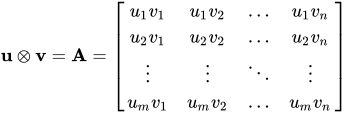
Or, in index notation:
- Failed to parse (Conversion error. Server ("https://wikimedia.org/api/rest_") reported: "Cannot get mml. Server problem."): {\displaystyle (\mathbf {u} \otimes \mathbf {v} )_{ij}=u_{i}v_{j}}
Denoting the dot product by Failed to parse (Conversion error. Server ("https://wikimedia.org/api/rest_") reported: "Cannot get mml. Server problem."): {\displaystyle \,\cdot ,\,} if given an Failed to parse (Conversion error. Server ("https://wikimedia.org/api/rest_") reported: "Cannot get mml. Server problem."): {\displaystyle n\times 1} vector Failed to parse (Conversion error. Server ("https://wikimedia.org/api/rest_") reported: "Cannot get mml. Server problem."): {\displaystyle \mathbf {w} ,} then Failed to parse (Conversion error. Server ("https://wikimedia.org/api/rest_") reported: "Cannot get mml. Server problem."): {\displaystyle (\mathbf {u} \otimes \mathbf {v} )\mathbf {w} =(\mathbf {v} \cdot \mathbf {w} )\mathbf {u} .} If given a Failed to parse (Conversion error. Server ("https://wikimedia.org/api/rest_") reported: "Cannot get mml. Server problem."): {\displaystyle 1\times m} vector then Failed to parse (Conversion error. Server ("https://wikimedia.org/api/rest_") reported: "Cannot get mml. Server problem."): {\displaystyle \mathbf {x} (\mathbf {u} \otimes \mathbf {v} )=(\mathbf {x} \cdot \mathbf {u} )\mathbf {v} ^{\operatorname {T} }.}

If Failed to parse (Conversion error. Server ("https://wikimedia.org/api/rest_") reported: "Cannot get mml. Server problem."): {\displaystyle \mathbf {u} } and are vectors of the same dimension bigger than 1, then Failed to parse (Conversion error. Server ("https://wikimedia.org/api/rest_") reported: "Cannot get mml. Server problem."): {\displaystyle \det(\mathbf {u} \otimes \mathbf {v} )=0} .
The outer product Failed to parse (Conversion error. Server ("https://wikimedia.org/api/rest_") reported: "Cannot get mml. Server problem."): {\displaystyle \mathbf {u} \otimes \mathbf {v} } is equivalent to a matrix multiplication Failed to parse (Conversion error. Server ("https://wikimedia.org/api/rest_") reported: "Cannot get mml. Server problem."): {\displaystyle \mathbf {u} \mathbf {v} ^{\operatorname {T} },} provided that is represented as a Failed to parse (Conversion error. Server ("https://wikimedia.org/api/rest_") reported: "Cannot get mml. Server problem."): {\displaystyle m\times 1} column vector and Failed to parse (SVG (MathML can be enabled via browser plugin): Invalid response ("Math extension cannot connect to Restbase.") from server "https://wikimedia.org/api/rest_v1/":): {\displaystyle \mathbf{v}} as a Failed to parse (SVG (MathML can be enabled via browser plugin): Invalid response ("Math extension cannot connect to Restbase.") from server "https://wikimedia.org/api/rest_v1/":): {\displaystyle n \times 1} column vector (which makes Failed to parse (SVG (MathML can be enabled via browser plugin): Invalid response ("Math extension cannot connect to Restbase.") from server "https://wikimedia.org/api/rest_v1/":): {\displaystyle \mathbf{v}^{\operatorname{T}}} a row vector).[2][3] For instance, if Failed to parse (SVG (MathML can be enabled via browser plugin): Invalid response ("Math extension cannot connect to Restbase.") from server "https://wikimedia.org/api/rest_v1/":): {\displaystyle m = 4} and Failed to parse (SVG (MathML can be enabled via browser plugin): Invalid response ("Math extension cannot connect to Restbase.") from server "https://wikimedia.org/api/rest_v1/":): {\displaystyle n = 3,} then[4]

- Failed to parse (SVG (MathML can be enabled via browser plugin): Invalid response ("Math extension cannot connect to Restbase.") from server "https://wikimedia.org/api/rest_v1/":): {\displaystyle \mathbf{u} \otimes \mathbf{v} = \mathbf{u}\mathbf{v}^\textsf{T} = \begin{bmatrix}u_1 \\ u_2 \\ u_3 \\ u_4\end{bmatrix} \begin{bmatrix}v_1 & v_2 & v_3\end{bmatrix} = \begin{bmatrix} u_1 v_1 & u_1 v_2 & u_1 v_3 \\ u_2 v_1 & u_2 v_2 & u_2 v_3 \\ u_3 v_1 & u_3 v_2 & u_3 v_3 \\ u_4 v_1 & u_4 v_2 & u_4 v_3 \end{bmatrix}. }
For complex vectors, it is often useful to take the conjugate transpose of Failed to parse (SVG (MathML can be enabled via browser plugin): Invalid response ("Math extension cannot connect to Restbase.") from server "https://wikimedia.org/api/rest_v1/":): {\displaystyle \mathbf{v},} denoted Failed to parse (SVG (MathML can be enabled via browser plugin): Invalid response ("Math extension cannot connect to Restbase.") from server "https://wikimedia.org/api/rest_v1/":): {\displaystyle \mathbf{v}^\dagger} or Failed to parse (SVG (MathML can be enabled via browser plugin): Invalid response ("Math extension cannot connect to Restbase.") from server "https://wikimedia.org/api/rest_v1/":): {\displaystyle \left(\mathbf{v}^\textsf{T}\right)^*} :
- Failed to parse (SVG (MathML can be enabled via browser plugin): Invalid response ("Math extension cannot connect to Restbase.") from server "https://wikimedia.org/api/rest_v1/":): {\displaystyle \mathbf{u} \otimes \mathbf{v} = \mathbf{u} \mathbf{v}^\dagger = \mathbf{u} \left(\mathbf{v}^\textsf{T}\right)^*.}
Contrast with Euclidean inner product
[edit | edit source]If Failed to parse (SVG (MathML can be enabled via browser plugin): Invalid response ("Math extension cannot connect to Restbase.") from server "https://wikimedia.org/api/rest_v1/":): {\displaystyle m = n,} then one can take the matrix product the other way, yielding a scalar (or Failed to parse (SVG (MathML can be enabled via browser plugin): Invalid response ("Math extension cannot connect to Restbase.") from server "https://wikimedia.org/api/rest_v1/":): {\displaystyle 1 \times 1} matrix):
- Failed to parse (SVG (MathML can be enabled via browser plugin): Invalid response ("Math extension cannot connect to Restbase.") from server "https://wikimedia.org/api/rest_v1/":): {\displaystyle \left\langle\mathbf{u}, \mathbf{v}\right\rangle = \mathbf{u}^\textsf{T} \mathbf{v}}
which is the standard inner product for Euclidean vector spaces,[3] better known as the dot product. The dot product is the trace of the outer product.[5] Unlike the dot product, the outer product is not commutative.
Multiplication of a vector Failed to parse (SVG (MathML can be enabled via browser plugin): Invalid response ("Math extension cannot connect to Restbase.") from server "https://wikimedia.org/api/rest_v1/":): {\displaystyle \mathbf{w}} by the matrix Failed to parse (SVG (MathML can be enabled via browser plugin): Invalid response ("Math extension cannot connect to Restbase.") from server "https://wikimedia.org/api/rest_v1/":): {\displaystyle \mathbf{u} \otimes \mathbf{v}} can be written in terms of the inner product, using the relation Failed to parse (SVG (MathML can be enabled via browser plugin): Invalid response ("Math extension cannot connect to Restbase.") from server "https://wikimedia.org/api/rest_v1/":): {\displaystyle \left(\mathbf{u} \otimes \mathbf{v}\right)\mathbf{w} = \mathbf{u}\left\langle\mathbf{v}, \mathbf{w}\right\rangle} .
The outer product of tensors
[edit | edit source]Given two tensors Failed to parse (SVG (MathML can be enabled via browser plugin): Invalid response ("Math extension cannot connect to Restbase.") from server "https://wikimedia.org/api/rest_v1/":): {\displaystyle \mathbf{u}, \mathbf{v}} with dimensions Failed to parse (SVG (MathML can be enabled via browser plugin): Invalid response ("Math extension cannot connect to Restbase.") from server "https://wikimedia.org/api/rest_v1/":): {\displaystyle (k_1, k_2, \dots, k_m)} and Failed to parse (SVG (MathML can be enabled via browser plugin): Invalid response ("Math extension cannot connect to Restbase.") from server "https://wikimedia.org/api/rest_v1/":): {\displaystyle (l_1, l_2, \dots, l_n)} , their outer product Failed to parse (SVG (MathML can be enabled via browser plugin): Invalid response ("Math extension cannot connect to Restbase.") from server "https://wikimedia.org/api/rest_v1/":): {\displaystyle \mathbf{u} \otimes \mathbf{v}} is a tensor with dimensions Failed to parse (SVG (MathML can be enabled via browser plugin): Invalid response ("Math extension cannot connect to Restbase.") from server "https://wikimedia.org/api/rest_v1/":): {\displaystyle (k_1, k_2, \dots, k_m, l_1, l_2, \dots, l_n)} and entries
- Failed to parse (SVG (MathML can be enabled via browser plugin): Invalid response ("Math extension cannot connect to Restbase.") from server "https://wikimedia.org/api/rest_v1/":): {\displaystyle (\mathbf{u} \otimes \mathbf{v})_{i_1, i_2, \dots i_m, j_1, j_2, \dots, j_n} = u_{i_1, i_2, \dots, i_m} v_{j_1, j_2, \dots, j_n}}
For example, if Failed to parse (SVG (MathML can be enabled via browser plugin): Invalid response ("Math extension cannot connect to Restbase.") from server "https://wikimedia.org/api/rest_v1/":): {\displaystyle \mathbf{A}} is of order 3 with dimensions Failed to parse (SVG (MathML can be enabled via browser plugin): Invalid response ("Math extension cannot connect to Restbase.") from server "https://wikimedia.org/api/rest_v1/":): {\displaystyle (3, 5, 7)} and Failed to parse (SVG (MathML can be enabled via browser plugin): Invalid response ("Math extension cannot connect to Restbase.") from server "https://wikimedia.org/api/rest_v1/":): {\displaystyle \mathbf{B}} is of order 2 with dimensions Failed to parse (SVG (MathML can be enabled via browser plugin): Invalid response ("Math extension cannot connect to Restbase.") from server "https://wikimedia.org/api/rest_v1/":): {\displaystyle (10, 100),} then their outer product Failed to parse (SVG (MathML can be enabled via browser plugin): Invalid response ("Math extension cannot connect to Restbase.") from server "https://wikimedia.org/api/rest_v1/":): {\displaystyle \mathbf{C}} is of order 5 with dimensions Failed to parse (SVG (MathML can be enabled via browser plugin): Invalid response ("Math extension cannot connect to Restbase.") from server "https://wikimedia.org/api/rest_v1/":): {\displaystyle (3, 5, 7, 10, 100).} If Failed to parse (SVG (MathML can be enabled via browser plugin): Invalid response ("Math extension cannot connect to Restbase.") from server "https://wikimedia.org/api/rest_v1/":): {\displaystyle \mathbf{A}} has a component A[2, 2, 4] = 11 and Failed to parse (SVG (MathML can be enabled via browser plugin): Invalid response ("Math extension cannot connect to Restbase.") from server "https://wikimedia.org/api/rest_v1/":): {\displaystyle \mathbf{B}} has a component B[8, 88] = 13, then the component of Failed to parse (SVG (MathML can be enabled via browser plugin): Invalid response ("Math extension cannot connect to Restbase.") from server "https://wikimedia.org/api/rest_v1/":): {\displaystyle \mathbf{C}} formed by the outer product is C[2, 2, 4, 8, 88] = 143.
Connection with the Kronecker product
[edit | edit source]The outer product and Kronecker product are closely related; in fact the same symbol is commonly used to denote both operations.
If Failed to parse (SVG (MathML can be enabled via browser plugin): Invalid response ("Math extension cannot connect to Restbase.") from server "https://wikimedia.org/api/rest_v1/":): {\displaystyle \mathbf{u} = \begin{bmatrix}1 & 2 & 3\end{bmatrix}^\textsf{T}} and Failed to parse (SVG (MathML can be enabled via browser plugin): Invalid response ("Math extension cannot connect to Restbase.") from server "https://wikimedia.org/api/rest_v1/":): {\displaystyle \mathbf{v} = \begin{bmatrix}4 & 5\end{bmatrix}^\textsf{T}} , we have:
- Failed to parse (SVG (MathML can be enabled via browser plugin): Invalid response ("Math extension cannot connect to Restbase.") from server "https://wikimedia.org/api/rest_v1/":): {\displaystyle \begin{align} \mathbf{u} \otimes_\text{Kron} \mathbf{v} &= \begin{bmatrix} 4 \\ 5 \\ 8 \\ 10 \\ 12 \\ 15\end{bmatrix}, & \mathbf{u} \otimes_\text{outer} \mathbf{v} &= \begin{bmatrix} 4 & 5 \\ 8 & 10 \\ 12 & 15\end{bmatrix} \end{align}}
In the case of column vectors, the Kronecker product can be viewed as a form of vectorization (or flattening) of the outer product. In particular, for two column vectors Failed to parse (SVG (MathML can be enabled via browser plugin): Invalid response ("Math extension cannot connect to Restbase.") from server "https://wikimedia.org/api/rest_v1/":): {\displaystyle \mathbf{u}} and Failed to parse (SVG (MathML can be enabled via browser plugin): Invalid response ("Math extension cannot connect to Restbase.") from server "https://wikimedia.org/api/rest_v1/":): {\displaystyle \mathbf{v}} , we can write:
- Failed to parse (SVG (MathML can be enabled via browser plugin): Invalid response ("Math extension cannot connect to Restbase.") from server "https://wikimedia.org/api/rest_v1/":): {\displaystyle \mathbf{u} \otimes_{\text{Kron}} \mathbf{v} = \operatorname{vec}(\mathbf{v} \otimes_\text{outer} \mathbf{u})}
(The order of the vectors is reversed on the right side of the equation.)
Another similar identity that further highlights the similarity between the operations is
- Failed to parse (SVG (MathML can be enabled via browser plugin): Invalid response ("Math extension cannot connect to Restbase.") from server "https://wikimedia.org/api/rest_v1/":): {\displaystyle \mathbf{u} \otimes_{\text{Kron}} \mathbf{v}^\textsf{T} = \mathbf u \mathbf{v}^\textsf{T} = \mathbf{u} \otimes_{\text{outer}} \mathbf{v}}
where the order of vectors needs not be flipped. The middle expression uses matrix multiplication, where the vectors are considered as column/row matrices.
Connection with the matrix product
[edit | edit source]Given a pair of matrices Failed to parse (SVG (MathML can be enabled via browser plugin): Invalid response ("Math extension cannot connect to Restbase.") from server "https://wikimedia.org/api/rest_v1/":): {\displaystyle \mathbf{A}} of size Failed to parse (SVG (MathML can be enabled via browser plugin): Invalid response ("Math extension cannot connect to Restbase.") from server "https://wikimedia.org/api/rest_v1/":): {\displaystyle m\times p} and Failed to parse (SVG (MathML can be enabled via browser plugin): Invalid response ("Math extension cannot connect to Restbase.") from server "https://wikimedia.org/api/rest_v1/":): {\displaystyle \mathbf{B}} of size Failed to parse (SVG (MathML can be enabled via browser plugin): Invalid response ("Math extension cannot connect to Restbase.") from server "https://wikimedia.org/api/rest_v1/":): {\displaystyle p\times n} , consider the matrix product Failed to parse (SVG (MathML can be enabled via browser plugin): Invalid response ("Math extension cannot connect to Restbase.") from server "https://wikimedia.org/api/rest_v1/":): {\displaystyle \mathbf{C} = \mathbf{A}\,\mathbf{B}} defined as usual as a matrix of size Failed to parse (SVG (MathML can be enabled via browser plugin): Invalid response ("Math extension cannot connect to Restbase.") from server "https://wikimedia.org/api/rest_v1/":): {\displaystyle m\times n} .
Now let Failed to parse (SVG (MathML can be enabled via browser plugin): Invalid response ("Math extension cannot connect to Restbase.") from server "https://wikimedia.org/api/rest_v1/":): {\displaystyle \mathbf a^\text{col}_k} be the Failed to parse (SVG (MathML can be enabled via browser plugin): Invalid response ("Math extension cannot connect to Restbase.") from server "https://wikimedia.org/api/rest_v1/":): {\displaystyle k} -th column vector of Failed to parse (SVG (MathML can be enabled via browser plugin): Invalid response ("Math extension cannot connect to Restbase.") from server "https://wikimedia.org/api/rest_v1/":): {\displaystyle \mathbf A} and let Failed to parse (SVG (MathML can be enabled via browser plugin): Invalid response ("Math extension cannot connect to Restbase.") from server "https://wikimedia.org/api/rest_v1/":): {\displaystyle \mathbf b^\text{row}_k} be the Failed to parse (SVG (MathML can be enabled via browser plugin): Invalid response ("Math extension cannot connect to Restbase.") from server "https://wikimedia.org/api/rest_v1/":): {\displaystyle k} -th row vector of Failed to parse (SVG (MathML can be enabled via browser plugin): Invalid response ("Math extension cannot connect to Restbase.") from server "https://wikimedia.org/api/rest_v1/":): {\displaystyle \mathbf B} . Then Failed to parse (SVG (MathML can be enabled via browser plugin): Invalid response ("Math extension cannot connect to Restbase.") from server "https://wikimedia.org/api/rest_v1/":): {\displaystyle \mathbf{C}} can be expressed as a sum of column-by-row outer products:
- Failed to parse (SVG (MathML can be enabled via browser plugin): Invalid response ("Math extension cannot connect to Restbase.") from server "https://wikimedia.org/api/rest_v1/":): {\displaystyle \mathbf{C} = \mathbf{A}\, \mathbf{B} = \left( \sum_{k=1}^p {A}_{ik}\, {B}_{kj} \right)_{ \begin{matrix} 1\le i \le m \\[-20pt] 1 \le j\le n \end{matrix} } = \begin{bmatrix} & & \\ \mathbf a^\text{col}_{1} & \cdots & \mathbf a^\text{col}_{p} \\ & & \end{bmatrix} \begin{bmatrix} & \mathbf b^\text{row}_{1} & \\ & \vdots & \\ & \mathbf b^\text{row}_{p} & \end{bmatrix} = \sum_{k=1}^p \mathbf a^\text{col}_k \mathbf b^\text{row}_k}
This expression has duality with the more common one as a matrix built with row-by-column inner product entries (or dot product): Failed to parse (SVG (MathML can be enabled via browser plugin): Invalid response ("Math extension cannot connect to Restbase.") from server "https://wikimedia.org/api/rest_v1/":): {\displaystyle C_{ij} = \langle{\mathbf a^\text{row}_i,\,\mathbf b_j^\text{col}}\rangle}
This relation is relevant[6] in the application of the Singular Value Decomposition (SVD) (and Spectral Decomposition as a special case). In particular, the decomposition can be interpreted as the sum of outer products of each left (Failed to parse (SVG (MathML can be enabled via browser plugin): Invalid response ("Math extension cannot connect to Restbase.") from server "https://wikimedia.org/api/rest_v1/":): {\displaystyle \mathbf{u}_k} ) and right (Failed to parse (SVG (MathML can be enabled via browser plugin): Invalid response ("Math extension cannot connect to Restbase.") from server "https://wikimedia.org/api/rest_v1/":): {\displaystyle \mathbf{v}_k} ) singular vectors, scaled by the corresponding nonzero singular value Failed to parse (SVG (MathML can be enabled via browser plugin): Invalid response ("Math extension cannot connect to Restbase.") from server "https://wikimedia.org/api/rest_v1/":): {\displaystyle \sigma_k} :
- Failed to parse (SVG (MathML can be enabled via browser plugin): Invalid response ("Math extension cannot connect to Restbase.") from server "https://wikimedia.org/api/rest_v1/":): {\displaystyle \mathbf{A} = \mathbf{U \Sigma V^T} = \sum_{k=1}^{\operatorname{rank}(A)}(\mathbf{u}_k \otimes \mathbf{v}_k) \, \sigma_k}
This result implies that Failed to parse (SVG (MathML can be enabled via browser plugin): Invalid response ("Math extension cannot connect to Restbase.") from server "https://wikimedia.org/api/rest_v1/":): {\displaystyle \mathbf{A}} can be expressed as a sum of rank-1 matrices with spectral norm Failed to parse (SVG (MathML can be enabled via browser plugin): Invalid response ("Math extension cannot connect to Restbase.") from server "https://wikimedia.org/api/rest_v1/":): {\displaystyle \sigma_k} in decreasing order. This explains the fact why, in general, the last terms contribute less, which motivates the use of the truncated SVD as an approximation. The first term is the least squares fit of a matrix to an outer product of vectors.
Properties
[edit | edit source]The outer product of vectors satisfies the following properties:
- Failed to parse (SVG (MathML can be enabled via browser plugin): Invalid response ("Math extension cannot connect to Restbase.") from server "https://wikimedia.org/api/rest_v1/":): {\displaystyle \begin{align} (\mathbf{u} \otimes \mathbf{v})^\textsf{T} &= (\mathbf{v} \otimes \mathbf{u}) \\ (\mathbf{v} + \mathbf{w}) \otimes \mathbf{u} &= \mathbf{v} \otimes \mathbf{u} + \mathbf{w} \otimes \mathbf{u} \\ \mathbf{u} \otimes (\mathbf{v} + \mathbf{w}) &= \mathbf{u} \otimes \mathbf{v} + \mathbf{u} \otimes \mathbf{w} \\ c (\mathbf{v} \otimes \mathbf{u}) &= (c\mathbf{v}) \otimes \mathbf{u} = \mathbf{v} \otimes (c\mathbf{u}) \end{align}}
The outer product of tensors satisfies the additional associativity property:
- Failed to parse (SVG (MathML can be enabled via browser plugin): Invalid response ("Math extension cannot connect to Restbase.") from server "https://wikimedia.org/api/rest_v1/":): {\displaystyle (\mathbf{u} \otimes \mathbf{v}) \otimes \mathbf{w} = \mathbf{u} \otimes (\mathbf{v} \otimes \mathbf{w}) }
Rank of an outer product
[edit | edit source]If u and v are both nonzero, then the outer product matrix uvT always has matrix rank 1. Indeed, the columns of the outer product are all proportional to u. Thus they are all linearly dependent on that one column, hence the matrix is of rank one.
("Matrix rank" should not be confused with "tensor order", or "tensor degree", which is sometimes referred to as "rank".)
Definition (abstract)
[edit | edit source]Let V and W be two vector spaces. The outer product of Failed to parse (SVG (MathML can be enabled via browser plugin): Invalid response ("Math extension cannot connect to Restbase.") from server "https://wikimedia.org/api/rest_v1/":): {\displaystyle \mathbf v \in V} and Failed to parse (SVG (MathML can be enabled via browser plugin): Invalid response ("Math extension cannot connect to Restbase.") from server "https://wikimedia.org/api/rest_v1/":): {\displaystyle \mathbf w \in W} is the element Failed to parse (SVG (MathML can be enabled via browser plugin): Invalid response ("Math extension cannot connect to Restbase.") from server "https://wikimedia.org/api/rest_v1/":): {\displaystyle \mathbf v \otimes \mathbf w \in V \otimes W} .
If W is an inner product space, then it is possible to define the outer product as a linear map W → V. In this case, the linear map Failed to parse (SVG (MathML can be enabled via browser plugin): Invalid response ("Math extension cannot connect to Restbase.") from server "https://wikimedia.org/api/rest_v1/":): {\displaystyle \mathbf x \mapsto \langle \mathbf w, \mathbf x\rangle} is an element of the dual space of W, as this maps linearly a vector into its underlying field, of which Failed to parse (SVG (MathML can be enabled via browser plugin): Invalid response ("Math extension cannot connect to Restbase.") from server "https://wikimedia.org/api/rest_v1/":): {\displaystyle \langle \mathbf w, \mathbf x\rangle} is an element. The outer product W → V is then given by
- Failed to parse (SVG (MathML can be enabled via browser plugin): Invalid response ("Math extension cannot connect to Restbase.") from server "https://wikimedia.org/api/rest_v1/":): {\displaystyle (\mathbf v \otimes \mathbf w) (\mathbf x) = \left\langle \mathbf w, \mathbf x \right\rangle \mathbf v.}
This shows why a conjugate transpose of w is commonly taken in the complex case.
In programming languages
[edit | edit source]In some programming languages, given a two-argument function f (or a binary operator), the outer product, f, of two one-dimensional arrays, A and B, is a two-dimensional array C such that C[i, j] = f(A[i], B[j]). This is syntactically represented in various ways: in APL, as the infix binary operator ∘.f; in J, as the postfix adverb f/; in R, as the function outer(A, B, f) or the special %o%;[7] in Mathematica, as Outer[f, A, B]. In MATLAB, the function kron(A, B) is used for this product. These often generalize to multi-dimensional arguments, and more than two arguments.
In the Python library NumPy, the outer product can be computed with function np.outer().[8] In contrast, np.kron results in a flat array. The outer product of multidimensional arrays can be computed using np.multiply.outer.
Applications
[edit | edit source]As the outer product is closely related to the Kronecker product, some of the applications of the Kronecker product use outer products. These applications are found in quantum theory, signal processing, and image compression.[9]
Spinors
[edit | edit source]Suppose s, t, w, z ∈ C so that (s, t) and (w, z) are in C2. Then the outer product of these complex 2-vectors is an element of M(2, C), the 2 × 2 complex matrices:
- Failed to parse (SVG (MathML can be enabled via browser plugin): Invalid response ("Math extension cannot connect to Restbase.") from server "https://wikimedia.org/api/rest_v1/":): {\displaystyle \begin{pmatrix} sw & tw \\ sz & tz \end{pmatrix}.}
The determinant of this matrix is swtz − sztw = 0 because of the commutative property of C.
In the theory of spinors in three dimensions, these matrices are associated with isotropic vectors due to this null property. Élie Cartan described this construction in 1937,[10] but it was introduced by Wolfgang Pauli in 1927[11] so that M(2,C) has come to be called Pauli algebra.
Concepts
[edit | edit source]The block form of outer products is useful in classification. Concept analysis is a study that depends on certain outer products:
When a vector has only zeros and ones as entries, it is called a logical vector, a special case of a logical matrix. The logical operation and takes the place of multiplication. The outer product of two logical vectors (ui) and (vj) is given by the logical matrix Failed to parse (SVG (MathML can be enabled via browser plugin): Invalid response ("Math extension cannot connect to Restbase.") from server "https://wikimedia.org/api/rest_v1/":): {\displaystyle \left(a_{ij}\right) = \left(u_i \land v_j\right)} . This type of matrix is used in the study of binary relations, and is called a rectangular relation or a cross-vector.[12]
See also
[edit | edit source]Products
[edit | edit source]Duality
[edit | edit source]References
[edit | edit source]- ↑ Lerner, R. G.; Trigg, G. L. (1991). Encyclopaedia of Physics (2nd ed.). VHC. ISBN 0-89573-752-3.
- ↑ Lipschutz, S.; Lipson, M. (2009). Linear Algebra. Schaum’s Outlines (4th ed.). McGraw-Hill. ISBN 978-0-07-154352-1.
- ↑ 3.0 3.1 Keller, Frank (February 23, 2020). "Algebraic Properties of Matrices; Transpose; Inner and Outer Product" (PDF). inf.ed.ac.uk. Archived (PDF) from the original on 2017-12-15. Retrieved September 6, 2020.
- ↑ James M. Ortega (1987) Matrix Theory: A Second Course, page 7, Plenum Press ISBN 0-306-42433-9
- ↑ Stengel, Robert F. (1994). Optimal Control and Estimation. New York: Dover Publications. p. 26. ISBN 0-486-68200-5.
- ↑ Trefethen, Lloyd N.; Bau III, David (1997). Numerical linear algebra. Philadelphia: Society for Industrial and Applied Mathematics. ISBN 978-0-89871-361-9.
- ↑ "outer function | R Documentation". rdocumentation.org. Retrieved 2020-09-07.
- ↑ "numpy.outer — NumPy v1.19 Manual". numpy.org. Retrieved 2020-09-07.
- ↑ Steeb, Willi-Hans; Hardy, Yorick (2011). "Applications (Chapter 3)". Matrix Calculus and Kronecker Product: A Practical Approach to Linear and Multilinear Algebra (2 ed.). World Scientific. ISBN 978-981-4335-31-7.
- ↑ Élie Cartan (1937) Lecons sur la theorie des spineurs, translated 1966: The Theory of Spinors, Hermann, Paris
- ↑ Pertti Lounesto (1997) Clifford Algebras and Spinors, page 51, Cambridge University Press ISBN 0-521-59916-4
- ↑ Ki-Hang Kim (1982) Boolean Matrix Theory and Applications, page 37, Marcel Dekker ISBN 0-8247-1788-0
Further reading
[edit | edit source]- Carlen, Eric; Canceicao Carvalho, Maria (2006). "Outer Products and Orthogonal Projections". Linear Algebra: From the Beginning. Macmillan. pp. 217–218. ISBN 9780716748946.