Deprecated: Use of MediaWiki\Skin\Skin::appendSpecialPagesLinkIfAbsent was deprecated in MediaWiki 1.44. [Called from MediaWiki\Skin\Skin::buildSidebar in /var/www/html/w/includes/skins/Skin.php at line 1639] in /var/www/html/w/includes/debug/MWDebug.php on line 386
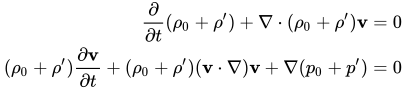
For sound waves of any magnitude of a disturbance in velocity, pressure, and density we have
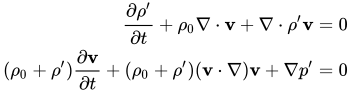
In the case that the fluctuations in velocity, density, and pressure are small, we can approximate these as
Where is the perturbed velocity of the fluid, is the pressure of the fluid at rest, is the perturbed pressure of the system as a function of space and time, is the density of the fluid at rest, and is the variance in the density of the fluid over space and time.
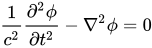
In the case that the velocity is irrotational (), we then have the acoustic wave equation that describes the system:
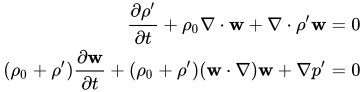
We can have these equations work for a moving medium by setting , where is the constant velocity that the whole fluid is moving at before being disturbed (equivalent to a moving observer) and is the fluid velocity.
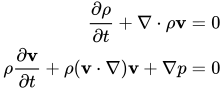
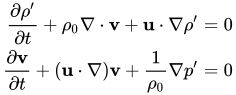
Starting with the above given equations of motion for a medium at rest:
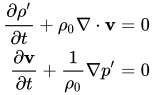
Let us now take to all be small quantities.
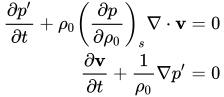
In the case that we keep terms to first order, for the continuity equation, we have the term going to 0. This similarly applies for the density perturbation times the time derivative of the velocity. Moreover, the spatial components of the material derivative go to 0. We thus have, upon rearranging the equilibrium density:
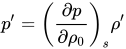
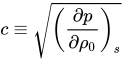
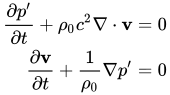
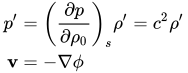
Next, given that our sound wave occurs in an ideal fluid, the motion is adiabatic, and then we can relate the small change in the pressure to the small change in the density by
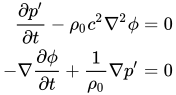
In the case that the fluid is irrotational, that is , we can then write and thus write our equations of motion as
The second equation tells us that
And the use of this equation in the continuity equation tells us that
This simplifies to
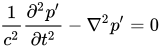
Thus the velocity potential obeys the wave equation in the limit of small disturbances. The boundary conditions required to solve for the potential come from the fact that the velocity of the fluid must be 0 normal to the fixed surfaces of the system.
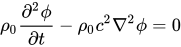
Taking the time derivative of this wave equation and multiplying all sides by the unperturbed density, and then using the fact that tells us that
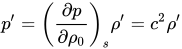
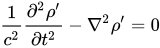
Similarly, we saw that . Thus we can multiply the above equation appropriately and see that
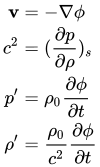
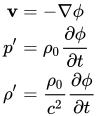
Thus, the velocity potential, pressure, and density all obey the wave equation. Moreover, we only need to solve one such equation to determine all other three. In particular, we have
If we make the previous assumptions of the fluid being ideal and the velocity being irrotational, then we have
Under these assumptions, our linearized sound equations become
Importantly, since is a constant, we have Failed to parse (Conversion error. Server ("https://wikimedia.org/api/rest_") reported: "Cannot get mml. Server problem."): {\displaystyle (\mathbf {u} \cdot \nabla )[\nabla \phi ]=\nabla [(\mathbf {u} \cdot \nabla )\phi ]}
, and then the second equation tells us that
Failed to parse (Conversion error. Server ("https://wikimedia.org/api/rest_") reported: "Cannot get mml. Server problem."): {\displaystyle {\frac {1}{\rho _{0}}}\nabla p'=\nabla \left[{\frac {\partial \phi }{\partial t}}+(\mathbf {u} \cdot \nabla )\phi \right]}
Or just that
Failed to parse (Conversion error. Server ("https://wikimedia.org/api/rest_") reported: "Cannot get mml. Server problem."): {\displaystyle p'=\rho _{0}\left[{\frac {\partial \phi }{\partial t}}+(\mathbf {u} \cdot \nabla )\phi \right]}
Now, when we use this relation with the fact that Failed to parse (Conversion error. Server ("https://wikimedia.org/api/rest_") reported: "Cannot get mml. Server problem."): {\displaystyle {\frac {1}{c^{2}}}{\frac {\partial p'}{\partial t}}-\rho _{0}\nabla ^{2}\phi +{\frac {1}{c^{2}}}\mathbf {u} \cdot \nabla p'=0}
, alongside cancelling and rearranging terms, we arrive at
This differential equation must be solved with the appropriate boundary conditions. Note that setting returns us the wave equation. Regardless, upon solving this equation for a moving medium, we then have
Failed to parse (Conversion error. Server ("https://wikimedia.org/api/rest_") reported: "Cannot get mml. Server problem."): {\displaystyle {\begin{aligned}\mathbf {v} &=-\nabla \phi \\p'&=\rho _{0}\left({\frac {\partial }{\partial t}}+\mathbf {u} \cdot \nabla \right)\phi \\\rho '&={\frac {\rho _{0}}{c^{2}}}\left({\frac {\partial }{\partial t}}+\mathbf {u} \cdot \nabla \right)\phi \end{aligned}}}












![{\displaystyle {\begin{aligned}{\frac {1}{c^{2}}}{\frac {\partial p'}{\partial t}}-\rho _{0}\nabla ^{2}\phi +{\frac {1}{c^{2}}}\mathbf {u} \cdot \nabla p'&=0\\-{\frac {\partial }{\partial t}}(\nabla \phi )-(\mathbf {u} \cdot \nabla )[\nabla \phi ]+{\frac {1}{\rho _{0}}}\nabla p'&=0\end{aligned}}}](https://wikimedia.org/api/rest_v1/media/math/render/svg/aa2cce6070bbe2513e8131ddecfe208a22934c21)
![{\displaystyle \left[{\frac {1}{c^{2}}}\left({\frac {\partial }{\partial t}}+\mathbf {u} \cdot \nabla \right)^{2}-\nabla ^{2}\right]\phi =0}](https://wikimedia.org/api/rest_v1/media/math/render/svg/a45ad2bd461f06c68efa2c35e7ecb3b43c4f1517)