Unchecked

Almost everywhere

From Wikipedia
Jump to navigation Jump to search
File:Function-1 x.svg
The function 1/x is differentiable and continuous almost everywhere; more precisely, everywhere except at x = 0.

In measure theory (a branch of mathematical analysis), a property holds almost everywhere if, in a technical sense, the set for which the property holds takes up nearly all possibilities. The notion of "almost everywhere" is a companion notion to the concept of measure zero, and is analogous to the notion of almost surely in probability theory.

More specifically, a property holds almost everywhere if it holds for all elements in a set except a subset of measure zero,[1][2] or equivalently, if the set of elements for which the property holds is conull. In cases where the measure is not complete, it is sufficient that the set be contained within a set of measure zero. When discussing sets of real numbers, the Lebesgue measure is usually assumed unless otherwise stated.

The term almost everywhere is abbreviated a.e.;[3] in older literature p.p. is used, to stand for the equivalent French phrase presque partout.[4]

A set with full measure is one whose complement is of measure zero. In probability theory, the terms almost surely, almost certain and almost always refer to events with probability 1 not necessarily including all of the outcomes. These are exactly the sets of full measure in a probability space.

Occasionally, instead of saying that a property holds almost everywhere, it is said that the property holds for almost all elements (though the term almost all can also have other meanings).

Definition

[edit | edit source]

If Failed to parse (SVG (MathML can be enabled via browser plugin): Invalid response ("Math extension cannot connect to Restbase.") from server "https://wikimedia.org/api/rest_v1/":): {\displaystyle (X,\Sigma,\mu) } is a measure space, a property Failed to parse (SVG (MathML can be enabled via browser plugin): Invalid response ("Math extension cannot connect to Restbase.") from server "https://wikimedia.org/api/rest_v1/":): {\displaystyle P } is said to hold almost everywhere in Failed to parse (SVG (MathML can be enabled via browser plugin): Invalid response ("Math extension cannot connect to Restbase.") from server "https://wikimedia.org/api/rest_v1/":): {\displaystyle X } if there exists a measurable set Failed to parse (SVG (MathML can be enabled via browser plugin): Invalid response ("Math extension cannot connect to Restbase.") from server "https://wikimedia.org/api/rest_v1/":): {\displaystyle N \in \Sigma } with Failed to parse (SVG (MathML can be enabled via browser plugin): Invalid response ("Math extension cannot connect to Restbase.") from server "https://wikimedia.org/api/rest_v1/":): {\displaystyle \mu(N) = 0 } , and all Failed to parse (SVG (MathML can be enabled via browser plugin): Invalid response ("Math extension cannot connect to Restbase.") from server "https://wikimedia.org/api/rest_v1/":): {\displaystyle x\in X\setminus N } have the property Failed to parse (SVG (MathML can be enabled via browser plugin): Invalid response ("Math extension cannot connect to Restbase.") from server "https://wikimedia.org/api/rest_v1/":): {\displaystyle P } .[5] Another common way of expressing the same thing is to say that "almost every point satisfies Failed to parse (SVG (MathML can be enabled via browser plugin): Invalid response ("Math extension cannot connect to Restbase.") from server "https://wikimedia.org/api/rest_v1/":): {\displaystyle P\, } ", or that "for almost every Failed to parse (SVG (MathML can be enabled via browser plugin): Invalid response ("Math extension cannot connect to Restbase.") from server "https://wikimedia.org/api/rest_v1/":): {\displaystyle x } , Failed to parse (SVG (MathML can be enabled via browser plugin): Invalid response ("Math extension cannot connect to Restbase.") from server "https://wikimedia.org/api/rest_v1/":): {\displaystyle P(x) } holds".

It is not required that the set Failed to parse (SVG (MathML can be enabled via browser plugin): Invalid response ("Math extension cannot connect to Restbase.") from server "https://wikimedia.org/api/rest_v1/":): {\displaystyle \{x\in X: \neg P(x)\} } has measure zero; it may not be measurable. By the above definition, it is sufficient that Failed to parse (SVG (MathML can be enabled via browser plugin): Invalid response ("Math extension cannot connect to Restbase.") from server "https://wikimedia.org/api/rest_v1/":): {\displaystyle \{x\in X: \neg P(x)\} } be contained in some set Failed to parse (SVG (MathML can be enabled via browser plugin): Invalid response ("Math extension cannot connect to Restbase.") from server "https://wikimedia.org/api/rest_v1/":): {\displaystyle N } that is measurable and has measure zero. However, this technicality vanishes when considering a complete measure space: if Failed to parse (SVG (MathML can be enabled via browser plugin): Invalid response ("Math extension cannot connect to Restbase.") from server "https://wikimedia.org/api/rest_v1/":): {\displaystyle X} is complete then Failed to parse (SVG (MathML can be enabled via browser plugin): Invalid response ("Math extension cannot connect to Restbase.") from server "https://wikimedia.org/api/rest_v1/":): {\displaystyle N} exists with measure zero if and only if Failed to parse (SVG (MathML can be enabled via browser plugin): Invalid response ("Math extension cannot connect to Restbase.") from server "https://wikimedia.org/api/rest_v1/":): {\displaystyle \{x\in X: \neg P(x)\}} is measurable with measure zero.

Properties

[edit | edit source]
  • If property Failed to parse (SVG (MathML can be enabled via browser plugin): Invalid response ("Math extension cannot connect to Restbase.") from server "https://wikimedia.org/api/rest_v1/":): {\displaystyle P } holds almost everywhere and implies property Failed to parse (SVG (MathML can be enabled via browser plugin): Invalid response ("Math extension cannot connect to Restbase.") from server "https://wikimedia.org/api/rest_v1/":): {\displaystyle Q } , then property Failed to parse (SVG (MathML can be enabled via browser plugin): Invalid response ("Math extension cannot connect to Restbase.") from server "https://wikimedia.org/api/rest_v1/":): {\displaystyle Q } holds almost everywhere. This follows from the monotonicity of measures.
  • If Failed to parse (SVG (MathML can be enabled via browser plugin): Invalid response ("Math extension cannot connect to Restbase.") from server "https://wikimedia.org/api/rest_v1/":): {\displaystyle (P_n) } is a finite or a countable sequence of properties, each of which holds almost everywhere, then their conjunction Failed to parse (SVG (MathML can be enabled via browser plugin): Invalid response ("Math extension cannot connect to Restbase.") from server "https://wikimedia.org/api/rest_v1/":): {\displaystyle \forall n P_n } holds almost everywhere. This follows from the countable sub-additivity of measures.
  • By contrast, if Failed to parse (SVG (MathML can be enabled via browser plugin): Invalid response ("Math extension cannot connect to Restbase.") from server "https://wikimedia.org/api/rest_v1/":): {\displaystyle (P_x)_{x\in \mathbf R} } is an uncountable family of properties, each of which holds almost everywhere, then their conjunction Failed to parse (SVG (MathML can be enabled via browser plugin): Invalid response ("Math extension cannot connect to Restbase.") from server "https://wikimedia.org/api/rest_v1/":): {\displaystyle \forall x P_x } does not necessarily hold almost everywhere. For example, if Failed to parse (SVG (MathML can be enabled via browser plugin): Invalid response ("Math extension cannot connect to Restbase.") from server "https://wikimedia.org/api/rest_v1/":): {\displaystyle \mu } is Lebesgue measure on Failed to parse (SVG (MathML can be enabled via browser plugin): Invalid response ("Math extension cannot connect to Restbase.") from server "https://wikimedia.org/api/rest_v1/":): {\displaystyle X = \mathbf R } and Failed to parse (SVG (MathML can be enabled via browser plugin): Invalid response ("Math extension cannot connect to Restbase.") from server "https://wikimedia.org/api/rest_v1/":): {\displaystyle P_x } is the property of not being equal to Failed to parse (SVG (MathML can be enabled via browser plugin): Invalid response ("Math extension cannot connect to Restbase.") from server "https://wikimedia.org/api/rest_v1/":): {\displaystyle x } (i.e. Failed to parse (SVG (MathML can be enabled via browser plugin): Invalid response ("Math extension cannot connect to Restbase.") from server "https://wikimedia.org/api/rest_v1/":): {\displaystyle P_x(y) } is true if and only if Failed to parse (SVG (MathML can be enabled via browser plugin): Invalid response ("Math extension cannot connect to Restbase.") from server "https://wikimedia.org/api/rest_v1/":): {\displaystyle y \neq x } ), then each holds almost everywhere, but the conjunction Failed to parse (SVG (MathML can be enabled via browser plugin): Invalid response ("Math extension cannot connect to Restbase.") from server "https://wikimedia.org/api/rest_v1/":): {\displaystyle \forall x P_x } does not hold anywhere.

As a consequence of the first two properties, it is often possible to reason about "almost every point" of a measure space as though it were an ordinary point rather than an abstraction.[citation needed] This is often done implicitly in informal mathematical arguments. However, one must be careful with this mode of reasoning because of the third bullet above: universal quantification over uncountable families of statements is valid for ordinary points but not for "almost every point".

Examples

[edit | edit source]
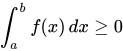
  • If f : RR is a Lebesgue integrable function and Failed to parse (SVG (MathML can be enabled via browser plugin): Invalid response ("Math extension cannot connect to Restbase.") from server "https://wikimedia.org/api/rest_v1/":): {\displaystyle f(x) \ge 0 } almost everywhere, then Failed to parse (SVG (MathML can be enabled via browser plugin): Invalid response ("Math extension cannot connect to Restbase.") from server "https://wikimedia.org/api/rest_v1/":): {\displaystyle \int_a^b f(x) \, dx \geq 0} for all real numbers Failed to parse (SVG (MathML can be enabled via browser plugin): Invalid response ("Math extension cannot connect to Restbase.") from server "https://wikimedia.org/api/rest_v1/":): {\displaystyle a < b } with equality if and only if Failed to parse (SVG (MathML can be enabled via browser plugin): Invalid response ("Math extension cannot connect to Restbase.") from server "https://wikimedia.org/api/rest_v1/":): {\displaystyle f(x) = 0} almost everywhere.
  • If f : [a, b] → R is a monotonic function, then f is differentiable almost everywhere.
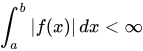
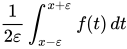
  • If f : RR is Lebesgue measurable and Failed to parse (SVG (MathML can be enabled via browser plugin): Invalid response ("Math extension cannot connect to Restbase.") from server "https://wikimedia.org/api/rest_v1/":): {\displaystyle \int_a^b |f(x)| \, dx < \infty} for all real numbers Failed to parse (SVG (MathML can be enabled via browser plugin): Invalid response ("Math extension cannot connect to Restbase.") from server "https://wikimedia.org/api/rest_v1/":): {\displaystyle a < b } , then there exists a set E (depending on f) such that, if x is in E, the Lebesgue mean Failed to parse (SVG (MathML can be enabled via browser plugin): Invalid response ("Math extension cannot connect to Restbase.") from server "https://wikimedia.org/api/rest_v1/":): {\displaystyle \frac{1}{2\varepsilon} \int_{x-\varepsilon}^{x+\varepsilon} f(t)\,dt} converges to f(x) as Failed to parse (SVG (MathML can be enabled via browser plugin): Invalid response ("Math extension cannot connect to Restbase.") from server "https://wikimedia.org/api/rest_v1/":): {\displaystyle \epsilon} decreases to zero. The set E is called the Lebesgue set of f. Its complement can be proved to have measure zero. In other words, the Lebesgue mean of f converges to f almost everywhere.
  • A bounded function f : [a, b] → R is Riemann integrable if and only if it is continuous almost everywhere.
  • As a curiosity, the decimal expansion of almost every real number in the interval [0, 1] contains the complete text of Shakespeare's plays, encoded in ASCII; similarly for every other finite digit sequence, see Normal number.

Definition using ultrafilters

[edit | edit source]

Outside of the context of real analysis, the notion of a property true almost everywhere is sometimes defined in terms of an ultrafilter. An ultrafilter on a set X is a maximal collection F of subsets of X such that:

  1. If UF and UV then VF
  2. The intersection of any two sets in F is in F
  3. The empty set is not in F

A property P of points in X holds almost everywhere, relative to an ultrafilter F, if the set of points for which P holds is in F.

For example, one construction of the hyperreal number system defines a hyperreal number as an equivalence class of sequences that are equal almost everywhere as defined by an ultrafilter.

The definition of almost everywhere in terms of ultrafilters is closely related to the definition in terms of measures, because each ultrafilter defines a finitely-additive measure taking only the values 0 and 1, where a set has measure 1 if and only if it is included in the ultrafilter.

With this notion of "almost everywhere" Łoś's theorem can be understood as saying that a first-order formula is true in an ultraproduct if and only if it's true in almost all of the factors.

See also

[edit | edit source]

References

[edit | edit source]
  1. Weisstein, Eric W. "Almost Everywhere". mathworld.wolfram.com. Retrieved 2019-11-19.
  2. Halmos, Paul R. (1974). Measure theory. New York: Springer-Verlag. ISBN 0-387-90088-8.
  3. "Definition of almost everywhere | Dictionary.com". www.dictionary.com. Retrieved 2019-11-19.
  4. Ursell, H. D. (1932-01-01). "On the Convergence Almost Everywhere of Rademacher's Series and of the Bochnerfejér Sums of a Function almost Periodic in the Sense of Stepanoff". Proceedings of the London Mathematical Society. s2-33 (1): 457–466. doi:10.1112/plms/s2-33.1.457. ISSN 0024-6115.
  5. "Properties That Hold Almost Everywhere - Mathonline". mathonline.wikidot.com. Retrieved 2019-11-19.

Bibliography

[edit | edit source]
  • Billingsley, Patrick (1995). Probability and measure (3rd ed.). New York: John Wiley & Sons. ISBN 0-471-00710-2.

Template:Measure theory Template:Lp spaces