Analytic continuation
In complex analysis, a branch of mathematics, analytic continuation is a technique to extend the domain of definition of a given analytic function. Analytic continuation often succeeds in defining further values of a function, for example in a new region where the infinite series representation that initially defined the function becomes divergent.
The step-wise continuation technique may, however, come up against difficulties. These may have an essentially topological nature, leading to inconsistencies (defining more than one value). They may alternatively have to do with the presence of singularities. The case of several complex variables is rather different, since singularities then need not be isolated points, and its investigation was a major reason for the development of sheaf cohomology.
Initial discussion
[edit | edit source]Suppose f is an analytic function defined on a non-empty open subset U of the complex plane . If V is a larger open subset of , containing U, and F is an analytic function defined on V such that

- Failed to parse (Conversion error. Server ("https://wikimedia.org/api/rest_") reported: "Cannot get mml. Server problem."): {\displaystyle F(z)=f(z)\qquad \forall z\in U,}
then F is called an analytic continuation of f. In other words, the restriction of F to U is the function f we started with.
Analytic continuations are unique in the following sense: if V is the connected domain of two analytic functions F1 and F2 such that U is contained in V and for all z in U

then

on all of V. This is because F1 − F2 is an analytic function which vanishes on the open, connected domain U of f and hence must vanish on its entire domain. This follows directly from the identity theorem for holomorphic functions.
Applications
[edit | edit source]A common way to define functions in complex analysis proceeds by first specifying the function on a small domain only, and then extending it by analytic continuation.
In practice, this continuation is often done by first establishing some functional equation on the small domain and then using this equation to extend the domain. Examples are the Riemann zeta function and the gamma function.
The concept of a universal cover was first developed to define a natural domain for the analytic continuation of an analytic function. The idea of finding the maximal analytic continuation of a function in turn led to the development of the idea of Riemann surfaces.
Analytic continuation is used in Riemannian manifolds, in the context of solutions of Einstein's equations. For example, Schwarzschild coordinates can be analytically continued into Kruskal–Szekeres coordinates.[1]
Worked example
[edit | edit source]Begin with a particular analytic function . In this case, it is given by a power series centered at Failed to parse (Conversion error. Server ("https://wikimedia.org/api/rest_") reported: "Cannot get mml. Server problem."): {\displaystyle z=1} :

Failed to parse (Conversion error. Server ("https://wikimedia.org/api/rest_") reported: "Cannot get mml. Server problem."): {\displaystyle f(z)=\sum _{k=0}^{\infty }(-1)^{k}(z-1)^{k}.}
By the Cauchy–Hadamard theorem, its radius of convergence is 1. That is, is defined and analytic on the open set Failed to parse (Conversion error. Server ("https://wikimedia.org/api/rest_") reported: "Cannot get mml. Server problem."): {\displaystyle U=\{|z-1|<1\}} which has boundary . Indeed, the series diverges at Failed to parse (Conversion error. Server ("https://wikimedia.org/api/rest_") reported: "Cannot get mml. Server problem."): {\displaystyle z=0\in \partial U} .

Pretend we don't know that Failed to parse (Conversion error. Server ("https://wikimedia.org/api/rest_") reported: "Cannot get mml. Server problem."): {\displaystyle f(z)=1/z} (because it is a geometric series), and focus on recentering the power series at a different point Failed to parse (Conversion error. Server ("https://wikimedia.org/api/rest_") reported: "Cannot get mml. Server problem."): {\displaystyle a\in U} :
Failed to parse (Conversion error. Server ("https://wikimedia.org/api/rest_") reported: "Cannot get mml. Server problem."): {\displaystyle f(z)=\sum _{k=0}^{\infty }a_{k}(z-a)^{k}.}
We'll calculate the 's and determine whether this new power series converges in an open set which is not contained in . If so, we will have analytically continued to the region Failed to parse (Conversion error. Server ("https://wikimedia.org/api/rest_") reported: "Cannot get mml. Server problem."): {\displaystyle U\cup V} which is strictly larger than .


The distance from to Failed to parse (Conversion error. Server ("https://wikimedia.org/api/rest_") reported: "Cannot get mml. Server problem."): {\displaystyle \partial U} is Failed to parse (Conversion error. Server ("https://wikimedia.org/api/rest_") reported: "Cannot get mml. Server problem."): {\displaystyle \rho =1-|a-1|>0} . Take Failed to parse (Conversion error. Server ("https://wikimedia.org/api/rest_") reported: "Cannot get mml. Server problem."): {\displaystyle 0<r<\rho } ; let be the disk of radius around ; and let Failed to parse (Conversion error. Server ("https://wikimedia.org/api/rest_") reported: "Cannot get mml. Server problem."): {\displaystyle \partial D} be its boundary. Then Failed to parse (Conversion error. Server ("https://wikimedia.org/api/rest_") reported: "Cannot get mml. Server problem."): {\displaystyle D\cup \partial D\subset U} . Using Cauchy's differentiation formula to calculate the new coefficients, one has Failed to parse (Conversion error. Server ("https://wikimedia.org/api/rest_") reported: "Cannot get mml. Server problem."): {\displaystyle {\begin{aligned}a_{k}&={\frac {f^{(k)}(a)}{k!}}\\&={\frac {1}{2\pi i}}\int _{\partial D}{\frac {f(\zeta )d\zeta }{(\zeta -a)^{k+1}}}\\&={\frac {1}{2\pi i}}\int _{\partial D}{\frac {\sum _{n=0}^{\infty }(-1)^{n}(\zeta -1)^{n}d\zeta }{(\zeta -a)^{k+1}}}\\&={\frac {1}{2\pi i}}\sum _{n=0}^{\infty }(-1)^{n}\int _{\partial D}{\frac {(\zeta -1)^{n}d\zeta }{(\zeta -a)^{k+1}}}\\&={\frac {1}{2\pi i}}\sum _{n=0}^{\infty }(-1)^{n}\int _{0}^{2\pi }{\frac {(a+re^{i\theta }-1)^{n}rie^{i\theta }d\theta }{(re^{i\theta })^{k+1}}}\\&={\frac {1}{2\pi }}\sum _{n=0}^{\infty }(-1)^{n}\int _{0}^{2\pi }{\frac {(a-1+re^{i\theta })^{n}d\theta }{(re^{i\theta })^{k}}}\\&={\frac {1}{2\pi }}\sum _{n=0}^{\infty }(-1)^{n}\int _{0}^{2\pi }{\frac {\sum _{m=0}^{n}{\binom {n}{m}}(a-1)^{n-m}(re^{i\theta })^{m}d\theta }{(re^{i\theta })^{k}}}\\&={\frac {1}{2\pi }}\sum _{n=0}^{\infty }(-1)^{n}\sum _{m=0}^{n}{\binom {n}{m}}(a-1)^{n-m}r^{m-k}\int _{0}^{2\pi }e^{i(m-k)\theta }d\theta \\\end{aligned}}}


The integral goes to zero whenever . We can then assume Failed to parse (Conversion error. Server ("https://wikimedia.org/api/rest_") reported: "Cannot get mml. Server problem."): {\displaystyle m=k} without affecting the sum, leading toFailed to parse (Conversion error. Server ("https://wikimedia.org/api/rest_") reported: "Cannot get mml. Server problem."): {\displaystyle {\begin{aligned}a_{k}&={\frac {1}{2\pi }}\sum _{n=k}^{\infty }(-1)^{n}{\binom {n}{k}}(a-1)^{n-k}\int _{0}^{2\pi }d\theta \\&=\sum _{n=k}^{\infty }(-1)^{n}{\binom {n}{k}}(a-1)^{n-k}\\&=(-1)^{k}\sum _{m=0}^{\infty }{\binom {m+k}{k}}(1-a)^{m}\\&=(-1)^{k}a^{-k-1}\end{aligned}}}

The last summation results from the kth derivation of the geometric series, which gives the formula Failed to parse (Conversion error. Server ("https://wikimedia.org/api/rest_") reported: "Cannot get mml. Server problem."): {\displaystyle {\frac {1}{(1-x)^{k+1}}}=\sum _{m=0}^{\infty }{\binom {m+k}{k}}x^{m}.}
Then, Failed to parse (Conversion error. Server ("https://wikimedia.org/api/rest_") reported: "Cannot get mml. Server problem."): {\displaystyle {\begin{aligned}f(z)&=\sum _{k=0}^{\infty }a_{k}(z-a)^{k}\\&=\sum _{k=0}^{\infty }(-1)^{k}a^{-k-1}(z-a)^{k}\\&={\frac {1}{a}}\sum _{k=0}^{\infty }\left(1-{\frac {z}{a}}\right)^{k}\\&={\frac {1}{a}}{\frac {1}{1-\left(1-{\frac {z}{a}}\right)}}\\&={\frac {1}{z}}\\&={\frac {1}{(z+a)-a}}\end{aligned}}}
which has radius of convergence Failed to parse (Conversion error. Server ("https://wikimedia.org/api/rest_") reported: "Cannot get mml. Server problem."): {\displaystyle |a|} around . If we choose Failed to parse (Conversion error. Server ("https://wikimedia.org/api/rest_") reported: "Cannot get mml. Server problem."): {\displaystyle a\in U} with Failed to parse (Conversion error. Server ("https://wikimedia.org/api/rest_") reported: "Cannot get mml. Server problem."): {\displaystyle |a|>1} , then is not a subset of and is actually larger in area than . The plot shows the result for Failed to parse (Conversion error. Server ("https://wikimedia.org/api/rest_") reported: "Cannot get mml. Server problem."): {\displaystyle a={\tfrac {1}{2}}(3+i).}

We can continue the process: select Failed to parse (Conversion error. Server ("https://wikimedia.org/api/rest_") reported: "Cannot get mml. Server problem."): {\displaystyle b\in U\cup V} , recenter the power series at , and determine where the new power series converges. If the region contains points not in Failed to parse (Conversion error. Server ("https://wikimedia.org/api/rest_") reported: "Cannot get mml. Server problem."): {\displaystyle U\cup V} , then we will have analytically continued even further. This particular can be analytically continued to the whole punctured complex plane Failed to parse (Conversion error. Server ("https://wikimedia.org/api/rest_") reported: "Cannot get mml. Server problem."): {\displaystyle \mathbb {C} \setminus \{0\}.}

In this particular case the obtained values of Failed to parse (Conversion error. Server ("https://wikimedia.org/api/rest_") reported: "Cannot get mml. Server problem."): {\displaystyle f(-1)} are the same when the successive centers have a positive imaginary part or a negative imaginary part. This is not always the case; in particular this is not the case for the complex logarithm, the antiderivative of the above function.
Formal definition of a germ
[edit | edit source]The power series defined below is generalized by the idea of a germ. The general theory of analytic continuation and its generalizations is known as sheaf theory. Let
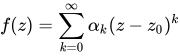
be a power series converging in the disk Dr(z0), r > 0, defined by
- Failed to parse (Conversion error. Server ("https://wikimedia.org/api/rest_") reported: "Cannot get mml. Server problem."): {\displaystyle D_{r}(z_{0})=\{z\in \mathbb {C} :|z-z_{0}|<r\}} .
Note that without loss of generality, here and below, we will always assume that a maximal such r was chosen, even if that r is ∞. Also note that it would be equivalent to begin with an analytic function defined on some small open set. We say that the vector
- Failed to parse (Conversion error. Server ("https://wikimedia.org/api/rest_") reported: "Cannot get mml. Server problem."): {\displaystyle g=(z_{0},\alpha _{0},\alpha _{1},\alpha _{2},\ldots )}
is a germ of f. The base g0 of g is z0, the stem of g is (α0, α1, α2, ...) and the top g1 of g is α0. The top of g is the value of f at z0.
Any vector g = (z0, α0, α1, ...) is a germ if it represents a power series of an analytic function around z0 with some radius of convergence r > 0. Therefore, we can safely speak of the set of germs .

The topology of the set of germs
[edit | edit source]Let g and h be germs. If Failed to parse (Conversion error. Server ("https://wikimedia.org/api/rest_") reported: "Cannot get mml. Server problem."): {\displaystyle |h_{0}-g_{0}|<r} where r is the radius of convergence of g and if the power series defined by g and h specify identical functions on the intersection of the two domains, then we say that h is generated by (or compatible with) g, and we write g ≥ h. This compatibility condition is neither transitive, symmetric nor antisymmetric. If we extend the relation by transitivity, we obtain a symmetric relation, which is therefore also an equivalence relation on germs (but not an ordering). This extension by transitivity is one definition of analytic continuation. The equivalence relation will be denoted Failed to parse (Conversion error. Server ("https://wikimedia.org/api/rest_") reported: "Cannot get mml. Server problem."): {\displaystyle \cong } .
We can define a topology on . Let r > 0, and let
- Failed to parse (Conversion error. Server ("https://wikimedia.org/api/rest_") reported: "Cannot get mml. Server problem."): {\displaystyle U_{r}(g)=\{h\in {\mathcal {G}}:g\geq h,|g_{0}-h_{0}|<r\}.}
The sets Ur(g), for all r > 0 and Failed to parse (Conversion error. Server ("https://wikimedia.org/api/rest_") reported: "Cannot get mml. Server problem."): {\displaystyle g\in {\mathcal {G}}} define a basis of open sets for the topology on .
A connected component of (i.e., an equivalence class) is called a sheaf. We also note that the map defined by Failed to parse (Conversion error. Server ("https://wikimedia.org/api/rest_") reported: "Cannot get mml. Server problem."): {\displaystyle \phi _{g}(h)=h_{0}:U_{r}(g)\to \mathbb {C} ,} where r is the radius of convergence of g, is a chart. The set of such charts forms an atlas for , hence is a Riemann surface. is sometimes called the universal analytic function.
Examples of analytic continuation
[edit | edit source]- Failed to parse (Conversion error. Server ("https://wikimedia.org/api/rest_") reported: "Cannot get mml. Server problem."): {\displaystyle L(z)=\sum _{k=1}^{\infty }{\frac {(-1)^{k+1}}{k}}(z-1)^{k}}
is a power series corresponding to the natural logarithm near z = 1. This power series can be turned into a germ
- Failed to parse (Conversion error. Server ("https://wikimedia.org/api/rest_") reported: "Cannot get mml. Server problem."): {\displaystyle g=\left(1,0,1,-{\frac {1}{2}},{\frac {1}{3}},-{\frac {1}{4}},{\frac {1}{5}},-{\frac {1}{6}},\ldots \right)}
This germ has a radius of convergence of 1, and so there is a sheaf S corresponding to it. This is the sheaf of the logarithm function.
The uniqueness theorem for analytic functions also extends to sheaves of analytic functions: if the sheaf of an analytic function contains the zero germ (i.e., the sheaf is uniformly zero in some neighborhood) then the entire sheaf is zero. Armed with this result, we can see that if we take any germ g of the sheaf S of the logarithm function, as described above, and turn it into a power series f(z) then this function will have the property that exp(f(z)) = z. If we had decided to use a version of the inverse function theorem for analytic functions, we could construct a wide variety of inverses for the exponential map, but we would discover that they are all represented by some germ in S. In that sense, S is the "one true inverse" of the exponential map.
In older literature, sheaves of analytic functions were called multi-valued functions. See sheaf for the general concept.
Natural boundary
[edit | edit source]Suppose that a power series has radius of convergence r and defines an analytic function f inside that disc. Consider points on the circle of convergence. A point for which there is a neighbourhood on which f has an analytic extension is regular, otherwise singular. The circle is a natural boundary if all its points are singular.
More generally, we may apply the definition to any open connected domain on which f is analytic, and classify the points of the boundary of the domain as regular or singular: the domain boundary is then a natural boundary if all points are singular, in which case the domain is a domain of holomorphy.
Example I: A function with a natural boundary at zero (the prime zeta function)
[edit | edit source]For we define the so-called prime zeta function, Failed to parse (Conversion error. Server ("https://wikimedia.org/api/rest_") reported: "Cannot get mml. Server problem."): {\displaystyle P(s)} , to be

- Failed to parse (Conversion error. Server ("https://wikimedia.org/api/rest_") reported: "Cannot get mml. Server problem."): {\displaystyle P(s):=\sum _{p\ {\text{ prime}}}p^{-s}.}
This function is analogous to the summatory form of the Riemann zeta function when in so much as it is the same summatory function as Failed to parse (Conversion error. Server ("https://wikimedia.org/api/rest_") reported: "Cannot get mml. Server problem."): {\displaystyle \zeta (s)} , except with indices restricted only to the prime numbers instead of taking the sum over all positive natural numbers. The prime zeta function has an analytic continuation to all complex s such that Failed to parse (Conversion error. Server ("https://wikimedia.org/api/rest_") reported: "Cannot get mml. Server problem."): {\displaystyle 0<\Re (s)<1} , a fact which follows from the expression of Failed to parse (Conversion error. Server ("https://wikimedia.org/api/rest_") reported: "Cannot get mml. Server problem."): {\displaystyle P(s)} by the logarithms of the Riemann zeta function as
- Failed to parse (Conversion error. Server ("https://wikimedia.org/api/rest_") reported: "Cannot get mml. Server problem."): {\displaystyle P(s)=\sum _{n\geq 1}\mu (n){\frac {\log \zeta (ns)}{n}}.}
Since Failed to parse (Conversion error. Server ("https://wikimedia.org/api/rest_") reported: "Cannot get mml. Server problem."): {\displaystyle \zeta (s)} has a simple, non-removable pole at Failed to parse (Conversion error. Server ("https://wikimedia.org/api/rest_") reported: "Cannot get mml. Server problem."): {\displaystyle s:=1} , it can then be seen that has a simple pole at Failed to parse (Conversion error. Server ("https://wikimedia.org/api/rest_") reported: "Cannot get mml. Server problem."): {\displaystyle s:={\tfrac {1}{k}},\forall k\in \mathbb {Z} ^{+}} . Since the set of points

- Failed to parse (Conversion error. Server ("https://wikimedia.org/api/rest_") reported: "Cannot get mml. Server problem."): {\displaystyle \operatorname {Sing} _{P}:=\left\{k^{-1}:k\in \mathbb {Z} ^{+}\right\}=\left\{1,{\frac {1}{2}},{\frac {1}{3}},{\frac {1}{4}},\ldots \right\}}
has accumulation point 0 (the limit of the sequence as Failed to parse (Conversion error. Server ("https://wikimedia.org/api/rest_") reported: "Cannot get mml. Server problem."): {\displaystyle k\mapsto \infty } ), we can see that zero forms a natural boundary for . This implies that has no analytic continuation for s left of (or at) zero, i.e., there is no continuation possible for when Failed to parse (Conversion error. Server ("https://wikimedia.org/api/rest_") reported: "Cannot get mml. Server problem."): {\displaystyle 0\geq \Re (s)} . As a remark, this fact can be problematic if we are performing a complex contour integral over an interval whose real parts are symmetric about zero, say Failed to parse (Conversion error. Server ("https://wikimedia.org/api/rest_") reported: "Cannot get mml. Server problem."): {\displaystyle I_{F}\subseteq \mathbb {C} \ {\text{such that}}\ \Re (s)\in (-C,C),\forall s\in I_{F}} for some Failed to parse (Conversion error. Server ("https://wikimedia.org/api/rest_") reported: "Cannot get mml. Server problem."): {\displaystyle C>0} , where the integrand is a function with denominator that depends on in an essential way.
Example II: A typical lacunary series (natural boundary as subsets of the unit circle)
[edit | edit source]For integers Failed to parse (Conversion error. Server ("https://wikimedia.org/api/rest_") reported: "Cannot get mml. Server problem."): {\displaystyle c\geq 2} , we define the lacunary series of order c by the power series expansion
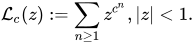


Clearly, since Failed to parse (Conversion error. Server ("https://wikimedia.org/api/rest_") reported: "Cannot get mml. Server problem."): {\displaystyle c^{n+1}=c\cdot c^{n}} there is a functional equation for Failed to parse (Conversion error. Server ("https://wikimedia.org/api/rest_") reported: "Cannot get mml. Server problem."): {\displaystyle {\mathcal {L}}_{c}(z)} for any z satisfying Failed to parse (Conversion error. Server ("https://wikimedia.org/api/rest_") reported: "Cannot get mml. Server problem."): {\displaystyle |z|<1} given by Failed to parse (Conversion error. Server ("https://wikimedia.org/api/rest_") reported: "Cannot get mml. Server problem."): {\displaystyle {\mathcal {L}}_{c}(z)=z^{c}+{\mathcal {L}}_{c}(z^{c})} . It is also not difficult to see that for any integer Failed to parse (Conversion error. Server ("https://wikimedia.org/api/rest_") reported: "Cannot get mml. Server problem."): {\displaystyle m\geq 1} , we have another functional equation for Failed to parse (Conversion error. Server ("https://wikimedia.org/api/rest_") reported: "Cannot get mml. Server problem."): {\displaystyle {\mathcal {L}}_{c}(z)} given by
- Failed to parse (Conversion error. Server ("https://wikimedia.org/api/rest_") reported: "Cannot get mml. Server problem."): {\displaystyle {\mathcal {L}}_{c}(z)=\sum _{i=0}^{m-1}z^{c^{i}}+{\mathcal {L}}_{c}(z^{c^{m}}),\forall |z|<1.}
For any positive natural numbers c, the lacunary series function diverges at Failed to parse (SVG (MathML can be enabled via browser plugin): Invalid response ("Math extension cannot connect to Restbase.") from server "https://wikimedia.org/api/rest_v1/":): {\displaystyle z = 1} . We consider the question of analytic continuation of Failed to parse (Conversion error. Server ("https://wikimedia.org/api/rest_") reported: "Cannot get mml. Server problem."): {\displaystyle {\mathcal {L}}_{c}(z)} to other complex z such that Failed to parse (SVG (MathML can be enabled via browser plugin): Invalid response ("Math extension cannot connect to Restbase.") from server "https://wikimedia.org/api/rest_v1/":): {\displaystyle |z| > 1.} As we shall see, for any Failed to parse (SVG (MathML can be enabled via browser plugin): Invalid response ("Math extension cannot connect to Restbase.") from server "https://wikimedia.org/api/rest_v1/":): {\displaystyle n \geq 1} , the function Failed to parse (SVG (MathML can be enabled via browser plugin): Invalid response ("Math extension cannot connect to Restbase.") from server "https://wikimedia.org/api/rest_v1/":): {\displaystyle \mathcal{L}_c(z)} diverges at the Failed to parse (SVG (MathML can be enabled via browser plugin): Invalid response ("Math extension cannot connect to Restbase.") from server "https://wikimedia.org/api/rest_v1/":): {\displaystyle c^{n}} -th roots of unity. Hence, since the set formed by all such roots is dense on the boundary of the unit circle, there is no analytic continuation of Failed to parse (SVG (MathML can be enabled via browser plugin): Invalid response ("Math extension cannot connect to Restbase.") from server "https://wikimedia.org/api/rest_v1/":): {\displaystyle \mathcal{L}_c(z)} to complex z whose modulus exceeds one.
The proof of this fact is generalized from a standard argument for the case where Failed to parse (SVG (MathML can be enabled via browser plugin): Invalid response ("Math extension cannot connect to Restbase.") from server "https://wikimedia.org/api/rest_v1/":): {\displaystyle c := 2.} [2] Namely, for integers Failed to parse (SVG (MathML can be enabled via browser plugin): Invalid response ("Math extension cannot connect to Restbase.") from server "https://wikimedia.org/api/rest_v1/":): {\displaystyle n \geq 1} , let
- Failed to parse (SVG (MathML can be enabled via browser plugin): Invalid response ("Math extension cannot connect to Restbase.") from server "https://wikimedia.org/api/rest_v1/":): {\displaystyle \mathcal{R}_{c,n} := \left \{z \in \mathbb{D} \cup \partial{\mathbb{D}}: z^{c^n} = 1 \right \},}
where Failed to parse (SVG (MathML can be enabled via browser plugin): Invalid response ("Math extension cannot connect to Restbase.") from server "https://wikimedia.org/api/rest_v1/":): {\displaystyle \mathbb{D}} denotes the open unit disk in the complex plane and Failed to parse (SVG (MathML can be enabled via browser plugin): Invalid response ("Math extension cannot connect to Restbase.") from server "https://wikimedia.org/api/rest_v1/":): {\displaystyle |\mathcal{R}_{c,n} | = c^n} , i.e., there are Failed to parse (SVG (MathML can be enabled via browser plugin): Invalid response ("Math extension cannot connect to Restbase.") from server "https://wikimedia.org/api/rest_v1/":): {\displaystyle c^n} distinct complex numbers z that lie on or inside the unit circle such that Failed to parse (SVG (MathML can be enabled via browser plugin): Invalid response ("Math extension cannot connect to Restbase.") from server "https://wikimedia.org/api/rest_v1/":): {\displaystyle z^{c^n} = 1} . Now the key part of the proof is to use the functional equation for Failed to parse (SVG (MathML can be enabled via browser plugin): Invalid response ("Math extension cannot connect to Restbase.") from server "https://wikimedia.org/api/rest_v1/":): {\displaystyle \mathcal{L}_c(z)} when Failed to parse (SVG (MathML can be enabled via browser plugin): Invalid response ("Math extension cannot connect to Restbase.") from server "https://wikimedia.org/api/rest_v1/":): {\displaystyle |z| < 1} to show that
- Failed to parse (SVG (MathML can be enabled via browser plugin): Invalid response ("Math extension cannot connect to Restbase.") from server "https://wikimedia.org/api/rest_v1/":): {\displaystyle \forall z \in \mathcal{R}_{c,n}, \qquad \mathcal{L}_c(z) = \sum_{i=0}^{c^n-1} z^{c^i} + \mathcal{L}_c(z^{c^n}) = \sum_{i=0}^{c^n-1} z^{c^i} + \mathcal{L}_c(1) = +\infty.}
Thus for any arc on the boundary of the unit circle, there are an infinite number of points z within this arc such that Failed to parse (SVG (MathML can be enabled via browser plugin): Invalid response ("Math extension cannot connect to Restbase.") from server "https://wikimedia.org/api/rest_v1/":): {\displaystyle \mathcal{L}_c(z) = \infty} . This condition is equivalent to saying that the circle Failed to parse (SVG (MathML can be enabled via browser plugin): Invalid response ("Math extension cannot connect to Restbase.") from server "https://wikimedia.org/api/rest_v1/":): {\displaystyle C_1 := \{z: |z| = 1\}} forms a natural boundary for the function Failed to parse (SVG (MathML can be enabled via browser plugin): Invalid response ("Math extension cannot connect to Restbase.") from server "https://wikimedia.org/api/rest_v1/":): {\displaystyle \mathcal{L}_c(z)} for any fixed choice of Failed to parse (SVG (MathML can be enabled via browser plugin): Invalid response ("Math extension cannot connect to Restbase.") from server "https://wikimedia.org/api/rest_v1/":): {\displaystyle c \in \Z \quad c > 1.} Hence, there is no analytic continuation for these functions beyond the interior of the unit circle.
Monodromy theorem
[edit | edit source]The monodromy theorem gives a sufficient condition for the existence of a direct analytic continuation (i.e., an extension of an analytic function to an analytic function on a bigger set).
Suppose Failed to parse (SVG (MathML can be enabled via browser plugin): Invalid response ("Math extension cannot connect to Restbase.") from server "https://wikimedia.org/api/rest_v1/":): {\displaystyle D\subset \Complex} is an open set and f an analytic function on D. If G is a simply connected domain containing D, such that f has an analytic continuation along every path in G, starting from some fixed point a in D, then f has a direct analytic continuation to G.
In the above language this means that if G is a simply connected domain, and S is a sheaf whose set of base points contains G, then there exists an analytic function f on G whose germs belong to S.
Hadamard's gap theorem
[edit | edit source]For a power series
- Failed to parse (SVG (MathML can be enabled via browser plugin): Invalid response ("Math extension cannot connect to Restbase.") from server "https://wikimedia.org/api/rest_v1/":): {\displaystyle f(z)=\sum_{k=0}^\infty a_k z^{n_k}}
with
- Failed to parse (SVG (MathML can be enabled via browser plugin): Invalid response ("Math extension cannot connect to Restbase.") from server "https://wikimedia.org/api/rest_v1/":): {\displaystyle \liminf_{k\to\infty}\frac{n_{k+1}}{n_k} > 1}
the circle of convergence is a natural boundary. Such a power series is called lacunary. This theorem has been substantially generalized by Eugène Fabry (see Fabry's gap theorem) and George Pólya.
Pólya's theorem
[edit | edit source]Let
- Failed to parse (SVG (MathML can be enabled via browser plugin): Invalid response ("Math extension cannot connect to Restbase.") from server "https://wikimedia.org/api/rest_v1/":): {\displaystyle f(z)=\sum_{k=0}^\infty \alpha_k (z-z_0)^k}
be a power series. Then there exist εk ∈ {−1, 1} such that
- Failed to parse (SVG (MathML can be enabled via browser plugin): Invalid response ("Math extension cannot connect to Restbase.") from server "https://wikimedia.org/api/rest_v1/":): {\displaystyle g(z)=\sum_{k=0}^\infty \varepsilon_k\alpha_k (z-z_0)^k}
has the convergence disc of f around z0 as a natural boundary.
The proof of this theorem makes use of Hadamard's gap theorem.
See also
[edit | edit source]- Mittag-Leffler star
- Holomorphic functional calculus
- Numerical analytic continuation
- Polya's shire theorem
References
[edit | edit source]- ↑ Kruskal, M. D. (1960-09-01). "Maximal Extension of Schwarzschild Metric". Physical Review. 119 (5): 1743–1745. Bibcode:1960PhRv..119.1743K. doi:10.1103/PhysRev.119.1743.
- ↑ See the example given on the MathWorld page for natural boundary.
- Lars Ahlfors (1979). Complex Analysis (3 ed.). McGraw-Hill. pp. 172, 284.
- Ludwig Bieberbach (1955). Analytische Fortsetzung. Springer-Verlag.
- P. Dienes (1957). The Taylor series: an introduction to the theory of functions of a complex variable. New York: Dover Publications, Inc. Bibcode:1957tsai.book.....D.