Banach algebra
In mathematics, especially functional analysis, a Banach algebra, named after Stefan Banach, is an associative algebra over the real or complex numbers (or over a non-Archimedean complete normed field) that at the same time is also a Banach space, that is, a normed space that is complete in the metric induced by the norm. The norm is required to satisfy Failed to parse (Conversion error. Server ("https://wikimedia.org/api/rest_") reported: "Cannot get mml. Server problem."): {\displaystyle \|x\,y\|\ \leq \|x\|\,\|y\|\quad {\text{ for all }}x,y\in A.}

This ensures that the multiplication operation is continuous with respect to the metric topology.
A Banach algebra is called unital if it has an identity element for the multiplication whose norm is Failed to parse (Conversion error. Server ("https://wikimedia.org/api/rest_") reported: "Cannot get mml. Server problem."): {\displaystyle 1,} and commutative if its multiplication is commutative. Any Banach algebra (whether it is unital or not) can be embedded isometrically into a unital Banach algebra so as to form a closed ideal of . Often one assumes a priori that the algebra under consideration is unital because one can develop much of the theory by considering and then applying the outcome in the original algebra. However, this is not the case all the time. For example, one cannot define all the trigonometric functions in a Banach algebra without identity.

The theory of real Banach algebras can be very different from the theory of complex Banach algebras. For example, the spectrum of an element of a nontrivial complex Banach algebra can never be empty, whereas in a real Banach algebra it could be empty for some elements.
Banach algebras can also be defined over fields of -adic numbers. This is part of -adic analysis.

Examples
[edit | edit source]The prototypical example of a Banach algebra is Failed to parse (Conversion error. Server ("https://wikimedia.org/api/rest_") reported: "Cannot get mml. Server problem."): {\displaystyle C_{0}(X)} , the space of (complex-valued) continuous functions, defined on a locally compact Hausdorff space , that vanish at infinity. Failed to parse (Conversion error. Server ("https://wikimedia.org/api/rest_") reported: "Cannot get mml. Server problem."): {\displaystyle C_{0}(X)} is unital if and only if is compact. The complex conjugation being an involution, Failed to parse (Conversion error. Server ("https://wikimedia.org/api/rest_") reported: "Cannot get mml. Server problem."): {\displaystyle C_{0}(X)} is in fact a C*-algebra. More generally, every C*-algebra is a Banach algebra by definition.

- The set of real (or complex) numbers is a Banach algebra with norm given by the absolute value.
- The set of all real or complex -by- matrices becomes a unital Banach algebra if we equip it with a sub-multiplicative matrix norm.
- Take the Banach space (or Failed to parse (Conversion error. Server ("https://wikimedia.org/api/rest_") reported: "Cannot get mml. Server problem."): {\displaystyle \mathbb {C} ^{n}} ) with norm Failed to parse (Conversion error. Server ("https://wikimedia.org/api/rest_") reported: "Cannot get mml. Server problem."): {\displaystyle \|x\|=\max _{}|x_{i}|} and define multiplication componentwise: Failed to parse (Conversion error. Server ("https://wikimedia.org/api/rest_") reported: "Cannot get mml. Server problem."): {\displaystyle \left(x_{1},\ldots ,x_{n}\right)\left(y_{1},\ldots ,y_{n}\right)=\left(x_{1}y_{1},\ldots ,x_{n}y_{n}\right).}
- The quaternions form a 4-dimensional real Banach algebra, with the norm being given by the absolute value of quaternions.
- The algebra of all bounded real- or complex-valued functions defined on some set (with pointwise multiplication and the supremum norm) is a unital Banach algebra.
- The algebra of all bounded continuous real- or complex-valued functions on some locally compact space (again with pointwise operations and supremum norm) is a Banach algebra.
- The algebra of all continuous linear operators on a Banach space (with functional composition as multiplication and the operator norm as norm) is a unital Banach algebra. The set of all compact operators on is a Banach algebra and closed ideal. It is without identity if Failed to parse (Conversion error. Server ("https://wikimedia.org/api/rest_") reported: "Cannot get mml. Server problem."): {\displaystyle \dim E=\infty .} [1]
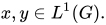
- If is a locally compact Hausdorff topological group and is its Haar measure, then the Banach space Failed to parse (Conversion error. Server ("https://wikimedia.org/api/rest_") reported: "Cannot get mml. Server problem."): {\displaystyle L^{1}(G)} of all -integrable functions on becomes a Banach algebra under the convolution Failed to parse (Conversion error. Server ("https://wikimedia.org/api/rest_") reported: "Cannot get mml. Server problem."): {\displaystyle xy(g)=\int x(h)y\left(h^{-1}g\right)d\mu (h)} for [2]
- Uniform algebra: A Banach algebra that is a subalgebra of the complex algebra Failed to parse (Conversion error. Server ("https://wikimedia.org/api/rest_") reported: "Cannot get mml. Server problem."): {\displaystyle C(X)} with the supremum norm and that contains the constants and separates the points of (which must be a compact Hausdorff space).
- Natural Banach function algebra: A uniform algebra all of whose characters are evaluations at points of Failed to parse (Conversion error. Server ("https://wikimedia.org/api/rest_") reported: "Cannot get mml. Server problem."): {\displaystyle X.}
- C*-algebra: A Banach algebra that is a closed *-subalgebra of the algebra of bounded operators on some Hilbert space.
- Measure algebra: A Banach algebra consisting of all Radon measures on some locally compact group, where the product of two measures is given by convolution of measures.[2]
- The algebra of the quaternions is a real Banach algebra, but it is not a complex algebra (and hence not a complex Banach algebra) for the simple reason that the center of the quaternions is the real numbers, which cannot contain a copy of the complex numbers.
- An affinoid algebra is a certain kind of Banach algebra over a nonarchimedean field. Affinoid algebras are the basic building blocks in rigid analytic geometry.



Properties
[edit | edit source]Several elementary functions that are defined via power series may be defined in any unital Banach algebra; examples include the exponential function and the trigonometric functions, and more generally any entire function. (In particular, the exponential map can be used to define abstract index groups.) The formula for the geometric series remains valid in general unital Banach algebras. The binomial theorem also holds for two commuting elements of a Banach algebra.
The set of invertible elements in any unital Banach algebra is an open set, and the inversion operation on this set is continuous (and hence is a homeomorphism), so that it forms a topological group under multiplication.[3]
If a Banach algebra has unit Failed to parse (Conversion error. Server ("https://wikimedia.org/api/rest_") reported: "Cannot get mml. Server problem."): {\displaystyle \mathbf {1} ,} then Failed to parse (Conversion error. Server ("https://wikimedia.org/api/rest_") reported: "Cannot get mml. Server problem."): {\displaystyle \mathbf {1} } cannot be a commutator; that is, Failed to parse (Conversion error. Server ("https://wikimedia.org/api/rest_") reported: "Cannot get mml. Server problem."): {\displaystyle xy-yx\neq \mathbf {1} } for any Failed to parse (Conversion error. Server ("https://wikimedia.org/api/rest_") reported: "Cannot get mml. Server problem."): {\displaystyle x,y\in A.} This is because Failed to parse (Conversion error. Server ("https://wikimedia.org/api/rest_") reported: "Cannot get mml. Server problem."): {\displaystyle xy} and Failed to parse (Conversion error. Server ("https://wikimedia.org/api/rest_") reported: "Cannot get mml. Server problem."): {\displaystyle yx} have the same spectrum except possibly

The various algebras of functions given in the examples above have very different properties from standard examples of algebras such as the reals. For example:
- Every real Banach algebra that is a division algebra is isomorphic to the reals, the complexes, or the quaternions. Hence, the only complex Banach algebra that is a division algebra is the complexes. (This is known as the Gelfand–Mazur theorem.)
- Every unital real Banach algebra with no zero divisors, and in which every principal ideal is closed, is isomorphic to the reals, the complexes, or the quaternions.[4]
- Every commutative real unital Noetherian Banach algebra with no zero divisors is isomorphic to the real or complex numbers.
- Every commutative real unital Noetherian Banach algebra (possibly having zero divisors) is finite-dimensional.
- Permanently singular elements in Banach algebras are topological divisors of zero, that is, considering extensions of Banach algebras some elements that are singular in the given algebra have a multiplicative inverse element in a Banach algebra extension Failed to parse (Conversion error. Server ("https://wikimedia.org/api/rest_") reported: "Cannot get mml. Server problem."): {\displaystyle B.} Topological divisors of zero in are permanently singular in any Banach extension of Failed to parse (Conversion error. Server ("https://wikimedia.org/api/rest_") reported: "Cannot get mml. Server problem."): {\displaystyle A.}

Spectral theory
[edit | edit source]Unital Banach algebras over the complex field provide a general setting to develop spectral theory. The spectrum of an element Failed to parse (Conversion error. Server ("https://wikimedia.org/api/rest_") reported: "Cannot get mml. Server problem."): {\displaystyle x\in A,} denoted by , consists of all those complex scalars such that Failed to parse (Conversion error. Server ("https://wikimedia.org/api/rest_") reported: "Cannot get mml. Server problem."): {\displaystyle x-\lambda \mathbf {1} } is not invertible in Failed to parse (Conversion error. Server ("https://wikimedia.org/api/rest_") reported: "Cannot get mml. Server problem."): {\displaystyle A.} The spectrum of any element is a closed subset of the closed disc in with radius Failed to parse (Conversion error. Server ("https://wikimedia.org/api/rest_") reported: "Cannot get mml. Server problem."): {\displaystyle \|x\|} and center Failed to parse (Conversion error. Server ("https://wikimedia.org/api/rest_") reported: "Cannot get mml. Server problem."): {\displaystyle 0,} and thus is compact. Moreover, the spectrum of an element is non-empty and satisfies the spectral radius formula: Failed to parse (Conversion error. Server ("https://wikimedia.org/api/rest_") reported: "Cannot get mml. Server problem."): {\displaystyle \sup\{|\lambda |:\lambda \in \sigma (x)\}=\lim _{n\to \infty }\|x^{n}\|^{1/n}.}


Given Failed to parse (Conversion error. Server ("https://wikimedia.org/api/rest_") reported: "Cannot get mml. Server problem."): {\displaystyle x\in A,} the holomorphic functional calculus allows to define Failed to parse (Conversion error. Server ("https://wikimedia.org/api/rest_") reported: "Cannot get mml. Server problem."): {\displaystyle f(x)\in A} for any function holomorphic in a neighborhood of Failed to parse (Conversion error. Server ("https://wikimedia.org/api/rest_") reported: "Cannot get mml. Server problem."): {\displaystyle \sigma (x).} Furthermore, the spectral mapping theorem holds:[5] Failed to parse (Conversion error. Server ("https://wikimedia.org/api/rest_") reported: "Cannot get mml. Server problem."): {\displaystyle \sigma (f(x))=f(\sigma (x)).}

When the Banach algebra is the algebra of bounded linear operators on a complex Banach space (for example, the algebra of square matrices), the notion of the spectrum in coincides with the usual one in operator theory. For Failed to parse (Conversion error. Server ("https://wikimedia.org/api/rest_") reported: "Cannot get mml. Server problem."): {\displaystyle f\in C(X)} (with a compact Hausdorff space ), one sees that: Failed to parse (Conversion error. Server ("https://wikimedia.org/api/rest_") reported: "Cannot get mml. Server problem."): {\displaystyle \sigma (f)=\{f(t):t\in X\}.}

The norm of a normal element of a C*-algebra coincides with its spectral radius. This generalizes an analogous fact for normal operators.
Let be a complex unital Banach algebra in which every non-zero element is invertible (a division algebra). For every Failed to parse (Conversion error. Server ("https://wikimedia.org/api/rest_") reported: "Cannot get mml. Server problem."): {\displaystyle a\in A,} there is Failed to parse (Conversion error. Server ("https://wikimedia.org/api/rest_") reported: "Cannot get mml. Server problem."): {\displaystyle \lambda \in \mathbb {C} } such that Failed to parse (Conversion error. Server ("https://wikimedia.org/api/rest_") reported: "Cannot get mml. Server problem."): {\displaystyle a-\lambda \mathbf {1} } is not invertible (because the spectrum of is not empty) hence Failed to parse (Conversion error. Server ("https://wikimedia.org/api/rest_") reported: "Cannot get mml. Server problem."): {\displaystyle a=\lambda \mathbf {1} :} this algebra is naturally isomorphic to (the complex case of the Gelfand–Mazur theorem).

Ideals and characters
[edit | edit source]Let be a unital commutative Banach algebra over Failed to parse (Conversion error. Server ("https://wikimedia.org/api/rest_") reported: "Cannot get mml. Server problem."): {\displaystyle \mathbb {C} .} Since is then a commutative ring with unit, every non-invertible element of Failed to parse (SVG (MathML can be enabled via browser plugin): Invalid response ("Math extension cannot connect to Restbase.") from server "https://wikimedia.org/api/rest_v1/":): {\displaystyle A} belongs to some maximal ideal of Failed to parse (SVG (MathML can be enabled via browser plugin): Invalid response ("Math extension cannot connect to Restbase.") from server "https://wikimedia.org/api/rest_v1/":): {\displaystyle A.} Since a maximal ideal Failed to parse (SVG (MathML can be enabled via browser plugin): Invalid response ("Math extension cannot connect to Restbase.") from server "https://wikimedia.org/api/rest_v1/":): {\displaystyle \mathfrak m} in Failed to parse (SVG (MathML can be enabled via browser plugin): Invalid response ("Math extension cannot connect to Restbase.") from server "https://wikimedia.org/api/rest_v1/":): {\displaystyle A} is closed, Failed to parse (SVG (MathML can be enabled via browser plugin): Invalid response ("Math extension cannot connect to Restbase.") from server "https://wikimedia.org/api/rest_v1/":): {\displaystyle A / \mathfrak m} is a Banach algebra that is a field, and it follows from the Gelfand–Mazur theorem that there is a bijection between the set of all maximal ideals of Failed to parse (SVG (MathML can be enabled via browser plugin): Invalid response ("Math extension cannot connect to Restbase.") from server "https://wikimedia.org/api/rest_v1/":): {\displaystyle A} and the set Failed to parse (SVG (MathML can be enabled via browser plugin): Invalid response ("Math extension cannot connect to Restbase.") from server "https://wikimedia.org/api/rest_v1/":): {\displaystyle \Delta(A)} of all nonzero homomorphisms from Failed to parse (SVG (MathML can be enabled via browser plugin): Invalid response ("Math extension cannot connect to Restbase.") from server "https://wikimedia.org/api/rest_v1/":): {\displaystyle A} to Failed to parse (SVG (MathML can be enabled via browser plugin): Invalid response ("Math extension cannot connect to Restbase.") from server "https://wikimedia.org/api/rest_v1/":): {\displaystyle \Complex.} The set Failed to parse (SVG (MathML can be enabled via browser plugin): Invalid response ("Math extension cannot connect to Restbase.") from server "https://wikimedia.org/api/rest_v1/":): {\displaystyle \Delta(A)} is called the "structure space" or "character space" of Failed to parse (SVG (MathML can be enabled via browser plugin): Invalid response ("Math extension cannot connect to Restbase.") from server "https://wikimedia.org/api/rest_v1/":): {\displaystyle A,} and its members "characters".
A character Failed to parse (SVG (MathML can be enabled via browser plugin): Invalid response ("Math extension cannot connect to Restbase.") from server "https://wikimedia.org/api/rest_v1/":): {\displaystyle \chi} is a linear functional on Failed to parse (SVG (MathML can be enabled via browser plugin): Invalid response ("Math extension cannot connect to Restbase.") from server "https://wikimedia.org/api/rest_v1/":): {\displaystyle A} that is at the same time multiplicative, Failed to parse (SVG (MathML can be enabled via browser plugin): Invalid response ("Math extension cannot connect to Restbase.") from server "https://wikimedia.org/api/rest_v1/":): {\displaystyle \chi(a b) = \chi(a) \chi(b),} and satisfies Failed to parse (SVG (MathML can be enabled via browser plugin): Invalid response ("Math extension cannot connect to Restbase.") from server "https://wikimedia.org/api/rest_v1/":): {\displaystyle \chi(\mathbf{1}) = 1.} Every character is automatically continuous from Failed to parse (SVG (MathML can be enabled via browser plugin): Invalid response ("Math extension cannot connect to Restbase.") from server "https://wikimedia.org/api/rest_v1/":): {\displaystyle A} to Failed to parse (SVG (MathML can be enabled via browser plugin): Invalid response ("Math extension cannot connect to Restbase.") from server "https://wikimedia.org/api/rest_v1/":): {\displaystyle \Complex,} since the kernel of a character is a maximal ideal, which is closed. Moreover, the norm (that is, operator norm) of a character is one. Equipped with the topology of pointwise convergence on Failed to parse (SVG (MathML can be enabled via browser plugin): Invalid response ("Math extension cannot connect to Restbase.") from server "https://wikimedia.org/api/rest_v1/":): {\displaystyle A} (that is, the topology induced by the weak-* topology of Failed to parse (SVG (MathML can be enabled via browser plugin): Invalid response ("Math extension cannot connect to Restbase.") from server "https://wikimedia.org/api/rest_v1/":): {\displaystyle A^*} ), the character space, Failed to parse (SVG (MathML can be enabled via browser plugin): Invalid response ("Math extension cannot connect to Restbase.") from server "https://wikimedia.org/api/rest_v1/":): {\displaystyle \Delta(A),} is a Hausdorff compact space.
For any Failed to parse (SVG (MathML can be enabled via browser plugin): Invalid response ("Math extension cannot connect to Restbase.") from server "https://wikimedia.org/api/rest_v1/":): {\displaystyle x \in A,} Failed to parse (SVG (MathML can be enabled via browser plugin): Invalid response ("Math extension cannot connect to Restbase.") from server "https://wikimedia.org/api/rest_v1/":): {\displaystyle \sigma(x) = \sigma(\hat x)} where Failed to parse (SVG (MathML can be enabled via browser plugin): Invalid response ("Math extension cannot connect to Restbase.") from server "https://wikimedia.org/api/rest_v1/":): {\displaystyle \hat x} is the Gelfand representation of Failed to parse (SVG (MathML can be enabled via browser plugin): Invalid response ("Math extension cannot connect to Restbase.") from server "https://wikimedia.org/api/rest_v1/":): {\displaystyle x} defined as follows: Failed to parse (SVG (MathML can be enabled via browser plugin): Invalid response ("Math extension cannot connect to Restbase.") from server "https://wikimedia.org/api/rest_v1/":): {\displaystyle \hat x} is the continuous function from Failed to parse (SVG (MathML can be enabled via browser plugin): Invalid response ("Math extension cannot connect to Restbase.") from server "https://wikimedia.org/api/rest_v1/":): {\displaystyle \Delta(A)} to Failed to parse (SVG (MathML can be enabled via browser plugin): Invalid response ("Math extension cannot connect to Restbase.") from server "https://wikimedia.org/api/rest_v1/":): {\displaystyle \Complex} given by Failed to parse (SVG (MathML can be enabled via browser plugin): Invalid response ("Math extension cannot connect to Restbase.") from server "https://wikimedia.org/api/rest_v1/":): {\displaystyle \hat x(\chi) = \chi(x).} The spectrum of Failed to parse (SVG (MathML can be enabled via browser plugin): Invalid response ("Math extension cannot connect to Restbase.") from server "https://wikimedia.org/api/rest_v1/":): {\displaystyle \hat x,} in the formula above, is the spectrum as element of the algebra Failed to parse (SVG (MathML can be enabled via browser plugin): Invalid response ("Math extension cannot connect to Restbase.") from server "https://wikimedia.org/api/rest_v1/":): {\displaystyle C(\Delta(A))} of complex continuous functions on the compact space Failed to parse (SVG (MathML can be enabled via browser plugin): Invalid response ("Math extension cannot connect to Restbase.") from server "https://wikimedia.org/api/rest_v1/":): {\displaystyle \Delta(A).} Explicitly, Failed to parse (SVG (MathML can be enabled via browser plugin): Invalid response ("Math extension cannot connect to Restbase.") from server "https://wikimedia.org/api/rest_v1/":): {\displaystyle \sigma(\hat x) = \{\chi(x) : \chi \in \Delta(A)\}.}
As an algebra, a unital commutative Banach algebra is semisimple (that is, its Jacobson radical is zero) if and only if its Gelfand representation has trivial kernel. An important example of such an algebra is a commutative C*-algebra. In fact, when Failed to parse (SVG (MathML can be enabled via browser plugin): Invalid response ("Math extension cannot connect to Restbase.") from server "https://wikimedia.org/api/rest_v1/":): {\displaystyle A} is a commutative unital C*-algebra, the Gelfand representation is then an isometric *-isomorphism between Failed to parse (SVG (MathML can be enabled via browser plugin): Invalid response ("Math extension cannot connect to Restbase.") from server "https://wikimedia.org/api/rest_v1/":): {\displaystyle A} and Failed to parse (SVG (MathML can be enabled via browser plugin): Invalid response ("Math extension cannot connect to Restbase.") from server "https://wikimedia.org/api/rest_v1/":): {\displaystyle C(\Delta(A)).} Template:Efn-la
Banach *-algebras
[edit | edit source]A Banach *-algebra Failed to parse (SVG (MathML can be enabled via browser plugin): Invalid response ("Math extension cannot connect to Restbase.") from server "https://wikimedia.org/api/rest_v1/":): {\displaystyle A} is a Banach algebra over the field of complex numbers, together with a map Failed to parse (SVG (MathML can be enabled via browser plugin): Invalid response ("Math extension cannot connect to Restbase.") from server "https://wikimedia.org/api/rest_v1/":): {\displaystyle {}^* : A \to A} that has the following properties:
- Failed to parse (SVG (MathML can be enabled via browser plugin): Invalid response ("Math extension cannot connect to Restbase.") from server "https://wikimedia.org/api/rest_v1/":): {\displaystyle \left(x^*\right)^* = x} for all Failed to parse (SVG (MathML can be enabled via browser plugin): Invalid response ("Math extension cannot connect to Restbase.") from server "https://wikimedia.org/api/rest_v1/":): {\displaystyle x \in A} (so the map is an involution).
- Failed to parse (SVG (MathML can be enabled via browser plugin): Invalid response ("Math extension cannot connect to Restbase.") from server "https://wikimedia.org/api/rest_v1/":): {\displaystyle (x + y)^* = x^* + y^*} for all Failed to parse (SVG (MathML can be enabled via browser plugin): Invalid response ("Math extension cannot connect to Restbase.") from server "https://wikimedia.org/api/rest_v1/":): {\displaystyle x, y \in A.}
- Failed to parse (SVG (MathML can be enabled via browser plugin): Invalid response ("Math extension cannot connect to Restbase.") from server "https://wikimedia.org/api/rest_v1/":): {\displaystyle (\lambda x)^* = \bar{\lambda}x^*} for every Failed to parse (SVG (MathML can be enabled via browser plugin): Invalid response ("Math extension cannot connect to Restbase.") from server "https://wikimedia.org/api/rest_v1/":): {\displaystyle \lambda \in \Complex} and every Failed to parse (SVG (MathML can be enabled via browser plugin): Invalid response ("Math extension cannot connect to Restbase.") from server "https://wikimedia.org/api/rest_v1/":): {\displaystyle x \in A;} here, Failed to parse (SVG (MathML can be enabled via browser plugin): Invalid response ("Math extension cannot connect to Restbase.") from server "https://wikimedia.org/api/rest_v1/":): {\displaystyle \bar{\lambda}} denotes the complex conjugate of Failed to parse (SVG (MathML can be enabled via browser plugin): Invalid response ("Math extension cannot connect to Restbase.") from server "https://wikimedia.org/api/rest_v1/":): {\displaystyle \lambda.}
- Failed to parse (SVG (MathML can be enabled via browser plugin): Invalid response ("Math extension cannot connect to Restbase.") from server "https://wikimedia.org/api/rest_v1/":): {\displaystyle (x y)^* = y^* x^*} for all Failed to parse (SVG (MathML can be enabled via browser plugin): Invalid response ("Math extension cannot connect to Restbase.") from server "https://wikimedia.org/api/rest_v1/":): {\displaystyle x, y \in A.}
In other words, a Banach *-algebra is a Banach algebra over Failed to parse (SVG (MathML can be enabled via browser plugin): Invalid response ("Math extension cannot connect to Restbase.") from server "https://wikimedia.org/api/rest_v1/":): {\displaystyle \Complex} that is also a *-algebra.
In most natural examples, one also has that the involution is isometric, that is, Failed to parse (SVG (MathML can be enabled via browser plugin): Invalid response ("Math extension cannot connect to Restbase.") from server "https://wikimedia.org/api/rest_v1/":): {\displaystyle \|x^*\| = \|x\| \quad \text{ for all } x \in A.} Some authors include this isometric property in the definition of a Banach *-algebra.
A Banach *-algebra satisfying Failed to parse (SVG (MathML can be enabled via browser plugin): Invalid response ("Math extension cannot connect to Restbase.") from server "https://wikimedia.org/api/rest_v1/":): {\displaystyle \|x^* x\| = \|x^*\| \|x\|} is a C*-algebra.
See also
[edit | edit source]Notes
[edit | edit source]References
[edit | edit source]- ↑ Conway 1990, Example VII.1.8.
- ↑ 2.0 2.1 Conway 1990, Example VII.1.9.
- ↑ Conway 1990, Theorem VII.2.2.
- ↑ García, Miguel Cabrera; Palacios, Angel Rodríguez (1995). "A New Simple Proof of the Gelfand-Mazur-Kaplansky Theorem". Proceedings of the American Mathematical Society. 123 (9): 2663–2666. doi:10.2307/2160559. ISSN 0002-9939. JSTOR 2160559.
- ↑ Takesaki 1979, Proposition 2.8.
- Bollobás, B (1990). Linear Analysis. Cambridge University Press. ISBN 0-521-38729-9.
- Bonsall, F. F.; Duncan, J. (1973). Complete Normed Algebras. New York: Springer-Verlag. ISBN 0-387-06386-2.
- Conway, J. B. (1990). A Course in Functional Analysis. Graduate Texts in Mathematics. 96. Springer Verlag. ISBN 0-387-97245-5.
- Dales, H. G.; Aeina, P.; Eschmeier, J; Laursen, K.; Willis, G. A. (2003). Introduction to Banach Algebras, Operators and Harmonic Analysis. Cambridge University Press. doi:10.1017/CBO9780511615429. ISBN 0-521-53584-0.
- Mosak, R. D. (1975). Banach algebras. Chicago Lectures in Mathematics. University of Chicago Press). ISBN 0-226-54203-3.
- Takesaki, M. (1979). Theory of Operator Algebras I. Encyclopaedia of Mathematical Sciences. 124 (1st ed.). Berlin Heidelberg: Springer-Verlag. ISBN 978-3-540-42248-8. ISSN 0938-0396.
Template:Spectral theory Template:Functional analysis Template:Banach spaces