Broccoli
Broccoli (Brassica oleracea var. italica) is an edible green plant in the cabbage family (family Brassicaceae, genus Brassica) whose large flowering head, stalk and small associated leaves are eaten as a vegetable. Broccoli is classified in the Italica cultivar group of the species Brassica oleracea. Broccoli has large flower heads, or florets, usually dark green, arranged in a tree-like structure branching out from a thick stalk, which is usually light green. Leaves surround the mass of flower heads. Broccoli resembles cauliflower, a different but closely related cultivar group of the same Brassica species.
It can be eaten either raw or cooked. Broccoli is a particularly rich source of vitamin C and vitamin K. Contents of its characteristic sulfur-containing glucosinolate compounds, isothiocyanates and sulforaphane, are diminished by boiling but are better preserved by steaming, microwaving or stir-frying.[1]
Rapini, sometimes called "broccoli rabe", is a distinct species from broccoli, forming similar but smaller heads, and is actually a type of turnip (Brassica rapa).[2]
Taxonomy
[edit | edit source]Brassica oleracea var. italica was described in 1794 by Joseph Jakob von Plenck in Icones Plantarum Medicinalium 6:29, t. 534.[3] Like all the other brassicas, broccoli was developed from the wild cabbage (Brassica oleracea var. oleracea), also called colewort or field cabbage.
Etymology
[edit | edit source]The word broccoli, first used in the 17th century, comes from the Italian plural of broccolo, which means "the flowering crest of a cabbage", and is the diminutive form of brocco, meaning "small nail" or "sprout".[4]
History
[edit | edit source]Broccoli resulted from the breeding of landrace Brassica crops in the northern Mediterranean starting in about the sixth century BCE.[5] Broccoli has its origins in primitive cultivars grown in the Roman Empire and was most likely improved via artificial selection in the southern Italian Peninsula or in Sicily.[6][7][8] Broccoli was spread to northern Europe by the 18th century and brought to North America in the 19th century by Italian immigrants.[7] After the Second World War, the breeding of the United States and Japanese F1 hybrids increased yields, quality, growth speed, and regional adaptation, which produced the cultivars commonly grown since then: 'Premium Crop', 'Packman', and 'Marathon'.[7]
Description
[edit | edit source]Broccoli is an annual cruciferous plant which can grow up to Template:Cvt tall.[9]
Broccoli inflorescence grows at the end of a central, edible stem and is dark green.[9] Violet, yellow, or even white heads have been created, but these varieties are rare. The flowers are yellow with four petals.
The growth season for broccoli is 14–15 weeks. Broccoli is collected by hand immediately after the head is fully formed yet the flowers are still in their bud stage. The plant develops numerous small "heads" from the lateral shoots which can be harvested later.
Varieties
[edit | edit source]There are three commonly grown types of broccoli.[7] The most familiar is Calabrese broccoli, often referred to simply as "broccoli", named after Calabria in Italy. It has large 10-to-20-centimetre (4–8 in) green heads and thick stalks. It is a cool-season annual crop. Sprouting broccoli (white or purple) has a larger number of heads with many thin stalks.[10] Purple cauliflower or violet cauliflower is a type of broccoli grown in Europe and North America. It has a head shaped like cauliflower but consists of many tiny flower buds. Sometimes, but not always, it has a purple cast to the tips of the flower buds. Purple cauliflower may also be white, red, green, or other colors.[11]
Beneforté is a variety of broccoli containing 2–3 times more glucoraphanin and produced by crossing broccoli with a wild Brassica variety, Brassica oleracea var villosa.[12]
Other cultivar groups of Brassica oleracea
[edit | edit source]Other cultivar groups of Brassica oleracea include cabbage (Capitata Group), cauliflower and Romanesco broccoli (Botrytis Group), kale (Acephala Group), collard (Viridis Group), kohlrabi (Gongylodes Group), Brussels sprouts (Gemmifera Group), and kai-lan (Alboglabra Group).[13] As these groups are the same species, they readily hybridize: for example, broccolini or "Tenderstem broccoli" is a cross between broccoli and kai-lan.[14] Broccoli cultivars form the genetic basis of the "tropical cauliflowers" commonly grown in South and Southeastern Asia, although they produce a more cauliflower-like head in warmer conditions.[15][7]
Cultivation
[edit | edit source]The majority of broccoli cultivars are cool-weather crops that grow poorly in hot summer weather. Broccoli grows best in an average daily temperature range of 54–68 °F (12–20 °C).[16] When the cluster of flowers (also referred to as a "head") appears in the plant center, the cluster is generally green.[16] Garden pruners or shears are used to cut the head about 25 mm (1 in) from the tip.[16]
 China China |
9.8 |
 India India |
9.8 |
 United States United States |
1.0 |
 Mexico Mexico |
0.7 |
 Spain Spain |
0.7 |
| World | 26.9 |
| *Combined with cauliflower; Source: FAOSTAT, United Nations[17] | |
The growth of the broccoli head is temperature dependent, with higher temperatures leading to poorer head formation, while growth slows below Template:Cvt.[16] The specific response of broccoli to long-term heat-stress conditions, such as may occur with climate change, remain undetermined.[18][better source needed]
Broccoli is harvested before the flowers on the head bloom in a yellow color.[16] Broccoli cannot be harvested using machines, but rather is hand-harvested.[19]
Production
[edit | edit source]In 2024, world production of broccoli (combined with cauliflowers) was 27 million tonnes, with China and India together accounting for 73% of the total (table). Secondary producers, each having about one million tonnes or less annually, were the United States, Mexico, and Spain.
In the United States, broccoli is grown year-round in California, which produced 92% of the crop nationally for sales as fresh produce in 2024.[20]
Nutrition
[edit | edit source]Raw broccoli is 89% water, 7% carbohydrates, 3% protein, and contains negligible fat (table). A 100-gram (3+1⁄2-ounce) reference amount of raw broccoli provides 141 kilojoules (34 kilocalories) of food energy and is a rich source (20% or higher of the Daily Value, DV) of vitamin C (99% DV) and vitamin K (85% DV) (table). Raw broccoli also contains moderate amounts (10–19% DV) of several B vitamins and the dietary mineral potassium, whereas other micronutrients are low in content (less than 10% DV). Broccoli contains the dietary provitamin A carotenoid, beta-carotene.[21]
Cooking
[edit | edit source]Boiling substantially reduces the levels of broccoli glucosinolates, while other cooking methods, such as steaming, microwaving, and stir-frying, have no significant effect on glucosinolate levels.[1]
Taste
[edit | edit source]The perceived bitterness of cruciferous vegetables, such as broccoli, results from glucosinolates and their hydrolysis products, particularly isothiocyanates and other sulfur-containing compounds.[22] Preliminary research indicates that genetic inheritance through the gene TAS2R38 may be responsible in part for bitter taste perception in broccoli.[23]
Pests
[edit | edit source]The larvae of Pieris rapae, also known as the "small white" butterfly, are a common pest in broccoli and were mostly introduced accidentally to North America, Australia, and New Zealand.[24]
Additional pests common to broccoli production include:[25][26]
- Aphids
- Cabbage looper
- Cabbage webworm
- Cross-striped cabbageworm
- Diamondback moth
- Cabbage maggot
- Harlequin cabbage bug
Gallery
[edit | edit source]-
 Furrow flood irrigation on a field of broccoli raised for seed in Yuma, Arizona.
 -
 Broccoli in flower
 -
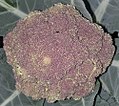 Sicilian purple broccoli
 -
 Broccoli "giant", whose flowering head and stalk can reach a kilo.
(NRCS_Photo_Gallery).jpg)


See also
[edit | edit source]- Broccolini
- Epicuticular wax
- George H. W. Bush broccoli comments; the 41st U.S. president famously disliked the vegetable
- Microgreen
References
[edit | edit source]- ↑ 1.0 1.1 Nugrahedi, Probo Y.; Verkerk, Ruud; Widianarko, Budi; Dekker, Matthijs (2015). "A Mechanistic Perspective on Process-Induced Changes in Glucosinolate Content in Brassica Vegetables: A Review". Critical Reviews in Food Science and Nutrition. 55 (6): 823–838. doi:10.1080/10408398.2012.688076. ISSN 1040-8398. PMID 24915330. S2CID 25728864.
- ↑ Main, Sandy. "Rapini/Broccoli Raab". sonomamg.ucanr.edu. Archived from the original on 30 May 2015. Retrieved 13 September 2021.
- ↑ Missouri Botanical Garden. "Brassica oleracea var. italica". tropicos.org. Missouri Botanical Garden. Retrieved 18 October 2023.
- ↑ "Broccoli". Online Etymology Dictionary. 2022. Archived from the original on 19 January 2023. Retrieved 18 January 2023.
- ↑ Maggioni, Lorenzo; Bothmer, Roland; Poulsen, Gert; Branca, Ferdinando (2010). "Origin and Domestication of Cole Crops (Brassica oleracea L.): Linguistic and Literary Considerations". Economic Botany. 64 (2): 109–123. doi:10.1007/s12231-010-9115-2. hdl:10568/121874. S2CID 2771884.
- ↑ Nonnecke, Ib (November 1989). Vegetable Production. Springer-Verlag New York, LLC. p. 394. ISBN 978-0-442-26721-6. Archived from the original on 9 March 2023. Retrieved 6 October 2020.
- ↑ 7.0 7.1 7.2 7.3 7.4 Stansell, Zachary; Björkman, Thomas (1 October 2020). "From landrace to modern hybrid broccoli: the genomic and morphological domestication syndrome within a diverse B. oleracea collection". Horticulture Research. 7 (1): 159. Bibcode:2020HorR....7..159S. doi:10.1038/s41438-020-00375-0. ISSN 2052-7276. PMC 7528014. PMID 33082966. S2CID 224724369.
- ↑ Stansell, Zachary; Hyma, Katie; Fresnedo-Ramírez, Jonathan; Sun, Qi; Mitchell, Sharon; Björkman, Thomas; Hua, Jian (1 July 2018). "Genotyping-by-sequencing of Brassica oleracea vegetables reveals unique phylogenetic patterns, population structure and domestication footprints". Horticulture Research. 5 (1): 38. Bibcode:2018HorR....5...38S. doi:10.1038/s41438-018-0040-3. ISSN 2052-7276. PMC 6026498. PMID 29977574.
- ↑ 9.0 9.1 "Broccoli, plant". Encyclopædia Britannica. 3 March 2025. Retrieved 15 April 2025.
- ↑ "Broccoli". Royal Horticultural Society. Archived from the original on 24 March 2020. Retrieved 24 March 2020.
- ↑ Branca, Ferdinando (2008), Prohens, Jaime; Nuez, Fernando (eds.), "Cauliflower and Broccoli", Vegetables I: Asteraceae, Brassicaceae, Chenopodicaceae, and Cucurbitaceae, Handbook of Plant Breeding, New York, NY: Springer, 1, pp. 151–186, doi:10.1007/978-0-387-30443-4_5, ISBN 978-0-387-30443-4
- ↑ "British research leads to UK-wide launch of Beneforté broccoli". Quadram Institute. 25 June 2012. Retrieved 24 March 2020.
- ↑ Dixon, G.R. (2007). Vegetable brassicas and related crucifers. Wallingford: CABI. ISBN 978-0-85199-395-9.
- ↑ Lua error in package.lua at line 80: module 'Module:Citation/CS1/Suggestions' not found.
- ↑ Bjorkman, T.; Pearson, K. J. (1 January 1998). "High temperature arrest of inflorescence development in broccoli (Brassica oleracea var. italica L.)". Journal of Experimental Botany. 49 (318): 101–106. doi:10.1093/jxb/49.318.101. ISSN 0022-0957.
- ↑ 16.0 16.1 16.2 16.3 16.4 "Basics of broccoli production". North Carolina State University Extension. 22 July 2024. Retrieved 9 February 2026.
- ↑ "Broccoli (and cauliflower) production in 2024, Crops/Regions/World list/Production Quantity/Year (pick lists)". UN Food and Agriculture Organization, Corporate Statistical Database (FAOSTAT). 2026. Retrieved 9 February 2026.
- ↑ Siomos, Anastasios S.; Koularmanis, Konstantinos; Tsouvaltzis, Pavlos (4 November 2022). "The Impacts of the Emerging Climate Change on Broccoli (Brassica oleracea L. var. italica Plenck.) Crop". Horticulturae. 8 (11): 1032. doi:10.3390/horticulturae8111032. ISSN 2311-7524.
- ↑ "Broccoli production". Pennsylvania State University, Extension Service. 20 June 2005. Archived from the original on 19 February 2021. Retrieved 10 February 2021.
- ↑ "Broccoli". Agricultural Marketing Resource Center, US Department of Agriculture. 1 May 2024. Retrieved 15 April 2026.
- ↑ Farnham, Mark W.; Kopsell, Dean A. (August 2009). "Importance of Genotype on Carotenoid and Chlorophyll Levels in Broccoli Heads". HortScience. 44 (5): 1248-1253. doi:10.21273/HORTSCI.44.5.1248. Retrieved 18 October 2023. PDF
- ↑ Lua error in package.lua at line 80: module 'Module:Citation/CS1/Suggestions' not found.
- ↑ Lipchock SV, Mennella JA, Spielman AI, Reed DR (2013). "Human bitter perception correlates with bitter receptor messenger RNA expression in taste cells". Am J Clin Nutr. 98 (4): 1136–43. doi:10.3945/ajcn.113.066688. PMC 3778862. PMID 24025627.
- ↑ Heitzman, J. Richard; Heitzman, Joan E. (1996). Love, Kathy; Larsen, LuAnne (eds.). Butterflies and moths of Missouri. Rathert, Jim (principal photographer). Jefferson City, MO: Missouri Dept. of Conservation. ISBN 1-887247-06-8.
- ↑ "Cabbage, Broccoli & Other Cole Crop Insect Pests". Home & Garden Information Center. South Carolina: Clemson University. 4 May 2020. Archived from the original on 7 December 2020. Retrieved 28 November 2020.
- ↑ Brackney, Susan M. "Broccoli for Beginners". Hobby Farms. 26 (2): 60–63.
External links
[edit | edit source] |
Wikimedia Commons has media related to Broccoli. |
- PROTAbase on Brassica oleracea (cauliflower and broccoli) (archived 10 February 2016)
- List of North American broccoli cultivars, USDA/ARS Vegetable Laboratory