Elliptical polarization
Template:Multiple In electrodynamics, elliptical polarization is the polarization of electromagnetic radiation such that the tip of the electric field vector describes an ellipse in any fixed plane intersecting, and normal to, the direction of propagation. An elliptically polarized wave may be resolved into two linearly polarized waves in phase quadrature, with their polarization planes at right angles to each other. Since the electric field can rotate clockwise or counterclockwise as it propagates, elliptically polarized waves exhibit chirality.
Circular polarization and linear polarization can be considered to be special cases of elliptical polarization. This terminology was introduced by Augustin-Jean Fresnel in 1822,[1] before the electromagnetic nature of light waves was known.
Mathematical description
[edit | edit source]The classical sinusoidal plane wave solution of the electromagnetic wave equation for the electric and magnetic fields is (Gaussian units)
- Failed to parse (SVG (MathML can be enabled via browser plugin): Invalid response ("Math extension cannot connect to Restbase.") from server "https://wikimedia.org/api/rest_v1/":): {\displaystyle \mathbf{E} ( \mathbf{r} , t ) = \left| \mathbf{E} \right| \mathrm{Re} \left \{ |\psi\rangle \exp \left [ i \left ( kz-\omega t \right ) \right ] \right \} }
- Failed to parse (Conversion error. Server ("https://wikimedia.org/api/rest_") reported: "Cannot get mml. Server problem."): {\displaystyle \mathbf {B} (\mathbf {r} ,t)={\hat {\mathbf {z} }}\times \mathbf {E} (\mathbf {r} ,t),}
where is the wavenumber, Failed to parse (Conversion error. Server ("https://wikimedia.org/api/rest_") reported: "Cannot get mml. Server problem."): {\textstyle \omega =ck} is the angular frequency of the wave propagating in the +z direction, and is the speed of light.


Here Failed to parse (Conversion error. Server ("https://wikimedia.org/api/rest_") reported: "Cannot get mml. Server problem."): {\displaystyle |\mathbf {E} |} is the amplitude of the field and

is the normalized Jones vector. This is the most complete representation of polarized electromagnetic radiation and corresponds in general to elliptical polarization.
Polarization ellipse
[edit | edit source]At a fixed point in space (or for fixed z), the electric vector traces out an ellipse in the x-y plane. The semi-major and semi-minor axes of the ellipse have lengths A and B, respectively, that are given by

- Failed to parse (Conversion error. Server ("https://wikimedia.org/api/rest_") reported: "Cannot get mml. Server problem."): {\displaystyle A=|\mathbf {E} |{\sqrt {\frac {1+{\sqrt {1-\sin ^{2}(2\theta )\sin ^{2}\beta }}}{2}}}}
and
- ,
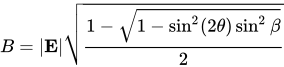
where Failed to parse (Conversion error. Server ("https://wikimedia.org/api/rest_") reported: "Cannot get mml. Server problem."): {\displaystyle \beta =\alpha _{y}-\alpha _{x}} with the phases Failed to parse (Conversion error. Server ("https://wikimedia.org/api/rest_") reported: "Cannot get mml. Server problem."): {\displaystyle \alpha _{x}} and Failed to parse (Conversion error. Server ("https://wikimedia.org/api/rest_") reported: "Cannot get mml. Server problem."): {\displaystyle \alpha _{y}} . The orientation of the ellipse is given by the angle the semi-major axis makes with the x-axis. This angle can be calculated from

- Failed to parse (Conversion error. Server ("https://wikimedia.org/api/rest_") reported: "Cannot get mml. Server problem."): {\displaystyle \tan 2\phi =\tan 2\theta \cos \beta } .
If Failed to parse (Conversion error. Server ("https://wikimedia.org/api/rest_") reported: "Cannot get mml. Server problem."): {\displaystyle \beta =0} , the wave is linearly polarized. The ellipse collapses to a straight line Failed to parse (Conversion error. Server ("https://wikimedia.org/api/rest_") reported: "Cannot get mml. Server problem."): {\displaystyle (A=|\mathbf {E} |,B=0} ) oriented at an angle Failed to parse (Conversion error. Server ("https://wikimedia.org/api/rest_") reported: "Cannot get mml. Server problem."): {\displaystyle \phi =\theta } . This is the case of superposition of two simple harmonic motions (in phase), one in the x direction with an amplitude Failed to parse (Conversion error. Server ("https://wikimedia.org/api/rest_") reported: "Cannot get mml. Server problem."): {\displaystyle |\mathbf {E} |\cos \theta } , and the other in the y direction with an amplitude Failed to parse (Conversion error. Server ("https://wikimedia.org/api/rest_") reported: "Cannot get mml. Server problem."): {\displaystyle |\mathbf {E} |\sin \theta } . When increases from zero, i.e., assumes positive values, the line evolves into an ellipse that is being traced out in the counterclockwise direction (looking in the direction of the propagating wave); this then corresponds to left-handed elliptical polarization; the semi-major axis is now oriented at an angle Failed to parse (Conversion error. Server ("https://wikimedia.org/api/rest_") reported: "Cannot get mml. Server problem."): {\displaystyle \phi \neq \theta } . Similarly, if Failed to parse (SVG (MathML can be enabled via browser plugin): Invalid response ("Math extension cannot connect to Restbase.") from server "https://wikimedia.org/api/rest_v1/":): {\displaystyle \beta} becomes negative from zero, the line evolves into an ellipse that is being traced out in the clockwise direction; this corresponds to right-handed elliptical polarization.


If Failed to parse (SVG (MathML can be enabled via browser plugin): Invalid response ("Math extension cannot connect to Restbase.") from server "https://wikimedia.org/api/rest_v1/":): {\displaystyle \beta=\pm\pi/2} and Failed to parse (SVG (MathML can be enabled via browser plugin): Invalid response ("Math extension cannot connect to Restbase.") from server "https://wikimedia.org/api/rest_v1/":): {\displaystyle \theta=\pi/4} , Failed to parse (SVG (MathML can be enabled via browser plugin): Invalid response ("Math extension cannot connect to Restbase.") from server "https://wikimedia.org/api/rest_v1/":): {\displaystyle A=B=|\mathbf{E}|/\sqrt{2}} , i.e., the wave is circularly polarized. When Failed to parse (SVG (MathML can be enabled via browser plugin): Invalid response ("Math extension cannot connect to Restbase.") from server "https://wikimedia.org/api/rest_v1/":): {\displaystyle \beta=\pi/2} , the wave is left-circularly polarized, and when Failed to parse (SVG (MathML can be enabled via browser plugin): Invalid response ("Math extension cannot connect to Restbase.") from server "https://wikimedia.org/api/rest_v1/":): {\displaystyle \beta=-\pi/2} , the wave is right-circularly polarized.
Parameterization
[edit | edit source]Any fixed polarization can be described in terms of the shape and orientation of the polarization ellipse, which is defined by two parameters: axial ratio AR and tilt angle Failed to parse (SVG (MathML can be enabled via browser plugin): Invalid response ("Math extension cannot connect to Restbase.") from server "https://wikimedia.org/api/rest_v1/":): {\displaystyle \tau} . The axial ratio is the ratio of the lengths of the major and minor axes of the ellipse, and is always greater than or equal to one.
Alternatively, polarization can be represented as a point on the surface of the Poincaré sphere, with Failed to parse (SVG (MathML can be enabled via browser plugin): Invalid response ("Math extension cannot connect to Restbase.") from server "https://wikimedia.org/api/rest_v1/":): {\displaystyle 2\times \tau} as the longitude and Failed to parse (SVG (MathML can be enabled via browser plugin): Invalid response ("Math extension cannot connect to Restbase.") from server "https://wikimedia.org/api/rest_v1/":): {\displaystyle 2\times \epsilon} as the latitude, where Failed to parse (SVG (MathML can be enabled via browser plugin): Invalid response ("Math extension cannot connect to Restbase.") from server "https://wikimedia.org/api/rest_v1/":): {\displaystyle \epsilon=\arccot(\pm AR)} . The sign used in the argument of the Failed to parse (SVG (MathML can be enabled via browser plugin): Invalid response ("Math extension cannot connect to Restbase.") from server "https://wikimedia.org/api/rest_v1/":): {\displaystyle \arccot} depends on the handedness of the polarization. Positive indicates left hand polarization, while negative indicates right hand polarization, as defined by IEEE.
For the special case of circular polarization, the axial ratio equals 1 (or 0 dB) and the tilt angle is undefined. For the special case of linear polarization, the axial ratio is infinite.
In nature
[edit | edit source]The reflected light from some beetles (e.g. Cetonia aurata) is elliptical polarized.[2]
See also
[edit | edit source]- Ellipsometry
- Fresnel rhomb
- Photon polarization
- Sinusoidal plane-wave solutions of the electromagnetic wave equation
References
[edit | edit source]- Public Domain This article incorporates public domain material from the General Services Administration document: "Federal Standard 1037C". (in support of MIL-STD-188)

- ↑ A. Fresnel, "Mémoire sur la double réfraction que les rayons lumineux éprouvent en traversant les aiguilles de cristal de roche suivant les directions parallèles à l'axe", read 9 December 1822; printed in H. de Senarmont, E. Verdet, and L. Fresnel (eds.), Oeuvres complètes d'Augustin Fresnel, vol. 1 (1866), pp.Template:Nnbsp731–51; translated as "Memoir on the double refraction that light rays undergo in traversing the needles of quartz in the directions parallel to the axis", Template:Zenodo, 2021 (open access); §§9–10.
- ↑ Arwin, Hans; Magnusson, Roger; Landin, Jan; Järrendahl, Kenneth (April 21, 2012). "Chirality-induced polarization effects in the cuticle of scarab beetles: 100 years after Michelson". Philosophical Magazine. 92 (12): 1583–1599. Bibcode:2012PMag...92.1583A. doi:10.1080/14786435.2011.648228. S2CID 13988658.
- Henri Poincaré (1889) Théorie Mathématique de la Lumière, volume 1 and Volume 2 (1892) via Internet Archive.
- H. Poincaré (1901) Électricité et Optique : La Lumière et les Théories Électrodynamiques, via Internet Archive