Free group
In mathematics, the free group over a given set consists of all words that can be built from members of , considering two words to be different unless their equality follows from the group axioms (e.g. but for ). The members of are called generators of , and the number of generators is the rank of the free group. An arbitrary group is called free if it is isomorphic to for some subset of , that is, if there is a subset of such that every element of can be written in exactly one way as a product of finitely many elements of and their inverses (disregarding trivial variations such as ).


A related but different notion is a free abelian group; both notions are particular instances of a free object from universal algebra. As such, free groups are defined by their universal property.
History
[edit | edit source]Free groups first arose in the study of hyperbolic geometry, as examples of Fuchsian groups (discrete groups acting by isometries on the hyperbolic plane). In an 1882 paper, Walther von Dyck pointed out that these groups have the simplest possible presentations.[1] The algebraic study of free groups was initiated by Jakob Nielsen in 1924, who gave them their name and established many of their basic properties.[2][3][4] Max Dehn realized the connection with topology, and obtained the first proof of the full Nielsen–Schreier theorem.[5] Otto Schreier published an algebraic proof of this result in 1927,[6] and Kurt Reidemeister included a comprehensive treatment of free groups in his 1932 book on combinatorial topology.[7] Later on in the 1930s, Wilhelm Magnus discovered the connection between the lower central series of free groups and free Lie algebras.
Examples
[edit | edit source]The group of integers is free of rank 1; a generating set is . The integers are also a free abelian group, although all free groups of rank are non-abelian. A free group on a two-element set occurs in the proof of the Banach–Tarski paradox and is described there.


On the other hand, any nontrivial finite group cannot be free, since the elements of a free generating set of a free group have infinite order.
In algebraic topology, the fundamental group of a bouquet of k circles (a set of k loops having only one point in common) is the free group on a set of k elements.
Construction
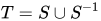
[edit | edit source]The free group with free generating set can be constructed as follows. is a set of symbols, and we suppose for every in there is a corresponding "inverse" symbol, , in a set . Let , and define a word in to be any written product of elements of . That is, a word in is an element of the monoid generated by . The empty word is the word with no symbols at all. For example, if , then , and is a word in .





If an element of lies immediately next to its inverse, the word may be simplified by omitting the pair: A word that cannot be simplified further is called reduced.


The free group is defined to be the group of all reduced words in , with concatenation of words (followed by reduction if necessary) as group operation. The identity is the empty word.
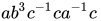
A reduced word is called cyclically reduced if its first and last letter are not inverse to each other. Every word is conjugate to a cyclically reduced word, and a cyclically reduced conjugate of a cyclically reduced word is a cyclic permutation of the letters in the word. For instance is not cyclically reduced, but is conjugate to , which is cyclically reduced. The only cyclically reduced conjugates of are , , and .


Universal property
[edit | edit source]The free group is the universal group generated by the set . This can be formalized by the following universal property: given any function from to a group , there exists a unique homomorphism making the following diagram commute (where the unnamed mapping denotes the inclusion from into ):


That is, homomorphisms are in one-to-one correspondence with functions . For a non-free group, the presence of relations would restrict the possible images of the generators under a homomorphism.


To see how this relates to the constructive definition, think of the mapping from to as sending each symbol to a word consisting of that symbol. To construct for the given , first note that sends the empty word to the identity of and it has to agree with on the elements of . For the remaining words (consisting of more than one symbol), can be uniquely extended, since it is a homomorphism, i.e., .


The above property characterizes free groups up to isomorphism, and is sometimes used as an alternative definition. It is known as the universal property of free groups, and the generating set is called a basis for . The basis for a free group is not uniquely determined.
Being characterized by a universal property is the standard feature of free objects in universal algebra. In the language of category theory, the construction of the free group (similar to most constructions of free objects) is a functor from the category of sets to the category of groups. This functor is left adjoint to the forgetful functor from groups to sets.
Facts and theorems
[edit | edit source]Some properties of free groups follow readily from the definition:
- Any group is the homomorphic image of some free group . Let be a set of generators of . The natural map : is an epimorphism, which proves the claim. Equivalently, is isomorphic to a quotient group of some free group . If can be chosen to be finite here, then is called finitely generated. The kernel is the set of all relations in the presentation of ; if can be generated by the conjugates of finitely many elements of , then is finitely presented.
- If has more than one element, then is not abelian, and in fact the center of is trivial (that is, consists only of the identity element).
- Two free groups and are isomorphic if and only if and have the same cardinality. This cardinality is called the rank of the free group . Thus for every cardinal number k, there is, up to isomorphism, exactly one free group of rank k.
- A free group of finite rank n > 1 has an exponential growth rate of order 2n − 1.


A few other related results are:
- The Nielsen–Schreier theorem: Every subgroup of a free group is free. Furthermore, if the free group has rank n and the subgroup has index e in , then is free of rank 1 + e(n–1).
- A free group of rank k clearly has subgroups of every rank less than k. Less obviously, a (nonabelian!) free group of rank at least 2 has subgroups of all countable ranks.
- The commutator subgroup of a free group of rank k > 1 has infinite rank; for example for , it is freely generated by the commutators for non-zero m and n.
- The free group in two elements is SQ universal; the above follows as any SQ universal group has subgroups of all countable ranks.
- Any group that acts on a tree, freely and preserving the orientation, is a free group of countable rank (given by 1 plus the Euler characteristic of the quotient graph).
- The Cayley graph of a free group of finite rank, with respect to a free generating set, is a tree on which the group acts freely, preserving the orientation. As a topological space (a one-dimensional simplicial complex), this Cayley graph is contractible. For a finitely presented group Failed to parse (SVG (MathML can be enabled via browser plugin): Invalid response ("Math extension cannot connect to Restbase.") from server "https://wikimedia.org/api/rest_v1/":): {\displaystyle G} , the natural homomorphism defined above, Failed to parse (SVG (MathML can be enabled via browser plugin): Invalid response ("Math extension cannot connect to Restbase.") from server "https://wikimedia.org/api/rest_v1/":): {\displaystyle \varphi:F\to G} , defines a covering map of Cayley graphs Failed to parse (SVG (MathML can be enabled via browser plugin): Invalid response ("Math extension cannot connect to Restbase.") from server "https://wikimedia.org/api/rest_v1/":): {\displaystyle \varphi^*:\Gamma(F)\to\Gamma(G)} , in fact a universal covering. Hence, the fundamental group of the Cayley graph Failed to parse (SVG (MathML can be enabled via browser plugin): Invalid response ("Math extension cannot connect to Restbase.") from server "https://wikimedia.org/api/rest_v1/":): {\displaystyle \Gamma(G)} is isomorphic to the kernel of Failed to parse (SVG (MathML can be enabled via browser plugin): Invalid response ("Math extension cannot connect to Restbase.") from server "https://wikimedia.org/api/rest_v1/":): {\displaystyle \varphi} , the normal subgroup of relations among the generators of Failed to parse (SVG (MathML can be enabled via browser plugin): Invalid response ("Math extension cannot connect to Restbase.") from server "https://wikimedia.org/api/rest_v1/":): {\displaystyle G} . The extreme case is when Failed to parse (SVG (MathML can be enabled via browser plugin): Invalid response ("Math extension cannot connect to Restbase.") from server "https://wikimedia.org/api/rest_v1/":): {\displaystyle G=\{e\}} , the trivial group, considered with as many generators as Failed to parse (SVG (MathML can be enabled via browser plugin): Invalid response ("Math extension cannot connect to Restbase.") from server "https://wikimedia.org/api/rest_v1/":): {\displaystyle F} , all of them trivial; the Cayley graph Failed to parse (SVG (MathML can be enabled via browser plugin): Invalid response ("Math extension cannot connect to Restbase.") from server "https://wikimedia.org/api/rest_v1/":): {\displaystyle \Gamma(G)} is a bouquet of circles, and its fundamental group is Failed to parse (SVG (MathML can be enabled via browser plugin): Invalid response ("Math extension cannot connect to Restbase.") from server "https://wikimedia.org/api/rest_v1/":): {\displaystyle F} itself.
- Any subgroup of a free group, Failed to parse (SVG (MathML can be enabled via browser plugin): Invalid response ("Math extension cannot connect to Restbase.") from server "https://wikimedia.org/api/rest_v1/":): {\displaystyle H \subset F} , corresponds to a covering space of the bouquet of circles, namely to the Schreier coset graph of Failed to parse (SVG (MathML can be enabled via browser plugin): Invalid response ("Math extension cannot connect to Restbase.") from server "https://wikimedia.org/api/rest_v1/":): {\displaystyle F/H} . This can be used to give a topological proof of the Nielsen-Schreier theorem above.
- The groupoid approach to these results, given in the work by P.J. Higgins below, is related to the use of covering spaces above. It allows more powerful results, for example on Grushko's theorem, and a normal form for the fundamental groupoid of a graph of groups. In this approach there is considerable use of free groupoids on a directed graph.
- Grushko's theorem has the consequence that if a subset Failed to parse (SVG (MathML can be enabled via browser plugin): Invalid response ("Math extension cannot connect to Restbase.") from server "https://wikimedia.org/api/rest_v1/":): {\displaystyle B} of a free group Failed to parse (SVG (MathML can be enabled via browser plugin): Invalid response ("Math extension cannot connect to Restbase.") from server "https://wikimedia.org/api/rest_v1/":): {\displaystyle F} on n elements generates Failed to parse (SVG (MathML can be enabled via browser plugin): Invalid response ("Math extension cannot connect to Restbase.") from server "https://wikimedia.org/api/rest_v1/":): {\displaystyle F} and has n elements, then Failed to parse (SVG (MathML can be enabled via browser plugin): Invalid response ("Math extension cannot connect to Restbase.") from server "https://wikimedia.org/api/rest_v1/":): {\displaystyle B} generates Failed to parse (SVG (MathML can be enabled via browser plugin): Invalid response ("Math extension cannot connect to Restbase.") from server "https://wikimedia.org/api/rest_v1/":): {\displaystyle F} freely.


![{\displaystyle [a^{m},b^{n}]}](https://wikimedia.org/api/rest_v1/media/math/render/svg/ddea5f711d3a2797031b6a33a042d3090bf1dd6b)


Free abelian group
[edit | edit source]The free abelian group on a set Failed to parse (SVG (MathML can be enabled via browser plugin): Invalid response ("Math extension cannot connect to Restbase.") from server "https://wikimedia.org/api/rest_v1/":): {\displaystyle S} is defined via its universal property in the analogous way, with obvious modifications: Consider a pair Failed to parse (SVG (MathML can be enabled via browser plugin): Invalid response ("Math extension cannot connect to Restbase.") from server "https://wikimedia.org/api/rest_v1/":): {\displaystyle (F,\varphi)} , where Failed to parse (SVG (MathML can be enabled via browser plugin): Invalid response ("Math extension cannot connect to Restbase.") from server "https://wikimedia.org/api/rest_v1/":): {\displaystyle F} is an abelian group and Failed to parse (SVG (MathML can be enabled via browser plugin): Invalid response ("Math extension cannot connect to Restbase.") from server "https://wikimedia.org/api/rest_v1/":): {\displaystyle \varphi:S\to F} is a function. Failed to parse (SVG (MathML can be enabled via browser plugin): Invalid response ("Math extension cannot connect to Restbase.") from server "https://wikimedia.org/api/rest_v1/":): {\displaystyle F} is said to be the free abelian group on Failed to parse (SVG (MathML can be enabled via browser plugin): Invalid response ("Math extension cannot connect to Restbase.") from server "https://wikimedia.org/api/rest_v1/":): {\displaystyle S} with respect to Failed to parse (SVG (MathML can be enabled via browser plugin): Invalid response ("Math extension cannot connect to Restbase.") from server "https://wikimedia.org/api/rest_v1/":): {\displaystyle \varphi} if for any abelian group Failed to parse (SVG (MathML can be enabled via browser plugin): Invalid response ("Math extension cannot connect to Restbase.") from server "https://wikimedia.org/api/rest_v1/":): {\displaystyle G} and any function Failed to parse (SVG (MathML can be enabled via browser plugin): Invalid response ("Math extension cannot connect to Restbase.") from server "https://wikimedia.org/api/rest_v1/":): {\displaystyle \psi:S\to G} , there exists a unique homomorphism Failed to parse (SVG (MathML can be enabled via browser plugin): Invalid response ("Math extension cannot connect to Restbase.") from server "https://wikimedia.org/api/rest_v1/":): {\displaystyle f:F\to G} such that Failed to parse (SVG (MathML can be enabled via browser plugin): Invalid response ("Math extension cannot connect to Restbase.") from server "https://wikimedia.org/api/rest_v1/":): {\displaystyle f(\varphi(s))=\psi(s),\ \forall s\in S.}
The free abelian group on Failed to parse (SVG (MathML can be enabled via browser plugin): Invalid response ("Math extension cannot connect to Restbase.") from server "https://wikimedia.org/api/rest_v1/":): {\displaystyle S} can be explicitly identified as the free group Failed to parse (SVG (MathML can be enabled via browser plugin): Invalid response ("Math extension cannot connect to Restbase.") from server "https://wikimedia.org/api/rest_v1/":): {\displaystyle F(S)} modulo the subgroup generated by its commutators, Failed to parse (SVG (MathML can be enabled via browser plugin): Invalid response ("Math extension cannot connect to Restbase.") from server "https://wikimedia.org/api/rest_v1/":): {\displaystyle [F(S),F(S)]} , i.e. its abelianisation. In other words, the free abelian group on Failed to parse (SVG (MathML can be enabled via browser plugin): Invalid response ("Math extension cannot connect to Restbase.") from server "https://wikimedia.org/api/rest_v1/":): {\displaystyle S} is the set of words that are distinguished only up to the order of letters. The rank of a free group can therefore also be defined as the rank of its abelianisation as a free abelian group.
Tarski's problems
[edit | edit source]Around 1945, Alfred Tarski asked whether the free groups on two or more generators have the same first-order theory, and whether this theory is decidable. Sela (2006) answered the first question by showing that any two nonabelian free groups have the same first-order theory, and Kharlampovich & Myasnikov (2006) answered both questions, showing that this theory is decidable.
A similar unsolved (as of 2011) question in free probability theory asks whether the von Neumann group algebras of any two non-abelian finitely generated free groups are isomorphic.
See also
[edit | edit source]- Generating set of a group
- Presentation of a group
- Nielsen transformation, a factorization of elements of the automorphism group of a free group
- Normal form for free groups and free product of groups
- Free product
Notes
[edit | edit source]- ↑ von Dyck, Walther (1882). "Gruppentheoretische Studien (Group-theoretical Studies)". Mathematische Annalen. 20 (1): 1–44. doi:10.1007/BF01443322. S2CID 179178038. Archived from the original on 2016-03-04. Retrieved 2015-09-01.
- ↑ Nielsen, Jakob (1917). "Die Isomorphismen der allgemeinen unendlichen Gruppe mit zwei Erzeugenden". Mathematische Annalen. 78 (1): 385–397. doi:10.1007/BF01457113. JFM 46.0175.01. MR 1511907. S2CID 119726936. Archived from the original on 2016-03-05. Retrieved 2015-09-01.
- ↑ Nielsen, Jakob (1921). "On calculation with noncommutative factors and its application to group theory. (Translated from Danish)". The Mathematical Scientist. 6 (1981) (2): 73–85.
- ↑ Nielsen, Jakob (1924). "Die Isomorphismengruppe der freien Gruppen". Mathematische Annalen. 91 (3): 169–209. doi:10.1007/BF01556078. S2CID 122577302. Archived from the original on 2016-03-05. Retrieved 2015-09-01.
- ↑ See Magnus, Wilhelm; Moufang, Ruth (1954). "Max Dehn zum Gedächtnis". Mathematische Annalen. 127 (1): 215–227. doi:10.1007/BF01361121. S2CID 119917209. Archived from the original on 2016-03-05. Retrieved 2015-09-01.
- ↑ Schreier, Otto (1928). "Die Untergruppen der freien Gruppen". Abhandlungen aus dem Mathematischen Seminar der Universität Hamburg. 5 (1): 161–183. doi:10.1007/BF02952517. S2CID 121888949.
- ↑ Reidemeister, Kurt (1972) [1932]. Einführung in die kombinatorische Topologie. Darmstadt: Wissenschaftliche Buchgesellschaft.
References
[edit | edit source]- Kharlampovich, Olga; Myasnikov, Alexei (2006). "Elementary theory of free non-abelian groups". Journal of Algebra. 302 (2): 451–552. doi:10.1016/j.jalgebra.2006.03.033. MR 2293770.
- W. Magnus, A. Karrass and D. Solitar, "Combinatorial Group Theory", Dover (1976).
- P.J. Higgins, 1971, "Categories and Groupoids", van Nostrand, {New York}. Reprints in Theory and Applications of Categories, 7 (2005) pp 1–195.
- Sela, Zlil (2006). "Diophantine geometry over groups. VI. The elementary theory of a free group". Geom. Funct. Anal. 16 (3): 707–730. doi:10.1007/s00039-006-0565-8. MR 2238945. S2CID 123197664.
- Serre, Jean-Pierre, Trees, Springer (2003) (English translation of "arbres, amalgames, SL2", 3rd edition, astérisque 46 (1983))
- P.J. Higgins, The fundamental groupoid of a graph of groups, Journal of the London Mathematical Society (2) 13 (1976), no. 1, 145–149.
- Aluffi, Paolo (2009). Algebra: Chapter 0. AMS Bookstore. p. 70. ISBN 978-0-8218-4781-7..
- Grillet, Pierre Antoine (2007). Abstract algebra. Springer. p. 27. ISBN 978-0-387-71567-4..