Geometric algebra
Template:For-multiTemplate:Not to be confused with In mathematics, a geometric algebra (also known as a Clifford algebra) is an algebra that can represent and manipulate geometrical objects such as vectors. Geometric algebra is built out of two fundamental operations, addition and the geometric product. Multiplication of vectors results in higher-dimensional objects called multivectors. Compared to other formalisms for manipulating geometric objects, geometric algebra is noteworthy for supporting vector division (though generally not by all elements) and addition of objects of different dimensions.
The geometric product was first briefly mentioned by Hermann Grassmann,[1] who was chiefly interested in developing the closely related exterior algebra. In 1878, William Kingdon Clifford greatly expanded on Grassmann's work to form what are now usually called Clifford algebras in his honor (although Clifford himself chose to call them "geometric algebras"). Clifford defined the Clifford algebra and its product as a unification of the Grassmann algebra and Hamilton's quaternion algebra. Adding the dual of the Grassmann exterior product allows the use of the Grassmann–Cayley algebra. In the late 1990s, plane-based geometric algebra and conformal geometric algebra (CGA) respectively provided a framework for euclidean geometry and classical geometries.[2] In practice, these and several derived operations allow a correspondence of elements, subspaces and operations of the algebra with geometric interpretations. For several decades, geometric algebras went somewhat ignored, greatly eclipsed by the vector calculus then newly developed to describe electromagnetism. The term "geometric algebra" was repopularized in the 1960s by David Hestenes, who advocated its importance to relativistic physics.[3]
The scalars and vectors have their usual interpretation and make up distinct subspaces of a geometric algebra. Bivectors provide a more natural representation of the pseudovector quantities of 3D vector calculus that are derived as a cross product, such as oriented area, oriented angle of rotation, torque, angular momentum and the magnetic field. A trivector can represent an oriented volume, and so on. An element called a blade may be used to represent a subspace and orthogonal projections onto that subspace. Rotations and reflections are represented as elements. Unlike a vector algebra, a geometric algebra naturally accommodates any number of dimensions and any quadratic form such as in relativity.
Examples of geometric algebras applied in physics include the spacetime algebra (and the less common algebra of physical space). Geometric calculus, an extension of GA that incorporates differentiation and integration, can be used to formulate other theories such as complex analysis and differential geometry, e.g. by using the Clifford algebra instead of differential forms. Geometric algebra has been advocated, most notably by David Hestenes[4] and Chris Doran,[5] as the preferred mathematical framework for physics. Proponents claim that it provides compact and intuitive descriptions in many areas including classical and quantum mechanics, electromagnetic theory, and relativity.[6] GA has also found use as a computational tool in computer graphics[7] and robotics.
Definition and notation
[edit | edit source]There are a number of different ways to define a geometric algebra. Hestenes's original approach was axiomatic,[8] "full of geometric significance" and equivalent to the universal[lower-alpha 1] Clifford algebra.[9] Given a finite-dimensional vector space Template:Tmath over a field Template:Tmath with a symmetric bilinear form (the inner product,[lower-alpha 2] e.g., the Euclidean or Lorentzian metric) Template:Tmath, the geometric algebra of the quadratic space Template:Tmath is the Clifford algebra Template:Tmath, an element of which is called a multivector. The Clifford algebra is commonly defined as a quotient algebra of the tensor algebra, though this definition is abstract, so the following definition is presented without requiring abstract algebra.
- Definition
- A unital associative algebra Template:Tmath with a nondegenerate symmetric bilinear form Template:Tmath is the Clifford algebra of the quadratic space Template:Tmath if[10]
- it contains Template:Tmath and Template:Tmath as distinct subspaces
- Template:Tmath for Template:Tmath
- Template:Tmath generates Template:Tmath as an algebra
- Template:Tmath is not generated by any proper subspace of Template:Tmath.
To cover degenerate symmetric bilinear forms, the last condition must be modified.[lower-alpha 3] It can be shown that these conditions uniquely characterize the geometric product.
For the remainder of this article, only the real case, Template:Tmath, will be considered. The notation Template:Tmath (respectively Template:Tmath) will be used to denote a geometric algebra for which the bilinear form Template:Tmath has the signature Template:Tmath (respectively Template:Tmath).
The product in the algebra is called the geometric product, and the product in the contained exterior algebra is called the exterior product (frequently called the wedge product or the outer product[lower-alpha 4]). It is standard to denote these respectively by juxtaposition (i.e., suppressing any explicit multiplication symbol) and the symbol Template:Tmath.
The above definition of the geometric algebra is still somewhat abstract, so we summarize the properties of the geometric product here. For multivectors Template:Tmath:
- Template:Tmath (closure)
- Template:Tmath, where Template:Tmath is the identity element (existence of an identity element)
- Template:Tmath (associativity)
- Template:Tmath and Template:Tmath (distributivity)
- Template:Tmath for Template:Tmath.
The exterior product has the same properties, except that the last property above is replaced by Template:Tmath for Template:Tmath.
Note that in the last property above, the real number Template:Tmath need not be nonnegative if Template:Tmath is not positive-definite. An important property of the geometric product is the existence of elements that have a multiplicative inverse. For a vector Template:Tmath, if then exists and is equal to Template:Tmath. A nonzero element of the algebra does not necessarily have a multiplicative inverse. For example, if is a vector in such that Template:Tmath, the element is both a nontrivial idempotent element and a nonzero zero divisor, and thus has no inverse.[lower-alpha 5]


It is usual to identify and with their images under the natural embeddings and Template:Tmath. In this article, this identification is assumed. Throughout, the terms scalar and vector refer to elements of and respectively (and of their images under this embedding).


Geometric product
[edit | edit source]


For vectors Template:Tmath and Template:Tmath, we may write the geometric product of any two vectors Template:Tmath and Template:Tmath as the sum of a symmetric product and an antisymmetric product:

Thus we can define the inner product of vectors as

so that the symmetric product can be written as

Conversely, Template:Tmath is completely determined by the algebra. The antisymmetric part is the exterior product of the two vectors, the product of the contained exterior algebra:

Then by simple addition:
- the ungeneralized or vector form of the geometric product.

The inner and exterior products are associated with familiar concepts from standard vector algebra. Geometrically, and are parallel if their geometric product is equal to their inner product, whereas and are perpendicular if their geometric product is equal to their exterior product. In a geometric algebra for which the square of any nonzero vector is positive, the inner product of two vectors can be identified with the dot product of standard vector algebra. The exterior product of two vectors can be identified with the signed area enclosed by a parallelogram the sides of which are the vectors. The cross product of two vectors in dimensions with positive-definite quadratic form is closely related to their exterior product.

Most instances of geometric algebras of interest have a nondegenerate quadratic form. If the quadratic form is fully degenerate, the inner product of any two vectors is always zero, and the geometric algebra is then simply an exterior algebra. Unless otherwise stated, this article will treat only nondegenerate geometric algebras.
The exterior product is naturally extended as an associative bilinear binary operator between any two elements of the algebra, satisfying the identities

where the sum is over all permutations of the indices, with the sign of the permutation, and are vectors (not general elements of the algebra). Since every element of the algebra can be expressed as the sum of products of this form, this defines the exterior product for every pair of elements of the algebra. It follows from the definition that the exterior product forms an alternating algebra.


The equivalent structure equation for Clifford algebra is[16][17]
![{\displaystyle a_{1}a_{2}a_{3}\dots a_{n}=\sum _{i=0}^{[{\frac {n}{2}}]}\sum _{\mu \in {}{\mathcal {C}}}(-1)^{k}\operatorname {Pf} (a_{\mu _{1}}\cdot a_{\mu _{2}},\dots ,a_{\mu _{2i-1}}\cdot a_{\mu _{2i}})a_{\mu _{2i+1}}\land \dots \land a_{\mu _{n}}}](https://wikimedia.org/api/rest_v1/media/math/render/svg/e3fbfcface4d9d348b1b76c9718276f343c8f197)
where is the Pfaffian of Template:Tmath and provides combinations, Template:Tmath, of Template:Tmath indices divided into Template:Tmath and Template:Tmath parts and Template:Tmath is the parity of the combination.


The Pfaffian provides a metric for the exterior algebra and, as pointed out by Claude Chevalley, Clifford algebra reduces to the exterior algebra with a zero quadratic form.[18] The role the Pfaffian plays can be understood from a geometric viewpoint by developing Clifford algebra from simplices.[19] This derivation provides a better connection between Pascal's triangle and simplices because it provides an interpretation of the first column of ones.
Blades, grades, and basis
[edit | edit source]A multivector that is the exterior product of linearly independent vectors is called a blade, and is said to be of grade Template:Tmath.[lower-alpha 6] A multivector that is the sum of blades of grade is called a (homogeneous) multivector of grade Template:Tmath. From the axioms, with closure, every multivector of the geometric algebra is a sum of blades.

Consider a set of linearly independent vectors spanning an Template:Tmath-dimensional subspace of the vector space. With these, we can define a real symmetric matrix (in the same way as a Gramian matrix)

![{\displaystyle [\mathbf {A} ]_{ij}=a_{i}\cdot a_{j}}](https://wikimedia.org/api/rest_v1/media/math/render/svg/5207597ca24e5f3fc11785e33dd676e5565e164f)
By the spectral theorem, can be diagonalized to diagonal matrix by an orthogonal matrix via


![{\displaystyle \sum _{k,l}[\mathbf {O} ]_{ik}[\mathbf {A} ]_{kl}[\mathbf {O} ^{\mathrm {T} }]_{lj}=\sum _{k,l}[\mathbf {O} ]_{ik}[\mathbf {O} ]_{jl}[\mathbf {A} ]_{kl}=[\mathbf {D} ]_{ij}}](https://wikimedia.org/api/rest_v1/media/math/render/svg/c169d06e467c5c7959e7da65c5b01b1bb89a4d05)
Define a new set of vectors Template:Tmath, known as orthogonal basis vectors, to be those transformed by the orthogonal matrix:
![{\displaystyle e_{i}=\sum _{j}[\mathbf {O} ]_{ij}a_{j}}](https://wikimedia.org/api/rest_v1/media/math/render/svg/bb80eb1d95f0720fd0d25abff339a0aed390074e)
Since orthogonal transformations preserve inner products, it follows that Failed to parse (SVG (MathML can be enabled via browser plugin): Invalid response ("Math extension cannot connect to Restbase.") from server "https://wikimedia.org/api/rest_v1/":): {\displaystyle e_i\cdot e_j=[\mathbf{D}]_{ij}} and thus the Failed to parse (SVG (MathML can be enabled via browser plugin): Invalid response ("Math extension cannot connect to Restbase.") from server "https://wikimedia.org/api/rest_v1/":): {\displaystyle \{e_1, \ldots, e_r\}} are perpendicular. In other words, the geometric product of two distinct vectors Failed to parse (SVG (MathML can be enabled via browser plugin): Invalid response ("Math extension cannot connect to Restbase.") from server "https://wikimedia.org/api/rest_v1/":): {\displaystyle e_i \ne e_j} is completely specified by their exterior product, or more generally
- Failed to parse (SVG (MathML can be enabled via browser plugin): Invalid response ("Math extension cannot connect to Restbase.") from server "https://wikimedia.org/api/rest_v1/":): {\displaystyle \begin{array}{rl} e_1e_2\cdots e_r &= e_1 \wedge e_2 \wedge \cdots \wedge e_r \\ &= \left(\sum_j [\mathbf{O}]_{1j}a_j\right) \wedge \left(\sum_j [\mathbf{O}]_{2j}a_j \right) \wedge \cdots \wedge \left(\sum_j [\mathbf{O}]_{rj}a_j\right) \\ &= (\det \mathbf{O}) a_1 \wedge a_2 \wedge \cdots \wedge a_r \end{array}}
Therefore, every blade of grade Failed to parse (SVG (MathML can be enabled via browser plugin): Invalid response ("Math extension cannot connect to Restbase.") from server "https://wikimedia.org/api/rest_v1/":): {\displaystyle r} can be written as the exterior product of Failed to parse (SVG (MathML can be enabled via browser plugin): Invalid response ("Math extension cannot connect to Restbase.") from server "https://wikimedia.org/api/rest_v1/":): {\displaystyle r} vectors. More generally, if a degenerate geometric algebra is allowed, then the orthogonal matrix is replaced by a block matrix that is orthogonal in the nondegenerate block, and the diagonal matrix has zero-valued entries along the degenerate dimensions. If the new vectors of the nondegenerate subspace are normalized according to
- Failed to parse (SVG (MathML can be enabled via browser plugin): Invalid response ("Math extension cannot connect to Restbase.") from server "https://wikimedia.org/api/rest_v1/":): {\displaystyle \widehat{e_i}=\frac{1}{\sqrt{|e_i \cdot e_i|}}e_i,}
then these normalized vectors must square to Failed to parse (SVG (MathML can be enabled via browser plugin): Invalid response ("Math extension cannot connect to Restbase.") from server "https://wikimedia.org/api/rest_v1/":): {\displaystyle +1} or Template:Tmath. By Sylvester's law of inertia, the total number of Template:Tmath and the total number of Template:Tmaths along the diagonal matrix is invariant. By extension, the total number Failed to parse (SVG (MathML can be enabled via browser plugin): Invalid response ("Math extension cannot connect to Restbase.") from server "https://wikimedia.org/api/rest_v1/":): {\displaystyle p} of these vectors that square to Failed to parse (SVG (MathML can be enabled via browser plugin): Invalid response ("Math extension cannot connect to Restbase.") from server "https://wikimedia.org/api/rest_v1/":): {\displaystyle +1} and the total number Failed to parse (SVG (MathML can be enabled via browser plugin): Invalid response ("Math extension cannot connect to Restbase.") from server "https://wikimedia.org/api/rest_v1/":): {\displaystyle q} that square to Failed to parse (SVG (MathML can be enabled via browser plugin): Invalid response ("Math extension cannot connect to Restbase.") from server "https://wikimedia.org/api/rest_v1/":): {\displaystyle -1} is invariant. (The total number of basis vectors that square to zero is also invariant, and may be nonzero if the degenerate case is allowed.) We denote this algebra Template:Tmath. For example, Failed to parse (SVG (MathML can be enabled via browser plugin): Invalid response ("Math extension cannot connect to Restbase.") from server "https://wikimedia.org/api/rest_v1/":): {\displaystyle \mathcal{G}(3,0)} models three-dimensional Euclidean space, Failed to parse (SVG (MathML can be enabled via browser plugin): Invalid response ("Math extension cannot connect to Restbase.") from server "https://wikimedia.org/api/rest_v1/":): {\displaystyle \mathcal{G}(1,3)} relativistic spacetime and Failed to parse (SVG (MathML can be enabled via browser plugin): Invalid response ("Math extension cannot connect to Restbase.") from server "https://wikimedia.org/api/rest_v1/":): {\displaystyle \mathcal{G}(4,1)} a conformal geometric algebra of a three-dimensional space.
The set of all possible products of Failed to parse (SVG (MathML can be enabled via browser plugin): Invalid response ("Math extension cannot connect to Restbase.") from server "https://wikimedia.org/api/rest_v1/":): {\displaystyle n} orthogonal basis vectors with indices in increasing order, including Failed to parse (SVG (MathML can be enabled via browser plugin): Invalid response ("Math extension cannot connect to Restbase.") from server "https://wikimedia.org/api/rest_v1/":): {\displaystyle 1} as the empty product, forms a basis for the entire geometric algebra (an analogue of the PBW theorem). For example, the following is a basis for the geometric algebra Template:Tmath:
- Failed to parse (SVG (MathML can be enabled via browser plugin): Invalid response ("Math extension cannot connect to Restbase.") from server "https://wikimedia.org/api/rest_v1/":): {\displaystyle \{1, e_1, e_2, e_3, e_1e_2, e_2e_3, e_3e_1, e_1e_2e_3\}}
A basis formed this way is called a standard basis for the geometric algebra, and any other orthogonal basis for Failed to parse (SVG (MathML can be enabled via browser plugin): Invalid response ("Math extension cannot connect to Restbase.") from server "https://wikimedia.org/api/rest_v1/":): {\displaystyle V} will produce another standard basis. Each standard basis consists of Failed to parse (SVG (MathML can be enabled via browser plugin): Invalid response ("Math extension cannot connect to Restbase.") from server "https://wikimedia.org/api/rest_v1/":): {\displaystyle 2^n} elements. Every multivector of the geometric algebra can be expressed as a linear combination of the standard basis elements. If the standard basis elements are Failed to parse (SVG (MathML can be enabled via browser plugin): Invalid response ("Math extension cannot connect to Restbase.") from server "https://wikimedia.org/api/rest_v1/":): {\displaystyle \{ B_i \mid i \in S \}} with Failed to parse (SVG (MathML can be enabled via browser plugin): Invalid response ("Math extension cannot connect to Restbase.") from server "https://wikimedia.org/api/rest_v1/":): {\displaystyle S} being an index set, then the geometric product of any two multivectors is
- Failed to parse (SVG (MathML can be enabled via browser plugin): Invalid response ("Math extension cannot connect to Restbase.") from server "https://wikimedia.org/api/rest_v1/":): {\displaystyle \left( \sum_i \alpha_i B_i \right) \left( \sum_j \beta_j B_j \right) = \sum_{i,j} \alpha_i\beta_j B_i B_j .}
The terminology "Failed to parse (SVG (MathML can be enabled via browser plugin): Invalid response ("Math extension cannot connect to Restbase.") from server "https://wikimedia.org/api/rest_v1/":): {\displaystyle k} -vector" is often encountered to describe multivectors containing elements of only one grade. In higher dimensional space, some such multivectors are not blades (cannot be factored into the exterior product of Failed to parse (SVG (MathML can be enabled via browser plugin): Invalid response ("Math extension cannot connect to Restbase.") from server "https://wikimedia.org/api/rest_v1/":): {\displaystyle k} vectors). By way of example, Failed to parse (SVG (MathML can be enabled via browser plugin): Invalid response ("Math extension cannot connect to Restbase.") from server "https://wikimedia.org/api/rest_v1/":): {\displaystyle e_1 \wedge e_2 + e_3 \wedge e_4 } in Failed to parse (SVG (MathML can be enabled via browser plugin): Invalid response ("Math extension cannot connect to Restbase.") from server "https://wikimedia.org/api/rest_v1/":): {\displaystyle \mathcal{G}(4,0)} cannot be factored; typically, however, such elements of the algebra do not yield to geometric interpretation as objects, although they may represent geometric quantities such as rotations. Only Template:Tmath-, Template:Tmath-, Template:Tmath- and Template:Tmath-vectors are always blades in Template:Tmath-space.
Versor
[edit | edit source]A Template:Tmath-versor is a multivector that can be expressed as the geometric product of Failed to parse (SVG (MathML can be enabled via browser plugin): Invalid response ("Math extension cannot connect to Restbase.") from server "https://wikimedia.org/api/rest_v1/":): {\displaystyle k} invertible vectors.[lower-alpha 7][21] Unit quaternions (originally called versors by Hamilton) may be identified with rotors in 3D space in much the same way as real 2D rotors subsume complex numbers; for the details refer to Dorst.[22]
Some authors use the term "versor product" to refer to the frequently occurring case where an operand is "sandwiched" between operators. The descriptions for rotations and reflections, including their outermorphisms, are examples of such sandwiching. These outermorphisms have a particularly simple algebraic form.[lower-alpha 8] Specifically, a mapping of vectors of the form
- Failed to parse (SVG (MathML can be enabled via browser plugin): Invalid response ("Math extension cannot connect to Restbase.") from server "https://wikimedia.org/api/rest_v1/":): {\displaystyle V \to V : a \mapsto RaR^{-1}} extends to the outermorphism Failed to parse (SVG (MathML can be enabled via browser plugin): Invalid response ("Math extension cannot connect to Restbase.") from server "https://wikimedia.org/api/rest_v1/":): {\displaystyle \mathcal{G}(V) \to \mathcal{G}(V) : A \mapsto RAR^{-1}.}
Since both operators and operand are versors there is potential for alternative examples such as rotating a rotor or reflecting a spinor always provided that some geometrical or physical significance can be attached to such operations.
By the Cartan–Dieudonné theorem we have that every isometry can be given as reflections in hyperplanes and since composed reflections provide rotations then we have that orthogonal transformations are versors.
In group terms, for a real, non-degenerate Template:Tmath, having identified the group Failed to parse (SVG (MathML can be enabled via browser plugin): Invalid response ("Math extension cannot connect to Restbase.") from server "https://wikimedia.org/api/rest_v1/":): {\displaystyle \mathcal{G}^\times} as the group of all invertible elements of Template:Tmath, Lundholm gives a proof that the "versor group" Failed to parse (SVG (MathML can be enabled via browser plugin): Invalid response ("Math extension cannot connect to Restbase.") from server "https://wikimedia.org/api/rest_v1/":): {\displaystyle \{ v_1 v_2 \cdots v_k \in \mathcal{G} \mid v_i \in V^\times\}} (the set of invertible versors) is equal to the Lipschitz group Failed to parse (SVG (MathML can be enabled via browser plugin): Invalid response ("Math extension cannot connect to Restbase.") from server "https://wikimedia.org/api/rest_v1/":): {\displaystyle \Gamma} (a.k.a. Clifford group, although Lundholm deprecates this usage).[23]
Subgroups of the Lipschitz group
[edit | edit source]We denote the grade involution as Template:Tmath and reversion as Template:Tmath.
Although the Lipschitz group (defined as Template:Tmath) and the versor group (defined as Template:Tmath) have divergent definitions, they are the same group. Lundholm defines the Template:Tmath, Template:Tmath, and Template:Tmath subgroups of the Lipschitz group.[24]
| Subgroup | Definition | GA term |
|---|---|---|
| Failed to parse (SVG (MathML can be enabled via browser plugin): Invalid response ("Math extension cannot connect to Restbase.") from server "https://wikimedia.org/api/rest_v1/":): {\displaystyle \Gamma} | Failed to parse (SVG (MathML can be enabled via browser plugin): Invalid response ("Math extension cannot connect to Restbase.") from server "https://wikimedia.org/api/rest_v1/":): {\displaystyle \{ S \in \mathcal{G}^{\times} \mid \widehat{S} V S^{-1} \subseteq V \} } | versors |
| Failed to parse (SVG (MathML can be enabled via browser plugin): Invalid response ("Math extension cannot connect to Restbase.") from server "https://wikimedia.org/api/rest_v1/":): {\displaystyle \operatorname{Pin}} | Failed to parse (SVG (MathML can be enabled via browser plugin): Invalid response ("Math extension cannot connect to Restbase.") from server "https://wikimedia.org/api/rest_v1/":): {\displaystyle \{ S \in \Gamma \mid S \widetilde{S} = \pm 1 \} } | unit versors |
| Failed to parse (SVG (MathML can be enabled via browser plugin): Invalid response ("Math extension cannot connect to Restbase.") from server "https://wikimedia.org/api/rest_v1/":): {\displaystyle \operatorname{Spin}} | Failed to parse (SVG (MathML can be enabled via browser plugin): Invalid response ("Math extension cannot connect to Restbase.") from server "https://wikimedia.org/api/rest_v1/":): {\displaystyle {\operatorname{Pin}} \cap \mathcal{G}^{[0]} } | even unit versors |
| Failed to parse (SVG (MathML can be enabled via browser plugin): Invalid response ("Math extension cannot connect to Restbase.") from server "https://wikimedia.org/api/rest_v1/":): {\displaystyle \operatorname{Spin}^{+}} | Failed to parse (SVG (MathML can be enabled via browser plugin): Invalid response ("Math extension cannot connect to Restbase.") from server "https://wikimedia.org/api/rest_v1/":): {\displaystyle \{ S \in \operatorname{Spin} \mid S \widetilde{S} = 1 \} } | rotors |
Multiple analyses of spinors use GA as a representation.[25]
Grade projection
[edit | edit source]A Template:Tmath-graded vector space structure can be established on a geometric algebra by use of the exterior product that is naturally induced by the geometric product.
Since the geometric product and the exterior product are equal on orthogonal vectors, this grading can be conveniently constructed by using an orthogonal basis Template:Tmath.
Elements of the geometric algebra that are scalar multiples of Failed to parse (SVG (MathML can be enabled via browser plugin): Invalid response ("Math extension cannot connect to Restbase.") from server "https://wikimedia.org/api/rest_v1/":): {\displaystyle 1} are of grade Failed to parse (SVG (MathML can be enabled via browser plugin): Invalid response ("Math extension cannot connect to Restbase.") from server "https://wikimedia.org/api/rest_v1/":): {\displaystyle 0} and are called scalars. Elements that are in the span of Failed to parse (SVG (MathML can be enabled via browser plugin): Invalid response ("Math extension cannot connect to Restbase.") from server "https://wikimedia.org/api/rest_v1/":): {\displaystyle \{e_1,\ldots,e_n\}} are of grade Template:Tmath and are the ordinary vectors. Elements in the span of Failed to parse (SVG (MathML can be enabled via browser plugin): Invalid response ("Math extension cannot connect to Restbase.") from server "https://wikimedia.org/api/rest_v1/":): {\displaystyle \{e_ie_j\mid 1\leq i<j\leq n\}} are of grade Failed to parse (SVG (MathML can be enabled via browser plugin): Invalid response ("Math extension cannot connect to Restbase.") from server "https://wikimedia.org/api/rest_v1/":): {\displaystyle 2} and are the bivectors. This terminology continues through to the last grade of Template:Tmath-vectors. Alternatively, Template:Tmath-vectors are called pseudoscalars, Template:Tmath-vectors are called pseudovectors, etc. Many of the elements of the algebra are not graded by this scheme since they are sums of elements of differing grade. Such elements are said to be of mixed grade. The grading of multivectors is independent of the basis chosen originally.
This is a grading as a vector space, but not as an algebra. Because the product of an Template:Tmath-blade and an Template:Tmath-blade is contained in the span of Failed to parse (SVG (MathML can be enabled via browser plugin): Invalid response ("Math extension cannot connect to Restbase.") from server "https://wikimedia.org/api/rest_v1/":): {\displaystyle 0} through Template:Tmath-blades, the geometric algebra is a filtered algebra.
A multivector Failed to parse (SVG (MathML can be enabled via browser plugin): Invalid response ("Math extension cannot connect to Restbase.") from server "https://wikimedia.org/api/rest_v1/":): {\displaystyle A} may be decomposed with the grade-projection operator Template:Tmath, which outputs the grade-Template:Tmath portion of Template:Tmath. As a result:
- Failed to parse (SVG (MathML can be enabled via browser plugin): Invalid response ("Math extension cannot connect to Restbase.") from server "https://wikimedia.org/api/rest_v1/":): {\displaystyle A = \sum_{r=0}^{n} \langle A \rangle _r }
As an example, the geometric product of two vectors Failed to parse (SVG (MathML can be enabled via browser plugin): Invalid response ("Math extension cannot connect to Restbase.") from server "https://wikimedia.org/api/rest_v1/":): {\displaystyle a b = a \cdot b + a \wedge b = \langle a b \rangle_0 + \langle a b \rangle_2} since Failed to parse (SVG (MathML can be enabled via browser plugin): Invalid response ("Math extension cannot connect to Restbase.") from server "https://wikimedia.org/api/rest_v1/":): {\displaystyle \langle a b \rangle_0=a\cdot b} and Failed to parse (SVG (MathML can be enabled via browser plugin): Invalid response ("Math extension cannot connect to Restbase.") from server "https://wikimedia.org/api/rest_v1/":): {\displaystyle \langle a b \rangle_2 = a\wedge b} and Template:Tmath, for Failed to parse (SVG (MathML can be enabled via browser plugin): Invalid response ("Math extension cannot connect to Restbase.") from server "https://wikimedia.org/api/rest_v1/":): {\displaystyle i} other than Failed to parse (SVG (MathML can be enabled via browser plugin): Invalid response ("Math extension cannot connect to Restbase.") from server "https://wikimedia.org/api/rest_v1/":): {\displaystyle 0} and Template:Tmath.
A multivector Failed to parse (SVG (MathML can be enabled via browser plugin): Invalid response ("Math extension cannot connect to Restbase.") from server "https://wikimedia.org/api/rest_v1/":): {\displaystyle A} may also be decomposed into even and odd components, which may respectively be expressed as the sum of the even and the sum of the odd grade components above:
- Failed to parse (SVG (MathML can be enabled via browser plugin): Invalid response ("Math extension cannot connect to Restbase.") from server "https://wikimedia.org/api/rest_v1/":): {\displaystyle A^{[0]} = \langle A \rangle _0 + \langle A \rangle _2 + \langle A \rangle _4 + \cdots }
- Failed to parse (SVG (MathML can be enabled via browser plugin): Invalid response ("Math extension cannot connect to Restbase.") from server "https://wikimedia.org/api/rest_v1/":): {\displaystyle A^{[1]} = \langle A \rangle _1 + \langle A \rangle _3 + \langle A \rangle _5 + \cdots }
This is the result of forgetting structure from a Template:Tmath-graded vector space to Template:Tmath-graded vector space. The geometric product respects this coarser grading. Thus in addition to being a Template:Tmath-graded vector space, the geometric algebra is a Template:Tmath-graded algebra, a.k.a. a superalgebra.
Restricting to the even part, the product of two even elements is also even. This means that the even multivectors defines an even subalgebra. The even subalgebra of an Template:Tmath-dimensional geometric algebra is algebra-isomorphic (without preserving either filtration or grading) to a full geometric algebra of Failed to parse (SVG (MathML can be enabled via browser plugin): Invalid response ("Math extension cannot connect to Restbase.") from server "https://wikimedia.org/api/rest_v1/":): {\displaystyle (n-1)} dimensions. Examples include Failed to parse (SVG (MathML can be enabled via browser plugin): Invalid response ("Math extension cannot connect to Restbase.") from server "https://wikimedia.org/api/rest_v1/":): {\displaystyle \mathcal{G}^{[0]}(2,0) \cong \mathcal{G}(0,1)} and Template:Tmath.
Representation of subspaces
[edit | edit source]Geometric algebra represents subspaces of Failed to parse (SVG (MathML can be enabled via browser plugin): Invalid response ("Math extension cannot connect to Restbase.") from server "https://wikimedia.org/api/rest_v1/":): {\displaystyle V} as blades, and so they coexist in the same algebra with vectors from Template:Tmath. A Template:Tmath-dimensional subspace Failed to parse (SVG (MathML can be enabled via browser plugin): Invalid response ("Math extension cannot connect to Restbase.") from server "https://wikimedia.org/api/rest_v1/":): {\displaystyle W} of Failed to parse (SVG (MathML can be enabled via browser plugin): Invalid response ("Math extension cannot connect to Restbase.") from server "https://wikimedia.org/api/rest_v1/":): {\displaystyle V} is represented by taking an orthogonal basis Failed to parse (SVG (MathML can be enabled via browser plugin): Invalid response ("Math extension cannot connect to Restbase.") from server "https://wikimedia.org/api/rest_v1/":): {\displaystyle \{b_1,b_2,\ldots, b_k\}} and using the geometric product to form the blade Template:Tmath. There are multiple blades representing Template:Tmath; all those representing Failed to parse (SVG (MathML can be enabled via browser plugin): Invalid response ("Math extension cannot connect to Restbase.") from server "https://wikimedia.org/api/rest_v1/":): {\displaystyle W} are scalar multiples of Template:Tmath. These blades can be separated into two sets: positive multiples of Failed to parse (SVG (MathML can be enabled via browser plugin): Invalid response ("Math extension cannot connect to Restbase.") from server "https://wikimedia.org/api/rest_v1/":): {\displaystyle D} and negative multiples of Template:Tmath. The positive multiples of Failed to parse (SVG (MathML can be enabled via browser plugin): Invalid response ("Math extension cannot connect to Restbase.") from server "https://wikimedia.org/api/rest_v1/":): {\displaystyle D} are said to have the same orientation as Template:Tmath, and the negative multiples the opposite orientation.
Blades are important since geometric operations such as projections, rotations and reflections depend on the factorability via the exterior product that (the restricted class of) Template:Tmath-blades provide but that (the generalized class of) grade-Template:Tmath multivectors do not when Template:Tmath.
Unit pseudoscalars
[edit | edit source]Unit pseudoscalars are blades that play important roles in GA. A unit pseudoscalar for a non-degenerate subspace Failed to parse (SVG (MathML can be enabled via browser plugin): Invalid response ("Math extension cannot connect to Restbase.") from server "https://wikimedia.org/api/rest_v1/":): {\displaystyle W} of Failed to parse (SVG (MathML can be enabled via browser plugin): Invalid response ("Math extension cannot connect to Restbase.") from server "https://wikimedia.org/api/rest_v1/":): {\displaystyle V} is a blade that is the product of the members of an orthonormal basis for Template:Tmath. It can be shown that if Failed to parse (SVG (MathML can be enabled via browser plugin): Invalid response ("Math extension cannot connect to Restbase.") from server "https://wikimedia.org/api/rest_v1/":): {\displaystyle I} and Failed to parse (SVG (MathML can be enabled via browser plugin): Invalid response ("Math extension cannot connect to Restbase.") from server "https://wikimedia.org/api/rest_v1/":): {\displaystyle I'} are both unit pseudoscalars for Template:Tmath, then Failed to parse (SVG (MathML can be enabled via browser plugin): Invalid response ("Math extension cannot connect to Restbase.") from server "https://wikimedia.org/api/rest_v1/":): {\displaystyle I = \pm I'} and Template:Tmath. If one doesn't choose an orthonormal basis for Template:Tmath, then the Plücker embedding gives a vector in the exterior algebra but only up to scaling. Using the vector space isomorphism between the geometric algebra and exterior algebra, this gives the equivalence class of Failed to parse (SVG (MathML can be enabled via browser plugin): Invalid response ("Math extension cannot connect to Restbase.") from server "https://wikimedia.org/api/rest_v1/":): {\displaystyle \alpha I} for all Template:Tmath. Orthonormality gets rid of this ambiguity except for the signs above.
Suppose the geometric algebra Failed to parse (SVG (MathML can be enabled via browser plugin): Invalid response ("Math extension cannot connect to Restbase.") from server "https://wikimedia.org/api/rest_v1/":): {\displaystyle \mathcal{G}(n,0)} with the familiar positive definite inner product on Failed to parse (SVG (MathML can be enabled via browser plugin): Invalid response ("Math extension cannot connect to Restbase.") from server "https://wikimedia.org/api/rest_v1/":): {\displaystyle \R^n} is formed. Given a plane (two-dimensional subspace) of Template:Tmath, one can find an orthonormal basis Failed to parse (SVG (MathML can be enabled via browser plugin): Invalid response ("Math extension cannot connect to Restbase.") from server "https://wikimedia.org/api/rest_v1/":): {\displaystyle \{ b_1, b_2 \}} spanning the plane, and thus find a unit pseudoscalar Failed to parse (SVG (MathML can be enabled via browser plugin): Invalid response ("Math extension cannot connect to Restbase.") from server "https://wikimedia.org/api/rest_v1/":): {\displaystyle I = b_1 b_2} representing this plane. The geometric product of any two vectors in the span of Failed to parse (SVG (MathML can be enabled via browser plugin): Invalid response ("Math extension cannot connect to Restbase.") from server "https://wikimedia.org/api/rest_v1/":): {\displaystyle b_1} and Failed to parse (SVG (MathML can be enabled via browser plugin): Invalid response ("Math extension cannot connect to Restbase.") from server "https://wikimedia.org/api/rest_v1/":): {\displaystyle b_2} lies in Template:Tmath, that is, it is the sum of a Template:Tmath-vector and a Template:Tmath-vector.
By the properties of the geometric product, Template:Tmath. The resemblance to the imaginary unit is not incidental: the subspace Failed to parse (SVG (MathML can be enabled via browser plugin): Invalid response ("Math extension cannot connect to Restbase.") from server "https://wikimedia.org/api/rest_v1/":): {\displaystyle \{ \alpha_0 + \alpha_1 I \mid \alpha_i \in \R \} } is Template:Tmath-algebra isomorphic to the complex numbers. In this way, a copy of the complex numbers is embedded in the geometric algebra for each two-dimensional subspace of Failed to parse (SVG (MathML can be enabled via browser plugin): Invalid response ("Math extension cannot connect to Restbase.") from server "https://wikimedia.org/api/rest_v1/":): {\displaystyle V} on which the quadratic form is definite.
It is sometimes possible to identify the presence of an imaginary unit in a physical equation. Such units arise from one of the many quantities in the real algebra that square to Template:Tmath, and these have geometric significance because of the properties of the algebra and the interaction of its various subspaces.
In Template:Tmath, a further familiar case occurs. Given a standard basis consisting of orthonormal vectors Failed to parse (SVG (MathML can be enabled via browser plugin): Invalid response ("Math extension cannot connect to Restbase.") from server "https://wikimedia.org/api/rest_v1/":): {\displaystyle e_i} of Template:Tmath, the set of all Template:Tmath-vectors is spanned by
- Failed to parse (SVG (MathML can be enabled via browser plugin): Invalid response ("Math extension cannot connect to Restbase.") from server "https://wikimedia.org/api/rest_v1/":): {\displaystyle \{ e_3 e_2 , e_1 e_3 , e_2 e_1 \} .}
Labelling these Template:Tmath, Failed to parse (SVG (MathML can be enabled via browser plugin): Invalid response ("Math extension cannot connect to Restbase.") from server "https://wikimedia.org/api/rest_v1/":): {\displaystyle j} and Failed to parse (SVG (MathML can be enabled via browser plugin): Invalid response ("Math extension cannot connect to Restbase.") from server "https://wikimedia.org/api/rest_v1/":): {\displaystyle k} (momentarily deviating from our uppercase convention), the subspace generated by Template:Tmath-vectors and Template:Tmath-vectors is exactly Template:Tmath. This set is seen to be the even subalgebra of Template:Tmath, and furthermore is isomorphic as an Template:Tmath-algebra to the quaternions, another important algebraic system.
Extensions of the inner and exterior products
[edit | edit source]It is common practice to extend the exterior product on vectors to the entire algebra. This may be done through the use of the above-mentioned grade projection operator:
- Failed to parse (SVG (MathML can be enabled via browser plugin): Invalid response ("Math extension cannot connect to Restbase.") from server "https://wikimedia.org/api/rest_v1/":): {\displaystyle C \wedge D := \sum_{r,s}\langle \langle C \rangle_r \langle D \rangle_s \rangle_{r+s} } (the exterior product)
This generalization is consistent with the above definition involving antisymmetrization. Another generalization related to the exterior product is the commutator product:
- Failed to parse (SVG (MathML can be enabled via browser plugin): Invalid response ("Math extension cannot connect to Restbase.") from server "https://wikimedia.org/api/rest_v1/":): {\displaystyle C \times D := \tfrac{1}{2}(CD-DC) } (the commutator product)
The regressive product is the dual of the exterior product (respectively corresponding to the "meet" and "join" in this context).[lower-alpha 9] The dual specification of elements permits, for blades Template:Tmath and Template:Tmath, the intersection (or meet) where the duality is to be taken relative to a blade containing both Template:Tmath and Template:Tmath (the smallest such blade being the join).[27]
- Failed to parse (SVG (MathML can be enabled via browser plugin): Invalid response ("Math extension cannot connect to Restbase.") from server "https://wikimedia.org/api/rest_v1/":): {\displaystyle C \vee D := ((CI^{-1}) \wedge (DI^{-1}))I }
with Template:Tmath the unit pseudoscalar of the algebra. The regressive product, like the exterior product, is associative.[28]
The inner product on vectors can also be generalized, but in more than one non-equivalent way. The paper (Dorst 2002) gives a full treatment of several different inner products developed for geometric algebras and their interrelationships, and the notation is taken from there. Many authors use the same symbol as for the inner product of vectors for their chosen extension (e.g. Hestenes and Perwass). No consistent notation has emerged.
Among these several different generalizations of the inner product on vectors are:
- Failed to parse (SVG (MathML can be enabled via browser plugin): Invalid response ("Math extension cannot connect to Restbase.") from server "https://wikimedia.org/api/rest_v1/":): {\displaystyle C \;\rfloor\; D := \sum_{r,s}\langle \langle C\rangle_r \langle D \rangle_{s} \rangle_{s-r} } (the left contraction)
- Failed to parse (SVG (MathML can be enabled via browser plugin): Invalid response ("Math extension cannot connect to Restbase.") from server "https://wikimedia.org/api/rest_v1/":): {\displaystyle C \;\lfloor\; D := \sum_{r,s}\langle \langle C\rangle_r \langle D \rangle_{s} \rangle_{r-s} } (the right contraction)
- Failed to parse (SVG (MathML can be enabled via browser plugin): Invalid response ("Math extension cannot connect to Restbase.") from server "https://wikimedia.org/api/rest_v1/":): {\displaystyle C * D := \sum_{r,s}\langle \langle C \rangle_r \langle D \rangle_s \rangle_{0} } (the scalar product)
- Failed to parse (SVG (MathML can be enabled via browser plugin): Invalid response ("Math extension cannot connect to Restbase.") from server "https://wikimedia.org/api/rest_v1/":): {\displaystyle C \bullet D := \sum_{r,s}\langle \langle C\rangle_r \langle D \rangle_{s} \rangle_{|s-r|} } (the "(fat) dot" product)[lower-alpha 10]
Dorst (2002) makes an argument for the use of contractions in preference to Hestenes's inner product; they are algebraically more regular and have cleaner geometric interpretations. A number of identities incorporating the contractions are valid without restriction of their inputs. For example,
- Failed to parse (SVG (MathML can be enabled via browser plugin): Invalid response ("Math extension cannot connect to Restbase.") from server "https://wikimedia.org/api/rest_v1/":): {\displaystyle C \;\rfloor\; D = ( C \wedge ( D I^{-1} ) ) I }
- Failed to parse (SVG (MathML can be enabled via browser plugin): Invalid response ("Math extension cannot connect to Restbase.") from server "https://wikimedia.org/api/rest_v1/":): {\displaystyle C \;\lfloor\; D = I ( ( I^{-1} C) \wedge D ) }
- Failed to parse (SVG (MathML can be enabled via browser plugin): Invalid response ("Math extension cannot connect to Restbase.") from server "https://wikimedia.org/api/rest_v1/":): {\displaystyle ( A \wedge B ) * C = A * ( B \;\rfloor\; C ) }
- Failed to parse (SVG (MathML can be enabled via browser plugin): Invalid response ("Math extension cannot connect to Restbase.") from server "https://wikimedia.org/api/rest_v1/":): {\displaystyle C * ( B \wedge A ) = ( C \;\lfloor\; B ) * A }
- Failed to parse (SVG (MathML can be enabled via browser plugin): Invalid response ("Math extension cannot connect to Restbase.") from server "https://wikimedia.org/api/rest_v1/":): {\displaystyle A \;\rfloor\; ( B \;\rfloor\; C ) = ( A \wedge B ) \;\rfloor\; C }
- Failed to parse (SVG (MathML can be enabled via browser plugin): Invalid response ("Math extension cannot connect to Restbase.") from server "https://wikimedia.org/api/rest_v1/":): {\displaystyle ( A \;\rfloor\; B ) \;\lfloor\; C = A \;\rfloor\; ( B \;\lfloor\; C ) .}
Benefits of using the left contraction as an extension of the inner product on vectors include that the identity Failed to parse (SVG (MathML can be enabled via browser plugin): Invalid response ("Math extension cannot connect to Restbase.") from server "https://wikimedia.org/api/rest_v1/":): {\displaystyle ab = a \cdot b + a \wedge b } is extended to Failed to parse (SVG (MathML can be enabled via browser plugin): Invalid response ("Math extension cannot connect to Restbase.") from server "https://wikimedia.org/api/rest_v1/":): {\displaystyle aB = a \;\rfloor\; B + a \wedge B} for any vector Failed to parse (SVG (MathML can be enabled via browser plugin): Invalid response ("Math extension cannot connect to Restbase.") from server "https://wikimedia.org/api/rest_v1/":): {\displaystyle a} and multivector Template:Tmath, and that the projection operation Failed to parse (SVG (MathML can be enabled via browser plugin): Invalid response ("Math extension cannot connect to Restbase.") from server "https://wikimedia.org/api/rest_v1/":): {\displaystyle \mathcal{P}_b (a) = (a \cdot b^{-1})b } is extended to Failed to parse (SVG (MathML can be enabled via browser plugin): Invalid response ("Math extension cannot connect to Restbase.") from server "https://wikimedia.org/api/rest_v1/":): {\displaystyle \mathcal{P}_B (A) = (A \;\rfloor\; B^{-1}) \;\rfloor\; B} for any blade Failed to parse (SVG (MathML can be enabled via browser plugin): Invalid response ("Math extension cannot connect to Restbase.") from server "https://wikimedia.org/api/rest_v1/":): {\displaystyle B} and any multivector Failed to parse (SVG (MathML can be enabled via browser plugin): Invalid response ("Math extension cannot connect to Restbase.") from server "https://wikimedia.org/api/rest_v1/":): {\displaystyle A} (with a minor modification to accommodate null Template:Tmath, given below).
Dual basis
[edit | edit source]Let Failed to parse (SVG (MathML can be enabled via browser plugin): Invalid response ("Math extension cannot connect to Restbase.") from server "https://wikimedia.org/api/rest_v1/":): {\displaystyle \{ e_1 , \ldots , e_n \}} be a basis of Template:Tmath, i.e. a set of Failed to parse (SVG (MathML can be enabled via browser plugin): Invalid response ("Math extension cannot connect to Restbase.") from server "https://wikimedia.org/api/rest_v1/":): {\displaystyle n} linearly independent vectors that span the Template:Tmath-dimensional vector space Template:Tmath. The basis that is dual to Failed to parse (SVG (MathML can be enabled via browser plugin): Invalid response ("Math extension cannot connect to Restbase.") from server "https://wikimedia.org/api/rest_v1/":): {\displaystyle \{ e_1 , \ldots , e_n \}} is the set of elements of the dual vector space Failed to parse (SVG (MathML can be enabled via browser plugin): Invalid response ("Math extension cannot connect to Restbase.") from server "https://wikimedia.org/api/rest_v1/":): {\displaystyle V^{*}} that forms a biorthogonal system with this basis, thus being the elements denoted Failed to parse (SVG (MathML can be enabled via browser plugin): Invalid response ("Math extension cannot connect to Restbase.") from server "https://wikimedia.org/api/rest_v1/":): {\displaystyle \{ e^1 , \ldots , e^n \}} satisfying
- Failed to parse (SVG (MathML can be enabled via browser plugin): Invalid response ("Math extension cannot connect to Restbase.") from server "https://wikimedia.org/api/rest_v1/":): {\displaystyle e^i \cdot e_j = \delta^i{}_j,}
where Failed to parse (SVG (MathML can be enabled via browser plugin): Invalid response ("Math extension cannot connect to Restbase.") from server "https://wikimedia.org/api/rest_v1/":): {\displaystyle \delta} is the Kronecker delta.
Given a nondegenerate quadratic form on Template:Tmath, Failed to parse (SVG (MathML can be enabled via browser plugin): Invalid response ("Math extension cannot connect to Restbase.") from server "https://wikimedia.org/api/rest_v1/":): {\displaystyle V^{*}} becomes naturally identified with Template:Tmath, and the dual basis may be regarded as elements of Template:Tmath, but are not in general the same set as the original basis.
Given further a GA of Template:Tmath, let
- Failed to parse (SVG (MathML can be enabled via browser plugin): Invalid response ("Math extension cannot connect to Restbase.") from server "https://wikimedia.org/api/rest_v1/":): {\displaystyle I = e_1 \wedge \cdots \wedge e_n}
be the pseudoscalar (which does not necessarily square to Template:Tmath) formed from the basis Template:Tmath. The dual basis vectors may be constructed as
- Failed to parse (SVG (MathML can be enabled via browser plugin): Invalid response ("Math extension cannot connect to Restbase.") from server "https://wikimedia.org/api/rest_v1/":): {\displaystyle e^i=(-1)^{i-1}(e_1 \wedge \cdots \wedge \check{e}_i \wedge \cdots \wedge e_n) I^{-1},}
where the Failed to parse (SVG (MathML can be enabled via browser plugin): Invalid response ("Math extension cannot connect to Restbase.") from server "https://wikimedia.org/api/rest_v1/":): {\displaystyle \check{e}_i} denotes that the Template:Tmathth basis vector is omitted from the product.
A dual basis is also known as a reciprocal basis or reciprocal frame.
A major usage of a dual basis is to separate vectors into components. Given a vector Template:Tmath, scalar components Failed to parse (SVG (MathML can be enabled via browser plugin): Invalid response ("Math extension cannot connect to Restbase.") from server "https://wikimedia.org/api/rest_v1/":): {\displaystyle a^i} can be defined as
- Failed to parse (SVG (MathML can be enabled via browser plugin): Invalid response ("Math extension cannot connect to Restbase.") from server "https://wikimedia.org/api/rest_v1/":): {\displaystyle a^i=a\cdot e^i\ ,}
in terms of which Failed to parse (SVG (MathML can be enabled via browser plugin): Invalid response ("Math extension cannot connect to Restbase.") from server "https://wikimedia.org/api/rest_v1/":): {\displaystyle a} can be separated into vector components as
- Failed to parse (SVG (MathML can be enabled via browser plugin): Invalid response ("Math extension cannot connect to Restbase.") from server "https://wikimedia.org/api/rest_v1/":): {\displaystyle a=\sum_i a^i e_i\ .}
We can also define scalar components Failed to parse (SVG (MathML can be enabled via browser plugin): Invalid response ("Math extension cannot connect to Restbase.") from server "https://wikimedia.org/api/rest_v1/":): {\displaystyle a_i} as
- Failed to parse (SVG (MathML can be enabled via browser plugin): Invalid response ("Math extension cannot connect to Restbase.") from server "https://wikimedia.org/api/rest_v1/":): {\displaystyle a_i=a\cdot e_i\ ,}
in terms of which Failed to parse (SVG (MathML can be enabled via browser plugin): Invalid response ("Math extension cannot connect to Restbase.") from server "https://wikimedia.org/api/rest_v1/":): {\displaystyle a} can be separated into vector components in terms of the dual basis as
- Failed to parse (SVG (MathML can be enabled via browser plugin): Invalid response ("Math extension cannot connect to Restbase.") from server "https://wikimedia.org/api/rest_v1/":): {\displaystyle a=\sum_i a_i e^i\ .}
A dual basis as defined above for the vector subspace of a geometric algebra can be extended to cover the entire algebra.[29] For compactness, we'll use a single capital letter to represent an ordered set of vector indices. I.e., writing
- Failed to parse (SVG (MathML can be enabled via browser plugin): Invalid response ("Math extension cannot connect to Restbase.") from server "https://wikimedia.org/api/rest_v1/":): {\displaystyle J=(j_1,\dots ,j_n)\ ,}
where Template:Tmath, we can write a basis blade as
- Failed to parse (SVG (MathML can be enabled via browser plugin): Invalid response ("Math extension cannot connect to Restbase.") from server "https://wikimedia.org/api/rest_v1/":): {\displaystyle e_J=e_{j_1}\wedge e_{j_2}\wedge\cdots\wedge e_{j_n}\ .}
The corresponding reciprocal blade has the indices in opposite order:
- Failed to parse (SVG (MathML can be enabled via browser plugin): Invalid response ("Math extension cannot connect to Restbase.") from server "https://wikimedia.org/api/rest_v1/":): {\displaystyle e^J=e^{j_n}\wedge\cdots \wedge e^{j_2}\wedge e^{j_1}\ .}
Similar to the case above with vectors, it can be shown that
- Failed to parse (SVG (MathML can be enabled via browser plugin): Invalid response ("Math extension cannot connect to Restbase.") from server "https://wikimedia.org/api/rest_v1/":): {\displaystyle e^J * e_K=\delta^J_K\ ,}
where Failed to parse (SVG (MathML can be enabled via browser plugin): Invalid response ("Math extension cannot connect to Restbase.") from server "https://wikimedia.org/api/rest_v1/":): {\displaystyle *} is the scalar product.
With Failed to parse (SVG (MathML can be enabled via browser plugin): Invalid response ("Math extension cannot connect to Restbase.") from server "https://wikimedia.org/api/rest_v1/":): {\displaystyle A} a multivector, we can define scalar components as[30]
- Failed to parse (SVG (MathML can be enabled via browser plugin): Invalid response ("Math extension cannot connect to Restbase.") from server "https://wikimedia.org/api/rest_v1/":): {\displaystyle A^{ij\cdots k}=(e^k\wedge\cdots\wedge e^j\wedge e^i)*A\ ,}
in terms of which Failed to parse (SVG (MathML can be enabled via browser plugin): Invalid response ("Math extension cannot connect to Restbase.") from server "https://wikimedia.org/api/rest_v1/":): {\displaystyle A} can be separated into component blades as
- Failed to parse (SVG (MathML can be enabled via browser plugin): Invalid response ("Math extension cannot connect to Restbase.") from server "https://wikimedia.org/api/rest_v1/":): {\displaystyle A=\sum_{i<j<\cdots<k} A^{ij\cdots k} e_i\wedge e_j\wedge\cdots \wedge e_k\ .}
We can alternatively define scalar components
- Failed to parse (SVG (MathML can be enabled via browser plugin): Invalid response ("Math extension cannot connect to Restbase.") from server "https://wikimedia.org/api/rest_v1/":): {\displaystyle A_{ij\cdots k}=(e_k\wedge\cdots\wedge e_j\wedge e_i)*A\ ,}
in terms of which Failed to parse (SVG (MathML can be enabled via browser plugin): Invalid response ("Math extension cannot connect to Restbase.") from server "https://wikimedia.org/api/rest_v1/":): {\displaystyle A} can be separated into component blades as
- Failed to parse (SVG (MathML can be enabled via browser plugin): Invalid response ("Math extension cannot connect to Restbase.") from server "https://wikimedia.org/api/rest_v1/":): {\displaystyle A=\sum_{i<j<\cdots<k} A_{ij\cdots k} e^i\wedge e^j\wedge\cdots \wedge e^k\ .}
Linear functions
[edit | edit source]Although a versor is easier to work with because it can be directly represented in the algebra as a multivector, versors are a subgroup of linear functions on multivectors, which can still be used when necessary. The geometric algebra of an Template:Tmath-dimensional vector space is spanned by a basis of Failed to parse (SVG (MathML can be enabled via browser plugin): Invalid response ("Math extension cannot connect to Restbase.") from server "https://wikimedia.org/api/rest_v1/":): {\displaystyle 2^n} elements. If a multivector is represented by a Failed to parse (SVG (MathML can be enabled via browser plugin): Invalid response ("Math extension cannot connect to Restbase.") from server "https://wikimedia.org/api/rest_v1/":): {\displaystyle 2^n \times 1} real column matrix of coefficients of a basis of the algebra, then all linear transformations of the multivector can be expressed as the matrix multiplication by a Failed to parse (SVG (MathML can be enabled via browser plugin): Invalid response ("Math extension cannot connect to Restbase.") from server "https://wikimedia.org/api/rest_v1/":): {\displaystyle 2^n \times 2^n} real matrix. However, such a general linear transformation allows arbitrary exchanges among grades, such as a "rotation" of a scalar into a vector, which has no evident geometric interpretation.
A general linear transformation from vectors to vectors is of interest. With the natural restriction to preserving the induced exterior algebra, the outermorphism of the linear transformation is the unique[lower-alpha 11] extension of the versor. If Failed to parse (SVG (MathML can be enabled via browser plugin): Invalid response ("Math extension cannot connect to Restbase.") from server "https://wikimedia.org/api/rest_v1/":): {\displaystyle f} is a linear function that maps vectors to vectors, then its outermorphism is the function that obeys the rule
- Failed to parse (SVG (MathML can be enabled via browser plugin): Invalid response ("Math extension cannot connect to Restbase.") from server "https://wikimedia.org/api/rest_v1/":): {\displaystyle \underline{\mathsf{f}}(a_1 \wedge a_2 \wedge \cdots \wedge a_r) = f(a_1) \wedge f(a_2) \wedge \cdots \wedge f(a_r)}
for a blade, extended to the whole algebra through linearity.
Modeling geometries
[edit | edit source]Although a lot of attention has been placed on CGA, it is to be noted that GA is not just one algebra, it is one of a family of algebras with the same essential structure.[31]
Vector space model
[edit | edit source]The even subalgebra of Failed to parse (SVG (MathML can be enabled via browser plugin): Invalid response ("Math extension cannot connect to Restbase.") from server "https://wikimedia.org/api/rest_v1/":): {\displaystyle \mathcal{G}(2,0)} is isomorphic to the complex numbers, as may be seen by writing a vector Failed to parse (SVG (MathML can be enabled via browser plugin): Invalid response ("Math extension cannot connect to Restbase.") from server "https://wikimedia.org/api/rest_v1/":): {\displaystyle P} in terms of its components in an orthonormal basis and left multiplying by the basis vector Template:Tmath, yielding
- Failed to parse (SVG (MathML can be enabled via browser plugin): Invalid response ("Math extension cannot connect to Restbase.") from server "https://wikimedia.org/api/rest_v1/":): {\displaystyle Z = e_1 P = e_1 ( x e_1 + y e_2) = x (1) + y ( e_1 e_2) ,}
where we identify Failed to parse (SVG (MathML can be enabled via browser plugin): Invalid response ("Math extension cannot connect to Restbase.") from server "https://wikimedia.org/api/rest_v1/":): {\displaystyle i \mapsto e_1e_2} since
- Failed to parse (SVG (MathML can be enabled via browser plugin): Invalid response ("Math extension cannot connect to Restbase.") from server "https://wikimedia.org/api/rest_v1/":): {\displaystyle (e_1 e_2)^2 = e_1 e_2 e_1 e_2 = -e_1 e_1 e_2 e_2 = -1 .}
Similarly, the even subalgebra of Failed to parse (SVG (MathML can be enabled via browser plugin): Invalid response ("Math extension cannot connect to Restbase.") from server "https://wikimedia.org/api/rest_v1/":): {\displaystyle \mathcal{G}(3,0)} with basis Failed to parse (SVG (MathML can be enabled via browser plugin): Invalid response ("Math extension cannot connect to Restbase.") from server "https://wikimedia.org/api/rest_v1/":): {\displaystyle \{1, e_2 e_3, e_3 e_1, e_1 e_2 \}} is isomorphic to the quaternions as may be seen by identifying Template:Tmath, Failed to parse (SVG (MathML can be enabled via browser plugin): Invalid response ("Math extension cannot connect to Restbase.") from server "https://wikimedia.org/api/rest_v1/":): {\displaystyle j \mapsto -e_3 e_1} and Template:Tmath.
Every associative algebra has a matrix representation; replacing the three Cartesian basis vectors by the Pauli matrices gives a representation of Template:Tmath:
- Failed to parse (SVG (MathML can be enabled via browser plugin): Invalid response ("Math extension cannot connect to Restbase.") from server "https://wikimedia.org/api/rest_v1/":): {\displaystyle \begin{align} e_1 = \sigma_1 = \sigma_x &= \begin{pmatrix} 0 & 1 \\ 1 & 0 \end{pmatrix} \\ e_2 = \sigma_2 = \sigma_y &= \begin{pmatrix} 0 & -i \\ i & 0 \end{pmatrix} \\ e_3 =\sigma_3 = \sigma_z &= \begin{pmatrix} 1 & 0 \\ 0 & -1 \end{pmatrix} \,. \end{align}}
Dotting the "Pauli vector" (a dyad):
- Failed to parse (SVG (MathML can be enabled via browser plugin): Invalid response ("Math extension cannot connect to Restbase.") from server "https://wikimedia.org/api/rest_v1/":): {\displaystyle \sigma = \sigma_1 e_1 + \sigma_2 e_2 + \sigma_3 e_3} with arbitrary vectors Failed to parse (SVG (MathML can be enabled via browser plugin): Invalid response ("Math extension cannot connect to Restbase.") from server "https://wikimedia.org/api/rest_v1/":): {\displaystyle a } and Failed to parse (SVG (MathML can be enabled via browser plugin): Invalid response ("Math extension cannot connect to Restbase.") from server "https://wikimedia.org/api/rest_v1/":): {\displaystyle b } and multiplying through gives:
- Failed to parse (SVG (MathML can be enabled via browser plugin): Invalid response ("Math extension cannot connect to Restbase.") from server "https://wikimedia.org/api/rest_v1/":): {\displaystyle (\sigma \cdot a)(\sigma \cdot b) = a \cdot b + a \wedge b } (Equivalently, by inspection, Template:Tmath)
Spacetime model
[edit | edit source]In physics, the main applications are the geometric algebra of Minkowski 3+1 spacetime, Template:Tmath, called spacetime algebra (STA),[3] or less commonly, Template:Tmath, interpreted the algebra of physical space (APS).
While in STA, points of spacetime are represented simply by vectors, in APS, points of Template:Tmath-dimensional spacetime are instead represented by paravectors, a three-dimensional vector (space) plus a one-dimensional scalar (time).
In spacetime algebra the electromagnetic field tensor has a bivector representation Template:Tmath.[32] Here, the Failed to parse (SVG (MathML can be enabled via browser plugin): Invalid response ("Math extension cannot connect to Restbase.") from server "https://wikimedia.org/api/rest_v1/":): {\displaystyle i = \gamma_0 \gamma_1 \gamma_2 \gamma_3} is the unit pseudoscalar (or four-dimensional volume element), Failed to parse (SVG (MathML can be enabled via browser plugin): Invalid response ("Math extension cannot connect to Restbase.") from server "https://wikimedia.org/api/rest_v1/":): {\displaystyle \gamma_0} is the unit vector in time direction, and Failed to parse (SVG (MathML can be enabled via browser plugin): Invalid response ("Math extension cannot connect to Restbase.") from server "https://wikimedia.org/api/rest_v1/":): {\displaystyle E} and Failed to parse (SVG (MathML can be enabled via browser plugin): Invalid response ("Math extension cannot connect to Restbase.") from server "https://wikimedia.org/api/rest_v1/":): {\displaystyle B} are the classic electric and magnetic field vectors (with a zero time component). Using the four-current Template:Tmath, Maxwell's equations then become
Formulation Homogeneous equations Non-homogeneous equations Fields Failed to parse (SVG (MathML can be enabled via browser plugin): Invalid response ("Math extension cannot connect to Restbase.") from server "https://wikimedia.org/api/rest_v1/":): {\displaystyle D F = \mu_0 J } Failed to parse (SVG (MathML can be enabled via browser plugin): Invalid response ("Math extension cannot connect to Restbase.") from server "https://wikimedia.org/api/rest_v1/":): {\displaystyle D \wedge F = 0 } Failed to parse (SVG (MathML can be enabled via browser plugin): Invalid response ("Math extension cannot connect to Restbase.") from server "https://wikimedia.org/api/rest_v1/":): {\displaystyle D ~\rfloor~ F = \mu_0 J } Potentials (any gauge) Failed to parse (SVG (MathML can be enabled via browser plugin): Invalid response ("Math extension cannot connect to Restbase.") from server "https://wikimedia.org/api/rest_v1/":): {\displaystyle F = D \wedge A} Failed to parse (SVG (MathML can be enabled via browser plugin): Invalid response ("Math extension cannot connect to Restbase.") from server "https://wikimedia.org/api/rest_v1/":): {\displaystyle D ~\rfloor~ (D \wedge A) = \mu_0 J } Potentials (Lorenz gauge) Failed to parse (SVG (MathML can be enabled via browser plugin): Invalid response ("Math extension cannot connect to Restbase.") from server "https://wikimedia.org/api/rest_v1/":): {\displaystyle F = D A} Failed to parse (SVG (MathML can be enabled via browser plugin): Invalid response ("Math extension cannot connect to Restbase.") from server "https://wikimedia.org/api/rest_v1/":): {\displaystyle D ~\rfloor~ A = 0 }
Failed to parse (SVG (MathML can be enabled via browser plugin): Invalid response ("Math extension cannot connect to Restbase.") from server "https://wikimedia.org/api/rest_v1/":): {\displaystyle D^2 A = \mu_0 J }
In geometric calculus, juxtaposition of vectors such as in Failed to parse (SVG (MathML can be enabled via browser plugin): Invalid response ("Math extension cannot connect to Restbase.") from server "https://wikimedia.org/api/rest_v1/":): {\displaystyle DF} indicate the geometric product and can be decomposed into parts as Template:Tmath. Here Failed to parse (SVG (MathML can be enabled via browser plugin): Invalid response ("Math extension cannot connect to Restbase.") from server "https://wikimedia.org/api/rest_v1/":): {\displaystyle D} is the covector derivative in any spacetime and reduces to Failed to parse (SVG (MathML can be enabled via browser plugin): Invalid response ("Math extension cannot connect to Restbase.") from server "https://wikimedia.org/api/rest_v1/":): {\displaystyle \nabla} in flat spacetime. Where Failed to parse (SVG (MathML can be enabled via browser plugin): Invalid response ("Math extension cannot connect to Restbase.") from server "https://wikimedia.org/api/rest_v1/":): {\displaystyle \bigtriangledown} plays a role in Minkowski Template:Tmath-spacetime which is synonymous to the role of Failed to parse (SVG (MathML can be enabled via browser plugin): Invalid response ("Math extension cannot connect to Restbase.") from server "https://wikimedia.org/api/rest_v1/":): {\displaystyle \nabla} in Euclidean Template:Tmath-space and is related to the d'Alembertian by Template:Tmath. Indeed, given an observer represented by a future pointing timelike vector Failed to parse (SVG (MathML can be enabled via browser plugin): Invalid response ("Math extension cannot connect to Restbase.") from server "https://wikimedia.org/api/rest_v1/":): {\displaystyle \gamma_0} we have
- Failed to parse (SVG (MathML can be enabled via browser plugin): Invalid response ("Math extension cannot connect to Restbase.") from server "https://wikimedia.org/api/rest_v1/":): {\displaystyle \gamma_0\cdot\bigtriangledown=\frac{1}{c}\frac{\partial}{\partial t}}
- Failed to parse (SVG (MathML can be enabled via browser plugin): Invalid response ("Math extension cannot connect to Restbase.") from server "https://wikimedia.org/api/rest_v1/":): {\displaystyle \gamma_0\wedge\bigtriangledown=\nabla}
Boosts in this Lorentzian metric space have the same expression Failed to parse (SVG (MathML can be enabled via browser plugin): Invalid response ("Math extension cannot connect to Restbase.") from server "https://wikimedia.org/api/rest_v1/":): {\displaystyle e^{{\beta}}} as rotation in Euclidean space, where Failed to parse (SVG (MathML can be enabled via browser plugin): Invalid response ("Math extension cannot connect to Restbase.") from server "https://wikimedia.org/api/rest_v1/":): {\displaystyle {\beta}} is the bivector generated by the time and the space directions involved, whereas in the Euclidean case it is the bivector generated by the two space directions, strengthening the "analogy" to almost identity.
The Dirac matrices are a representation of Template:Tmath, showing the equivalence with matrix representations used by physicists.
Homogeneous models
[edit | edit source]Homogeneous models generally refer to a projective representation in which the elements of the one-dimensional subspaces of a vector space represent points of a geometry.
In a geometric algebra of a space of Failed to parse (SVG (MathML can be enabled via browser plugin): Invalid response ("Math extension cannot connect to Restbase.") from server "https://wikimedia.org/api/rest_v1/":): {\displaystyle n} dimensions, the rotors represent a set of transformations with Failed to parse (SVG (MathML can be enabled via browser plugin): Invalid response ("Math extension cannot connect to Restbase.") from server "https://wikimedia.org/api/rest_v1/":): {\displaystyle n(n-1)/2} degrees of freedom, corresponding to rotations – for example, Failed to parse (SVG (MathML can be enabled via browser plugin): Invalid response ("Math extension cannot connect to Restbase.") from server "https://wikimedia.org/api/rest_v1/":): {\displaystyle 3} when Failed to parse (SVG (MathML can be enabled via browser plugin): Invalid response ("Math extension cannot connect to Restbase.") from server "https://wikimedia.org/api/rest_v1/":): {\displaystyle n=3} and Failed to parse (SVG (MathML can be enabled via browser plugin): Invalid response ("Math extension cannot connect to Restbase.") from server "https://wikimedia.org/api/rest_v1/":): {\displaystyle 6} when Template:Tmath. Geometric algebra is often used to model a projective space, i.e. as a homogeneous model: a point, line, plane, etc. is represented by an equivalence class of elements of the algebra that differ by an invertible scalar factor.
The rotors in a space of dimension Failed to parse (SVG (MathML can be enabled via browser plugin): Invalid response ("Math extension cannot connect to Restbase.") from server "https://wikimedia.org/api/rest_v1/":): {\displaystyle n+1} have Failed to parse (SVG (MathML can be enabled via browser plugin): Invalid response ("Math extension cannot connect to Restbase.") from server "https://wikimedia.org/api/rest_v1/":): n(n-1)/2+n degrees of freedom, the same as the number of degrees of freedom in the rotations and translations combined for an Template:Tmath-dimensional space.
This is the case in Projective Geometric Algebra (PGA), which is used[33][34][35] to represent Euclidean isometries in Euclidean geometry (thereby covering the large majority of engineering applications of geometry). In this model, a degenerate dimension is added to the three Euclidean dimensions to form the algebra Template:Tmath. With a suitable identification of subspaces to represent points, lines and planes, the versors of this algebra represent all proper Euclidean isometries, which are always screw motions in 3-dimensional space, along with all improper Euclidean isometries, which includes reflections, rotoreflections, transflections, and point reflections. PGA allows projection, meet, and angle formulas to be derived from Failed to parse (SVG (MathML can be enabled via browser plugin): Invalid response ("Math extension cannot connect to Restbase.") from server "https://wikimedia.org/api/rest_v1/":): {\displaystyle \mathcal{G}(3,0,1)} - with a very minor extension to the algebra it is also possible to derive distances and joins.
PGA is a widely used system that combines geometric algebra with homogeneous representations in geometry, but there exist several other such systems. The conformal model discussed below is homogeneous, as is "Conic Geometric Algebra",[36] and see Plane-based geometric algebra for discussion of homogeneous models of elliptic and hyperbolic geometry compared with the Euclidean geometry derived from PGA.
Conformal model
[edit | edit source]Working within GA, Euclidean space Failed to parse (SVG (MathML can be enabled via browser plugin): Invalid response ("Math extension cannot connect to Restbase.") from server "https://wikimedia.org/api/rest_v1/":): {\displaystyle \mathbb E^3} (along with a conformal point at infinity) is embedded projectively in the CGA Failed to parse (SVG (MathML can be enabled via browser plugin): Invalid response ("Math extension cannot connect to Restbase.") from server "https://wikimedia.org/api/rest_v1/":): {\displaystyle \mathcal{G}(4,1)} via the identification of Euclidean points with 1D subspaces in the 4D null cone of the 5D CGA vector subspace. This allows all conformal transformations to be performed as rotations and reflections and is covariant, extending incidence relations of projective geometry to rounds objects such as circles and spheres.
Specifically, we add orthogonal basis vectors Failed to parse (SVG (MathML can be enabled via browser plugin): Invalid response ("Math extension cannot connect to Restbase.") from server "https://wikimedia.org/api/rest_v1/":): {\displaystyle e_+} and Failed to parse (SVG (MathML can be enabled via browser plugin): Invalid response ("Math extension cannot connect to Restbase.") from server "https://wikimedia.org/api/rest_v1/":): {\displaystyle e_-} such that Failed to parse (SVG (MathML can be enabled via browser plugin): Invalid response ("Math extension cannot connect to Restbase.") from server "https://wikimedia.org/api/rest_v1/":): {\displaystyle e_+^2 = +1} and Failed to parse (SVG (MathML can be enabled via browser plugin): Invalid response ("Math extension cannot connect to Restbase.") from server "https://wikimedia.org/api/rest_v1/":): {\displaystyle e_-^2 = -1} to the basis of the vector space that generates Failed to parse (SVG (MathML can be enabled via browser plugin): Invalid response ("Math extension cannot connect to Restbase.") from server "https://wikimedia.org/api/rest_v1/":): {\displaystyle \mathcal{G}(3,0)} and identify null vectors
- Failed to parse (SVG (MathML can be enabled via browser plugin): Invalid response ("Math extension cannot connect to Restbase.") from server "https://wikimedia.org/api/rest_v1/":): {\displaystyle n_\text{o} = \tfrac{1}{2}(e_- - e_+)} as the point at the origin and
- Failed to parse (SVG (MathML can be enabled via browser plugin): Invalid response ("Math extension cannot connect to Restbase.") from server "https://wikimedia.org/api/rest_v1/":): {\displaystyle n_\infty = e_- + e_+} as a conformal point at infinity (see Compactification), giving
- Failed to parse (SVG (MathML can be enabled via browser plugin): Invalid response ("Math extension cannot connect to Restbase.") from server "https://wikimedia.org/api/rest_v1/":): {\displaystyle n_\infty \cdot n_\text{o} = -1 .}
(Some authors set Failed to parse (SVG (MathML can be enabled via browser plugin): Invalid response ("Math extension cannot connect to Restbase.") from server "https://wikimedia.org/api/rest_v1/":): {\displaystyle e_4 = n_\text{o}} and Template:Tmath.[37]) This procedure has some similarities to the procedure for working with homogeneous coordinates in projective geometry, and in this case allows the modeling of Euclidean transformations of Failed to parse (SVG (MathML can be enabled via browser plugin): Invalid response ("Math extension cannot connect to Restbase.") from server "https://wikimedia.org/api/rest_v1/":): {\displaystyle \mathbb{R}^3} as orthogonal transformations of a subset of Template:Tmath.
A fast changing and fluid area of GA, CGA is also being investigated for applications to relativistic physics.
Table of models
[edit | edit source]Note in this list that Template:Tmath and Template:Tmath can be swapped and the same name applies; for example, with relatively little change occurring, see sign convention. For example, Failed to parse (SVG (MathML can be enabled via browser plugin): Invalid response ("Math extension cannot connect to Restbase.") from server "https://wikimedia.org/api/rest_v1/":): {\displaystyle \mathcal{G}(3, 1, 0)} and Failed to parse (SVG (MathML can be enabled via browser plugin): Invalid response ("Math extension cannot connect to Restbase.") from server "https://wikimedia.org/api/rest_v1/":): {\displaystyle \mathcal{G}(1, 3, 0)} are both referred to as Spacetime Algebra.[38]
| Name | Signature | Blades, e.g., oriented geometric objects that algebra can represent | Rotors, e.g., orientation-preserving transformations that the algebra can represent | Notes |
|---|---|---|---|---|
| Vectorspace GA, VGA | Failed to parse (SVG (MathML can be enabled via browser plugin): Invalid response ("Math extension cannot connect to Restbase.") from server "https://wikimedia.org/api/rest_v1/":): {\displaystyle \mathcal{G}(3,0,0)} | Planes and lines through the origin | Rotations, e.g. Failed to parse (SVG (MathML can be enabled via browser plugin): Invalid response ("Math extension cannot connect to Restbase.") from server "https://wikimedia.org/api/rest_v1/":): {\displaystyle \mathrm{SO} (3)} | First GA to be discovered by William Clifford |
| Projective GA, PGA, Rigid GA, RGA, Plane-based GA | Failed to parse (SVG (MathML can be enabled via browser plugin): Invalid response ("Math extension cannot connect to Restbase.") from server "https://wikimedia.org/api/rest_v1/":): {\displaystyle \mathcal{G}(3,0,1)} | Planes, lines, and points anywhere in space | Rotations and translations, e.g., rigid motions, Failed to parse (SVG (MathML can be enabled via browser plugin): Invalid response ("Math extension cannot connect to Restbase.") from server "https://wikimedia.org/api/rest_v1/":): {\displaystyle \mathrm{SE}(3)} aka Failed to parse (SVG (MathML can be enabled via browser plugin): Invalid response ("Math extension cannot connect to Restbase.") from server "https://wikimedia.org/api/rest_v1/":): {\displaystyle \mathrm{SO}(3,0,1)} | Slight modifications to the signature allow for the modelling of hyperbolic and elliptic space, see main article. Cannot model the entire "projective" group. |
| Spacetime Algebra, STA | Failed to parse (SVG (MathML can be enabled via browser plugin): Invalid response ("Math extension cannot connect to Restbase.") from server "https://wikimedia.org/api/rest_v1/":): {\displaystyle \mathcal{G}(3,1,0)} | Volumes, planes and lines through the origin in spacetime | Rotations and spacetime boosts, e.g. Template:Tmath, the Lorentz group | Basis for Gauge Theory Gravity. |
| Spacetime Algebra Projectivized,[39] STAP | Failed to parse (SVG (MathML can be enabled via browser plugin): Invalid response ("Math extension cannot connect to Restbase.") from server "https://wikimedia.org/api/rest_v1/":): {\displaystyle \mathcal{G}(3,1,1)} | Volumes, planes, lines, and points (events) in spacetime | Rotations, translations, and spacetime boosts (Poincare group) | |
| Conformal GA, CGA | Failed to parse (SVG (MathML can be enabled via browser plugin): Invalid response ("Math extension cannot connect to Restbase.") from server "https://wikimedia.org/api/rest_v1/":): {\displaystyle \mathcal{G}(4,1,0)} | Spheres, circles, point pairs (or dipoles), round points, flat points, lines, and planes anywhere in space | Transformations of space that preserve angles (Conformal group Template:Tmath) | |
| Conformal Spacetime Algebra,[40] CSTA | Failed to parse (SVG (MathML can be enabled via browser plugin): Invalid response ("Math extension cannot connect to Restbase.") from server "https://wikimedia.org/api/rest_v1/":): {\displaystyle \mathcal{G}(4,2,0)} | Spheres, circles, planes, lines, light-cones, trajectories of objects with constant acceleration, all in spacetime | Conformal transformations of spacetime, e.g. transformations that preserve rapidity along arclengths through spacetime | Related to Twistor theory. |
| Mother Algebra[41] | Failed to parse (SVG (MathML can be enabled via browser plugin): Invalid response ("Math extension cannot connect to Restbase.") from server "https://wikimedia.org/api/rest_v1/":): {\displaystyle \mathcal{G}(3,3,0)} | Unknown | Projective group | |
| GA for Conics, GAC | Failed to parse (SVG (MathML can be enabled via browser plugin): Invalid response ("Math extension cannot connect to Restbase.") from server "https://wikimedia.org/api/rest_v1/":): {\displaystyle \mathcal{G}(5,3,0)} | Points, point pair/triple/quadruple, Conic, Pencil of up to 6 independent conics. | Reflections, translations, rotations, dilations, others | Conics can be created from control points and pencils of conics. |
| Quadric Conformal GA, QCGA[43] | Failed to parse (SVG (MathML can be enabled via browser plugin): Invalid response ("Math extension cannot connect to Restbase.") from server "https://wikimedia.org/api/rest_v1/":): {\displaystyle \mathcal{G}(9,6,0)} | Points, tuples of up to 8 points, quadric surfaces, conics, conics on quadratic surfaces (such as Spherical conic), pencils of up to 9 quadric surfaces. | Reflections, translations, rotations, dilations, others | Quadric surfaces can be created from control points and their surface normals can be determined. |
| Double Conformal Geometric Algebra (DCGA)[44] | Failed to parse (SVG (MathML can be enabled via browser plugin): Invalid response ("Math extension cannot connect to Restbase.") from server "https://wikimedia.org/api/rest_v1/":): {\displaystyle \mathcal{G}(8,2,0)} | Points, Darboux Cyclides, quadrics surfaces | Reflections, translations, rotations, dilations, others | Uses bivectors of two independent CGA basis to represents 5×5 symmetric "matrices" of 15 unique coefficients. This is at the cost of the ability to perform intersections and construction by points. |
Geometric interpretation in the vector space model
[edit | edit source]Projection and rejection
[edit | edit source]For any vector Failed to parse (SVG (MathML can be enabled via browser plugin): Invalid response ("Math extension cannot connect to Restbase.") from server "https://wikimedia.org/api/rest_v1/":): {\displaystyle a} and any invertible vector Template:Tmath,
- Failed to parse (SVG (MathML can be enabled via browser plugin): Invalid response ("Math extension cannot connect to Restbase.") from server "https://wikimedia.org/api/rest_v1/":): {\displaystyle a = amm^{-1} = (a\cdot m + a \wedge m)m^{-1} = a_{\| m} + a_{\perp m} ,}
where the projection of Failed to parse (SVG (MathML can be enabled via browser plugin): Invalid response ("Math extension cannot connect to Restbase.") from server "https://wikimedia.org/api/rest_v1/":): {\displaystyle a} onto Failed to parse (SVG (MathML can be enabled via browser plugin): Invalid response ("Math extension cannot connect to Restbase.") from server "https://wikimedia.org/api/rest_v1/":): {\displaystyle m} (or the parallel part) is
- Failed to parse (SVG (MathML can be enabled via browser plugin): Invalid response ("Math extension cannot connect to Restbase.") from server "https://wikimedia.org/api/rest_v1/":): {\displaystyle a_{\| m} = (a \cdot m)m^{-1} }
and the rejection of Failed to parse (SVG (MathML can be enabled via browser plugin): Invalid response ("Math extension cannot connect to Restbase.") from server "https://wikimedia.org/api/rest_v1/":): {\displaystyle a} from Failed to parse (SVG (MathML can be enabled via browser plugin): Invalid response ("Math extension cannot connect to Restbase.") from server "https://wikimedia.org/api/rest_v1/":): {\displaystyle m} (or the orthogonal part) is
- Failed to parse (SVG (MathML can be enabled via browser plugin): Invalid response ("Math extension cannot connect to Restbase.") from server "https://wikimedia.org/api/rest_v1/":): {\displaystyle a_{\perp m} = a - a_{\| m} = (a\wedge m)m^{-1} .}
Using the concept of a Template:Tmath-blade Template:Tmath as representing a subspace of Template:Tmath and every multivector ultimately being expressed in terms of vectors, this generalizes to projection of a general multivector onto any invertible Template:Tmath-blade Template:Tmath as[lower-alpha 12]
- Failed to parse (SVG (MathML can be enabled via browser plugin): Invalid response ("Math extension cannot connect to Restbase.") from server "https://wikimedia.org/api/rest_v1/":): {\displaystyle \mathcal{P}_B (A) = (A \;\rfloor\; B) \;\rfloor\; B^{-1} ,}
with the rejection being defined as
- Failed to parse (SVG (MathML can be enabled via browser plugin): Invalid response ("Math extension cannot connect to Restbase.") from server "https://wikimedia.org/api/rest_v1/":): {\displaystyle \mathcal{P}_B^\perp (A) = A - \mathcal{P}_B (A) .}
The projection and rejection generalize to null blades Failed to parse (SVG (MathML can be enabled via browser plugin): Invalid response ("Math extension cannot connect to Restbase.") from server "https://wikimedia.org/api/rest_v1/":): {\displaystyle B} by replacing the inverse Failed to parse (SVG (MathML can be enabled via browser plugin): Invalid response ("Math extension cannot connect to Restbase.") from server "https://wikimedia.org/api/rest_v1/":): {\displaystyle B^{-1}} with the pseudoinverse Failed to parse (SVG (MathML can be enabled via browser plugin): Invalid response ("Math extension cannot connect to Restbase.") from server "https://wikimedia.org/api/rest_v1/":): {\displaystyle B^{+}} with respect to the contractive product.[lower-alpha 13] The outcome of the projection coincides in both cases for non-null blades.[45][46] For null blades Template:Tmath, the definition of the projection given here with the first contraction rather than the second being onto the pseudoinverse should be used,[lower-alpha 14] as only then is the result necessarily in the subspace represented by Template:Tmath.[45] The projection generalizes through linearity to general multivectors Template:Tmath.[lower-alpha 15] The projection is not linear in Template:Tmath and does not generalize to objects Template:Tmath that are not blades.
Reflection
[edit | edit source]Simple reflections in a hyperplane are readily expressed in the algebra through conjugation with a single vector. These serve to generate the group of general rotoreflections and rotations.
The reflection Failed to parse (SVG (MathML can be enabled via browser plugin): Invalid response ("Math extension cannot connect to Restbase.") from server "https://wikimedia.org/api/rest_v1/":): {\displaystyle c'} of a vector Failed to parse (SVG (MathML can be enabled via browser plugin): Invalid response ("Math extension cannot connect to Restbase.") from server "https://wikimedia.org/api/rest_v1/":): {\displaystyle c} along a vector Template:Tmath, or equivalently in the hyperplane orthogonal to Template:Tmath, is the same as negating the component of a vector parallel to Template:Tmath. The result of the reflection will be
- Failed to parse (SVG (MathML can be enabled via browser plugin): Invalid response ("Math extension cannot connect to Restbase.") from server "https://wikimedia.org/api/rest_v1/":): {\displaystyle c' = {-c_{\| m} + c_{\perp m}} = {-(c \cdot m)m^{-1} + (c \wedge m)m^{-1}} = {(-m \cdot c - m \wedge c)m^{-1}} = -mcm^{-1} }
This is not the most general operation that may be regarded as a reflection when the dimension Template:Tmath. A general reflection may be expressed as the composite of any odd number of single-axis reflections. Thus, a general reflection Failed to parse (SVG (MathML can be enabled via browser plugin): Invalid response ("Math extension cannot connect to Restbase.") from server "https://wikimedia.org/api/rest_v1/":): {\displaystyle a'} of a vector Failed to parse (SVG (MathML can be enabled via browser plugin): Invalid response ("Math extension cannot connect to Restbase.") from server "https://wikimedia.org/api/rest_v1/":): {\displaystyle a} may be written
- Failed to parse (SVG (MathML can be enabled via browser plugin): Invalid response ("Math extension cannot connect to Restbase.") from server "https://wikimedia.org/api/rest_v1/":): {\displaystyle a \mapsto a' = -MaM^{-1} ,}
where
- Failed to parse (SVG (MathML can be enabled via browser plugin): Invalid response ("Math extension cannot connect to Restbase.") from server "https://wikimedia.org/api/rest_v1/":): {\displaystyle M = pq \cdots r} and Failed to parse (SVG (MathML can be enabled via browser plugin): Invalid response ("Math extension cannot connect to Restbase.") from server "https://wikimedia.org/api/rest_v1/":): {\displaystyle M^{-1} = (pq \cdots r)^{-1} = r^{-1} \cdots q^{-1}p^{-1} .}
If we define the reflection along a non-null vector Failed to parse (SVG (MathML can be enabled via browser plugin): Invalid response ("Math extension cannot connect to Restbase.") from server "https://wikimedia.org/api/rest_v1/":): {\displaystyle m} of the product of vectors as the reflection of every vector in the product along the same vector, we get for any product of an odd number of vectors that, by way of example,
- Failed to parse (SVG (MathML can be enabled via browser plugin): Invalid response ("Math extension cannot connect to Restbase.") from server "https://wikimedia.org/api/rest_v1/":): {\displaystyle (abc)' = a'b'c' = (-mam^{-1})(-mbm^{-1})(-mcm^{-1}) = -ma(m^{-1}m)b(m^{-1}m)cm^{-1} = -mabcm^{-1} \,}
and for the product of an even number of vectors that
- Failed to parse (SVG (MathML can be enabled via browser plugin): Invalid response ("Math extension cannot connect to Restbase.") from server "https://wikimedia.org/api/rest_v1/":): {\displaystyle (abcd)' = a'b'c'd' = (-mam^{-1})(-mbm^{-1})(-mcm^{-1})(-mdm^{-1}) = mabcdm^{-1} .}
Using the concept of every multivector ultimately being expressed in terms of vectors, the reflection of a general multivector Failed to parse (SVG (MathML can be enabled via browser plugin): Invalid response ("Math extension cannot connect to Restbase.") from server "https://wikimedia.org/api/rest_v1/":): {\displaystyle A} using any reflection versor Failed to parse (SVG (MathML can be enabled via browser plugin): Invalid response ("Math extension cannot connect to Restbase.") from server "https://wikimedia.org/api/rest_v1/":): {\displaystyle M} may be written
- Failed to parse (SVG (MathML can be enabled via browser plugin): Invalid response ("Math extension cannot connect to Restbase.") from server "https://wikimedia.org/api/rest_v1/":): {\displaystyle A \mapsto M\alpha(A)M^{-1} ,}
where Failed to parse (SVG (MathML can be enabled via browser plugin): Invalid response ("Math extension cannot connect to Restbase.") from server "https://wikimedia.org/api/rest_v1/":): {\displaystyle \alpha} is the automorphism of reflection through the origin of the vector space (Template:Tmath) extended through linearity to the whole algebra.
Rotations
[edit | edit source]If we have a product of vectors Failed to parse (SVG (MathML can be enabled via browser plugin): Invalid response ("Math extension cannot connect to Restbase.") from server "https://wikimedia.org/api/rest_v1/":): {\displaystyle R = a_1a_2 \cdots a_r} then we denote the reverse as
- Failed to parse (SVG (MathML can be enabled via browser plugin): Invalid response ("Math extension cannot connect to Restbase.") from server "https://wikimedia.org/api/rest_v1/":): {\displaystyle \widetilde R = a_r\cdots a_2 a_1.}
As an example, assume that Failed to parse (SVG (MathML can be enabled via browser plugin): Invalid response ("Math extension cannot connect to Restbase.") from server "https://wikimedia.org/api/rest_v1/":): {\displaystyle R = ab } we get
- Failed to parse (SVG (MathML can be enabled via browser plugin): Invalid response ("Math extension cannot connect to Restbase.") from server "https://wikimedia.org/api/rest_v1/":): {\displaystyle R\widetilde R = abba = ab^2a = a^2b^2 = ba^2b = baab = \widetilde RR.}
Scaling Failed to parse (SVG (MathML can be enabled via browser plugin): Invalid response ("Math extension cannot connect to Restbase.") from server "https://wikimedia.org/api/rest_v1/":): {\displaystyle R} so that Failed to parse (SVG (MathML can be enabled via browser plugin): Invalid response ("Math extension cannot connect to Restbase.") from server "https://wikimedia.org/api/rest_v1/":): {\displaystyle R\widetilde R = 1} then
- Failed to parse (SVG (MathML can be enabled via browser plugin): Invalid response ("Math extension cannot connect to Restbase.") from server "https://wikimedia.org/api/rest_v1/":): {\displaystyle (Rv\widetilde R)^2 = Rv^{2}\widetilde R = v^2R\widetilde R = v^2 }
so Failed to parse (SVG (MathML can be enabled via browser plugin): Invalid response ("Math extension cannot connect to Restbase.") from server "https://wikimedia.org/api/rest_v1/":): {\displaystyle Rv\widetilde R} leaves the length of Failed to parse (SVG (MathML can be enabled via browser plugin): Invalid response ("Math extension cannot connect to Restbase.") from server "https://wikimedia.org/api/rest_v1/":): {\displaystyle v} unchanged. We can also show that
- Failed to parse (SVG (MathML can be enabled via browser plugin): Invalid response ("Math extension cannot connect to Restbase.") from server "https://wikimedia.org/api/rest_v1/":): {\displaystyle (Rv_1\widetilde R) \cdot (Rv_2\widetilde R) = v_1 \cdot v_2}
so the transformation Failed to parse (SVG (MathML can be enabled via browser plugin): Invalid response ("Math extension cannot connect to Restbase.") from server "https://wikimedia.org/api/rest_v1/":): {\displaystyle Rv\widetilde R} preserves both length and angle. It therefore can be identified as a rotation or rotoreflection; Failed to parse (SVG (MathML can be enabled via browser plugin): Invalid response ("Math extension cannot connect to Restbase.") from server "https://wikimedia.org/api/rest_v1/":): {\displaystyle R} is called a rotor if it is a proper rotation (as it is if it can be expressed as a product of an even number of vectors) and is an instance of what is known in GA as a versor.
There is a general method for rotating a vector involving the formation of a multivector of the form Failed to parse (SVG (MathML can be enabled via browser plugin): Invalid response ("Math extension cannot connect to Restbase.") from server "https://wikimedia.org/api/rest_v1/":): {\displaystyle R = e^{-B \theta / 2} } that produces a rotation Failed to parse (SVG (MathML can be enabled via browser plugin): Invalid response ("Math extension cannot connect to Restbase.") from server "https://wikimedia.org/api/rest_v1/":): {\displaystyle \theta } in the plane and with the orientation defined by a Template:Tmath-blade Template:Tmath.
Rotors are a generalization of quaternions to Template:Tmath-dimensional spaces.
Examples and applications
[edit | edit source]Hypervolume of a parallelotope spanned by vectors
[edit | edit source]For vectors Template:Tmath and Template:Tmath spanning a parallelogram we have
- Failed to parse (SVG (MathML can be enabled via browser plugin): Invalid response ("Math extension cannot connect to Restbase.") from server "https://wikimedia.org/api/rest_v1/":): {\displaystyle a \wedge b = ((a \wedge b) b^{-1}) b = a_{\perp b} b }
with the result that Template:Tmath is linear in the product of the "altitude" and the "base" of the parallelogram, that is, its area.
Similar interpretations are true for any number of vectors spanning an Template:Tmath-dimensional parallelotope; the exterior product of vectors Template:Tmath, that is Template:Tmath, has a magnitude equal to the volume of the Template:Tmath-parallelotope. An Template:Tmath-vector does not necessarily have a shape of a parallelotope – this is a convenient visualization. It could be any shape, although the volume equals that of the parallelotope.
Intersection of a line and a plane
[edit | edit source]We may define the line parametrically by Template:Tmath, where Template:Tmath and Template:Tmath are position vectors for points P and T and Template:Tmath is the direction vector for the line.
Then
- Failed to parse (SVG (MathML can be enabled via browser plugin): Invalid response ("Math extension cannot connect to Restbase.") from server "https://wikimedia.org/api/rest_v1/":): {\displaystyle B \wedge (p-q) = 0} and Failed to parse (SVG (MathML can be enabled via browser plugin): Invalid response ("Math extension cannot connect to Restbase.") from server "https://wikimedia.org/api/rest_v1/":): {\displaystyle B \wedge (t + \alpha v - q) = 0}
so
- Failed to parse (SVG (MathML can be enabled via browser plugin): Invalid response ("Math extension cannot connect to Restbase.") from server "https://wikimedia.org/api/rest_v1/":): {\displaystyle \alpha = \frac{B \wedge(q-t)}{B \wedge v} }
and
- Failed to parse (SVG (MathML can be enabled via browser plugin): Invalid response ("Math extension cannot connect to Restbase.") from server "https://wikimedia.org/api/rest_v1/":): {\displaystyle p = t + \left(\frac{B \wedge (q-t)}{B \wedge v}\right) v. }
Rotating systems
[edit | edit source]A rotational quantity such as torque or angular momentum is described in geometric algebra as a bivector. Suppose a circular path in an arbitrary plane containing orthonormal vectors Template:Tmath and Template:Tmath is parameterized by angle.
- Failed to parse (SVG (MathML can be enabled via browser plugin): Invalid response ("Math extension cannot connect to Restbase.") from server "https://wikimedia.org/api/rest_v1/":): {\displaystyle \mathbf{r} = r(\widehat{u} \cos \theta + \widehat{\ \!v} \sin \theta) = r \widehat{u}(\cos \theta + \widehat{u} \widehat{\ \!v} \sin \theta)}
By designating the unit bivector of this plane as the imaginary number
- Failed to parse (SVG (MathML can be enabled via browser plugin): Invalid response ("Math extension cannot connect to Restbase.") from server "https://wikimedia.org/api/rest_v1/":): {\displaystyle {i} = \widehat{u} \widehat{\ \!v} = \widehat{u} \wedge \widehat{\ \!v}}
- Failed to parse (SVG (MathML can be enabled via browser plugin): Invalid response ("Math extension cannot connect to Restbase.") from server "https://wikimedia.org/api/rest_v1/":): {\displaystyle i^2 = -1 }
this path vector can be conveniently written in complex exponential form
- Failed to parse (SVG (MathML can be enabled via browser plugin): Invalid response ("Math extension cannot connect to Restbase.") from server "https://wikimedia.org/api/rest_v1/":): {\displaystyle \mathbf{r} = r \widehat{u} e^{i\theta} }
and the derivative with respect to angle is
- Failed to parse (SVG (MathML can be enabled via browser plugin): Invalid response ("Math extension cannot connect to Restbase.") from server "https://wikimedia.org/api/rest_v1/":): {\displaystyle \frac{d \mathbf{r}}{d\theta} = r \widehat{u} i e^{i\theta} = \mathbf{r} i .}
For example, torque is generally defined as the magnitude of the perpendicular force component times distance, or work per unit angle. Thus the torque, the rate of change of work Template:Tmath with respect to angle, due to a force Template:Tmath, is
- Failed to parse (SVG (MathML can be enabled via browser plugin): Invalid response ("Math extension cannot connect to Restbase.") from server "https://wikimedia.org/api/rest_v1/":): {\displaystyle \tau = \frac{dW}{d\theta} = F \cdot \frac{dr}{d\theta} = F \cdot (\mathbf{r} i) .}
Rotational quantities are represented in vector calculus in three dimensions using the cross product. Together with a choice of an oriented volume form Template:Tmath, these can be related to the exterior product with its more natural geometric interpretation of such quantities as a bivectors by using the dual relationship
- Failed to parse (SVG (MathML can be enabled via browser plugin): Invalid response ("Math extension cannot connect to Restbase.") from server "https://wikimedia.org/api/rest_v1/":): {\displaystyle a \times b = -I (a \wedge b) .}
Unlike the cross product description of torque, Template:Tmath, the geometric algebra description does not introduce a vector in the normal direction; a vector that does not exist in two and that is not unique in greater than three dimensions. The unit bivector describes the plane and the orientation of the rotation, and the sense of the rotation is relative to the angle between the vectors Template:Tmath and Template:Tmath.
Geometric calculus
[edit | edit source]Geometric calculus extends the formalism to include differentiation and integration including differential geometry and differential forms.[47]
Essentially, the vector derivative is defined so that the GA version of Green's theorem is true,
- Failed to parse (SVG (MathML can be enabled via browser plugin): Invalid response ("Math extension cannot connect to Restbase.") from server "https://wikimedia.org/api/rest_v1/":): {\displaystyle \int_A dA \,\nabla f = \oint_{\partial A} dx \, f}
and then one can write
- Failed to parse (SVG (MathML can be enabled via browser plugin): Invalid response ("Math extension cannot connect to Restbase.") from server "https://wikimedia.org/api/rest_v1/":): {\displaystyle \nabla f = \nabla \cdot f + \nabla \wedge f}
as a geometric product, effectively generalizing Stokes' theorem (including the differential form version of it).
In 1D when Template:Tmath is a curve with endpoints Template:Tmath and Template:Tmath, then
- Failed to parse (SVG (MathML can be enabled via browser plugin): Invalid response ("Math extension cannot connect to Restbase.") from server "https://wikimedia.org/api/rest_v1/":): {\displaystyle \int_A dA \,\nabla f = \oint_{\partial A} dx \, f}
reduces to
- Failed to parse (SVG (MathML can be enabled via browser plugin): Invalid response ("Math extension cannot connect to Restbase.") from server "https://wikimedia.org/api/rest_v1/":): {\displaystyle \int_a^b dx \, \nabla f = \int_a^b dx \cdot \nabla f = \int_a^b df = f(b) -f(a)}
or the fundamental theorem of integral calculus.
Also developed are the concept of vector manifold and geometric integration theory (which generalizes differential forms).
History
[edit | edit source]Before the 20th century
[edit | edit source]Although the connection of geometry with algebra dates as far back at least to Euclid's Elements in the third century B.C. (see Greek geometric algebra), GA in the sense used in this article was not developed until 1844, when it was used in a systematic way to describe the geometrical properties and transformations of a space. In that year, Hermann Grassmann introduced the idea of a geometrical algebra in full generality as a certain calculus (analogous to the propositional calculus) that encoded all of the geometrical information of a space.[48] Grassmann's algebraic system could be applied to a number of different kinds of spaces, the chief among them being Euclidean space, affine space, and projective space. Following Grassmann, in 1878 William Kingdon Clifford examined Grassmann's algebraic system alongside the quaternions of William Rowan Hamilton in (Clifford 1878). From his point of view, the quaternions described certain transformations (which he called rotors), whereas Grassmann's algebra described certain properties (or Strecken such as length, area, and volume). His contribution was to define a new product – the geometric product – on an existing Grassmann algebra, which realized the quaternions as living within that algebra. Subsequently, Rudolf Lipschitz in 1886 generalized Clifford's interpretation of the quaternions and applied them to the geometry of rotations in Template:Tmath dimensions. Later these developments would lead other 20th-century mathematicians to formalize and explore the properties of the Clifford algebra.
Nevertheless, another revolutionary development of the 19th-century would completely overshadow the geometric algebras: that of vector analysis, developed independently by Josiah Willard Gibbs and Oliver Heaviside. Vector analysis was motivated by James Clerk Maxwell's studies of electromagnetism, and specifically the need to express and manipulate conveniently certain differential equations. Vector analysis had a certain intuitive appeal compared to the rigors of the new algebras. Physicists and mathematicians alike readily adopted it as their geometrical toolkit of choice, particularly following the influential 1901 textbook Vector Analysis by Edwin Bidwell Wilson, following lectures of Gibbs.
In more detail, there have been three approaches to geometric algebra: quaternionic analysis, initiated by Hamilton in 1843 and geometrized as rotors by Clifford in 1878; geometric algebra, initiated by Grassmann in 1844; and vector analysis, developed out of quaternionic analysis in the late 19th century by Gibbs and Heaviside. The legacy of quaternionic analysis in vector analysis can be seen in the use of Template:Tmath, Template:Tmath, Template:Tmath to indicate the basis vectors of Template:Tmath: it is being thought of as the purely imaginary quaternions. From the perspective of geometric algebra, the even subalgebra of the Space Time Algebra is isomorphic to the GA of 3D Euclidean space and quaternions are isomorphic to the even subalgebra of the GA of 3D Euclidean space, which unifies the three approaches.
20th century and present
[edit | edit source]Progress on the study of Clifford algebras quietly advanced through the twentieth century, although largely due to the work of abstract algebraists such as Élie Cartan, Hermann Weyl and Claude Chevalley. The geometrical approach to geometric algebras has seen a number of 20th-century revivals. In mathematics, Emil Artin's Geometric Algebra[49] discusses the algebra associated with each of a number of geometries, including affine geometry, projective geometry, symplectic geometry, and orthogonal geometry. In physics, geometric algebras have been revived as a "new" way to do classical mechanics and electromagnetism, together with more advanced topics such as quantum mechanics and gauge theory.[5] David Hestenes reinterpreted the Pauli and Dirac matrices as vectors in ordinary space and spacetime, respectively, and has been a primary contemporary advocate for the use of geometric algebra.
In computer graphics and robotics, geometric algebras have been revived in order to efficiently represent rotations and other transformations. For applications of GA in robotics (screw theory, kinematics and dynamics using versors), computer vision, control and neural computing (geometric learning) see Bayro (2010).
See also
[edit | edit source]- Comparison of vector algebra and geometric algebra
- Clifford algebra
- Grassmann–Cayley algebra
- Spacetime algebra
- Spinor
- Quaternion
- Algebra of physical space
- Universal geometric algebra
Notes
[edit | edit source]- ↑ A 'universal' algebra is the most "complete" or least degenerate algebra that satisfies all the defining equations. In this article, by 'Clifford algebra' we mean the universal Clifford algebra.
- ↑ The term inner product as used in geometric algebra refers to the symmetric bilinear form on the Template:Tmath-vector subspace, and is a synonym for the scalar product of a pseudo-Euclidean vector space, not the inner product on a normed vector space. Some authors may extend the meaning of inner product to the entire algebra, but there is little consensus on this. Even in texts on geometric algebras, the term is not universally used.
- ↑ It may be replaced by the condition that[11] the product of any set of linearly independent vectors in Template:Tmath must not be in Template:Tmath or that[12] the dimension of the algebra must be Template:Tmath.
- ↑ The term outer product used in geometric algebra conflicts with the meaning of outer product elsewhere in mathematics
- ↑ Given Template:Tmath, we have that Template:Tmath, showing that is idempotent, and that Template:Tmath, showing that it is a nonzero zero divisor.
- ↑ Grade is a synonym for degree of a homogeneous element under the grading as an algebra with the exterior product (a Template:Tmath-grading), and not under the geometric product.
- ↑ "reviving and generalizing somewhat a term from hamilton's quaternion calculus which has fallen into disuse" Hestenes defined a Template:Tmath-versor as a multivector which can be factored into a product of Failed to parse (SVG (MathML can be enabled via browser plugin): Invalid response ("Math extension cannot connect to Restbase.") from server "https://wikimedia.org/api/rest_v1/":): {\displaystyle k} vectors.[20]
- ↑ Only the outermorphisms of linear transformations that respect the bilinear form fit this description; outermorphisms are not in general expressible in terms of the algebraic operations.
- ↑ [...] the exterior product operation and the join relation have essentially the same meaning. The Grassmann–Cayley algebra regards the meet relation as its counterpart and gives a unifying framework in which these two operations have equal footing [...] Grassmann himself defined the meet operation as the dual of the exterior product operation, but later mathematicians defined the meet operator independently of the exterior product through a process called shuffle, and the meet operation is termed the shuffle product. It is shown that this is an antisymmetric operation that satisfies associativity, defining an algebra in its own right. Thus, the Grassmann–Cayley algebra has two algebraic structures simultaneously: one based on the exterior product (or join), the other based on the shuffle product (or meet). Hence, the name "double algebra", and the two are shown to be dual to each other.[26]
- ↑ This should not be confused with Hestenes's irregular generalization Template:Tmath, where the distinguishing notation is from Dorst, Fontijne & Mann (2007), p. 590, §B.1, which makes the point that scalar components must be handled separately with this product.
- ↑ The condition that Failed to parse (SVG (MathML can be enabled via browser plugin): Invalid response ("Math extension cannot connect to Restbase.") from server "https://wikimedia.org/api/rest_v1/":): {\displaystyle \underline{\mathsf{f}}(1) = 1} is usually added to ensure that the zero map is unique.
- ↑ This definition follows Dorst, Fontijne & Mann (2007) and Perwass (2009) – the left contraction used by Dorst replaces the ("fat dot") inner product that Perwass uses, consistent with Perwass's constraint that grade of Template:Tmath may not exceed that of Template:Tmath.
- ↑ Dorst appears to merely assume Failed to parse (SVG (MathML can be enabled via browser plugin): Invalid response ("Math extension cannot connect to Restbase.") from server "https://wikimedia.org/api/rest_v1/":): {\displaystyle B^{+}} such that Template:Tmath, whereas Perwass (2009) defines Template:Tmath, where Failed to parse (SVG (MathML can be enabled via browser plugin): Invalid response ("Math extension cannot connect to Restbase.") from server "https://wikimedia.org/api/rest_v1/":): {\displaystyle B^{\dagger}} is the conjugate of Template:Tmath, equivalent to the reverse of Failed to parse (SVG (MathML can be enabled via browser plugin): Invalid response ("Math extension cannot connect to Restbase.") from server "https://wikimedia.org/api/rest_v1/":): {\displaystyle B} up to a sign.
- ↑ That is to say, the projection must be defined as Template:Tmath and not as Template:Tmath, though the two are equivalent for non-null blades Template:Tmath.
- ↑ This generalization to all Template:Tmath is apparently not considered by Perwass or Dorst.


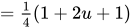

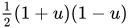
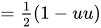


Citations
[edit | edit source]- ↑ Hestenes 1986, p. 6
- ↑ Li 2008, p. 411
- ↑ 3.0 3.1 Hestenes 1966
- ↑ Hestenes 2003
- ↑ 5.0 5.1 Doran 1994
- ↑ Lasenby, Lasenby & Doran 2000
- ↑ Hildenbrand et al. 2004
- ↑ Hestenes & Sobczyk 1984, p. 3–5
- ↑ Aragón, Aragón & Rodríguez 1997, p. 101
- ↑ Lounesto 2001, p. 190
- ↑ Lounesto 2001, p. 191
- ↑ Vaz & da Rocha 2016, p. 58, Theorem 3.1
- ↑ 13.0 13.1 Hestenes 2005
- ↑ Penrose 2007
- ↑ Wheeler, Misner & Thorne 1973, p. 83
- ↑ Wilmot 1988a, p. 2338
- ↑ Wilmot 1988b, p. 2346
- ↑ Chevalley 1991
- ↑ Wilmot 2023
- ↑ Hestenes & Sobczyk 1984, p. 103
- ↑ Dorst, Fontijne & Mann 2007, p. 204
- ↑ Dorst, Fontijne & Mann 2007, pp. 177–182
- ↑ Lundholm & Svensson 2009, pp. 58 et seq
- ↑ Lundholm & Svensson 2009, p. 58
- ↑ Francis & Kosowsky 2008
- ↑ Kanatani 2015, pp. 112–113
- ↑ Dorst & Lasenby 2011, p. 443
- ↑ Vaz & da Rocha 2016, §2.8
- ↑ Hestenes & Sobczyk 1984, p. 31
- ↑ Doran & Lasenby 2003, p. 102
- ↑ Dorst & Lasenby 2011, p. vi
- ↑ Electromagnetism using Geometric Algebra versus Components, retrieved 2013-03-19
- ↑ Selig 2005
- ↑ Hadfield & Lasenby 2020
- ↑ "Projective Geometric Algebra", projectivegeometricalgebra.org, retrieved 2023-10-03
- ↑ 36.0 36.1 Hrdina, Návrat & Vašík 2018
- ↑ Lengyel 2024
- ↑ Wu 2022
- ↑ Sokolov 2013
- ↑ Lasenby 2004
- ↑ Dorst 2016
- ↑ Perwass 2009
- ↑ Breuils et al. 2019
- ↑ Easter & Hitzer 2017
- ↑ 45.0 45.1 Dorst, Fontijne & Mann 2007, §3.6 p. 85
- ↑ Perwass 2009, §3.2.10.2 p. 83
- ↑ Hestenes & Sobczyk 1984
- ↑ Grassmann 1844
- ↑ Artin 1988
References and further reading
[edit | edit source]- Arranged chronologically
- Grassmann, Hermann (1844), Die lineale Ausdehnungslehre ein neuer Zweig der Mathematik: dargestellt und durch Anwendungen auf die übrigen Zweige der Mathematik, wie auch auf die Statik, Mechanik, die Lehre vom Magnetismus und die Krystallonomie erläutert, Leipzig: O. Wigand, OCLC 20521674
- Clifford, Professor (1878), "Applications of Grassmann's Extensive Algebra", American Journal of Mathematics, 1 (4): 350–358, doi:10.2307/2369379, JSTOR 2369379
- Artin, Emil (1988) [1957], Geometric algebra, Wiley Classics Library, Wiley, doi:10.1002/9781118164518, ISBN 978-0-471-60839-4, MR 1009557
- Hestenes, David (1966), Space–time Algebra, Gordon and Breach, ISBN 978-0-677-01390-9, OCLC 996371
- Wheeler, J. A.; Misner, C.; Thorne, K. S. (1973), Gravitation, W.H. Freeman, ISBN 978-0-7167-0344-0
- Bourbaki, Nicolas (1980), "Ch. 9 "Algèbres de Clifford"", Eléments de Mathématique. Algèbre, Hermann, ISBN 9782225655166
- Hestenes, David; Sobczyk, Garret (1984), Clifford Algebra to Geometric Calculus, a Unified Language for Mathematics and Physics, Springer Netherlands, ISBN 978-90-277-1673-6
- Hestenes, David (1986), "A Unified Language for Mathematics and Physics", in J.S.R. Chisholm; A.K. Commons (eds.), Clifford Algebras and Their Applications in Mathematical Physics, NATO ASI Series (Series C), 183, Springer, pp. 1–23, doi:10.1007/978-94-009-4728-3_1, ISBN 978-94-009-4728-3
- Wilmot, G.P. (1988a), The Structure of Clifford algebra. Journal of Mathematical Physics, 29, pp. 2338–2345
- Wilmot, G.P. (1988b), "Clifford algebra and the Pfaffian expansion", Journal of Mathematical Physics, 29: 2346–2350, doi:10.1063/1.528118
- Chevalley, Claude (1991), The Algebraic Theory of Spinors and Clifford Algebras, Collected Works, 2, Springer, ISBN 3-540-57063-2
- Doran, Chris J. L. (1994), Geometric Algebra and its Application to Mathematical Physics (PhD thesis), University of Cambridge, doi:10.17863/CAM.16148, hdl:1810/251691, OCLC 53604228
- Baylis, W. E., ed. (2011) [1996], Clifford (Geometric) Algebra with Applications to Physics, Mathematics, and Engineering, Birkhäuser, ISBN 9781461241058
- Aragón, G.; Aragón, J.L.; Rodríguez, M.A. (1997), "Clifford Algebras and Geometric Algebra", Advances in Applied Clifford Algebras, 7 (2): 91–102, doi:10.1007/BF03041220, S2CID 120860757
- Hestenes, David (1999), New Foundations for Classical Mechanics (2nd ed.), Springer Verlag, ISBN 978-0-7923-5302-7
- Lasenby, Joan; Lasenby, Anthony N.; Doran, Chris J. L. (2000), "A Unified Mathematical Language for Physics and Engineering in the 21st Century" (PDF), Philosophical Transactions of the Royal Society A, 358 (1765): 21–39, Bibcode:2000RSPTA.358...21L, doi:10.1098/rsta.2000.0517, S2CID 91884543, archived (PDF) from the original on 2015-03-19
- Lounesto, Pertti (2001), Clifford Algebras and Spinors (2nd ed.), Cambridge University Press, ISBN 978-0-521-00551-7
- Baylis, W. E. (2002), Electrodynamics: A Modern Geometric Approach (2nd ed.), Birkhäuser, ISBN 978-0-8176-4025-5
- Dorst, Leo (2002), "The Inner Products of Geometric Algebra", in Dorst, L.; Doran, C.; Lasenby, J. (eds.), Applications of Geometric Algebra in Computer Science and Engineering, Birkhäuser, pp. 35–46, doi:10.1007/978-1-4612-0089-5_2, ISBN 978-1-4612-0089-5
- Doran, Chris J. L.; Lasenby, Anthony N. (2003), Geometric Algebra for Physicists (PDF), Cambridge University Press, Bibcode:2003gap..book.....D, ISBN 978-0-521-71595-9, archived (PDF) from the original on 2009-01-06
- Hestenes, David (2003), "Oersted Medal Lecture 2002: Reforming the Mathematical Language of Physics" (PDF), Am. J. Phys., 71 (2): 104–121, Bibcode:2003AmJPh..71..104H, CiteSeerX 10.1.1.649.7506, doi:10.1119/1.1522700
- Hildenbrand, Dietmar; Fontijne, Daniel; Perwass, Christian; Dorst, Leo (2004), "Geometric Algebra and its Application to Computer Graphics" (PDF), Proceedings of Eurographics 2004, doi:10.2312/egt.20041032, archived (PDF) from the original on 2015-09-06
- Lasenby, Anthony (2004), "Conformal Models of de Sitter Space, Initial Conditions for Inflation and the CMB", AIP Conference Proceedings, 736, pp. 53–70, arXiv:astro-ph/0411579, doi:10.1063/1.1835174, S2CID 18034896
- Hestenes, David (2005), Introduction to Primer for Geometric Algebra
- Selig, J.M. (2005), Geometric Fundamentals of Robotics, Monographs in Computer Science, New York, NY: Springer New York, doi:10.1007/b138859, ISBN 978-0-387-20874-9
- Bain, J. (2006), "Spacetime structuralism: §5 Manifolds vs. geometric algebra", in Dennis Dieks (ed.), The ontology of spacetime, Elsevier, p. 54 ff, ISBN 978-0-444-52768-4
- Dorst, Leo; Fontijne, Daniel; Mann, Stephen (2007), Geometric algebra for computer science: an object-oriented approach to geometry, Elsevier, ISBN 978-0-12-369465-2, OCLC 132691969
- Penrose, Roger (2007), The Road to Reality, Vintage books, ISBN 978-0-679-77631-4
- Francis, Matthew R.; Kosowsky, Arthur (2008), "The Construction of Spinors in Geometric Algebra", Annals of Physics, 317 (2): 383–409, arXiv:math-ph/0403040v2, Bibcode:2005AnPhy.317..383F, doi:10.1016/j.aop.2004.11.008, S2CID 119632876
- Li, Hongbo (2008), Invariant Algebras and Geometric Reasoning, World Scientific, ISBN 9789812770110. Chapter 1 as PDF
- Vince, John A. (2008), Geometric Algebra for Computer Graphics, Springer, ISBN 978-1-84628-996-5
- Lundholm, Douglas; Svensson, Lars (2009), "Clifford Algebra, Geometric Algebra and Applications", arXiv:0907.5356v1 [math-ph]
- Perwass, Christian (2009), Geometric Algebra with Applications in Engineering, Geometry and Computing, 4, Bibcode:2009gaae.book.....P, doi:10.1007/978-3-540-89068-3, ISBN 978-3-540-89067-6
- Selig, J. M. (2000), "Clifford algebra of points, lines and planes" (PDF), Robotica, 18 (5): 545–556, doi:10.1017/S0263574799002568, S2CID 28929170
- Bayro-Corrochano, Eduardo (2010), Geometric Computing for Wavelet Transforms, Robot Vision, Learning, Control and Action, Springer Verlag, ISBN 9781848829299
- Bayro-Corrochano, E.; Scheuermann, Gerik, eds. (2010), Geometric Algebra Computing in Engineering and Computer Science, Springer, ISBN 9781849961080 Extract online at https://davidhestenes.net/geocalc/html/UAFCG.html #5 New Tools for Computational Geometry and rejuvenation of Screw Theory
- Goldman, Ron (2010), Rethinking Quaternions: Theory and Computation, Morgan & Claypool, Part III. Rethinking Quaternions and Clifford Algebras, ISBN 978-1-60845-420-4
- Dorst, Leo.; Lasenby, Joan (2011), Guide to Geometric Algebra in Practice, Springer, ISBN 9780857298119
- Macdonald, Alan (2011), Linear and Geometric Algebra, CreateSpace, ISBN 9781453854938, OCLC 704377582
- Snygg, John (2011), A New Approach to Differential Geometry using Clifford's Geometric Algebra, Springer, ISBN 978-0-8176-8282-8
- Hildenbrand, Dietmar (2012), "Foundations of Geometric Algebra computing", Numerical Analysis and Applied Mathematics Icnaam 2012: International Conference of Numerical Analysis and Applied Mathematics, AIP Conference Proceedings, 1479 (1): 27–30, Bibcode:2012AIPC.1479...27H, doi:10.1063/1.4756054
- Sokolov, Andrey (2013), Clifford algebra and the projective model of Minkowski (Pseudo-Euclidean) spaces, arXiv:1307.4179
- Bromborsky, Alan (2014), An introduction to Geometric Algebra and Calculus (PDF), archived (PDF) from the original on 2019-10-15
- Klawitter, Daniel (2015), Clifford Algebras, doi:10.1007/978-3-658-07618-4, ISBN 978-3-658-07617-7
- Kanatani, Kenichi (2015), Understanding Geometric Algebra: Hamilton, Grassmann, and Clifford for Computer Vision and Graphics, CRC Press, ISBN 978-1-4822-5951-3
- Li, Hongbo; Huang, Lei; Shao, Changpeng; Dong, Lei (2015), "Three-Dimensional Projective Geometry with Geometric Algebra", arXiv:1507.06634v1 [math.MG]
- Hestenes, David (2017), "The Genesis of Geometric Algebra: A Personal Retrospective", Advances in Applied Clifford Algebras, 27: 351–379, doi:10.1007/s00006-016-0664-z, S2CID 253592888 Check
|s2cid=value (help) - Dorst, Leo (2016), "3D Oriented Projective Geometry Through Versors of Template:Tmath", Advances in Applied Clifford Algebras, 26 (4): 1137–1172, doi:10.1007/s00006-015-0625-y
- Vaz, Jayme; da Rocha, Roldão (2016), An Introduction to Clifford Algebras and Spinors, Oxford University Press, Bibcode:2016icas.book.....V, ISBN 978-0-19-878292-6
- Easter, Robert Benjamin; Hitzer, Eckhard (2017), "Double Conformal Geometric Algebra", Advances in Applied Clifford Algebras, 27 (3): 2175–2199, doi:10.1007/s00006-017-0784-0, S2CID 253600526 Check
|s2cid=value (help) - Du, Juan; Goldman, Ron; Mann, Stephen (2017), "Modeling 3D Geometry in the Clifford Algebra R(4, 4)", Advances in Applied Clifford Algebras, 27 (4): 3039–3062, doi:10.1007/s00006-017-0798-7, S2CID 253587390 Check
|s2cid=value (help) - Bayro-Corrochano, Eduardo (2018), Computer Vision, Graphics and Neurocomputing, Geometric Algebra Applications, I, Springer, ISBN 978-3-319-74830-6
- Template:Cite thesis
- Lavor, Carlile; Xambó-Descamps, Sebastià; Zaplana, Isiah (2018), A Geometric Algebra Invitation to Space-Time Physics, Robotics and Molecular Geometry, Springer, pp. 1–, ISBN 978-3-319-90665-2
- Hrdina, Jaroslav; Návrat, Aleš; Vašík, Petr (2018), "Geometric Algebra for Conics", Advances in Applied Clifford Algebras, 28 (3), doi:10.1007/s00006-018-0879-2, S2CID 125649450
- Breuils, Stéphane; Fuchs, Laurent; Hitzer, Eckhard; Nozick, Vincent; Sugimoto, Akihiro (2019), "Three-dimensional quadrics in extended conformal geometric algebras of higher dimensions from control points, implicit equations and axis alignment" (PDF), Advances in Applied Clifford Algebras, 29 (3), doi:10.1007/s00006-019-0974-z, S2CID 253597480 Check
|s2cid=value (help) - Josipović, Miroslav (2019), Geometric Multiplication of Vectors: An Introduction to Geometric Algebra in Physics, Springer International Publishing;Birkhäuser, p. 256, Bibcode:2019gmva.book.....J, ISBN 978-3-030-01756-9
- Hadfield, Hugo; Lasenby, Joan (2020), "Constrained Dynamics in Conformal and Projective Geometric Algebra", Advances in Computer Graphics, Lecture Notes in Computer Science, 12221, pp. 459–471, doi:10.1007/978-3-030-61864-3_39, ISBN 978-3-030-61863-6, S2CID 224820480
- Wu, Bofeng (2022), "A signature invariant geometric algebra framework for spacetime physics and its applications in relativistic dynamics of a massive particle and gyroscopic precession", Scientific Reports, 12 (1): 3981, arXiv:2111.07353, Bibcode:2022NatSR..12.3981W, doi:10.1038/s41598-022-06895-0, PMC 8901677 Check
|pmc=value (help), PMID 35256628 - Wilmot, G.P. (2023), "The Algebra Of Geometry", GitHub
- Lengyel, Eric (2024), Projective Geometric Algebra Illuminated, Lincoln, California: Terathon Software LLC, ISBN 979-8-9853582-5-4
External links
[edit | edit source]| File:Wikibooks-logo-en-noslogan.svg | Wikibooks has a book on the topic of: Physics in the Language of Geometric Algebra. An Approach with the Algebra of Physical Space |

| Error creating thumbnail: | Wikiversity has learning resources about Investigating 3D geometric algebra |

- A Survey of Geometric Algebra and Geometric Calculus Alan Macdonald, Luther College, Iowa
- Imaginary Numbers are not Real – the Geometric Algebra of Spacetime. Introduction (Cambridge GA group)
- Geometric Algebra 2015, Masters Course in Scientific Computing, from Dr. Chris Doran (Cambridge)
- Maths for (Games) Programmers: 5 – Multivector methods – comprehensive introduction and reference for programmers, from Ian Bell
- IMPA Summer School 2010 Fernandes Oliveira Intro and Slides
- University of Fukui E.S.M. Hitzer and Japan GA publications
- Google Group for GA
- Geometric Algebra Primer Introduction to GA, Jaap Suter
- Geometric Algebra Resources curated wiki, Pablo Bleyer
- Applied Geometric Algebras in Computer Science and Engineering 2018 Early Proceedings
- bivector.net Geometric Algebra for CGI, Vision and Engineering community website
- AGACSE 2021 Videos
English translations of early books and papers
- G. Combebiac, "calculus of tri-quaternions" (Doctoral dissertation)
- M. Markic, "Transformants: A new mathematical vehicle. A synthesis of Combebiac's tri-quaternions and Grassmann's geometric system. The calculus of quadri-quaternions"
- C. Burali-Forti, "The Grassmann method in projective geometry" A compilation of three notes on the application of exterior algebra to projective geometry
- C. Burali-Forti, "Introduction to Differential Geometry, following the method of H. Grassmann" Early book on the application of Grassmann algebra
- H. Grassmann, "Mechanics, according to the principles of the theory of extension" – one of his papers on the applications of exterior algebra
Research groups
- Geometric Calculus International. Links to Research groups, Software, and Conferences, worldwide
- Cambridge Geometric Algebra group. Full-text online publications, and other material
- University of Amsterdam group
- Geometric Calculus research & development (archive of Hestenes's website at Arizona State University)
- GA-Net blog and newsletter archive. Geometric Algebra/Clifford Algebra development news
- Geometric Algebra for Perception Action Systems. Geometric Cybernetics Group (CINVESTAV, Campus Guadalajara, Mexico)