Graded ring
Template:Algebraic structures In mathematics, in particular abstract algebra, a graded ring is a ring such that the underlying additive group is a direct sum of abelian groups such that Template:Tmath. The index set is usually the set of nonnegative integers or the set of integers, but can be any monoid. The direct sum decomposition is usually referred to as gradation or grading.

A graded module is defined similarly (see below for the precise definition). It generalizes graded vector spaces. A graded module that is also a graded ring is called a graded algebra. A graded ring could also be viewed as a graded Template:Tmath-algebra.
The associativity is not important (in fact not used at all) in the definition of a graded ring; hence, the notion applies to non-associative algebras as well; e.g., one can consider a graded Lie algebra.
First properties
[edit]Generally, the index set of a graded ring is assumed to be the set of nonnegative integers, unless otherwise explicitly specified. This is the case in this article.
A graded ring is a ring that is decomposed into a direct sum

of additive groups, such that

for all nonnegative integers and Template:Tmath.

A nonzero element of is said to be homogeneous of degree Template:Tmath. By definition of a direct sum, every nonzero element of can be uniquely written as a sum where each is either 0 or homogeneous of degree Template:Tmath. The nonzero are the homogeneous components of Template:Tmath.




Some basic properties are:
- is a subring of Template:Tmath; in particular, the multiplicative identity is a homogeneous element of degree zero.
- For any , is a two-sided Template:Tmath-module, and the direct sum decomposition is a direct sum of Template:Tmath-modules.
- is an [[associative algebra|associative Template:Tmath-algebra]].


Ideals
[edit]An ideal Failed to parse (Conversion error. Server ("https://wikimedia.org/api/rest_") reported: "Cannot get mml. Server problem."): {\displaystyle I\subseteq R} is homogeneous, if for every Template:Tmath, the homogeneous components of also belong to Template:Tmath. (Equivalently, if it is a graded submodule of Template:Tmath; see § Graded module.) The intersection of a homogeneous ideal with is an Template:Tmath-submodule of called the homogeneous part of degree of Template:Tmath. A homogeneous ideal is the direct sum of its homogeneous parts.

Quotients
[edit]If is a two-sided homogeneous ideal in Template:Tmath, then Failed to parse (Conversion error. Server ("https://wikimedia.org/api/rest_") reported: "Cannot get mml. Server problem."): {\displaystyle R/I} is also a graded ring, decomposed as
- Failed to parse (Conversion error. Server ("https://wikimedia.org/api/rest_") reported: "Cannot get mml. Server problem."): {\displaystyle R/I=\bigoplus _{n=0}^{\infty }R_{n}/I_{n},}
where is the homogeneous part of degree of Template:Tmath.

Basic examples
[edit]- Any (non-graded) ring R can be given a gradation by letting Template:Tmath, and Failed to parse (Conversion error. Server ("https://wikimedia.org/api/rest_") reported: "Cannot get mml. Server problem."): {\displaystyle R_{i}=0} for i ≠ 0. This is called the trivial gradation on R.
- The polynomial ring Failed to parse (Conversion error. Server ("https://wikimedia.org/api/rest_") reported: "Cannot get mml. Server problem."): {\displaystyle R=k[t_{1},\ldots ,t_{n}]} is graded by degree: it is a direct sum of consisting of homogeneous polynomials of degree i.
- Let S be the set of all nonzero homogeneous elements in a graded integral domain R. Then the localization of R with respect to S is a -graded ring.
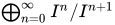
- If I is an ideal in a commutative ring R, then is a graded ring called the associated graded ring of R along I; geometrically, it is the coordinate ring of the normal cone along the subvariety defined by I.
- Let X be a topological space, HTemplate:Hairspi(X; R) the ith cohomology group with coefficients in a ring R. Then H *(X; R), the cohomology ring of X with coefficients in R, is a graded ring whose underlying group is Failed to parse (Conversion error. Server ("https://wikimedia.org/api/rest_") reported: "Cannot get mml. Server problem."): {\textstyle \bigoplus _{i=0}^{\infty }H^{i}(X;R)} with the multiplicative structure given by the cup product.

Graded module
[edit]The corresponding idea in module theory is that of a graded module, namely a left module M over a graded ring R such that
- Failed to parse (Conversion error. Server ("https://wikimedia.org/api/rest_") reported: "Cannot get mml. Server problem."): {\displaystyle M=\bigoplus _{i\in \mathbb {N} }M_{i},}
and
- Failed to parse (Conversion error. Server ("https://wikimedia.org/api/rest_") reported: "Cannot get mml. Server problem."): {\displaystyle R_{i}M_{j}\subseteq M_{i+j}}
for every i and j.
Examples:
- A graded vector space is an example of a graded module over a field (with the field having trivial grading).
- A graded ring is a graded module over itself. An ideal in a graded ring is homogeneous if and only if it is a graded submodule. The annihilator of a graded module is a homogeneous ideal.
- Given an ideal I in a commutative ring R and an R-module M, the direct sum Failed to parse (Conversion error. Server ("https://wikimedia.org/api/rest_") reported: "Cannot get mml. Server problem."): {\displaystyle \bigoplus _{n=0}^{\infty }I^{n}M/I^{n+1}M} is a graded module over the associated graded ring Failed to parse (Conversion error. Server ("https://wikimedia.org/api/rest_") reported: "Cannot get mml. Server problem."): {\textstyle \bigoplus _{0}^{\infty }I^{n}/I^{n+1}} .
A morphism Failed to parse (Conversion error. Server ("https://wikimedia.org/api/rest_") reported: "Cannot get mml. Server problem."): {\displaystyle f:N\to M} of graded modules, called a graded morphism or graded homomorphism , is a homomorphism of the underlying modules that respects grading; i.e., Template:Tmath. A graded submodule is a submodule that is a graded module in own right and such that the set-theoretic inclusion is a morphism of graded modules. Explicitly, a graded module N is a graded submodule of M if and only if it is a submodule of M and satisfies Template:Tmath. The kernel and the image of a morphism of graded modules are graded submodules.
Remark: To give a graded morphism from a graded ring to another graded ring with the image lying in the center is the same as to give the structure of a graded algebra to the latter ring.
Given a graded module , the -twist of is a graded module defined by Failed to parse (Conversion error. Server ("https://wikimedia.org/api/rest_") reported: "Cannot get mml. Server problem."): {\displaystyle M(\ell )_{n}=M_{n+\ell }} (cf. Serre's twisting sheaf in algebraic geometry).


Let M and N be graded modules. If Failed to parse (Conversion error. Server ("https://wikimedia.org/api/rest_") reported: "Cannot get mml. Server problem."): {\displaystyle f\colon M\to N} is a morphism of modules, then f is said to have degree d if . An exterior derivative of differential forms in differential geometry is an example of such a morphism having degree 1.

Invariants of graded modules
[edit]Given a graded module M over a commutative graded ring R, one can associate the formal power series Template:Tmath:
- Failed to parse (Conversion error. Server ("https://wikimedia.org/api/rest_") reported: "Cannot get mml. Server problem."): {\displaystyle P(M,t)=\sum \ell (M_{n})t^{n}}
(assuming Failed to parse (Conversion error. Server ("https://wikimedia.org/api/rest_") reported: "Cannot get mml. Server problem."): {\displaystyle \ell (M_{n})} are finite.) It is called the Hilbert–Poincaré series of M.
A graded module is said to be finitely generated if the underlying module is finitely generated. The generators may be taken to be homogeneous (by replacing the generators by their homogeneous parts.)
Suppose R is a polynomial ring Template:Tmath, k a field, and M a finitely generated graded module over it. Then the function Failed to parse (Conversion error. Server ("https://wikimedia.org/api/rest_") reported: "Cannot get mml. Server problem."): {\displaystyle n\mapsto \dim _{k}M_{n}} is called the Hilbert function of M. The function coincides with the integer-valued polynomial for large n called the Hilbert polynomial of M.
Graded algebra
[edit]An associative algebra A over a ring R is a graded algebra if it is graded as a ring.
In the usual case where the ring R is not graded (in particular if R is a field), it is given the trivial grading (every element of R is of degree 0). Thus, Failed to parse (Conversion error. Server ("https://wikimedia.org/api/rest_") reported: "Cannot get mml. Server problem."): {\displaystyle R\subseteq A_{0}} and the graded pieces Failed to parse (Conversion error. Server ("https://wikimedia.org/api/rest_") reported: "Cannot get mml. Server problem."): {\displaystyle A_{i}} are R-modules.
In the case where the ring R is also a graded ring, then one requires that
- Failed to parse (Conversion error. Server ("https://wikimedia.org/api/rest_") reported: "Cannot get mml. Server problem."): {\displaystyle R_{i}A_{j}\subseteq A_{i+j}}
In other words, we require A to be a graded left module over R.
Examples of graded algebras are common in mathematics:
- Polynomial rings. The homogeneous elements of degree n are exactly the homogeneous polynomials of degree n.
- The tensor algebra Failed to parse (Conversion error. Server ("https://wikimedia.org/api/rest_") reported: "Cannot get mml. Server problem."): {\displaystyle T^{\bullet }V} of a vector space V. The homogeneous elements of degree n are the tensors of order n, Template:Tmath.
- The exterior algebra Failed to parse (Conversion error. Server ("https://wikimedia.org/api/rest_") reported: "Cannot get mml. Server problem."): {\displaystyle \textstyle \bigwedge \nolimits ^{\bullet }V} and the symmetric algebra are also graded algebras.
- The cohomology ring Failed to parse (Conversion error. Server ("https://wikimedia.org/api/rest_") reported: "Cannot get mml. Server problem."): {\displaystyle H^{\bullet }} in any cohomology theory is also graded, being the direct sum of the cohomology groups Template:Tmath.

Graded algebras are much used in commutative algebra and algebraic geometry, homological algebra, and algebraic topology. One example is the close relationship between homogeneous polynomials and projective varieties (cf. Homogeneous coordinate ring).
Another example of a graded algebra which is non-commutative is the Leavitt path algebra which has a natural -grading.
G-graded rings and algebras
[edit]The above definitions have been generalized to rings graded using any monoid G as an index set. A G-graded ring R is a ring with a direct sum decomposition
- Failed to parse (Conversion error. Server ("https://wikimedia.org/api/rest_") reported: "Cannot get mml. Server problem."): {\displaystyle R=\bigoplus _{i\in G}R_{i}}
such that
- Failed to parse (Conversion error. Server ("https://wikimedia.org/api/rest_") reported: "Cannot get mml. Server problem."): {\displaystyle R_{i}R_{j}\subseteq R_{i\cdot j}.}
Elements of R that lie inside for some are said to be homogeneous of grade i.

The previously defined notion of "graded ring" now becomes the same thing as an -graded ring, where is the monoid of natural numbers under addition. The definitions for graded modules and algebras can also be extended this way replacing the indexing set with any monoid G.

Remarks:
- If we do not require that the ring have an identity element, semigroups may replace monoids.
Examples:
- A group naturally grades the corresponding group ring; similarly, monoid rings are graded by the corresponding monoid.
- An (associative) superalgebra is another term for a -graded algebra. Examples include Clifford algebras. Here the homogeneous elements are either of degree 0 (even) or 1 (odd).

Anticommutativity
[edit]Some graded rings (or algebras) are endowed with an anticommutative structure. This notion requires a homomorphism of the monoid of the gradation into the additive monoid of , the field with two elements. Specifically, a signed monoid consists of a pair Failed to parse (Conversion error. Server ("https://wikimedia.org/api/rest_") reported: "Cannot get mml. Server problem."): {\displaystyle (\Gamma ,\varepsilon )} where is a monoid and Failed to parse (Conversion error. Server ("https://wikimedia.org/api/rest_") reported: "Cannot get mml. Server problem."): {\displaystyle \varepsilon \colon \Gamma \to \mathbb {Z} /2\mathbb {Z} } is a homomorphism of additive monoids. An anticommutative -graded ring is a ring A graded with respect to such that:


- Failed to parse (Conversion error. Server ("https://wikimedia.org/api/rest_") reported: "Cannot get mml. Server problem."): {\displaystyle xy=(-1)^{\varepsilon (\deg x)\varepsilon (\deg y)}yx,}
for all homogeneous elements x and y.
Examples
[edit]- An exterior algebra is an example of an anticommutative algebra, graded with respect to the structure Failed to parse (Conversion error. Server ("https://wikimedia.org/api/rest_") reported: "Cannot get mml. Server problem."): {\displaystyle (\mathbb {Z} ,\varepsilon )} where Failed to parse (Conversion error. Server ("https://wikimedia.org/api/rest_") reported: "Cannot get mml. Server problem."): {\displaystyle \varepsilon \colon \mathbb {Z} \to \mathbb {Z} /2\mathbb {Z} } is the quotient map.
- A supercommutative algebra (sometimes called a skew-commutative associative ring) is the same thing as an anticommutative Failed to parse (Conversion error. Server ("https://wikimedia.org/api/rest_") reported: "Cannot get mml. Server problem."): {\displaystyle (\mathbb {Z} /2\mathbb {Z} ,\varepsilon )} -graded algebra, where is the identity map of the additive structure of Template:Tmath.

Graded monoid
[edit]Intuitively, a graded monoid is the subset of a graded ring, Failed to parse (Conversion error. Server ("https://wikimedia.org/api/rest_") reported: "Cannot get mml. Server problem."): {\textstyle \bigoplus _{n\in \mathbb {N} _{0}}R_{n}} , generated by the 's, without using the additive part. That is, the set of elements of the graded monoid is Failed to parse (Conversion error. Server ("https://wikimedia.org/api/rest_") reported: "Cannot get mml. Server problem."): {\displaystyle \bigcup _{n\in \mathbb {N} _{0}}R_{n}} .
Formally, a graded monoid[1] is a monoid , with a gradation function such that Failed to parse (Conversion error. Server ("https://wikimedia.org/api/rest_") reported: "Cannot get mml. Server problem."): {\displaystyle \phi (m\cdot m')=\phi (m)+\phi (m')} . Note that the gradation of Failed to parse (Conversion error. Server ("https://wikimedia.org/api/rest_") reported: "Cannot get mml. Server problem."): {\displaystyle 1_{M}} is necessarily 0. Some authors request furthermore that Failed to parse (Conversion error. Server ("https://wikimedia.org/api/rest_") reported: "Cannot get mml. Server problem."): {\displaystyle \phi (m)\neq 0} when m is not the identity.


Assuming the gradations of non-identity elements are non-zero, the number of elements of gradation n is at most Failed to parse (Conversion error. Server ("https://wikimedia.org/api/rest_") reported: "Cannot get mml. Server problem."): {\displaystyle g^{n}} where g is the cardinality of a generating set G of the monoid. Therefore, the number of elements of gradation n or less is at most (for Failed to parse (Conversion error. Server ("https://wikimedia.org/api/rest_") reported: "Cannot get mml. Server problem."): {\displaystyle g=1} ) or Failed to parse (Conversion error. Server ("https://wikimedia.org/api/rest_") reported: "Cannot get mml. Server problem."): {\textstyle {\frac {g^{n+1}-1}{g-1}}} else. Indeed, each such element is the product of at most n elements of G, and only Failed to parse (Conversion error. Server ("https://wikimedia.org/api/rest_") reported: "Cannot get mml. Server problem."): {\textstyle {\frac {g^{n+1}-1}{g-1}}} such products exist. Similarly, the identity element can not be written as the product of two non-identity elements. That is, there is no unit divisor in such a graded monoid.

Power series indexed by a graded monoid
[edit]These notions allow us to extend the notion of power series ring. Instead of the indexing family being , the indexing family could be any graded monoid, assuming that the number of elements of degree n is finite, for each integer n.
More formally, let Failed to parse (Conversion error. Server ("https://wikimedia.org/api/rest_") reported: "Cannot get mml. Server problem."): {\displaystyle (K,+_{K},\times _{K})} be an arbitrary semiring and a graded monoid. Then Failed to parse (Conversion error. Server ("https://wikimedia.org/api/rest_") reported: "Cannot get mml. Server problem."): {\displaystyle K\langle \langle R\rangle \rangle } denotes the semiring of power series with coefficients in K indexed by R. Its elements are functions from R to K. The sum of two elements Failed to parse (Conversion error. Server ("https://wikimedia.org/api/rest_") reported: "Cannot get mml. Server problem."): {\displaystyle s,s'\in K\langle \langle R\rangle \rangle } is defined pointwise, it is the function sending Failed to parse (Conversion error. Server ("https://wikimedia.org/api/rest_") reported: "Cannot get mml. Server problem."): {\displaystyle m\in R} to Failed to parse (Conversion error. Server ("https://wikimedia.org/api/rest_") reported: "Cannot get mml. Server problem."): {\displaystyle s(m)+_{K}s'(m)} , and the product is the function sending Failed to parse (Conversion error. Server ("https://wikimedia.org/api/rest_") reported: "Cannot get mml. Server problem."): {\displaystyle m\in R} to the infinite sum Failed to parse (Conversion error. Server ("https://wikimedia.org/api/rest_") reported: "Cannot get mml. Server problem."): {\displaystyle \sum _{p,q\in R \atop p\cdot q=m}s(p)\times _{K}s'(q)} . This sum is correctly defined (i.e., finite) because, for each m, there are only a finite number of pairs (p, q) such that pq = m.

Free monoid
[edit]In formal language theory, given an alphabet A, the free monoid of words over A can be considered as a graded monoid, where the gradation of a word is its length.
See also
[edit]Notes
[edit]Citations
[edit]- ↑ Sakarovitch, Jacques (2009). "Part II: The power of algebra". Elements of automata theory. Translated by Thomas, Reuben. Cambridge University Press. p. 384. ISBN 978-0-521-84425-3. Zbl 1188.68177.
References
[edit]- Template:Lang Algebra.
- Bourbaki, N. (1974). "Ch. 1–3, 3 §3". Algebra I. Springer. ISBN 978-3-540-64243-5.
- Steenbrink, J. (1977). "Intersection form for quasi-homogeneous singularities" (PDF). Compositio Mathematica. 34 (2): 211–223 See p. 211. ISSN 0010-437X.
- Matsumura, H. (1989). "5 Dimension theory §S3 Graded rings, the Hilbert function and the Samuel function". Commutative Ring Theory. Cambridge Studies in Advanced Mathematics. 8. Translated by Reid, M. (2nd ed.). Cambridge University Press. ISBN 978-1-107-71712-1.