Limit inferior and limit superior
 | This article includes a list of general references, but it remains largely unverified because it lacks sufficient corresponding inline citations. (February 2019) |
In mathematics, the limit inferior and limit superior (or limes inferior and limes superior) of a sequence can be thought of as limiting (that is, eventual and extreme) bounds on the sequence. They can be thought of in a similar fashion for a function (see limit of a function). For a set, they are the infimum and supremum of the set's limit points, respectively. In general, when there are multiple objects around which a sequence, function, or set accumulates, the inferior and superior limits extract the smallest and largest of them; the type of object and the measure of size is context-dependent, but the notion of extreme limits is invariant. Limit inferior is also called infimum limit, limit infimum, liminf, inferior limit, lower limit, or inner limit; limit superior is also known as supremum limit, limit supremum, limsup, superior limit, upper limit, or outer limit.
The limit inferior of a sequence Failed to parse (Conversion error. Server ("https://wikimedia.org/api/rest_") reported: "Cannot get mml. Server problem."): {\displaystyle (x_{n})} is denoted by and the limit superior of a sequence is denoted by Failed to parse (Conversion error. Server ("https://wikimedia.org/api/rest_") reported: "Cannot get mml. Server problem."): {\displaystyle \limsup _{n\to \infty }x_{n}\quad {\text{or}}\quad \varlimsup _{n\to \infty }x_{n}.}


Definition for sequences
[edit | edit source]The limit inferior of a sequence is defined by or


Similarly, the limit superior of is defined by or


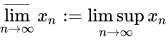
Alternatively, the notations Failed to parse (Conversion error. Server ("https://wikimedia.org/api/rest_") reported: "Cannot get mml. Server problem."): {\displaystyle \varliminf _{n\to \infty }x_{n}:=\liminf _{n\to \infty }x_{n}} and are sometimes used.
The limits superior and inferior can equivalently be defined using the concept of subsequential limits of the sequence .[1] An element of the extended real numbers is a subsequential limit of if there exists a strictly increasing sequence of natural numbers such that Failed to parse (Conversion error. Server ("https://wikimedia.org/api/rest_") reported: "Cannot get mml. Server problem."): {\displaystyle \xi =\lim _{k\to \infty }x_{n_{k}}} . If Failed to parse (Conversion error. Server ("https://wikimedia.org/api/rest_") reported: "Cannot get mml. Server problem."): {\displaystyle E\subseteq {\overline {\mathbb {R} }}} is the set of all subsequential limits of , then


- Failed to parse (Conversion error. Server ("https://wikimedia.org/api/rest_") reported: "Cannot get mml. Server problem."): {\displaystyle \limsup _{n\to \infty }x_{n}=\sup E}
and
- Failed to parse (Conversion error. Server ("https://wikimedia.org/api/rest_") reported: "Cannot get mml. Server problem."): {\displaystyle \liminf _{n\to \infty }x_{n}=\inf E.}
If the terms in the sequence are real numbers, the limit superior and limit inferior always exist, as the real numbers together with ±∞ (i.e. the extended real number line) are complete. More generally, these definitions make sense in any partially ordered set, provided the suprema and infima exist, such as in a complete lattice.
Whenever the ordinary limit exists, the limit inferior and limit superior are both equal to it; therefore, each can be considered a generalization of the ordinary limit which is primarily interesting in cases where the limit does not exist. In general,

The limits inferior and superior are related to big-O notation in that they bound a sequence only "in the limit"; the sequence may exceed the bound. However, with big-O notation the sequence can only exceed the bound in a finite prefix of the sequence, whereas the limit superior of a sequence like e−n may actually be less than all elements of the sequence. The only promise made is that some tail of the sequence can be bounded above by the limit superior plus an arbitrarily small positive constant, and bounded below by the limit inferior minus an arbitrarily small positive constant.
The limit superior and limit inferior of a sequence are a special case of those of a function (see below).
The case of sequences of real numbers
[edit | edit source]In mathematical analysis, limit superior and limit inferior are important tools for studying sequences of real numbers. Since the supremum and infimum of an unbounded set of real numbers may not exist (the reals are not a complete lattice), it is convenient to consider sequences in the affinely extended real number system: we add the positive and negative infinities to the real line to give the complete totally ordered set [−∞,∞], which is a complete lattice.
Interpretation
[edit | edit source]Consider a sequence consisting of real numbers. Assume that the limit superior and limit inferior are real numbers (so, not infinite).
- The limit superior of is the smallest real number such that, for any positive real number , there exists a natural number such that Failed to parse (Conversion error. Server ("https://wikimedia.org/api/rest_") reported: "Cannot get mml. Server problem."): {\displaystyle x_{n}<b+\varepsilon } for all Failed to parse (Conversion error. Server ("https://wikimedia.org/api/rest_") reported: "Cannot get mml. Server problem."): {\displaystyle n>N} . In other words, any number larger than the limit superior is an eventual upper bound for the sequence. Only a finite number of elements of the sequence are greater than .
- The limit inferior of is the largest real number such that, for any positive real number , there exists a natural number such that for all Failed to parse (Conversion error. Server ("https://wikimedia.org/api/rest_") reported: "Cannot get mml. Server problem."): {\displaystyle n>N} . In other words, any number below the limit inferior is an eventual lower bound for the sequence. Only a finite number of elements of the sequence are less than Failed to parse (Conversion error. Server ("https://wikimedia.org/api/rest_") reported: "Cannot get mml. Server problem."): {\displaystyle b-\varepsilon } .


Properties
[edit | edit source]The relationship of limit inferior and limit superior for sequences of real numbers is as follows:

As mentioned earlier, it is convenient to extend to Failed to parse (Conversion error. Server ("https://wikimedia.org/api/rest_") reported: "Cannot get mml. Server problem."): {\displaystyle [-\infty ,\infty ].} Then, Failed to parse (Conversion error. Server ("https://wikimedia.org/api/rest_") reported: "Cannot get mml. Server problem."): {\displaystyle \left(x_{n}\right)} in converges if and only if Failed to parse (Conversion error. Server ("https://wikimedia.org/api/rest_") reported: "Cannot get mml. Server problem."): {\displaystyle \liminf _{n\to \infty }x_{n}=\limsup _{n\to \infty }x_{n}} in which case is equal to their common value. (Note that when working just in convergence to or would not be considered as convergence.) Since the limit inferior is at most the limit superior, the following conditions hold

![{\displaystyle [-\infty ,\infty ]}](https://wikimedia.org/api/rest_v1/media/math/render/svg/e13233867b861889693a36843d98e51d90d38f9f)


![{\displaystyle {\begin{alignedat}{4}\liminf _{n\to \infty }x_{n}&=\infty &&\;\;{\text{ implies }}\;\;\lim _{n\to \infty }x_{n}=\infty ,\\[0.3ex]\limsup _{n\to \infty }x_{n}&=-\infty &&\;\;{\text{ implies }}\;\;\lim _{n\to \infty }x_{n}=-\infty .\end{alignedat}}}](https://wikimedia.org/api/rest_v1/media/math/render/svg/7d852c5770203cf299b08ed6be505d67a9f061a7)
If Failed to parse (Conversion error. Server ("https://wikimedia.org/api/rest_") reported: "Cannot get mml. Server problem."): {\displaystyle I=\liminf _{n\to \infty }x_{n}} and Failed to parse (Conversion error. Server ("https://wikimedia.org/api/rest_") reported: "Cannot get mml. Server problem."): {\displaystyle S=\limsup _{n\to \infty }x_{n}} , then the interval need not contain any of the numbers Failed to parse (Conversion error. Server ("https://wikimedia.org/api/rest_") reported: "Cannot get mml. Server problem."): {\displaystyle x_{n},} but every slight enlargement Failed to parse (Conversion error. Server ("https://wikimedia.org/api/rest_") reported: "Cannot get mml. Server problem."): {\displaystyle [I-\epsilon ,S+\epsilon ],} for arbitrarily small will contain for all but finitely many indices Failed to parse (Conversion error. Server ("https://wikimedia.org/api/rest_") reported: "Cannot get mml. Server problem."): {\displaystyle n.} In fact, the interval is the smallest closed interval with this property. We can formalize this property like this: there exist subsequences Failed to parse (Conversion error. Server ("https://wikimedia.org/api/rest_") reported: "Cannot get mml. Server problem."): {\displaystyle x_{k_{n}}} and Failed to parse (Conversion error. Server ("https://wikimedia.org/api/rest_") reported: "Cannot get mml. Server problem."): {\displaystyle x_{h_{n}}} of (where and Failed to parse (Conversion error. Server ("https://wikimedia.org/api/rest_") reported: "Cannot get mml. Server problem."): {\displaystyle h_{n}} are increasing) for which we have Failed to parse (Conversion error. Server ("https://wikimedia.org/api/rest_") reported: "Cannot get mml. Server problem."): {\displaystyle \liminf _{n\to \infty }x_{n}+\epsilon >x_{h_{n}}\;\;\;\;\;\;\;\;\;x_{k_{n}}>\limsup _{n\to \infty }x_{n}-\epsilon }
![{\displaystyle [I,S]}](https://wikimedia.org/api/rest_v1/media/math/render/svg/972048c7b2bf2661ff65c30ed23de099f470fc2d)


On the other hand, there exists a Failed to parse (Conversion error. Server ("https://wikimedia.org/api/rest_") reported: "Cannot get mml. Server problem."): {\displaystyle n_{0}\in \mathbb {N} } so that for all


To recapitulate:
- If is greater than the limit superior, there are at most finitely many greater than if it is less, there are infinitely many.
- If is less than the limit inferior, there are at most finitely many less than if it is greater, there are infinitely many.


Conversely, it can also be shown that:
- If there are infinitely many greater than or equal to , then is lesser than or equal to the limit supremum; if there are only finitely many Failed to parse (SVG (MathML can be enabled via browser plugin): Invalid response ("Math extension cannot connect to Restbase.") from server "https://wikimedia.org/api/rest_v1/":): {\displaystyle x_n} greater than , then is greater than or equal to the limit supremum.
- If there are infinitely many lesser than or equal to , then Failed to parse (SVG (MathML can be enabled via browser plugin): Invalid response ("Math extension cannot connect to Restbase.") from server "https://wikimedia.org/api/rest_v1/":): {\displaystyle \lambda} is greater than or equal to the limit inferior; if there are only finitely many lesser than , then Failed to parse (SVG (MathML can be enabled via browser plugin): Invalid response ("Math extension cannot connect to Restbase.") from server "https://wikimedia.org/api/rest_v1/":): {\displaystyle \lambda} is lesser than or equal to the limit inferior.[2]
In general,The liminf and limsup of a sequence are respectively the smallest and greatest cluster points.[3]

- For any two sequences of real numbers Failed to parse (SVG (MathML can be enabled via browser plugin): Invalid response ("Math extension cannot connect to Restbase.") from server "https://wikimedia.org/api/rest_v1/":): {\displaystyle (a_n), (b_n),} the limit superior satisfies subadditivity whenever the right side of the inequality is defined (that is, not Failed to parse (SVG (MathML can be enabled via browser plugin): Invalid response ("Math extension cannot connect to Restbase.") from server "https://wikimedia.org/api/rest_v1/":): {\displaystyle \infty - \infty} or Failed to parse (SVG (MathML can be enabled via browser plugin): Invalid response ("Math extension cannot connect to Restbase.") from server "https://wikimedia.org/api/rest_v1/":): {\displaystyle -\infty + \infty} ): Failed to parse (SVG (MathML can be enabled via browser plugin): Invalid response ("Math extension cannot connect to Restbase.") from server "https://wikimedia.org/api/rest_v1/":): {\displaystyle \limsup_{n\to\infty}\, (a_n + b_n) \leq \limsup_{n\to\infty} a_n +\ \limsup_{n\to\infty} b_n.}
Analogously, the limit inferior satisfies superadditivity:Failed to parse (SVG (MathML can be enabled via browser plugin): Invalid response ("Math extension cannot connect to Restbase.") from server "https://wikimedia.org/api/rest_v1/":): {\displaystyle \liminf_{n\to\infty}\, (a_n + b_n) \geq \liminf_{n\to\infty} a_n +\ \liminf_{n\to\infty} b_n.} In the particular case that one of the sequences actually converges, say Failed to parse (SVG (MathML can be enabled via browser plugin): Invalid response ("Math extension cannot connect to Restbase.") from server "https://wikimedia.org/api/rest_v1/":): {\displaystyle a_n \to a,} then the inequalities above become equalities (with Failed to parse (SVG (MathML can be enabled via browser plugin): Invalid response ("Math extension cannot connect to Restbase.") from server "https://wikimedia.org/api/rest_v1/":): {\displaystyle \limsup_{n\to\infty} a_n} or Failed to parse (SVG (MathML can be enabled via browser plugin): Invalid response ("Math extension cannot connect to Restbase.") from server "https://wikimedia.org/api/rest_v1/":): {\displaystyle \liminf_{n\to\infty} a_n} being replaced by Failed to parse (SVG (MathML can be enabled via browser plugin): Invalid response ("Math extension cannot connect to Restbase.") from server "https://wikimedia.org/api/rest_v1/":): {\displaystyle a} ).
- For any two sequences of non-negative real numbers Failed to parse (SVG (MathML can be enabled via browser plugin): Invalid response ("Math extension cannot connect to Restbase.") from server "https://wikimedia.org/api/rest_v1/":): {\displaystyle (a_n), (b_n),} the inequalities Failed to parse (SVG (MathML can be enabled via browser plugin): Invalid response ("Math extension cannot connect to Restbase.") from server "https://wikimedia.org/api/rest_v1/":): {\displaystyle \limsup_{n\to\infty}\, (a_n b_n) \leq \left(\limsup_{n\to\infty} a_n \!\right) \!\!\left(\limsup_{n\to\infty} b_n \!\right)} and Failed to parse (SVG (MathML can be enabled via browser plugin): Invalid response ("Math extension cannot connect to Restbase.") from server "https://wikimedia.org/api/rest_v1/":): {\displaystyle \liminf_{n\to\infty}\, (a_n b_n) \geq \left(\liminf_{n\to\infty} a_n \right)\!\!\left(\liminf_{n\to\infty} b_n\right)}
hold whenever the right-hand side is not of the form Failed to parse (SVG (MathML can be enabled via browser plugin): Invalid response ("Math extension cannot connect to Restbase.") from server "https://wikimedia.org/api/rest_v1/":): {\displaystyle 0 \cdot \infty.}
If Failed to parse (SVG (MathML can be enabled via browser plugin): Invalid response ("Math extension cannot connect to Restbase.") from server "https://wikimedia.org/api/rest_v1/":): {\displaystyle \lim_{n\to\infty} a_n = A} exists (including the case Failed to parse (SVG (MathML can be enabled via browser plugin): Invalid response ("Math extension cannot connect to Restbase.") from server "https://wikimedia.org/api/rest_v1/":): {\displaystyle A = +\infty} ) and Failed to parse (SVG (MathML can be enabled via browser plugin): Invalid response ("Math extension cannot connect to Restbase.") from server "https://wikimedia.org/api/rest_v1/":): {\displaystyle B = \limsup_{n\to\infty} b_n,} then Failed to parse (SVG (MathML can be enabled via browser plugin): Invalid response ("Math extension cannot connect to Restbase.") from server "https://wikimedia.org/api/rest_v1/":): {\displaystyle \limsup_{n\to\infty} \left(a_n b_n\right) = A B} provided that Failed to parse (SVG (MathML can be enabled via browser plugin): Invalid response ("Math extension cannot connect to Restbase.") from server "https://wikimedia.org/api/rest_v1/":): {\displaystyle A B} is not of the form Failed to parse (SVG (MathML can be enabled via browser plugin): Invalid response ("Math extension cannot connect to Restbase.") from server "https://wikimedia.org/api/rest_v1/":): {\displaystyle 0 \cdot \infty.}
Examples
[edit | edit source]- As an example, consider the sequence given by the sine function: Failed to parse (SVG (MathML can be enabled via browser plugin): Invalid response ("Math extension cannot connect to Restbase.") from server "https://wikimedia.org/api/rest_v1/":): {\displaystyle x_n = \sin(n).} Using the fact that π is irrational, it follows that Failed to parse (SVG (MathML can be enabled via browser plugin): Invalid response ("Math extension cannot connect to Restbase.") from server "https://wikimedia.org/api/rest_v1/":): {\displaystyle \liminf_{n\to\infty} x_n = -1} and Failed to parse (SVG (MathML can be enabled via browser plugin): Invalid response ("Math extension cannot connect to Restbase.") from server "https://wikimedia.org/api/rest_v1/":): {\displaystyle \limsup_{n\to\infty} x_n = +1.} (This is because the sequence Failed to parse (SVG (MathML can be enabled via browser plugin): Invalid response ("Math extension cannot connect to Restbase.") from server "https://wikimedia.org/api/rest_v1/":): {\displaystyle \{1, 2, 3, \ldots\}} is equidistributed mod 2π, a consequence of the equidistribution theorem.)
- An example from number theory is Failed to parse (SVG (MathML can be enabled via browser plugin): Invalid response ("Math extension cannot connect to Restbase.") from server "https://wikimedia.org/api/rest_v1/":): {\displaystyle \liminf_{n\to\infty}\, (p_{n+1} - p_n),} where Failed to parse (SVG (MathML can be enabled via browser plugin): Invalid response ("Math extension cannot connect to Restbase.") from server "https://wikimedia.org/api/rest_v1/":): {\displaystyle p_n} is the Failed to parse (SVG (MathML can be enabled via browser plugin): Invalid response ("Math extension cannot connect to Restbase.") from server "https://wikimedia.org/api/rest_v1/":): {\displaystyle n} -th prime number.
- The value of this limit inferior is conjectured to be 2 – this is the twin prime conjecture – but as of April 2014[update] has only been proven to be less than or equal to 246.[4] The corresponding limit superior is Failed to parse (SVG (MathML can be enabled via browser plugin): Invalid response ("Math extension cannot connect to Restbase.") from server "https://wikimedia.org/api/rest_v1/":): {\displaystyle +\infty} , because there are arbitrarily large gaps between consecutive primes.
Real-valued functions
[edit | edit source]Assume that a function is defined from a subset of the real numbers to the real numbers. As in the case for sequences, the limit inferior and limit superior are always well-defined if we allow the values +∞ and −∞; in fact, if both agree then the limit exists and is equal to their common value (again possibly including the infinities). For example, given Failed to parse (SVG (MathML can be enabled via browser plugin): Invalid response ("Math extension cannot connect to Restbase.") from server "https://wikimedia.org/api/rest_v1/":): {\displaystyle f(x) = \sin(1/x)} , we have Failed to parse (SVG (MathML can be enabled via browser plugin): Invalid response ("Math extension cannot connect to Restbase.") from server "https://wikimedia.org/api/rest_v1/":): {\displaystyle \limsup_{x\to 0} f(x) = 1} and Failed to parse (SVG (MathML can be enabled via browser plugin): Invalid response ("Math extension cannot connect to Restbase.") from server "https://wikimedia.org/api/rest_v1/":): {\displaystyle \liminf_{x\to 0} f(x) = -1} . The difference between the two is a rough measure of how "wildly" the function oscillates, and in observation of this fact, it is called the oscillation of f at 0. This idea of oscillation is sufficient to, for example, characterize Riemann-integrable functions as continuous except on a set of measure zero.[5] Note that points of nonzero oscillation (i.e., points at which f is "badly behaved") are discontinuities which make up a negligible subset.
The limit superior of a real-valued function defined on an interval containing a point Failed to parse (SVG (MathML can be enabled via browser plugin): Invalid response ("Math extension cannot connect to Restbase.") from server "https://wikimedia.org/api/rest_v1/":): {\displaystyle x_0} is[6] Failed to parse (SVG (MathML can be enabled via browser plugin): Invalid response ("Math extension cannot connect to Restbase.") from server "https://wikimedia.org/api/rest_v1/":): {\displaystyle \limsup_{x\to x_0} f(x) = \inf_{a > 0} \sup f((x_0-a,x_0+a)),} and the limit inferior is Failed to parse (SVG (MathML can be enabled via browser plugin): Invalid response ("Math extension cannot connect to Restbase.") from server "https://wikimedia.org/api/rest_v1/":): {\displaystyle \liminf_{x\to x_0} f(x) = \sup_{a > 0} \inf f((x_0-a,x_0+a)).} Moreover, there are one-sided versions for functions which are defined on intervals having Failed to parse (SVG (MathML can be enabled via browser plugin): Invalid response ("Math extension cannot connect to Restbase.") from server "https://wikimedia.org/api/rest_v1/":): {\displaystyle a} as an endpoint: Failed to parse (SVG (MathML can be enabled via browser plugin): Invalid response ("Math extension cannot connect to Restbase.") from server "https://wikimedia.org/api/rest_v1/":): {\displaystyle \limsup_{x\to x_0^+} f(x) = \inf_{a > 0} \sup f((x_0,x_0+a)),} Failed to parse (SVG (MathML can be enabled via browser plugin): Invalid response ("Math extension cannot connect to Restbase.") from server "https://wikimedia.org/api/rest_v1/":): {\displaystyle \limsup_{x\to x_0^-} f(x) = \inf_{a > 0} \sup f((x_0-a,x_0)),} Failed to parse (SVG (MathML can be enabled via browser plugin): Invalid response ("Math extension cannot connect to Restbase.") from server "https://wikimedia.org/api/rest_v1/":): {\displaystyle \liminf_{x\to x_0^+} f(x) = \sup_{a > 0} \inf f((x_0,x_0+a)),} Failed to parse (SVG (MathML can be enabled via browser plugin): Invalid response ("Math extension cannot connect to Restbase.") from server "https://wikimedia.org/api/rest_v1/":): {\displaystyle \liminf_{x\to x_0^-} f(x) = \sup_{a > 0} \inf f((x_0-a,x_0)).}
Functions from topological spaces to complete lattices
[edit | edit source]Functions from metric spaces
[edit | edit source]There is a notion of limsup and liminf for functions defined on a metric space whose relationship to limits of real-valued functions mirrors that of the relation between the limsup, liminf, and the limit of a real sequence. Take a metric space Failed to parse (SVG (MathML can be enabled via browser plugin): Invalid response ("Math extension cannot connect to Restbase.") from server "https://wikimedia.org/api/rest_v1/":): {\displaystyle X} , a subspace Failed to parse (SVG (MathML can be enabled via browser plugin): Invalid response ("Math extension cannot connect to Restbase.") from server "https://wikimedia.org/api/rest_v1/":): {\displaystyle E} contained in Failed to parse (SVG (MathML can be enabled via browser plugin): Invalid response ("Math extension cannot connect to Restbase.") from server "https://wikimedia.org/api/rest_v1/":): {\displaystyle X} , and a function Failed to parse (SVG (MathML can be enabled via browser plugin): Invalid response ("Math extension cannot connect to Restbase.") from server "https://wikimedia.org/api/rest_v1/":): {\displaystyle f:E \to \overline{\mathbb{R}}} . Define, for any point Failed to parse (SVG (MathML can be enabled via browser plugin): Invalid response ("Math extension cannot connect to Restbase.") from server "https://wikimedia.org/api/rest_v1/":): {\displaystyle a} of the closure of Failed to parse (SVG (MathML can be enabled via browser plugin): Invalid response ("Math extension cannot connect to Restbase.") from server "https://wikimedia.org/api/rest_v1/":): {\displaystyle E} ,[7]
Failed to parse (SVG (MathML can be enabled via browser plugin): Invalid response ("Math extension cannot connect to Restbase.") from server "https://wikimedia.org/api/rest_v1/":): {\displaystyle \limsup_{x \to a} f(x) = \lim_{\varepsilon \to 0} \left(\sup\,\{ f(x) : x \in E \cap B(a,\varepsilon)\}\right)} and
Failed to parse (SVG (MathML can be enabled via browser plugin): Invalid response ("Math extension cannot connect to Restbase.") from server "https://wikimedia.org/api/rest_v1/":): {\displaystyle \liminf_{x \to a} f(x) = \lim_{\varepsilon \to 0} \left(\inf\,\{ f(x) : x \in E \cap B(a,\varepsilon) \}\right)}
where Failed to parse (SVG (MathML can be enabled via browser plugin): Invalid response ("Math extension cannot connect to Restbase.") from server "https://wikimedia.org/api/rest_v1/":): {\displaystyle B(a,\varepsilon)} denotes the metric ball of radius Failed to parse (SVG (MathML can be enabled via browser plugin): Invalid response ("Math extension cannot connect to Restbase.") from server "https://wikimedia.org/api/rest_v1/":): {\displaystyle \varepsilon} about Failed to parse (SVG (MathML can be enabled via browser plugin): Invalid response ("Math extension cannot connect to Restbase.") from server "https://wikimedia.org/api/rest_v1/":): {\displaystyle a} .
Note that as ε shrinks, the supremum of the function over the ball is non-increasing (strictly decreasing or remaining the same), so we have
Failed to parse (SVG (MathML can be enabled via browser plugin): Invalid response ("Math extension cannot connect to Restbase.") from server "https://wikimedia.org/api/rest_v1/":): {\displaystyle \limsup_{x \to a} f(x) = \inf_{\varepsilon > 0} \left(\sup\,\{ f(x) : x \in E \cap B(a,\varepsilon) \}\right)} and similarly Failed to parse (SVG (MathML can be enabled via browser plugin): Invalid response ("Math extension cannot connect to Restbase.") from server "https://wikimedia.org/api/rest_v1/":): {\displaystyle \liminf_{x \to a} f(x) = \sup_{\varepsilon > 0} \left(\inf\,\{ f(x) : x \in E \cap B(a,\varepsilon)\}\right).}
The definition of limsup and liminf in a metric spaces can be equivalently reformulated as follows:
- The limit superior of Failed to parse (SVG (MathML can be enabled via browser plugin): Invalid response ("Math extension cannot connect to Restbase.") from server "https://wikimedia.org/api/rest_v1/":): {\displaystyle f(x)} as Failed to parse (SVG (MathML can be enabled via browser plugin): Invalid response ("Math extension cannot connect to Restbase.") from server "https://wikimedia.org/api/rest_v1/":): {\displaystyle x\to x_0} is the supremum of Failed to parse (SVG (MathML can be enabled via browser plugin): Invalid response ("Math extension cannot connect to Restbase.") from server "https://wikimedia.org/api/rest_v1/":): {\displaystyle \limsup_{n\to\infty}f(x_n)} taken over all sequences tending to Failed to parse (SVG (MathML can be enabled via browser plugin): Invalid response ("Math extension cannot connect to Restbase.") from server "https://wikimedia.org/api/rest_v1/":): {\displaystyle x_0} .
- The limit inferior of Failed to parse (SVG (MathML can be enabled via browser plugin): Invalid response ("Math extension cannot connect to Restbase.") from server "https://wikimedia.org/api/rest_v1/":): {\displaystyle f(x)} as Failed to parse (SVG (MathML can be enabled via browser plugin): Invalid response ("Math extension cannot connect to Restbase.") from server "https://wikimedia.org/api/rest_v1/":): {\displaystyle x\to x_0} is the infimum of Failed to parse (SVG (MathML can be enabled via browser plugin): Invalid response ("Math extension cannot connect to Restbase.") from server "https://wikimedia.org/api/rest_v1/":): {\displaystyle \liminf_{n\to\infty}f(x_n)} taken over all sequences tending to Failed to parse (SVG (MathML can be enabled via browser plugin): Invalid response ("Math extension cannot connect to Restbase.") from server "https://wikimedia.org/api/rest_v1/":): {\displaystyle x_0} .
Functions from topological spaces
[edit | edit source]This finally motivates the definitions for general topological spaces. Take X, E and a as before, but now let X be a topological space. In this case, we replace metric balls with neighborhoods:[8]
- Failed to parse (SVG (MathML can be enabled via browser plugin): Invalid response ("Math extension cannot connect to Restbase.") from server "https://wikimedia.org/api/rest_v1/":): {\displaystyle \limsup_{x \to a} f(x) = \inf\,\{\, \sup\,\{ f(x) : x \in E \cap U \} : U\ \mathrm{open},\, a \in U \}}
- Failed to parse (SVG (MathML can be enabled via browser plugin): Invalid response ("Math extension cannot connect to Restbase.") from server "https://wikimedia.org/api/rest_v1/":): {\displaystyle \liminf_{x \to a} f(x) = \sup\,\{\, \inf\,\{ f(x) : x \in E \cap U \} : U\ \mathrm{open},\, a \in U \}}
(there is a way to write the formula using "lim" using nets and the neighborhood filter). This version is often useful in discussions of semi-continuity which crop up in analysis quite often. An interesting note is that this version subsumes the sequential version by considering sequences as functions from the natural numbers as a topological subspace of the extended real line, into the space (the closure of N in [−∞,∞], the extended real number line, is N ∪ {∞}.)
Sequences of sets
[edit | edit source]The power set ℘(X) of a set X is a complete lattice that is ordered by set inclusion, and so the supremum and infimum of any set of subsets (in terms of set inclusion) always exist. In particular, every subset Y of X is bounded above by X and below by the empty set ∅ because ∅ ⊆ Y ⊆ X. Hence, it is possible (and sometimes useful) to consider superior and inferior limits of sequences in ℘(X) (i.e., sequences of subsets of X).
There are two common ways to define the limit of sequences of sets. In both cases:
- The sequence accumulates around sets of points rather than single points themselves. That is, because each element of the sequence is itself a set, there exist accumulation sets that are somehow nearby to infinitely many elements of the sequence.
- The supremum/superior/outer limit is a set that joins these accumulation sets together. That is, it is the union of all of the accumulation sets. When ordering by set inclusion, the supremum limit is the least upper bound on the set of accumulation points because it contains each of them. Hence, it is the supremum of the limit points.
- The infimum/inferior/inner limit is a set where all of these accumulation sets meet. That is, it is the intersection of all of the accumulation sets. When ordering by set inclusion, the infimum limit is the greatest lower bound on the set of accumulation points because it is contained in each of them. Hence, it is the infimum of the limit points.
- Because ordering is by set inclusion, then the outer limit will always contain the inner limit (i.e., lim inf Xn ⊆ lim sup Xn). Hence, when considering the convergence of a sequence of sets, it generally suffices to consider the convergence of the outer limit of that sequence.
The difference between the two definitions involves how the topology (i.e., how to quantify separation) is defined. In fact, the second definition is identical to the first when the discrete metric is used to induce the topology on X.
General set convergence
[edit | edit source]A sequence of sets in a metrizable space approaches a limiting set when the elements of each member of the sequence approach the elements of the limiting set. In particular, if is a sequence of subsets of Failed to parse (Conversion error. Server ("https://wikimedia.org/api/rest_") reported: "Cannot get mml. Server problem."): {\displaystyle X,} then:


- which is also called the outer limit, consists of those elements which are limits of points in taken from (countably) infinitely many Failed to parse (Conversion error. Server ("https://wikimedia.org/api/rest_") reported: "Cannot get mml. Server problem."): {\displaystyle n.} That is, if and only if there exists a sequence of points Failed to parse (Conversion error. Server ("https://wikimedia.org/api/rest_") reported: "Cannot get mml. Server problem."): {\displaystyle (x_{k})} and a subsequence Failed to parse (Conversion error. Server ("https://wikimedia.org/api/rest_") reported: "Cannot get mml. Server problem."): {\displaystyle (X_{n_{k}})} of such that Failed to parse (Conversion error. Server ("https://wikimedia.org/api/rest_") reported: "Cannot get mml. Server problem."): {\displaystyle x_{k}\in X_{n_{k}}} and Failed to parse (Conversion error. Server ("https://wikimedia.org/api/rest_") reported: "Cannot get mml. Server problem."): {\displaystyle \lim _{k\to \infty }x_{k}=x.}
- which is also called the inner limit, consists of those elements which are limits of points in for all but finitely many (that is, cofinitely many Failed to parse (SVG (MathML can be enabled via browser plugin): Invalid response ("Math extension cannot connect to Restbase.") from server "https://wikimedia.org/api/rest_v1/":): {\displaystyle n} ). That is, Failed to parse (SVG (MathML can be enabled via browser plugin): Invalid response ("Math extension cannot connect to Restbase.") from server "https://wikimedia.org/api/rest_v1/":): {\displaystyle x \in \liminf X_n} if and only if there exists a sequence of points Failed to parse (SVG (MathML can be enabled via browser plugin): Invalid response ("Math extension cannot connect to Restbase.") from server "https://wikimedia.org/api/rest_v1/":): {\displaystyle (x_k)} such that Failed to parse (SVG (MathML can be enabled via browser plugin): Invalid response ("Math extension cannot connect to Restbase.") from server "https://wikimedia.org/api/rest_v1/":): {\displaystyle x_k \in X_k} and Failed to parse (SVG (MathML can be enabled via browser plugin): Invalid response ("Math extension cannot connect to Restbase.") from server "https://wikimedia.org/api/rest_v1/":): {\displaystyle \lim_{k\to\infty} x_k = x.}





The limit Failed to parse (SVG (MathML can be enabled via browser plugin): Invalid response ("Math extension cannot connect to Restbase.") from server "https://wikimedia.org/api/rest_v1/":): {\displaystyle \lim X_n} exists if and only if Failed to parse (SVG (MathML can be enabled via browser plugin): Invalid response ("Math extension cannot connect to Restbase.") from server "https://wikimedia.org/api/rest_v1/":): {\displaystyle \liminf X_n} and Failed to parse (SVG (MathML can be enabled via browser plugin): Invalid response ("Math extension cannot connect to Restbase.") from server "https://wikimedia.org/api/rest_v1/":): {\displaystyle \limsup X_n} agree, in which case Failed to parse (SVG (MathML can be enabled via browser plugin): Invalid response ("Math extension cannot connect to Restbase.") from server "https://wikimedia.org/api/rest_v1/":): {\displaystyle \lim X_n = \limsup X_n = \liminf X_n.} [9] The outer and inner limits should not be confused with the set-theoretic limits superior and inferior, as the latter sets are not sensitive to the topological structure of the space.
Special case: discrete metric
[edit | edit source]This is the definition used in measure theory and probability. Further discussion and examples from the set-theoretic point of view, as opposed to the topological point of view discussed below, are at set-theoretic limit.
By this definition, a sequence of sets approaches a limiting set when the limiting set includes elements which are in all except finitely many sets of the sequence and does not include elements which are in all except finitely many complements of sets of the sequence. That is, this case specializes the general definition when the topology on set X is induced from the discrete metric.
Specifically, for points x, y ∈ X, the discrete metric is defined by
- Failed to parse (SVG (MathML can be enabled via browser plugin): Invalid response ("Math extension cannot connect to Restbase.") from server "https://wikimedia.org/api/rest_v1/":): {\displaystyle d(x,y) := \begin{cases} 0 &\text{if } x = y,\\ 1 &\text{if } x \neq y, \end{cases}}
under which a sequence of points (xk) converges to point x ∈ X if and only if xk = x for all but finitely many k. Therefore, if the limit set exists it contains the points and only the points which are in all except finitely many of the sets of the sequence. Since convergence in the discrete metric is the strictest form of convergence (i.e., requires the most), this definition of a limit set is the strictest possible.
If (Xn) is a sequence of subsets of X, then the following always exist:
- lim sup Xn consists of elements of X which belong to Xn for infinitely many n (see countably infinite). That is, x ∈ lim sup Xn if and only if there exists a subsequence (Xnk) of (Xn) such that x ∈ Xnk for all k.
- lim inf Xn consists of elements of X which belong to Xn for all except finitely many n (i.e., for cofinitely many n). That is, x ∈ lim inf Xn if and only if there exists some m > 0 such that x ∈ Xn for all n > m.
Observe that x ∈ lim sup Xn if and only if x ∉ lim inf Xnc.
- lim Xn exists if and only if lim inf Xn and lim sup Xn agree, in which case lim Xn = lim sup Xn = lim inf Xn.
In this sense, the sequence has a limit so long as every point in X either appears in all except finitely many Xn or appears in all except finitely many Xnc. [10]
Using the standard parlance of set theory, set inclusion provides a partial ordering on the collection of all subsets of X that allows set intersection to generate a greatest lower bound and set union to generate a least upper bound. Thus, the infimum or meet of a collection of subsets is the greatest lower bound while the supremum or join is the least upper bound. In this context, the inner limit, lim inf Xn, is the largest meeting of tails of the sequence, and the outer limit, lim sup Xn, is the smallest joining of tails of the sequence. The following makes this precise.
- Let In be the meet of the nth tail of the sequence. That is,
- Failed to parse (SVG (MathML can be enabled via browser plugin): Invalid response ("Math extension cannot connect to Restbase.") from server "https://wikimedia.org/api/rest_v1/":): {\displaystyle \begin{align}I_n &= \inf\,\{ X_m : m \in \{n, n+1, n+2, \ldots\}\}\\ &= \bigcap_{m=n}^{\infty} X_m = X_n \cap X_{n+1} \cap X_{n+2} \cap \cdots. \end{align}}
- The sequence (In) is non-decreasing (i.e. In ⊆ In+1) because each In+1 is the intersection of fewer sets than In. The least upper bound on this sequence of meets of tails is
- Failed to parse (SVG (MathML can be enabled via browser plugin): Invalid response ("Math extension cannot connect to Restbase.") from server "https://wikimedia.org/api/rest_v1/":): {\displaystyle \begin{align} \liminf_{n\to\infty} X_n &= \sup\,\{ \,\inf\,\{X_m: m \in \{n, n+1, \ldots\}\}: n \in \{1,2,\dots\}\}\\ &= \bigcup_{n=1}^\infty \left({\bigcap_{m=n}^\infty}X_m\right)\!. \end{align}}
- So the limit infimum contains all subsets which are lower bounds for all but finitely many sets of the sequence.
- Similarly, let Jn be the join of the nth tail of the sequence. That is,
- Failed to parse (SVG (MathML can be enabled via browser plugin): Invalid response ("Math extension cannot connect to Restbase.") from server "https://wikimedia.org/api/rest_v1/":): {\displaystyle \begin{align}J_n &= \sup\,\{ X_m : m \in \{n, n+1, n+2, \ldots\}\}\\ &= \bigcup_{m=n}^{\infty} X_m = X_n \cup X_{n+1} \cup X_{n+2} \cup \cdots. \end{align}}
- The sequence (Jn) is non-increasing (i.e. Jn ⊇ Jn+1) because each Jn+1 is the union of fewer sets than Jn. The greatest lower bound on this sequence of joins of tails is
- Failed to parse (SVG (MathML can be enabled via browser plugin): Invalid response ("Math extension cannot connect to Restbase.") from server "https://wikimedia.org/api/rest_v1/":): {\displaystyle \begin{align} \limsup_{n\to\infty} X_n &= \inf\,\{ \,\sup\,\{X_m: m \in \{n, n+1, \ldots\}\}: n \in \{1,2,\dots\}\}\\ &= \bigcap_{n=1}^\infty \left({\bigcup_{m=n}^\infty}X_m\right)\!. \end{align}}
- So the limit supremum is contained in all subsets which are upper bounds for all but finitely many sets of the sequence.
Examples
[edit | edit source]The following are several set convergence examples. They have been broken into sections with respect to the metric used to induce the topology on set X.
- Using the discrete metric
- The Borel–Cantelli lemma is an example application of these constructs.
- Using either the discrete metric or the Euclidean metric
- Consider the set X = {0,1} and the sequence of subsets:
- Failed to parse (SVG (MathML can be enabled via browser plugin): Invalid response ("Math extension cannot connect to Restbase.") from server "https://wikimedia.org/api/rest_v1/":): {\displaystyle (X_n) = (\{0\},\{1\},\{0\},\{1\},\{0\},\{1\},\dots).}
- The "odd" and "even" elements of this sequence form two subsequences, ({0}, {0}, {0}, ...) and ({1}, {1}, {1}, ...), which have limit points 0 and 1, respectively, and so the outer or superior limit is the set {0,1} of these two points. However, there are no limit points that can be taken from the (Xn) sequence as a whole, and so the interior or inferior limit is the empty set { }. That is,
- lim sup Xn = {0,1}
- lim inf Xn = { }
- However, for (Yn) = ({0}, {0}, {0}, ...) and (Zn) = ({1}, {1}, {1}, ...):
- lim sup Yn = lim inf Yn = lim Yn = {0}
- lim sup Zn = lim inf Zn = lim Zn = {1}
- Consider the set X = {50, 20, −100, −25, 0, 1} and the sequence of subsets:
- Failed to parse (SVG (MathML can be enabled via browser plugin): Invalid response ("Math extension cannot connect to Restbase.") from server "https://wikimedia.org/api/rest_v1/":): {\displaystyle (X_n) = (\{50\}, \{20\}, \{-100\}, \{-25\}, \{0\}, \{1\}, \{0\}, \{1\}, \{0\}, \{1\}, \dots).}
- As in the previous two examples,
- lim sup Xn = {0,1}
- lim inf Xn = { }
- That is, the four elements that do not match the pattern do not affect the lim inf and lim sup because there are only finitely many of them. In fact, these elements could be placed anywhere in the sequence. So long as the tails of the sequence are maintained, the outer and inner limits will be unchanged. The related concepts of essential inner and outer limits, which use the essential supremum and essential infimum, provide an important modification that "squashes" countably many (rather than just finitely many) interstitial additions.
- Using the Euclidean metric
- Consider the sequence of subsets of rational numbers:
- Failed to parse (SVG (MathML can be enabled via browser plugin): Invalid response ("Math extension cannot connect to Restbase.") from server "https://wikimedia.org/api/rest_v1/":): {\displaystyle (X_n) = ( \{0\}, \{1\}, \{1/2\}, \{1/2\}, \{2/3\}, \{1/3\}, \{3/4\}, \{1/4\}, \dots ).}
- The "odd" and "even" elements of this sequence form two subsequences, ({0}, {1/2}, {2/3}, {3/4}, ...) and ({1}, {1/2}, {1/3}, {1/4}, ...), which have limit points 1 and 0, respectively, and so the outer or superior limit is the set {0,1} of these two points. However, there are no limit points that can be taken from the (Xn) sequence as a whole, and so the interior or inferior limit is the empty set { }. So, as in the previous example,
- lim sup Xn = {0,1}
- lim inf Xn = { }
- However, for (Yn) = ({0}, {1/2}, {2/3}, {3/4}, ...) and (Zn) = ({1}, {1/2}, {1/3}, {1/4}, ...):
- lim sup Yn = lim inf Yn = lim Yn = {1}
- lim sup Zn = lim inf Zn = lim Zn = {0}
- In each of these four cases, the elements of the limiting sets are not elements of any of the sets from the original sequence.
- The Ω limit (i.e., limit set) of a solution to a dynamic system is the outer limit of solution trajectories of the system.[9]: 50–51 Because trajectories become closer and closer to this limit set, the tails of these trajectories converge to the limit set.
- For example, an LTI system that is the cascade connection of several stable systems with an undamped second-order LTI system (i.e., zero damping ratio) will oscillate endlessly after being perturbed (e.g., an ideal bell after being struck). Hence, if the position and velocity of this system are plotted against each other, trajectories will approach a circle in the state space. This circle, which is the Ω limit set of the system, is the outer limit of solution trajectories of the system. The circle represents the locus of a trajectory corresponding to a pure sinusoidal tone output; that is, the system output approaches/approximates a pure tone.
Generalized definitions
[edit | edit source]The above definitions are inadequate for many technical applications. In fact, the definitions above are specializations of the following definitions.
Definition for a set
[edit | edit source]The limit inferior of a set X ⊆ Y is the infimum of all of the limit points of the set. That is,
- Failed to parse (SVG (MathML can be enabled via browser plugin): Invalid response ("Math extension cannot connect to Restbase.") from server "https://wikimedia.org/api/rest_v1/":): {\displaystyle \liminf X := \inf\,\{ x \in Y : x \text{ is a limit point of } X \}\,}
Similarly, the limit superior of X is the supremum of all of the limit points of the set. That is,
- Failed to parse (SVG (MathML can be enabled via browser plugin): Invalid response ("Math extension cannot connect to Restbase.") from server "https://wikimedia.org/api/rest_v1/":): {\displaystyle \limsup X := \sup\,\{ x \in Y : x \text{ is a limit point of } X \}\,}
Note that the set X needs to be defined as a subset of a partially ordered set Y that is also a topological space in order for these definitions to make sense. Moreover, it has to be a complete lattice so that the suprema and infima always exist. In that case every set has a limit superior and a limit inferior. Also note that the limit inferior and the limit superior of a set do not have to be elements of the set.
Definition for filter bases
[edit | edit source]Take a topological space X and a filter base B in that space. The set of all cluster points for that filter base is given by
- Failed to parse (SVG (MathML can be enabled via browser plugin): Invalid response ("Math extension cannot connect to Restbase.") from server "https://wikimedia.org/api/rest_v1/":): {\displaystyle \bigcap\, \{ \overline{B}_0 : B_0 \in B \}}
where Failed to parse (SVG (MathML can be enabled via browser plugin): Invalid response ("Math extension cannot connect to Restbase.") from server "https://wikimedia.org/api/rest_v1/":): {\displaystyle \overline{B}_0} is the closure of Failed to parse (SVG (MathML can be enabled via browser plugin): Invalid response ("Math extension cannot connect to Restbase.") from server "https://wikimedia.org/api/rest_v1/":): {\displaystyle B_0} . This is clearly a closed set and is similar to the set of limit points of a set. Assume that X is also a partially ordered set. The limit superior of the filter base B is defined as
- Failed to parse (SVG (MathML can be enabled via browser plugin): Invalid response ("Math extension cannot connect to Restbase.") from server "https://wikimedia.org/api/rest_v1/":): {\displaystyle \limsup B := \sup\, \bigcap\, \{ \overline{B}_0 : B_0 \in B \}}
when that supremum exists. When X has a total order, is a complete lattice and has the order topology,
- Failed to parse (SVG (MathML can be enabled via browser plugin): Invalid response ("Math extension cannot connect to Restbase.") from server "https://wikimedia.org/api/rest_v1/":): {\displaystyle \limsup B = \inf\,\{ \sup B_0 : B_0 \in B \}.}
Similarly, the limit inferior of the filter base B is defined as
- Failed to parse (SVG (MathML can be enabled via browser plugin): Invalid response ("Math extension cannot connect to Restbase.") from server "https://wikimedia.org/api/rest_v1/":): {\displaystyle \liminf B := \inf\, \bigcap\, \{ \overline{B}_0 : B_0 \in B \}}
when that infimum exists; if X is totally ordered, is a complete lattice, and has the order topology, then
- Failed to parse (SVG (MathML can be enabled via browser plugin): Invalid response ("Math extension cannot connect to Restbase.") from server "https://wikimedia.org/api/rest_v1/":): {\displaystyle \liminf B = \sup\,\{ \inf B_0 : B_0 \in B \}.}
If the limit inferior and limit superior agree, then there must be exactly one cluster point and the limit of the filter base is equal to this unique cluster point.
Specialization for sequences and nets
[edit | edit source]Note that filter bases are generalizations of nets, which are generalizations of sequences. Therefore, these definitions give the limit inferior and limit superior of any net (and thus any sequence) as well. For example, take topological space Failed to parse (SVG (MathML can be enabled via browser plugin): Invalid response ("Math extension cannot connect to Restbase.") from server "https://wikimedia.org/api/rest_v1/":): {\displaystyle X} and the net Failed to parse (SVG (MathML can be enabled via browser plugin): Invalid response ("Math extension cannot connect to Restbase.") from server "https://wikimedia.org/api/rest_v1/":): {\displaystyle (x_\alpha)_{\alpha \in A}} , where Failed to parse (SVG (MathML can be enabled via browser plugin): Invalid response ("Math extension cannot connect to Restbase.") from server "https://wikimedia.org/api/rest_v1/":): {\displaystyle (A,{\leq})} is a directed set and Failed to parse (SVG (MathML can be enabled via browser plugin): Invalid response ("Math extension cannot connect to Restbase.") from server "https://wikimedia.org/api/rest_v1/":): {\displaystyle x_\alpha \in X} for all Failed to parse (SVG (MathML can be enabled via browser plugin): Invalid response ("Math extension cannot connect to Restbase.") from server "https://wikimedia.org/api/rest_v1/":): {\displaystyle \alpha \in A} . The filter base ("of tails") generated by this net is Failed to parse (SVG (MathML can be enabled via browser plugin): Invalid response ("Math extension cannot connect to Restbase.") from server "https://wikimedia.org/api/rest_v1/":): {\displaystyle B} defined by
- Failed to parse (SVG (MathML can be enabled via browser plugin): Invalid response ("Math extension cannot connect to Restbase.") from server "https://wikimedia.org/api/rest_v1/":): {\displaystyle B := \{ \{ x_\alpha : \alpha_0 \leq \alpha \} : \alpha_0 \in A \}.\,}
Therefore, the limit inferior and limit superior of the net are equal to the limit superior and limit inferior of Failed to parse (SVG (MathML can be enabled via browser plugin): Invalid response ("Math extension cannot connect to Restbase.") from server "https://wikimedia.org/api/rest_v1/":): {\displaystyle B} respectively. Similarly, for topological space Failed to parse (SVG (MathML can be enabled via browser plugin): Invalid response ("Math extension cannot connect to Restbase.") from server "https://wikimedia.org/api/rest_v1/":): {\displaystyle X} , take the sequence Failed to parse (SVG (MathML can be enabled via browser plugin): Invalid response ("Math extension cannot connect to Restbase.") from server "https://wikimedia.org/api/rest_v1/":): {\displaystyle (x_n)} where Failed to parse (SVG (MathML can be enabled via browser plugin): Invalid response ("Math extension cannot connect to Restbase.") from server "https://wikimedia.org/api/rest_v1/":): {\displaystyle x_n \in X} for any Failed to parse (SVG (MathML can be enabled via browser plugin): Invalid response ("Math extension cannot connect to Restbase.") from server "https://wikimedia.org/api/rest_v1/":): {\displaystyle n \in \mathbb{N}} . The filter base ("of tails") generated by this sequence is Failed to parse (SVG (MathML can be enabled via browser plugin): Invalid response ("Math extension cannot connect to Restbase.") from server "https://wikimedia.org/api/rest_v1/":): {\displaystyle C} defined by
- Failed to parse (SVG (MathML can be enabled via browser plugin): Invalid response ("Math extension cannot connect to Restbase.") from server "https://wikimedia.org/api/rest_v1/":): {\displaystyle C := \{ \{ x_n : n_0 \leq n \} : n_0 \in \mathbb{N} \}.\,}
Therefore, the limit inferior and limit superior of the sequence are equal to the limit superior and limit inferior of Failed to parse (SVG (MathML can be enabled via browser plugin): Invalid response ("Math extension cannot connect to Restbase.") from server "https://wikimedia.org/api/rest_v1/":): {\displaystyle C} respectively.
See also
[edit | edit source]- Essential infimum and essential supremum
- Envelope (waves)
- One-sided limit
- Dini derivatives
- Set-theoretic limit
References
[edit | edit source]- ↑ Rudin, W. (1976). Principles of Mathematical Analysis. New York: McGraw-Hill. p. 56. ISBN 007054235X.
- ↑ Gleason, Andrew M. (1992) [1966]. Fundamentals of Abstract Analysis. A K Peters/CRC Press. pp. 176–177. ISBN 978-1-4398-6481-4. LCCN 91006841. OCLC 1074040561.
- ↑ Gleason, Andrew M. (1992) [1966]. Fundamentals of Abstract Analysis. A K Peters/CRC Press. pp. 160–182. ISBN 978-1-4398-6481-4. LCCN 91006841. OCLC 1074040561.
- ↑ "Bounded gaps between primes". Polymath wiki. Retrieved 14 May 2014.Template:Rs
- ↑ "Lebesgue's Criterion for Riemann integrability (MATH314 Lecture Notes)" (PDF). University of Windsor. Archived from the original (PDF) on 2007-03-03. Retrieved 2006-02-24.
- ↑ Dunford & Schwartz 1957, p. 4.
- ↑ Dieudonné 1976, p. 30.
- ↑ Bourbaki 1998, IV.5.6.
- ↑ 9.0 9.1 Goebel, Rafal; Sanfelice, Ricardo G.; Teel, Andrew R. (2009). "Hybrid dynamical systems". IEEE Control Systems Magazine. 29 (2): 28–93. doi:10.1109/MCS.2008.931718.
- ↑ Halmos, Paul R. (1950). Measure Theory. Princeton, NJ: D. Van Nostrand Company, Inc.
- Amann, H.; Escher, Joachim (2005). Analysis. Basel; Boston: Birkhäuser. ISBN 0-8176-7153-6.
- Bourbaki, Nicolas (1998). Elements of Mathematics: General Topology, 1–4. Springer. ISBN 0-201-00636-7.
- Dieudonné, Jean (1976). Treatise on analysis, volume 2. Academic Press.
- Dunford; Schwartz (1957). Linear operators. Wiley.
- González, Mario O (1991). Classical complex analysis. New York: M. Dekker. ISBN 0-8247-8415-4.
External links
[edit | edit source] |
Wikimedia Commons has media related to Limit inferior and limit superior. |