List of logarithmic identities
In mathematics, many logarithmic identities exist. The following is a compilation of the notable of these, many of which are used for computational purposes.
Trivial identities
[edit | edit source]Trivial mathematical identities are relatively simple (for an experienced mathematician), though not necessarily unimportant. The trivial logarithmic identities are as follows:
| Failed to parse (SVG (MathML can be enabled via browser plugin): Invalid response ("Math extension cannot connect to Restbase.") from server "https://wikimedia.org/api/rest_v1/":): {\displaystyle \log_b(1) = 0 } , | since | |
| , | since |


Explanations
[edit | edit source]By definition, we know that:

where and .


Setting , we can see that:


So, substituting these values into the formula, we see that:

which gets us the first property.
Setting , we can see that:


So, substituting these values into the formula, we see that:

which gets us the second property.
Cancelling exponentials
[edit | edit source]Logarithms and exponentials with the same base cancel each other. This is true because logarithms and exponentials are inverse operations – much like the same way multiplication and division are inverse operations, and addition and subtraction are inverse operations:[1]


Both of the above are derived from the following two equations that define a logarithm: (note that in this explanation, the variables of and may not be referring to the same number)


Looking at the equation , and substituting the value for of , we get the following equation:


which gets us the first equation.
Another more rough way to think about it is that , and that that "" is .


Looking at the equation , and substituting the value for of , we get the following equation:


which gets us the second equation.
Another more rough way to think about it is that , and that that "" is .


Using simpler operations
[edit | edit source]Logarithms can be used to make calculations easier. For example, two numbers can be multiplied just by using a logarithm table and adding. These are often known as logarithmic properties, which are documented in the table below.[2] The first three operations below assume that x = bc and/or y = bd, so that logb(x) = c and logb(y) = d. Derivations also use the log definitions x = blogb(x) and x = logb(bx).
| because | ||
| because | ||
| because | ||
| because | ||
| because | ||
| because |






![{\displaystyle \log _{b}\left({\sqrt[{y}]{x}}\right)={\frac {\log _{b}(x)}{y}}}](https://wikimedia.org/api/rest_v1/media/math/render/svg/de242874c347b5ca76ff4594f7595f5c94ff935e)
![{\displaystyle {\sqrt[{y}]{x}}=x^{1/y}}](https://wikimedia.org/api/rest_v1/media/math/render/svg/d3ac55954aa0ab68281337cdf011c7e92b309446)




Where , , and are positive real numbers and , and and are real numbers.


The laws result from canceling exponentials and the appropriate law of indices. Starting with the first law:

The law for powers exploits another of the laws of indices:

The law relating to quotients then follows:


Similarly, the root law is derived by rewriting the root as a reciprocal power:
![{\displaystyle \log _{b}({\sqrt[{y}]{x}})=\log _{b}(x^{\frac {1}{y}})={\frac {1}{y}}\log _{b}(x)}](https://wikimedia.org/api/rest_v1/media/math/render/svg/9d3eba91cc156e4939f7136dc81d43c2f391e449)
Derivations of product, quotient, and power rules
[edit | edit source]These are the three main logarithm laws, rules, or principles,[3] from which the other properties listed above can be proven. Each of these logarithm properties correspond to their respective exponent law, and their derivations and proofs will hinge on those facts. There are multiple ways to derive or prove each logarithm law – this is just one possible method.
Logarithm of a product
[edit | edit source]To state the logarithm of a product law formally:

Derivation:
Let , where , and let . We want to relate the expressions and . This can be done more easily by rewriting in terms of exponentials, whose properties we already know. Additionally, since we are going to refer to and quite often, we will give them some variable names to make working with them easier: Let , and let .


Rewriting these as exponentials, we see that
Failed to parse (SVG (MathML can be enabled via browser plugin): Invalid response ("Math extension cannot connect to Restbase.") from server "https://wikimedia.org/api/rest_v1/":): {\displaystyle \begin{align} m &= \log_b(x) \iff b^m = x, \\ n &= \log_b(y) \iff b^n = y. \end{align}}
From here, we can relate Failed to parse (SVG (MathML can be enabled via browser plugin): Invalid response ("Math extension cannot connect to Restbase.") from server "https://wikimedia.org/api/rest_v1/":): {\displaystyle b^m} (i.e. Failed to parse (SVG (MathML can be enabled via browser plugin): Invalid response ("Math extension cannot connect to Restbase.") from server "https://wikimedia.org/api/rest_v1/":): {\displaystyle x} ) and Failed to parse (SVG (MathML can be enabled via browser plugin): Invalid response ("Math extension cannot connect to Restbase.") from server "https://wikimedia.org/api/rest_v1/":): {\displaystyle b^n} (i.e. Failed to parse (SVG (MathML can be enabled via browser plugin): Invalid response ("Math extension cannot connect to Restbase.") from server "https://wikimedia.org/api/rest_v1/":): {\displaystyle y} ) using exponent laws as
Failed to parse (SVG (MathML can be enabled via browser plugin): Invalid response ("Math extension cannot connect to Restbase.") from server "https://wikimedia.org/api/rest_v1/":): {\displaystyle xy = (b^m)(b^n) = b^m \cdot b^n = b^{m + n}}
To recover the logarithms, we apply Failed to parse (SVG (MathML can be enabled via browser plugin): Invalid response ("Math extension cannot connect to Restbase.") from server "https://wikimedia.org/api/rest_v1/":): {\displaystyle \log_b} to both sides of the equality.
Failed to parse (SVG (MathML can be enabled via browser plugin): Invalid response ("Math extension cannot connect to Restbase.") from server "https://wikimedia.org/api/rest_v1/":): {\displaystyle \log_b(xy) = \log_b(b^{m + n})}
The right side may be simplified using one of the logarithm properties from before: we know that Failed to parse (SVG (MathML can be enabled via browser plugin): Invalid response ("Math extension cannot connect to Restbase.") from server "https://wikimedia.org/api/rest_v1/":): {\displaystyle \log_b(b^{m + n}) = m + n} , giving
Failed to parse (SVG (MathML can be enabled via browser plugin): Invalid response ("Math extension cannot connect to Restbase.") from server "https://wikimedia.org/api/rest_v1/":): {\displaystyle \log_b(xy) = m + n}
We now resubstitute the values for Failed to parse (SVG (MathML can be enabled via browser plugin): Invalid response ("Math extension cannot connect to Restbase.") from server "https://wikimedia.org/api/rest_v1/":): {\displaystyle m} and Failed to parse (SVG (MathML can be enabled via browser plugin): Invalid response ("Math extension cannot connect to Restbase.") from server "https://wikimedia.org/api/rest_v1/":): {\displaystyle n} into our equation, so our final expression is only in terms of Failed to parse (SVG (MathML can be enabled via browser plugin): Invalid response ("Math extension cannot connect to Restbase.") from server "https://wikimedia.org/api/rest_v1/":): {\displaystyle x} , Failed to parse (SVG (MathML can be enabled via browser plugin): Invalid response ("Math extension cannot connect to Restbase.") from server "https://wikimedia.org/api/rest_v1/":): {\displaystyle y} , and Failed to parse (SVG (MathML can be enabled via browser plugin): Invalid response ("Math extension cannot connect to Restbase.") from server "https://wikimedia.org/api/rest_v1/":): {\displaystyle b} .
Failed to parse (SVG (MathML can be enabled via browser plugin): Invalid response ("Math extension cannot connect to Restbase.") from server "https://wikimedia.org/api/rest_v1/":): {\displaystyle \log_b(xy) = \log_b(x) + \log_b(y)}
This completes the derivation.
Logarithm of a quotient
[edit | edit source]To state the logarithm of a quotient law formally:
Failed to parse (SVG (MathML can be enabled via browser plugin): Invalid response ("Math extension cannot connect to Restbase.") from server "https://wikimedia.org/api/rest_v1/":): {\displaystyle \forall b \in \mathbb{R}_+, b \neq 1, \forall x, y, \in \mathbb{R}_+, \log_b \left( \frac{x}{y} \right) = \log_b(x) - \log_b(y)}
Derivation:
Let Failed to parse (SVG (MathML can be enabled via browser plugin): Invalid response ("Math extension cannot connect to Restbase.") from server "https://wikimedia.org/api/rest_v1/":): {\displaystyle b \in \mathbb{R}_+} , where Failed to parse (SVG (MathML can be enabled via browser plugin): Invalid response ("Math extension cannot connect to Restbase.") from server "https://wikimedia.org/api/rest_v1/":): {\displaystyle b \neq 1} , and let Failed to parse (SVG (MathML can be enabled via browser plugin): Invalid response ("Math extension cannot connect to Restbase.") from server "https://wikimedia.org/api/rest_v1/":): {\displaystyle x, y \in \mathbb{R}_+} .
We want to relate the expressions Failed to parse (SVG (MathML can be enabled via browser plugin): Invalid response ("Math extension cannot connect to Restbase.") from server "https://wikimedia.org/api/rest_v1/":): {\displaystyle \log_b(x)} and Failed to parse (SVG (MathML can be enabled via browser plugin): Invalid response ("Math extension cannot connect to Restbase.") from server "https://wikimedia.org/api/rest_v1/":): {\displaystyle \log_b(y)} . This can be done more easily by rewriting in terms of exponentials, whose properties we already know. Additionally, since we are going to refer to Failed to parse (SVG (MathML can be enabled via browser plugin): Invalid response ("Math extension cannot connect to Restbase.") from server "https://wikimedia.org/api/rest_v1/":): {\displaystyle \log_b(x)} and Failed to parse (SVG (MathML can be enabled via browser plugin): Invalid response ("Math extension cannot connect to Restbase.") from server "https://wikimedia.org/api/rest_v1/":): {\displaystyle \log_b(y)} quite often, we will give them some variable names to make working with them easier: Let Failed to parse (SVG (MathML can be enabled via browser plugin): Invalid response ("Math extension cannot connect to Restbase.") from server "https://wikimedia.org/api/rest_v1/":): {\displaystyle m = \log_b(x)} , and let Failed to parse (SVG (MathML can be enabled via browser plugin): Invalid response ("Math extension cannot connect to Restbase.") from server "https://wikimedia.org/api/rest_v1/":): {\displaystyle n = \log_b(y)} .
Rewriting these as exponentials, we see that:
Failed to parse (SVG (MathML can be enabled via browser plugin): Invalid response ("Math extension cannot connect to Restbase.") from server "https://wikimedia.org/api/rest_v1/":): {\displaystyle \begin{align} m &= \log_b(x) \iff b^m = x, \\ n &= \log_b(y) \iff b^n = y. \end{align}}
From here, we can relate Failed to parse (SVG (MathML can be enabled via browser plugin): Invalid response ("Math extension cannot connect to Restbase.") from server "https://wikimedia.org/api/rest_v1/":): {\displaystyle b^m} (i.e. Failed to parse (SVG (MathML can be enabled via browser plugin): Invalid response ("Math extension cannot connect to Restbase.") from server "https://wikimedia.org/api/rest_v1/":): {\displaystyle x} ) and Failed to parse (SVG (MathML can be enabled via browser plugin): Invalid response ("Math extension cannot connect to Restbase.") from server "https://wikimedia.org/api/rest_v1/":): {\displaystyle b^n} (i.e. Failed to parse (SVG (MathML can be enabled via browser plugin): Invalid response ("Math extension cannot connect to Restbase.") from server "https://wikimedia.org/api/rest_v1/":): {\displaystyle y} ) using exponent laws as
Failed to parse (SVG (MathML can be enabled via browser plugin): Invalid response ("Math extension cannot connect to Restbase.") from server "https://wikimedia.org/api/rest_v1/":): {\displaystyle \frac{x}{y} = \frac{(b^m)}{(b^n)} = \frac{b^m}{b^n} = b^{m - n}}
To recover the logarithms, we apply Failed to parse (SVG (MathML can be enabled via browser plugin): Invalid response ("Math extension cannot connect to Restbase.") from server "https://wikimedia.org/api/rest_v1/":): {\displaystyle \log_b} to both sides of the equality.
Failed to parse (SVG (MathML can be enabled via browser plugin): Invalid response ("Math extension cannot connect to Restbase.") from server "https://wikimedia.org/api/rest_v1/":): {\displaystyle \log_b \left( \frac{x}{y} \right) = \log_b \left( b^{m -n} \right)}
The right side may be simplified using one of the logarithm properties from before: we know that Failed to parse (SVG (MathML can be enabled via browser plugin): Invalid response ("Math extension cannot connect to Restbase.") from server "https://wikimedia.org/api/rest_v1/":): {\displaystyle \log_b(b^{m - n}) = m - n} , giving
Failed to parse (SVG (MathML can be enabled via browser plugin): Invalid response ("Math extension cannot connect to Restbase.") from server "https://wikimedia.org/api/rest_v1/":): {\displaystyle \log_b \left( \frac{x}{y} \right) = m -n}
We now resubstitute the values for Failed to parse (SVG (MathML can be enabled via browser plugin): Invalid response ("Math extension cannot connect to Restbase.") from server "https://wikimedia.org/api/rest_v1/":): {\displaystyle m} and Failed to parse (SVG (MathML can be enabled via browser plugin): Invalid response ("Math extension cannot connect to Restbase.") from server "https://wikimedia.org/api/rest_v1/":): {\displaystyle n} into our equation, so our final expression is only in terms of Failed to parse (SVG (MathML can be enabled via browser plugin): Invalid response ("Math extension cannot connect to Restbase.") from server "https://wikimedia.org/api/rest_v1/":): {\displaystyle x} , Failed to parse (SVG (MathML can be enabled via browser plugin): Invalid response ("Math extension cannot connect to Restbase.") from server "https://wikimedia.org/api/rest_v1/":): {\displaystyle y} , and Failed to parse (SVG (MathML can be enabled via browser plugin): Invalid response ("Math extension cannot connect to Restbase.") from server "https://wikimedia.org/api/rest_v1/":): {\displaystyle b} .
Failed to parse (SVG (MathML can be enabled via browser plugin): Invalid response ("Math extension cannot connect to Restbase.") from server "https://wikimedia.org/api/rest_v1/":): {\displaystyle \log_b \left( \frac{x}{y} \right) = \log_b(x) - \log_b(y)}
This completes the derivation.
Logarithm of a power
[edit | edit source]To state the logarithm of a power law formally:
Failed to parse (SVG (MathML can be enabled via browser plugin): Invalid response ("Math extension cannot connect to Restbase.") from server "https://wikimedia.org/api/rest_v1/":): {\displaystyle \forall b \in \mathbb{R}_+, b \neq 1, \forall x \in \mathbb{R}_+, \forall r \in \mathbb{R}, \log_b(x^r) = r\log_b(x)}
Derivation:
Let Failed to parse (SVG (MathML can be enabled via browser plugin): Invalid response ("Math extension cannot connect to Restbase.") from server "https://wikimedia.org/api/rest_v1/":): {\displaystyle b \in \mathbb{R}_+} , where Failed to parse (SVG (MathML can be enabled via browser plugin): Invalid response ("Math extension cannot connect to Restbase.") from server "https://wikimedia.org/api/rest_v1/":): {\displaystyle b \neq 1} , let Failed to parse (SVG (MathML can be enabled via browser plugin): Invalid response ("Math extension cannot connect to Restbase.") from server "https://wikimedia.org/api/rest_v1/":): {\displaystyle x\in \mathbb{R}_+} , and let Failed to parse (SVG (MathML can be enabled via browser plugin): Invalid response ("Math extension cannot connect to Restbase.") from server "https://wikimedia.org/api/rest_v1/":): {\displaystyle r \in \mathbb{R}} . For this derivation, we want to simplify the expression Failed to parse (SVG (MathML can be enabled via browser plugin): Invalid response ("Math extension cannot connect to Restbase.") from server "https://wikimedia.org/api/rest_v1/":): {\displaystyle \log_b(x^r)} . To do this, we begin with the simpler expression Failed to parse (SVG (MathML can be enabled via browser plugin): Invalid response ("Math extension cannot connect to Restbase.") from server "https://wikimedia.org/api/rest_v1/":): {\displaystyle \log_b(x)} . Since we will be using Failed to parse (SVG (MathML can be enabled via browser plugin): Invalid response ("Math extension cannot connect to Restbase.") from server "https://wikimedia.org/api/rest_v1/":): {\displaystyle \log_b(x)} often, we will define it as a new variable: Let Failed to parse (SVG (MathML can be enabled via browser plugin): Invalid response ("Math extension cannot connect to Restbase.") from server "https://wikimedia.org/api/rest_v1/":): {\displaystyle m = \log_b(x)} .
To more easily manipulate the expression, we rewrite it as an exponential. By definition, Failed to parse (SVG (MathML can be enabled via browser plugin): Invalid response ("Math extension cannot connect to Restbase.") from server "https://wikimedia.org/api/rest_v1/":): {\displaystyle m = \log_b(x) \iff b^m = x} , so we have
Failed to parse (SVG (MathML can be enabled via browser plugin): Invalid response ("Math extension cannot connect to Restbase.") from server "https://wikimedia.org/api/rest_v1/":): {\displaystyle b^m = x}
Similar to the derivations above, we take advantage of another exponent law. In order to have Failed to parse (SVG (MathML can be enabled via browser plugin): Invalid response ("Math extension cannot connect to Restbase.") from server "https://wikimedia.org/api/rest_v1/":): {\displaystyle x^r} in our final expression, we raise both sides of the equality to the power of Failed to parse (SVG (MathML can be enabled via browser plugin): Invalid response ("Math extension cannot connect to Restbase.") from server "https://wikimedia.org/api/rest_v1/":): {\displaystyle r} :
Failed to parse (SVG (MathML can be enabled via browser plugin): Invalid response ("Math extension cannot connect to Restbase.") from server "https://wikimedia.org/api/rest_v1/":): {\displaystyle \begin{align} (b^m)^r &= (x)^r \\ b^{mr} &= x^r \end{align} }
where we used the exponent law Failed to parse (SVG (MathML can be enabled via browser plugin): Invalid response ("Math extension cannot connect to Restbase.") from server "https://wikimedia.org/api/rest_v1/":): {\displaystyle (b^m)^r = b^{mr}} .
To recover the logarithms, we apply Failed to parse (SVG (MathML can be enabled via browser plugin): Invalid response ("Math extension cannot connect to Restbase.") from server "https://wikimedia.org/api/rest_v1/":): {\displaystyle \log_b} to both sides of the equality.
Failed to parse (SVG (MathML can be enabled via browser plugin): Invalid response ("Math extension cannot connect to Restbase.") from server "https://wikimedia.org/api/rest_v1/":): {\displaystyle \log_b(b^{mr}) = \log_b(x^r)}
The left side of the equality can be simplified using a logarithm law, which states that Failed to parse (SVG (MathML can be enabled via browser plugin): Invalid response ("Math extension cannot connect to Restbase.") from server "https://wikimedia.org/api/rest_v1/":): {\displaystyle \log_b(b^{mr}) = mr} .
Failed to parse (SVG (MathML can be enabled via browser plugin): Invalid response ("Math extension cannot connect to Restbase.") from server "https://wikimedia.org/api/rest_v1/":): {\displaystyle mr = \log_b(x^r)}
Substituting in the original value for Failed to parse (SVG (MathML can be enabled via browser plugin): Invalid response ("Math extension cannot connect to Restbase.") from server "https://wikimedia.org/api/rest_v1/":): {\displaystyle m} , rearranging, and simplifying gives
Failed to parse (SVG (MathML can be enabled via browser plugin): Invalid response ("Math extension cannot connect to Restbase.") from server "https://wikimedia.org/api/rest_v1/":): {\displaystyle \begin{align} \left( \log_b(x) \right)r &= \log_b(x^r) \\ r\log_b(x) &= \log_b(x^r) \\ \log_b(x^r) &= r\log_b(x) \end{align} }
This completes the derivation.
Changing the base
[edit | edit source]Most calculators have buttons for natural logarithms (ln) and common logarithms (log or log10), but not all calculators have buttons for the logarithm of an arbitrary base. Accordingly, it is sometimes useful to change the base of a logarithm.
As briefly mentioned in the § Trivial identities section, the definition of a logarithm is: Failed to parse (SVG (MathML can be enabled via browser plugin): Invalid response ("Math extension cannot connect to Restbase.") from server "https://wikimedia.org/api/rest_v1/":): {\displaystyle \log_b(y) = x \iff b^x = y.} Solving for x in the exponential equation bx = y could be done on most calculators by using common or natural logarithms: Failed to parse (SVG (MathML can be enabled via browser plugin): Invalid response ("Math extension cannot connect to Restbase.") from server "https://wikimedia.org/api/rest_v1/":): {\displaystyle b^x = y \iff x = \log_b(y) = \frac{\log(y)}{\log(b)} = \frac{\ln(y)}{\ln(b)}.} For example, the binary logarithm (log2), which is widely used in computer science, could be calculated on most calculators as: Failed to parse (SVG (MathML can be enabled via browser plugin): Invalid response ("Math extension cannot connect to Restbase.") from server "https://wikimedia.org/api/rest_v1/":): {\displaystyle 2^x = y \iff x = \log_2(y) = \frac{\log(y)}{\log(2)} = \frac{\ln(y)}{\ln(2)}}
More generally, the change of base formula can be formally defined as:Failed to parse (SVG (MathML can be enabled via browser plugin): Invalid response ("Math extension cannot connect to Restbase.") from server "https://wikimedia.org/api/rest_v1/":): {\displaystyle \forall a, b \in \mathbb{R}_+, a, b \neq 1, \forall x \in \mathbb{R}_+, \log_b(x) = \frac{\log_a(x)}{\log_a(b)}}
Proof and derivation
[edit | edit source]Let Failed to parse (SVG (MathML can be enabled via browser plugin): Invalid response ("Math extension cannot connect to Restbase.") from server "https://wikimedia.org/api/rest_v1/":): {\displaystyle a, b \in \mathbb{R}_+} , where Failed to parse (SVG (MathML can be enabled via browser plugin): Invalid response ("Math extension cannot connect to Restbase.") from server "https://wikimedia.org/api/rest_v1/":): {\displaystyle a, b \neq 1} Let Failed to parse (SVG (MathML can be enabled via browser plugin): Invalid response ("Math extension cannot connect to Restbase.") from server "https://wikimedia.org/api/rest_v1/":): {\displaystyle x \in \mathbb{R}_+} . Here, Failed to parse (SVG (MathML can be enabled via browser plugin): Invalid response ("Math extension cannot connect to Restbase.") from server "https://wikimedia.org/api/rest_v1/":): {\displaystyle a} and Failed to parse (SVG (MathML can be enabled via browser plugin): Invalid response ("Math extension cannot connect to Restbase.") from server "https://wikimedia.org/api/rest_v1/":): {\displaystyle b} are the two bases we will be using for the logarithms. They cannot be 1, because the logarithm function is not well defined for the base of 1.[citation needed] The number Failed to parse (SVG (MathML can be enabled via browser plugin): Invalid response ("Math extension cannot connect to Restbase.") from server "https://wikimedia.org/api/rest_v1/":): {\displaystyle x} will be what the logarithm is evaluating, so it must be a positive number. Since we will be dealing with the term Failed to parse (SVG (MathML can be enabled via browser plugin): Invalid response ("Math extension cannot connect to Restbase.") from server "https://wikimedia.org/api/rest_v1/":): {\displaystyle \log_b(x)} quite frequently, we define it as a new variable: Let Failed to parse (SVG (MathML can be enabled via browser plugin): Invalid response ("Math extension cannot connect to Restbase.") from server "https://wikimedia.org/api/rest_v1/":): {\displaystyle m = \log_b(x)} .
To more easily manipulate the expression, it can be rewritten as an exponential. Failed to parse (SVG (MathML can be enabled via browser plugin): Invalid response ("Math extension cannot connect to Restbase.") from server "https://wikimedia.org/api/rest_v1/":): {\displaystyle b^m = x }
Applying Failed to parse (SVG (MathML can be enabled via browser plugin): Invalid response ("Math extension cannot connect to Restbase.") from server "https://wikimedia.org/api/rest_v1/":): {\displaystyle \log_a} to both sides of the equality,
Failed to parse (SVG (MathML can be enabled via browser plugin): Invalid response ("Math extension cannot connect to Restbase.") from server "https://wikimedia.org/api/rest_v1/":): {\displaystyle \log_a(b^m) = \log_a(x) }
Now, using the logarithm of a power property, which states that Failed to parse (SVG (MathML can be enabled via browser plugin): Invalid response ("Math extension cannot connect to Restbase.") from server "https://wikimedia.org/api/rest_v1/":): {\displaystyle \log_a(b^m) = m\log_a(b)} ,
Failed to parse (SVG (MathML can be enabled via browser plugin): Invalid response ("Math extension cannot connect to Restbase.") from server "https://wikimedia.org/api/rest_v1/":): {\displaystyle m\log_a(b) = \log_a(x)}
Isolating Failed to parse (SVG (MathML can be enabled via browser plugin): Invalid response ("Math extension cannot connect to Restbase.") from server "https://wikimedia.org/api/rest_v1/":): {\displaystyle m} , we get the following:
Failed to parse (SVG (MathML can be enabled via browser plugin): Invalid response ("Math extension cannot connect to Restbase.") from server "https://wikimedia.org/api/rest_v1/":): {\displaystyle m = \frac{\log_a(x)}{\log_a(b)}}
Resubstituting Failed to parse (SVG (MathML can be enabled via browser plugin): Invalid response ("Math extension cannot connect to Restbase.") from server "https://wikimedia.org/api/rest_v1/":): {\displaystyle m = \log_b(x)} back into the equation,
Failed to parse (SVG (MathML can be enabled via browser plugin): Invalid response ("Math extension cannot connect to Restbase.") from server "https://wikimedia.org/api/rest_v1/":): {\displaystyle \log_b(x) = \frac{\log_a(x)}{\log_a(b)}}
This completes the proof that .
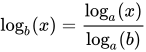
This formula has several consequences:
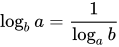
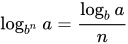


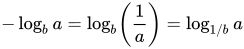

where is any permutation of the subscripts 1, ..., n. For example


Summation and subtraction
[edit | edit source]The following summation and subtraction rule is especially useful in probability theory when one is dealing with a sum of log-probabilities:
| Failed to parse (SVG (MathML can be enabled via browser plugin): Invalid response ("Math extension cannot connect to Restbase.") from server "https://wikimedia.org/api/rest_v1/":): {\displaystyle \log_b (a+c) = \log_b a + \log_b \left(1 + \frac{c}{a}\right)} | because | Failed to parse (SVG (MathML can be enabled via browser plugin): Invalid response ("Math extension cannot connect to Restbase.") from server "https://wikimedia.org/api/rest_v1/":): {\displaystyle \left(a + c \right) = a \times \left(1 + \frac{c}{a} \right)} |
| Failed to parse (SVG (MathML can be enabled via browser plugin): Invalid response ("Math extension cannot connect to Restbase.") from server "https://wikimedia.org/api/rest_v1/":): {\displaystyle \log_b (a-c) = \log_b a + \log_b \left(1 - \frac{c}{a}\right)} | because | Failed to parse (SVG (MathML can be enabled via browser plugin): Invalid response ("Math extension cannot connect to Restbase.") from server "https://wikimedia.org/api/rest_v1/":): {\displaystyle \left(a - c \right) = a \times \left(1 - \frac{c}{a} \right)} |
Note that the subtraction identity is not defined if Failed to parse (SVG (MathML can be enabled via browser plugin): Invalid response ("Math extension cannot connect to Restbase.") from server "https://wikimedia.org/api/rest_v1/":): {\displaystyle a=c}
, since the logarithm of zero is not defined. Also note that, when programming, Failed to parse (SVG (MathML can be enabled via browser plugin): Invalid response ("Math extension cannot connect to Restbase.") from server "https://wikimedia.org/api/rest_v1/":): {\displaystyle a}
and Failed to parse (SVG (MathML can be enabled via browser plugin): Invalid response ("Math extension cannot connect to Restbase.") from server "https://wikimedia.org/api/rest_v1/":): {\displaystyle c}
may have to be switched on the right hand side of the equations if Failed to parse (SVG (MathML can be enabled via browser plugin): Invalid response ("Math extension cannot connect to Restbase.") from server "https://wikimedia.org/api/rest_v1/":): {\displaystyle c \gg a}
to avoid losing the "1 +" due to rounding errors. Many programming languages have a specific log1p(x) function that calculates Failed to parse (SVG (MathML can be enabled via browser plugin): Invalid response ("Math extension cannot connect to Restbase.") from server "https://wikimedia.org/api/rest_v1/":): {\displaystyle \log_e (1+x)}
without underflow (when Failed to parse (SVG (MathML can be enabled via browser plugin): Invalid response ("Math extension cannot connect to Restbase.") from server "https://wikimedia.org/api/rest_v1/":): {\displaystyle x}
is small).
More generally:
Failed to parse (SVG (MathML can be enabled via browser plugin): Invalid response ("Math extension cannot connect to Restbase.") from server "https://wikimedia.org/api/rest_v1/":): {\displaystyle \log _b \sum_{i=0}^N a_i = \log_b a_0 + \log_b \left( 1+\sum_{i=1}^N \frac{a_i}{a_0} \right) = \log _b a_0 + \log_b \left( 1+\sum_{i=1}^N b^{\left( \log_b a_i - \log _b a_0 \right)} \right)}
Exponents
[edit | edit source]A useful identity involving exponents:
Failed to parse (SVG (MathML can be enabled via browser plugin): Invalid response ("Math extension cannot connect to Restbase.") from server "https://wikimedia.org/api/rest_v1/":): {\displaystyle x^{\frac{\log(\log(x))}{\log(x)}} = \log(x)}
or more universally:
Failed to parse (SVG (MathML can be enabled via browser plugin): Invalid response ("Math extension cannot connect to Restbase.") from server "https://wikimedia.org/api/rest_v1/":): {\displaystyle x^{\frac{\log(a)}{\log(x)}} = a}
Other or resulting identities
[edit | edit source]Failed to parse (SVG (MathML can be enabled via browser plugin): Invalid response ("Math extension cannot connect to Restbase.") from server "https://wikimedia.org/api/rest_v1/":): {\displaystyle \frac{1}{\frac{1}{\log_x(a)} + \frac{1}{\log_y(a)}} = \log_{xy}(a)} Failed to parse (SVG (MathML can be enabled via browser plugin): Invalid response ("Math extension cannot connect to Restbase.") from server "https://wikimedia.org/api/rest_v1/":): {\displaystyle \frac{1}{\frac{1}{\log_x(a)}-\frac{1}{\log_y(a)}} = \log_{\frac{x}{y}}(a)}
Inequalities
[edit | edit source]Based on,[4]
Failed to parse (SVG (MathML can be enabled via browser plugin): Invalid response ("Math extension cannot connect to Restbase.") from server "https://wikimedia.org/api/rest_v1/":): {\displaystyle \frac{x}{1+x} \leq \ln(1+x) \leq \frac{x(6+x)}{6+4x} \leq x \mbox{ for all } {-1} < x} Failed to parse (SVG (MathML can be enabled via browser plugin): Invalid response ("Math extension cannot connect to Restbase.") from server "https://wikimedia.org/api/rest_v1/":): {\displaystyle \begin{align} \frac{2x}{2+x}&\leq3-\sqrt{\frac{27}{3+2x}}\leq\frac{x}{\sqrt{1+x+x^2/12}} \\[4pt] &\leq \ln(1+x)\leq \frac{x}{\sqrt{1+x}}\leq \frac{x}{2}\frac{2+x}{1+x} \\[4pt] &\text{ for } 0 \le x \text{, reverse for } {-1} < x \le 0 \end{align}}
All are accurate around Failed to parse (SVG (MathML can be enabled via browser plugin): Invalid response ("Math extension cannot connect to Restbase.") from server "https://wikimedia.org/api/rest_v1/":): {\displaystyle x=0} , but not for large numbers.
Tropical identities
[edit | edit source]The following identity relates log semiring to the min-plus semiring.
Failed to parse (SVG (MathML can be enabled via browser plugin): Invalid response ("Math extension cannot connect to Restbase.") from server "https://wikimedia.org/api/rest_v1/":): {\displaystyle \lim_{T \rightarrow 0} -T\log(e^{-\frac{s}{T}} + e^{-\frac{t}{T}}) = \mathrm{min}\{s,t\}}
Calculus identities
[edit | edit source]Limits
[edit | edit source]Failed to parse (SVG (MathML can be enabled via browser plugin): Invalid response ("Math extension cannot connect to Restbase.") from server "https://wikimedia.org/api/rest_v1/":): {\displaystyle \lim_{x\to 0^+}\log_a(x)=-\infty\quad \mbox{if } a > 1} Failed to parse (SVG (MathML can be enabled via browser plugin): Invalid response ("Math extension cannot connect to Restbase.") from server "https://wikimedia.org/api/rest_v1/":): {\displaystyle \lim_{x\to 0^+}\log_a(x)=\infty\quad \mbox{if } 0 < a < 1} Failed to parse (SVG (MathML can be enabled via browser plugin): Invalid response ("Math extension cannot connect to Restbase.") from server "https://wikimedia.org/api/rest_v1/":): {\displaystyle \lim_{x\to\infty}\log_a(x)=\infty\quad \mbox{if } a > 1} Failed to parse (SVG (MathML can be enabled via browser plugin): Invalid response ("Math extension cannot connect to Restbase.") from server "https://wikimedia.org/api/rest_v1/":): {\displaystyle \lim_{x\to\infty}\log_a(x)=-\infty\quad \mbox{if } 0 < a < 1} Failed to parse (SVG (MathML can be enabled via browser plugin): Invalid response ("Math extension cannot connect to Restbase.") from server "https://wikimedia.org/api/rest_v1/":): {\displaystyle \lim_{x\to \infty}x^b\log_a(x)=\infty\quad \mbox{if } b > 0} Failed to parse (SVG (MathML can be enabled via browser plugin): Invalid response ("Math extension cannot connect to Restbase.") from server "https://wikimedia.org/api/rest_v1/":): {\displaystyle \lim_{x\to\infty}\frac{\log_a(x)}{x^b}=0\quad \mbox{if } b > 0}
The last limit is often summarized as "logarithms grow more slowly than any power or root of x".
Derivatives of logarithmic functions
[edit | edit source]Failed to parse (SVG (MathML can be enabled via browser plugin): Invalid response ("Math extension cannot connect to Restbase.") from server "https://wikimedia.org/api/rest_v1/":): {\displaystyle {d \over dx} \ln x = {1 \over x }, x > 0} Failed to parse (SVG (MathML can be enabled via browser plugin): Invalid response ("Math extension cannot connect to Restbase.") from server "https://wikimedia.org/api/rest_v1/":): {\displaystyle {d \over dx} \ln |x| = {1 \over x }, x \neq 0} Failed to parse (SVG (MathML can be enabled via browser plugin): Invalid response ("Math extension cannot connect to Restbase.") from server "https://wikimedia.org/api/rest_v1/":): {\displaystyle {d \over dx} \log_a x = {1 \over x \ln a}, x > 0, a > 0, \text{ and } a\neq 1}
Integral definition
[edit | edit source]Failed to parse (SVG (MathML can be enabled via browser plugin): Invalid response ("Math extension cannot connect to Restbase.") from server "https://wikimedia.org/api/rest_v1/":): {\displaystyle \ln x = \int_1^x \frac {1}{t}\ dt }
To modify the limits of integration to run from Failed to parse (SVG (MathML can be enabled via browser plugin): Invalid response ("Math extension cannot connect to Restbase.") from server "https://wikimedia.org/api/rest_v1/":): {\displaystyle x} to Failed to parse (SVG (MathML can be enabled via browser plugin): Invalid response ("Math extension cannot connect to Restbase.") from server "https://wikimedia.org/api/rest_v1/":): {\displaystyle 1} , we change the order of integration, which changes the sign of the integral:
Failed to parse (SVG (MathML can be enabled via browser plugin): Invalid response ("Math extension cannot connect to Restbase.") from server "https://wikimedia.org/api/rest_v1/":): {\displaystyle -\int_1^x \frac{1}{t} \, dt = \int_x^1 \frac{1}{t} \, dt}
Therefore:
Failed to parse (SVG (MathML can be enabled via browser plugin): Invalid response ("Math extension cannot connect to Restbase.") from server "https://wikimedia.org/api/rest_v1/":): {\displaystyle \ln \frac{1}{x} = \int_x^1 \frac{1}{t} \, dt}
Riemann Sum
[edit | edit source]Failed to parse (SVG (MathML can be enabled via browser plugin): Invalid response ("Math extension cannot connect to Restbase.") from server "https://wikimedia.org/api/rest_v1/":): {\displaystyle \ln(n + 1) = } Failed to parse (SVG (MathML can be enabled via browser plugin): Invalid response ("Math extension cannot connect to Restbase.") from server "https://wikimedia.org/api/rest_v1/":): {\displaystyle \lim_{k \to \infty} \sum_{i=1}^{k} \frac{1}{x_i} \Delta x = } Failed to parse (SVG (MathML can be enabled via browser plugin): Invalid response ("Math extension cannot connect to Restbase.") from server "https://wikimedia.org/api/rest_v1/":): {\displaystyle \lim_{k \to \infty} \sum_{i=1}^{k} \frac{1}{1 + \frac{i-1}{k}n} \cdot \frac{n}{k} =} Failed to parse (SVG (MathML can be enabled via browser plugin): Invalid response ("Math extension cannot connect to Restbase.") from server "https://wikimedia.org/api/rest_v1/":): {\displaystyle \lim_{k \to \infty} \sum_{x=1}^{k \cdot n} \frac{1}{1 + \frac{x}{k}} \cdot \frac{1}{k} =} Failed to parse (SVG (MathML can be enabled via browser plugin): Invalid response ("Math extension cannot connect to Restbase.") from server "https://wikimedia.org/api/rest_v1/":): {\displaystyle \lim_{k \to \infty} \sum_{x=1}^{k \cdot n} \frac{1}{k + x} = \lim_{k \to \infty} \sum_{x=k+1}^{k \cdot n + k} \frac{1}{x} = \lim_{k \to \infty} \sum_{x=k+1}^{k (n + 1)} \frac{1}{x}}
for Failed to parse (SVG (MathML can be enabled via browser plugin): Invalid response ("Math extension cannot connect to Restbase.") from server "https://wikimedia.org/api/rest_v1/":): {\displaystyle \textstyle \Delta x = \frac{n}{k}} and Failed to parse (SVG (MathML can be enabled via browser plugin): Invalid response ("Math extension cannot connect to Restbase.") from server "https://wikimedia.org/api/rest_v1/":): {\displaystyle x_{i}} is a sample point in each interval.
Series representation
[edit | edit source]The natural logarithm Failed to parse (SVG (MathML can be enabled via browser plugin): Invalid response ("Math extension cannot connect to Restbase.") from server "https://wikimedia.org/api/rest_v1/":): {\displaystyle \ln(1 + x)} has a well-known Taylor series[5] expansion that converges for Failed to parse (SVG (MathML can be enabled via browser plugin): Invalid response ("Math extension cannot connect to Restbase.") from server "https://wikimedia.org/api/rest_v1/":): {\displaystyle x} in the open-closed interval (−1, 1]:
Failed to parse (SVG (MathML can be enabled via browser plugin): Invalid response ("Math extension cannot connect to Restbase.") from server "https://wikimedia.org/api/rest_v1/":): {\displaystyle \ln(1 + x) = \sum_{n=1}^{\infty} \frac{(-1)^{n+1} x^n}{n} = x - \frac{x^2}{2} + \frac{x^3}{3} - \frac{x^4}{4} + \frac{x^5}{5} - \frac{x^6}{6} + \cdots.}
Within this interval, for Failed to parse (SVG (MathML can be enabled via browser plugin): Invalid response ("Math extension cannot connect to Restbase.") from server "https://wikimedia.org/api/rest_v1/":): {\displaystyle x = 1} , the series is conditionally convergent, and for all other values, it is absolutely convergent. For Failed to parse (SVG (MathML can be enabled via browser plugin): Invalid response ("Math extension cannot connect to Restbase.") from server "https://wikimedia.org/api/rest_v1/":): {\displaystyle x > 1} or Failed to parse (SVG (MathML can be enabled via browser plugin): Invalid response ("Math extension cannot connect to Restbase.") from server "https://wikimedia.org/api/rest_v1/":): {\displaystyle x \leq -1} , the series does not converge to Failed to parse (SVG (MathML can be enabled via browser plugin): Invalid response ("Math extension cannot connect to Restbase.") from server "https://wikimedia.org/api/rest_v1/":): {\displaystyle \ln(1 + x)} . In these cases, different representations[6] or methods must be used to evaluate the logarithm.
Harmonic number difference
[edit | edit source]It is not uncommon in advanced mathematics, particularly in analytic number theory and asymptotic analysis, to encounter expressions involving differences or ratios of harmonic numbers at scaled indices.[7] The identity involving the limiting difference between harmonic numbers at scaled indices and its relationship to the logarithmic function provides an intriguing example of how discrete sequences can asymptotically relate to continuous functions. This identity is expressed as[8]
Failed to parse (SVG (MathML can be enabled via browser plugin): Invalid response ("Math extension cannot connect to Restbase.") from server "https://wikimedia.org/api/rest_v1/":): {\displaystyle \lim_{{k \to \infty}} (H_{{k(n+1)}} - H_k) = \ln(n+1)} which characterizes the behavior of harmonic numbers as they grow large. This approximation (which precisely equals Failed to parse (SVG (MathML can be enabled via browser plugin): Invalid response ("Math extension cannot connect to Restbase.") from server "https://wikimedia.org/api/rest_v1/":): {\displaystyle \ln(n+1)} in the limit) reflects how summation over increasing segments of the harmonic series exhibits integral properties, giving insight into the interplay between discrete and continuous analysis. It also illustrates how understanding the behavior of sums and series at large scales can lead to insightful conclusions about their properties. Here Failed to parse (SVG (MathML can be enabled via browser plugin): Invalid response ("Math extension cannot connect to Restbase.") from server "https://wikimedia.org/api/rest_v1/":): {\displaystyle H_k} denotes the Failed to parse (SVG (MathML can be enabled via browser plugin): Invalid response ("Math extension cannot connect to Restbase.") from server "https://wikimedia.org/api/rest_v1/":): {\displaystyle k} -th harmonic number, defined as
Failed to parse (SVG (MathML can be enabled via browser plugin): Invalid response ("Math extension cannot connect to Restbase.") from server "https://wikimedia.org/api/rest_v1/":): {\displaystyle H_k = \sum_{{j=1}}^k \frac{1}{j}}
The harmonic numbers are a fundamental sequence in number theory and analysis, known for their logarithmic growth. This result leverages the fact that the sum of the inverses of integers (i.e., harmonic numbers) can be closely approximated by the natural logarithm function, plus a constant, especially when extended over large intervals.[9][7][10] As Failed to parse (SVG (MathML can be enabled via browser plugin): Invalid response ("Math extension cannot connect to Restbase.") from server "https://wikimedia.org/api/rest_v1/":): {\displaystyle k} tends towards infinity, the difference between the harmonic numbers Failed to parse (SVG (MathML can be enabled via browser plugin): Invalid response ("Math extension cannot connect to Restbase.") from server "https://wikimedia.org/api/rest_v1/":): {\displaystyle H_{k(n+1)}} and Failed to parse (SVG (MathML can be enabled via browser plugin): Invalid response ("Math extension cannot connect to Restbase.") from server "https://wikimedia.org/api/rest_v1/":): {\displaystyle H_k} converges to a non-zero value. This persistent non-zero difference, Failed to parse (SVG (MathML can be enabled via browser plugin): Invalid response ("Math extension cannot connect to Restbase.") from server "https://wikimedia.org/api/rest_v1/":): {\displaystyle \ln(n+1)} , precludes the possibility of the harmonic series approaching a finite limit, thus providing a clear mathematical articulation of its divergence.[11][12] The technique of approximating sums by integrals (specifically using the integral test or by direct integral approximation) is fundamental in deriving such results. This specific identity can be a consequence of these approximations, considering:
Failed to parse (SVG (MathML can be enabled via browser plugin): Invalid response ("Math extension cannot connect to Restbase.") from server "https://wikimedia.org/api/rest_v1/":): {\displaystyle \sum_{{j=k+1}}^{k(n+1)} \frac{1}{j} \approx \int_k^{k(n+1)} \frac{dx}{x}}
Harmonic limit derivation
[edit | edit source]The limit explores the growth of the harmonic numbers when indices are multiplied by a scaling factor and then differenced. It specifically captures the sum from Failed to parse (SVG (MathML can be enabled via browser plugin): Invalid response ("Math extension cannot connect to Restbase.") from server "https://wikimedia.org/api/rest_v1/":): {\displaystyle k+1} to Failed to parse (SVG (MathML can be enabled via browser plugin): Invalid response ("Math extension cannot connect to Restbase.") from server "https://wikimedia.org/api/rest_v1/":): {\displaystyle k(n+1)} :
Failed to parse (SVG (MathML can be enabled via browser plugin): Invalid response ("Math extension cannot connect to Restbase.") from server "https://wikimedia.org/api/rest_v1/":): {\displaystyle H_{{k(n+1)}} - H_k = \sum_{{j=k+1}}^{k(n+1)} \frac{1}{j}}
This can be estimated using the integral test for convergence, or more directly by comparing it to the integral of Failed to parse (SVG (MathML can be enabled via browser plugin): Invalid response ("Math extension cannot connect to Restbase.") from server "https://wikimedia.org/api/rest_v1/":): {\displaystyle 1/x} from Failed to parse (SVG (MathML can be enabled via browser plugin): Invalid response ("Math extension cannot connect to Restbase.") from server "https://wikimedia.org/api/rest_v1/":): {\displaystyle k} to Failed to parse (SVG (MathML can be enabled via browser plugin): Invalid response ("Math extension cannot connect to Restbase.") from server "https://wikimedia.org/api/rest_v1/":): {\displaystyle k(n+1)} :
Failed to parse (SVG (MathML can be enabled via browser plugin): Invalid response ("Math extension cannot connect to Restbase.") from server "https://wikimedia.org/api/rest_v1/":): {\displaystyle \lim_{{k \to \infty}} \sum_{{j=k+1}}^{k(n+1)} \frac{1}{j} = \int_k^{k(n+1)} \frac{dx}{x} = \ln(k(n+1)) - \ln(k) = \ln\left(\frac{k(n+1)}{k}\right) = \ln(n+1)}
As the window's lower bound begins at Failed to parse (SVG (MathML can be enabled via browser plugin): Invalid response ("Math extension cannot connect to Restbase.") from server "https://wikimedia.org/api/rest_v1/":): {\displaystyle k+1} and the upper bound extends to Failed to parse (SVG (MathML can be enabled via browser plugin): Invalid response ("Math extension cannot connect to Restbase.") from server "https://wikimedia.org/api/rest_v1/":): {\displaystyle k(n+1)} , both of which tend toward infinity as Failed to parse (SVG (MathML can be enabled via browser plugin): Invalid response ("Math extension cannot connect to Restbase.") from server "https://wikimedia.org/api/rest_v1/":): {\displaystyle k \to \infty} , the summation window encompasses an increasingly vast portion of the smallest possible terms of the harmonic series (those with astronomically large denominators), creating a discrete sum that stretches towards infinity, which mirrors how continuous integrals accumulate value across an infinitesimally fine partitioning of the domain. In the limit, the interval is effectively from Failed to parse (SVG (MathML can be enabled via browser plugin): Invalid response ("Math extension cannot connect to Restbase.") from server "https://wikimedia.org/api/rest_v1/":): {\displaystyle 1} to Failed to parse (SVG (MathML can be enabled via browser plugin): Invalid response ("Math extension cannot connect to Restbase.") from server "https://wikimedia.org/api/rest_v1/":): {\displaystyle n+1} where the onset Failed to parse (SVG (MathML can be enabled via browser plugin): Invalid response ("Math extension cannot connect to Restbase.") from server "https://wikimedia.org/api/rest_v1/":): {\displaystyle k} implies this minimally discrete region.
Double series formula
[edit | edit source]The harmonic number difference formula for Failed to parse (SVG (MathML can be enabled via browser plugin): Invalid response ("Math extension cannot connect to Restbase.") from server "https://wikimedia.org/api/rest_v1/":): {\displaystyle \ln(m)} is an extension[8] of the classic, alternating identity of Failed to parse (SVG (MathML can be enabled via browser plugin): Invalid response ("Math extension cannot connect to Restbase.") from server "https://wikimedia.org/api/rest_v1/":): {\displaystyle \ln(2)} :
Failed to parse (SVG (MathML can be enabled via browser plugin): Invalid response ("Math extension cannot connect to Restbase.") from server "https://wikimedia.org/api/rest_v1/":): {\displaystyle \ln(2) = \lim_{k \to \infty} \sum_{n=1}^{k} \left( \frac{1}{2n-1} - \frac{1}{2n} \right)}
which can be generalized as the double series over the residues of Failed to parse (SVG (MathML can be enabled via browser plugin): Invalid response ("Math extension cannot connect to Restbase.") from server "https://wikimedia.org/api/rest_v1/":): {\displaystyle m} :
Failed to parse (SVG (MathML can be enabled via browser plugin): Invalid response ("Math extension cannot connect to Restbase.") from server "https://wikimedia.org/api/rest_v1/":): {\displaystyle \ln(m) = \sum_{x \in \langle m \rangle \cap \mathbb{N}} \sum_{r \in \mathbb{Z}_m \cap \mathbb{N}} \left( \frac{1}{x-r} - \frac{1}{x} \right) = \sum_{x \in \langle m \rangle \cap \mathbb{N}} \sum_{r \in \mathbb{Z}_m \cap \mathbb{N}} \frac{r}{x(x-r)} }
where Failed to parse (SVG (MathML can be enabled via browser plugin): Invalid response ("Math extension cannot connect to Restbase.") from server "https://wikimedia.org/api/rest_v1/":): {\displaystyle \langle m \rangle} is the principal ideal generated by Failed to parse (SVG (MathML can be enabled via browser plugin): Invalid response ("Math extension cannot connect to Restbase.") from server "https://wikimedia.org/api/rest_v1/":): {\displaystyle m} . Subtracting Failed to parse (SVG (MathML can be enabled via browser plugin): Invalid response ("Math extension cannot connect to Restbase.") from server "https://wikimedia.org/api/rest_v1/":): {\displaystyle \textstyle \frac{1}{x}} from each term Failed to parse (SVG (MathML can be enabled via browser plugin): Invalid response ("Math extension cannot connect to Restbase.") from server "https://wikimedia.org/api/rest_v1/":): {\displaystyle \textstyle \frac{1}{x-r}} (i.e., balancing each term with the modulus) reduces the magnitude of each term's contribution, ensuring convergence by controlling the series' tendency toward divergence as Failed to parse (SVG (MathML can be enabled via browser plugin): Invalid response ("Math extension cannot connect to Restbase.") from server "https://wikimedia.org/api/rest_v1/":): {\displaystyle m} increases. For example:
Failed to parse (SVG (MathML can be enabled via browser plugin): Invalid response ("Math extension cannot connect to Restbase.") from server "https://wikimedia.org/api/rest_v1/":): {\displaystyle \ln(4) = \lim_{k \to \infty} \sum_{n=1}^{k} \left( \frac{1}{4n-3} - \frac{1}{4n} \right) + \left( \frac{1}{4n-2} - \frac{1}{4n} \right) + \left( \frac{1}{4n-1} - \frac{1}{4n} \right)}
This method leverages the fine differences between closely related terms to stabilize the series. The sum over all residues Failed to parse (SVG (MathML can be enabled via browser plugin): Invalid response ("Math extension cannot connect to Restbase.") from server "https://wikimedia.org/api/rest_v1/":): {\displaystyle r \in \N} ensures that adjustments are uniformly applied across all possible offsets within each block of Failed to parse (SVG (MathML can be enabled via browser plugin): Invalid response ("Math extension cannot connect to Restbase.") from server "https://wikimedia.org/api/rest_v1/":): {\displaystyle m} terms. This uniform distribution of the "correction" across different intervals defined by Failed to parse (SVG (MathML can be enabled via browser plugin): Invalid response ("Math extension cannot connect to Restbase.") from server "https://wikimedia.org/api/rest_v1/":): {\displaystyle x-r} functions similarly to telescoping over a very large sequence. It helps to flatten out the discrepancies that might otherwise lead to divergent behavior in a straightforward harmonic series. Note that the structure of the summands of this formula matches those of the interpolated harmonic number Failed to parse (SVG (MathML can be enabled via browser plugin): Invalid response ("Math extension cannot connect to Restbase.") from server "https://wikimedia.org/api/rest_v1/":): {\displaystyle H_x} when both the domain and range are negated (i.e., Failed to parse (SVG (MathML can be enabled via browser plugin): Invalid response ("Math extension cannot connect to Restbase.") from server "https://wikimedia.org/api/rest_v1/":): {\displaystyle -H_{-x}} ). However, the interpretation and roles of the variables differ.
Deveci's Proof
[edit | edit source]A fundamental feature of the proof is the accumulation of the subtrahends Failed to parse (SVG (MathML can be enabled via browser plugin): Invalid response ("Math extension cannot connect to Restbase.") from server "https://wikimedia.org/api/rest_v1/":): {\textstyle \frac{1}{x}} into a unit fraction, that is, Failed to parse (SVG (MathML can be enabled via browser plugin): Invalid response ("Math extension cannot connect to Restbase.") from server "https://wikimedia.org/api/rest_v1/":): {\textstyle \frac{m}{x} = \frac{1}{n}} for Failed to parse (SVG (MathML can be enabled via browser plugin): Invalid response ("Math extension cannot connect to Restbase.") from server "https://wikimedia.org/api/rest_v1/":): {\displaystyle m \mid x} , thus Failed to parse (SVG (MathML can be enabled via browser plugin): Invalid response ("Math extension cannot connect to Restbase.") from server "https://wikimedia.org/api/rest_v1/":): {\displaystyle m = \omega + 1} rather than Failed to parse (SVG (MathML can be enabled via browser plugin): Invalid response ("Math extension cannot connect to Restbase.") from server "https://wikimedia.org/api/rest_v1/":): {\displaystyle m = |\mathbb{Z}_{m} \cap \mathbb{N}|} , where the extrema of Failed to parse (SVG (MathML can be enabled via browser plugin): Invalid response ("Math extension cannot connect to Restbase.") from server "https://wikimedia.org/api/rest_v1/":): {\displaystyle \mathbb{Z}_{m} \cap \mathbb{N}} are Failed to parse (SVG (MathML can be enabled via browser plugin): Invalid response ("Math extension cannot connect to Restbase.") from server "https://wikimedia.org/api/rest_v1/":): {\displaystyle [0, \omega]} if Failed to parse (SVG (MathML can be enabled via browser plugin): Invalid response ("Math extension cannot connect to Restbase.") from server "https://wikimedia.org/api/rest_v1/":): {\displaystyle \mathbb{N} = \mathbb{N}_{0}} and Failed to parse (SVG (MathML can be enabled via browser plugin): Invalid response ("Math extension cannot connect to Restbase.") from server "https://wikimedia.org/api/rest_v1/":): {\displaystyle [1, \omega]} otherwise, with the minimum of Failed to parse (SVG (MathML can be enabled via browser plugin): Invalid response ("Math extension cannot connect to Restbase.") from server "https://wikimedia.org/api/rest_v1/":): {\displaystyle 0} being implicit in the latter case due to the structural requirements of the proof. Since the cardinality of Failed to parse (SVG (MathML can be enabled via browser plugin): Invalid response ("Math extension cannot connect to Restbase.") from server "https://wikimedia.org/api/rest_v1/":): {\displaystyle \mathbb{Z}_{m} \cap \mathbb{N}} depends on the selection of one of two possible minima, the integral Failed to parse (SVG (MathML can be enabled via browser plugin): Invalid response ("Math extension cannot connect to Restbase.") from server "https://wikimedia.org/api/rest_v1/":): {\displaystyle \textstyle \int \frac{1}{t} dt} , as a set-theoretic procedure, is a function of the maximum Failed to parse (SVG (MathML can be enabled via browser plugin): Invalid response ("Math extension cannot connect to Restbase.") from server "https://wikimedia.org/api/rest_v1/":): {\displaystyle \omega} (which remains consistent across both interpretations) plus Failed to parse (SVG (MathML can be enabled via browser plugin): Invalid response ("Math extension cannot connect to Restbase.") from server "https://wikimedia.org/api/rest_v1/":): {\displaystyle 1} , not the cardinality (which is ambiguous[13][14] due to varying definitions of the minimum). Whereas the harmonic number difference computes the integral in a global sliding window, the double series, in parallel, computes the sum in a local sliding window—a shifting Failed to parse (SVG (MathML can be enabled via browser plugin): Invalid response ("Math extension cannot connect to Restbase.") from server "https://wikimedia.org/api/rest_v1/":): {\displaystyle m} -tuple—over the harmonic series, advancing the window by Failed to parse (SVG (MathML can be enabled via browser plugin): Invalid response ("Math extension cannot connect to Restbase.") from server "https://wikimedia.org/api/rest_v1/":): {\displaystyle m} positions to select the next Failed to parse (SVG (MathML can be enabled via browser plugin): Invalid response ("Math extension cannot connect to Restbase.") from server "https://wikimedia.org/api/rest_v1/":): {\displaystyle m} -tuple, and offsetting each element of each tuple by Failed to parse (SVG (MathML can be enabled via browser plugin): Invalid response ("Math extension cannot connect to Restbase.") from server "https://wikimedia.org/api/rest_v1/":): {\textstyle \frac{1}{m}} relative to the window's absolute position. The sum Failed to parse (SVG (MathML can be enabled via browser plugin): Invalid response ("Math extension cannot connect to Restbase.") from server "https://wikimedia.org/api/rest_v1/":): {\textstyle \sum_{n=1}^{k} \sum \frac{1}{x - r}} corresponds to Failed to parse (SVG (MathML can be enabled via browser plugin): Invalid response ("Math extension cannot connect to Restbase.") from server "https://wikimedia.org/api/rest_v1/":): {\displaystyle H_{km}} which scales Failed to parse (SVG (MathML can be enabled via browser plugin): Invalid response ("Math extension cannot connect to Restbase.") from server "https://wikimedia.org/api/rest_v1/":): {\displaystyle H_{m}} without bound. The sum Failed to parse (SVG (MathML can be enabled via browser plugin): Invalid response ("Math extension cannot connect to Restbase.") from server "https://wikimedia.org/api/rest_v1/":): {\textstyle \sum_{n=1}^{k} -\frac{1}{n}} corresponds to the prefix Failed to parse (SVG (MathML can be enabled via browser plugin): Invalid response ("Math extension cannot connect to Restbase.") from server "https://wikimedia.org/api/rest_v1/":): {\displaystyle H_{k}} trimmed from the series to establish the window's moving lower bound Failed to parse (SVG (MathML can be enabled via browser plugin): Invalid response ("Math extension cannot connect to Restbase.") from server "https://wikimedia.org/api/rest_v1/":): {\displaystyle k+1} , and Failed to parse (SVG (MathML can be enabled via browser plugin): Invalid response ("Math extension cannot connect to Restbase.") from server "https://wikimedia.org/api/rest_v1/":): {\displaystyle \ln(m)} is the limit of the sliding window (the scaled, truncated[15] series):
Failed to parse (SVG (MathML can be enabled via browser plugin): Invalid response ("Math extension cannot connect to Restbase.") from server "https://wikimedia.org/api/rest_v1/":): {\displaystyle \begin{align} \sum_{n=1}^k \sum_{r=1}^{\omega} \left( \frac{1}{mn - r} - \frac{1}{mn} \right) &= \sum_{n=1}^k \sum_{r=0}^{\omega} \left( \frac{1}{mn - r} - \frac{1}{mn} \right) \\ &= \sum_{n=1}^k \left( -\frac{1}{n} + \sum_{r=0}^{\omega} \frac{1}{mn - r} \right) \\ &= -H_k + \sum_{n=1}^k \sum_{r=0}^{\omega} \frac{1}{mn - r} \\ &= -H_k + \sum_{n=1}^k \sum_{r=0}^{\omega} \frac{1}{(n-1)m + m - r} \\ &= -H_k + \sum_{n=1}^k \sum_{j=1}^m \frac{1}{(n-1)m + j} \\ &= -H_k + \sum_{n=1}^k \left( H_{nm} - H_{m(n-1)} \right) \\ &= -H_k + H_{mk} \end{align}} Failed to parse (SVG (MathML can be enabled via browser plugin): Invalid response ("Math extension cannot connect to Restbase.") from server "https://wikimedia.org/api/rest_v1/":): {\displaystyle \lim_{k \to \infty} H_{km} - H_k = \sum_{x \in \langle m \rangle \cap \mathbb{N}} \sum_{r \in \mathbb{Z}_m \cap \mathbb{N}} \left( \frac{1}{x-r} - \frac{1}{x} \right) = \ln(\omega + 1) = \ln(m)}
Integrals of logarithmic functions
[edit | edit source]Failed to parse (SVG (MathML can be enabled via browser plugin): Invalid response ("Math extension cannot connect to Restbase.") from server "https://wikimedia.org/api/rest_v1/":): {\displaystyle \int \ln x \, dx = x \ln x - x + C = x(\ln x - 1) + C} Failed to parse (SVG (MathML can be enabled via browser plugin): Invalid response ("Math extension cannot connect to Restbase.") from server "https://wikimedia.org/api/rest_v1/":): {\displaystyle \int \log_a x \, dx = x \log_a x - \frac{x}{\ln a} + C = \frac{x (\ln x - 1)}{\ln a} + C}
To remember higher integrals, it is convenient to define:
Failed to parse (SVG (MathML can be enabled via browser plugin): Invalid response ("Math extension cannot connect to Restbase.") from server "https://wikimedia.org/api/rest_v1/":): {\displaystyle x^{\left [n \right]} = x^{n}(\log(x) - H_n)}
where Failed to parse (SVG (MathML can be enabled via browser plugin): Invalid response ("Math extension cannot connect to Restbase.") from server "https://wikimedia.org/api/rest_v1/":): {\displaystyle H_n} is the nth harmonic number:
Failed to parse (SVG (MathML can be enabled via browser plugin): Invalid response ("Math extension cannot connect to Restbase.") from server "https://wikimedia.org/api/rest_v1/":): {\displaystyle x^{\left [ 0 \right ]} = \log x} Failed to parse (SVG (MathML can be enabled via browser plugin): Invalid response ("Math extension cannot connect to Restbase.") from server "https://wikimedia.org/api/rest_v1/":): {\displaystyle x^{\left [ 1 \right ]} = x \log(x) - x} Failed to parse (SVG (MathML can be enabled via browser plugin): Invalid response ("Math extension cannot connect to Restbase.") from server "https://wikimedia.org/api/rest_v1/":): {\displaystyle x^{\left [ 2 \right ]} = x^2 \log(x) - \begin{matrix} \frac{3}{2} \end{matrix}x^2} Failed to parse (SVG (MathML can be enabled via browser plugin): Invalid response ("Math extension cannot connect to Restbase.") from server "https://wikimedia.org/api/rest_v1/":): {\displaystyle x^{\left [ 3 \right ]} = x^3 \log(x) - \begin{matrix} \frac{11}{6} \end{matrix}x^3}
Then:
Failed to parse (SVG (MathML can be enabled via browser plugin): Invalid response ("Math extension cannot connect to Restbase.") from server "https://wikimedia.org/api/rest_v1/":): {\displaystyle \frac{d}{dx}\, x^{\left[ n \right]} = nx^{\left[ n-1 \right]}} Failed to parse (SVG (MathML can be enabled via browser plugin): Invalid response ("Math extension cannot connect to Restbase.") from server "https://wikimedia.org/api/rest_v1/":): {\displaystyle \int x^{\left[ n \right]}\,dx = \frac{x^{\left [ n+1 \right ]}}{n+1} + C}
Approximating large numbers
[edit | edit source]The identities of logarithms can be used to approximate large numbers. Note that logb(a) + logb(c) = logb(ac), where a, b, and c are arbitrary constants. Suppose that one wants to approximate the 44th Mersenne prime, 232,582,657 −1. To get the base-10 logarithm, we would multiply 32,582,657 by log10(2), getting 9,808,357.09543 = 9,808,357 + 0.09543. We can then get 109,808,357 × 100.09543 ≈ 1.25 × 109,808,357.
Similarly, factorials can be approximated by summing the logarithms of the terms.
Complex logarithm identities
[edit | edit source]The complex logarithm is the complex number analogue of the logarithm function. No single valued function on the complex plane can satisfy the normal rules for logarithms. However, a multivalued function can be defined which satisfies most of the identities. It is usual to consider this as a function defined on a Riemann surface. A single valued version, called the principal value of the logarithm, can be defined which is discontinuous on the negative x axis, and is equal to the multivalued version on a single branch cut.
Definitions
[edit | edit source]In what follows, a capital first letter is used for the principal value of functions, and the lower case version is used for the multivalued function. The single valued version of definitions and identities is always given first, followed by a separate section for the multiple valued versions.
- ln(r) is the standard natural logarithm of the real number r.
- Arg(z) is the principal value of the arg function; its value is restricted to (−π, π]. It can be computed using Arg(x + iy) = atan2(y, x).
- Log(z) is the principal value of the complex logarithm function and has imaginary part in the range (−π, π].
- Failed to parse (SVG (MathML can be enabled via browser plugin): Invalid response ("Math extension cannot connect to Restbase.") from server "https://wikimedia.org/api/rest_v1/":): {\displaystyle \operatorname{Log}(z) = \ln(|z|) + i \operatorname{Arg}(z)}
- Failed to parse (SVG (MathML can be enabled via browser plugin): Invalid response ("Math extension cannot connect to Restbase.") from server "https://wikimedia.org/api/rest_v1/":): {\displaystyle e^{\operatorname{Log}(z)} = z}
The multiple valued version of log(z) is a set, but it is easier to write it without braces and using it in formulas follows obvious rules.
- log(z) is the set of complex numbers v which satisfy ev = z
- arg(z) is the set of possible values of the arg function applied to z.
When k is any integer:
Failed to parse (SVG (MathML can be enabled via browser plugin): Invalid response ("Math extension cannot connect to Restbase.") from server "https://wikimedia.org/api/rest_v1/":): {\displaystyle \log(z) = \ln(|z|) + i \arg(z)} Failed to parse (SVG (MathML can be enabled via browser plugin): Invalid response ("Math extension cannot connect to Restbase.") from server "https://wikimedia.org/api/rest_v1/":): {\displaystyle \log(z) = \operatorname{Log}(z) + 2 \pi i k} Failed to parse (SVG (MathML can be enabled via browser plugin): Invalid response ("Math extension cannot connect to Restbase.") from server "https://wikimedia.org/api/rest_v1/":): {\displaystyle e^{\log(z)} = z}
Constants
[edit | edit source]Principal value forms:
Failed to parse (SVG (MathML can be enabled via browser plugin): Invalid response ("Math extension cannot connect to Restbase.") from server "https://wikimedia.org/api/rest_v1/":): {\displaystyle \operatorname{Log}(1) = 0} Failed to parse (SVG (MathML can be enabled via browser plugin): Invalid response ("Math extension cannot connect to Restbase.") from server "https://wikimedia.org/api/rest_v1/":): {\displaystyle \operatorname{Log}(e) = 1}
Multiple value forms, for any k an integer:
Failed to parse (SVG (MathML can be enabled via browser plugin): Invalid response ("Math extension cannot connect to Restbase.") from server "https://wikimedia.org/api/rest_v1/":): {\displaystyle \log(1) = 0 + 2 \pi i k} Failed to parse (SVG (MathML can be enabled via browser plugin): Invalid response ("Math extension cannot connect to Restbase.") from server "https://wikimedia.org/api/rest_v1/":): {\displaystyle \log(e) = 1 + 2 \pi i k}
Summation
[edit | edit source]Principal value forms:[16]
Failed to parse (SVG (MathML can be enabled via browser plugin): Invalid response ("Math extension cannot connect to Restbase.") from server "https://wikimedia.org/api/rest_v1/":): {\displaystyle \operatorname{Log}(z_1) + \operatorname{Log}(z_2) = \operatorname{Log}(z_1 z_2) \pmod {2 \pi i}} Failed to parse (SVG (MathML can be enabled via browser plugin): Invalid response ("Math extension cannot connect to Restbase.") from server "https://wikimedia.org/api/rest_v1/":): {\displaystyle \operatorname{Log}(z_1) + \operatorname{Log}(z_2) = \operatorname{Log}(z_1 z_2)\quad (-\pi <\operatorname{Arg}(z_1)+\operatorname{Arg}(z_2)\leq \pi; \text{ e.g., } \operatorname{Re}z_1\geq 0 \text{ and } \operatorname{Re}z_2 > 0)} Failed to parse (SVG (MathML can be enabled via browser plugin): Invalid response ("Math extension cannot connect to Restbase.") from server "https://wikimedia.org/api/rest_v1/":): {\displaystyle \operatorname{Log}(z_1) - \operatorname{Log}(z_2) = \operatorname{Log}(z_1 / z_2) \pmod {2 \pi i}} Failed to parse (SVG (MathML can be enabled via browser plugin): Invalid response ("Math extension cannot connect to Restbase.") from server "https://wikimedia.org/api/rest_v1/":): {\displaystyle \operatorname{Log}(z_1) - \operatorname{Log}(z_2) = \operatorname{Log}(z_1 / z_2) \quad (-\pi <\operatorname{Arg}(z_1)-\operatorname{Arg}(z_2)\leq \pi; \text{ e.g., } \operatorname{Re}z_1\geq 0 \text{ and } \operatorname{Re}z_2 > 0)}
Multiple value forms:
Failed to parse (SVG (MathML can be enabled via browser plugin): Invalid response ("Math extension cannot connect to Restbase.") from server "https://wikimedia.org/api/rest_v1/":): {\displaystyle \log(z_1) + \log(z_2) = \log(z_1 z_2)} Failed to parse (SVG (MathML can be enabled via browser plugin): Invalid response ("Math extension cannot connect to Restbase.") from server "https://wikimedia.org/api/rest_v1/":): {\displaystyle \log(z_1) - \log(z_2) = \log(z_1 / z_2)}
Powers
[edit | edit source]A complex power of a complex number can have many possible values.
Principal value form:
Failed to parse (SVG (MathML can be enabled via browser plugin): Invalid response ("Math extension cannot connect to Restbase.") from server "https://wikimedia.org/api/rest_v1/":): {\displaystyle {z_1}^{z_2} = e^{z_2 \operatorname{Log}(z_1)} } Failed to parse (SVG (MathML can be enabled via browser plugin): Invalid response ("Math extension cannot connect to Restbase.") from server "https://wikimedia.org/api/rest_v1/":): {\displaystyle \operatorname{Log}{\left({z_1}^{z_2}\right)} = z_2 \operatorname{Log}(z_1) \pmod {2 \pi i}}
Multiple value forms:
Failed to parse (SVG (MathML can be enabled via browser plugin): Invalid response ("Math extension cannot connect to Restbase.") from server "https://wikimedia.org/api/rest_v1/":): {\displaystyle {z_1}^{z_2} = e^{z_2 \log(z_1)}}
Where k1, k2 are any integers:
Failed to parse (SVG (MathML can be enabled via browser plugin): Invalid response ("Math extension cannot connect to Restbase.") from server "https://wikimedia.org/api/rest_v1/":): {\displaystyle \log{\left({z_1}^{z_2}\right)} = z_2 \log(z_1) + 2 \pi i k_2} Failed to parse (SVG (MathML can be enabled via browser plugin): Invalid response ("Math extension cannot connect to Restbase.") from server "https://wikimedia.org/api/rest_v1/":): {\displaystyle \log{\left({z_1}^{z_2}\right)} = z_2 \operatorname{Log}(z_1) + z_2 2 \pi i k_1 + 2 \pi i k_2}
Asymptotic identities
[edit | edit source]Pronic numbers
[edit | edit source]As a consequence of the harmonic number difference, the natural logarithm is asymptotically approximated by a finite series difference,[8] representing a truncation of the integral at Failed to parse (SVG (MathML can be enabled via browser plugin): Invalid response ("Math extension cannot connect to Restbase.") from server "https://wikimedia.org/api/rest_v1/":): {\displaystyle k = n} :
Failed to parse (SVG (MathML can be enabled via browser plugin): Invalid response ("Math extension cannot connect to Restbase.") from server "https://wikimedia.org/api/rest_v1/":): {\displaystyle H_{{2T[n]}} - H_n \sim \ln(n+1)}
where Failed to parse (SVG (MathML can be enabled via browser plugin): Invalid response ("Math extension cannot connect to Restbase.") from server "https://wikimedia.org/api/rest_v1/":): {\displaystyle T[n]} is the nth triangular number, and Failed to parse (SVG (MathML can be enabled via browser plugin): Invalid response ("Math extension cannot connect to Restbase.") from server "https://wikimedia.org/api/rest_v1/":): {\displaystyle 2T[n]} is the sum of the first n even integers. Since the nth pronic number is asymptotically equivalent to the nth perfect square, it follows that:
Failed to parse (SVG (MathML can be enabled via browser plugin): Invalid response ("Math extension cannot connect to Restbase.") from server "https://wikimedia.org/api/rest_v1/":): {\displaystyle H_{{n^2}} - H_n \sim \ln(n+1)}
Prime number theorem
[edit | edit source]The prime number theorem provides the following asymptotic equivalence:
Failed to parse (SVG (MathML can be enabled via browser plugin): Invalid response ("Math extension cannot connect to Restbase.") from server "https://wikimedia.org/api/rest_v1/":): {\displaystyle \frac{n}{\pi(n)} \sim \ln n}
where Failed to parse (SVG (MathML can be enabled via browser plugin): Invalid response ("Math extension cannot connect to Restbase.") from server "https://wikimedia.org/api/rest_v1/":): {\displaystyle \pi(n)} is the prime counting function. This relationship is equal to:[17][8]: 2
Failed to parse (SVG (MathML can be enabled via browser plugin): Invalid response ("Math extension cannot connect to Restbase.") from server "https://wikimedia.org/api/rest_v1/":): {\displaystyle \frac{n}{H(1, 2, \ldots, n)} \sim \ln n}
where Failed to parse (SVG (MathML can be enabled via browser plugin): Invalid response ("Math extension cannot connect to Restbase.") from server "https://wikimedia.org/api/rest_v1/":): {\displaystyle H(x_1, x_2, \ldots, x_n)} is the harmonic mean of Failed to parse (SVG (MathML can be enabled via browser plugin): Invalid response ("Math extension cannot connect to Restbase.") from server "https://wikimedia.org/api/rest_v1/":): {\displaystyle x_1, x_2, \ldots, x_n} . This is derived from the fact that the difference between the Failed to parse (SVG (MathML can be enabled via browser plugin): Invalid response ("Math extension cannot connect to Restbase.") from server "https://wikimedia.org/api/rest_v1/":): {\displaystyle n} th harmonic number and Failed to parse (SVG (MathML can be enabled via browser plugin): Invalid response ("Math extension cannot connect to Restbase.") from server "https://wikimedia.org/api/rest_v1/":): {\displaystyle \ln n} asymptotically approaches a small constant, resulting in Failed to parse (SVG (MathML can be enabled via browser plugin): Invalid response ("Math extension cannot connect to Restbase.") from server "https://wikimedia.org/api/rest_v1/":): {\displaystyle H_{n^2} - H_n \sim H_n} . This behavior can also be derived from the properties of logarithms: Failed to parse (SVG (MathML can be enabled via browser plugin): Invalid response ("Math extension cannot connect to Restbase.") from server "https://wikimedia.org/api/rest_v1/":): {\displaystyle \ln n} is half of Failed to parse (SVG (MathML can be enabled via browser plugin): Invalid response ("Math extension cannot connect to Restbase.") from server "https://wikimedia.org/api/rest_v1/":): {\displaystyle \ln n^2} , and this "first half" is the natural log of the root of Failed to parse (SVG (MathML can be enabled via browser plugin): Invalid response ("Math extension cannot connect to Restbase.") from server "https://wikimedia.org/api/rest_v1/":): {\displaystyle n^2} , which corresponds roughly to the first Failed to parse (SVG (MathML can be enabled via browser plugin): Invalid response ("Math extension cannot connect to Restbase.") from server "https://wikimedia.org/api/rest_v1/":): {\displaystyle \textstyle \frac{1}{n}} th of the sum Failed to parse (SVG (MathML can be enabled via browser plugin): Invalid response ("Math extension cannot connect to Restbase.") from server "https://wikimedia.org/api/rest_v1/":): {\displaystyle H_{n^2}} , or Failed to parse (SVG (MathML can be enabled via browser plugin): Invalid response ("Math extension cannot connect to Restbase.") from server "https://wikimedia.org/api/rest_v1/":): {\displaystyle H_n} . The asymptotic equivalence of the first Failed to parse (SVG (MathML can be enabled via browser plugin): Invalid response ("Math extension cannot connect to Restbase.") from server "https://wikimedia.org/api/rest_v1/":): {\displaystyle \textstyle \frac{1}{n}} th of Failed to parse (SVG (MathML can be enabled via browser plugin): Invalid response ("Math extension cannot connect to Restbase.") from server "https://wikimedia.org/api/rest_v1/":): {\displaystyle H_{n^2}} to the latter Failed to parse (SVG (MathML can be enabled via browser plugin): Invalid response ("Math extension cannot connect to Restbase.") from server "https://wikimedia.org/api/rest_v1/":): {\displaystyle \textstyle \frac{n-1}{n}} th of the series is expressed as follows:
Failed to parse (SVG (MathML can be enabled via browser plugin): Invalid response ("Math extension cannot connect to Restbase.") from server "https://wikimedia.org/api/rest_v1/":): {\displaystyle \frac{H_n}{H_{n^2}} \sim \frac{\ln \sqrt{n}}{\ln n} = \frac{1}{2}}
which generalizes to:
Failed to parse (SVG (MathML can be enabled via browser plugin): Invalid response ("Math extension cannot connect to Restbase.") from server "https://wikimedia.org/api/rest_v1/":): {\displaystyle \frac{H_n}{H_{n^k}} \sim \frac{\ln \sqrt[k]{n}}{\ln n} = \frac{1}{k}} Failed to parse (SVG (MathML can be enabled via browser plugin): Invalid response ("Math extension cannot connect to Restbase.") from server "https://wikimedia.org/api/rest_v1/":): {\displaystyle k H_n \sim H_{n^k}}
and:
Failed to parse (SVG (MathML can be enabled via browser plugin): Invalid response ("Math extension cannot connect to Restbase.") from server "https://wikimedia.org/api/rest_v1/":): {\displaystyle k H_n - H_n \sim (k - 1) \ln(n+1)} Failed to parse (SVG (MathML can be enabled via browser plugin): Invalid response ("Math extension cannot connect to Restbase.") from server "https://wikimedia.org/api/rest_v1/":): {\displaystyle H_{{n^k}} - H_n \sim (k - 1) \ln(n+1)} Failed to parse (SVG (MathML can be enabled via browser plugin): Invalid response ("Math extension cannot connect to Restbase.") from server "https://wikimedia.org/api/rest_v1/":): {\displaystyle k H_n - H_{{n^k}} \sim (k - 1) \gamma}
for fixed Failed to parse (SVG (MathML can be enabled via browser plugin): Invalid response ("Math extension cannot connect to Restbase.") from server "https://wikimedia.org/api/rest_v1/":): {\displaystyle k} . The correspondence sets Failed to parse (SVG (MathML can be enabled via browser plugin): Invalid response ("Math extension cannot connect to Restbase.") from server "https://wikimedia.org/api/rest_v1/":): {\displaystyle H_n} as a unit magnitude that partitions Failed to parse (SVG (MathML can be enabled via browser plugin): Invalid response ("Math extension cannot connect to Restbase.") from server "https://wikimedia.org/api/rest_v1/":): {\displaystyle H_{n^k}} across powers, where each interval Failed to parse (SVG (MathML can be enabled via browser plugin): Invalid response ("Math extension cannot connect to Restbase.") from server "https://wikimedia.org/api/rest_v1/":): {\displaystyle \textstyle \frac{1}{n}} to Failed to parse (SVG (MathML can be enabled via browser plugin): Invalid response ("Math extension cannot connect to Restbase.") from server "https://wikimedia.org/api/rest_v1/":): {\displaystyle \textstyle \frac{1}{n^2}} , Failed to parse (SVG (MathML can be enabled via browser plugin): Invalid response ("Math extension cannot connect to Restbase.") from server "https://wikimedia.org/api/rest_v1/":): {\displaystyle \textstyle \frac{1}{n^2}} to Failed to parse (SVG (MathML can be enabled via browser plugin): Invalid response ("Math extension cannot connect to Restbase.") from server "https://wikimedia.org/api/rest_v1/":): {\displaystyle \textstyle \frac{1}{n^3}} , etc., corresponds to one Failed to parse (SVG (MathML can be enabled via browser plugin): Invalid response ("Math extension cannot connect to Restbase.") from server "https://wikimedia.org/api/rest_v1/":): {\displaystyle H_n} unit, illustrating that Failed to parse (SVG (MathML can be enabled via browser plugin): Invalid response ("Math extension cannot connect to Restbase.") from server "https://wikimedia.org/api/rest_v1/":): {\displaystyle H_{n^k}} forms a divergent series as Failed to parse (SVG (MathML can be enabled via browser plugin): Invalid response ("Math extension cannot connect to Restbase.") from server "https://wikimedia.org/api/rest_v1/":): {\displaystyle k \to \infty} .
Real Arguments
[edit | edit source]These approximations extend to the real-valued domain through the interpolated harmonic number. For example, where Failed to parse (SVG (MathML can be enabled via browser plugin): Invalid response ("Math extension cannot connect to Restbase.") from server "https://wikimedia.org/api/rest_v1/":): {\displaystyle x \in \mathbb{R}} :
Failed to parse (SVG (MathML can be enabled via browser plugin): Invalid response ("Math extension cannot connect to Restbase.") from server "https://wikimedia.org/api/rest_v1/":): {\displaystyle H_{{x^2}} - H_x \sim \ln x}
Stirling numbers
[edit | edit source]The natural logarithm is asymptotically related to the harmonic numbers by the Stirling numbers[18] and the Gregory coefficients.[19] By representing Failed to parse (SVG (MathML can be enabled via browser plugin): Invalid response ("Math extension cannot connect to Restbase.") from server "https://wikimedia.org/api/rest_v1/":): {\displaystyle H_n} in terms of Stirling numbers of the first kind, the harmonic number difference is alternatively expressed as follows, for fixed Failed to parse (SVG (MathML can be enabled via browser plugin): Invalid response ("Math extension cannot connect to Restbase.") from server "https://wikimedia.org/api/rest_v1/":): {\displaystyle k} :
Failed to parse (SVG (MathML can be enabled via browser plugin): Invalid response ("Math extension cannot connect to Restbase.") from server "https://wikimedia.org/api/rest_v1/":): {\displaystyle \frac{s(n^k+1, 2)}{(n^k)!} - \frac{s(n+1, 2)}{n!} \sim (k-1) \ln(n+1)}
See also
[edit | edit source]- List of formulae involving π
- List of integrals of logarithmic functions
- List of mathematical identities
- Lists of mathematics topics
- List of trigonometric identities
References
[edit | edit source]- ↑ Weisstein, Eric W. "Logarithm". mathworld.wolfram.com. Retrieved 2020-08-29.
- ↑ "4.3 - Properties of Logarithms". people.richland.edu. Retrieved 2020-08-29.
- ↑ "Properties and Laws of Logarithms". courseware.cemc.uwaterloo.ca/8. Retrieved 2022-04-23.
- ↑ Topsøe, Flemming (2007), "Some bounds for the logarithmic function" (PDF), in Cho, Yeol Je; Kim, Jong Kyu; Dragomir, Sever S. (eds.), Inequality theory and applications, Vol. 4: Papers from the 8th International Conference on Nonlinear Functional Analysis and Applications held at Gyeongsang National University, Chinju and Kyungnam University, Masan, August 9–13, 2004, New York: Nova Science Publishers, pp. 137–151, ISBN 978-1-59454-874-1, MR 2349596
- ↑ Weisstein, Eric W. "Mercator Series". MathWorld--A Wolfram Web Resource. Retrieved 2024-04-24.
- ↑ To extend the utility of the Mercator series beyond its conventional bounds one can calculate Failed to parse (SVG (MathML can be enabled via browser plugin): Invalid response ("Math extension cannot connect to Restbase.") from server "https://wikimedia.org/api/rest_v1/":): {\textstyle \ln(1 + x)} for Failed to parse (SVG (MathML can be enabled via browser plugin): Invalid response ("Math extension cannot connect to Restbase.") from server "https://wikimedia.org/api/rest_v1/":): {\textstyle x = -\frac{n}{n+1}} and Failed to parse (SVG (MathML can be enabled via browser plugin): Invalid response ("Math extension cannot connect to Restbase.") from server "https://wikimedia.org/api/rest_v1/":): {\textstyle n \geq 0} and then negate the result, Failed to parse (SVG (MathML can be enabled via browser plugin): Invalid response ("Math extension cannot connect to Restbase.") from server "https://wikimedia.org/api/rest_v1/":): {\textstyle \ln\left(\frac{1}{n+1}\right)} , to derive Failed to parse (SVG (MathML can be enabled via browser plugin): Invalid response ("Math extension cannot connect to Restbase.") from server "https://wikimedia.org/api/rest_v1/":): {\textstyle \ln(n + 1)} . For example, setting Failed to parse (SVG (MathML can be enabled via browser plugin): Invalid response ("Math extension cannot connect to Restbase.") from server "https://wikimedia.org/api/rest_v1/":): {\textstyle x = -\frac{1}{2}} yields Failed to parse (SVG (MathML can be enabled via browser plugin): Invalid response ("Math extension cannot connect to Restbase.") from server "https://wikimedia.org/api/rest_v1/":): {\textstyle \ln 2 = \sum_{n=1}^{\infty} \frac{1}{n 2^n}} .
- ↑ 7.0 7.1 Flajolet, Philippe; Sedgewick, Robert (2009). Analytic Combinatorics. Cambridge University Press. p. 389. ISBN 978-0521898065. See page 117, and VI.8 definition of shifted harmonic numbers on page 389
- ↑ 8.0 8.1 8.2 8.3 Deveci, Sinan (2022). "On a Double Series Representation of the Natural Logarithm, the Asymptotic Behavior of Hölder Means, and an Elementary Estimate for the Prime Counting Function". arXiv:2211.10751 [math.NT]. See Theorem 5.2. on pages 22 - 23
- ↑ Graham, Ronald L.; Knuth, Donald E.; Patashnik, Oren (1994). Concrete Mathematics: A Foundation for Computer Science. Addison-Wesley. p. 429. ISBN 0-201-55802-5.
- ↑ "Harmonic Number". Wolfram MathWorld. Retrieved 2024-04-24. See formula 13.
- ↑ Kifowit, Steven J. (2019). More Proofs of Divergence of the Harmonic Series (PDF) (Report). Prairie State College. Retrieved 2024-04-24. See Proofs 23 and 24 for details on the relationship between harmonic numbers and logarithmic functions.
- ↑ Bell, Jordan; Blåsjö, Viktor (2018). "Pietro Mengoli's 1650 Proof That the Harmonic Series Diverges". Mathematics Magazine. 91 (5): 341–347. doi:10.1080/0025570X.2018.1506656. hdl:1874/407528. JSTOR 48665556. Retrieved 2024-04-24.
- ↑ Harremoës, Peter (2011). "Is Zero a Natural Number?". arXiv:1102.0418 [math.HO]. A synopsis on the nature of 0 which frames the choice of minimum as the dichotomy between ordinals and cardinals.
- ↑ Barton, N. (2020). "Absence perception and the philosophy of zero". Synthese. 197 (9): 3823–3850. doi:10.1007/s11229-019-02220-x. PMC 7437648. PMID 32848285. See section 3.1
- ↑ The Failed to parse (SVG (MathML can be enabled via browser plugin): Invalid response ("Math extension cannot connect to Restbase.") from server "https://wikimedia.org/api/rest_v1/":): {\displaystyle k+1} shift is characteristic of the right Riemann sum employed to prevent the integral from degenerating into the harmonic series, thereby averting divergence. Here, Failed to parse (SVG (MathML can be enabled via browser plugin): Invalid response ("Math extension cannot connect to Restbase.") from server "https://wikimedia.org/api/rest_v1/":): {\textstyle -\frac{1}{n}} functions analogously, serving to regulate the series. The successor operation Failed to parse (SVG (MathML can be enabled via browser plugin): Invalid response ("Math extension cannot connect to Restbase.") from server "https://wikimedia.org/api/rest_v1/":): {\displaystyle m = \omega + 1} signals the implicit inclusion of the modulus Failed to parse (SVG (MathML can be enabled via browser plugin): Invalid response ("Math extension cannot connect to Restbase.") from server "https://wikimedia.org/api/rest_v1/":): {\displaystyle m} (the region omitted from Failed to parse (SVG (MathML can be enabled via browser plugin): Invalid response ("Math extension cannot connect to Restbase.") from server "https://wikimedia.org/api/rest_v1/":): {\displaystyle \mathbb{N}_{1}} ). The importance of this, from an axiomatic perspective, becomes evident when the residues of Failed to parse (SVG (MathML can be enabled via browser plugin): Invalid response ("Math extension cannot connect to Restbase.") from server "https://wikimedia.org/api/rest_v1/":): {\displaystyle m} are formulated as Failed to parse (SVG (MathML can be enabled via browser plugin): Invalid response ("Math extension cannot connect to Restbase.") from server "https://wikimedia.org/api/rest_v1/":): {\displaystyle e^{\ln(\omega + 1)}} , where Failed to parse (SVG (MathML can be enabled via browser plugin): Invalid response ("Math extension cannot connect to Restbase.") from server "https://wikimedia.org/api/rest_v1/":): {\displaystyle \omega + 1} is bootstrapped by Failed to parse (SVG (MathML can be enabled via browser plugin): Invalid response ("Math extension cannot connect to Restbase.") from server "https://wikimedia.org/api/rest_v1/":): {\displaystyle \omega = 0} to produce the residues of modulus Failed to parse (SVG (MathML can be enabled via browser plugin): Invalid response ("Math extension cannot connect to Restbase.") from server "https://wikimedia.org/api/rest_v1/":): {\displaystyle m = \omega = \omega_{0} + 1 = 1} . Consequently, Failed to parse (SVG (MathML can be enabled via browser plugin): Invalid response ("Math extension cannot connect to Restbase.") from server "https://wikimedia.org/api/rest_v1/":): {\displaystyle \omega} represents a limiting value in this context.
- ↑ Abramowitz, Milton (1965). Handbook of Mathematical Functions with Formulas, Graphs, and Mathematical Tables. Irene A. Stegun. New York: Dover Publications. ISBN 0-486-61272-4. OCLC 429082.
- ↑ Elliott, Jesse (2021). "Harmonic Numbers and the Prime Counting Function" (PDF). Integers. 21: 3. doi:10.5281/zenodo.10807579. Retrieved 26 February 2026.
Because H_n ~ log n (n → ∞), the prime number theorem is equivalent to π(n) ~ n/H_n (n → ∞), where n/H_n is also the harmonic mean of the integers 1, 2, 3, ..., n.
- ↑ Khristo N. Boyadzhiev (2022). "New series identities with Cauchy, Stirling, and harmonic numbers, and Laguerre polynomials". pp. 2, 6. arXiv:1911.00186 [math.NT].
- ↑ Comtet, Louis (1974). Advanced Combinatorics. Kluwer.
