Measurable space
In mathematics, a measurable space or Borel space[1] is a basic object in measure theory. It consists of a set and a σ-algebra, which defines the subsets that will be measured.
It captures and generalises intuitive notions such as length, area, and volume with a set of 'points' in the space, but regions of the space are the elements of the σ-algebra, since the intuitive measures are not usually defined for points. The algebra also captures the relationships that might be expected of regions: that a region can be defined as an intersection of other regions, a union of other regions, or the space with the exception of another region.

Definition
[edit]Consider a set and a σ-algebra on Then the tuple is called a measurable space.[2] The elements of are called measurable sets within the measurable space.


Note that in contrast to a measure space, no measure is needed for a measurable space.
Example
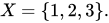
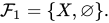
[edit]Look at the set: One possible -algebra would be: Then is a measurable space. Another possible -algebra would be the power set on : With this, a second measurable space on the set is given by



Common measurable spaces
[edit]If is finite or countably infinite, the -algebra is most often the power set on so This leads to the measurable space


If is a topological space, the -algebra is most commonly the Borel -algebra so This leads to the measurable space that is common for all topological spaces such as the real numbers


Ambiguity with Borel spaces
[edit]The term Borel space is used for different types of measurable spaces. It can refer to
- any measurable space, so it is a synonym for a measurable space as defined above [1]
- a measurable space that is Borel isomorphic to a measurable subset of the real numbers (again with the Borel -algebra)[3]
See also
[edit]- Borel set – Class of mathematical sets
- Measurable function – Kind of mathematical function
- Measure – Generalization of mass, length, area and volume
- Standard Borel space
- Category of measurable spaces
References
[edit]- ↑ 1.0 1.1 Template:SpringerEOM
- ↑ Klenke, Achim (2008). Probability Theory. Berlin: Springer. p. 18. doi:10.1007/978-1-84800-048-3. ISBN 978-1-84800-047-6.
- ↑ Kallenberg, Olav (2017). Random Measures, Theory and Applications. Probability Theory and Stochastic Modelling. 77. Switzerland: Springer. p. 15. doi:10.1007/978-3-319-41598-7. ISBN 978-3-319-41596-3.