Modus tollens
Template:Infobox mathematical statement
In propositional logic, modus tollens (/ˈmoʊdəs ˈtɒlɛnz/) (MT), also known as modus tollendo tollens (Latin for "mode that by denying denies")[1] and denying the consequent,[2] is a deductive argument form and a rule of inference. Modus tollens is a mixed hypothetical syllogism that takes the form of "If P, then Q. Not Q. Therefore, not P." It is an application of the general truth that if a statement is true, then so is its contrapositive. The form shows that inference from P implies Q to the negation of Q implies the negation of P is a valid argument.
The history of the inference rule modus tollens goes back to antiquity.[3] The first to explicitly describe the argument form modus tollens was Theophrastus.[4]
Modus tollens is closely related to modus ponens. There are two similar, but invalid, forms of argument: affirming the consequent and denying the antecedent. See also contraposition and proof by contrapositive.
Explanation
[edit | edit source]The form of a modus tollens argument is a mixed hypothetical syllogism, with two premises and a conclusion:
- If P, then Q.
- Not Q.
- Therefore, not P.
The first premise is a conditional ("if-then") claim, such as P implies Q. The second premise is an assertion that Q, the consequent of the conditional claim, is not the case. From these two premises it can be logically concluded that P, the antecedent of the conditional claim, is also not the case.
For example:
- If the dog detects an intruder, the dog will bark.
- The dog did not bark.
- Therefore, no intruder was detected by the dog.
Supposing that the premises are both true (the dog will bark if it detects an intruder, and does indeed not bark), it logically follows that no intruder has been detected. This is a valid argument since it is not possible for the conclusion to be false if the premises are true. (It is conceivable that there may have been an intruder that the dog did not detect, but that does not invalidate the argument; the first premise is "if the dog detects an intruder". The thing of importance is that the dog detects or does not detect an intruder, not whether there is one.)
Example 1:
- If I am the burglar, then I can crack a safe.
- I cannot crack a safe.
- Therefore, I am not the burglar.
Example 2:
- If Rex is a chicken, then he is a bird.
- Rex is not a bird.
- Therefore, Rex is not a chicken.
Relation to modus ponens
[edit | edit source]Every use of modus tollens can be converted to a use of modus ponens and one use of transposition to the premise which is a material implication. For example:
- If P, then Q. (premise – material implication)
- If not Q, then not P. (derived by transposition)
- Not Q . (premise)
- Therefore, not P. (derived by modus ponens)
Likewise, every use of modus ponens can be converted to a use of modus tollens and transposition.
Formal notation
[edit | edit source]The modus tollens rule can be stated formally as:
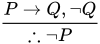
where stands for the statement "P implies Q". stands for "it is not the case that Q" (or in brief "not Q"). Then, whenever "" and "" each appear by themselves as a line of a proof, then "" can validly be placed on a subsequent line.


The modus tollens rule may be written in sequent notation:

where is a metalogical symbol meaning that is a syntactic consequence of and in some logical system;

or as the statement of a functional tautology or theorem of propositional logic:

where and are propositions expressed in some formal system;


or including assumptions:
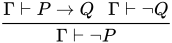
though since the rule does not change the set of assumptions, this is not strictly necessary.
More complex rewritings involving modus tollens are often seen, for instance in set theory:


("P is a subset of Q. x is not in Q. Therefore, x is not in P.")
Also in first-order predicate logic:



("For all x if x is P then x is Q. y is not Q. Therefore, y is not P.")
Strictly speaking these are not instances of modus tollens, but they may be derived from modus tollens using a few extra steps.
Justification via truth table
[edit | edit source]The validity of modus tollens can be clearly demonstrated through a truth table.
| p | q | p → q |
|---|---|---|
| T | T | T |
| T | F | F |
| F | T | T |
| F | F | T |
In instances of modus tollens we assume as premises that p → q is true and q is false. There is only one line of the truth table—the fourth line—which satisfies these two conditions. In this line, p is false. Therefore, in every instance in which p → q is true and q is false, p must also be false.
Formal proof
[edit | edit source]Via disjunctive syllogism
[edit | edit source]| Step | Proposition | Derivation |
|---|---|---|
| 1 | Given | |
| 2 | Given | |
| 3 | Material implication (1) | |
| 4 | Disjunctive syllogism (3,2) |


Via reductio ad absurdum
[edit | edit source]| Step | Proposition | Derivation |
|---|---|---|
| 1 | Given | |
| 2 | Given | |
| 3 | Assumption | |
| 4 | Modus ponens (1,3) | |
| 5 | Conjunction introduction (2,4) | |
| 6 | Reductio ad absurdum (3,5) |

Via contraposition
[edit | edit source]| Step | Proposition | Derivation |
|---|---|---|
| 1 | Given | |
| 2 | Given | |
| 3 | Contraposition (1) | |
| 4 | Modus ponens (2,3) |

Correspondence to other mathematical frameworks
[edit | edit source]Probability calculus
[edit | edit source]Modus tollens represents an instance of the law of total probability combined with Bayes' theorem expressed as:

where the conditionals and are obtained with (the extended form of) Bayes' theorem expressed as:


Failed to parse (Conversion error. Server ("https://wikimedia.org/api/rest_") reported: "Cannot get mml. Server problem."): {\displaystyle \Pr(P\mid Q)={\frac {\Pr(Q\mid P)\,a(P)}{\Pr(Q\mid P)\,a(P)+\Pr(Q\mid \lnot P)\,a(\lnot P)}}\;\;\;} and

In the equations above Failed to parse (Conversion error. Server ("https://wikimedia.org/api/rest_") reported: "Cannot get mml. Server problem."): {\displaystyle \Pr(Q)} denotes the probability of , and Failed to parse (Conversion error. Server ("https://wikimedia.org/api/rest_") reported: "Cannot get mml. Server problem."): {\displaystyle a(P)} denotes the base rate (aka. prior probability) of . The conditional probability generalizes the logical statement , i.e. in addition to assigning TRUE or FALSE we can also assign any probability to the statement. Assume that Failed to parse (Conversion error. Server ("https://wikimedia.org/api/rest_") reported: "Cannot get mml. Server problem."): {\displaystyle \Pr(Q)=1} is equivalent to being TRUE, and that Failed to parse (Conversion error. Server ("https://wikimedia.org/api/rest_") reported: "Cannot get mml. Server problem."): {\displaystyle \Pr(Q)=0} is equivalent to being FALSE. It is then easy to see that Failed to parse (Conversion error. Server ("https://wikimedia.org/api/rest_") reported: "Cannot get mml. Server problem."): {\displaystyle \Pr(P)=0} when Failed to parse (Conversion error. Server ("https://wikimedia.org/api/rest_") reported: "Cannot get mml. Server problem."): {\displaystyle \Pr(Q\mid P)=1} and Failed to parse (Conversion error. Server ("https://wikimedia.org/api/rest_") reported: "Cannot get mml. Server problem."): {\displaystyle \Pr(Q)=0} . This is because Failed to parse (Conversion error. Server ("https://wikimedia.org/api/rest_") reported: "Cannot get mml. Server problem."): {\displaystyle \Pr(\lnot Q\mid P)=1-\Pr(Q\mid P)=0} so that Failed to parse (Conversion error. Server ("https://wikimedia.org/api/rest_") reported: "Cannot get mml. Server problem."): {\displaystyle \Pr(P\mid \lnot Q)=0} in the last equation. Therefore, the product terms in the first equation always have a zero factor so that Failed to parse (Conversion error. Server ("https://wikimedia.org/api/rest_") reported: "Cannot get mml. Server problem."): {\displaystyle \Pr(P)=0} which is equivalent to being FALSE. Hence, the law of total probability combined with Bayes' theorem represents a generalization of modus tollens.[5]

Subjective logic
[edit | edit source]Modus tollens represents an instance of the abduction operator in subjective logic expressed as:

where Failed to parse (Conversion error. Server ("https://wikimedia.org/api/rest_") reported: "Cannot get mml. Server problem."): {\displaystyle \omega _{Q}^{A}} denotes the subjective opinion about , and Failed to parse (Conversion error. Server ("https://wikimedia.org/api/rest_") reported: "Cannot get mml. Server problem."): {\displaystyle (\omega _{Q|P}^{A},\omega _{Q|\lnot P}^{A})} denotes a pair of binomial conditional opinions, as expressed by source . The parameter Failed to parse (Conversion error. Server ("https://wikimedia.org/api/rest_") reported: "Cannot get mml. Server problem."): {\displaystyle a_{P}} denotes the base rate (aka. the prior probability) of . The abduced marginal opinion on is denoted Failed to parse (Conversion error. Server ("https://wikimedia.org/api/rest_") reported: "Cannot get mml. Server problem."): {\displaystyle \omega _{P{\tilde {\|}}Q}^{A}} . The conditional opinion Failed to parse (Conversion error. Server ("https://wikimedia.org/api/rest_") reported: "Cannot get mml. Server problem."): {\displaystyle \omega _{Q|P}^{A}} generalizes the logical statement , i.e. in addition to assigning TRUE or FALSE the source can assign any subjective opinion to the statement. The case where Failed to parse (Conversion error. Server ("https://wikimedia.org/api/rest_") reported: "Cannot get mml. Server problem."): {\displaystyle \omega _{Q}^{A}} is an absolute TRUE opinion is equivalent to source saying that is TRUE, and the case where Failed to parse (Conversion error. Server ("https://wikimedia.org/api/rest_") reported: "Cannot get mml. Server problem."): {\displaystyle \omega _{Q}^{A}} is an absolute FALSE opinion is equivalent to source saying that is FALSE. The abduction operator Failed to parse (Conversion error. Server ("https://wikimedia.org/api/rest_") reported: "Cannot get mml. Server problem."): {\displaystyle {\widetilde {\circledcirc }}} of subjective logic produces an absolute FALSE abduced opinion when the conditional opinion Failed to parse (Conversion error. Server ("https://wikimedia.org/api/rest_") reported: "Cannot get mml. Server problem."): {\displaystyle \omega _{Q|P}^{A}} is absolute TRUE and the consequent opinion Failed to parse (Conversion error. Server ("https://wikimedia.org/api/rest_") reported: "Cannot get mml. Server problem."): {\displaystyle \omega _{Q}^{A}} is absolute FALSE. Hence, subjective logic abduction represents a generalization of both modus tollens and of the Law of total probability combined with Bayes' theorem.[6]


See also
[edit | edit source]- Evidence of absence
- Latin phrases
- Modus operandi
- Modus ponens – Rule of logical inference
- Modus vivendi
- Non sequitur
- Performative contradiction
- Proof by contradiction – Form of proof
- Proof by contrapositive
- Stoic logic
- Law of excluded middle
Notes
[edit | edit source]- ↑ Stone, Jon R. (1996). Latin for the Illiterati: Exorcizing the Ghosts of a Dead Language. London: Routledge. p. 60. ISBN 978-0-415-91775-9.
- ↑ Sanford, David Hawley (2003). If P, Then Q: Conditionals and the Foundations of Reasoning (2nd ed.). London: Routledge. p. 39. ISBN 978-0-415-28368-7.
[Modus] tollens is always an abbreviation for modus tollendo tollens, the mood that by denying denies.
- ↑ Susanne Bobzien (2002). "The Development of Modus Ponens in Antiquity", Phronesis 47.
- ↑ "Ancient Logic: Forerunners of Modus Ponens and Modus Tollens". Stanford Encyclopedia of Philosophy.
- ↑ Audun Jøsang 2016:p.2
- ↑ Audun Jøsang 2016:p.92
Sources
[edit | edit source]- Audun Jøsang, 2016, Subjective Logic; A formalism for Reasoning Under Uncertainty Springer, Cham, ISBN 978-3-319-42337-1
External links
[edit | edit source]- Modus Tollens at Wolfram MathWorld