Product topology
In topology and related areas of mathematics, a product space is the Cartesian product of a family of topological spaces equipped with a natural topology called the product topology. This topology differs from another, perhaps more natural-seeming, topology called the box topology, which can also be given to a product space and which agrees with the product topology when the product is over only finitely many spaces. However, the product topology is "correct" in that it makes the product space a categorical product of its factors, whereas the box topology is too fine; in that sense the product topology is the natural topology on the Cartesian product.
Definition
[edit | edit source]Throughout, will be some non-empty index set and for every index let be a topological space. Denote the Cartesian product of the sets by


Failed to parse (Conversion error. Server ("https://wikimedia.org/api/rest_") reported: "Cannot get mml. Server problem."): {\displaystyle X:=\prod X_{\bullet }:=\prod _{i\in I}X_{i}}
and for every index , denote the -th canonical projection by


Failed to parse (Conversion error. Server ("https://wikimedia.org/api/rest_") reported: "Cannot get mml. Server problem."): {\displaystyle {\begin{aligned}p_{i}:\ \prod _{j\in I}X_{j}&\to X_{i},\\[3mu](x_{j})_{j\in I}&\mapsto x_{i}.\\\end{aligned}}}
The product topology, sometimes called the Tychonoff topology, on Failed to parse (Conversion error. Server ("https://wikimedia.org/api/rest_") reported: "Cannot get mml. Server problem."): {\textstyle \prod _{i\in I}X_{i}} is defined to be the coarsest topology (that is, the topology with the fewest open sets) for which all the projections Failed to parse (Conversion error. Server ("https://wikimedia.org/api/rest_") reported: "Cannot get mml. Server problem."): {\textstyle p_{i}:\prod X_{\bullet }\to X_{i}} are continuous. It is the initial topology on Failed to parse (Conversion error. Server ("https://wikimedia.org/api/rest_") reported: "Cannot get mml. Server problem."): {\textstyle \prod _{i\in I}X_{i}} with respect to the family of projections Failed to parse (Conversion error. Server ("https://wikimedia.org/api/rest_") reported: "Cannot get mml. Server problem."): {\displaystyle \left\{p_{i}\mathbin {\big \vert } i\in I\right\}} . The Cartesian product Failed to parse (Conversion error. Server ("https://wikimedia.org/api/rest_") reported: "Cannot get mml. Server problem."): {\textstyle X:=\prod _{i\in I}X_{i}} endowed with the product topology is called the product space. The open sets in the product topology are the unions of (finitely many or infinitely many) sets of the form Failed to parse (Conversion error. Server ("https://wikimedia.org/api/rest_") reported: "Cannot get mml. Server problem."): {\textstyle \prod _{i\in I}U_{i}} , where each Failed to parse (Conversion error. Server ("https://wikimedia.org/api/rest_") reported: "Cannot get mml. Server problem."): {\displaystyle U_{i}} is open in and for only finitely many . In particular, for a finite product (in particular, for the product of two topological spaces), the set of all Cartesian products between one basis element from each gives a basis for the product topology of Failed to parse (Conversion error. Server ("https://wikimedia.org/api/rest_") reported: "Cannot get mml. Server problem."): {\textstyle \prod _{i\in I}X_{i}} . That is, for a finite product, the set of all Failed to parse (Conversion error. Server ("https://wikimedia.org/api/rest_") reported: "Cannot get mml. Server problem."): {\textstyle \prod _{i\in I}U_{i}} , where each Failed to parse (Conversion error. Server ("https://wikimedia.org/api/rest_") reported: "Cannot get mml. Server problem."): {\displaystyle U_{i}} is an element of the (chosen) basis of , is a basis for the product topology of Failed to parse (Conversion error. Server ("https://wikimedia.org/api/rest_") reported: "Cannot get mml. Server problem."): {\textstyle \prod _{i\in I}X_{i}} .

The product topology on Failed to parse (Conversion error. Server ("https://wikimedia.org/api/rest_") reported: "Cannot get mml. Server problem."): {\textstyle \prod _{i\in I}X_{i}} is the topology generated by the sets of the form Failed to parse (Conversion error. Server ("https://wikimedia.org/api/rest_") reported: "Cannot get mml. Server problem."): {\displaystyle p_{i}^{-1}\left(U\right)} , where and is an open subset of . A subset of is open if and only if it is the union of (possibly infinitely many) intersections of finitely many sets of the form Failed to parse (Conversion error. Server ("https://wikimedia.org/api/rest_") reported: "Cannot get mml. Server problem."): {\displaystyle p_{i}^{-1}\left(U\right)} . The Failed to parse (Conversion error. Server ("https://wikimedia.org/api/rest_") reported: "Cannot get mml. Server problem."): {\displaystyle p_{i}^{-1}\left(U\right)} 's are sometimes called open cylinders, and their intersections are cylinder sets.


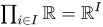
The product topology is also called the topology of pointwise convergence because a sequence (or more generally, a net) in converges if and only if all its projections to the spaces converge. Explicitly, a sequence Failed to parse (Conversion error. Server ("https://wikimedia.org/api/rest_") reported: "Cannot get mml. Server problem."): {\textstyle s_{\bullet }=\left(s_{n}\right)_{n=1}^{\infty }} (respectively, a net Failed to parse (Conversion error. Server ("https://wikimedia.org/api/rest_") reported: "Cannot get mml. Server problem."): {\textstyle s_{\bullet }=\left(s_{a}\right)_{a\in A}} ) converges to a given point Failed to parse (Conversion error. Server ("https://wikimedia.org/api/rest_") reported: "Cannot get mml. Server problem."): {\textstyle x\in \prod _{i\in I}X_{i}} if and only if Failed to parse (Conversion error. Server ("https://wikimedia.org/api/rest_") reported: "Cannot get mml. Server problem."): {\displaystyle p_{i}\left(s_{\bullet }\right)\to p_{i}(x)} in for every index , where Failed to parse (Conversion error. Server ("https://wikimedia.org/api/rest_") reported: "Cannot get mml. Server problem."): {\displaystyle p_{i}\left(s_{\bullet }\right):=p_{i}\circ s_{\bullet }} denotes Failed to parse (Conversion error. Server ("https://wikimedia.org/api/rest_") reported: "Cannot get mml. Server problem."): {\displaystyle \left(p_{i}\left(s_{n}\right)\right)_{n=1}^{\infty }} (respectively, denotes Failed to parse (Conversion error. Server ("https://wikimedia.org/api/rest_") reported: "Cannot get mml. Server problem."): {\displaystyle \left(p_{i}\left(s_{a}\right)\right)_{a\in A}} ). In particular, if Failed to parse (Conversion error. Server ("https://wikimedia.org/api/rest_") reported: "Cannot get mml. Server problem."): {\displaystyle X_{i}=\mathbb {R} } for all , then the Cartesian product is the space of all real-valued functions on , and convergence in the product topology is the same as pointwise convergence of functions.

Examples
[edit | edit source]If the real line is endowed with its standard topology then the product topology on the product of copies of is equal to the ordinary Euclidean topology on (Because is finite, this is also equivalent to the box topology on )


The Cantor set is homeomorphic to the product of countably many copies of the discrete space and the space of irrational numbers is homeomorphic to the product of countably many copies of the natural numbers, where again each copy carries the discrete topology.

Several additional examples are given in the article on the initial topology.
Properties
[edit | edit source]The set of Cartesian products between the open sets of the topologies of each forms a basis for what is called the box topology on In general, the box topology is finer than the product topology, but for finite products they coincide.

The product space together with the canonical projections, can be characterized by the following universal property: if is a topological space, and for every Failed to parse (SVG (MathML can be enabled via browser plugin): Invalid response ("Math extension cannot connect to Restbase.") from server "https://wikimedia.org/api/rest_v1/":): {\displaystyle i \in I,} Failed to parse (SVG (MathML can be enabled via browser plugin): Invalid response ("Math extension cannot connect to Restbase.") from server "https://wikimedia.org/api/rest_v1/":): {\displaystyle f_i : Y \to X_i} is a continuous map, then there exists precisely one continuous map Failed to parse (SVG (MathML can be enabled via browser plugin): Invalid response ("Math extension cannot connect to Restbase.") from server "https://wikimedia.org/api/rest_v1/":): {\displaystyle f : Y \to X} such that for each Failed to parse (SVG (MathML can be enabled via browser plugin): Invalid response ("Math extension cannot connect to Restbase.") from server "https://wikimedia.org/api/rest_v1/":): {\displaystyle i \in I} the following diagram commutes:


This shows that the product space is a product in the category of topological spaces. It follows from the above universal property that a map Failed to parse (SVG (MathML can be enabled via browser plugin): Invalid response ("Math extension cannot connect to Restbase.") from server "https://wikimedia.org/api/rest_v1/":): {\displaystyle f : Y \to X} is continuous if and only if Failed to parse (SVG (MathML can be enabled via browser plugin): Invalid response ("Math extension cannot connect to Restbase.") from server "https://wikimedia.org/api/rest_v1/":): {\displaystyle f_i = p_i \circ f} is continuous for all Failed to parse (SVG (MathML can be enabled via browser plugin): Invalid response ("Math extension cannot connect to Restbase.") from server "https://wikimedia.org/api/rest_v1/":): {\displaystyle i \in I.} In many cases it is easier to check that the component functions Failed to parse (SVG (MathML can be enabled via browser plugin): Invalid response ("Math extension cannot connect to Restbase.") from server "https://wikimedia.org/api/rest_v1/":): {\displaystyle f_i} are continuous. Checking whether a map Failed to parse (SVG (MathML can be enabled via browser plugin): Invalid response ("Math extension cannot connect to Restbase.") from server "https://wikimedia.org/api/rest_v1/":): {\displaystyle X \to Y} is continuous is usually more difficult; one tries to use the fact that the Failed to parse (SVG (MathML can be enabled via browser plugin): Invalid response ("Math extension cannot connect to Restbase.") from server "https://wikimedia.org/api/rest_v1/":): {\displaystyle p_i} are continuous in some way.
In addition to being continuous, the canonical projections Failed to parse (SVG (MathML can be enabled via browser plugin): Invalid response ("Math extension cannot connect to Restbase.") from server "https://wikimedia.org/api/rest_v1/":): {\displaystyle p_i : X \to X_i} are open maps. This means that any open subset of the product space remains open when projected down to the Failed to parse (SVG (MathML can be enabled via browser plugin): Invalid response ("Math extension cannot connect to Restbase.") from server "https://wikimedia.org/api/rest_v1/":): {\displaystyle X_i.} The converse is not true: if Failed to parse (SVG (MathML can be enabled via browser plugin): Invalid response ("Math extension cannot connect to Restbase.") from server "https://wikimedia.org/api/rest_v1/":): {\displaystyle W} is a subspace of the product space whose projections down to all the Failed to parse (SVG (MathML can be enabled via browser plugin): Invalid response ("Math extension cannot connect to Restbase.") from server "https://wikimedia.org/api/rest_v1/":): {\displaystyle X_i} are open, then Failed to parse (SVG (MathML can be enabled via browser plugin): Invalid response ("Math extension cannot connect to Restbase.") from server "https://wikimedia.org/api/rest_v1/":): {\displaystyle W} need not be open in Failed to parse (SVG (MathML can be enabled via browser plugin): Invalid response ("Math extension cannot connect to Restbase.") from server "https://wikimedia.org/api/rest_v1/":): {\displaystyle X} (consider for instance Failed to parse (SVG (MathML can be enabled via browser plugin): Invalid response ("Math extension cannot connect to Restbase.") from server "https://wikimedia.org/api/rest_v1/":): {\textstyle W = \R^2 \setminus (0, 1)^2.} ) The canonical projections are not generally closed maps (consider for example the closed set Failed to parse (SVG (MathML can be enabled via browser plugin): Invalid response ("Math extension cannot connect to Restbase.") from server "https://wikimedia.org/api/rest_v1/":): {\textstyle \left\{(x,y) \in \R^2 : xy = 1\right\},} whose projections onto both axes are Failed to parse (SVG (MathML can be enabled via browser plugin): Invalid response ("Math extension cannot connect to Restbase.") from server "https://wikimedia.org/api/rest_v1/":): {\displaystyle \R \setminus \{0\}} ).
Suppose Failed to parse (SVG (MathML can be enabled via browser plugin): Invalid response ("Math extension cannot connect to Restbase.") from server "https://wikimedia.org/api/rest_v1/":): {\textstyle \prod_{i \in I} S_i} is a product of arbitrary subsets, where Failed to parse (SVG (MathML can be enabled via browser plugin): Invalid response ("Math extension cannot connect to Restbase.") from server "https://wikimedia.org/api/rest_v1/":): {\displaystyle S_i \subseteq X_i} for every Failed to parse (SVG (MathML can be enabled via browser plugin): Invalid response ("Math extension cannot connect to Restbase.") from server "https://wikimedia.org/api/rest_v1/":): {\displaystyle i \in I.} If all Failed to parse (SVG (MathML can be enabled via browser plugin): Invalid response ("Math extension cannot connect to Restbase.") from server "https://wikimedia.org/api/rest_v1/":): {\displaystyle S_i} are non-empty then Failed to parse (SVG (MathML can be enabled via browser plugin): Invalid response ("Math extension cannot connect to Restbase.") from server "https://wikimedia.org/api/rest_v1/":): {\textstyle \prod_{i \in I} S_i} is a closed subset of the product space Failed to parse (SVG (MathML can be enabled via browser plugin): Invalid response ("Math extension cannot connect to Restbase.") from server "https://wikimedia.org/api/rest_v1/":): {\displaystyle X} if and only if every Failed to parse (SVG (MathML can be enabled via browser plugin): Invalid response ("Math extension cannot connect to Restbase.") from server "https://wikimedia.org/api/rest_v1/":): {\displaystyle S_i} is a closed subset of Failed to parse (SVG (MathML can be enabled via browser plugin): Invalid response ("Math extension cannot connect to Restbase.") from server "https://wikimedia.org/api/rest_v1/":): {\displaystyle X_i.} More generally, the closure of the product Failed to parse (SVG (MathML can be enabled via browser plugin): Invalid response ("Math extension cannot connect to Restbase.") from server "https://wikimedia.org/api/rest_v1/":): {\textstyle \prod_{i \in I} S_i} of arbitrary subsets in the product space Failed to parse (SVG (MathML can be enabled via browser plugin): Invalid response ("Math extension cannot connect to Restbase.") from server "https://wikimedia.org/api/rest_v1/":): {\displaystyle X} is equal to the product of the closures:[1]
Failed to parse (SVG (MathML can be enabled via browser plugin): Invalid response ("Math extension cannot connect to Restbase.") from server "https://wikimedia.org/api/rest_v1/":): {\displaystyle {\operatorname{Cl}_X}\Bigl(\prod_{i \in I} S_i\Bigr) = \prod_{i \in I} \bigl({\operatorname{Cl}_{X_i}} S_i\bigr). }
Any product of Hausdorff spaces is again a Hausdorff space; this comes from a simple preservation of disjoint open neighborhoods under the inverse of canonical projections from Failed to parse (SVG (MathML can be enabled via browser plugin): Invalid response ("Math extension cannot connect to Restbase.") from server "https://wikimedia.org/api/rest_v1/":): {\displaystyle X_i} 's to Failed to parse (SVG (MathML can be enabled via browser plugin): Invalid response ("Math extension cannot connect to Restbase.") from server "https://wikimedia.org/api/rest_v1/":): {\textstyle \prod_{i \in I} X_i} .
Tychonoff's theorem, which is equivalent to the axiom of choice, states that any product of compact spaces is a compact space. A specialization of Tychonoff's theorem that requires only the ultrafilter lemma (and not the full strength of the axiom of choice) states that any product of compact Hausdorff spaces is a compact space.
If Failed to parse (SVG (MathML can be enabled via browser plugin): Invalid response ("Math extension cannot connect to Restbase.") from server "https://wikimedia.org/api/rest_v1/":): {\textstyle z = \left(z_i\right)_{i \in I} \in X} is fixed then the set
Failed to parse (SVG (MathML can be enabled via browser plugin): Invalid response ("Math extension cannot connect to Restbase.") from server "https://wikimedia.org/api/rest_v1/":): {\displaystyle \left\{ x = \left(x_i\right)_{i \in I} \in X \mathbin{\big\vert} x_i = z_i \text{ for all but finitely many } i \right\} }
is a dense subset of the product space Failed to parse (SVG (MathML can be enabled via browser plugin): Invalid response ("Math extension cannot connect to Restbase.") from server "https://wikimedia.org/api/rest_v1/":): {\displaystyle X} .[1]
Relation to other topological notions
[edit | edit source]Separation
- Every product of T0 spaces is T0.
- Every product of T1 spaces is T1.
- Every product of Hausdorff spaces is Hausdorff.
- Every product of regular spaces is regular.
- Every product of Tychonoff spaces is Tychonoff.
- A product of normal spaces need not be normal.
Compactness
- Every product of compact spaces is compact (Tychonoff's theorem).
- A product of locally compact spaces need not be locally compact. However, an arbitrary product of locally compact spaces where all but finitely many are compact is locally compact (This condition is sufficient and necessary).
Connectedness
- Every product of connected (resp. path-connected) spaces is connected (resp. path-connected).
- Every product of hereditarily disconnected spaces is hereditarily disconnected.
Metric spaces
- Countable products of metric spaces are metrizable spaces.
Axiom of choice
[edit | edit source]One of many ways to express the axiom of choice is to say that it is equivalent to the statement that the Cartesian product of a collection of non-empty sets is non-empty.[2] The proof that this is equivalent to the statement of the axiom in terms of choice functions is immediate: one needs only to pick an element from each set to find a representative in the product. Conversely, a representative of the product is a set which contains exactly one element from each component.
The axiom of choice occurs again in the study of (topological) product spaces; for example, Tychonoff's theorem on compact sets is a more complex and subtle example of a statement that requires the axiom of choice and is equivalent to it in its most general formulation,[3] and shows why the product topology may be considered the more useful topology to put on a Cartesian product.
See also
[edit | edit source]- Disjoint union (topology)
- Final topology
- Initial topology - Sometimes called the projective limit topology
- Inverse limit – Construction in category theory
- Pointwise convergence
- Quotient space (topology)
- Subspace (topology)
- Weak topology – Mathematical term
Notes
[edit | edit source]- ↑ 1.0 1.1 Bourbaki 1989, pp. 43–50.
- ↑ Pervin, William J. (1964), Foundations of General Topology, Academic Press, p. 33
- ↑ Hocking, John G.; Young, Gail S. (1988) [1961], Topology, Dover, p. 28, ISBN 978-0-486-65676-2
References
[edit | edit source]- Template:Bourbaki General Topology Part I Chapters 1-4
- Willard, Stephen (1970). General Topology. Reading, Mass.: Addison-Wesley Pub. Co. ISBN 0486434796. Retrieved 13 February 2013.
- Kelley, John L. (2017). General Topology (Dover ed.). Dover Publications. ISBN 978-0-486-81544-2.