Weak topology
TemplateStyles' src attribute must not be empty.
 | This article needs editing for compliance with Wikipedia's Manual of Style. In particular, it has problems with MOS:FORMULA - avoid mixing <math>...</math> and {{math}} in the same expression. (July 2025) |
In mathematics, weak topology is an alternative term for certain initial topologies, often on topological vector spaces or spaces of linear operators, for instance on a Hilbert space. The term is most commonly used for the initial topology of a topological vector space (such as a normed vector space) with respect to its continuous dual. The remainder of this article will deal with this case, which is one of the concepts of functional analysis.
One may call subsets of a topological vector space weakly closed (respectively, weakly compact, etc.) if they are closed (respectively, compact, etc.) with respect to the weak topology. Likewise, functions are sometimes called weakly continuous (respectively, weakly differentiable, weakly analytic, etc.) if they are continuous (respectively, differentiable, analytic, etc.) with respect to the weak topology.
History
Starting in the early 1900s, David Hilbert and Marcel Riesz made extensive use of weak convergence. The early pioneers of functional analysis did not elevate norm convergence above weak convergence and oftentimes viewed weak convergence as preferable.[1] In 1929, Banach introduced weak convergence for normed spaces and also introduced the analogous weak-* convergence.[1] The weak topology is called topologie faible in French and schwache Topologie in German.
The weak and strong topologies
Let be a topological field, namely a field with a topology such that addition, multiplication, and division are continuous. In most applications will be either the field of complex numbers or the field of real numbers with the familiar topologies.

Weak topology with respect to a pairing
Both the weak topology and the weak* topology are special cases of a more general construction for pairings, which we now describe. The benefit of this more general construction is that any definition or result proved for it applies to both the weak topology and the weak* topology, thereby making redundant the need for many definitions, theorem statements, and proofs. This is also the reason why the weak* topology is also frequently referred to as the "weak topology"; because it is just an instance of the weak topology in the setting of this more general construction.
Suppose (X, Y, b) is a pairing of vector spaces over a topological field (i.e. X and Y are vector spaces over and b : X × Y → is a bilinear map).
- Notation. For all x ∈ X, let b(x, •) : Y → denote the linear functional on Y defined by y Template:Mapsto b(x, y). Similarly, for all y ∈ Y, let b(•, y) : X → be defined by x Template:Mapsto b(x, y).
- Definition. The weak topology on X induced by Y (and b) is the weakest topology on X, denoted by 𝜎(X, Y, b) or simply 𝜎(X, Y), making all maps b(•, y) : X → continuous, as y ranges over Y.[1]
The weak topology on Y is now automatically defined as described in the article Dual system. However, for clarity, we now repeat it.
- Definition. The weak topology on Y induced by X (and b) is the weakest topology on Y, denoted by 𝜎(Y, X, b) or simply 𝜎(Y, X), making all maps b(x, •) : Y → continuous, as x ranges over X.[1]
If the field has an absolute value Template:Mabs, then the weak topology 𝜎(X, Y, b) on X is induced by the family of seminorms, py : X → , defined by

- py(x) := Template:Mabs
for all y ∈ Y and x ∈ X. This shows that weak topologies are locally convex.
- Assumption. We will henceforth assume that is either the real numbers or the complex numbers .

Canonical duality
We now consider the special case where Y is a vector subspace of the algebraic dual space of X (i.e. a vector space of linear functionals on X).
There is a pairing, denoted by or , called the canonical pairing whose bilinear map is the canonical evaluation map, defined by for all and . Note in particular that is just another way of denoting i.e. .


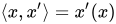


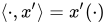
- Assumption. If Y is a vector subspace of the algebraic dual space of X then we will assume that they are associated with the canonical pairing ⟨X, Y⟩.
In this case, the weak topology on X (resp. the weak topology on Y), denoted by 𝜎(X,Y) (resp. by 𝜎(Y,X)), is the weak topology on X (resp. on Y) with respect to the canonical pairing ⟨X, Y⟩.
The topology σ(X,Y) is the initial topology of X with respect to Y.
If Y is a vector space of linear functionals on X, then the continuous dual of X with respect to the topology σ(X,Y) is precisely equal to Y.[1](Rudin 1991, Theorem 3.10)
The weak and weak* topologies
Let X be a topological vector space (TVS) over , that is, X is a vector space equipped with a topology so that vector addition and scalar multiplication are continuous. We call the topology that X starts with the original, starting, or given topology (the reader is cautioned against using the terms "initial topology" and "strong topology" to refer to the original topology since these already have well-known meanings, so using them may cause confusion). We may define a possibly different topology on X using the topological or continuous dual space , which consists of all linear functionals from X into the base field that are continuous with respect to the given topology.

Recall that is the canonical evaluation map defined by for all and , where in particular, .


- Definition. The weak topology on X is the weak topology on X with respect to the canonical pairing Failed to parse (SVG (MathML can be enabled via browser plugin): Invalid response ("Math extension cannot connect to Restbase.") from server "https://wikimedia.org/api/rest_v1/":): {\displaystyle \langle X,X^*\rangle} .[1]
- Definition: The weak topology on Failed to parse (SVG (MathML can be enabled via browser plugin): Invalid response ("Math extension cannot connect to Restbase.") from server "https://wikimedia.org/api/rest_v1/":): {\displaystyle X^*} is the weak topology on Failed to parse (SVG (MathML can be enabled via browser plugin): Invalid response ("Math extension cannot connect to Restbase.") from server "https://wikimedia.org/api/rest_v1/":): {\displaystyle X^*} with respect to the canonical pairing Failed to parse (SVG (MathML can be enabled via browser plugin): Invalid response ("Math extension cannot connect to Restbase.") from server "https://wikimedia.org/api/rest_v1/":): {\displaystyle \langle X,X^*\rangle} .[1] This topology is also called the weak* topology.
Weak topology induced by the continuous dual space
Alternatively, the weak topology on a TVS X is the initial topology with respect to the family Failed to parse (SVG (MathML can be enabled via browser plugin): Invalid response ("Math extension cannot connect to Restbase.") from server "https://wikimedia.org/api/rest_v1/":): {\displaystyle X^*} . In other words, it is the coarsest topology on X such that each element of Failed to parse (SVG (MathML can be enabled via browser plugin): Invalid response ("Math extension cannot connect to Restbase.") from server "https://wikimedia.org/api/rest_v1/":): {\displaystyle X^*} remains a continuous function.
A subbase for the weak topology is the collection of sets of the form Failed to parse (SVG (MathML can be enabled via browser plugin): Invalid response ("Math extension cannot connect to Restbase.") from server "https://wikimedia.org/api/rest_v1/":): {\displaystyle \phi^{-1}(U)} where Failed to parse (SVG (MathML can be enabled via browser plugin): Invalid response ("Math extension cannot connect to Restbase.") from server "https://wikimedia.org/api/rest_v1/":): {\displaystyle \phi\in X^*} and U is an open subset of the base field Failed to parse (SVG (MathML can be enabled via browser plugin): Invalid response ("Math extension cannot connect to Restbase.") from server "https://wikimedia.org/api/rest_v1/":): {\displaystyle \mathbb{K}} . In other words, a subset of X is open in the weak topology if and only if it can be written as the union of (possibly infinitely many) sets, each of which is the intersection of finitely many sets of the form Failed to parse (SVG (MathML can be enabled via browser plugin): Invalid response ("Math extension cannot connect to Restbase.") from server "https://wikimedia.org/api/rest_v1/":): {\displaystyle \phi^{-1}(U)} .
From this point of view, the weak topology is the coarsest polar topology.
Weak convergence
The weak topology is characterized by the following condition: a net Failed to parse (SVG (MathML can be enabled via browser plugin): Invalid response ("Math extension cannot connect to Restbase.") from server "https://wikimedia.org/api/rest_v1/":): {\displaystyle (x_\lambda)} in X converges in the weak topology to the element x of X if and only if Failed to parse (SVG (MathML can be enabled via browser plugin): Invalid response ("Math extension cannot connect to Restbase.") from server "https://wikimedia.org/api/rest_v1/":): {\displaystyle \phi(x_\lambda)} converges to Failed to parse (SVG (MathML can be enabled via browser plugin): Invalid response ("Math extension cannot connect to Restbase.") from server "https://wikimedia.org/api/rest_v1/":): {\displaystyle \phi(x)} in Failed to parse (SVG (MathML can be enabled via browser plugin): Invalid response ("Math extension cannot connect to Restbase.") from server "https://wikimedia.org/api/rest_v1/":): {\displaystyle \mathbb{R}} or Failed to parse (SVG (MathML can be enabled via browser plugin): Invalid response ("Math extension cannot connect to Restbase.") from server "https://wikimedia.org/api/rest_v1/":): {\displaystyle \mathbb{C}} for all Failed to parse (SVG (MathML can be enabled via browser plugin): Invalid response ("Math extension cannot connect to Restbase.") from server "https://wikimedia.org/api/rest_v1/":): {\displaystyle \phi\in X^*} .
In particular, if Failed to parse (SVG (MathML can be enabled via browser plugin): Invalid response ("Math extension cannot connect to Restbase.") from server "https://wikimedia.org/api/rest_v1/":): {\displaystyle x_n} is a sequence in X, then Failed to parse (SVG (MathML can be enabled via browser plugin): Invalid response ("Math extension cannot connect to Restbase.") from server "https://wikimedia.org/api/rest_v1/":): {\displaystyle x_n} converges weakly to x if
- Failed to parse (SVG (MathML can be enabled via browser plugin): Invalid response ("Math extension cannot connect to Restbase.") from server "https://wikimedia.org/api/rest_v1/":): {\displaystyle \varphi(x_n) \to \varphi(x)}
as n → ∞ for all Failed to parse (SVG (MathML can be enabled via browser plugin): Invalid response ("Math extension cannot connect to Restbase.") from server "https://wikimedia.org/api/rest_v1/":): {\displaystyle \varphi \in X^*} . In this case, it is customary to write
- Failed to parse (SVG (MathML can be enabled via browser plugin): Invalid response ("Math extension cannot connect to Restbase.") from server "https://wikimedia.org/api/rest_v1/":): {\displaystyle x_n \overset{\mathrm{w}}{\longrightarrow} x}
or, sometimes,
- Failed to parse (SVG (MathML can be enabled via browser plugin): Invalid response ("Math extension cannot connect to Restbase.") from server "https://wikimedia.org/api/rest_v1/":): {\displaystyle x_n \rightharpoonup x.}
Other properties
If X is equipped with the weak topology, then addition and scalar multiplication remain continuous operations, and X is a locally convex topological vector space.
If X is a normed space, then the dual space Failed to parse (SVG (MathML can be enabled via browser plugin): Invalid response ("Math extension cannot connect to Restbase.") from server "https://wikimedia.org/api/rest_v1/":): {\displaystyle X^*} is itself a normed vector space by using the norm
- Failed to parse (SVG (MathML can be enabled via browser plugin): Invalid response ("Math extension cannot connect to Restbase.") from server "https://wikimedia.org/api/rest_v1/":): {\displaystyle \|\phi\|=\sup_{\|x\|\le 1} |\phi(x)|.}
This norm gives rise to a topology, called the strong topology, on Failed to parse (SVG (MathML can be enabled via browser plugin): Invalid response ("Math extension cannot connect to Restbase.") from server "https://wikimedia.org/api/rest_v1/":): {\displaystyle X^*} . This is the topology of uniform convergence. The uniform and strong topologies are generally different for other spaces of linear maps; see below.
Weak-* topology
- Weak-* convergence
A net Failed to parse (SVG (MathML can be enabled via browser plugin): Invalid response ("Math extension cannot connect to Restbase.") from server "https://wikimedia.org/api/rest_v1/":): {\displaystyle \phi_{\lambda}} in Failed to parse (SVG (MathML can be enabled via browser plugin): Invalid response ("Math extension cannot connect to Restbase.") from server "https://wikimedia.org/api/rest_v1/":): {\displaystyle X^*} is convergent to Failed to parse (SVG (MathML can be enabled via browser plugin): Invalid response ("Math extension cannot connect to Restbase.") from server "https://wikimedia.org/api/rest_v1/":): {\displaystyle \phi} in the weak-* topology if it converges pointwise:
- Failed to parse (SVG (MathML can be enabled via browser plugin): Invalid response ("Math extension cannot connect to Restbase.") from server "https://wikimedia.org/api/rest_v1/":): {\displaystyle \phi_{\lambda} (x) \to \phi (x)}
for all Failed to parse (SVG (MathML can be enabled via browser plugin): Invalid response ("Math extension cannot connect to Restbase.") from server "https://wikimedia.org/api/rest_v1/":): {\displaystyle x\in X} . In particular, a sequence of Failed to parse (SVG (MathML can be enabled via browser plugin): Invalid response ("Math extension cannot connect to Restbase.") from server "https://wikimedia.org/api/rest_v1/":): {\displaystyle \phi_n\in X^*} converges to Failed to parse (SVG (MathML can be enabled via browser plugin): Invalid response ("Math extension cannot connect to Restbase.") from server "https://wikimedia.org/api/rest_v1/":): {\displaystyle \phi} provided that
- Failed to parse (SVG (MathML can be enabled via browser plugin): Invalid response ("Math extension cannot connect to Restbase.") from server "https://wikimedia.org/api/rest_v1/":): {\displaystyle \phi_n(x)\to\phi(x)}
for all x ∈ X. In this case, one writes
- Failed to parse (SVG (MathML can be enabled via browser plugin): Invalid response ("Math extension cannot connect to Restbase.") from server "https://wikimedia.org/api/rest_v1/":): {\displaystyle \phi_n \overset{w^*}{\to} \phi}
as n → ∞.
Weak-* convergence is sometimes called the simple convergence or the pointwise convergence. Indeed, it coincides with the pointwise convergence of linear functionals.
Properties
If X is a separable (i.e. has a countable dense subset) locally convex space and H is a norm-bounded subset of its continuous dual space, then H endowed with the weak* (subspace) topology is a metrizable topological space.[1] However, for infinite-dimensional spaces, the metric cannot be translation-invariant.[2] If X is a separable metrizable locally convex space then the weak* topology on the continuous dual space of X is separable.[1]
- Properties on normed spaces
By definition, the weak* topology is weaker than the weak topology on Failed to parse (SVG (MathML can be enabled via browser plugin): Invalid response ("Math extension cannot connect to Restbase.") from server "https://wikimedia.org/api/rest_v1/":): {\displaystyle X^*} . An important fact about the weak* topology is the Banach–Alaoglu theorem: if X is normed, then the closed unit ball in Failed to parse (SVG (MathML can be enabled via browser plugin): Invalid response ("Math extension cannot connect to Restbase.") from server "https://wikimedia.org/api/rest_v1/":): {\displaystyle X^*} is weak*-compact (more generally, the polar in Failed to parse (SVG (MathML can be enabled via browser plugin): Invalid response ("Math extension cannot connect to Restbase.") from server "https://wikimedia.org/api/rest_v1/":): {\displaystyle X^*} of a neighborhood of 0 in X is weak*-compact). Moreover, the closed unit ball in a normed space X is compact in the weak topology if and only if X is reflexive.
In more generality, let F be locally compact valued field (e.g., the reals, the complex numbers, or any of the p-adic number systems). Let X be a normed topological vector space over F, compatible with the absolute value in F. Then in Failed to parse (SVG (MathML can be enabled via browser plugin): Invalid response ("Math extension cannot connect to Restbase.") from server "https://wikimedia.org/api/rest_v1/":): {\displaystyle X^*} , the topological dual space X of continuous F-valued linear functionals on X, all norm-closed balls are compact in the weak* topology.
If X is a normed space, a version of the Heine-Borel theorem holds. In particular, a subset of the continuous dual is weak* compact if and only if it is weak* closed and norm-bounded.[1] This implies, in particular, that when X is an infinite-dimensional normed space then the closed unit ball at the origin in the dual space of X does not contain any weak* neighborhood of 0 (since any such neighborhood is norm-unbounded).[1] Thus, even though norm-closed balls are compact, X* is not weak* locally compact.
If X is a normed space, then X is separable if and only if the weak* topology on the closed unit ball of Failed to parse (SVG (MathML can be enabled via browser plugin): Invalid response ("Math extension cannot connect to Restbase.") from server "https://wikimedia.org/api/rest_v1/":): {\displaystyle X^*} is metrizable,[1] in which case the weak* topology is metrizable on norm-bounded subsets of Failed to parse (SVG (MathML can be enabled via browser plugin): Invalid response ("Math extension cannot connect to Restbase.") from server "https://wikimedia.org/api/rest_v1/":): {\displaystyle X^*} . If a normed space X has a dual space that is separable (with respect to the dual-norm topology) then X is necessarily separable.[1] If X is a Banach space, the weak* topology is not metrizable on all of Failed to parse (SVG (MathML can be enabled via browser plugin): Invalid response ("Math extension cannot connect to Restbase.") from server "https://wikimedia.org/api/rest_v1/":): {\displaystyle X^*} unless X is finite-dimensional.[3]
Examples
Hilbert spaces
Consider, for example, the difference between strong and weak convergence of functions in the Hilbert space L2(Failed to parse (SVG (MathML can be enabled via browser plugin): Invalid response ("Math extension cannot connect to Restbase.") from server "https://wikimedia.org/api/rest_v1/":): {\displaystyle \mathbb{R}^n} ). Strong convergence of a sequence Failed to parse (SVG (MathML can be enabled via browser plugin): Invalid response ("Math extension cannot connect to Restbase.") from server "https://wikimedia.org/api/rest_v1/":): {\displaystyle \psi_k\in L^2(\R^n)} to an element ψ means that
- Failed to parse (SVG (MathML can be enabled via browser plugin): Invalid response ("Math extension cannot connect to Restbase.") from server "https://wikimedia.org/api/rest_v1/":): {\displaystyle \int_{\R^n} |\psi_k-\psi |^2\,{\rm d}\mu\, \to 0}
as k → ∞. Here the notion of convergence corresponds to the norm on L2.
In contrast weak convergence only demands that
- Failed to parse (SVG (MathML can be enabled via browser plugin): Invalid response ("Math extension cannot connect to Restbase.") from server "https://wikimedia.org/api/rest_v1/":): {\displaystyle \int_{\R^n} \bar{\psi}_k f\,\mathrm d\mu \to \int_{\R^n} \bar{\psi}f\, \mathrm d\mu}
for all functions f ∈ L2 (or, more typically, all f in a dense subset of L2 such as a space of test functions, if the sequence {ψk} is bounded). For given test functions, the relevant notion of convergence only corresponds to the topology used in Failed to parse (SVG (MathML can be enabled via browser plugin): Invalid response ("Math extension cannot connect to Restbase.") from server "https://wikimedia.org/api/rest_v1/":): {\displaystyle \mathbb{C}} .
For example, in the Hilbert space L2(0,π), the sequence of functions
- Failed to parse (SVG (MathML can be enabled via browser plugin): Invalid response ("Math extension cannot connect to Restbase.") from server "https://wikimedia.org/api/rest_v1/":): {\displaystyle \psi_k(x) = \sqrt{2/\pi}\sin(k x)}
form an orthonormal basis. In particular, the (strong) limit of Failed to parse (SVG (MathML can be enabled via browser plugin): Invalid response ("Math extension cannot connect to Restbase.") from server "https://wikimedia.org/api/rest_v1/":): {\displaystyle \psi_k} as k → ∞ does not exist. On the other hand, being an orthonormal sequence in a Hilbert space, it must converge weakly to zero, by the Riesz representation theorem, Bessel's inequality, and the nth-term test for series. Alternatively, the Riemann–Lebesgue lemma can be used to show that the weak limit exists and is zero.
Distributions
One normally obtains spaces of distributions by forming the strong dual of a space of test functions (such as the compactly supported smooth functions on Failed to parse (SVG (MathML can be enabled via browser plugin): Invalid response ("Math extension cannot connect to Restbase.") from server "https://wikimedia.org/api/rest_v1/":): {\displaystyle \mathbb{R}^n} ). In an alternative construction of such spaces, one can take the weak dual of a space of test functions inside a Hilbert space such as L2. Thus one is led to consider the idea of a rigged Hilbert space.
Weak topology induced by the algebraic dual
Suppose that X is a vector space and X# is the algebraic dual space of X (i.e. the vector space of all linear functionals on X). If X is endowed with the weak topology induced by X# then the continuous dual space of X is X#, every bounded subset of X is contained in a finite-dimensional vector subspace of X, every vector subspace of X is closed and has a topological complement.[4]
Operator topologies
If X and Y are topological vector spaces, the space L(X,Y) of continuous linear operators f : X → Y may carry a variety of different possible topologies. The naming of such topologies depends on the kind of topology one is using on the target space Y to define operator convergence (Yosida 1980, IV.7 Topologies of linear maps). There are, in general, a vast array of possible operator topologies on L(X,Y), whose naming is not entirely intuitive.
For example, the strong operator topology on L(X,Y) is the topology of pointwise convergence. For instance, if Y is a normed space, then this topology is defined by the seminorms indexed by x ∈ X:
- Failed to parse (SVG (MathML can be enabled via browser plugin): Invalid response ("Math extension cannot connect to Restbase.") from server "https://wikimedia.org/api/rest_v1/":): {\displaystyle f\mapsto \|f(x)\|_Y.}
More generally, if a family of seminorms Q defines the topology on Y, then the seminorms pq, x on L(X,Y) defining the strong topology are given by
- Failed to parse (SVG (MathML can be enabled via browser plugin): Invalid response ("Math extension cannot connect to Restbase.") from server "https://wikimedia.org/api/rest_v1/":): {\displaystyle p_{q,x} : f \mapsto q(f(x)),}
indexed by q ∈ Q and x ∈ X.
In particular, see the weak operator topology and weak* operator topology.
See also
References
- ↑ 1.00 1.01 1.02 1.03 1.04 1.05 1.06 1.07 1.08 1.09 1.10 1.11 1.12 Narici & Beckenstein 2011, pp. 225–273.
- ↑ Folland 1999, pp. 170.
- ↑ Proposition 2.6.12, p. 226 in Megginson, Robert E. (1998), An introduction to Banach space theory, Graduate Texts in Mathematics, 183, New York: Springer-Verlag, pp. xx+596, ISBN 0-387-98431-3.
- ↑ Trèves 2006, pp. 36, 201.
Bibliography
- Conway, John B. (1994), A Course in Functional Analysis (2nd ed.), Springer-Verlag, ISBN 0-387-97245-5
- Folland, G.B. (1999). Real Analysis: Modern Techniques and Their Applications (Second ed.). John Wiley & Sons, Inc. ISBN 978-0-471-31716-6.
- Template:Narici Beckenstein Topological Vector Spaces
- Pedersen, Gert (1989), Analysis Now, Springer, ISBN 0-387-96788-5
- Template:Rudin Walter Functional Analysis
- Template:Schaefer Wolff Topological Vector Spaces
- Template:Trèves François Topological vector spaces, distributions and kernels
- Willard, Stephen (February 2004). General Topology. Courier Dover Publications. ISBN 9780486434797.
- Yosida, Kosaku (1980), Functional analysis (6th ed.), Springer, ISBN 978-3-540-58654-8
Template:Functional analysis Template:Duality and spaces of linear maps